







Abstract
Sustainability education is more crucial than ever. High-impact practices, such as hands-on undergraduate research projects and service learning, can help to make the teaching and learning of sustainability relevant through the possibilities they open for convergence education. This case study describes how Chandler-Gilbert Community College revised and revitalized its sustainability program, as well as the evolution, since 2015, of its annual service-learning event, Sustainability Day. Curriculum is developed by using the overarching issues of climate change with subthemes of water, biodiversity, renewable energy, carbon footprint, and ethnobotany, among others. The case study demonstrates how such a program and event inspired collaboration between the campus and the community involving everyone in finding solutions to sustainability challenges in the face of climate change and points to the potential for deep learning for college students.
Introduction
We are at an environmental crossroads facing rising poverty, declining biodiversity, lack of access to clean water, military conflicts related to climate and energy, a rising world population, epidemics, firestorms, floods, rising sea levels, and human migration of people seeking shelter from these storms, so it is imperative that we foster a deep understanding of sustainability to empower present and future generations to address the challenges of climate change. A key approach to addressing these inequities and challenges has been identified and supported by the United Nations: sustainable development. As noted by the UN, sustainability improves the quality of life for all people, not just for our generation, but for future generations too. 1
The current and future generations from all walks of life need to come together to solve the daunting problems of climate change today. 2 Educators must prepare their students to learn about these pressing issues and work to equip them with the hope, skills, and confidence to generate creative solutions. But how do we inspire students to learn to become change agents?
Chandler-Gilbert Community College (CGCC) rose to this challenge by creating an ongoing sustainability program to teach and inspire both college students and third-graders through several intersecting high-impact practices (HIPs): predominantly service and experiential learning, undergraduate research, and collaborative projects using problem-based learning. Faculty across the disciplines, ranging from STEM to humanities to social and behavioral sciences, came together to develop and renew the curriculum, grappling with how to inspire and motivate students to become tomorrow's change agents. After much dialogue, faculty designed a multipronged approach using the principles of convergence education.
Convergence education addresses complex problems from multiple perspectives: “Convergence is the deep integration of knowledge, techniques, and expertise from multiple fields to form new and expanded frameworks for addressing scientific and societal challenges and opportunities.” 3 Furthermore, convergence bridges the gaps between numerous disciplines and touches on the partnerships between academic, government, and industry stakeholders 4 because climate change and disasters need to be confronted by multiple stakeholders and disciplines. Students need contextual, theoretical, and practical knowledge about how different fields intersect, and they need to understand how stakeholders intersect and diverge. Interdisciplinary approaches and ameliorative solutions to the world's social, environmental, and economic problems call for5-8 “diverse and rich cross-cultural learning opportunities that simultaneously prepare students for understanding sustainability challenges and build student capacity to develop robust solution options to these challenges.” 9 (p. 19)
Recognizing this, in fall 2014 the CGCC Sustainability Team began to infuse sustainability across the curriculum through creative honors projects and myriad service-learning activities. Teaching and learning using HIPs have been tested widely and shown to benefit students from diverse institutions and backgrounds. 10 This case study traces the evolution of how HIPs at CGCC not only built community and student connections, but also impacted faculty and staff, allowing the initial HIP to continue to expand and improve sustainability learning and innovations, additional HIPs, and new college collaborations.
Institutional Overview of Chandler-Gilbert Community College
Chandler-Gilbert Community College (CGCC) belongs to the Maricopa County Community College District, one of the largest districts in the nation, serving nearly 200,000 students. Founded in 1985, CGCC is a comprehensive community college in Chandler, Arizona, focused on the higher education needs of its communities; it is currently one of the fastest-growing colleges in the district.
CGCC offers 60 degree programs and certificates in some of the careers currently most in-demand. After graduation, students may join the workforce or transfer to a university. Transfer partnerships with the state universities and many out-of-state universities make it convenient for students to complete their bachelor's degree. Whether on campus or online, classes are taught by award-winning, nationally recognized faculty dedicated to ensuring the success of all students.
From its inception, CGCC has cultivated a strong connection with the community, as reflected in the school's vision and mission, which affirms that it is students who will lead us into a sustainable future. The college's values also emphasize: “Innovation through Exploration, Learning through Experiences, Growth through Service, Sustainability through Engagement, and finally, Inclusiveness through Awareness.” 11
Since 2014, faculty have incorporated numerous cocurricular activities to address the social, economic, and environmental aspects of sustainability. In the last two years, the college has renewed a previous theme, SEE Your World, which initially grew out of the UN Millennium Goals—SEE stands for social, economic, and environmental pillars of sustainability. 12 Several different tracks for an academic certificate in sustainability are also offered.
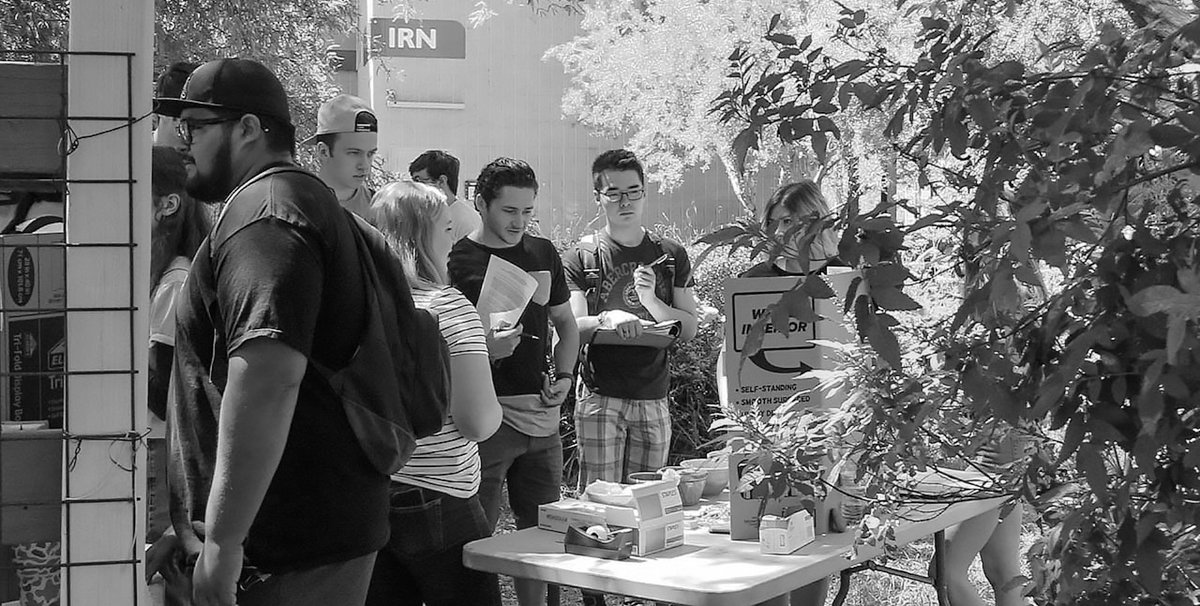
The college's outdoor garden/lab space, called the Environmental Technology Center (ETC) 13 is dedicated to environmental education across disciplines and is the site for Sustainability Day. The redesigned semester-long curriculum culminates in a week of sustainability events that are capped at an annual Sustainability Day held at the ETC in April. These activities combine learning, community outreach, and service with broad and diverse participation, involving students in college-wide engagement.
Sustainability across the Curriculum
The annual Sustainability Week activities inspire students to realize their potential as change agents through service and experiential learning. Extensive dialogue during bimonthly meetings led faculty to create a multipronged effort to impact student learning by incorporating sustainability in the classroom either for a few weeks or an entire semester. Faculty worked with the Office of Student Life, the library, and facilities to create student service-learning opportunities. The project team determined yearly themes such as climate change, water, and renewable energy, and developed the curriculum accordingly. Student Life staff then developed and organized related service-learning activities.
The primary goal was for students to learn to apply interdisciplinary approaches and solutions to the world's social, environmental, and economic problems because “there is a particular need for diverse and rich cross-cultural learning opportunities that simultaneously prepare students for understanding sustainability challenges and build student capacity to develop robust solution options to these challenges.” 9 (p. 19) For colleges interested in sustainability, this case study suggests that the development of year-long HIP activities culminating in a HIP event such as Sustainability Day can create opportunities for cross-college learning and collaboration that benefit all involved, helping to foster communities of learning centered around the issue of our times: sustaining ourselves and future generations socially, economically, and environmentally.
Chronology of Sustainability Day
Sustainability Day—part of Sustainability Week—grew out of student participation in poster sessions on sustainability that were held yearly from 2008 to 2014. Students worked on a semester-long project on various aspects of sustainability, such as climate change, carbon footprint, and biodiversity, and disseminated their findings through both a poster session and informal presentations at a Speaker's Corner. Approximately 400 posters were presented each year with approximately 140 short team presentations.
In fall 2014, the CGCC faculty team revised and revitalized the curriculum, and the poster session evolved into the interactive project-based Sustainability Day. In 2015-2016, the Sustainability Day planning committee chose to develop learning activity stations instead of the poster displays, so fewer sections participated. However, this change helped students to be more actively engaged in creating relevant hands-on learning activities related to sustainability.
Subsequently, the partnership with CGCC's Service-Learning Team took shape and evolved into a large-scale service-learning event. Chandler Traditional Academy (CTA)-Humphrey Elementary was the first to partner with CGCC for this event. The schools have a long history of collaboration as part of their effort to serve the needs of their elementary students and to expose them to college at an early age. Teachers from CTA-Humphrey collaborated with the Service-Learning Team and with Sustainability Day planning faculty to align the third-grade curriculum leading up to Sustainability Day and to plan logistics for the younger students to visit the CGCC campus. Informed by the knowledge gained in their respective classes, the CGCC students developed interactive activities and created a field guide for the third graders.
In 2016, the superintendent of Higley Unified School District (HUSD) heard about Sustainability Day and visited the event, spurring interest in partnering with CGCC to bring their third graders to the next Sustainability Day. The Service-Learning Team and Sustainability Day planning committee collaborated with HUSD to explore options for increasing the number of third graders in the program. In 2017, approximately 90 HUSD third-graders joined the Chandler students for Sustainability Day. Since then, Sustainability Day has evolved and expanded even further, serving 172 elementary school students from the local area (see Table 1). Sustainability Day grew into a week of activities focusing more explicitly on the three pillars of sustainability: social, environmental, and economic (SEE).
CGCC Sustainability Week: By the Numbers
In academic year 2018-2019, faculty and staff revisited the pillars of sustainability and made them even more explicit for college students and children by re-using the theme, SEE Your World. Students designated which pillars their station most addressed and activities were designed for third-graders to make these connections, too. The program continues to grow with new faculty and new disciplinary collaborations, generating yet other HIP practices, including experiential creative projects, among others.
Curriculum
The curriculum is one of the most critical ways to engage students in the interdisciplinary concepts of sustainability.14,15 Faculty across disciplines, including biology, humanities, geology, history, and education, revised their curriculum to embed sustainability. Faculty strived to provide central themes such as climate change, water, renewable energy, plants, and society and related them to issues confronting our world today. Students were then encouraged both to apply the big ideas of the central themes to a specific discipline through experiential learning projects designed, developed, and deployed during a two-semester sequence of the courses and to study interdisciplinary solutions through research and collaboration. The following examples show the incorporation of sustainability across the curriculum.
Sustainability Day, spring, 2019 (Credit for photos: Michael Lucas/CGCC)
HIP: Undergraduate Research Experiences
HIP: Independent research experiences
Faculty worked with the administration to develop several special project courses, enabling the creation of independent student research experiences. The special project courses were developed in various disciplines: sustainability (SSH298AA), biology (BIO298AA), humanities (HUM298AA), and geology (GEO 298AA).
Using principles of convergence education, students from the biology and sustainability courses worked together on specific topics related to mycology. 16 Students researched hügelkultur mounds and African foods/desert permaculture plots, and developed a mycology handbook for biology major classes. After mastering the subject, students had the opportunity to be teaching assistants in the freshman classes of environmental biology and sustainable world.
Humanities students in a special projects course focused on ethnobotany explored how cultures use plants medicinally and culturally. Plants and People was a research-and-presentation style course supporting and developing the campus' commitment to preserve culturally significant plants in the ETC. Course outcomes called for students to collect, cultivate, research, and demonstrate an understanding of human plant use cross-culturally.
HIP: Course-based undergraduate research
In honors biology courses, sustainability was incorporated through thematic topics including climate change, water, renewable energy, and biodiversity, among others. Furthermore, a course-based undergraduate research experience (CURE) with algal biofuels was incorporated into the honors biology course. 17 Students were grouped and assigned as mock scientific advisors to a biofuel startup company and charged with determining the optimal conditions for growing the alga, Chlorella protothecoides. 17 Each group represented a biofuel company and created testable hypotheses. Students designed experiments to test their hypotheses and determine the optimal growing conditions. This CURE enabled students to think and perform experiments like scientists. Using the principles of convergence, students not only learned about the biological and environmental aspects of the algal biofuels, but also about the economic and political facets of the compelling issues of climate change.
Students also developed activities/games related to renewable energy to mentor elementary school students because “today's students need to understand the processes and interdisciplinary nature of science. They also need to appreciate the role of science in society and be able to communicate effectively about science with diverse audiences.” 18 (p. 34) This experience gave the college students service-learning opportunities to mentor third graders and communicate effectively about renewable energy sources.
Design thinking projects
Students from the Sustainable Cities (SSH 111) and the Sustainable World (SUS 110) courses designed and facilitated a sustainable city. The students brainstormed and designed a multisensory water cycle powered by human activity. They also designed a city powered by various forms of renewable energies.
HIP: Service-Learning
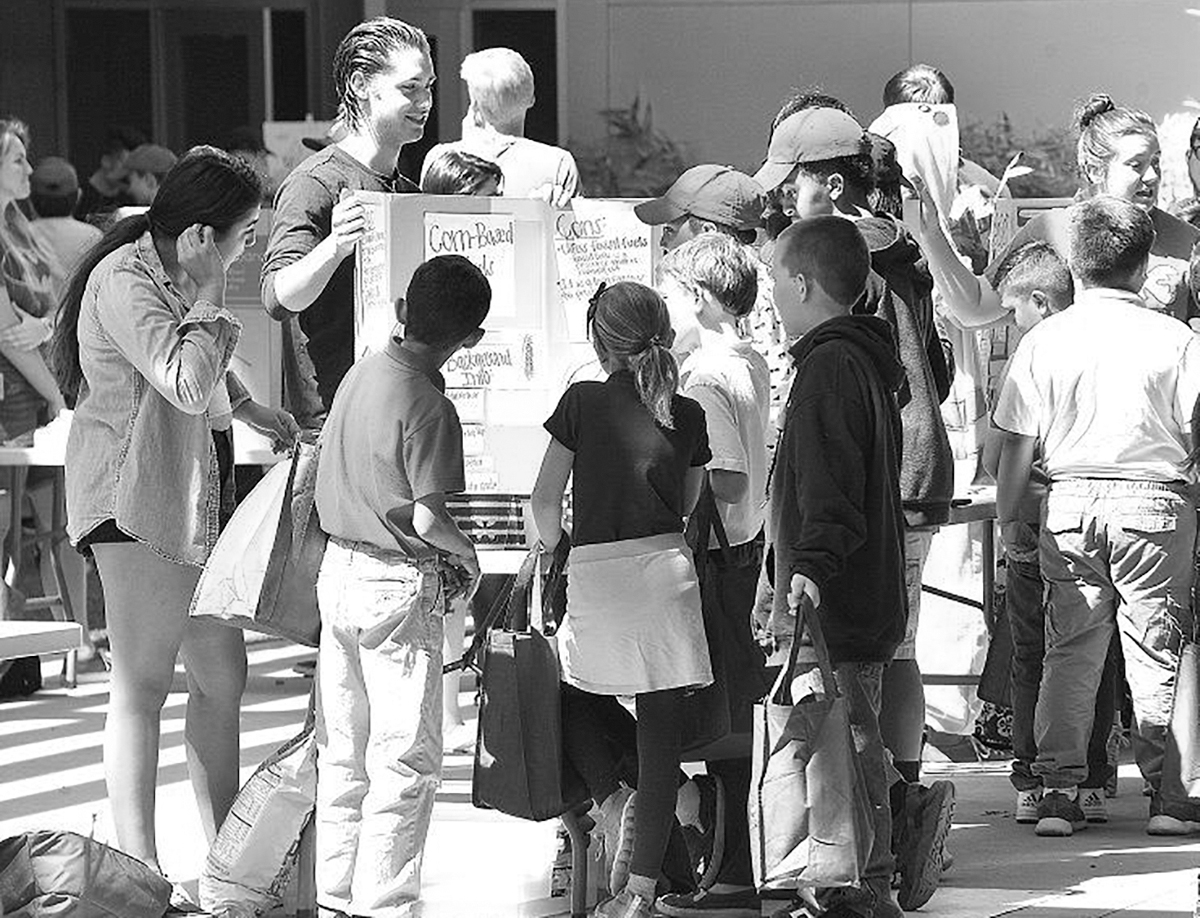
All the sustainability efforts including the special projects, CUREs, and both one and two-semester learning are made visible during a week of sustainability activities in April. These activities combine learning, community outreach, and service with broad and diverse participation. Service-learning, a HIP that combines academic instruction with meaningful service in the larger community, is a two-way street that connects the campus to community. As part of the service-learning program, CGCC students not only develop interactive activities based on their learning in their disciplines, but their learning stations at Sustainability Day must also effectively teach and engage third graders.
Sustainability Day, corn-based interactive activity
The college-wide sustainability week includes the following:
Events during Sustainability Week and Sustainability Day engage the entire campus—divisions, facilities, Enrollment Services—fostering and sustaining institutional partnerships and friendships. Lessons and student-led projects have been showcased during Sustainability Week in April of every year since 2014. In 2017, nearly 400 CGCC students developed 72 interactive stations. The students mentored 170 elementary students from three school districts and 30 faculty/staff were involved in the event. Examples of games/activities include oceans of trash, bottle biology, ethnobotany, germ learn, sustainable structures, renewable energy, clean water, and painting with colors of the wind. Humanities students worked with the third-graders to use a student-built adobe oven, learn about seed saving and seed libraries, and using plant fibers for weaving. Students worked on place-based projects and activities at the ETC to spark a sense of place for the community. Sustainability Week events have included documentary screenings and discussions and gardening workshops for CGCC students and staff. Some films that have been shown are Seeds of Time
19
and Peyote to LSD: Doorway to the Gods.
20
A field guide for elementary school students was created with fun educational activities on sustainability. Each third grader was gifted an eco-bag, a field guide, and a small cactus.
Sustainability Day, ironwood activity
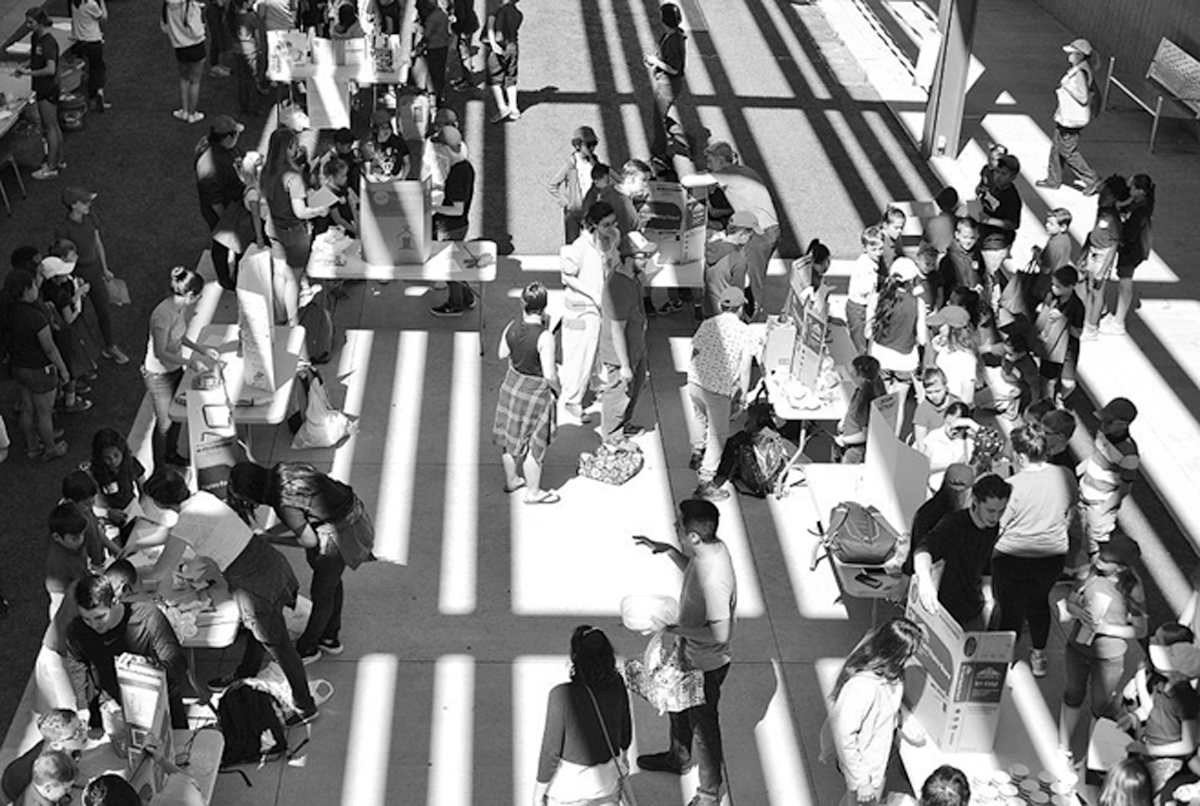
The CGCC program supports students and college-wide engagement as well as learning. The power of convergence education, combined with the power of a large-scale annual service-learning event, shows the possibilities for deep learning and collaboration across the college and the community, engaging everyone.
Evolution of Sustainability Day
Notable connections and innovations were fostered by the significant outgrowth of Sustainability Day and the revitalization of the sustainability program. For example, CGCC's Food Waste Recycling Project, which won national acclaim through AASHE in fall 2019, 21 grew out of the participation of adjunct and full-time faculty members meeting and then applying for an internal institutional grant for funding. This project involved the collaboration of faculty from engineering, biology, library, and English. In the future, business and economics faculty are planning to participate in the project. Theater arts faculty and students will also be involved in raising awareness about food waste recycling through a video production. Furthermore, Sustainability Day, now well established, continues to draw in new disciplines and faculty. Arts faculty will be involved in designing activities, creating new connections through HIPs that not only impact students, but also impact faculty by inspiring collaboration and creativity.
Sustainability Day, microscope activity
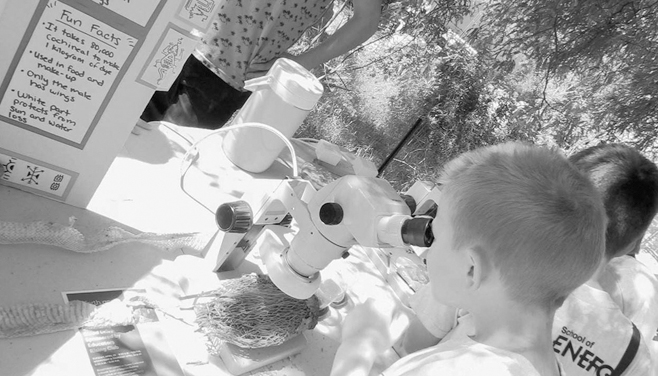
The evolution of this event as a high-impact service-learning project thus points to a web of curricular connections that continues to grow in positive ways to address our future. The creation of an archive of activities and assignments as well as the insights/best practices of previous sustainability events and participants is being developed. In the future, the faculty team plan to continue focusing on the SEE Your World theme and systematically gathering assessment data to inform deeper teaching and learning.
Conclusions and Recommendations
The CGCC Sustainability Team collaborates with like-minded individuals across the campus and the community to design and implement an exemplary program for student learning and success. Students are exposed to convergence education that combines the scientific, ecological, cultural, and historical aspects of sustainability. This event and year-long learning connects staff from academic and occupational disciplines, administrative divisions, operational support areas, and student life working together for a sustainable future for everyone. Through these myriad year-long activities, students acquire real-world interdisciplinary knowledge and problem-solving skills. Students in varied disciplines of biology, sustainability, and humanities develop a heightened sense of global interconnectivity and interdependence by connecting local actions to global change.
Some recommendations for colleges and universities interested in replicating this project are as follows:
Develop strong partnerships between faculty and administrators to ensure seamless development of new courses and certificates in sustainability.
Identify various programs and committees around campus that can be leveraged to build a sustainability program. A strong partnership with the office of student life and the civic engagement committee is critical for success.
Invite stakeholders from different sections of the campus to participate in the sustainability project to make the project robust.
Build and cultivate partnerships with stakeholders from the community, government agencies, nonprofit organizations, and K-12 institutions.
Identify a multidisciplinary theme for the service-learning project each year that revolves around a compelling societal problem so that faculty and other stakeholders can come together with students to solve the issue.
For a sustainability project to be truly successful, the passion of a grassroots effort from faculty and the support of the administration are paramount. A key event, such as Sustainability Day, can start small, yet evolve over time and generate further collaborations for sustainability and sustainability learning.
Learning occurs through teaching others: the redesign of curriculum, combined with the development of a major event to make learning visible through teaching, has inspired college students to become change agents. Students who participated in Sustainability Day in a previous year returned after graduation to lead workshops on best practices for Southwest desert gardening, permaculture, mycelium benefits, gardening and emotional healing, and water filtration modeling, and to teach about native plants and their uses by local Native American tribes. Others served as consultants for local schools interested in establishing school gardens. Such projects can inform, entertain, and inspire younger students. Service-learning, convergence education, and cross-campus collaboration provide opportunities to not only develop critical interpersonal skills and professional competencies for students' future endeavors, but also to address climate challenges. Our best hope for a sustainable future lies in sustaining and inspiring the current generation and community.
Footnotes
Acknowledgment
It takes a village to develop and implement a sustainability program. We would like to acknowledge and thank all the CGCC faculty participating in the sustainability program as well as the Offices of the President and Student Life, Academic Affairs, the Environmental Technology Center, and Administrative Services who provided key support. We thank all the third-grade teachers, their students, and ours for participating in the event. Thanks also to Boyce Thompson Institute for Plant Research at Cornell University for the course-based undergraduate research project on algal biofuels.
Author Disclosure Statement
No competing financial interests exist.