







Abstract
Tissue engineering (TE) is a scientific field that will have an influence on our daily lives. It has the potential to revolutionize medical treatments, but it has also an impact on our human image and is associated with potential risks and ethical aspects. Among the publicly controversial issues are embryonic and induced pluripotent stem cells, cloning, uncertainties regarding risks and informed consent issues. To maintain public confidence in the science of TE, a good solution is public dialogues with patients and other interested lay people that gives the public the chance to independently evaluate TE issues and build their own opinion based on information from different perspectives. The article describes public participation projects in TE on stem cell research and gene therapy and presents the case study of the EU-Gene Activated Matrices for Bone and Cartilage Regeneration on Arthritis (GAMBA) panels, a dialogue with patient and citizen panels in three European countries. In the GAMBA panels, lay participants assessed the basic research project aimed at finding ways of healing osteoarthritis through a matrix composed of adult stem cells, gene vectors, nanoparticles, and biomaterials. The results of the dialogues in different countries, such as Denmark, Japan, Ireland, Switzerland, and Germany, are compared and the evaluation criteria for high quality dialogues are presented, including multiperspectivity, openness of results, a clear mandate, impartial facilitation of the panels, and transparency.
Introduction
T
On the long run, a broad societal acceptance of an innovative research field like TE and therapies evolving from it is a key factor for further development and funding. However, in the past years, the public has become more skeptical about the benefits of science and technology to society. More than half of the people (at least in Europe) disapprove the statement that “Science and Technology can sort out any problem” (57% disapproval, 22% approval, 19% “neither agree nor disagree”)5(pp.40–41); more positive, about half of the people are convinced that “Science and Technology are making our lives healthier” (52% approval, 19% disapproval, 26% “neither agree nor disagree”),5(p.35) but acceptance is declining.5(p.33)
Public debates and the opinions of lay people have an increased influence on scientific progress. The communication between lay people and scientists—including intermediate actors such as the media and decision makers—is a new challenge, especially for the life sciences. Build on the democratic idea(l) that important societal developments should be broadly discussed within the society and need the approval of at least a majority (better: most) of the respective societal members, lay people should have a stake in deciding which developments they want or not. This also applies to science and especially to the life sciences, which challenge our (common) understanding of and our societal dealings with life, health/illness, and death. Another reason for engaging with the public is the uncertainty under which many decisions in research and research policy have to be made: “In such cases decisions may be based to a significant extent upon the values of the involved experts, which, in themselves, have no greater inherent validity than those held by lay publics.”6(p.332) Therefore, including societal values and judgments increases the credibility and the legitimacy of scientific decisions. We need a scientific citizenship, described by U. Felt as a new form of “scientific democracy,” where citizens are not convinced or tamed by scientists, but get a voice in negotiations at the eye level with scientists about scientific issues 6 ; (for a critical appraisal of public participation exercises, see Refs.7,8).
As TE is an emerging field, there is a chance—and also the need—to discuss its opportunities, potential risks, and associated ethical aspects with a wider public, including future patients. In this article, experiences with dialogues in the TE field are outlined by presenting the case study of Gene Activated Matrices for Bone and Cartilage Regeneration on Arthritis (GAMBA), c an in-depth dialogue with patients and lay citizens as part of a basic EU research project. In addition, a few public participation approaches like the United Kingdom stem cell dialogue and consensus conferences (CCs) on TE are shortly presented and their results compared, showing how dialogue with lay people can be frugal for science and society.
This article is written from a practitioner's perspective, therefore, theoretical science and technology study insights on public participation and engagement are limited to a few references and the quality criteria.
GAMBA: Patients and Citizens Assess Stem Cell and Gene Therapy Basic Research
In the EU project GAMBA (2010–2013), scientists from six EU countries are searching for novel therapeutic approaches for osteoarthritis (OA), which will hopefully trigger an endogenous healing process. 9
Gene vectors can transport specific therapeutic genes into the body's own stem cells, which lead to the production of certain proteins. These proteins are the therapeutic agents. During the experimental stages, GAMBA aims to identify a combination of the following healing processes: to stop inflammation, to heal the cartilage, and to heal the bones. With the chosen proteins (anti-inflammatory protein IL-10, cartilage, and bone proteins TGF-ß/BMP-2), the GAMBA scientists want to demonstrate the effectiveness of several different control mechanisms. To that effect, they examine various combinations of matrices with stem cells and gene vectors with respective trigger systems.
Lay Panels
To assess the GAMBA project from a societal point of view, so-called lay panels with patients and citizens in three partner countries were carried out as a separate, independent component of the project. Five panels with altogether 71 participants aged between 19 and 82 d in Munich/Germany, Galway/Ireland, and Zollikerberg near Zurich/Switzerland developed a joint statement and recommendations on GAMBA between May 2011 and July 2012 on two weekends with an interval of 3 weeks. The methodology of the lay panel uses elements of the established public participation methods, “citizen jury” and “consensus conference”; panels are facilitated by professional, impartial facilitation experts. Of utmost importance is the multiperspective expert input (see quality criteria below).
The lay panels are a type of microcosm, reflecting a smaller image of social reality. The whole groups' assessment, and not—as in a survey—the sum of the uninformed individuals' opinions, is leading to the results that are based on intensive discussions and negotiations.
Objective and Proceedings of the Lay Panels
In the lay dialogue, participants were asked to assess the GAMBA field of research from their various perspectives as patients or interested citizens. To prepare them for this, they first got an introduction to GAMBA: before the panels, participants received two brochures (Manual and Compendium) written in layman's terms by science journalist Beatrice Lugger in collaboration with the project team, who had analyzed more than 700 scientific and lay publications. In the panels, participants listened to presentations (on OA, the GAMBA project approach, possible risks, and the ethical aspects of gene and stem cell therapies) and questioned the presenters. They also selected 3–5 experts from a list of 10–12 with different backgrounds for a hearing. e In addition, some of them extended their knowledge of ethical and social aspects through so-called ambassadorships and reported back to the panel (Fig. 1). Equipped with all this information, participants discussed the opportunities, possible risks, and ethical aspects of GAMBA in-depth in nonfacilitated breakout groups with four to six rotating members to ensure maximum mixture of opinions, and in the facilitated plenary, and drew up their recommendations on GAMBA (Fig. 2).
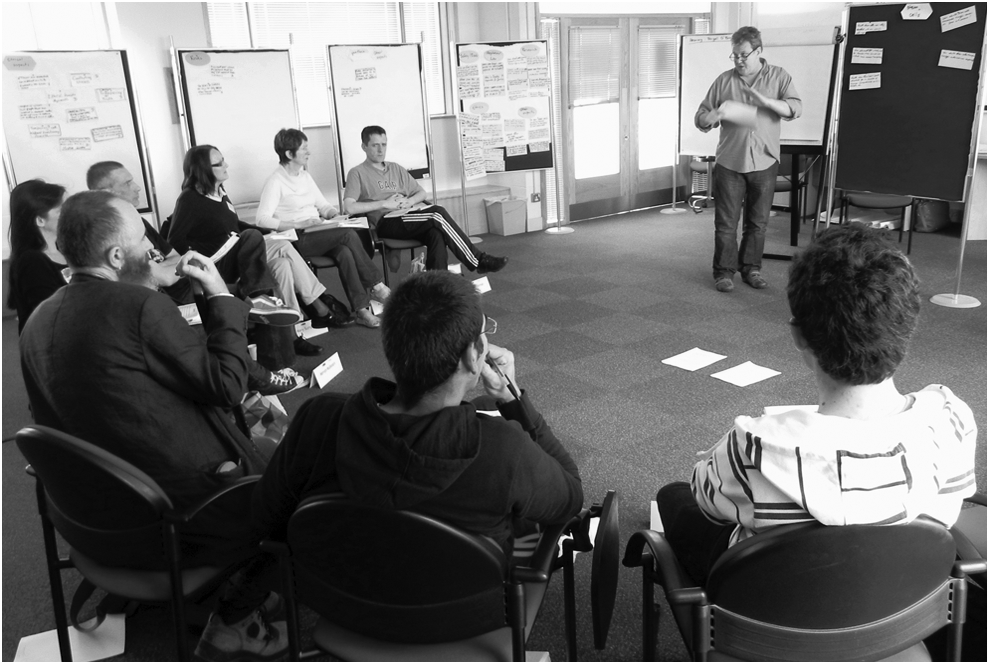
Irish Panel Member presents his ambassadorship findings to his fellow panelists.
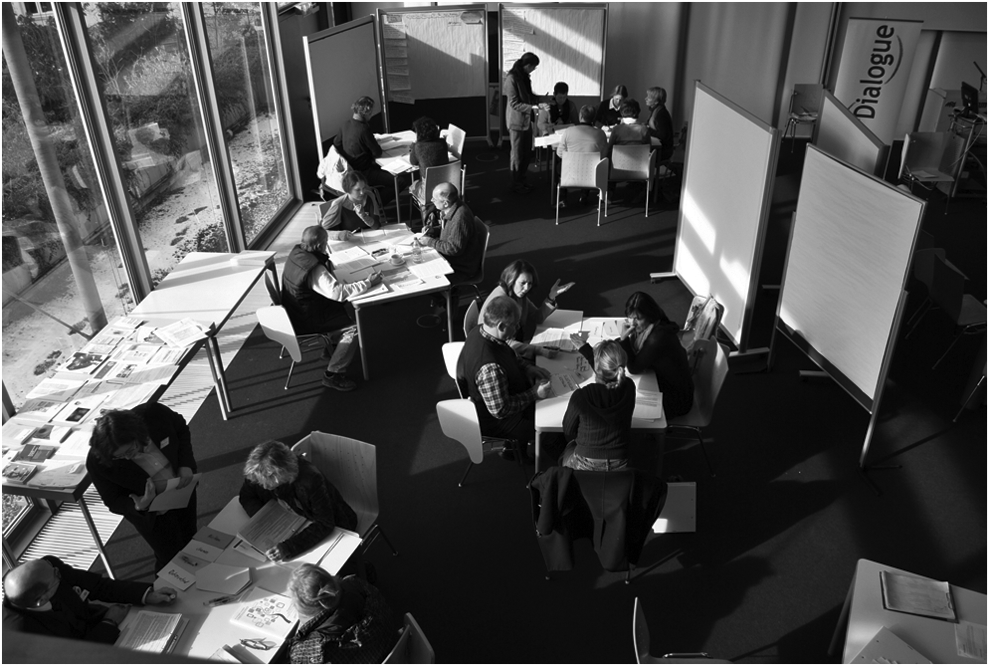
Members of the German citizen panel negotiate on recommendations in breakout groups.
Comparison Between the Patient and the Lay Panels
The recommendations of patients and lay citizens are quite similar in most cases; for example, it was important for both groups to include the social and economic context. On the other hand, every panel had its own focal points.
• Patient panels focus more on specific improvements such as a better understanding of underlying OA mechanisms or the hope that a GAMBA therapy would free patients from lifelong drug use.
• Ethical aspects, like informed consent, data protection, or the use of OA animals in preclinic, were also focused on more in the patient panels. The citizen panels were discussing more fundamental issues such as the human image of TE sciences or enhancement.
• As regard risks, patients evaluated in more detail the personal risks of the patient, whereas citizens emphasized more the societal consequences (i.e., effects on third parties and the environment) or epigenetic influences on health.
As a consequence, it is recommended to have not only patients participate, but also interested lay persons, as both groups set priorities from their specific points of view. Resulting from these views, conceptual deficits are laid open, credibility crises can be better foreseen, and targeted information can be designed. In addition, the panels raise the scientific citizenship of those interested.
Evaluation of the GAMBA Panels from a Participants' Perspective
All participants besides one (n=70) filled in an evaluation questionnaire at the end of the panels. All members judge the panels as meaningful and educational (see Fig. 3); 98% found them fair, an important precondition for a credible dialogue. Just less than three quarters believe the panels to be “a serious attempt of active participation”; however, 19% of participants had doubts regarding codetermination what might be due to the weak mandate of the panels toward research politics (addressees of the lay report are mainly the GAMBA scientists and the scientific community). Altogether, four out of five participants thought that the panels were “appropriate for the problem.”
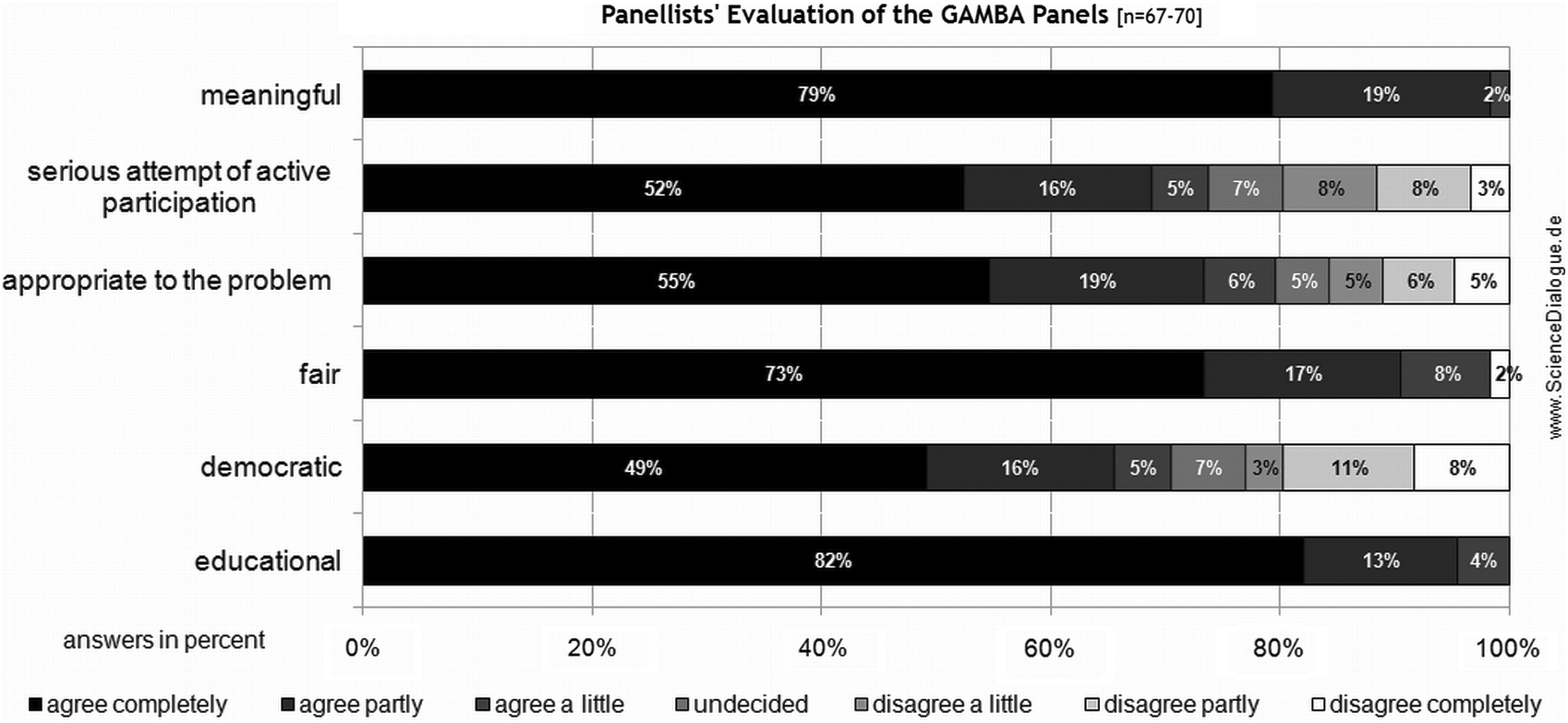
Panelists' evaluation of the Gene Activated Matrices for Bone and Cartilage Regeneration on Arthritis (GAMBA) panels.
Lessons Learned from the GAMBA Dialogue
Lay people are well capable of dealing with complicated and complex scientific issues such as gene and cell therapies; with good support, their interest and motivation leads to a qualified understanding of the main facts so they can assess the subject based on their values and personal experiences.
The lay recommendations are of high quality and embed the research into the societal environment when asking—among many other things—about alternatives, risks, societal consequences, informed consent to research and therapy, justice of access to treatments, and transparent research outcomes, including publication of failures and negative results.
The lay people follow mainly the lines of the information material (Manual, Compendium) and the information presented by the experts, f but set their own priorities and investigate the subject on their own if the experts do not have sufficient answers or are not available any more.
The researchers who participated in the panels all state that they benefitted from the interaction with the patients and citizens as they now have a clearer, personal view of the needs and concerns of the potential end user of their research. The material produced (i.e., Manual and Compendium and the lay report) can be used for teaching and public communication by the whole GAMBA consortium and other scientists.
The recommendations of the GAMBA panels were directed mainly to the researchers. At the final public event in Germany, chairpersons of the German stem cell and gene therapy societies and the leader of the Munich gene center at the university were present and valued the lay report. More dissemination of the results among scientists' associations and research politics in the European Union, Germany, Ireland, and Switzerland (the GAMBA panel countries) is planned. Nevertheless, it would be ideal in a future project, to have a representative from research politics as an explicit addressee of the lay recommendations, who values the results and justifies what can be implemented and what not.
Other Examples of Citizen Participation in TE Areas
There are a couple of public participation initiatives in the area of TE, where lay people are engaging with science g ; stem cell research was the main subject, but also gene therapy was an issue:
United Kingdom Research Council's Public Dialogues
The United Kingdom Research Councils are publicly funded agencies responsible for coordinating and funding diverse areas of research. In their view, public engagement of science provides “substantial benefits to the researchers involved in engaging the public, as well as providing a major contribution to society. Engaging the public can also improve the quality of research and its impact, by widening research horizons.” 10
The Research Councils held a couple of public dialogues, including one on synthetic biology 11 and one on stem cell research in 2008. 2 The stem cell dialogue comprised a stakeholder workshop, a public survey, and three lay workshops (with around 40 participants in each workshop group) in the five British regions. A slight majority of participants were women (106 from 200); there are no data on the participant's age. Workshop 1 introduced stem cell research and explored general aspirations and concerns for the science and clinical treatments. Workshop 2 looked in-depth at the social and ethical issues related to the sources of stem cells. Workshop 3 focused on future applications of stem cells and the wider social implications of stem cell banks, therapies, and clinical trials. The project has been evaluated independently. 12
German Citizen's Conference on Stem Cell Research
The Max Delbrück Center for Molecular Medicine, Germany, organized a citizen's conference on stem cell research in 2003/2004 with 12 citizens between 18 and 63 years (randomly selected) producing a citizen's vote in a facilitated series of three workshops using the CC method. Participants listened to expert presentations on the scientific basics of stem cell research and on ethical aspects, performed a public hearing with 13 self-selected experts (from a list of 50), compiled their vote on the subject and presented it at a public press conference to the President of the German parliament. The group discussed mainly the use of embryonic stem cells and the potentials and risks associated with stem cell therapies. One main recommendation is to prefer adult stem cells over embryonic stem cells because of reduced risks and no moral concerns. 13
In addition, two CCs h were organized on gene therapy in Denmark 1995 15 and Japan 1998, 16 which are cited here for reference and comparison with the GAMBA panels (see below).
Similarities Between the Stem Cell Dialogue Results in the Different Countries2,9,13
There are many similarities between the three dialogues (UK stem cell dialogue, German Citizen's Conference, GAMBA panels).
• Panels see high potentials regarding stem cells; all participants emphasize a moral obligation to pursue the research with the goal of treating serious diseases, where there are no other reasonable therapy options.
• All panels see considerable advantages in using the findings from stem cell research for the understanding of disease causes and mechanisms as well as cancer development.
• All panels see considerable risks, for example, in cancer development, tissue rejection, or infections.
• All panels state that transparency is unsatisfactory because the scientific system makes it difficult for researchers to voice concerns over risks 2 or to publish failures and negative results. 9 “Open discussion around uncertainties…(is) fundamental for trust.”2(p.viii)
• The majority of participants prefer adult stem cells over embryonic cells for ethical and risk reasons (higher cancer risk); All panels warn that scientists do not give premature promises of cures.
• Participants see the danger of neglecting alternative treatments because funding for stem cell research “may divert resources from other areas of medical research investment.” 2 German speaking panels are keen not to neglect complementary medicine and lifestyle issues.
• Adequate regulation is of high importance to all panels; the lack of an international regulatory framework is criticized.
• All panels emphasize the importance of true informed consent, where risks are fully explained (with neutral counseling 9 ) and equal access to treatments (no therapies only for the rich).
• It is important for participants that therapies reflect public rather than commercial interests.
• All panels demand that “science be responsive to public concerns” and that the “everyday practice and discussion of science is mindful of societal views.” 2
Differences Between the Three Dialogues Are
• The United Kingdom participants seem to be more in favor of research with embryonic cells, while the German GAMBA citizen panel prefers the use of adult stem cells as “medically and ethically more acceptable as compared to embryonic stem cells.”9(p.33), i The German citizen's conference states that “if embryos do not have a chance of accomplishing their development (because they are left over from IVF), it is not justifiable not to use them for research.”13(p.147) On the other hand, this panel and a significant number of United Kingdom panelists are against the pure fabrication of embryos for research purposes.
• Despite excitement of its potentials, the United Kingdom panels voice concerns over the safety of iPSCs; as an alternative, they recommend the use of cord blood as a source of stem cells.
• For the United Kingdom panels, the raising of funds through charities and to attract venture capital is important.
• The United Kingdom panels highlight “wealth opportunities” 12 through stem cell research; German GAMBA panels emphasize the creation of jobs. 9
Similarities Between the Gene Therapy Dialogue Results in the Different Countries9,15,16
It is not easy to compare the two CCs held in the 1990s to the GAMBA panels held in 2011/2012 because science has progressed in the meantime. j On the other hand, there are still very few gene therapy products on the market, although many more clinical trials have been performed in the last 15 years. Hence, it is interesting to see that even the actual GAMBA panels still talk about the promises of gene therapy. Whereas science has made progress, some more risks have been brought up and the ethical issues are about the same.
Further similarities:
• All panels see gene therapy as being worth to be researched, so that one day it might be an additional opportunity for healing from which suffering people should not be deprived.
• All panels see considerable risks associated with gene therapy such as the development of cancer as a consequence of the therapeutic gene being inserted at an unfavorable location, an overreaction of the immune system, and the risk of an impact on germ cells. In addition, all panels state that many potential side effects are still insecure or unknown.
• All panels raise ethical questions such as the fear that gene therapy research might open the door of manipulating germ cells or be misused for enhancement; other ethical issues are similar to the ones voiced by the stem cell panels.
Quality Criteria
To ensure that dialogues are not misused as techniques with the “appearance of involvement…and little genuine interest in implementing any recommendation” (Rowe/Frewer 2000 17 ), therefore not instrumentalizing participants in approving predefined results, it is necessary to use criteria to measure the quality of a dialogue. A high quality dialogue must fulfill the following quality criteria k :
•
•
•
•
•
Final Remarks
Engaging in high quality dialogue with lay people has the following advantages for scientists.
• Interest in research is created and/or augmented;
• Dialogue increases mutual understanding between scientists and lay people;
• Potential end users give qualified feedback in a benevolent, factual environment and serve as an early warning system for credibility crises;
• Open discussions about risks and ethical aspects besides opportunities increase credibility; research is embedded in the societal environment and can therefore include societal expectations and the need for communication at an early stage.
Lay people are generating differentiated and balanced assessments of opportunities and risks in high quality science dialogues, if the above-mentioned quality criteria are adhered to. Participants are usually ready to accept certain risks if these are taken into account in a serious way, well pondered against the opportunities and if risk research is adequately funded. In addition, lay panelists expect that researchers themselves grapple with sociopolitical and ethical aspects of their research and do not delegate their responsibility. If these aspects are taken into account, science and society will both benefit from the dialogues.
Footnotes
Acknowledgments
Thanks to Maren Schuepphaus and Sven Siebert for contributions to this article and to the anonymous reviewers for their constructive comments.
Disclosure Statement
No competing financial interests exist.