







Abstract
Introduction:
The COVID-19 pandemic has led to considerable changes in the health care system. Experts suggested that individuals protect themselves through social isolation during the pandemic, and consequently, the importance of telemedicine came to be understood for patients with chronic diseases. Telemedicine started to be used in developing countries where the appropriate infrastructure was lacking earlier. The present study investigates the level of satisfaction of patients with inherited metabolic disorders (IMDs) with telemedicine.
Methods:
This prospective study was conducted by making use of a new video appointment program that ensures the privacy of the patients in video-based consultations. The sociodemographic characteristics of the patients, their clinical status, their views on the telemedicine system, and their levels of satisfaction were questioned.
Results:
Overall, 174 patients were included in the study. The most common diagnoses were aminoacidopathies, lipid metabolism disorders, biotinidase deficiency, and lysosomal/peroxisomal diseases. More than half of the parents (67.6%) who lived in another city reported accommodation issues when coming to the hospital, and most believed telemedicine would save them time (93.1%) and money for travel (81.6%). The lack of laboratory and radiological tests (83.9%) was stated as the main disadvantage by most parents. Almost all the parents (96.6%) stated that they would opt for telemedicine if it became available in daily practice. The overall satisfaction rate was 94.6 (±10.1)/100.
Conclusions:
The present research is the most extensive cohort study to date assessing telemedicine in patients with IMDs and it highlights the importance of telemedicine, especially in developing countries during the COVID-19 pandemic.
Introduction
The COVID-19 pandemic has affected the whole world, and it has led to many changes in society, the economy, and the health care system. Experts recommend that individuals isolate themselves at home as much as possible. 1 Telemedicine systems have come to play a crucial role in reducing human contact when accessing health services. 2,3
Telemedicine has witnessed an unprecedented upward trend since the announcement of the pandemic. 4,5 In addition, with the announcement of curfews by governments, it has been recommended that health services be accessed from home all over the world. 6 People have become more familiar with technology and Internet applications as a result of the pandemic, and this has been reflected positively in telemedicine applications. 5
Individuals with chronic conditions who rely on continuous health care faced difficulties in accessing health care during the pandemic. 7 Inherited metabolic disorders (IMDs), which fall into this group, require regular follow-up if a clinical worsening of the condition is to be avoided. Disruptions in the follow-up and treatment of patients with IMDs can lead to cognitive impairment, coma, and even death, and so such patients need to be in regular communication with their doctors. Telemedicine has emerged as a potential solution to the problem of health care access for patients with IMDs in the ongoing COVID-19 pandemic. 8
Since many developing countries lack sufficient telemedicine infrastructure, it is crucial to identify the components that determine patient–parent satisfaction to improve the provision of health care services. 9,10 Accordingly, the needs of patients with IMDs, the parents' expectations, and the limitations of families are required to be understood. 9 –12
Telemedicine is not a routine application of the health system in Turkey. As in the whole world, interest in telemedicine has increased in Turkey during the COVID-19 pandemic. Studies on telemedicine usability and patients' satisfaction in Turkey show that telemedicine is highly needed in daily practice in our country. It can be a safe and low-cost alternative to eliminate the grievances of chronic pediatric patients in our country. 13
In the present study, we evaluate the effectiveness of telemedicine for those with IMDs during the COVID-19 pandemic.
Methods
PATIENT COHORT AND DATA EXTRACTION
This prospective study was conducted by making use of a new video appointment program, designed by the Department of Computer Engineering, Ankara University Engineering Faculty with the privacy and confidentiality of the patients and parents in mind. The program allowed video appointments to be conducted by involving the patient and the doctor.
An account was created by the doctors, and appointment dates were set for the patients who agreed to participate. Information on how to connect to the system was provided to the patients/parents by the doctors by phone. At the date and time of the appointment, each patient entered their unique ID number and password. The doctors offered guidance when the parents encountered problems.
The parents of 212 of the patients being followed up by the Pediatric Metabolism Department were called by phone and invited to take part in a video appointment, among whom 11 declined to participate due to their unfamiliarity with the system, their concerns over safety, and their inability to spare the time for an appointment. Of the total, 174 of the parents (86.5%) were able to successfully connect to the system and took part in a video appointment. Of the remainder, 13 parents reported that they could not attend due to Internet problems and 14 parents had computer/mobile phone problems (Fig. 1). The consent of those who were able to connect successfully to the system and who participated was obtained electronically through the system.
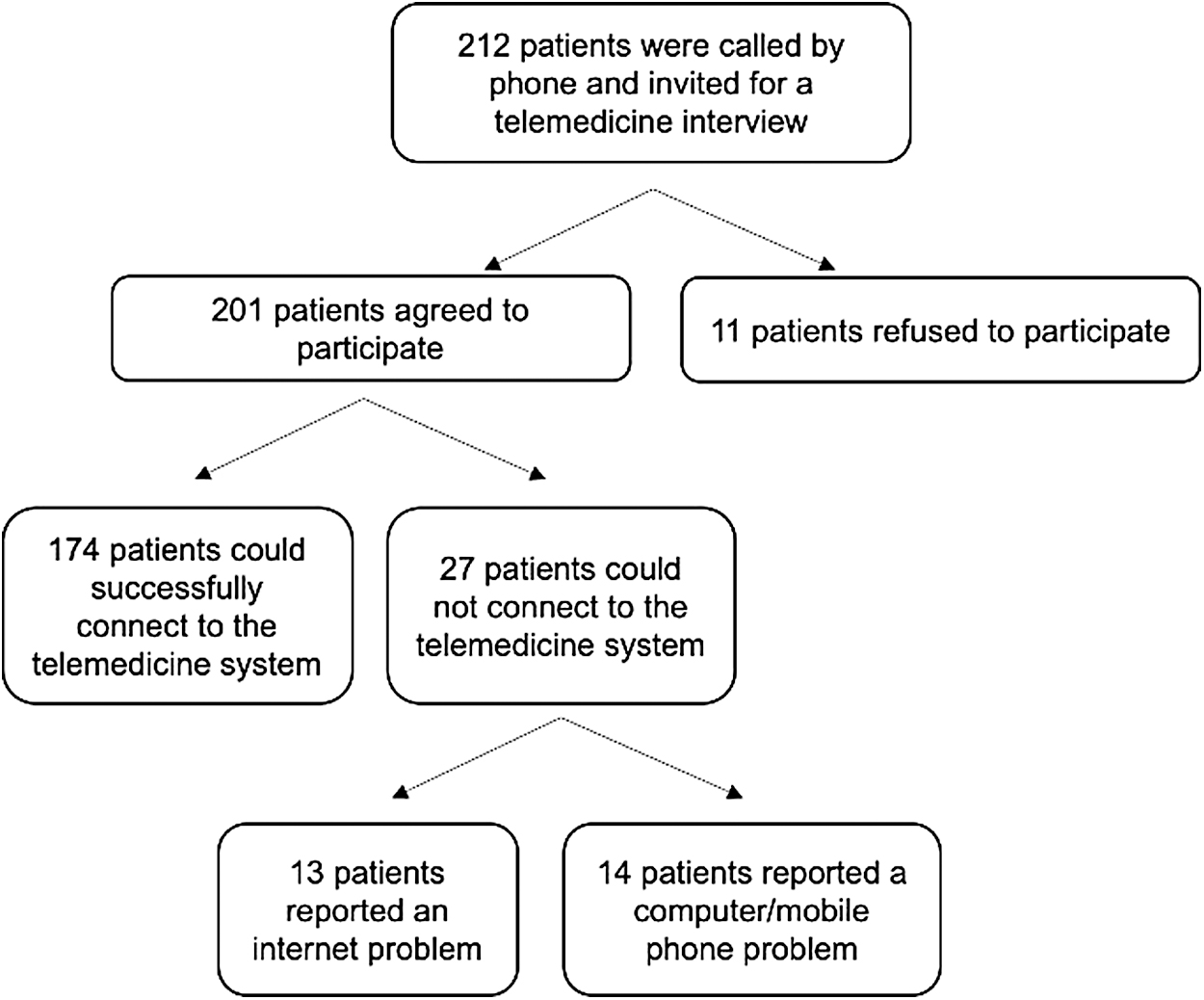
Study flow chart.
Before the video appointments, the clinical files of the patient were evaluated by the doctor, who discussed the patients' complaints, medications, diet, and last laboratory results with the family during the appointments. Any clinically stable patients who reported acute complaints were referred to the pediatric emergency department by the doctor. At the end of the video appointments, the sociodemographic characteristics of the patients, their clinical situations, their views on the telemedicine system, and their satisfaction levels were questioned. Participants filled out the questionnaires themselves through the technological interface online, and they recorded them before exiting the system.
Approval for the development and use of the program was obtained from the Ankara University Ethics Committee, and it was made ready for use through trial appointments (Ethics committee code i5-270-20). The research was conducted under the ethical and humane principles of the study established by the Declaration of Helsinki.
STATISTICAL ANALYSIS
Data were recorded with IBM SPSS Statistics for Macintosh (Version 27.0; IBM Corp., Armonk, NY). Continuous variables were presented as median (25th–75th percentiles) or mean with standard deviation, whereas categorical variables were presented as percentages.
Results
SOCIODEMOGRAPHIC CHARACTERISTICS
Overall, 174 patients were included in the study, among whom 84 (48.3%) were female and 90 (51.7%) were male. The median age of the patients was 6.3 years (25th–75th percentile: 3.0–10.7). The median age of the parents participating in the appointment was 36 years (25th–75th percentile: 31–40). The participants reported their education levels as 33.3% high school, 20.7% middle school, and 18.4% elementary school. Of the parents, 104 (59.8%) said that they were unemployed (Table 1), 27 reported an income less than 210.00 United States Dollars (USD) (hunger threshold), 152 parents reported an income less than 625.00 USD (poverty threshold), and 10 reported no income.
Sociodemographic Characteristics
USD, United States Dollar.
Of the total, 109 of the participants (62.6%) lived in Ankara, where the hospital is located. Of those, 68 (62.3%) reported arriving at the hospital by private car/taxi and 35 (32%) by public transport; 62 (56.8%) reported taking more than 30 min to get to the hospital. Of the 65 participants living outside Ankara, 61 (93.8%) reported that their journey had taken longer than 3 h; 49.2% reported travel expenses amounting to 100.00 USD or more, Of them, 43 (66.1%) reported staying at a hotel/pension, and 22 (33.8%) at a friends' or relatives' house; 39 (60%) reported spending 50.00 USD or more on accommodation; and 44 (67.9%) stated that they had difficulty in finding accommodation. The mothers or fathers of 119 patients said that they had taken time off work to go to the hospital, among whom 83 (69.6%) stated that they had difficulty in taking time off work. Further, of the 68 who could not attend the regular outpatient clinic controls, 50 percent gave the reason as travel issues, 45.6% COVID-19 anxiety, and 38.1% financial issues (Table 1).
CLINICAL FEATURES
Of the 174 patients included in the study, aminoacidopathies were the most common disorders (24.7%), followed by lipid metabolism disorders, biotinidase deficiency, and lysosomal/peroxisomal diseases, with rates of 21.8%, 19.5%, and 7.5%, respectively (Table 2).
Clinical Features of Patients
The participants reported being followed by the pediatric metabolism department for an average of 3 years (25th–75th percentile: 1.5–5.1), 126 (72.4%) reported receiving oral medication, 82 (47.1%) underwent diet therapy, and seven (4%) received enzyme replacement therapy (ERT) at the hospital. Of the total, 144 participants (82.7%) said they came to the hospital for doctor's follow-up, 82.2% for laboratory tests, 33.9% for dietitian follow-up, and 62% for prescription/health reports at less than 6-month intervals. Further, 73 (48.3%) of the 151 participants who received treatment reported motivation problems related to the treatment as the reason for not regularly attending the outpatient clinic controls (Table 2).
FEATURES OF VIDEO APPOINTMENTS
During the telemedicine, 137 of the participants (78.7%) used mobile phones, and 116 participants (66.7%) used their home Wi-Fi. When asked about the specific advantages of telemedicine, the most common response was time saving (93.1%), followed by journey elimination (86.8%) and elimination of travel expenses (81.6%). The most commonly reported disadvantages were the lack of access to radiological and laboratory tests (83.9%), and the lack of any physical examination (70.7%).
The participants stated that in the future they could use telemedicine to learn radiological and laboratory results (94.8%), to obtain prescription/health reports (76.4%) and to reach the doctor in case of an emergency (62.6%). Of the total, 170 (97.7%) participants stated that they found telemedicine to be useful, three were not entirely sure about the benefit, 168 (96.6%) said that they would prefer telemedicine in the future, and 157 found it more convenient to meet via video (Table 3).
Patients' Answers to Questions About Telemedicine
Wi-Fi, wireless fidelity.
TELEMEDICINE SATISFACTION ASSESSMENT
The participants were questioned about their satisfaction with the telemedicine system from two perspectives, being its technical and health services aspects, scoring each response in a range from 1: very bad to 5: very good. The scores of each question are presented in sub-headings. The mean telemedicine satisfaction point given by parents in terms of technical and health care was 94.6 ± 10.1 out of 100. Satisfaction survey questions and the answers are presented in Table 4.
Satisfaction Survey Questions
1: very bad/2: bad/3: average/4: good/5: very good.
SD, standard deviation.
Discussion
In recent years, telemedicine electronic communication providers have been included within the scope of health service provision as an essential tool, and so the advantages and disadvantages of telemedicine have become a crucial area of study. 14 The present study reveals the pros and cons of telemedicine in the clinical follow-up of IMDs. To the best of our knowledge, the present study evaluates the effectiveness of telemedicine in the highest number of IMDs patients to date during the COVID-19 pandemic.
Despite the lack of a telemedicine infrastructure in our country, the parents interviewed within the scope of the research reported a very high level of satisfaction. Almost all participants found it “useful” and stated that they would like to use it in the future. The most common diagnoses in the participants were aminoacidopathies, lipid metabolism disorders, biotinidase deficiency, and lysosomal/peroxisomal diseases, for which follow-up via telemedicine was generally considered appropriate. Around three-quarters of the patients were on oral medication, and half were undergoing diet therapy. The parents stated that the ability to have the doctor following up on medication and diet therapies via telemedicine increased their motivation and reduced unnecessary hospital admissions.
Telemedicine has been shown to be more beneficial in developing countries than developed countries and it contributes to meeting unmet needs and improving health services in countries where the provision of health services is inadequate. 15,16 In addition, the diagnosis, treatment, and follow-up of low-income patients with lower costs increase the quality of health services in developing countries. 17,18 In the present study, 87.4% of the parents reported an income below the poverty threshold, and 38.1% of those who were not regularly followed up reported that they were unable to attend the outpatient clinic due to financial issues. It can be predicted that telemedicine will become much more helpful for low-income families.
Most doctors specializing in IMDs work in central city hospitals. In a study conducted by the European Reference Network for Hereditary Metabolic Disorders (MetabERN) investigating the social and medical needs of patients with IMDs, 61.1% of the patients said that there was no medical service/doctor specialized in their condition, and 72.3% reported being unable to access specialized emergency services in their region. 19 Centers specializing in IMD are predominantly in the metropolises in our country, although 48.8% of our patient population live in rural areas. From this perspective, it is apparent that telemedicine reduces patient referrals, distance traveled, expenses and time, and thus stress. 11,12
In the present study, 37.4% of the patients reported living more than 300 km from the hospital, 48.6% said they had traveled for more than an hour, and 27.5% said they had spent more than 50.00 USD. For the 24.7% of the patients in the study advised to attend the hospital for controls at 3-month or shorter intervals, all these financial expenses represent a severe burden for the family. Of the respondents, 67.6% said they had problems finding a place to stay when they came to Ankara, where the hospital is located.
Further, almost one-third spent more than 100.00 USD on accommodation, which constitutes one-third of the monthly income of almost half of the respondents. Financial expenses were not the only reported problem, as 68.4% of the parents said that they needed to take time off work, and 69.6% said that they encountered problems in doing so, which can be considered a severe social barrier. In other studies, telemedicine has been reported to have the significant advantage of reducing the need to take time off from school/work. 13,20
The main benefits of telemedicine include ease of access to a doctor and savings in time. 10,14,21 Almost all the parents stated that telemedicine had saved them time. When evaluated in terms of the time spent at the hospital, 82.7% of the patients stated that they attended the outpatient clinic more frequently than every 6 months, and 85.6% of the patients reported waiting for their appointment for more than 15 min. Previous studies have reported the advantages of reduced or eliminated waiting times. 13,20
Patients reported that in the past they had needed to come to the hospital for laboratory and imaging results, dietitian appointments, prescriptions, and health reports, and the fact that these works can be conducted remotely via telemedicine will contribute significantly to savings of time. Almost all the participants stated that they would like to use telemedicine to learn their test results, whereas 75% said they would like to receive prescriptions/health reports via this route in the future.
Telemedicine also improves the adherence of patients to treatment, while also increasing their motivation and quality of life by increasing their access to medical care. 22 Consistently, in our study, half of the parents stated that not coming to regular follow-up appointments is related with low adherence to medications and diet treatment. Being in contact with the health care team in some way will improve patients' motivation to continue their treatment.
As it is known, access to health care has become problematic during the COVID-19 pandemic. Accordingly, the working days and hours of IMDs centers around the world have been restricted, and some clinics have even closed due to the pandemic. 8,23 In a study conducted by the European Organization for Rare Diseases, it is reported that during the pandemic, 70% of patients had postponed their appointments, and 60% had interrupted their treatments. 24 In the present study, 45.6% of the patients delayed their controls due to COVID-19 anxiety and lockdown.
Previous studies have reported a deterioration in the results of clinical and laboratory tests of IMDs patients who have disrupted their controls and treatments in the pandemic, as another area in which telemedicine has gained importance. 25 –27 Telemedicine was already witnessing a rise in popularity even before the pandemic, and its popularity has accelerated as people have become more familiar with technology in a need to reduce their social contacts. 5 As this research was also carried out during the pandemic, the general satisfaction may be reported to be high.
Along with the advantages, there are, of course, also disadvantages with telemedicine, with the lack of the ability to undergo a physical examination being among the most common in literature. 28 In the present study, the most frequently reported disadvantage was the inability to undergo radiological and laboratory tests, followed by a lack of physical examinations. Regular hospital admissions are required for patients receiving ERT, among whom there were seven in the present study, and almost all of them reported missing their treatment at least once during the COVID-19 pandemic due to the lack of home-infusion therapy in our country.
There are several limitations to the present study. To the best of our knowledge, it is the largest study to date investigating telemedicine in patients with IMDs in terms of the number of respondents, although further studies involving larger groups are needed. The fact that the study was conducted in a single center is also a significant disadvantage. Although the findings reveal the effectiveness of telemedicine only in our country, the present study can serve as a guide for studies in other developing countries.
Conclusions
The COVID-19 pandemic has changed the way we manage health care. As the number of COVID-19 cases continues to rise, patients with IMDs need to be cared for in the safest possible way possible. Our study has shown telemedicine to be a reliable approach to the clinical follow-up of patients with IMDs. The need for this telemedicine is obvious, especially for patients living in rural areas where there is limited or zero access to specialized IMD health care teams. The future of telemedicine in the provision of remote care is promising in IMDs.
Footnotes
Acknowledgments
The authors thank Mustafa Murat and Murat Çoban from the Department of Computer Engineering, Faculty of Engineering, Ankara University, for developing a new video appointment program for the project.
Disclosure Statement
The authors declared no potential conflicts of interest with respect to the research, authorship, and/or publication of this article.
Funding Information
No funding was received for this article.