







Abstract
Introduction:
The terms “telemedicine” and “telehealth” are similar, yet, carry different meanings and are often defined differently.
Methods:
A decadal longitudinal study analyzing the usage of these terms in the Telemedicine and e-Health Journal (TMJ) between 2010 and 2020 was conducted. Looking at the keywords assigned to the “Original Research” articles, “telemedicine” (34%) is used almost three times more than telehealth (12%). Although “other” keywords are assigned at a similar frequency as “telemedicine,” a similar pattern is followed for the terms within the text.
Results:
“Telemedicine” and “other” terms are used the most (36%), while articles using both (“telemedicine” and “telehealth”) (15%) or “telehealth” (14%) as terms throughout the article are less. This longitudinal study also analyzed the TMJs editorial board between 2010 and 2020. Most of the board is made up of physicians (MD or DO) (42) or PhDs (33), with 25 out the 75 having dual credentialing.
Conclusions:
Also, while there is international influence within the board (UK, India, France, Canada, etc.), most of the board is associated with an American organization (educational and/or corporate). Most of the board (34/75) has also been present between 10 and 11 years within the study period (a total of 11 years).
Introduction
Word choice is incredibly powerful. Famed authors are intentional with their words in their works of literature. The academic world is no different. The choice between using “telemedicine” versus “telehealth” is a powerful one, especially now with a limelight shining on teleservices provided in health care due to the COVID-19 pandemic. A recent review of the terms on PubMed for the period January 2019–December 2021, yielded 18,151 publications with the term “telemedicine” and of “telehealth,” 20,342.
To further understand the distribution between the related terms “telemedicine” and “telehealth” in the last 11 years (2010–2020), specifically in the Telemedicine and e-Health Journal (TMJ), this article explores the number of times the terms “telemedicine,” “telehealth,” both, or neither were used in the article published either as keywords or within the article itself.
To better understand the TMJs perspective, this study also analyzed the journal's editorial board during the same period, 2010–2020. This provided insight into the perspective of the journal. The editorial board's credentialing, country affiliation, and years of service were explored.
DEFINITIONS
Often “telemedicine” is used interchangeably with “telehealth” since the connotations are similar, but both of these terms have very different annotations:
Telemedicine refers to a health care provider services (e.g., telenutrition, telepsychology, telepharmacy) provided at a distance via telecommunications and other technologies. 1
Telehealth refers to any health care-related service (including nonclinical such as administration, training, continuing medical education) provided at a distance via some sort of technology. 1
Which term is used by specific literature, organizations, and presentations is sometimes chosen without meticulous consideration, but there should be as each term has different implications. Large health care organizations such as Centers for Medicare & Medicaid Services (CMS), Department of Veterans Affairs, Indian Health Services, and private insurers such as UnitedHealthcare and BlueCross BlueShield have varying definitions of each term. Although they tend to use telehealth over telemedicine for reimbursements, they support ancillary health services. Their precise definitions are outlined in Table 1. The Federal Government alone has several definitions, solely based on legislative intent. 2,3
The Definitions of Telehealth According to Several Health Organizations
CMS does not consider certain services (remote physiologic monitoring, eVisits, or Communication Technology-Based Services) to be “Telehealth”—those are all covered, but with different rules. Each state defines it differently and reimburses for it differently—it's up to the states.
CMS does have a page on “Telehealth,” but they use the term interchangeably with “Telemedicine.” CMS uses the term “Telehealth” in all of its Physician Fee Schedules, Interim Final Rules, etc. How CMS reimburses for telehealth is determined by two things: The Social Security Act, Section 1834(m) and CMs' own regulatory authority. CMS can add codes to its list of approved “Telehealth services.”
CMS, Centers for Medicare & Medicaid Services.
Furthermore, given telemedicine and telehealth's recent shift onto center stage due to the COVID-19 pandemic, 4 the frequency at which each term has been used gives insight into the specific health care changes and preferences (especially in policy) that are occurring. Each term's usage also indicates which way the intersection between health care and telecommunications is swaying. To gain specific insight on the usage of the terminology “telemedicine” and “telehealth,” this article examines the TMJ between 2010 and 2020 (11-year range).
Methods
The data for this article are derived from the TMJ. It was established in 1995 by Mary Ann Liebert Publishing with Mark Goldberg as the initial editor, followed by Rashid Bashshur. In 2005, Ronald Merrell and Charles Doarn became editors-in-chief. Doarn has been the sole editor-in-chief since 2020. The purpose of this journal was to be a peer-reviewed, scientific journal for cutting-edge telemedicine applications for achieving optimal patient care and research outcomes and to share this knowledge to enhance clinical practice and serve as foundational material for policy development. 5
To better understand the perspective of TMJ, the data mined for this article included an analysis of the board members. To obtain an accurate list, the editor-in-chief Mr. Doarn was contacted. He provided a list of board members and their affiliations. The data for the board member credentials, country affiliation, and service years were derived from that list for this article.
Each edition of the journal includes many sections—“Editorials,” “Letter to the Editor,” “Original Research,” “Reviews,” etc. To better understand which terms are used in the articles, the “Original Research” section was the focus. For each study within that section, it was run through the computer's “find” function to highlight the terms “telemedicine,” “telehealth,” and any other “tele-” term to see if a different pattern could be found. If a clear majority between the terms is present in an article, then for data purposes, it is assigned as a “telemedicine,” “telehealth,” or “other” article. If no, there is no clear majority that the article is assigned as “other” or “both”, depending on the specific distribution. For the keyword data, the numbers are derived from the list of key words assigned to each “Original Research” article.
Once the data were compiled, it was visualized using Microsoft Excel.
THE JOURNAL
Since the journal's inception, the editorial board has been made up of physicians (MD and DO) along with other professionals from a variety of disciplines. Figure 1 below visualizes the educational background of the board.
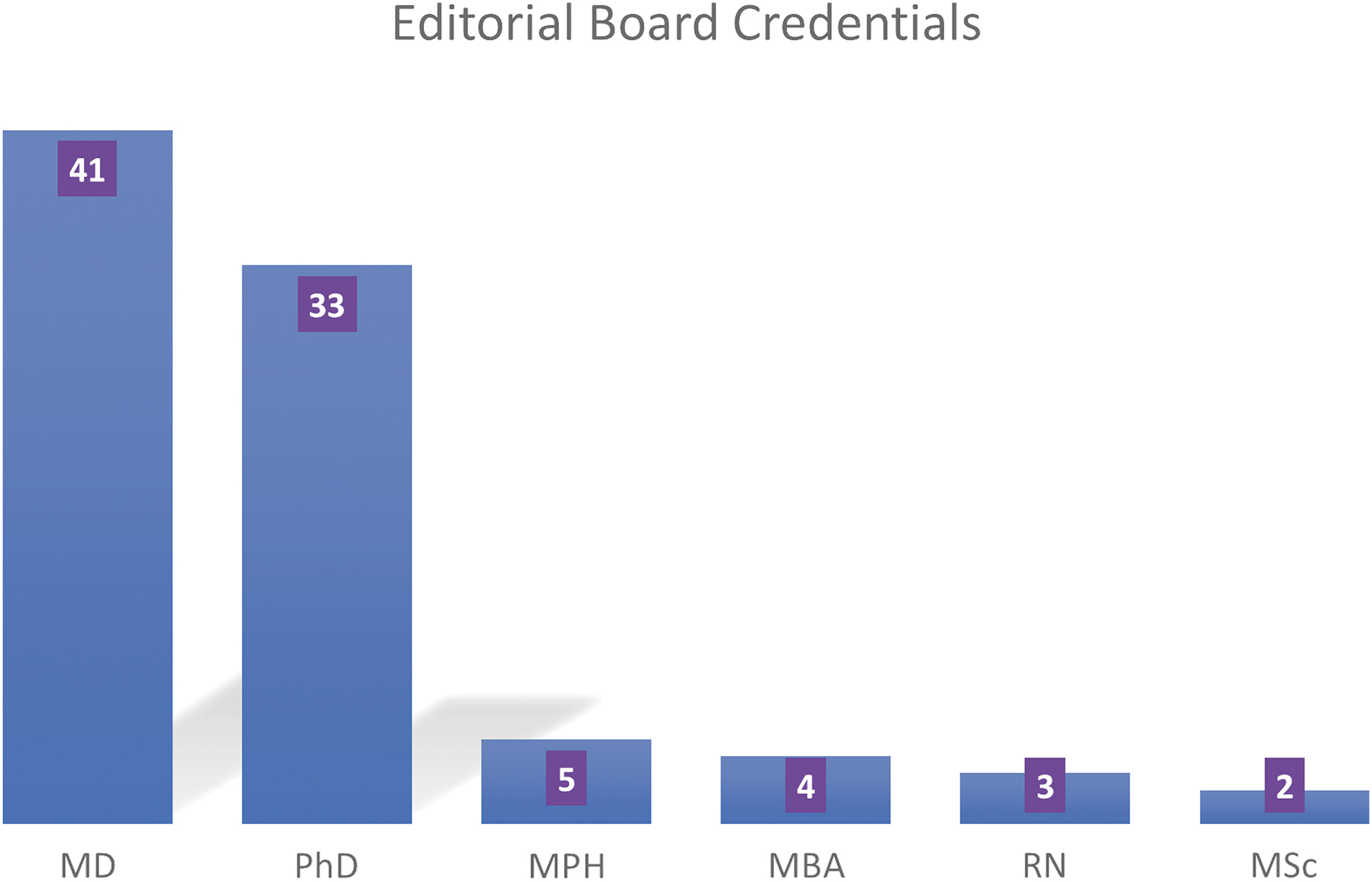
Credentialing of the Telemedicine and e-Health Journal Editorial Board.
Analyzing the credentials of the TMJ editorial board depicted in Figure 1, most members have a physician (MD or DO) background, followed by PhD, then master degrees. Twenty-five members of the board have dual degree qualifications,
The Editorial Board also includes telemedical and e-Health leaders from around the world as depicted in Figure 2. While the majority of the board (51/75, 68%) is affiliated with a U.S.-based academic institution or organization, there is significant international representation. From its inception, the board has included representation from Argentina, Canada, Brazil, France, Germany, India, Italy, Japan, Norway, Pakistan, Romania, South Africa, South Korea, Sweden, Russia, and the United Kingdom.
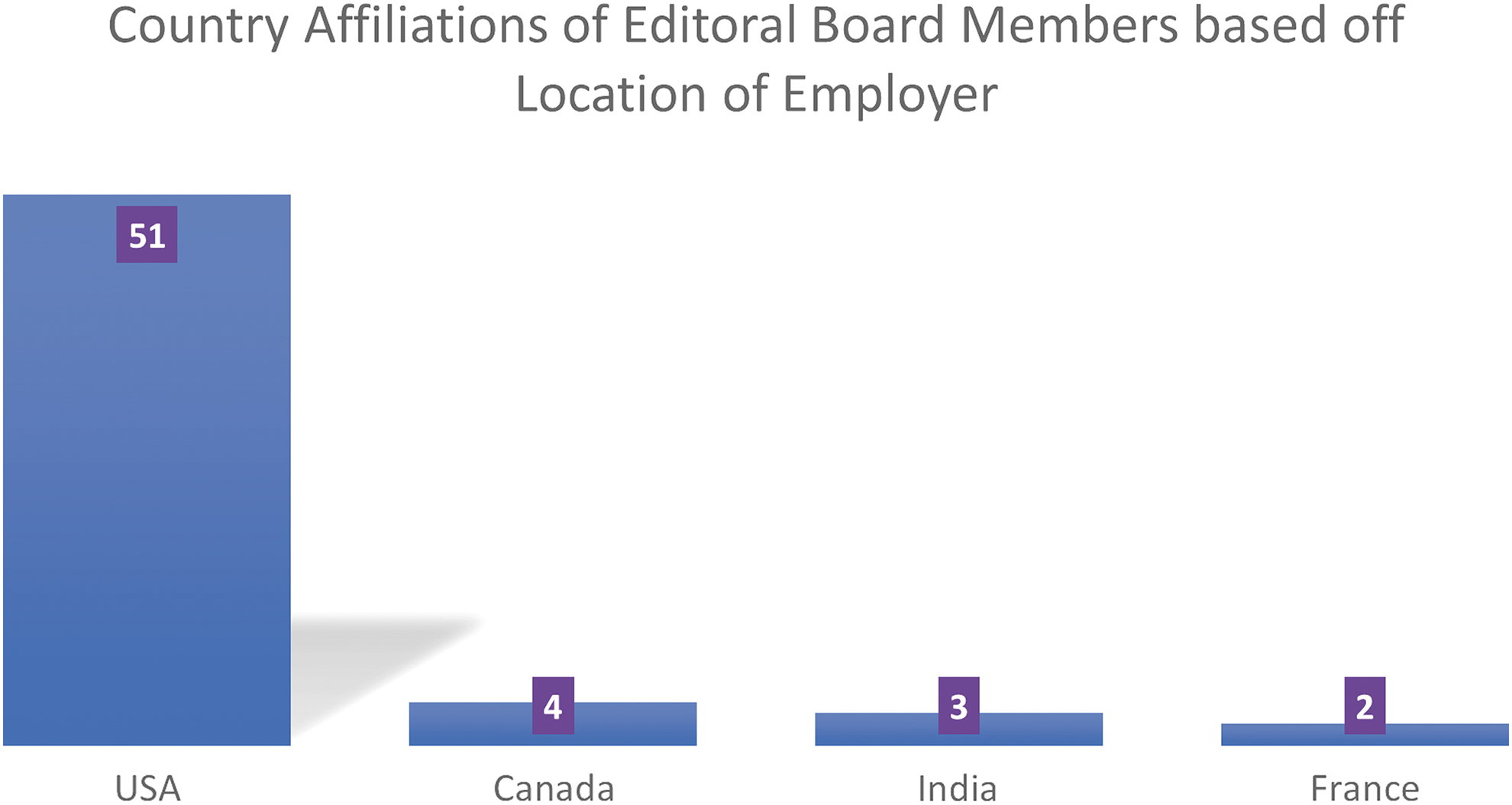
Country affiliations of board members based off location of employer (university or organization).
Furthermore, a large portion of the Editorial Board (28/75, 37%) has been involved for the whole-time frame of this study (2010–2020, 11 years). Also, everyone on the board in this time frame has been involved longer than a year. Figure 3 below quantifies this information.
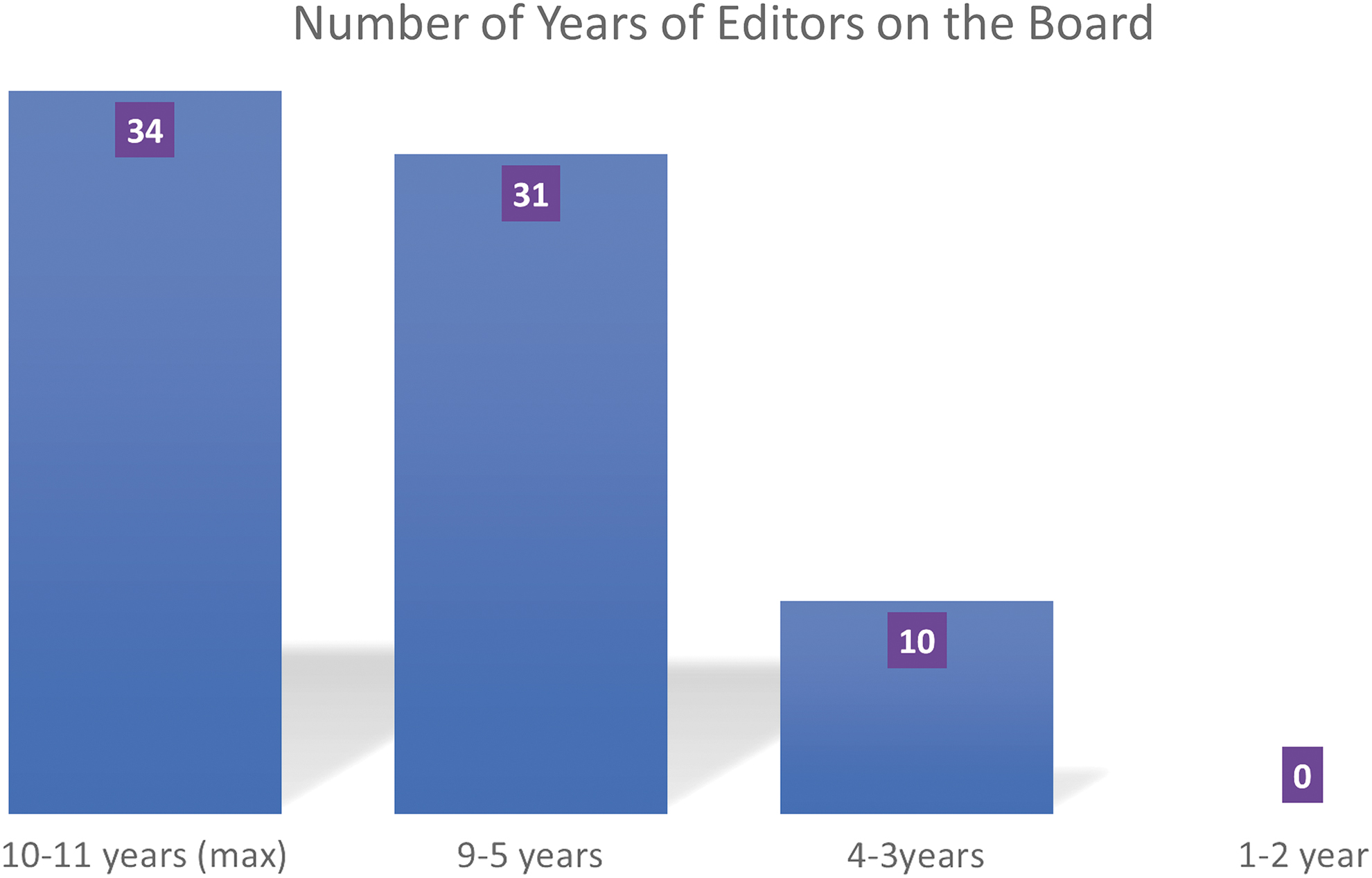
The number of years each board member has served.
Initially, the journal only had 4 quarterly issues, and then it was shortly expanded to 6 issues a year, then 10 issues a year, and now it has 12 issues a year (monthly). The submissions for this journal have also skyrocketed in the last year, due to the increased interest and usage of telemedicine and telehealth as a result of the COVID-19 pandemic. According to Fairhealth, telehealth claim lines have increased 2,817% from December 2019 to December 2020. 6 More recent reports from 2021 have shown that telehealth usage has stabilized at levels 38 times higher than prepandemic times. 7
TERMINOLOGY
A total of 1,783 articles were published in the TMJ between 2010 and 2020. Of the 1,783 articles, 1,505 (84%) had keywords assigned to them and 16% did not, particularly older articles published closer to the year 2010.
This study only analyzed the 1,195 “Original Research” articles (which had keywords assign to them) between 2010 and 2020. Figure 4 below depicts the distribution of keywords assigned to these articles.
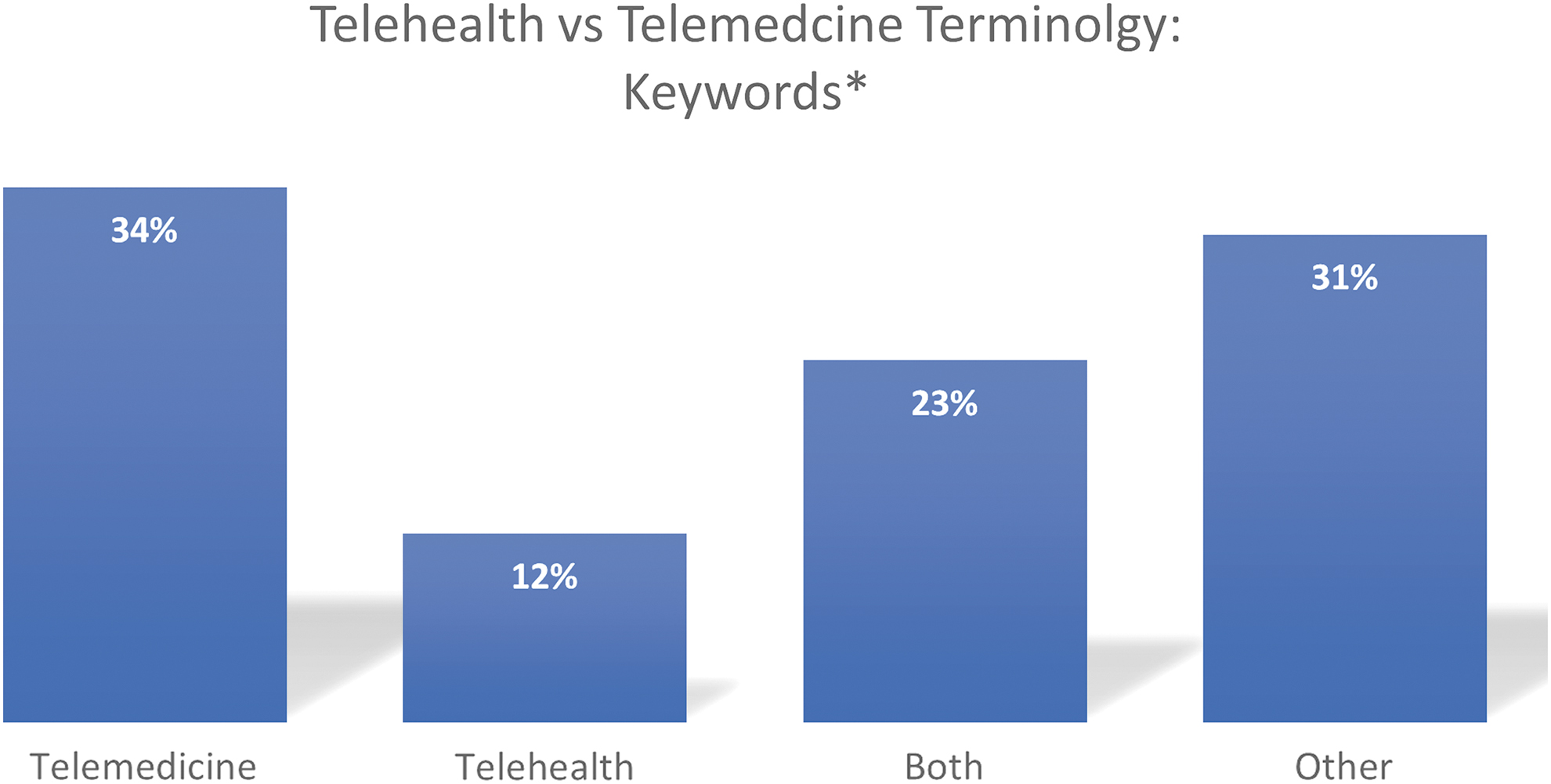
The frequency at which either Telemedicine, Telehealth, Both, or Other was assigned as keywords for “Original Research” article published in the “Telemedicine and e-Health” Journal between 2010 and 2020.
The “other” key terms used most often include mobile health (m-health), e-Health, and some sort of telespecialty. Other frequently used terms include technology, patient portals, or distance education.
Looking through all the articles analyzed, 36% use “telemedicine,” 14% use “telehealth,” 15% use both, and 36% use other terms in the passage text to refer to a type of long-distance health care service or related topic (Fig. 5).
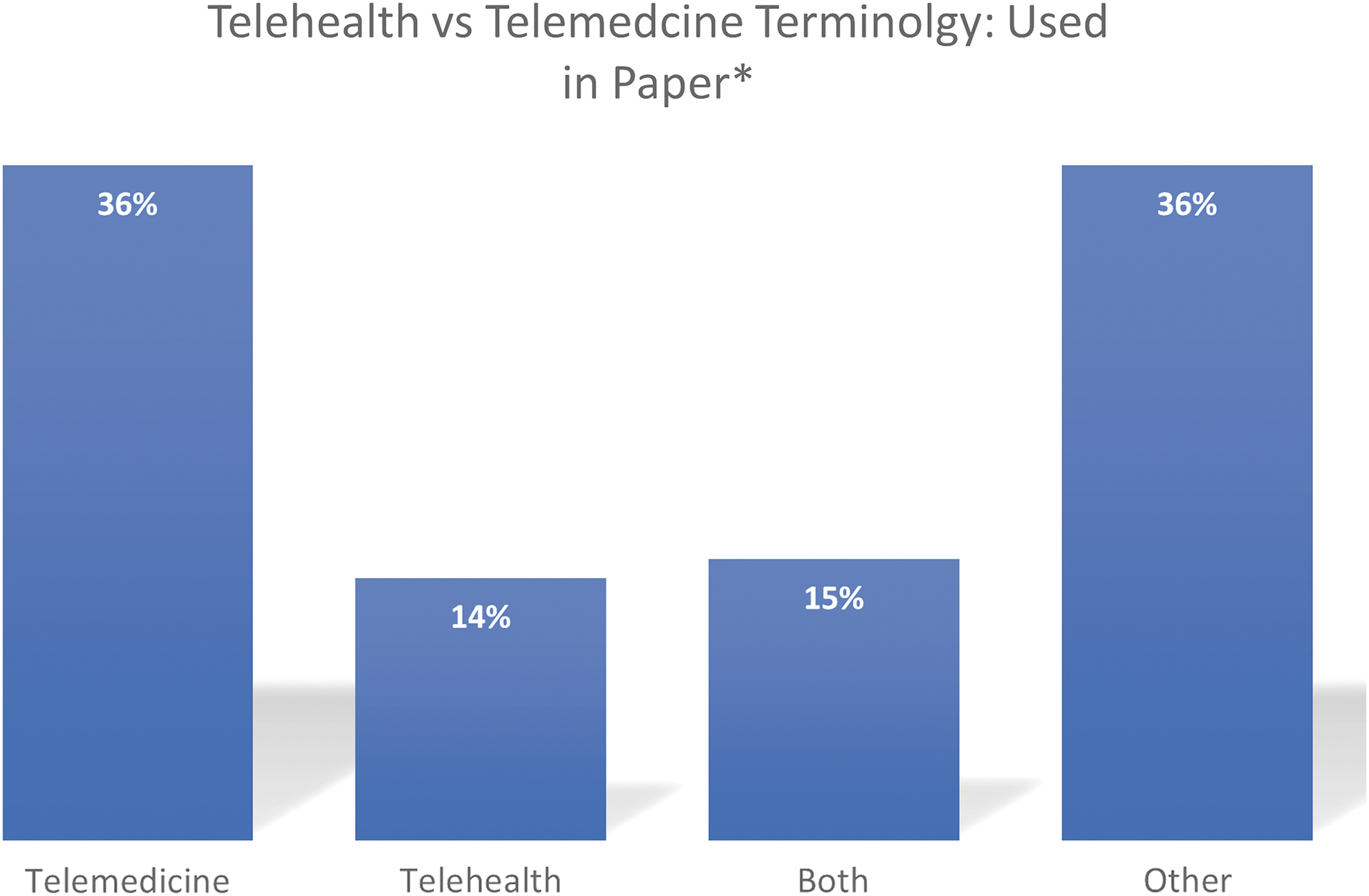
The frequency at which either Telemedicine, Telehealth, neither, or both were used within “Original Research” article published in the “Telemedicine and e-Health” Journal between 2010 and 2020.
Conclusions
As telemedicine and telehealth become more mainstream terms, understanding their different definitions becomes more important. The word “telemedicine” does not encompass everything that the health care field is. Also, the word “telehealth” often does not provide the specificity needed in building infrastructure for “care at a distance.” Looking back at the TMJ, we can see the deliberate choices made between those words, and how those choices have shaped the field. Combing through the vocabulary of the journal, multiple facets of the field come to light, from m-health to telecardiology.
Footnotes
Authors' Contributions
The concept of this article was derived by Ms. Sodhi and Dr. Weinstein, who both discussed this concept and analysis with Mr. Doarn. Data analysis and writing were conducted by Ms. Sodhi and reviewed by Ms. Stewart. All authors participated in the final writing and editing of the article.
Acknowledgments
The authors acknowledge the guidance provided to N.S., a research fellow and medical student at the University of Arizona from Dr. Ronald Weinstein. Dr. Weinstein worked closely with Ms. Sodhi and the other authors in completing this work. The authors extend their thanks and appreciation to Ms. Nancy Rowe for her help in the preparation of all the figures.
Disclosure Statement
No competing financial interests exist.
Funding Information
No funding was received for this article.