







Abstract
Introduction:
Data addressing the economic aspects of telehealth initiatives are incipient. This study aimed to evaluate the labor costs for running a COVID-19 telehealth system and its potential incremental access to health care service.
Methods:
From July 2020 to July 2021, data from a Brazilian teleconsultation service were analyzed. Labor costs were estimated by time-driven activity-based costing. A Generalized Reduced Gradient solving method was coded to maximize the mean incremental access rate and two scenarios were considered to compare the teleconsultation with the in-person consultation: (1) only the length of time that patients spent with a clinician in an in-person consultation was accounted and (2) in addition to the medical consultation, nursing screening was accounted. The mean incremental access rate of the teleconsultation service was defined as a maximization objective in the model.
Results:
Mean labor costs per medical and nursing teleconsultations are Int$ 24 and Int$ 10, based on data analyses from 25,258 patients. Telemonitoring a patient with a daily call for 7 days costs, on average, Int$ 14. COVID-19 teleconsultation service represents, on average, an incremental access to medical consultation rate of 35% to 52% (min 23% max 63%) for the scenarios (1) and (2), respectively, and considering the current consumed budget for this service.
Discussion:
A COVID-19 telehealth service contributes to increasing access to the health care system without increasing costs. These services can be included in the bundle of care strategies offered in a national public health care system that looks for more sustainable strategies to provide care.
Introduction
The COVID-19 pandemic has brought societal and economic challenges of great magnitude that represented a major boost for the development of innovative health care solutions to mitigate the impact of the disease on individual health and health systems. 1,2 In this context, telehealth has emerged as a valuable tool for preserving physical distancing and isolation, reducing infection rates, and the demand on strained health care infrastructure. 3
Considering the needs generated by the pandemic, the Telehealth Network of Minas Gerais (TNMG), one of the largest public telehealth services in Latin America, 4,5 implemented a synchronous teleconsultation service for the care of patients with suspected or confirmed COVID-19 that is in operation since May 2020 in two medium-sized Brazilian cities and as a part of a health support program of a federal university.
Although a great number of telehealth services have been developed since the beginning of the pandemic, data addressing the costs and the potential incremental access to health care service achieved by the establishment of a teleconsultation service for COVID-19 are still incipient. The main goals of this study were to describe the labor costs for running a teleconsultation service to support the access of patients with suspected or confirmed COVID-19 to the health care system and to estimate the potential of incremental access to medical consultation allowed by the establishment of this teleconsultation service.
Methods
THE TELECOVID-MG SERVICE
The COVID-19 telehealth service included in the analyses is named TeleCOVID-MG and was developed by TNMG. TNMG was created in 2005 and provides clinical support for >1,000 Brazilian cities. The major clinical support activities offered by TNMG are teleconsultations and different modalities of telediagnosis, such as electrocardiogram, Holter and ambulatory blood pressure monitoring, spirometry, and retinography analysis. 4 –6
TeleCOVID-MG has been in operation in two medium-sized Brazilian cities since May 2020. These cities, Teófilo Otoni and Divinópolis, have public universities that integrate the TNMG, together with Universidade Federal de Minas Gerais. Upon the implementation in these two cities, the project was expanded in November 2020 to faculty, public servants, and students from the Universidade Federal de Minas Gerais, in the city of Belo Horizonte. Teófilo Otoni, Divinópolis, and Belo Horizonte are located in the State of Minas Gerais. Teófilo Otoni has a population of 134,745 inhabitants and a human development index (HDI) of 0.70; Divinópolis has a population of 213,016 inhabitants and an HDI of 0.76; Belo Horizonte has a population of 2,375,151 inhabitants and an HDI of 0.81 (see
TeleCOVID-MG has two main goals, as previously described 7 : (1) providing the general population with COVID-19 evidence-based information and (2) assessing patients with respiratory symptoms.
The system was built to operate in four interdependent levels. User access is carried out either via chatbot or through a special telephone switchboard (level 1). Patients with respiratory complaints who have been in-person assisted at any health care service in those cities could also be included in the TeleCOVID-MG system by local managers. Screening is performed through a list of questions elaborated drawing on the best available evidence and this interaction is conducted by the chatbot agent or by properly trained professionals. After screening and according to the severity of symptoms and comorbidities, patients are assessed by a nurse or a physician (levels 2 and 3, respectively). According to the evaluation by nursing and/or medical staff, patients may be advised to keep home isolation or to seek onsite evaluation at a primary care center or an emergency unit. All patients evaluated through the teleconsultation system are included in the telemonitoring program (level 4), which monitors and provides support to them for at least 10 days after the onset of respiratory symptoms. Undergraduate medical students from the local universities trained for the task and working under the supervision of a physician or a nurse composed of the telemonitoring team.
It is important to remark that, according to the clinical findings, one team can request for an evaluation by the staff of another level at any time.
Figure 1 details the activities and the mean time per activity calculated by the registers of patients who used the service.
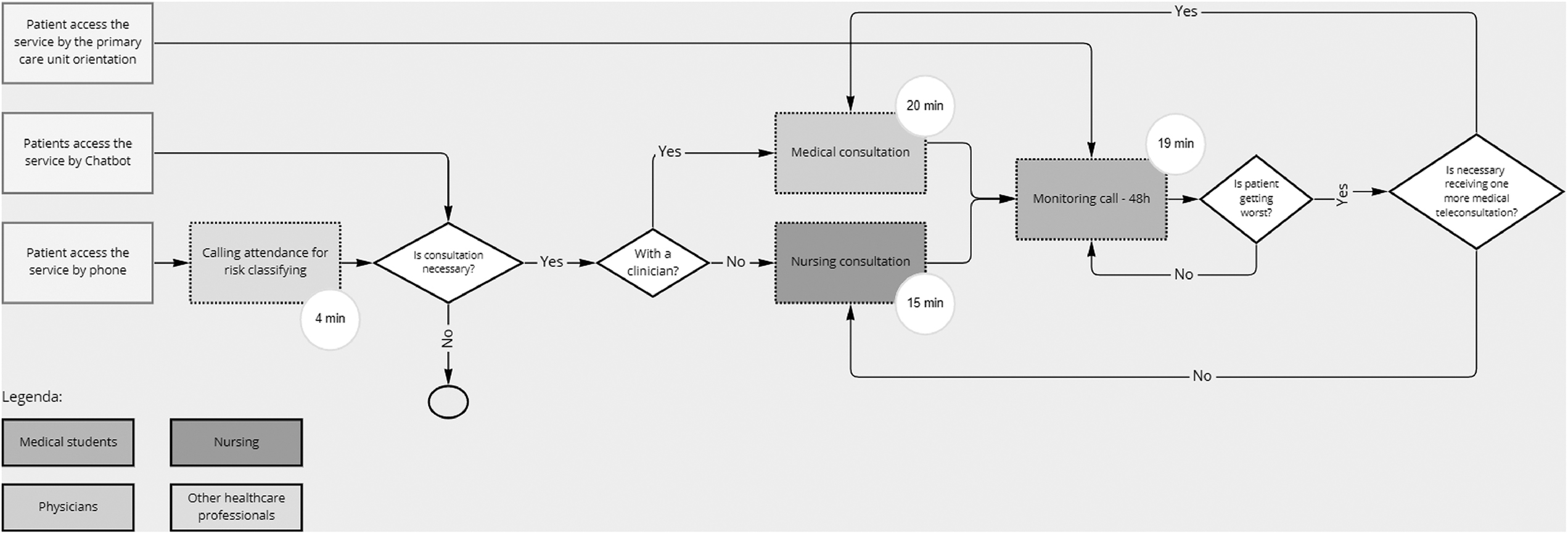
TeleCOVID-MG service workflow and mean time per activity.
In addition to carrying out teleconsultations, the TeleCOVID-MG system enables issuing medical prescriptions, reports, and orders for diagnostic COVID-19 tests.
The clinical protocols used by the teleconsultation staff were based on guidelines elaborated by the World Health Organization, the Brazilian Ministry of Health, and municipality health departments.
Cost
Costs were estimated by applying time-driven activity-based costing (TDABC) methodology, so the costs of all resources used to offer the TeleCOVID-MG service were computed. 8 The method TDABC enables more accurate cost estimates in care spending, specifically because it uses two parameters: (1) the unit cost of resource inputs, and (2) the time and quantity of resources required to perform a transaction or an activity. 9 It has been applied in health care studies to estimate costs with high accuracy and identify opportunities to deliver care with more efficiency. 10,11 In this study, the TDABC application followed the methodological recommendations for health care use as described before in academic literature. 12,13
The TDABC starts with designing the process of activities necessary to deliver the service to the population. A multidisciplinary team including clinicians, information technology technicians, and managers from the TeleCOVID-MG service were invited to describe the process.
In sequence, the labor resources necessary to perform each activity from the process were identified. Labor costs included clinicians, students, nurses, data scientists, and administrative staff, also classified as direct and indirect resources. A direct resource is performing activities directly to patients, for example, the clinician who does a call-consultation to patients. In contrast, indirect resources are those that provide support for the service to happen with quality, such as information technology and data science professionals.
One-year payment history of salaries for the health care professionals and academic incentives (scholarships) for the undergraduate students who work at the telemonitoring level were used to calculate the mean cost per labor resource. For the direct labor resource, the hired hours per category were used to calculate the cost capacity rate. The indirect resources were accounted for by each direct activity considering the intensity that those activities require from the information technology and administrative professionals.
The mean time per direct activity used the historic data from July 1, 2020 to July 31, 2021 of all the registers of patients, which were submitted to a telemonitoring, medical, or nursing consultation. Finally, the total cost per activity in each month was calculated by multiplying the mean time per activity, the cost capacity rate of the direct and indirect resource attributed to each activity, and the total of patients that consumed the activity in the period. The cost information was reported per activity and period in a descriptive manner.
Cost data were collected and analyzed in Brazilian currency and reported in Reais (R$ in 2020) and international dollars according to the purchasing power parity value (Int$ in 2020). 8
HEALTH CARE SYSTEM ACCESS ESTIMATE
To estimate the potential access increase to the health care system that the TeleCOVID-MG may offer, Generalized Reduced Gradient (GRG nonlinear) solving method was used, coded to maximize the mean incremental access rate. 14 The model was developed using Microsoft Excel for Mac® (CA).
The model used the monthly total cost of the TeleCOVID-MG calculated in the study as a reference of the total financial budget to provide in-person primary care for COVID-19 medical consultations. The cost of one in-person medical consultation considered recent federal physician hiring agreements, launched to support the COVID-19 demand, nominated “Mais Médicos para o Brasil” published in March 11, 2020 and September 24, 2021. Physicians' salary and estimated taxes established on these agreements amount to Int$ 57 per hour dedicated to clinical service in primary care services in any State of Brazil, whereas nursing amount to Int$ 17 per hour. 15,16
Two scenarios were considered in the analyses. For the first one, clinicians dedicate on average 30 min per patient consultation (including the direct contact and the time dedicated to input clinical data on the electronic health record). The labor cost per in-person consultation was estimated by multiplying the cost per hour and the length of time estimated per consultation. For the second one, in addition to the medical consultation, it was considered that before the consultation, each patient was screened by a nurse, and for this activity, a duration of 15 min was estimated (i.e., a nurse dedicates 15 min for each patient that will be submitted to a medical consultation). In addition, for the in-person consultation, it was considered that each patient spends on average Int$ 3.8 (R$9) on public transportation, roundtrip tickets.
Using this cost per consultation and transportation information, the constraints equations [Eq. (1)] were defined in the model for each month.
where:
X(t) = total cost registered in the period for the medical consultations in the TeleCOVID-MG;
N(t) = number of patients that could be submitted to in-person consultations in each period;
C = cost per an in-person medical consultation.
The incremental access rate per period (Y) was calculated following Equation (2).
where:
Y = Incremental access rate per period;
N(t) = number of patients that could be submitted to in-person consultations in each period;
Z(t) = number of patients submitted to medical consultations in the TeleCOVID-MG service in each period.
Finally, the mean incremental access rate was defined as a maximization objective in the model. Ethical approval for this research was obtained from the Universidade Federal de Minas Gerais Research Ethics Committee (CAAE: 35953620.9.0000.5149).
Results
Throughout the study, 25,258 patients were accessed through TeleCOVID-MG service. The characteristics of these patients are described in Table 1. This corresponds to 15,801 phone calls, 35,475 nursing consultations, 20,876 medical consultations, and 100,890 monitoring calls for suspected or confirmed COVID-19 cases (Table 2).
Clinical Characteristics of the Patients
Values are given as , n (%), unless otherwise specified.
SD, standard deviation; UFMG, Universidade Federal de Minas Gerais.
Activity Registers and Mean Time Per Activity
TELECOVID-MG COST DESCRIPTION
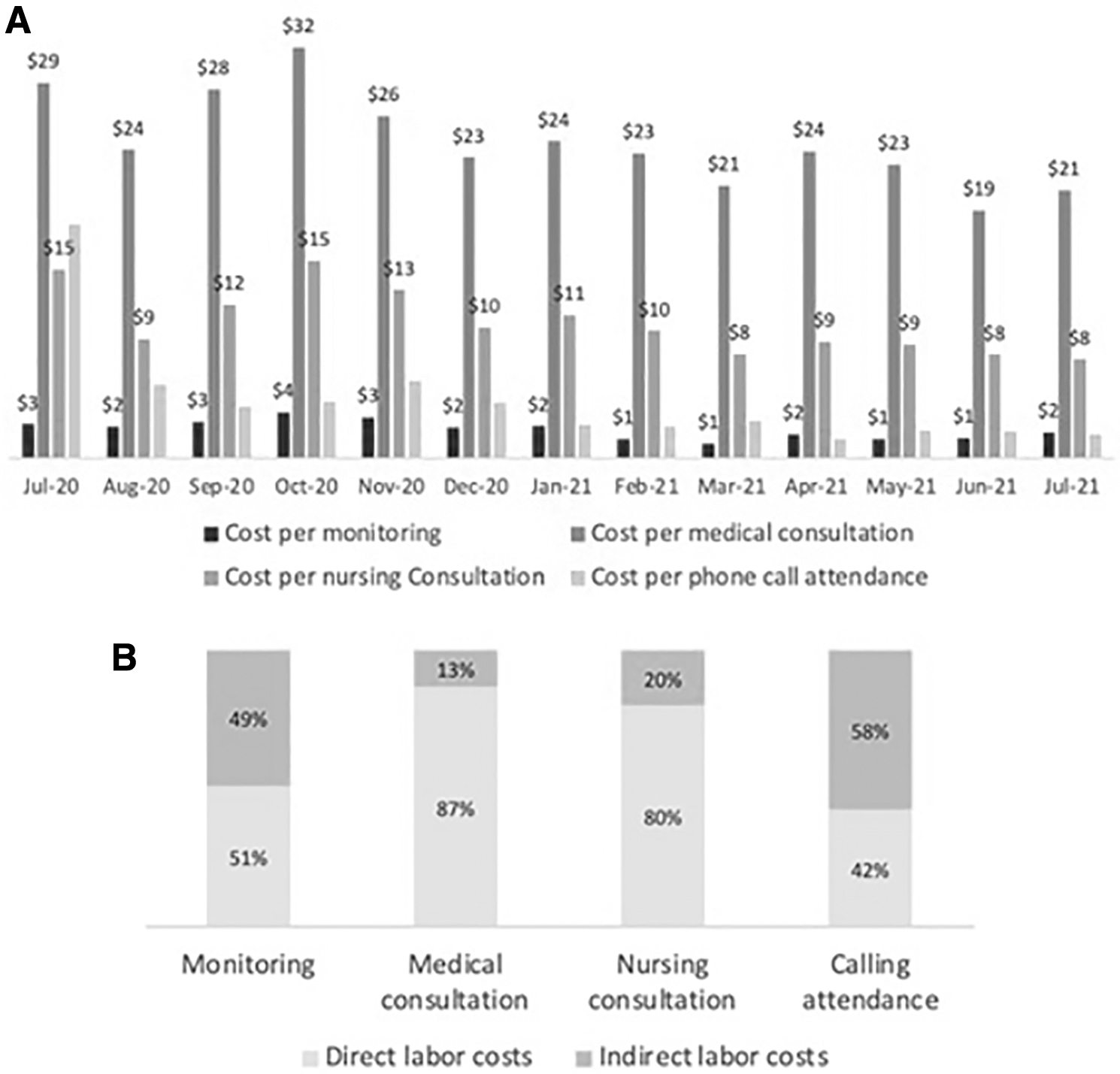
The mean cost per monitoring was Int$ 2 (standard deviation [SD] = 0.7), medical consultation Int$ 24 (SD = 3), nursing consultation Int$ 10 (SD = 2), and calling attendance Int$ 3 (SD = 1). From July 2020 to July 2021, the mean cost decreased for all the services, which is given in Figure 2A, except for the telemonitoring service. The activities performed by medical students or nonmedical health care, proportionally concentrate more indirect costs, as they are performed by lower cost professionals (Fig. 2B).
MEDICAL CONSULTATION ACCESS INCREASE ESTIMATE
For both scenarios, the optimization model was solved in <1 min, ran three interactions, and achieved the precision expected. All the constraints resulted in zero.
The mean total cost registered for the COVID-19 medical teleconsultation service was Int$ 38,115 (minimum Int$ 24,305 and maximum Int$ 52,536) in the period analyzed. Considering this total cost as a reference to optimize the number of consultations that could be performed in each service model and both scenarios, it was estimated that the TeleCOVID-MG service represents mean incremental access to medical consultation rate of 35% (Min 23% and Max 49%) in scenario 1, and 52% (Min 38% and Max 63%) in scenario 2 (Fig. 3).
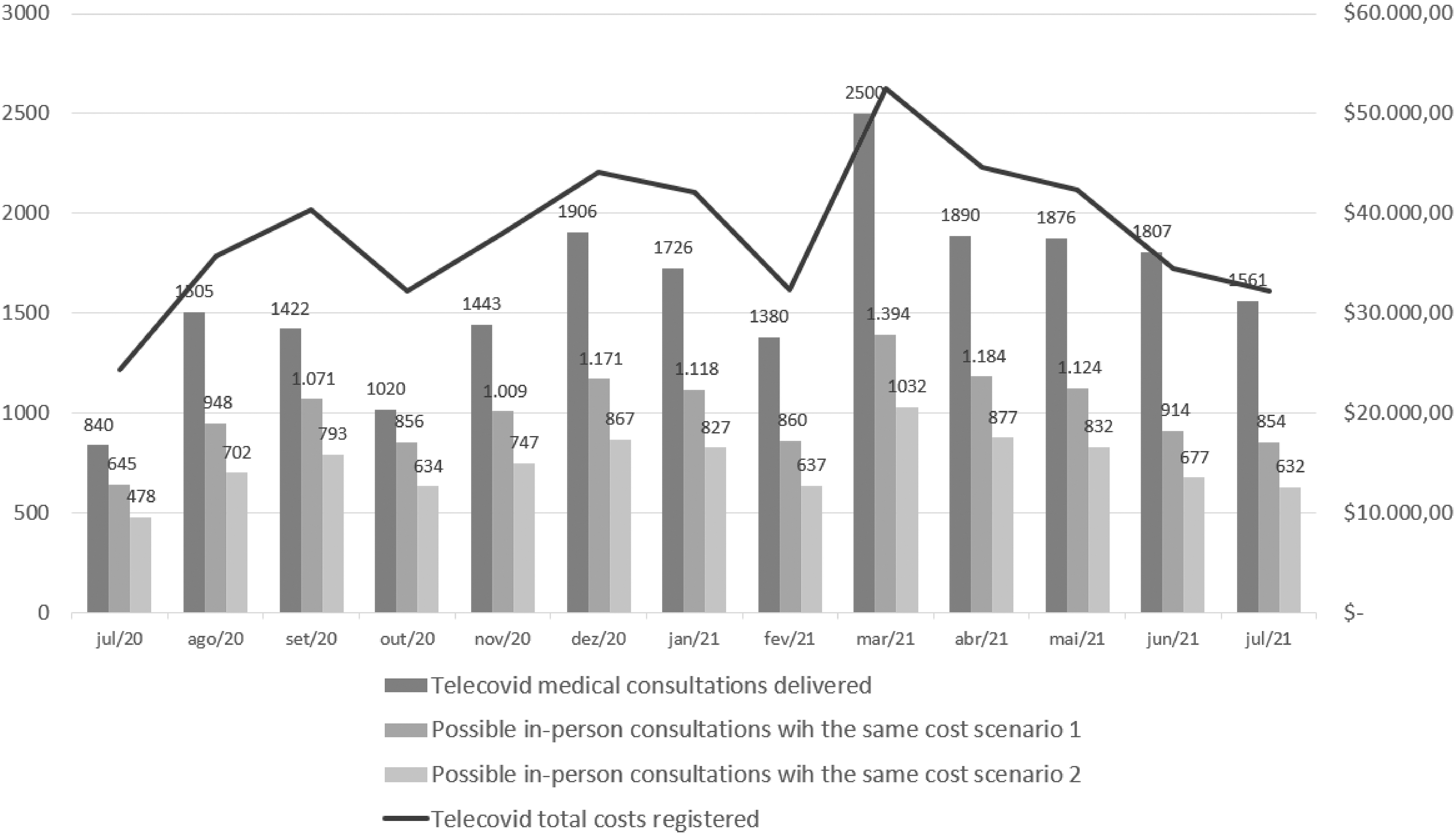
Mean incremental access to medical consultation in scenario 1. The bars represent the absolute number of medical consultations that can be delivered with the same budget in the Tele COVID-MG service and in the in-person service in both scenarios. The line indicates the total budget consumed with medical consultations in the Tele COVID-MG service each month, which was used as the parameter to run the optimization module.
Discussion
This study is innovative by demonstrating the labor cost to provide a teleconsultation service for managing patients with suspected or confirmed COVID-19 in a public health care system, and to demonstrate that it can be a cost-saving strategy. This information is valuable for managers, to better allocate and plan public funding for health care services to the population. In the context of scarce resources to deliver care with quality and safety to the population, 17 the study was also a pioneer in estimating how a telehealth service contributes to increasing access to the health care system to the population.
Before 2020, teleconsultation services were not regulated in Brazil, which occurred just in March 2020, attending to the new pandemic demands. 18 TNMG was a pioneer in developing a public COVID-19 teleconsultation service in the country and the exponential increase in telemedicine services has been observed not just in Brazil, 19 –22 but worldwide. 1,2
Despite this massive adoption of telemedicine, there is not a lot of evidence yet about the economic impact of those services on the health care systems. Recently, in Brazil, accurate cost information to offer a telemedicine service to ophthalmology patients was generated. 6 By applying the same method used in this study, the TDABC, the authors demonstrated that the telemedicine service could be cost-saving in comparison with a traditional in-person consultation. 23 For type 2 diabetes, another study also applied the TDABC in Brazil and concluded that offering remote care for those patients can be cost-saving and result in a better outcome in patients' quality of life. 24 Following the previous studies, the current research is the first to suggest a similar result for the care delivery of a disease that looks for answers about manners to increase population access to the health care system.
It was possible to demonstrate that medical and nursing teleconsultations for COVID-19 patient's costs, on average, Int$ 24 and Int$ 10 per consultation, respectively, and to telemonitor a patient with a daily call for 7 days costs Int$ 14. Over the analyzed period, the decrease in medical and nursing teleconsultation costs demonstrates the trend of labor expenses reduction owing to progressive professional learning in how to deal with the telehealth system, with the remote assessment of the patient and, in this case, with a new disease. All the learning contributes to the optimization of the teleconsultation time. Managers must be aware of this learning curve while planning the implementation of a teleconsultation service, which was already reported in the telemedicine literature. 25
TeleCOVID-MG succeeded in offering a quality and low-cost monitoring service (Int$ 2 per assessment), proving that telehealth could satisfactorily meet this new demand generated by the COVID-19 pandemic and may be adopted in other similar scenarios, offering economically attractive alternatives to the health care systems.
Compared with in-person consultations, COVID-19 teleconsultation service is already cost-saving, but the highest value is in the incremental access rate. In-person services worked in the same or higher capacities during the pandemic, but by the reason of the huge demand for primary care during the pandemic period, the opportunity to offer a service that can increment the access to the health care system by 35% or 50% (according to each scenario) is valuable.
For a universal health care public system such as the Brazilian one (Sistema Único de Saúde, SUS), these findings can inspire future applications of telemedicine. Almost 78% of the Brazilian population is supported by the public health care system, which consumes ∼4.5% of the national Gross Domestic Product. Any strategies that contribute to increasing the efficiency of the health care resource consumption increase value, by delivering qualified care to the population without increasing costs. 26
In the past 2 years, several studies have been performed at a national level recommending the use of synchronous teleconsultations in a complementary manner to provide care access to the population, a few examples are for orthopedics, 27 acromegalic, 28 and diabetes patients. 24 The results reported in this research are another example of how teleconsultation services may be included in the bundle of services offered in a national public health care system that looks for more sustainable strategies to better provide care to the population.
This study has some limitations. The assessment of the clinical solvability of the TeleCOVID-MG service was not our aim. The costs information for the TeleCOVID-MG and the in-person primary care services have not included structural and equipment costs. Our analyses are limited to labor costs in both services. The transportation cost used is an estimated mean cost, but future studies should look for more accurate transportation cost data.
Footnotes
Acknowledgments
The authors thank the entire TeleCOVID-MG team, including physicians, nurses, medical students, managers, and all other health professionals.
Authors' Contributions
C.R.A.d.O., A.P.B.d.S.E., M.S.M., M.B.M.A., C.A.P. and A.L.P.R. coordinated the research; M.C.P., M.S.M. and L.B.R. organized and provided the data from TeleCOVID-MG service; C.R.A.d.O. and A.P.B.d.S.E. analyzed the data and drafted the article; all authors reviewed and edited the article; all authors approved the final version of the article.
Disclosure Statement
No competing financial interests exist.
Funding Information
The authors disclosed receipt of the following financial support for the research, authorship, and/or publication of this article: this work was supported by Assembleia Legislativa de Minas Gerais; SESU/MEC [SEI-23072.211119/2020-10]; and CAPES [Grant No. 88887.507149/2020-00]. A.L.P.R. is supported in part by CNPq [Grant Nos. 310679/2016-8, 465518/2014-1]; and by FAPEMIG [Grant Nos. PPM-00428-17, RED-00081-16].