







Abstract
Introduction:
To properly combine osteoporosis treatment with dental treatment and to prevent medication-related osteonecrosis of the jaw (MRONJ), a system of communication between health providers can be smoothly made within a short time is required. With the recent increase in the possibility of telemedicine being introduced in Korea, it is expected that the introduction of teleconsultation between health providers treating osteoporosis will reduce the discomfort of patients and health providers and improve satisfaction. In this study, a survey was conducted on the knowledge and experience of MRONJ to find out the willingness of dentists treating osteoporosis patients for teleconsultation.
Methods:
An online questionnaire-based survey was conducted to investigate the intention for teleconsultation for MRONJ with a total of 516 dentists between September and October 2021.
Results:
Two-thirds of the respondents had experience of requesting consultation other dentists or doctors for the osteoporosis or MRONJ patients. They answered that the referral letter was the most used consultation request method and that it took a long time to get a reply. As for the intention of teleconsultation, 70% of the respondents answered that they were willing. The more experienced or the higher the educational level, the higher the intention for teleconsultation. Although the intention of dentists for teleconsultation was high, satisfaction with the cost of teleconsultation was low.
Discussion:
Although dentists' intention to use teleconsultation was high, satisfaction with the cost of medical care for teleconsultation was low, so it seems that this should be coordinated.
Introduction
Osteoporosis is a systemic skeletal disease characterized by low bone mass, and the incidence of osteoporosis continues to increase as progressively aging populations. 1,2 This can lead to a decrease in bone strength that can increase the risk of fracture. 3,4 Bone resorption inhibitors, such as bisphosphonates or denosumab, are often used to prevent fractures in osteoporotic patients. 5,6 However, caution is needed when using inhibitors of bone resorption, as long-term administration can cause medication-related osteonecrosis of the jaw (MRONJ). 7 –10 MRONJ treatment is usually difficult; so close collaboration between dentist and physician is important to prevent this from happening. 11
In order for physicians and dentists to cooperate in Korea, even within the same medical institution, a patient must visit each clinic at least once. Phone calls and e-mails cannot be used as they are not acknowledged as legal records, and patients must visit the dentist or physician in person with a consultation letter. This procedure consumes a lot of time and medical resources and requires repeated patient visits to medical institutions. Since patient treatment is inappropriately delayed, it becomes an obstacle to establishing a smooth cooperative system. Therefore, it is necessary to improve the consultation so that patients at risk of fractures or MRONJ can receive treatment based on optimal decision-making. 12 –14
For dental treatment of patients with osteoporosis, consultation between dentists and physicians might use teleconsultation. In Korea, telemedicine is only available between medical personnel under the Medical law, but it is rarely implemented because there are no regulations on this. After the COIVD-19 pandemic, discussions on telemedicine have been actively taking place, and the teleconsultation fee (draft) was announced in December 2020. The teleconsultation fee is divided into a referral fee and a consultation fee. Dentists can receive about 10 dollars for a referral and about 30 dollars for consulting from the National Health Insurance Corporation. In addition, the consultation fee is exempted from the patient's out-of-pocket expenses because the patient does not visit the consultation institution. If teleconsultation between dentists and physicians treating MRONJ and osteoporosis is introduced, it is expected that the discomfort of patients and medical staff will be reduced and satisfaction will be improved.
The purpose of this study was to explore the direction of teleconsultation in Korean dentistry by investigating the willingness to use teleconsultation and satisfaction with the cost of teleconsultation by dentists treating osteoporosis patients.
Methods
This survey study was approved by the institutional review board of the dental hospital at Yonsei University (IRB number: 2-2021-0081). Informed consent was obtained from all study participants. All data were anonymized to ensure participant confidentiality.
PARTICIPANTS
This survey was conducted with 516 Korean dentist license holders. Only dentists working in the clinic were included, and those who could not read the questionnaire, such as foreigners and illiterate people, were excluded.
SURVEY METHOD
The survey was conducted from September 2021 to October 2021 and took the form of an online questionnaire-based survey using the Google form. For the survey, a link to the survey was provided on the Korean dentist community website so that dentists could freely participate in it.
The questionnaire consisted of four parts, which are as follows: (1) knowledge of medication, (2) knowledge and experience of MRONJ, (3) intention to request teleconsultation, and (4) general information. The questionnaire consisted of a total of 28 questions, including those about how much they knew about MRONJ, experience of requesting consultation for osteoporosis patients, intention to use teleconsultations, and satisfaction with the cost of medical care for teleconsultation. Most of the questions were multiple choices, and satisfaction with the cost of medical care for teleconsultation was surveyed on a Likert scale out of 5.
STATISTICAL ANALYSIS
The data were analyzed statistically using IBM SPSS (version 25.0; IBM Corporation, New York, NY, USA). Reliability analysis was performed to determine whether the participants had given consistent responses. Data were presented as frequencies (%), as all variables were categorical. Pearson's chi-square tests were used to compare differences between dentists both with and without consultation experience. Logistic regression analysis was performed to measure association with factors that influence the decision to use teleconsultation, from which odds ratios for each explanatory variable with the corresponding 95% confidence interval and p-value were presented. Statistical significance was set at p < 0.05.
Results
A total of 516 people participated in the survey, and the general characteristics of the participants are described in Table 1. The reliability analysis result of the questionnaire was found to be reliable as Cronbach's alpha of 0.956.
General Characteristics of Survey Respondents (n = 516)
A majority, 77.7% (401/516), of the dentists who responded said that they had been educated on osteoporosis medication. Regarding where they had received this education, 47.9% (192/401) said at the university, 33.7% (135/401) at the conference, and 10.5% (42/401) at the specialist curriculum (Fig. 1). Among dentists who had received training in osteoporosis, 93.1% (373/401) responded that they needed a dental examination before administering bisphosphonates, and 84.5% (339/401) answered that they needed to stop the patient using osteoporosis drugs before tooth extraction or implant surgery.
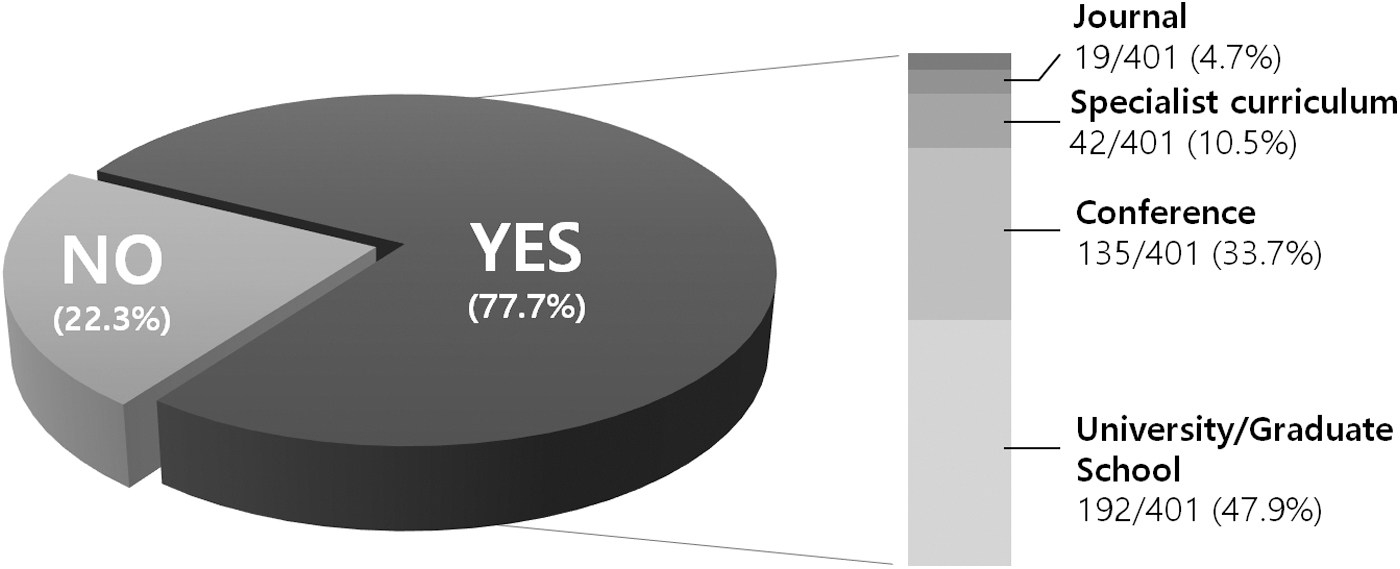
Education experience of onosteoporosis medication. Of the 516 dentists, 401 responded that they had received training on osteoporosis treatment. Regarding where they had received this education, 47.9% (192/401) said at the university, 33.7% (135/401) at the conference, and 10.5% (42/401) at the specialist curriculum.
Regarding how much they knew about MRONJ, 52.1% (268/516) answered that they knew about the concept to some extent and could explain it to the patient simply. Only 1.7% (9/516) of the respondents answered that they did not know about MRONJ at all (Fig. 2).
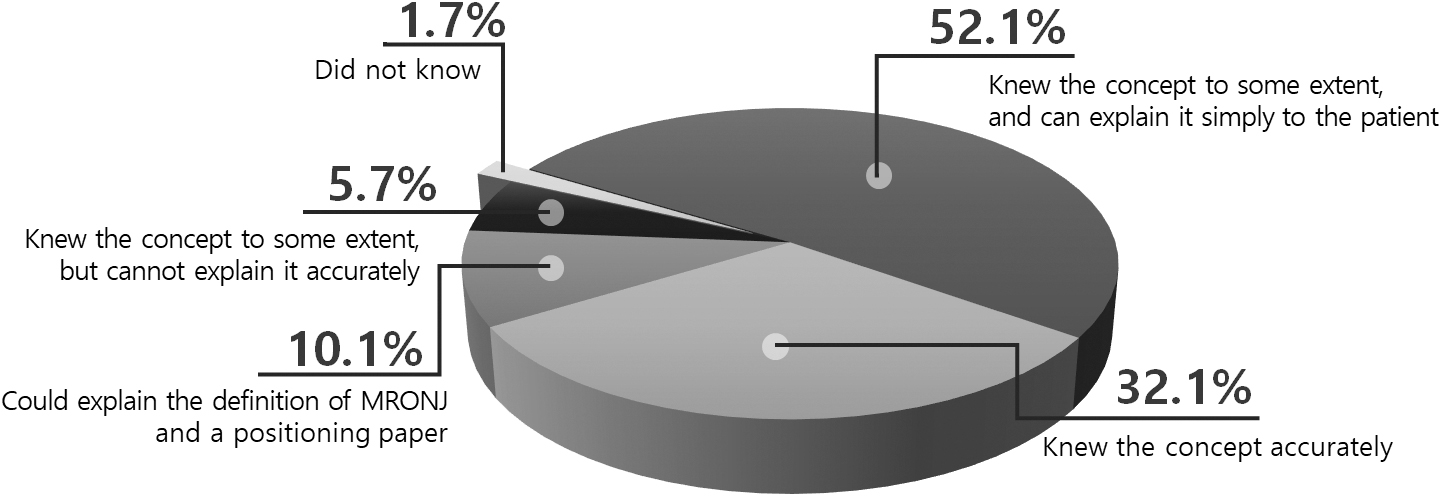
Knowledge of MRONJ. Regarding how much they knew about MRONJ, 268 out of 516 dentists answered that they knew about the concept to some extent and could explain it to the patient simply. Only 1.7% (9/516) of the respondents answered that they did not know about MRONJ at all. MRONJ, medication-related osteonecrosis of the jaw.
For osteoporosis or MRONJ patients, 67.1% (346/516) responded that they had consulted with another dentist or internal medicine physician. There was a statistically significant difference between the dentists with and without consulting experience according to the type of practice (p = 0.002) (Table 2). Among the dentists with experience in consultation, 93.1% said that they used a referral letter as a method of consultation. When asked if they were satisfied with the time it took to receive a reply to a consultation request, 79.21% answered that they were dissatisfied.
Comparison of Consulting Experience By Type of Practice and Specialty
Data are presented as n (%).
The level of statistical significance was set at p < 0.05 (** p < 0.005).
When asked if they would like to use a teleconsultation, 70.2% (362/516) said yes, and the reason that they gave was promptness (46.0%), improved communication (27.3%), and convenience (26.7%) in that order. On the other hand, among the dentists who answered that they did not want to use a teleconsultation, the most common reason was the legal liability (37.3%), followed by the possibility of giving an incorrect answer (29.3%).
As a factor significantly influencing the intention to use the teleconsultation, there was experience of the consultation. The intention to use the teleconsultation of dentists with experience in the normal consultation was 1.522 times higher than that of dentists without experience (p = 0.036). In addition, educational background was a factor that had a significant influence, and the higher the educational level, the higher the willingness to use the teleconsultation 1.516 times (p = 0.008) (Table 3).
Factors Affecting the Intention to Use Teleconsultation (n = 516)
The level of statistical significance was set at p < 0.05 (** p < 0.005).
CI, confidence interval; MRONJ, medication-related osteonecrosis of the jaw; OR, odds ratio.
When asked if they knew that the cost of medical care for teleconsultations was introduced to South Korea in 2020, 95.5% (493/516) of dentists answered that they did not know. As for the referral fee and consultation fee of the cost of medical care for teleconsultation, 322 people and 310 people answered that it is cheap, respectively (Fig. 3). Regarding the intention to use teleconsultations for the cost of medical care for teleconsultation, 53.3% (275/516) answered that they would use it if teleconsultations were activated regardless of the amount, and 15.3% (79/516) said they would use it if it were more expensive. Finally, 21.1% responded that they did not intend to use it (109/516).
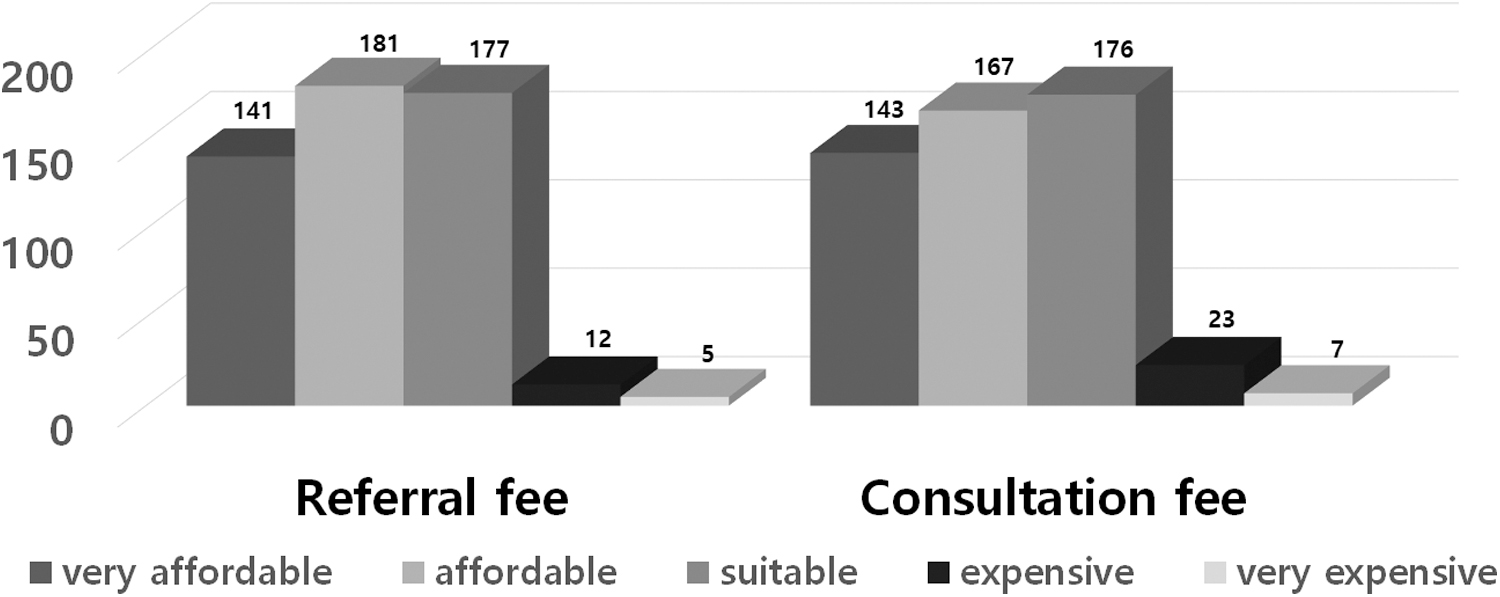
Level of satisfaction with the cost of medical care for teleconsultation. The cost of medical care for teleconsultations with the National Health Insurance Service was introduced to South Korea in 2020, and the referral fee was about 10 USD (11,210 KRW) and the consultation fee was about 30 USD (31,380 KRW). As for the referral fee and consultation fee of the cost of medical care for teleconsultation, 177 and 176 people answered that it is suitable, respectively. In addition, 322 and 310 respondents, respectively, answered that referral fee and consultation fee were cheap.
Discussion
Many dentists who participated in the survey answered that they had been educated about osteoporosis medication (77.7%), and most of the respondents knew about MRONJ. Two-thirds of the total respondents were dentists who had consulted other dentists or physicians about the treatment of osteoporosis or MRONJ patients. A referral letter was most commonly used method of requesting a consultation, and they responded that it took a long time to receive a reply.
Regarding the intention to use teleconsultations, 7 out of 10 respondents answered that they would, and the intention of women was higher than that of men, but this was not significant. On the other hand, as the age increased, the intention to engage in teleconsultation decreased by 1.3%, but this was also not significant. The higher the educational level, the higher the intention to use teleconsultations, and it increased by 1.516 times, showing a significant difference.
Although the number of dentists who intended to use teleconsultations was high, most dentists were not aware of the cost of medical care for teleconsultations announced by the National Health Insurance Service. Satisfaction with the cost was also low, meaning that adjustment of the cost would be necessary.
Korea has been amending the Medical Act in 2010 to implement telemedicine, but it was not commercialized due to the lack of an appropriate medical cost system and the failure to agree on issues such as attribution of responsibility in the event of an accident. 15 Through this study, it was confirmed that dentists' satisfaction with the cost of teleconsultation was low, but it is currently impossible to claim for this costs in Korea. Only emergency teleconsultation or the digital medical support system of the Korea Social Security Information Service can be charged for the cost of medical care for teleconsultations, which are practically a cost that general medical personnel cannot claim. That is why the development of telemedicine in Korea will be slow due to barriers such as policy, confidentiality, and accountability issues as well as low satisfaction with the cost. 16 –19
A survey of the awareness and perceptions of dentists on MRONJ was conducted in several countries. A survey of 74 dentists in Saudi Arabia mentioned the need for an education program related to MRONJ due to lack of knowledge about MRONJ. 20 A survey on the perception of MRONJ among 129 general dental practitioners (GDPs) in the United Kingdom showed that there were many GDPs who were not confident with treating patients taking bisphosphonates. 21 There was also a survey on the cooperation between Japanese dentists and physicians for the prevention of MRONJ in osteoporosis patients. 13 The knowledge and experience of MRONJ differed between dentists and physicians, so it was insufficient to enable medical and dental cooperation for the prevention of MRONJ in osteoporosis patients.
Various studies on teledentistry have been published recently. In a study conducted on all dentists in private practice in France, 57.1% stated that they had never heard of or did not know about teledentistry. 22 According to a study conducted on graduate students of dental schools in India, 79.2% of graduate students said they would consider practicing teledentistry in the future, and were satisfied with teledentistry. 23 In the United Kingdom, the attitude toward orthodontic specialists providing teleconsulting in general dentistry was investigated, and more than half of the consultants were interested in providing a teleconsultation for the GDPs. 24
There was also a study that suggested the use of teleconsultation to facilitate cooperation between dentists and physicians on osteoporosis. 12 It was reported that active communication between medical personnel could be promoted through teleconsultation, but when text-based teleconsultation is used, patient consent procedures for the transmission of personal information, medical information, and medical images must be prepared.
Even if it is not teleconsultation between medical personnel, teleconsultation between osteoporosis patients and medical personnel can also be a suitable option for osteoporosis treatment. 25 For chronic conditions requiring regular follow-up, teleconsultation can be an effective treatment delivery option in nonemergency situations. In response to the COVID-19 pandemic in Korea, teleconsultation services were temporarily allowed from February 2020 to May 2023. During this period, patients with chronic diseases, including diseases of the musculoskeletal system, used teleconsultation services the most, and it was similar to the case in the United States. 26,27 Through these cases, teleconsultation for osteoporosis patients seems to be effective.
This survey study had several limitations. First, as only 516 dentists participated in the survey, it cannot be viewed as a generalization of the perception of over 30,000 Korean dentists. Second, 45.5% of dentists who participated in this survey had Advanced General Dentistry (AGD) as their specialty. Due to the number of dentists with AGD qualifications suddenly increasing as a result of the transitional measure of the specialist system implemented in 2018, the proportion of AGD specialists participating in the survey was high. Since MRONJ lectures are included in the curriculum for AGD, the survey results might have been biased.
Nevertheless, the knowledge and awareness of MRONJ among dentists treating osteoporosis or MRONJ patients could be used as basic data when introducing teleconsultations in South Korea in the future.
Conclusion
If teleconsultation between health providers treating MRONJ and osteoporosis is introduced in dentistry, it is expected to reduce inconvenience and increase satisfaction for health providers. If teleconsultation is activated, decision-making for osteoporosis or MRONJ patients will be accelerated, but it seems that the cost of medical care for teleconsultation needs to be coordinated for this.
Footnotes
Acknowledgments
We gratefully acknowledge the strong support of a grant of the Korea Health Technology R&D Project through the Korea Health Industry Development Institute (KHIDI). We also would like to thank all those who participated in the survey.
Authors' Contributions
Y.C., N.H., Y.R., and W.P. jointly designed and conducted the research. Y.C. contributed to drafting the manuscript and drawing up the figures. N.H. contributed to data analysis and interpretation. Y.R. and W.P. reviewed the final manuscript. All authors read and approved the final manuscript.
Disclosure Statement
The authors declare that there is no conflict of interest.
Funding Information
This research was supported by a grant of the Korea Health Technology R&D Project through the Korea Health Industry Development Institute (KHIDI), funded by the Ministry of Health and Welfare, Republic of Korea (Grant No.: HI18C0474).