







Abstract
Objective:
As digital natives appear to be the most suitable target group for technological innovations, we tested this notion by analyzing their attitude toward the implementation of telemedicine in Poland.
Methods:
An online survey was conducted from April to October 2021, yielding responses from 475 university students on their experience with teleconsultations, which are an essential part of telemedicine. Satisfaction-related questions were used to perform cluster analysis, and subsequently, clusters were compared based on significant differences in responses including sociodemographic and utilization patterns. Open-ended questions were analyzed to further gauge the rationale behind the demonstrated attitude.
Results:
The responses were polarized. In the cluster analysis, on one side were the “Skeptics” and “Enemies,” who shared negative opinions on professionalism and convenience, differing only in their assessment of intangible skills. On the other side were the “Enthusiasts,” who were satisfied in all categories; the “Indifferent,” who lacked strong opinions; and the “Time-pressed,” who, while openly admitting its drawbacks, were highly likely to continue using it due to its time-saving potential. Recurring concerns in open-ended questions focused on unreliable diagnoses and uncooperative administrative personnel.
Conclusions:
The reception was polarized. The split in answers suggests that administrative problems were limited to some providers, indicating they should be possible to overcome. There is a clear pattern that telemedicine is seen as an incomplete service. However, many would happily continue to use it due to its convenience and time-saving benefits.
Introduction
The landscape of health care delivery is undergoing a profound transformation, particularly among younger individuals, including students, where telemedicine utilization has changed significantly in recent years. Younger generations exhibit a heightened proficiency in utilizing technology, encompassing smartphones, tablets, and computers. This technological fluency translates into convenient and intuitive access to telemedicine services, which the young approach willingly but still with detachment. 1 –3
The demanding lifestyles of young adults, including students, professionals, and individuals in the early stages of their careers, often leave them with scant time for conventional health care appointments. Telemedicine addresses this challenge by offering flexibility, eliminating the need to commute to physical health care facilities, thereby saving time and accommodating their hectic schedules. Younger individuals prioritize convenience and efficiency in their daily routines, seeking solutions that align with their fast-paced lifestyles. Telemedicine, with its provision of on-demand access to health care professionals, allows them to promptly address medical concerns without enduring the wait times typical of traditional clinics.
The COVID-19 pandemic served as a catalyst, accelerating the adoption of telemedicine among younger generations. Lockdowns and social distancing measures compelled individuals to explore virtual health care options to reduce potential exposure to the virus in crowded medical settings. This increased awareness and acceptance of telemedicine as a convenient health care delivery model further facilitated its integration into mainstream health care systems. 4
The burgeoning interest in telemedicine among the younger demographic mirrors a shift toward modern, technology-driven health care solutions prioritizing accessibility, convenience, and efficiency. As telemedicine continues to evolve and become more ingrained in health care practices, it is poised to play an increasingly prominent role in meeting the health care needs of younger generations. Telemedicine is currently employed across various domains, 5,6 with studies conducted among both patients and professionals highlighting its advantages and shortcomings. 7 –9 The pandemic accelerated telemedicine development in Poland, 10 leading to expansions in legal frameworks and regulations governing its implementation. 11 –14 Recognizing the benefits of telemedicine solutions, such as convenience, expedited service delivery, cost savings, time efficiency, and enhanced doctor availability, is increasingly drawn to these innovative health care options. 15,16
Observing the behavioral preferences for using digital gadgets and technology, Prensky coined the term “digital natives” for the current technology-literate generation. Digital natives (DNs), born after the 1980s and exposed to digital technologies from an early age, represent a demographic particularly receptive to telemedicine services, warranting further exploration by researchers and practitioners alike. 17
The aim of this study is to classify the attitudes of Polish individuals referred to as DNs toward their experiences with teleconsultations, with the objective of describing and analyzing distinct consumer groups. As the majority of this generation in Polish conditions are students, we aim to capture patterns influencing their behaviors in this regard, using students as the example, as they are inherently the most dynamic and, simultaneously, urban members of their generation (who spend a large part of their time in the city even though they do not live there), often serving as trendsetters. Additionally, this research aims to formulate guidelines essential for the development of telemedicine services tailored to meet the specific needs of this demographic. Attitude, in this context, refers to a predominantly fixed emotional or evaluative stance toward an object, typically expressed in positive, negative, or neutral terms, or a predisposition to adopt such a stance.
Methods
Cluster analysis was used to analyze the dataset, conducted solely on the basis of responses related to attitudes and use of telemedicine. With this technique, an algorithm segmented it into groups of potentially similar observations, determined by the resemblances in their answers. This approach facilitates the characterization of these groups in a manner that is easy to interpret and directly derived from observational data, minimizing the risk of bias stemming from theory-driven interpretation. Subsequent characterization also takes into account psycho-demographic variables. Characteristics are built based on variables for which a particular cluster stood out in a statistically significant way from the other clusters as a whole.
Fisher’s exact test for binary variables and Kruskal–Wallis test for Likert-scale questions were used. To gain a deeper understanding of the underlying motivations, this quantitative approach was complemented by a qualitative approach. In particular, the repeated and insightful comments provided by participants in their unstructured responses were highlighted in the cluster characteristics. The threshold for statistical significance was set at p < 0.05.
Primarily for the purpose of data visualization, the subset of questions selected for cluster analysis was also subjected to principal component analysis in JASP 0.16.3, using the oblique rotation method with an eigenvalues cutoff point of 0.4. Statistical analysis and data visualization were performed in Python 3.10. Clustering was conducted using the Kmeans function from the sklearn.cluster library (version 0.0.1post). Statistical tests were conducted using the scipy library (version 1.11.2). Data visualization, in the form of a Sankey diagram depicting the flow of respondents between an increasing number of clusters, was generated using the plotly library (version 5.14.1).
An online survey was conducted from April to October 2021 during the COVID pandemic. We received replies from 475 respondents who conducted televisits. The research tools used comprised of self-authored questionnaire. 18 –20
Informed, written consent was obtained from all eligible participants before the survey. The consent form included information on the study’s purpose and methods and the contact details of the study coordinator for any queries or doubts regarding the questionnaire. Respondents were informed about the anonymous, voluntary, and confidential nature of the survey.
Results
The study group was described by demographic characteristics as in Table 1. The majority of our research group comprised of females, accounting for 73.7%. Students were inquired about their current academic year, with years 1–3 classified as undergraduate and subsequent years as postgraduate (integrated master’s programs). Poland has universal health coverage, which was used by the majority of our respondents.
Characteristics of Analyzed Student Sample
Principal component analysis of all the questions unveiled three major axes concerning attitudes and utilization of telemedicine. The first axis, denoted in red and termed “Convenience,” comprised questions pertaining to the time-saving aspect and interest in subsequent televisits, with slightly less emphasis on the opinion regarding the lack of physical examination or its notable deviation from in-person visits. The second axis, represented in green and labeled “Friendliness,” encompassed issues such as privacy considerations, the attitudes of the doctor and support staff, and even the quality of sound. The third axis, depicted in blue and termed “Quality,” comprised questions related to the accuracy of diagnosis, the doctor’s responsiveness to expectations and concerns, understanding of the patient’s health issue, encouragement for open communication, provision of all necessary information, and the patient’s trust in the doctor.
Responses concerning attitudes and utilization of telemedicine underwent cluster analysis, as depicted in Fig. 1. The information from each analyzed dimension was visualized separately and then superimposed to create RGB colors. Therefore, in individual plots, a darker color indicated lower levels of satisfaction among respondents regarding a specific issue. In the case of combined colors, the same pattern held true; however, the overall shade indicated which category was the most dominant.
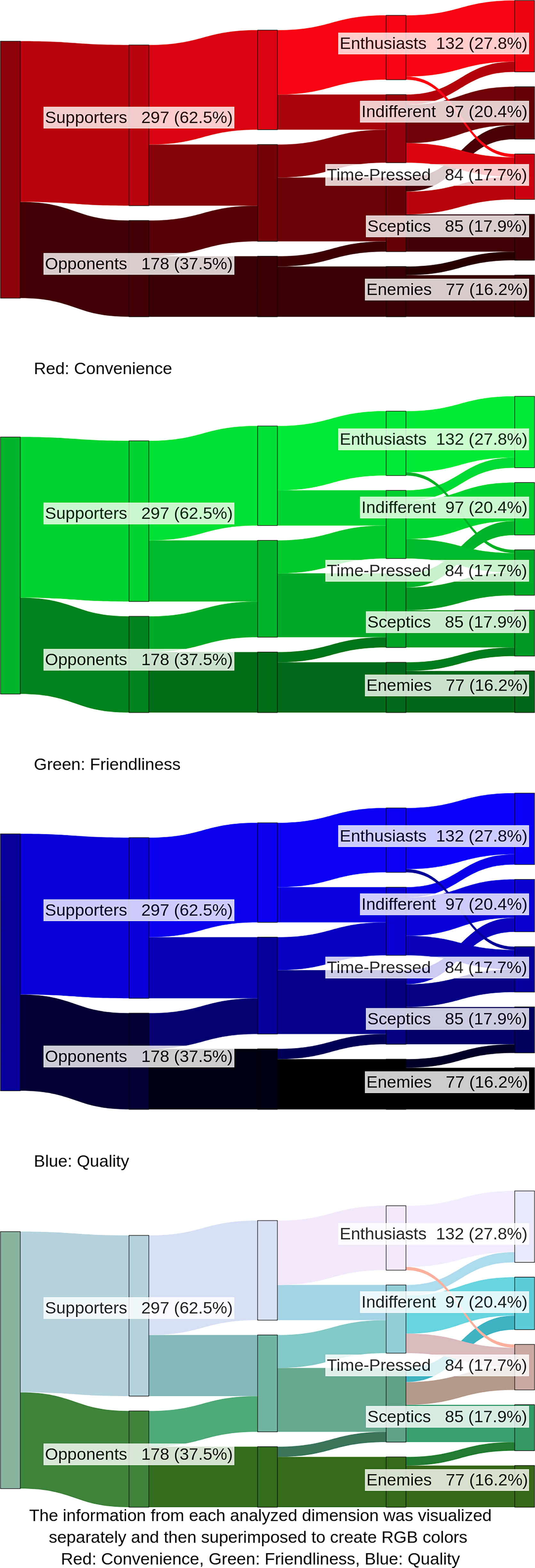
Cluster analysis of attitudes and utilization of telemedicine. RGB, color space model Red Green Blue.
The initial split into two clusters naturally divided people into supporters and opponents of telemedicine. Opponents were relatively fewer than supporters 37.5% versus 62.53%. Among supporters, the largest group was “Enthusiasts” and among opponents “Skeptics” rather than “Enemies” (Fig. 1).
Subsequent further splits created intermediate groups, though the most informative and meaningful division appeared for 5. The supporter cluster was effectively divided into “Enthusiasts,” “Indifferent,” and “Time-pressed,” while the “Opponents” were divided into “Skeptics” and “Enemies,” though there was some minor flow from “Opponents” to “Indifferent.”
“Enthusiasts” were clearly satisfied on all three categories. They were also more likely to use private health care, and their contact was slightly less likely to be related to COVID-19 infection. In spite of not using demographic variables for cluster formation, this group stood out as the oldest and the most urban. While they were slightly more likely to declare their ability to solve their problems, in this group were also patients appreciating telemedicine due to being socially anxious. Notably, they were the only group that described their experience in open-ended responses with phrases like “I’m delighted,” “Wonderful,” or “Very happy”.
“Indifferent” expressed a relatively positive opinion on issues of quality and friendliness, though they did not see any gains from telemedicine and were not interested in using it in the future. Additionally, they were the group that declared they were less likely to use medical services in the past and stood out as those who used the lowest number of televisits. Their lukewarm reception was summarized in their own words: “I think it’s a good concept but not well-executed.”
“Time-pressed” strongly appreciated time-saving aspects. They stood out in response to questions related to saving time and their willingness to use telemedicine in the future, although they rated other categories lower than the “Indifferent” group. Within this group, the answers were mixed, with some individuals mentioning that their experience varied depending on the provider. One person generally preferred standard in-person visits but highly appreciated the convenience of avoiding traveling to a different city. Another person explicitly mentioned that “Televisit wasn’t a problem; calling the reception was.” Their overall attitude is well-captured by their own response: “It is an interesting and faster way to obtain a sick leave from work or a referral or prescription, but it can be challenging to present your medical condition to the doctor.”
“Skeptics” saw no gain from telemedicine and rated its quality negatively. However, on softer friendliness-related categories, their perceptions were rather mixed. They lacked unique utilization features, but interestingly, they were the ones most likely to be younger than the rest of the group. While a few people in this group described telemedicine as a “joke” and one even as a “threat to health and lives,” some objections were highly specific. In some cases, there were clear attempts to use video conferences, which nevertheless led to incorrect diagnoses of dermatological problems.
“Enemies” were the group that rated telemedicine negatively in all possible categories. They had less contact with specialists and were more likely to come from rural regions. In this group, five people even described cases of misdiagnosis, including situations where the diagnosis and treatment changed after seeing another doctor in person.
There was a highly interesting pattern concerning responses about administrative personnel. Within “Enthusiasts,” there were barely any remarks, and in this case, the administrative personnel were, regrettably, not as wonderful as their doctor. Among “Time-pressed” and “Indifferent,” there were snarky remarks concerning their attitude, with phrases like “acting as if they were doing a favor” or “appearing as if they were assigned the job as a punishment.” For the “Skeptics” and “Enemies,” there were people complaining that for days no one even picked up the phone. While the suggestion of privacy violation may sound like an exaggeration, in the “Enemies” cluster, three members in participant remarks complained about being asked by the receptionist about their medical condition.
Notably, some explicitly stated opinions deviated from the typical cluster tendencies, adding a layer of nuance. In the most enthusiastic clusters, there were people somewhat less thrilled by the diligence of administrative personnel or noticing that in public health care, the attitude is inferior to the one they observed in private health care. Alternatively, even in groups where the approach was negative, there were some remarks that indeed, it’s a very effective way of issuing a prescription.
Answers indirectly imply that DNs, who one would expect to be enthusiastic about using cutting-edge technology, were not particularly impressed as the solutions used were not especially high-tech. Only 23.2% of them booked their visit online and merely 14.1% made a video call. If the primary technology used was a phone call with numerous complaints about sound quality, this may not have been seen as a great innovation. Additionally, some patients complained about technical problems with a lack of electronic access to medical documentation.
Discussion
The analysis of DNs’ behavior in relation to telemedicine remains relatively unexplored in the existing literature, particularly concerning cluster analysis. Our study fills this gap by conducting a detailed cluster analysis, offering unique insights into this domain. 21 –24 In the realm of telemedicine development, adopting a user-centered design approach is imperative. By incorporating the specific needs and social contexts of the target demographic, tailored telehealth applications can be devised, 25 a necessity currently overlooked within Poland’s telehealth landscape.
Our findings indicate a predominance of telemedicine supporters over opponents, consistent with prior research in both specialized and primary health care settings. 8,26 –28 Notably, among the supporter cohort, the “Enthusiasts” subgroup (27.8%) emerges as particularly receptive to telehealth, echoing the sentiments of older individuals 29,30 in urban locales, 31 who opt for private health care services. 32 The portrayal of DNs, characterized by their dynamic adaptability to digital environments, resonates with positive telemedicine evaluations observed in student populations facing economic constraints. 33
The “Indifferents” (20.4%) constitute a particularly intriguing group, as their characteristics are seldom addressed in existing literature. These individuals may potentially embrace telemedicine if it were impeccably organized. Engaging this group with targeted initiatives presents a unique opportunity. With persuasive messaging highlighting the tangible benefits of telemedicine, they could transition into enthusiastic adopters. Demonstrating the simplicity and efficacy of virtual health care services is crucial to winning their approval. Given their limited engagement with traditional health care services, activities like prescription renewals, diagnostic tests, and preventive training may pique their interest. Notably, their positive perception of staff communication skills aligns with observations in similar studies, such as those by Kludacz-Alessandri. 34
The second largest group of our respondents (17.7%) are those who appreciate the time savings that telemedicine provides. Similar findings on time savings can be found in the work of Almathami et al. 35 Russo et al., 36 and Coombes et al. 37 Respondents surveyed by Evers et al. 38 also appreciate the time savings, while declaring cost savings. This group of respondents claims that the quality of televisits depends on the provider. Similar findings can be found in Liu et al. survey. 39
The “Skeptics” (17.9%) emphasized instances of misdiagnosis encountered during telemedicine consultations. This contrasts with findings from the Mayo Clinic study, where such occurrences are rare. 40 Similar observations were made by Smith et al. in their analysis of pediatricians. 41 Hence, the prevalence of skepticism appears to be a characteristic of countries where telemedicine adoption surged primarily during the pandemic. The negative perception of telemedicine among skeptics could stem from challenges associated with video-based consultations. Moreover, younger individuals, who generally exhibit less tolerance for digital errors, may contribute to this sentiment. Conversely, in a study by Italian researchers involving a broader age range, older participants expressed more skepticism toward televisits. 42 This suggests that experience with telemedicine, rather than age alone, influences attitudes toward it.
The “Enemies” group comprises individuals with the most adverse views toward telemedicine, particularly in primary care settings. Swedish researchers underscore that although telemedicine is viewed positively in primary care, its widespread availability does not guarantee meeting all patient needs. 43 This holds true for our respondents in this group, who frequently interact with primary care physicians but express dissatisfaction with these interactions. Laryngological studies reveal slight disparities between outpatient and inpatient diagnoses, with 85% of cases showing concurrence between diagnoses made by online and in-person physicians. 44
There are also reservations in existing literature regarding studies on diagnostic accuracy, particularly in primary care contexts. Diagnostic precision has seldom been examined across the broader spectrum of diagnoses typically encountered by primary care physicians. Authors inquire about the development of tests, referrals, or procedures to mitigate the risk of ambiguity. Primary care clinicians have swiftly transitioned to a significantly different diagnostic and clinical question management platform. They now grapple with determining whether patients are healthy, mildly or moderately ill, or in need of emergency medical attention, and deciding on suitable tests, referrals, or procedures without relying on traditional physical examinations. 45 Additionally, this group with negative perceptions is primarily composed of respondents residing in rural areas. Similar findings of poorer evaluations of benefits in rural settings are reported by Wang et al. 31 and Pierce et al. 46
Characteristics highlighted in the open-ended questions of all respondent groups also included their assessment of administrative personnel. With the exception of the “Enthusiasts” group, all other groups expressed negative sentiments regarding these issues. Problems cited included difficulties in reaching out, lack of responsiveness, as well as encountering unhelpful and unpleasant interactions. Similar concerns are documented in the works of other researchers. 47 For instance, a study by Polish authors noted that a waiting time of more than 2 days for a telephone consultation resulted in a low rating of the health care facility. Furthermore, 27.3% of respondents faced challenges in scheduling appointments with their preferred general practitioner (GP), while 13.1% encountered obstacles in booking appointments with any GP. Additionally, 42.4% of patients reported difficulties in contacting a primary care center either by phone or online. 48
In the aftermath of rolling out telemedicine in a somewhat improvised manner, the Polish government began codifying the legal framework. Guidelines published by the Ministry of Health and the Foundations Telemedicine Working Group clarified the rights and responsibilities of doctors and other medical and paramedical professionals regarding teleconsultation. 49 The 2022 Interdisciplinary Standard for Providing Telemedicine Services was also created. This form of medical visit has become a niche part of the Polish health care system for ordering diagnostic tests, follow-up visits, and prescription renewals, similar to patterns observed in other countries. 50
To some extent, the impression that telemedicine is of inferior quality, though possibly time-saving, reflects the experience of telemedicine being perceived as a conventional visit but using a phone call, with all its limitations. It should be noted that numerous individually small techno-organizational steps have been employed in Poland, which, combined, improve patient experience though also enhance conventional visits. For example, electronic prescriptions were implemented in 2018, laboratory results obtained standardized electronic form in 2021, and from 2023, prescribing psychiatric medications requires patients to authorize their doctor via a text message code to access their recent prescription history and check for potential medication interactions. There had been some first genuine fundamental changes in the overall approach in utilizing telemedicine, as whole eligible population received electronic referral for COVID-19 vaccination issued directly by health care minister. However, this streamlining has not been fully realized. Although influenza vaccination is recommended and fully refunded for certain easily identifiable age groups, it still requires an individual doctor’s prescription for each patient. Telemedicine has only facilitated this process by enabling prescriptions to be issued during televisits. Thus suitable employment of telemedicine would most likely require meticulous rethinking of procedures and their automatization. This underscores the importance of collaboration between medical and health care teams to develop telemedicine services that better align with patient needs, a point also emphasized by Brenton et al. 51 Furthermore, the successful implementation of telemedicine solutions in Poland will also hinge on factors described by Willis et al., 45 including organizational system factors, regulations, reimbursement policies, health system supports, scheduling, productivity requirements, patient continuity, continuous learning, and improvement.
The human factor appears to significantly hinder the popularization of telemedicine. The numerous complaints about administrative personnel are quite telling. Addressing this may require a long-term culture change, regulations enforcing quality standards for state-contracted providers, accompanied by regulations facilitating disciplinary actions, or possibly encouraging a technological shift towards electronic booking, as seen in the efficient implementation during the COVID-19 vaccination campaign. Moreover, given the numerous specific complaints about diagnosis quality, placing more emphasis on proper diagnosis and treatment of patients remotely in the medical curriculum is likely to be beneficial. 52
Conclusions
The responses of digital nomads to digital medicine were sharply split in their satisfaction. Nonetheless, certain trends emerged. In terms of subsequent utilization, the primary concern was not whether telemedicine matched in-person care but whether it offered substantial time savings. The implementation of telemedicine often felt uncertain, with successful interactions hinging on responsive and adaptable health care providers. An ongoing issue was the administrative aspect, which appeared to be the weakest link in the process, leading to patients’ highly negative experiences, particularly when phone calls went unanswered—an issue that requires attention. Another significant challenge was patients expressing limited trust in televisit diagnoses and reporting instances where their previous diagnoses were found to be incorrect upon seeking a second opinion in person.
Limitations
Even if the characterization of clusters is based on sound statistics, it can sometimes lead to an overemphasis on subtle differences. As the study was conducted during the pandemic there had been a few unique patterns that could have skewed the results. Some students attributed their negative experiences to doctors assuming every respiratory infection was COVID-19, leading to improper treatment of other conditions like bacterial tonsillitis. However, one patient complained about antibiotic overprescription, suggesting the problem could be making accurate remote diagnoses based on unspecific symptoms, with COVID-19 being merely a plausible guess in ambiguous cases. As a lack of paid sick leave was a predictor of evading COVID-19 diagnosis, for a student any contact with a person who could impose restrictions based on partially open-to-interpretation government guidelines may be stressful and decrease satisfaction. 53
The study only involved younger generations, while an opinion poll indicates significant age differences, with Polish retirees appearing more content with this form of service. 54 Even within the younger generation, this sample should not be treated as fully representative as it is skewed towards those of higher socioeconomic status. Based on detected differences in satisfaction related to the rural–urban and public–private health care divide, a more balanced sample would likely show somewhat lower satisfaction.
Additionally, the research was conducted during the early implementation of telemedicine in Poland, so some challenges may reflect initial implementation issues rather than inherent problems. As the challenges were less noticeable in private health care, one could attribute this to private providers being quicker to adapt. Future studies will need to target other demographics to capture behaviors and trends across the entire patient population in the long run.
Bioethics Declaration
The study received a positive opinion from the Bioethics Committee of the Poznań University of Medical Sciences in a decision No. KB-143/21.
Footnotes
Authors’ Contributions
Design and conceptualization: A.F., M.P.W., and D.W. Methodology: A.F. and D.W. Investigation and data collection: A.F. and D.W. Formal analysis: M.P.W. Software: M.P.W. Writing: A.F., D.W., and M.P.W. Editing: A.F. and M.P.W.
Disclosure Statement
The authors declare no conflict of interest.
Funding Information
This research received no external funding.