







Abstract
Schmallenberg virus, a novel orthobunyavirus, is spreading among ruminants, especially sheep and cattle, throughout Europe. To determine the risk for domestic dog infection, we conducted a survey among cases referred to the university Companion Animal Clinic to assess possible seroconversion. No evidence of transmission to dogs was detected.
Introduction
Defining as precisely as possible the host range of the newcomer is a key point for predicting the outcome of the emergence of SBV disease in Europe. In this respect, it must be pointed out that orthobunyaviruses infect more animal species than those in which the fetus is damaged. For instance, antibodies to similar viruses were detected in sera of horses, donkeys, pigs, and dogs (Godsey et al. 1988). Recently, serological evidence for SBV infection in wild ruminant species (Cervus elaphus and Capreolus capreolus) was reported (Linden et al. 2012). In the present study, the objective was to seek serological evidence of SBV infection among domestic dogs living in a geographical area where exposure to infected insect vectors was high in 2011, as judged from the very high seroprevalence reported among cattle in that region (Garigliany et al. 2012c).
Materials and Methods
During April 20, 2012, to January 31, 2013, serum samples from 132 dogs living in southern Belgium were obtained by the veterinary staff of the Companion Animal Clinic. The vast majority of these animals lived in the area where a high seroprevalence to SBV had been measured among ruminants before (Fig. 1A). The dogs were divided into three cohorts: (1) Hunting dogs living in a mixed pasture and forest landscape and housed exclusively outdoors in premises located close to cattle farms (n=22, from three places), (2) pet/guard dogs living in a fragmented agricultural landscape, in small rural villages distributed along the road network and spending 4–12 h a day outside (n=50), and (3) pet dogs living in the city of Liège and spending between 1 and 2 h a day outside (n=60). Samples were obtained only from animals that were immunocompetent at the alleged time of emergence (August, 2011). None of the females sampled had an history of dystocia or birth of malformed puppies. Some of the animals were referred for neurological signs, but no virus was detected at the time of the visit.
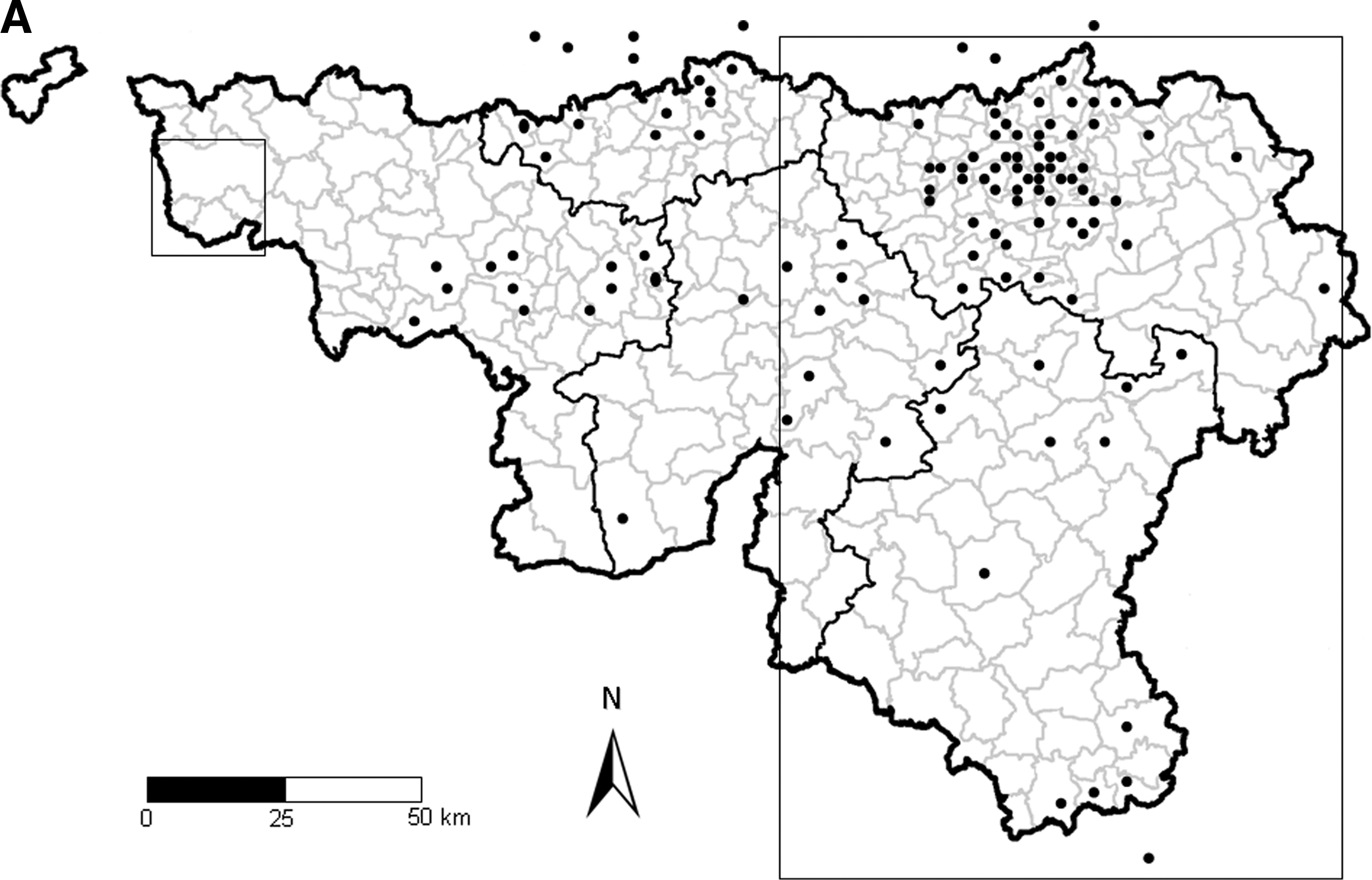
(
We first used the ID Screen Schmallenberg virus indirect enzyme-linked immunosorbent assay (ELISA) kit made commercially available by the company ID.vet Innovative Diagnostics (Montpellier, France) to determine whether serum samples contained immunoglobulin G (IgG) antibodies against the recombinant nucleoprotein of the emerging SBV. Results were expressed as percentages of the reference signal yielded by the positive control serum, with serological status defined as negative (<60%), doubtful (60–70%), or positive (>70%) by the manufacturer. Then, when the competitive ELISA kit specifically designed for the detection of antibodies directed against the SBV nucleoprotein in serum or plasma from multiple-species was released by the same company, the samples were tested again according to the recommendations and decision thresholds defined by the manufacturer.
Results and Discussion
Using the first kit (indirect ELISA), all serum samples but one were negative for antibodies against SBV, the last being categorized as doubtful. Because the kit is commercially dedicated to ruminant species, the possibility that the conjugate used in the kit is unable to efficiently bind canine immunoglobulins must be taken into account. However, a series of experiments conducted in parallel in our laboratory showed that testing the sera from experimentally infected mice with this ELISA generates absorbance values higher than those measured from naturally infected cattle sera (unpublished data). Qualitatively speaking, the conjugate should therefore be able to effectively detect anti-SBV IgGs from a wide range of species. Quantitatively speaking, the likely difference between conjugate's affinity for ruminant and nonruminant IgGs could alter the thresholds claimed to discriminate seronegative from seropositive sera in carnivorous species.
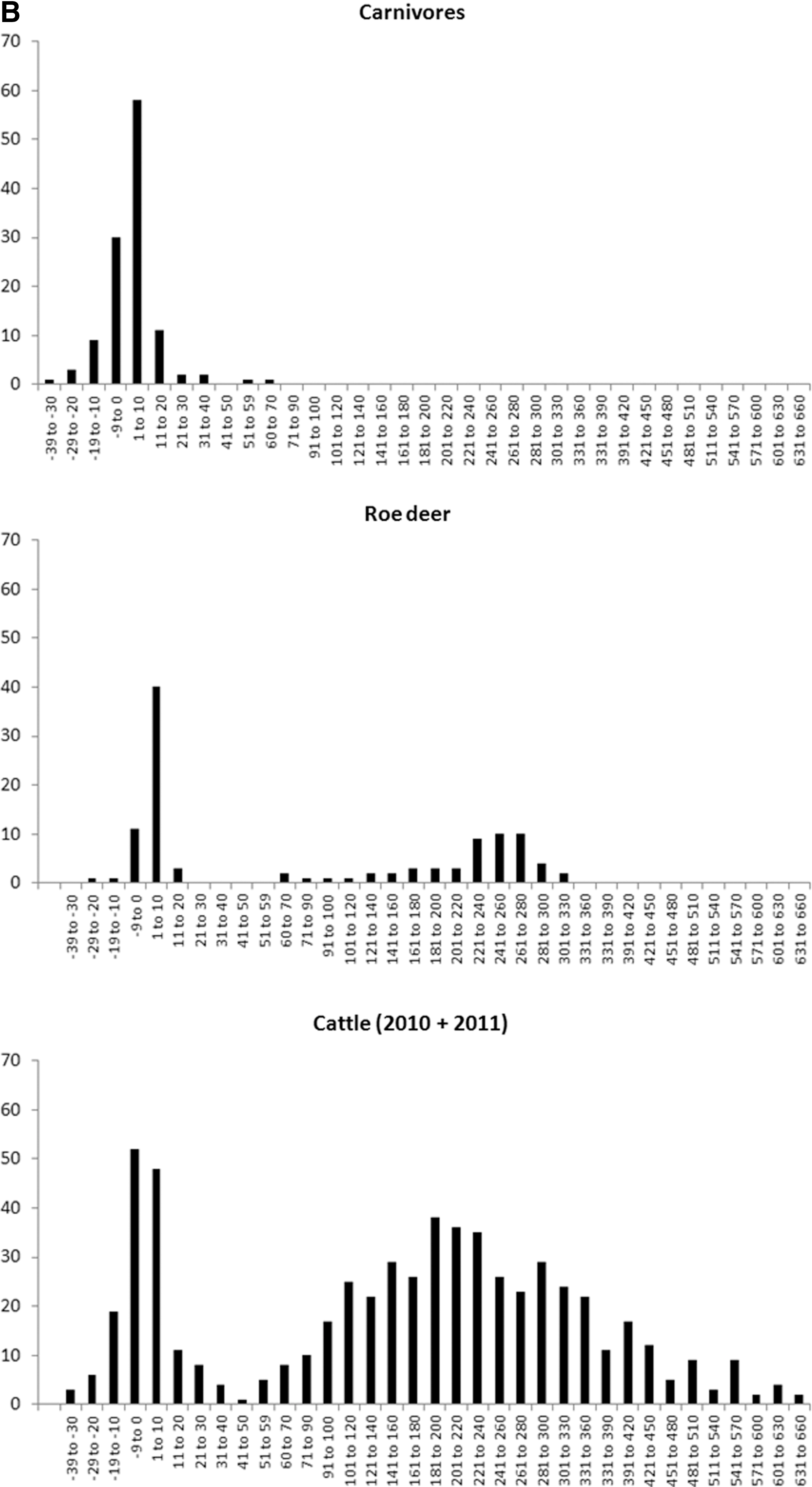
When examining the frequency distribution of the results generated by the same ELISA in naturally infected cattle (Garigliany et al. 2012c) and roe deer (Linden et al. 2012), a bimodal distribution was easily detected, which is consistent with the existence of two serologically distinct populations (Fig. 1B). Conversely, the frequency distribution of the results obtained in domestic dogs appeared clearly unimodal, rather suggesting a serologically homogeneous population. As the seroneutralizing titers measured from the five most and the five less ELISA-negative sera proved similarly less than 1/5, we concluded that the dog population sampled was homogeneously seronegative.
These results and their interpretation were then definitively confirmed by the demonstration of a 100% concordance with the results generated by the second-generation ELISA kit (competition). Such a result could reflect a lack of exposure of the animals examined to SBV-infected insects. As the vast majority of animals examined lived in a geographical area where more than 90% of cattle (Garigliany et al. 2012c), more than 55% of red deer, and about 90% of roe deer (Linden et al. 2012) had seroconverted by the end of autumn 2011, it is unlikely that they had not been exposed to infected insect vectors. This would be possible if all dogs were considered pets coming out only briefly outside.
None of the 22 hunting dogs housed exclusively outside has seroconverted, thus another factor probably explains the absence of seroconversion. Such a result could also reflect the fact that dogs were not bitten by insect vectors carrying SBV. This seems also unlikely because dogs are the target of several arboviruses (Godsey et al. 1988). Moreover, recent studies attribute a key role to Culicoides species in SBV transmission (Elbers et al. 2013) and, although carnivore species are not the favorite prey of these midges (Braverman et al. 1996), they were indeed showed to transmit bluetongue virus to dogs (Oura et al. 2011). Therefore, because the animals examined here were highly exposed to SBV-infected insect vectors, as it is likely that SBV is transmitted by Culicoides spp. and because there is evidence of Culicoides biting dogs, the lack of seroconversion in the sampled population suggests that, like in humans (Ducomble et al. 2012; Reusken et al., 2012), SBV is unable to evoke a specific IgG response in the canine species.
Footnotes
Acknowledgments
The authors warmly thank Jessica Pirson and Julien Paternostre for the drawings, Fergus Allerton and Coralie Pasquet for help in blood collection, and Deborah Kleijnen and Jérôme Wayet for technical support.
Author Disclosure Statement
No competing financial interests exist.