







Abstract
Annual entomological surveillance programs aiming to monitor mosquito populations and record presence and absence of mosquito species have been performed in Greece. We report, in this study, new records and expansion of Aedes albopictus in the islands of Lesvos (region of North Aegean), Crete (region of Crete), and the regional units of Rodopi in East Macedonia-Thrace. Furthermore, Culex tritaeniorhynchus was recorded for the first time in Arta (region of Epirus) in northwestern Greece.
Introduction
M
One of the main objectives of entomological surveillance is to record presence/absence of mosquito species, monitor mosquito populations and detect the geographical distribution, and possible expansion of mosquito species in new areas.
Aedes (Stegomyia) albopictus (Skuse, 1894), the Asian tiger mosquito, is considered to be the most invasive mosquito species in the world (Gratz, 2004). Ae. albopictus first appeared in western Greece, in 2003 (Samanidou-Voyadjoglou et al. 2005, Patsoula et al. 2006) and is now established in the capital city of Athens (Attica region), and in many regional units in Central Macedonia, Thessaly, and Peloponese (ECDC VBORNET 2016, Giatropoulos et al. 2012a,b, Giatropoulos 2013, LifeConops 2015). Worldwide, it is important for public health since it is known to transmit arboviruses, such as Dengue, Chikungunya, and Yellow fever. It is also a vector of filarial nematodes, Dirofilaria spp. (Cancrini et al. 2003a,b, Gratz 2004, Becker et al. 2010, and ECDC 2012). In recent years, cases of Dengue and Chikungunya fever have been recorded in Europe (Marchand et al. 2013, INVS 2014, Paty et al. 2014).
Culex(Culex) tritaeniorhynchus Giles is a part of the Culex vishnui subgroup (Toma et al. 2000), distributed throughout the Asian region, extending into the Middle-east, the Mediterranean and Afrotropical region, China, Russia, Japan, Korea, Indonesia (Lee et al. 1989), Northeast Africa, India, Iran, Iraq, Israel, Jordan, Lebanon, Maldives Islands, Mozambique, Saudi Arabia, Sri Lanka, Syria, Turkey, and Turkmenistan (Walter Reed Biosystematics Unit). In Europe, it has been reported in Albania (Danielovi and Adhami 1960, Adhami 1987) and Greece since 2003 from samples originating from a coastal marsh in the area of Marathon in the Prefecture of Attica (Samanidou and Harbach 2003). It has also been recorded in rice fields in the regional unit of Etoloakarnania, Western Greece, from 2008 to 2013 (Lytra and Emmanouel 2014). Cx. tritaeniorhynchus is a vector of Japanese Encephalitis (JE) (Bram 1967, Self et al. 1973) and isolates of other viruses, including Sindbis and Dengue, have been found in this species (Lee et al. 1989).
Our findings reflect the expansion and further establishment of these two species in new areas of the country, derived from the national entomological surveillance programs.
Materials and Methods
Entomological surveillance was carried out from May to November (period varies per regional unit) and included placing traps for adult mosquito collections and identification of mosquitoes up to species level (Patsoula et al. 2016). The results from the entomological surveillance activities were directly communicated to all the involved local authorities (regions and regional units, Departments of Public Health and Social Welfare, Directorates of Sanitation Control).
Traps for adult mosquito collections were placed in rural, urban, and periurban sites every 15 days, in 28 regional units in 2014 and 19 regional units in 2015. In 2014, a median number of 54 (range: 7–68) traps (CO2 and Triple traps) were placed throughout the study period in the 28 regional units, while in 2015, a median number of 8 (range: 0–31) traps were placed in the 19 regional units.
The entomological surveillance areas were chosen after evaluation of the existing data for vector-borne diseases in humans and animals from previous transmission periods. However, it was not possible to conduct the entomological surveillance in all areas recommended by the entomological protocol. The surveillance was carried out by the contractor companies, which were awarded tenders for environmental applications and mosquito control in the regions. The traps used were either CO2 and/or Triple traps according to the contractors' availability of the traps. The trap locations are presented in Figures 1 and 2, for the years 2014 and 2015, respectively.
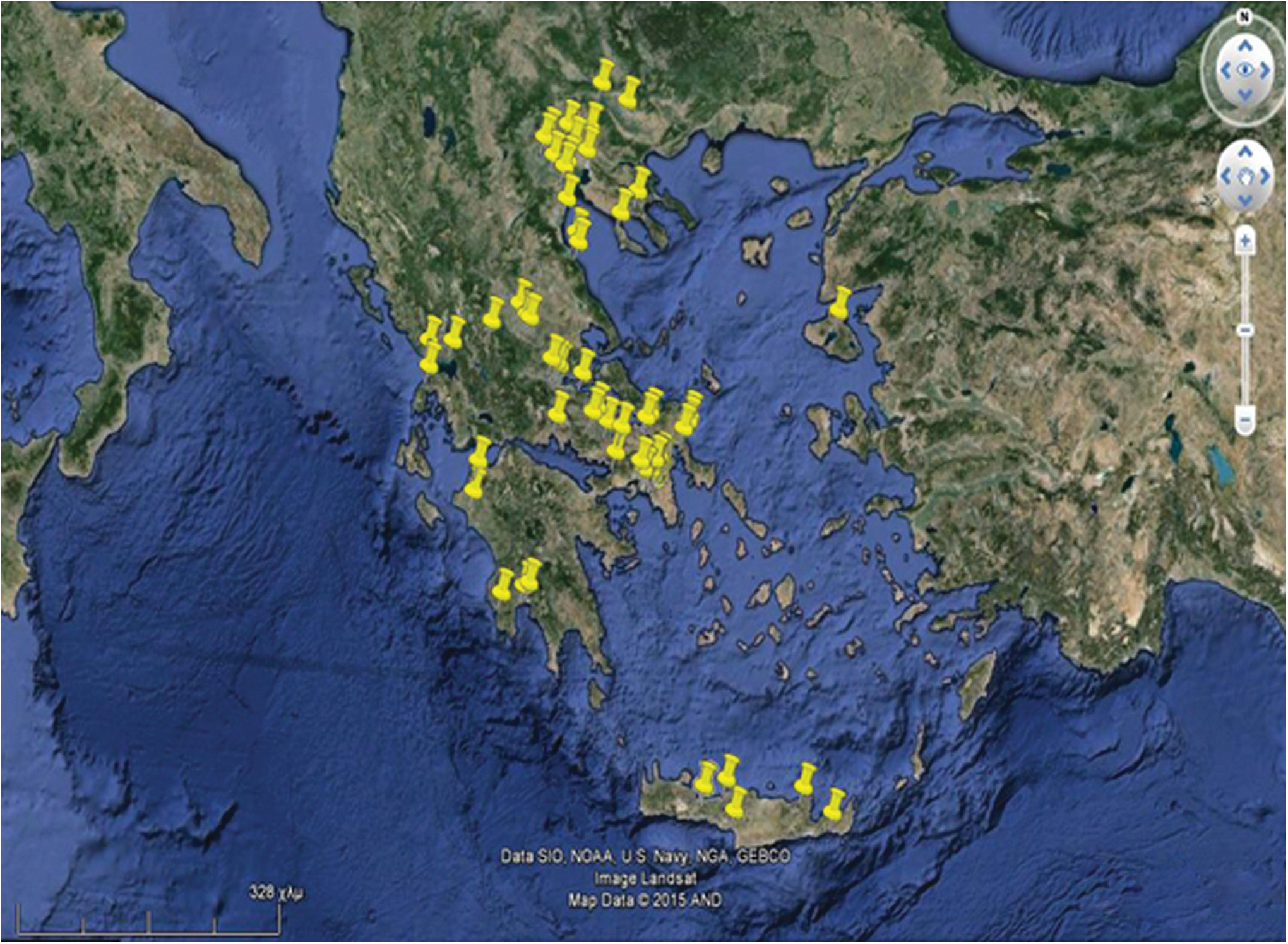
Sites of adult mosquito collections, 2014.
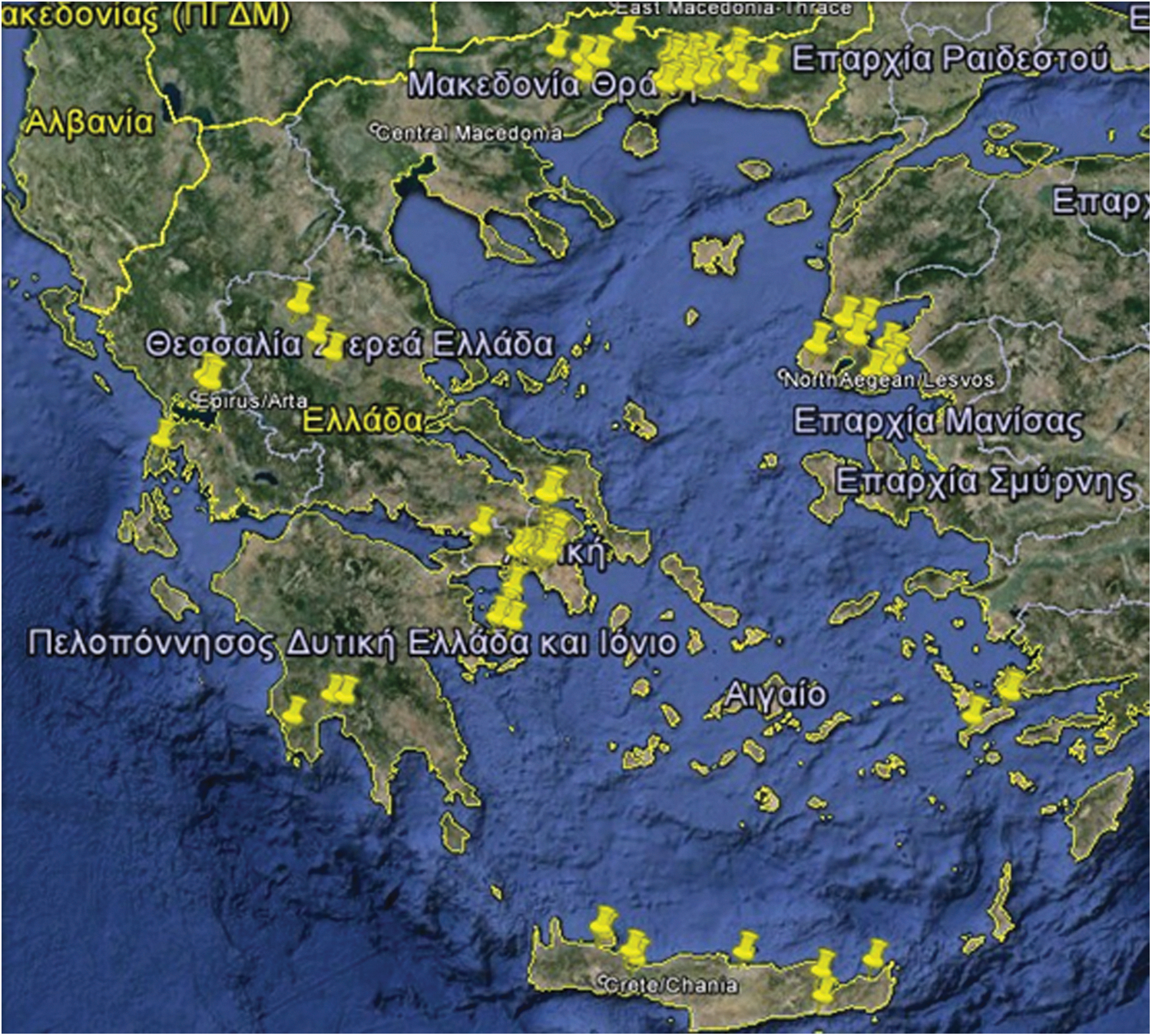
Sites of adult mosquito collections, 2015.
Traps were placed at dusk from ∼6:00 pm and were collected the following morning at 9:00 am. The contents of the whole trap were placed in a plastic container on dry ice and sent to the Laboratory of Medical Entomology in NSPH for identification. All mosquitoes were identified to the species level using morphological characters (Darsie and Samanidou-Voyadjoglou 1997, Harbach 1998, Samanidou and Harbach 2001, 2003, Schaffner et al. 2001). Ae. albopictus and Cx. tritaeniochynchus adults, which were collected for the first time in areas of the country, were also verified by polymerase chain reaction (PCR) methods.
DNA was extracted from one leg of individual adult mosquitoes following the protocol described in Patsoula et al. 2006. The nuclear ribosomal spacer gene ITS2 region of the rDNA gene was amplified by PCR using 5.8S and 28S primers (Porter and Collins 1991, Wesson et al. 1992, Collins and Paskewitz 1996) and a region of the mitochondrial cytochrome oxidase I gene (COI) was also amplified using primers C1-J-1718 and C1-N-2191 (Simon et al. 1994). PCR was carried out with the protocol and cycling conditions as described in Patsoula et al. 2006. The PCR products were run on 2% agarose gels. Gels were stained with ethidium bromide and bands were visualized under UV transillumination. Aedes albopictus products were subjected to a restriction fragment length polymorphism assay (RFLP) for further verification of the PCR results (Patsoula et al. 2006). PCR products for both genes were cleaned using a commercially available kit (DNA isolation spin kit agarose, Applichem, Germany), according to the manufacturer's instructions to be analyzed by sequencing.
Results
A total of 47,039 mosquitoes were collected in 2014, belonging to 14 mosquito species (Culex pipiens s.l., Culex theileri, Aedes caspius, Aedes dorsalis, Aedes albopictus, Aedes detritus, Aedes vexans, Culiseta annulata, Culiseta longiareolata, Anopheles sacharovi, Anopheles hyrcanus, Anopheles maculipennis s.l., Anopheles superpictus, Anopheles claviger).
In 2015, 2183 mosquitoes were collected. They belonged to 13 mosquito species and 1 genus (Culex pipiens s.l., Culex tritaeniorhynchus, Aedes caspius, Aedes dorsalis, Aedes albopictus, Aedes detritus, Aedes vexans, Culiseta annulata, Culiseta longiareolata, Anopheles sacharovi, Anopheles maculipennis s.l., Anopheles claviger, Uranotaenia unguiculata, Coquillettidia spp.).
In the context of the entomological surveillance for the years 2014 and 2015, Culex pipiens s.l. was the most abundant species (89% and 66.9%, respectively) and was collected in all study areas.
During the entomological surveillance programs, in 2014 and 2015, Ae. albopictus populations were recorded in areas with no previous official records of the species. In addition, Ae. albopictus has been reported in areas where it has been sporadically found and has been established by now (ECDC VBORNER).
Ae. albopictus has been detected for the first time in the regional unit of Chania in Crete for two consecutive years, in the island of Lesvos in the North Aegean region, and in the regional unit of Rodopi in East Macedonia & Thrace region. The species has already been introduced and further records were performed in the regional units of Halkidiki, Pieria, and Kilkis in the region of Central Macedonia, and in the regional units of Drama, Xanthi, in the East Macedonia & Thrace region.
In addition, Cx. tritaeniorhynchus mosquitoes were recorded for the first time in the regional unit of Arta (Epirus region).
In Tables 1 and 2, dates of mosquito collections, region, regional unit and municipality, the trap type that was used, environmental site, longitude and latitude, and the number of adult mosquitoes captured/trap/night are presented for Ae. albopictus and Cx. tritaeniorhynchus, respectively. The geographical distribution of mosquito traps that collected mosquitoes of the aforementioned species in different areas is presented in Figure 3.
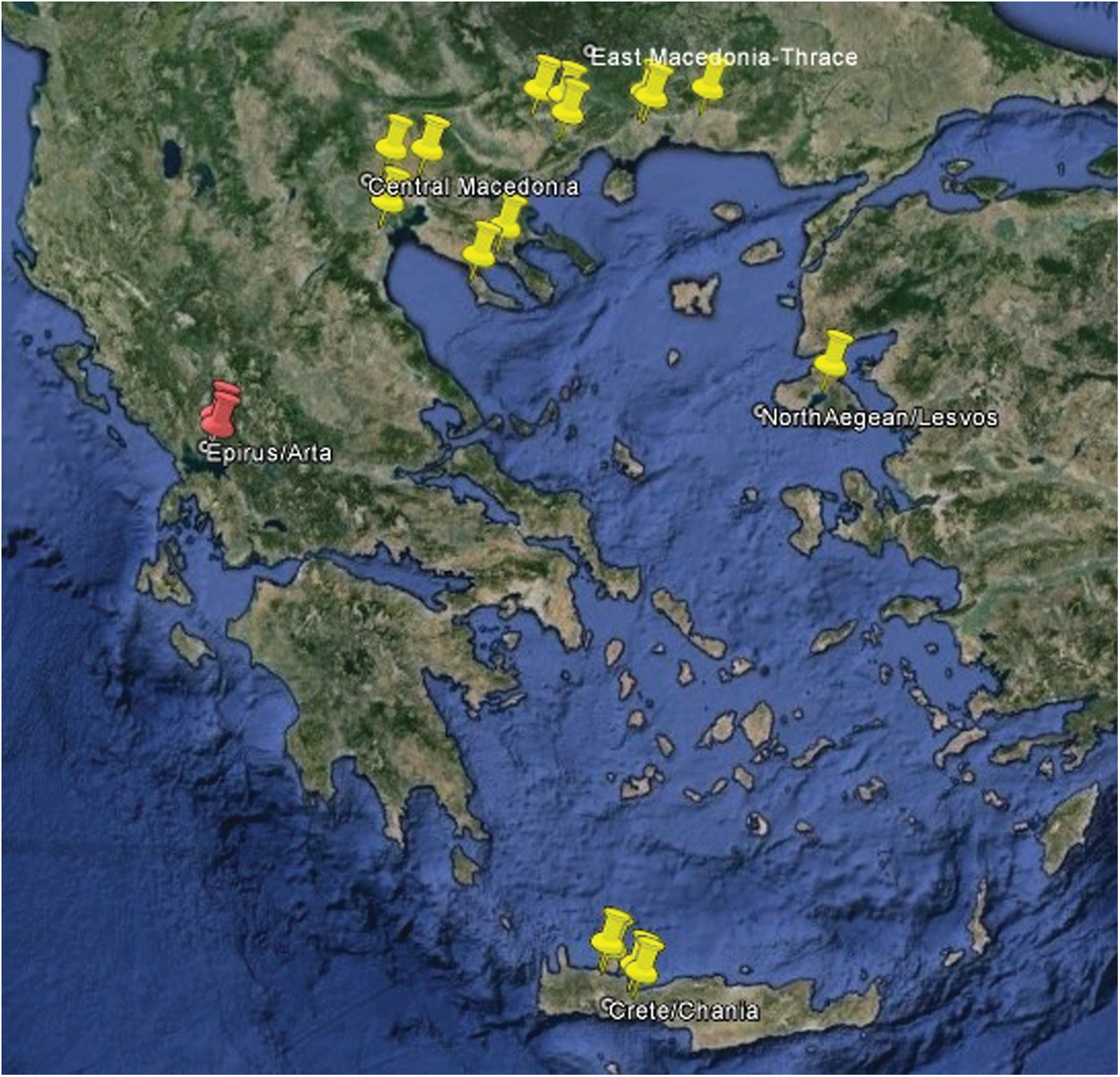
Geographical distribution of collection sites of Ae. albopictus and Cx. tritaeniorhynchus in new areas of the country. The yellow pins represent sites where Ae. albopictus adults were collected and red pins the sites of Cx. tritaeniorhynchus collections.
PCR amplification using both primer pairs (5.8S/28S and C1-J-1718/C1-N-219) produced fragments of the expected sizes, specific for Ae. albopictus. The RFLP assay verified that all samples examined were Ae. albopictus. Sequencing results of the four ITS2 and COI products revealed sequences with 98–100% homology to the GenBank deposited ones for Ae. albopictus. One COI and four ITS2 sequences have been submitted to the EMBL sequence database, with the accession numbers LT221029 and LT221030-33, respectively.
Sequencing of the two Cx. tritaeniorhynchus PCR products, examined for both genes, produced sequences sharing 95–99% homology with GenBank deposited ones. The two COI fragments share 99% similarities with GenBank sequences with accession numbers KC753196 and KC753197, regarding Cx. tritaeniorhynchus samples collected in rice fields in Etoloakarnania, Greece (Lytra and Emmanouel 2014). Two COI and two ITS2 sequences have been submitted to the EMBL sequence database, with accession numbers LT221027-28 and LT221034-35, respectively.
Discussion and Conclusion
Since the WNV outbreak in Greece in 2010 and the cases of autochthonous malaria due to Plasmodium vivax reported in Evrotas, Lakonia, there is increased concern among Public Health authorities, regions regarding vector-borne diseases. Entomological surveillance programs are implemented to promptly monitor mosquito species' presence/absence, detect pathogen species, and support mosquito control actions.
Our findings confirm the suspicion that Ae. albopictus has been expanding in Greece, a fact that increases the possibility for further local transmission of viruses transmitted through Ae. albopictus after their importation. Ae. albopictus is known to be an effective vector of Dengue, Chikungunya, Yellow fever, and other viruses (Gratz 2004, Becker et al. 2010, ECDC 2012). The species was involved in local transmission of cases of Dengue and Chikungunya in Europe (Marchand et al. 2013, INVS 2014, Paty et al. 2014). These facts along with the severe nuisance caused by Ae. albopictus to residents of cities and villages should be of great concern to public health authorities.
In addition, we report about the third record of Cx. tritaeniorhynchus in Greece in the Municipality of Nikolaos Skoufas, regional unit of Arta, region of Epirus, in Western Greece. Cx. tritaeniorhynchus was the most abundant species in this regional unit. These findings are important as they refer to urban settings and concern a regional unit in close proximity with Etoloakarnania where the previous records of the species were performed. It may suggest that the species has spread along the western part of the country. Cx. tritaeniorhynchus is also present in Albania (Danielovi and Adhami 1960, Adhami 1987), therefore we could hypothesize that the species is present and more widely distributed in western Greece. It has possibly been underestimated until now, since no data were available. Cx. tritaeniorhynchus is mainly distributed in south Asia, Middle East, and Afrotropical countries. It is a potential vector of important diseases and pathogens such as JE, Dengue, Rift valley fever, Sindbis, and microfilariae (Bram 1967, Self et al. 1973). This present record along with the previous ones indicate the need for further studies on Cx. tritaeniorhynchus distribution in other regions of the country.
A limitation of the study was the geographical distribution and representativeness of the mosquito collection sites, as surveillance activities were mainly based on the voluntary participation of local subcontractors of the vector control programs. Thus, it was not possible to conduct entomological surveillance in all areas recommended by the protocol and only distribution data on presence/absence of mosquito species are provided.
Currently, there is an increasing concern in Europe regarding vector-borne diseases (Semenza and Zeller 2014). The introduction and establishment of these two species impose risks for Greece, related to the pathogens that they can transmit in humans. This fact should be taken into consideration by public health authorities to implement integrated mosquito management programs, perform risk assessment, and work toward the development of a national strategic action plan, aiming to the prompt management of diseases transmitted by invasive mosquito species.
Footnotes
Acknowledgments
The authors would like to thank all regions and regional units and the subcontractor companies for mosquito management that performed adult collections and sent the samples to the Laboratory of Medical Entomology of NSPH, for participating in the Entomological Surveillance programs of 2014 and 2015.
Author Disclosure Statement
No competing financial interests exist.