







Abstract
Background:
Visceral leishmaniasis is a zoonosis distributed throughout Brazil and caused by the protozoan Leishmania infantum. The disease manifests in its visceral form, with dogs being the primary reservoir. Manaus is the largest city in the Brazilian Amazon region, and despite its significance, there are only documented cases of cutaneous leishmaniasis in humans. The aim of this study was to assess the occurrence of Leishmania infantum in horses in Manaus, Amazonas, Brazil.
Materials and Methods:
A total of 178 horses from 16 different properties within the city were sampled, and the specific molecular diagnosis was based on the L-like cathepsin gene.
Results:
Of the 178 horse samples, 82% were positive for L. infantum in the molecular diagnosis based on the L-like cathepsin gene, and of the 16 different properties sampled, only one did not have any positive animals.
Conclusion:
The role of horses in the transmission cycle of visceral leishmaniasis remains controversial, but the presence of infected horses before the appearance of human cases suggests that this host group could be considered sentinel, and their monitoring may serve as an early warning for the emergence of leishmaniasis in a given area.
Introduction
Leishmaniasis is a chronic, systemic, and potentially fatal disease caused by obligate intracellular protozoa belonging to the Trypanosomatidae family, genus Leishmania, and distributed worldwide. In the Americas, it is a serious and endemic public health issue (Brasil, 2019; PAHO, 2016 and PAHO, 2019).
In Brazil, visceral leishmaniasis (VL) is caused by Leishmania (Leishmania) infantum, while the main agents of cutaneous leishmaniasis (CL) are L. (L.) amazonensis, L. (Viannia) braziliensis, and L. (V.) guyanensis (Brasil, 2000, 2010, 2014). Both forms, VL and CL, are transmitted to humans and animals through the bite of female mosquitoes belonging to the Psychodidae family, subfamily Phlebotominae (Brasil, 2010, 2014).
Leishmaniasis has been reported in various Brazilian municipalities, showing significant changes in transmission patterns, initially predominating in sylvatic and rural environments and more recently in urban centers (Brasil, 2019). Human-induced modifications and the anthropization of sylvatic areas have threatened the natural ecosystems of phlebotomines and some mammals, promoting the adaptation of these insects and wild hosts to urbanized environments (Guerra et al., 2015).
Brazil currently has the fourth largest equine population on the planet (IBGE. Instituto Brasileiro de Geografia e Estatística , 2021), and horse breeding is a sector that generates over R$16 billion annually, creating 610,000 direct jobs and 2.43 million indirect jobs (MAPA. Ministério Da Agricultura, Pecuária E Abastecimento, 2016). The state of Amazonas has a population of nearly 30,000 horses (IBGE, 2021).
Infections by Leishmania have been described worldwide and in all states of Brazil (Cecílio et al., 2022) and can present cutaneous symptoms such as papules, nodules, ulcers, or crusts that tend to regress spontaneously (Limeira et al., 2019). Many studies have shown that horses can be parasitized by different Leishmania species, such as L. infantum, L. braziliensis, and L. siamensis (Gazzonis et al, 2020; Filho et al., 2008; Truppel et al., 2014; Müller et al., 2009).
Equids are animals that are close to humans for companionship, such as dogs and cats, for sports, or for work. Concurrently, socioeconomic conditions and environmental degradation in endemic leishmaniasis areas can favor parasitism in horses, which may serve as potential reservoirs and food sources for different species of phlebotomines (Limeira et al., 2019).
The Amazon biome has the largest extent and biodiversity in Brazil and a high degree of environmental degradation (Pires et al., 1985), and no study has been conducted for the specific diagnosis of L. infantum in horses in the Amazon biome. Thus, in this article, we describe the specific molecular diagnosis of Leishmania infantum in horses from the municipality of Manaus in the state of Amazonas, Brazil.
Materials and Methods
The study was conducted in the city of Manaus and Rio Preto da Eva, Amazonas state, and its metropolitan area, located in the Northern Region of Brazil. A total of 16 properties were selected for convenience and sampling from August 2018 to July 2019, and 178 blood samples were collected via external jugular venipuncture into Vacutainer collection tubes and stored at −20°C for subsequent DNA extraction (Table 1). There was no predominance of breed, sex, or age. All animals were raised in a mixed farming system (outdoors during the day and housed at night). At the time of collection, the animals showed no visible skin lesions; however, ulcerations caused by the parasitic worms Habronema and Draschia were reported.
Properties Sampled and Horses Positive for Leishmania infantum in Molecular Diagnosis Based on the Cathepsin L-Like Gene
The study was approved by the Committee on Ethics in the Use of Animals number 008.02.1417.2404/2020 from the Federal Institute of Education, Science, and Technology.
The samples were subjected to DNA extraction using the commercial “PureLink Genomic DNA Mini Kit” (ThermoFisher, MA, USA), following the manufacturer’s instructions. The DNA samples were then analyzed for specific molecular diagnosis of L. infantum based on the cathepsin L-like gene, under conditions previously described by Silva et al. (2019), using the primers CatLeishF (5′-GACAACGGCACCGTCGGCGCCAAAATAAAAG-3′) and CatLeishR (5′-CAGTACGGCGGTTTCGCTTGTCTGTTGAAGC-3′). The conditions for amplifying the cathepsin L-like gene included 34 cycles of denaturation at 94°C for 1 min, annealing at 64°C for 1 min, and extension at 72°C for 45 s. The PCR products were visualized by agarose gel electrophoresis at 1.5% and stained with GelRed (ThermoFisher).
Some amplified PCR products were selected by DNA sequencing in a genetic analyzer (ABI-PRISM 3500; Applied Biosystems, Foster City, CA), in accordance with the manufacturer’s instruction. The sequences obtained from host horses were compared with GenBank entries by using the BLAST program (http://blast.ncbi.nlm.nih.gov).
Results
Of the 178 horse samples, 82% (149/178) tested positive for L. infantum in the molecular diagnosis based on the cathepsin L-like gene. Out of the 16 different properties sampled, only one did not have any positive animal (Table 1; Fig. 1).
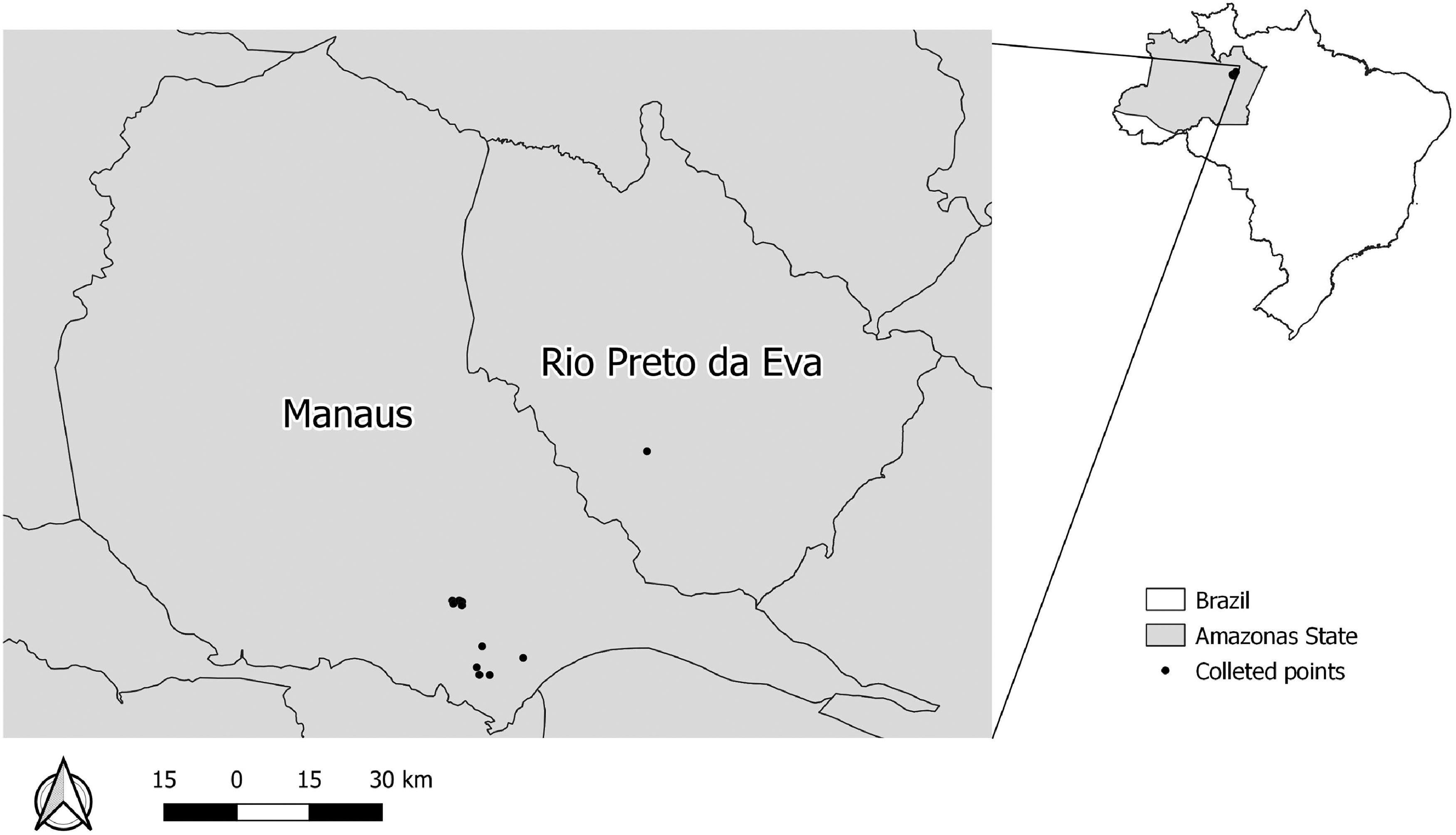
Location of the sampled properties for the specific molecular diagnosis of Leishmania infantum based on cathepsin L-like gene.
Ten DNA sequences of the amplified products were obtained, and all were identical (100% similarity) to L. infantum cathepsin L-like (GenBank accession number MH427795). All sequences obtained were deposited in GenBank (PV334198-PV344207).
Discussion
In the state of Amazonas, CL is recognized as an endemic disease, with documented cases prevalent in almost all municipalities of the region (Santos et al., 2024). The state’s development trajectory, marked by environmental changes such as road construction, resource extraction, deforestation activities, and notably urban expansion, has caused shifts in the dynamics of vector and reservoir populations, which are crucial for the transmission of infectious diseases in the area (Guerra et al., 2015).
In the 1980s, there was an escalation in the occurrence of VL in the Amazon region, with an increase in incidence in rural areas as well as in suburban and urban areas of medium-sized cities (Walsh et al., 1993). Ongoing deforestation activities facilitated the expansion of the vector (Lutzomyia longipalpis) into peridomestic environments, particularly in the metropolitan area of Belém (Lainson et al., 1983). Existing research has predominantly focused on other Brazilian states within the Amazon biome, making it challenging to understand the epidemiological landscape of the disease in the city of Manaus.
Several studies point to horses as hosts for different Leishmania species with a cosmopolitan distribution (Aguilar et al., 1986; Falqueto et al., 1987; Yoshida et al., 1988, 1990; Barbosa-Santos et al., 1994; Ramos-Vara et al., 1996; Koehler et al., 2002; Brandão-Filho et al., 2003; Rolão et al., 2005; Soares et al., 2013; Gazzonis et al., 2020; Mendes Junior et al., 2023). In Brazil, horses are identified as reservoirs for L. braziliensis (Truppel et al., 2014).
The role of horses in the CL transmission cycle has been established, but their role in the VL transmission cycle is still unclear. In Brazil, horses infected with L. infantum have been diagnosed in the states of Minas Gerais and São Paulo, using serological and molecular techniques (Feitosa et al., 2013; Soares et al., 2013; Benassi et al., 2018; Leonel et al., 2020). These findings, along with experimental studies (Cerqueira et al., 2003), classify horses as incidental hosts.
Various studies indicate infection by Leishmania in horses (Ramos-Vara et al., 1996; Müller et al., 2009; Escobar et al., 2019), but identification of L. infantum has only been carried out in endemic areas of the disease. The state of Amazonas is considered silent for VL, with five human cases recorded between 2000 and 2022 (Brasil, 2024). The main vectors in the region are Lutzomyia anduzei, Lutzomyia whitmani, and Lutzomyia umbratilis (Scarpassa et al., 2021), with no record of L. longipalpis, the primary vector of VL in Brazil. In regions where L. longipalpis is absent, alternative sandfly species may serve as vectors for L. infantum (Galvis-Ovallos et al., 2021).
Despite the low number of human cases and the absence of the main vector, in Manaus, seropositivity for anti-Leishmania spp. in dogs ranged from 3.5% to 12.5%, but a study conducted in 2021 found a seroprevalence of 20.8% and 39% in animals infected with L. infantum (Nascimento de Campos et al., 2024), corroborating the findings of this study.
The high positivity found may reflect the lack of studies in the area, which is considered silent, as well as the low number of recorded human cases. However, the high positivity in animals raises concerns about a possible outbreak in the human population.
Horses represent the fifth most preferred food source for phlebotomines in Brazil (Sousa et al., 2021). They are food sources for phlebotomines in peridomestic environments, promoting transmission to humans (Limeira et al., 2019).
The role of horses in the VL transmission cycle remains controversial, but the presence of infected horses before the appearance of human cases suggests that this host group may serve as a sentinel, and their monitoring could be used as an early warning for the emergence of leishmaniasis in a given region.
Footnotes
Funding Information
Conselho Nacional de Desenvolvimento Científico e Tecnológico—CNPq [grant number 301657/2022-0] and Coordenação de Aperfeiçoamento de Pessoal de Nível Superior (CAPES).
Acknowledgments
The authors thank all dog owners that accepted to collaborate in this study.