







Abstract
Although traditionally considered a male bastion, higher education in India is attracting more women who seek professional and career advancement. However, the prevalence of overt and covert discrimination, sexual harassment, and violence within academia continues to victimize women. India's traditional patriarchal society, structured on gender stereotypes, bias and inequity, impacts at all levels. Within the above contexts, this study analyzes secondary data on the prevalence of sexual harassment and gender-based violence against women within academia in India, and seeks to understand its contextual dynamics and dimensions. The authors conclude that despite many legislations, constitutional guarantees and governmental guidelines, female students, faculty, and staff within academia face considerable sexual harassment and violence that threatens to limit the progression of women toward academic pursuits as well as attainment of leadership in society.
Introduction
Surpassing China in April 2023 as the most populated nation in the world, India today has a population of 1.4 billion and is emerging as the fastest growing economy, with a predicted growth rate of 6.3% by 2024 (International Monetary Fund, 2023). Sustaining this growth is only possible when women who form about 48.4% of the Indian population (Population, 2021), are able to freely and equally contribute to the workforce through advanced education and skill development. However, holistic participation of women has been impacted by India's traditional patriarchal social structure, which reinforces stereotypes and sustains gender discrimination. For women to rise to leadership roles and participate equally in decision making, both the family and educational institutions need to provide the right environment for women to learn and to thrive.
Since the 1990s, the impact of globalization in India has created a vibrant developing economy with immense work opportunities for all. As women compete for equal participation within this new “knowledge society,” they seek admission to higher educational institutions for advanced learning. University campuses are expected to be “safe spaces” for students to interact freely in pursuit of knowledge; however, this assumption is contradicted by cases of sexual harassment and violence against women on campuses across India, which seriously impedes their academic and career pursuits. In order that universities can fulfill their role of providing an open environment for the development of free and critical thought, and bring about social transformation within society, they need to provide safety and security for all women within academia.
Conceptual Framework
The word “Academia” is applied to an environment or community engaged in the pursuit of research, education, and scholarship. People in academia include college and university students, professors, as well as administrative and support staff. Castells (2001) suggests that the basic functions of a university include ideological and cultural influence on society through socialization of students, development of a relatively autonomous space for critical thought and reflection, provision of a mechanism for selection and socialization of elite, knowledge generation, human capital formation, and skill development.
Universities also play a crucial role in social transformation, by providing access to higher education for groups previously not represented or underrepresented. Women across the globe, have remained underrepresented in higher education as it remained dominated by male students, particularly in Science, Technology, Engineering, and Mathematics (STEM) courses (Bielby et al., 2014; Meyer et al., 2015). Therefore, it might be valid to state that the role of universities can be fulfilled only if all members of society are able to experience higher learning in a space that is viewed as safe and secure, providing academic freedom and encouraging career and employment opportunities that are based on equality of achievement.
Both the family as well as educational institutions form vital constructs in gender socialization of masculinity and femininity as well as their connotations of inferior and superior positioning within social structures, indicating a sociological imprint on the choices of women (Chanana, 2006). This social phenomenon rooted in hyper masculinity and patriarchal conditioning within the family and society, also fosters a climate conducive to perpetration of violence and sexual harassment against the perceived “inferior” and “subjugated” female gender.
The United Nations declaration on the Elimination of Violence against Women (1993) defines gender violence as “Any act of gender-based violence that results in or is likely to result in, physical, sexual or psychological harm or suffering to women, including threats of such acts, coercion or arbitrary deprivation of liberty, whether occurring in public or in private life.” It includes physical, sexual, psychological, suffering caused to women at different stages in their life. Sexual harassment is defined as unsolicited and unwanted sexual behavior that is perceived by the victim as humiliating, offensive, and disabling in terms of their own safety and psychophysical wellbeing (Fitzgerald et al., 1995).
In India, the Sexual Harassment of Women at Workplace (Prevention, Prohibition, and Redressal) Act, 2013 (PoSH Act) states that sexual harassment includes any one or more of the following unwelcome acts or behavior (whether directly or by implication), namely physical contact and advances; a demand or request for sexual favors; making sexually colored remarks; showing pornography or any other unwelcome physical, verbal, or nonverbal conduct of sexual nature (Government of India, 2013). Sexual harassment often emanates from a position of power, to coerce a subordinate to accept unwanted sexual attention. It can also occur among peers through sharing sexual jokes, pornographic photos, or unwelcome sexual innuendos.
Gender violence against women is a universal phenomenon, sustained to reinforce patriarchal practices that perpetrate female subjugation and subordination. History validates that societies across civilizations have been largely patriarchal and many societies endorsed “taming of the wife” through beating and abuse as a necessary step to maintain power and order within families (Lentz, 1999; Sewell, 1989). Gender violence has often been used in conflict zones as a tool of war (Heineman, 2011). There are ample references to gender-based violence in ancient Greece and in ancient Rome (Ashmore, 2015; Witzke, 2016). Ptolemy refers to beating of a wife as punishment for her disrespect or rudeness (Matić, 2021). In Ancient Mesopotamia, the Hammurabi's Code also mentions gender violence (Fidler, 1913; Fox, 2013). In ancient India, the Manusmriti (Ahmed-Ghosh, 2004; Sinha, 2014) and Kautilya's Arthashastra (Boesche, 2003) refer to violence against women, validating the historical, sociocultural roots of gender violence within societies.
Within traditional Indian society, familial power structure rendered the position of women dependent on father, husband or son, often vindicating violence as a means to make her conform to sociocultural and religious norms and diktats dominated by patriarchy. For many Indian women, the choice of giving birth to a child, choice to go to school, to dress in nontraditional attire, career choice, marriage choice, freedom to use her dowry, and even nature of death (as in the case of sati) have been subject to male decision making. Any abrogation of societal norms was often dealt with violence, abuse, rape, and even honor killing.
In contemporary India, the participation of women in education and in the workforce continues to be impacted by its patriarchal and hierarchical social structure, which sustains objectification of women and caste-based inequities. Within the stereotypical sociocultural expectations and norms of “what is traditional” and “what is acceptable,” women in India continue to be considered as unequal and face discrimination and bias within a society that is still predisposed as “pro-male.” This is further amplified in cases of women belonging to marginalized castes that were traditionally deprived of seeking access to education. Workplace sexual harassment fosters insecurity, discomfort, and a hostile work environment that discourages many women from seeking employment. Despite the existence of legislations that provide for judicial action against offenders, the existence of a corrupt and inefficient system of justice as well as law and order structure with many loopholes, results in blatant misuse of the system by the powerful within society who often circumvent the laws with impunity.
The sustained increase in crime against women is evidenced by statistics provided by the NCRB (2021), which indicates that there were 428,278 recorded cases of crime against women in India in 2021, an increase of 15.3% over the recorded number of 371,503 in 2020. Within campuses across India, we see the prevalence of sex-based crime such as verbal harassment, physical assault, sexual coercion, inappropriate touching, stalking, cyber harassment, and rape (Nieder et al., 2022), largely due to lack of sensitization toward sexual harassment and inadequate reporting of sex-based crime, despite the fact that all these crimes are explicitly addressed through the Indian Penal Code (1860) and Special Laws and Legislations enacted in India.
Within the above contexts, this study seeks to understand the contextual dynamics, and dimensions of gender violence and sexual harassment against women in Indian academia through the following research questions:
What are the existing mechanisms to encourage reporting of cases of sexual harassment and violence among women in academia? What are the legal provisions to address sexual harassment and violence against women in academia? What is the level of reporting on cases of sexual harassment and gender-based violence in academia to official authorities? What kind of action is taken by educational institutions in the cases of sexual harassment that are reported? Is there reliable data on cases of sexual harassment and gender violence against women in academia?
The above research questions were analyzed using statistical data from government databases and archives in India, including Ministry of Education, National Crime Record Bureau, National Commission on Women, Census department, University Grants Commission (UGC), as well as news media reports. Furthermore, the authors suggest measures that need to be taken to alleviate the conditions of women in academia and restore them as “safe havens” for students and faculty to learn and develop holistically, in line with the prescribed role and functions of universities.
Literature Review
The study of Gender violence in academia is recent and has emerged out of greater awareness of the issues and challenges impacting the success of women in workplaces. Studies in this field highlight the prevalence, nature, and underlying causes of gender violence and sexual harassment in universities (Anitha et al., 2020; Clowes et al., 2009; Gómez, 2022; Kaukinen et al., 2017; Prior and de Heer, 2022). Deriving from scholarly analysis (Aja-Okorie, 2015; Cantalupo and Kidder, 2018; McKinney, 1990; Wood et al., 2021), sexual harassment in universities can be categorized by offender for clearer focus, namely sexual harassment of student by student, student by faculty/staff, faculty/staff by student and faculty/staff by faculty/staff.
While some scholars delve on attitudes and perceptions of students toward sexual harassment (Garcia et al., 2012; Vidu et al., 2014), others have focused on the institutional response toward such incidents as well as the support mechanisms available to victims (Eriksen et al., 2022). There are also some studies on interventions for prevention of campus gender violence (Cares et al., 2015; Kirk-Provencher et al., 2023; Wooten and Mitchell, 2015). However, these are mainly relative to academia in western contexts and only marginally studied elsewhere.
Within Indian contexts, there has been some research on the existence and complexities of gender violence in campuses. Dey (2019) explored how class, caste, religion, and geography influenced perceptions of sexual violence among those violated, their offenders and the resultant punishments in India, suggesting that social segregations, gender division, and patriarchy contribute to discrimination and violence. Nainar (2022) suggests the patriarchal dominance theory for better understanding of the deep-rooted causes of gender violence and sexual violence in India. Thus, the root of gender violence has been traced to existential patriarchy by many writers.
Collecting data from three universities in Delhi, Kousar (2018) studied the scope and incidence of sexual violence and related behaviors experienced by women on campus, including students, research scholars, and faculty. The results of this study validated that 80% of women experienced sexual and psychologically offensive behavior, 70% acknowledged that they were sexually assaulted, 2% acknowledged attempt to rape, and 89% had experienced stalking. Using legal case studies of gender-based crimes, Mishra and Bhutia (2023) explored the gaps in laws and complaint processes and analyzed the anomalies in teacher–student relations, particularly regarding consensual and nonconsensual behavior that maybe conducive to sexual harassment in academia. Mishra (2021) also found that college students are at greatest risk of sexual harassment in the first few months of their first and second semesters. Thus, scholarship acknowledges that more women in India are prone to gender violence in academia.
Chanana (2003) highlighted that social constructions of male power and female passivity impact the procedures for appointment, promotion, and governance and contribute to organizational and management discriminatory practices against women in academia, which results in their unequal representation in higher academic positions. This is validated by Das et al. (2023) who argue that although sexism is pervasive in academic institutions, it remains unnoticed and unaddressed. This results in gendered experiences that have crippling and debilitating implications for women, often impacting their career prospects in universities and perpetuating patriarchal power structures and hierarchies in the workplace.
John (2020) pointed out that violence has constrained female students' aspirations to seek higher education and employment. Focusing on an inner-city college in South India, Rogers (2008) argues that sexual harassment is a manifestation of instrumental violence, resulting from the intense competition for male privilege and status between the newly emerging middle-class elite and impoverished low-caste groups. This suggests that women from marginalized communities in India might be more vulnerable to gender violence in universities.
The #Metoo-movement in India further augmented research in this area. In 2017, law student Raya Sarkar published an online list of sexual predators in Indian universities (Banerjee, 2017). Anitha et al. (2020) examined the impact and limitations of the above online publication as a new form of collective action among feminists against gender violence and raised important questions about voice, solidarity, and resistance in the struggle against gender-based violence in India. Furthermore, Dey and Mendes (2022) provided insights into reasons why violated women turn to online spaces for justice and healing especially when conventional means of reporting and institutional action fail them. The challenges faced by internal complaints committee (ICCs) members within universities, such as ambiguities within the law, unrecognized cognitive bias, and a lack of adequate conversation on the topics, were also explored (Sinha and Bondestam, 2022).
Another aspect where sexual harassment impacts most is in higher scholarship and leadership within academia. Thomas (2015) and Vandana (2020) contend that exploitation and harassment hinder women from reaching top positions, which would explain the underrepresentation of women in the top echelons of academia. Analyzing data from a national study of social inequalities in higher education in India, Sabharwal et al. (2020) observed that conference access is embroiled in relational processes of gender exclusion within institutions resulting in proportionally lower participation from women and recommend scrutiny of policy implementation for greater gender inclusivity. Another study explores the manifestations of academic bullying through women faculty's victimization experiences by revealing the “safe game” tactics used by bullies such as overloading potential targets with work to portray them as incapable and incompetent, lodging formal complaints against women targets and building an environment of silence through threats (Krishna and Soumyaja, 2020).
Studying gender inequalities in publication of journal articles in 2017 for 186 research fields, Thelwall et al. (2019) compared 27,710 articles with an Indian male or female first author and concluded that there were 2.8 male first authors per female first author overall, necessitating greater initiatives to address the imbalance.
Evaluating the impact of sexual violence prevention training programs for female college students in select universities in New Delhi, Nieder et al. (2022) observed that students in the training group showed increased awareness of gender stereotypes, therefore sexual violence prevention programs must include all genders to bring about holistic social change. A cross-sectional study on college students in India, examined gender norms and perspectives, bystander intervention behaviors, and gender-based violence on campuses and concluded that there were considerable differences in male–female student responses to these parameters. This suggests that college students should be the focus of efforts to change the narrative of gender-based violence and norms in India (Asher et al., 2020).
Saini (2021) surveyed the experiences of teachers in an institution in Delhi and concluded that women who were violated, typically did not lodge formal complaints due to fear of social stigma. Furthermore, the injured party was often dissuaded from lodging formal complaints by authorities in attempts to safeguard institutional reputation. This suggests the need for greater institutional and faculty support to develop a more holistic understanding of how gendered social structures inflict violence on both women and men.
Thus, although there have been some efforts by academic scholars at addressing the existence, nature, and efforts to initiate action against offenders, these writings are minimal when compared with the deluge of media reports highlighting the prevalence and increase in gender violence in universities across India. Therefore, it is evident that there are vital gaps in academic research relating to existence of specific data on gender violence in academia, its trends and indicators, mechanisms for mitigation of such cases, and streamlining of action taken by universities, which this article seeks to address.
Women and Higher Education in India: A Historical Perspective
In India, some connotation of higher learning has existed since ancient times. As early as the fifth century, Taxila had emerged as a center for advanced learning and included many colleges with scholars like Panini and Kautilya (Shahid, 2012). Historical sources attest that Nalanda Mahavihara was a renowned site of higher education from the 5th to the 12th century CE, with 2000 teachers and 10,000 students (Pinkney, 2015). Vikramshila was also a renowned center of learning during the medieval period, contributing to the propagation of Buddhism in Tibet, Pegu, and Ceylon (Singh and Jha, 2017). These universities attracted students from Korea, China, Burma (Myanmar), Tibet, Nepal, and Sri Lanka.
Most ancient Indian texts reveal that women in early Vedic India were actively involved in religious and social life with access to education, as seen in references to many women rishis (saints), writers, and philosophers (Fane, 1975). Vedic texts refer to two types of scholarly women; the Brahmavadinis or women who never married and dedicated their lives to vedic study and Sadyodvahas who studied the Vedas until they married (Kapur, 2018; Rout, 2016; Saxena, 2015). There are references to women scholars like Gargi, who indulged in philosophical debate in the royal court, Viswawara and Sikta who composed Vedic hymns, Maitreyi and Lopamudra who pursued spiritual learning, and Ghosa, Apala, Urvasi, and Romasa who were renowned for their scholarly prowess (Banerji, 1999; Pramanik, 2019; Sharma, 2020).
Buddhist texts refer to both female monks (Bhiksuni) such as Khema, Mahaprajapati, Sumedha, as well as Sanghamitra, the daughter of King Ashoka who traveled to the Far East to spread Buddhism (Paranthaman et al., 2019; Tsomo, 2010). Jain texts mention Jayanti, a Kousambi princess who devoted her life to religion and philosophy (Lokare, 2022; Pal, 2019).
However, these were exceptions and even among these scholars, most were either monks, or studied until marriage or remained single and set aside domestic roles for religious pursuits. As family roles became more and more gender differentiated, men became associated with the public sphere and women were designated with domestic responsibilities of family and childcare. Kautilya in his Arthashastra negates any connotation of freedom for women and restricts them from going to public spaces without husband's permission (Chaudhuri et al., 2018; Ocasio, 2011). The Manusmrithi dictates that a woman is dependent on her father in childhood, on her husband in youth, and on her son in old age (Mukherjee, 2013) and advises women to stay indoors and obey husbands by fulfilling domestic roles (Naseera and Kuruvilla, 2022).
By the medieval times women faced more restrictions within society, yet there are references to prominent women in education and politics such as Razia Sultana, Gulbadan, Noor Jehan, Jahanara, Zebunnisa, and Jija Bai (Kumar Vardhan, 2014). As society gained more of a patrifocal and patriarchal structure, sons rather than daughters were educated and groomed to be breadwinners and torchbearers of the family, which led to the neglect of women's education.
In the modern period, the minutes of Elphinstone in 1823 and Macaulay in 1835 (Benson, 1972) laid the foundations for higher education in India. The Woods despatch of 1854 (Moore, 1964) put forth a coherent plan for higher education and three universities were established in the Bombay, Bengal, and Madras Presidencies in 1857. The Sergeants report of 1944 (Singhal, 2006) further recommended the formation of a Commission to oversee the work of universities. In 1956, by an act of parliament, the UGC was established as a statutory body under the Government of India for supervising and setting the norms and standards for all universities in India.
Formal schools for girls were established in 1854 under the initiation of the East India Company. Social reformers of the 19th century like Jyothiba Phule and Iswarchandra Vidyasagar encouraged women's learning as they considered oppression of women as a traditional instrument to maintain patriarchal dominance and gender inequality (Rao, 2007). Other cultural revivalists promoted education of women, as a means to strengthen traditional Indian culture and values against westernization, rather than as a liberating force from the patriarchal social structure (Patel, 1998).
After independence, the Dr. Radhakrishnan commission (1948) recommended enhancement of higher education for women. The National Committee on Women's Education (1958–1959) under Durgabhai Desmukh, The National Council of Women's Education (1962) and Bhaktavatsalam Committee (1963) made further recommendations to improve women's education. The Kothari Commission (1964–1966) recommended stringent efforts to close the gender gap in education. The National Policy on Education (1986) aimed “to play a positive interventionist role in the empowerment of women” and “widen women's access to vocational, technical, and professional education at all levels.” The year 2001, celebrated as women's empowerment year, recognized women as the agents of socioeconomic change in the country. Furthermore, within the last decade, there has been a steady growth in the number of higher educational institutions in India.
In the Indian context, both colleges and universities constitute educational institutions of higher learning, although a college offers degree and diploma courses to its students and is either autonomous or affiliated to a larger university, a university is an authorized educational and research institution that grants degrees to students, in respective fields. Table 1 indicates that 8944 new colleges and 471 new universities were added between 2011 and 2021 indicating the impetus given by the UGC for the establishment of higher educational institutions across India.
Number of Universities and Colleges in India from 2011 to 2021
Source: AISHE 2016–2017, 2017; 2020–2021, 2022.
At the time of independence there were ∼241,369 students registered in higher educational institutions. The last decade also witnessed a systematic increase in the number of student enrolment and a noteworthy increase in the number of female students from 43.76% in 2011 to 48.68% in 2021 (Table 2).
Student Enrolment at Various Levels of Higher Education from 2011 to 2021
Source: AISHE 2020–2021, 2022.
During this period, the number of faculty teaching in higher educational institutions has also increased. Table 3 indicates the overall increase in the number of academic faculty as well as an increase of female faculty from 38.99% in 2011 to 42.87% in 2021.
Proportion of Faculty Teaching in Higher Education from 2011 to 2021
Source: AISHE 2016–2017, 2017; 2020–2021, 2022.
In the initial years, women entering universities usually opted for courses in Arts, Science, and Commerce streams, with very few female students opting for science and technology courses. However, globalization has had a crucial impact on higher education by establishing a growing economy and knowledge society that requires specific skill development for work. Globalization is closely linked to technology and engineering as well as the sciences. Figure 1 indicates that female students prefer to enroll in Sciences, Arts, Commerce, and Medicine while enrolment in courses such as Engineering, IT, Law, and Management remain dominated by male students, contributing to gendered implications for university enrollment and employment in these fields.
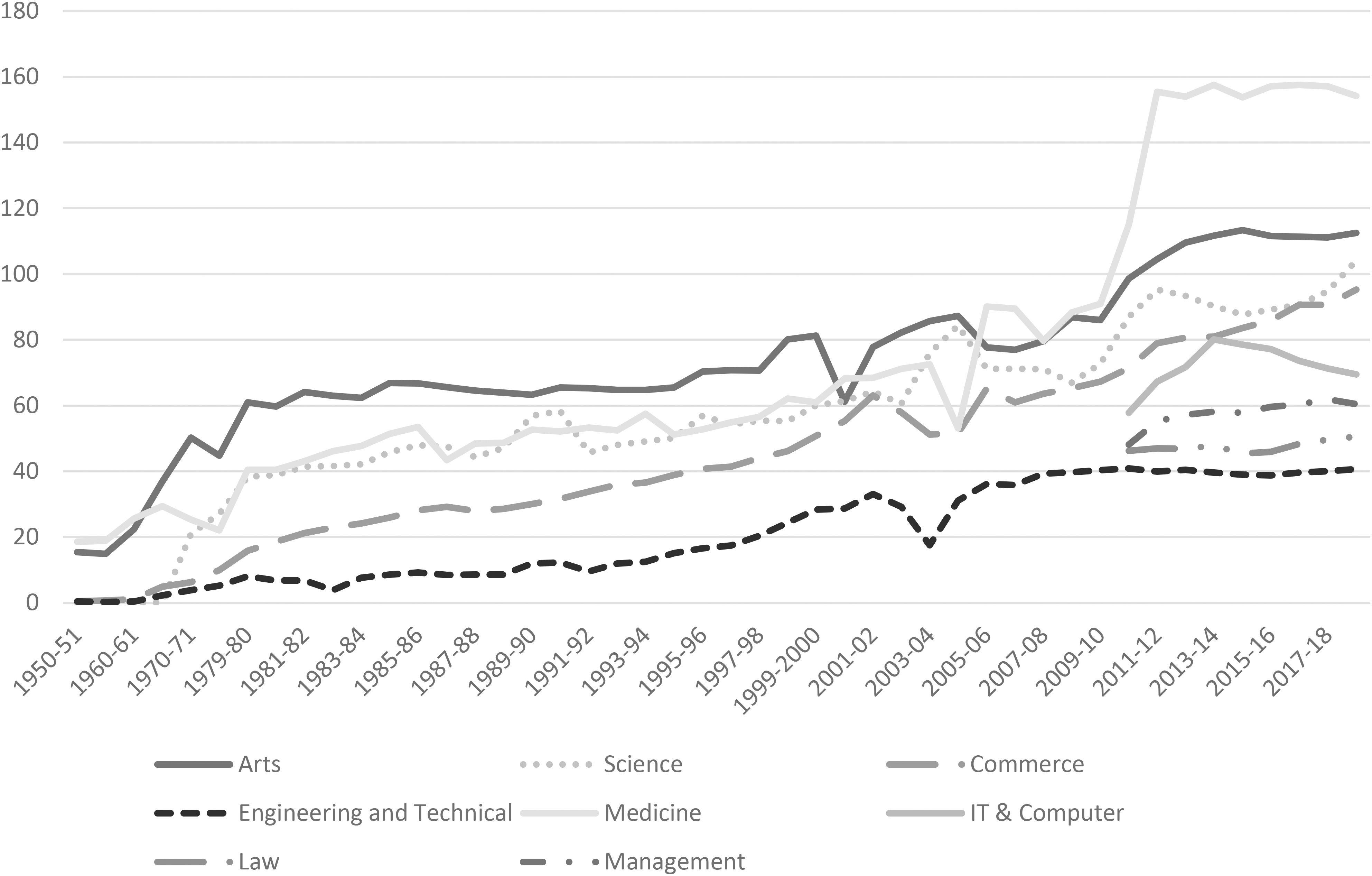
Female per 100 male students in various university courses from 1950 to 2018. Source: AISHE 2016–2017, 2017; 2020–2021, 2022.
This is lower than global statistics where gender disparity in STEM education is striking with females forming only 35% of all students enrolled in STEM-related fields (UNESCO, 2017).
India has many renowned educational institutions exclusively for Engineering and Technology courses such as the Indian Institutes of Technology (IIT) and Indian Institutes of Management, however despite decades of seat reservation for women, lower fees and affirmative action, the number of women in these institutions remain marginal. The reluctance of parents to invest in women's education sustained by the traditional belief that a daughter's income would go to the husband after marriage, and that childbearing and domestic responsibilities would prevent women from continuing their career, has resulted in a smaller number of women pursuing such fields. In addition, the vulnerability of women to gender-based violence and discrimination in the workplace, has impeded the wider participation of women in STEM courses.
Governmental Legislations and Violence Against Women
While there are many legislations in India that support women, the lack of uniform, fair, and consistent implementation of these laws (Bhattacharyya, 2016; Verma et al., 2017), has resulted in failure to bring offenders to justice and enforce punishments effectively.
The Indian Penal Code (1860), under Sections 294, 354, 354 A, and 509 made any act outraging the modesty of a woman, a crime. Any man making physical contact or advances involving unwelcome and explicit sexual overtures or obscene acts, singing obscene songs, demanding, or requesting sexual favors, showing pornography against the will of a woman or making sexually colored remarks, were held guilty of the offence of sexual harassment. Uttering any word or making any gesture intended to insult the modesty of a woman and intruding her privacy was made punishable.
The Industrial Employment (Standing Orders) Act (1946) was a commendable advance as it required employers to publish uniform conditions of employment and set up a complaints committee for redressal of grievances pertaining to workplace sexual harassment, although this was not limited to women. The Indecent Representation of Women (Prohibition) Act (1986), further prohibited indecent female representation through advertisements or in publications, writings, paintings, and figures. Furthermore, individual harassment containing “indecent representation of women” was also punishable by law.
In 1987, Bhanwari Devi who was an employee of the Rajasthan state government's Women's Development Program tried to prevent the marriage of a child, in her village of Bhateri in Rajasthan (Bhanwari Devi Gang Rape Case, 2022). While she successfully prevented the child marriage, four members of the community attacked and raped her, while her husband was beaten and restrained. Even as the trial court acquitted the offenders, several women activists and lawyers filed a Public Interest Litigation through the organization, Vishakha, in the Supreme Court based on the contention that Bhanwari Devi suffered sexual harassment and violence resulting from her work responsibilities (Sengupta, 2022).
This sparked widespread agitation and resulted in the Supreme Court passing a landmark judgment in the Vishaka vs the State of Rajasthan, which laid down the Vishakha guidelines to be followed, while dealing with sexual harassment complaints. The Supreme Court stated that every instance of sexual harassment is a violation of fundamental rights guaranteed under Articles 14, 15, and 21 and the right to freedom under Article 19 of the Constitution of India (Government of India, 2020). For the first time in India, the Vishakha guidelines defined sexual harassment and emphasized the duty of employers to provide a safe working environment for women employees and protect them from sexual harassment through disciplinary action against violators, file a criminal complaint and initiate action, set up a complaint redressal committee and assist in attaining justice. Employers also had to spread awareness and gender sensitization within the organization.
Based on these Vishakha guidelines, the Indian legislature enacted the Sexual Harassment of Women at Workplace (Prevention, Prohibition, and Redressal) Act (Government of India, 2013), to protect women against sexual harassment at the workplace and to put in place a redressal mechanism, to handle complaints. The act defined as amounting to sexual harassment in the workplace; any implied or explicit promise of preferential treatment; threat of detrimental treatment in her employment or about a woman's present or future employment status; interference with her work; creation of an intimidating, offensive, or hostile work environment; as well as humiliating treatment likely to affect her health or safety. It also made it mandatory for every employer of the Workplace to set up an ICC.
This act was a timely ratification by the Indian judiciary of the initiatives from activists and women's rights groups. It filled a void in existing law to safeguard the interests of working women. However, despite many legislations, women remain constrained by a traditional patriarchal mindset that restrains women within the home and demeans them outside, as vindicated in the many instances of workplace bias, harassment, and violence confirmed by national statistics (NCRB, 2022).
Violence and Sexual Harassment Against Women in Academia
University campuses are largely viewed as “safe havens” for students and faculty to interact freely. However, media accounts affirm the rise in cases of sexual harassment and gender violence in campuses across India (Sarkar, 2021). While there has been rapid increase in the percentage of female students (Table 2), a statistical increase in higher enrollment by itself does not redeem the fact that unsafe and hostile campus environment often forces women to either discontinue their courses or else suffer in silence against glaring gender violence on campus.
In 2013, the UGC in India formed the SAKSHAM special task force, to review and recommend policies to make campuses free of sexual discrimination and harassment. It aimed at identifying loopholes and formulating remedial measures to address the concerns of women on campuses. This task force reported that institutions in India lack gender sensitivity and there exists a culture of not speaking out on gender harassment and violence-related issues, due to concerns of confidentiality and fairness of enquiries (SAKSHAM, 2013). Based on recommendations of the task force, The UGC (Prevention, Prohibition, and Redressal of Sexual Harassment of Women Employees and Students in Higher Educational Institutions) Regulations, 2015 was issued, to put forth mechanisms and standards of safety to prevent sexual harassment in academia. All higher educational institutions were to prepare an exhaustive Code of Conduct handbooks with explicit bans on sexual harassment and display it on institutional websites for compliance.
Furthermore, every institution was to have an ICC and a special cell to deal with issues of gender-based violence, conduct gender sensitization programs, facilitate registration of grievances in the UGC student redressal portal as well as disseminate information and contact information for registration of sexual harassment grievances.
While there have been many awareness programs conducted across campuses to educate and sensitize the academic community against gender violence and sexual harassment as seen in Figure 2, there is a glaring absence of survivor-centered and trauma-sensitive approaches (Pathak, 2022).
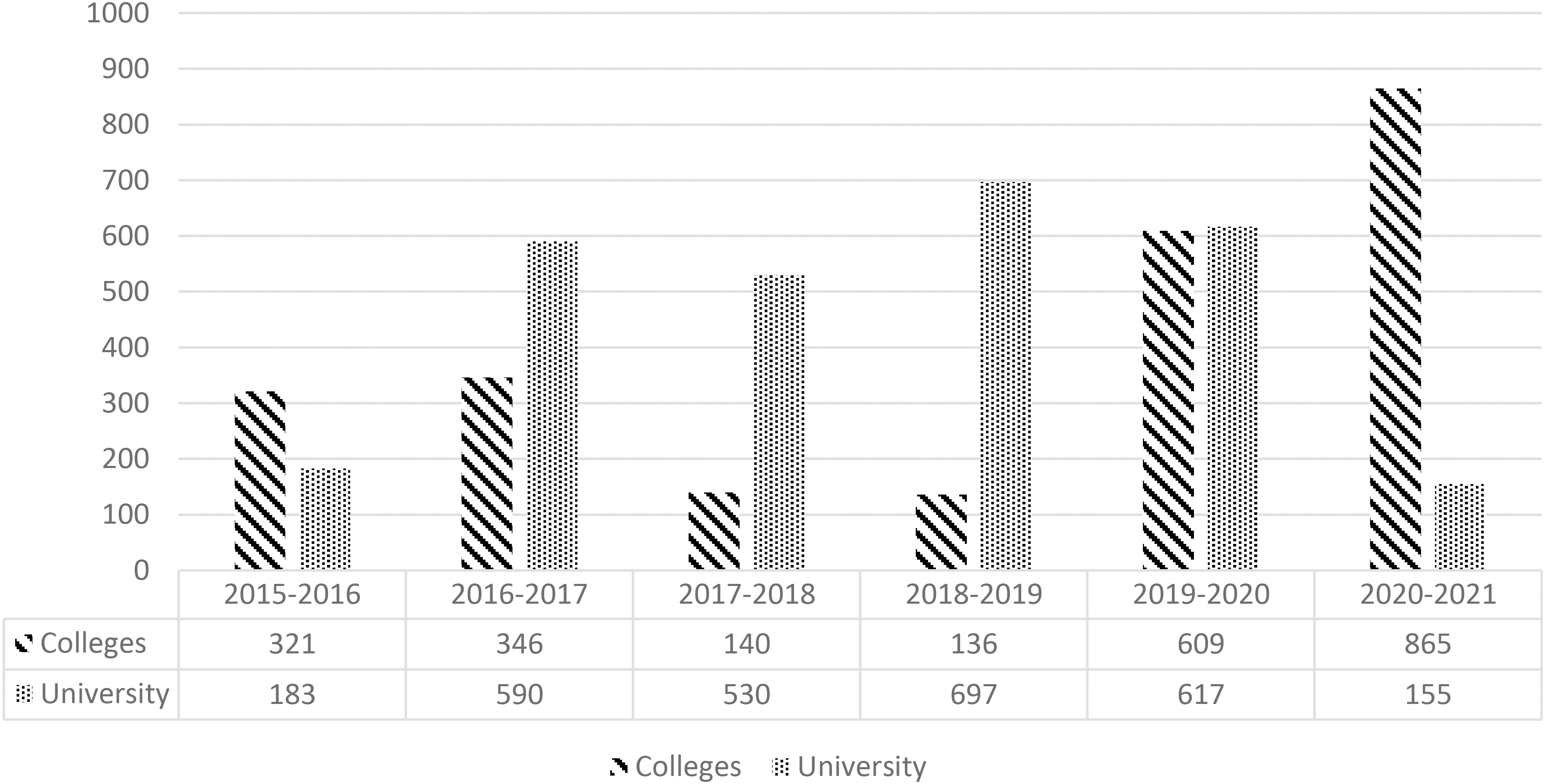
A dynamic SAKSHAM web portal was created to empower women through awareness and ensure compliance through an Annual Gender Audit by the Universities and their affiliated colleges on the number of registered cases of sexual harassment, number of complaints disposed of, pending cases, workshops held, and the nature of action. Table 4 shows the Gender Audit report trends through the last few years, indicating considerable variation in cases, which indicates erratic reporting. Furthermore, absence or negligible mediation, biased implementation, and limited or no action also hampers attempts to redress sexual harassment in academia.
Sexual Harassment Cases in Academia Registered in University Grants Commission Gender Audit (2016 to 2021)
Source: Annual Report of the UGC (2021, 2020, 2019, 2018, 2017, 2016).
UGC, University Grants Commission.
Considerable responsive action was taken to solve recorded cases as well as mitigate instances of new cases. While grave cases of sexual violence such as rape and assault were referred for due judicial process through registration of police complaints, other cases were referred for professional counseling in the presence of parents and enforcement officials. At times fines were enforced, or the offending party was suspended or even rusticated from the institution. In the case of offences by faculty and institutional staff, disciplinary action was initiated and depending on the offence some received job transfers, had to pay fines, or even received job termination. Responsive action was taken to reduce and spread awareness on the nature of sexual harassment and gender-based violence through legal workshops, seminars, establishment of an ICC (if it did not exist), self-defense classes, and gender sensitization workshops among others.
Gender Violence in Academia Through Media Reports and Unofficial Surveys
While the UGC requires institutions to conduct annual official gender audits and report them through the SAKSHAM web portal, the plethora of such cases across campuses reported by the media and through unofficial surveys suggests that formal reporting through official channels is limited.
A study was conducted by the Wire, an Indian nonprofit news and opinion website, involving current and former female students of higher educational institutions across India on the prevalence of sexual assault (defined under Section 354 of the Indian Penal Code as use of criminal force on a woman with the intention to outrage her modesty) in colleges and universities. It was noted that 57 of the 567 respondents were sexually assaulted at their institution, of which 87.71% were assaulted by students; 12.28% were assaulted by faculty members and 10.52% were assaulted by staff members (Dasgupta and Mukherjee, 2020). Additionally, it was reported that 40.3% kept these incidents to themselves, and 61.4% of them talked about it to a senior or a friend, 15.7% filed an official complaint within their institution, however, none of the survivors lodged an official police complaint (Table 5).
Data from Two Unofficial Surveys
Another survey conducted by the Board of Student Publications (BSP, 2021) in IIT Delhi reported that among 70 residents of the IIT Girls hostel, 25 experienced sexual harassment on campus by a professor, teaching assistant, senior, or fellow batch mate and 30 of them faced online sexual harassment. However, only three of the injured parties reported their experience to the relevant authorities (Table 5).
The above indicates that even though there are cases of sexual harassment in universities, a very small percentage of students actually report the incidents to the relevant authorities. Furthermore, these reports state that the response from university officials was slow or no action was taken. This indicates their limited sensitivity and poorly implemented policies. Often, institution-initiated action and registered cases against offenders only after students protested and demanded stringent action.
Even renowned institutions such as IIT have not been free of sexual harassment and gender violence. Although the IITs have established the Initiative for Gender Equity and Sensitization and ICCs for reporting of such cases, many cases go unreported and only a few students come forward despite being advised against reporting.
In August 2020, a female student filed a complaint with IIT-Madras against seven persons (two were staff, one PhD co-guide, one laboratory assistant, and three were fellow students) stating that she had been sexually assaulted, harassed, and raped twice between 2017 and 2020, once in a campus laboratory, and once during a college field trip. Here too the student was dissuaded by her co-guide from reporting against her upper caste assailants (Chandrababu, 2022). Thus, students who came forward to report such cases often face discouragement, isolation, intimidation, and pressure to remain quiet for fear of social rebuke. On May 28, 2021, another report emerged that a student was allegedly drugged and raped by a senior student and then left injured and unconscious for several hours at the IIT (Guwahati) campus. The authorities were initially slow to act but later suspended the student following protests (Barman, 2021).
In these cases, the response from university officials was delayed or no action was taken, which resulted in massive student protests and it was only after media reports emerged that some action was initiated for damage control. At Gargi College in New Delhi on February 6, 2020 a large mob of intoxicated men pushed their way into campus during its annual cultural festival, and molested many women students, which points to the sense of impunity in mob settings (Baxi, 2020) as well as culture of toxic masculinity and exhibitionism.
While these are just a few examples, they point to the powerlessness of society and institutions not only to provide a safe space for women to pursue academia but also to redress their grievances through official channels. Thus, they resort to journalists, television media channels, and social media such as Twitter, Instagram, and Facebook to highlight their compelling experiences of gender violence and harassment within campuses.
Discussion
Using statistical data from secondary sources, this study aimed to understand the contextual dynamics and dimensions of gender violence and sexual harassment in academia through five research questions.
Addressing our first research question on the mechanisms to encourage reporting cases of sexual harassment and violence among women in academia, it is noted that the UGC has acknowledged the gendered nature of institutions and strives to overcome internal constraints and systemic barriers against women's career advancement. Furthermore, the UGC mandates that all should have a written code of conduct and set up an ICC to facilitate greater awareness, promote gender sensitization, as well as the reporting and investigation of all cases. However, many universities until date have not instituted such a committee or even if they exist, injured parties are discouraged from official reporting of the cases for fear of jeopardizing their institutional reputation. Thus, the institutions seek to safeguard their own interests rather than provide justice for those violated.
Our second research question was on the legal provisions to address sexual harassment and violence in India. It was evident that since independence there have been consistent efforts to put forth legislations in favor of women's rights. However, the formal sanction of the Vishakha guidelines and the enactment of the Sexual Harassment of Women at Workplace (Prevention, Prohibition, and Redressal) Act (Government of India, 2013), are the more recent legal validation of deliberate and specific action against sexual harassment. While these acts have many loopholes in implementation and legal process and do not specifically address the scenarios of gender violence and harassment in academia, they are a positive step in this direction.
Our third research question was regarding the reporting of all cases of sexual harassment and gender-based violence against women in academia to the official authorities. Table 1 indicates that there has been a considerable increase in the total number of colleges and universities in India, and Table 2 and Table 3 indicate the phenomenal increase in the number of female students and faculty universities and colleges across India. However, we see from Figure 2 that the official data of number of cases of sexual harassment and gender-based violence registered through universities and colleges in the UGC official database is very small. Co-relating from Table 5, which indicates from unofficial sources that less than 20% of the cases of sexual harassment are reported by students, we can conclude that the actual number of such cases in academia is about 80% higher than reported in official statistics.
India's patriarchal culture with a propensity to blame the injured rather than the offender of sexual harassment, is a vital phenomenon that impedes reporting of cases of sexual harassment. Women in academia fear backlash from the power hierarchy within institutions especially when the assailants are members of the faculty or students with power and influence, which could result in ending their academic and career.
Often even the own family of the woman violated discourages her from raising a complaint, for fear of shame, embarrassment, and social familial ostracism. Furthermore, some families might prevent them from continuing their education or even accuse them of flirtatious behavior or coquettish mode of dressing. In addition, the family might also maintain silence and stress on confidentiality, for fear of jeopardizing the woman's chances in the marriage market, which would fall short of the traditional moral standards of “chastity” and “virginity” attached to Indian women. This “keep quiet” and “bear it all” psyche among Indian women is the most viable reason for underreporting cases.
Our fourth question was about the responsive action by educational institutions in cases of sexual harassment and violence. As reflected in Table 5 some cases were disposed of while in others various types of action were taken, including professional counseling, fines, suspension, rustication, disciplinary action, stoppage of increment or reduction of pay scale, job transfers, job termination, as well as efforts to create awareness through workshops and seminars. The authors suggest that more needs to be done as proactive action to prevent such cases, including training in self-defense techniques, discussion on hazardous behavior warnings such as use of alcohol, drugs, use of rohyphnol or other drugs used to facilitate rape and sexual assault, awareness of institutional complaints process, knowledge of legislations and legal process, as well as stringent punishments to offenders that will serve as deterrents against potential violation.
Our last question was about the availability of adequate data on cases of sexual harassment in academia. In this study, we found a considerable dearth of official data both in the UGC databases, as well as the National Crime databases. Even where data was available, it was restricted to registered cases and since most cases were not officially registered given the social psyche and gender conditioning prevalent in India's patriarchal society, data were incomplete and therefore had to be co-related through the use of media reports and the few unofficial online surveys available. Unless comprehensive data are maintained and corroborated through cross-sectional studies and reports, it would be impossible to get a precise and correct view of the gravity of the situation and its impact on women's progress in particular as well as the future of academia in general.
The authors conclude that higher educational institutions in India, which stand for “knowledge and social transformation” and include the highest entities of academia, have been unable to provide a safe space by protecting women. Academia needs to set the example by deconstructing gendered hierarchies through discourse, sensitization, and awareness rather than perpetuate sexual harassment through a cycle of secrecy and subterfuge. Academia, as a community, needs to adopt “victim-centered” approach rather than a “reputation-centered” approach to put an end to the “keep quiet and bear it all” psyche prevalent among Indian women. Educational programming through gender-inclusive strategies and increased representation of women in higher educational institutions at all levels as well as community mobilization through awareness programs and gender-inclusive textbooks in schools (Košir and Lakshminarayanan, 2023) would facilitate greater encouragement of women to break the “glass ceiling” rather than be restricted to the lowest rungs of academia.
Conclusion
The existence of sexual harassment and gender violence against women within academia violates the sanctity of the learning process and endangers women's advancement in India. Although there exist many governmental legislations and constitutional guarantees, female students, faculty, and staff within academia continue to face considerable sexual harassment and violence.
Tracing the development of women's education and precepts of gender violence sanctioned by a structure of patriarchy and gender inequality in India, this article reflects on the prevalence of sexual harassment within academia through official and unofficial data sources. Although the UGC has some measures to address grievances, these have failed to protect and guarantee the security of women. Institutions have often displayed a serious lack of gender sensitivity and a culture of discouraging reporting on cases of gender violence and harassment.
The researchers note the limited availability of official data in the study of sexual harassment and violence against women in academia in India, therefore, the reliance on data from media reports and unofficial surveys form the limitations of this article. The reluctance of institutional officials to discuss the high prevalence of sexual harassment across universities, except under promises of confidentiality, perhaps due to fear of institutional ire and reproach against any criticism, is also noted. The legal constraints of the existing legislations and their implementation in court procedures were not studied and might be an interesting area for future research. Furthermore, specific campus oriented official surveys by institutional authorities at the state levels will help to correlate the trajectories of sexual harassment across India and formulate specific procedural norms for their redressals within specific sociocultural environments. The authors also suggest future research on specific types of sexual harassment especially cyberstalking and trolling on social media as well as sexual violence within hostels in campuses.
The researchers recommend that there is a need for concentrated efforts by all stakeholders to restore a degree of “sanctity” and “security” within academia in India. Sexually offensive behavior needs to be clearly defined and redressal mechanisms must be clearly updated across campuses. More awareness needs to be created on norms of behavior within “academic ethics and code of conduct” especially in student–teacher interactions. Procedural rules of the ICC in campuses must be codified for a degree of uniformity in implementation and punitive measures. The existing UGC reporting system needs to be overhauled and all cases of underreporting or misreporting needs to be tackled stringently. Furthermore, unofficial surveys among students need to be conducted by third party surveyors, including media, research students, and NGOs to validate accuracy of official reporting. Above all, there is an intrinsic need to change the mindset of people, including academic community/family/police/institutional authorities to understand the fears, compulsions, and pressures on women.
Instead of relegating sexually offensive and gendered behavior as “male typical,” society at large needs to recognize it as flawed, sexist, socially deviant, and therefore unacceptable and warranting stringent punishment. The overall objectification of women in films, school textbooks, media, and sociocultural manifestations needs an overhaul, and such effort requires collaboration from all stakeholders to overcome inherent systemic constraints and challenges.
Footnotes
Authors' Contributions
R.L. conceptualized and coordinated the study. R.L. and S.K. collected the data. R.L. wrote and critically revised the article. S.K. carried out the statistical analysis. Both authors reviewed and approved the final article.
Author Disclosure Statement
No competing financial interests exist. AI systems were not used in this research and article preparation.
Funding Information
No funding was received for this article.