







Abstract


Introduction:
Hemorrhoidal disease is a common anorectal condition encountered by general surgeons all over the globe. Stapled hemorrhoidopexy (SH) has emerged as a minimally invasive surgical technique for the treatment of symptomatic hemorrhoidal disease, offering an alternative to traditional excisional methods, which are associated with increased postoperative pain. This technique involves the use of a stapling device to remove the prolapsed hemorrhoidal tissue while simultaneously reestablishing the anatomical position of the hemorrhoids. 1,2 This procedure is characterized by a shorter recovery time, reduced postoperative pain, and fewer complications compared to conventional hemorrhoidectomy when done meticulously in a selected group of patients. Recent studies have highlighted its effectiveness in managing symptomatic grade III hemorrhoids and grade II hemorrhoids refractory to medical management, with a focus on improving patient quality of life post-surgery. 3 This video case report presents a comprehensive review of the surgical technique, its indications, and the advantages over traditional methods. We also discuss the potential risks and challenges, including the possibility of recurrence, and the current role of SH in the management of hemorrhoidal disease. 4,5
Materials and Methods:
This study comprised 28 patients with grade III symptomatic hemorrhoids. All patients were managed by SH at AIIMS, New Delhi, with a follow-up of at least 12 months. The inclusion criteria were Grade III symptomatic hemorrhoids with failed conservative management. Grade II, Grade IV, and recurrent hemorrhoids were excluded. In this technique a circumferential purse-string suture is taken 1–2 cm above the dentate line with a 2-0 prolene suture involving only the mucosa and submucosa with the patient in the extended lithotomy position. This is followed by the introduction of the hemorrhoidal stapler with the fully opened anvil beyond the purse string, and the stapler is gradually closed till the orange indicator comes into the safety zone. The completeness of the doughnut is checked, and the tissue is sent for histopathological examination.
Results:
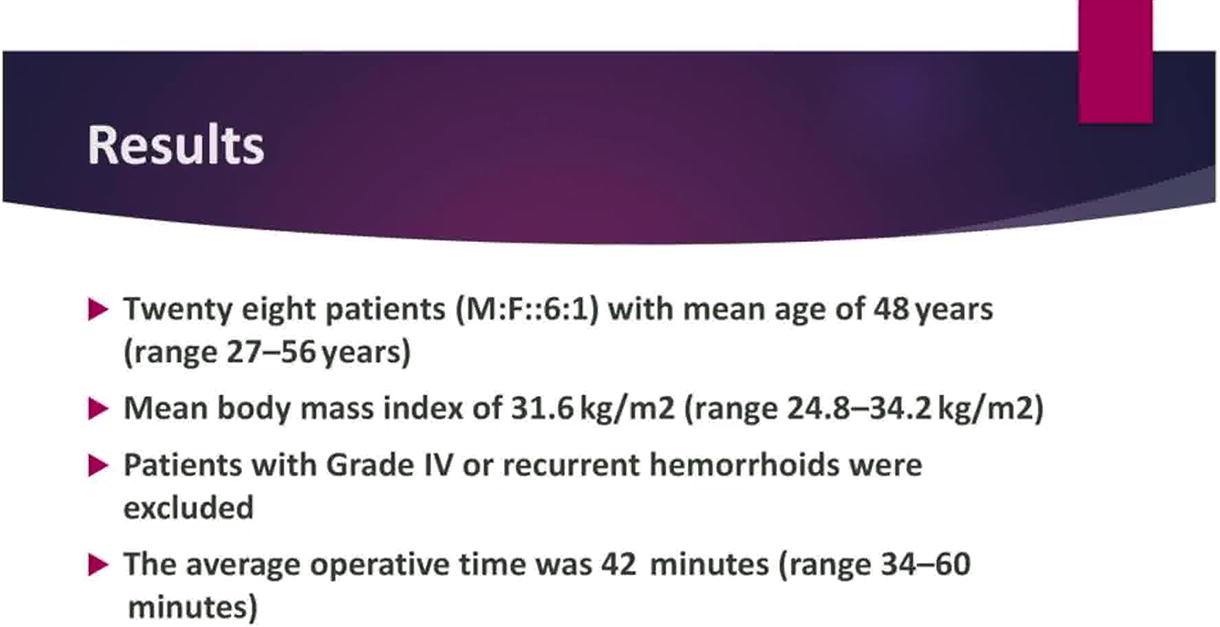
28 patients (M:F::6:1) with a mean age of 48 years (range: 27–56 years) and a mean body mass index of 31.6 kg/m2 (range: 24.8–34.2 kg/m2) were included. Patients with Grade IV or recurrent hemorrhoids were excluded from the study. The average operative time was 42 minutes (range: 34–60 minutes). The mean postoperative VAS score at 24 hours 2 (range 1 to 3) was low, and all patients were discharged on postoperative day 1. One patient reported recurrent bleeding at 3 months, which was managed conservatively. At 12 months of follow-up, all patients are clinically asymptomatic with no features of recurrence, stenosis, or chronic pain till now.
Conclusion:
SH represents a valuable minimal access surgical treatment for a selected group of patients with hemorrhoidal disease, particularly for patients seeking a less invasive surgical solution with quicker recovery times.
Patient Consent Statement:
Corresponding author have received and archived patient consent for video recording/publication of the video without exhibiting patient demographic details in advance.
Source of work or study:
This is an original work carried out in a tertiary care public hospital, and there are no conflicts of interest or obligations resulting from it to any of the authors.
Author Disclosure Statement:
There are no commercial associations during the last 3 years that might create a conflict of interest in connection with the video. The corresponding author has received and archived patient consent for video recording/publication in advance of video recording of the procedure.
Runtime of video:
9 mins 52 secs.