







Abstract
Abstract
Feeding Artemia nauplii as the main nutrition source for zebrafish is a common practice for many research facilities. Culturing live feed can be time-consuming and requires additional equipment to be purchased, maintained, and cleaned. Nonhatching decapsulated Artemia cysts (decaps) are a commercially available product that can be fed directly to fish. Several other ornamental fish species have been successfully cultured using decaps. Replacing Artemia nauplii with decaps could reduce the overall time and costs associated with the operation of a zebrafish facility. The objective of this study was to determine if decaps could be a suitable replacement to Artemia nauplii in juvenile and adult zebrafish culture. Wild-type zebrafish were fed one of three dietary treatments: decaps only, nauplii only, or a standard consisting of nauplii plus a commercially prepared pellet food. Survival, growth (length and weight), and embryo production were analyzed between the treatments. Fish receiving the decap diet demonstrated a significantly higher growth and embryo production when compared to the fish receiving the nauplii-only diet. When comparing the decap fish to the standard fish, no significant difference was found in mean survival, mean weight at 90 days postfertilization, or mean embryo production. It was determined that nonhatching decapsulated Artemia cysts can be used as a suitable replacement to Artemia nauplii in juvenile and adult zebrafish culture.
Introduction
F
The popularity of the zebrafish model has grown substantially in recent years. 8 To continue this growth, more new investigators need to choose zebrafish as their model organism. The thought of caring for an aquatic species can be intimidating to prospective investigators, and the idea of culturing live food for zebrafish could be enough to discourage them from starting their own colony. It would benefit the zebrafish community to develop methods, backed by scientific evidence, which would eliminate the need for culturing live food for this important model organism.
Nonhatching decapsulated Artemia cysts (decaps) are commercially available cysts that have their chorions chemically removed. The decaps have a long shelf life9,10 and can be fed directly to fish without soaking, hatching, or separating. The cost of decaps is approximately one-third of regular hatching cysts. Decaps have been successfully used in the culture of several aquatic species, including guppy (Poecilia reticulata), 9 golden shiner (Notemigonus crysoleucas) fry, 11 common carp (Cyprinus carpio) larvae, 12 African catfish (Clarias gariepinus) larvae,13,14 and giant tiger prawn (Penaeus monodon) larvae. 15
Replacing nauplii with decaps in juvenile and adult zebrafish culture could potentially reduce the time needed for feeding, reduce feed costs, decrease overhead costs (hatchers, airpumps, etc.), and require fewer expendables. Our objective was to determine if nonhatching decapsulated Artemia cysts could be a suitable replacement to Artemia nauplii for feeding juvenile and adult zebrafish.
Materials and Methods
Wild-type (Segrest Farms, Gibsonton, FL) zebrafish were used in this study. All fish were placed in self-cleaning tanks on a recirculating aquaculture system (Aquaneering, San Diego, CA). Photoperiod was set at 14-h-light (8:30 AM–10:30 PM) and 10-h-dark cycle. Water temperature and water chemistry values were within normal acceptable ranges (Table 1).
Juvenile growth and survival I—decaps versus nauplii
Twenty-eight days postfertilization (dpf), zebrafish were randomly assigned to a treatment group, which consisted of 10 tanks (2.8 L) with 10 fish per tank. Each tank contained a baffle and screen (400 μm for the first week and 850 μm thereafter). All fish were fed a combination of paramecia (1 mL/fish) and Artemia nauplii (one squirt/tank twice daily, quantity unknown) from 5 to 28 dpf, leading up to their respective trial. Zebrafish were then fed exclusively one of two dietary treatments (nauplii or decaps) for 62 days.
The nauplii treatment fish were fed newly hatched Artemia nauplii. Each day Artemia cysts (80% hatchability; INVE Aquaculture, Salt Lake City, UT) were placed in a conical hatcher with 13 L system water, ∼330 g salt (Instant Ocean, Blacksburg, VA), and supplied with constant aeration. Nauplii were harvested at 48 h and fed to the zebrafish twice daily using a squirt bottle (one squirt/tank/feeding).
The decap treatment fish were fed nonhatching decapsulated Artemia cysts (Brine Shrimp Direct, Ogden, UT) 0.033 g twice daily. This feeding rate was estimated to be equal to the amount of hatching cysts needed to produce the number of nauplii fed in one squirt to the nauplii fish.
Mortality was recorded weekly. At 90 dpf, zebrafish were anesthetized using 0.16 mg/mL Tricaine (Sigma, St. Louis, MO) and placed on a ruler for measuring fork length to the nearest millimeter. Fish were then patted dry with a paper towel and weighed to the nearest 0.001 g (Ohaus TS200S, Parsippany, NJ).
Juvenile growth and survival II—decaps versus nauplii versus standard diet
Zebrafish aged 28 dpf were randomly assigned to a treatment group as described above. Zebrafish were then fed exclusively one of three treatments (nauplii, decap, or standard) for 62 days.
The nauplii treatment was the same as in the first growth and survival experiment. The decap treatment fish were transitioned onto the decap diet by feeding them nauplii in the morning and decaps in the afternoon for the first week and then were fed exclusively decaps twice daily for the remainder of the study (0.028 g of dried cysts/tank/feeding).
The standard diet treatment zebrafish were fed one squirt of nauplii twice daily and 0.12 g of pellet feed (Scientific Hatcheries Diet for Zebrafish; Aquaneering) three to four times per week.
Mortality was recorded weekly. Lengths and weights were taken at 90 dpf as described previously.
Adult embryo production—decaps versus nauplii versus standard diet
Adult fish (5–7 months old) that were not part of previous experiments and were raised on the standard diet were randomly assigned to one of three dietary treatments (decaps, nauplii, standard). Each dietary treatment consisted of 5 tanks (2.8 L) containing 5 males and 5 females in each tank, for a total of 50 fish per treatment. Before the trial began, the mass of fish in each tank was taken to assure there was not a significant difference in sizes between treatments. Fish were fed their respective dietary treatment as described in the previous experiment.
Each tank of fish was placed into a breeding container once per week for 5 weeks starting on day 28. Viable embryos were collected, counted, and recorded for each spawning event. Embryos were considered viable if they were shown to be developing 4 h after the lights turned on in the fish room. All treatments were set up for breeding on the same day at the same time and all embryos were harvested in the afternoon.
Data analysis
Data from the first juvenile growth experiment were analyzed using the pairwise t-test with Bonferroni correction (R Statistical Computing). All other analyses were done using ANOVA (R Statistical Computing) followed by the Tukey HSD test. Each tank was considered a replicate. Significance was set at p<0.05.
Results
Juvenile growth and survival of zebrafish fed decaps versus nauplii
At 90 dpf, zebrafish receiving the decap treatment were found to have a significantly higher mean length (p<0.0001) and weight (p<0.0001) compared with zebrafish receiving the nauplii treatment (Fig. 1). No significant difference in 90 dpf mean survival rates was found between the nauplii (0.91) and decap (0.78) treatments.
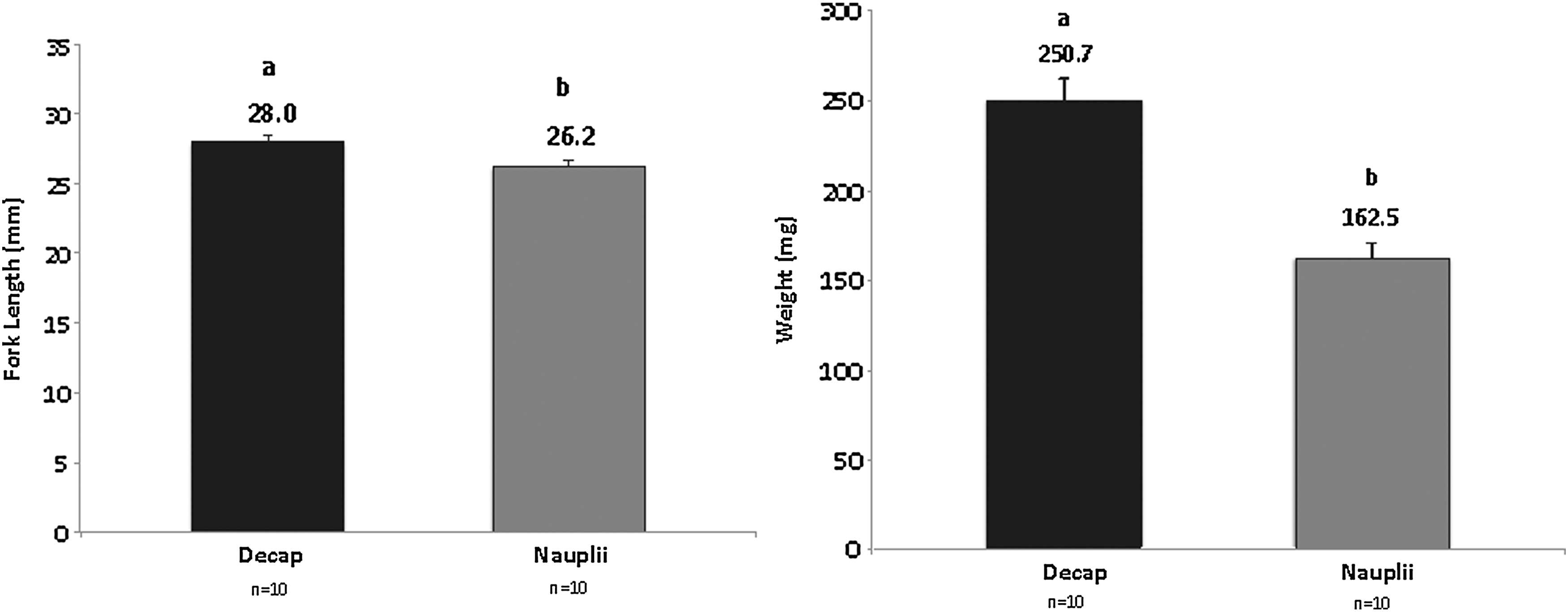
Mean fork lengths and weights of 90 days postfertilization (dpf) zebrafish fed either Artemia nauplii or decapsulated Artemia cysts for 62 days. Error bars represent standard error of the mean. Columns with different letters indicate a significant difference of p<0.05, as determined by the pairwise t-test using Bonferroni correction.
Juvenile growth and survival of zebrafish fed decaps versus nauplii versus standard diet
At 90 dpf, zebrafish receiving the standard dietary treatment were found to have the largest mean length (28.7 mm) followed by decap fish (27.7 mm) and nauplii fish (22.8 mm), as shown in Figure 2. The mean length for nauplii fish was found to be significantly lower than both the decap fish (p<0.0001) and the standard fish (p<0.0001), while the mean length of the decap fish was significantly lower than the standard fish (p=0.028). The mean weight was highest in the decap fish (236.9 mg) followed by those receiving the standard treatment (231.9 mg) and nauplii treatment (106.0 mg) (Fig. 2). The mean weight of the nauplii fish was significantly smaller than both the decap fish (p<0.0001) and standard fish (p<0.0001). No significant difference in mean survival rates was found between the nauplii (0.93), decap (0.94), and standard (0.86) treatments at 90 dpf.
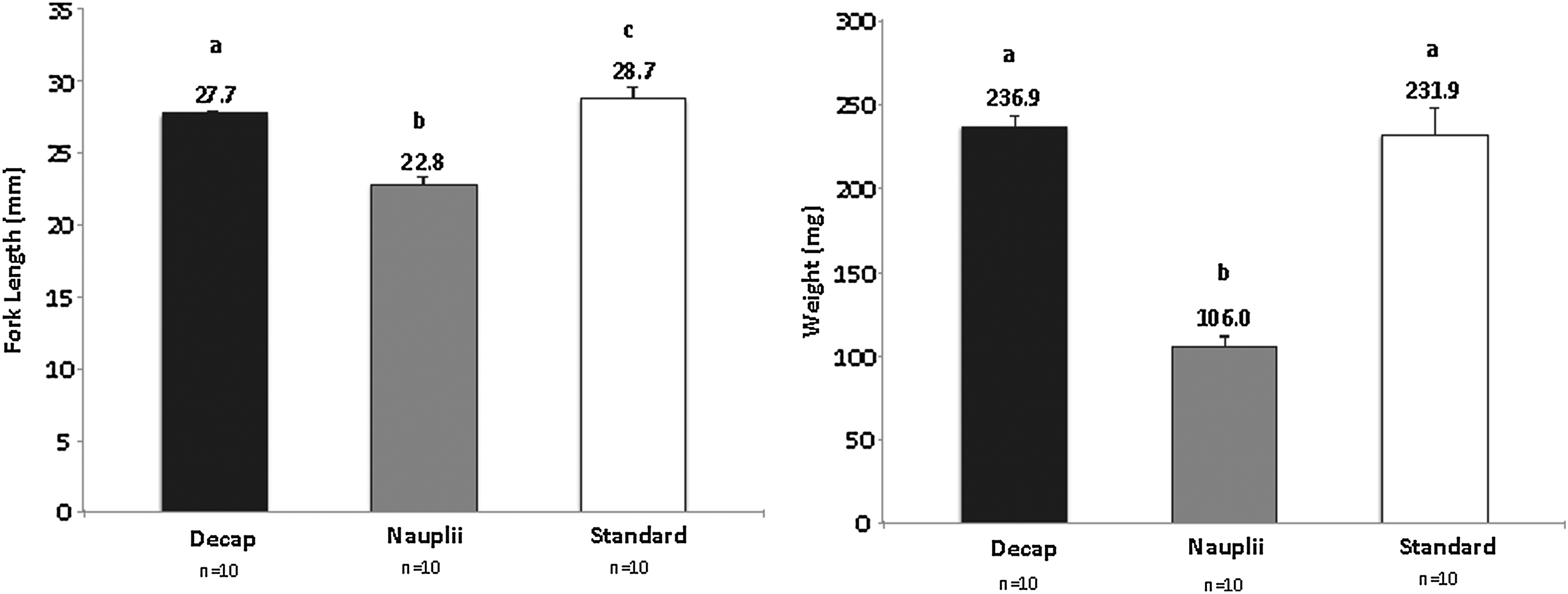
Mean fork lengths and weights of 90 dpf zebrafish fed Artemia nauplii, decapsulated Artemia cysts, or a standard diet for 62 days. Error bars represent standard error of the mean. Columns with different letters indicate a significant difference at p<0.05, as determined by ANOVA followed by the Tukey HSD test.
Adult embryo production of zebrafish fed decaps versus nauplii versus standard diet
Total viable embryo production was highest for fish receiving the decap diet (4938) followed by the standard diet (5281) and the nauplii diet (734). Mean embryo production from the nauplii fish was found to be significantly lower compared with the decap fish (p=0.003) and standard fish (p=0.001) (Fig. 3).
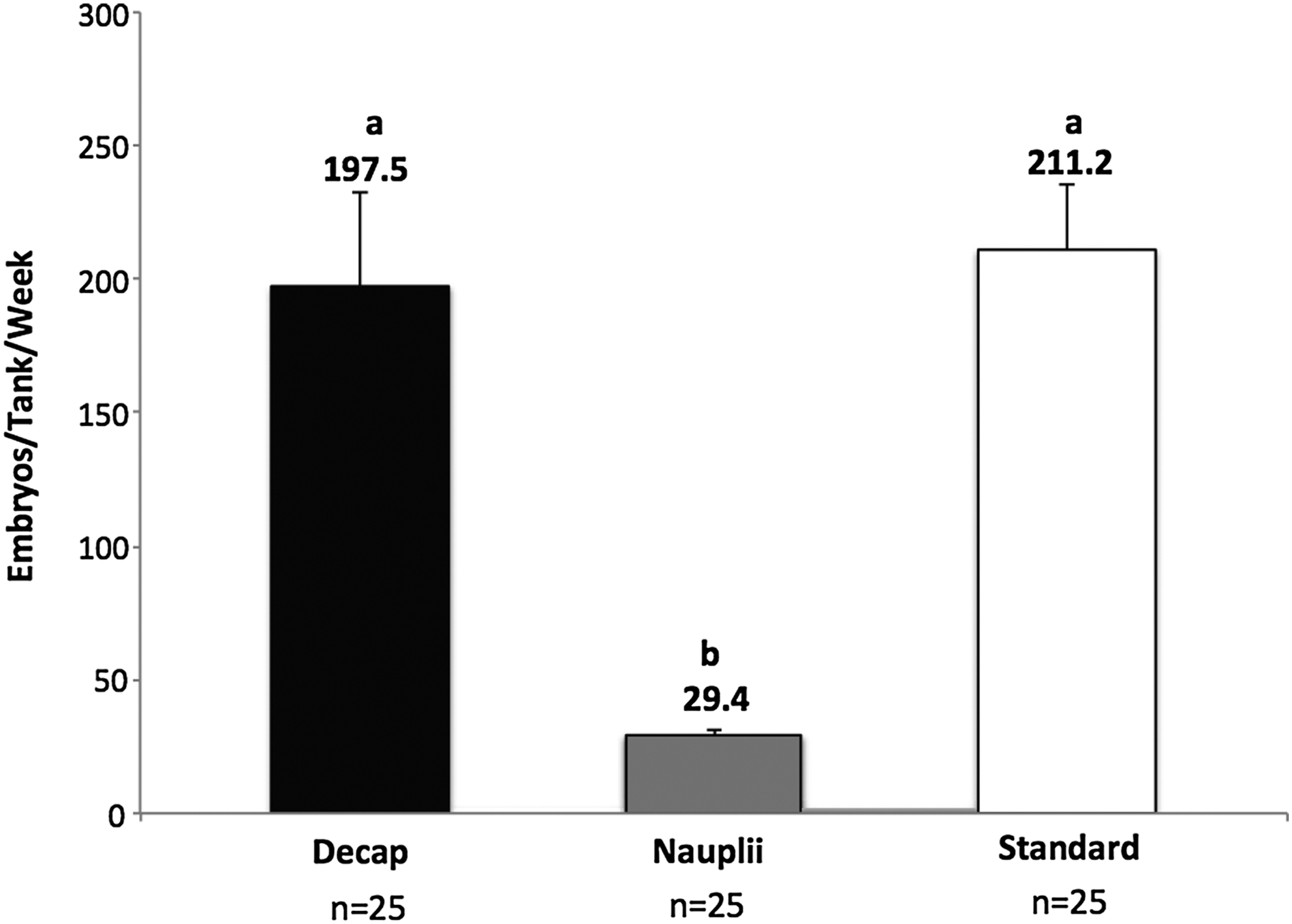
Mean embryo production (per tank per week) over a 5-week period for zebrafish fed Artemia nauplii, decapsulated Artemia cysts, or a standard diet. Error bars represent standard error of the mean. Columns with different letters indicate a significant difference at p<0.05, as determined by ANOVA followed by the Tukey HSD test.
Discussion
Juvenile zebrafish fed decapsulated Artemia cysts were found to have significantly higher growth at 90 dpf when compared to juvenile zebrafish fed Artemia nauplii alone. Embryo production of the nauplii fish was found to be significantly lower than both the decap fish or standard fish.
Nonhatching decapsulated Artemia cysts were observed to be present in the tank for a longer period of time than nauplii (over 3 h compared to less than an hour). Nauplii are free-swimming and are therefore susceptible to being washed-out of the self-cleaning tank relatively quickly due to the water flow. In zebrafish culture, it is generally recommended to have a water flow that exchanges the entire volume of the tank every 20 min. 1 Water enters the front of the tank, passes through the mesh screen, and exits from the bottom on the opposite end of the tank through a baffle. This water flow does not wash-out decapsulated cysts due to their initial buoyancy, but does allow the nauplii to exit the tank relatively quickly. It has been previously suggested that zebrafish will perform best when receiving small frequent meals due to their lack of a true stomach. 7 This may have resulted in reduced growth and embryo production of the nauplii fish.
The length and weight of 90 dpf fish from the growth portion of this study (22–28 mm, 106–250 mg) were found to be similar to previous growth studies, which comprised nauplii and various commercial or experimental diets by Siccardi et al. (18–26 mm, 70–237 mg) and Smith et al. (15–20 mm, 140–260 mg).16,17 Our results also coincide with Lawrence et al. who found that female zebrafish fed nauplii alone exhibited significantly lower growth compared to females fed a standard diet containing both nauplii and commercially available food. 18 In our study, both juvenile growth experiments showed that fish fed nonhatching decapsulated Artemia cysts have significantly higher mean length and weight at 90 dpf than fish fed Artemia nauplii alone. Similar differences in growth have been demonstrated in several other freshwater ornamental fish species that have been fed both nauplii and decaps. 9
While growth studies involving decapsulated Artemia cysts have been performed on several species, reproduction studies involving decaps have not been conducted to date. The nauplii treatment fish were found to have significantly lower embryo production than both the decap fish and standard fish (Fig. 3). In general, it is recommended to feed zebrafish a combination of nauplii and a commercial flake or pellet food.1–7 Gonzalez and Law found that zebrafish fed Artemia nauplii alone had the lowest gonadosomatic index, when compared to zebrafish fed either nauplii and a commercial feed or the commercial feed alone. 19 Markovich et al. found that the mean number of embryos produced by zebrafish fed Artemia alone was not significantly different from zebrafish fed either a control or commercial diet. 20 It is worth noting that these fish were fed three times per day and housed in an aquarium, as opposed to a self-cleaning tank, which may have led to more nauplii being consumed and thus producing more embryos. Lawrence et al. found that there was not a significant difference in mean embryo production between zebrafish fed nauplii alone and zebrafish fed a formulated diet. 18
Mean embryo production from the nauplii fish was very low (29 embryos/clutch). This is lower than what was found by Castranova et al., which reported average clutch sizes between facilities to be highly variable ranging from 49 to 378 embryos, and is attributed to a lack of standardization in husbandry protocols. 21
Zebrafish that were fed diets containing high levels of highly unsaturated fatty acids have been shown to increase embryo production. 22 It has been found that nonhatching decapsulated Artemia cysts have a higher concentration of omega-3 (n-3) fatty acids than Artemia nauplii. 9 Decaps have also been found to contain 30%–40% more energy than Artemia nauplii.10,23 We believe that these factors have also attributed to the increase in growth and reproductive performance of zebrafish in our study.
The first juvenile growth and survival experiment, containing two dietary treatments, found the mean survival rate of the decap fish (0.91) to be lower compared with the nauplii fish (0.78). While it was not significantly lower (p=0.055), maintaining a high survival rate is important for zebrafish facilities. Most of the mortalities for the decap fish were found to occur in the first week of the experiment, indicating that the mortalities were due to starvation occurring shortly after switching them from the pre-experimental diet (nauplii and paramecia) to the experimental diet (decaps). The diameter of the decapsulated cysts is similar to that of the nauplii and therefore was not considered a factor in their mortality. However, we hypothesized that the early mortality was due to the fact that the decap fish were not transitioned to their decap diet. For this reason, decap fish in the second juvenile growth and survival study were transitioned to the decap diet over a 1-week period (described in the Materials and Methods section), which resulted in an increase in their 90 dpf survival (0.94).
Replacing nauplii with decaps can be financially beneficial. The cost of hatchable cysts can range from $35 to $50 per pound (depending on hatchability), while decaps are approximately $15 per pound. The time it takes to feed decaps was estimated to be approximately half that of feeding nauplii. This reduction in labor comes from not needing to collect nauplii, clean hatchers and airstones, mix salt and cysts, or refill the squirt bottle several times per feeding. Eliminating the equipment needed to hatch Artemia would also result in more workspace for the facilities. The reduction in salt usage alone was estimated to save our facility ∼$200 per year. The overall financial savings to our facility were estimated to be $3000 per year or ∼3% of the annual budget.
The amount of feed that is fed to zebrafish has not been standardized due to, in part, the mode in which we distribute nauplii (one squirt). In contrast, the decaps in this study were fed using a handheld feeding device that distributes a fixed volume of dry feed by simply pulling a trigger. This has allowed our facility to feed a precise amount of dry feed to each tank and will be useful for further studies involving zebrafish nutrition. Design plans for this device can be found on the University of Minnesota, Zebrafish Core Facility website (www.peds.umn.edu/genetics/zebrafish/index.htm) as well as the Zebrafish Husbandry Association website (www.zhaonline.org) and are free to download.
Using decaps instead of nauplii would be most appealing to smaller facilities with limited labor (e.g., new facilities, single PI facilities, grade schools, etc.) and for new principal investigators. For example, facilities with limited labor may find it easier to recruit a volunteer to come in on the weekend to feed with a handheld feeder than to have them collect nauplii, feed with a squirt bottle, clean the resulting mess, and begin another Artemia culture. The idea of caring for zebrafish can be discouraging for investigators with limited husbandry experience, and the idea of culturing live food to feed those fish can be daunting. Replacing nauplii with decaps would aid in eliminating this negative aspect of zebrafish husbandry. Investigators may also find it appealing that decaps are less likely to be vectors for spreading diseases due to the fact that the process of decapsulation disinfects the cysts.9,24
Long-term effects of feeding decaps to zebrafish have not been thoroughly investigated. However, the zebrafish core facility, the University of Auckland, New Zealand, has been feeding nonhatching decapsulated Artemia cysts in combination with flake food to their fish since 2011 and has not observed any negative effects (Alhad Mahagaonkar, pers. comm., March 5, 2014).
When comparing the decap fish to the standard fish, no significant difference was found in mean survival, mean weight at 90 dpf, or mean embryo production. This contradicts the general recommendation that zebrafish are to be fed a variety of feeds to meet their nutritional requirements.1–7 Further studies with dietary treatments containing decaps+pellet feed should be conducted to determine if pellet or flake food would further improve zebrafish performance. It is also recommended that zebrafish nutritional requirements be determined to accurately determine suitability of commercial feeds and push toward a standardized diet for the zebrafish model.
In conclusion, nonhatching decapsulated Artemia cysts can be used as a suitable replacement to Artemia nauplii in the culture of juvenile and adult zebrafish. Young zebrafish (28 dpf) have been shown to readily accept nonhatching decapsulated brine shrimp cysts. Zebrafish fed the decap diet have significantly higher growth and embryo production when compared to feeding nauplii alone. Replacing nauplii with decaps could result in reduced feed and labor costs for research facilities. Further research involving decaps and supplemental feed (flake or pellet) should be conducted to determine if the combination could further improve zebrafish performance.
Footnotes
Disclosure Statement
No competing financial interests exist.