







Abstract
Abstract
Zebrafish are an excellent model system for research and teaching. Because of their relatively low maintenance costs, beautiful and bountiful embryos, and tool box of molecular genetic technique, zebrafish are ideal for countries with smaller research budgets and less well-developed science infrastructure. For these reasons, zebrafish are growing in popularity as a model system for research in Latin America. In response to this growing need, we held the Third Latin American Zebrafish Network (LAZEN) Course and Symposium in Valparaiso, Chile, in April 4–13, 2014. The course covered a wide variety of topics from fish husbandry to outreach and ended with a symposium hosting excellent scientists from Latin America and beyond.
T
Valparaiso, a city symbolic as a port of entry and melting pot of cultures rich in history, warmly embraced the idea of an international science meeting by offering their new cultural center as the site for the LAZEN Symposium (http://pcdv.cl/). The course was advertised internationally and received over 70 applicants hailing from Latin America and beyond. Funding, provided by the International Centre for Genetic Engineering and Biotechnology, United Nations University BIOLAC, and the Millennium Science Initiative, allowed us to cover costs for both the students and the invited professors. Priority was given to new researchers returning to Latin America to establish their own laboratories as well as young investigators within Latin America looking to add zebrafish to their research models. The final group of 16 students was selected from across Latin America (Chile, Argentina, Brazil, Ecuador, Peru, Columbia, Uruguay) (Fig. 1). Students were accepted with the understanding that they would present their research projects (in English) during the course and as a poster at the final symposium.
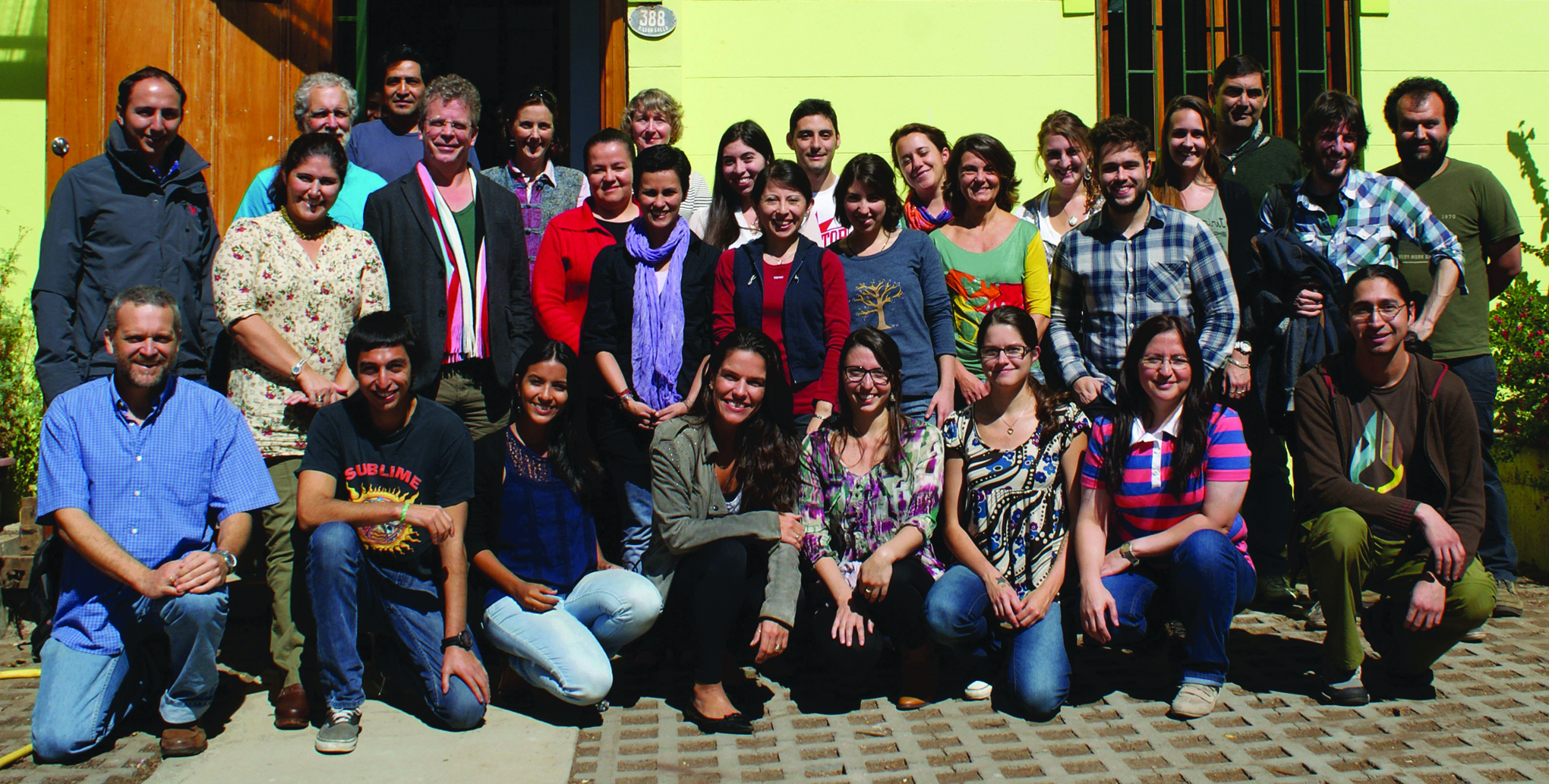
Students and professors of the LAZEN III course in front of the Science Center on Cerro Playa Ancha. The front row seated (L-R): Flavio Zolessi (UY), Jorge Torres (CH), Jaquelinne Pinheiro da Silva (BR), Monica Vianna (BR), Marina Bugnon (ARG), Laura Gonález, (ARG), Marisa Garcés (ARG), Cristian Calfún (CH). Standing (L-R): Juan Manuel Zambrano (CO), Carmen Feijoo (CH), Monte Westerfield (USA), Enrique Salas (MX), Derek Stemple (UK), Kate Whitlock (CH), Zayra Garavito-Aguilar (CO), Lila Solnica-Krezel (USA), Giovanna Sotil (PE), Barbara Ortega (CH), Adriana Orellana (EC), Matías Medrano (ARG), Ileana Sosa (UY), Isabel Benjumeda (CH), Nora Calcaterra (ARG), Marcella Bergamini de Baptista (BR), Pedro Nachtigall (BR), Carla María Borini (ARG), Daniel Barrio (ARG), Alan Talevi (ARG), Ricardo Ceriani (CH). Color images available online at www.liebertpub.com/zeb
The course started on April 4th with a meeting on Cerro Alegre (one of the many hills on which Valparaiso is built), where the students were housed, and a tour of Valparaiso. Bright and early the next morning, the students arrived to lectures on fish systems and fish husbandry. This topic was essential because many students were interested in the cost and functional designs of zebrafish systems. The science center, where lectures were held, contains an Aquaneering E-Rack used for outreach activities; by contrast, the laboratory of Dr. Whitlock has an Aquatic Habitats system. Thus, the students worked with two different zebrafish systems. Companies were invited to present at the course and speak with the students about pricing and technical details. After lunch at the science center, the students walked to the research laboratories of the University of Valparaiso for the practical part of the course where they learned basic information on crossing fish, staging embryos, and water systems. Each day was split between lectures and laboratory classes.
The course covered a variety of areas in which zebrafish are an excellent model system for research, with invited professors from within and outside Latin America (Fig. 1) covering a variety of topics during their lectures, including eye development (Flavio Zolessi, Uruguay), immune system (Carmen Feijoo, Chile), neural crest and facial structures (Nora Calcaterra, Argentina), behavior (Monica Vianna, Brazil), natural product screening (Enrique Salas, Mexico), fish husbandry and olfactory and endocrine systems (Kathleen Whitlock, Chile). Within these topics, the students learned techniques basic to zebrafish research: husbandry, immunocytochemistry, in situ hybridization, imaging techniques, juvenile and adult behaviors, Alcian blue labeling of head cartilages, assaying macrophage response to injury, and confocal and spinning disc microscopy (Fig. 2). On April 10th and as the course drew to an end, a morning of lectures by Lila Solnica-Krezel (genetic control of early development), Derek Stemple (the zebrafish genome), and Monte Westerfield (zebrafish resources) prepared the students for an afternoon workshop led by Monte and assisted by Derek and Lila. Following a guide prepared by Monte, the students learned to use ZFIN and ZIRC resources, including first registering and then searching for genes, mutants, transgenics, scientists, and publications. This workshop was extremely useful and all the LAZEN students as well as the teaching assistants (Isabel Benjumeda, Jorge Torres, Cristian Calfún, Ricardo Ceriani) participated with great zeal. Additionally, it was an excellent opportunity to help more of our Latin American scientists registered on ZFIN!
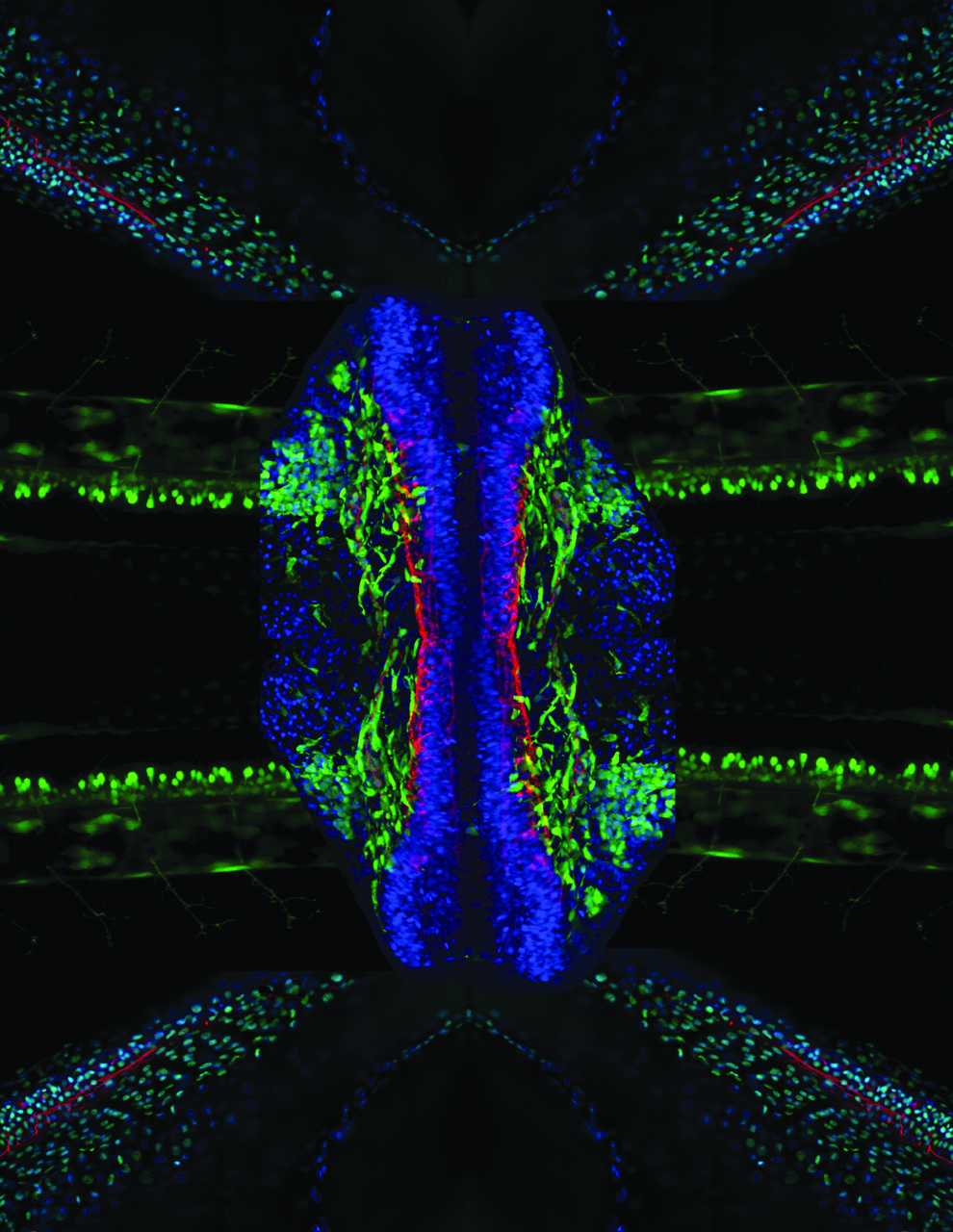
Collage of images taken by the students in the Latin American Zebrafish Network III Course in Valparaiso, Chile. Center: zebrafish embryos labeled for anti-acetylated tubulin (red), anti-GFP (Sox10:GFP, green), and DAPI (blue). Surrounding images: Spinal cord expressing Olig2:GFP (anti-GFP, green), anti-acetylated tubulin (red), and nuclei labeled with methyl green. Color images available online at www.liebertpub.com/zeb
A new activity for LAZEN this year was a science outreach event coordinated with our outreach program “Ciencia Al Tiro” (Science Immediately; www.cienciaaltiro.cl) that works with underprivileged students from Valparaiso. The students in Ciencia Al Tiro have previously participated in a workshop where they learned to be a science journalist and interviewed scientists within our Institute for Neuroscience. These same junior high students joined us on the last day of the course and interviewed Drs. Solnica-Krezel, Stemple, Westerfield, Calcaterra, and Zolessi. Of course, the initial questions were “what is your name” and “where do you come from,” leading to questions like “where is St. Louis in the USA,” and eventually “how did you decide to become a scientist.” At one moment, Monte Westerfield pulled out his passport and showed his student interviewer all the countries he visited as a scientist. Clearly, she was fascinated with the life of a scientist. This was a delightful and impressive workshop with the students learning not only about science but also all the opportunities to meet new people and exchange ideas that are part of science.
On April 11th, the LAZEN III Symposium started off with a talk “Why Zebrafish” by Monte Westerfield. This talk was extremely popular with an audience that rarely contemplates the use of a fish to unravel the genetic bases of disease in humans. This talk was followed by a series of excellent presentations by our invited scientists from Latin America and beyond (http://lazen.fcien.edu.uy/events/iiii-lazen-course-and-meeting), including talks from Drs. Westerfield (Ushers Syndrome), Solnica-Krezel (genetic and epigenetic control on gastrulation), and Stemple (molecular phenotyping). Sadly, the course/symposium closed on April 12th with an unexpectedly early end to the final dinner as the students and professors witnessed the massive fires exploding on the hills of Valparaiso. By the time the fires were out, our guests had left and more than 3000 people were homeless. We thank all the scientists, both professors and students, who so generously donated funds to help the underprivileged students of our public school system who lost everything.
The next LAZEN Course and Symposium will be held in 2016 and will be hosted by Brazil.