







Abstract
Abstract
Neogobius melanostomus (round goby) are a benthic dwelling invasive species of fish in the Great Lakes. This study was done to determine if a tone that mimics the frequency (175 Hz) of mating call of a male round goby would have an effect on male and female response. A testing tank and a simulated trap in front of a speaker at each end were used. Each fish was then placed individually into the small holding box that was in the center of the tank. A video camera was then turned on to record fish movement once the door was opened. Next, the artificial sound was turned on for 1 min (175, 300, 500 Hz, and no sound); 175 Hz mimics the conspecific mating call. This process was done for each frequency for each fish. The individual fish was then allowed to roam for 5 min. The video camera recorded fish location and behavior. From the videos, a continuous measure was collected according to when the fish crossed the center line. The hypothesis, if (N. melanostomus) hears different frequencies of sound projected from a certain location in a fish tank habitat, then the females will be attracted and spend more time on the sound-emitting side of the tank, which mimics the frequency of mating call of a male round goby (175 Hz, 13 pulse), was supported; females spent more time on the sound-emitting side of the tank and males avoided the sound-emitting side of the tank, analysis of variance p < 0.012.
Introduction
N
The average round goby ranges in length from 60 to 100 mm. They spawn every 3–4 weeks from April to September, in their native range. Males mature at 3–4 years of age, while females mature earlier, between the ages of two and three.6,7 Spawning is cued by water temperature (9–26°C). Before females can lay their eggs, males excavate a nest and fan the area with their caudal and pectoral fins. Males then guard the nest, continually inspecting the eggs, often not feeding during the entire process. Once the eggs hatch, the fatigued male goby often dies. In many species of fish, visual, auditory, and olfactory cues have been shown to affect male and female spawning interaction.7,8
Male gobies, in natural settings, vocalize a sound with a frequency of 175 Hz.9–11 This study was done to determine if in a laboratory setting, both male and female round goby would respond to an artificially generated sound of the same frequency. In addition, if a tone that mimics the frequency (175 Hz) of mating call of a male round goby (N. melanostomus) would have an effect on male and female response.
These problems led to the following question: What effect does gender, tone (frequencies of 175, 300, and 500 Hz), and sound location have on the response behavior of N. melanostomus (round goby) and the possibility of future trapping of this invasive species? The hypothesis was as follows: If (N. melanostomus) hears different frequencies of sound projected from a certain location in a fish tank habitat, then the females will be attracted and spend more time on the sound-emitting side of the tank, which mimics the frequency of mating call of a male round goby (175 Hz, 13 pulse). The impact of this research is that the scientific community will learn more about round goby mating behavior and to possibly be able to noninvasively extract these exotic fish from the Great Lakes.
Materials and Methods
This study was conducted at the University of Minnesota Duluth (UMD), in the Swenson Science Building. Round goby were extracted from Lake Superior by UMD biologists in 2012. The captured fish were placed in holding tanks in the biology laboratory and cared for and used by UMD scientists. Permission was granted to set up an experimental tank in the UMD biology laboratory so as to develop a protocol for removal of the invasive species from Lake Superior using a sound. These gobies were not released back into Lake Superior and will continue to be studied by UMD biologists.
Housing conditions
The fish were being housed by the UMD Biology Department for a study being done by university researchers with an approved Institutional Animal Care and Use Committee number of 1205A13881. The fish were observed by this study's researchers, but not solely for this study. The fish will never be returned to the wild because of their invasive species classification. UMD has a permit to house these fish. The fish will continue to be housed and cared for by UMD biologists and used in other studies.
To minimize potential discomfort, distress, pain, and injury to the animals during the course of this experiment, the fish were only handled for short periods of time or when necessary so as to reduce stress. The observational study would have been stopped if there was any sign of discomfort, distress, pain, and injury to the animals during the course of the experiment (the video tape was remotely observed at all times during testing). The qualified scientist continually monitored the student researchers at all times in the UMD biology laboratory and no vertebrate animal death was noted.
Between experiments, the gobies were housed in indoor glass aquariums with a rocky bottom, 12-cm sections of PVC pipe, and other goby. Local pond water was used in the holding and experimental tanks. This water was shown to contain potassium chloride (KCl), sodium chloride (NaCl), and calcium chloride dihydrate (CaCl2 · H2O). The experimental setup included two adjacent biology laboratories. The experimental tank was placed in one of the rooms and had a dimension of 280 × 60.5 cm. Each of the two submerged speakers was placed at the center of the short side (60.5 cm) of the tank, 192 cm apart (Fig. 1).
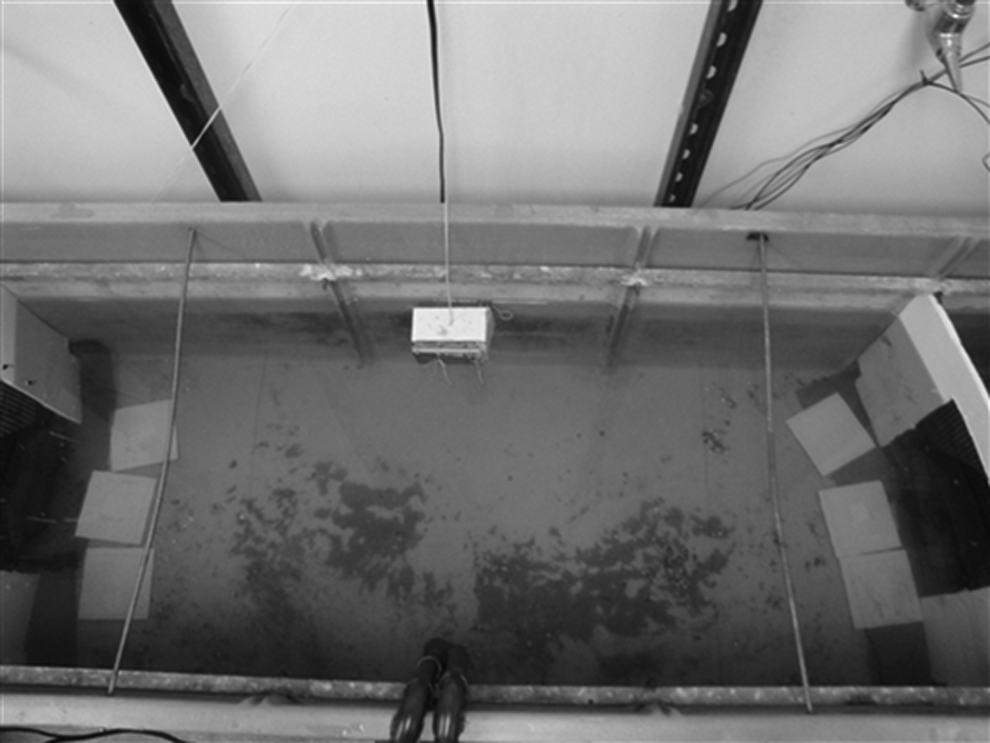
Testing tank used to measure round goby reaction to an artificial sound (frequency of 175, 300, and 500 Hz), mimicking the goby's mating call, had a dimension of 280 × 60.5 cm. Each of the two speakers was placed at the center of the short side (60.5 cm) of the tank, 192 cm apart.
In the center of the testing tank was a holding box. The holding box was just big enough to fit a medium-sized goby. The box was made completely out of wood with a string attached to a movable door, when pulled by the researchers in the adjacent room; the fish could enter the experimental tank without any distraction. A video camera was mounted above the tank so as to record the fish behavior (time [seconds] to enter the trap at each end and time [seconds] spent on each side of the tank).
Laboratory protocol
To prepare for testing the round goby's attraction to auditory cues, again, the sex and length in millimeters (mm) of each of the fish were recorded. Each of the eight fish was then placed into the small holding box that was submerged in the center of the experimental tank, one at a time. The mounted video camera was then turned on so as to continuously record fish movement once the door was opened.
Next, the artificial sounds were each turned on for 1 min at frequencies of 175, 300, and 500 Hz; 175 Hz mimics the conspecific mating call of the male round goby. This process was done for each of the three frequencies, and a test with no sound, for each fish. The order the fish were exposed to each frequency, or no frequency, varied so that the order the sound was played to each fish would not be a variable. The sound frequency range of 175–500 Hz is within the normal hearing range of the fish (B. Vetter, pers. comm.).9–11
After 1 min of sound exposure or no sound exposure, the holding box door was remotely pulled up using a string that was fed into the adjacent room, releasing a single fish into the main test tank. The individual test fish was then allowed to roam for 5 min. As stated previously, the mounted video camera was turned on before the fish was placed in the test tank so as to remotely record fish location and behavior during the entire 5 min.
Finally, after 5 min, researchers entered the room to stop the recording and the procedure was repeated for each of the sound frequencies and fish. Later, the videos were played. While watching the 32 h of video (Fig. 2), a virtual line (60.5 cm) was vertically drawn at the center of the long side (192 cm), dividing the tank into two 60.5 × 81 cm halves.
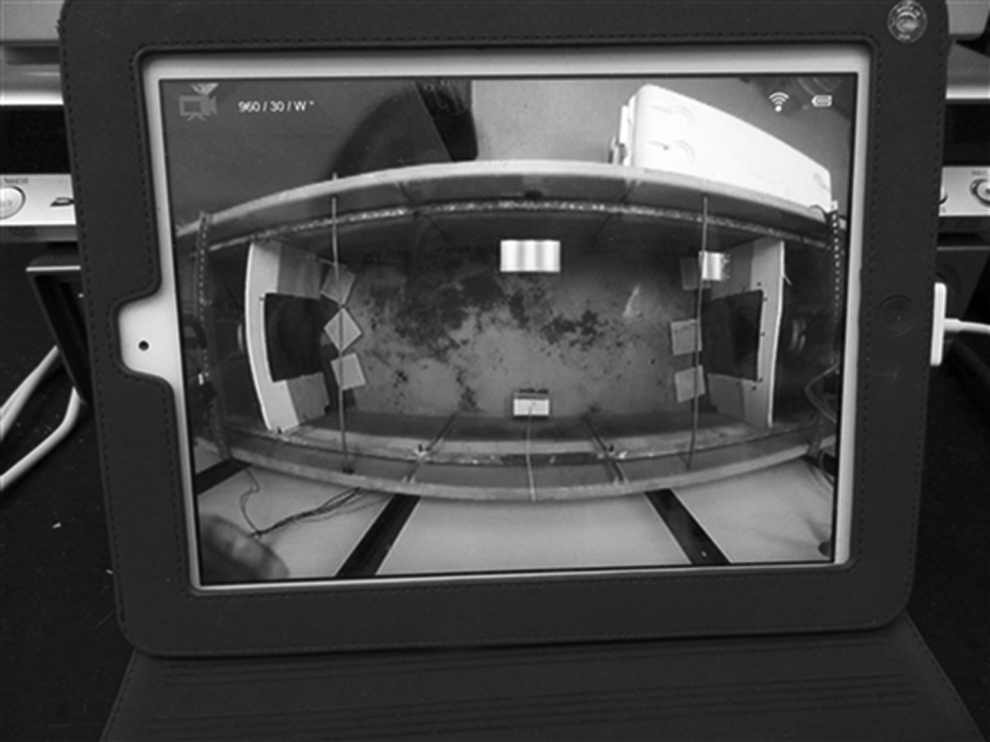
The hand-held digital device used to monitor fish behavior. A virtual line (60.5 cm) was vertically drawn at the center of the long side (192 cm) of the device so as to record a continuous measure of the total time each fish spent on each side of the tank.
While watching the video for each fish, a continuous measure was collected. A stop watch was started whenever the fish crossed the center line, entering the side of the tank projecting the sound, and shut off and turned back on when the fish crossed the line into the nonsound-projecting side. The total time the fish was on each side was calculated. This same procedure was repeated for the no-sound control. There was a net in front of each speaker to simulate a minnow trap. Each time the fish entered the minnow trap in front of a speaker (sound producing and nonsound producing) was recorded.
Statistical analysis
Eight round goby were used in all; four female and four male goby were tested with each of the three sounds and without sound. Enough fish were used to do statistical analysis, while reducing the number of vertebrate animals used. To determine if there was a significant difference between the continuous measure of the time spent by each fish on the sound-emitting side and the nonsound-emitting side of the tank, each measurement for each fish was compared to itself using a univariate analysis of variance (ANOVA) and a comparison of time spent on each side of the tank was compared by the independent variables gender, sound frequency, and the side of the tank the sound was coming from.
Error bar graphs were used to show one standard error (65%) of how the data (time) varied around the mean for each of the independent variables. A p-value of p < 0.05 was used to show significance. Also, a bar graph compared the percentage of time a fish (male or female) entered the simulated minnow trap in front of speaker on each side and it was noted if the sound was being played from that side and what frequency it was. A chi-square (χ2) 2 × 2 contingency table, with a p < 0.05 showing significance was used to determine if there was a difference between males and females according to the minnow trap they entered.
Results
Figure 3 shows the average time (in seconds) that N. melanostomus spent on the side of the tank emitting an active sound frequency of 175 Hz, the same frequency as the mating call a male round goby. The females spent all 300.00 ± .00 s on the sound-emitting side, whereas the males spent 65.75 ± 131.500 s on the sound-emitting side. Females spent significantly more time on the side of the tank emitting 175 Hz after calculating an ANOVA, when gender was compared, with a p-value of p < 0.012.
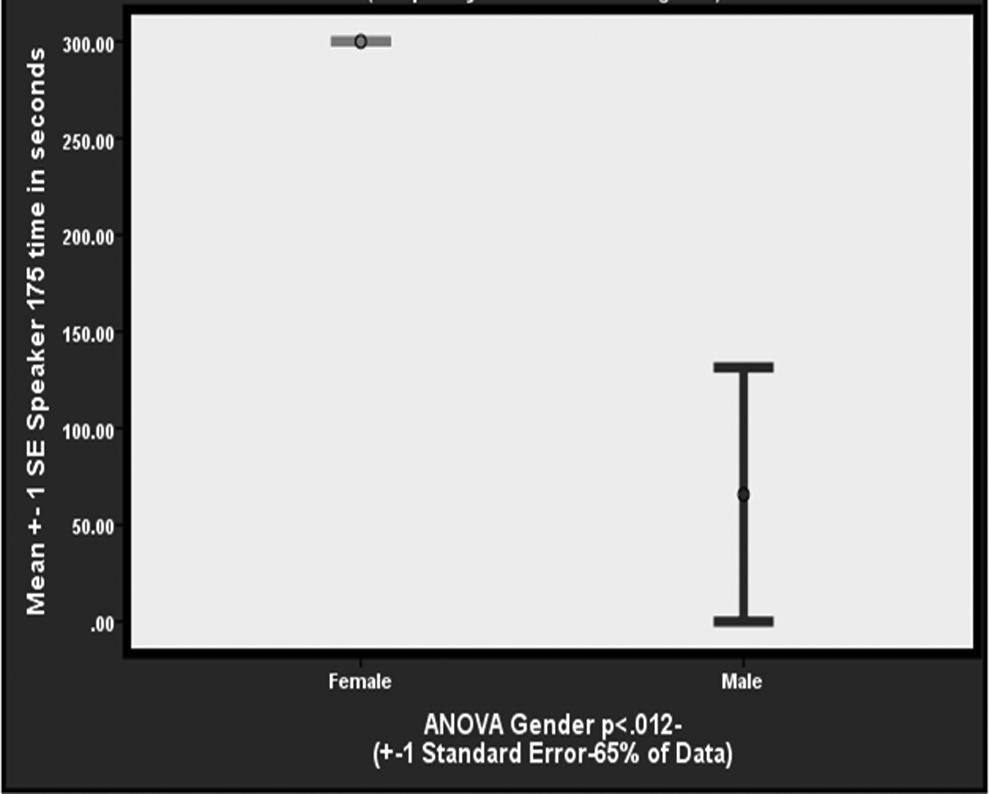
The average time (in seconds) that Neogobius melanostomus spent on the side of the tank emitting an active sound frequency of 175 Hz (The same frequency as a male round goby's mating call). Females spent significantly more time on the side of the tank emitting this sound.
Figure 4 shows the average time (seconds) that N. melanostomus spent on the side of the tank emitting an active sound frequency of 300 Hz. The females spent an average of 225.00 ± 150.00 s on the side of the tank emitting sound and the males spent an average of 233.00 ± 134.00 s on the same side. There was no significant difference between genders when the time spent on the sound-emitting side of the tank was compared using an ANOVA with a p-value of p < 0.939.
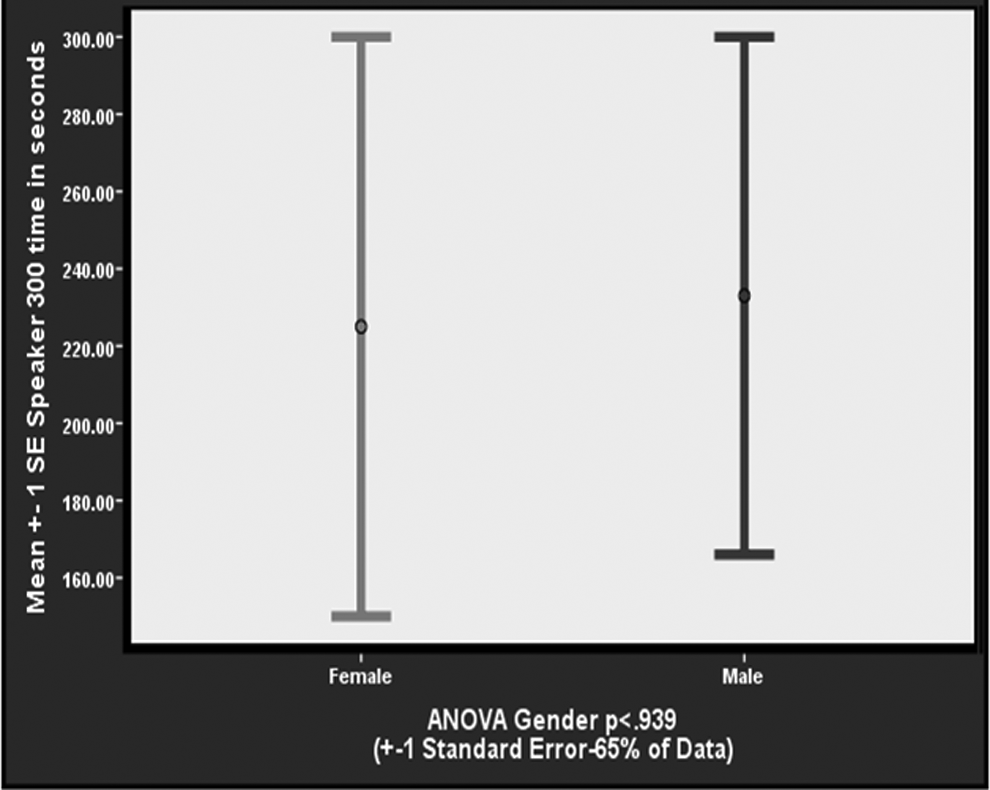
The average time (seconds) that N. melanostomus spent on the side of the tank emitting an active sound frequency of 300 Hz. There was no significant difference between genders when the time spent on the sound-emitting side of the tank was compared.
Figure 5 shows the average time (seconds) that N. melanostomus spent on the side of the tank emitting an active sound frequency of 500 Hz. The females spent an average of 0.00 ± 0.00 s on the side of the tank emitting sound and the males' spent an average of 20.50 ± 23.69 s on the same sound-emitting side of the tank. Males spent more time on the sound-emitting side of the tank, yet the difference was not significant using an ANOVA with a p-value of p < 0.134. Both males and females appear to avoid this frequency.
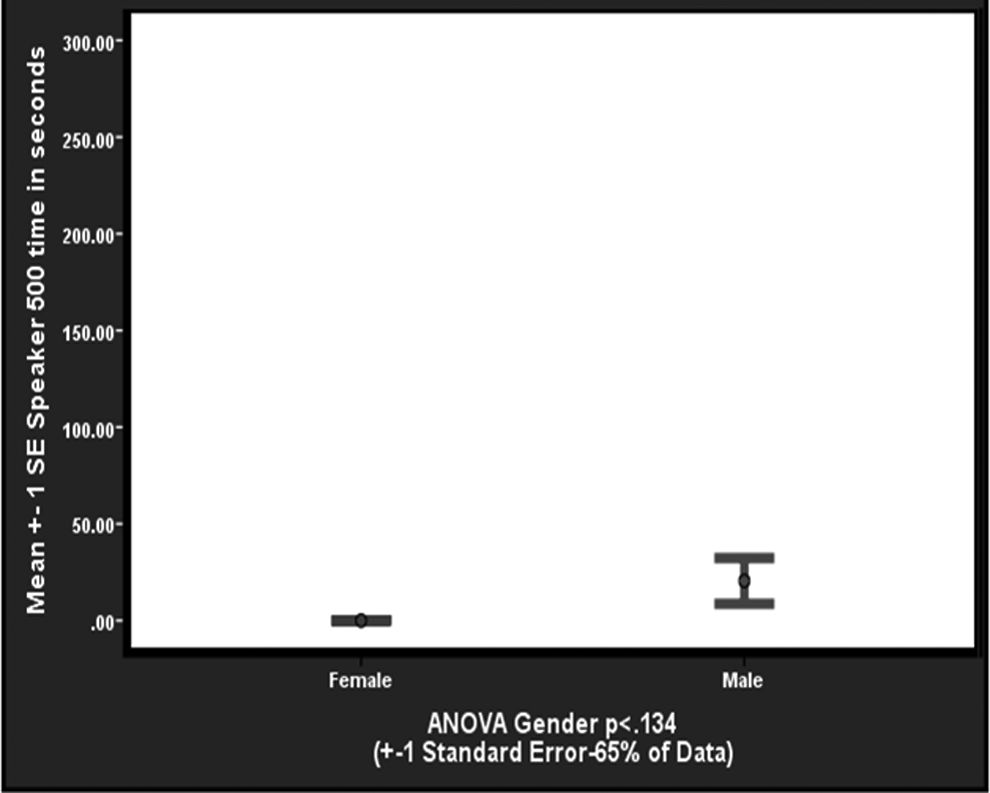
The average time (seconds) that N. melanostomus spent on the side of the tank emitting an active sound frequency of 500 Hz. Males spent more time on the side of the tank emitting this sound, yet the difference was not significant.
Figure 6 shows the average time (in seconds) that N. melanostomus (round goby) spent on a side of an experimental tank when no sound was played. The females spent an average of 151.50 ± 129.11 s on the left side and the males spent 185.25 ± 133.64 s, also on the left side. There was no significant difference in time spent on either side of the tank when no sound was played using an ANOVA, compared by gender with a p-value of p < 0.729.
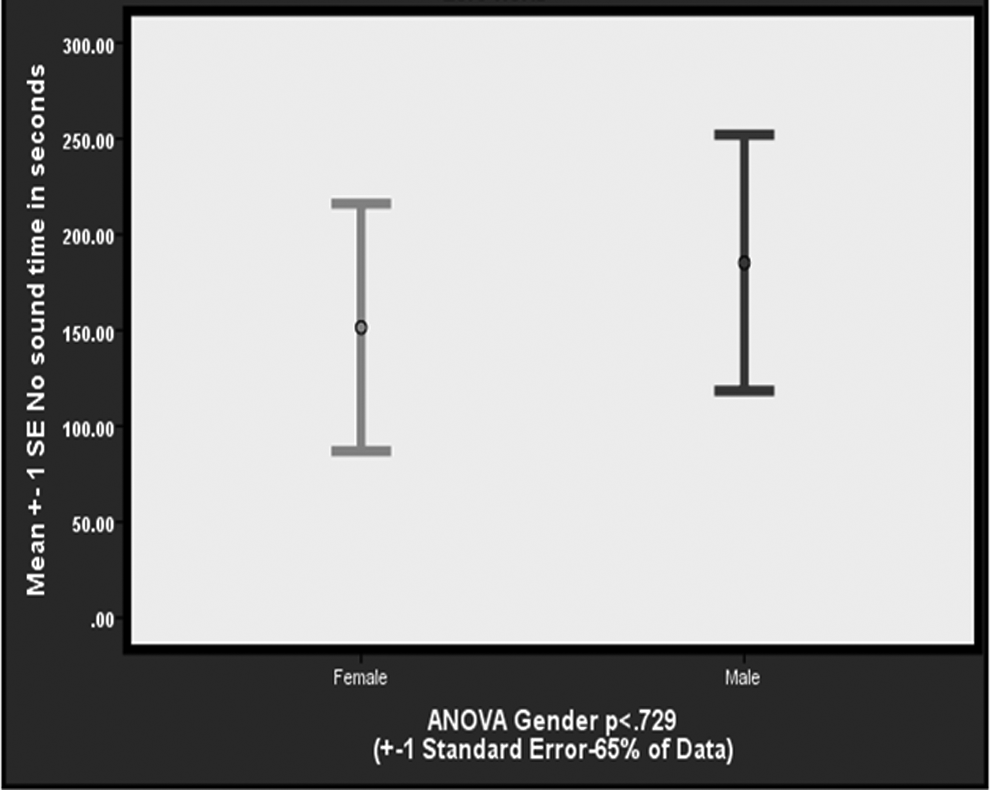
The average time (in seconds) that N. melanostomus (round goby) spent on a side of an experimental tank where no sound was played. There was no significant difference in time spent on either side of the tank when no sound was played.
Figure 7 shows the percentage of N. melanostomus that went into a small minnow trap in front of speakers that were playing different frequencies of sound and those that were not (175, 300, and 500 Hz). When 175 Hz (the same frequency as a male mating call) was played, 100% of the females went into the minnow trap on the sound-emitting side of the tank, while 100% of the males went into the trap on the opposite side of the sound. Using a chi-square (χ2) 2 × 2 contingency table, the χ2 = 200 with a p-value of p < 0.00001, indicating that the male and female behavior was not similar relative to which minnow trap they went into, but different when 175 Hz was played and not played behind a minnow trap.
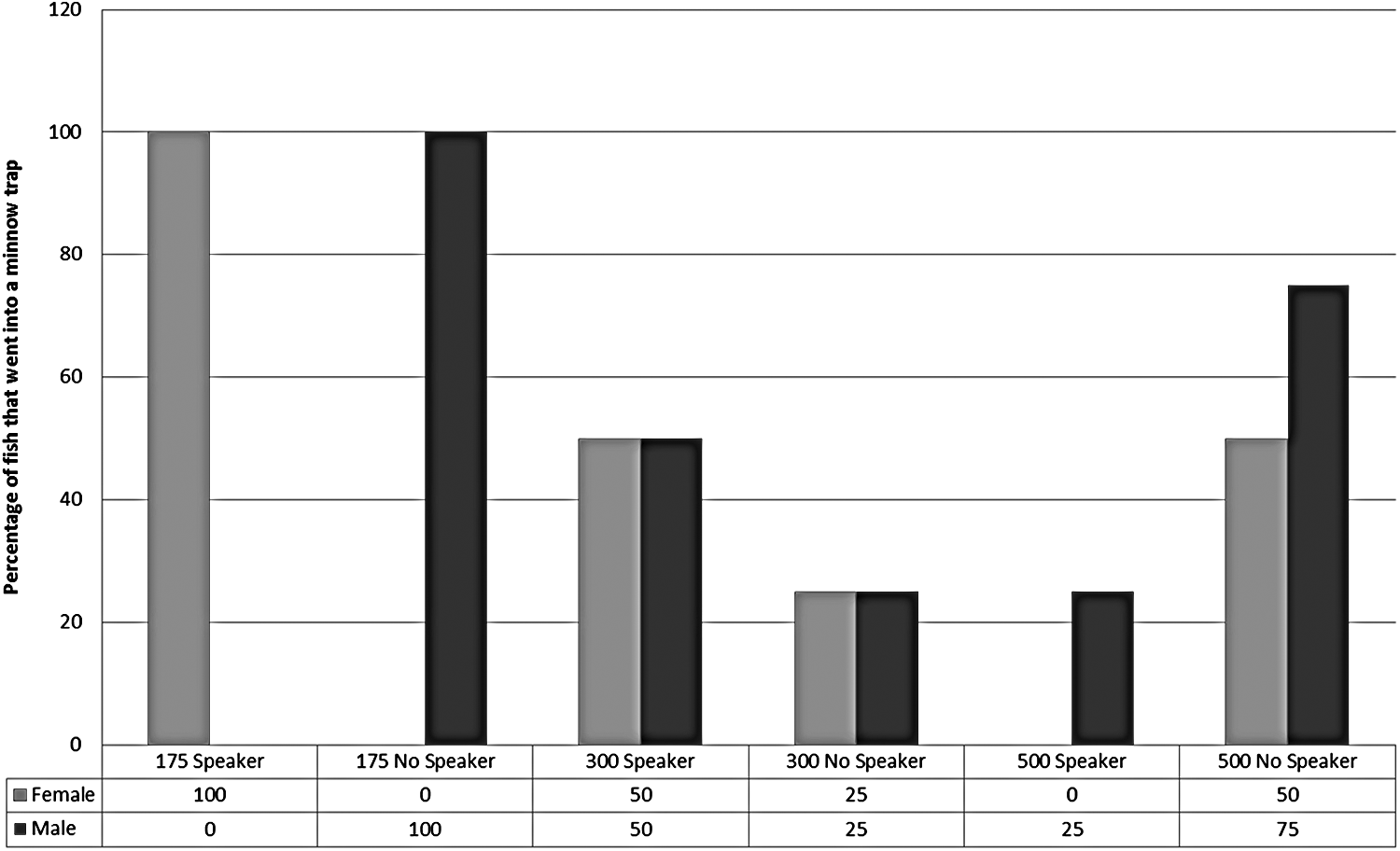
The percentage of time N. melanostomus went into a small minnow trap in front of speakers that were playing different frequencies of sound and those that were not (175, 300, and 500 Hz). When 175 Hz (the same frequency as a male mating call) was played, 100% of the females went into the minnow trap on the side of the tank emitting active sound frequencies, while 100% of the males went into the trap on the opposite side of the speaker. When 300 Hz was played on one side of the tank, there was no significant difference by gender. When 500 Hz was played, 25% of the females went into the trap on the side of the tank emitting active sound frequencies, while 0% of the males did.
When 300 Hz was played, there was no difference (the same percentage) between males and females by which minnow trap they went into, whether the speaker was playing or not. Both genders went to the sound-emitting side 50% of the time. Using a chi-square (χ2) 2 × 2 contingency table, the χ2 = 0 with a p-value of p < 1. Indicating that the male and female behavior was similar relative to which minnow trap they went into, when 300 Hz was played and not played behind a minnow trap.
When 500 Hz was played, the females went only to the minnow trap on the nonsound-emitting side of the tank (50%), while 75% of the males went to that same side. Zero percent of the females went into the trap on the sound-emitting side, while 25% of the males did, females appear to avoid the frequency of 500 Hz. Using a Chi-square (χ2) 2 × 2 contingency table, the χ2 = 15 with a p-value of p < 0.00001. Indicating that the male and female behavior was not similar relative to which minnow trap they went into, but different when 500 Hz was played and not played behind a minnow trap.
Conclusion/Discussion
The site for this study, the University of Minnesota Duluth, is located near the shores of Lake Superior, one of the five Great Lakes. Round goby, introduced from the ballast water of cargo ships into Lake Superior, have principally populated the Duluth-Superior Harbor and the lower St. Louis River. 12 This study's results are important because in locations where round gobies have been established, large numbers of other native species have declined. 13
Round goby prey on lake trout eggs, a primary Lake Superior recreational fish, and fry and may feed on the fry and eggs of other species. Further compounding the problem is that they have been found to have the same diet preference as many other native fish species. 14 As stated before, the diet of the adult round goby consists mainly of zebra mussel in Lake Superior. Zebra mussel is also an invasive species, but their abundant presence can enhance the proliferation of the round goby. 15 Developing a protocol to noninvasively remove round goby from Lake Superior is an important task that needs to be accomplished.
Using conspecific sound frequencies to remove round gobies is a new and novel technique.
Some methods that have been tried, with little success, are trapping, netting, barriers, and entrapment. Rotenone, an organic product extracted from a plant, was used in Pefferlaw Brook, in Ontario, Canada, in an attempt to block round goby from entering an area lake. This organic chemical targets gills by preventing fish from absorbing oxygen. This product is deadly for hours and can be detected in the water for 1–5 weeks. Rotenone is not toxic to plants and nongill-breathing wildlife and does not bioaccumulate, but is not a feasible treatment in lakes such as Lake Superior because of the massive fish kill that would occur. 16
This year's novel research shows that a conspecific mating call frequency can be used to attract and trap female round gobies. They were attracted to and spent significantly more time on the sound-emitting side of the tank. When the conspecific male mating call with a frequency of 175 Hz was played, 100% of the females went into the minnow trap on the sound-emitting side, while 100% of the males went into the trap on the opposite side of the sound-emitting side. Surprisingly, males avoided the conspecific call, yet, attracting and removing female round gobies could effectively control their population.
Male round goby appears to be threatened by, or just want to avoid the male mating call frequency (175 Hz) used in this study. They spent significantly more time on the nonsound-emitting side and went into the simulated minnow trap on the nonsound-emitting side. This avoidance behavior is surprising because round gobies have been noted for their aggressive behavior and success at evicting native species from rock shelters used for spawning and predator evasion. For example, in tanks when round gobies were introduced with mottled sculpin, the gobies chased the sculpin away. 14
This aggressive behavior may only be exhibited during spawning and when other species are present. This study found different results when a frequency of 175 Hz was played; males did not appear to be aggressive toward this frequency, they avoided it. In nature, this behavior would eliminate conspecific competition and could allow individual males undisturbed breeding, enhancing reproduction.
Isabella-Valenzi 17 looked at attracting female round gobies to conspecific mating sounds recorded in the wild. This study set up a similar tank situation, but used an actual male grunt call recorded in Lake Michigan, with a frequency of 180 Hz, and noted the number of times the sound was approached in a 10-min period. The reproductive females approached the grunt call significantly more times, yet rarely approached the sound more than twice. When the male drum call with a frequency of 160 Hz was played, the reproductive females and males were found to avoid the sound by moving toward the sound on the opposite side of the tank. Therefore, the drum sound was proposed to be a territorial defense sound to ward off other male round gobies.
In the above study, only the number of times a round goby approached the sound-emitting side was recorded and not the total time spent on this sound-emitting side, as this study implemented. In addition, the 2012 study did not investigate whether the round gobies entered a simulated minnow trap as this year's study had. Interestingly, this year's study used a frequency of 175 Hz, right between the frequency emitted by the drum and grunt.
This study was done in a simulated laboratory environment. When the sounds are played in a simulated tank environment, the sound waves could be bouncing all around the tank, making it difficult for the fish to interpret the direction of sound. Yet, the data suggest that the male and female round goby were able to distinguish which side of the tank the sound was coming from. Although, a field study would further substantiate the mating frequency sound directional bias by females and sound avoidance by males.
The original hypothesis of this study was, if round goby (N. melanostomus) hears different frequencies (175, 300, and 500 Hz) of sound projected from a certain location in a fish tank habitat, then, the females will be attracted and spend more time (seconds) and be closer to the sound-emitting side of the tank, which mimics the frequency of mating call of a male round goby (175 Hz).9–11 This will possibly allow scientists to noninvasively trap and remove this exotic species from the Great Lakes, while releasing any other trapped organisms (crayfish).
The hypothesis was supported; female round goby spent significantly more time on the sound-emitting side of the tank. The male round goby spent significantly more time on the side of the tank not emitting active sound. However, when other frequencies were played, there was no significant difference between the amount of time the females and males spent on the side not emitting and the side emitting sound. Conversely, when the conspecific male mating call, with a frequency of 175 Hz was played, 100% of the females went into the minnow trap on the sound-emitting side, while 100% of the males went into the trap on the nonsound-emitting side. Interestingly, in the 500 Hz tanks, both males and females spent more time on the nonsound-emitting side of the tank.
Possibly, the frequency of 500 Hz could be used as an auditory “repellant” in the field to “corral” both males and females into an enclosure. It appears using a sound frequency that mimics the male mating call (175 Hz) can be used to trap females, while deterring males, thus being a feasible noninvasive control/removal method. It is important to learn more about invasive species so that in the future they can be better controlled in lakes and other bodies of water; more testing needs to be conducted in the round goby's natural habitat, especially during their mating season. Future studies need to be done, using the conspecific mating frequency of 175 Hz, in the wild, to determine if the trapping success as noted by this study can be replicated and the frequency of 500 Hz could be used to corral and trap both male and female round gobies.
Footnotes
Acknowledgments
We would like to thank Dr. Allen Mensinger, Professor of Biology, and Brooke Vetter, his PhD biology graduate student, both at the University of Minnesota Duluth (UMD), for their guidance and use of Dr. Mensinger's laboratory. In addition, we would like to thank Dr. Robert Lloyd, Associate Professor of Psychology (UMD), for his statistical and methodology assistance.
Author Contributions
C.R.M. and C.E.N. are high school students at Cloquet Senior High School in Cloquet, MN. This research was performed as part of their 2013–2014 Science Fair project. They presented their work at several conferences, including the MN Academy of Science State Science Fair, the Tri-State Junior Science and Humanities Symposium. This research was selected as the top water research article for the 2014 MN Stockholm Junior Waterprize and was presented at the Genius Olympiad where it received the Bronze Grand Award. At the 2014 Intel International Science and Engineering Fair in Las Angeles, CA, this research was awarded the American Veterinary Association first place award. C.A.W. has a doctorate in Educational Policy and Administration from the University of Minnesota and is currently a science teacher at both Cloquet Senior High and Middle School. She is also the director of the NE Minnesota and American Indian Science and Engineering Regional Fair. She comentored C.R.M. and C.E.N. in their round goby research, as well as provided training, technical support, and guidance throughout the research and writing process.
Disclosure Statement
No competing financial interests exit.