







Abstract
As the population ages, increasing numbers of patients regularly attend their GP with chronic conditions, such as diabetes, ischaemic heart disease, hypertension and chronic obstructive pulmonary disease (COPD). Similarly, depression is becoming more common. By 2020, the World Health Organization estimates that depression will be one of the leading causes of disability worldwide, second only to ischaemic heart disease. As one of the frontline care providers for patients with chronic medical illnesses, GPs are in an ideal position to diagnose and manage depression in this patient group. This article reviews the aetiology of depression in chronic illness, the challenges involved in diagnosis and recommended management strategies.
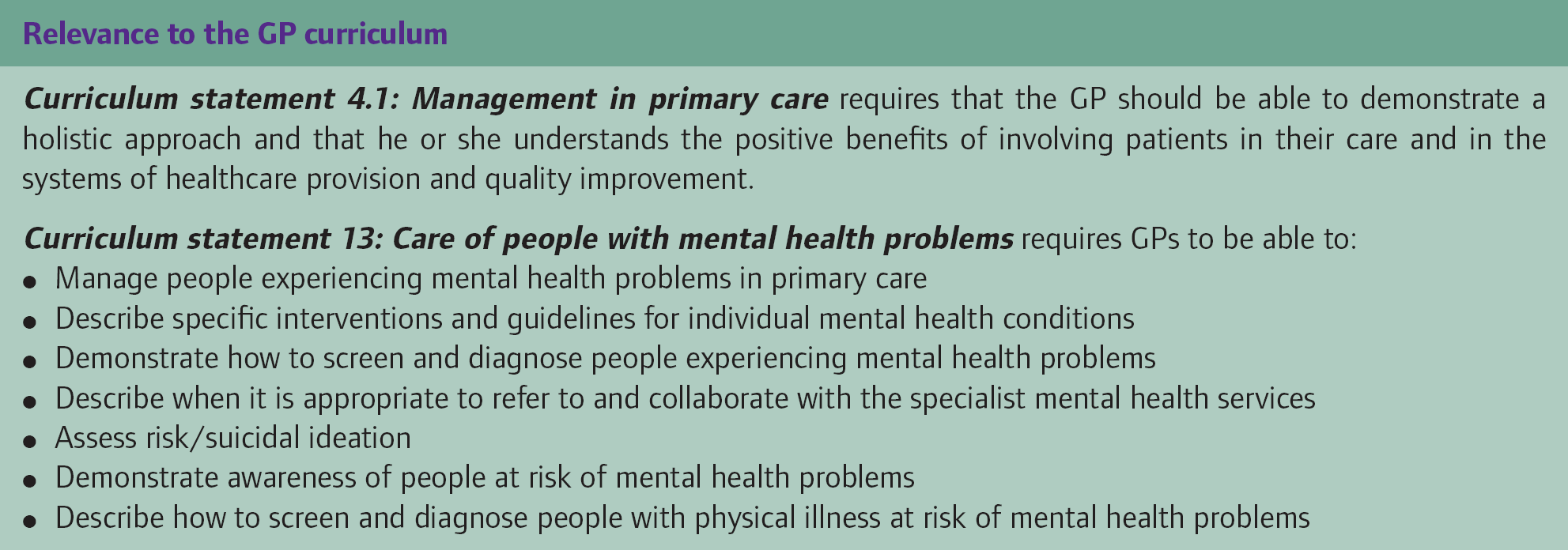
Relevance to the GP curriculum
Manage people experiencing mental health problems in primary care Describe specific interventions and guidelines for individual mental health conditions Demonstrate how to screen and diagnose people experiencing mental health problems Describe when it is appropriate to refer to and collaborate with the specialist mental health services Assess risk/suicidal ideation Demonstrate awareness of people at risk of mental health problems Describe how to screen and diagnose people with physical illness at risk of mental health problems
Epidemiology
Severe depression affects 1 in 20 people at some point in their lives and a much higher proportion of those with chronic physical illnesses. Depression is reported to affect as many as:
30% of people with epilepsy 40% of people after a stroke 50% of people following myocardial infarction or coronary arterial disease 50% with type two diabetes mellitus 50% of people with cancer and up to 80% of those diagnosed with rheumatoid arthritis
Aetiology of depression in chronic illness
The new diagnosis of any chronic disease is a stressful event for patients, with anxiety and sadness understood as a normal response. Depression becomes more likely when this event occurs in a patient who is already vulnerable due to biological, psychological or social risk factors, such as genetic predisposition, poor coping strategies or inadequate social support.
In addition to these pre-existing risk factors, the illness itself may increase the risk of developing depression by direct biological and social mechanisms. For example, the location of the lesion following a cerebrovascular accident is thought to determine the type of post-stroke mood disorder, and depression in Alzheimer's and Parkinson's disease may be due to the neurodegenerative process itself.
Having a chronic illness may also reduce a patient's social interaction. This could be for a variety of reasons, such as difficulty communicating after a stroke or due to driving restrictions imposed after a seizure for patients with epilepsy. Reduced social interaction may lead to a decrease in the quality of a patient's social network and increased risk of developing depression.
Impact of medications
In addition to biological mechanisms linking chronic disease pathology to depression, many patients with chronic conditions take medications that are known to cause depressive symptoms. These include antihypertensives, antiepileptics, corticosteroids and chemotherapy agents. In the elderly especially, polypharmacy may make it difficult to distinguish which medication, if any, is responsible for symptoms of low mood.
Feedback loop between depression and chronic illness
While it is clear that having a chronic disease increases lifetime risk of developing depression, the inverse is also true; having depression increases an individual's risk of developing a chronic disease. An example of this feedback loop is that depression is more common after myocardial infarction, and depression itself is associated with increased risk of developing chronic cardiac disease through direct biological mechanisms. Depression leads to raised levels of proinflammatory cytokines, which increase risk of atherosclerosis and therefore cardiac and cerebrovascular disease. Depression is also linked to changes in autonomic functioning, increased platelet activation and hypercoagulable states.
Similar feedback exists between depression and obesity; depression in childhood is a strong predictor of adult obesity, and depression is more common in those who are obese, due to increased cortisol levels. Weight loss leads to improved mood, but treatment of depression has not been found to lead to loss of weight. Depression increases serum levels of growth hormone and glucocorticoids, leading to insulin resistance and therefore an increased risk of developing depression.
Depression may also increase the risk of developing chronic physical illnesses due to behavioural factors. For example, those with depression are more likely to smoke and are less likely to adhere to healthy diets and exercise regimes.
Diagnosing depression in chronic illness
Diagnosing depression in those with chronic physical illnesses presents a challenge. Depression may be trivialized and seen as a realistic response to the stresses of living with a chronic disease and patients may underreport symptoms of low mood due to the remaining stigma attached to mental health problems.
Specific illnesses may present additional difficulties. In patients who have suffered a stroke, diagnosis may be complicated by cognitive impairment or dysphasia, while many illnesses have symptoms in common with depression, such as weight loss and fatigue, which may confuse diagnosis. It is generally recommended to count these overlapping symptoms towards a diagnosis of depression rather than excluding them.
The National Institute for Health and Clinical Excellence (NICE) recommends that practitioners are alert to possible depression in those with chronic physical health problems, and if they are concerned to consider following the sequence of questions shown in Figure 1. The importance of diagnosis of depression in chronic illness is emphasized by the fact that Quality and Outcomes Framework (QOF) points are attached to screening for depression in diabetes and coronary heart disease.
NICE guidelines for assessing depression in a patient with a chronic physical illness.
In general practice, it may be useful to use the Patient Health Questionnaire (PHQ-9) to assess further any patients identified as having possible depression by the NICE screening questions, initially for providing evidence towards diagnosis and recording a baseline level of severity of depression and later to evaluate response to treatment.
In reviewing any patient with a chronic physical illness complicated by depression, it is also important to conduct a thorough assessment of any functional or social difficulties suffered, either as a result of the depression or the physical illness. As some medications can contribute or cause symptoms of depression, it is worth reviewing a patient's medications and considering whether they are helping to maintain symptoms of depression.
The risk factors for developing depression in those with chronic illnesses include:
deteriorating condition ongoing pain dysphasia impairment in function isolation any past history of mental illness
In addition to the advice provided by NICE, it is worth considering these factors when assessing the risk of developing depression in individuals with chronic illnesses.
Severity of depression
The severity of an individual's depression should affect their initial management, and therefore, it is crucial to make an assessment of this. There are two main classification systems: the International Classification of Diseases tenth revision (ICD-10) and the Diagnostic and Statistical Manual of Mental Disorders, fourth edition (DSM-IV). It is of note that in order to assess comprehensively a patient's depression, it is important to assess degree of functional impairment not just number of symptoms.
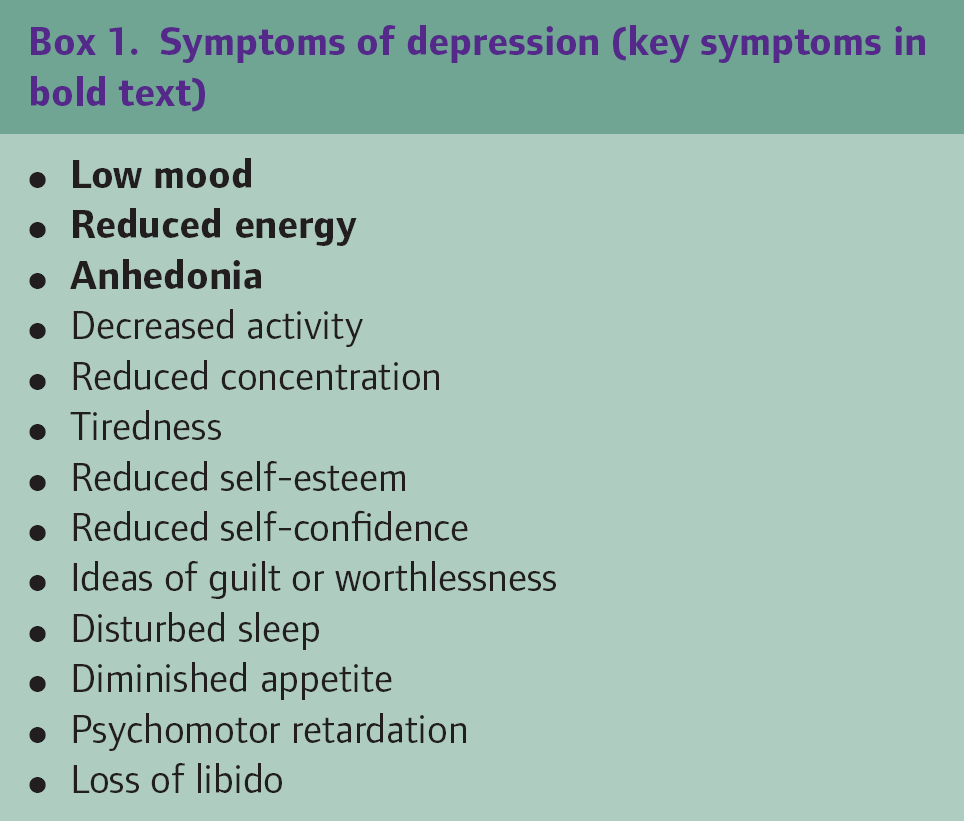
For mild depression, ICD-10 requires two or three of the symptoms given in Box 1 to be present. While patients may be distressed by these, they should be able to continue with most of their daily activities.
Symptoms of depression (key symptoms in bold text)
Decreased activity Reduced concentration Tiredness Reduced self-esteem Reduced self-confidence Ideas of guilt or worthlessness Disturbed sleep Diminished appetite Psychomotor retardation Loss of libido
In moderate depression, ICD-10 requires that four of the symptoms listed in Box 1 be present. These are likely to interfere with patients' normal activities.
A diagnosis of severe depression in ICD-10 requires four of the symptoms of depression listed in Box 1, whereas DSM-IV requires five symptoms. The symptoms are marked and distressing and typically involve loss of self-esteem and ideas of worthlessness or guilt, as well as thoughts of suicide. Symptoms markedly impair an individual's functioning. They should be present for at least 2 weeks, with each symptom present for most of each day. Each classification system requires key symptoms to be present for a formal diagnosis of severe depression; DSM-IV requires one and ICD-10 two. Severe depression can occur with or without psychotic symptoms.
It is increasingly recognized that having symptoms of depression that fall below the criteria for diagnosis under ICD-10 and DSM-IV may impact on the course of a chronic physical illness and be distressing for patients. It is therefore advisable to be alert to any depressive symptoms and to assess how they are affecting patients' lives.
Suicidal ideation
Suicidal ideation is more common when depression occurs in the context of medical illness. It is especially common in those with functional impairment from their physical illness and those with psychiatric co-morbidities. However, it often remains undetected. Physical suffering and pain or having a medical illness that poses significant restrictions to lifestyle may also increase suicide risk. Therefore, suicide risk should be assessed in all patients with depression and a chronic illness, and this assessment can be as simple as just asking the final question of the question sequence in Figure 1. Any patient who is deemed to be at risk of suicide should be referred to specialist mental health services and will potentially need more frequent contact subsequently.
Impact of depression on chronic illness
Depression in those with chronic medical illnesses is increasingly recognized to affect adversely the prognosis of the medical illness. It is associated with poorer glycaemic control in diabetics and more end-organ complications, higher obesity rates and increased healthcare costs due to increased use of services among those with depression. Depression is also strongly linked with increased disability in chronic back pain. People with depression are more likely to smoke and live sedentary lifestyles and are less likely to adhere to medication regimes, including oral hypoglycaemics, antihypertensives and lipid-lowering medications.
Depression also affects how patients perceive their symptoms and their medical illness. Those with depression are more likely to suffer and report pain associated with chronic physical illnesses (Bair et al., 2003). Reporting of symptoms associated with poor glycaemic control in diabetics with comorbid depression has been found to be more closely related to the severity of patients' depression than to their HbA1C (Lustman et al., 1988). In those with treatment-resistant epilepsy, it is presence of depression not frequency of seizures that predicts quality of life (Boylan et al., 2004). As morbidity and mortality are increased in those with chronic physical illnesses complicated by depression, it is vitally important to manage depression as quickly and effectively as possible.
Management of depression in chronic illness
While it is clearly important to treat depression when it is recognized in a patient with a chronic medical illness, a feedback loop exists here also, whereby treating the chronic medical condition may improve a patient's depression. In COPD sufferers, for example, pulmonary rehabilitation is found to improve depression (Paz-Diaz et al., 2007) and improved glycaemic control in diabetes is associated with improved mood (Van der Does et al., 1996).
NICE recommends using a stepped approach to management of depression in patients with chronic medical illnesses, as shown in Figure 2. Despite the rigid appearance of this stepped approach, at all steps, it is important to be aware of the preferences of the patient and, if appropriate, their families and carers.
NICE stepped care model for managing depression.
Successful treatment of depression in people with chronic physical health problems can potentially extend their life expectancy and have a large impact on their quality of life. Whichever management is appropriate, depending on severity of depression, the target should be to remove completely depressive symptoms. Management of depression can be divided into psychological and pharmacological therapies.
Psychological management
Low-intensity psychological and psychosocial interventions are recommended for those with persistent subthreshold depression, subthreshold depression causing significant functional impairment or mild to moderate depression. These might include self-help groups, individual guided self-help based on cognitive behavioural therapy (CBT) principles or computerized CBT. High-intensity psychological interventions might include group or individual CBT or behavioural couples therapy. Group-based CBT is in groups of six to eight people and should run over 6–8 weeks. Similarly, individual CBT should run for 6–8 weeks or until symptoms are resolved. Some community services for those suffering from chronic illnesses offer tailored counselling services for those needing support. It is also possible to involve liaison psychiatry services to support patients with depression associated with chronic illness.
Pharmacological management
Evidence has widely shown selective serotonin reuptake inhibitors (SSRIs) to be effective in treating depression in chronic physical illness, and unless contraindicated, these should be the first-line pharmacological treatment. Indeed, in heart disease, some data exists to show that SSRIs may be cardioprotective. It is worth being aware, however, that SSRIs can lower seizure threshold in patients with epilepsy. Tricyclic antidepressants (TCAs) are contraindicated in cardiac patients as they have antiarrhythmic properties that might increase mortality. Both SSRIs and TCAs are effective in improving symptoms in post-stroke depression and also improve function and survival after stroke. Some studies have also suggested that they improve mini-mental state examination scores after stroke. In diabetes, SSRIs and TCAs reduce symptoms of depression but also decrease glycaemic control and increase hypoglycaemia and food cravings. CBT might therefore be a better option for diabetic patients; as well as reducing symptoms in depression, it also improves disease management and glycaemic control.
Antidepressants are not recommended as first-line for subthreshold depression or mild depression in chronic illness but could be considered if the patient has had moderate depression previously, if the depression complicates the management of the physical health problem or if psychological interventions fail. After starting a patient on a new antidepressant, they should be reviewed after 2 weeks and then regularly afterwards; NICE recommends seeing patients every 2–4 weeks for the first 3 months and then increasing to longer intervals. If patients are at risk of suicide, they should be reviewed after 1 week and then regularly and frequently until their suicide risk is minimized. After symptoms are relieved, patients should continue the medication for 6 months and then have the need for the antidepressant reviewed.
Key points
Depression is common in patients with chronic physical illnesses There is complex feedback between depression and many chronic physical illnesses, involving biological and social components Depression is associated with increased morbidity and mortality of chronic illness, as well as increased healthcare costs, and therefore, diagnosis and treatment are a priority GPs should maintain a low threshold for assessing for depression in patients with chronic illnesses Both psychological and pharmacological treatments are important in managing depression in chronic disease, and type of treatment should depend upon assessment of severity of depression