







Abstract
Each month, Crammer's Corner features information and practical advice to help you learn the core knowledge and skills described in the RCGP curriculum and prepare for the new MRCGP assessments.
This month, Crammer's Corner focuses on Workplace-Based Assessment, explaining the 12 professional competence areas every GP Specialty Registrar must demonstrate successfully in their ePortfolio in order to complete training.
The 12 professional competencies of Workplace-Based Assessment
Workplace based Assessment focuses on assessing your behaviour as a doctor in the workplace, by continuously evaluating your progress against 12 ‘professional competencies’. The 12 competencies of WPBA are derived from the 10 curriculum domains described in the RCGP's core curriculum statement: Being a General Practitioner (see Table 1).
The 10 curriculum domains from Being a General Practitioner a
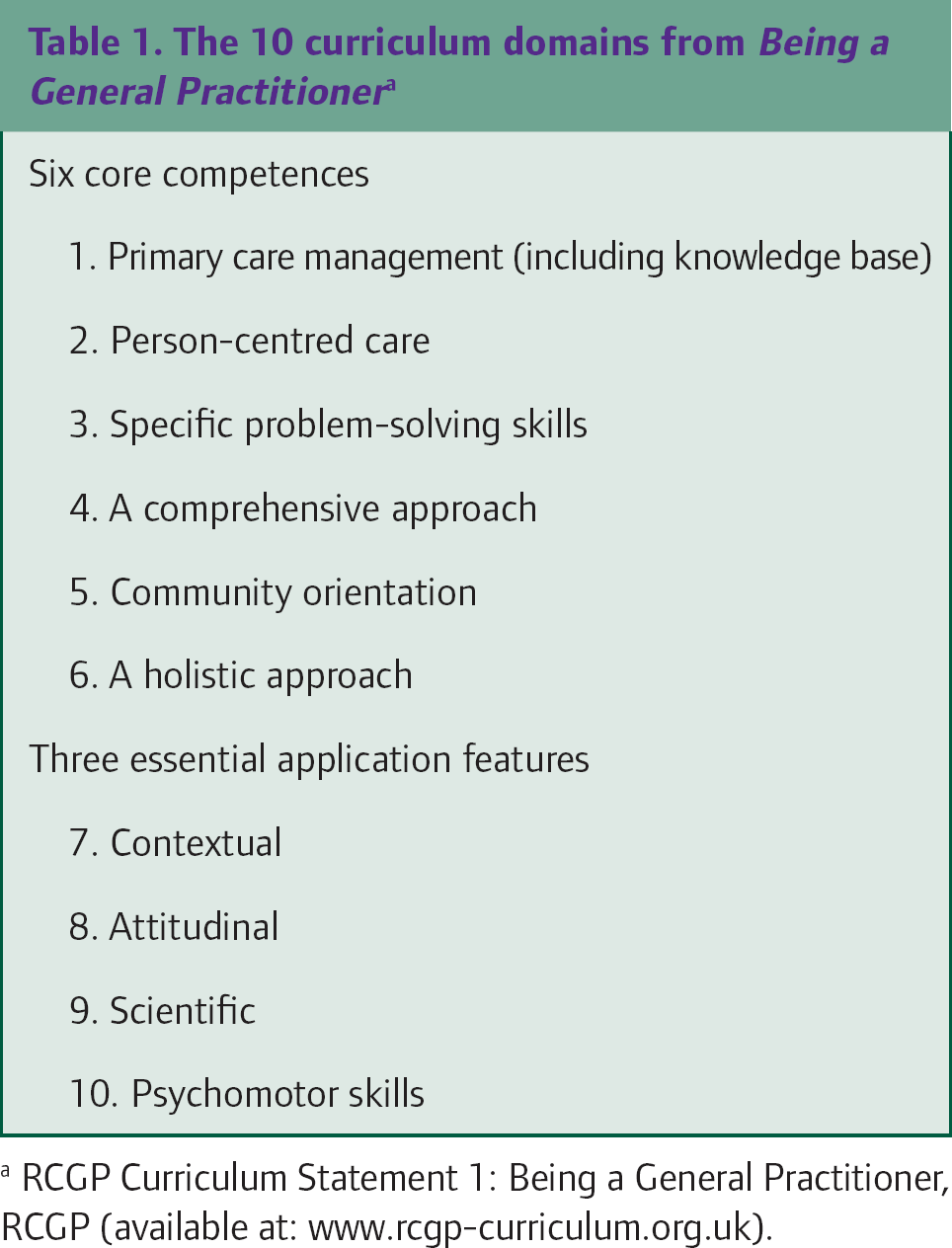
RCGP Curriculum Statement 1: Being a General Practitioner, RCGP (available at: www.rcgp-curriculum.org.uk).
While the domains described in the curriculum cover the core aspects of general practice that you must learn during training, the professional competencies are the relevant behaviours and tasks that can be directly observed and assessed. Each of the competencies describes a group of common tasks that a GP performs as part of their everyday work (see Table 2). Workplace-based assessment involves capturing evidence as you perform these everyday tasks and recording it in your ePortfolio, in order to demonstrate to your educational supervisor that you perform these tasks to a suitable standard.
The 12 professional competencies of Workplace-Based Assessment

Each of the 12 professional competencies in is derived from one of the 10 curriculum domains (in brackets).
As a GP in training, when you record your learning activities in the ePortfolio, you file these activities under the relevant curriculum statement heading as ‘evidence’. After your educational supervisor reviews the evidence you have submitted, he or she decides which of the 12 professional competencies, if any, the evidence supports. In other words, your educational supervisor translates the evidence you record as you cover the curriculum (which is your framework for learning to be a GP) into evidence of competence in the 12 professional competencies (which are the framework for assessing your performance). This brings learning and assessment together into one continuous process.
Evidence for each of the 12 professional competencies is gathered in a range of different settings throughout the 3 years of training. It is not expected that you will have much in your ePortfolio at first (not forgetting the minimal evidence required every 6 months), but you will gradually build up evidence for each competency area as training progresses. As the evidence in your ePortfolio grows, you will begin to notice certain areas where you have collected lots of evidence and other areas where gaps exist—either because you have collected insufficient evidence or because that area needs further development.
Reviewing the evidence in your ePortfolio
Every 6 months, you and your educational supervisor will meet up to review the evidence collected in your ePortfolio. As part of this review, you conduct a self-assessment, and your educational supervisor evaluates your progress against each of the 12 professional competencies. Based on the outcome, a new learning plan is agreed, the main educational aim being that you should adapt your learning programme to address the areas where you need further development.
In the event that the concerns about your progress are serious or need urgent attention, then your Deanery will be involved. Each Deanery has an expert panel that reviews the ePortfolios of all Specialty Registrars who are considered to be having difficulties, plus a random selection of those who are progressing well. The RCGP, as the body responsible for the national monitoring of WPBA, has a representative on each Deanery body whose role is to ensure overall fairness and to maintain standards across all the Deaneries.
Progress through each of the competence areas can be recorded as:
(I) Insufficient evidence
(N) Needs further development
(C) Competent
(E) Excellent
Detailed descriptors (also known as ‘word pictures’) are available on the RCGP website for each of the 12 professional competencies, to show the level of achievement required. Your educational supervisor will use these descriptors when evaluating the evidence in your ePortfolio. The descriptors are fairly tough—the following table shows the descriptors for the first professional competency ‘Communication and consultation skills’.

This competency is about communication with patients, and the use of recognized consultation techniques.
What happens if you fail a review?
‘Failure’ is not an option! Fortunately, this is not because of the dire consequences that will result, but because Workplace-based Assessment is an ongoing process and not an exam, so technically speaking you cannot ‘fail’ it (until the last review in your 3-year training programme). As you have a review every 6 months, there should be ample time to identify and address the areas you need to work on and ensure you have collected sufficient evidence in all the 12 professional competencies by the end of your 3-year training period.
It is important to remember that there is a minimal amount of evidence that you must collect before each 6-monthly review (see the RCGP website or ask your educational supervisor for details). This requirement has been set by PMETB, the regulatory body for GP training and is not up for negotiation! If you do not collect the minimal amount of evidence, you will automatically be referred to your Deanery panel who will have to decide what further action is required. Serious issues of professional performance, or if you miss a placement due to ill health or maternity leave, will be managed by the processes already in place in your Deanery.
It is likely that each review will identify that you have a number of ‘developmental needs’, or your Clinical Supervisor's Report (at the end of each of your secondary care posts) will highlight a number of areas for you to work on. This is not something to get too concerned about—it is much better to get productive feedback on the areas you need to develop than to continue to underperform in blissful ignorance!
Any developmental needs that come up at your review should be considered in the context of your whole training programme; it is inevitable that some of your training posts will offer more relevant educational experiences than others and you will only get the opportunity to develop some of your general practice skills when you are working in the general practice setting.