







Abstract

The world is a small place and our patients come from a culturally diverse background. To treat all patient, it is important that we understand their cultural background and customs.
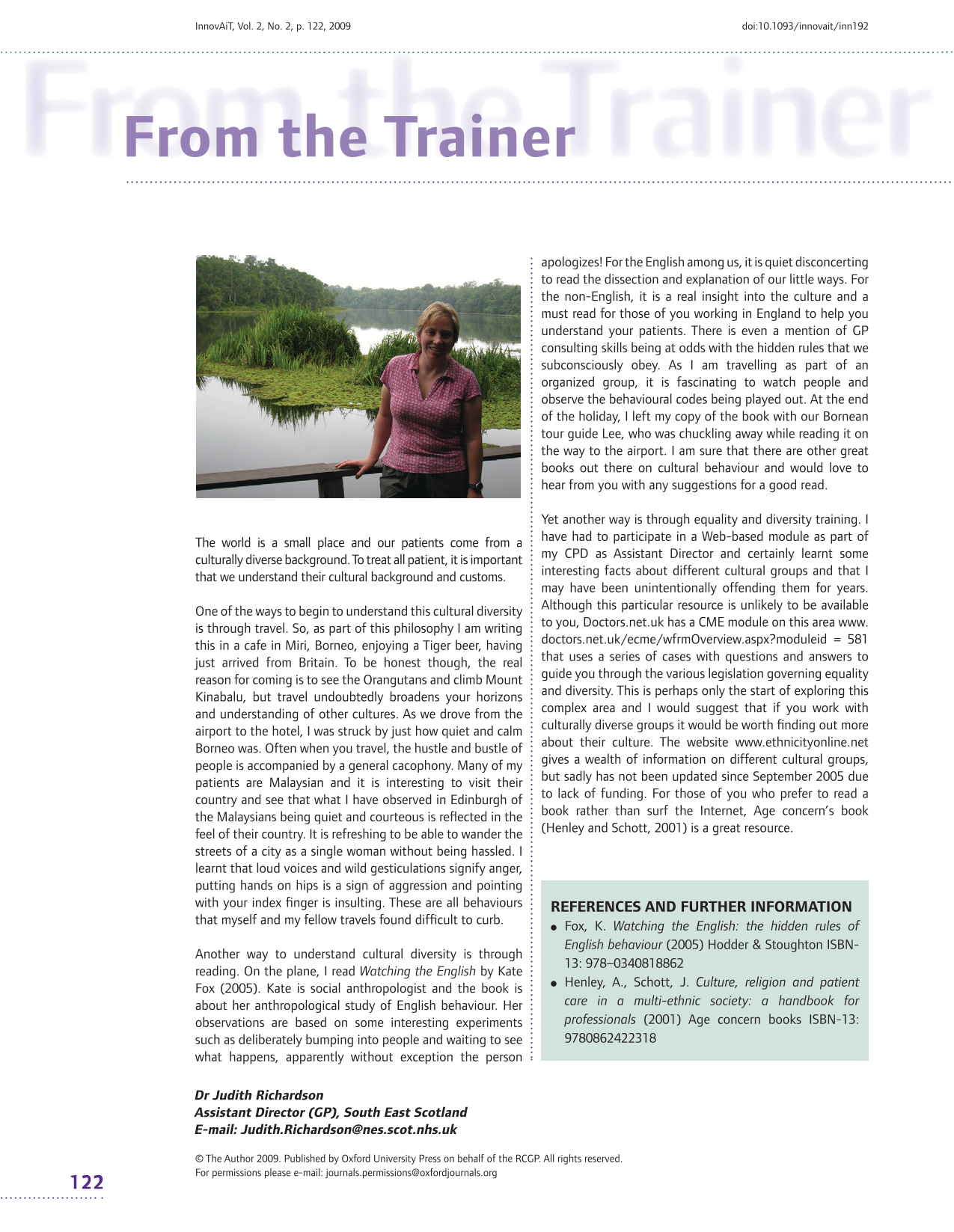
One of the ways to begin to understand this cultural diversity is through travel. So, as part of this philosophy I am writing this in a cafe in Miri, Borneo, enjoying a Tiger beer, having just arrived from Britain. To be honest though, the real reason for coming is to see the Orangutans and climb Mount Kinabalu, but travel undoubtedly broadens your horizons and understanding of other cultures. As we drove from the airport to the hotel, I was struck by just how quiet and calm Borneo was. Often when you travel, the hustle and bustle of people is accompanied by a general cacophony. Many of my patients are Malaysian and it is interesting to visit their country and see that what I have observed in Edinburgh of the Malaysians being quiet and courteous is reflected in the feel of their country. It is refreshing to be able to wander the streets of a city as a single woman without being hassled. I learnt that loud voices and wild gesticulations signify anger, putting hands on hips is a sign of aggression and pointing with your index finger is insulting. These are all behaviours that myself and my fellow travels found difficult to curb.
Another way to understand cultural diversity is through reading. On the plane, I read Watching the English by Kate Fox (2005). Kate is social anthropologist and the book is about her anthropological study of English behaviour. Her observations are based on some interesting experiments such as deliberately bumping into people and waiting to see what happens, apparently without exception the person apologizes! For the English among us, it is quiet disconcerting to read the dissection and explanation of our little ways. For the non-English, it is a real insight into the culture and a must read for those of you working in England to help you understand your patients. There is even a mention of GP consulting skills being at odds with the hidden rules that we subconsciously obey. As I am travelling as part of an organized group, it is fascinating to watch people and observe the behavioural codes being played out. At the end of the holiday, I left my copy of the book with our Bornean tour guide Lee, who was chuckling away while reading it on the way to the airport. I am sure that there are other great books out there on cultural behaviour and would love to hear from you with any suggestions for a good read.
Yet another way is through equality and diversity training. I have had to participate in a Web-based module as part of my CPD as Assistant Director and certainly learnt some interesting facts about different cultural groups and that I may have been unintentionally offending them for years. Although this particular resource is unlikely to be available to you, Doctors.net.uk has a CME module on this area www.doctors.net.uk/ecme/wfrmOverview.aspx?moduleid = 581 that uses a series of cases with questions and answers to guide you through the various legislation governing equality and diversity. This is perhaps only the start of exploring this complex area and I would suggest that if you work with culturally diverse groups it would be worth finding out more about their culture. The website www.ethnicityonline.net gives a wealth of information on different cultural groups, but sadly has not been updated since September 2005 due to lack of funding. For those of you who prefer to read a book rather than surf the Internet, Age concern's book (Henley and Schott, 2001) is a great resource.