







Abstract
The ability to teach as a doctor in general practice (GP) is not only a requirement for the GP curriculum but is increasingly being recognized as a key skill for any doctor in the modern National Health Service (NHS). The recent guidance document from the General Medical Council, ‘Duties of a doctor’ clearly states: ‘Teaching, training, appraising and assessing doctors and students are important for the care of patients now and in the future. You should be willing to contribute to these activities’. Long gone are the days when doctors were expected to know all they needed to know simply because they were doctors. New models of working and the drive for all new alternative providers of medical services practices to offer training mean that the ability to teach is also an attractive skill for you to offer to future employers. The types of people involved in teaching and learning in primary care are now more diverse than ever before. Working in a multidisciplinary team with other colleagues brings unique challenges that could see you feeling out of your comfort zone. This article will help you to feel more prepared to teach others, using the example of teaching about asthma.
The GP curriculum and teaching
GP curriculum statement number 3.7: Teaching, mentoring and clinical supervision states that general practices (GPs) should be able to Plan and structure a teaching episode appropriately for the learners concerned
Preparation
A good teaching episode will depend on good planning from you, the teacher, and good communication with the learners. It is important to have some knowledge of the learners and their experiences and learning needs. You will need to decide on your chosen format, although you may wish to combine different styles of teaching to some extent. Some of the choices might be
One-to-one teaching Small group teaching Lecture Peer teaching Provision of distance learning materials or self-directed learning materials Problem-based learning
The factors that will determine which you choose will include the number of learners whom you will be teaching, the agenda for your teaching session and the length of time available to you. You might structure your session or you might want to leave sections of the time for the learners to direct the teaching style and content.
You should have some idea about the accommodation available to you (you might want to speak to the practice manager or senior partner to find out what times and places are usually used for teaching in the practice). If you choose to carry out your teaching episode at a different location outside the practice, you may need to liaise with the local postgraduate medical education centre or even a private conference facility. The room layout may be difficult to change but if you have the chance it would be better to plan this according to your needs. For example, removing tables and arranging chairs in a circle in advance could enhance group discussion or arranging tables with groups of chairs might enhance group work. Proficiency with any technology (including user names and passwords for computer software) will be an asset if you are using unfamiliar equipment. You should also ensure that you have a contact whom you can speak to during the teaching session (e.g. for temperature control or unexpected technological problems). Many of these issues can be avoided by making a visit before the date and arriving early on the day.
In a primary care setting, you might be teaching people who have previously had a wide range of experiences. You might be teaching clinical or non-clinical staff or a mixture of these (Box 1). Clinical staff might include professionals from nursing backgrounds and doctors of different levels of experience. It is important not to feel daunted by this. In planning your teaching episode, you will need to assess what your learners are likely to know already and you might even learn something from the experience yourself. If you are teaching a junior doctor, who has just completed a respiratory medicine attachment, think about the areas that he or she is unlikely to have covered in hospital. For example, the relatively well patients who come for their asthma review but where the practice needs to assess their control with objective measures. This can be a good time to show the learner the way things are done in your particular practice (e.g. shortcuts on the computer system, setting up a template and how to consult with such a patient without it turning into a box-ticking exercise). Your learner may have pre-existing ideas about the subject. A mind-mapping exercise might be a good way to start the session off. This would work well with an individual as well as a team (Fig. 1). You write the main point at the start and then keep writing the words or phrases that spring to mind and link to each concept as they occur.

An example mind map that may result from a teaching episode on asthma
Potential learners in primary care
Doctors
GP partner Salaried GP Locum GP GP registrar Foundation doctor Medical student
Nurses
Nurse practitioners
Health care assistants
Midwives
Health visitors
Physiotherapists
Occupational therapists
Speech and language therapists
Phlebotomist
Counsellor
Practice manager
Receptionists
Secretaries
Administrators
Patient groups
Knowing your audience will help you to put the new material into context for the learners. For example, as a GP in an alternative providers of medical services practice, I was working with non-clinical staff who had never before worked in a GP surgery. However, on closer questioning, it transpired that some members of staff had worked in hospital and in other National Health Service (NHS) settings. Nowadays patient groups may also request a doctor to come and facilitate their own learning and, if you are teaching such a patient group, you may wish to contact the group ahead of time asking them the following:
Do they have asthma? What is their age range? Are there any specific issues the group likes to address?
Using your skills to find out more about your learners in this way can help you to engage their attention and also to select what you are going to impart in your teaching.
Learning styles
When you were a medical student, you might have come across questionnaires that assess learning styles. There are a variety of such questionnaires available. Some of them can be accessed online. Asking your learner to share with you the sort of learning style he or she prefers might help you to decide what style of teaching you are going to use. For example, www.vark-learn.com has a questionnaire that you can use to see whether you are more visual, aural, reading/writing or kinaesthetic.
Visual learners will tend to want to see pictures, diagrams and figures. Aural learners will prefer to hear the materials and may like to listen to recordings. The learners who prefer to read and write will want to go and look at books or write things down. Kinaesthetic learners will prefer to do things practically and learn this way.
When planning your teaching episode, you may want to take the VARK learning style into account and have an element of all four learning styles in your teaching. I have used the table below to explore how I might teach about asthma reviews depending on the learning style (Table 1).
Learning styles and tips

There are other learning style and personality questionnaires. Some of these may prove useful if you are going to have repeated teaching episodes with a single learner, which happens frequently between GP trainer and GP registrar. An example of such a questionnaire is the Myers-Briggs Type Indicator, which allows you to assess the learner's degree of
Extroversion versus introversion. An extrovert person may respond better to class discussion, answering questions and doing presentations. An introvert learner may not respond to being nominated by you to answer questions and may need to work on something, such as presentation skills, that is unnatural to them. Sensing versus intuition. Those learners who have a sensing learning style will pay more attention to the information that comes through their five senses. So they will remember the sound of the inhaler and may remember the taste and smell of the placebo medicine. The learners who are more intuitive will pay more attention to the patterns of your teaching. Thinking versus feeling. Thinking learners will tend to like the logic behind the condition of asthma. Feeling learners may prefer to hear stories about patients who have seen you with asthma and how it affected them. Judging versus perceiving. Judging learners will prefer to have definite guidance and instruction, whereas the perceiving learners may be happy to feel their way around the subject as they go through the teaching.
This may influence how you choose to teach. The indicators are combined to give you an overall profile of your learner, so you would not specifically concentrate on only one aspect of the style.
Another example is the Honey and Mumford learning style questionnaire which gives rise to the following indicators:
Activist—this type of learner will like to do things so you should plan activities or actions for them in the teaching episode. For example, testing your inhaler technique. Reflector—this type of learner will appreciate the chance to sit back and see the big picture. You could concentrate on showing this type of learner printouts from lung function tests and concluding on the findings. Theorist—this type of learner might prefer to talk about the physiology of asthma and work out how and why different treatments work. Pragmatist—this type of learner prefers practical things and might prefer to get on with running an asthma review clinic or taking part in an asthma review to learn about it.
In a short teaching session with multiple learners, it may be hard to adapt to everyone's learning styles but an awareness of the learners' needs will still be helpful. Learners may also adapt to your teaching style or change in their style over time. This can occur especially if a learner has been used to a very different learning environment prior to coming to primary care (e.g. a doctor who may have come to you as their first attachment in primary care after working only in secondary care overseas).
Establish your learner's needs
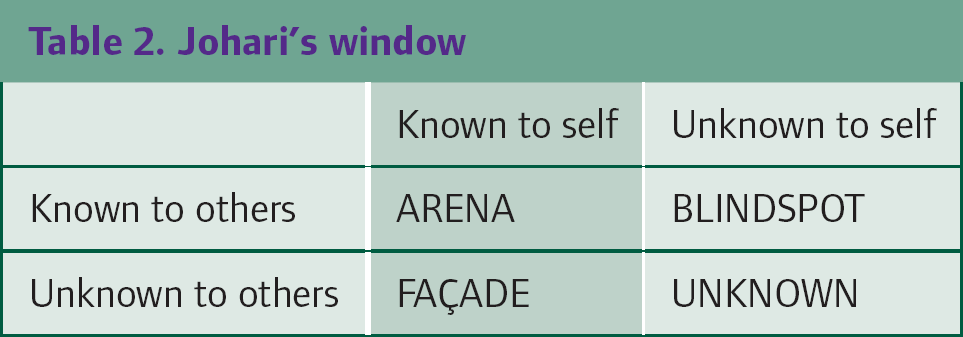
If you are teaching a learner who has gaps in his or her knowledge, then this is the ideal chance to find out what they need to know. Using Johari's window (Luft, 1969) is a great way to explain to your learner that there will always be things that we know we do not know (conscious incompetence) and things that we do not know we do not know (unconscious incompetence) (Table 2). The challenge in teaching learners about the things that neither of you have realized that they do not know is obvious. This is where bringing prior evidence of learning and a learning log can help so that these unknowns may be identified.
Johari's window
Ask your learners if they can bring examples of asthma patients whom they have dealt with. There might be a particular incident that made them uncomfortable (e.g. a receptionist might bring a significant event of a patient who had an asthma attack in the waiting room). This can be presented to you in advance so you can prepare something based around the incident or incorporate it into your session.
Showing the learners the idea of PUNs and DENs (patient's unmet needs and doctor's educational needs) can help here. In practice, this will mean whenever you meet a patient where you do not know something, you keep a log of this and subsequently this becomes your educational need. They are also a good opportunity to link to the ePortfolio and learning logs. This idea can also be adapted for non-clinical staff, whereby they keep a log of areas or issues where they have felt unprepared.
If the learning episode is a tutorial, you might want to give the learner a questionnaire to complete in advance that will expose areas of ignorance or to highlight the importance of your topic. For example, prior to a teaching session about patient referral for a foundation doctor, you might use these questions:
Would you refer a 15-year-old girl on salbutamol, beclometasone inhaler and a leukotriene-receptor antagonist with nocturnal cough and occasional wheeze to hospital? Why might you refer her? If so, where might you refer her? How will you go about referring her? What outcome from the referral is desired?
This might be a good icebreaker and emphasize to the learner the reasons for the session.
Pitch your teaching at the appropriate level
Teaching a respiratory specialist nurse about the management of asthma may be intimidating but pitching your teaching at the appropriate level will make this a more productive process for both learner and teacher. Good teaching is like good consultation skills. You want to ensure that you check with the learner what they already know. This can be harder when you have learners from different backgrounds with mixed needs. For example, when teaching the practice nurse, medical student and foundation doctors together you might want to set up your learning session with varied tasks or tasks where each learner can adopt their usual work role. In such a mixed group, it is important to bring learners to a similar point early on in the session, as learning is more productive when information is constructed in the context of previous knowledge. You can use the varying knowledge and experiences of different group members to do this in a way that is inclusive, embraces different learning styles and enhances contributions. So with the example of asthma, you can set up a problem-based learning scenario where the case develops needs where each different learner feels involved.
Brian is a 16-year-old rugby player who came to the asthma nurse specialist clinic for review with an increasing need for using his blue inhalers. What will you need to cover during this appointment?
Brian develops a severe asthma attack the following week during a rugby match and comes back to the nurse specialist clinic. What guidelines will you need to refer to in order to address his need for asthma control?
Brian comes back 6 months later because the asthma is still not controlled. He also asks to speak to a male doctor in confidence. What are the main issues that you might like to cover in the consultation? How will you react to his request to see a doctor in confidence?
Thus, by the end of the session, the scenarios become progressively more demanding and all learners have something they can contribute to the learning process. They may teach one another something about the topic and also about their roles within the team.
Adapt your teaching to the circumstances
It is important to ask yourself what has brought about the teaching episode that you are involved in. In a new practice environment you might want to achieve the aims of your role in the practice, such as to ensure the staff are adequately trained to perform their role. You might be a doctor taking responsibility for another more junior clinical colleague and therefore you will want to ensure that your learner achieves their learning needs to fulfil a service and remain safe. The teaching may be to address a point that you are trying to make, for example your own political view of the NHS system. You might also be trying to learn about a topic yourself while also getting your learner to learn something. Teaching can be a great chance to challenge pre-existing beliefs and update knowledge for colleagues who may be unaware of recent advances in evidence-based medicine. It can also be a non-threatening natural environment in which to do so.
Feedback
Getting feedback is crucial to a successful teaching experience and also important for you to ensure that you learn from the experience as well. How you choose to obtain feedback will be influenced by the time available, number of learners and how likely they are to respond. You can choose to use
Verbal feedback Questionnaires Emails Blank paper for anonymous comments
If you choose to design a questionnaire, it should be simple and quick to administer so that learners can quickly give their feedback and you can easily make sense of their comments. A simple questionnaire that you can adapt can be found on the web site of the British Council (Box 2). It is aimed at people teaching English but the questions are broad and could be adapted for most teaching sessions.
Peer review of your teaching may also assist you to improve your teaching style. The colleague who assesses you will be able to sit in and give you feedback later. In order to make the exercise more constructive, you might agree two aspects for him/her to concentrate on [e.g. (i) Do I engage with the learner's learning style? (ii) Do I summarize effectively?] The colleague should be able to see things about your teaching that you cannot because he or she is not distracted by teaching or learning.
Summary
Through planning teaching episodes regularly and obtaining feedback, you will gain confidence in teaching. You should find this a learning experience for yourself and find this a good way to become familiar with how other learners think. Through using learners' learning styles, you can adapt your teaching methods for their benefit. For a group of learners, using a variety of learning styles will make your teaching more effective. If you find that you have an interest in developing your teaching skills, there are a number of short courses run by universities and deaneries. There are also distance learning courses. Some courses allow you to accumulate credits that can lead to a formal teaching qualification, such as a Postgraduate Certificate in Medical Education.
Obtaining feedback for teaching episodes
What did you like about today's lesson? Why? Was there anything you did not like? Why? What did you find difficult? What would you like guidance on?
What is the most important thing you have learned today? What would you like to learn more about? What are you able to do now that you could not do before?
Ask questions about their needs, learning preferences, abilities, hopes and whether they feel the course is helping them or not. Ask them for their suggestions for changes and improvements.
Ask your class to write you a message anonymously on a piece of paper. They then put them in a ‘safe place’ in the classroom to protect their anonymity. Gather them in. Read them, then respond to them in class. Questions can be general such as: Are you enjoying the session — why/why not? Or specific, such as: What do you think of the task we did today?
(Adapted from the British Council website, 2009.)
Key points
Spend time on preparation Get to know your audience Use a variety of learning styles Establish your learner's needs Pitch your teaching at the appropriate level Adapt your teaching to the circumstances Obtain feedback