







Abstract
Travel abroad is becoming increasingly commonplace. In the 1960s, international travellers numbered almost 100 million. The 1990s saw over 4% growth annually in the tourism industry. By 2002, this number was closer to 715 million. This increasing mobility is in part due to the availability of economical air transport. Despite the 6% fall in visits abroad by UK travellers in light of the recent financial downturn, large numbers of people continue to travel abroad.
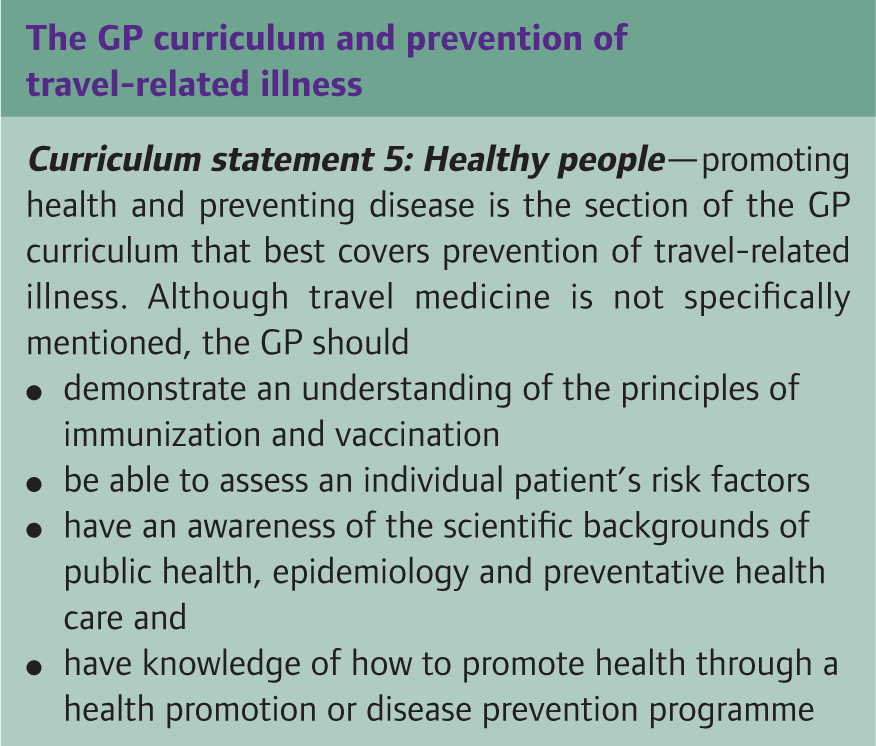
The GP curriculum and prevention of travel-related illness
demonstrate an understanding of the principles of immunization and vaccination
be able to assess an individual patient's risk factors
have an awareness of the scientific backgrounds of public health, epidemiology and preventative healthcare and
have knowledge of how to promote health through a health promotion or disease prevention programme
Rising numbers of travellers results in increasing exposure to travel-related morbidity. Advising travellers constitutes a major responsibility of a practice and under the General Medical Services contract certain travel vaccinations need to be provided. The focus of this article is on prevention of travel-related illness rather than the management of complications arising from travel.
Risk assessment
Individuals may decide to travel at short notice and to exotic locations, despite having significant comorbidities. An understanding of basic travel advice, familiarity with more specific but common concerns and where to access further information is vital. The bulk of preventative measures are directed against infectious diseases. However, it is important to remember accidents, thromboembolic disease as well as specific considerations for travellers with comorbidities especially during air travel.
The key to preventing travel-related illness lies in identifying risks and ‘at-risk’ individuals and attenuating these risks where possible. A commonly adopted method of identification is the two-part pre-travel risk assessment. Part one usually comprises a pre-travel questionnaire that a patient completes before attending for a travel appointment. The questionnaire allows for the ‘who’, ‘where’, ‘when’, ‘why’ and ‘how’ of the proposed trip to be established. This may be supplemented by a telephone consultation prior to actual face-to-face contact.
Who, where and when?
The age, gender and sex of a traveller will determine risk exposure. For instance, a higher accident rate has been documented in male travellers aged 20–29 years. Pregnancy and childhood will affect advice concerning both immunization and antimalarial prophylaxis (Table 1).
Different destinations present vastly different risk profiles and diseases can often present seasonal patterns of prevalence. It is important to establish the precise details and the subsequent preventative requirements. For example, travel to a country requiring proof of yellow fever vaccination requires administration of the vaccine 10 days before departure for the Certificate of Vaccination or Prophylaxis to be valid. Centres offering vaccination can be located via the Fitfortravel website (www.fitfortravel.nhs.uk).
Why and how?
Travel to visit friends and relatives is now the most common reason for foreign travel, accounting for 18% of visits abroad by UK residents. Business travel is the next most common reason. Such visits can have significant implications for the health care advice offered. Corporate trips are associated with feelings of isolation and resultant excessive alcohol use and casual sex. Holidaying is often associated with increased risk-taking behaviour.
Topics to consider during pre-travel risk assessment

Travellers' itineraries differ greatly and advice needs to be tailored to the individual. Antimalarial advice for a backpacker journeying through several South American countries will differ to that for the expatriate on a long-term secondment to an individual South American state.
Patients returning to their countries of origin are at higher risk of contracting malaria, typhoid fever, cholera and hepatitis A. This is thought to be due to a variety of reasons including erroneously presumed immunity, awareness of prevention strategies and cultural beliefs.
Mode of travel should also be considered. Long-haul air travel presents particular problems. These are primarily due to prolonged immobility and the physiological challenges an aeroplane cabin presents. It is vital to identify at-risk groups. The World Health Organization Research into Global Hazards of Travel Project recently reported that the key determinant for deep venous thrombosis (DVT) is immobilization and the risk of thrombosis is increased by travel of greater than 4 hours. Appropriate advice regarding in-flight exercises, sufficient water intake and antiembolism hosiery should be offered accordingly. There is currently a lack of evidence to support the role of aspirin in preventing DVT. See Box 1 for risk factors associated with DVT.
Patients with cardiovascular and respiratory problems are at higher risk from air travel. In general, those with stable cardiac or respiratory conditions who can climb 12 stairs and walk 50 m on flat ground without severe breathlessness or developing angina are fit to fly on commercial aeroplanes. The Civil Aviation Authority has produced a comprehensive resource for health professionals concerning air travel and its health implications (see ‘References and further information’).
Risk factors for DVT
Thrombophilia
Recent major surgery
Trauma or surgery of the lower limbs
Family history of DVT
Age over 40 years
The oral contraceptive pill
Advice
Having completed a risk assessment, the findings should be translated into practical considerations and advice for the traveller (see Box 2).
Post-risk assessment advice
Provide general and specific travel health advice appropriate to the individual traveller
Is the destination suitable for the traveller? e.g. in pregnancy to a high-risk malaria area
Assess disease risk at destination and whether it is vaccine preventable
Recommended vaccines and schedules
Explain disease transmission and prevention
Obtain informed consent to vaccinate (if needed)
Advise on malaria prevention including chemoprophylaxis if appropriate
Ensure the traveller understands your recommendations
Direct travellers to websites for country-specific travel advice (e.g. Foreign and Commonwealth Office)
Infectious diseases
The prevention of infectious diseases constitutes a major component of the travel risk assessment and subsequent vaccinations and advice. Health Protection Scotland's TRAVAX website (www.travax.nhs.uk) is an indispensible online resource for determining infectious disease risks for global travel.
Food- and water-borne diseases
Travellers' diarrhoea, typhoid fever, cholera and hepatitis A can all be acquired by ingesting contaminated food or water. Travellers' diarrhoea occurs in up to a half of European travellers who spend 3 weeks or more in developing regions. The most common organism responsible for travellers' diarrhoea is Escherichia coli but a range of bacteria, viruses and parasites has been implicated. Although vaccination plays a role in prevention, the importance of basic precautions cannot be overstated (see Box 3).
Eat and drink safely
Always wash your hands after going to the lavatory, before handling food and before eating
If you have any doubts about the water available for drinking, washing food or cleaning teeth, boil it, sterilize it with disinfecting tablets or use bottled water—preferably carbonated with gas—in sealed containers
Avoid ice unless you are sure it is made from treated or chlorinated water. This includes ice used to keep food cool as well as ice in drinks.
It is usually safe to drink hot tea or coffee, wine, beer, carbonated water and soft drinks and packaged or bottled fruit juices
Food may be contaminated even though it looks, smells and tastes perfectly normal, so avoid
salads
uncooked fruit and vegetables, unless you can peel or shell them yourself
food which has been kept warm
food likely to have been exposed to flies
dishes containing uncooked egg
ice cream from unreliable sources, such as kiosks or itinerant traders
shellfish, especially if uncooked
unpasteurized dairy produce
food from street traders unless you are sure that it is freshly prepared and hot
Eat freshly cooked food which is thoroughly cooked and still piping hot
Malaria
Approximately 2000 cases of malaria are reported annually in the UK. Total or partial non-compliance with prophylaxis is the major risk factor. Antimalarial prophylaxis is not totally effective and forms one part of an antimalarial strategy—the ABCD strategy.
Reducing
Using appropriate
Awareness of the residual risk and prompt
The choice of antimalarial prophylaxis is dictated by resistance patterns in travel destinations. Common antimalarials include chloroquine, proguanil, mefloquine, doxycycline and atovaquone/proguanil. They share the need to be taken before, during and after travel. They differ in how long before and after travel to take treatment and how often to take treatment. For instance, mefloquine and chloroquine are taken weekly whereas the others are taken daily. Another determinant of choice is cost and it must be borne in mind that antimalarials must be issued as private prescriptions and are not covered under an ordinary FP10.
Sexually transmitted and blood-borne diseases
Sexually transmitted diseases (STDs) are endemic worldwide but certain locations have a far higher prevalence. Unprotected sexual activity exposes travellers to STDs including human immunodeficiency virus (HIV) and hepatitis B. Sub-Saharan Africa and South-East Asia present the highest risk for HIV. The Far East, Pacific Islands and sub-Saharan Africa have the highest prevalence of hepatitis B.
Prevention revolves around raising awareness, advising against unprotected sexual intercourse, stressing the importance of condoms and minimizing hazardous behaviour. Intravenous drug use and body piercings carry substantial risks too.
Other considerations
Accidents
Travellers often fail to take the same precautions on holiday that they would normally. Analysis of one series of 7000 medical cases reported to insurers revealed that one-third of cases were due to accidents. Hazardous sports and alcohol and drug use are common precipitants.
Environmental hazards
Holidays may involve extremes of both altitude and climate (including sun exposure). These challenges should be addressed by advising against rapid changes of altitude and about appropriate steps to minimize chances of sunburn.
Pregnancy
Although travel during pregnancy is, in most cases, trouble free, there are three specific concerns that should be borne in mind:
Antimalarial chemoprophylaxis—malaria is usually a more severe disease during pregnancy and can result in harm to the foetus. Choloroquine and proguanil in combination are often the first line. However, travel to chloroquine-resistant areas poses challenges due to certain drugs being unsuitable (doxycycline and atovaquone/proguanil) or due to lack of available safety information. If a patient cannot be dissuaded from travelling to an area of high chloroquine resistance, mefloquine can be used in the second and third trimesters.
Vaccinations—live vaccines in particular should be avoided during pregnancy due to the theoretical risk to the foetus. A certificate of exemption can be provided for yellow fever for the purposes of entry into a country requiring this.
Flying—airlines usually allow travel up to the 36th week of pregnancy but from the 28th week onwards, the airline may request a doctor's letter stating that the pregnancy is normal, the expected delivery date, and that the doctor is happy for the woman to fly.
Travel with children
Children have different travel requirements (such as vaccination) and may be more susceptible to certain risks of travel. Travel sickness is common in the 3 to 12-year-old category. Acute diarrhoea can result in dehydration very rapidly especially in hot countries. Oral rehydration therapy and prompt medical review are key to preventing complications. Young children are also particularly susceptible to heat and sun injury and should be kept well protected and offered plenty of fluid. Parents may want to consider packing basic analgesia/antipyretics and oral rehydration salts as these may not be readily available at destinations.
Key points
As foreign travel increases, so does exposure to the morbidities associated with travel
The key to preventing travel-related illness is identifying risk and ‘at-risk’ individuals
A risk assessment should be undertaken looking at the who, where, when, why and how of travel
Advice should incorporate general and specific measures appropriate to the individual traveller
Prevention of infectious disease forms only one component of holistic travel advice
The NHS' Travax website should be consulted in offering travellers individualized advice and patients can be sign-posted towards the NHS' www.fitfortravel.nhs.ukwebsite