







Abstract

This competency is about the appropriate use of primary care administration systems, effective record keeping and information technology for the benefit of patient care.
There are three major themes in the primary care administration and information management and technology (IMT) performance area, each represented by a progression, which we will discuss over the next two articles.
Let us look at the word pictures in Fig. 1, which concern our use of the practice administration and computing systems.
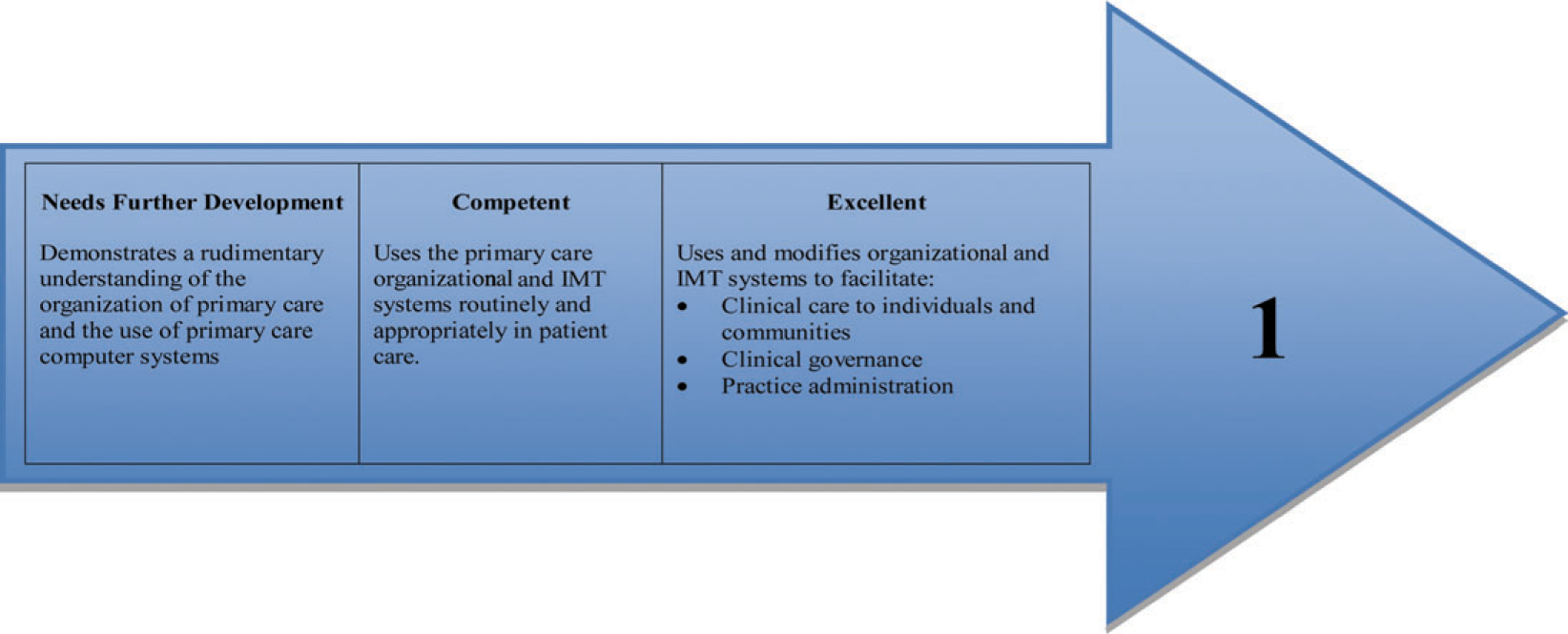
The first competency progression of primary care administration and IMT.
Demonstrates a rudimentary understanding of the organization of primary care and the use of primary care computersystems
As the competency suggests, our level of understanding need not be great but should be sufficient to understand the structure of practice management including the roles and responsibilities of those involved.
For example, we should know in general terms about the types of data collected, how these are collated and used for management and clinical purposes and how the practice computer systems IT connects with inter- and intranets and allows data transfer with authorized agencies such as hospitals and community pharmacies. We also need to understand how computing is changing to allow national accessibility of National Health Service data through the electronic care record and the opportunities and threats that this brings.
Uses the primary care organizational and IMT systems routinely and appropriately in patient care
The ‘competent’ descriptor is concerned with whether we can apply our understanding to practice. The curriculum usefully lays out a number of specific IMT skills that need to be acquired and it is worth reading about these.
When you first joined the practice, you should have had an introduction to the computing system. Whoever does this initial training might also be able to advise you how to monitor your progress with learning to use the system. They may be able to collate feedback, for example when information is not entered (such as a new repeat prescription) or properly coded (such as a disease or referral) and problems then arise.
To demonstrate effective use of protocols, you should firstly know whether there is a protocol that should be used. To understand the clinical importance, look at the data that the template requires you to collect and ask yourself why these have been chosen. Ask yourself what might happen if the templates were not completed. Who loses out and how can this be avoided?
Call and recall systems can be used for any situation that requires predictable periodic patient review. A system is especially important where the patient might come to harm if a review is missed, for example
monitoring thyroid function where biochemical abnormality will occur well before any symptoms or
bone scanning every few years in patients with osteoporosis, where the follow-up period is long and likely to be forgotten
One of the great advances that data management brings is the opportunity to look at trends and identify problems while they are developing and before they become a significant clinical issue. In the past, this could only be done retrospectively, for example in response to periodic audits or to significant events.
An example is that if it is seen that control of blood pressure or blood sugar in diabetics is starting to fall short of the standard, action can be taken to direct resources to the problem.
Comparatively little use is made of IMT to improve decision making and patient care. For example, attendances for the same coded problem can be viewed together, thereby illustrating how the problem has evolved. This can demonstrate abnormal patterns that might otherwise be difficult to see and that the patient may not have pieced together.
The skills that need to be acquired relate to knowing and observing the agreed practice routines so as to facilitate the running of the practice. This will extend from knowing who does what and involving team and staff members appropriately to knowing the areas in which practice protocols exist and following these when required.
Uses and modifies organizational and IMT systems to facilitate
Clinical care to individuals and communities, Clinical governance, Practice administration.
The previous competency was heavily concerned with ‘using’ the systems whereas this, under the excellent column, reaches another level that requires us to understand the systems well enough to modify them in line with perceived need.
Attending the business and clinical meetings of the practice is a good way of observing the practicalities of organizational change. These meetings also help us to learn where the impetus for such changes comes from.
Try attending these meetings, listen out for proposed changes and look closely at the action points. Try to follow the simpler ones through so that you can learn about the practicalities of making such changes.
These categories are not mutually exclusive. For example, the medical literature may suggest that carers are relatively unsupported and that through neglect of their own health they have an increased risk of morbidity that could be avoided. The practice may then decide to keep a carers' register and develop a protocol for capturing carers' details and proactively offering advice on support services and health checks for those not already under medical care. In this example, ‘clinical care to individuals and communities’ is improved.