







Abstract
Academic GPs have made significant contributions to the care of many millions of patients through research in primary care populations. They have also been instrumental in the development of community-based undergraduate medical education. Here, we explore what academic GP training involves and why all associates in training should have an interest in research and teaching.
The GP curriculum and academic GP training
All GPs will be initiators, collaborators or users of research. In this context, the minimum competence required is that of a user. The effective user of research will be able to demonstrate competence in the following areas:
Prioritizing relevant information Critical appraisal Problem framing Accessing evidence Implementing change in clinical practice Basic statistics Evaluating ethical issues and the need to have projects approved through research governance committees
All GPs will be involved in teaching of other practitioners be they medical or allied health professionals. They will be able to
Use appropriate teaching methods Evaluate outcomes of teaching.
The importance of academic general practice
General practice is a scientific discipline at the heart of decision-making in the National Health Service (NHS), where the vast majority of common and costly medical problems are managed and where public health and health promotion interface with clinical care. The Royal College of General Practitioners' (RCGP) motto ‘Cum Scientia Caritas’ means scientific knowledge applied with compassion. The RCGP curriculum also describes the ability to adopt a critical and research-based approach to practice as one of the essential features required for being a GP. Evidence-based medicine has become increasingly important in health care yet much of the evidence is from highly selected secondary care populations. Research in the setting of primary care, where most patients are managed, is increasingly important. Academic general practice departments around the UK are conducting important research to answer research questions relevant to the primary care population. General practice is also becoming an increasingly important part of undergraduate education.
What is an academic GP trainee?
An academic GP trainee is usually a doctor in clinical general practice training who also has an interest in general practice research and/or teaching. There are several pathways for academic GP training but most academic training schemes have two components. Firstly, the scheme should provide sound clinical training to ensure the trainee is able to gain Membership of the Royal College of General Practitioners (MRCGP) and subsequently a Certificate of Completion of Training. Secondly, the scheme should offer a post within an academic general practice department to give the trainee experience in the research environment, allowing them to be involved in existing research projects or conduct their own original research. Spending time as part of a research team within a university department can also provide an insight into what a career in academic general practice would be like. Some programmes also offer the opportunity to study for a Master's degree-usually in primary care, medical education or public health.
How are academic GP trainee places funded?
There are approximately 10 national posts offered annually through the Academic Clinical Fellow training scheme, sometimes referred to as the ‘Walport’ scheme (after Dr Mark Walport, Director of the Wellcome Trust). Entry is at ST1 level and the scheme is 4 rather than 3 years long. Under these schemes, 25% of a trainee's salary is provided by the National Coordinating Centre for Research Capacity Development (NCCRCD) and the other 75% is provided by local deaneries to cover the clinical component of training. Trainees have contact with an academic department from the start of the scheme; however, they usually spend half of the working week in the department during specialist training years 3 and 4.
There are also a significant number of academic GP training posts, which are funded locally through deaneries or university departments. These can vary from year to year depending on local finances. Many of these posts are for entry at ST3 level for a period of 2 years, usually with half of the time spent in clinical training and the other half within the university department. Some departments may also consider offering shorter posts for those wanting to experience research but who are reluctant to extend training by a year in the future. There are also some 4 month foundation year placements within academic general practice, which may offer an opportunity to gain useful exposure to the research environment. The national schemes are based in Birmingham, Manchester, Oxford, Cambridge, Keele, Bristol and Southampton; however, most universities have a department of academic general practice or primary care.
What do academic GP trainees do?
Academic GP trainees typically spend more time within the university department in ST3 and ST4. An average week for an academic ST4 may, for example, involve 2 1/2 days in clinical practice and 2 1/2 days based in the academic department. The clinical days are similar to every other GP trainee and the same number of work place-based assessments must be submitted each year. It is as important for academic GP trainees to acquire sufficient skills and knowledge during training to be a competent GP at the end of training as it is for any other GP trainee.
Academic sessions vary tremendously from those of clinical practice. Trainees are encouraged to think, ponder and develop creative new research ideas. The type of work the academic trainee may be involved with during their time in the academic department can vary between sites. Some academic trainees will be part of a research team and may be involved with data collection, analysis of results or writing up papers. Others will have the opportunity to carry out their own project and produce original research. Many departments are involved with medical student education, which provides an opportunity for academic GP trainees to develop teaching and mentoring skills. There are also training posts which focus specifically on medical education and the academic trainee may work on developing new curricula or medical education research. Examples of projects that the authors of this paper have been recently involved with are indicated in Box 1.
Typical Academic Clinical Fellow projects
Writing peer-reviewed papers Co-editing a textbook Gathering data for a screening study Analysing data from a randomized control trial Conducting a small qualitative study Taking part in a Cochrane Review
Some academic time will be used to attend Master's lectures and work on assignments or a dissertation. Provision of Master's (or diploma and certificate) courses and funding can vary between departments but Master's in Public Health, Primary Care or Medical Education may be available and can be helpful to learn the basics of research and/or health professional education. A Master's course provides a great opportunity to meet people from a variety of different backgrounds ranging from social scientists through to health care executives. A guide to the sort of work and competences required of GP trainees undertaking the 4 year national training scheme is given in Table 1.
Milestones and timescale for achievement of academic competences
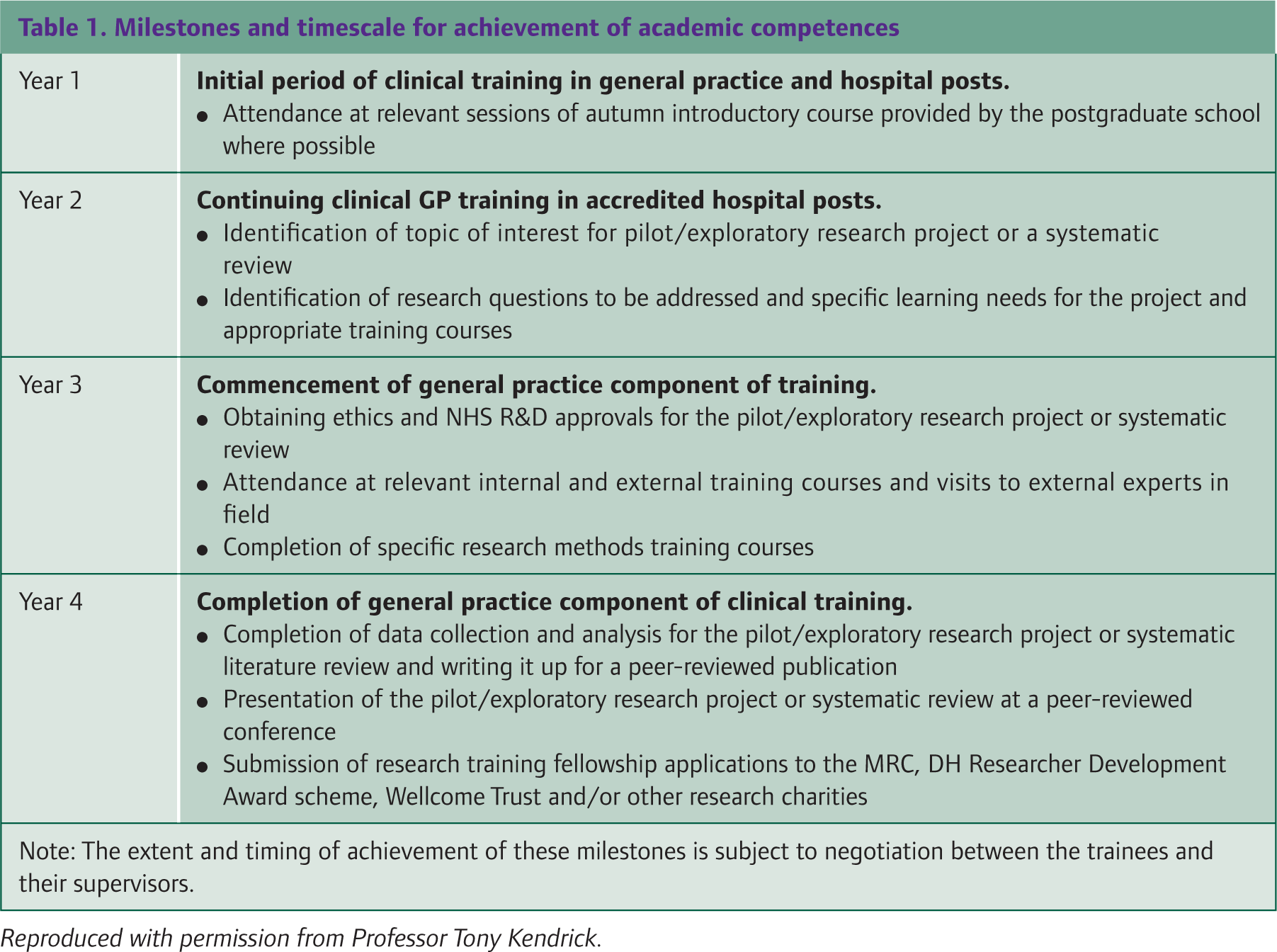
Note: The extent and timing of achievement of these milestones is subject to negotiation between the trainees and their supervisors.
Why academic work is important to all GP trainees
All doctors are expected to practise evidence-based medicine within the modern NHS. It is therefore important for all GPs to have an understanding of the basic principles of research. The RCGP curriculum statement 3.1 ‘Research and Academic: Activity’ describes the competences required of all GPs. An ability to access relevant research, critically appraise the findings and translate them into clinical practice where appropriate is essential for general practice to become truly evidence based. Many GP trainees will also be involved in medical education in some way during their career after qualification either by becoming a trainer or by tutoring medical students or GP trainees within their practice.
Research in general practice relies on the cooperation and support of local practices, which are increasingly forming regional research networks. GPs may not wish to conduct research themselves but may find themselves involved in a research study and will need to be able to explain the principles of the study and ethical implications to their patients to facilitate informed consent.
The Society for Academic Primary Care
Academic GP trainees and those interested in research may wish to join the Society for Academic Primary Care (SAPC). The aim of the Society is to promote excellence in research, education and policy development in general practice and primary health care. It holds an annual scientific meeting (ASM) that provides a forum for networking and presenting and discussing latest research. Membership provides entry to a network of researchers and teachers in primary care throughout the UK and Ireland with inducements such as reductions on the cost of primary care journals, newsletters and entitlement to attend courses in research methods held the day before the ASM.
Future career
At the end of training, there are a number of options available to academic GP trainees. Some may wish to register for a higher degree such as a PhD to further their research career. The career progression after a PhD is to clinical lecturer, senior lecturer and ultimately professor (see Fig. 1). These positions may focus on primary care and/or medical education. Most academic GPs continue to maintain clinical exposure and spend several sessions a week working in practice. This powerful combination of on-the-ground clinician and medical researcher helps to ensure that primary care research is patient-centred and clinically relevant as well as helping to promote evidence-based practice in surgeries where academics are based.
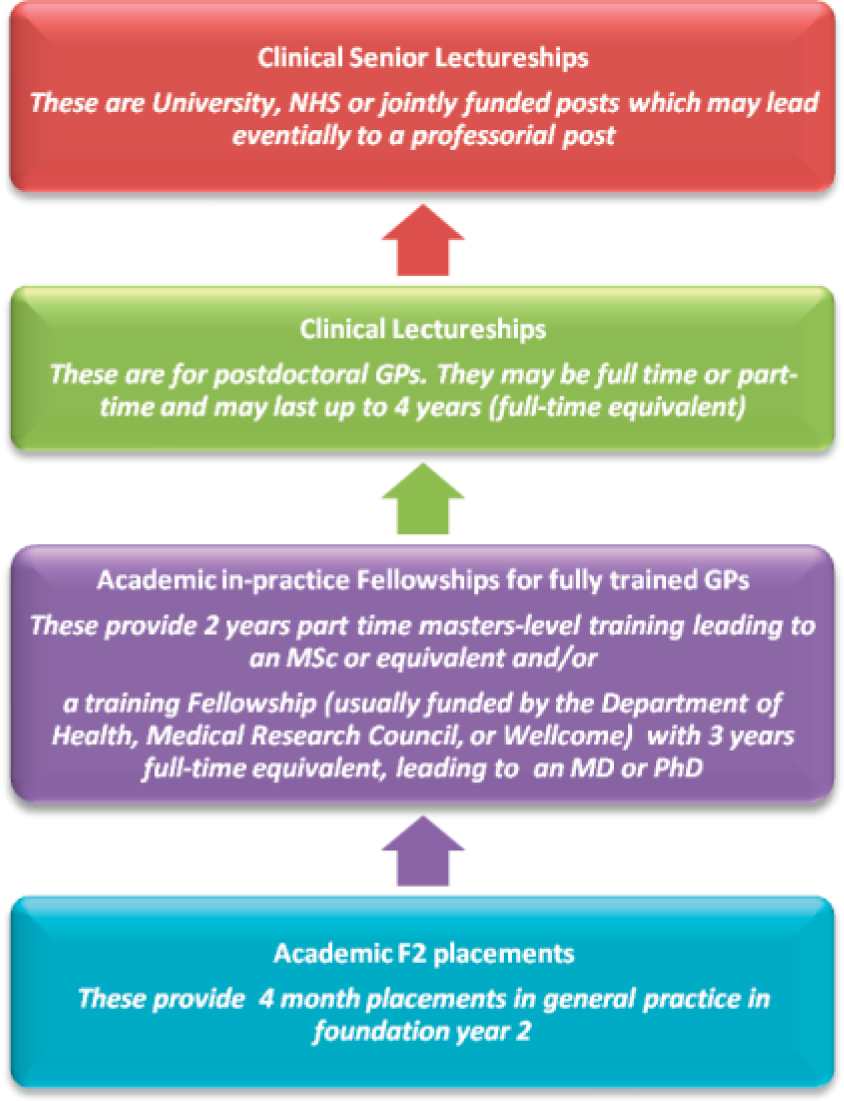
A career ladder for academic GPs.
Key points
General practice is a scientific discipline at the heart of decision-making in the NHS Academic GP training schemes are available nationally and locally and may involve research and/or medical education Research and academic activity is important for all GP trainees There are clear career pathways available to those who wish to pursue an academic career An understanding of basic research principles is vital to ensure evidence-based practice