







Abstract
The Yellow Card Scheme
At a recent conference, I came across the Medicines and Healthcare products Regulatory Agency (MHRA) stall and their now familiar Yellow Card Scheme, whereby health professionals voluntarily report adverse drug reactions to the MHRA. You may already know that we only need to suspect that an adverse drug reaction may be caused by particular medicine, to report it. This goes for all suspected adverse drug reactions for new medicines (denoted with the black triangle), medicines used in children and all serious drug reactions for established vaccines and medicines. The point to reiterate is that do not assume that someone else will report it. Interestingly, patients are also able to self-report.
You will also be pleased to learn that the Yellow Card Scheme can also be accessed online for easier, more efficient access. Log on to www.yellowcard.gov.uk.
Dealing with stress
The other week I just had one of those absolutely ghastly days: woke up late, no breakfast, duty doctor dealing with emergencies, walk-ins, home visits, nurses' queries, unrealistic patients, weepy patients, finished late and exhausted. On the way home, I lamented about my plight, ‘this can't go on — imagine doing this for the rest of your life?’
It has been 2 weeks since that day. It is odd how stress affects you. I used to think ‘whatever doesn't kill you makes you stronger’. But it did affect me. My trainer warned me that there will be days like this. The term housekeeping comes to mind.
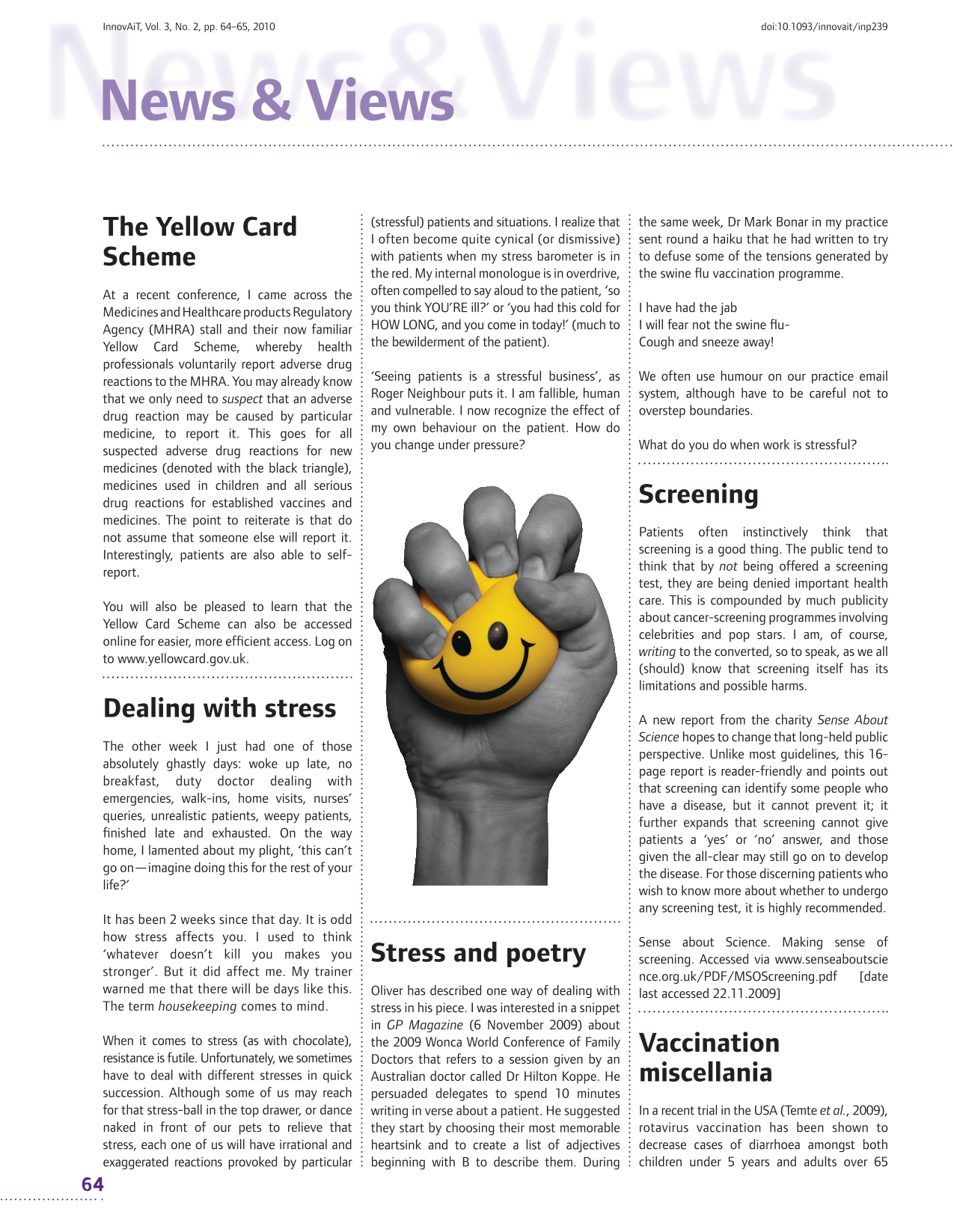
When it comes to stress (as with chocolate), resistance is futile. Unfortunately, we sometimes have to deal with different stresses in quick succession. Although some of us may reach for that stress-ball in the top drawer, or dance naked in front of our pets to relieve that stress, each one of us will have irrational and exaggerated reactions provoked by particular (stressful) patients and situations. I realize that I often become quite cynical (or dismissive) with patients when my stress barometer is in the red. My internal monologue is in overdrive, often compelled to say aloud to the patient, ‘so you think YOU'RE ill?’ or ‘you had this cold for HOW LONG, and you come in today!’ (much to the bewilderment of the patient).
‘Seeing patients is a stressful business’, as Roger Neighbour puts it. I am fallible, human and vulnerable. I now recognize the effect of my own behaviour on the patient. How do you change under pressure?

Stress and poetry
Oliver has described one way of dealing with stress in his piece. I was interested in a snippet in GP Magazine (6 November 2009) about the 2009 Wonca World Conference of Family Doctors that refers to a session given by an Australian doctor called Dr Hilton Koppe. He persuaded delegates to spend 10 minutes writing in verse about a patient. He suggested they start by choosing their most memorable heartsink and to create a list of adjectives beginning with B to describe them. During the same week, Dr Mark Bonar in my practice sent round a haiku that he had written to try to defuse some of the tensions generated by the swine flu vaccination programme.
I have had the jab
I will fear not the swine flu-
Cough and sneeze away!
We often use humour on our practice email system, although have to be careful not to overstep boundaries.
What do you do when work is stressful?
Screening
Patients often instinctively think that screening is a good thing. The public tend to think that by not being offered a screening test, they are being denied important health care. This is compounded by much publicity about cancer-screening programmes involving celebrities and pop stars. I am, of course, writing to the converted, so to speak, as we all (should) know that screening itself has its limitations and possible harms.
A new report from the charity Sense About Science hopes to change that long-held public perspective. Unlike most guidelines, this 16-page report is reader-friendly and points out that screening can identify some people who have a disease, but it cannot prevent it; it further expands that screening cannot give patients a ‘yes’ or ‘no’ answer, and those given the all-clear may still go on to develop the disease. For those discerning patients who wish to know more about whether to undergo any screening test, it is highly recommended.
Sense about Science. Making sense of screening. Accessed via www.senseaboutscience.org.uk/PDF/MSOScreening.pdf [date last accessed 22.11.2009]
Vaccination miscellania
In a recent trial in the USA (Temte et al., 2009), rotavirus vaccination has been shown to decrease cases of diarrhoea amongst both children under 5 years and adults over 65 years. The vaccine is being evaluated in the UK so this may get added to the childhood vaccination programme. That might mean far fewer miserable children in our surgeries, and perhaps fewer days that those of you with children in childcare have to keep them at home.
A recent European study (Prymula et al., 2009) showed significant reduction in febrile response to childhood primary and booster vaccinations if prophylactic paracetamol was given; however, even after boosting, lower antibody reactions for several of the antigens were found in the prophylactic paracetamol group. I think this study asks as many questions as it answers.
How long do vaccines last? Researchers using UK data have shown that vaccine-induced immunity to whooping cough lasts at least 30 years (Wearing and Rohani 2009).
More nurses than doctors give childhood and travel vaccines. Would you be able to discuss vaccination with the mother of a small child? If you are trying to practise explaining things in terms that patients understand, sitting in with the practice nurse can be one way to pick up tips.
Prymula, R. et al. Effect of prophylactic paracetamol administration at time of vaccination on febrile reactions and antibody responses in children: two open-label, randomised controlled trials The Lancet (2009) 374: p.1339–50
Temte et al. (2009) Effects of Rotavirus vaccine on primary care visits, hospitalizations and laboratory testing in Wisconsin, 2002–2008 (Oral Presentation On Completed Research November 2009 ID26) Accessed via www.napcrg.org [date last accessed 15.11.2009]
Wearing, H.J., Rohani, P. Estimating the duration of pertussis immunity using epidemiological signatures. PLoS Pathogens Online (2009) 5(10): e1000647. Accessed via www.plospathogens.org/article/info:doi%2F10.1371%2Fjournal.ppat.1000647 [date last accessed 15.11.2009]
Diabetes prevention
I probably bore my patients to tears by suggesting that a combination of sensible diet and some exercise might be good for their health. Anecdotally, I now have a handful of patients who have presented to me over the years for advice regarding their health been found to have impaired fasting glucose levels and have managed to keep these steady or even reduce them via lifestyle change. A recent Lancet article describes a 10 year study that demonstrated delayed onset of diabetes by lifestyle intervention (and to a lesser extent by prescribing metformin).
Diabetes Prevention Program Research Group. 10-year follow-up of diabetes incidence and weight loss in the Diabetes Prevention Program Outcomes Study The Lancet (2009) 374. p.1677–86