







Abstract
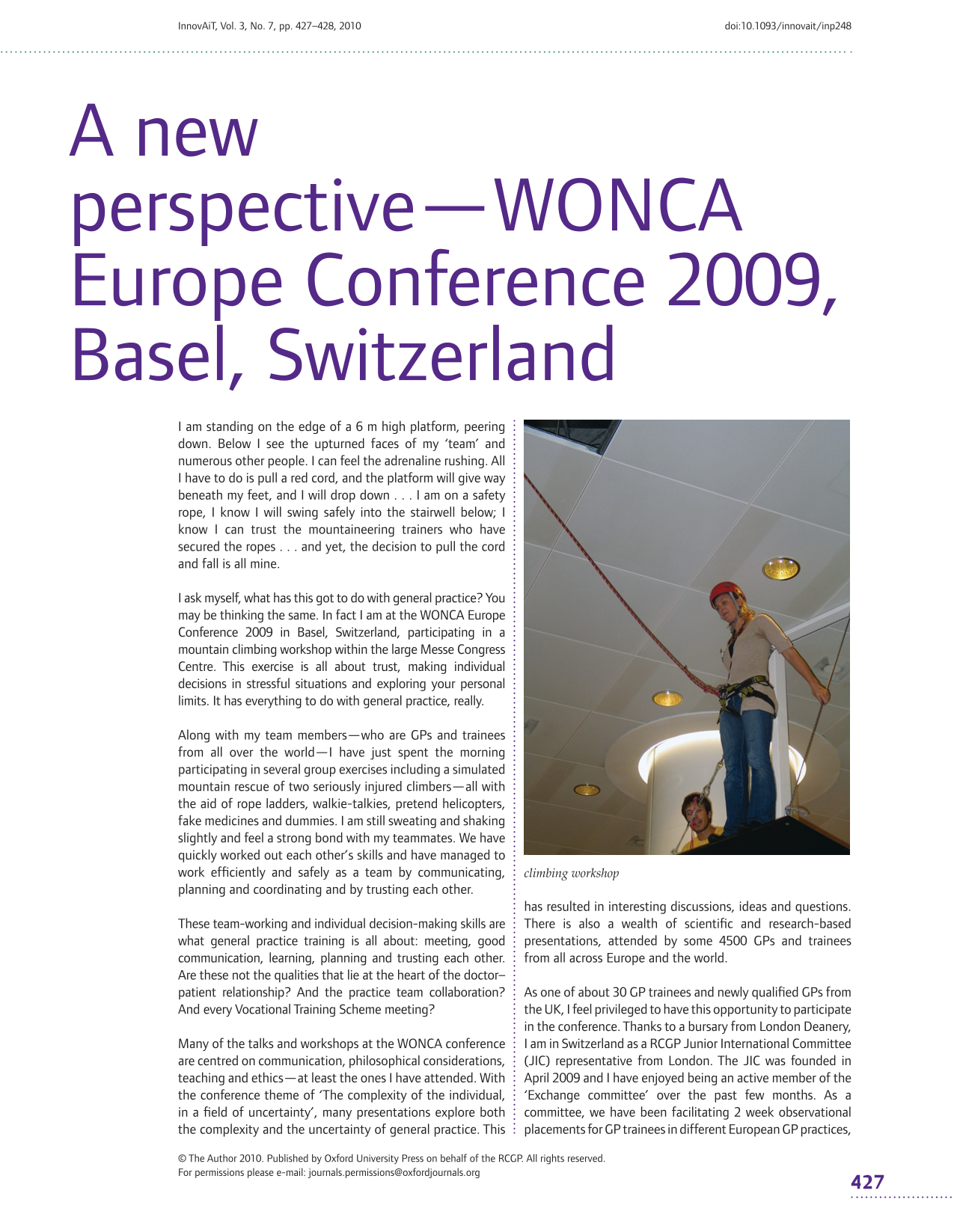
I am standing on the edge of a 6 m high platform, peering down. Below I see the upturned faces of my ‘team’ and numerous other people. I can feel the adrenaline rushing. All I have to do is pull a red cord, and the platform will give way beneath my feet, and I will drop down … I am on a safety rope, I know I will swing safely into the stairwell below; I know I can trust the mountaineering trainers who have secured the ropes … and yet, the decision to pull the cord and fall is all mine.
I ask myself, what has this got to do with general practice? You may be thinking the same. In fact I am at the WONCA Europe Conference 2009 in Basel, Switzerland, participating in a mountain climbing workshop within the large Messe Congress Centre. This exercise is all about trust, making individual decisions in stressful situations and exploring your personal limits. It has everything to do with general practice, really.
Along with my team members—who are GPs and trainees from all over the world — I have just spent the morning participating in several group exercises including a simulated mountain rescue of two seriously injured climbers—all with the aid of rope ladders, walkie-talkies, pretend helicopters, fake medicines and dummies. I am still sweating and shaking slightly and feel a strong bond with my teammates. We have quickly worked out each other's skills and have managed to work efficiently and safely as a team by communicating, planning and coordinating and by trusting each other.
These team-working and individual decision-making skills are what general practice training is all about: meeting, good communication, learning, planning and trusting each other. Are these not the qualities that lie at the heart of the doctor-patient relationship? And the practice team collaboration? And every Vocational Training Scheme meeting?
Many of the talks and workshops at the WONCA conference are centred on communication, philosophical considerations, teaching and ethics—at least the ones I have attended. With the conference theme of ‘The complexity of the individual, in a field of uncertainty, many presentations explore both the complexity and the uncertainty of general practice. This There is also a wealth of scientific and research-based presentations, attended by some 4500 GPs and trainees from all across Europe and the world.
climbing workshop

As one of about 30 GP trainees and newly qualified GPs from the UK, I feel privileged to have this opportunity to participate in the conference. Thanks to a bursary from London Deanery, I am in Switzerland as a RCGP Junior International Committee (JIC) representative from London. The JIC was founded in April 2009 and I have enjoyed being an active member of the ‘Exchange committee’ over the past few months. As a committee, we have been facilitating 2 week observational placements for GP trainees in different European GP practices, as part of the Hippokrates-Vasco da Gama (VdGM) programme. It has been very productive to meet our European colleagues in the VdGM Committee, who have been working in theme groups on research, education and training, image and exchange. The VdGM Movement was established by GP trainees in Lisbon in 2005 and is the WONCA Europe working group for young and future GPs. It aims to extend the knowledge of general practice in a European perspective, by sharing ideas and experiences in order to improve family medicine in Europe. Many countries have set up subcommittees, such as the JIC in the UK, and there is a dynamic interaction between the different member organizations, which have facilitated numerous exchanges across Europe.
JIC delegates at WONCA conference

And it is all about exchange here at the conference. Exchange of ideas, contacts, training opportunities and research questions. Having met GP trainees from Russia to Greece, Denmark to Portugal, I feel inspired by their enthusiasm. Not only have I gained a better understanding of how general practice and training works in other countries but I have also come to realize just how fortunate we are in the UK with our well established general practice system within the National Health Service (NHS), and how high the quality of our GP training is. Many countries—including our host Switzerland—are struggling to recruit young doctors to general practice and have only just started to formalize training opportunities.
This realization is reinforced during another interesting experience when I visit a Swiss GP practice. In fact, one of my team members from the climbing workshop is a Swiss GP and kindly invites me to visit her surgery in Basel during our lunch break. She runs the surgery with her husband and I am surprised to hear that she trained as a hospital general physician and has never had any formal GP vocational training. Even more surprising is the discovery of a fully functioning laboratory and X-ray machine in their small practice, which serves a population of only 1200 patients. I wonder how this can be feasible and learn a lot about the funding and organization, as well as the health beliefs and expectations of the Swiss. I am very grateful to my Swiss GP colleague for showing me her practice, and I invite her to visit me in London one day.
Just as standing up on the edge of the platform gave me a new viewpoint, I feel this opportunity to participate in the conference has given me a new perspective on general practice. We may sometimes feel we have mountains to climb within general practice training; we may find ourselves looking over the edge into uncertainty together with our patients; but above all, I feel we can trust each other and our international colleagues to improve clinical standards and patient care in general practice worldwide.
For further information about VdGM go to: www.vdgm.eu.