







Abstract
The word, ‘professionalism’ arouses strong feelings and passions because many doctors have their own preferred view of what this means. Perhaps that is the heart of it because professionalism is as much an ideology or creed that we believe in and sign up to as an expectation from profession, society and ourselves of how skilful and effective we should be in our work.
What we look for when we assess professionalism?
We can develop our professionalism by learning to respect the expectations of profession and society and to show respect to people (including ourselves) and to our professional responsibilities. The latter are defined by the codes of conduct and laws of profession and society. Respect is partly an attitude but it is also a number of behaviours that show how ‘seriously’ (e.g. diligently or thoughtfully) we approach things.
For assessors, a shorthand way of assessing professionalism is to look at the doctor's attitudes and behaviour. Do these indicate that the doctor has, and is able to maintain, the respect that is required?
In the MRCGP competence framework, ‘professionalism’ is mainly described in the performance areas of ‘Maintaining an ethical approach to practise’ and ‘Fitness to practise’. In the next three articles we will consider the first of these.
Maintaining an ethical approach to practise: ethics
This competence is about practising ethically with integrity and a respect for diversity.
Ethics sounds vague, but it has real practical significance. One way to consider ethics is to look at its major application in medicine, which is its role in improving decision making.
Personal values are not fixed in perpetuity and should be informed by a number of people and organizations. Likewise, the views that patients hold will not only change from person to person but may also change in an individual over time, particularly through the course of a chronic disease or in response to significant life events such as bereavement. For example, someone who may never have thought that suicide was an acceptable option, may find themselves changing their mind when having to endure intolerable suffering.
This first competence progression, shown in Fig. 1, is principally about personal values, attitudes and ethical approaches.
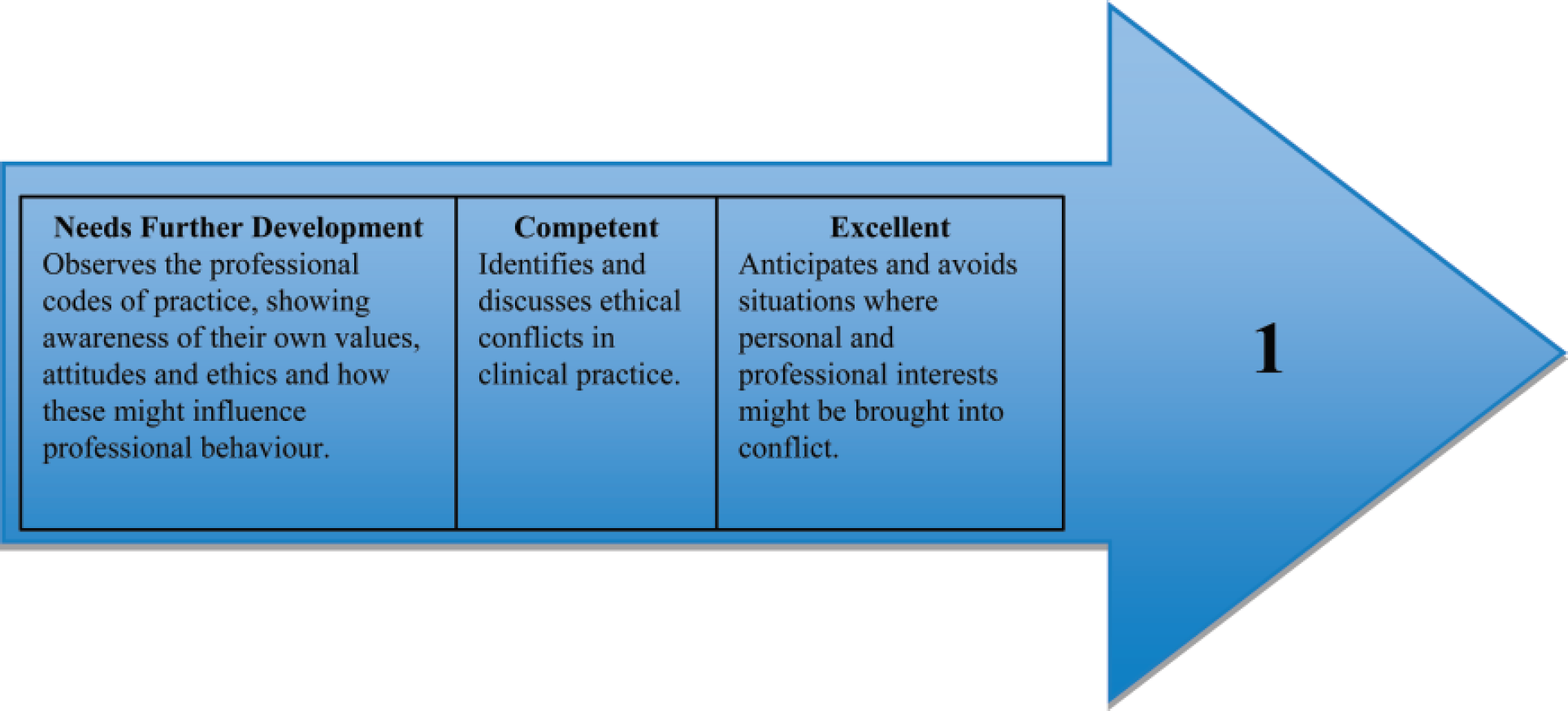
The first competence progression of maintaining an ethical approach to practise.
Looking at each of the word pictures in turn:
A lack of awareness of the broad themes within the General Medical Council's ‘Good Medical Practice’(GMP) would be of concern, as this document helps us to gauge, challenge and develop our values.
At this basic level of ability, we may not need to know GMP in detail or be able to use skilfully an ethical framework to argue an ethical problem. However, we should be able to recognize when the problem has attitudinal or ethical dimensions and be able to deduce what these might be. Additionally, we should be able to argue how values, attitudes and ethics, particularly our own, might influence a decision.
This competence is thought by many educators to be the most important within the ethics domain. The competence requires us to identify correctly situations in which an ethical issue, particularly an ethical conflict, might be an important factor in problem solving.
An ethical framework, when applied to these areas of conflict, can greatly help to act as a template. The ethical framework most commonly used in medicine utilizes the four bioethical principles: autonomy, beneficence, non-maleficence and justice. This may sound rather dry, but in practice it is an invaluable tool not only for explaining our thoughts and actions to others but also for helping us to clarify our own reasoning.
Here are a few examples from the curriculum that demonstrate the wide range of topics that have ethical implications:
Be able to balance the autonomy of patients with visual problems and public safety Ensure that the risks of diabetic complications are not overstated in order to coerce a patient into complying with treatment Describe the ethical principles involved when treating an incompetent patient (e.g. unconsciousness) and when treating a patient who is unable to communicate (e.g. dysphasia) Describe the ethical aspects of managing patients/families with genetic conditions, being aware of the issues involved in genetic testing, such as confidentiality, testing children and pre-symptomatic testing Able to identify ethical aspects of clinical practice relating to the use of information, e.g. security, confidentiality and use of information for insurance company use.
Have you come across these situations? Can you think of examples of your own?
At the ‘excellent’ end of this progression, we are able to show insight and honesty even in the face of temptation to do otherwise. The reason for raising conflict of interest as an issue is that trust between doctors and patients and doctors and colleagues may be damaged by situations in which financial or other personal interests affect, or could be feared to affect, professional judgement.
All doctors will be familiar with the situation where drug companies offer gifts, meals etc. in order to literally ‘curry favour’ and thereby influence future decision making. We might think that we are beyond such influence and if we do, we should ask ourselves ‘Why do commercially astute companies still continue to use these mechanisms?’
Assessment corner: anticipating ethical conflicts
‘Anticipation’ is a mechanism by which ethical insight and motivation come together to prevent ‘ethical events’. Where does this happen in your practice? Who have you observed doing it? How often have you raised an ethical issue?
Ethics is intended to help us make better decisions. As many significant decisions are made in practice meetings, how often is an ethical angle introduced to help problem solving in these meetings?