







Abstract

This competence is about practising ethically with integrity and a respect for diversity.
The final competence progression in this performance area builds on the previous one by considering the challenges and benefits of diversity. It is described in Fig. 1.
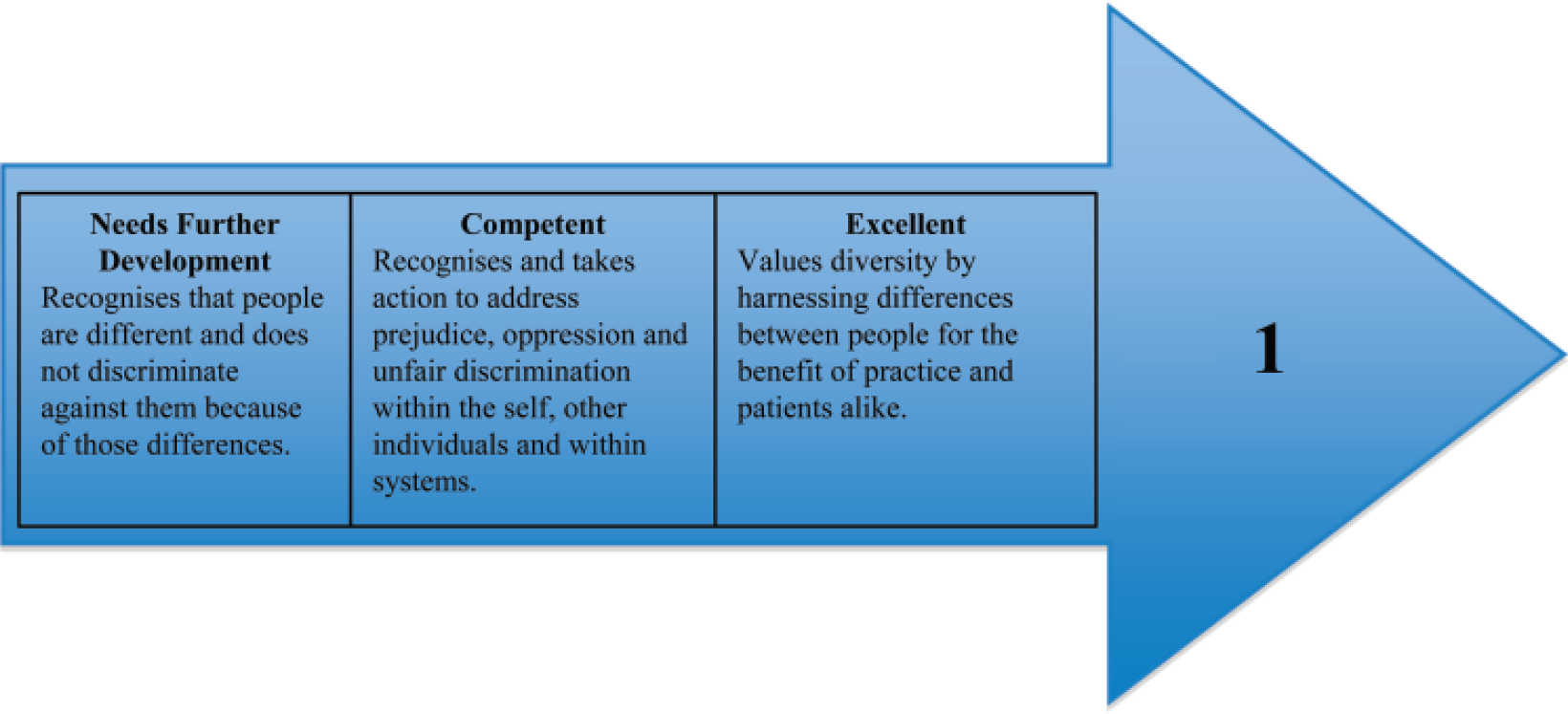
The third competence progression of maintaining an ethical approach to practise.
Looking at each of the word pictures in turn:
Diversity, meaning the differences between people, is valuable, but because it is often misunderstood, it is insufficiently applied. A radio broadcaster exhorted us by saying ‘We are given diversity; let us not turn this into division’.
When diversity is appropriately used, it:
Builds on the mindset of promoting equality and avoiding unfair bias and prejudice Assumes pluralism, which is the belief that the numerous distinct ethnic, religious or cultural groups present in society are desirable and socially beneficial. On this basis, diversity is proactive. Is proactive, recognizing talent, celebrating and harnessing individual differences Is inclusive and internally initiated Means each person is treated and valued as unique, including background, heritage, economic class, personality and experience
Try thinking of diversity not as a subject but as an attitude. Doctors who really understand diversity, show sensibility and cultural humility toward people rather than just a knowledge of facts. Why humility? Because, they do not presume to know the patient's thoughts and do not make assumptions that people, by virtue of their background, will behave or think in particular ways. Instead of treating people as stereotypes (which is so easily done), they encourage people to talk about their perspective and then seek to learn from this.
Valuing diversity is therefore of practical use, in helping us to feel confident and competent in dealing with people from different backgrounds, different sociological groups and different cultures. We need to remember that ‘people’ includes our colleagues as well as our patients.
We can draw a parallel with team development, where experience teaches us that functional teams are diverse in that they comprise a variety of personalities rather than being made up of just one personality type. Therefore, a team might have someone who is good on the theoretical aspects of a problem and another who hates the theory but likes the practicalities of putting things into action. Both are needed if the team is to work well.
Likewise with diversity, a group of people who have different perspectives can greatly enhance joint endeavours. How does this help us in practice life? One significant example is that understanding and valuing a different perspective from our own can improve shared decision making in the consultation both with patients and with colleagues.
This competence is common to equality and fairness and to diversity.
Remember that differences do not just relate to the obvious, such as racial prejudice, but to factors that are more subtle. For example, we may be intolerant of people who have different upbringings such as different schooling (e.g. private versus state sector), have different political or cultural values, who dress differently or who are difficult to understand because of language or accent. Prejudice, which may simply start with irritation, seriously impairs our willingness to recognize and learn from what others have to contribute.
In addition to promoting an appropriate culture within the organization, we need to understand how diversity can be applied to useful effect.
Sometimes, diversity can be harnessed in relation to a specific problem. For example, a sizeable ethnic minority community may need targeted attention from healthcare workers with a particular understanding of the needs and concerns of that community. Remember that diversity is not just about differences in culture. For instance, the diverse perspectives of the patient population could be used to advise on practice development. However, how prevalent is this? For example, how many practices discuss the development of an adolescent health clinic with teenagers in the community?
In our leadership role, we can demonstrate this competence by being proactive in seeking out talent and in putting people together who are different but potentially complementary.
In the end, equality and diversity are stepping stones to seeing people as individuals rather than as categories or stereotypes. No one wants to be selected because of the requirement for organizations to comply with ‘equal opportunities’ or with ‘diversity awareness’. People need to be understood, valued and promoted on the basis of who they are as individuals and what they have to offer. The attention given to equality and diversity reflects the fact that misunderstanding and prejudice are widespread and need to be overcome. British society has moved a great deal in recent years in the direction of valuing its multiculturalism and the example that doctors set as role models is as important to society as it is to the profession.