







Abstract

Touching the Void
The title of this famous book, which was later adapted for film in 2003, has always fascinated me. In 1985, Joe Simpson, the author, attempted to venture up an unclimbed perilous peak in the Peruvian Andes. During the climb, he fell, shattering his knee. The story is an incredible account of his survival in impossible circumstances.
Much like a mountaineer, I am coming to the end of the ascent of my mountain—the MRCGP. Of course the plight pales to insignificance compared to Simpson's adventures but still gaining membership is hard work. This will be my last ‘from the AiT’. And what next? I feel like I'm touching the void.
It's not just the end of guaranteed employment and the start of unsupervised practice that I'm preoccupied with—it's the end of the weekly vocational training scheme (VTS) teaching as well. I welcome Wednesday mornings; a lie-in and a chance to catch up with friends while drinking good coffee. I am now realizing I probably took those teaching sessions for granted. While surveying the expanse of blank pages in my diary following our ‘goodbye session’, I began to wonder how you maintain continual professional development (CPD) at the end of GP training.
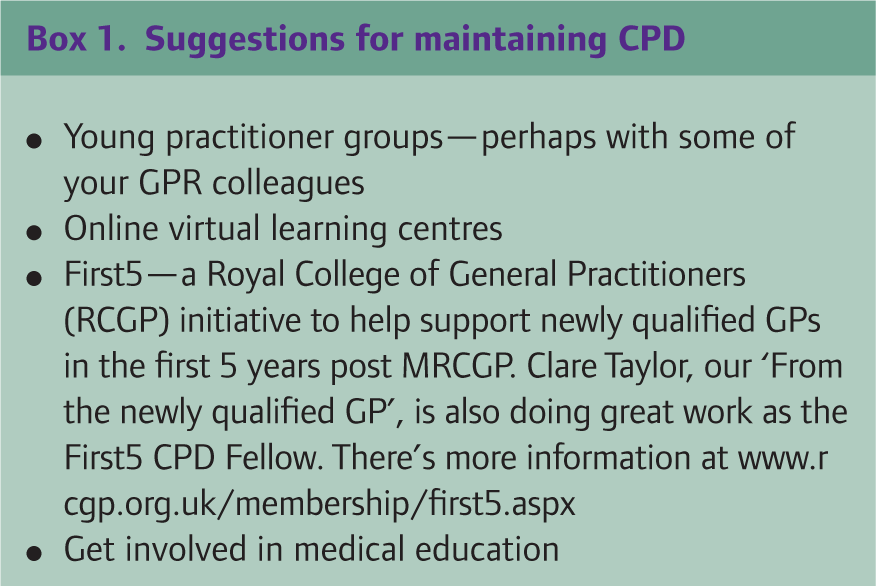
Now our VTS group wasn't completely flawless. I have great respect for our group leader but I am left feeling like we were wrapped a little too carefully in cotton wool. I suspect that the transition from AiT to ‘proper GP’ won't be as smooth as it could be. I have spent a great deal of time musing over this and discussing the issue with friends in different stages of their career. Encouragingly, I found that there are ways of building up a sustainable way of achieving continuing professional development following GP training (Box 1).
I also have to warn you—don't get too excited about finishing your eportfolio. It is not clear what toolkit we will be using for revalidation but the essence of reflection on learning, logging courses, analysing significant events, collecting multi-source feedback and arranging patient questionnaires prevails. These online toolkits don't demand the three per week log entries or the gathering of video consultations as evidence but the principle of competence based practice lives on beyond training.
So what will you do after you finish? The number of options at the moment makes it an exciting time to be an Associate-in-Training (AiT) and a newly qualified GP. If you look around you, the calibre of GP is getting better and better as the membership exam gains more kudos. If you haven't already, I advise you to start thinking about life beyond GP training.
Suggestions for maintaining CPD
Young practitioner groups—perhaps with some of your GPR colleagues
Online virtual learning centres
First5—a Royal College of General Practitioners (RCGP) initiative to help support newly qualified GPs in the first 5 years post MRCGP. Clare Taylor, our ‘From the newly qualified GP’, is also doing great work as the First5 CPD Fellow. There's more information at www.rcgp.org.uk/membership/first5.aspx
Get involved in medical education
Even within ST1, start thinking beyond the patients, the paperwork, the prescriptions, the blood results and watch what the partners are doing. This routine clinical work mostly becomes just that—more routine. A partner in a practice has much more responsibility and will spend their time on varied practice-management-related tasks. So few partnerships are available and so few GP Registrars seem to want partnerships after finishing their training. What does this mean for the future of general practice?
After I finish. I'm locuming in a few practices I have worked in as a GP Registrar and then relocating to the North West. Hopefully, after a period of locuming there, I'll find a more permanent salaried post—then who knows? Locuming is high risk and insecure but does have benefits. Salaried general practice is a popular choice. Some friends have dream contracts in excellent practices and others, are on the path to burn-out due to being the only salaried GP in a practice of work-shy partners. A few have taken on partnerships and are having varied experiences. To be a partner or not to be a partner, that is the question. The question I'm asking myself anyway.