







Abstract
The small group is one of the more common settings in which you may find yourself teaching. It can take many forms from the breakout group on a vocational training scheme day, to an undergraduate ethics discussion, or a newly diagnosed patient information event. The skill of facilitation has many transferable attributes, including those associated with chairing a meeting. A greater understanding of the role of the facilitator can also help you get the most out of education events that you attend as a user. This article aims to equip you with seven carefully considered tools to enhance your facilitation skills and also discusses ways in which you can actually demonstrate those abilities.
The GP curriculum and teaching
Know your role
A dictionary definition of the word suggests that the facilitator is there to make the learning process easier for those learning in groups, but what does that actually mean in practice? Your role as facilitator in a group of first-year medical students looking at the cardiovascular examination may be very different to your role in a group of peers unpacking the ‘difficult consultation’. Nevertheless, there are several features that are common to the facilitation role. Rogers (2002) describes these as group leader, teacher, group member and audience: these are further explained in Table 1.
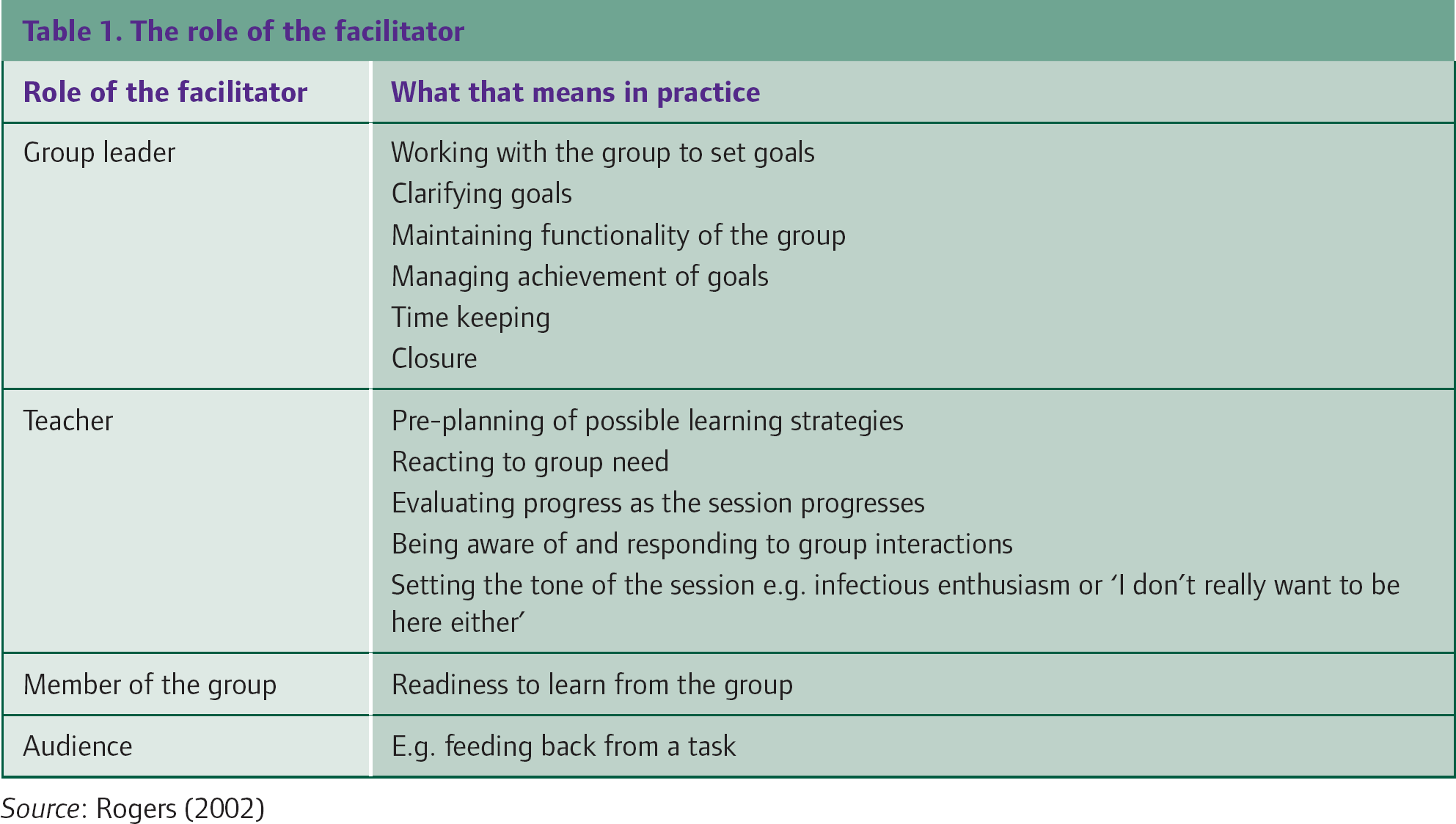
There is much in the problem-based learning literature about the merits of the ‘expert’ versus the ‘non-expert’ facilitator, but before you undertake a facilitation role, you should ascertain what the group's expectation of you will be. Are you being billed as the local expert on NICE guidelines, for example? Would you be comfortable with this billing?
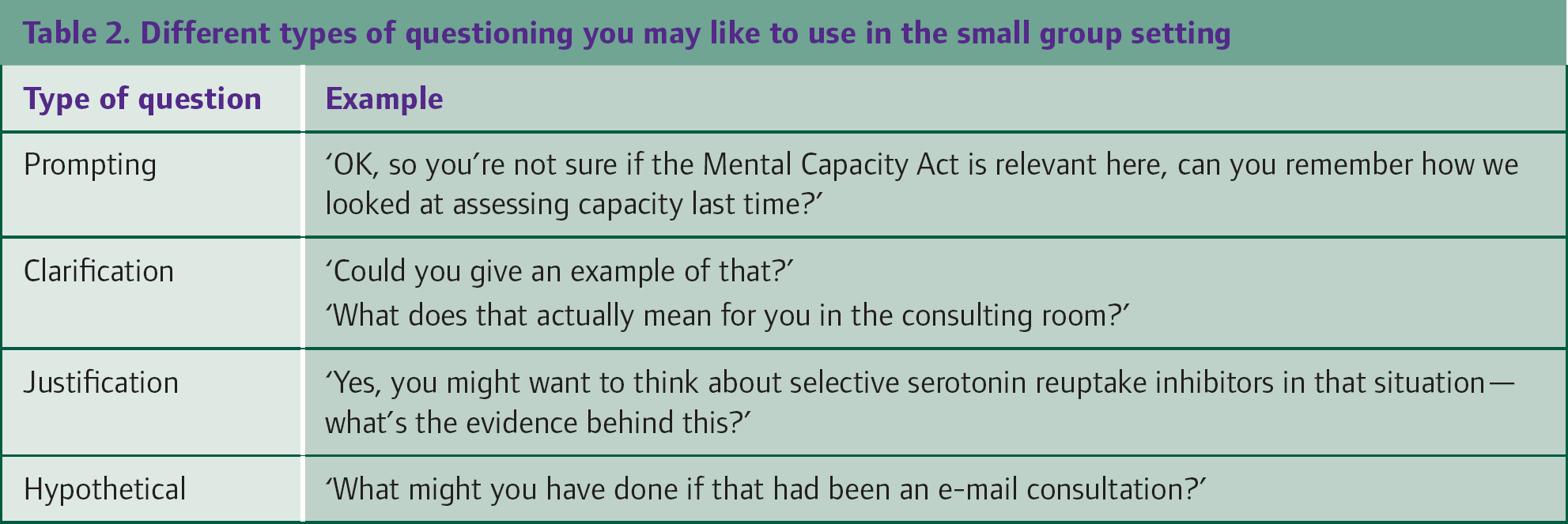
One of the advantages of the small group is that it can foster active learning, but in order for it to be effective, there must be adequate discussion between the group members. Part of the facilitation role is to encourage such interaction with the use of appropriate questioning. We're quite used to exploring different questioning types in the consultation and similar principles apply in the small group setting. Although it might be tempting to begin groups with open questions, sometimes it's better to start with more closed ones, in order to be less threatening, and to begin the process of activating prior knowledge, which is a good primer for any teaching session. Once you're under way, feel free to use as many different types of questioning as you can think of but be careful about turning the session in to a ‘guess what's on my mind’ exercise. Table 2 gives a few examples of different questioning types you may already be using.
Different types of questioning you may like to use in the small group setting
Think about your communication skills throughout the facilitation process, including the use of active listening: look interested in what your group is saying and respond appropriately. It may be useful to reflect back a response to a group member in order to clarify what they have said. When someone says something, that's a little ‘off the wall’, you might want to try asking the group to respond to this rather than immediately proffering your own opinion.
Know your group
Members
Discovering the constitution of your group is important. How you approach facilitation may differ significantly if you have a group of undergraduate students, peers, allied health professionals or patients. Interprofessional learning is increasingly common in postgraduate medical education and has the potential to foster good relationships and improve patient care (Pullon and Fry, 2005). Unfortunately, there is still the possibility of conflict within these groups (Balwin and Daugherty, 2008). Even though such conflict may not actually manifest itself, it's useful to be prepared for how you may deal with these issues. There will be more discussion on conflict in the section entitled ‘know your escape route’.
People's description of small may vary between 2 and more than 50. If your main plan for the session is to have participants break off into smaller groups and then return for a plenary at the end, this could be quite difficult with only three people present. Problem-based learning, an increasingly common form of small group teaching across many disciplines, may be described as ‘student centred, problem-based enquiry based … collaborative … learning’ (The Problem-Based Learning initiative). Optimal group size for this sort of activity is thought to be between 5 and 10. If a group is too small, there may be paucity of opinion and pre-existing knowledge, too large a group may impede universal engagement. In reality, when you teach in the health sector, you may have to be quite flexible with numbers (as you may be competing with clinical duties, for example): it is useful to have several different strategies up your sleeve.
Environment
Think about the way in which your room is laid out—is it conducive to the task you are undertaking? A horseshoe or circle arrangement is often more helpful to group discussion than sitting in rows behind tables. Try to be aware of and respond to temperature, light and space issues. A group of six people talking alone in the corner of a room designed for 500 may feel a little lost: likewise, if your room is too small, people may begin to feel uncomfortable and not really be interested in the task in hand.
Maslow (1998) described a hierarchy of human need that is now much used in education and management. Once basic physical and safety needs are met, social and self-esteem needs also have to be addressed, before the full potential of an individual can be realized. Think about the different ways in which you might foster a ‘safe’ teaching environment and enhance the sense of belonging and self-esteem in your group. Actually knowing who the individual members of your group are can help. Mentioning them by name after a contribution, or in expectation of a response, can foster good relationships. Using sticky labels or a room plan may assist you here.
Group development
Bruce Tuckman described the lifecycle of a group as having five stages: forming, storming, norming, performing and adjourning (Tuckman, 1965; Tuckman and Jensen, 1977). These are further explained in Table 3. While the different stages may not be overt and noticeable in every group you encounter, it's useful to have these stages in the back of your mind. When a group's life is short and the group has come together for a specific functional task, at a one-off educational workshop for example, elements of the storming and norming may be very short-lived or sidelined. These stages may be more apparent in a group that has a longer life, such as a study group that will meet over the course of a year.
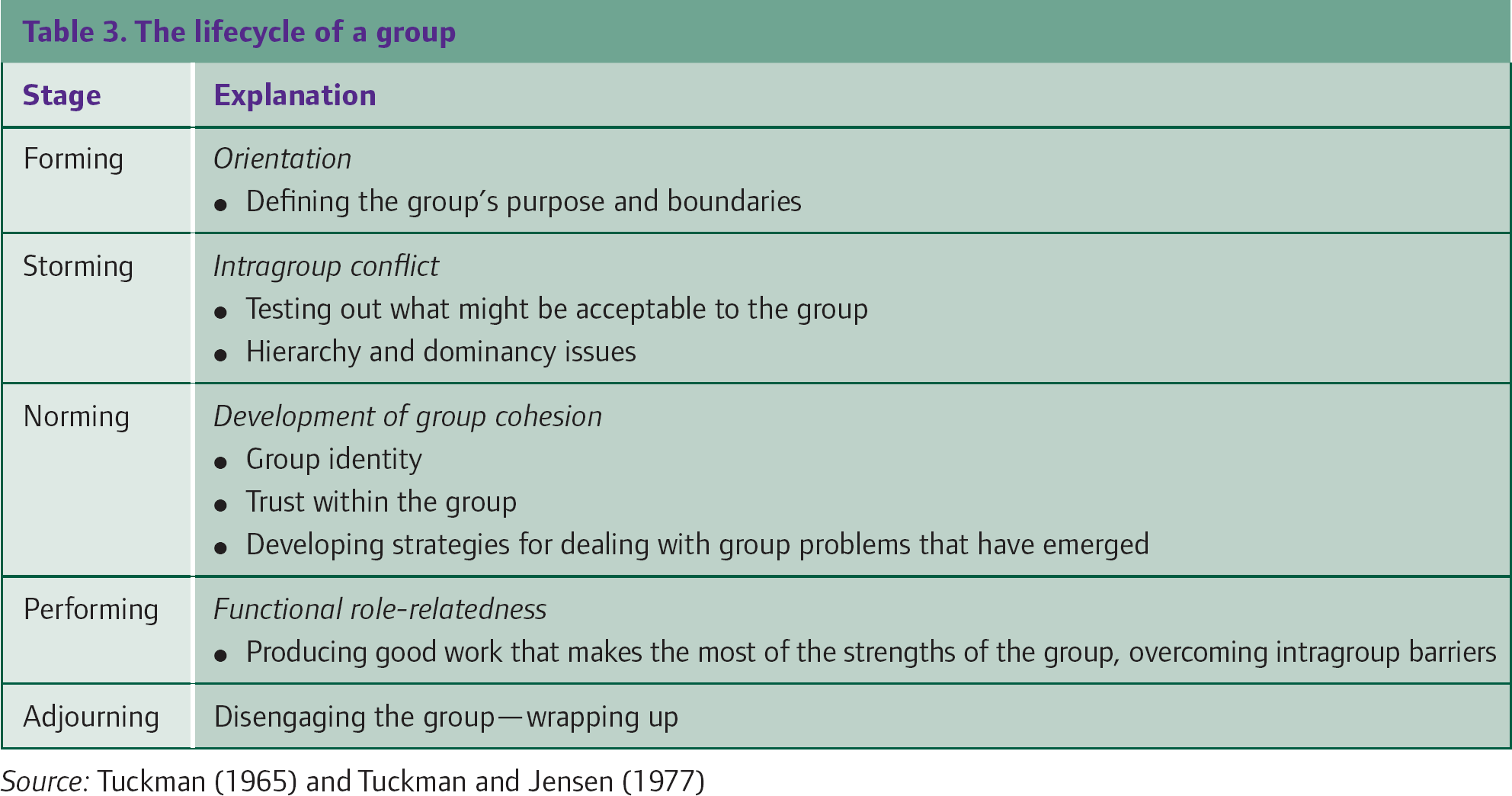
As task driven medics, it may be tempting to look at Tuckman's model and think ‘what's the point of the first few stages, can't we just cut them out and get to the performing level?’ For certain tasks, such as those involving personal opinion or personal professional practice, especially when that opinion or practice may be challenged, the first few levels may be very important; unfortunately, power play can rear its head in almost any situation. It is quite possible for a group to cycle between the middle three stages as different issues present themselves: some groups may never actually reach a functional performing stage. If you find yourself facilitating a group that has a long history, there may be unresolved issues (such as ground rules) that may need revisiting to help progression.
Know your options
Various techniques can be employed when facilitating a small group. Plan what you would like to do with your group once you know what the goals will be, but be prepared with a few alternative strategies that can be introduced in response to the needs of the group as the session progresses.
Round the group
Different members of the group are asked in turn to contribute something specific. This may not work if your group is too large, and a time limit for each person (e.g. 30 seconds) may also be useful. The order of contribution may simply be serially based on seat position but could also be chosen by the last person to speak or random allocation. Going round the group can be a useful way to start and/or end a session. For example, members could be invited to share something they have learnt during the session.
Brainstorming
This is a common method of pooling knowledge and/or ideas when presented with a given problem. It may be one of the ways in which you activate prior knowledge at the beginning of a session or encourage the development of problem solving. It may involve a group shout-out with contributions being scribed by a volunteer. It can foster teamwork, as the whole group can participate, and may need to adhere to group rules in order to be effective. Variations on the brainstorming theme include giving each member some sticky post-it notes and asking them to individually think of ideas and concepts. These can then be stuck on a presentation wall and sorted into groups to see the common themes that have emerged. The advantage of using post-it notes is that even the quieter group members can easily participate—the disadvantage is that you may not get the same cross-fertilization of ideas that can occur in a group shout-out.
Buzz groups
This is where a large group is split into several smaller groups to discuss a specific question or topic area for a short period of time. The name is derived from the ‘buzz’ of lots of different conversations occurring in the same room at the same time. In its most simple form, students may be talking in groups of two or three with those seated around them. If you would like to encourage thoughts or responses to a new concept, for example, it may be better to use buzz groups to begin with as students may be more likely to proffer their opinion after testing it out in the less threatening environment of their immediate neighbours. Buzz groups are a good way to provide a change of focus to a large group discussion and can also be used to help check group understanding. They can also be a useful way of encouraging participation from quieter group members. If your group size is relatively large, you may have to be quite strict with limiting feedback time.
Snowballing
This describes the amalgamation of first two and then four buzz groups, prior to the feedback stage. Within each mega buzz group, members must present their initial discussions and then negotiate what their pooled response to the main group will be. The slowly increasing size of the group can actually help achieve universal involvement: people who would normally feel uncomfortable contributing within a group of eight may feel more included. Some, however, may feel frustrated at having to reiterate their thoughts several times, so try not to use this technique more than once in a session. You could also introduce a slight variation in the task as the buzz groups and mega buzz groups join together.
Crossover groups
This is another method of maximizing the potential for cross-fertilization of ideas within micro groups. A group of 12 students can be split in to three groups of four in order to discuss a topic or idea. After a given period of time, the group of 12 students is re-split in to four groups of three: the new groups comprising a person from each of the three original groups.
Goldfish bowl
A discussion or other group activity takes place between a group of people (in the ‘goldfish bowl’) who are encircled by another group. The latter group is there in an observing capacity but may be given specific things to watch for or comment on later. Roles can then be reversed.
Syndicate or breakout groups
The large group is broken into smaller groups, each with specific tasks. Depending on the task, you may want them to solely use the pooled knowledge of their syndicate or external sources, such as the library or Internet. Tasks can be fed back in a plenary session, with groups using media, such as flip chart paper. To add variety to the feedback session, you may wish to provide a range of media and let the group decide the best means to feedback. If you are facilitating a series of sessions and group members are able to meet between sessions (either physically or virtually), syndicate groups can be formed at the end of one session with a view to feeding back at the beginning of the next.
Role play
The consultation is the mainstay of role play in medical education. Students can be split into groups of three (patient, doctor and observer) with roles being changed after each consultation. Other techniques include the consultation taking place with the remainder of the group in goldfish bowl mode. Although this can seem more threatening for those involved, the experience can be beneficial for all: fish bowlers can be given specific tasks, such as observing for aspects of a given consultation model. There are many variations on fishbowling a role-play consultation, including participants calling time out and nominating one of the observers to continue in their role from that point in the consultation. Pendelton's guidelines for feedback, where positive aspects are praised before constructive criticisms proffered, can be a useful tool to employ at the end of any role-play session (Pendelton et al., 1984). A good role-play session can be very time consuming to prepare, and some of the participants may feel uncomfortable being put under the microscope. Try to give people some sort of ‘get out of jail free’ option and be prepared to step in if you think things are getting too much for someone to cope with. How much you want to do this may depend on what sort of group you are facilitating: a group of first-year medical students may need more safety nets than a group of practising doctors who will have to get themselves out of real-life sticky situations. Whatever the constitution of the group, adequate debriefing at the end of a session is important: people may be surprised how much they get into character. Role play need not be limited to the consultation and could be adapted for almost any educational situation. This may include fishbowling a mock-up practice meeting or even role playing the household of a single parent. As with any modality, beware of over use.
Games
Games can be loosely described as any activity where there is interaction between people (or between people and a machine), which may sometimes have an element of competition. When they are done well, they can enhance group learning and be fun. They can be used to vary the educational stimulus within a small group session, but as with anything, you need to find a task that's appropriate to your group. If you are running a session on teenage, sexual health for your vocational training scheme (VTS) group, or a group of practice nurses, for example, using games that are often used with teenagers to tackle this topic (e.g. www.path.org/files/gamesbook.pdf) could be a useful strategy. For the less adventurous, quizzes can also be classed as games.
Beginnings and endings
The very thought of the term ‘icebreaker’ tends to leave some people feeling cold. This may be due to previous experience of inappropriate or embarrassing activities. Starting out and setting the tone for the group can be very important: if the group needs to interact but do not yet know each other, an activity to enhance this process could be very useful. This may be as simple as asking group members to introduce themselves and say why they are here. Finding out a little more about the background of your group may also help enhance the diversity of future discussion. Websites and books abound with different possibilities of icebreaker and get-to-know-you activities: a good place to start is www.icebreakers.ws. Find a few that suit your style as a person and try to marry this with the type of group you are leading. Don't be afraid to experiment, but if you do experiment, be prepared to apologize if it goes wrong!
Another concept to consider at the start of a group's life is ‘group rules’. Whether these are overtly needed will depend on the purpose and life expectancy of the group. It's often more useful to allow the group to decide these for themselves, with some guidance about what may be important. Issues that can be addressed in rules include confidentiality, time keeping and respect for others in the group. Rules may be revisited as appropriate, for example before (or during) a session that might discuss personal opinions on ethical issues.
Appropriately ending a session can be as important as a good introduction. You may wish to recap what has been covered and use the opportunity for clarification of any problems. Try to keep to time: if you said you would finish at 5 p.m. that will be when people will be expecting to stop.
Know your escape route
Whether you have nightmares about trying to facilitate a dysfunctional group or painful memories of personal involvement in such a group, planning what you might do when things start to go wrong is a good idea. Having said that, remember that prevention is better than cure. Look back to Table 1, the roles of the facilitator; have these in mind when you're planning your group session. For example, are you planning on adequately warming up (and down) your group for the proposed session activity? Some common scenarios that might occur in a ‘difficult group’ are briefly discussed below. If you'd like to read more about this, I'd suggest the book by Tiberius (1999) or Exley and Dennick (2004) as starters.
Non-participation
One of the many transferable skills that can be gained from the small group setting is interpersonal interaction. It's therefore important for the facilitator to be observant towards the level of participation. There may be many reasons for people not participating, which can include being uncomfortable with the topic or particular group, having a reflective learning style, being tired or distracted or not feeling that they have the opportunity to interact. Breaking into buzz groups may give the quieter individuals a chance of interacting, which may build confidence for interacting in a larger group. You may find it useful to circulate round the buzz groups as an observer to monitor the level of interaction here. In a larger group setting, direct questioning of different group members is also an option, which may be easier to do as you get to know the group better. Be on the lookout for body language that may suggest that the quieter member may have something to contribute, such as purposefully looking at the current speaker, inhaling as if preparing to speak, raising eyebrows or even starting to say something. Varying the seating pattern of the group may also help.
Dominant group members
Again, there could be many reasons behind someone's dominance, and similar strategies that were mentioned for the quiet member (like breaking out into buzz groups) could also help the more dominant individual. If you have more than one dominant presence, it can sometimes help to put them in the same buzz group, as at least one of them will not be able to dominate in this setting. In the larger group, you may wish to allocate him/her to a specific task, such as scribe or timekeeper, which should allow some space in the main discussion. Appropriate participation is one of the areas that are usefully covered in group rules. While it doesn't often help if the facilitator just waves the list of rules at the persistent speaker, you may wish to recap these rules before particular sessions. Self-policing can be an important part of group development, but some groups will need more of a firm support from their facilitator in such matters. It can feel very difficult as a facilitator to intervene, especially if you agree with what your dominant presence is saying. In the interests of the rest of the group, however, you may have to directly challenge a persistent speaker, and this can be done in a non-confrontational way. You may even have to interrupt the person mid flow once you see an appropriate junction, such as when he/she starts to make a second (or third) point that the rest of the group has not responded to. You can then ask the rest of the group to specifically respond to the points raised: hopefully, you will have picked up on some nonverbal cues that others want to participate. Sometimes, it may be useful to have a quiet word with the dominant member at the end of a session: in some cases, the fact that you have recognized their actions may reduce their need for dominance in future sessions.
Conflict
It is sometimes said that our weaknesses can be our greatest strengths. Unhelpful conflict can destroy a small group, but conflict is also what they have been designed to contain. When discussing ethics, for example, a person's viewpoint may be challenged and group members may even experience a paradigm shift. The birth of a new paradigm can, however, be a painful and traumatic experience, which may need careful management from the facilitator. This may include prefacing certain sessions with health warnings and adequate debriefing at the end. This is another area where group rules can be important: these may include maintaining appropriate confidentiality, and challenging an idea, rather than engaging in personal attack. The latter may be quite subtle, and the facilitator may wish to use probing or clarification questions after some points are made. Be aware of your own feelings also: if you're running a small group session on a particular ethical issue, do you have any unresolved issues that need appropriate housekeeping beforehand? It's not good to unconsciously (or consciously) add to any unhelpful conflict.
Other forms of conflict may unfortunately rear their heads. There may be overt or covert power struggles between group members, who may even have some form of history that is unknown to you or the group. On some occasions, you may even feel that there is a general feeling of group discontentment. How you deal with these issues will largely be down to your personal style and how important you feel any observed problems may be when considering the lifespan of your particular group. You may wish to reflect your feelings or observations back to the group: helping the group to manage its own problems may be an important part of the group's development. Reviewing the overall purpose of the small group may also be useful.
Know what you've done
As with any aspect of medicine, it's really important to learn from our experiences, both good and bad. Sit down, have a cup of tea and engage in some ‘analytic evaluation and strategic planning for improvement after the teaching event’ (Pinsky et al., 1998) or reflection. Ask yourself some questions—What went well? Why? What do you think didn't go well? Why? What would you have done differently? If you have the opportunity, share some of your reflections with a colleague or mentor. To begin with, on your own, you may find it quite difficult to work out why something did go so well (or badly). As you reflect on teaching episodes, just as when you reflect on your consultations, you should soon start to see patterns emerging. As you do that, you may begin to feel more confident when you're actually in the facilitation role—responding to the ‘something just doesn't feel right’ intuition along with the ‘I think the group's now ready for some challenging debate’ ones also.
Prove what you've done
The GP curriculum states that you should demonstrate the ability to facilitate a small group. As well as your own reflections, compile feedback on your facilitation from other sources, which can include actual members of your small group, as well as external observers. A recent review of the literature suggested that there is not always good correlation between personal reflection and learner evaluation: learners in medical education tend to rate their tutors higher than those tutors rate themselves (Kogan and Shea, 2007).
Feedback from members of the group
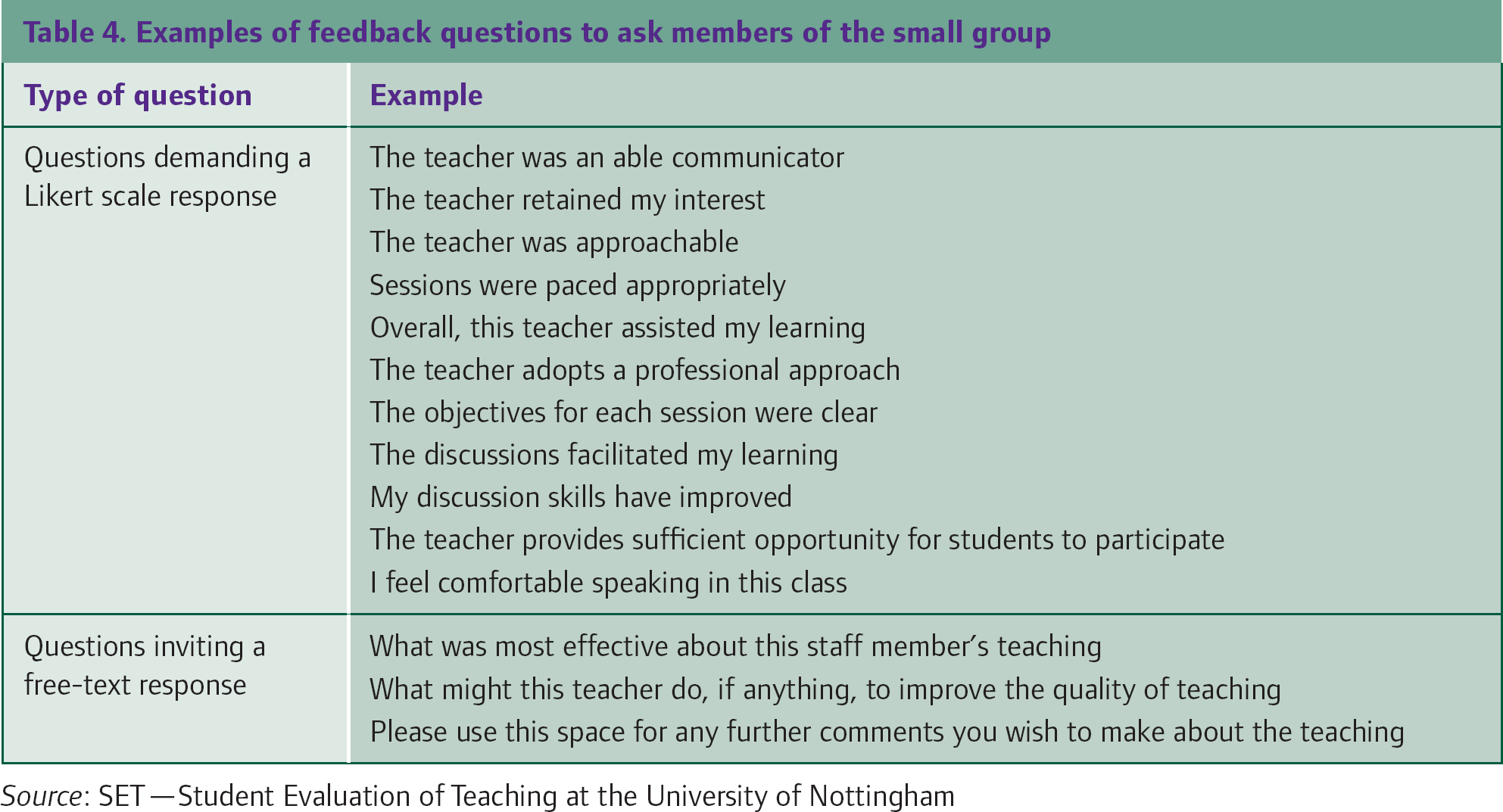
This is the most common and readily available form of feedback obtained. It can vary in complexity from anonymously writing a response to ‘What did you like about the session? What can be improved?’ to a structured focus-group style event. Different institutions produce their own feedback forms, and examples of questions asked of students from the University of Nottingham medical school are given in Table 4. These questions form part of ‘SET’—student evaluation of teaching, which each teacher must undergo on a regular basis. Part of the value of receiving feedback is being able to go through this with someone. Although it's a real confidence boost to receive good feedback, there will inevitably be occasions when the feedback is less than favourable. Try to view feedback from different sources as a whole: there will be members of your small group who you will find more difficult than others and particular topic areas that you will find more difficult to handle as a facilitator.
Examples of feedback questions to ask members of the small group
Feedback from outside the group
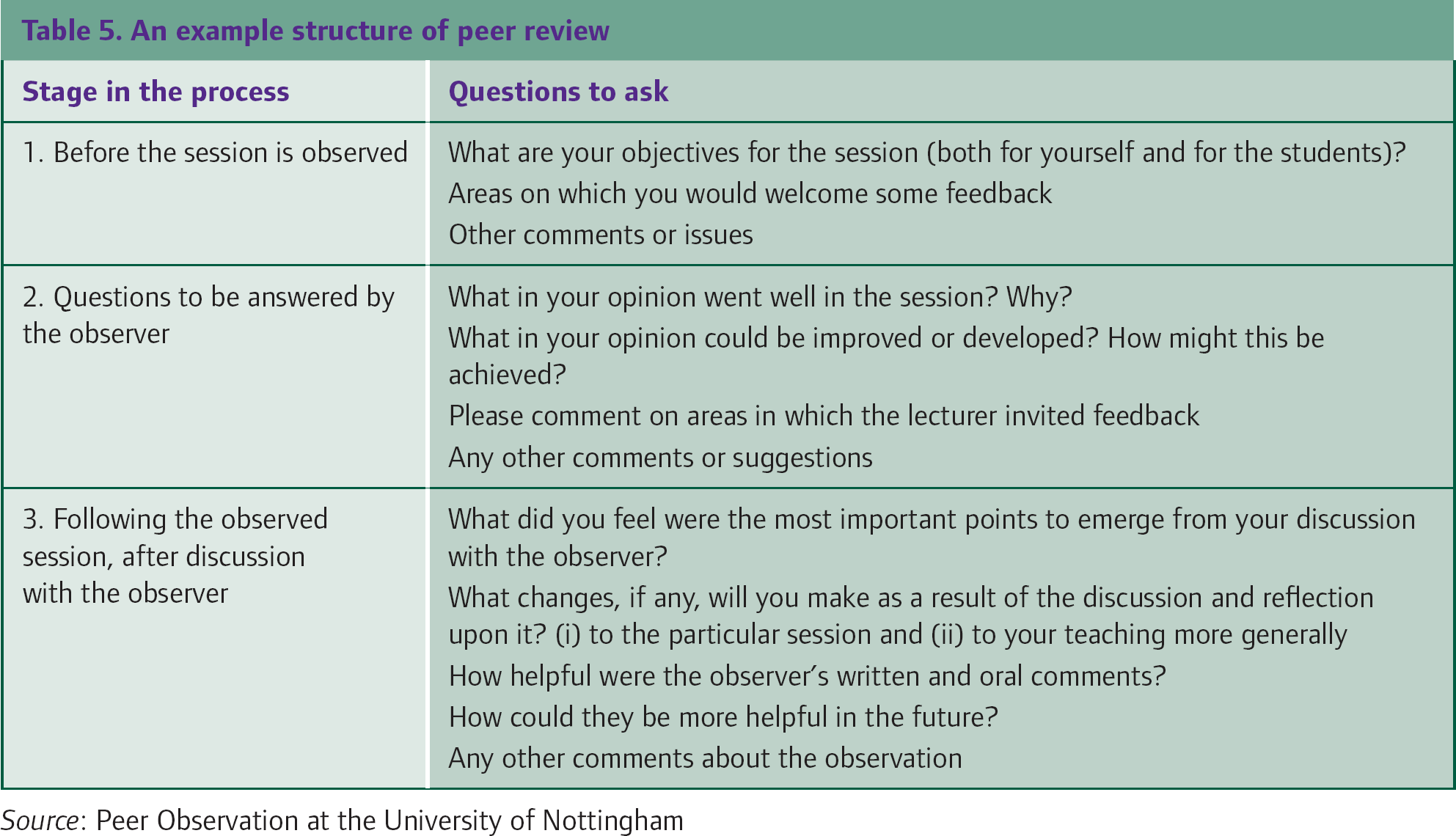
The process of ‘peer review’, whereby a teaching peer observes your small group session, and then gives you feedback, can be a useful way to gain additional insight into your teaching style and to share best practice. You may wish to have a reciprocal arrangement, so that you can observe and review their teaching also. Some institutions have formal peer review programmes, and details of that from the University of Nottingham are shown in Table 5. You could also record a group session for the purpose of self-review and then ask a mentor to watch with you and proffer specific feedback. Be sure to get appropriate consent from your group, though!
An example structure of peer review
What to do next
As with any skill, it's really important that you do actually get the chance to practice facilitating, if you want to be able to develop as a facilitator. Depending on the way in which your VTS group is structured, you may have plenty of opportunity for practice here. Even if you do, you may wish to consider getting experience of different teaching environments. The most obvious step would be to contact your local medical school (either the head of teaching in the Primary Care Department or the director of medical education would be a good starting point). Try to explore novel teaching opportunities—sixth form groups or local youth groups often want to engage in ethical discussion and can give you the experience of facilitating different age groups.
If you would like to have teaching as a prominent part of your career portfolio, look in to doing some sort of formal qualification. Many universities run part-time education masters that are either face-to-face or distance and/or online administered. Often these qualifications can start at the postgraduate certificate or diploma level before progressing to the master's stage. On a smaller scale, there are several 1–2 day courses [such as the Teaching Improvement Programme System (TIPS) and Teaching and Assessing Clinical Skills (TACS)] that provide a useful introduction to the theory behind teaching and will often give you the opportunity to practise teaching in a safe environment with the opportunity for feedback.
Any new task can be scary, and as facilitator, one can sometimes feel very exposed. With appropriate preparation, and the right frame of mind, however, facilitating a small group can be an exciting and rewarding experience.
Key points
Find out about the group you are facilitating and their expectations of you Plan a structure for the small group session using different teaching modalities Respond to group need and dynamics throughout the session Obtain feedback from your session Reflect on the session Plan to gain more experience of facilitation