







Abstract
Silver award for e-GP
The e-GP learning resource won a silver award for ‘Excellence in the production of e-learning content—Public Sector’ at the 2010 e-Learning Age Awards. We are delighted that there was recognition of the work we have put into making the modules interactive (I edit the Women's Health module). If you have not used any of the sessions, have a go on www.e-GP.org; the sessions are free to GPs and AiTs and cover the breadth of the curriculum.
Apps for the busy GP
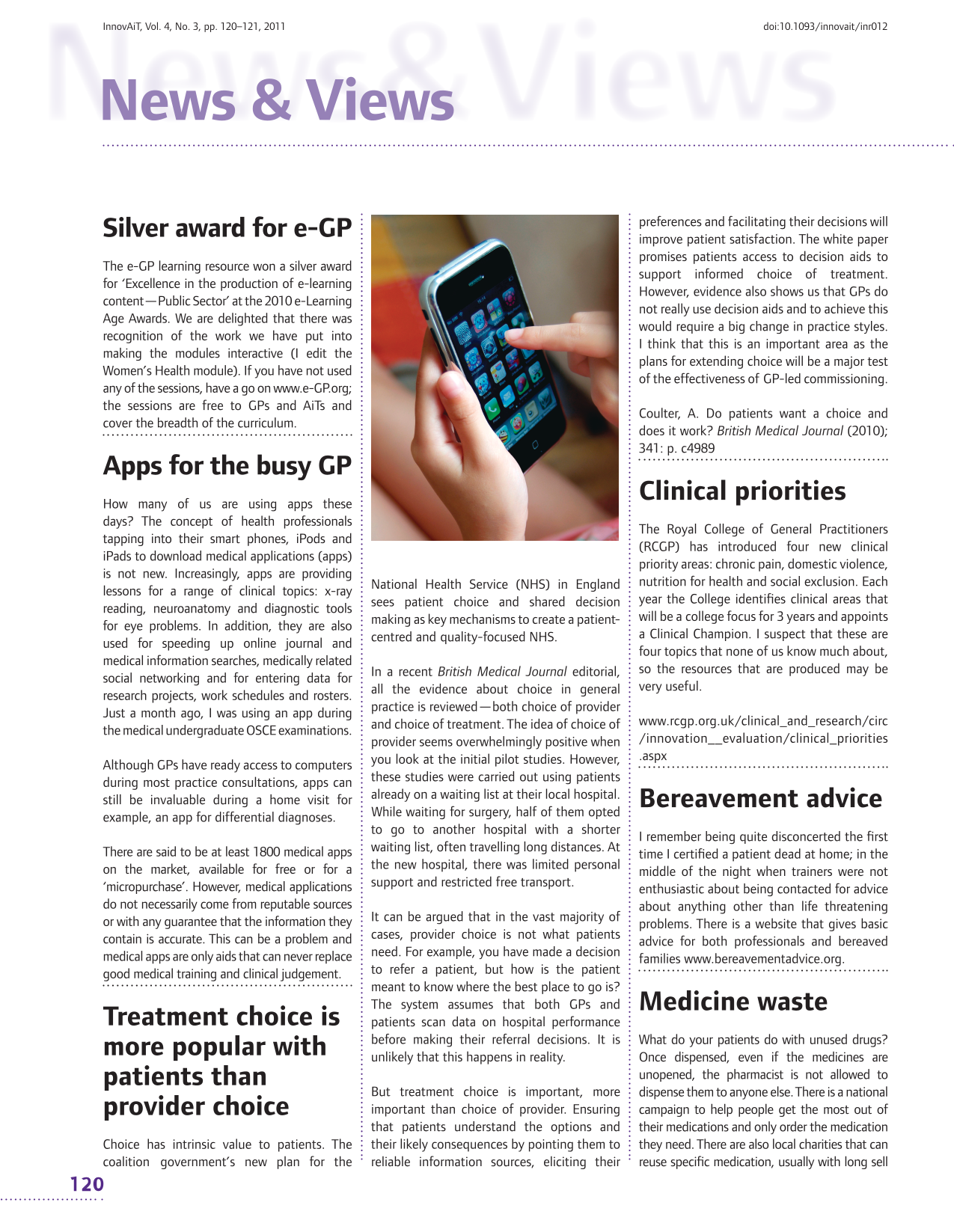
How many of us are using apps these days? The concept of health professionals tapping into their smart phones, iPods and iPads to download medical applications (apps) is not new. Increasingly, apps are providing lessons for a range of clinical topics: x-ray reading, neuroanatomy and diagnostic tools for eye problems. In addition, they are also used for speeding up online journal and medical information searches, medically related social networking and for entering data for research projects, work schedules and rosters. Just a month ago, I was using an app during the medical undergraduate OSCE examinations.
Although GPs have ready access to computers during most practice consultations, apps can still be invaluable during a home visit for example, an app for differential diagnoses.
There are said to be at least 1800 medical apps on the market, available for free or for a ‘micropurchase’. However, medical applications do not necessarily come from reputable sources or with any guarantee that the information they contain is accurate. This can be a problem and medical apps are only aids that can never replace good medical training and clinical judgement.
Treatment choice is more popular with patients than provider choice
Choice has intrinsic value to patients. The coalition government's new plan for the National Health Service (NHS) in England sees patient choice and shared decision making as key mechanisms to create a patient-centred and quality-focused NHS.

In a recent British Medical Journal editorial, all the evidence about choice in general practice is reviewed—both choice of provider and choice of treatment. The idea of choice of provider seems overwhelmingly positive when you look at the initial pilot studies. However, these studies were carried out using patients already on a waiting list at their local hospital. While waiting for surgery, half of them opted to go to another hospital with a shorter waiting list, often travelling long distances. At the new hospital, there was limited personal support and restricted free transport.
It can be argued that in the vast majority of cases, provider choice is not what patients need. For example, you have made a decision to refer a patient, but how is the patient meant to know where the best place to go is? The system assumes that both GPs and patients scan data on hospital performance before making their referral decisions. It is unlikely that this happens in reality.
But treatment choice is important, more important than choice of provider. Ensuring that patients understand the options and their likely consequences by pointing them to reliable information sources, eliciting their preferences and facilitating their decisions will improve patient satisfaction. The white paper promises patients access to decision aids to support informed choice of treatment. However, evidence also shows us that GPs do not really use decision aids and to achieve this would require a big change in practice styles. I think that this is an important area as the plans for extending choice will be a major test of the effectiveness of GP-led commissioning.
Coulter, A. Do patients want a choice and does it work? British Medical Journal (2010); 341: p. c4989
Clinical priorities
The Royal College of General Practitioners (RCGP) has introduced four new clinical priority areas: chronic pain, domestic violence, nutrition for health and social exclusion. Each year the College identifies clinical areas that will be a college focus for 3 years and appoints a Clinical Champion. I suspect that these are four topics that none of us know much about, so the resources that are produced may be very useful.
www.rcgp.org.uk/clinical_and_research/circ/innovation__evaluation/clinical_priorities.aspx
Bereavement advice
I remember being quite disconcerted the first time I certified a patient dead at home; in the middle of the night when trainers were not enthusiastic about being contacted for advice about anything other than life threatening problems. There is a website that gives basic advice for both professionals and bereaved families www.bereavementadvice.org.
Medicine waste
What do your patients do with unused drugs? Once dispensed, even if the medicines are unopened, the pharmacist is not allowed to dispense them to anyone else. There is a national campaign to help people get the most out of their medications and only order the medication they need. There are also local charities that can reuse specific medication, usually with long sell by dates. You could talk to one of your local pharmacists about activities in your area. www.medicinewaste.com
Breakfast
I love breakfast. I eat breakfast every day and particularly enjoy it at weekends and on holiday when it can take half the morning. A recent study shows that skipping breakfast can adversely affect cardiovascular health. ‘Breakfast skippers’ had larger waist circumferences, higher fasting insulin, total cholesterol and low-density lipoprotein than those who eat breakfast.
Smith, J., Gall, S., McNaughton, S., et al. Skipping breakfast: longitudinal associations with cardiometabolic risk factors in the Childhood Determinants of Adult Health Study. American Journal of Clinical Nutrition (2010); 92: p. 1316–25
Stillbirth
In a December edition of the British Medical Journal, a doctor described his thoughts about the stillbirth of his son. He pointed out that stillbirth is more common than either Down's syndrome or cot death but is a topic that is rarely discussed. He searched PubMed and ‘stillbirth’ yielded 4012 hits, whereas ‘pregnancy’ yielded 666 789. His article made me reflect. During 20 years as a GP I have sent three women into hospital when I could not find a foetal heart and I have found each occasion difficult to deal with. Discussion does change practice; when I was a medical student, women who were delivering babies known to be dead or having late abortions for severe foetal abnormalities were surrounded by women having live babies and had their own babies whisked away as soon as possible. Over the years, women have been encouraged to see and have mementos of their babies; at least an acknowledgement of the life and loss. Perhaps discussion would drive research and improve care.
Teenage pregnancy
Babies born to teenage mothers are more likely to be premature or low birth weight, more likely to die in the first year of life and more likely to be admitted to hospital as a result of accidents or gastroenteritis.
What provision does your practice make for teenage parents? Do your reception staff have specific training about dealing with teenagers? How easy is it for teenagers to get appointments at convenient times? I am sure you can think of other questions. Audit is on the curriculum; looking at some aspect of teenage care would give you appropriate e-portfolio entries and might produce useful change in your practice.
Aspirin
Once again aspirin hits the headlines as a ‘wonder drug’; this time another study suggesting regular low-dose aspirin reduces the chances of dying from a range of common cancers. This was a large study (25 000 patients) with participants randomized to receive or not receive low-dose aspirin for 4–8 years. Benefits were greatest for cancer of the proximal colon and did not improve with higher doses of aspirin but did improve with duration of use.
Balancing risks and benefits of low-dose aspirin consumption have become a complex conversation that tests the ability to discuss relative risks at an individual level. As with discussions about screening, these are the sort of topics that could be tested in the Clinical Skills Assessment.
Rothwell, P., Wilson, M., Elwin, C., et al. Long-term effect of aspirin on colorectal cancer incidence and mortality: 20-year follow-up of five randomised trials. The Lancet (2010); 376 (9754): p. 1741–50
Are you confident about diagnosing lumbar spinal stenosis?
The clinical syndrome of lumbar spinal stenosis is a common diagnosis in older adults presenting with lower extremity pain. Often, these patients can be misdiagnosed as having peripheral large joint osteoarthritis or even vascular rather than neuropathic causes for their pain. In the UK, we are generally discouraged from using X-ray to aid diagnosis. A recent review article quantified the most useful symptoms for increasing the likelihood of the clinical syndrome of lumbar spinal stenosis namely:
Having no pain when seated [likelihood ratio (LR), 7.4; 95% confidence interval (CI), 1.9-30]
Improvement of symptoms when bending forward (LR, 6.4; 95% CI, 4.1-9.9)
The presence of bilateral buttock or leg pain (LR, 6.3; 95% CI, 3.1-13)
Neurogenic claudication (LR, 3.7; 95% CI, 2.9-4.8).
The absence of neurogenic claudication (LR, 0.23; 95% CI, 0.17-0.31) also decreased the likelihood of the diagnosis. A wide-based gait and abnormal Romberg test result increased the likelihood of the clinical syndrome of lumbar spinal stenosis.
Suri, P., Rainville, J., Kalichman, L. et al. Does this older adult with lower extremity pain have the clinical syndrome of lumbar spinal stenosis? Journal of the American Medical Association (2010) 304 (23): p. 2628–36