







Abstract
As part of their training, Associates-in-Training (AiTs) will spend time in hospital within surgical specialties. Most hospitals have dedicated clinics for the preoperative assessment of patients scheduled for elective surgery, which are usually run by specialist nurses. However, sometimes, the responsibility for preoperative assessment will fall to the AiT. If you have not done this before, it can be daunting and it may be difficult to know which investigations patients need. Most hospitals will have preoperative assessment guidelines and proformas for you to use but here are some basics to get you started.
What is preoperative assessment?
Preoperative assessment is important and serves two main purposes:
Firstly, to provide patients with information about their surgical procedure, anaesthetic and recovery
Secondly, to ensure that the patient is fit for surgery
What is my role?
The patients you see should already have been seen by a surgeon so that they will know about the operation they are having. Patients will also be seen by an anaesthetist to discuss their anaesthetic, but this often only happens on the day of surgery. If you can ensure all the necessary investigations are done and potential problems flagged up beforehand this will be very helpful.
What should I do?
Take a thorough history and examination including an anaesthetic history. Particularly important points to cover include:
A personal or family history of anaesthetic problems—these range from post-operative nausea and vomiting to rare but life-threatening complications like malignant hyperthermia and suxamethonium apnoea
Medication history—some medications (e.g. steroids, anti-platelets and warfarin) may need to be stopped or require additional management in the perioperative period (see Box 1). It is especially important to ask about allergies as patients often receive a dose of prophylactic antibiotics once they are anaesthetized
Clinical examination will vary depending on your patient but should include examination of the cardiovascular and respiratory systems as a minimum
How do I decide which investigations patients need?
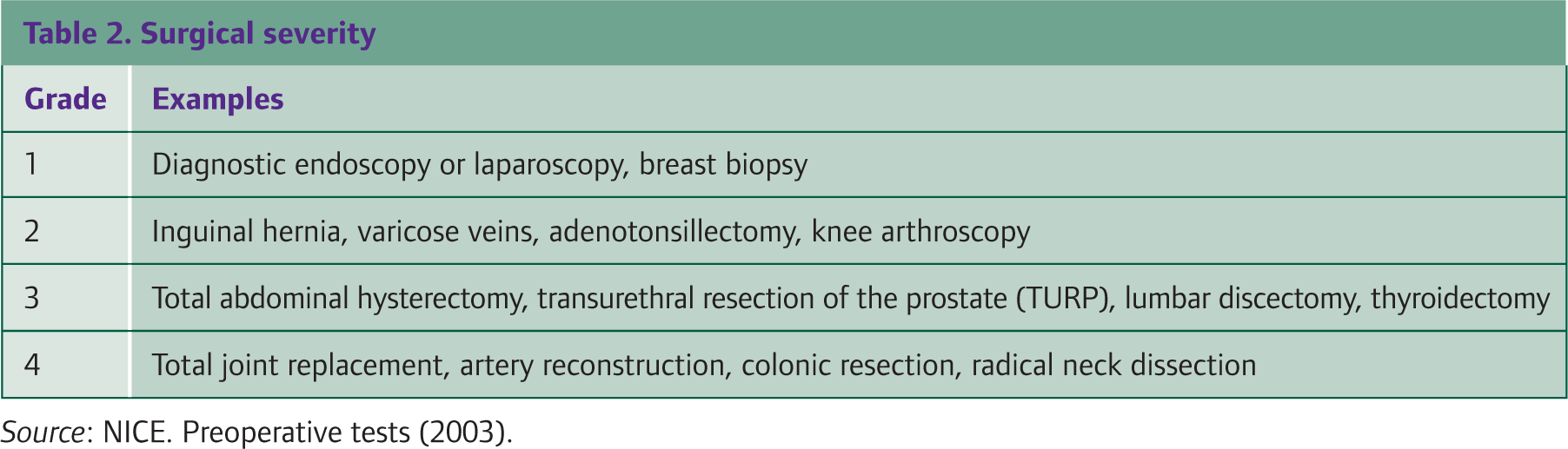
It can be challenging to decide which investigations a patient requires. Often, a judgement must be made on a case-by-case basis. However, the process can be facilitated by guidelines that have been published by the National Institute for Health and Clinical Excellence (NICE, 2003). These consider the appropriateness of investigations for particular patient groups and hence help you decide which investigations may be required (Table 1). In general, patients having major surgery and those with chronic health conditions require more preoperative investigations than patients having minor surgery who are otherwise well. Tables 2 and 3 provide a guide to classifying the severity of surgery and disease respectively.
Summary of guidance on the use of preoperative tests in elective surgery


Other tests to consider include:
A pregnancy test, which should be carried out on any woman who says that she may be pregnant
A sickle cell test, which should be offered if there is a family history of the disease or the patient is from a high-risk area
• Haemostasis tests, which should be carried out if there is a specific indication (e.g. the patient is taking an anticoagulant or undergoing a procedure in which haemostasis is particularly important)
Urine analysis, random blood glucose and lung function tests may also be appropriate in some situations; the NICE guidance provides more detail in this regard
Preoperative medication management*
Patients will be taking these drugs for a reason and the risks and benefits of stopping any drug needs to be considered carefully. The decision of when to restart drugs will be made as soon as possible after surgery.
For minor surgery, normal insulin and oral hypoglycaemics should be omitted on the day of surgery and restarted with the first meal post-operatively
For major surgery, normal insulin and oral hypoglycaemics should be omitted on the day of surgery and an insulin sliding scale should be commenced preoperatively. This should continue until the patient is eating and drinking satisfactorily. Oral hypoglycaemics can then be recommenced, but long-acting insulin may need to be converted to short acting for a period of time to avoid hypoglycaemia.
Poorly controlled diabetics may need to be admitted the night before surgery for an insulin sliding scale to ensure optimum control preoperatively. The hospital diabetic team will be able to provide further advice if needed.
As a general rule, patients taking less than 10 mg of prednisolone a day do not need extra steroid cover but should continue their usual dose. This may need to be converted to an intravenous preparation, usually hydrocortisone, if the patient is nil by mouth. The BNF contains a useful conversion table.
Patients taking more than 10 mg daily for more than 3 weeks or who have taken such a dose within the past 3 months will need additional steroid cover. This is administered intravenously on induction of anaesthesia and then prescribed as a reducing dose for the post-operative period. The amount required will depend upon the severity of surgery and will be decided by the anaesthetist and surgeon.
These are guidelines only. Please refer to local policy.
If a patient is anaemic
Anaemia is usually investigated and treated before elective surgery, ideally guided by haematinics and avoiding blood transfusion. However, if surgery is needed more urgently, then the team may need to proceed before the anaemia is corrected.
What about other investigations?
If you are concerned about a patient's co-morbidities or are not sure if further preoperative investigations (e.g. echocardiography or pulmonary function tests) are needed, you should contact the anaesthetist who will be responsible for the patient or the on-call anaesthetist. Your hospital's anaesthetic secretaries should be able to help you do this.
Patients to flag up prior to the date of surgery
If a patient has any of the following conditions, it is advisable to discuss them with the anaesthetist as they have an increased likelihood of problems during anaesthesia. The anaesthetic may need to be adapted to reduce this risk.
Severe cardiovascular, respiratory or renal disease (see Table 3)
Severe allergies/anaphylaxis (especially to latex)
Personal or family history of anaesthetic problems (such as malignant hyperthermia, suxamethonium apnoea or difficult airway)
Obesity: patients with a body mass index (BMI) greater than 30 have an increased risk of obstructive sleep apnoea, gastro-oesophageal reflux disease and other co-morbidities, such as diabetes. Special equipment may need to be available for their admission, including special theatre tables, correctly sized blood pressure cuffs and extra staff for safe manual handling
Diabetes: patients with diabetes may have co-existing microvascular and macrovascular disease which could increase their risk of a cardiovascular event in the perioperative phase. Chronic renal impairment may also be present, leading to problems with fluid balance and drug excretion. In addition, particular consideration needs to be given to their medication requirements in the perioperative period (see Box 1)
Previously undiagnosed heart murmurs
Severe gastro-oesophageal reflux disease: this increases the risk of aspiration at induction of anaesthesia, requiring the use of a different technique to avoid this possibility
What are the fasting guidelines?
These apply for both regional and general anaesthetics as there is always a small possibility that sedation or general anaesthesia may be required during a planned regional anaesthetic. According to guidelines from the Royal College of Nursing, patients can have
Water or clear fluids up to 2 hours before surgery
Food (which includes solids, milk and milk-containing drinks) up to 6 hours before surgery
Normal medications on the morning of surgery (see Box 1)
Local protocols should be available to help you with this, but if not, then consult senior colleagues.
In the GP surgery
When referring a patient for surgery, it is worth considering whether measures are necessary to help improve their health and hence fitness for the operation. This may include referral to services such as the smoking cessation clinic or weight loss programmes. It also includes provision of optimal treatment for chronic conditions, such as diabetes and chronic respiratory disease. Such measures will help reduce the risk of perioperative complications and facilitate a rapid recovery.
How can I get more experience?
Try to get to theatre to see as many different procedures as possible. This will give you an idea of what is involved, the type of anaesthetic and the length of time taken. If you are interested, most hospitals have high-risk preoperative assessment clinics usually run by anaesthetists. These can include specialist investigations such as cardiopulmonary exercise testing which you could arrange to attend. A friendly anaesthetist could also show you some of the more basic assessments such as ways to assess the airway.
The ‘Enhanced Recovery Programme’
The ‘Enhanced Recovery Programme’ is a package which aims to improve patient comfort, facilitate rapid recovery and reduce length of stay following all major elective surgery. Originally developed in Denmark for patients undergoing colorectal surgery, its use is becoming increasingly widespread throughout the UK. The key elements are
Preoperatively, there is an emphasis on obtaining optimal management of a patient's chronic health conditions. Prior to surgery, attention is paid to nutrition, with high calorie drinks taken at specified intervals up to 2 hours before surgery
Perioperatively, standardized anaesthetic and surgical techniques are employed, ensuring adequate pain control and avoidance of post-operative nausea and vomiting
Post-operatively, early oral nutrition and mobilization are crucial
In order for the programme to be most effective, it requires a well-trained highly motivated multidisciplinary team and a well-informed highly motivated patient. Patients are therefore carefully selected preoperatively.