







Abstract

How can you help a patient whose life as a farmer stops when he becomes paraplegic after an accident? How can you encourage a young lad with cerebral palsy that there is an adventure out there that he can fully participate in? One answer is with a voyage on board one of the Jubilee Sailing Trust's (JST) two majestic tall ships. The Lord Nelson is about to celebrate her 25th birthday and Tenacious has just had her 10th birthday.
The JST is a charity that aims to promote the integration of people of all physical abilities through the sailing of tall ships on the open seas. It sets out to challenge the barriers between able-bodied and disabled people by literally getting them to pull on the same rope (there are very few winches on the vessels).
I first made contact with the JST when I was looking for a challenge for my last sabbatical 6 years ago, and I have been involved with them since. Now, my work for the trust involves assessing the medical forms of applicants to sail who have a medical condition or who are over 70 years old. I also help write protocols for the management of specific medical conditions at sea, support the permanent crew and take calls from the ships to give a second opinion on medical problems which occur during a voyage. We keep up to date and are often ahead of current safety requirements.
Early morning sail handling on board Tenacious in the Caribbean

Hoisting a member of the voyage crew up to the first platform.

Over 30 years of JST, experience has gone into sorting the practical difficulties of running vessels which cater for disabled and able-bodied crews. The ships are built to be totally accessible to wheelchairs, with lifts between floors and decks, hoists and disabled access heads (toilets) on each level. The compass will speak to you if you are blind or you can helm with a joystick if you have problems with your hands. Braille signs are all about and the messes have lowered tables and tracks to clamp wheelchairs into in heavy weather. Since 1978, over 36 000 people have sailed with the JST and around 16 500 were disabled, with some 5000 wheelchair users.
As the voyages vary in length and location—from local UK day sails and coastal passages to European trips and ocean crossings—we can generally find something to suit most individuals who meet our criteria. We have taken a man on a ventilator to sea for a day sail and often cope with all the fluid necessary for peritoneal dialysis on a voyage. We attempt to facilitate all physically disabled people to have a fulfilling sail. On each voyage, there is an opportunity for assisted climbs, involving the crew pulling wheelchairs up to the first platform or an amputee climbing the ratlines with a safety rope. We have developed protocols to enable as many people as possible to safely climb the rigging; particular consideration needs to be made for the possibility of hypoglycaemic episodes in people with diabetes or seizures in those with epilepsy.
Each voyage has up to 40 places for ‘voyage crew’ and up to 20 of these may have a medical condition or disability. They will be buddied by the able-bodied members of the voyage crew. However, the buddy system is not just about helping the disabled. One might find a blind person who is a seasoned voyager showing a novice able-bodied crew member around. Integration of abilities is an important part of the JST mission.
It is the crew who make the ships work. The voyage crew is split into four watches who sail the ship under the command of the 8–10 professional permanent crew. Each watch has a watch leader who works hard to run the nine or so crew under their care, helping to guide them through their duties during the journey. Some watch leaders may themselves have a disability and all watch leaders have earned their nomination from demonstrating enthusiasm and ability on a previous voyage.
Data have been collected which looks at the self-esteem and disability awareness of both disabled and able-bodied voyage crew. There is clear evidence of gains achieved in confidence and a sense of well-being, which are sustained even after leaving the ship. Over 60% of first time voyagers sail with JST again.
The ships also participate in the Tall Ships Races around Europe with up to 100 other vessels. The ports—as I can verify—provide fabulous festivals on our arrival and parties for the crews to enjoy. The camaraderie among the various crews is something special. So far I have sailed in the Mediterranean, the Baltic, the North Sea, the Canaries and the Caribbean, sometimes as a voyage doctor and other times as a watch leader—both get concessionary rates and both are equally rewarding. Lord Nelson is currently in the Canaries and Tenacious is crossing the Atlantic as I write.
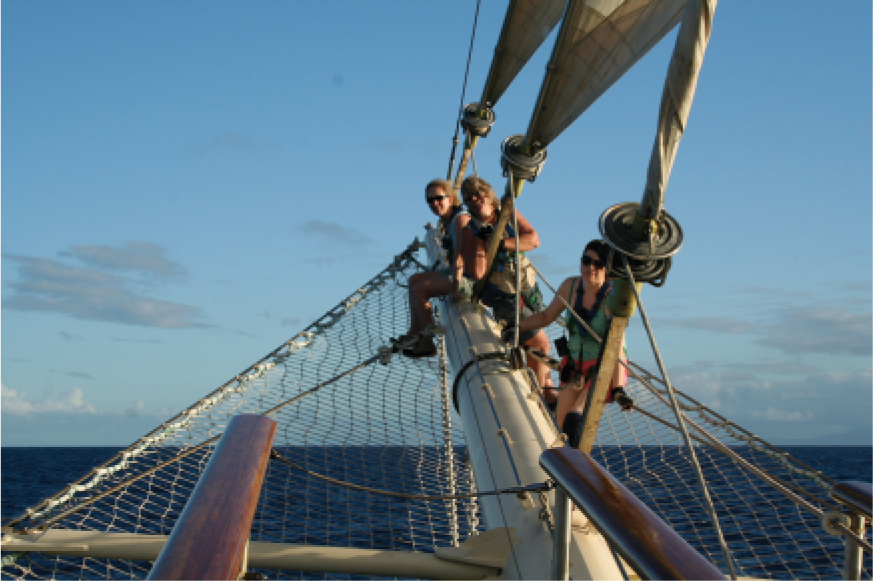
The author (centre) with her watch leader to left of picture and her buddy closer to the camera. Tenacious' bowsprit—a fine place to relax and watch dolphins play in the bow wave.
There are so many points in life where a new project can be beneficial and rewarding; yet, many doctors and their patients are likely to be completely unaware of the experiences that the JST can offer. Doctors could consider taking on the role of voyage doctor, who accompanies the medical purser (a qualified nurse) on most voyages. This role involves providing support to the medical purser and prescribing from the stock of medications on board, although on rare occasions there may be medical emergencies needing evacuation. No special training is required, just common sense.
Doctors may also find it helpful to inform some of their patients about the opportunity to sail with the JST. When a patient is having a difficult time adjusting to a new diagnosis or has had to endure some unpleasant treatment, it is encouraging to be able to recommend an accessible experience. All voyagers have the opportunity to progress up the ladder to sail as watch leader or even cook's assistant or bosun's mate after nomination by the permanent crew. For those who do not wish to sail, during the periods in which the ships undergo maintenance able-bodied and disabled volunteers are welcome on board to help the permanent crew refit the vessels. Maintenance periods can be in the UK, Europe or even the West Indies.
Are you or your patients looking for new adventures? Come and join us!
To find out more information about JST, please access the website www.jst.org.uk.