







Abstract

Case study
A 31-year-old Somali woman was referred by her GP to the gynaecology clinic with a history of a non-tender slowly enlarging lump in her groin. The lump had been present for about 2 years and had not really concerned the patient very much until it started to get quite large.
The referral letter mentioned that the woman had been subjected to female genital mutilation (FGM) as a child. The patient reported that she did not recall the procedure taking place; however, her mother told her that she was about 2 years old at the time and that sand or dirt had been rubbed into the wound to try to prevent further bleeding.
On examination, there was a non-tender, mobile loculated 5–6 cm mass over the clitoral area (Figs. 1 and 2). The mass was excised as a day case under general anaesthesia. The histology report confirmed the presence of a benign epidermal inclusion cyst containing friable cream/brown semisolid material.

Inclusion cyst.
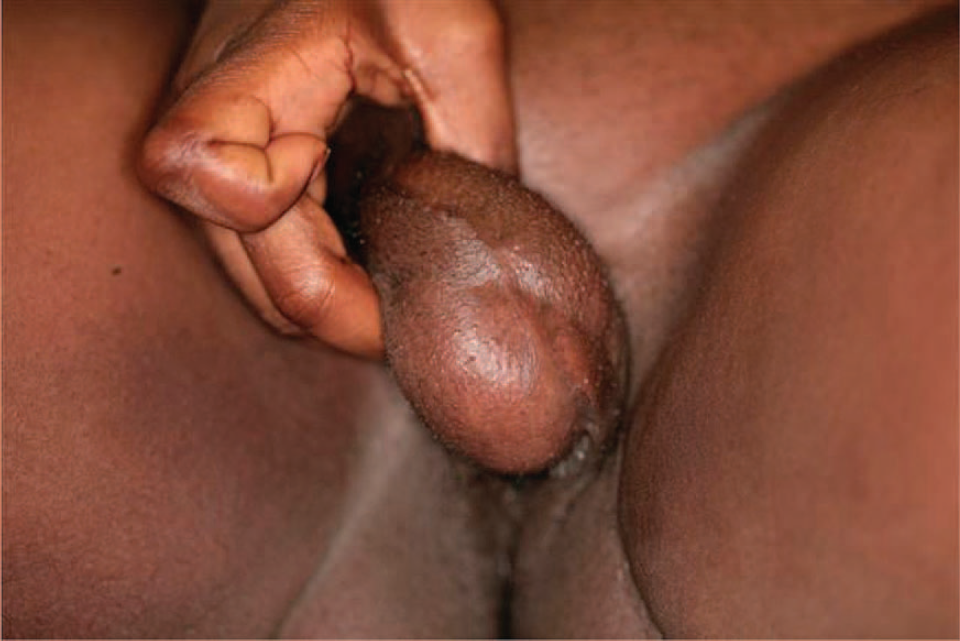
Patient demonstrating the mobility and size of the cyst.
Discussion
The World Health Organization (WHO) describes FGM as procedures that intentionally alter or injure female genital organs for non-medical reasons. An estimated 100–140 million girls and women worldwide are currently living with the consequences of FGM.
The act of FGM or the assistance of a woman or child to have FGM is illegal in the UK and is punishable by a fine or up to 14 years in prison. Despite this, it has been estimated that in the UK, over 20 000 girls under the age of 15 years are at high risk of FGM and 66 000 women are living with its consequences, although its true extent is unknown due to its hidden nature (Forward, 2007).
In Britain, the most common age for a girl to undergo FGM is between 7 and 9 years of age although there is considerable variability between communities. It is most likely to occur at the start of the summer holidays with the girl being taken overseas.
FGM is classified into four main categories (see Box 1). It is usually performed by traditional practitioners, most commonly elderly women and birth attendants. Frequently, no anaesthetic is used. FGM is often performed in nonsterile conditions and crude equipment such as scissors, knives, razor blades and glass may be used to carry out the procedure.
Classification of FGM.
Type 1— Partial or complete removal of the clitoris Type 2— Includes type 1 as well as removal of the labia minora with or without removal of the labia majora Type 3 —Infibulation — this involves narrowing of the vaginal opening by suturing it together. Usually, a small hole is left to allow for menstruation and urination; however, it may not be large enough to allow penetrative intercourse Type 4— This involves all other harmful procedures including pricking, piercing, incising, scraping and cauterizing the genital area
After a woman is married, the husband may try to open the infibulation himself by gradual dilatation during intercourse. If the opening is too small, then he may open it using a knife or glass. Couples may also seek help from trained health professionals to have the infibulation reversed. Frequently, during childbirth, an additional procedure may be required in order to allow passage of the foetal head without tearing of the surrounding scar tissue. It should be noted that the practice of' re-infibulation' following childbirth is also illegal in the UK.
FGM is most common in the western, eastern and northeastern regions of Africa; in some countries in Asia and in the Middle East. The highest prevalence rates are found in Djibouti, Egypt, Guinea, Sierra Leone, Somalia and Sudan with 90% or more of women undergoing FGM (Department of Health, 2011). Eritrea and Mali also have very high prevalence rates of around 80%.
There are many different factors that motivate the practice of FGM; these vary between different countries and ethnic groups. Some commonly quoted reasons include the preservation of the dignity of the family, guarantee of fidelity and virginity to the husband, the dampening or removal of a woman's sexual pleasure and because the female genitals are considered unhygienic and need to be cleaned by removal. Epidermal inclusion cysts are a recognized complication of FGM and may present many years after the initial procedure. Other complications are outlined in Box 2
The role of the GP
GPs have a key role to play in identifying girls at risk of FGM and managing the sensitive issues that arise in women who have already been subjected to it. Risk factors for FGM include:
Ethnic origin from a country where there is a high prevalence of FGM The mother or sibling of the child has been subjected to FGM The family is not well integrated into British society
The GP should be alerted to an imminent risk of FGM if the child comes from a community where it is routinely practised and there appear to be preparations to take the child abroad. Be especially alert to:
Parental request for vaccinations (outside the routine childhood vaccination schedule) Planned absences from school Girls talking about having a ‘special procedure’ or a procedure to’ become a woman'
GPs should also be alert to signs that may indicate that FGM has already taken place. These may include difficulty walking, sitting or standing, taking longer than normal in the bathroom or toilet due to difficulties urinating, frequent urinary or menstrual problems, prolonged school absences and a reluctance to undergo normal medical examinations — for example, smear tests. A girl or woman may ask for help but may not be explicit about the problem due to embarrassment or fear.
Consider making questions about FGM a routine part of your history taking in women and children who come from communities that practise it. Information leaflets about FGM may be included in new patient welcome packs.
Taking a history
The language used when asking questions about FGM is very important. Many women come from communities where FGM is considered normal practice and the term ‘mutilation’ may be considered offensive and is probably inappropriate. Negative reactions from health care professionals may add to the sense of distress and humiliation that some women may already feel. See Box 3, for issues to consider when taking a history.
Complications of FGM.
Severe pain Emotional shock (exacerbated by having to reconcile being subjected to the trauma by relatives) Haemorrhage Wound infections and blood borne viruses Urinary retention Injury to adjacent tissues, e.g. urethra or anus Fracture or dislocation as a result of restraint Death
Chronic vaginal, pelvic and urinary tract infections Difficulties with menstruation and passing urine Infertility Infibulation cysts, neuromas and keloid scar formation Complications in pregnancy and delay in second stage of childbirth. Antenatal obstetric review should be considered especially if there is extensive scarring or the infibulation is still' closed' Psychological damage—low libido, depression, anxiety and sexual dysfunction, flashbacks during pregnancy and childbirth, substance misuse and self-harm
Taking a history—points to consider.
The woman may wish to speak to a female practitioner Be sensitive to the fact that women may be very loyal to their parents and their community Be non-judgemental but point out that FGM is illegal in the UK Use terminology that is likely to be understood Avoid loaded or offensive questions — women may be unlikely to view the procedure as ‘abusive’ Make a sensitive enquiry into how FGM has affected the woman's sexual relationship with her partner. Remember that some women may have very low expectations when considering what constitutes a healthy sex life
Make use of non-judgemental questions such as
‘Have you been closed?’ ‘Were you circumcized?’ ‘Have you been cut down there?’
When there are language issues, consider use of a professional interpreter rather than a relative or friend because:
This may give the opportunity to ask about other forms of abuse such as domestic violence Family members or friends may mislead health care professionals and encourage the victim not to complain about FGM The woman may not feel happy discussing these very sensitive issues via a friend or relative for fear of shame or reprisals
Further management
Children who have been identified as being at risk of FGM should be referred to the local safeguarding children team and social services. Bear in mind that some individuals may be extremely frightened of contact with the authorities for fear of deportation or removal of family members. The family should be involved in discussions relating to these concerns and their agreement with the course of action should be sought, providing that this will not place the child at risk of significant harm. Children who have been subjected to FGM should be examined by a paediatrician with appropriate training.
Although FGM is considered normal practice in many communities, it does not follow that affected women and girls suffer no psychological harm. For example, the patient described in this case felt that no one should have to undergo FGM, prompting her to share her experience. There are 16 specialist clinics across the UK that can provide additional support for victims of FGM, details of which are provided in the 2011 Department of Health Guidelines in the reference section of this article.
Footnotes
Acknowledgements
Images reprinted with permission from the patient.