







Abstract
GPs are being handed the reins to the National Health Service (NHS) in England. Commissioning groups scratch their heads and wonder how on earth they are going to cope. As Associates-in-Training (AiTs), we are the prospective workforce of general practice and will hold a degree of responsibility for the provision and structure of the health services. We must ensure the survival of the NHS and improve the health of present and future generations; yet, in the face of an ever-growing population and increasing financial restraint, how can this be achieved?
We now have a widely used buzzword—'sustainability’. Sustainability can be defined as meeting the needs of today without compromising the needs of tomorrow. In the context of the NHS, it means maintaining the current—and future— quality of health care, firstly within the constraints of the planet and its ecosystems and secondly within current economic conditions.
At the present time, you might say, economic conditions are going to be the more decisive factor in the future of the NHS. With cuts and redundancies, do we have the luxury of giving priority to environmental issues? But what is not often realized is that as we tackle environmental issues, we are often saving money too. This article will try to show how the two are in many ways connected and how you, as future GPs, can play your part.
Environmental and economic sustainability in the NHS
Repeatedly, and quite rightly, we are urged to reduce our destruction of nature and tackle climate change, to preserve resources and curtail pollution. We, as doctors, should especially appreciate the importance of this as human health depends on a healthy environment. We need clean air and water, sustainable food production and green space.
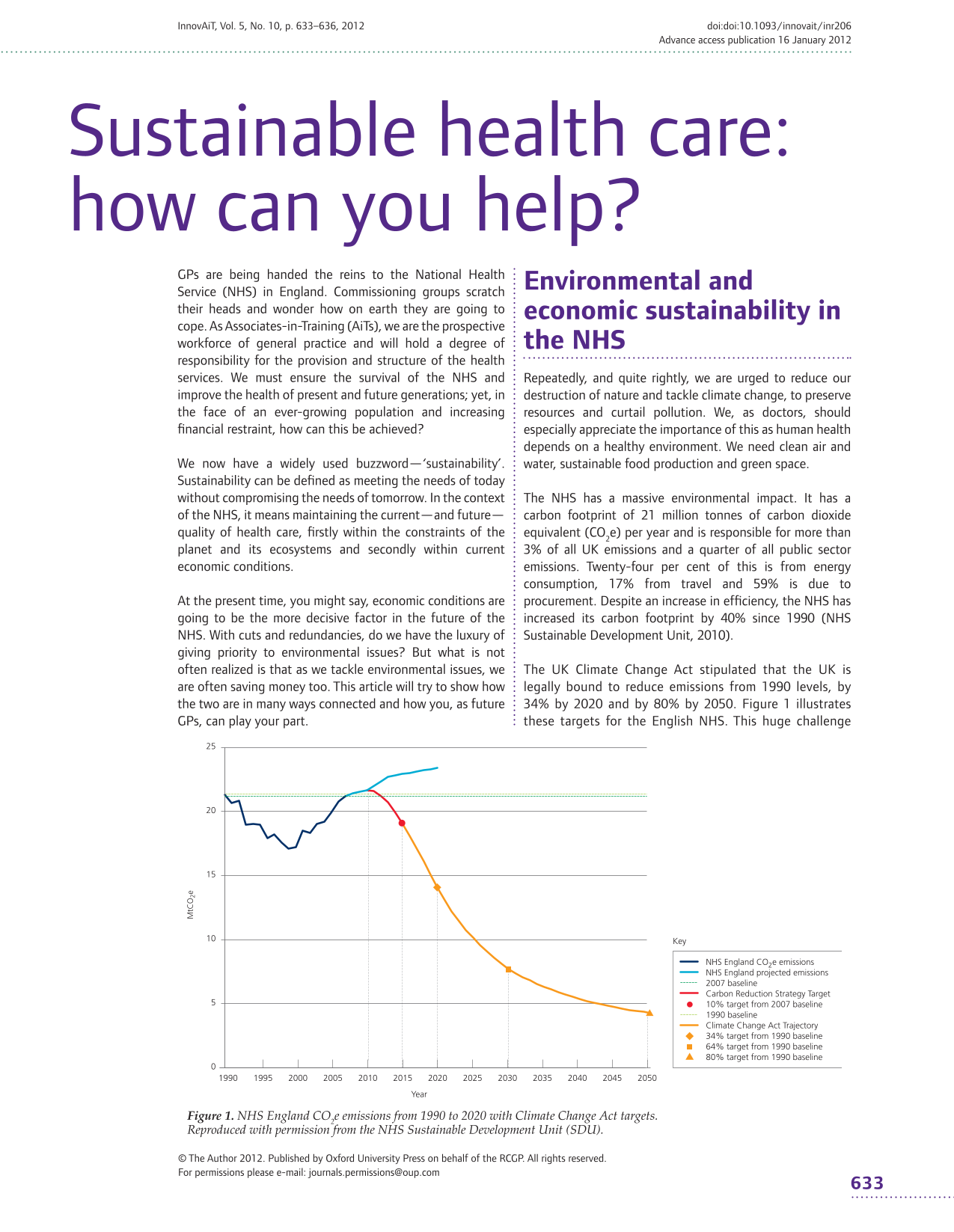
The NHS has a massive environmental impact. It has a carbon footprint of 21 million tonnes of carbon dioxide equivalent (CO2e) per year and is responsible for more than 3% of all UK emissions and a quarter of all public sector emissions. Twenty-four per cent of this is from energy consumption, 17% from travel and 59% is due to procurement. Despite an increase in efficiency, the NHS has increased its carbon footprint by 40% since 1990 (NHS Sustainable Development Unit, 2010).
The UK Climate Change Act stipulated that the UK is legally bound to reduce emissions from 1990 levels, by 34% by 2020 and by 80% by 2050. Figure 1 illustrates these targets for the English NHS. This huge challenge will require the growth of emissions to be not just moderated but reversed, with a reduction in absolute emissions. This will only be achieved with urgent radical change.

NHS England CO2e emissions from 1990 to 2020 with Climate Change Act targets.
Before we throw our hands up in horror at the need to meet (yet another!) governmental target, we should remember that even if evidence for climatic change is questioned, most would agree that it is prudent to minimize pollution and use finite resources carefully. Taking measures to protect the environment by reducing carbon emissions results in a healthier population. For instance, encouraging patients to walk or cycle rather than drive and promoting a diet of fresh vegetarian foods and less red meat has a lower carbon footprint, while at the same time bringing multiple health benefits. The amusing ‘Carbon Addict’ website, based on scientific evidence, illustrates how a low carbon lifestyle can lead to a reduction in heart disease, diabetes, cancer, obesity, mental health problems, road deaths and diseases from air pollution.
A healthier population may reduce health service expenditure. Preventative and evidence-based medicine, health promotion and encouraging patients to take on more responsibility for their own health (with an emphasis on self-care) could reduce calls on cash-strapped health services. On the other side of the equation, making money-saving changes often has environmental benefits. Streamlining processes, ensuring efficient referral pathways, minimizing waste, saving energy and sourcing locally can all save money while saving carbon.
What you can do?
Sustainability in general practice is a relatively new concept and published examples of GP practices undertaking sustainability projects are few and far between. So how can you promote environmental and economic sustainability? Here are some examples to give you inspiration:
Energy and buildings
Investigate energy saving in your practice with regard to heating, electricity or water. Consider increased insulation, an efficient boiler system, motion sensor lighting or thermostatic controls to regulate temperatures. Install low energy light bulbs or solar panels as well as water saving devices such as spray taps and toilet cistern dams. In an average GP surgery, an annual energy saving of up to 20% can be achieved with little investment. That equates to cost savings of around £2000/year (Carbon Trust, 2007). Three key areas for saving energy might be through ‘switching off’, maintenance and introducing environmentally friendly measures during refurbishment.
Travel
Reduce travel of staff and patients, and encourage low carbon transport, hold meetings by teleconference or videoconference, increase use of telephone appointments, and bring care closer to home. Consider doing home visits on a bicycle or get an energy efficient or electric car for the practice. You could provide a charging point at the surgery!
Resources and procurement
Develop a Sustainable Procurement Policy for your practice so that everything is purchased with sustainability in mind. Choose environmentally sympathetic suppliers and products and single sources to reduce transport costs. Also, encourage maintaining, sharing and re-using of products and consideration of the ‘whole life costs’ of items. Of course, many of the products we use are dictated by Primary Care Trusts (PCTs), but as GPs become increasingly involved in commissioning decisions, there may be more opportunities to advocate sustainable procurement in the future.
Identify any waste of resources. The Sustainable Action Planning (SAP) website describes a pilot in a laboratory service which suggests that over £100000/year could be saved on rejected laboratory samples by improved labelling and handling of samples. Paper waste could be reduced through double-sided printing, no paper prescriptions and limiting paper communication. Also, consider how your practice could tackle medicine waste; the York Health Economics Consortium along with the School of Pharmacy, University of London, estimated that £300 million/year is wasted in England on primary and community care prescriptions of medicines.
Does your practice recycle paper, card, cans, plastics, batteries and printer cartridges? Recycling may be cheaper in your area. In my training practice, I calculated that we could save 20% on the waste disposal bill and 1.8 tonnes of CO2e per year, through changing waste contractors and increasing recycling.
Clinical practice, processes and referral pathways
Can you identify inefficiency in your clinical practice? Think about the carbon and financial impact of making a referral or ordering an investigation. Can you do the blood test there and then rather than asking the patient to return at a later date? It is estimated that the carbon footprint generated by one single outpatient appointment is around 50 kg CO2e, so taking bloods on the same day, and perhaps combining that with a blood pressure check, saves up to 100 kg CO2e (NHS Sustainable Development Unit, 2010). At present, this might be difficult; there is little time within 10 minute appointments and only one daily sample run to the laboratory. But perhaps, the system needs a re-think.
Education and advocacy
Be a sustainability advocate and lead by example. Sign up to the Good Corporate Citizen Assessment model. Good corporate citizenship is using corporate power and resources in a way that benefits the social, economic and physical environment. Take a global health perspective; canvas for personal carbon entitlements within a fair shares global framework such as ‘Contraction and Convergence’ (Global Commons Institute). Help to stabilize population growth by promoting literacy and access to birth control through Marie Stopes or the International Planned Parenthood Federation.
Put sustainability on the agenda, in the practice or on committees. Doctors have a strong voice. Increase your influence and that of all health professionals by joining the Climate and Health Council.
Overcoming the barriers
Unfortunately, there are barriers. Any change is slow and difficult and what is seen as ‘environmentally friendly’ policies may be a low priority within a busy professional life. Some question whether reducing carbon is necessary, perhaps feeling that, as health care is a good thing, some secondary damaging effect on the environment can be justified. But according to Dr Robin Stott, the founding member of the Climate and Health Council, ‘promoting carbon rationing could be your most important contribution to patients' health’ (Stott, 2006).
Many doctors have the inclination and motivation to change but find barriers difficult to overcome. GPs often lack the time or the tools to take action and are up against considerable organizational and financial restrictions. Actions of GP practices are often constrained by the PCT and any financial outlay is likely to affect partners' personal income. So, in order to work towards sustainable health care, all levels of the NHS hierarchy need to work together to identify and break down the barriers. GPs have the opportunity, however, to make great changes through commissioning.
Sustainable Action Planning (SAP), illustrated in Fig. 2, can help GPs to take action towards sustainability. Figure 2 is my simple interpretation of which is similar to the audit cycle, which identifies opportunities for change using various tools such as inputs and outputs, and process flows. Opportunities are prioritized and explored before a change is made through action planning. Changes are monitored and financial and environmental benefits, as shown by the carbon footprint, are assessed. The Carbon Trust or National Energy Foundation can help you to calculate your carbon footprint, and the Royal College of General Practitioners also has a ‘footprinter’ that your practice can sign up to. Remember to write it up as a project for your portfolio.
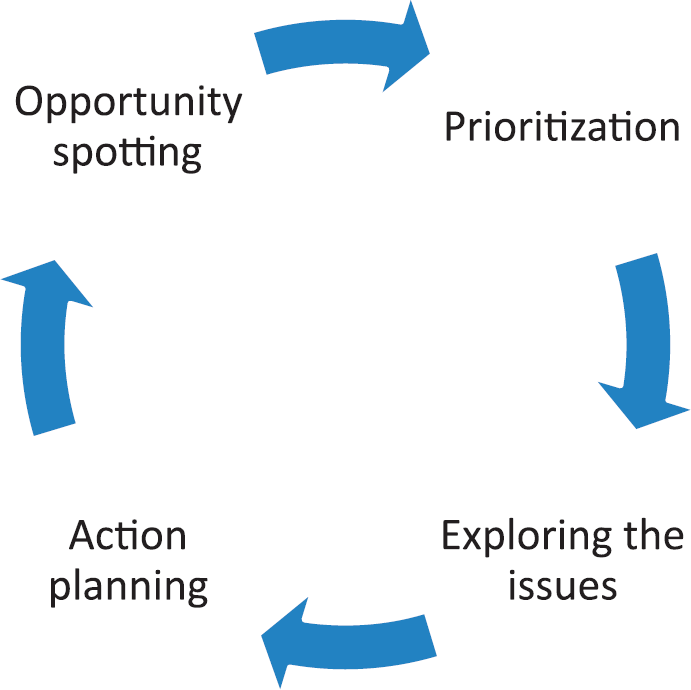
A flow diagram to show SAP.
Conclusions
Just look at your practice. What could you change? Massive challenges face us on a national and global scale. The principles of sustainability, sustainable health care and SAP may help us to address these challenges, and at the same time, relieve the all too real current financial pressure. Although there are major barriers, we, as the workforce of the future, can make a big difference. Just remember that there is a lot more to it than simply switching to energy-saving light bulbs!