







Abstract

An understanding of medical ethics is a key professional skill for any GP.
What is medical ethics?
Medical ethics is a branch of applied ethics, which considers whether actions in relation to our patients are right or wrong. How we justify ethical decisions is complex and there is a wide body of ethical theory that helps with these decisions. One major medical ethical theory is the Four Principles approach of Beauchamp and Childress (2001). The basic ideas behind the Four Principles—that we should try to always respect the patient's autonomy, do good, avoid harm and act fairly—are an excellent starting point for considering ethical dilemmas.
Even with an appreciation of ethical theory, experience is required in order to balance ethical principles when they conflict. Workplace-based assessment (WPBA) is an excellent way to gain this understanding. In this article, I will outline how you can use the components of WPBA to enhance ethical development.
Clinical evaluation exercises, the consultation observation tool and case-based discussion
Many (probably most) consultations have an ethical dimension. Here are some examples:
How is consent obtained for antihypertensive treatment? How do you assess if a patient with dementia is competent to make a decision? What is the most ethical way to deal with a contraceptive request in a young person?
Clinical evaluation exercises (mini-CEXs) using the consultation observation tool (COT) and case-based discussions (CbDs) are wonderful opportunities to have experienced clinicians review your work.
How can you maximize the ethical yield from this process? In selecting cases, deliberately choose those with a clear ethical element. Having identified a case with an ethical dimension, ask your supervisor to comment specifically on how you handled the ethical element of the case and be prepared to challenge his or her arguments.
Direct observation of procedural skills
All direct observations of procedural skills (DOPs) have a competency related to consent, and there is an important skill in obtaining consent well. For example, how do you get consent for a procedure when you are not sure that the patient fully understands what you are explaining or when the patient has a condition that precludes understanding? Ask your supervisor to comment on your consent process rather than just your clinical skills.
Multi-source feedback
Multi-source feedback (MSF) allows your colleagues to comment semi-anonymously on your performance. While this is usually in terms of clinical skills or team working skills, why not ask for comment about ethical awareness or ethical reasoning?
Patient satisfaction questionnaire
The patient satisfaction questionnaire (PSQ) allows patients to comment about your clinical skills and their overall satisfaction with the consultation they have just had. The questions are not directly about ethical content but they reflect key ethical concepts such as the respect for autonomy and beneficence and the word pictures reflect this—for example: ‘treating you with respect’ or ‘really listening’.
Clinical encounters
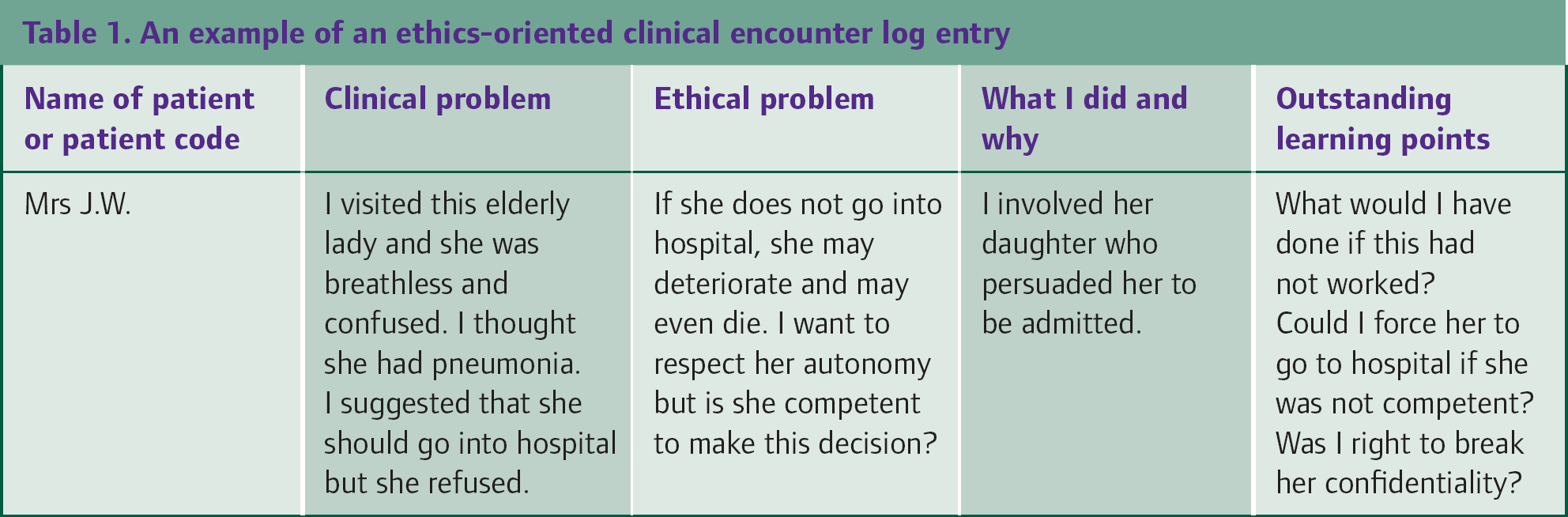
Why not make some of your ‘clinical encounter’ log entries ethics related? One way to do this is to compile an ‘ethical log’, which is a simple record of consultations with an ethical element. An example of how this could be done is included in Table 1.
An example of an ethics-oriented clinical encounter log entry
One excellent way of learning is ‘hot’ teaching when you ask an experienced colleague about a puzzling case. Why not use your ethical log as a basis for these conversations?
Audits
Excellent audits can be done comparing actual practice to ethical standards. Here are two examples:
Do we always offer and record the offer of a chaperone in medical notes? How well is confidentiality protected in our practice waiting room?
Many significant events occur because ethical guidelines have not been followed and these make ideal opportunities for significant event analysis, another type of audit.
Tutorials
Tutorials often reflect on some clinical topic. Why not ask your trainer to introduce tutorials on ethical topics, such as confidentiality, consent, capacity or rationing?
In addition to the resources listed below, further information about medical ethics is available in the monthly Journal of Medical Ethics, past issues of InnovAiT and from the British Medical Association and General Medical Council websites.