







Abstract
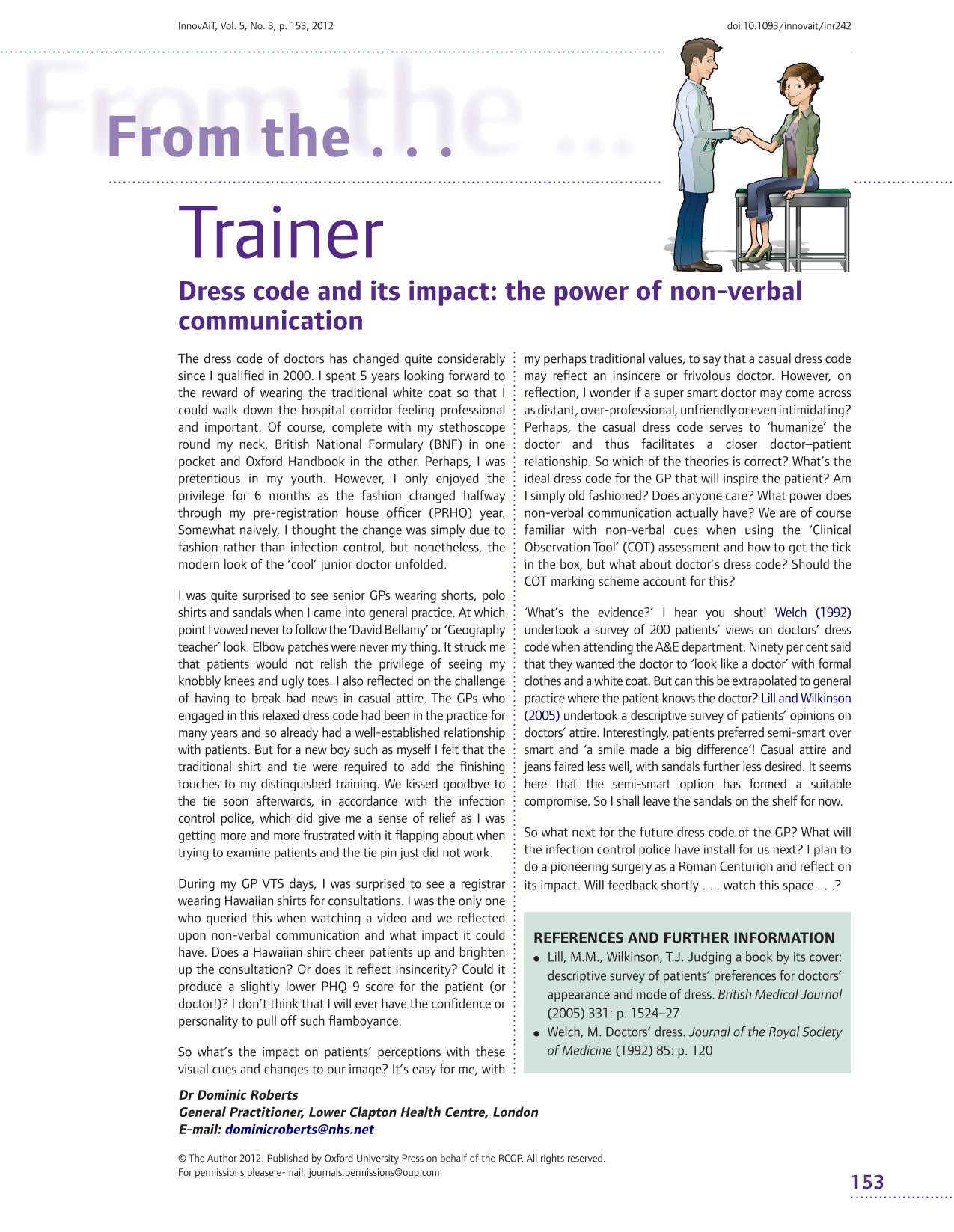
Dress code and its impact: the power of non-verbal communication

The dress code of doctors has changed quite considerably since I qualified in 2000. I spent 5 years looking forward to the reward of wearing the traditional white coat so that I could walk down the hospital corridor feeling professional and important. Of course, complete with my stethoscope round my neck, British National Formulary (BNF) in one pocket and Oxford Handbook in the other. Perhaps, I was pretentious in my youth. However, I only enjoyed the privilege for 6 months as the fashion changed halfway through my pre-registration house officer (PRHO) year. Somewhat naively, I thought the change was simply due to fashion rather than infection control, but nonetheless, the modern look of the ‘cool’ junior doctor unfolded.
I was quite surprised to see senior GPs wearing shorts, polo shirts and sandals when I came into general practice. At which point I vowed never to follow the ‘David Bellamy’ or ‘Geography teacher’ look. Elbow patches were never my thing. It struck me that patients would not relish the privilege of seeing my knobbly knees and ugly toes. I also reflected on the challenge of having to break bad news in casual attire. The GPs who engaged in this relaxed dress code had been in the practice for many years and so already had a well-established relationship with patients. But for a new boy such as myself I felt that the traditional shirt and tie were required to add the finishing touches to my distinguished training. We kissed goodbye to the tie soon afterwards, in accordance with the infection control police, which did give me a sense of relief as I was getting more and more frustrated with it flapping about when trying to examine patients and the tie pin just did not work.
During my GP VTS days, I was surprised to see a registrar wearing Hawaiian shirts for consultations. I was the only one who queried this when watching a video and we reflected upon non-verbal communication and what impact it could have. Does a Hawaiian shirt cheer patients up and brighten up the consultation? Or does it reflect insincerity? Could it produce a slightly lower PHQ-9 score for the patient (or doctor!)? I don't think that I will ever have the confidence or personality to pull off such flamboyance.
So what's the impact on patients' perceptions with these visual cues and changes to our image? It's easy for me, with my perhaps traditional values, to say that a casual dress code may reflect an insincere or frivolous doctor. However, on reflection, I wonder if a super smart doctor may come across as distant, over-professional, unfriendly or even intimidating? Perhaps, the casual dress code serves to ‘humanize’ the doctor and thus facilitates a closer doctor–patient relationship. So which of the theories is correct? What's the ideal dress code for the GP that will inspire the patient? Am I simply old fashioned? Does anyone care? What power does non-verbal communication actually have? We are of course familiar with non-verbal cues when using the ‘Clinical Observation Tool’ (COT) assessment and how to get the tick in the box, but what about doctor's dress code? Should the COT marking scheme account for this?
‘What's the evidence?’ I hear you shout! Welch (1992) undertook a survey of 200 patients' views on doctors' dress code when attending the A&E department. Ninety per cent said that they wanted the doctor to ‘look like a doctor’ with formal clothes and a white coat. But can this be extrapolated to general practice where the patient knows the doctor? Lill and Wilkinson (2005) undertook a descriptive survey of patients' opinions on doctors' attire. Interestingly, patients preferred semi-smart over smart and ‘a smile made a big difference’! Casual attire and jeans faired less well, with sandals further less desired. It seems here that the semi-smart option has formed a suitable compromise. So I shall leave the sandals on the shelf for now.
So what next for the future dress code of the GP? What will the infection control police have install for us next? I plan to do a pioneering surgery as a Roman Centurion and reflect on its impact. Will feedback shortly … watch this space …?