







Abstract
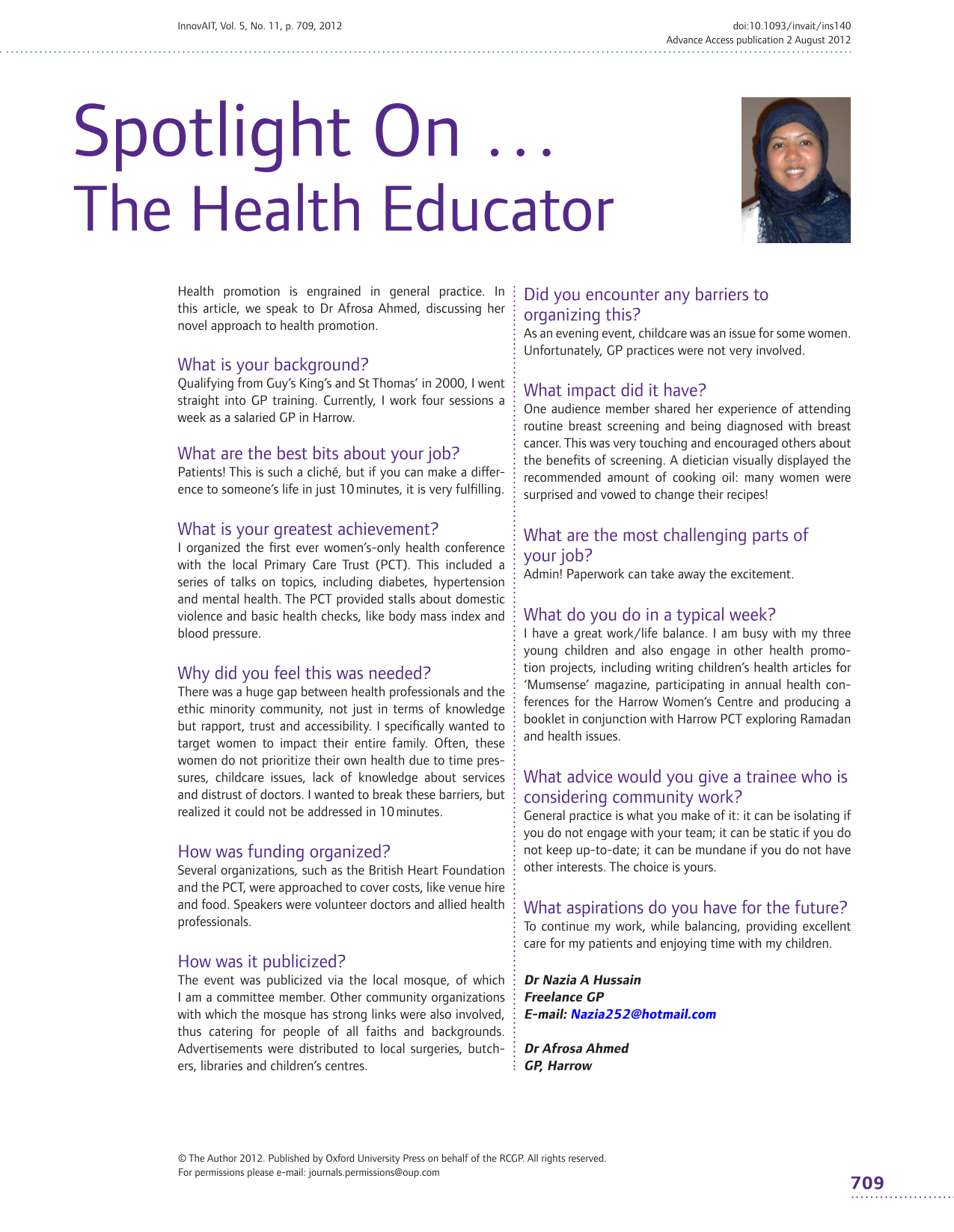

Health promotion is engrained in general practice. In this article, we speak to Dr Afrosa Ahmed, discussing her novel approach to health promotion.
What is your background?
Qualifying from Guy's King's and St Thomas’ in 2000, I went straight into GP training. Currently, I work four sessions a week as a salaried GP in Harrow.
What are the best bits about your job?
Patients! This is such a cliché, but if you can make a difference to someone's life in just 10minutes, it is very fulfilling.
What is your greatest achievement?
I organized the first ever women's-only health conference with the local Primary Care Trust (PCT). This included a series of talks on topics, including diabetes, hypertension and mental health. The PCT provided stalls about domestic violence and basic health checks, like body mass index and blood pressure.
Why did you feel this was needed?
There was a huge gap between health professionals and the ethic minority community, not just in terms of knowledge but rapport, trust and accessibility. I specifically wanted to target women to impact their entire family.
Often, these women do not prioritize their own health due to time pressures, childcare issues, lack of knowledge about services and distrust of doctors. I wanted to break these barriers, but realized it could not be addressed in 10minutes.
How was funding organized?
Several organizations, such as the British Heart Foundation and the PCT, were approached to cover costs, like venue hire and food. Speakers were volunteer doctors and allied health professionals.
How was it publicized?
The event was publicized via the local mosque, of which I am a committee member. Other community organizations with which the mosque has strong links were also involved, thus catering for people of all faiths and backgrounds. Advertisements were distributed to local surgeries, butchers, libraries and children's centres.
Did you encounter any barriers to organizing this?
As an evening event, childcare was an issue for some women. Unfortunately, GP practices were not very involved.
What impact did it have?
One audience member shared her experience of attending routine breast screening and being diagnosed with breast cancer. This was very touching and encouraged others about the benefits of screening.
A dietician visually displayed the recommended amount of cooking oil: many women were surprised and vowed to change their recipes!
What are the most challenging parts of your job?
Admin! Paperwork can take away the excitement.
What do you do in a typical week?
I have a great work/life balance. I am busy with my three young children and also engage in other health promotion projects, including writing children's health articles for ‘Mumsense’ magazine, participating in annual health conferences for the Harrow Women's Centre and producing a booklet in conjunction with Harrow PCT exploring Ramadan and health issues.
What advice would you give a trainee who is considering community work?
General practice is what you make of it: it can be isolating if you do not engage with your team; it can be static if you do not keep up-to-date; it can be mundane if you do not have other interests. The choice is yours.
What aspirations do you have for the future?
To continue my work, while balancing, providing excellent care for my patients and enjoying time with my children.