







Abstract
Background
Decreased heart rate variability (HRV) may predict cardiac death after myocardial infarction (MI). Coronary artery bypass grafting (CABG) strongly decreases HRV, but improves survival. The aim of the study was to determine the prognostic value of HRV decreased by coronary surgery.
Design and methods
Four-year follow-up was performed in 175 consecutive patients with HRV decreased by CABG (51) or MI (124). Mortality and secondary events rate were analysed. Decreased HRV, defined by the standard deviation of mean RR interval (SDNN) < 100 ms, was detected by a routine 24-h Holter electrocardiogram at admission to stationary rehabilitation 3 weeks to 3 months after acute MI or CABG. Two groups did not differ except by age; CABG patients were younger (56 versus 64 years, P<0.01), but this did not influence differences in survival (NS).
Results
HRV was lower among CABG patients than among MI patients (SDNN = 66 ± 20ms versus 77 ± 14 ms; P<0.001), but cumulative survival and event-free survival were much better in the CABG group than in the MI group. During a 46 ± 20 months follow-up, there were 10% new events in the CABG and 43% in the MI group (P<0.001). Mortality was 8% in the CABG and 33% in the MI group (log-rank=3.6; P<0.001). Unlike in the MI group, HRV was not different between survivors and non-survivors in the CABG group.
Conclusions
In contrast to the strong prognostic potential of HRV in patients with MI, decreased HRV has no prognostic significance in patients who have undergone CABG surgery.
Introduction
Decreased heart rate variability (HRV) has been found to be an important predictor of cardiac death in patients with myocardial infarction [1]. Measurement of HRV had prognostic value in the unselected older population [2] and attempts were made to involve HRV in a routine clinical practice [3, 4]. However, it seems that HRV may not be useful in all coronary disease settings [5, 6].
Coronary artery bypass grafting improves survival [7], but simultaneously decreases HRV [8–11] even more than does myocardial infarction [12]. This may seem contradictory to someone who uses low HRV as a prognostic marker of an increased risk of cardiac death. Clinical practice shows that cardiac surgery patients with extremely decreased HRV often have an excellent outcome. Stein et al. [5] have found no prognostic significance for HRV decreased by cardiac surgery in a retrospective study, but there is very little prospective data.
Therefore, the aim of this study was to define the prognostic significance of decreased HRV in cardiac bypass surgery patients. For that purpose, we analysed the survival of patients with HRV decreased in association with coronary artery bypass grafting and compared it with the survival of patients whose HRV was decreased in association with myocardial infarction.
Methods
Patients
Survival was prospectively analysed in 175 consecutive stationary cardiac rehabilitation patients who were in sinus rhythm and with no sinus node disease or second- or third-degree atrioventricular block, but whose routine made 24-h Holter electrocardiogram show decreased HRV. They had suffered myocardial infarction (MI; 124 patients) or undergone coronary artery bypass grafting (CABG; 51 patients) 3 weeks to 3 months before. Electrocardiogram and enzyme testing verified the diagnosis of MI. Cardiac surgery was performed by the use of an extracorporal circulation machine. All CABG patients received three or more bypass grafts. Patients with perioperative infarction and those with urgent revascularization following myocardial infarction were not included, nor were those older than 79 years nor those with diseases limiting survival or affecting HRV (cancer, stroke, insulin-dependent diabetes, thyroid disease).
Survival of CABG patients was compared with that of MI patients as each group had the same underlying (coronary artery) disease. There was no significant difference (NS) between the myocardial infarction and CABG groups for gender (71% male), incidence of hypertension (24%), diabetes (19%), left ventricular systolic dysfunction (34%) defined by ejection fraction lower than 40%, and time elapsed from their MI (1.6 ± 0.8 months) or CABG (1.5 ± 0.9 months). There were no differences in the use of medication (beta adrenergic blockers, digoxine, amiodaron, sotalol, propafenon, mexiletine, calcium channels antagonists, angiotensin-converting enzyme inhibitors, nitrates and diuretics) either. The only significant difference recorded was age; CABG patients were younger (56 ± 11 versus 64 ± 9 years, P<0.01).
Follow-up
As approved by the Hospital Ethics Committee, a questionnaire on the present health status was mailed to patients. If there was no response, the family physician was contacted. This study focused on combined cardiovascular and cerebrovascular mortality as the primary endpoint and on both fatal and non-fatal events (myocardial infarction, unstable angina, stroke and transient ischaemic attacks) as the secondary endpoint. Five of 129 MI patients enrolled in the study were excluded because of a non-cardiovascular cause of death (cancer). Those who underwent cardiac revascularization procedures (coronary angioplasty or bypass surgery) during the follow-up were considered alive at the date of intervention and excluded from further analysis.
Measurements
HRV was calculated from 24-h Holter electrocardiogram, by a commercial system (Oxford Instruments). R–R intervals that included ectopic beats were excluded and extrapolated by linear interpolation. Spectral analysis was computed using fast Fourier transformation. Ten-minute epochs were repeatedly transformed and averaged throughout the 24-h period. Details were published elsewhere [4]. Standard deviation of mean R–R interval (SDNN) was used as a representative of overall HRV. The cut-off between the normal and moderately diminished HRV was defined arbitrarily by the value of SDNN lower than 100 ms [1]. Most of the variables proposed by the Task Force on the Heart Rate Variability [3] were analysed. Left ventricular ejection fraction was determined by a Simpson rule, from apical four- and two-chamber view.
Statistics
Differences in patient characteristics were analysed by Fisher exact test for categorical variables and by Student's t-test for continuous variables. Most of the HRV variables analysed best fit a logarithmic distribution [4], so median values are given for comparison between MI and CABG groups in Table 1. Median values of logarithmically transformed variables were compared by the Mann–Whitney U-test. Except in Table 1, all possible differences in the SDNN were analysed by t-test, because SDNN was normally distributed [4].
Significance of differences in the rate of events or death between the two groups was verified by Fisher exact tests. Time to death and time to predefined cardiovascular events was analysed by the Kaplan–Meier method and compared with the log-rank test. The effects of sex, age, time elapsed from MI or CABG, concomitant diseases, left ventricular ejection fraction and medication on difference in survival was analysed by proportional hazard (Cox) regression. SPSS for Windows, version 7.5 (SPSS Inc., Chicago, Illinois, USA) was used.
Median HRV values and differences between logarithmically transformed values (in ms, except pNN50 in percent)
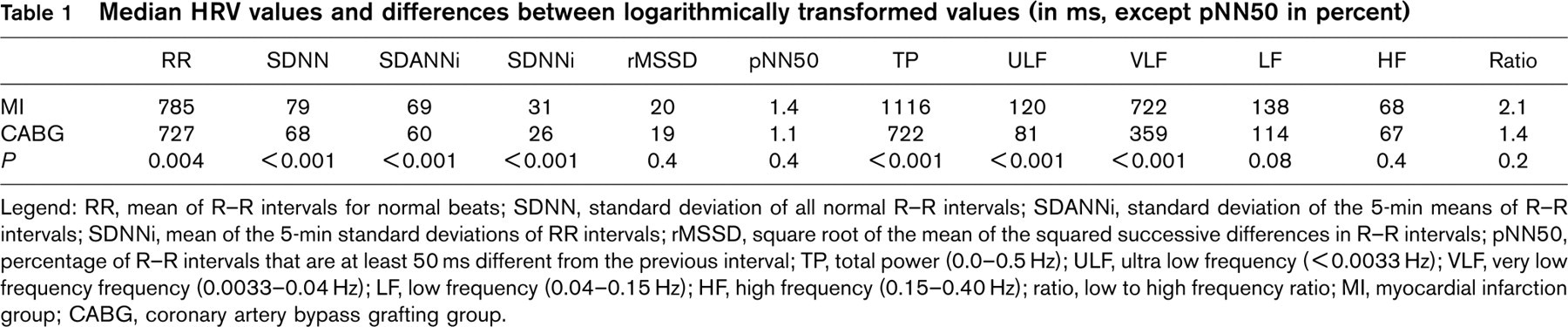
Legend: RR, mean of R–R intervals for normal beats; SDNN, standard deviation of all normal R–R intervals; SDANNi, standard deviation of the 5-min means of R–R intervals; SDNNi, mean of the 5-min standard deviations of RR intervals; rMSSD, square root of the mean of the squared successive differences in R–R intervals; pNN50, percentage of R–R intervals that are at least 50 ms different from the previous interval; TP, total power (0.0–0.5 Hz); ULF, ultra low frequency (< 0.0033 Hz); VLF, very low frequency frequency (0.0033–0.04 Hz); LF, low frequency (0.04–0.15 Hz); HF, high frequency (0.15–0.40 Hz); ratio, low to high frequency ratio; MI, myocardial infarction group; CABG, coronary artery bypass grafting group.
Results
Overall HRV was lower among CABG patients than among MI patients (SDNN=66 ± 20ms versus 77 ± 14ms; P < 0.001), independent of positive or negative history of MI prior to coronary artery surgery (SDNN = 68 ± 21ms versus 64 ± 21ms; NS). In contrast to overall HRV, the values of other HRV variables (rMSSD, pNN50, LF, HF, LF/HF ratio) did not differ between the two groups (Table 1).
During the follow-up period (46 ± 20 months, range 0.03 to 77), 45 patients died and 13 survived secondary cardiovascular or cerebrovascular event. Seventeen patients, all from the MI group, underwent revascularization procedures and sustained no further secondary events. Cumulative survival and cumulative event-free survival were much better in the CABG group than in the MI group. New events occurred in five (10%) CABG patients and in 53 (43%) MI patients (P < 0.001). Four (8%) CABG patients and 41 (33%) MI patients died (P < 0.001). Kaplan–Meier curves depicting difference in cumulative survival are shown in Figure 1, and the log-rank test confirmed the same difference (P < 0.001) for the survival and for the event-free survival.
The paradoxical finding of better survival in the group with worse HRV would indicate that HRV has no prognostic value in CABG group or has no prognostic value at all. The latter is not true because survival was strongly related to HRV in the MI group. Deceased MI patients had lower SDNN than those who survived the follow-up period (68 ± 15ms versus 82 ± 12ms; P<0.001). The same difference was found for the event-free survival in the MI group (69 ± 14 ms versus 83 ± 12ms; P<0.001). That was not the case in the CABG group. The difference in HRV between survivors (SDNN 67 ± 21 ms) and non-survivors (SDNN 59 ± 20 ms) did not reach statistical significance among the CABG patients. The same difference was found for the event-free survival (SDNN was 67 ± 20ms in survivors and 58 ± 22 ms in non-survivors; difference NS), confirming that HRV has no prognostic value only in CABG patients.
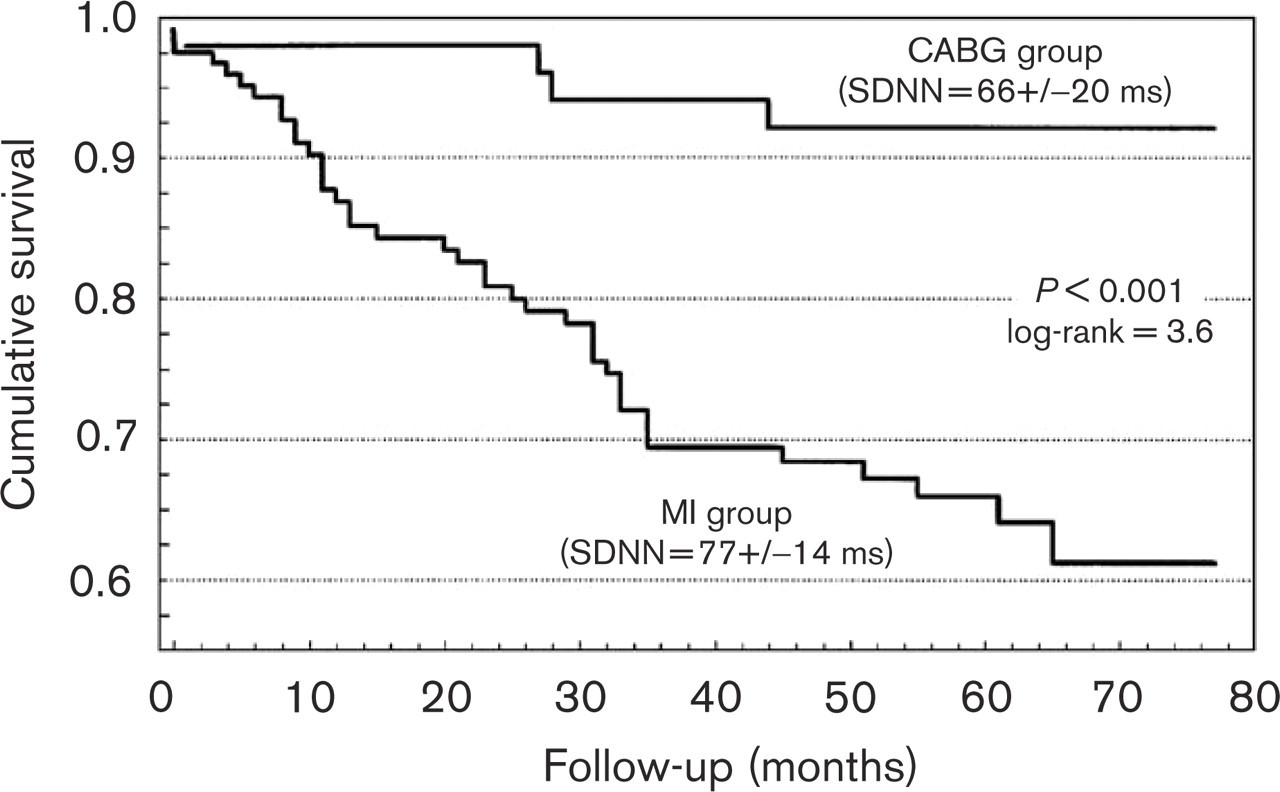
Survival curves (Kaplan–Meier) of patients with HRV decreased by coronary artery surgery or myocardial infarction. CABG, coronary artery bypass graft; MI, myocardial infarction; SDNN, standard deviation of all normal R–R intervals.
Beside HRV, the two groups also differed according to age, however, the age difference did not influence differences in survival (χ2 value was 0.24 for survival and 1.18 for event-free survival; NS both).
Discussion
This study clearly documents that the usual association between depressed HRV and increased mortality does not exist in coronary artery disease patients who have undergone bypass surgery. The seemingly contradictory findings of a simultaneous decrease in HRV and improvement in survival by CABG indicate that low HRV is not an invariable predictor of an adverse outcome. Conversely, the prognostic value of a decreased HRV was confirmed once more for MI patients.
Our results are consistent with data reported retrospectively from the CAST trial by Stein and colleagues [5] where post-CABG patients had markedly decreased HRV in conjunction with improved short-term survival. They also concluded that ‘recognition of this is necessary to prevent misclassification of risk'. Similar opinion on the value of decreased HRV as a prognostic marker in the absence of myocardial infarction can be found elsewhere in the literature [6], but the explanation for this opinion was not given.
A non-lethal decrease of HRV in CABG patients can be explained by the increase of perioperative sympathetic activity and by a mechanism of autonomic denervation different from that accompanying heart infarction, namely, myocardial necrosis. The decrease in HRV following CABG is related to increased sympathetic activity and to perioperative procedures [9], so our findings are actually consistent with what might be expected. It seems that the heart, denervated by a surgeons knife and simultaneously stimulated by revascularization, has a great potential of autonomic reinnervation. There is evidence that HRV decreased in such a manner can recover completely over a period of time [10]. Thus, it appears that a non-pathologic, postoperatively decreased HRV has no importance for the routine clinical work and postoperative prognosis during at least the first months following cardiac surgery.
An incidental finding of the study was that there were no differences in HRV indices which reflect specific components of overall autonomic modulation of heart rate (rMSSD, pNN50, LF, HF) between the CABG and MI groups. That could be the consequence of a smaller perioperative decrease in these segments than in overall HRV [10]. The lack of difference in HF, pNN50 and rMSSD could equally be due to the fact that among cardiac patients there is a high prevalence of non-respiratory sinus arrhythmia which exaggerates HRV in some patients and does not reflect cardiac autonomic modulation. However, it seems that central frequency of the HRV spectrum shifts leftward in association with progression in ischaemic heart disease [13], and therefore long-term measures of sympathovagal balance do not reflect clinical findings in cardiac patients with low overall HRV [14]. We hope that our ongoing study of perioperative changes of HRV will shed more light upon this discrepancy in the changes of HRV elements.
Although not the primary focus of this study, the mortality rate in the MI group (30% in 3 years) seems to be very high. That fact does not surprise us because in our country myocardial infarction patients who undergo stationary cardiac rehabilitation are generally at higher risk, and because only those with low HRV were included. A similar mortality rate has been found in other myocardial infarction patients with decreased HRV [1].
The limitation of this study is that groups selected by low HRV do not represent all patients with MI or CABG, but our intention was just to analyse predictive value of decreased HRV in CABG patients, not in a general cardiac population. From a methodological standpoint this may not be the optimal approach. It remains possible that low HRV after CABG would have a predictive value when compared with patients with normal or high HRV after CABG, but survival in CABG patients with low HRV was too good to compare it with that in patients with normal HRV. Finally, it would be interesting to define predictive value of decreased HRV in diabetic patients because Stein and co-workers [5] found in the CAST sample low predictive value of HRV not only for CABG, but for diabetic patients as well. Unfortunately, our sample was too small to test this hypothesis.
The study protocol covered cardiovascular events, but the mode of cardiac death was not analysed due to the small number of deceased patients (only four) in the CABG group; this might be considered a limitation of the study. Due to technical limitations, we obtained no measurements of baroreflex sensitivity [15, 16] or of other indexes of autonomic nervous system activity that have been associated with increased mortality risk [17]. It is possible that measurement of these parameters would have added insights into difference in the decrease of overall HRV compared with other HRV parameters that reflect activity of different components of the autonomic nervous system.
It must be noted that there were mean differences in HRV post-CABG in survivors and non-survivors, even though these were not significant. This suggests that under ordinary clinical circumstances SDNN would not be useful in risk stratifying post-CABG patients, but it also suggests that with sufficient statistical power, namely, with a large enough sample, SDNN might be significantly different in non-survivors. Finally, it would be interesting to define time-course of HRV recovery [18] in CABG patients by repeated HRV measurement, but the study design was directed strictly to survival.
In conclusion, no matter how strong is the prognostic potential of HRV in patients with myocardial infarction, low HRV can not be used as a prognostic marker of increased risk of cardiac death in patients shortly after coronary artery surgery.