







Abstract
Background Turkish adults have a high incidence of coronary artery disease (CAD).
Design The role of lipoprotein(a) (Lp[a]) as a risk factor for CAD and its association with paraoxonase-1 (PON1) activity and lipid peroxidation indicators were evaluated in Turkish subjects living in Antalya.
Methods Paraoxonase-1 activity, Lp(a), conjugated dienes (CD) and thiobarbituric acid-reactive substances (TBARS) levels were measured in 45 healthy controls and 72 CAD patients.
Results In CAD patients, decreased PON1 activity and increased Lp(a), CD and TBARS levels were observed. Risk factors associated with CAD included TBARS, age and CD.
Conclusions Our results indicate an association between PON1 activity and Lp(a) level in CAD patients. Eur J Cardiovasc Prev Rehabil 12: 185–186 © 2005 The European Society of Cardiology
Keywords
Introduction
Paraoxonase-1 (PON1), a high-density lipoprotein (HDL)-associated enzyme, facilitates the inhibition of low-density lipoprotein (LDL) oxidation by destroying the biologically active phospholipids in oxidatively modified LDL [1]. Lipoprotein(a) [Lp(a)] contains a LDL-like moiety and can be modified by oxidative events and by the action of lipolytic and proteolytic enzymes [2].
The activity of PON1 and Lp(a) distribution is known to be influenced by ethnic origin [2, 3]. No report is available in the literature evaluating the possible associations between the activities of PON1 and the concentrations of Lp(a) in the serum of coronary artery disease (CAD) patients and controls in Turkish people living in Antalya. The present study aimed to investigate the activity of PON1 and the levels of Lp(a) and lipid peroxidation indicators [conjugated dienes (CD) and thiobarbituric acid-reactive substances (TBARS)] in CAD patients and healthy subjects living in Antalya, Turkey.
Methods
This study was designed as a double-blind case–control study and the subjects were chosen randomly from people living in the south of Turkey (Antalya region), coming from the same ethnic origin, unrelated to each other, who underwent coronary angiography at the Cardiology Department of the Medical Faculty of Akdeniz University.
The standard Judkin's technique was used for coronary arteriographic examination and images were interpreted by a panel of experienced cardiologists blinded to data on all biochemical analysis. A stenosis estimated as > 25% in at least one major coronary artery was considered to indicate CAD. Participants with no detectable coronary artery anomaly were classified as controls. Blood samples were obtained after a 12-h fasting.
Serum PON1 activity was measured by the methods described by Furlong et al. [4] and Mackness et al. [5] with minimal modifications. Lipoprotein(a) concentrations were measured by an immunoturbidimetric method using a Roche/Hitachi 911 analyzer and specific antisera. The HDL-cholesterol (HDL-C) was assayed on an Abbott Aeroset auto-analyzer, using an enzymatic colorimetric method. The LDL-cholesterol (LDL-C) fraction was calculated using the Friedewald equation [6]. Conjugated diene levels were measured by the method of Recknagel and Glende [7]. Thiobarbituric acid-reactive substances levels were measured by the method described by Wasowicz et al. [8].
Student's t-test, Pearson's correlation test and stepwise logistic regression analysis were used for statistical analyses.
Results
Table 1 reports data of all parameters from controls and CAD patients. In the total population (n = 117), PON1 activity negatively correlated with CD (r = −0.262, P < 0.005) and TBARS levels (r = −0.198, P < 0.05) and age (r = −0.218, P < 0.05). Lipoprotein(a) levels positively correlated with LDL-C (r = 0.197, P < 0.05) and TBARS levels (r = 0.185, P < 0.05).
In CAD patients, PON1 activity positively correlated with Lp(a) level (r = 0.329, P < 0.01) and negatively correlated with age (r = −0.306, P < 0.01). On multiple logistic regression analysis, risk factors associated with CAD included TBARS, age and CD.
Discussion
We observed decreased PON1 activity in CAD patients unlike the Iranian patients, supporting the concept that PON1 activity shows great inter-ethnic variability [3].
The CAD patients had higher concentrations of Lp(a) than controls as in another study in Ankara, Turkey [9]. In CAD patients, we observed a positive correlation between PON1 activities and Lp(a) levels. No report is yet available concerning their relation in CAD. Paraoxonase-1 might be influencing the modification of Lp(a) in the atherogenic process.
Increased levels of lipid peroxidation indicators in CAD patients, support the earlier study that lipid peroxidation is involved in CAD [10]. The overproduction of lipid peroxidation products may inactivate or reduce the detoxification capacity of PON1 as suggested by Aviram et al. [11].
Paraoxonase-1 (PON1) activity, lipoprotein(a) [Lp(a)], high-density lipoprotein cholesterol (HDL-C), low-density lipoprotein cholesterol (LDL-C), conjugated dienes (CD) and thiobarbituric acid-reactive substances (TBARS) levels in controls and coronary artery disease (CAD) patients
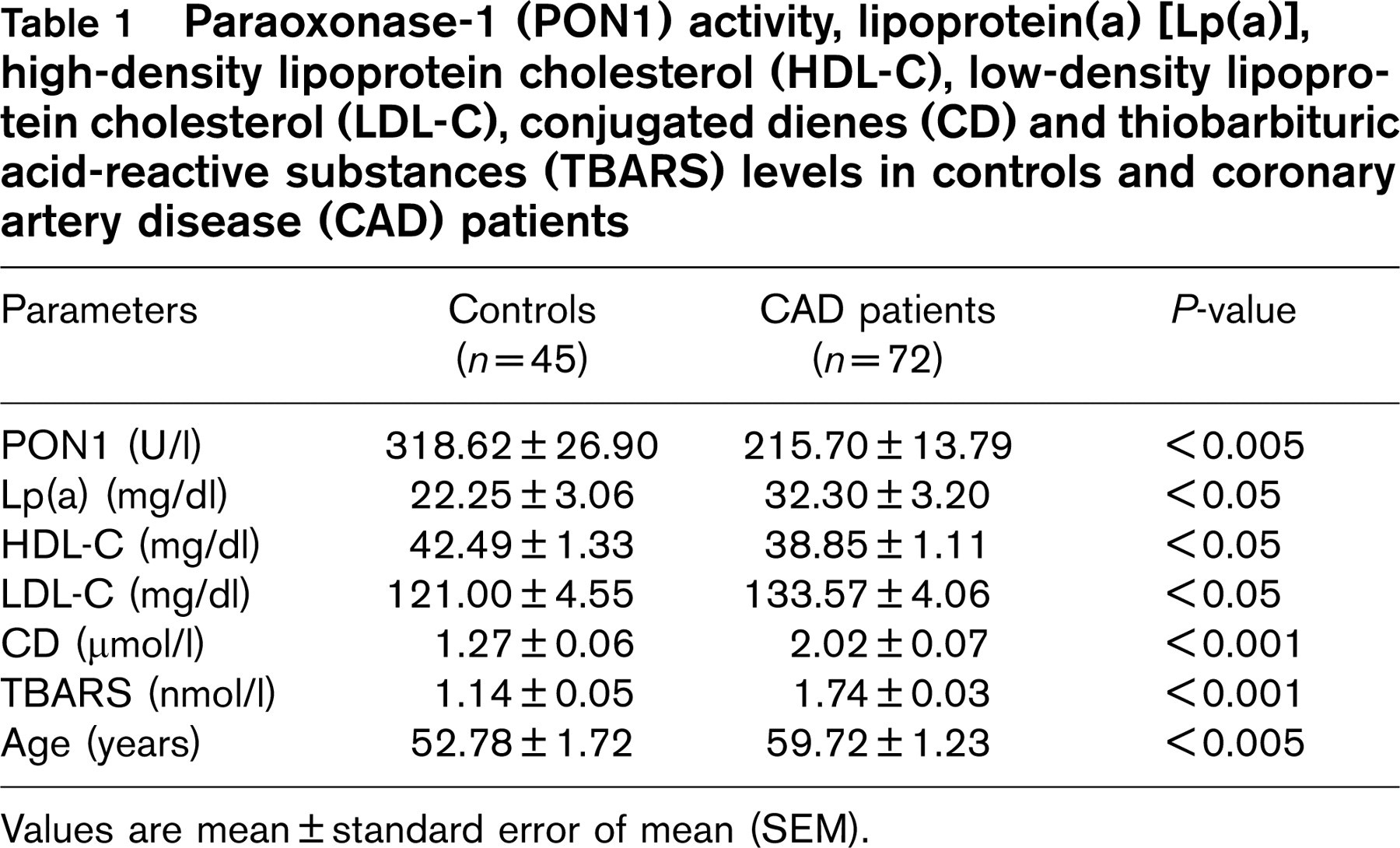
Values are mean±standard error of mean (SEM).
This is the first report showing the association among PON1 activities and Lp(a) levels in subjects living in Antalya, Turkey. The findings of the present study reflect the results of 117 Turkish subjects living in the Antalya region who underwent coronary angiography, but do not predict the risk analysis of the general Turkish population. Thus studies with greater number of subjects are required to evaluate their association.