






Abstract
Background
The study was conducted to obtain the frequency of the hepatic lipase C-514T polymorphism and evaluate its relation with serum HDL cholesterol levels in Tehran.
Methods
A segment of the gene mentioned was amplified by polymerase chain reaction in 545 people and the restriction fragment length polymorphism revealed.
Results
The T allele frequency was 0.154. No significant relationship between HDL cholesterol levels and C-514T polymorphism was found even after adjusting for age, body mass index and blood pressure.
Conclusion
The frequency of the polymorphism is similar to other Caucasian populations and no significant relationship exists between the non-CC genotype of the gene and a higher serum HDL cholesterol concentration.
Keywords
Introduction
Many factors contribute to the progression of atherosclerosis and there has been strong evidence that a low concentration of high-density lipoprotein cholesterol (HDL-C) is associated with an increased risk of coronary heart disease (CHD) [1]. Decreased HDL-C concentration is associated with environmental variables such as abdominal obesity [2], lifestyles and cigarette smoking [3], but genetic factors also play a significant role [4]. Hepatic lipase participates in the metabolism of IDL and large low-density lipoprotein (LDL) to form smaller, denser LDL particles and in the conversion of HDL2 to HDL3. In addition, hepatic lipase can mediate the unloading of cholesterol from HDL to the plasma membrane in the liver [5]. In recent studies, the C-514T polymorphism in the promoter region of the hepatic lipase gene (LIPC) was associated with significant variations in hepatic lipase activity, HDL-C levels and LDL particle size.
The aim of the present study was to determine the frequency and phenotypic expression of the C-515T polymorphism of the hepatic lipase gene in 545 Tehran Lipid and Glucose Study (TLGS) participants and its relationship with HDL-C levels.
Materials and methods
We studied the inter-individual variability in lipid levels, associated with this LIPC polymorphism among TLGS participants, the details of the TLGS are presented elsewhere [6–8]. Five hundred and forty-five healthy Tehran residents, aged between 30 and 70 years, who were among participant of the TLGS, between March and September 2003, were entered in this study. Height, weight and blood pressure of each participant were measured. Body mass index (BMI) was defined as weight (kg) divided by height squared (m2). After 12-h fasting, serum and whole blood samples were collected in non-ethylenediaminetetraacetic acid (EDTA) and EDTA coated tubes, respectively. After centrifugation for 10 min at 3000 rpm, sera were separated and stored at −70°C in 1.5 ml aliquots. Glucose and lipids were measured immediately from fresh sera.
Serum glucose, total cholesterol, HDL-C, and triglyceride levels were measured as previously described [7]. Coefficients of variation of total cholesterol, HDL-C, and triglyceride measurements were below 5%.
Buffy coats were separated from EDTA anticoagulated samples and stored at −70°C. Genomic DNA was extracted from the buffy coats with a salting out method [9]. A fragment of a 285 bp sequence of the LIPC gene was amplified by the polymerase chain reaction (PCR) in a DNA thermal cycler (Hybaid Omnigene Co., UK) with the previously reported method [10]. The PCR products were subjected to restriction enzyme analysis by digestion with 1 U of the restriction endonuclease Nla III for 10μl of PCR sample at 37°C for 4 h in the recommended buffer, and the fragments were separated by electrophoresis on a 3% agarose gel. After electrophoresis, the gel was treated with ethidium bromide for 10 min, and DNA fragments were visualized by ultraviolet illumination. The resulting fragments were 215 and 70bp for the T allele and 285bp for the uncut C allele. After sample analysis, we calculated the frequency of this polymorphism in the population studied.
Statistical analysis
Allele frequencies were determined by test for Hardy-Weinberg equilibrium of all LIPC gene variants. Means were compared between groups using ANOVA. The Tukey test was performed for multiple comparisons. We did a multiple regression analysis for smoking and BMI.
Results
Participant characteristics
The distribution of alleles was consistent with the Hardy-Weinberg equilibrium. Table 1 provides a summary of demographic and biochemical characteristics of the participants according to their genotype. The number of hemozygotes for the T allele was less than other groups. Mean age, BMI, systolic and diastolic blood pressure, total cholesterol, LDL cholesterol, triglyceride and glucose levels were not significantly different in the three groups of genotypes. The mean of the HDL-C concentration in T allele homozygotes was higher than C allele homozygote (1.01 ± 0.26, 0.95 ± 0.23 mmol/l, respectively) but this was not statistically significant. We combined subjects with TT and CT alleles and then compared this group with CC allele participants. The results showed no significant difference for HDL-C concentration between these two groups even after adjustment for age, BMI, systolic and diastolic blood pressure and smoking.
We did a multivariate analysis for smoking and BMI, because these two factors influence HDL-C level. The results show that smoking, but not BMI, has an effect on HDL-C levels in our population. None of the factors had any effect on the result of this study.
Discussion
The frequency of the Tallele was 0.154 and no significant relationship between HDL-C levels and C-514T polymorphism was found in the population studied.
Low HDL-C levels are associated with an increase in the risk of coronary artery disease [11]. In the report of the TLGS, 73% had low HDL-C [12] which could be attributed to industrialization, modification of lifestyle, unhealthy diet, decreased physical activity, and an increased prevalence of hypertriglyceridemia, obesity and smoking [8].
The C-514T allele frequency was 0.164 in men and 0.144 in women. Previous studies of different races showed that the frequencies of the allele were 0.15-0.21, 0.45-0.53, and about 0.47 in Caucasians, African Americans, and Japanese Americans, respectively [13]. Our data support previous reports on the variability of the hepatic lipase polymorphism in different races [13,14], but we did not find any statistically significant relation between C-514T polymorphism and HDL-C levels in our population. A trend from low to high HDL-C levels can be seen, however, from CC to TT alleles (0.95 ± 0.23 versus 1.01 ± 0.26 mmol/l, respectively). In addition, no statistically significant differences in HDL-C and other lipid levels were observed across the LIPC polymorphism after dividing participants into two groups with CC and CT/TT alleles and adjusting for age, BMI, systolic blood pressure, diastolic blood pressure and smoking. The association between HDL-C level and the C-514T polymorphism in the LIPC gene has been previously reported in several studies [10,13,14].
As a result, we could not find a statistical relationship between this polymorphism and HDL-C levels. It is still possible, however, that this polymorphism does not affect hepatic lipase activity in this population. One limitation of this study is that the hepatic lipase activity was not obtained.
Plasma levels of lipids and lipoproteins according to hepatic lipase genotypes in the population studied
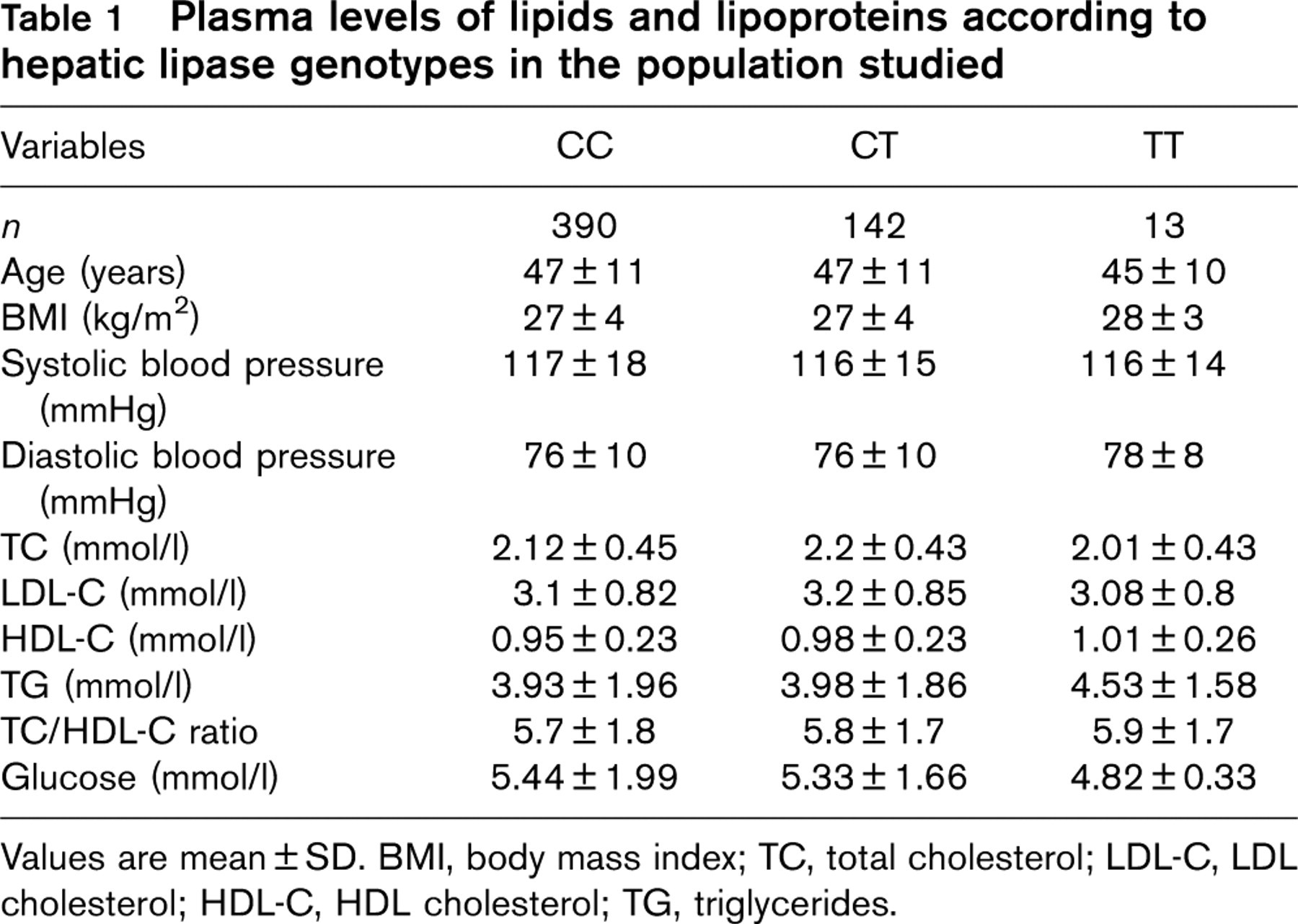
Values are mean ± SD. BMI, body mass index; TC, total cholesterol; LDL-C, LDL cholesterol; HDL-C, HDL cholesterol; TG, triglycerides.
In conclusion, our study shows that persons from Tehran have a frequency of the hepatic lipase gene C-514T polymorphism that is similar to that of other Caucasian populations. In addition no statistical relationship was found between the non-CC genotype of the hepatic lipase gene and a higher serum HDL-C concentration. Nonetheless, an increased trend for TT allele percentile and T allele frequency can be seen from the low to high HDL-C levels. We could obtain more conclusive results if we were to measure the hepatic lipase activity.