







Abstract
Background
Due to occupational restrictions many people's recreational endurance activities are confined to the weekends. We intended to clarify if cumulating the training load in such a way diminishes endurance gains.
Design
We conducted a longitudinal study comparing training-induced changes within three independent samples.
Methods
Thirty-eight healthy untrained participants (45 ± 8 years, 80 ± 18kg; 172 ± 9cm) were stratified for endurance capacity and sex and randomly assigned to three groups: ‘weekend warrior’ (n = 13, two sessions per week on consecutive days, 75min each, intensity 90% of the anaerobic threshold; baseline lactate + 1.5 mmol/l), regular training (n = 12, five sessions per week, 30min each, same intensity as weekend warrior), and control (n = 13, no training). Training was conducted over 12 weeks and monitored by means of heart rate. Identical graded treadmill protocols before and after the training program served for exercise prescription and assessment of endurance effects.
Results V O2max improved similarly in weekend warrior (+ 3.4ml/min per kg) and register training (+ 1.5ml/min per kg; P =0.20 between groups). Compared with controls (− 1.0ml/min per kg) this effect was significant for weekend warriors (P<0.01) whereas there was only a tendency for the regular training group (P =0.10). In comparison with controls (mean decrease, 3 beats/min), the average heart rate during exercise decreased significantly by 11 beats/min (weekend warriors, P<0.01) and 9 beats/min (regular training, P<0.05). There was no significant difference, however, between the weekend warrior and regular training groups (P =0.99).
Conclusion
In a middle-aged population of healthy untrained subjects, cumulating the training load at the weekends does not lead to an impairment of endurance gains in comparison with a smoother training distribution.
Introduction
Within the general population the awareness of health benefits from regular exercise is increasing. Nevertheless, in many individuals occupational constraints and other problems of individual time scheduling lead to difficulties in organizing their training during the week's working days. Many persons tend to make up for this during the weekend. These so-called ‘weekend warriors’ pile up their training load on two consecutive days and, thus, often exercise intensely for long durations. Although such a distribution of training sessions does not comply with current recommendations [1] some training effect is likely. At present, however, it is unclear whether weekend warriors reach comparable training effectiveness to individuals who distribute the same total training load more smoothly over the 7 days of the week.
Endurance exercise is considered to be the most appropriate mode for preventive and recreational purposes and exerts the most prominent advantageous cardiocirculatory effects [2]. With the exception of interval training, intensity and duration are the main characteristics of typical training sessions [3]. Most often such sessions consist of cycling, running or walking of moderate intensity, which is guided by heart rate prescriptions. Portable devices enable monitoring of one's own heart rate, which is displayed continuously on a wristwatch. Consequently, this study investigated endurance training effects of moderate intensity walking/running, which was prescribed by the use of heart rates. It focused on the effect of different scheduling of training sessions during the week with intensity and total duration held constant. It was hypothesized that cumulating training on two consecutive days (weekend warrior) leads to an impairment of endurance training effectiveness.
Methods
Study design and employed methods are in accordance with the ethical standards of the Declaration of Helsinki and approved by the institutional review board. Each participant gave written informed consent prior to the start of this study.
Subjects and general design
Thirty-eight healthy subjects participated in this investigation which was conducted between August 2003 and November 2004. Recruitment was performed by means of advertisements in a local newspaper as well as announcements in several university departments until May 2004 (end of inclusion period). Subjects had, thus, a heterogeneous social and occupational background. About one-third of them worked at the university of Saarland where the study took place. None was acquainted with any of the investigators or employed at the sports medicine department. Inclusion criteria were age between 30 and 60 years and untrained status, that is, no regular endurance training within recent years and absence of activities with endurance effects within the last 6 months. Subjects were excluded from participation if they had diseases of the musculoskeletal system which prevented exercise, or other contraindications to exercise (e.g. recent myocardial infarction, myocarditis, thyreo-toxicosis). In addition, arterial blood pressure > 160/ 100mmHg as well as total cholesterol >300mg/dl were incompatible with participation in this study.
Subjects were randomized into two training groups (weekend warrior, n = 12; regular training, n = 13) and one control group (n = 13). A stratification was performed using sex and V O2max (two strata, cut-off 35ml/min per kg for females, and 45ml/min per kg for males) as criteria. All groups performed an initial pre-test and a post-test after 12 weeks of training (training groups) or unchanged activity (controls). All participants took their usual breakfast prior to reporting to the laboratory. Testing started always between 0830 and 0930 h. Medical history, physical examination, routine laboratory status (results not shown), and resting electrocardiogram (ECG) were conducted prior to the first exercise test to ensure the absence of health risks.
Exercise testing
After recording a 12-lead resting ECG in the supine position, stepwise incremental treadmill ergometry was carried out. The velocity of the first stage was either 4 or 5 km/h depending on age, sex and body dimensions; stage duration was 3 min. The increase in velocity to the next two stages was 1 km/h each, and from the fourth stage (6 or 7 km/h, respectively) inclination of the treadmill was increased stepwise by 3% per stage. Between the first stages 45-s breaks were made to allow for capillary blood sampling and measurement of blood pressure until the anaerobic threshold was safely passed (subjective assessment of investigator). From that moment, no further breaks of the exercise protocol were made, and inclination of the treadmill was increased by 1% per minute until exhaustion to ensure appropriate measurement of V O2max [4]. Intraindividually, exercise protocols were identical between pre-testing and post-testing.
Capillary blood sampling for determination of the blood lactate concentrations was carried out at rest and at the end of each stage (until the anaerobic threshold was considered to be passed, see above). Another sample was taken 3 min after cessation of exercise to assess the degree of effort spent. A six-lead ECG was recorded every minute during exercise, and the heart rate (HR) was calculated from these traces. In no single case did the occurrence of cardiocirculatory or respiratory symptoms limit exercise. Between individuals, the chosen protocol remained the same during post-testing.
Gas exchange measurements (MetaMax II; Cortex, Leipzig, Germany) were carried out throughout the exercise tests. Measurements of oxygen uptake (V O2max), carbon dioxide output (V O2max), and minute ventilation (V E) occurred every 10s. In addition to traditional procedures, oxygen uptakes at maximal exercise and at the anaerobic threshold were expressed allometrically (ml/min per kg2/3 instead of ml/min per kg) to make up for differences in body weight more precisely [5, 6].
Determination of anaerobic threshold and training intensity
The anaerobic threshold was determined from the lactate curve using a modification of the Hagberg/Coyle lactate threshold [7]. It consists of identifying the baseline of the blood lactate concentration and determining the oxygen uptake corresponding to a concentration of baseline + 1.5 mmol/l [8]. Training intensity was given to the subjects as the HR corresponding to 90% of the V O2 at anaerobic threshold (V O2AT). A range of ± 5 beats/min was regarded as acceptable. HR was recorded throughout all training sessions by means of a telemetric system (Alpin 5; Ciclosport, Krailling, Germany). Data were transferred to a stationary computer once every week during the supervised session (see below).
Training program
Training was conducted over a period of 12 weeks at two consecutive (weekend warrior) or five freely chosen days (regular training) of the week. One session per week was supervised by one of the investigators. After 10min warm-up (calisthenics), the programme consisted of walking or running within the prescribed HR range for 75 (weekend warrior) or 30m (regular training). Thus, both training programmes resulted in the same duration per week and - due to the identical exercise intensity - in the same total energy consumption (approximately 1400 kcal). The only difference between programmes was the distribution of the training load. Missed training sessions due to acute infectious disease or other unavoidable events were tolerated up to a total duration of 2 weeks but not during the last 4 weeks of the programme. In such cases, the training period was lengthened by the missed sessions to end up at 12 training weeks. In cases of absence cumulating to between 3 and 5 weeks, one to two additional training weeks were added to the scheduled 12 weeks. Longer periods of absence resulted in exclusion of a participant from statistical calculations.
Statistics
The estimation of an adequate sample size was made for comparisons between one training and the control group and based on an effect size of 0.6–0.7 (expected difference in the mean effect of training versus control condition divided by the SD of the changes in the control group) which would have been equal to a difference of approximately 4–5 beats/min. For an α-error of 0.05 and a β-error of 0.8 we arrived at a sample size of 12–15 subjects per group [9]. Statistical comparisons were made solely between groups, no testing was done on an intra-group level. After testing of preconditions for parametric testing, two-factorial repeated measures analysis of variance (ANOVA) (factor 1, group; factor 2, pre-testing versus post-testing) was applied for the analysis of V O2max treadmill duration, resting HR, V O2AT, HRmax, maximal lactate concentration (La max), and RER max (maximal expiratory exchange ratio). For statistical analysis of the HR curve, a third factor (repeated measures during one exercise test) was included into the ANOVA. Exercise measurements of HR beyond the 12th minute were excluded from analysis because of the reduced number due to earlier test cessations in certain subjects. A significant interaction between the factors ‘group’ and ‘pre-testing versus post-testing’ was regarded as indicating differences in training effectiveness, or in the degree of effort, respectively. In such cases, post-hoc testing was done between the three groups by means of a Scheffé test for independent samples comparing the pre and post-testing differences. To carry out this procedure for exercise HR, a mean change in HR between the first and the 12th minute of exercise between pre-testing and post-testing was calculated in each individual. This was considered appropriate because HR curves usually shift homogeneously, and it seemed redundant to calculate statistics on particular time points during the tests. The significance level for the α-error was set at P <0.05. Data are presented as mean and SD throughout.
Results
Anthropometric data of the participants (n = 38) are given in Table 1 (no difference between groups for any of these variables; P > 0.20). Eight additional subjects were recruited but dropped out of the study before they finished all tests because of concurrent disease (n = 4), scheduling problems (n = 2) or non-compliance with the requirements of the training period (n = 2).
There was no medical event during any training session. Compliance with training requirements was without differences between weekend warriors and regular training. Mean total training time reached 1860 ± 170 min (103 ± 9% of the prescribed amount; range 89–121%) and 1883 ± 137 min (105 ± L 8% of the prescribed amount; range 92–119%) in weekend warriors and regular training, respectively. The average HR during training was 134 ± 9 beats/min in the weekend warriors (101 ± 3% of the prescription, range 94–105%) and 142 ± 13 beats/min in the regular training subjects (101 ± L 1% of the prescription, range 99–102%), respectively. No single subject violated training scheduling, that is two consecutive (weekend warrior) or five freely chosen (regular training) training dates per week, more than once. Missed training weeks added up to 1.1 ± 1.7 in weekend warriors and 1.5 ± 1.6 in regular training (P = 0.50; Mann-Whitney U-test).
Maximal ergometric parameters
The group/pre-testing versus post-testing interaction was significant for all three chosen effectiveness criteria of endurance training: P <0.001 for treadmill duration, P = 0.001 and P = 0.002 for V O2max (ml/min per kg and ml/min per kg2/3, respectively). When compared with controls, the training groups improved significantly in terms of treadmill duration. In contrast to weekend warriors (P < 0.002 to controls), however, there was only a tendency for regular training to improve V O2max, regardless of whether results were expressed per kg (P = 0.10 to controls) or allometrically per kg2/3 (P = 0.07). But post hoc-analysis revealed no significant difference between both training groups (Table 2). Criteria for the degree of effort showed no significant difference between groups or between times of testing. The corresponding P values can be obtained from Table 2.
Anthropometric data of the subjects
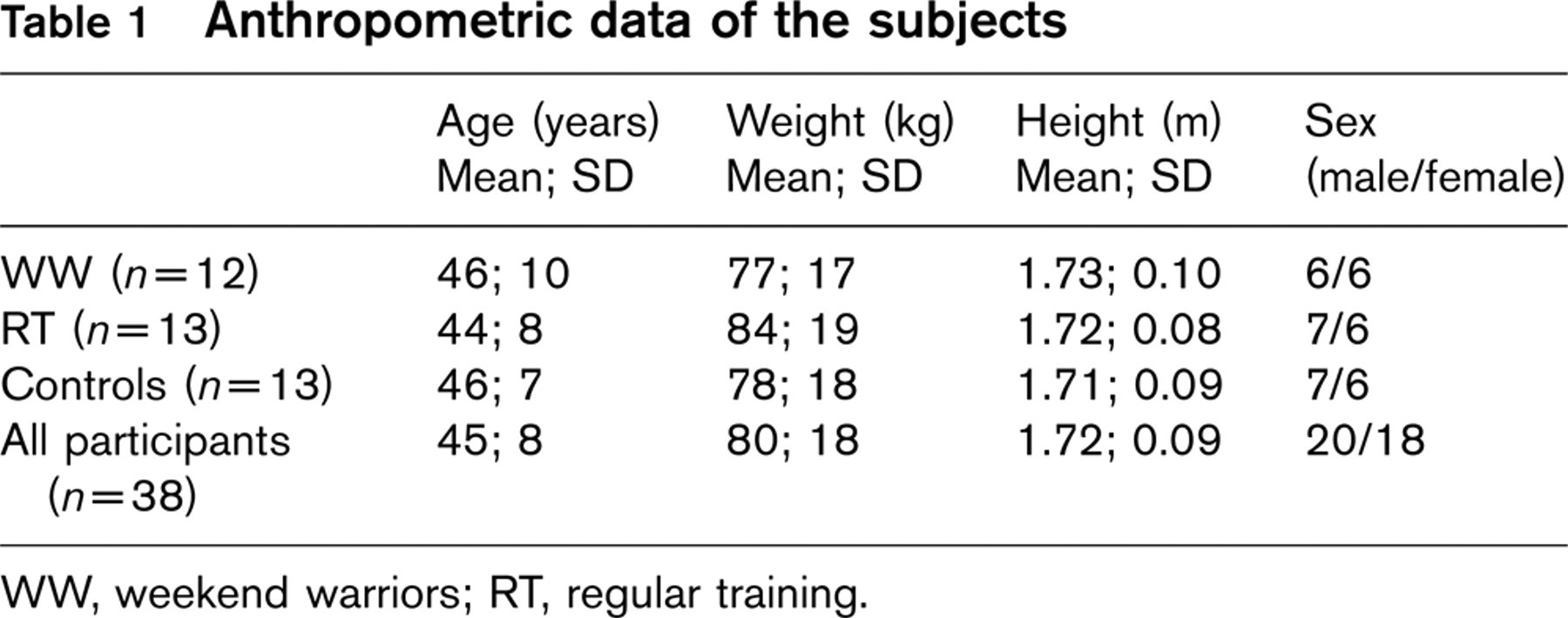
WW, weekend warriors; RT, regular training.
Maximal ergometric values of the subjects
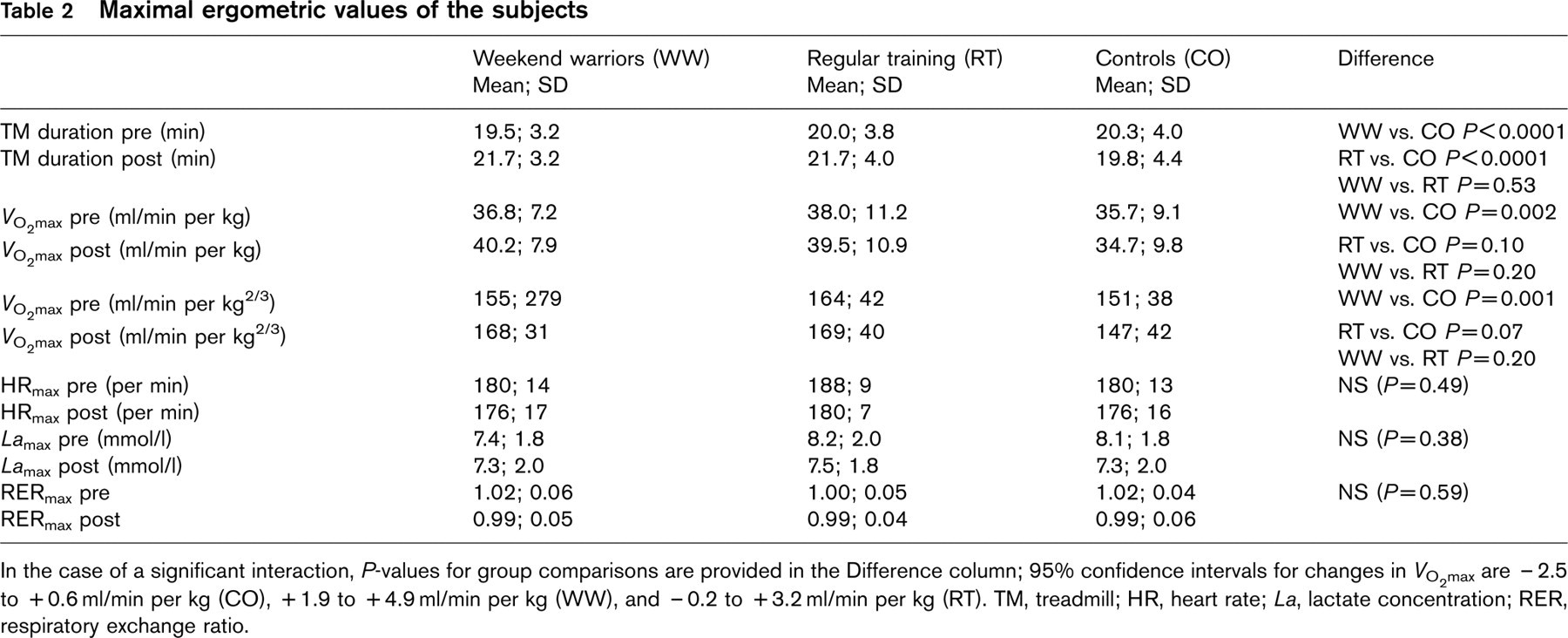
In the case of a significant interaction, P-values for group comparisons are provided in the Difference column; 95% confidence intervals for changes in V O2max are − 2.5 to + 0.6ml/min per kg (CO), + 1.9 to +4.9ml/min per kg (WW), and −0.2 to +3.2ml/min per kg (RT). TM, treadmill; HR, heart rate; La, lactate concentration; RER, respiratory exchange ratio.
Submaximal ergometric parameters
Resting HR (P = 0.0005) as well as exercise HR (P = 0.003) showed a significant group/pre-testing versus post-testing interaction. Post-hoc testing indicated significant differences between weekend warriors and controls (P = 0.003 for resting HR; P = 0.003 for exercise HR) and between regular training and controls (P = 0.003 for resting HR; P = 0.04 for exercise HR) whereas no differences were detected between weekend warriors and regular training (P = 0.99 for resting HR; P = 0.54 for exercise HR). Entire HR curves are displayed in Fig. 1.
There was no significant training effect on the lactate curve (P = 0.13 for the interaction of group and pretesting versus post-testing). Average lactate values after 12 min of exercise, that is, after the fourth stage, were 2.2 ± 1.0 and 2.2 ± 1.0 mmol/l for pre-testing and post-testing, respectively. For V O2AT, however, there was a tendency to different courses between groups due to the intervention period (P = 0.07 for the group/pre-testing versus post-testing interaction, regardless of whether expressed as per kg or per kg2/3). Mean changes in (V O2AT (ml/min per kg2/3) are shown in Fig. 2.
Discussion
The results of the present investigation indicate that cumulating endurance training at the weekends instead of dividing the same training load into five sessions per week does not necessarily impair its effectiveness, thereby falsifying our initial hypothesis. Neither maximal nor sub-maximal indices of endurance capacity indicate superior effectiveness of a ‘smoother’ training distribution. These findings have obvious relevance for individuals who face a severely restricted time budget due to occupational or other constraints. Excellent compliance of the subjects as well as very close training monitoring add value to the study. According to these observations, a meaningful categorization of recreational endurance training can be carried out by calculating the total energy consumption, at least for training frequencies between 2 and 5 sessions per week. It cannot, however, be ruled out that the unavoidably long duration of single training sessions in the ‘weekend warriors’ might lead to overload and, thus, impair compliance in the long term.
Intuitively, one tends to favour more frequent training during a week over two single sessions on consecutive days. This is reflected in recommendations to exercise ‘on most, preferably all days of the week’ and the American College of Sports Medicine (ACSM) statement that exercising on ‘3–5 days per week’ is appropriate to maintain or develop cardiorespiratory fitness [1]. Literature about the problem of adequate training distribution is, however, rare and far from conclusive [3, 10, 11]. This is reflected in the relatively low number of studies which build the basis for ACSM's main statements in 1998 with regard to frequencies in the range of two to five training sessions per week [3, 11–14] and partly addressed in the final statement: ‘The optimal training frequency for improving the LT and metabolic fitness are not known and may or may not be similar to that for improving V O2max [1]. In fact, no study specifically addressed the problem of the weekend warrior.
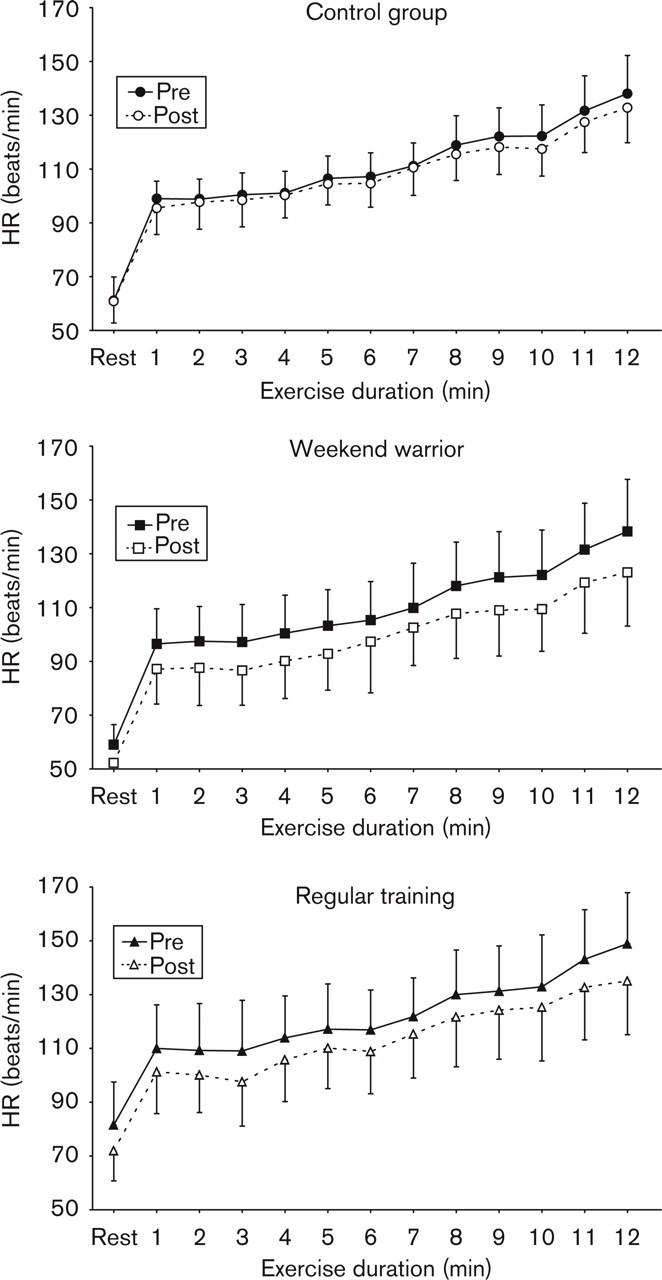
Changes in heart rate (HR) during pre-testing (solid line and filled symbols) and post-testing (scattered line and open symbols) on the treadmill in controls (top), weekend warriors (middle) and regular training (bottom).
Gettman et al. [13] held the duration of single training sessions (30 min) constant when they compared frequencies of one, three and five sessions per week in 55 jail inmates. Obviously, this led to differences in the total training load proportional to the frequency. The authors observed a corresponding change in V O2max being largest for the subjects exercising five times per week. The same was true for the Pollock et al. [14] study, which might have partly reported on the same subjects. Another attempt to assess the effect of different training frequencies on the maintenance of endurance gains was made after an initial 10-week conditioning period with six interval training sessions per week [15]. During the following 15 weeks the training effect on V O2max remained regardless of whether the participants reduced their schedule to two (n = 7) or four (n = 6) sessions per week. Although this result indicates equality of different training frequencies – with different total workloads – their transfer to the prospective question for the weekend warrior as addressed in the present investigation remains for discussion. It is nevertheless tenable that two training sessions on consecutive days might be sufficient for the purpose of maintenance even with clearly shorter duration than in the present study.
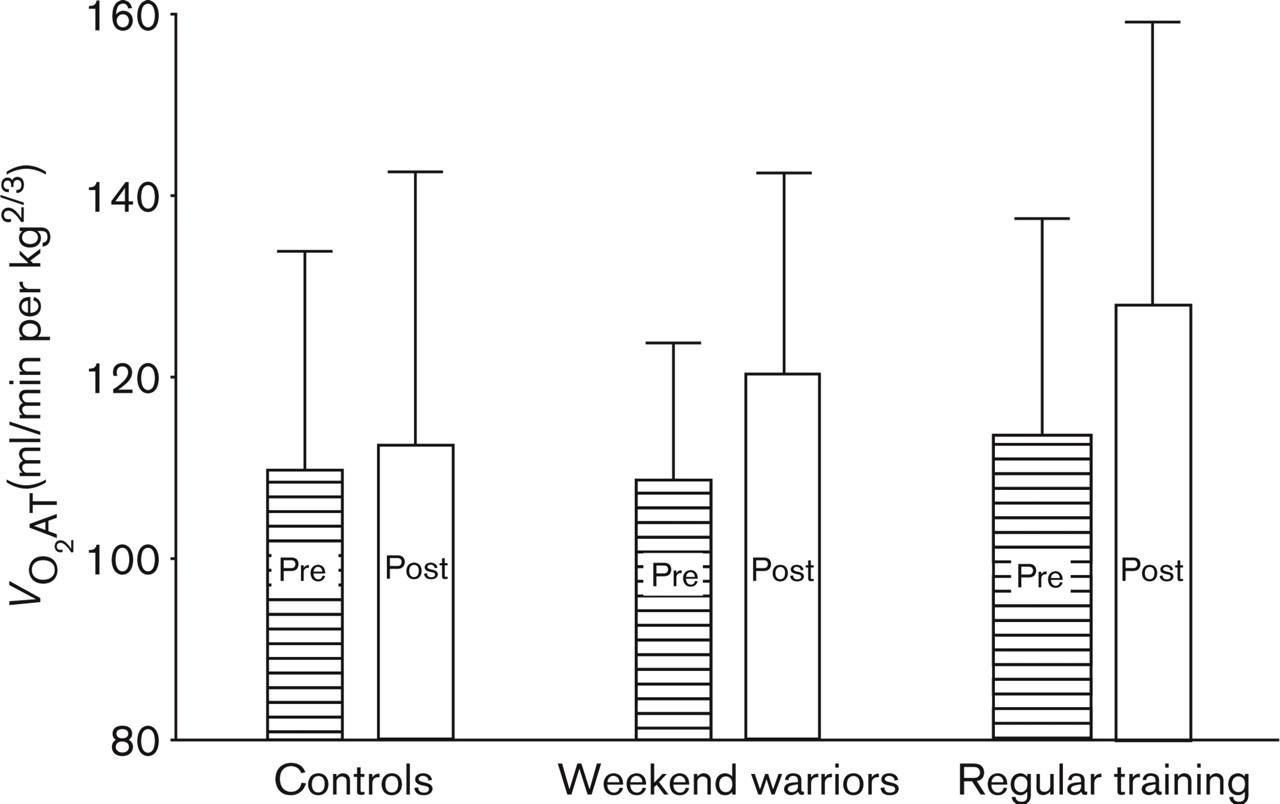
Changes in oxygen uptake at the anaerobic threshold (V O2AT) at pre-testing and post-testing in controls, weekend warriors, and regular training. Mean and SD; allometric scaling.
Interestingly, a subgroup analysis of the Harvard Alumni Health Study was published in 2004 [16] and compared weekend warriors with regularly active individuals over a period of 5 years with regard to mortality. Both groups had a mean energy output of more than 1000 kcal per week. It turned out that the relative risk of dying (0.85; 95% confidence interval 0.65–1.11) was not significantly different from the inactive group in the weekend warriors whereas regularly active individuals (0.64; 0.55–0.73) gained lifetime from their activity. Although the mean caloric expenditure was higher in the regular active group (a factor that could not be adjusted for because it was the basis of categorization) and activity was not limited to endurance training (reporting by mailed questionnaire), the results can be interpreted as an indication that endurance gains are not the single most important prognostic factor for weekend warriors.
Limitations of the study
Obviously, the generalizability of the present findings is limited due to the low number of subjects. The chosen close supervision and monitoring of training prevented much larger sample sizes and, thus, confined the study to the detection of rather large differences in the training effects. In addition, the use of independent samples implies a larger dependency on individual reactions to training stimuli. This might be the reason for partly larger endurance gains (in absolute terms) in the weekend warrior group, although they did not become significant between both training groups. Nevertheless, the samples were thoroughly stratified, which resulted in very similar preconditions within all experimental groups. Furthermore, the compliance with training prescription was rigidly controlled and equally good in weekend warriors and regular training. Under these given circumstances, careful extrapolation to other forms of endurance training with recreational purpose seems justified.
The definition of training intensities represents a debatable issue. Our choice to rely on a sub-maximal (lactate-derived) parameter resulted from known inaccuracies when maximal reference values are used [17–20]. When calculated as a percentage of V O2max, our intensities represented a mean of 71 ± 6% (range, 59–84%) and were well tolerated by all subjects. They can thus be evaluated as moderate to mildly strenuous when it is taken into account that maximal ergometric values might have been somewhat higher in several individuals if a running protocol had been applied instead of the chosen one with limited maximal (walking) speed. In addition to the chosen training intensity, this treadmill protocol could well be one reason for our small effects on V O2max (5–9%) in the training groups when compared with similar studies [13, 14]. There is, however, a wide variability in training effects on V O2max as illustrated by 40 weeks of training resulting in only 6% average improvement in five subjects [21] and even 8 weeks of high-intensity interval training leading to only 5–6% improvement in 21 female students [22].
Both training groups displayed no significant difference to control for (V O2AT and for the entire lactate curve. The reason for this is undoubtedly the confinement of the present analysis to rather low lactate concentrations. (V O2AT, by definition, is located 1.5 mmol/l above baseline levels. Due to early cessation of exercise in a few individuals, complete data was available until the 12th minute of exercise only when mean concentrations did not exceed 2.2 mmol/l. Extending the statistical analysis to later measurements would have included higher lactate values but less subjects. Therefore, the properties of the lactate curve with a flat course during low intensities and considerable fluctuations of baseline levels interfered with reaching significant inter-group differences.
In summary, cumulating weekly endurance training to two sessions on consecutive days (weekend warriors) for 12 weeks does not impair training effectiveness as compared with a more common training schedule (regular training) using a smoother distribution of the weekly training sessions. This statement refers to equal energy outputs of about 1400 kcal per week and was verified by means of maximal and submaximal indicators of endurance capacity. Additional studies are needed to clarify the generalizability of these findings to other populations. Furthermore, it remains to be elucidated if the resulting sessions of long durations in weekend warriors might lead to compliance problems or overload injuries.