






Abstract
Background
The lymphotoxin-α (LTA) gene has been implicated in the pathogenesis of atherosclerosis. We tested for an association between a functional polymorphism, LTA 252A/G, and common carotid artery intima-media thickness in 1088 siblings from 435 Diabetes Heart Study families.
Methods
Intima-media thickness was measured by high-resolution B-mode carotid ultrasonography. A MassARRAY system (Sequenom Inc., San Diego, California, USA) was used for genotyping.
Results
The LTA 252G allele was positively associated with increased intima-media thickness (the odds ratio for the G allele carriers being in the top tertile of the intima-media thickness distribution was 1.41, P = 0.04).
Conclusions
The LTA 252A/G polymorphism is moderately associated with sub-clinical atherosclerosis.
Introduction
Tumor necrosis factor (TNF) is a proinflammatory cytokine that induces the expression of other cytokines. A recent experimental study reported that fatty streak lesion size in atherogenic diet-fed mice was reduced by the disruption of the lymphotoxin-α (LTA) gene (encoding TNF-α) on chromosome 6p21, but not by the disruption of the TNF-α gene [1]. In a genome-wide Japanese case-control study, LTA gene variants showed the strongest evidence of predisposition to myocardial infarction (MI) [2]. The 252A/G polymorphism in intron 1 of LTA was in almost complete linkage disequilibrium with a missense variant (Thr26Asn) in exon 3. The 252A/G polymorphism was associated with MI, and subsequent functional assays demonstrated a higher transcriptional activity associated with the presence of the 252G allele. The association of the 252G allele with high risk of coronary artery disease was confirmed in a separate Japanese case-control study [3] and in a family-based association study of Caucasians [4]. The role of the 252A/G polymorphism in susceptibility to sub-clinical atherosclerosis determined by carotid intima-media thickness (IMT) remains unknown. Previously, our group reported a significant familial aggregation (heritability) of IMT among the sibling pairs with type 2 diabetes (T2D) participating in the Diabetes Heart Study (DHS) [5]. In this brief report, we examined the effect of the LTA 252A/G polymorphism on carotid IMT in DHS families.
Methods
Study design and population
The DHS was conducted in Forsyth County, North Carolina, to study the genetic epidemiology of cardiovascular disease and related phenotypes in families with multiple individuals diagnosed with T2D. Siblings concordant for T2D were recruited, along with one non-diabetic sibling in each family when possible. T2D was clinically defined as diabetes developing after age 34 years and treated with insulin or oral agents, in the absence of historic evidence of ketoacidosis. Genotype information on LTA was available on 1088 siblings (932 European American and 156 African American) from 435 families.
Association of the LTA 252A/G polymorphism with mean intima-media thickness and risk of elevated intima-media thickness (being in the top tertile)
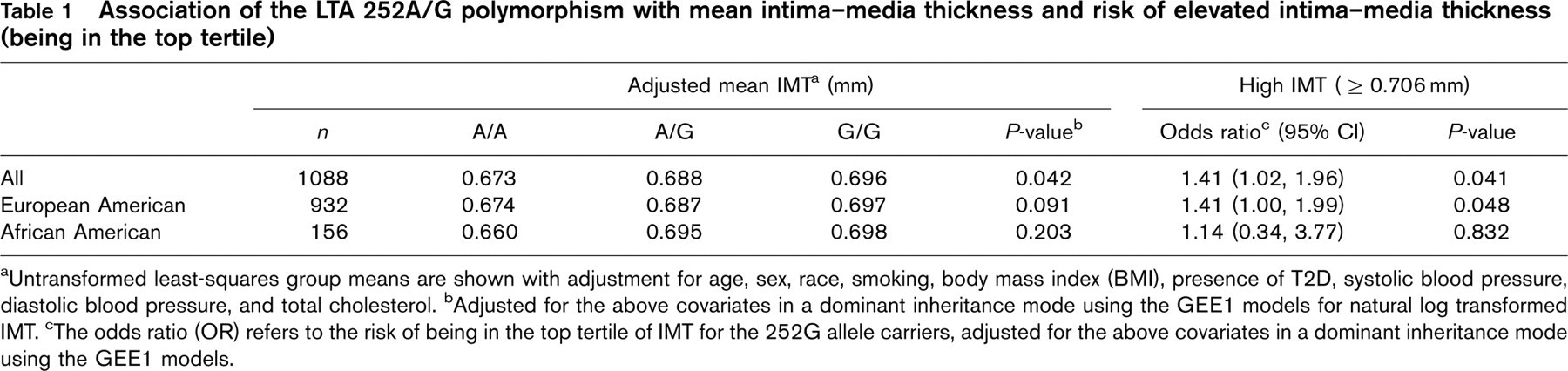
aUntransformed least-squares group means are shown with adjustment for age, sex, race, smoking, body mass index (BMI), presence of T2D, systolic blood pressure, diastolic blood pressure, and total cholesterol. bAdjusted for the above covariates in a dominant inheritance mode using the GEE1 models for natural log transformed IMT. cThe odds ratio (OR) refers to the risk of being in the top tertile of IMT for the 252G allele carriers, adjusted for the above covariates in a dominant inheritance mode using the GEE1 models.
Laboratory measurements
Participant presented fasting to the Wake Forest University School of Medicine General Clinical Research Center. Interviews for demographic and clinical information, and measurement of resting blood pressure, serum chemistries, fasting glucose and lipids were performed. On the same day, high-resolution B-mode carotid ultrasonography was performed using a 7.5 MHz transducer and a Biosound Esaote AU5 machine (Indianapolis, Indiana, USA). To enhance the reproducibility of carotid measures, standardized interrogation angles were used. The detailed descriptions of the ultrasound scanning and reading techniques have been previously reported [5]. A MassARRAY SNP genotyping system (Sequenom Inc., San Diego, California, USA) was used for genotyping.
Statistical analysis
A χ2 goodness of fit test was used for testing departure from Hardy-Weinberg equilibrium proportions. IMT was analyzed both as a dichotomous and a continuous variable. When treated as a dichotomous variable, we calculated the odds ratio (OR) for IMT being in the top tertile. The rationale for this analysis is that the relationship between IMT and clinical vascular events has been shown to be nonlinear and strongest at higher values of IMT [6]. As a continuous variable, IMT was natural logarithm transformed to better approximate the distributional assumptions of conditional normality. To account for the familial correlation inherent in sibships, generalized estimating equations (GEE1) assuming exchangeable correlations and using a robust estimator of the variance were calculated for all regression analyses using SAS version 8.0 (SAS Institute Inc., Cary, North Carolina, USA). The multivariate GEE1 models adjusted for traditional cardiovascular risk factors.
Results
The characteristics of DHS participants were previously reported (mean age 61 years; 55% female; 84% T2D) [5]. The median IMT was 0.656 mm (interquartile range, 0.584–0.736 mm). The G allele frequencies for the LTA 252A/G polymorphism differed by ethnicity (0.36 in European Americans, 0.60 in African Americans); the frequencies were consistent, however, with Hardy-Weinberg proportion expectations within each ethnicity. Allele frequencies in both subgroups were similar to those reported previously [7].
Adjusted IMT means (untransformed) by genotype showed that the LTA 252A/G carriers of the G allele (252G/G and 252A/G) had higher IMT than the 252A/A homozygotes (Table 1). This observation was significant in a dominant inheritance mode (P = 0.04) and marginally significant in an additive inheritance mode (P = 0.05) with adjustment of race and other covariates. Analysis of IMT by tertile showed that the 252G carriers were more common in the top tertile with or without adjustment. Compared to 252A/A homozygotes, the OR for being in the top tertile was 1.41 (95% CI, 1.02–1.96; P = 0.041) for the 252G allele carriers in multivariate analysis controlling for all of the above traditional cardiovascular risk factors. This association was also significant in the subset of European Americans, but not in the smaller sample of African Americans, although the point estimates were in the same direction for both these groups. Stratification of the overall group by sex, smoking, or presence of diabetes revealed similar results in the various sub-groups.
Discussion
This study is the first to report an association of the LTA 252A/G polymorphism with anatomically defined atherosclerosis. The association was observed in the overall cohort and in the European American sample. A similar non-significant trend was observed in the small sample of African Americans. These findings support a role for this, or other closely linked genetic variants, in the pathogenesis of atherosclerosis.
Several lines of evidence support the functionality of the 252A/G polymorphism. The 252G allele is associated with higher TNF-α levels in humans and greater production of TNF-α in in-vitro studies, when compared with the 252A allele, presumably through higher transcriptional regulatory activity [8]. Importantly, three other epidemiologic studies, including the Japanese genome-wide association study, observed an association between the 252G allele and clinical cardiovascular disease [2–4]. The 252G allele, however, is in almost complete linkage disequilibrium with the 26Asn allele and biological activity of a threonine-to-asparagine substitution at codon 26 was suggested in an in-vitro setting, where the 26Asn allele was associated with a higher expression of mRNA coding for vascular cell-adhesion molecule 1 (VCAM1) and E-selectin [2]. It is nearly impossible to determine its individual independent effect in an epidemiologic study of this type.
The data from the current study add to the growing body of evidence suggesting that genetic variation in the LTA gene may play an important role in the pathogenesis of atherosclerosis. More population-based, genetic and functional studies are clearly warranted to further refine our understanding of this important relationship.