






Abstract
Cardiovascular disease (CVD) is the leading cause of death and hospitalization in both men and women in nearly all countries of Europe. The most frequent forms of CVD are those of an atherosclerotic origin, mainly ischaemic heart disease, stroke and heart failure. The magnitude of the problem contrasts with the usual paucity and poor quality of data available on incidence and prevalence of CVD, except for few rigorous but limited studies.
The objectives of the health interview and health examination surveys (HIS/HES) are to evaluate the frequency and the distribution of the disease, to evaluate trends and treatment effectiveness, to estimate risk factors distribution and prevalence of high risk conditions and to monitor prevention programmes.
According to the EUROCISS project (EUROpean Cardiovascular Surveillance Set) recommendations, surveys are aimed at describing the prevalence of the following CVD conditions: myocardial infarction, heart failure, angina pectoris, peripheral arterial disease, stroke, and ischaemic heart disease.
HIS and HES were developed to supplement information collected from routine databases and population-based registers to implement consistent public health policies. HIS can be repeated periodically in a new sample of the population, or can follow up over time the population recruited at baseline. Procedures and methods to collect information from participants include self-administered questionnaires, direct interviewer-administered questions and telephone interviews. A minimum set of questions to be administered every year, along with a longer, more detailed module to be administered periodically are recommended to evaluate CVD prevalence. The addition of HES provides more detailed and objective information that can be used to improve estimates regarding prevalence of both risk factors and disease status.
The selection of more specialized CVD-specific tests will depend on the objective the survey is designed to achieve, the assumed response rate and the cost and time considerations. For HES on CVD the minimum required is to perform the following measurements: height, weight, blood pressure, waist circumference, total and high density lipoprotein-cholesterol and glucose assay in a nonfasting blood sample. The next appropriate step would be to perform an electrocardiogram. High costs usually make HES difficult to carry out.
Standardization of measurements, training of personnel and quality control are essential to assure reliable data. A high response rate is extremely important, as nonrespondents tend to have different health characteristics from the rest of the sample and their omission therefore results in bias.
This manual of operations is intended for health professionals and policy makers and provides a standardized and simple model for the implementation of a CVD survey. Eur J Cardiovasc Prev Rehabil 14 (Suppl 3):S43-S61 © 2007 The European Society of Cardiology
Keywords
Introduction and rationale
Burden of disease
The most frequent forms of cardiovascular disease (CVD) are those of an atherosclerotic origin, mainly ischaemic heart disease (IHD), stroke, heart failure (HF) and peripheral arterial disease (PAD).
CVD clinically manifests itself in middle life and older age, after exposure to risk factors. Even though clinical onset is mainly acute, CVD often evolves gradually and causes substantial loss of quality of life (QoL), disability and lifelong dependence on health services and medications. The societal costs of CVD are substantial and they are not only those directly related to healthcare and social services, but also include those linked to (a) illness benefits and retirement, (b) impact on families and caregivers, and (c) loss of years of productive life.
Changes in society's socioeconomic conditions and their concomitant influence on lifestyles affect the level and evolution of CVD in populations and individuals, in such a way that small changes in the prevalence of common risk factors like hypertension or smoking might have a large impact on the incidence of CVD [1]. The absolute number of patients in need of using health services for CVD conditions, however, does not decrease to the same extent owing to an increase in survival and a growth in the proportion of older people.
The magnitude of the problem contrasts with the usual paucity and poor quality of data available on incidence and prevalence of CVD, except for few rigorous but limited studies carried out in certain geographical areas.
Leading causes of CVD morbidity and mortality are IHD and stroke. Just under half of all deaths from CVD are from IHD and nearly a third are from stroke, and this is the case in almost all the European Union (EU) countries.
In 2005, all chronic diseases accounted for 72% of the total global burden of disease in the population aged 30 years and older. CVD alone accounts for 20% of global total disability adjusted life years in those more than 30 years of age [2].
In terms of health, acute events may mean an increasing number of dependent, chronically ill and disabled people, which may cause increasing costs of healthcare and strain the healthcare system. Despite this, according to the Organisation for Economic Cooperation and Development (OECD), it does not appear inevitable that longer life leads to higher costs. This is one of the reasons why the health system should be largely oriented to work on preventive actions.
Epidemiological studies have shown that CVD is preventable to a large extent. Public actions to lower the prevalence of risk factors in the population require a clear understanding and knowledge of the magnitude and consequences of CVD. Once reliable data are available, different preventive strategies can be implemented to reduce the occurrence and impact of the disease.
Health interview and health examination surveys (HIS/HES) to determine the distributions, frequencies and determinants of CVD and their trends are essential to plan and implement prevention and control programmes.
Cardiovascular disease surveys
The objective of a population health survey is to evaluate the frequency and the distribution of CVD and its risk factors, to evaluate trends and treatment effectiveness, to estimate distribution and prevalence of high risk conditions and to monitor prevention programmes and their effectiveness.
Focusing on the general population, surveys may provide a comprehensive picture of the disease in the community, highlight problem areas and suggest where treatment facilities and strategies are most in need of improvement. They may provide the information needed to plan healthcare services and to develop and test which methods are most useful as a basis for preventive and treatment action. These population-based surveys provide, as well, valuable additional information that can be linked with the information generated by other sources such as population-based registers.
Clinical and vital statistical studies have contributed notably to the understanding of causes and distribution of CVD, but their conclusions usually require verification by direct measurements on defined populations. Moreover, certain types of questions cannot be answered without conducting specific CVD surveys.
CVD surveys are needed to understand the characteristics, the burden and the consequences of the disease in the population through:
the monitoring of the occurrence of disease, that is to assess the population differences and trends in disease prevalence over time;
the understanding of the differences and changes in the natural disease dynamics between sexes, age groups, social classes, ethnic groups, etc.;
the identification of vulnerable groups;
the monitoring of the consequences of disease in the community;
the monitoring of the utilization of new diagnostic tools and treatments and their impact.
This is crucial to:
develop health strategies and policies;
plan health services and health expenditures;
improve appropriate allocation of resources;
evaluate the effectiveness of interventions.
Surveys must follow standardized procedures and methods to:
avoid biases from diagnostic fashions;
ensure data comparability (different populations and trends);
ensure data comparability with other surveys within the country;
ensure international comparability.
Historical background
The modern era of cardiovascular epidemiology began after the Second World War with the establishment of a number of cohort studies. What follows is a brief description of some of the studies that have contributed to our understanding of CVD epidemiology.
The Framingham Study, the best-known study, and a model for many others, was launched in the early 1950s. Several thousand men and women of all ages in Framingham, a community near Boston, were examined for certain personal suspected risk factors and followed-up for many years for coronary heart disease. The most consistent and powerful of these in explaining coronary risk were cigarette smoking, hypertension, plasma lipids and overweight. The control of these factors has occupied a central role in health promotion and public policy [3].
The Seven Countries Study was the first to compare CVD incidence and risk factors using a common protocol and standardized methodology in different international populations (USA, Finland, The Netherlands, Yugoslavia, Italy, Greece, Japan). That study, launched at the end of the 1950s and following 12000 men aged 40-59 years at baseline, found large differences in dietary fat intake, serum cholesterol and heart disease incidence (mortality and morbidity).
The study was unique for its time in standardization of measurements of diet, risk factors and CVD, training its survey teams and central, blindfold coding, selecting diagnostic criteria for the identification of diseases and analysis of data [4].
The Whitehall Study, of almost 20000 men aged 40-69 years examined in the 1960s and followed-up at regular intervals, is still being carried out (and since 1985 women have also been included). This study produced important insight into the determinants of health, highlighting the importance of the social environment in disease causation and cautioning against using stress uncritically as an explanation [5].
The MONItoring trends and determinants in CArdiovascular diseases (MONICA) Study, from the mid-1980s to mid-1990s, monitored coronary events and classic risk factors for coronary heart disease in 38 populations from 21 countries. Population surveys to estimate trends in risk factors were carried out in men and women aged 35-64 years.
Risk factors were measured with standard procedures during two surveys based on independent probability samples of the population at the beginning and the end of the 10-year period, generally with a third survey in the middle [1].
Existing surveys in EUROCISS (EUROpean Cardiovascular Surveillance Set) member countries: a brief overview
Tables 1 and 2 provide a description of the main surveys on CVD. Almost all these do not specifically focus on CVD but are general health surveys, in which CVD is monitored as part of the overall health monitoring of the population (i.e., as part of the national health survey). As shown in Table 1, the HES periodicity varies among countries. Methods of data collection include specific questions and/or the London School of Hygiene and Tropical Medicine (LSHTM) questionnaire for the evaluation of symptoms, medical examination and electrocardiogram (ECG).
Health Examination Surveys – disease: all IHD
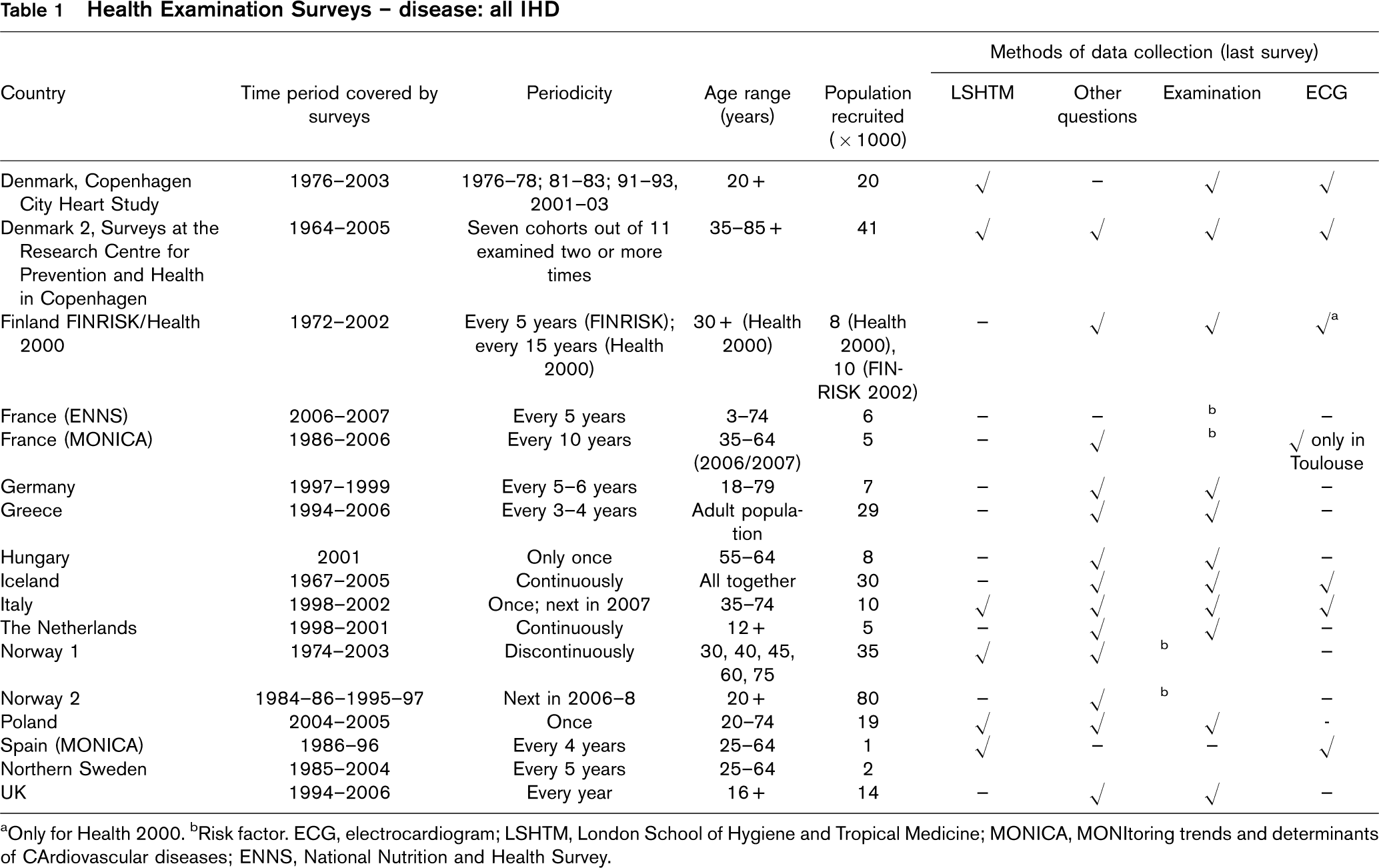
aOnly for Health 2000. bRisk factor. ECG, electrocardiogram; LSHTM, London School of Hygiene and Tropical Medicine; MONICA, MONItoring trends and determinants of CArdiovascular diseases; ENNS, National Nutrition and Health Survey.
Health Interview Surveys - disease: all IHD
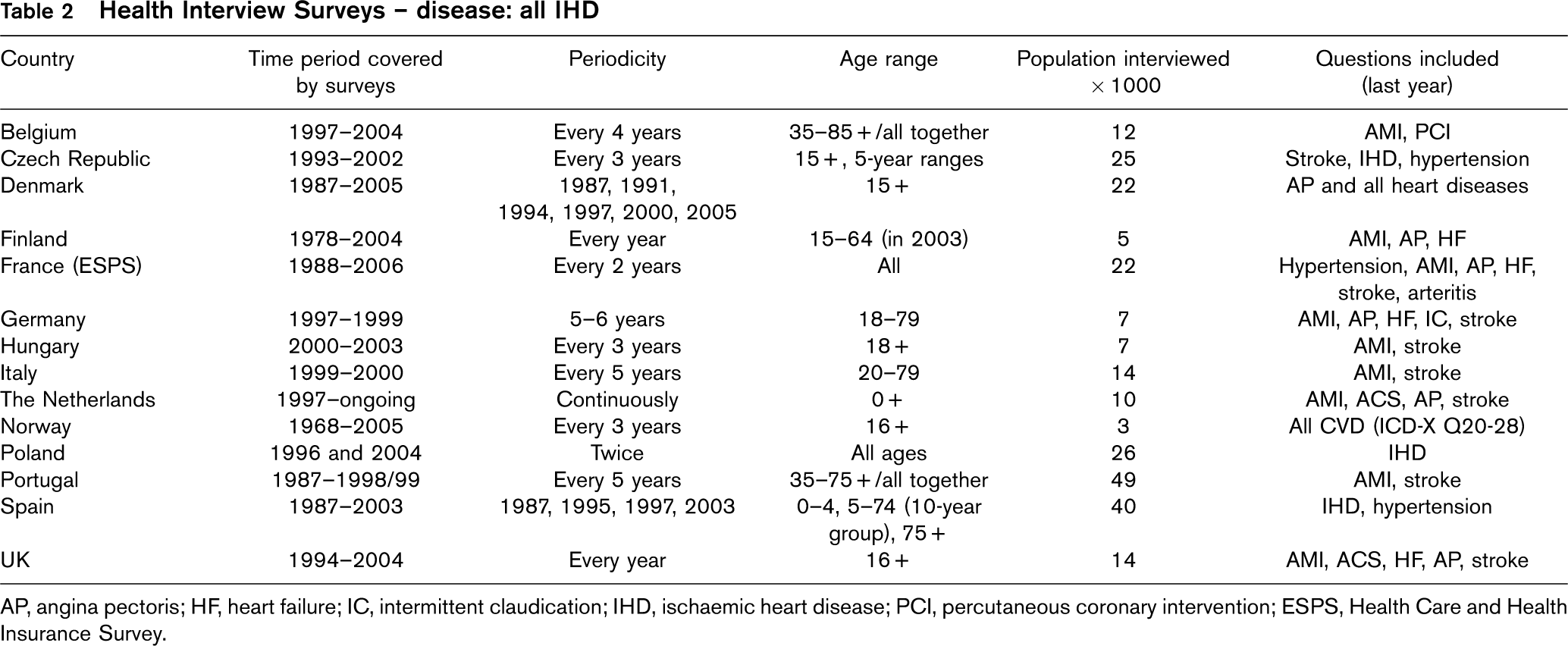
AP, angina pectoris; HF, heart failure; IC, intermittent claudication; IHD, ischaemic heart disease; PCI, percutaneous coronary intervention; ESPS, Health Care and Health Insurance Survey.
HIS are included in Table 2; they usually report findings from general questions on health conditions elicited through the use of self-administered questionnaires. Therefore, some conditions such as the prevalence of hypertension and diabetes could be underestimated given that only a part of individuals with diabetes and hypertension are aware of their condition [6].
The source of all information reported in these tables is the questionnaire filled in by each EUROCISS project partner. Data have been last updated in 2006, therefore any change occurred after this time period is not reported.
Objectives
The purpose of the EUROCISS project is to provide a general guide and updated methods for the surveillance of CVD to those EU countries that lack appropriate surveillance systems and therefore wish to perform a survey to produce comparable and reliable indicators.
This manual represents a useful tool to estimate CVD prevalence, a core indicator recommended by the EUROCISS project research group for inclusion in the short list of health indicators set up by the European Community Health Indicators Monitoring (ECHIM) project. This project was launched in 2005 with the aim of implementing health monitoring in the EU [7].
The procedures illustrated in this manual are designed with the main goal of simplicity and ease of implementation. Starting from a minimum data set and following a stepwise procedure, a standardized model for the implementation of surveys is provided.
These survey procedures are aimed at describing the prevalence of the following CVD conditions: myocardial infarction (MI), HF, angina pectoris (AP), PAD, stroke and IHD.
More detailed surveys may collect information on risk factors, social and demographic variables of population.
Strategy for surveillance
Surveillance methods and types of registers
Surveillance is the ongoing, systematic collection, analysis, interpretation and dissemination of health information to health professionals and policy makers. Surveillance, defined as a continuous, and not episodic or intermittent activity, differs from monitoring [8, 9].
Disease surveillance in a population can be done using many different data sources (Table 3). Most countries have national databases on causes of death and on discharge diagnoses for hospitalized patients.
Mortality statistics have for many years been the main tool for monitoring CVD trends and comparing health, disease pattern and mortality within and between countries. Causes of death are coded according to the International Classification of Diseases (ICD) to make data comparable among countries but the different ICD versions adopted by countries and different methods of ascertainment have led to problems in comparison.
In recent years, routine statistics have also included hospital discharge diagnoses which, in some countries, are coded according to the same ICD as the mortality data.
Many countries also have HIS/HES. These surveys are primarily used for monitoring CVD prevalence, risk factors (health behaviour, social network, environmental risk factors) and disease consequences (disability, reduced physical function, unemployment).
Tools for monitoring CVD

CVD, cardiovascular disease; HDR, hospital discharge records; HES, health examination survey; HIS, health interview survey; AMI/ACS, acute myocardial infarction/acute coronary syndrome; YLD, years of life lived with disability.
Relationship between registers and surveys
HIS and HES were developed to supplement information collected from routine information systems with additional details on socio-demographic characteristics, data on risk factors and physical/biological measurements to develop consistent public health policies. On the basis of the self-reports (HIS) and with the added benefit of physical examinations (e.g., blood pressure) and/or biological measurements (e.g., serum cholesterol) (HES), surveys enable policy makers to set priorities and to monitor trends in the health of the population.
Data for health monitoring, including monitoring of CVD, can be obtained from both registers and surveys; these instruments complement each other, as one has limitations not present in the other.
In general, institutional-based registers such as hospital discharge or general practitioner's (GP) registers can provide an overview on treated morbidity and suggest hypotheses for further investigations. These types of registers are valuable for healthcare service evaluation, but are not sufficient for health monitoring purposes. There are two main reasons for this: first, registers are subject to selection bias, as health service users differ from the general population. Second, estimates of prevalence are difficult to obtain, as the denominator (i.e., total number of patients seen within a particular time period) remains unclear or must be approximated; in addition, the numerator is sometimes also questionable owing to the lack of exhaustivity of the registration process. Population-based register can partly overcome this problem, but coverage remains a major concern.
Population health surveys can overcome much of the selection bias affecting register data, provided participation rates are high in all population subgroups. The added value of a population-based survey is the horizontal approach of data collection, enabling the collection of a wealth of information on health and its determinants: health status, health determinants, personal characteristics, uptake of services, etc. The simultaneous collection of these elements from the same person makes it possible to produce a global picture of the health of the population, identifying priority areas for treatment and prevention. In addition, when data are periodically gathered over time, changes in health and effects of health policies and interventions can be monitored.
The population health survey brings together the arguments for an increased investment in health promotion and prevention, and rationalization on healthcare and expenditure. This information thus provides a powerful framework for a rational policy decision-making process.
On the other hand, the results of health surveys have to be interpreted with caution as compared with more objective data coming from registers or routine statistics. Selection bias may result from nonresponse owing to those who refuse to participate or could not be reached. As data are collected in a sample of the population, statistical methods have to be applied taking into account the sampling design to interpret the results adequately. In addition, owing to the relatively small sample size, health surveys are usually not suitable for health monitoring in small geographic areas. For these purposes, particular surveys targeted to special populations or applying small-area methodology are more appropriate techniques.
Health information surveys and health examination surveys
HIS may be part of a permanent system of data collection at a national or regional level. They can be repeated periodically, in a new sample of the population, or follow up over time all or a subgroup of those recruited at baseline. One of the main characteristics of a survey is that most of the information gathered is provided by the individuals themselves, with all the potential subjectivity involved. Their experience and how they feel in relation to their own health status plays a major role, as well as the level of knowledge they have about it. Medical diagnoses refer to the declaration of a person answering the question: ‘Has a doctor ever told you that you have …?’ without any objective verification of the diagnosis by medical records; in some instances the self-reported information may not be sufficient to assess CVD morbidity. On the other hand, not only the conditions are considered, but there is also the possibility of investigating their impact on the functional status of the respondent; hence functionality and disability related to the disease are also important issues that can be investigated by a survey.
Self-reported information on disease can be more reliable if integrated with questions on drug-specific consumption.
HES are designed to investigate health issues: data are collected using survey questionnaires; in addition, physical examination and/or biological testing are carried out to obtain objective measurements to complement the subjective reporting of individuals.
A HIS/HES can vary in size and complexity, from an interview with a few measurements and/or blood assay to a comprehensive health examination taking several hours to complete. Some CVD risk factors can only be identified by clinical measurements such as blood pressure, blood lipids and blood glucose. ECG is also an important tool to assess CVD, in particular to detect an old MI, atrioventricular conduction defects, arrythmias and left ventricular hypertrophy. It can be read according to the Minnesota code that changes qualitative diagnoses into quantitative results; in fact, Minnesota code allows researchers to measure waves magnitude and duration and to transform them into numerical measures [10]. More clinical information can be obtained by clinical examinations carried out by nurses and doctors, which enables the actual prevalence of many CVD conditions to be assessed. Hand-held echocardiography is recommended to make a reliable diagnosis of HF [11].
High costs of clinical examination make HES difficult to carry out; only few HIS and HES use properly standardized and sensitive methods to assess CVD morbidity.
Ad hoc CVD surveys provide important information on risk factors and disease prevalence but are seldom representative of the whole country. They are usually conducted on adults and often have some age cut-off (e.g., exclude individuals >70 years). Their reliability depends greatly on the participation rate and methodologies adopted. If conducted in representative population samples, ad-hoc CVD surveys may provide a reliable estimation of CVD prevalence. Standardized procedures and methods are available, such as the questionnaires from the LSHTM used to identify effort AP, old MI and intermittent claudication (IC). These have been used for many years in population studies and are available in different languages. They may evaluate the presence of symptoms, of great importance for the health system when evaluating the burden of disease, because they record not only the acute manifestations of a previous disease (for example old MI), but also the symptoms (for example chest pain) that contribute to the use of health services and to health costs.
Minimum set of questions for health interview surveys
Detailed guidelines about population health survey design and methods are provided in other publications [12]. A document produced by the Statistical Office of the European Communities (EUROSTAT) Task Force 2 is available on the web site europa.eu.int/comm/eurostat [13]. This manual provides further indications specific for HIS on CVD questions.
Self-completed questionnaires, direct interviewer-administered questions and telephone interviews are common methods used to collect information from individuals enroled. Questionnaire design depends on the method of administration and questionnaires need to be validated.
As a general recommendation, a strategy for surveillance would be to use a national population health survey as the instrument of choice to collect information on CVD risk factors and prevalence. A minimum set of questions should be included (short module), together with a longer and more detailed module to be administered periodically, for example every 5-10 years.
Essential items to be recorded in any survey are full name, sex, marital status, date of birth, area of residence, identification number, date of interview and identity of the interviewer. To respect the privacy and confidentiality of the respondent, full name, area of residence, identification number and exact day of birth are never disclosed; even if the respondent gives informed consent, the anonymity is preserved (especially in the case of sensitive health data). Recording the personal identification number (PIN), which is used by the national health service, makes it possible to link data collected with hospital discharge records or death certificate, eventually for the follow-up. Educational level (expressed as years of education) and occupational classification are important because CVD recognizes a socioeconomic position influence (see also Socio-cultural characteristics) [14].
The most important outcome measures in surveys are estimates of the prevalence of CVD (old MI, AP, IC, HF, stroke). These can be obtained by asking directly about each condition, or can be measured indirectly through questions to assess symptoms. When designing a questionnaire to obtain such estimates, it is important to consider that all current techniques for measuring the prevalence of CVD have some limitations, for example symptom questionnaires have poor specificity for IHD and cannot be relied upon for cross-cultural comparisons of prevalence. The comparison of prevalence estimates based on a history of diagnosed heart disease may be biased by differences in access to medical care and diagnostic facilities. If HIS can be combined with HES, the addition of clinical examinations can improve on the estimates. For example, ECG criteria for prevalence of IHD (standardized through use of Minnesota coding) are more likely to yield unbiased comparisons of prevalence than questionnaire alone.
The minimum set of questions and recommendations for each condition are reported below. Irrespective of the presence of symptoms, the presence of the condition diagnosed by a doctor, together with the use of medication to treat the condition, should be considered indicative of the presence of the disease. Moreover, questions like ‘Have you ever been told by a doctor that you had … heart disease?’ can be followed by questions about the diagnostic and therapeutic procedures performed [percutaneous transluminal coronary angioplasty (PTCA), coronary artery bypass grafting (CABG), with specific medication].
Angina pectoris
AP is the commonest symptom of IHD. To assess angina, a minimum set of standard questions (A: Recommended questions) or the standard World Health Organization (WHO)/LSHTM questionnaire (B: Recommended questionnaire) can be used. The standard questionnaire of the LSHTM has been widely used; it was originally validated in men against clinical diagnoses, but it is a questionnaire that records symptoms in a standardized manner (chest pain relieved by rest) rather than the presence of disease. Especially in women, the questionnaire fails to distinguish coronary from noncoronary symptoms [15]. The questionnaire is also not recommended for use in older people [16]. Anyway, presently it represents the standardized tool translated in all languages.
A. Recommended questions
Have you ever been told by a doctor that you had angina pectoris?
If yes:
How old were you when you had the first attack?
Have you had an attack in the past 12 months?
Are you currently (in the last 2 weeks) taking any medicines, tablets or pills because of your angina pectoris?
If yes:
Name the medicines you are taking.
Interventions (CABG, PTCA):
Have you ever undergone any surgery procedure because of your condition?
If yes:
How long ago was it?
What type of surgery did you undergo?
Angioplasty (balloon treatment for angina pectoris)
CABG
Other
B. Recommended questionnaire
Chest pain on effort – LSHTM questionnaire
Note: please do not proceed to next question if your answer is marked with asterisk (∗)
Have you ever had any pain or discomfort in your chest?
Yes (ask next question)
No∗
Do you get it when you walk uphill or hurry?
Yes
No∗
Never hurry
Do you get it when you walk at an ordinary pace at the level?
Yes
No
What do you do if you get it while you are walking?
Stop or slow down
Carry on∗
Record ‘Stop or slow down’ if subject carries on after taking nitroglycerine If you stand still, what happens to it?
Relieved
Not relieved∗
If relieved:
How soon?
10 min or less
More than 10 min∗
Will you show me where it was?
Sternum (upper or middle)
Sternum (lower)
Left anterior chest
Left arm
Other Do you feel it anywhere else?
Yes
No Did you see a doctor because of this pain (or discomfort)?
Yes
No
If yes, what did he say it was?
Myocardial infarction
To assess an old MI, standard questions (A: Recommended questions) or the LSHTM questionnaire (B: Recommended questionnaire) can be used as well.
A. Recommended questions
Have you ever been told by a doctor that you had myocardial infarction (heart attack)?
If yes:
How old were you when you had the first attack?
Have you had an attack in the past 12 months?
Are you currently (in the last 2 weeks) taking any medicines, tablets or pills because of your myocardial infarction?
If yes:
Name the medicines you are taking.
Interventions (CABG, PTCA):
Have you ever undergone any surgery or operation because of your condition?
If yes:
How long ago was it?
What type of surgery did you undergo?
Angioplasty (balloon treatment for angina)
CABG
Other
B. Recommended questionnaire
Possible infarction – LSHTM questionnaire
Have you ever had a severe pain across the front of your chest lasting for half an hour and more?
Yes
No
Did you see a doctor because of this pain?
Yes
No
If Yes:
[What did he say it was?]
[How many of these attacks have you had?]
First attack: date_____ duration of pain_____
Second attack date_____ duration of pain_____
Third attack date_____ duration of pain_____
Fourth attack date_____ duration of pain_____
Stroke
It is difficult to use a questionnaire survey to measure the prevalence of an old cerebrovascular accident: many patients with stroke are unable to participate (they are not able to reach the place of screening or are hospitalized/in a long-term care home or are too impaired). For these reasons, if the institutionalized population is not included in the survey, stroke registers are more likely to yield valid data.
A. Recommended questions
Have you ever been told by a doctor that you had a stroke?
If yes:
How old were you when you had your stroke?
Have you had a stroke in the past 12 months?
Are you currently (in the last 2 weeks) taking any medicines, tablets or pills because of your stroke?
If yes:
Name the medicines you are taking.
Heart failure
No validated set of questions to assess symptoms of HF exists, because symptoms are not sufficiently specific for the disease. The European Society of Cardiology provided guidelines for the diagnosis of HF for use in clinical practice and epidemiological surveys [17]. According to these guidelines, objective evidence of cardiac dysfunction has to be present to establish the presence of HF, in particular: presence of symptoms of HF (at rest or during exercise), objective evidence (preferably by echocardiography) of systolic and/or diastolic cardiac dysfunction (at rest) and, in cases in which the diagnosis is in doubt, response to treatment directed towards HF. The presence of shortness of breath or fatigue can be assessed by means of the WHO questionnaire [12], but a clinical examination is required to verify the presence of ankle swelling and pulmonary crepitations or rhonchi.
A. Recommended questions
Have you ever been told by a doctor that you had heart failure?
If yes:
How old were you when you suffered from heart failure?
Have you suffered from heart failure in the past 12 months?
Are you currently (in the last 2 weeks) taking any medicines, tablets or pills because of your heart failure?
If yes:
Name the medicines you are taking.
Intermittent claudication
IC is the commonest symptom of PAD. To assess PAD, LSHTM questionnaire is recommended.
Recommended questionnaire
IC – LSHTM questionnaire
Note: please do not proceed to next question if your answer is marked with asterisk (∗)
Do you get pain in either leg on walking?
Yes
No∗
Does this pain ever begin when you are standing still or sitting?
Yes∗
No
In what part of your leg do you feel it?
Pain includes calf/calves
Pain does not include calf/calves∗
If calves not mentioned, ask: Anywhere else?
Do you get it if you walk uphill or hurry?
Yes
No∗
Never hurries or walks uphill
Do you get it if you walk at an ordinary pace on the level?
Yes
No
Does the pain ever disappear while you are walking?
Yes∗
No
What do you do if you get it when you are walking?
Stop or slow down
Carry on∗
What happens to it if you stand still?
Relieved
Not relieved∗
How soon?
10 min or less
More than 10 min
The set of questions asking about each doctor-diagnosed condition is further summarized in Table 4a.
Other relevant topics
Measurement of
The minimum information to be collected on
Recommended questions suggested by the European Health Risk Monitoring (EHRM) [18] are:
Hypertension
When was your blood pressure last measured by a health professional?
Within the past 12 months
1-5 years ago
Not within the past 5 years
Have you been told by a health professional in the past year (12 months) that you have elevated blood pressure or hypertension?
Yes
No
Uncertain
Are you currently taking medication prescribed by a doctor to lower your blood pressure?
Yes
No
Uncertain
Has a doctor in the past year ordered you to change your lifestyle, in order to lower your blood pressure?
Yes
No
Uncertain
Cholesterol
When was your blood cholesterol last measured?
Within the past 12 months
1-5 years ago
Not within the past 5 years
Have you been told by a health professional in the past year (12 months) that you have raised (elevated) blood cholesterol?
Yes
No
Uncertain
Are you currently taking medication prescribed by a doctor to lower your blood cholesterol level?
Yes
No
Uncertain
Has a doctor in the past year ordered you to change your lifestyle, in order to lower your total blood cholesterol?
Yes
No
Uncertain
Diabetes
Have you ever been told by a doctor that you have diabetes?
Yes
No
Uncertain
Minimum set of recommended questions for CVD (AP, MI, HF, stroke) - HIS
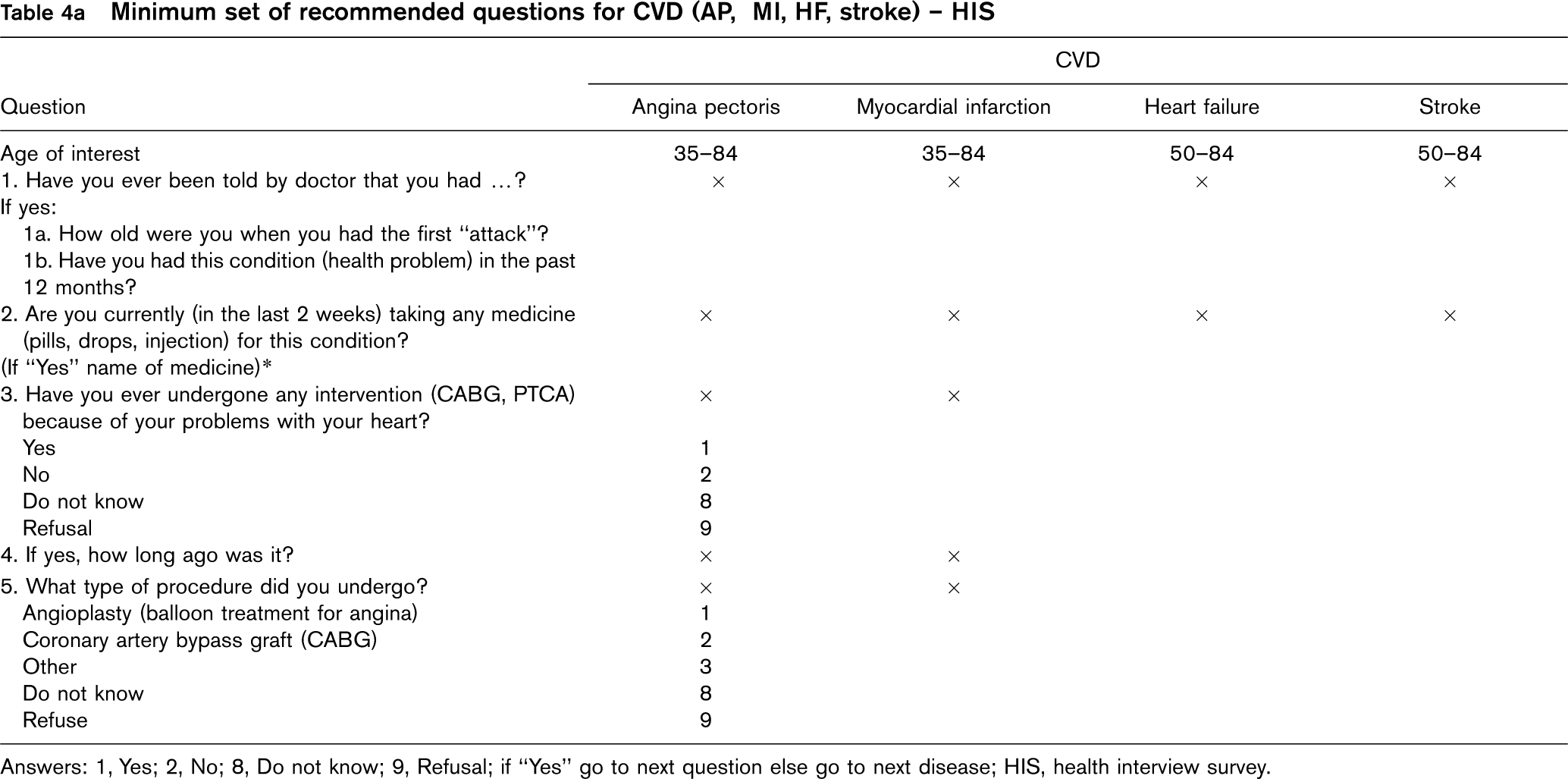
Answers: 1, Yes; 2, No; 8, Do not know; 9, Refusal; if “Yes” go to next question else go to next disease; HIS, health interview survey.
Minimum set of recommended questions for CVD risk factors – HIS
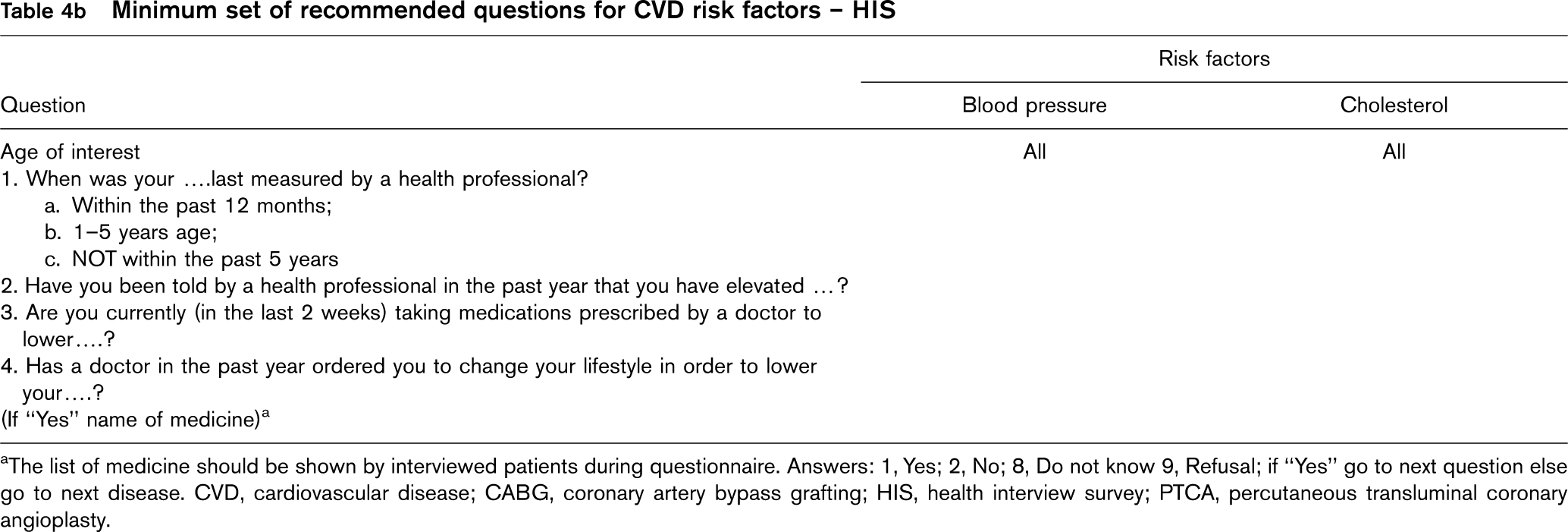
aThe list of medicine should be shown by interviewed patients during questionnaire. Answers: 1, Yes; 2, No; 8, Do not know 9, Refusal; if “Yes” go to next question else go to next disease. CVD, cardiovascular disease; CABG, coronary artery bypass grafting; HIS, health interview survey; PTCA, percutaneous transluminal coronary angioplasty.
Are you currently taking insulin or pills to control diabetes?
Yes
No
Uncertain
Medications taken by participants should be coded according to the pharmacological classification. See Anatomical Therapeutic Chemical (ATC) classification for Cardiovascular System at the following web site: http://www.whocc.no.
The set of recommended questions for CVD risk factors are further summarized in Table 4b.
Standard questions on smoking, drinking, physical activity and diet exist and can be found in several HIS/HES [19].
Already existing questions should be reviewed and used when possible, before starting to create new questions. Other health monitoring projects, in particular the EHRM project [18], reviewed the measurement protocols of national health surveys in Europe and provided recommendations for the measurement of major chronic disease risk factors
Minimum set of examinations for health examination surveys
A step-by-step approach is recommended, taking into account time and budgetary restraints. Priorities on a minimum set of questions and examinations to include should be based on public health criteria, starting from a basic set of questions/examinations and building up layers of complexity on the basis of user needs and available resources. A stepwise approach is proposed in Table 5.
Measurements based on physical examination are generally difficult to standardize. For example, a clinical examination is less accurate than an ECG for a diagnosis of arrhythmias. However, special equipment may be difficult and cumbersome to use, specialized personnel may need to be employed and the procedure may be costly, time consuming and demanding for the respondent. Hence, when cheap and quick measurements exist they should be the first choice. Where a method exists, but is expensive, it can be used in a subsample to validate estimates obtained from less costly techniques (e.g., waist and hip circumference for visceral fat distribution instead of a tomography).
Each measurement should be standardized and ethically approved, which means easy to perform, not expensive and without risk of harm to the patient.
Risk factors
The minimum set of measurements should include indicators for risk factors; in particular, arterial blood pressure, anthropometric measurements (height, weight and waist circumference) and a blood sample (for lipid and glucose measurements).
Protocols and operational guidelines for these measurements have been published as part of the EHRM project [18]. A brief summary of methods to measure major risk factors follows below.
Arterial blood pressure
Blood pressure should be measured by a qualified nurse or physician, before drawing blood, applying the appropriate cuff (normal or for obese persons) on the right arm, with a mercury sphygmomanometer, or a validated automated device, with the participant sitting, after 4-min rest. Three consecutive measurements should be performed and their mean (or the mean of the second and third) used in the analysis.
Anthropometric measurements
These should be measured with participants wearing light clothing.
Height and weight A wall height ruler and a balance beam scale should be used for height and weight, respectively. Data should be computed in the body mass index (BMI = weight in kilograms divided by the square of the height in metres).
Waist circumference Should be measured in centimeters by means of an insertion tape passed around the waist, defined as the mid-point between the iliac crest and the costal margin. The participant should be in the standing position.
Laboratory tests
Total cholesterol and high-density lipoprotein-cholesterol levels should be assayed on nonfasting blood samples into a laboratory certified for lipid tests by the Cholesterol Reference Method Laboratory Network. Glycemia should be assessed taking a blood sample after 8-hour fasting.
Stepwise approach for CVD HIS/HES
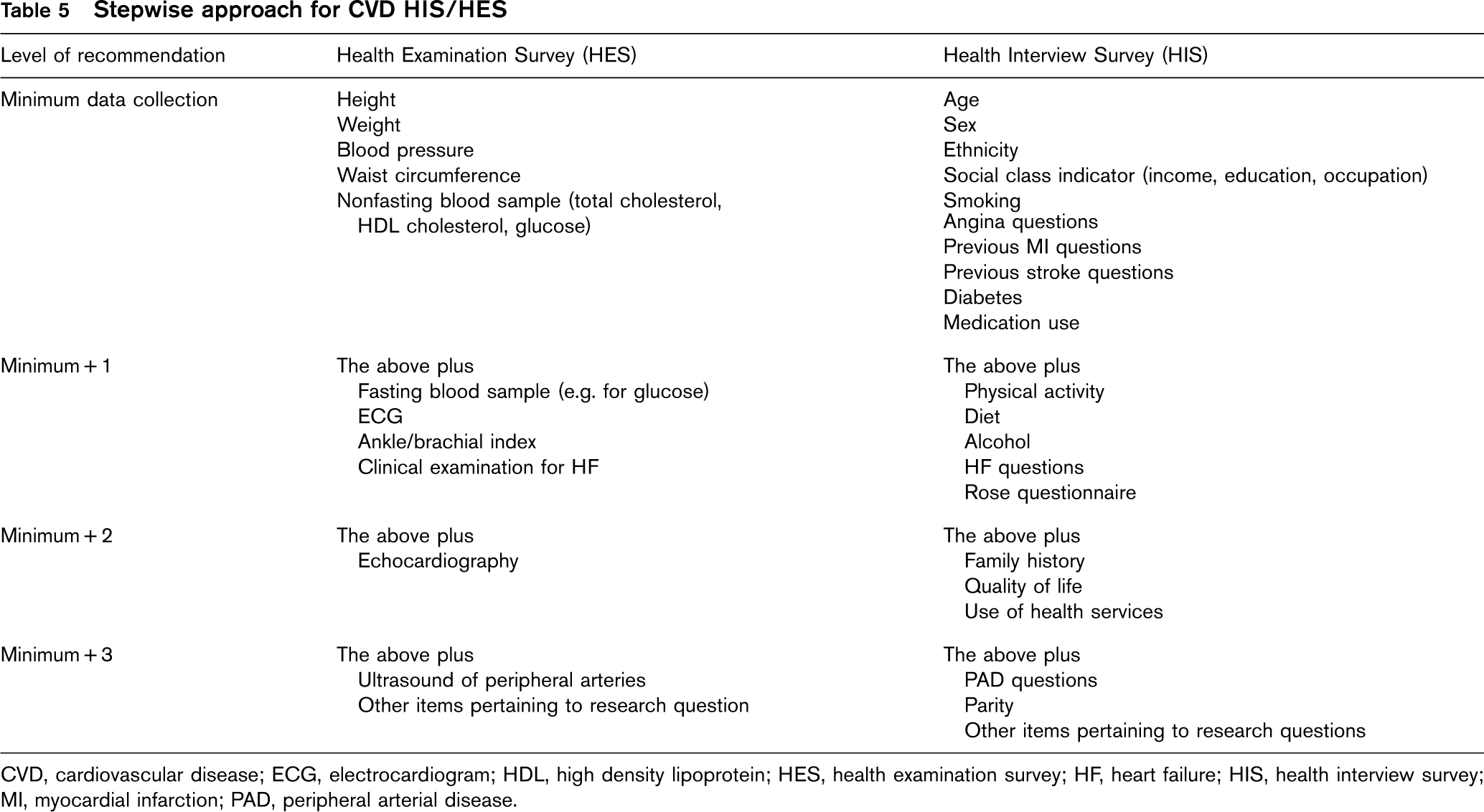
CVD, cardiovascular disease; ECG, electrocardiogram; HDL, high density lipoprotein; HES, health examination survey; HF, heart failure; HIS, health interview survey; MI, myocardial infarction; PAD, peripheral arterial disease.
Recommended procedures for more specialized CVD-specific tests are detailed below. The selection of these measurements will depend on the specific questions the survey is designed to answer, the overall burden on the respondent, cost and time considerations. The minimum required is to perform an ECG.
Electrocardiogram
The ECG is a graphic time-based record of voltage change produced on the body surface by electrical events in the heart muscle. It is used in CVD survey for the following reasons: to provide information on rate, rhythm conduction and state of myocardium; it is useful in diagnosing manifestations of IHD (MI, hypertrophy, AP); the information contained in the ECG is additional to and independent of that obtained by medical history and physical examination; it is of value in establishing categories of risk for future cardiac events and mortality and is an objective quantitative record of a bioelectrical signal characteristic of the individual. The participant should lie supine and the arms rest comfortably along the trunk. The position of the chest electrodes should be: V1 fourth intercostals space, right sternal edge; V2 fourth intercostals space, left sternal edge; V3 midway between V2 and V4; V4 fifth intercostals space where it is crossed by the midclavicular line; V5 left anterior axillary line with the horizontal position of position V4; V6 same horizontal level but at the left midaxillary line.
The recording of at least five technically good complex per lead is suggested to facilitate the reading by Minnesota code.
Recommended procedures for Minnesota code
The recommended procedure for recording a resting ECG and the technical requirements for a suitable electrocardiograph are described in detail in the reference manual for the Minnesota code [10]. Minnesota code is a score to classify Q waves (item 1), ST junction (item 4), segment depression and T waves (item 5), A-V conduction defect (item 6), ventricular conduction defect (item 7) and arrythmias (item 8). This does not need to be performed by a cardiologist, it is possible to train any observer who has a good basic technical education.
Minnesota coded major Q waves (codes 1.1 or 1.2) are recommended as the standard criterion for IHD in prevalence surveys. Use of more specific criteria including stand T-wave changes as a measure of prevalence in epidemiological surveys is to be discouraged. In women especially, these ECG signs have poor specificity for IHD [12].
Ankle-brachial index
The ankle-brachial index (ABI), a ratio of ankle systolic blood pressure to arm blood pressure, is used in clinical practice to assess the patency of the lower extremity arterial system and to screen for the presence of occlusive PAD. Owing to its good reliability and validity, non-invasive nature, and ease of use, the ABI has been used in epidemiologic studies to estimate the prevalence of PAD. Reports indicate that low ABI values (e.g., ≤ 0.9) are strongly associated with CVD risk factors, preclinical and clinical CVD and CVD mortality, thus can be considered a marker for generalized atherosclerotic disease [12].
Uncertainty regarding the lower normal limit of the ABI, however, exists, with published abnormal cut-off points ranging from 0.80 to 0.98. Varying the value defining an abnormal ABI can markedly affect estimates of PAD prevalence, yet adequate studies have not been conducted in healthy population to determine the normal ranges and lower abnormal cut-off point values of the ABI. A resting ankle-brachial blood pressure ration of less than 0.9 or a fall in ankle blood pressure of 30 mmHg or more in one or both legs is taken as evidence of PAD.
To measure the ABI, the participant should assume a supine position and rest comfortably for at least 5 min before the pressure is measured. This ensures that any changes in pressure that might have occurred due to previous walking have a chance to stabilize. Right and left arms and both legs should be measured. Blood pressures will be obtained in the following order: right arm, right ankle, then left arm, left ankle or simultaneously bilateral brachial artery and ankle.
Echocardiography (to be performed only in a subgroup)
Echocardiography is a powerful diagnostic tool that provides immediate access for the evaluation of cardiac and vascular structures and assessment of heart function [11, 20, 21]. Echocardiography, however, is best used after a careful history, physical examination, appropriate ECG, and chest radiograph have been obtained so that the appropriate questions can be asked. Indiscriminate use of echocardiography or its use for ‘screening’ is not indicated.
Two-dimensional imaging can accurately quantify cardiac chamber sizes, wall thickness, ventricular function, valvular anatomy and great vessel size.
Furthermore, echocardiography should be performed by laboratories with adequately trained physicians. Echocardiography is useful for assessing the presence of HF.
Ultrasound of peripheral arteries (carotides and femoral arteries)
The Doppler principle states that the frequency of reflected ultrasound is altered by a moving target, such as red blood cells. The magnitude of this Doppler shift relates to the velocity of the blood cells [22].
Doppler ultrasonography shows the direction and velocity of blood flow and thus can detect turbulent flow owing to narrowing or blockage of blood vessels. Colour Doppler ultrasonography shows the different rates of blood flow in different colours. Doppler ultrasonography and colour Doppler ultrasonography are commonly used to help diagnose disorders affecting heart, arteries and veins in the neck, trunk, legs and arms.
Currently, Doppler echocardiography consists of three modalities: pulsed wave (PW) Doppler, continuous wave Doppler and colour Doppler imaging.
PW Doppler measures flow velocity within a specific site (or sample volume) and is used in combination with the two-dimensional (2D) image to record flow velocities within discrete regions of the heart and great vessels.
Continuous wave Doppler, on the other hand, can record very high blood flow velocities but cannot localize the site of origin of these velocities along the pathway of the sound beam.
Colour flow Doppler uses PW Doppler technology but with the addition of multiple gates or regions of interest within the path of the sound beam. In each of these regions, a flow velocity estimate is superimposed on the 2D image with a colour scale based on flow direction, mean velocity and sometimes velocity variance.
Population
Before planning a survey, a detailed description of the characteristics of the target population under surveillance is necessary; in particular, age range, sex distribution, socio-cultural characteristics, including ethnic origin and migration level; whether institutionalized people should be included or not; moreover, geographic and/or administrative area and differences between urban and rural areas need to be identified.
When selecting the target population, a number of decisions need to be made. For example, whether or not to boost populations of interest (such as minority ethnic groups) or age groups of interest (such as older age groups for specific conditions).
Age range
For CVD surveys the age range is one of the most important criteria for the selection of the respondents.
The EUROCISS project suggests a wide age range, that is 35 + years. The choice of the upper limit will depend on the condition of interest.
In the case of some pathologies (i.e., HF), surveys conducted among very old individuals are limited in their ability to detect different concomitant pathologies. It is therefore advisable to establish the upper age limit to 75–80 years. Young people (less than 50 years), might be excluded from a survey of HF as they rarely have such disease, except in relation to congenital heart disease.
Similarly, if the survey is conducted to assess the prevalence of individuals who have experienced stroke, it is necessary to increase the age limit up to 84 years and to exclude young people, thus restricting the age range to 55–84 years.
As for surveys conducted among individuals with IHD or previous MI, the suggested age range is 35–80 years, thus excluding the age range 80–84 years, whose individuals are at higher risk of stroke rather than MI, and including IHD in young people.
Therefore, for the most exhaustive CVD survey the recommended age range to cover all the above-mentioned conditions is 35–84 years.
Sex
Population has to involve both sexes. If an estimation of prevalence of some CVD is required, larger samples of women have to be selected because of the lower prevalence of the disease in this group.
Socio-cultural characteristics
Social classification is important because rates of ill-health display marked social gradients in most societies. Understanding the causes of these gradients is a key area of research into the epidemiology and control of CVD.
Occupational status, rate of school attendance and revenue could be used to classify socioeconomic status.
Education could be assessed asking about the highest level attained (compulsory education, higher education, university), and the number of studying years. As differences are evident among countries with respect to school systems, it could be useful to obtain both data.
In some countries a national classification of occupational status exists. For instance, the system traditionally used by the Registrar-General for England and Wales assigned occupations to one of six classes: professional (I), managerial (II), skilled nonmanual (III-N), skilled manual (III-M), semi-skilled manual (IV) and unskilled manual (V). If no official classification exists, it should at least be possible to classify occupations as manual (‘blue-collar’) or nonmanual (‘white-collar’), or as manual work, clerical work, free profession. Most countries use the international classification CISCO 88, in which the first digit defines the ten main occupational classes.
Income could be useful to define the socioeconomic status. Although this information may be obtained without difficulties in some countries (e.g., UK where these data are routinely collected) in other countries people may be unwilling to declare their earned income.
Ethnic origin and migration level
Data on ethnic groups, defined by parentage, religious and cultural characteristics are important but very sensitive.
Assessing ethnic origin is important given that CVD prevalence usually differs between ethnic groups. Considering the large number of migrants coming into Europe, the migration level is now crucial to evaluate CVD morbidity. For instance, the prevalence of some CVD, that is those CVD derived from rheumatic diseases, differs largely between European and extra European countries.
Geographic and/or administrative area
Geographical or administrative borders of the surveillance area must be clearly defined. Administrative borders do not necessarily identify an homogeneous ethnic group. As a consequence, in some areas the CVD prevalence cannot be representative of the whole country. To evaluate the environmental impact on CVD prevalence, it is necessary to specify whether the area is urban or rural.
Population sampling
Samples of population with the aforementioned characteristics could be chosen from the general population, or from the GPs’ patient list or else through opportunistic screenings.
The results yielded from the sample may be generalized to the general population from which it has been selected with a degree of precision, but only on the grounds that:
the sample must be representative of the parent population;
the sample must be sufficiently large;
there must be adequate participation.
In determining sample size it is often useful to seek the assistance of a statistician. The kind of information needed to determine sample size includes:
the objectives of the study including the plan for statistical analysis;
the accuracy of the measurements to be made;
the degree of precision required by the investigator when generalizations from a sample to the population are made;
if the groups are to be compared, the magnitude of the differences that the investigator regards as meaningful;
the investigator's resources.
The larger the sampling size, the less the sampling variation: roughly the usefulness of a sample is proportional to the square root of its size. The recommended method of sampling is probability sampling, in which each individual unit in the total population has the same probability or likelihood of being selected.
The first requirement is a nominal roll or sampling frame identifying each individual member or unit of the population from which the sample is to be drawn (e.g., population census lists, voter lists, tax lists, household registers, lists of employees).
Random national samples
Random national samples could be used in questionnaire study, both interviewer-conducted and self-distributed. Physical examination of a random national sample is expensive to undertake and some cluster samples may be much easier to identify and examine. International comparisons are easily based on studies of restricted samples within each country. It is important to have representative samples from different geographical areas (north, centre, south).
Random national samples have the advantage of being representative of the population, but their limitations lie in the fact that they may be spread across different areas too far from each other and their examination is usually expensive.
General Practitioner's network
From a GP's network, samples could be selected from randomly recruited patients and from volunteer-recruited patients. It is recommended that patients be randomly selected from GP lists. This kind of selected sample, being very heterogeneous, is more representative of the general population. Samples from a GP's network are also relatively easy to enrol.
Opportunistic screenings
Medical examinations not directly related to CVD, such as business checkups, voluntary blood donation, prevention initiatives (including free health visits), occasional checkups for pathologies are different from CVD surveys, which provide data on population samples. These samples are not representative of the whole population.
Response rate
A high response rate is extremely important, as non-respondents tend to have different health characteristics from the rest of the sample, and their omission therefore results in bias. Unfortunately, the direction and extent of the bias are often unpredictable: some individuals refuse to come for examination because they feel fit and cannot be bothered, others because they feel ill and afraid. The amount of bias introduced depends on the frequency of the condition in the sample as a whole, the proportion of nonrespondents, and the extent to which the nonrespondents are atypical.
With a high-prevalence condition a poor response rate is less likely to be serious, provided that nonrespondents are not different from those who respond (e.g., younger, of lower socioeconomic status, etc.).
Unfortunately most cardiovascular conditions have low prevalence rates. In a study of the ECG changes of infarction in a population with a true prevalence of 2%, failure to examine 20% of the sample among whom the prevalence was 5% would lead to a prevalence estimate among respondents of 1.25%, a proportionately serious error.
The primary aim must therefore be to obtain a response rate such that serious bias will not occur even if the nonrespondents are unrepresentative. In practice, this cannot always be achieved, and one must then try to assess the bias resulting from the omission of nonrespondents on the basis of such information as is available for the whole sample – for example, age, sex and residence.
As the likelihood of bias depends on the cause of nonresponse, the investigator should report the numbers that fall into various categories - for example, removed since census, on holiday, ill, dead or refused to take part. Direct assessment of bias may sometimes be possible by making a special effort to interview or examine a subsample of the nonrespondents.
A protocol should specify the sequence of efforts to follow up nonresponders and a record keeping system to document and monitor this.
Personal contact (by nurse, physician, or key local figure or the senior investigator) and convenient appointments, arrangements for time off from work, transportation, etc., may help elicit cooperation and overcome resistance to response.
Populations with the following characteristics may have a low response rate, which may vary among countries:
ethnic minorities;
elderly;
low education and occupational status;
poorer classes;
illness-U-shaped curve with lower response in the most sick and the most well;
mental illness;
institutionalized people often not included unless specifically sampled for;
feeble memory.
Reporting
The purpose of a HIS/HES is to present a picture of disease in a population at a particular point in time. The survey provides estimates of the disease prevalence, that is the number of patients who have experienced AP, HF, MI, stroke, IC and with high risk conditions (hypertension, hyperlipidaemia, diabetes). The prevalence is one of the indicators included in the ECHIM short list [7], together with attack rate and incidence which can be obtained through population-based registers.
The prevalence should be presented for the age ranges 35–44, 45–54, 55–64, 65–74, 75–84, 85 years and over (if included), according to EUROCISS recommendations, and provided for men and women separately. Indicators should be directly standardized by age (35–74 years) and sex using the European population as a reference [23].
Quality control
Standardization of measurements, training of personnel and quality control are essential to assure reliable data. Manuals of operations containing detailed procedures and methods on standardization, training and quality controls are already available [12]. It is recommended to use survey instruments whose sensitivity and specificity have already been assessed. Such questionnaires, laboratory techniques, diagnostic criteria and procedures for measurements are already available in literature. For example, the EHRM project produced recommendations, protocols and manuals of operations for chronic disease risk factors surveys, including CVD risk factors [18].
Personnel assigned to screening should be properly trained and quality control should be assured for the whole collection period. To perform a survey many medical personnel may be needed and their activities should be under regular quality control for the whole collection period to ensure validity and comparability of data.
To reduce measure variability it is important to consider:
season of year (continuous survey takes care of this);
time of day (morning/afternoon);
setting;
time of last meal or last cigarette (counting at least 12 h from the end of the last meal if laboratory analysis includes lipids).
A pilot test of the entire set of procedures and methods is needed before starting screening procedures to:
rehearse the main investigation;
identify problems with methods; practicality, reliability and validity;
familiarize staff with practical problems;
result in refinement of techniques before going into the field;
make observations on respondents’ reactions;
record time to do interview and study procedures;
test appropriateness of arrangement of the questionnaire and ‘flow’ of procedures;
allow better estimates of space, personnel, supply and equipment needs.
Ethical issues
The Helsinki declaration requires that biomedical research with human subjects must conform to generally accepted scientific principles.
The ‘Recommendation n. R (97)5 of the committee of ministers to EU member states on the protection of medical data’ [24] gives guidelines on how medical data can be registered, stored and used in a way that ensures the rights and the fundamental freedoms of the individual and in particular the right to privacy. (Adopted by the Committee of Ministers on 13 February 1997 at the 584th meeting of the Ministers’ Deputies).
In the following the most important recommendations are presented:
‘Medical data should be collected and processed only by healthcare professionals, or by individuals or bodies working on behalf of healthcare professionals. Individuals or bodies working on behalf of healthcare professionals who collect and process medical data should be subject to the same rules of confidentiality incumbent on healthcare professionals, or to comparable rules of confidentiality.’
‘Medical data shall be collected and processed fairly and lawfully and only for specified purposes.’
‘Medical data may be collected and processed:
if provided for by law for
public health reasons; or
subject to Principle 4.8 (processing of genetic data for the purpose of a judicial procedure or a criminal investigation should be the subject of a specific law offering appropriate safeguards), the prevention of a real danger or the suppression of a specific criminal offence; or
another important public interest; or
if permitted by law:
for preventive medical purposes or for diagnostic or for therapeutic purposes with regard to the data subject or a relative in the genetic line; or
to safeguard the vital interests of the data subject or of a third person; or
for the fulfilment of specific contractual obligations; or
to establish, exercise or defend a legal claim; or
if the data subject or his/her legal representative or an authority or any person or body provided for by law has given his/her consent for one or more purposes, and in so far as domestic law does not provide otherwise.’
Whenever possible, medical data used for scientific research purposes should be anonymous. Professional and scientific organisations as well as public authorities should promote the development of techniques and procedures securing anonymity. However, if such nonymisation would make a scientific research project impossible, and the project is to be carried out for legitimate purposes, it could be carried out with personal data on condition that:
the data subject has given his/her informed consent for one or more research purposes; or
when the data subject is a legally incapacitated person incapable of free decision, and domestic law does not permit the data subject to act on his/her own behalf, his/her legal representative or an authority, or any person or body provided for by law, has given his/her consent in the framework of a research project related to the medical condition or illness of the data subject; or
disclosure of data for the purpose of a defined scientific research project concerning an important public interest has been authorised by the body or bodies designated by domestic law, but only if:
the data subject has not expressly opposed disclosure; and
despite reasonable efforts, it would be impracticable to contact the data subject to seek his consent; and
the interests of the research project justify the authorisation; or
the scientific research is provided for by law and constitutes a necessary measure for public health reasons.
In 1985, the International Statistical Institute (ISI) formed a Declaration on Professional Ethics, which most national statistical agencies have agreed on. The declaration can be found at http://isi.cbs.nl/ethics.htm. In short, the declaration covers obligations to society (considering conflicting interests), obligations to founders and employers (clarifying obligations and roles, guarding privileged information), obligations to colleagues (maintaining confidence in statistics, communicating ethical principles) and obligations to individuals (refers to human subjects, including individuals, households and corporate entities: in particular, avoiding undue intrusion, obtaining informed consent, modifications to informed consent, protecting the interest of persons, maintaining confidentiality of records, inhibiting disclosure of identities). In CVD surveys it is important to obtain informed consent, to respect privacy and confidentiality, to avoid harm and to maintain well-being of the respondent. Before conducting a CVD survey, it is important to find out if there are any national ethical restrictions to be considered.
A specific ethical issue to be considered relative to HIS/HES is related to how to deal with suspected, previously undiagnosed, pathological findings (e.g., hypertension) because of the implications, for example, with insurance policies.
Recommendations
The following ‘steps’ are recommended when planning and implementing CVD surveys.
They are in some ways arbitrary and not purely sequential. Many ‘steps’ take place simultaneously and recurrently throughout the conduct of a survey.
Definition of objectives
The aims should be specified in precise as well as general terms.
The definition of specific aims should be based on the current state of knowledge in the country and on a thorough review of the literature.
Choice of study population
The choice of a study population depends on a subtle balance of a number of issues:
suitability – adequate numbers of persons at risk;
feasibility – logistic and cost considerations;
availability – accessibility, likelihood of cooperation.
Selection of variables to be measured
The characteristics to be measured are referred to as variables whether measured numerically (age, blood pressure, height, weight, cholesterol) or categorically (sex, education level, history of CVD). During the planning of a study it is necessary to select and define variables which will be measured (refer to Table 5).
Selection of measurement instruments
Methods of collecting information should be selected and applied for the following:
questionnaires – interview or self-administered;
physical examination – clinical examination by a physician (e.g., pulse rate)
special investigations – ECG, blood tests, weight, height, etc.
Definition of diseases
It is also important to have clear operational definitions of CVD. Clinician establishes diagnosis by clinical judgement, avoiding rigid rules.
In a survey, unless standard working definitions are used, the findings will not be reproducible. This means that only a person who answers positively to all questions of LSHTM questionnaire for effort angina will be classified as having angina symptoms.
Planning the records
The types of records to be prepared include the lists of persons to be examined; the appointment books, and the letters of introduction and invitation; and informed consent according to local legislation.
Planning the analysis and coding
Decisions on statistical techniques to be used in analysis, if a statistician is consulted, should be outlined in the planning stage.
Planning for time, personnel, space, supplies and equipment
To implement a survey, it is necessary to prepare a budget and obtain funds, to set the time line of stages and activities, to provide a list of the numbers and types of personnel needed and for what periods (clerks, technicians, editors and data staff, physicians, nurses, interviewers, field coordinator, etc.), to establish the amounts and types of space needed and for what periods, to arrange personnel recruitment and training.
In addition, forms should be printed, maps and census materials should be available, sampling frames should be prepared and types of equipment and supplies needed at each stage should be provided.
Population surveys do not require highly trained clinicians or highly skilled personnel, usually trained nurses can conduct the study.
Incorporation of plans in a written protocol
It is necessary to specify in writing the detailed plans as they relate to aims, methods of procedure and plans for data analysis.
Recruitment of the population
Successful recruitment of a study population requires careful preparation through personal contacts and an educational campaign. In this way individuals will be motivated to join the study and community leaders will be supportive and have pride in their association with the project.
The contacts and campaigns must be made with the interests of the different groups in mind. The population or community should be understood in terms of organizations, political and cultural make up and interests in planning these contacts.
Institutional human studies or ethics committees may need to approve the study.
Recruitment and training of staff
It is recommended that interviewers and others in contact with the community are carefully selected, capable, personable and interested. Criteria procedures for selection should take into account special needs and characteristics of the study population and the procedures to be employed.
Regular meetings for feedback and reinforcement, ongoing surveillance of techniques and results, periodic re-standardization and quality control are required.
Field organization
If a survey includes a number of procedures each done by a different worker, it is necessary to design a ‘line of flow’ where participants pass from one station to another.
A precise knowledge of staffing needs on the basis of pretests and pilots, of the numbers of interviewers, clerks, technicians, physicians, nurses, administrative staff, of routine work done in regular working hours and of regular meeting for in-service education and problem solving is required. Persons undergoing examinations must be notified with results.
Footnotes
Acknowledgements
This project has received financial support from the European Commission, Directorate General for Health and Consumer Protection – Grant Agreement no. 2003118 and from the CUORE project of the Italian Ministry of Health.