







Abstract
As a student, participation in the 24-h Estafette Run was something that was decided upon the day before the start; however, as Bucks Fizz (former British Eurovision triumphs, not champagne!) would suggest; ‘now those days are gone.’ Nowadays, with the body no longer as fit as the mind, one tends to take a more considered approach. We recommend that instead of waiting for the passing of another New Year's Eve to make that resolution, galvanize yourselves into action and make your minds up right now. In Barcelona, the city of the XXVth Olympiad, with the statement of this year's congress ‘Prevention of Cardiovascular Disease’ impregnated deep in your frontal lobes, take the first step into the realms of a heart healthy life.
As cardiologists and members of the European Society of Cardiology, we should practice what we preach. Before embarking on your new regime, seek preparticipation screening for cardiovascular disease if you experience anginal symptoms, have more than one established acquired risk factor for atherosclerosis, or a strong family history of ischaemic heart disease. Once you overcome this minor hurdle, you are ready to get going. Just remember though, many of us are not used to regular endurance training; some of us have piled on kilograms around the waist line in addition to undergoing advanced biological maturation (known by some as ageing) and may not have much idea about the importance of the correct shoes or clothing. How do we survive an initially overenthusiastic and unrealistic attempt to run the London marathon next year? One word, repeated twice; ‘polé polé’ it easy' if you don't speak Swahili). Here are a couple of useful tips to consider before throwing yourself headlong into a new and healthy infatuation.
No pain, no gain? How to run effectively …
For those of you who hate the idea of ‘gadgets’ [such as heart rate (HR) monitors] and want to combine a healthy and effective run with the pleasure of the countryside, or a chat with your neighbour, try to use the talk-test. Your workout should be intense enough to make you breathe deeply and to feel a little winded, but not unpleasant. If conversation is reasonably comfortable, you are working at a good moderate intensity. If you are able to sing, speed up! For vigorous intensity, you should feel the need to pause for a breath after a couple of words. The use of a HR monitor is the next step in optimizing your efforts. Running at between 80 and 90% of your maximal HR is known as your threshold, and is the highest effort level. Remember that the (220 minus age) formula is only a rough estimate of a parameter that follows a wide normal distribution, but is a reasonable starting estimate. To obtain a true guide to exercise intensity, submitting yourself to a cardiopulmonary exercise test and actually measuring your maximal HR, and specifically, defining your anaerobic threshold, is a reproducible objective way to tailor your training and is advised for those who find targets and numbers helpful, but this is no substitute for getting out there and getting going!
Your body may protest
Don't forget to listen to your body. Remember to be objective when gazing in the mirror! If you are underweight (BMI < 18) or overweight (BMI > 25), if you already suffer from a vulnerable Achilles tendon, a sore knee or a weak back, remember you are ‘not’ a sports doctor, and the last time you looked at a knee was at a medical school. A simple piece of advice from an expert or a minor correction of your shoe sole might do wonders. If you develop an injury, do not ‘run through it’. Assess, be reasonable and get advice.
If you have flu, a feverish cold or a tummy bug, do not train until you have fully recovered. Then start gently and build up gradually. Do not attempt to catch up on lost mileage after illness or injury – this may cause further damage or illness. If you have flu it can take as much as a month to recover.
Fluid lost in sweat must be replaced; otherwise, your body becomes dehydrated and less efficient. Take it easy on fermented grapes, berries and barley and cut back on the Red Bull. Take plenty of nonalcoholic drinks, especially when training in hot weather. Drink enough to keep your urine a pale straw colour. Drink plenty of liquids after training, especially long runs.
Running on a cloud – get outside!
The beauty of running for a stressed, overworked cardiologist is the ease with which you put on your running shoes, step out your front door, and forget about the worries of the office. Don't confine yourself to the treadmill, be adventurous! The great outdoor beckons, and to maximize your pleasure and guarantee injury-free sporting, choose another environment and a harmless running surface. It makes the effort somehow more bearable if you have something beautiful to look at. For a run that mixes constantly changing surroundings with near-ideal running surfaces, head for your local woodland. Concrete is a hard and unforgiving surface that can worsen any little niggles and injuries that you may have and try to avoid it wherever possible. For those of you who must run on concrete roads, please ensure you are running against on-coming traffic and make yourselves visible by wearing bright reflective clothing.
If a vacation nearby a tropic wide-sanded beach seems the ideal time to boost up your training, take it easy when running on the sand – it will play havoc with your Achilles tendons if you are not used to it. Just limit your efforts to a little every day – and by the end of your break you will be strengthened and ready to return home refreshed.
‘These boots are made for walkin’ – they may not be made for running …
The glamour of other sports may be beguiling – imagine shiny bikes and flashy surfing equipment – but there is one simply crucial investment for a smart runner – shoes! You need to invest in a good pair of shoes and you should replace these at least every 500 miles (maybe more often if you are very hard on shoes …). Don't neglect this advice; shoes lose shock absorption, cushioning and stability over time. For once, let yourself be talked into a good buy. Look for a specialized seller, get advice from a runner-salesman and test the shoes, if not outside, then on a treadmill, preferably in the evening. Don't buy what looks flamboyant, on sale, or is aggressively advertised. Overpronation or supination of your foot will usually not lead to injury in daily life but might do so when you start running. Take an old pair of shoes along with you, a simple look at the soles may provide a valuable indication to potential problems; if they are worn on the inside (overpronation) or outside (supination) of the sole, then this influences the choice of shoe. Another way to simply assess this is by doing the ‘Wet test’; after a shower or bath – with wet feet – simply walk across a smooth floor. The shape of your footprint can show whether you overpronate or underpronate. Either by choosing a specifically designed shoe that corrects this problem or, if severe, by having an orthotic device fitted, injuries can be avoided at the offset. Don't underestimate the foundations (read ‘feet’) of your body, especially when you start moving it!
Don't let any of this put you off. Running is one of the best ways to lose weight, de-stress and get out and enjoy the countryside. Give it a go – you will feel better for it!.
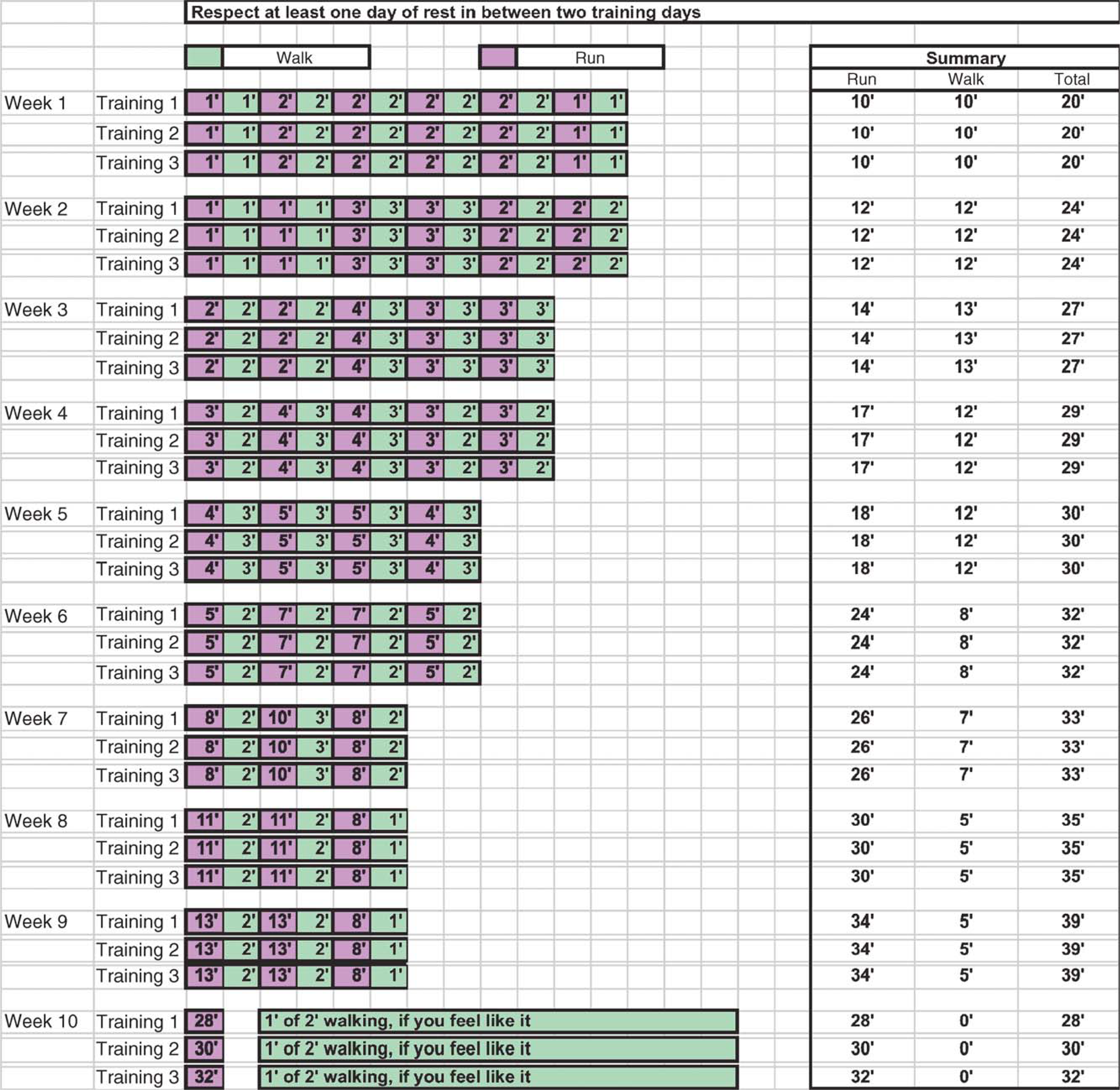
Example of a ‘start to run’ programme aiming to complete a 5K after 10 weeks.