






Abstract
Background
Design and method
Results
Conclusion
Introduction
Acute physical exercise effects are described as a paradox [1]. Indeed, regular physical activity is known to reduce cardiac sudden death risk, and its long-term cardiovascular benefits have been well validated by several prospective studies both in primary and secondary cardiovascular prevention [2]. However, the fact that the risk of acute cardiovascular events (ACVEs) is transiently increased during and immediately after acute, and mainly vigorous, exercise is well described [3–5]. These sports-related events concern mainly relatively untrained participants [3–6], but they also are sometimes reported in well-trained athletes with unknown cardiovascular disease [7–9].
Although sports-related ACVEs are globally rare, because of media coverage they are always perceived by the general population as tragic and unbelievable events. Thus, they can cast doubt on the healthiness of physical activity for the general population. In order to try to prevent these dramatic events, North American and European recommendations concerning eligibility for participation in competitive sports [10–12] and leisure-time physical activities have recently been proposed [13–15].
Sports-related cardiac sudden death (SD) and myocardial infarction (MI) are the most frequently reported events [4–7, 16, 17]. However, information concerning other serious sports-related events, such as aortic dissection and stroke, and those that are less serious, such as nonfatal ventricular or supraventricular arrhythmias, is scarce [17, 18]. Moreover, most of the actually available reports are retrospective, and come from North America [7, 8] and some European countries such as Italy [9], Scandinavia [19], and Germany [20]. To our knowledge, the only one prospective study published has concerned only SD in young Italian people [21]. Thus, the real incidence of sports-related SD and other ACVEs are unknown. The aim of this study was to prospectively study the incidence of all sports-related ACVEs in the general population of a region of France.
Methods
This 1-year prospective study carried out between 1 March 2005 and 28 February 2006 concerned three departments of the southwest of France. Four hospital medical emergency departments participated in the study. The official 10 to 80-year-old population registered in the three departments covered by the study was 1 954 382 participants, with 1 005 353 women and 949 029 men [22].
All cases of sports-related ACVEs that occurred during and/or within 1-h post-sports practice and reported to the four emergency departments have been collected. In each individual case, the same check list has been filled in by the emergency staff. In case of hospitalization, all patients' data have been collected. An MI diagnostic was carried out in accordance with ECG and classical blood markers alterations. A diagnosis of arrhythmia was performed, with the first ECG recording obtained by the emergency team on the field.
As a result of the classical sports-related ACVE, etiologies are reported in accordance with the population age. We have compared three population groups, below 35 years of age (n = 732 747; 363 493 women), between 35 and 59 years of age (n = 812 846; 415 519 women) and above 59 years of age (n = 408 789; 224 365 women) [7–9, 21]. Results are expressed as mean (± SD). For statistical comparison, we used Student's unpaired t-test or Pearson's χ2 test with Fisher's exact test when appropriate. Statistical analysis was performed with the EpiInfo for Windows, Version 3.3.2 software package (SPSS Inc., Chicago, Illinois, USA). Level of significance was set at a P value of less than 0.05.
Results
During the 1-year period of the study, 127 sports-related ACVEs were collected and 79 participants were hospitalized. Emergency departments were called for dizziness or syncope in 58% cases, thoracic pain in 38.4%, and cardiac arrhythmias in 3.6%. Sports-related ACVEs were observed on thoroughfares (40.2%), on the beach (23.5%), during field sports (18.9%), on the mountains or at home (7.9% for each), in swimming pools and in changing rooms (0.8% for each). Sports-related ACVE causes are summarized in Table 1.
The mean age of participants was 45.5 (14.6) years (range 10-80). Global, sex, and age incidences of sports-related ACVEs are reported in Table 2. Both significant sex and age effects were observed. More men [n = 103; 81.1%, mean age 46.9 (13.1) years] than women were involved [n = 24; 18.9%; mean age 39.9 (18.9) years]; (P < 0.001). With regard to the age effect, most sports-related ACVEs were observed in the age group of 35-59 years in comparison with the above 35 and below 59-years-old groups (P < 0.05). However, no significant age effect was observed in women (Table 2). Sex and age incidences of sports-related deaths and nonlethal MI are presented in Table 2.
Sports-related ACVE causes
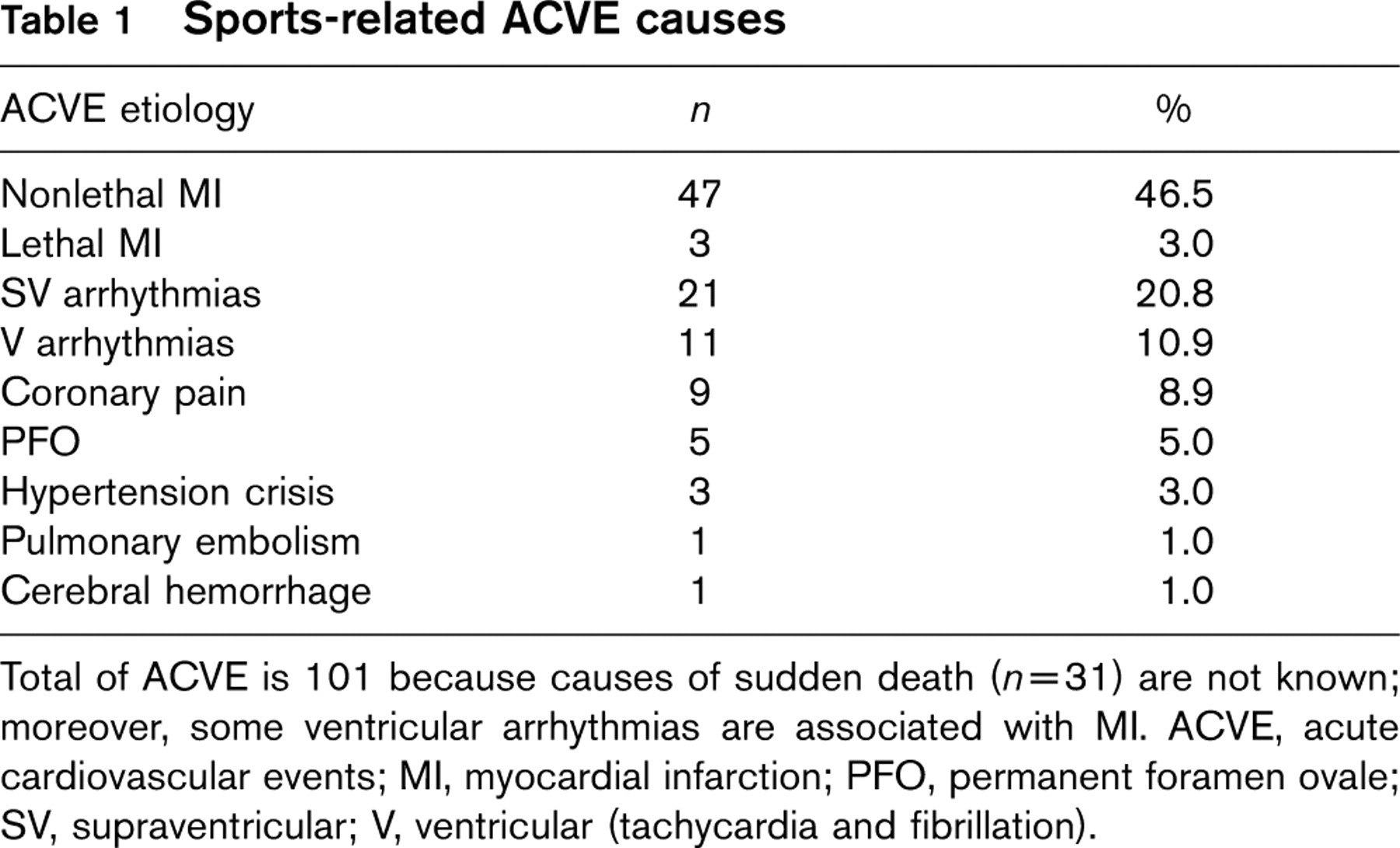
Total of ACVE is 101 because causes of sudden death (n = 31) are not known; moreover, some ventricular arrhythmias are associated with MI. ACVE, acute cardiovascular events; MI, myocardial infarction; PFO, permanent foramen ovale; SV, supraventricular; V, ventricular (tachycardia and fibrillation).
Incidences (n) of sports-related ACVE deaths and nonlethal MI

Note that concerning ACVE, age was unknown for two men. ACVE, acute cardiovascular events; MI, myocardial infarction.
P < 0.01 between men and women.
P < 0.001 between men and women.
P < 0.05 between age groups. †P ≤ 0.01 between age groups.

Five years age groups incidences of sports-related sudden death (SD) and nonlethal myocardial infarction (MI) observed in men.
Forty sports-related deaths were reported. Thirty-seven SD were observed, with a successful cardiopulmonary resuscitation in six cases, and three delayed deaths (MI in all cases) noted during hospitalization. The global death incidence was 2/100 000 participants/year (1.9/100 000 participants/year for SD). The mean age of the participants concerned was 49 (13.9) years (range 15-79). More men (n = 38) than women were involved, mostly in the 35-59-years-old group (Table 2, P < 0.01 and Fig. 1). In women, only two deaths (0.2/100 000 women/year) were reported (Table 2, Fig. 2).
Sports-related MI has involved 50 participants (global yearly incidence 2.6/100 000 participants) with a lethal MI in three cases (all men). Sports-related nonlethal MI was thus reported in 47 cases (2.4/100 000 participants/year), with a mean age of 52.8 (10.7) years (range 34-79). Men were mainly concerned (n = 42; 89.4%, Fig. 1). For men below 35 years of age, MI incidence was very low. Men in the age group of 35-59 years were more affected (P = 0.01 vs. > 59-years-old group). No significant difference was noted in different age groups of women (Fig. 2).
Sports-related supraventricular arrhythmias (n = 21) were equally observed in men (n = 10) and women (n = 11). Conversely, sports-related ventricular arrhythmias (n = 11) more often involved men (n = 10) than women (P < 0.001). Running, swimming, and cycling were mainly involved (Table 3), with no significant age effect. All sea divers' ACVEs (n = 5) were related to stroke symptoms in relation to a permeable foramen ovale secondary proven and then successfully treated. No other sports-related stroke events were observed.
Despite the fact that sports-related ACVE frequency tended to increase on Saturday and Sunday and during August and September, no significant difference was noted in weekly and monthly ACVE distributions. Finally, no significant difference was noted with regard to the time of day.
Discussion
The main results of this 1-year prospective study are (i) the incidence of sports-related ACVEs needing an emergency intervention in the general population was 6.5/100 000 participants/year, (ii) sports-related MI and SD were the two main causes of emergency calls, (iii) men were significantly more affected than women, except in cases of supraventricular arrhythmia, and (iv) in men, sports-related death and MI were most often observed in the 35 to 59-year-old group.
Positive effects of moderate regular physical activity far outweigh its rare potential negative effects in the general population and patients [1, 2, 10, 11]. However, it is also well reported that ACVE risk is transiently increased during and immediately after acute, and mainly vigorous, exercise [1, 3–5, 23]. Sports practice activity is described as a trigger that reveals an unknown cardiac disease [10, 11, 21]. Earlier studies were mostly retrospective, and concerned sports-related SD and/or MI in young or middle-aged people [4, 6–8, 19–21].
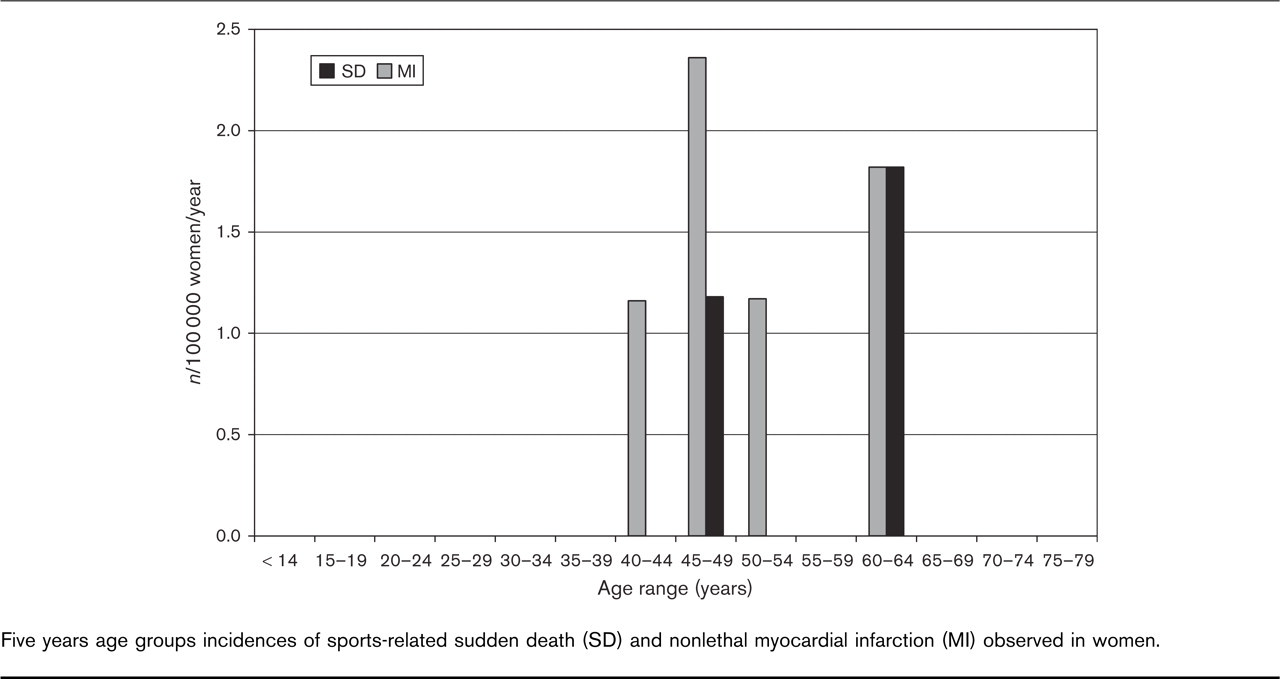
Five years age groups incidences of sports-related sudden death (SD) and nonlethal myocardial infarction (MI) observed in women.
Sports practiced during the cardiovascular events
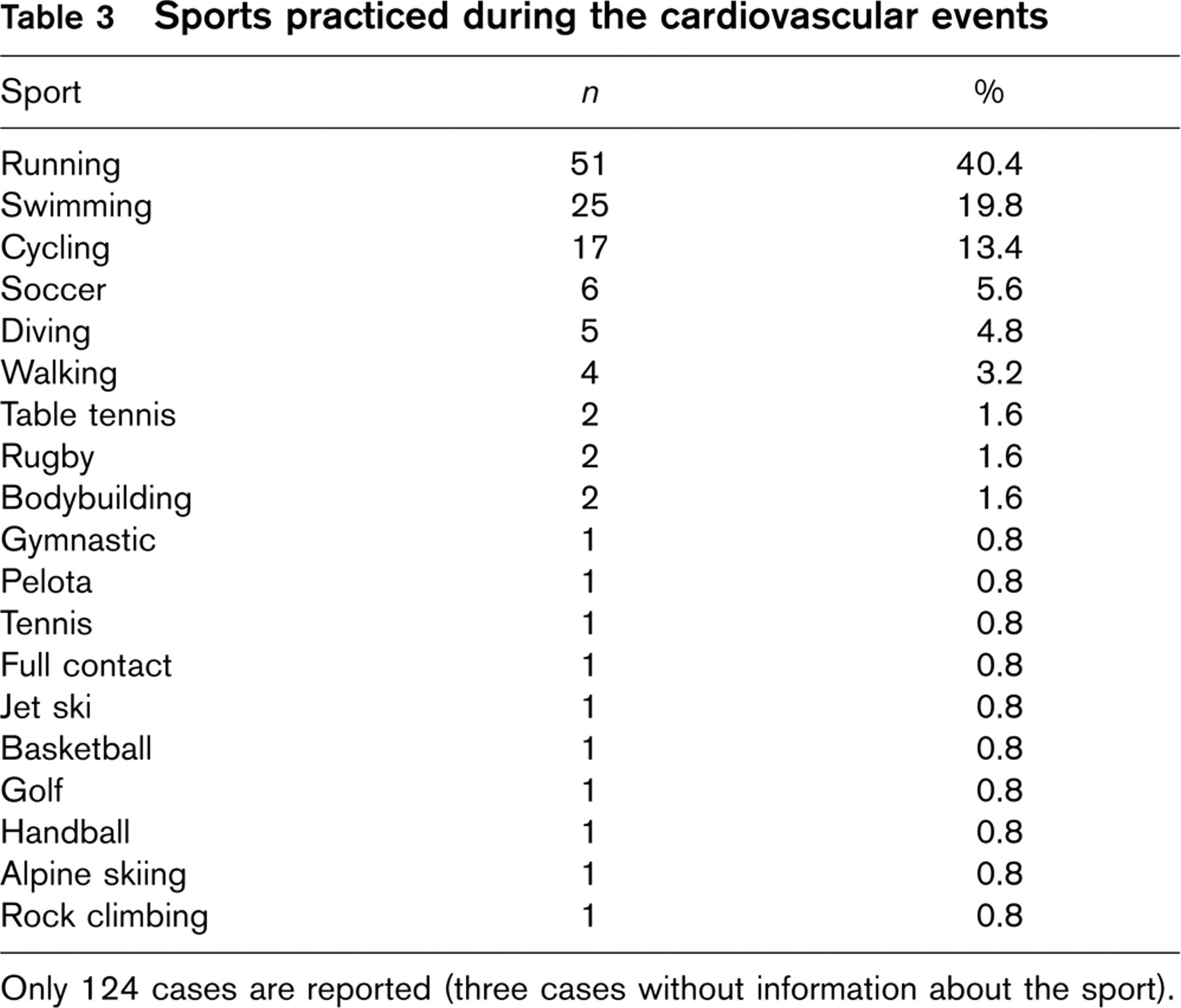
Only 124 cases are reported (three cases without information about the sport).
The incidence of emergency intervention in our population comprised 6.5/100 000 participants/year. In moderately trained people, the sports-related ACVE risk estimate ranges proposed are 0.005-0.05 participant/year in women and 0.02-0.03 participant/year in men [24].
The youngest of our patients was a 14-year-old boy and the oldest patient was a 79-year-old man, who both presented with sudden death. Most of the sports-related ACVEs concerned the 35-59-year-old men group. The annual incidence of sports-related ACVEs in men was nearly five-fold higher than that observed in women, confirming previous data [20, 25–28]. This sex difference, also noted in the daily life of the general population, is not well explained [26]. Lower sports participation rate, lower exercise intensity level, later onset of coronary disease, and smaller heart size in women have been proposed as potential explanations [25].
Sports-related global death and SD incidences comprised 2/100 000 and 1.9/100 000 participants/year, respectively, and concerned mainly men. The below 35-year-old death incidence (Table 2) observed is higher than in retrospective studies [7, 8] and is near the incidence in the Italian (2; 6/100 000 men/year) prospective study [21]. The 35-59-years-old group sports-related death incidence was significantly higher than the below 35 and the 59-79-years-old groups incidence (Table 2). In women, only two deaths were observed, both after 35 years old. Thus, our incidence (0.2/100 000 participants/year) is near the 0.1-0.3 and q1.1/100 000 incidences reported in retrospective [7, 8] and prospective [21] studies, respectively. It must be noted that most of these earlier studies have concerned competitive populations. Higher prevalence of cardiac, particularly coronary artery, diseases in middle-aged participants can explain our results [5, 7, 12]. A greater participation in high-intensity exercise practice in the youngest group can explain the lack of difference with the oldest one. In accordance with official data published, we can estimate that sports-related SD reported here constitutes between 1.9 and 2.1% of the overall yearly incidence of SD in the population studied.
Increased MI risk during exercise or 1-h postexercise is well described [5, 24, 28, 29]. However, absolute incidence for this event in the general population is not well known [3]. Here, sports-related MI was the most frequent ACVE (46.5%). Thus, we confirm the Helsinki MI register results [16]. Moreover, it must be noted that acute coronary pain events was the emergency call cause in nine cases. Thus, globally, coronary disease was involved in 59 cases (58%) of the 101 ACVEs with known etiology in our study. Exercise-related acute coronary syndrome and coronary SD in previously healthy and asymptomatic adults seem mainly to be the result of alterations in vascular endothelial and parietal anatomy and function. Intense exercise is associated with high hemodynamic, mechanical, and chemical constraints to epicardial coronary arteries [23, 30, 31]. Angiographic and anatomic studies have found that intense acute exercise is an independent risk factor for a disruption or an erosion of a vulnerable, not necessarily stenotic, atherosclerotic plaque [32–34]. Men were greatly more affected than women. We confirm that exertion nonlethal MI incidence is low (one man) below 35 years of age [6, 29, 30]. Between 35 and 59 years of age, sports-related nonlethal MI and death incidences were 2.1 and 1.4, respectively, higher than that after 59 years of age. This difference could be explained by a lower rate of participation in vigorous exercise among the older group [29]. The incidence observed in our 35-59-years-old group is lower than the 6.8 times higher estimation proposed by others [31]. This discrepancy may be explained both by a different cardiovascular risk level and by the fact that our study concerns only sports activities and not all physical activities, as in earlier studies. Moreover, our study MI incidence may be lowered by the lack of autopsy. Thus, in regard to sports-related ACVE causes, our data confirm the high predominance of coronary artery disease [1, 5, 19, 20].
Exercise induces catecholergic alterations, which favors cardiac arrhythmias [10, 11, 14, 15]. The incidence of sports-related arrhythmias noted in this study can seem relatively low. However, the incidence observed here may be underestimated. Indeed, sports-related SD can be the first and isolated symptom of arrhythmia, and we have reported earlier that sports practitioners do not always consult their physician in cases of exercise-related palpitations or dizziness [35]. Sports-related supra-ventricular arrhythmias equally affected men and women. QJ; To our knowledge, prevalence of acute sports-related supraventricular arrhythmias in the general population has not been reported. Atrial fibrillation seems more frequent in old-age endurance-trained men [18]. Ventricular tachycardia and fibrillation were observed in 11 cases, and cardiopulmonary resuscitation efficacy was 55%, which is better than data recently reported on the sports field [27].
Running, cycling, and swimming were the main sports concerned, whereas soccer and rugby are the main sports practiced in the region studied. The mean age of patients with SD and MI was not significantly affected by the sport practiced. Thus, in regard to running and cycling, intensity and duration of practice may have an impact, as proposed earlier [4, 19]. Specific sea hazards may have an impact, because, concerning swimming, ACVEs were mainly noted on the beach.
If sports-related ACVEs tended to be more frequent on Saturday and Sunday, no difference was noted between ACVE morning and afternoon repartition. It has been proposed that sports-related ACVE are mainly observed in spring and summer. In this study, we noted no season's effect on the sports-related ACVE incidence [36].
This study presents some limitations. First, because of lack of autopsy findings, cause of sports-related SD cannot be specified. However, in accordance with the age of the sports-related SD subjects, we can reasonably assume that many of them were in relation with coronary disease. Second, it is possible that sports-related ACVEs incidence has been underestimated. Indeed, subjects with low symptoms sports-related ACVEs deciding against calling emergency departments might not been registered. Third, we have no results to confirm the roles of competition practice, cardiovascular risk nor individual fitness level on sports-related ACVEs incidence [4, 26].
Conclusion
This 1-year prospective study, carried out in a general population, gave new important information on sports-related ACVEs. The incidence of emergency interventions was 6.5/100 000 participants/year. Sports-related MI and sudden death, which were the two main causes of ACVEs, were most often reported in men below 35 years old.
Footnotes
Acknowledgements
The authors thank Miss Nathalie Ville, PhD, for her helpful comments on this manuscript. This study has been supported with a grant from ‘Club des Cardiologues du Sport’.
Potential conflicts of interest: none declared.