






Abstract
Background
Methods
Results
Conclusion
Introduction
Advances in a variety of factors including income, nutrition, education, sanitation and health care have led to a substantial increase in life expectancy during the past century [1]. These factors may also explain differences in life expectancy in-between and within nations. In Germany, the partition between East and West after World War II had yielded two subnations with each having its own course of life expectancy. Although life expectancy in West Germany increased similar to the increase observed in other Western nations, these changes were less pronounced in East Germany. In particular, during the 1980s, life expectancy of adults living in the East worsened relative to their Western counterparts [2]. One year after the reunification of Germany in 1991, female and male babies born in the West could expect an average lifespan of 79.0 and 72.6 years, respectively, whereas in the East life expectancy was 2-3 years shorter [3]. Although healthcare systems have been adapted during the last few years, these differences have been attenuated in women but are still present in men. Thus, estimated life expectancies of female and male newborns in the West were 81.6 and 76.2 years, respectively, but 81.3 and 74.7 years in the East in the years 2002/2004 [4]. Besides this East-to-West gradient, life expectancy in Germany also exhibits a North-to-South gradient that can barely be explained by socioeconomic factors [5].
Regional disparities in cardiovascular risk factors represent one hypothesis to explain differences in life expectancy. Recently, we have found regional disparities in hypertension prevalence by analysing data from two population-based studies, the Kooperative Gesundheitsforschung im Raum Augsburg (KORA) and the Study of Health in Pomerania (SHIP) [6]. Hypertension prevalence was 40 and 61% among 25-74 years old men in southwest and northeast Germany, respectively, and 29 and 38% among women. Proportions of hypertensive patients being unaware, aware and untreated, treated or controlled were similar between both populations indicating that differences in healthcare systems did not significantly contribute to regional disparities in hypertension prevalence [6].
Left ventricular hypertrophy (LVH) is a major sequel to hypertension [7–11]. LVH increases the risk of heart failure and arrhythmias thereby increasing the mortality risk [12–15]. Thus, a higher LVH prevalence in East compared with West Germany might partly explain disparities in life expectancy within this country. We therefore undertook this study to investigate differences in LVH prevalence between northeast and southwest Germany.
Methods
Study populations and regions
Data from two population-based studies, KORA conducted in southwest and SHIP conducted in northeast Germany were utilized. Samples for both studies were selected using official population registries in which every resident's address, age and sex were mandatorily stored. All participants were Caucasians. Informed written consent was obtained from all participants. All investigations were approved by the local ethics committees and public data protection agencies. Both studies were monitored by external review boards of independent scientists.
The third survey of the Monitoring of Trends and Determinants of Cardiovascular Disease Augsburg project (Kooperative Gesundheitsstudie im Raum Augsburg, KORA) was conducted from October 1994 to June 1995. Detailed information on study design, sampling procedures and data collection is given elsewhere [16]. In brief, a two-stage age-stratified and sex-stratified cluster sample of 6640 individuals aged 25-74 years was drawn [17]. A total number of 4856 individuals (response 74.9%) finally participated. There were 1103 participants aged 45-75 years living in the city of Augsburg who were examined echocardiographically. Among them, 49 participants (0.4%) had prior history of myocardial infarction, and in 219 participants (20.8%) echocardiograms could not be classified. For this study we thus used data from 835 participants (446 women).
SHIP is a cross-sectional survey in West Pomerania [18]. The total population comprised 212 157 inhabitants. A two-stage cluster sampling method was applied that was also used in KORA [17]. A total number of 7008 participants aged 20-79 years with German citizenship were sampled, with 292 men and 292 women in each of the 12 5-year age strata. The net sample (after exclusion of migrated or deceased persons) comprised 6267 eligible participants. The SHIP population finally comprised 4310 participants, corresponding to a final response of 68.8%. Data collection was performed between October 1997 and May 2001. From 2302 participants, 107 (0.5%) were excluded owing to prior history of myocardial infarction and a further of 514 patients (23.4%) because of nonclassifiable echocardiograms. For this study, data from 1681 participants (922 women) aged 45 to 74 years were thus available.
Measurements
Demographic data, medical histories on diabetes and myocardial infarction, as well as information regarding the use of antihypertensive drugs were collected by computer-assisted personal interviews using identical methods in both studies. With regard to smoking habits, participants were categorized into current, former and never smokers. Diabetes was defined as self-reported physicians' diagnosis of diabetes. Height and weight as well as waist and hip circumferences were measured for the calculation of the body mass index [BMI = weight (kg)/height2 (m2)] and the waist-to-hip ratio (WHR), respectively. Overweight was defined as BMI of ≥ 25kg/m2 and obesity as BMI of ≥ 30kg/m2.
After a resting period of at least 5 min, systolic and diastolic blood pressures were measured three times at the right arm of seated participants. The methods applied, however, were different between both studies. Although a Hawksley random zero sphygmomanometer was used in KORA, blood pressure measurements in SHIP were performed using a digital blood pressure monitor (HEM-705CP; Omron Corporation, Tokyo, Japan). The mean of the second and third measurement was calculated and used for the present analyses in both surveys. Systolic and diastolic blood pressures of ≥140 and ≥ 90mmHg, respectively, were considered increased.
Two-dimensional and M-mode echocardiography was performed by certified physicians using a Sonos 1500 (Hewlett Packard Inc., Palo Alto, California, USA) in KORA and Vingmed CFM 800A system (GE Medical Systems, Waukesha, Wisconsin, USA) in SHIP. M-mode images of the left ventricle were recorded at papillary level. Left ventricular dimensions (interventricular septum thickness, posterior wall thickness and left ventricular end-diastolic diameter) were measured off-line using the leading-edge convention, and left ventricular mass (LVM) was calculated according to standard procedures [19, 20]. LVM measurements of intrareader, intraobserver, interreader and interobserver agreements within both studies revealed Spearman's correlation coefficients of greater than 0.85 and differences in mean (± 2 SD) of less than 5% (< 25%) [21, 22]. The left ventricular mass index (LVMI) was calculated by dividing absolute values by height2.7. LVH was defined as an LVMI of more than 44g/m2.7 in women and 48g/m2.7 in men [23]. A senior scientist of our group (H.-W.H.) was in charge for quality assurance of echocardiographic measurements in KORA and also supervised the quality assurance of echocardiographic examinations in SHIP-0 being a member of SHIP's external Data Safety and Monitoring Committee.
Statistical analyses
Descriptive statistics were stratified by age and sex. Nonstratified analyses were conducted for LVM, LVMI and LVH. To achieve comparability between both studies for nonstratified analyses, data were weighted to the European standard population [24]. Point estimates for weighted data were calculated using STATA survey procedures. Linear regression analyses were performed to analyse the relationship between region and LVM, adjusted for age, sex, diabetes, smoking status, systolic and diastolic blood pressures, use of antihypertensive medication, BMI and WHR. Logistic regression was used to analyse the association between region and LVH prevalence using the same set of confounders. Regression coefficients are presented as results of the linear regression analyses, odds ratios (OR) for the logistic regression analyses. Ninety-five percent confidence intervals (CI) were given and P values were estimated from two-sided tests. Associations were regarded statistically significant if P value was less than 0.05. Statistical analyses were performed using SPSS (version 14.0.1; SPSS Inc., Chicago, Illinois, USA) and STATA (version 8.2; Stata-Corp LP, College Station, Texas, USA).
Results
The study populations of KORA and SHIP were compared with respect to selected general characteristics (Table 1). Across almost all age groups there were higher proportions of current smokers in SHIP than in KORA. With the exception of women aged 45-54 years, there were more participants with diabetes mellitus in SHIP than in KORA. Systolic blood pressures were similar between SHIP and KORA females but were higher in male SHIP participants compared with male KORA participants. SHIP participants of all age groups had higher diastolic blood pressures and more often used antihypertensive medication than KORA participants. There were no major differences in BMI and WHR between both study populations (Table 1).
Clinical characteristics of KORA and SHIP participants

Data are percentage or median (25th; 75th percentiles). BMI, body mass index; BP, blood pressure; KORA, Kooperative Gesundheitsforschung im Raum Augsburg; SHIP, Study of Health in Pomerania; WHR, waist-to-hip ratio.
With respect to echocardiographic measures, the left ventricular wall thicknesses were rather similar in both studies whereas left ventricular diameters were generally larger in SHIP. Thus, LVM and LVMI were consistently higher in SHIP participants compared with KORA participants. Consequently, there were also higher proportions of LVH in SHIP compared with KORA across all age groups (Table 2). The standardized LVH prevalence among women over all age groups was 37.7% (95% CI: 33.2-42.2) in KORA and 48.2% (95% CI: 45.0-51.5) in SHIP. The respective prevalence among men was 30.3% (95% CI: 25.8-34.9) in KORA and 46.8% (95% CI: 43.2-50.4) in SHIP.
Analyses using LVM as dependent variable revealed an association between study region and LVM in both women and men, which was independent of major confounders (Table 3). Living in the SHIP compared with the KORA study region explained a variability of LVM to an extent that was similar to the extent explained by increased systolic and diastolic blood pressures. Further correlates of LVM were advanced age, use of antihypertensive medication and increasing BMI in both sexes, history of diabetes among women and current smoking among men. The relationship between increased WHR and LVM was present among men and barely missed statistical significance among women (Table 3). As expected, the effects of BMI and WHR on the endpoint were attenuated when LVMI was used as a dependent variable (Table 4). These analyses, however, did not substantially affect the relation of interest. Again, the size of the effect of living in the SHIP region on LVMI was comparable with the size of the effects of increased blood pressures on LVMI (Table 4).
Consequently, logistic regression models used to analyse determinants of LVH prevalence also revealed a relationship between study region and LVH, which was independent of major confounders (Table 5). Women and men living in the SHIP region exhibited odds for LVH that were 1.57 and 1.68 times higher than in women and men of the KORA region, respectively. Further determinants for LVH in women were age, diabetes, high BMI and WHR, use of antihypertensive medication and high blood pressure. In men, age, high BMI, increased WHR, as well as increased systolic and diastolic blood pressures were further related to LVH (Table 5).
Echocardiographic characteristics of KORA and SHIP participants

Data are percentage or median (25th; 75th percentiles). IVS, intraventricular septum thickness; KORA, Kooperative Gesundheitsforschung im Raum Augsburg; LVEDD, left ventricular enddiastolic diameter; LVH, left ventricular hypertrophy; LVM, left ventricular mass; LVMI, left ventricular mass index; PWD, posterior wall thickness; SHIP, Study of Health in Pomerania.
aLVH defined as LVMI > 44 g/m2.7 in females and > 48 g/m2.7 in males [23].
Relationship between study region and left ventricular mass among women and men

Data are increment in left ventricular mass (g) with 95% confidence interval per 1 unit change. BMI, body mass index; Const., constant; KORA, Kooperative Gesundheitsforschung im Raum Augsburg; n, no; SHIP, Study of Health in Pomerania; WHR, waist-to-hip ratio; y, yes.
WHR > 1.00 in men or > 0.85 in women [38].
P < 0.05.
Relationship between study region and left ventricular mass index among women and men

Data are increment in left ventricular mass index (g/m2.7) [23] with 95% confidence interval per 1 unit change. BMI, body mass index; Const., constant; KORA, Kooperative Gesundheitsforschung im Raum Augsburg; n, no; SHIP, Study of Health in Pomerania; WHR, waist-to-hip ratio; y, yes.
WHR > 1.00 in men or > 0.85 in women [38].
P < 0.05.
We performed various sensitivity analyses. Thus, we applied alternate definitions of LVH [25]. We also varied the set of confounders by including different definitions of hypertension and using pulse pressure instead of systolic and diastolic blood pressures in our multivariable models. All these analyses did not change the major results substantially.
As methods for measuring blood pressure were different between KORA and SHIP, multiple sensitivity analyses were performed to assess the impact of potential study differences in systolic and diastolic blood pressure records. To simulate a random error in the measurements of the systolic blood pressure, each observed value of systolic blood pressure in the KORA population was multiplied by a normally distributed random number, which took on maximal values of 0.5 times the standard deviation of all observed systolic blood pressure values. In women, 100 of these analyses revealed a 95% CI for the observed mean OR estimate of 1.57-1.58. The respective results in men were 1.67-1.69. Assuming a linear systematic bias in the measurement of systolic blood pressure also did not materially change the major results of this study (Fig. 1). Even modelled increases or decreases in systolic blood pressure as large as 10 mmHg did not materially affect the statistical significance of the association between study region and LVH in both women (Fig. 1a) and men (Fig. 1b).
Relationship between study region and left ventricular hypertrophy among women and men

Data are odds ratio (95% confidence interval). BMI, body mass index; KORA, Kooperative Gesundheitsforschung im Raum Augsburg; n, no; SHIP, Study of Health in Pomerania; WHR, waist-to-hip ratio; y, yes.
WHR > 1.00 in men or > 0.85 in women [38].
P < 0.05.
Evaluating hypothetical method bias in diastolic blood pressure in the same way as for systolic blood pressure also did not substantially affect the main results. When each observed value of diastolic blood pressure in the KORA population was multiplied by a normally distributed random number, 100 of these analyses revealed a 95% CI for the observed mean OR estimate of 1.54-1.60 in women and 1.65-1.70 in men. Results were likewise stable in both women (Fig. 2a) and men (Fig. 2b) on assuming a linear systematic bias in the determination of diastolic blood pressure.
Discussion
In this study, we investigated possible regional disparities in LVH prevalence between two regions within Germany. Our analyses revealed a higher LVH prevalence in the northeast compared with the southwest. These differences were stable after adjustment for relevant confounders including blood pressure, BMI and WHR and were not influenced by possible method bias in evaluating systolic and diastolic blood pressures as major confounders. Regional disparities in LVH prevalence add explanation to the higher mortality in northeast compared with southwest Germany. It has been shown that populations living in regions with high LVH prevalence exhibit higher risks for stroke, heart failure and cardiac arrhythmias [12, 26, 27].
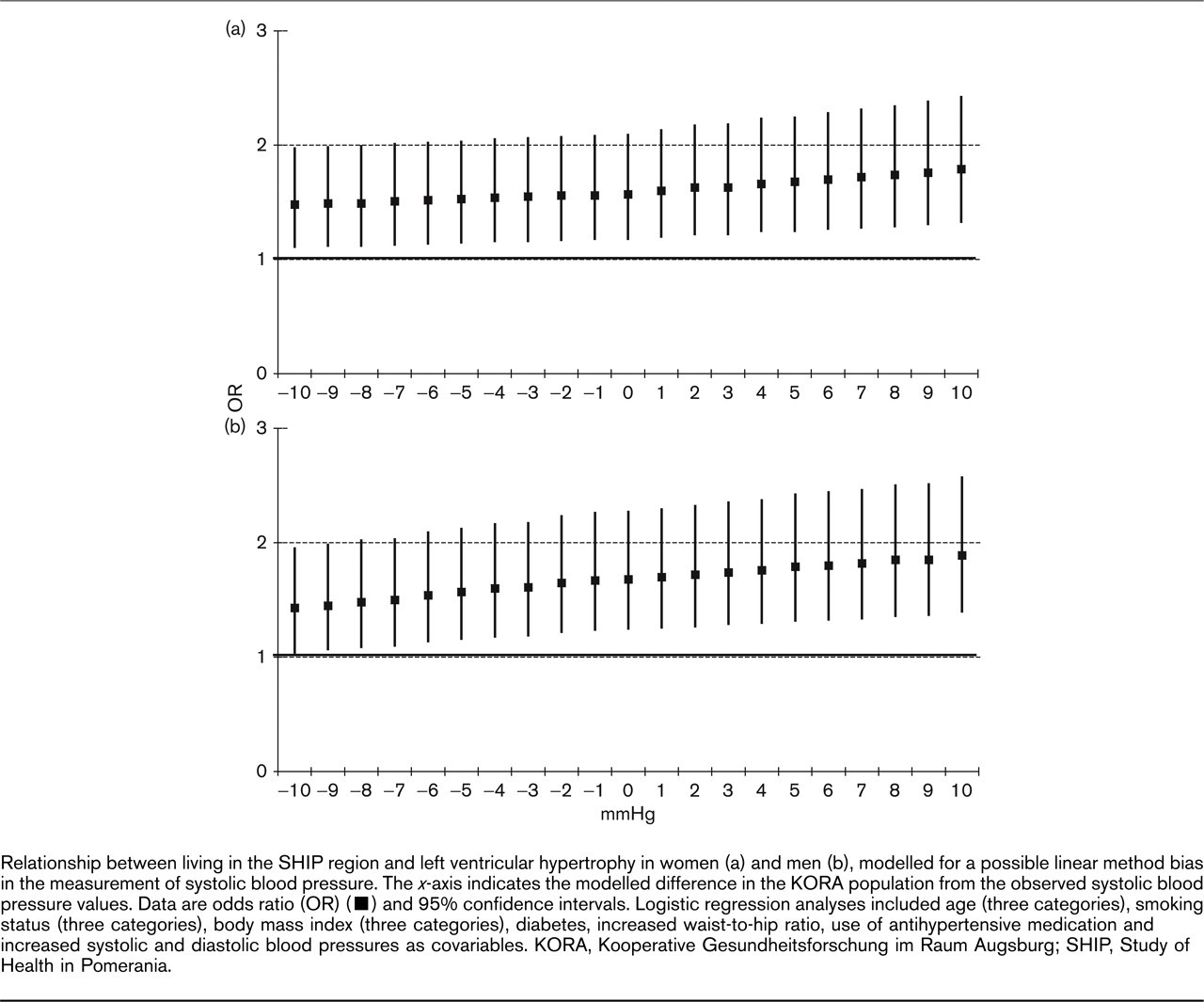
Relationship between living in the SHIP region and left ventricular hypertrophy in women (a) and men (b), modelled for a possible linear method bias in the measurement of systolic blood pressure. The x-axis indicates the modelled difference in the KORA population from the observed systolic blood pressure values. Data are odds ratio (OR) (▪) and 95% confidence intervals. Logistic regression analyses included age (three categories), smoking status (three categories), body mass index (three categories), diabetes, increased waist-to-hip ratio, use of antihypertensive medication and increased systolic and diastolic blood pressures as covariables. KORA, Kooperative Gesundheitsforschung im Raum Augsburg; SHIP, Study of Health in Pomerania.
There are several factors that might help explain differences in LVH prevalence between northeast and southwest Germany. First, major differences in mean blood pressure values and hypertension prevalence have been observed earlier between the two regions [6]. Although the blood pressure differences in our comparison were less pronounced than in the previous report, which may partly be accounted for by different blood pressure measurement techniques in the KORA survey of 1994-1995, our primary as well as the sensitivity analyses do not seem to support the view that blood pressure differences between the study regions explain away the differences in LVM and LVH. Second, differences in the prevalence of overweight and obesity might further contribute to regional disparities in LVH prevalence [28]. This may also explain why a more eccentric cardiac remodelling, expressed by larger end-diastolic diameters in the presence of similar wall thicknesses, is more prominent in the SHIP population; such changes are typically attributable to overweight and metabolic syndrome [29]. We note, however, that the association between region and the cardiac endpoints was independent of these factors in our multivariable analyses, and therefore we propose that factors other than blood pressure and metabolic syndrome have contributed to these regional differences.

Relationship between living in the SHIP region and left ventricular hypertrophy in women (a) and men (b), modelled for a possible linear method bias in the measurement of diastolic blood pressure. The x-axis indicates the modelled difference in the KORA population from the observed diastolic blood pressure values. Data are odds ratio (OR) (▪) and 95% confidence intervals. Logistic regression analyses included age (three categories), smoking status (three categories), body mass index (three categories), diabetes, increased waist-to-hip ratio, use of antihypertensive medication and increased systolic and diastolic blood pressures as covariables. KORA, Kooperative Gesundheitsforschung im Raum Augsburg; SHIP, Study of Health in Pomerania.
Regional disparities in LVH prevalence that have already been described between nations as well as within communities [12, 30, 31] were mainly related to ethnic differences. Consistent over a number of studies [30, 32, 33], Afro-Caribbeans exhibit a higher risk for LVH than Caucasians, which is mainly explainable by higher blood pressures and smaller nocturnal blood pressure decline in Afro-Caribbeans compared with Caucasians [34]. As this study investigated only Caucasians, ethnic differences between Blacks and Whites are not suitable to explain regional disparities in LVH prevalence described herein.
A number of genetic variants have been related to the risk of LVH, which also exhibit regional differences [31, 35, 36]. Notably, it has been repeatedly shown that Caucasians with Slavic origin exhibit higher LVH prevalence compared with Caucasians living in southern Europe [12, 31]. This might at least partly be explained by specific genetic variants or gene-environment interactions [31]. Given the regional adjacencies, it is tempting to hypothesize that the genetic background of the northeast German population might be more similar to Slavic populations and the genetic background of the southwest German population more similar to southern European populations thereby explaining some of the differences found in our study.
The strengths of our studies include the population-based approach and the high grade of standardization of general and echocardiographic measurements within both studies. One limitation is the lacking systematic assessment of interobserver variability between the studies. Although identical echocardiographic methods and standard operation procedures were used in both studies and a senior scientist of our group was involved in the quality assurance of KORA and SHIP, we cannot entirely exclude different observer skills and habits in performing echocardiographic examinations to have contributed to the regional differences described herein. Likewise, this may also apply for reading echocardiograms, because reading was not conducted by a central committee. The slightly higher proportion of participants that had to be excluded, as echocardiographic images were not useable in SHIP compared with KORA (23.4 vs. 20.8%), may indicate further observer bias. It may, however, also reflect regional differences in smoking or metabolic disorders. Thus, for example, obesity is more common in the SHIP than in the KORA region [6]. Likewise, smoking prevalence shows a similar distribution with a higher prevalence of current tobacco consumers in the northeast compared with the southwest [37], which may have given rise to a higher prevalence of lung emphysema in SHIP compared with KORA. Both obesity and lung emphysema hamper feasibility of echocardiographic examinations and are at the same time determinants of LVH. Therefore, if indeed these differences were at least partly responsible for different proportions of non-usable echocardiograms, the estimates for regional disparities in LVH would have been conservative in our study. In contrast, residual confounding might not be sufficiently handled in our study, which may have resulted in an overestimated association between region and LVH. We conclude that there is a higher prevalence of LVH in northeast Germany compared with southwest Germany. Regional disparities in hypertension and overweight only partly contribute to the differences in LVH prevalence. Our finding may help to further explain differences in cardiovascular mortality within Germany.
Footnotes
Acknowledgements
The KORA research platform was initiated and financed by the GSF National Research Center for Environment and Health, which is funded by the German Federal Ministry of Education and Research (BMBF) and by the State of Bavaria. The echocardiographic substudy in the KORA survey of 1994/1995 was supported by BMBF grant no. KBF01-GB9403. SHIP is part of the Community Medicine Research net ( ) of the University of Greifswald, Germany, which is funded by the BMBF (grant no. ZZ9603), the Ministry of Cultural Affairs as well as the Social Ministry of the Federal State of Mecklenburg-West Pomerania. The cooperative analyses in this project were supported by the ‘Kompetenznetzwerk Herzinsuffizienz’ of the BMBF.
Conflicts of interest: none
Funding from American institutes: none.