MEDICATION THERAPY AT DISCHARGE FOR PATIENTS HOSPITALIZED WITH ACUTE MYOCARDIAL INFARCTION
Bulley E1, Cypro A1, Bechtold D1, Salvatierra G3, Daratha K2. 1University of Washington, Seattle, WA; 2Washington State University, Spokane, WA and 3Seattle University, Seattle, WA.
Purpose of Study: Secondary prevention of acute myocardial infarction (AMI) with guideline- recommended medications leads to improved outcomes and reduced health care costs. However, prescribing patterns at discharge for patients hospitalized with AMI are suboptimal, with elderly and female patients historically vulnerable to guideline-inconsistent prescribing. We aim to determine if advanced age and female gender remain factors in guideline- inconsistent prescribing.
Methods Used: This retrospective observational study examined administrative and discharge medication records for 1,699 Medicare-eligible patients hospitalized with a primary diagnosis of AMI from two hospitals in Washington between 2007 and 2011. Drugs from discharge medication summaries were classified electronically (ACE/ARBs, beta-blockers, statins, aspirin, and clopidogrel) to determine each patient's prescription status for the five medication classes. Rates of nonprescription for each class were determined for both medically managed (MM) and revascularized (RV) patients. Binary logistic regression determined factors of nonprescription for each medication class.
Summary of Results: The mean age of the study sample was 76 and 60% of patients were male. MM patients (37%) were older and had more comorbidities than RV patients (63%). Nonprescription rates were high for each medication class (63% ACE/ARBS, 22% beta-blockers, 21% statins, 15% aspirin, and 40% clopidogrel) and are significantly higher among MM patients (40%, 26%, 31%, 22%, and 67%, respectively) than among RV patients (34%, 19%, 15%, 11%, and 24%, respectively). In fully adjusted models, advanced age predicted nonprescription of ACE/ARB for MM patients (OR=1.81) and female gender predicted nonprescription of statins for both MM (OR=1.69) and RV (OR=1.49) patients.
Conclusions: Use of guideline-recommended therapies for secondary prevention of AMI in the Medicare Part D era remains disturbingly low, with very elderly and female patients at increased risk. As 75 million baby boomers become Medicare-eligible, sustainable initiatives to improve outcomes and reduce costs for patients with AMI require urgent implementation.
2
DYNAMICAL MODEL OF OSCILLATORY GENE EXPRESSION IN BMP-4/9 VASCULAR ENDOTHELIAL CELL NETWORK
Yazdi D, Guihard P, Bostrom K, Garfinkel, A. UCLA, Westwood, CA.
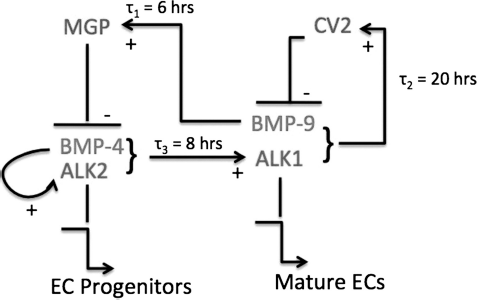
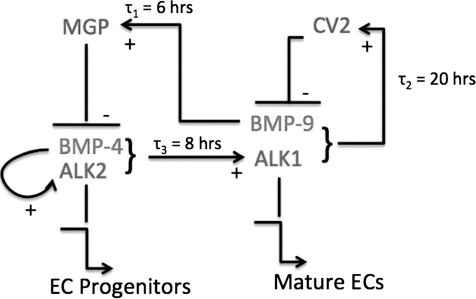
Purpose of Study: Bone morphogenic proteins (BMPs) and their inhibitors are increasingly appreciated for their role in vascular development. Matrix Gla protein (MGP) and crosssveinless 2 (CV2) antagonize BMP-4 and BMP-9, respectively, and the expression of both are stimulated by BMP-9/ALK1 signaling, while ALK1 is stimulated by BMP-4 signaling. This double negative feedback system is an important regulator of endothelial cell differentiation, angiogenesis, and maturation. Our collaborators recently discovered oscillatory gene expression of these proteins in human pulmonary artery endothelial cells (HPAECs) undergoing maturation in cell culture. We set out to explore the biological mechanisms guiding this periodic gene expression and to propose a functional role for these oscillations.
Methods Used: We used delay differential equations to mathematically model this network and applied dimensionless analysis to study the impact of relative protein degradation rates on oscillations. Monte Carlo parameter sampling and Hopf bifurcation analysis helped identify conditions yielding periodic dynamics.
Summary of Results: We discovered that the presence of BMP-4 is critical for oscillations and that its inhibitor, MGP, opposes them, making their mutual regulation important for oscillatory gene expression. We also identified the necessary existence of three time-delays, the presence of BMP-9 as a feedback regulator, and the function of CV2 as an indirect inhibitor of MGP as important factors for oscillations.
Conclusions: Findings from the cell culture experiments and the mathematical model led us to postulate that oscillations in this network are important for the maintenance of progenitor HPAECs and the lack of oscillations is associated with HPAEC maturation.
3
THE RELEVANCE OF DONOR SPECIFIC ANTI-HLA ANTIBODIES LATE AFTER HEART TRANSPLANTATION
Fong A, Liou F, Siddiqui S, Hamilton M, Kobashigawa J. Cedars-Sinai Medical Center, Los Angeles, CA.
Purpose of Study: The development of anti-HLA antibodies following heart transplantation has been associated with poor outcomes, including lower survival and increased risk for the development of cardiac allograft vasculopathy (CAV). It is known that anti-HLA antibodies may develop years after heart transplantation but it is not known whether these antibodies have clinical relevance.
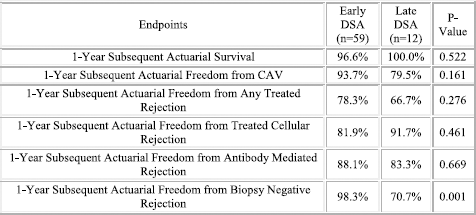
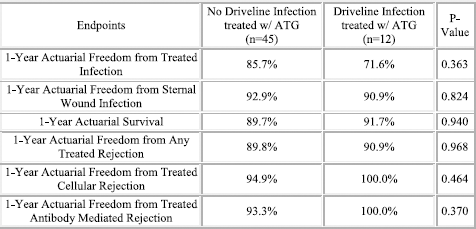
Methods Used: Between 2009 and 2013, we reviewed 71 heart transplant patients who had donor specific antibodies (DSA) early versus late after heart transplant. Late antibodies were defined as antibodies that developed after 1 year post-transplant. Subsequent 1 year survival, freedom from cardiac allograft vasculopathy (CAV), and freedom from rejection were then assessed.
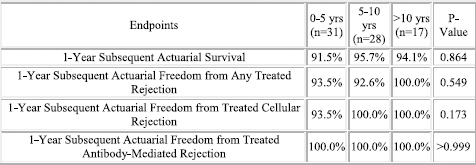
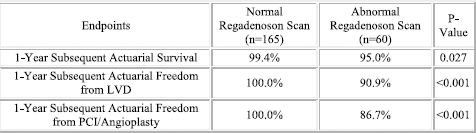
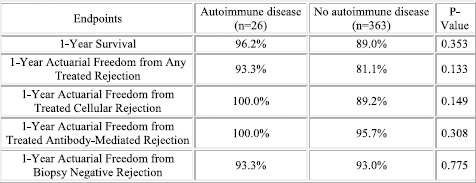
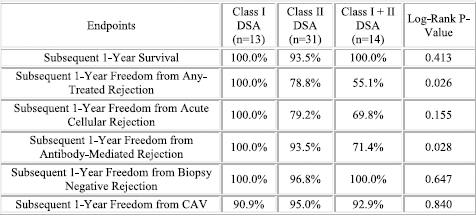
Summary of Results: Those patients who developed late DSA (at a mean time of 29.2 ± 10.3 months post-transplant) have a lower freedom from biopsy negative rejection in the ensuing year after detection of the initial antibody compared to those patients who developed early DSAs (at a mean time of 1.7 ± 3.3 months post-transplant). However, patients who developed late DSA did not appear to have worse outcomes in terms of 1-year subsequent actuarial survival, freedom from CAV, any-treated rejection, treated cellular rejection and treated antibody-mediated rejection compared to those who developed early DSA. (See table)
Conclusions: Late DSA development may be a marker for the development of biopsy negative rejection. However, subsequent survival and development of CAV, treated cellular rejection, and treated antibody-mediated rejection do not appear to be affected. Longer follow-up with larger numbers will be needed to confirm these results.
4
HISTONE DEACETYLASE INHIBITION ABROGATES HYPOXIA-INDUCED RIGHT VENTRICULAR HYPERTROPHY
Payne S1, Blakeslee W2, Demos-Davies K2, Long CS2,3, McKinsey TA2, Miyamoto S1. 1University of Colorado Denver School of Medicine, Aurora, CO; 2University of Colorado Denver School of Medicine, Aurora, CO and 3Denver Health and Hospital Authority, Denver, CO.
Purpose of Study: Single ventricle congenital heart disease (SV), is a severe form of hypoxic heart disease consisting of a univentricular circulation with only 68% survival to one year of age. Hypertrophy and failure of the single right ventricle (RV) is a common cause of death and transplant in children with SV and is without an effective therapy. Histone deacetylases (HDACs) catalyze removal of acetyl groups from chromatin resulting in gene repression. Treatment with HDAC inhibitors (HDACi) has been shown to block hypertrophy and fibrosis in animal models of heart failure. We have previously demonstrated that HDAC activity is increased in the RV of children with SV and that hypoxia induces RV hypertrophy in one-day old rats. The objective of this study was to investigate whether HDACi could modulate hypoxia-induced RV hypertrophy.
Methods Used: One-day-old rats were placed in a hypobaric chamber simulating 18,000 feet in elevation. Pups were randomized to receive vehicle (veh, via maternal intraperitoneal [IP] injection) or 10mpK direct IP injections of the pan-HDACi ITF daily for 7 days. Morphometric assessment and RT-PCR in the RV for hypertrophic gene expression was performed for both groups at the completion of the study.
Summary of Results: Pups treated with ITF had significantly lower heart weight to body weight ratio compared to veh group (p<0.05). The RV of the ITF group had significantly lower atrial natriuretic peptide (ANP) and β-myosin heavy chain (β-MHC); and although differences did not reach statistical significance, there was a trend towards higher expression of sarcoplasmic reticulum calcium-ATPase 2A (SERCA) and α-MHC. These changes are consistent with partial reversal of hypertrophic gene expression. There was paradoxically higher brain natriuretic peptide (BNP) gene expression in the ITF group.
Conclusions: In a neonatal animal model, HDACi treatment abrogates hypoxia-induced RV hypertrophy and results in partial blunting of pathologic hypertrophic gene expression. Although further study is needed, HDACs could represent a novel therapeutic target for the treatment of hypoxia-induced RV failure.
5
DOES THE DEVELOPMENT OF BW4 AND BW6 ANTIBODIES CONFER POORER OUTCOMES IN HEART TRANSPLANT PATIENTS?
Assad N, Liou F, Siddiqui S, Hamilton M, Kobashigawa J. Cedars-Sinai Medical Center, Los Angeles, CA.
Purpose of Study: Patients awaiting heart transplantation may be sensitized due to blood transfusions, pregnancy and previous organ transplants, which pose as a barrier to obtaining a compatible donor graft. Anti-HLA antibodies are known to be associated with poor outcome after heart transplantation. The public epitopes, Bw4 and Bw6 are known to be associated with antibody production. It has not been established whether antibodies to these public epitopes confer worse outcome after heart transplantation.
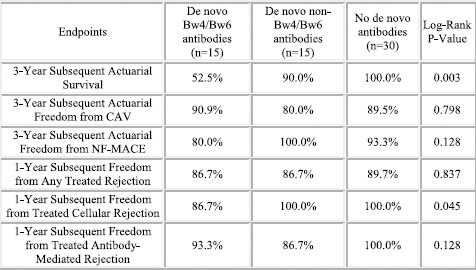
Methods Used: Between 2010 and 2013, we selected 15 patients who developed de novo non-donor specific anti-HLA antibodies against the Bw4 and Bw6 alleles post-transplant. Patients were compared against matched controls who developed de novo non-Bw4/Bw6 non-specific antibodies (n=15, 1:1 matched control) and those who had no antibody production (n=30, 2:1 matched control). Patients were matched for age, gender and time from transplant. Patients were followed subsequently for 3 years for survival, freedom from cardiac allograft vasculopathy (CAV) and freedom from non-fatal major adverse cardiac events (NF-MACE: myocardial infarction, new congestive heart failure, percutaneous coronary intervention, ICD/pacemaker placement and stroke). 1-year subsequent treated rejection, both cellular and antibody mediated, were also recorded and compared.
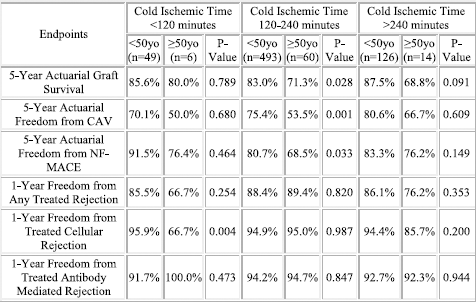
Summary of Results: Patients who developed antibodies against the Bw4 and Bw6 alleles had a lower 3 year survival and freedom from first year treated cellular rejection but similar 1-year freedom from any treated rejection and treated antibody-mediated rejection. There was also no significant difference in 3 year freedom from CAV and NF-MACE between the two groups. (See table)
Conclusions: Antibodies against the public epitopes of Bw4 and Bw6 appear to be associated with poorer outcomes. Patients who develop antibodies against these epitopes should be considered for more intense immunosuppression and more frequent monitoring.
6
THE ROLE OF HYPOTHERMIA AND CORONARY REPERFUSION IN MAXIMIZING NEUROLOGICALLY INTACT SURVIVAL AFTER CARDIAC ARREST
Ellingson C1,2, Kern KB1,2. 1University of Arizona College of Medicine, Tucson, AZ and 2Sarver Heart Center, Tucson, AZ.
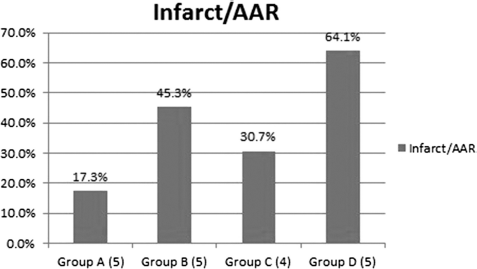
Purpose of Study: To demonstrate the efficacy of combined early coronary artery reperfusion therapy and early induction of hypothermia, better than each of these therapies alone. This will be assessed by measuring the size of the myocardial infarct in heart tissue and comparing it to the size of at risk tissue in the heart.
Methods Used: Occlude the Left Anterior Descending coronary artery of anesthetized swine with an angioplasty balloon inserted through the left carotid artery. Fibrillate and resuscitate swine to simulate cardiac arrest. Divide pigs into 4 groups labeled A, B, C, and D respectively: early reperfusion and cooling, late reperfusion and cooling, early reperfusion and no cooling, and late reperfusion and no cooling. Inject Unisperse blue into coronary arteries to delineate area at risk and infarcted tissue. Euthanize swine and calculate infarcted tissue, area at risk, and healthy tissue in heart slices.
Summary of Results: Our data demonstrate a significant decrease in the ratio of infracted tissue to area at risk with combined early coronary artery reperfusion therapy and early induction of hypothermia.
Conclusions: Combined early coronary artery reperfusion therapy and early induction of hypothermia leads to better outcomes than either of these therapies alone.
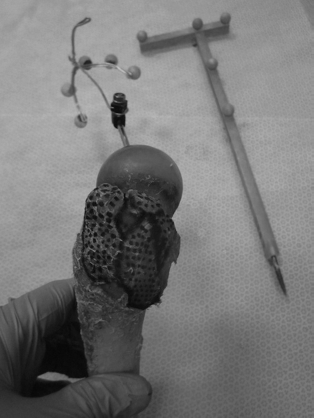
Group A: Early Reperfusion and Cooling. Group B: Late Reperfusion and Cooling. Group C: Early Reperfusion and No Cooling. Group D: Late Reperfusion and No Cooling.
7
CYLEX FAILS TO IMPROVE PREDICTIVE VALUE OF ALLOMAP FOR CARDIAC ALLOGRAFT REJECTION
Luu M, Aintablian T, Liou F, Hamilton M, Kobashigawa J. Cedars-Sinai Medical Center, Los Angeles, CA.
Purpose of Study: Non-invasive immune monitoring of heart transplant (HTx) patients (pts) is increasing in use. The AlloMap® blood test has been found to be helpful in the surveillance of cardiac allograft rejection, while the Cylex™ blood test is useful to assess global immune function. A higher Cylex is indicative of lower immunosuppression and thus higher risk of rejection. While Allomap® has high negative predictive value for rejection, it also has low positive predictive value. We chose to determine whether concomitant Cylex™ score would improve the predictive ability of Allomap® for rejection.
Methods Used: Between 2010-2014, we identified 209 instances of concomitant Cylex™ and Allomap® scores in 104 post-HTx pts. These occurrences were divided into two groups: those with low Cylex™ (<225) and those with moderate to high Cylex™ scores (≥≥225). We assessed the proportion of concomitant Allomaps® that were elevated (defined as ≥30 before 6-months post-transplant, and ≥34 greater than 6-months post-transplant) in each group. For those instances where a concomitant elevated Allomap® existed, concomitant endomyocardial biopsies were assessed for rejection, and the rate of rejection was compared between groups.
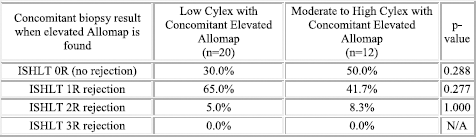
Summary of Results: There was no significant difference in the proportion of elevated Allomaps between the two groups. When comparing the instances of each elevated Allomap® per group, concomitant biopsies revealed no significant difference between the two groups in the occurrence of biopsy-proven International Society for Heart and Lung Transplantation (ISHLT) 1R, 2R, or 3R rejection. (See table)
Conclusions: Concomitant Cylex™ score does not appear to be helpful in improving the predictive ability of the Allomap® test for rejection post-HTx. Further studies are warranted to confirm findings.
8
THE LEFT GREATER SAPHENOUS VEIN IS THE PREFERRED CONDUIT FOR CORONARY ARTERY BYPASS GRAFTING
Uhr L1, Chen M3, Wu JJ2, Johnstone S2, Chen J2, Lee J2. 1Massachussetts Institute of Technology, Boston, MA; 2Kaiser Permanente, Honolulu, HI and 3Punahou School, Honolulu, HI.
Purpose of Study: As a Class I, Level B recommendation in the 2005 International Society of Minimally Invasive Cardiothoracic Surgery consensus statement, endoscopic vein harvesting (EVH) is now considered the standard of care for patients who require saphenous vein grafts for coronary revascularization. Although vein pathology is known to affect conduit quality, little is known about greater saphenous vein (GSV) anatomy or its impact on EVH. This ten-year study evaluates the GSV anatomy in the Hawaiian population.
Methods Used: From January 2000 to December 2009, 1239 patients underwent CABG. EVH was utilized in 80.2% cases, isolated open vein harvesting (OVH) in 10.4% and combined EVH and OVH in 9.4%. Positioning of operating room personnel resulted in a higher frequency of left thigh GSV harvesting. Patient demographics and vein characteristics were prospectively collected and retrospectively analyzed for this descriptive review.
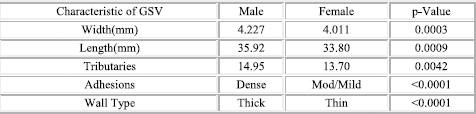
Summary of Results: In comparing EVH and OVH groups, no differences were seen preoperatively with respect to the number of diseased coronary arteries, ejection fraction, left ventricular end diastolic pressure, gender, leg girth, or number of bypass grafts. T-tests and chi-square tests were utilized to compare quantitative and qualitative data, respectively. Significant findings are depicted in the following tables.
Conclusions: Knowledge of GSV anatomy is crucial for successful vein harvest and subsequent grafting. Particularly during EVH, with its steep learning curve, attention to anatomy should improve harvesting techniques and conduit quality, thereby contributing to the long term success of CABG. Our results provide valuable anatomic data of the GSV and suggest that the left GSV is generally larger and therefore should be the first vein conduit of choice when performing this operation.
Endocrinology and Metabolism I
Concurrent Session
12:30 PM
Thursday, January 29, 2015
9
DIMINISHED EXPRESSION OF CD40 BY ADIPOSE TISSUE MACROPHAGE CORRELATES WITH BODY FAT IN HEALTHY NON-OBESE MEN
Chao JH1, Page ST1, Hagman D2, Kratz M2, Rubinow KB1. 1University of Washington, Seattle, WA and 2Fred Hutchinson Cancer Research Center, Seattle, WA.
Purpose of Study: Macrophages accumulate in adipose tissue with increasing obesity and metabolic dysregulation. During adipose tissue expansion, adipose tissue macrophages (ATM) undergo phenotypic shifts and secrete cytokines which may promote tissue inflammation and reduce adipocyte insulin sensitivity. CD40 is a cell surface receptor expressed on various immune cells including macrophages. When CD40 binds CD40 ligand (CD40L) on neighboring immune cells, a co-stimulatory dyad is formed. There are conflicting data, mostly in murine models, regarding the relationship between CD40 on ATM, obesity, and insulin sensitivity. Some studies have found a positive association between ATM CD40 expression and obesity and therefore suggested that CD40 plays a role in the pathophysiology of insulin resistance. In contrast, other studies demonstrate that CD40-CD40L deficiency improves insulin resistance. We evaluated ATM cell surface marker expression, including CD40, in subcutaneous adipose tissue from healthy men and examined whether ATM CD40 expression was associated with adiposity, BMI, and glucose tolerance.
Methods Used: Adipose tissue biopsies were performed on 32 healthy, non-diabetic men (mean age 39, range 22-55) with a mean BMI of 25.9kg/m2 (range 19.9-32.4). ATM were quantified and immunophenotyped using flow cytometry. Correlations between ATM CD40 expression and % total body fat (measured by dual energy x-ray absorptiometry), fasting glucose, 2-hour glucose after a 75g oral glucose challenge, and BMI were analyzed using Pearson's correlation coefficients.
Summary of Results: We found a significant inverse relationship between ATM CD40 expression and % total body fat (r=-0.4879; p=0.0091). No significant relationship was found between ATM CD40 expression and other metabolic parameters.
Conclusions: We found that an increase in body fat is associated with diminished ATM CD40 expression in healthy, non-obese men, in contrast to some studies in mice. Further studies are needed to investigate the regulation of ATM CD40 expression and to determine how differential expression of CD40-CD40L might influence the phenotype and function of other immune cell populations in adipose tissue.
10
EFFECTS OF MATERNAL ZINC DEFICIENCY ON OFFSPRING SATIETY, GLUCOSE HOMEOSTASIS AND GROWTH
Tzeng JA1, Philipps AF2, Lonnerdal B1. 1UC Davis, Davis, CA and 2Univ California Davis School of Medicine, Sacramemto, CA.
Purpose of Study: Zinc (Zn) is a micronutrient related to growth and glucose homeostasis. We have previously shown that marginal maternal Zn deficiency exerts negative and gender specific effects on offspring as long as 15 postnatal weeks. We investigated whether prenatal Zn deficiency and excess postnatal nutrition exacerbated abnormal growth and carbohydrate metabolism in offspring.
Methods Used: Female rats were fed a diet containing 25 ug Zn/g or 7 ug Zn/g ad libitum from 3 wks pre-conception to 3 wks postpartum. Offspring were culled to 4 per litter on day 2. After weaning, pups were fed a high fat diet containing 45% of calories from fat ad libitum. Food intake and weights of pups were measured daily and insulin (Ins) tolerance tests were performed when pups were 5 wks and 10 wks of age. Rats were killed at 15 wks of age, and tissues collected for further analysis. Serum Ins and leptin were analyzed by ELISA and leptin receptor (Obr) protein by Western blot.
Summary of Results: There were no differences in litter size or birth weight of pups between ZnC and ZnD groups. Postnatally, both male and female ZnD offspring weighed more than their respective controls. Food and caloric intakes over the 10 wk study period were 5% greater in ZnD than ZnC male animals(p<0.05). Basal Ins index of insensitivity (HOMA) in ZnD rats was significant higher than that of ZnC rats by 5 wks of both genders but persisted only in males by 10 wks (28% higher than control, p<0.05). Serum leptin levels were no different between groups. A linear relationship existed between leptin and weight gain only in ZnD males. Preliminary analysis suggests an over-abundance of Obr protein in brain but not liver of ZnD vs ZnC males.
Conclusions: We confirm our previous observation that maternal Zn deficiency is associated with offspring insulin insensitivity persisting into adolescence in male rats. We hypothesize that the novel findings of increased food intake and brain Obr protein in ZnD males may indicate a leptin insensitivity and furthermore that these findings may be due to epigenetic changes in the Ob receptor itself. There may be a propensity toward insulin resistance in later life relative to offspring, particularly males, who are born to Zn inadequate mothers.
11
HDL-MEDIATED ENOS ACTIVATION FALLS BEFORE THE ONSET OF T2DM IN OBESE NON-HUMAN PRIMATES
Couzens E1,2, Kim F2. 1Loma Linda University, Loma Linda, CA and 2University of Washington, Seattle, WA.
Purpose of Study: One of the protective actions of HDL is to stimulate the production of NO in endothelial cells via eNOS phosphorylation and activation. In T2DM we found that there is decreased HDL-mediated eNOS activity. Decreased eNOS has been proposed to increase risk for the development of T2DM. We hypothesized that HDL-mediated eNOS activation is impaired prior to the onset of T2DM during obesity. Evidence for this was seen in a group of non-human primates on a high fat diet for 24 months that became obese and subsequently developed insulin resistance and T2DM.
Methods Used: We utilized blood samples at baseline, 4, 8, 12, 18, and 24 months, isolated the HDL, and completed a cell-based assay in which HDL was incubated with endothelial cells, and eNOS phosphorylation, which is a marker of eNOS activity, was measured by in-cell western.
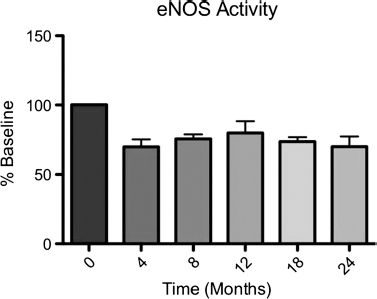
Summary of Results: In high fat fed primates, eNOS activity fell by 31% (p=0.0025) after 4 months and remained decreased between 4-24 months. At the end of 24 months, obese primates that underwent roux-en-y gastric bypass showed a 16% increase (p=0.1765) in eNOS activity.
Conclusions: These data indicate that HDL-mediated eNOS activation falls prior to the onset of T2DM and may be altered following bariatric surgery. Proteomic experiments are ongoing to determine the changes in HDL proteins and lipids that may cause decreased eNOS activity.
HDL-stimulated eNOS activity in high fat fed non-human primates at baseline, 4, 8, 12, 18, and 24 months. eNOS activity fell 31% (p=0.0025) after 4 months and remained decreased during the 4-24 month interval.
12
TRIGLYCERIDE HYPERTOLERANCE IN PATIENTS ON PARENTERAL NUTRITION
O'Keeffe DT1, Maraka S1, Nystrom EM2, McMahon M1, Miles JM1. 1Mayo Clinic, Rochester, MN and 2Mayo Clinic, Rochester, MN.
Purpose of Study: Hypertriglyceridemia is common in patients receiving intravenous fat emulsions (IVFE) as part of parenteral nutrition, and has been associated with higher risk of infection and higher mortality. We have found that some individuals appear to tolerate high rates of IVFE infusion unusually well. The present study was undertaken to identify factors that might account for triglyceride (TG) hypertolerance.
Methods Used: Electronic medical records of individuals receiving parenteral nutrition from January to December 2013 were reviewed. We arbitrarily defined TG hypertolerance (TGH) as a lipid infusion rate >2.0 gñm-2ñh-1 with TG levels <200 mg/dL. TG intolerance (TGI) was defined as TG ≥200 mg/dl with an infusion rate < 2.0 gñm-2ñh-1.
Summary of Results: Of 838 patients receiving parenteral nutrition, a TG level was available during IVFE infusion in 402. Of the latter, 16 (4%) had TGH and 73 (18%) had TGI. There were no gender differences between TGH (9 men, 8 women) and TGI (37 men, 36 women). TGH patients were slightly younger than TGI patients (48±4 vs 56±2 years), but the difference was not statistically significant (p = 0.054). TGH and TGI had lipid infusion rates of 2.9±0.4 and 0.8±0.02 gñm-2ñh-1 and TG levels of 106±12 and 311±18 mg/dl, respectively. IVFE provided calories equivalent to 74±10% (TGH) and 24±1% (TGI) of estimated basal energy requirements (Harris-Benedict equation). TGH patients had a lower BMI (21±1 vs. 30±1 kg/m2, p<0.0001) and higher TG clearance (5.3±0.6 vs. 0.6±0.02 L/min, p<0.0001) compared with TGI patients. There was no correlation between BMI and TG clearance in TGI, but a significant negative relationship between TG clearance and BMI in TGH (r = −0.50, p<0.05).
Conclusions: In summary, individuals with TGH had normal BMIs, whereas their TGI counterparts (who were selected for lower IVFE infusion rates and higher TG concentrations) were overweight/obese. TG clearance was markedly higher in TGH compared to TGI. Thus, some individuals with lower BMI are unusually tolerant of IVFE. This apparent enhanced efficiency of fat storage may represent an opportunity to provide more calories in selected depleted patients. Further study will be required to determine whether factors other than adiposity help determine TG tolerance.
13
ENDOTHELIAL DYSFUNCTION IN TYPE 1 DIABETIC ADOLESCENTS
Hegemann S, West A, Coe G, Cree-Green M, Nadeau K. University of Colorado Denver, Aurora, CO.
Purpose of Study: Individuals with type 1 diabetes (T1D) are at increased risk of developing cardiovascular disease (CVD). Determining the factors that increase CVD risk in T1D is thus of great importance. Youth are ideal to target for intervention, as early cardiovascular changes may still be reversible and because early T1D onset forecasts earlier complications. We aimed to assess endothelial function in T1D youth along with potential determinants of endothelial dysfunction.
Methods Used: Data were collected from 28 T1D adolescents (age 16.5±2 years, diabetes duration 7.9±3.8 years). Data are presented as mean±SD. Anthropometric measures were obtained and fasting labs were collected following an overnight insulin infusion to normalize glycemia. Participants were either normal weight (NW) (n=14, BMI%ile=63.9±17.0) or overweight/obese (O) (n=14, BMI%ile=93.0±4.5). Endothelial function was assessed fasting with reactive hyperemic index (RHI) using the EndoPAT™. An RHI score of 1.67 and below indicates endothelial dysfunction.
Summary of Results: Overall mean HbA1c was 8.7±1.4%, triglycerides 72.8±25.3 mg/dL, LDL cholesterol 80.3±19.2 mg/dL, HDL cholesterol 45.6± 10.5 mg/dL, free fatty acids (FFA) 407±196 uEq/L, leptin 16.2±12.3 ng/mL, hsCRP 1.8±2.5 mg/L and blood pressure (BP) 129/65±10.5/6.6 mmHg. Endothelial dysfunction was present in 59.1% of all T1D (RHI=1.7±0.52), 50% of NWT1D (RHI=1.7±0.50) and 70% of OT1D (RHI=1.6±0.56). Overall, RHI was inversely related to FFA (p=0.008, r=-0.550) and leptin (p=0.039, r=-0.462). In the OT1D group alone, RHI remained inversely associated with FFA (p=0.026, r=-0.693) but also with diabetes duration (p=0.04, r=-0.648). HbA1C, triglycerides, LDL, HDL, hsCRP, and BP did not correlate with RHI in any group.
Conclusions: T1D adolescents had endothelial dysfunction unrelated to glycemic control, fasting lipids, inflammation or BP. The association with fasting FFA argues that adipose insulin resistance (IR) may contribute to CVD risk in T1D. The relationship with leptin and the higher prevalence of endothelial dysfunction in the OT1D group also argues that obesity may worsen CVD in T1D. These findings highlight the early onset of CVD in T1D and the importance of future research on IR and obesity in T1D to decrease CVD risk.
14
ASSOCIATION OF PASSIVE AND ACTIVE SMOKING WITH PREDIABETES RISK IN A PREDOMINANTLY HISPANIC POPULATION
Purpose of Study: Active smoking is the leading cause of avoidable death and has been associated with an increased incidence of type 2 diabetes. Previous studies on the impact of passive smoking, however, have not been fully applied to a population that is enriched in Hispanic individuals. We investigated the association between active smoking, exposure to environmental tobacco smoke (ETS), and prediabetes risk in a New Mexico population known to be at risk for diabetes. We hypothesized that the risk for prediabetes would increase with increasing smoking status after adjustment for important covariates.
Methods Used: We screened 219 adults at risk for diabetes from New Mexico for glucose homeostasis status using A1c criteria. All subjects completed a comprehensive health survey at the time of screening. Subjects were categorized into five groups according to their history of exposure to tobacco smoke: NSU = Never Smoked and Unexposed to ETS; NSE = Never Smoked but Exposed to ETS; PSU = Previous Smoker and Unexposed to ETS; PSE = Previous Smoker and Exposed to ETS; CS = Current Smoker. Glucose homeostasis status was assigned as follows: no diabetes (A1c < 5.7%), prediabetes (A1c 5.7 - 6.4%), and T2D (A1c > 6.4%). Of the entire group, 60% had no diabetes, 39% had prediabetes, and 1% had new T2D.
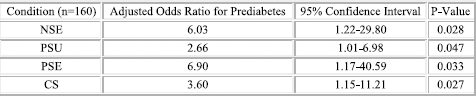
Summary of Results: 160 patients with complete data sets were included in a Multivariate Logistic Regression analysis using NSU as the reference group. Mean age was 45±14 years, the group was predominantly female (57M,103F), and the ethnic composition of the group was 44% Hispanic, 39% NHW, 11% Native American, 3% Black, and 3% Other. As shown in the Table, a history of exposure to ETS and/or active smoking increased the likelihood of having prediabetes after adjusting for age, sex, ethnicity, family history of diabetes, alcohol consumption, and systolic blood pressure.
Conclusions: Active or passive smoking are positively and independently associated with prediabetes risk in this cohort of New Mexicans.
Health Care Research I
Concurrent Session
12:30 PM
Thursday, January 29, 2015
15
ACCURACY OF EMS FIELD INFORMATION RELATED TO PRE-EXISTING CHRONIC HEALTH CONDITIONS AND MEDICATION TREATMENT IN OUT-OF-HOSPITAL CARDIAC ARREST
Foster AA1, Florea V2, Fahrenbruch C2, Blackwood J2, Rea T1,2. 1University of Washington, Seattle, WA and 2Seattle and King County EMS, Seattle, WA.
Purpose of Study: A person's chronic health conditions and medication treatments could influence resuscitation care and outcome following out-of-hospital cardiac arrest (OHCA). However little is known regarding the field availability or accuracy of information related to the pre-existing chronic health conditions or medication treatments among OHCA patients. We undertook a descriptive investigation to evaluate the accuracy of field information about chronic health conditions and medication treatments.
Methods Used: The investigation was a retrospective cohort study of persons suffering ventricular fibrillation OHCA treated by emergency medical services (EMS) in a large metropolitan county from January 1, 2007 to December 31, 2013. Patients were eligible if age > 17, non-traumatic etiology, and a shockable rhythm was initially monitored or developed during resuscitation. We independently evaluated pre-existing chronic health conditions and medication treatments using two distinct sources: 1) the EMS report form and 2) the hospital medical record specific to the OHCA event. We used the hospital information as the gold standard in deriving sensitivity (EMS positive/hospital positive) and specificity (EMS negative/Hospital negative). We chose the examples of diabetes as a chronic health condition and beta blocker therapy as a pre-existing medication treatment.
Summary of Results: Of the 2179 eligible consecutive patients, 1246 had hospital records. Of these, 1085 (87%) had EMS medical reports abstracted for this report. Diabetes status was known from 1026 (95%) of the hospital records and 828 (76%) of the EMS records, 795 (73%) with information from both. Patient medications were available for 864 (80%) and 712 (66%), respectively, with 600 (55%) having information from both. EMS ascertainment of diabetes diagnosis had a sensitivity of 0.72 (201/280) and specificity of 0.97 (498/515), while ascertainment of chronic beta blocker treatment was 0.68 (157/232) for sensitivity and 0.93 (343/368) for specificity.
Conclusions: Field information about specific pre-existing chronic health conditions or medication treatments has high specificity but lower sensitivity when using hospital information as the gold-standard.
16
ADHERENCE AND PERSISTENCE TO STATIN THERAPY IN A VETERAN POPULATION
Morotti K2, Lopez J2, Harvey M3, Vaupel V2, Swislocki A1,4, Siegel D1,4. 1VANCHCS, Martinez, CA; 2VANCHCS, Martinez, CA; 3VA Sierra Nevada Health Care System, Reno, NV and 4UC Davis School of Medicine, Sacramento, CA.
Purpose of Study: To evaluate factors that impact adherence to and persistence with statin therapy. While a relative cardiovascular risk reduction of 25-35% has been reported in patients that have started statins for elevated cholesterol, many patients fail to consistently take these medications as directed.
Methods Used: This retrospective study analyzed data extracted from a VA database encompassing 6 facilities in Northern California, Northern Nevada and Hawaii for patients newly prescribed statin medication between July 1, 2007 and December 31, 2012. Patient demographics, co-morbidities, prescription record information, and time on therapy were collected. Adherence to statin therapy was determined using the mean possession ratio (MPR), calculated as the total days’ supply of medication dispensed divided by the total number of days in the intended treatment period (MPR>0.8 is considered adherent). Persistence was defined as whether a patient continued to refill their statin prescription, with non-persistence occurring when a given patient did not refill their statin for a period of > 135 days.
Summary of Results: Of 37,214 patients, overall adherence to statins was reflected by a mean MPR of 0.867. Approximately 44% of patients continued to be persistent on statin therapy after 675 days. Patients prescribed pravastatin, lovastatin, rosuvastatin, and those who took more than 1 different statin during the follow-up period had statistically significant higher rates of adherence than those prescribed simvastatin. The overall mean MPR progressively, and significantly, increased with age groups from age 18-30 to 71-80 years of age. Using multiple logistic regression analysis, PTSD, ischemic heart disease, and hyperlipidemia were comorbidities associated with non-adherence.
Conclusions: In Veterans, statin adherence was excellent. Certain populations may benefit from interventions targeted at improving adherence to statins including younger Veterans (age 18-60), those prescribed simvastatin, and those with hyperlipidemia, ischemic heart disease, and/or PTSD.
17
RISK FACTORS FOR POSTPARTUM READMISSION FOR HYPERTENSIVE DISORDERS AT A TERTIARY HOSPITAL CENTER
Thomas K1, Lai J2, Walker S2, Benedetti T2. 1University of Washington School of Medicine, Seattle, WA and 2University of Washington Medical Center, Seattle, WA.
Purpose of Study: Nationwide, postpartum diagnoses are a leading cause for hospital readmission. This study focused on causes and predictive factors for postpartum readmission.
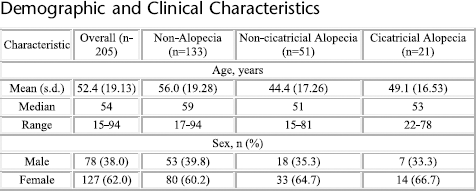
Methods Used: At UWMC, hypertensive disorders were the leading cause of postpartum readmissions from 2008 to 2013, constituting 31%. We conducted a retrospective case-control study of readmitted patients with a pre-discharge diagnosis of hypertensive disorder of pregnancy (HDP). Our comparison group was 192 delivery-year matched controls who were not readmitted, but had known HDP.
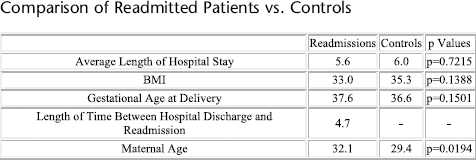
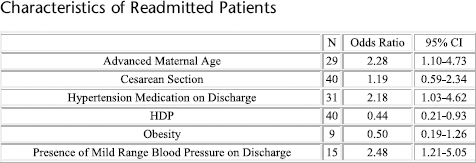
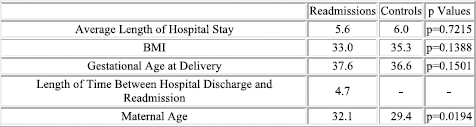
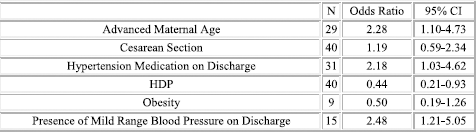
Summary of Results: 73 patients were readmitted postpartum with hypertension. Average time between discharge and readmission was 4.7 days. Of those readmitted, 40 had a pre-discharge diagnosis of HDP, while 33 were normotensive. In pre-diagnosed patients, mean maternal age at delivery was higher and they were more likely to be from a minority population (p<0.001). Additionally, they were 2.5 times more likely to have mild range blood pressures 24 hours prior to discharge and 2.2 times more likely to have been prescribed antihypertensive medications at discharge. There was no difference in BMI, mode of delivery, length of hospital stay or number of antihypertensive medications at discharge.
Conclusions: Four characteristics had a statistically significant association with postpartum readmission for HDP - age, ethnicity and mild range blood pressures with need for antihypertensive medications at discharge; however, BMI, mode of delivery and length of hospital stay were not predictive.
Comparison of Readmitted Patients vs. Controls
Characteristics of Readmitted Patients
18
DIAGNOSTIC AGREEMENT AMONG PATHOLOGISTS ASSESSING FLAT EPITHELIAL ATYPIA ON BREAST BIOPSY SPECIMENS
Samples L1, Rendi M2, Weaver D3, Frederick P1, Morgan T1, Elmore J1. 1University of Washington, Seattle, WA; 2University of Washington, Seattle, WA and 3University of Vermont, Burlington, VT.
Purpose of Study: Each year, 1.6 million breast biopsies are performed in the United States (US). Up to 10% of the core needle biopsies performed in this population may include flat epithelial atypia (FEA), a diagnosis with uncertain significance that can lead to additional costly and potentially harmful testing and treatment. In this study, we evaluated variability and potential errors in US pathologists’ use of the FEA diagnostic term.
Methods Used: Pathologists from the US were invited to participate in the Breast Pathology Study (B-Path). Each participant interpreted one of four test sets of 60 cases each, comprising 240 total breast biopsies. Reference diagnoses were defined for each case by a panel of three experienced breast pathologists. Variability in participating pathologists’ use of the FEA diagnostic term was assessed for each test set, as well as for 72 reference non-FEA benign cases and six reference FEA cases.
Summary of Results: Participating pathologists comprised 65% of invitees, and 91% (N=115) completed the study, providing 6,900 individual assessments. Use of the FEA term was highly variable, ranging from 0% to 35% of the 60 test cases interpreted by each participant. Of the 72 reference benign cases, 34 were identified as FEA by one or more participants even though they were not considered FEA by the reference pathologists. Variability was also apparent on each of the six reference FEA cases where participating pathologists’ agreement with the reference panel ranged from 17% to 52%. Common alternative diagnoses submitted by pathologists for the FEA reference cases included columnar cell hyperplasia (CCH), usual ductal hyperplasia (UDH), and atypical lobular hyperplasia (ALH).
Conclusions: There is a high degree of variability in use of the FEA assessment term by US pathologists. This variability implicates uncertainty and emphasizes that FEA is a challenging diagnosis in clinical practice; hence providers should exercise caution before considering subsequent testing and treatment. Methods to improve diagnostic accuracy of FEA should be explored, such as additional education of pathologists and use of second opinions.
19
POST IMPLEMENTATION EVALUATION OF TELEDERMATOLOGY IN A VA MEDICAL CENTER
Roman MM1, Chiu M2. 1David Geffen School of Medicine at UCLA, Loma Linda, CA and 2David Geffen School of Medicine at UCLA, Los Angeles, CA.
Purpose of Study: Evaluate the effectiveness of the telederm referrals that the West LA VA Medical Center Dermatology clinic receives from its 5 primary care teams.
Methods Used: 100 telederm consults at the dermatology clinic were analyzed retrospectively for indications and outcomes. Telederm diagnoses were categorized as “rash”, “growth”, or “other” and their dispositions as face-to-face dermatology referral or primary care follow up. Chi Square Test was used to examine the difference in patient dispositions.
Summary of Results: The 100 patients had 122 overlapping diagnoses. In 89% of “rash” (n = 64) and 88% of “other” (n = 16) cases, telederm was effective in resolving the issues without a dermatologist visit. Telederm was only effective in avoiding a dermatologist visit in 24% of “growth” (n = 42) cases. There was a significant difference in disposition for the “rash,” “growth,” and “other” groups (p = .05).
Conclusions: In this single site, it appears that telederm is more appropriate for “rashes” and “other” non-growth cases compared to “growth” cases. Thus, diagnoses classified as “growths” could be considered for direct referral to face-to-face dermatology.
20
CARDIAC SCREENING IN HIGH SCHOOL ATHLETES: THE IMPACT OF EXERCISE LEVEL ON SYMPTOM RESPONSE RATES
Haruta A, Zigman M, Drezner J. University of Washington, Seattle, WA.
Purpose of Study: Athletes are required to undergo a pre-participation physical evaluation (PPE) to screen for conditions predisposing to sudden cardiac death (SCD). The purpose of this study is to examine the relationship between exercise level and the rate of positive responses to standard cardiac screening questions in high school athletes.
Methods Used: Data was collected at community heart screening events directed by the Nick of Time Foundation from October 2010 to June 2013. Athletes were defined as those participating in at least one high school or club/select sport. The screen included questions based on the Pre-participation Physical Evaluation Monograph 4th Edition, a focused physical exam, and a resting 12-lead electrocardiogram. Abnormal findings were further evaluated by echocardiography. Exercise levels were self-reported as <5 hours of exercise/week (less competitive athlete), 5-10 hours of exercise/week (competitive athlete), and >10 hours of exercise/week (elite athlete). Chi-squared or Fisher's exact test was used to determine differences in the rates of symptom responses. Sensitivity (Sn), specificity (Sp), and positive predictive value (PPV) of history questions were calculated based on the cardiac disorders identified.
Summary of Results: 4728 high school athletes age 13-19 (mean 15.7 years; 54% male) were screened. Overall, 1252 (26%) answered “yes” to at least one cardiac symptom question with chest pain (25%) and shortness of breath (21%) with exercise most common. Positive history responses were significantly higher in less competitive vs. competitive and elite athletes (RR=1.57; p<0.0001), but not in competitive vs. elite athletes (RR=1.1, p=0.09). Athletes detected with conditions associated with SCD had higher positive response rates than normal cases (RR=1.81; p=0.02). Overall Sn (0.478) and PPV (0.009) did not differ significantly across exercise levels, but Sp was better in competitive and elite athletes vs. less competitive athletes (Sp=0.758 vs. 0.617, p<0.001).
Conclusions: Less competitive athletes report more cardiac symptoms than higher level athletes using standard PPE questionnaires. The generally high response rates to cardiac screening questions yields a modest Sn, but very low PPV and high false positive rates >23% across all exercise levels.
21
CROWD SOURCED ASSESSMENT OF TECHNICAL SKILLS (CSATS): A SCALABLE ASSESSMENT TOOL FOR THE NURSING WORKFORCE
Purpose of Study: In the current healthcare environment, education for technical skills focuses on quality improvement that demands ongoing skill assessment. Objectively assessing the competency of healthcare workers is a complex and challenging task that, when done effectively, improves patient care. Current methods are time-consuming, expensive, and subjectively evaluate each nurse. Crowd sourcing is the practice of obtaining services from a large group of people, typically the general public on an online community. CSATS (Crowd Sourced Assessment of Technical Skills) uses crowd sourcing as an innovative way to rapidly, objectively, and comprehensively assess technical skills. We hypothesized that CSATS could accurately evaluate the proficiency of nurses being trained to use a new glucometer.
Methods Used: We video recorded a total of 34 practicing nurses at one institution performing a glucometer skills test at 6 different nursing training sessions. We created an interface that displayed the video along with a detailed survey listing the individual glucometer steps. We uploaded this interface to an Amazon.com hosted crowd sourcing site, Mechanical Turk™. The crowd evaluated the completion and sequence of the glucometer steps in each video.
Summary of Results: In under 4 hours of posting the videos, we obtained 1,300 crowd ratings, an average of 38 per video, that evaluated the user's performance in the video based on completion and correct order of steps. The crowd found individual performance variance, identified specific training steps frequently missed by all users, and provided specific feedback tailored to each nurse. CSATS identified 15% of nurses who would benefit from additional training.
Conclusions: Our study showed that healthcare-naïve crowd workers can assess technical skill proficiency rapidly and accurately at nominal cost. CSATS may be a valuable tool to assist educators/supervisors in creating targeted training curricula for nurses in need of additional training while rapidly identifying nurses whose technical skills require no additional training in a particular skill. Thus, dramatically reducing the resource burden for nursing training.
22
MYMEDS: EVALUATING PATIENT AND PROVIDER PERSPECTIVES ON INTEGRATED CLINICAL PHARMACY SERVICES
Lonowski S1, Mangione C2, Chon J2, Fu J2, Moreno G2. 1University of California, Los Angeles, Los Angeles, CA and 2University of California, Los Angeles, Los Angeles, CA.
Purpose of Study: On average, 50% of medications are not taken as prescribed. Overuse and over-prescribing of medications is associated with increased risk of drug interactions and side effects, and medication management is often cited as a cause of hospital readmissions and ED visits. The UCLA MyMeds program addresses medication management issues through an innovative program that integrates clinical pharmacists into the primary care setting. The objectives of this study were to evaluate provider satisfaction with MyMeds, to compare patient and provider satisfaction, and to identify facilitators and barriers to full integration of pharmacist services.
Methods Used: Mixed methods study with a cross-sectional survey and semi-structured interviews with physicians who had ≥4 unique patient referrals to MyMeds (n=69). Major themes addressed were the pharmacists’ impact on team care, communication, medication therapy management, and workflow/workload. Select questions from the provider satisfaction survey were also compared to similar questions on a concurrently administered patient satisfaction survey. Standard qualitative content-analysis is currently underway to identify major themes from the interviews.
Summary of Results: Survey response rate was 61% and 13 physician interviews were conducted. 90% of survey respondents “agree” or “strongly agree” that having the pharmacist in the office makes management of the patient's medication more efficient, 93% “agree” or “strongly agree” that pharmacist recommendations are clinically helpful, 71% “agree” or “strongly agree” that having access to a pharmacist has increased their knowledge about medications they prescribe, and 75% “agree” or “strongly agree” that having a pharmacist as part of the primary care team has made their job easier.
Conclusions: This study provides new and unique insight into the impact of an innovative, team-based intervention in primary care. Provider satisfaction is particularly important as health systems work to create sustainable interventions to improve efficiency, reduce costs, and enhance quality of care.
Immunology and Rheumatology I
Concurrent Session
12:30 PM
Thursday, January 29, 2015
23
DO POST-TRANSCRIPTIONAL ELEMENTS CONTROLLING NLRP3 MRNA STABILITY DICTATE INFLAMMATION?
Varela SN1, Ram S2. 1University of Washington, Seattle, WA and 2University of Washington, Seattle, WA.
Purpose of Study: Dysregulation of immune gene expression can lead to inflammatory and auto-immune diseases. In this study, we investigated post-transcriptional regulation of Nod-Like Receptor Protein 3 (NLRP3), a sensor of pathogens in the cytosol and component of the inflammasome pathway. It is currently thought this requires two signals: the first to induce NLRP3 mRNA, and the second for activation. However, some studies disprove the necessity of the first signal for activation. Furthermore, the 3’ UTR of NLRP3 contains two polyadenlyation sites that produce an mRNA transcript with a long or short 3’ UTR. In this study, we investigated both the post-transcriptional control of NLRP3 mRNA by these two polyadenylation signals, and the necessity of the first signal for NLRP3 transcription.
Methods Used: Constructs were created containing the NLRP3 3’ UTR terminating at the first polyadenylation site (Short) or at the second site (Long), each downstream of a luciferase reporter, which is a measure stability and turnover of mRNA. We quantified luciferase activity in various cell lines to measure the expression levels of both 3’ UTR variants. We also used quantitative PCR to compare the copy number of each NLRP3 transcript variant following different inflammasome stimuli.
Summary of Results: In our effort to uncover how the alternate splicing site within the 3’ UTR may contribute to the regulation of NLRP3 mRNA, we discovered the luciferase activity of the long 3’ UTR was more significantly repressed compared to the short. Intruigingly, we also found unstimulated cells contained a significant number of NLRP3 transcripts which increased with stimulation.
Conclusions: The discovery of NLRP3 mRNA within unstimulated cells, taken with the higher repression of long 3’ UTRs, leads us to hypothesize that the more repressable NLRP3 with long 3’ UTR could be transcribed constitutively. Its repressable regions allow it to be stored within the cell and available for immediate translation upon infection. Future investigation on the length of 3’ UTRs in the context of microbial infection would give us insight into the regulation of inflammasomes. Overall, this study shows a previously unknown connection between the stability of NLRP3 mRNA and inflammatory and autoimmune diseases.
24
IGM-MEDIATED PHAGOCYTOSIS OF STAPHYLOCOCCUS AUREUS IN MICROGLIA IS DEPENDENT ON COMPLEMENT RECEPTOR 3, BUT NOT COMPLEMENT FACTOR 3
Hanson JF1, Quan Y2, Colonna L3, Moller T3, Weinstein JR2. 1University of Washington, Seattle, WA; 2University of Washington, Seattle, WA and 3University of Washington, Seattle, WA.
Purpose of Study: Microglia are the resident phagocytic cells in the CNS and play a critical role in clearing opsonized bacteria from brain abscesses and other CNS infections. Recently our lab has found that IgM-dependent phagocytosis of the bacteria Staphylococcus aureus (SA) in microglia is, unexpectedly, independent of IgM/IgA receptor Fcα/μR, but was dependent on intact Complement Receptor (CR3) expression/function. Here we examine if IgM- and IgG-dependent phagocytosis of SA in microglia is also dependent on Complement Factor 3 (C3).
Methods Used: We pre-incubated fluorescent labeled SA with either anti-SA IgG, IgM or corresponding isotype controls and than added the reaction mixes to primary cultured mouse microglia. We used flow cytometry to quantify both basal rates of phagocytosis (in absence of antibody) as well as fold rate increases following opsonization with either anti-SA IgG and IgM. In order to assess involvement of CR3 (a heterodimeric receptor composed of CD11b and CD18), we examined the effect of anti-CD11b blocking antibody on anti-SA IgM- and IgG-induced rates of phagocytosis. In order to examine the involvement of C3 in these processes, we carried out similar phagocytosis experiments on microglia derived from either wild-type (WT) or C3-/- mice.
Summary of Results: We found that in WT microglia, IgG- and IgM-opsonization increased phagocytosis by about 48- and 26-fold, respectively, over isotype control IgG and IgM. Addition of anti-CD11b blocking antibody (but not its isotype control), reduced IgM-mediated phagocytosis by 69% but had little effect on IgG-induced phagocytosis. In microglia derived from C3-/- mice, IgM- induced phagocytosis was similar to WT whereas IgG-induced phagocytosis was modestly attenuated (by about 20%).
Conclusions: Our findings suggest that IgM-, but not IgG-mediated phagocytosis of SA in microglia is dependent on Complement Receptor 3. These results also suggest that IgM-mediated phagocytosis is not dependent on cellular production of C3.
25
ENGINEERING OF DENDRITIC CELLS FOR STIMULATING GUT-HOMING IMMUNE CELLS
Chan C1, Li C1, Baylink DJ1, Xu Y1, Walter MH1, Lau KW1,2, Qin X1,2, Carreon Berumen E1, Tang X1. 1Loma Linda University, Loma Linda, CA and 2Jerry L. Pettis Memorial Veterans Affairs Medical Center, Loma Linda, CA.
Purpose of Study: Dendritic cells (DC) are the most important antigen presenting cells and show promise in cell-based immunotherapy. One crucial goal of the cell-based immunotherapy is the acquisition of gut-homing capacity in antigen-specific T cells through DC vaccination for the treatment of gut-related diseases. However, recent data suggest that ex vivo-generated DCs lose their ability to induce expression of gut-homing receptors on T cells. Since retinoic acid has been shown to imprint T cells with gut tropism, this study aims to evaluate a strategy that may restore the DCs’ capacity to induce expression of the gut-homing receptors (i.e. α4β7 and CCR9) in antigen-specific T cells.
Methods Used: DCs were generated by culturing bone marrow mononuclear cells in the presence of GM-CSF and IL-4. Using a lentiviral vector, the monocyte-derived DCs were engineered to constitutively express retinaldehyde dehydrogenase 2 (RALDH2), the enzyme that is responsible for converting retinal into retinoic acid. The expression of the ALDH1A2 gene that encodes for RALDH2 was confirmed by real time quantitative polymerase chain reaction. The intracellular expression of RALDH2 as well as its enzymatic function was further verified by flow cytometry. To evaluate the capacity of the engineered DCs to induce the gut-homing receptors in antigen-specific T cells, mice were subcutaneously injected with peptide (OTII)-pulsed DCs that were engineered for overexpression of RALDH2 (RALDH2-DC) or untreated (Control-DC). Ten days later, local draining lymph nodes were examined for expression of CCR9 and α4β7 on the peptide-specific T cells by multichromatic flow cytometry.
Summary of Results: Our data showed that CCR9 expression on the T lymphocytes in the draining lymph nodes of the mice injected with the OTII-pulsed RALDH2-DC but not Control-DC was significantly increased.
Conclusions: Our data therefore suggests that DCs engineered for overexpression of RALDH2 is a promising tool for developing antigen-specific immunotherapies for gut-related diseases.
26
ABSENCE OF CCL3 COMPROMISES RESOLUTION OF EXPERIMENTAL OTITIS MEDIA AND IMPAIRS HOST DEFENSE OF THE MIDDLE EAR
Nuyen BA1, Deniffel D2, Pak K2, Ryan A2. 1University of California, San Diego School of Medicine, La Jolla, CA and 2University of California San Diego, La Jolla, CA.
Purpose of Study: Acute otitis media (OM) is one of the most common pediatric diseases. Although it has become evident that the innate immune system plays a key role in host defense against OM, its precise mechanisms remain incompletely understood. In previous studies, the effect of pro-inflammatory cytokines could be compensated by in vivo application of recombinant CC chemokine ligand 3 (CCL3), a potent downstream effector of tumor necrosis factor (TNF) mediated-inflammation. To further explore the influence of this chemokine on host defense against middle ear (ME) infection we induced OM in CCL3 -/- mice by ME inoculation of nontypeable Haemophilus influenzae (NTHi).
Methods Used: 54 CCL3 (-/-) mice and 54 wild-type (WT) mice were divided into sets of 6 mice, 1 for each of the 9 time points (0, 1, 2, 3, 5, 7, 10, 14, and 21 days after inoculation). Three mice per set were used for ME histopathological analysis, and 3 mice per set were used for ME bacterial cultures. The MEs of these WT and CCL3 (-/-) mice were inoculated by transbullar injection of NTHi.
Summary of Results: Compared to their WT counterparts, CCL3 -/- animals demonstrated prolonged and persistent OM, evidenced by compromised bacterial clearance and delayed mucosal recovery. The diminished clearance of NTHi and the consequently prolonged presence of NTHi in the middle ears of CCL3 -/- mice correlated with a significantly prolonged and enhanced thickening of the middle ear mucosa late in the course of OM. In addition, mice lacking CCL3 were more likely to be colonized by other otopathogens, one of which we identified as Klebsiella pneumoniae. The higher prevalence of Klebsiella pneumoniae in ME of CCL3 -/- mice correlated with a significantly higher nasopharyngeal bacterial load and an altered composition of commensal nasopharyngeal flora in this strain, suggesting a predisposition for ME infection.
Conclusions: CCL3 appears to plays a key role not only in the innate immunity receptor-mediated inflammatory response to ME infection, but also in ME bacterial homeostasis. Therapies based on CCL3 could prove useful in treating persistent disease.
27
CHARACTERIZING THE ROLE OF THE ALTERNATIVE COMPLEMENT PATHWAY IN VASCULAR REGRESSION IN A MOUSE MODEL OF RETINOPATHY
Diaz Aguilar D1, Kim C2, Sweigard H2, Connor K2. 1UCLA, Los Angeles, CA and 2Massachusetts Eye and Ear Infirmary and Harvard Medical School, Boston, MA.
Purpose of Study: To evaluate the origin and role of the complement system in early retinal neo-vascularization
Methods Used: Following an oxygen induced retinopathy model, postnatal day 7 WT mice were exposed to 75% oxygen for 24 hours. Using laser capture microdissection we evaluated the changes in complement factor transcription in these mice (n=6) versus age- and strain-matched mice kept at room oxygen (n=6). Transcription levels of membrane-bound complement inhibitors: Cd55 and Cd59, soluble complement factors: C3, C5 and alternative-specific factor B were measured in the retinal vasculature, retinal pigment epithelium (RPE), outer nuclear layer (ONL), inner nuclear layer (INL) and ganglion cell layer (GCL). Additionally, alternative pathway knockout mice (Fb-/-) and age-matched WT-mice retinas were examined and quantitated after lectin vasculature staining.
Summary of Results: Following LCM the RPE and ONL were identified to be a major site of Fb translation and demonstrated increased expression following hyperoxia (p<.01). The ONL was also identified as a major production site for c3 and c5, however only the INL had significant increases in expression of both (p<.05). Within retinal vasculature, transcription of both complement inhibitors was decreased (p<.001) however expression in other layers was non-significant or increased (p<.05), potentially as a compensatory response to increased complement activity. Additionally, retinal vasculature analysis revealed that Fb-/- mice (n=10) exhibited less vaso-obliteration than age- and strain-matched WT mice (n=8) (p<.05).
Conclusions: Our results implicate the alternative pathway as a mediator of vascular regression during phase-I of NV. Specifically, upstream complement factors are induced in the retina, while the targeted removal of vessels is achieved by down-regulating their expression of complement inhibitors. To our knowledge, this is the first study to identify locations and relative expression of retinal complement factor transcription during NV and implicates the alternative complement in a protective role in NV proliferation and mitigating disease proliferation. Future studies will explore additional time points to further understand the role of the innate immune system in vascular retinopathy.
28
SURFACE APRIL IS ELEVATED ON MYELOID CELLS AND IS ASSOCIATED WITH DISEASE ACTIVITY IN RHEUMATOID ARTHRITIS PATIENTS
Daoud N1, Weldon AJ2,3, Moldovan I4,1, Cabling M1, Hernandez E6, Hsu S1, Gonzalez J2, Parra A2, Benitez A2,3, Colburn K1, Payne KJ5,2. 1Loma Linda University, Loma Linda, CA; 2Loma Linda University, Loma Linda, CA; 3Loma Linda University, Loma Linda, CA; 4Beaver Medical Group, Redlands, CA; 5Loma Linda University, Loma Linda, CA and 6Loma Linda University, Loma Linda, CA.
Purpose of Study: To assess surface APRIL (CD256) expression by circulating myeloid cells in rheumatoid arthritis (RA) and to determine its relationship to patient disease activity.
Methods Used: Peripheral blood mononuclear cells (PBMNCs) and plasma were obtained from RA patients and normal donors. PBMNCs were stained for flow cytometry to detect surface APRIL and blood cell surface markers to identify circulating myeloid cell subsets. Based on CD14 and CD16 phenotypes, monocyte subsets described as classical (CD14+CD16-), intermediate (CD14+CD16+), and non-classical (CD14loCD16+) were identified. Levels of surface APRIL expression were measured by flow cytometry and median fluorescence intensity (MFI) was used for comparisons. Levels of soluble APRIL in the plasma were determined by ELISA. Disease activity was measured by Disease Activity Score out of 28 joints (DAS28).
Summary of Results: In RA patients, total myeloid cells showed expression of surface APRIL which correlated with disease activity and with plasma APRIL levels measured in these patients. In normal donors, classical (CD14+CD16-) monocytes comprised more than 80% of circulating monocytes. However, in RA patients, the intermediate (CD14+CD16+) and non-classical (CD14loCD16+) subsets were elevated and made up the majority of circulating monocytes. In contrast to normal donors, where high levels of surface APRIL were only observed on non-classical (CD14loCD16+) monocytes, RA patients showed high levels of surface APRIL expression by all circulating monocyte subsets.
Conclusions: Surface APRIL is elevated on circulating myeloid cells in RA patients where it is highly correlated with disease activity. RA patients also showed skewing of monocytes toward subsets associated with secretion of TNF-α and/or IL-1β.
Infectious Diseases I
Concurrent Session
12:30 PM
Thursday, January 29, 2015
29
PRECLINICAL DEVELOPMENT OF NOVEL ANTIBIOTICS AGAINST GRAM POSITIVE BACTERIA
Duster N1, Creason S1, Ranade R1, Fan E2, Zhang Z2, Buckner F1. 1University of Washington, Seattle, WA and 2University of Washington, Seattle, WA.
Purpose of Study: Antibiotics with novel mechanisms of action are needed to counteract resistant Gram positive bacteria. Our laboratory is focused on inhibitors of protein translation that specifically block the enzyme methionyl-tRNA synthetase (MetRS). This essential enzyme attaches methionine to the corresponding tRNAmet that is used for protein translation. Most Gram positive bacteria have a type 1 MetRS enzyme which is distinct from the type 2 enzyme found in most Gram negative bacteria (and in the human cytoplasm). We hypothesize that type 1 MetRS inhibitors can be effective for treating Gram positive infections.
Methods Used: The S. aureus MetRS gene was PCR amplified and cloned into the AVA0421 plasmid then overexpressed and purified from E. coli. Radiometric and ATP depletion assay methods are being developed. Over 300 MetRS inhibitors were synthesized. MICs of selected compounds were measured by microbroth dilution methods following CLSI procedures.
Summary of Results: We have designed and synthesized >300 novel inhibitors of type 1 MetRS. Twenty-six compounds were tested against a panel of Gram positive bacteria. The most potent compounds had MIC values of 0.15-0.6 ug/mL against S. aureus and 0.04-0.08 ug/mL against E. faecalis. The MICs to the control drug vancomycin were 1.25-2.5 ug/mL for these strains. The compounds were inactive against Gram negative bacteria and had no toxicity to mammalian cells below 10 ug/mL. With these data, we decided to explore the target of action in bacteria, specifically the S. aureus MetRS. The recombinant protein was overexpressed and purified from E. coli, and now being adopted for functional assays to quantify uptake of 3H-methionine into tRNA. Next, we will screen our library of MetRS inhibitors against the S. aureus enzyme to identify the most potent compounds and define structure activity relationships. The enzyme data and additional screening against bacterial strains will be presented.
Conclusions: >300 inhibitors of the MetRS enzyme were synthesized. A subset of the library were screened against Gram positive bacteria identifying compounds with MICs lower than the control drug vancomycin and with low toxicity to mammalian cells. We have now cloned and expressed the S. aureus MetRS for enzymatic studies to guide hit-to-lead compound optimization.
30
THE SAE VIRULENCE SYSTEM PROMOTES INTERFERON-GAMMA TO ENHANCE STAPHYLOCOCCUS AUREUS SKIN DISEASE IN AN INTERLEUKIN-17 DEPENDENT MANNER
Addison C1, Guerra F2, Watkins R2, Voyich J2. 1University of Washington, Seattle, WA and 2Montana State University, Bozeman, MT.
Purpose of Study:Staphylococcus aureus (S. aureus) is responsible for the majority of skin infections in the clinic. Traditional antibiotic treatments have become increasingly ineffective, and the development of novel immunomodulatory therapies relies on a deeper understanding of the host response. Previously, we established that that S. aureus uses the SaeR/S two-component gene regulatory system to mediate interferon-gamma (IFNγ) induction during pathogenesis. Preliminary studies also suggest a link between interleukin-17 (IL-17) and IFNγ. Thus, we sought to further elucidate the role of IFNγ and IL-17 during S. aureus skin infection.
Methods Used: Using in vivo mouse models we examined lesion size and cytokine expression during subcutaneous infection with community-associated methicillin-resistant isolate USA300 (LAC) and its isogenic saeR/S deletion mutant (LACΔsaeR/S). A combination of immuno-defined mice, recombinant cytokines, and neutralizing antibodies were used to analyze the influence of SaeR/S on IFNγ and IL-17 during infection. Briefly, lesions were measured daily for dermonecrotic area and abscess volume. Punch biopsies were homogenized, and analyzed with ELISA, flow cytometry, and Procarta® immunoassays to determine concentrations of IFNγ, IL-17, and other cytokines.
Summary of Results: IFNγ-deficient (GKO) mice infected with LAC demonstrated reduced lesion size compared to wild-type (WT) mice (P<0.05). Analyses of LAC infected skin tissues yielded increased IL-17 at the foci of GKO mice relative to WT mice (P<0.05). Neutralization of IL-17 abolished the enhanced immunity observed in GKO mice. Moreover, administration of recombinant-IL-17 conferred protection in WT mice and reduced local production of IFNγ as early as 8 hours (P<0.05). None of the treatment groups exhibited differences in abscess development when infected with LACΔsaeR/S. Our data also suggests that administration of IL-17 modulated neutrophil chemotactic factors G-CSF, TNFα and KC.
Conclusions: Our observations suggest that saeR/S-mediated IFNγ production enhances lesion development by reducing the expression of protective IL-17.
31
PROCALCITONIN MEASUREMENTS IN COCCIDIOIDOMYCOSIS
Chahal R1, Nesbit L2, Strawter C3, Oren E4, Song K4, Knox K1,2,3. 1University of Arizona College of Medicine, Tucson, AZ; 2University of Arizona, Tucson, AZ; 3University of Arizona, Tucson, AZ and 4University of Arizona College of Public Health, Tucson, AZ.
Purpose of Study: Previous studies have shown that serum procalcitonin (PCT) is highly elevated in individuals with bacterial sepsis. The role of serum PCT in fungal infections has not yet been determined. In this study, we analyzed whether PCT is a valid biomarker for determining fungal infection, particularly coccidioidomycosis.
Methods Used: 115 serum samples from 111 patients with a suspected diagnosis of pneumonia; 70 men, 41 women. Of these, 29 samples were collected in an outpatient setting and 86 were collected acutely. Each sample was allocated to a group by etiology of infection: fungal (n=67), bacterial (n=12), viral (n=8), and non-infectious (n=28). The fungal group included coccidioidomycosis (n=59), aspergillosis (n=2), pneumocystis (n=1), and candidiasis (n=5). An enzyme-linked immunosorbent assay kit was used to prepare and analyze the samples. PCT levels were compared between groups, and the utility of PCT to distinguish between categories of infection was analyzed by Mann-Whitney U test.
Summary of Results: Of the 115 samples evaluated, the median serum PCT concentrations of fungal, bacterial, viral and non-infectious patients were 0.164, 0.242, 0.000, 0.000 ng/mL, respectively. The median PCT concentration for coccidioidomycosis was 0.178 ng/mL. The PCT concentration in the coccidioidomycosis patients was significantly higher than the non-infectious group (p < 0.05 two-tailed).
Conclusions: In this small study of banked serum samples, the serum PCT concentration did not differentiate between fungal and bacterial pneumonia. A larger, prospective study in patients with acute pneumonia is needed to better define the characteristics of PCT utility in fungal infections, particularly coccidioidomycosis. The use of a clinical PCT assay would also aid in this goal. The cost of a clinical assay was cost-prohibitive in this small study. There may be some utility in point of care testing in an acute setting, however.
32
OPTIMIZING CHITOSAN NANOPARTICLES FOR THE TREATMENT OF SEPSIS
Stevick CJ, Crofton A, Kirsch W. Loma Linda University, Loma Linda, CA.
Purpose of Study: In recent years, the therapeutic properties of chitosan (CS) - an abundant biopolymer with a wide range of potential biomedical uses - have come under scrutiny. The positive charge and biodegradability of CS make it an ideal candidate for binding and delivering drugs and genes. In addition to developing CS for treating bladder cancer and cerebral amyloid angiopathy, our lab has recently become interested in using it as an initial treatment for septic shock. Although the current treatment for sepsis - which is caused by release of cell membrane endotoxins into the blood by gram-negative bacteria - is to resolve individual symptoms, no treatment has been developed for removing the endotoxins themselves. Our previous experiments have shown CS to have a high affinity for endotoxins, leading to the hypothesis that CS nanoparticles could be an effective way to treat the underlying mechanism of the disease.
Methods Used: We synthesized CS nanoparticles via ionic gelation, which uses the negatively charged tripolyphosphate (TPP) ion as a cross-linking agent. Unfortunately, this process has not yet been effectively standardized in the literature, where there is inconsistent data concerning the protocol for obtaining particles with a minimum size and a maximum zeta potential - properties we hypothesize will be most effective in reducing blood endotoxin levels in septic patients. We used a Taguchi orthogonal array with eight parameters and three levels to each parameter to optimize CS nanoparticle synthesis.
Summary of Results: Our data indicate that a lower CS:TPP ratio produces smaller particles, which is in line with other recent publications on the topic. Also, it was found that heating the CS solution during particle preparation increases the overall yield of nanoparticles, while not appearing to increase the size of the particles. Finally, the preliminary zeta potential measurements show an important relationship between the acid solvent used to prepare the CS solution and the positive surface charge of the particles prepared.
Conclusions: Given our findings, it will be important for future experimentation to focus on determining the CS:TPP ratio (between 2:1 and 4:1) and acid solvent that produce particles with an ideal size and surface charge, which at the same time are hemocompatible and effective endotoxin chelators.
33
SOCIO-ECONOMIC, CLINICAL, AND BEHAVIORAL FACTORS ASSOCIATED WITH STUDY RETENTION AMONG TUBERCULOSIS PATIENTS IN BOTSWANA
Billings J1, Allan-Blitz L1, Ogopotse M2, Fane O2, Modongo C2,3, Shin SS1, Klausner J1, Zetola N2,3. 1UCLA, Los Angeles, CA; 2University of Botswana, Gaborone, Botswana and 3University of Pennsylvania, Philadelphia, PA.
Purpose of Study: Prospective cohort studies have been invaluable for expanding the understanding of tuberculosis (TB). High level of patient retention throughout the study period is vital to maintain study power and draw valid conclusions. This study aims to define factors associated with mid- and long-term study retention to identify participants at risk of being lost to follow-up in a large cohort TB study in Botswana.
Methods Used: We conducted a nested cross-sectional study of clinical and research records of culture positive TB patients enrolled from Sep 1, 2012 - Aug 31, 2013. Factors studied included sex, age, location, smoking status, alcohol consumption, previous incarceration, income, previous TB, HIV status, and antiretroviral therapy use (among HIV positive participants). Patient retention among the cohort is attempted at 6-month intervals. Study retention was analyzed for participants enrolled in the study for at least 12 months and was defined in two ways: 1) evidence of at least one retention at the time of this analysis; and 2) continued retention at 12 months after enrollment.
Summary of Results: Overall, 200/270 (74.1%) participants had been retained at least once at the time of this analysis and 124/270 (45.9%) participants had been retained at 12 months. Female sex (69.2% vs. 78.0% among males; p=0.10) and HIV infection (69.2% vs. 84.3% among HIV-uninfected participants; p=0.01) were negatively associated with retention at the time of this analysis. Female sex (38.3% vs. 52.0% among males; p=0.03) and rural setting (24.2% vs. 48.7% among urban setting; p<0.01) were negatively associated with retention at 12 months.
Conclusions: Improved efforts are needed to increase cohort study retention for female, HIV-infected, and rural participants.
34
FACTORS THAT INFLUENCE MYCOBACTERIUM TUBERCULOSIS CULTURE RESULTS IN PATIENTS DIAGNOSED WITH TUBERCULOSIS
Allan-Blitz L1, Ogopotse M2, Billings J1, Fane O2, Modongo C2,4, Shin SS1, Klausner J1, Zetola N2,3,4. 1UCLA, Los Angeles, CA; 2University of Botswana, Gaborone, Botswana; 3University of Pennsylvania, Philadelphia, PA and 4University of Pennsylvania, Philadelphia, PA.
Purpose of Study: Molecular epidemiology has revolutionized the understanding of Mycobacterium tuberculosis (MTB) transmission. Such studies require culture-based genotyping results from the majority of the study population to generate valid inferences. The present investigation aims to describe factors that influence MTB culture results within The Kopanyo Study, a molecular epidemiological study of MTB in Botswana.
Methods Used: We performed liquid culture for MTB confirmation and isolation among patients diagnosed with TB in routine clinical practice. Data were gathered via chart review from 29 clinics for patients enrolled between September 1st 2012 and August 31st 2013. Logistic regression modeling was used to determine factors associated with MTB culture positivity.
Summary of Results: We analyzed data for 574 TB patients (320 [55.7%] male). Of those, 435 (75.8%) were MTB culture positive. Among HIV-infected and uninfected patients 197/278 (70.9%) and 156/186 (83.9%) were culture positive, respectively (p<0.01). For sputum samples, the median time between diagnosis and initiation of culture was four days (interquartile rage 2 - 6). Among mucopurulent and salivary (clear, mucoid, blood-stained or salivary) samples, 221/339 (65.2%) and 122/221 (55.2%) were culture positive, respectively (p=0.02). In patients who underwent sputum induction via respiratory methods or gastric aspiration 30/71 (42.3%) were culture positive, as opposed to 142/220 (63.6%) who voluntarily expectorated sputum (p<0.01). In multivariable logistic regression analysis, only HIV-infection (OR=0.43; 95% CI = 0.26 - 0.732), age (21-30 years vs. <21 years; OR = 3.20; 95% CI = 1.39 - 7.37) and sputum induction (OR = 0.30; 95% CI = 0.13 - 0.70) were independently associated with culture positivity.
Conclusions: We found that age 21-30 years, HIV-infection, and sputum collection method are factors that must be taken into consideration in studies using MTB isolation. Improved methods of MTB culture detection are necessary for HIV co-infected populations and others with low levels of bacilli in the sputum.
35
DEMAND FOR ACUTE HIV TESTING IN HIGH-RISK MEN WHO HAVE SEX WITH MEN AND TRANSGENDER WOMEN IN LIMA, PERÚ
Wandell G1, Molina Y1,2, Sanchez H3, Greer AC1, Bain C2, Ríos J4, Segura P4, Lama J1,4, Sanchez J1,4, Duerr A1,2. 1University of Washington, Seattle, WA; 2Fred Hutchinson Cancer Research Center, Seattle, WA; 3Epicentro, Lima, Peru and 4Asociación Civil Impacta Salud y Educación, Lima, Peru.
Purpose of Study: Initiating treatment during Acute HIV Infection (AHI) could improve patient health and reduce HIV transmission through early viral load suppression. Nucleic acid amplification tests (NAAT) detect AHI that antibody tests miss, but they are not yet available as point-of-care tests, meaning patients must return for their results. Understanding the perceptions of such tests and how high-risk populations would use them is necessary to develop a patient-centered testing program. This study assessed knowledge of AHI, factors that would motivate AHI testing, and testing program preferences in men who have sex with men (MSM) and transgender women (TW) in Lima, Peru.
Methods Used: Four semi-structured focus groups were conducted in June-July 2014. This convenience sample included two groups with high-risk MSM (n=20) and two with TW sex workers (n=16). Transcripts were transcribed and analyzed using content analysis with inductive and deductive approaches.
Summary of Results: Although participants demonstrated low familiarity with the term AHI and its features, they correctly identified AHI symptoms. MSM and TW indicated that they would seek AHI testing after a risky sexual event or when they experienced AHI symptoms because they value personal and community health. Both populations expressed demand and were willing to pay for point-of-care AHI testing. Delayed result notification would not decrease testing demand among MSM, although it might for trans women. Participants preferred receiving results face to face and valued post-test counseling due to stigma.
Conclusions: These results suggest that AHI testing programs should 1) incorporate education linking HIV risk with AHI symptoms, 2) portray AHI as an opportunity to seek early treatment to improve community and personal health, and 3) address stigma these at-risk populations face through post-test counseling. The high demand and willingness to pay for AHI testing in a resource-limited population suggests that targeted AHI testing programs could be successful and cost-effective, especially with the coming development of point-of-care AHI assays.
36
EFFECT OF COPING STYLE ON LINKAGE TO CARE AND MENTAL HEALTH AMONG NEWLY DIAGNOSED HIV-INFECTED MEN WHO HAVE SEX WITH MEN AND TRANSGENDER WOMEN IN LIMA, PERÚ
Greer AC1, Molina Y2, Wandell G1, Sanchez H3, Bain C2, Konda K4, Villaran M5, Lama J5, Duerr A2,1. 1University of Washington, Seattle, WA; 2Fred Hutchinson Cancer Research Center, Seattle, WA; 3Epicentro, Lima, Peru; 4University of California, Los Angeles, Los Angeles, CA and 5Impacta, Lima, Peru.
Purpose of Study: Promoting immediate and continued linkage to care following HIV/AIDS diagnosis among men who have sex with men and transgender women (MSM/TW) is a public health priority. Coping strategies used after receipt of an HIV/AIDS diagnosis are potentially modifiable factors that may delay initiation of care and impact psychological distress. This study identifies coping strategies associated with treatment initiation and psychological distress in a sample of newly diagnosed MSM/TW living in Perú.
Methods Used: A mixed-method quantitative and qualitative study design was used. We studied coping, psychological distress, and linkage to care using the following data from HIV-infected (HIV+) MSM/TW in Lima, Perú: 1) secondary data from a randomized controlled trial (N=73), and 2) semi-structured interviews (N=28) and 2 focus groups (N=12 participants). Transcripts were analyzed in Spanish and coded using content analysis.
Summary of Results: Qualitative: Sadness/Despair is the most common emotional reaction to HIV+ diagnosis. Positive coping (active coping, positive re-framing, acceptance), social support, and distraction were the most commonly utilized coping strategies. Quantitative: Positive re-framing (r=-.30, p<.05), and acceptance (r=-.26, p<.05) were negatively associated with depression after HIV diagnosis, while coping strategies positively associated with depression after HIV diagnosis include denial (r=.48, p<.001), behavioral disengagement (r=.43, p<.001), and venting (r=.30, p<.01). Behavioral disengagement is negatively associated with linkage to care (r=-.30, p<.01).
Conclusions: In the face of significant sadness or despair after HIV diagnosis, HIV+ MSM/TW in Lima, Peru exhibit more positive than negative coping strategies. However, when negative coping strategies are used they appear to significantly impact participants’ psychological state and ability to link to care.
Neonatal Pulmonary I
Concurrent Session
12:30 PM
Thursday, January 29, 2015
37
PROTEIN ABUNDANCE AND PHOSPHORYLATION LEVEL OF VASODILATOR-STIMULATED PHOSPHOPROTEIN ARE AFFECTED BY VENTILATION MODE IN PRETERM LAMBS
Yoshigi M, Wang ZM, Yasuda K, Dahl MJ, Albertine K. University of Utah, Salt Lake City, UT.
Purpose of Study: Ventilator-induced mechanical stretch (volutrauma) contributes to the pathogenesis of respiratory distress syndrome and neonatal chronic lung disease. However, the molecular players that transduce mechanical stretch to downstream cell signaling pathways are poorly understood. We recently identified vasodilator-stimulated phosphoprotein (VASP) as a unique molecule that rapidly responds to mechanical stretch, regulates remodeling of actin cytoskeleton and cell-cell junctions, and adapts to mechanical stretch by changing its phosphorylation status. We hypothesized that VASP protein abundance and phosphorylation will be increased by invasive mechanical ventilation (MV) compared to non-invasive high-frequency nasal ventilation (HFNV) in preterm lambs.
Methods Used: Preterm lambs (~131d gestation; term ~150d), treated with antenatal steroids and postnatal surfactant and caffeine citrate, were managed by MV for 1d or 3d. Other preterm lambs were managed by HFNV for 1d or 3d (n=4). Immunoblot was used to quantify total VASP and phosphorylated VASP (pVASP-to-total-VASP ratio) in lung tissue. We used immunohistochemistry to localize total VASP and pVASP. Cyclic stretch experiments in vitro were used to determine whether mechanical stretch induced phosphorylation of VASP in ovine aortic smooth muscle cells, as is the case for human and mouse.
Summary of Results: MV for 1d or 3d increased protein abundance of VASP (5-fold and 4-fold increase, respectively; p<0.05) and pVASP/total VASP ratio (15-fold and 6-fold increase, respectively; p<0.05) compared to HFNV for 1d or 3d, respectively. Total VASP and pVASP were in vascular smooth muscle and endothelial cells, and alveolar and airway epithelial cells. MV led to more intense immunostain of both VASP and pVASP. Cyclic stretch experiments in vitro showed that mechanical stretch directly induced phosphorylation of VASP in ovine aortic smooth muscle cells.
Conclusions: We conclude that VASP protein abundance and phosphorylation are increased by invasive MV compared to non-invasive HFNV in preterm lambs. We speculate that increased phosphorylation of VASP during MV may be a compensatory response to tighten cell-cell junctions, thereby reducing liquid movement across epithelial cells into airspaces. (HL110002, HL062875, EB04443)
38
ELEVATED IGF-1 LEADS TO ALVEOLAR SIMPLIFICATION IN THE LUNG AT 3 DAYS OF VENTILATION OF PRETERM LAMBS
Dahl MJ, Bradford C, Summers K, Dong L, Wang ZM, Yoder BA, Null DM, Albertine K. University of Utah, Salt Lake City, UT.
Purpose of Study: Insulin-like growth factor-1 (IGF-1) participates in normal lung morphogenesis. In neonatal respiratory distress syndrome or neonatal chronic lung disease, IGF-1 mRNA expression is increased in the lung of preterm babies who died. We recently showed that IGF-1 mRNA and protein levels are increased in the lung of preterm lambs that are supported by invasive mechanical ventilation (MV) compared to non-invasive high-frequency nasal ventilation (HFNV). We also showed qualitatively, through experiments that either blocked IGF-1 receptor signaling during invasive MV or triggered IGF-1 receptor signaling during non-invasive HFNV, that IGF-1 is a molecular player in alveolar simplification of evolving neonatal chronic lung disease. However, our recent study did not have quantitative histological results on alveolar simplification. We hypothesized that IGF-1 causes quantitative histological changes in airspace wall structure that account for alveolar simplification in preterm lambs supported by invasive MV.
Methods Used: Preterm (PT) lambs, treated with antenatal steroids and postnatal surfactant and caffeine citrate, were managed by (1) MV alone, (2) MV+ IGF-1 receptor antagonist (nebulized 1/d on days of life 2 and 3), (3) HFNV alone, or (4) HFNV+ IGF-1 receptor agonist (1st treatment added to surfactant at time of delivery; nebulized 1/d on days of life 2 and 3) (n=4/group). We used image analysis to quantify structural indices of alveolar formation.
Summary of Results: Blocking IGF-1 receptor signaling during invasive MV led to thinner walls of distal airspaces (2.9±0.3 μm; not statistically different) and larger volume density of secondary septa (0.17±0.02 cm-1; p<0.05) compared to invasive MV alone (3.5±0.4 μm and 0.14±0.01 cm-1, respectively). Triggering IGF-1 receptor signaling during non-invasive HFNV led to thicker walls of distal airspaces (5.9±0.9 μm; p<0.05) and smaller volume density of secondary septa (0.03±0.01 cm-1; p<0.05) compared to non-invasive HFNV alone (2.7±0.4 μm and 0.17±0.02 cm-1, respectively).
Conclusions: We conclude that IGF-1 causes quantitative histological changes in airspace wall structure that account for alveolar simplification in preterm lambs supported by invasive MV for 3d. (HL110002, HL062875)
39
PERINATAL NICOTINE EXPOSURE'S EFFECTS ON LUNG FIBROBLAST DIFFERENTIATION ARE EPIGENETICALLY MEDIATED
Gong M, Corre A, Murthy N, Sakurai R, Rehan VK. Los Angeles Biomedical Research Institute at Harbor-UCLA Medical Center, Torrance, CA.
Purpose of Study: Perinatal nicotine (NIC) exposure-induced lung fibroblast differentiation is determined by NIC-mediated decrease in PPARγ expression; however, the underlying molecular mechanisms remain unknown. Since NIC induces PPARγ down-regulation via PKC activation and since PKC modulates DNA methyltransferase 1 (DNMT1), a key epigenetic regulator, using a well-established rat model of perinatal NIC-induced lung damage, we determined whether NIC-mediated increase in PKC activation and its downstream effects on DNMT1 play a key role in NIC's effects on lung fibroblast differentiation.
Methods Used: Pregnant rat dams received either placebo or NIC (1 mg/kg, sc) once daily from e6 until postnatal (PND)21, when lung tissue was collected. Using methylation-specific PCR, PPARγ promoter methylation and using Western blotting, total (t)- and phospho (p)- DNMT1 and PKC were determined. To gain mechanistic insights, e19 rat lung fibroblasts were cultured ±NIC (10-6 M) for 24h; protein levels of PPARγ, fibronectin, αSMA, key fibroblast differentiation markers, and t- and p-DNMT1 and PKC were determined by Western blotting. ChIP-PCR was performed to determine physical interaction between PPARγ, p-DNMT1, and p-PKC.
Summary of Results: NIC-induced increase in PPARγ promoter methylation was accompanied by an increase in t- and p-DNMT1 and PKC protein levels under both in vivo and in vitro conditions; however, pretreatment with a PKC inhibitor blocked NIC-mediated increase in p-DNMT1. ChIP-PCR confirmed NIC-mediated increased physical interaction between PPARγ promoter, DNMT1, H3K9Me3, and MeCP2, providing novel insights into epigenetics of NIC-mediated decrease in PPARγ and consequently its effect on lung fibroblast differentiation.
Conclusions: NIC exposure, under both in vitro and in vivo conditions, results in PKC activation, increased t- and p-DNMT1, and physical interaction between these molecules and H3K9Me3 and MeCP2, culminating in decreased PPARγ expression. Our findings provide important novel mechanistic insights into NIC's epigenetic regulation of PPARγ, and offer novel therapeutic targets for perinatal smoke-induced lung damage. Supported by NIH HD51857, HD71731, HL107118.
40
ACTIVATION OF L-TYPE CALCIUM CHANNELS INFLUENCES CALCIUM WAVES AFTER LONG-TERM HYPOXIA AND MATURATION
Shen C1, Romero M2, Brunelle A3, Dobyns A3, Francis M4, Taylor M4, Longo LD3, Wilson CG1,3, Wilson SM1,2,3. 1Loma Linda University, Loma Linda, CA; 2Loma Linda University, Loma Linda, CA; 3Loma Linda University, Loma Linda, CA and 4University of South Alabama College of Medicine, Mobile, AL.
Purpose of Study: L-type Ca2+ channels (CaL) mediate contraction of pulmonary artery smooth muscle cells. Evidence indicates that CaL influence Ca2+ waves in pulmonary arterial myocytes, and that Ca2+ waves themselves are correlated with vasoconstriction. FPL 64176 (FPL), a potent CaL activator, increases tension beyond membrane depolarization with high K+ or direct CaL activation with Bay K 8644. We therefore tested the proposal that direct CaL activation with FPL, as well as modifications by long-term hypoxia and maturation enhance contraction of pulmonary arterial myocytes by influencing Ca2+ waves.
Methods Used: To investigate this proposal, we manipulated CaL with FPL while recording Ca2+ waves in pulmonary arterial myocytes using confocal video microscopy of Fluo-4. Pulmonary arteries were isolated from fetal or adult sheep that resided at low altitude (LA) or high altitude (HA; 3,801 m) for >100 days. Automated analysis of the videos obtained several Ca2+ signaling parameters including area under the curve (AUC), average Fluo-4 fluorescence, number of cells firing, and correlations between Regions of Interest (ROIs).
Summary of Results: In adult myocytes, FPL decreased the AUC of Ca2+ waves, number of cells firing, and interaction among ROIs in the arterial wall. However, the average Flou-4 fluorescence, used as a marker of steady-state Ca2+, was unchanged. HA decreased AUC, but increased average Ca2+ in adults. Maturation increased AUC and the number of cells with waves.
Conclusions: FPL's decrease in calcium activity suggests there may be an uncoupling between CaL, Ca2+ waves, and contraction. Because average Fluo-4 fluorescence in the cell is not correlated with changes in AUC, the mechanisms underlying average Ca2+ and wave activity may be distinct. These findings collectively illustrate that altitude and development cause myriad Ca2+ signaling changes that likely associate with arterial contractility and the etiology of pulmonary hypertension.
41
MATERNAL TOBACCO SMOKE EXPOSURE ALTERS DEVELOPMENTALLY REGULATED ELASTIN ALTERNATIVE SPLICING IN THE LUNG OF RAT PUPS
Sainz AO, Zou C, Zhao J, Wang Y, Albertine K, Joss-Moore L. University of Utah, Salt Lake City, UT.
Purpose of Study: Maternal tobacco smoke (MTS) exposure reduces offspring lung function in humans and animal models. We showed that MTS increases static lung compliance in female, but not male, rat pups. Lung function depends on the developmental timing and integrity of elastic fiber assembly. Elastic fiber assembly and deposition in the lung depends on the expression of alternatively spliced elastin transcripts in the immature lung. Using RNA-seq, we identified alternative splicing at exon 7 of elastin transcripts in the immature rat lung. However, the developmental timing, and effect of MTS on exon 7 containing elastin transcripts is unknown. We hypothesized that levels of exon 7-containing elastin transcripts vary with lung development. We further hypothesized that in immature rat lung, MTS decreases exon 7-containing transcripts, in female but not male rat pups, relative to sex-matched controls.
Methods Used: Pregnant rats were exposed to tobacco smoke (MTS) or room air (Control) from gestational day 11 to term. One group of pups was killed at term birth (d0-immature lung), a second group was cross-fostered at birth to a control dam and killed at day of life 21 (d21-mature lung). Female and male pups were studied as separate groups (n=5/group). Real-time RT PCR was used to measure levels of elastin mRNA transcripts that contained exon 7 (elastin+Ex7).
Summary of Results: Levels of elastin+Ex7 transcripts decreased between d0 and d21 in normal (control) female (46±15%*) and male (61±14%*) rat pups. In female rat pups, MTS decreased elastin+Ex7 transcripts at d0 (16±2%*), and increased elastin+Ex7 at d21 (589±176%*) relative to age-matched control females. In male rat pups, MTS did not affect levels of elastin+Ex7 transcripts at d0, but increased elastin+Ex7 transcripts at d21 (462±85%*) relative to age-matched control male rat pups. *p<0.05
Conclusions: Exon 7-containing elastin transcripts in the rat lung are developmentally regulated and sex-specifically altered by MTS. We speculate that MTS-induced, sex-specific differences in elastin alternative splicing during development may alter lung function and structure through disruption of the timing and integrity of elastic fiber assembly in the rat.
42
PERINATAL NICOTINE EXPOSURE DISRUPTS PARACRINE COMMUNICATION BETWEEN BONE MARROW-DERIVED MESENCHYMAL STEM CELLS AND ALVEOLAR TYPE II CELLS TRANSGENERATIONALLY
Gong M, Liu J, Chou T, Sakurai R, Rehan VK. Los Angeles Biomedical Research Institute at Harbor-UCLA Medical Center, Torrance, CA.
Purpose of Study: Perinatal nicotine (NIC) exposure drives bone marrow-derived mesenchymal stem cells (BMSCs) towards a myofibroblastic phenotype transgenerationally. However, its consequence on alveolar type II (ATII) cell differentiation is not known. Our objectives were to determine 1) the effect of perinatally NIC exposed BMSCs on ATII cell differentiation; 2) whether this effect is transmitted transgenerationally; and 3) the underlying mechanisms involved. Hypothesis: Perinatally NIC exposed BMSCs impair ATII differentiation by affecting BMSC secretome, i.e., by affecting the paracrine communication between BMSCs and ATII cells and this effect is transmitted transgenerationally.
Methods Used: Pregnant rat dams were administered NIC (1 mg/kg s/c) once daily from e6 to postnatal day (PND)21. F1 and F3 generation pups were generated, as described previously (Rehan et al, AJP Lung, 2013). PND21 F1 and F3 BMSCs were isolated and cultured to collect condition media; fetal ATII cells were exposed to serial dilutions of condition media for 24h, following which ATII cell differentiation was assessed by determining protein levels of surfactant protein B (SPB) and cholinephosphate cytidylyltransferase-α (CCT-α), and choline incorporation into disaturated phosphatidylcholine (DSPC), all key markers of ATII cell differentiation. Using Q-Exactive orbitrap, global proteome of control and NIC exposed F1 and F3 conditioned media was determined.
Summary of Results: Condition media from both F1 and F3 BMSCs, perinatally exposed to nicotine in F0 gestation, inhibited ATII differentiation, as determined by the down-regulation of SPB and CCT-α protein levels and a significant decrease in choline incorporation into DSPC (p<0.05 vs. control for all). Perinatal NIC exposure imparted unique secretory proteomic profile to perinatally NIC exposed BMSCs (vs. control BMSCs).
Conclusions: Perinatally NIC exposed (in F0 gestation), F1 and F3 BMSCs inhibited ATII cell differentiation, potentially providing a novel mechanism for failed injury repair in offspring of perinatally smoke exposed pregnancies. Supported by NIH HD51857, HD71731, HL107118.
43
LIMITED POSTNATAL FEEDING REDUCES THE PPARγ-SETD8-H4K20ME1-WNT PATHWAY IN THE LUNG OF PRETERM LAMBS
Hagen-Lillevik S1, Dong L1, Rao B1, Moore B1, Martin C2, Dahl MJ1, Yoder BA1, Null DM1, Albertine K1, Joss-Moore L1. 1University of Utah, Salt Lake City, UT and 2Harvard, Cambridge, MA.
Purpose of Study: Preterm neonates supported by invasive mechanical ventilation (MV) often experience feeding intolerance accompanied by extrauterine growth restriction and decreased circulating docosahexanoic acid (DHA). A consequence is reduced alveolar formation. Our group showed that preterm lambs supported by high-frequency nasal ventilation (HFNV) feed and grow, and have normal alveolar formation. When feeding volumes are limited in preterm lambs supported by HFNV, extrauterine growth restriction with less alveolar formation occurs. Alveolar formation depends upon the DHA activated, PPARγ-Setd8-H4K20me1-Wnt pathway. We hypothesized that limited feeding of preterm lambs supported by HFNV reduces circulating DHA, as well as components of the PPARγ-Setd8-H4K20me1-Wnt pathway.
Methods Used: Two groups of preterm lambs, treated with antenatal steroids and postnatal surfactant and caffeine, were supported by non-invasive HFNV for 21d. One (control) group received feedings as tolerated, progressing to ad libitum. The other (limited) group had feedings restricted to 75% (mL/Kg/d of life) of that received by the control group (matched for daily feeding tolerated during MV). Both groups were fed ewe's colostrum/mature milk. We measured circulating DHA, lung protein levels of PPARγ, Setd8, β-catenin and mRNA transcript levels of Wnt signaling components LEF-1, WNT2, WNT7A, WNT11, and MMP12.
Summary of Results: Limited feeding reduced serum DHA levels 2-fold relative to control. Limited feeding decreased lung protein abundance of PPARγ and Setd8 2-fold compared to control. Limited feeding also reduced β-catenin protein abundance and LEF-1, WNT2, WNT7A, WNT11, and MMP12 mRNA transcript levels 2- to 4-fold compared to control.
Conclusions: Limited feeding of preterm lambs managed by HFNV reduces components of the PPARγ-Setd8-H4K20me1-Wnt pathway in the lung. We speculate that restoration of serum DHA levels in preterm lambs managed by limited feeding during HFNV will restore PPARγ-Setd8-H4K20me1-Wnt pathway activation and alveolar formation. (DK084036, HL110002, HL062875)
44
THE EFFECT OF ACUTE HYPOXIA ON RYR ACTIVITY IN HIGH ALTITUDE ACCLIMATIZED FETAL AND ADULT SHEEP
Yoo T2, Romero M1, Puglisi J3, Bers DM3, Izu L3, Longo LD2, Wilson SM1,2. 1Loma Linda University School of Medicine, Loma Linda, CA; 2Loma Linda University School of Medicine, Loma Linda, CA and 3University of California at Davis, Davis, CA.
Purpose of Study: Chronic high altitude exposure while in-utero reprograms the fetal lung. This can significantly increase the likelihood of developing pulmonary hypertension after birth, a condition associated with long term complications or death. One component to these changes is exaggerated pulmonary vasculature contraction in response to acute hypoxia following birth. Previous research has suggested ryanodine receptors (RYRs) play a role in mediating pulmonary vascular activity during acute hypoxia. We sought to explore the role of RYR in the mechanism behind this exaggerated acute hypoxic response by measuring Ca2+spark activity in the pulmonary arterial myocytes of fetal and adult sheep exposed to high altitude for significant periods of time.
Methods Used: We obtained fetal or adult sheep that resided at either low (300m, LA) or high (3801m, HA) altitude for <100 days. Pulmonary arteries were isolated and underwent Ca2+ imaging by loading cells with Fluo-4 and using line-scan techniques on a Zeiss 710 laser scanning confocal microscope. Images were then analyzed via a customized software package (SparkLab) for several parameters, including # of cells with sparks, spark frequency, and the spatial and temporal characteristics of the sparks.
Summary of Results: There was a significant difference in the # of cells with sparks and spark frequency only in Adult LA and there were differences in firing between the Adult LA and Fetal LA. In both cases, the parameters were greater in the AN Control group. Although not significant, trends were observed in several groups. Ca2+ spark frequency dropped modestly with acute hypoxia following HA in the fetus while increasing in adults. In addition, we found significant differences in several factors associated with the spatial-temporal relationships among sparks, though their role in modulating vascular contraction is still unclear.
Conclusions: Though still in the preliminary stages, our results support the theory that RYRs are affected by high altitude fetal reprogramming and, by extension, their activation by acute hypoxia.
Neonatal - General I
Concurrent Session
12:30 PM
Thursday, January 29, 2015
45
CHORIOAMNIONITIS: OUTCOMES OF ASYMPTOMATIC LATE PRETERM AND TERM NEONATES WITH NON-ROUTINE USE OF EMPIRIC ANTIBIOTICS
Jan A1,2,3, Ramanathan R1,2,3, Cayabyab R1,2,3. 1LAC+USC Medical Center, Los Angeles, CA; 2Children's Hospital Los Angeles, Los Angeles, CA and 3University of Southern California, Los Angeles, CA.
Purpose of Study: Chorioamnionitis is a known risk for early onset newborn sepsis. Current recommendations from the American Academy of Pediatrics and the Center for Disease Control advocate the use of empiric antibiotics in asymptomatic term newborns with maternal chorioamnionitis. It has been the policy in our institution to complete a limited laboratory evaluation in asymptomatic late preterm and term newborns without administration of empiric antibiotics. The study objective was to evaluate the outcomes of asymptomatic late preterm and term infants whose mothers had chorioamnionitis.
Methods Used: A retrospective data review was conducted from 2009 to 2013 for late preterm and term neonates born to mothers with a diagnosis of chorioamnionitis. Laboratory evaluations consisted of blood culture at birth, and complete blood count, C- reactive protein (CRP) done at birth to 11 hours, at 12-24 hours and at 25-48 hours of postnatal life. Maternal and newborn demographics, risk factors, and laboratory results were evaluated.
Summary of Results: There were 147 infants included in the study with mean birth weight of 3442 grams ± 406 and mean gestational age of 39 ± 1.4. Fifty-two infants (35.4%) were subsequently admitted to the NICU for abnormal laboratory values or clinical symptoms. The common presenting symptoms were respiratory distress (63.6%), temperature instability (45.5%) and tachycardia (9%). CRP was the most frequent laboratory abnormality in the admitted infants. This was significantly higher in admitted babies at 3 different time periods within the first 48 hours (p<0.05). Of those admitted to the NICU, thirty-five infants (67%) were treated with antibiotics for greater than 72 hours with a median length of stay of 7 days due to persistently abnormal laboratories or clinical symptoms. There were 5 (9.6%) infants with positive blood cultures and 2 infants with a clinical diagnosis of meningitis.
Conclusions: Non-routine use of empiric antibiotics in asymptomatic term and preterm infants with maternal chorioamninonitis avoided admission to the NICU in two-thirds of infants. This prevented potential disruption in maternal bonding, increased hospitalization costs, and exposure to antibiotics.
46
IMPACT OF STANDARDIZED COMMUNICATION TECHNIQUES ON ERRORS DURING SIMULATED NEONATAL RESUSCITATION
Yamada NK, Fuerch JH, Halamek LP. Lucile Packard Children's Hospital at Stanford, Palo Alto, CA.
Purpose of Study: Healthcare professionals have a 16-55% error rate in adherence to the Neonatal Resuscitation Program (NRP) algorithm. Poor communication has been highly correlated with noncompliance with NRP steps. Standardized communication techniques (SCTs) have been proven to reduce errors in information-dense and high-risk fields such as aviation. Despite similarities in risk to human life, no such lexicon for effective communication exists in healthcare. The purpose of this study was to investigate if use of SCTs decreased errors during simulated neonatal resuscitation.
Methods Used: In a randomized, prospective, cross-over study, subjects performed as lead resuscitator in two simulated neonatal resuscitations. Two confederates were trained to use or not use SCTs based on randomization. Subjects led one scenario in which confederates used non-standard communication, and a second in which confederates used SCTs. Order of scenarios and communication methods were randomized. An NRP instructor blinded to group assignment reviewed each videotaped resuscitation. Primary outcome measures were: calculated percent error rate, time to initiation of positive pressure ventilation (PPV), and time to initiation of chest compressions (CC).
Summary of Results: Thirteen subjects were recruited. Average number of communication techniques used in the SCT scenarios was 15.5 compared to 6.7 in the non-standard communication group (p=0.0015), indicating that confederates used the SCTs as intended. Teams exposed to SCTs showed a trend in decreased average error rate (40% vs. 37%, p=0.18), decreased time to PPV (32.4 vs. 30.7 sec, p=0.58), and decreased time to CC (120.7 vs. 112.8 sec, p=0.78).
Conclusions: The results show a trend towards decreased error and improved human performance to suggest that SCTs are effective. While not statistically significant, these differences could be clinically significant. This study has generated novel objective data about the rate and types of errors made during neonatal resuscitation and the efficacy of SCTs to decrease those errors. Focused training in SCTs has the potential to standardize communication throughout healthcare in much the same way it has been systematized in aviation and air traffic control.
47
THE INCIDENCE OF CEREBELLAR HEMORRHAGE IN EXTREMELY LOW BIRTH WEIGHT INFANTS
Kim L1,2, Shiroshi M1, Cen S1, Prosper A1, Erickson R1, Liu D1, Boyko O1, Vachon L1, Cayabyab R1. 1University of Southern California, Los Angeles, CA and 2Children's Hospital Los Angeles, Los Angeles, CA.
Purpose of Study: The diagnosis of cerebellar hemorrhages in preterm neonates has been increasing due to widespread and routine use of the mastoid fontanelle with cranial ultrasounds and MRI. The purpose of this study is to investigate the incidence of mild, moderate, and severe cerebellar hemorrhage (CBH) and identify antenatal and postnatal risk factors associated with its occurrence.
Methods Used: This is a retrospective cohort study on all babies with birth weight (BW) <1000 grams born between 2009 and 2013 at LAC+USC who developed CBH diagnosed by MRI. Maternal and neonatal demographics, clinical data and imaging reports were abstracted from electronic and paper medical records. Cranial ultrasounds and MRIs were reviewed for grading classification of CBH. The statistical method used for categorical outcomes was the McNemar Test and for continuous outcomes was the Wilcoxon sign rank test.
Summary of Results: There were 212 babies with BW less than 1000 grams born during the study period. Forty one infants (19%) with cerebellar hemorrhage had a mean gestational age of 25 weeks +/-2 and mean birth weight of 510.7 grams +/-170. Of the 41 infants with CBH, 22 were categorized as mild, 7 were moderate, and 12 were severe. 11/41 infants had isolated CBH while 25 were associated with Grade 1 or 2 IVH and 5 were associated with grade 3 or 4 IVH. In a subgroup analysis of 27 babies with CBH matched with controls on GA, There was no significant difference in antenatal and postnatal risk factors between infants with and without CBH. These factors include maternal steroid and magnesium exposure, mode of delivery, resuscitation at delivery, vasopressor resistant hypotension, IVH, and chorioamnionitis.
Conclusions: The incidence of CBH in our study is comparable to other studies. 1/3 of CBH in our study was not associated with any IVH however 60% was associated with mild IVH. The lack of association of antenatal, intrapartum and postnatal risk factors with the development of CBH in our population of ELBW infants maybe secondary to a small sample size.
48
HISTOLOGIC CHORIOAMNIONITIS ASSOCIATED WITH ANTIBIOTIC TREATMENT IN ASYMPTOMATIC LATE PRETERM AND TERM NEONATES
Jan A1,2,3, Ramanathan R1,2,3, Cayabyab R1,2,3. 1LAC+USC Medical Center, Los Angeles, CA; 2Children's Hospital Los Angeles, Los Angeles, CA and 3University of Southern California, Los Angeles, CA.
Purpose of Study: Early onset sepsis (EOS) can cause significant neonatal morbidity and mortality. Maternal factors including positive Group B streptococcus (GBS) status and non-use of intrapartum antibiotic prophylaxis (IAP), prolonged rupture of membranes and clinical chorioamnionitis have been shown to increase the risk for EOS. The impact of histologic chorioamnionitis and its significance in neonatal management remains uncertain. Empiric antibiotic therapy is not routine at our institution for asymptomatic late preterm and term neonates exposed to clinical chorioamnionitis. The objective of this study was to evaluate the association of histologic chorioamnionitis with outcomes of late preterm and term infants born to mothers with clinical chorioamnionitis.
Methods Used: A retrospective data review was conducted from 2009 to 2013 for late preterm and term newborns born to mothers with a diagnosis of clinical chorioamnionitis. Maternal and newborn demographics, risk factors, placental pathology reports and neonatal outcomes were evaluated.
Summary of Results: A total of 134 infants with mean birth weight of 3484 ± 425 grams and mean gestational age of 39 ± 1 weeks with placental pathology were included in the study. There was no difference in the GBS status, IAP, highest maternal intrapartum temperature and mode of delivery in mothers of infants admitted to the neonatal intensive care unit (NICU) for antibiotic therapy compared to infants not admitted. Of those infants admitted, 56.3% were born to mothers with histologic chorioamnionitis or funisitis compared to 34.9% of infants not admitted (p=0.01). Admitted neonates that had evidence of maternal histologic chorioamnionitis were more often treated with antibiotics for 7 days or greater compared to those without histologic chorioamnionitis (92.9% vs. 40%).
Conclusions: Histologic evidence of chorioamnionitis or funisitis is more frequent among late preterm and term neonates of mothers with clinical chorioamnionitis who subsequently require admission to the NICU for antibiotic therapy.
49
SURVIVAL AND MORBIDITY IN INFANTS LESS THAN 500 GRAMS- A SINGLE CENTER EXPERIENCE
Jha OP, Biniwale M, Ramanathan R, Barton L. LAC+USC Medical Center, Los Angeles, CA.
Purpose of Study: In the United States, the proportion of live-born infants with birth weight (BW) <500 g has significantly increased from 0.12% in 1983 to 0.18% in 2005. There are very few studies regarding the outcomes and associated morbidities in this specific population. The purpose of this study was to review changes in survival and morbidity for infants born <500 g at our institution from 2009 to 2013 compared to 5 years prior. We also wanted to compare morbidities of these infants with those for infants born between 500 to 1000 gm.
Methods Used: Data obtained for infants with BW <500g born between Jan’04-Dec’08 as well as infants with BW <500g, 500-750g and 751-1000g for those born between Jan’09-Dec’13. Infants provided comfort care or who died in first 24 hours were excluded from mortality and morbidity statistics The data was collected using retrospective chart review of our NICU database. Outcome measures included survival to discharge, patent ductus arteriosus (PDA), intraventricular hemorrhage (IVH) gr III or higher, Cerebellar hemorrhage (CH), necrotizing enterocolitis (NEC), bronchopumlmonary dysplasia (BPD), retinopathy of prematurity (ROP) Stage I or higher and pre-discharge brain MRI findings.
Summary of Results: A total of 200 infants fulfilled our inclusion criteria. Primary analyses comparing <500g infants born between Jan’04-Dec’08 vs. those born between Jan’09-Dec’13, revealed improved survival (42.8% vs. 68.7%). Incidence of Gr III IVH was lower in ‘09-‘13 group (6.2% vs. 14.2%).
Comparison between <500g, 500-750g and 750-1000g cohorts, survival was 68.7%, 83.3% and 96.2% respectively. The incidence of CH was comparable in <500g and 500-750 g cohorts (25% and 26.6% respectively). Abnormal findings on discharge MRI were 31.1%, 43.2% and 20.2% respectively.
Conclusions: Survival of the infants with BW<500 g has improved significantly at our institution in the last 5 years, with significantly improved survival of micropreemies, morbidity was higher, but majority predischarge MRIs were normal. The inpatient morbidities in <500g cohort, is similar to higher weight groups except Gr III IVH and abnormal MRI findings, which were overall high in less than 750 g infant's
50
IMPROVING DIAGNOSTIC ACCURACY & EFFICIENCY BY OPTIMIZATION OF BEDSIDE DATA DISPLAY
Fuerch J, Yamada NK, Halamek LP. Lucile Packard Children's Hospital at Stanford, Palo Alto, CA.
Purpose of Study: Current methods of bedside data display require healthcare professionals to assimilate multiple sources of data located in separate physical and virtual locations in order to respond to time sensitive changes in clinical status. Such a system fails to facilitate pattern recognition essential for the trainee learning experience and is suboptimal for ensuring patient safety and enhancing skill acquisition. Other high-risk industries have developed strategies to address these safety and human performance issues. Flight cockpits are designed to facilitate assimilation of time sensitive data and their implementation has been shown to reduce crew mental workload, prevent errors and enhance cost savings. Such a strategy may yield similar results when applied in healthcare. Aim: To evaluate if simultaneous data display (patient problem list, vital sign trends/current vital signs, laboratory results, and radiograph) at the patient bedside improves diagnostic accuracy and efficiency in a simulated neonatal intensive care environment.
Methods Used: 18 healthcare professionals with a current NRP card were recruited. Utilizing a prospective randomized matched pairs design, subjects interacted with the simultaneous or conventional data display (simulated patient, bedside monitor, computer) during a clinical scenario for a maximum of 10 minutes and then crossed over to the other display, each subject serving as their own control. Subjects listed the patient's problems as rapidly as possible and completed a questionnaire giving feedback on the displays.
Summary of Results: 71% of subjects identified more diagnoses in the simultaneous display, regardless of the scenario. Diagnoses were made more rapidly in the simultaneous display in 44% of subjects (avg:3 min); 33% took the max amount of time allowed. The simultaneous display was rated on average 4.6/5 with 5 indicating “very valuable.”
Conclusions: Based on the results to date, this configuration of data display yields more accurate and potentially more efficient diagnoses, decreasing the time for physicians to recognize and act on a patient's changing clinical status. Thus, a simple alteration of the clinical environment is capable of improving patient safety and accelerating the process of transitioning from a novice learner to an expert clinician.
51
PALLIATIVE CARE FOR CRITICALLY ILL PREMATURE INFANTS: PROVIDERS’ TRAINING, PERSPECTIVES, AND PRACTICES IN INTENSIVE CARE NURSERIES IN VIETNAM
Quach A,1, Tran HT2, Partridge JC3. 1University of California, San Francisco, San Francisco, CA; 2National Hospital of Pediatrics, Hanoi, Viet Nam and 3University of California, San Francisco, San Francisco, CA.
Purpose of Study: To characterize providers’ perceptions and practice of palliative care for critically ill premature infants in intensive care nurseries in Vietnam.
Methods Used: We surveyed physicians and nurses working in neonatal intensive care units at the National Hospital of Pediatrics (NHP) and the Obstetrics and Gynecology Hospital (OGH) in Hanoi, Vietnam. Survey questions asked physicians and nurses about their training, practices, communication, perceived barriers, and needs regarding palliative care (PC) for critically ill premature infants.
Summary of Results: 124 providers completed surveys (MDs: 38, RNs: 86) from both hospitals (NHP: 97, OGH: 27). Most providers (85%) had never received formal PC training; 54% were satisfied with the PC provided at their hospital; and 98% reported that they would be interested in receiving additional training in PC. 58% of providers had cared for more than 20 dying infants in the prior year. Nurses felt more frequently than doctors that they had provided good PC to the last dying infant for which they had provided care (RNs: 52%, MDs: 29%, p=0.01). When asked about communication practices, 31% of providers never or infrequently presented the option of PC to parents, and 41% never or infrequently involved parents in deciding treatment goals. Among 11 explored barriers to PC, the most frequently cited were family preference for more life-sustaining treatment than providers felt appropriate (50%); staff shortages or time constraints (37%); and difficulty acting upon parents’ wishes (25%). A parent's wish to keep their child alive, no matter the consequences, was perceived as a frequent moral dilemma by 52% of providers.
Conclusions: Providers report that communication with parents, difficulty involving parents in medical decision-making, and staff shortages or time constraints restrict current palliative practices. Nearly all surveyed providers were interested in additional palliative care training, suggesting an unmet need for a formal palliative care training program and an opportunity to improve the patient and parent experience for critically ill premature infants in Vietnam.
52
COST AWARENESS AMONG PHYSICIANS IN THE NEONATAL INTENSIVE CARE UNIT
Osman CL1, Wei D2, Lakshmanan A1, Friedlich P1, Chin S1, Dukhovny D3, Romley J4. 1Children's Hospital Los Angeles / LAC+USC Medical Center, Los Angeles, CA; 2Children's Hospital and Research Center, Oakland, Oakland, CA; 3Beth Israel Deaconess Medical Center, Boston, MA and 4Price School of Public Policy, University of Southern California, Los Angeles, CA.
Purpose of Study: The burden of rising healthcare costs in neonatology is widely recognized, but little is known about how physicians consider cost in their practice.
Methods Used: A 54-item survey was administered to members of the Section on Perinatal Pediatrics of the American Academy of Pediatrics. Primary outcome was cost-awareness, a new variable combining 1) self-reported cost-consciousness and 2) knowledge of cost of common medications, imaging and lab evaluations. These values were identified by Clinical Transaction Codes from the Pediatric Health Information System Cost Master Index. In multivariable logistic regression, the adjusted odds of cost-awareness were estimated in association with potential predictors.
Summary of Results: Analysis of the 303 complete surveys showed the median (IQR) number of years in practice of participants was 12 (2, 25). 208 (68%) worked in academics, 92 (31%) completed training and 25 (9%) had some education about healthcare costs. 216 (77%) stated that trainees should have formal instruction about healthcare costs. 124 (41%) reported cost-consciousness in daily decision-making and 33 (11%) had objective knowledge of costs of common medications, imaging and lab evaluations. 112 (37%) of participants had cost-awareness. Adjusting for practice years, gender, training level, type of practice, knowledge of billing and reimbursement, formalized education about costs and practicing > 15 years were associated with increased cost-awareness, adjusted OR (95% CI), 2.5 (1.1-5.7) and 2.6 (1.4-4.6) respectively.
Conclusions: Although most responders reported a desire for trainees to have formal education about healthcare costs, few reported formal education about costs themselves. Education about costs and experience over 15 years was associated with increased cost-awareness, suggesting that knowledge can be gained over time in practice or more rapidly with a structured curriculum. Results of this study show desire for increased education among neonatologists and increased cost-awareness from education and experience.
Poster Session I
Cardiovascular
2:30 PM
Thursday, January 29, 2015
53
PEDIATRIC SWEET SYNDROME AND PULMONARY HYPERTENSION: A CASE REPORT
Castellanos B1, Chang A2. 1LSU, New Orleans, LA and 2CHOC Hospital, Orange, CA.
Case Report: Sweet Syndrome (SS), also known as acute febrile neutrophilic dermatosis, was first described by Dr. Robert Douglas Sweet in 1964, when he observed a pattern of skin eruptions associated with fever and leukocytosis in several female patients. The underlying cause of SS is not known, however, there are several associations including infection or inflammation, malignancy, and drugs. To date, there has not been any report of SS associated with Pulmonary Hypertension (PH). The purpose of this case report is to describe the first known case of PH in a young child with SS. A better understanding of SS and its relationship to ph is needed in order to quickly identify and adequately treat the condition.
Major and minor diagnostic criteria for Sweet Syndrome
Neutrophilic infiltration in Sweet Syndrome
Sweet Syndrome rash example
54
CHANGE IN WEIGHT POST-TOTAL ARTIFICIAL HEART: IMPACT ON OUTCOME?
Kim F, Liou F, Yabuno J, Hamilton M, Kobashigawa J. Cedars-Sinai Medical Center, Los Angeles, CA.
Purpose of Study: The total artificial heart (TAH) is becoming more commonly used in patients with severe bi-ventricular heart failure. These patients are severely ill and may have multi-organ system failure. The placement of a TAH can stabilize these patients and allow vital organs to heal. It has been demonstrated that prior left ventricular assist devices (LVADs) leads to decreased appetite following device placement. It is not clear whether the TAH also decreased appetite and results in weight loss. The purpose of this study is to assess weight gain or weight loss and its impact on outcome following placement of a TAH.
Methods Used: Between 2012 and 2014 we assessed 33 heart failure patients who required TAH placement. All patients were maintained on the TAH for at least one month. The weight of each patient was recorded at baseline and one month post implant. Patients were then separated based on whether their weight increased or decreased at one month post-TAH implant. Six month device success and freedom from complications including treated infection, stroke, gastrointestinal (GI) bleeding, and renal failure requiring dialysis were assessed.
Summary of Results: 19 patients had weight loss with an average of 10.0 ± 9.4 kg at one month. 14 patients had weight gain with an average of 3.4 ± 4.4 kg. There was no difference in six month actuarial device success, freedom from treated infection, stroke, GI bleed, and renal failure requiring dialysis between the two groups. (See table)
Conclusions: Weight loss post-TAH placement does not appear to confer poorer outcomes.
55
KAWASAKI DISEASE WITH ARTHRITIS IN AN 8 YEAR OLD GIRL
Zia R, Shah R. University Of Nevada School of Medicine, Las Vegas, NV.
Case Report: Kawasaki disease is a febrile illness that typically affects children <5 years of age. It is characterized by ≥5 days of fever and ≥4 of the 5 clinical features (bilateral nonexudative conjunctivitis, lip and oral changes, extremity changes, exanthem, and cervical lymphadenopathy). Those with fever of ≥5 days and <4 of the clinical features can be diagnosed with the disease when coronary abnormalities are present. Arthritis can also aid in making the diagnosis.
An 8-year-old girl presented with 6 days of fever, a unilaterally enlarged cervical lymph node, and 1 day of “shin pain” in a lower extremity. Examination revealed a left 3.0 cm x 3.5 cm tender, erythematous anterior node; the lower extremity exam was unremarkable. Bacterial lymphadenitis was diagnosed, and a 10-day course of clindamycin was prescribed; the extremity was further observed. By day 16 of illness, her symptoms had progressed; fever persisted, and she had 1 day of bilateral nonexudative conjunctivitis and 3 days of swelling of hands and feet with erythematous palms and soles. The joints of the hands and feet were painful and swollen; she had difficulty ambulating. There was swelling and tenderness of bilateral proximal and distal interphalangeal joints with limited motion. The left foot dorsum was swollen and tender. Movement of the ankles and weight bearing were painful; she walked with a limp. A CBC on day 16 of illness showed WBC 15,000/mm3 (range, 4.27-11.4), hemoglobin 9 gm/dL (range, 11.5-14.5), hematocrit 25.6% (range, 35-45) and platelets 495,000/mm3 (range, 150-450). ESR was 112 mm/hr (range, <15) and CRP 50 was mg/L (range, 0.03-5). An echocardiogram showed dilatation of the coronary arteries without aneurysms. Aspirin (90 mg/kg/d orally) and immune globulin intravenous (IVIG) (2 gram/kg/dose) were started; she required one dose of IVIG. Her symptoms improved and she defervesced. Low-dose aspirin (5 mg/kg/d) was started on day 18 of illness, and on day 21, she was asymptomatic.
This case illustrates the importance of considering Kawasaki disease in the evaluation of an older febrile patient and that arthritis is a manifestation of the disease. Coronary artery abnormalities may develop; prompt recognition of the disease and therapy is crucial to preventing cardiac abnormalities.
Poster Session
Community Health
2:30 PM
Thursday, January 29, 2015
56
BEAUTY IS IN THE EYE OF THE BEHOLDER: BODY SELF-IMAGE PERCEPTIONS OF URBAN HIGH SCHOOL STUDENTS
Amaral A1, Avila J1, Andrade M1, Mendoza A1, Ordonez B1, Kinman R2,3. 1Fresno High School, Fresno, CA; 2University of California San Francisco-Fresno, Fresno, CA and 3Children's Hospital Central California, Madera, CA.
Purpose of Study: Bulimia, anorexia, and depression are mental health disorders common among adolescents. Contributing to these disorders can be a low self-esteem resulting from a poor body self-image.
Methods Used: To determine how a typical teenager at a large urban high school views their body image and what factors most influence how they view themselves, a survey was developed to assess these issues. In addition, posters were made showing typical persons in the students’ lives with comments as to why these persons were felt to be beautiful. These posters were displayed at a school lunch time activity focusing on body image. Student participants were given the survey to complete, and asked to post positive comments on the poster about the person in the poster.
Summary of Results: 62 adolescents (male & female, age range 14-18 years) completed the survey. Although 68% of those surveyed reported that they felt happy about how they looked, 54% reported they would change something about themselves, and 45% felt that they were not as attractive as they would like to be. A slight majority (52%) felt that they were not as healthy as they would like to be, with 45% reporting that they had dieted and/or skipped meals in order to try and lose weight. Friends, media, and parents were reported to be the most influential factors that governed how they felt about themselves.
Conclusions: These results suggest that although the majority of students reported that they felt comfortable with how they looked, many students still had features that they would like to improve, with body weight the most common feature they reported either wanting to change or having tried to change. As a result of this survey, affirmation cards containing positive comments were developed to randomly hand out to students, faculty, and staff at that school in an attempt to further boost the confidence and self-esteem of both the students and faculty/staff.
57
“MAINTAINING INDEPENDENCE IN REXBURG IDAHO HOMEBOUND PATIENTS”
Bell J. University of Washington, Seattle, WA.
Purpose of Study: To maintain mobility and prevent re-admittance to nursing facilities for Rexburg homebound patients.
Methods Used: Research shows that seniors are much more likely to engage in regular physical activity when they participate with others. Additionally, success in maintaining or improving physical health is dramatically improved when there is someone working with them whom they are accountable to. We've also come to understand that mental exercises, such as meditation, are crucial for maintaining and improving health. With this knowledge in hand, The Rexburg Home Buddy Exercise Program (RHBEP) was formed. A community volunteer makes regular visits (at least once a week) to a homebound participant and together they execute a workout designed to reach a common goal. The exercise portion is mediated by a video such as “Sit and Be Fit.” The volunteer and the DVD are aids to help the participant feel as though they are joining in a class setting. The volunteer acts as a mentor to incorporate an element of accountability. Parts of the videos feature meditation exercises that address the mental health portion of staying fit.
Summary of Results: The community has shown great support for the program. Volunteers, doctors, nursing facility staff, and Rexburg's only senior center have all donated resources to get the program up and running. Participants are delighted to have someone to aid them in their goals to stay mobile as well as to have regular social interaction. Effectiveness of the program will be measured in number of goals achieved by the participants and more importantly by the re-admission rates at both of the tier 1 nursing facilities in Rexburg.
Conclusions: Most of the volunteer population for the REHBP is provided by the pre-professional students at BYU-Idaho. This is a great opportunity for the students attending to participate in a patient-oriented volunteer program. We hope that an up close and personal relationship with those who suffer from chronic disease(s) will give them a unique view into the environment and daily routines of their future patients. Future efforts and consideration could be given to the younger generations on exercises or habits that would prevent them from becoming homebound.
58
WALKING CHEWELAH TO BETTER HEALTH: INCREASING THE PHYSICAL ACTIVITY OF WOMEN IN CHEWELAH, WA THROUGH THE ORGANIZATION OF A WOMAN'S WALKING CLUB
Coates L. University of Washington School of Medicine, Seattle, WA.
Purpose of Study: This project aims to increase the physical activity of women in Chewelah in order to combat obesity and diabetes. This will be done by providing both the opportunity and social motivation to exercise through the organization of a walking club using the resources and social involvement of the Chewelah Woman's Club (CWC). Chewelah is a rural community of 2,600 in Northeast Washington. Despite its proximity to a popular ski resort, which becomes a hiking trail in the summer, exercise is not a priority for most residents. Stevens County has an obesity rate of 28% according to the 2010 US Census and a diabetes rate of 10% with many pre-diabetics unaccounted for. Moderate exercise, such as walking, can help residents slim down and control or prevent diabetes. The CWC values promoting healthy lifestyles for women in Chewelah.
Methods Used: Rural, low-income women tend to exercise much less than their male and urban counterparts. Research studying the barriers to physical activity shows that an intervention that incorporates social support and accountability through the organization of an exercise group provides realistic means to promote healthy lifestyles in this hard to reach population. Through social support, education and accountability, women's perceptions of exercise can become more positive which makes them more likely to participate in activity. The CWC, along with members of the community, value the social aspect of this intervention and the use of Chewelah's environment for promoting exercise.
Summary of Results: The project aims to organize a walking club with the CWC. To begin with, the walking club would be advertised to members of the club, with the hopes of extending to other members of the community through the creation of a Facebook group and with the help from the community health clinic directing women towards the club. The club will decide dates, times and lengths that work best.
Conclusions: The organizational leaders of the Woman's Club will present the idea of a walking club to the rest of the organization at the next meeting, but were confident they could get it started. Both the organization and community members thought the biggest strength of this intervention was incorporating social support into a program that increases both education of and opportunity for physical activity.
59
TORRINGTON CONDOM AVAILABILITY PROGRAM: REDUCING RATES OF CHLAMYDIA
Fluckiger AL. University of Washington, Seattle, WA.
Purpose of Study: To decrease the number of new cases of chlamydia in Goshen County.
Methods Used: Torrington is a city of 6000 and is the county seat of Goshen County, population 13,249. Goshen County has the third highest number of new chlamydia cases, yet it is the 14th (out of 23) in population. Currently the only place that offers free condoms is public health and the high schools (although this is done only to those over the age of 18). A nationwide study found that 56.7% of males (primarily white and heterosexual) who used condoms got that condom from a free source. Additionally, condom availability programs have been administered with great success in schools and communities across the nation. Currently the state of Wyoming is piloting a condom availability program, and the local public health offices have agreed to act as suppliers for the dispensers. A walk- around survey established places where condoms might be best accessed. Business owners were approached and asked if they would donate the use of their bathroom walls to hang the condom dispensers.
Summary of Results: Three owners approved condom dispensers in 4 bars (TTT, Highway bar, The Broncho, Tote Away), and the clinic agreed to put them up. The total number of condom dispensers planned for was 12, but the state can only fund 10 of them.
Conclusions: Both business owners and Goshen County Public Health were interested in this program. Hopefully with minimal follow up the business and public health will develop a regular filling schedule. Ideally someone at the county public health office would begin to manage this. Funding may be a concern at some point in the future; Wyoming is just beginning to roll this program out and doesn't have a permanent budget for it.
Map of Torrington, dots indicate location of the dispensers.
60
EFFECTIVENESS OF EARLY EXPOSURE TO HANDS-ON DA VINCI ROBOTICS AND SUTURING SIMULATIONS IN A PREMEDICAL SUMMER PROGRAM
Garcia AJ1,2, Hwee B1, Yacoubian V1, Vashist T1, Zarinafsar S1, Jennings P1, Yousuf T1, Afghani B1. 1UC Irvine School of Medicine, Irvine, CA and 2UCLA, LA, CA.
Purpose of Study: Studies to show the effectiveness of early exposure simulation workshops in high school students are lacking. The goal of this study was to evaluate the effectiveness of the Da Vinci robotics and suturing simulations on garnering the interest high school students towards health careers.
Methods Used: High school students participated in hands-on Da Vinci robotics and suturing workshops in a summer premedical program at the University of California, Irvine that was held during the summers of 2011 through 2014. The workshops were evaluated via an anonymous evaluation provided by the high school students. Students were asked to rate the effectiveness of the workshop and also provide any positive or negative feedback about the workshop.
Summary of Results: Of 498 participants, 459 (92%) completed the evaluations. When asked if the workshops had increased their interest in healthcare, 91% of the students responded yes, 7% somewhat, 1% no, and 1% did not respond. The comments to “any feedback” were categorized into three themes: a) inspired to pursue a health career, b) significance of hands on exposure, and c) motivated by da Vinci Robotics. The majority of the students (84%) were inspired to pursue a career in healthcare, 34% emphasized the significance of the hands-on exposure, and 26% were motivated by the high end Da Vinci robotics. For 9% of the respondents, their response could not be categorized into one of the major themes above. Some of the respondents provided more than one comment and each could be categorized into 2 different themes. All comments were positive and included “fulfilling their dream of becoming a surgeon” and “best hands on experience ever.” In addition, the participants evaluated the effectiveness of the speaker and the relevance of the topic for their future goals. On a scale of 1 indicating the lowest and 5 the highest, the average rating of the effectiveness of the speaker was 4.84, and the relevance of the topic was 4.93.
Conclusions: Our results demonstrate that early exposure to Da Vinci robotics and suturing simulations increased the interest of high school students toward pursuing a career in medicine. Further studies need to be conducted to determine the long-term effectiveness of the workshops.
Gaul C. University of Washington School of Medicine, Seattle, WA.
Purpose of Study: The focus of this project was substance abuse related morbidity and mortality. The project looked to address Polson, MT's concern with mothers abusing substances before, during, and after pregnancy, and to help connect them with the treatment resources available to them in the area.
Methods Used: Professional literature shows that the most effective ways to treat such issues are providing education and treatment opportunities to those who abuse substances. Several health care professionals and the program coordinator of “Best Beginnings Children's Partnership” were contacted to discuss how to deal with this community concern. It was found that education, treatment options, and patient compliance were crucial in helping to reduce maternal substance abuse. Other communities have focused on getting pregnant mothers with substance abuse habits into treatment programs as early as possible.
Summary of Results: The intervention strategy chosen for Sober Mothers, Strong Babies was a document that will be widely distributed in Polson to help educate pregnant mothers about the dangers of drug abuse before, during and after pregnancy, and to provide a complete list of treatment resources available to them. Physicians plan to implement the document into their EMR and distribute to those who are suspected of abusing substances. Pharmacists plans to give the document to mothers who fill narcotic prescriptions while pregnant. The coordinator of “Best Beginnings” plans to distribute the document to the tribe newspaper, tribal childhood wellbeing programs, and many other non-clinical entities.
Conclusions: The intervention is a first step towards reducing substance abuse among mothers in the Polson community. Statistics from 2014 will be helpful with predicting if this intervention has helped cut down on mothers using while pregnant. Limiting factors for this intervention were time, money, and coordination. The next step would be to continue working with Best Beginnings in efforts to further the educational campaign through document distribution, newspaper, radio, and community meetings/conferences.
62
DEVELOPING A COORDINATED NETWORK OF ADDICTION RECOVERY SERVICES FOR PREGNANT WOMEN IN JUNEAU, ALASKA
Jorgensen K. University of Washington School of Medicine, Seattle, WA.
Purpose of Study: This project aims to more effectively coordinate social and medical services in order to improve support for pregnant women struggling with addiction. Juneau has less than 35,000 people and is located in Southeast Alaska. Recently, Juneau has developed a significant substance abuse problem. In 2013 the police department confiscated $2 million worth of drugs, over a quarter of which were opiates. Juneau has many community resources aimed to help people struggling with stress, addiction, domestic violence, homelessness, childcare and health care, but no in-patient rehabilitation center.
Methods Used: Meetings with several pregnant women who were being seen for opiate addiction in conjunction with their pregnancy noted a lack of social support to help facilitate their recovery. Further conversations and in-person meetings with perinatal substance abuse experts in Anchorage, Alaska and Seattle, Washington supported literature reviews advocating for coordinated social and medical interventions to address the problem of drug addiction in pregnancy.
Summary of Results: A meeting was held with 15 community organizations where a presentation on opiate addiction in pregnancy was given and a conversation about furthering the medical-social partnership began. Community partners were receptive to the idea of working closely with physicians to help coordinate referrals in order to reach a maximum number of women. Flow-chart diagrams for physicians to efficiently and effectively select the best community partner to meet the needs of their patients were discussed as an ideal manner for partners to communicate their role in a comprehensive model of care. Out of the meeting came an increased awareness on behalf of community partners on the issue of drug abuse and pregnancy, and a motivation to work together going forward.
Conclusions: Until Juneau is able to fund a comprehensive medical-social facility for substance abuse in pregnancy the option of coordinating currently existing systems appears to be the best approach. Ideally, the organizational partnership will continue and strengthen. Further meetings involving more local partners will help widen the net cast to ensure as many women as possible are reached. Community partners appear committed to working with the medical providers to facilitate referrals and identify women in need of assistance.
63
IMPLEMENTING A NEEDLE EXCHANGE PROGRAM IN BILLINGS, MONTANA
Kennelly M. University of Washington School of Medicine, Seattle, WA.
Purpose of Study: Establish a needle exchange program (NEP) to prevent transmission of blood borne diseases, such as HIV and hepatitis C, among intravenous drug users (IDUs).
Billings is located in Yellowstone County where the population is 154,000. According to the Montana DPHHS, in 2013 Yellowstone County had over 100 people living with HIV. Montana reported 1,220 cases of HIV in the same year. Of those cases, IDU was the cause of transmission in 24% of women and 9% of men.
Billings does not have a formal means of providing safe injection tools to IDUs to prevent the spread of disease.
Methods Used: A literature review found that NEPs are effective at decreasing risky injection behavior, such as sharing needles, which in turn decreases disease transmission. Information was obtained from the Open Aid Alliance in Missoula regarding their NEP's educational resources, funds, and equipment. A Billings police officer was consulted to assess the police department's stance on the proposed NEP and to confirm the legality of the program. The Yellowstone AIDS Project (YAP) was approached to be a community partner. A recovered meth addict with a 10-year history of IV drug use was interviewed.
Summary of Results: A NEP was designed that would run out of YAP and hand out kits with syringes, cotton, clean water, tourniquet, and cookers. A sharps container would be available for needle disposal. Counseling would be available. A police officer supported the NEP with some reservations. He suggested that the police department could put lock boxes around the city for used syringe collection. A former IDU emphasized maintaining clients’ anonymity in a non-judgmental and welcoming space. She was optimistic that IDUs would be appreciative of the services.
Conclusions: Funding and staffing the NEP is of concern, and ensuring clients’ trust and assuring confidentiality and safety is a top priority. Next steps would include holding a focus group in the community to gauge responses and address concerns that NEPs promote drug use. Partnering with healthcare providers to raise awareness of the need for the program may be useful in garnering public acceptance.
Acknowledgements: Clint at YAP, Tanya Hamilton, MD, Ryan Farris, MD, Missoula Open Aid Alliance
64
SUN VALLEY YOUTH IMPROV PROGRAM: ADDRESSING ADOLESCENT MENTAL HEALTH THROUGH A THEATER-BASED YOUTH DEVELOPMENT PROGRAM
Ma C. Wayne State University, Seattle, WA.
Purpose of Study: The project seeks to establish a long-term improv program to address youth mental health in Blaine County (BC) school curriculums. Hailey, the seat of BC, serves a population of about 8,000 people. Suicide rates are on the rise from 23.7 to 32.8 per 100,000 from 2009 to 2010. These county rates are above the state and national suicide rates. Seeking help for mental health needs is difficult in BC because of the dearth of mental health resources. The Sun Valley Youth Improv Program addresses adolescent mental health through sociodrama by providing an environment of open, honest communication and opportunities for self-reflection and development of new and improved coping skills in Hailey, Idaho.
Methods Used: The demographic analysis survey and clinic and community conversations revealed lack of mental health resources as a community concern. Adolescent mental health in particular was a recurring theme. A literature review was completed to find evidence-based community interventions addressing youth mental health. Four findings indicate sociodrama/improv as an effective method to engage youth in an interactive, honest, open setting. Improv helps participants discover and reflect on their own feelings and beliefs and spontaneously develop new coping skills to approach problems instead of falling back on old habits. Another meta-analysis revealed the effectiveness of a school-based program implemented over many years.
Summary of Results: The intervention idea and supporting literature were sent to private and public schools in BC and discussed with several community partners. Adults and students would receive training in improv, create scenes, and discuss decisions acted out by students pulled into scenes. The curriculum would be developmentally appropriate and within a cognitive behavioral context.
Conclusions: Strengths of a program like this include a flexible framework to address changing topics in mental health based on present needs of youth and an interactive, engaging format. The project's greatest challenge is initial development and implementation. For long term success, a community member to champion the project needs to be identified, and significant planning and coordination are required to work out specific details. Mental health resources are scarce in BC, and improv is an evidence-based method to address this need.
65
TEACHING SEXUAL AND REPRODUCTIVE HEALTH THROUGH PEER EDUCATION
McMahon K. University of Washington School of Medicine, Seattle, WA.
Purpose of Study: To address adolescent pregnancy and sexually transmitted infections, peer-educators from Carroll College will present difficult sexual and reproductive health topics to high school students.
Methods Used: In the literature, peer-led sexual and reproductive health education has been correlated with decreased teen birth rates and incidences of STIs. Such an approach is popular with both the mentors and mentees. Other communities have addressed similar problems using 11th and 12th graders to educate underclassmen. Interviews were conducted with Dr. Leslie Angel (associative professor of psychology at Carroll College), Mr. Brett Zanto (principal of Capital High School) and Emily Hill (current sophomore at CHS) about implementing peer sexual education at CHS.
Summary of Results: A proposal was developed to conduct peer-led sexual education using college students as peers to sophomores at CHS. This proposal was presented to Dr. Angel, Mr. Zanto, and Emily. They identified the following collective strengths: the extent of collected research, the potential positive relationship between college and high school students, and the commitment to both the Helena community and schools.
Conclusions: Lewis and Clark County's teen birth rate (52.4 births per 1000 girls ages 15 to 19) exceeds Montana's average (46.2) and the Healthy People 2020 target (36.2). Past studies have established that peer-education can decrease unsafe sexual behaviors, such as unprotected intercourse. Factors that could limit the proposal include time constraints within health classes, approval of school board and community, and incorporation of peer-education into pre-existing curricula.
Both CHS and Carroll are interested in implementing the health plan. In the future, it will be important to work with the schools, school board, and the community to make the proposal a reality.
66
THE IMPACT OF MATERNAL AGE AT MARRIAGE ON MALNUTRITION OF HOSPITALIZED CHILDREN IN DHAKA, BANGLADESH
Huynh D1, Bleakly T2, Kache S2, Chisti MJ3. 1Stanford University School of Medicine, Stanford, CA; 2Stanford University School of Medicine, Stanford, CA and 3icddr, b, Dhaka, Bangladesh.
Purpose of Study: Childhood malnutrition is a worldwide health problem that continues to cause numerous deaths in children under five years of age.This study focuses on understanding more about the maternal and childhood characteristics associated with malnutrition of children under five at the International Centre for Diarrhoeal Disease Research, Bangladesh (icddr, b) in Dhaka, Bangladesh. We asked if younger maternal age at marriage, younger current age of the mother, and lower birth order relates to more severe malnutrition in hospitalized children.
Methods Used: 135 subjects were enrolled in this cross sectional study according to eligibility criteria: children 1-59 months admitted to the short stay, long stay, malnutrition, and intensive care units of icddr, b between July 8-Aug. 6, 2013. Patient's mother signed informed consent before data was collected through translated interviews and electronic medical records and recorded on secure REDcap database. Weight for age Z score was the primary measure of malnutrition used for data analysis. With SAS Enterprise Guide 6.1, Pearson's correlation, Fisher's Exact test and exploratory analysis were conducted.
Summary of Results: Data analysis shows no statistically significant relationship between maternal age at marriage of the mother or current age of the mother and the child's malnutrition level. However, this study supports other findings in which decreased educational years (p=0.019, Fisher's Exact) and decreased BMI of the mother (p= 0.009, Fisher's Exact) relates to more severe childhood malnutrition.
Conclusions: Due to small sample size, low power of the analysis, and other limitations, we cannot draw conclusions on the relationship between maternal age at marriage and childhood malnutrition, but we do see that, 82.2% of mothers married by the age of 18 (the legal marrying age for Bangladeshi females). The child, mother, and household characteristics we studied allow us to have a holistic perspective on the social situations of hospitalized children at icddr, b. Future study with large sample and adequate power may help in further understanding the health of the mother in obtaining gravidity and parity and the child through collecting health outcomes of the hospitalized children.
67
LGBT HEALTH ISSUES IMMERSION DAY: MEASURING THE IMPACT OF AN LGBT HEALTH EDUCATION INTERVENTION
Nuyen BA1, Scholz R1, Hernandez RA2, Graff N1,2. 1University of California, San Diego School of Medicine, La Jolla, CA and 2University of California, San Diego School of Medicine, La Jolla, CA.
Purpose of Study: Lesbian, gay, bisexual, and transgender (LBGT) people are a greatly underserved patient population in the US. Compounding this need is the gaping inadequacy in addressing LGBT health issues in US medical education. With the creation of “LGBT Health Issues Immersion Day,” we sought to help address this educational deficit for 2nd-year medical students. We then analyzed the impact of this educational intervention.
Methods Used: LGBT Health Issues Immersion Day was composed of 1) lectures from a local LGBT resource center, 2) LGBT community member panel Q&A on LGBT health and health care utilization, and 3) video training modules with clinical vignettes. Second-year medical students at this institution (N = 81) completed pre- and post- intervention questionnaires, which were administered using blinded Qualtrics diagnostics.
Summary of Results: Analysis of pre- and post-intervention five-level Likert item questions revealed that students demonstrated a significant increase in 1) level of knowledge of LGBT patients’ health risks 2) level of comfort in engaging LGBT patients 3) level of confidence in connecting LGBT patients to LGBT friendly health-care providers and services. Descriptive survey questions then measured students’ general observations irrespective of the intervention. A minority (27.2%) of students observed judgmental behaviors towards LGBT patients from physicians, while slightly more than half (53.1%) observed judgmental behaviors towards LGBT patients from their peers. Lastly, 81.8% found LGBT Health Immersion Day to be “useful” or “very useful” in cultural-competency care training.
Conclusions: LGBT Health Issues Immersion Day proved to improve students’ self-reported knowledge level of LGBT health risks, level of comfort in engaging LGBT patients, and level of confidence in connecting LGBT patients to LGBT health care resources. Including more and higher-quality hours of LGBT health instruction may be a necessary means to train our next generation of LGBT culturally-competent physicians.
68
HEALTH INSURANCE FOR THE UNINSURED IN TWIN FALLS, IDAHO
Potts DA. University of Washington, Seattle, WA.
Purpose of Study: Help uninsured individuals determine eligibility for health coverage and connect them with qualified individuals to complete application.
Methods Used: Through conversations with physicians and patients at a free clinic, it became clear that education was needed regarding the health insurance options that exist, and how to obtain coverage. Studies show that simply handing an individual an application does not guarantee successful enrollment. Successful enrollment is achieved far more often when a trained individual acts as a navigator to assist throughout the application process.
Summary of Results: A licensed insurance agent volunteered to navigate the application process for qualified patrons of the Wellness Tree Free Clinic. As open enrollment approaches, she will train the clinic staff in identifying potential candidates for health insurance plans offered under the Affordable Care Act. Either individually or as a small group, the agent will then facilitate applications for these patients. Additionally, information was consolidated into a simple resource guide outlining free and low cost health coverage options. Eligibility guidelines, income limits, local site addresses, online links and a brief introduction to the Affordable Care Act marketplace are available to patients of the clinic in a binder now stored in the lobby of the free clinic. Education, a licensed professional, and a patient group in need have been convened to lower the uninsured rate of Twin Falls, Idaho.
Conclusions: This project is a step to increase health coverage in the Twin Falls community. The Wellness Tree clinic is very interested in building this project. Enrolling eligible patients in health coverage allows the clinic to reach more individuals who do not currently fit eligibility requirements. Plans are in place to create a computer workstation for patients to apply for health insurance on-site at the clinic. A local reporter ran a front-page story on the clinic and the efforts to increase health insurance enrollment. By increasing awareness of the issue, the hope is more uninsured individuals will know where to turn for assistance in obtaining coverage.
69
HEALTHY EATING MADE EASY: BILINGUAL MEAL GUIDES SPECIALIZED FOR LOW INCOME FAMILIES
Rieck C. University of Washington, Seattle, WA.
Purpose of Study: Project Yummy Underbudget Meals (YUM) aims to combat obesity and associated diseases by providing healthy, low-cost, quick to prepare, delicious recipes to families using the Snohomish County Food Banks.
Methods Used: Through clinical observations, it was evident that many of the low income patients were obese due to unique stressors such as low income wages, risky employment, limited access to healthcare, and inadequate knowledge on eating healthy. A literature review was then conducted to examine the feasibility of healthy eating programs. After meeting with the Director of the Marysville Food Bank and seeing what products the food bank usually carries, 7 recipes were selected on the basis of ease of preparing, low cost, availability of free products in the food bank, cultural relevancy, and taste. The recipes were printed in both English and Spanish in order to reach 99% of the food bank users.
Summary of Results: Project YUM was implemented at the Marysville Food Bank during normal food bank hours through recipe packets, multiple demonstrations of preparing one of the recipes, taste samples and counseling in both English in Spanish. A total of 104 packets were distributed during the course of the demonstration, reaching an estimated 333 people.
Conclusions: The food bank recipients accepted Project YUM based on the immediate feedback, increased requests for ingredients from the recipe packets and continued use. Project YUM was successful because it focused on making healthy eating easier for the user. Each recipe was selected to counter the negative stereotypes about healthy eating; that it is expensive, takes too long to prepare and leaves the person still hungry. The program focused on matching low income cooking skills with bilingual, culturally relevant recipes that have common shared ingredients available for free at the food bank. Preparing one recipe as a demonstration with personal dietary counseling further encouraged immediate use. Finally, an estimated cost with itemized average prices from four local stores highlighted the monetary savings on each recipe. If future programs look to emulate this, these are key factors that need to be addressed. All healthy eating programs would benefit from taking the multifaceted approach that project YUM took. By directly addressing the main concerns that potential users have, the reasons to oppose eating healthy diminish.
70
DEVELOPING A PATHWAY TO PRIMARY HEALTHCARE AND ACUTE SERVICES FOR INTRAVENOUS DRUG USERS IN A RURAL COMMUNITY
Smith R. University of Washington School of Medicine, Seattle, WA.
Purpose of Study: Through a developed healthcare pathway, intravenous drug users (IDU) are encouraged to establish care and build relationships with providers at a federally-qualified community health center to reduce drug-related morbidity.
Methods Used: Interviews were conducted with IDU accessing a syringe distribution program (Open Aid Alliance (OAA)), the staff of OAA, and the local federally funded community health center (Partnership Health Center (PHC)). Additionally, a literature review was conducted to better understand behaviors and needs of rural IDU communities, and acceptable interventions increasing accessibility of healthcare for IDU.
Summary of Results: Interviews conducted with IDU using the syringe distribution program found barriers to accessing healthcare services as inability to pay, fear of legal recourse, and anxiety around being shamed by physicians. A partnership among the institutions was agreed upon to better serve the needs of the IDU community. A campaign for IDU to establish care at PHC began by word-of-mouth and posted materials in the OAA. The pathway encourages IDU to access healthcare through the PHC clinic or a homeless shelter, the Povorello Center. The shelter provides clinical staff from PHC every weekday and a discreet means to engage providers in a non-clinical setting. The providers taking part in the pathway receive a cultural and clinical competency workshop, and agree to accept patients for primary care or same-day appointments for acute problems/procedures. The intervention provides a warm hand-off from staff at OAA to a group of known, trustworthy healthcare providers at PHC.
Conclusions: Developing a linkage-to-care program increases interactions IDU have with local healthcare establishments. Research on IDU has found that access to non-judgmental healthcare services decreases drug-related morbidity and increases the likelihood current IV drug users will seek help in recovering. The relationship will continue with ongoing partnership of the Open Aid Alliance and Partnership Health Center. Follow up may include a survey of patient satisfaction.
71
FEASIBILITY OF USING VERBAL AUTOPSY TO ASSESS CAUSES OF INFANT DEATH IN ENUGU NIGERIA
Ugwu CS1, Ezeanolue E2. 1University of Arizona, Tucson, AZ and 2University of Nevada, Las Vegas, NV.
Purpose of Study: To assess the feasibility of using verbal autopsy (VA) interviews to identify causes of infant death in communities across Enugu, Nigeria. The pilot study assessed: 1) adaptability of the WHO standard VA tool to Igbo 2) logistical implementation of the interviews and 3) cultural acceptability of the tool.
Methods Used: This study was nested under the Healthy Beginning Initiative (HBI) a randomized control trial examining uptake of HIV testing during pregnancy when conducted during a baby shower. Participants who experienced post- or neonatal death after enrolling in HBI were identified and interviewed using the WHO VA tool, in June and August 2014. Interviews were conducted in Igbo, Pidgin or English per participant preference.
Summary of Results: A total of 30 neonatal and post-neonatal deaths were assessed. Data collection issues included: 1) field workers skipping questions during interviews resulted in missing data necessary to identify probable causes of death 2) caregivers inability to remember events due to time lapse before interview. Logistical constraints: 1) time to complete the interviews 2) lack of a private location to conduct interviews 3) inadequate transportation networks. Barriers to cultural acceptability: 1) conflict with religious beliefs 2) presence of additional persons and 3) adaptability issues primarily related to some concepts not adequately translated into Igbo. Positives of using VA: 1) probable causes of some deaths assessed 2) participants with history infant loss identified.
Conclusions: Solutions for difficulties in implementation: 1) training field workers to use VA tool to guide interviews 2) review data within a few days after interview for completion. Logistics: 1) central interview location 3) transportation stipend to defray participant travel cost 4) understanding terrain and road conditions of communities for in-home interviews. Cultural awareness: 1) prior conversation with respondent, detailing purpose of VA to improve trust and guide who should be present with primary caregiver at the interview 2) separate interviews if several caregivers are willing to provide information, then analyzed together to determine discrepancies in answers. Verbal autopsies may be feasible in Enugu, if problems and solutions identified in the pilot study are taken into consideration.
72
INCREASING PEDESTRIAN SAFETY ON MAIN STREET/HIGHWAY 287 IN ENNIS, MONTANA WITH RECTANGULAR RAPID FLASH BEACONS AND ADVANCED WARNING SIGNS
Wilson I. University of Washington, Seattle, WA.
Purpose of Study: Traffic-related injuries and deaths, including vehicle versus pedestrian, have steadily increased in the United States since the 1950s. Drivers often fail to yield to pedestrians despite using marked crossings, especially in areas of uncontrolled traffic. Main Street in Ennis, Montana is one such area. Ennis is a small town in Southwestern Montana whose Main Street is heavily trafficked by semi-trailers and seasonal tourist travel. A lack of marked crossings and traffic control make it difficult for pedestrians to safely cross. This project aims to increase driver yielding to pedestrians through the use of rectangular rapid-flash beacons and advance warning signs on Main Street.
Methods Used: Research in pedestrian safety measures supports traffic control and use of signaling devices to alert motorists of pedestrian activity. Rectangular rapid-flash beacons (RRFB) have been shown to effectively increase driver yielding to pedestrians in uncontrolled traffic areas. In-street signs and lighting, also proven effective, would not work in Ennis due to winter snowplowing. The intervention idea and supporting research were informally presented to an active member of Madison Byways, as well as several other residents that frequently walk in downtown Ennis.
Summary of Results: The project aims to install a pair of RRFBs on the pedestrian crossing signs at the established crosswalk in downtown Ennis. Another set of high-visibility pedestrian signs with RRFBs are to be placed several hundred feet in advance of the crosswalk to warn oncoming traffic of crossing pedestrians. The RRFBs are activated when a pedestrian pushes a button at the crosswalk. The proposed intervention was received enthusiastically by community members and members of Madison Byways.
Conclusions: Funding this project is the greatest limiting factor. The next step is to contact Madison County and the Montana Department of Transportation to investigate funding and implementation. Madison Byways was awarded a grant by the Montana DOT to build sidewalks linking the school to downtown Ennis, and it was suggested that RRFBs somehow be included. The existing research in pedestrian safety focused on urban multi-lane roadways. Through this project it was found that there exists a need for traffic-related research in rural areas.
72A PATIENT CHARACTERISTICS ASSOCIATED WITH PSYCHOLOGICAL SAFETY AMONG RHEUMATOLOGY FELLOWS: FINDINGS FROM VETERANS AFFAIRS LEARNERS’ PERCEPTION SURVEY
Nguyen C, Torralba K, Gamboa J, Cannon G, Baz S, Kashner M. Loma Linda University Medical Center, Fontana, CA.
Purpose of Study: Psychological safety is the perception of interpersonal risk and/or consequences, in bringing up problems, raising issues, and asking questions in work environments. Since 2001, the Veterans Affairs (VA) Office of Academic Affiliations has administered the Learners’ Perceptions Survey (LPS) to assess their clinical training experiences at VA health facilities. This study is designed to assess psychological safety reported by rheumatology fellows and facility plus patient characteristics.
Methods Used: We examined responses by 70 Rheumatology fellows during academic years 2011 through 2013 from 29 VA Medical Centers. PS was assessed on a 5-point Likert scale (“strongly agree,” “agree,” “neither,” “disagree,” and “strongly disagree”) with: “members of the clinical team of which I was a part are able to bring up problems and tough issues”. This question accounted for 85% of the cumulative variance with other question formats “I feel free to question decisions or actions of those with more authority,” and “It is safe to take a risk on this clinical team.”
Summary of Results: Out of 70 Rheumatology fellows, the results show 67 (95%) agreed that VA offered a psychological safe training environment, including 43 (61%) whom strongly agreed. By contrast, 563 (51%) of 1,108 fellows from all other medical subspecialties had strongly agreed with PS. Respondents’ assessment of psychological safety did not vary with respect to facility complexity (x2(3)=3.771, p=0.287), region where VA was located (x2(14)=11.673, p=0.633), or mix of patients seen by age (x2(5)=10.076, p=0.073), chronic mental condition (x2(5)=4.462, p=0.347), substance abuse (x2(4)=3.250, p=0.517), or low income (x2(5)=3.222, p=0.666). On the other hand, 21 (81%) of 26 fellows treating fewer than 24% patients with no social support reported strongly agreeing with psychological safely, compared to only 21 (49%) of 43 fellows whose patients tended to have social support (x2(3)=8.644, p=0.034).
Conclusions: VA Rheumatology fellows reported a high level of psychologically safety. With the exception of fellows who reported seeing patients with no social support, the level of psychological safety did not vary by respondent's characteristics, level of facility complexity, or mix of patients the fellow sees.
Poster Session
Endocrinology and Metabolism
2:30 PM
Thursday, January 29, 2015
73
HEMATURIA AS A PRESENTING SYMPTOM IN NEW ONSET DIABETIC KETOACIDOSIS
Camacho JE, Wong C, Agarwal H. University of New Mexico, Albuquerque, NM.
Case Report: Background: Polyuria and polydipsia are the most common presenting symptoms (66%) in children with new onset type I diabetes (TIDM). Hematuria is an unusual presenting symptom in new onset diabetic ketoacidosis (DKA).
Case Report: An 11 year old previously healthy Caucasian male presented to the hospital for evaluation of a 1 day history of painless gross hematuria. He had a 2 day history of rhinorrhea and diffuse abdominal pain, but no history of fever, dysuria or trauma. Over the past 2 months, he had lost 20 pounds and had worsening fatigue. His physical examination revealed normal vital signs, generalized abdominal tenderness with no masses, and normal external genitalia. Urinalysis revealed gross hematuria (>150 RBCs/hpf), proteinuria (100 mg/dl), glycosuria (500 mg/dl) and ketonuria (80 mg/dl). He had microalbuminuria (108 mg/g Cr) with elevated urine protein/creatinine ratio (11.4 mg/mg) and elevated urine calcium/creatinine ratio (2.6 mg/mg). Urine culture was negative. Renal ultrasound was normal and renal function was normal (BUN: 7 mg/dl, serum creatinine: 0.46 mg/dl). DKA was diagnosed based on serum glucose of 300 mg/dl, anion gap metabolic acidosis (base deficit 22mEq/L), glycosuria and ketonuria. Coagulation studies, serum C3, C4 and IgA levels were normal. ASO titers, ANA, dsDNA and ANCA levels were negative. DKA was treated with intravenous fluids, insulin infusion and electrolyte replacement. Treatment of his DKA and TIDM with insulin therapy and glycemic regulation led to significant improvement of hematuria (7 RBCs/hpf), urine calcium/creatinine ratio (0.1 mg/mg) and urine protein/creatinine ratio (0.5 mg/mg) over the next 4 days.
Discussion: Gross hematuria is a rare clinical presentation of new onset DKA as in our patient. Detailed urinary, serological and radiological investigations ruled out a specific renal pathology. The cause of the patient's gross hematuria on initial presentation is likely related to hypercalciuria associated with a transient proximal tubulopathy. In this case, the proximal tubules were unable to re-absorb low molecular weight proteins and calcium secondary to overload of the sodium-glucose transporters in the proximal tubules. IgA nephropathy could not be definitively ruled out as a renal biopsy was not obtained although serum IgA levels were normal.
Poster Session
General Internal Medicine and Aging
2:30 PM
Thursday, January 29, 2015
74
SUMATRIPTAN RESULTING IN TRANSIENT LACTIC ACIDOSIS
Andrews RJ, Showers S, Jernigan J. University of New Mexico, Albuquerque, NM.
Case Report: This case reminds us to be mindful of all side effects of medications given in the inpatient setting. Sumatriptan confounded the care of our patient by falsely elevating lactic acid. A 33 year old male with a history of migraines, ongoing IV drug use with previous ORIF and subsequent infection requiring long term Nafcillin treatment was admitted from an outpatient antibiotic infusion center for treatment of a PICC line infection. On day 10 of the hospitalization he reported a migraine and requested 50 mg of sumatriptan from the overnight covering physician. Shortly thereafter, he became agitated with a BP of 160/102, HR 129, and O2 sat 83%. The abnormal vital signs lasted for several hours and the overnight physician evaluated the patient who reported anxiety, vague chest discomfort and mild abdominal pain. Troponin was found to be mildly elevated at 0.5 without any ischemic EKG changes which was confirmed with follow up Transthoracic Echo. Lactate was critically high at 13.7 but decreased to 2.1 with only a 1 L Bolus of fluids. The rapid decrease in lactate led us to believe that it was more likely a transient side effect of the medication rather than a consequence of ongoing severe sepsis. Blood cultures drawn were negative at 5 days. This patient never had a documented episode of hypotension during this episode. The patient's abdominal pain quickly resolved without intervention which ruled out mesenteric ischemia or ischemic colitis as a cause of his lactic acidosis. The acute elevation in lactate was presumed to be due to the sumatriptan administration. The proposed mechanism is that the medication's vasoconstrictive properties cause a transient subclinical tissue hypoperfusion. While sumatriptan has been associated with rare cases of mesenteric and cardiac ischemia, there are no case reports of the medication inducing a lactic acidosis without clinically significant tissue ischemia, despite the fact that the mechanism of action may be similar. Similar to recommendations that metformin not be routinely used in hospitalized patients out of concern for lactic acidosis, we recommend consideration that sumatriptan is not optimal for migraines in the inpatient setting.
75
DESIGNING A PALLIATIVE MEDICINE COURSE FOR FIRST YEAR WWAMI STUDENTS
Cornish D. University of Washington, Seattle, WA.
Purpose of Study: As the US population ages, it is increasingly necessary to overcome the complex cultural and educational roadblocks that continue to disrupt the inclusion of formal palliative care education into medical school curricula. The aim of this Palliative Medicine Curriculum Design project is twofold: (1) to enrich the experience of first year Montana-WWAMI medical students by providing opportunities for them to form meaningful relationships with community members; and (2) to aid those students in developing a relevant framework in which to think critically about how to provide compassionate and informed care.
Methods Used: The course was designed in a collaborative effort between physicians and students by modeling similar successful programs, such as the “Firefly” project at UCSF SOM, and by conducting research into current literature reviews of medical education and palliative care curricula. A course instructor was identified who has extensive experience in the palliative care field, and is already affiliated with the WWAMI program.
Summary of Results: A complete proposed curriculum was reviewed and accepted by UW SOM faculty for inclusion in the Fall 2014 course elective selection. Currently, 15 percent of the Montana-WWAMI class is enrolled in and participating in the inaugural one-credit course at Montana State University, Bozeman.
Conclusions: The collaborators are hopeful that the palliative care class will provide valuable, and relevant experience for MT-WWAMI students. A pre-course and post-course questionnaire is being developed for use to assess student understanding of palliative medicine, and results from these questionnaires should provide insight into class effectiveness and future course direction. The long-term goal is to improve upon the existing course and to recommend its adoption into the greater WWAMI region.
76
SEVERE OSTEOARTHRITIS ASSOCIATED WITH EARLY ONSET MENOPAUSE
Hughbanks M1, Burger-Van der Walt E2. 1University of Colorado School of Medicine, Aurora, CO and 2University of Colorado Hospital, Aurora, CO.
Purpose of Study: Arthritis is the most common cause of disability in the U.S. Osteoarthritis (OA), a condition characterized by the breakdown of articular cartilage, is the most common type of arthritis. A study of a woman presenting with early onset menopause and subsequent severe degenerative OA, provokes the question of whether estrogen and its receptors (ERs) play a role in the maintenance of articular cartilage. This study aims to determine whether or not the role of estrogen and ERs in the onset and progression of OA has been defined in the literature and to establish the need for further investigation into their role in OA.
Methods Used: The literature was reviewed using PubMed with the following key words: osteoarthritis, estrogen, estrogen receptors, articular cartilage, and menopause. The case was reviewed via access to the patient's medical records.
Summary of Results: This study found that the presence of ERs has been shown in human chondrocytes and joint fluid but that the effect of life cycle processes and disease states on their expression is unknown. A 2008 review of animal studies evaluating ovarectomized animals found an increased risk for OA and also found that those treated with estrogen replacement (HRT) had a protective benefit. One study examined ER expression in human cartilage in 18 patients with degenerative spondylolisthesis or spinal stenosis and found that patients with increased degeneration of the joint had increased ER levels. Case Review: A 75 y.o. woman presents with cervical and lumbar degenerative disease, bilateral knee and shoulder OA, multiple joint pain, stiffness in the morning, and an inability to walk long distances. Past medical history is significant for menopause onset at age 35 without HRT, early onset OA requiring left knee replacement at age 60 with subsequent loosening of the prosthesis, age appropriate osteopenia, and no inflammatory diseases. Physicians have no explanation for her early onset of severe degenerative OA.
Conclusions: This study demonstrates that estrogen and its receptors are linked to OA development. However, the role of estrogen and ERs in the maintenance of articular cartilage is still not well understood and the change in receptors has not been quantified in human subjects. It is therefore recommended that this role be investigated.
Behavior and Development I
Concurrent Session
3:30 PM
Thursday, January 29, 2015
77
WITHDREW
78
THE ASSOCIATION OF MATERNAL TOUCH WITH INFANT AFFECT AND COGNITION AT 4 AND 9 MONTHS OF AGE
Brooks CA, Myers O, Aragón C, Phillips J, Caprihan A, Lowe J. University of New Mexico, Albuquerque, NM.
Purpose of Study: Maternal touch has been shown to modulate infants’ affect and provide a foundation for secure attachment in the infant. As maternal touch modulates infant affect, infant affect and affect regulation modulate secure attachment. Secure attachment in infants has been shown to correlate with better mother-infant interactions. Maternal-infant co-regulation has shown improved infant motor developmental index and physical developmental index scores. We hypothesized that infant development will be significantly related to positive types of maternal touch.
Methods Used: We studied 50 mother-infant dyads at 4 and 9 months using the Still Face Paradigm. Maternal touch and infant affect was coded and Spearman correlations used to measure the association of touch to: infant affect, cognition and language scores as measured by the Bayley Scales of Infant Development III, a Social Emotional Scale and a Parenting Stress Index. Regression was used to predict whether types of maternal touch resulted in improved cognitive and language scores.
Summary of Results: Positive correlations were seen between playful touch and positive infant affect in both the baseline and reunion episodes of the Still Face Paradigm at 4 and 9 months (4 months baseline, R=0.55; p<0.001 and 4 months reunion, R=0.56; p<0.001; 9 months baseline, R=0.57; p<0.001 and 9 months reunion, R=0.37; p=0.009). Negative correlations were seen with attention seeking touch and language scores at 4 months (4 months baseline, R=-0.31; p=0.03) and attention seeking touch and cognition scores at 9 months (9 months baseline, R=-0.31, p=0.03). Regression showed no significance. There were no associations between maternal touch and the Parenting Stress Index or the Social Emotional Scale.
Conclusions: Maternal playful touch correlates with positive infant affect and attention seeking touch negatively correlates with language scores. This information can be used to further study the impact of touch on interventions to promote infant cognitive outcomes.
76A VOCAL CORD PARALYSIS AND CRICOARYTENOIDITIS IN AN ELDERLY WOMAN WITH ANTI-DSDNA AND CCP ANTIBODIES
Ngo M, Torralba K. Loma Linda University, Loma Linda, CA.
Case Report: Introduction
Emergent upper airway involvement in rheumatic diseases is generally mediated by any of three pathogenic mechanisms: vocal cord paralysis, cricoarytenoiditis and mucochondral inflammation (i.e. subglottic stenosis). Upper airway involvement in both systemic lupus erythematosus (SLE) and rheumatoid arthritis (RA) is a rare but potentially devastating condition leading to rapid imminent respiratory failure if not managed in an appropriate and timely manner.
Case Description: A 69 year-old Filipino female had insidious onset fatigue, generalized weakness, photosensitivity, anorexia, and 15 lb weight loss over 4 months. Over the course of 5 days, she developed difficult and noisy breathing. Physical exam was notable for harsh inspiratory stridor, and respiratory rate of 25/min. No angioedema, neck mass, rashes, joint swelling were noted. Initial treatment included oxygen, bronchodilators, and methylprednisolone 250 mg intravenously (IV) single dose with mild improvement. Computerized tomography of the neck and chest were negative for airway collapse, or mass lesions. Direct laryngoscopy showed bilateral cricoarytenoid inflammation and vocal cord paralysis (VCP). Serologies showed antinuclear antibody (ANA) 1:160, homogeneous pattern, (+) anti-double stranded DNA (dsDNA), low C3 and C4.
At time of rheumatology consult, stridor had worsened again. Methylprednisolone 1 gram IV daily for three days and cyclophosphamide 1200mg IV was given. Stridor improved over 8 days. Subsequently cyclic citrullinated peptide (CCP) antibodies was high positive; other ANA subsets and ANCA panels were negative.
Discussion: Based on 1992 Systemic Lupus International Collaborating Clinics (SLICC) criteria, this patient fulfilled SLE critiera based on photosensitivity, (+) ANA and anti-dsDNA and low C3 and C4. Her upper airway features are part of her initial manifestations of elderly onset SLE, or even possibly “Rhupus”, although RA criteria based on American College of Rheumatology 2010 classification was not fulfilled despite (+)anti-CCP. Most VCP is unilateral. Few cases published mostly used corticosteroids and cytotoxic therapy with variable success. Emergent upper airway disease warrants evaluation for rheumatic diseases and timely immunomodulatory treatment.
79
ADDRESSING BARRIERS TO EARLY SCREENING, DIAGNOSIS AND TREATMENT OF AUTISM SPECTRUM DISORDER IN LATINO CHILDREN
Gist L, Gahagan S. UCSD, San Diego, CA.
Purpose of Study: Autism is a life-long neurodevelopmental disorder that affects children and their families across all racial, cultural and socioeconomic groups. Early diagnosis of autism leads to early entry into services and results in improved outcomes. There have been a number of recent studies reporting differences in prevalence, diagnosis and service use between Latino families and non-Latino white families. Despite these differences, there is little research available on specific cultural barriers to screening, diagnosis and treatment of autism among Latino families, to account for the discrepancy. Our objective is to obtain a comprehensive understanding of the potential barriers to timely screening, evaluation and treatment in Latino children with a diagnosis of autism spectrum disorder and to identify the point in the process at which these barriers occur.
Methods Used: Qualitative methods will be used to obtain an understanding of the perceived barriers to early screening, diagnosis and treatment in Latino children with autism. Because there is limited scientific information on the specific barriers to care which may impact Latino, a focus group design was selected as a primary means to elucidate traditional and cultural barriers directly from members of the community. A series of focus groups will be held with Latino parents of children with autism, primary care providers who are involved in the primary medical care of Latino children with autism, and community providers from agencies that typically provide screening for developmental or behavioral disorders or who provide diagnosis or treatment for children with autism.
Summary of Results: This abstract is being submitted as a work in progress. Focus groups are expected to start in November 2014. We expect to find some key cultural, traditional and health care barriers that may contribute to later diagnosis of autism among Latino children. We also expect that the perceived barriers may be different depending on the source of the information, parents, medical providers or community and treatment providers.
Conclusions: This research is necessary to provide a foundation of perceived barriers to early access to autism services for Latino children. Once common barriers are identified, further research and/or program development can occur to attempt to mitigate these differences.
80
PREDICTIVE VALIDITY OF SOCIAL ENGAGEMENT AND ATYPICAL BEHAVIOR SCORES ON THE SCREENING TOOL FOR AUTISM IN TODDLERS
Duffy B, Ibanez L, Stone W. University of Washington, Seattle, WA.
Purpose of Study: The Screening Tool for Autism in Toddlers (STAT) is a validated screening tool consisting of 12 interactive items designed to identify children at risk for Autism Spectrum Disorder (ASD). Characteristic features of ASD include deficits in social engagement and the presence of atypical behaviors, and while the STAT examines social-communication, these features are not directly assessed by the current version. Thus, the present study examined: (1) the psychometric properties of two new scales examining social engagement and atypical behaviors in the STAT; and (2) whether these scales increased the predictive validity of the STAT above and beyond the current risk score.
Methods Used: The STAT was administered to 38 18-month-old toddlers who received a gold-standard diagnostic evaluation at 24 months to determine diagnostic outcome; 12 toddlers received a diagnosis of ASD. Social engagement and atypical behaviors were retrospectively coded by two reliable coders. For Social Engagement, coders indicated whether the child was engaged with the examiner most of the time (a score of 1), some of the time (2), or very little (3) both on an item-by-item basis as well as an overall score at the end of the assessment. For Atypical Behaviors, coders indicated whether the child exhibited atypical language, repetitive body actions, repetitive object actions, and/or sensory-seeking behavior with objects on an item-by-item basis. The analyses below focus on the Overall Social Engagement score and the total number of Atypical Behaviors (omitting atypical language) across all 12 STAT items.
Summary of Results: Receiver Operating Characteristic (ROC) curve analysis indicated that the optimal cutoff score was ≥2 for Social Engagement (sensitivity=.75, specificity=.81, PPV=.64, and NPV=.88) and was ≥1 for Atypical Behaviors (sensitivity=.67, specificity=.73, PPV=.53, and NPV=.83). A logistic regression including these scores and the current risk score indicated that only social engagement was a unique predictor of diagnostic outcome at 24 months (b=2.71, p≤.01).
Conclusions: The current findings indicate that the addition of the Overall Social Engagement score may improve the predictive validity of the STAT. Both the Social Engagement and Atypical Behaviors scores need to be further examined in an independent sample.
81
FAMILIAL RATES OF PSYCHIATRIC DISORDERS IN CHILDREN WITH AUTISM SPECTRUM DISORDERS ASSOCIATED WITH GENETIC MUTATIONS
Luhrs K, Bernier R, Hudac C. University of Washington School of Medicine, Seattle, WA.
Purpose of Study: Autism Spectrum Disorder (ASD) is a neurodevelopmental disorder characterized by repetitive, restricted, stereotyped behaviors and abnormal reciprocal social communication. The disorder is characterized by phenotypic and genetic heterogeneity and elevated rates of psychiatric disorders have been consistently reported among the relatives of individuals with ASD. Many of the genetic events associated with ASD confer risk of both autism and other psychiatric disorders, but the relationship between genetic events and the observed range of psychiatric phenotypes is not clear. The purpose of this study is to examine the familial rate of psychiatric disorders using a novel approach to elucidate mechanisms of inheritance. We compared familial rates of psychiatric disorders in two groups of individuals with ASD distinguished by copy number variation (CNV) and gene disrupting (SNV) genetic events. Understanding the genotypic relationships between ASD and other psychiatric disorders has important implications for diagnoses, therapies, and strategies for investigating the etiology of neurodevelopmental disorders.
Methods Used: Participants included 64 4- to 18-year-old children with ASD and their families participating in a “genetics first” study of individuals with an ASD-associated SNV genetic event and 64 children with ASD-associated CNV selected from the Simons Simplex Collection (SCC). Information regarding family history of psychiatric disorders was collected through semi-structured caregiver interviews administered by mental health clinicians. Independent samples T-Tests were used to compare the familial rate of psychiatric disorders between the SNV group and CNV group.
Summary of Results: An independent samples t-test indicated that the familial rate of psychiatric disorders was significantly higher for participants with a CNV genetic event (M =.21, SD = .24) than for participants with a SNV genetic event (M = .14, SD = .16), t(111) = 2.01, p=.04, d = 0.36.
Conclusions: Children with ASD-associated CNV's have a significantly higher familial rate ofpsychiatric disorders than children with ASD-associated SNV's. This novel finding suggests that the presence of CNVs in ASD may play a different contributory role to the development of ASD and psychiatric disorders than ASD-associated gene truncating mutations.
82
EXPLORING SHARED DECISION-MAKING IN CHILDREN WITH NEURODEVELOPMENTAL DISORDERS
Hubner LM, Huffman LC. Stanford University Medical Center, Palo Alto, CA.
Purpose of Study: Shared Decision-Making (SDM) encourages patient participation and collaboration with healthcare providers in treatment choices. SDM is helpful in situations of medical uncertainty, and therefore ideally used with families of children with neurodevelopmental disorders, where care is particularly complex. Depending on the neurodevelopmental disorder, variation exists in treatment options and evidence for effectiveness. This variation may alter the interaction between providers and families, resulting in differences in SDM. Aims: (1) Describe differences in reported use of SDM among families of children with neurodevelopmental disorders, specifically comparing Autism Spectrum Disorder (ASD), Cerebral Palsy (CP), and Down Syndrome (DS), and (2) Establish risk/protective factors associated with SDM.
Methods Used: Analysis of 2009-10 National Survey of Children with Special Health Care Needs. Variables: child diagnostic group (ASD, CP, DS), descriptive characteristics (e.g., age, gender), risk/protective factors (e.g., activity limitations/presence of medical home or family-centered care), parent-reported SDM (categorical, Y/N; ordinal, score 0-12). Subjects: children age 2-17 years, with current diagnosis of ASD, CP, or DS.
Summary of Results: Sample consists of 3966 children with ASD (3055), CP (558), or DS (353), representing ~1 million children nationally. Prevalence (%) and mean score (M(SE)) of SDM was significantly lower among families of children with ASD (57%, M=8.7(0.1)) compared to CP (71%, M=9.7(0.2)) or DS (71%, M=10.0(0.2)). Within each of the diagnostic groups (ASD, CP, or DS), SDM did not differ based on any descriptive characteristic; however, SDM was higher in the setting of certain protective factors (i.e., if children had a medical home or family centered care). For the ASD group only, the risk factor of functional activity limitation was negatively associated with SDM outcomes (76%, M=10.0(0.4) in those least limited vs. 54%, M=8.5(0.2) in those most limited).
Conclusions: Compared to CP or DS, families of children with ASD are significantly less likely to report SDM. Within the ASD group, those particularly at risk for lacking SDM are those whose condition significantly limits their daily activities. These results can inform future intervention. An ordinal scale measuring SDM may be useful in capturing incremental SDM change.
83
COPY NUMBER VARIANTS AND DYSMORPHIC FINDINGS IN CHILDREN WITH AUTISM SPECTRUM DISORDERS
Kazlauskas KA. 1UC San Diego School of Medicine, San Diego, CA and 2Naval Medical Center San Diego, San Diego, CA.
Purpose of Study: Autism Spectrum Disorder (ASD) is a neurodevelopmental condition characterized by deficits in social skills, communication, and restricted or repetitive patterns of behavior. Chromosomal microarrays are routinely ordered as a first-line test for children with this diagnosis. Abnormalities on microarrays, termed copy number variants (CNVs), are found in only 10-20% of these patients. Of these abnormal genetic tests, only 5-10% are considered pathogenic. Studies involving various neurodevelopmental conditions have demonstrated an increased likelihood of copy number variants in the presence of dysmorphic findings. Many of these studies focus on intellectual disability (ID). Very few studies have primary or secondary data that compares CNVs and dysmorphic findings in children with ASDs. The objective of this study is to determine whether a correlation exists between copy number variants on the microarray test and dysmorphic findings on physical examination in children diagnosed with an autism spectrum disorder.
Methods Used: Data will be collected via a retrospective chart review using patient records at Naval Medical Center San Diego. Using the AHLTA EHR system, patients diagnosed with an ASD in the Developmental Pediatrics Department will be collected from 01JAN2009-30JUN2014. Charts will be analyzed to look for documentation of dysmorphic features on physical exam. Charts will also be analyzed for evidence of completion of a microarray test and the results of that test. A list of variables that are known risk factors for an ASD diagnosis will be collected. A subset of data will be evaluated for those patients who have seen the geneticist at NMCSD in order to compare physical exam findings with microarray testing. Data will be analyzed via multivariate logistic regression analysis using adjusted and unadjusted data.
Summary of Results: This is work in progress conducted at Naval Medical Center San Diego.
Conclusions: No results as yet.
Cardiovascular II
Concurrent Session
3:30 PM
Thursday, January 29, 2015
84
FAMILIES IN MOTION: AN INTERVENTION TO REDUCE CHILDREN'S SCREEN TIME AND PROMOTE PHYSICAL ACTIVITY THROUGH A WIC CLINIC-BASED EDUCATIONAL PROGRAM IN MONTPELIER, IDAHO
Erley CL. University of Washington, Seattle, WA.
Purpose of Study: Families in Motion (FIM) aims to decrease the incidence of childhood obesity in the rural community of Montpelier, Idaho through educating parents regarding the risks of sedentary behavior and providing resources to promote physical activity.
Methods Used: Review of relevant literature revealed that interventions aimed at reducing sedentary behavior (i.e. TV use) and promoting physical activity were effective in reducing rates of childhood obesity. Specifically, two studies showed the efficacy of interventions based in WIC clinics. Conversations with Montpelier WIC staff revealed an opportunity to implement an educational program during regular client appointments. The FIM program was developed utilizing examples from the literature.
Summary of Results: FIM was designed as a 15 minute-long interactive educational curriculum to be implemented by WIC counselors. The program begins with a short survey assessing household habits, followed by a discussion of the FIM brochure that includes educational information such as screen time recommendations for children and ideas to promote physical activity. Clients are given a comprehensive guide to community activities that was compiled with assistance from community members and city employees. The program concludes with an exit survey and clients are given a laminated screen time and activity log to take home. The medical student spent several mornings sharing the program with four WIC clients and their families. Most clients were unaware of screen time recommendations and expressed a desire to implement FIM suggestions and utilize FIM resources.
Conclusions: FIM was successful in promoting discussion and providing educational resources regarding screen time and physical activity. The program is sustainable for WIC staff members, and will likely be presented to the Southeast Idaho WIC regional office for possible implementation at other sites. The program could be strengthened by the development of educational resources for children in the daycare and school settings, as was discussed in the literature.
85
DEVELOPMENT OF A COMMUNITY-BASED EDUCATIONAL PROGRAM ON HYPERTENSION
Harrington CA. University of Washington School of Medicine, Seattle, WA.
Purpose of Study: A community health assessment conducted for Dhulikhel Municipality, Nepal, identified hypertension as a vital health issue. An ongoing study of cardiovascular disease in this area has found a prevalence of hypertension among adults over age 17 of 42.2% for males and 29.5% for females. When asked in qualitative interviews, ten members of the Dhulikhel Municipality stated that they would be very interested in attending a community-based educational class on hypertension. The goal of the project was to develop the curriculum for hypertension education to be given by the Dhulikhel Hospital Community Department (the “Community Department”).
Methods Used: Seventeen interviews and six more informal conversations conducted over a two-week period in June 2014 formed the basis for a community health assessment for Dhulikhel Municipality. The findings of the community health assessment were supported by a literature review focused on hypertension and cardiovascular disease in Nepal. With the assistance of the Community Department, a lesson plan for a community-based educational program on hypertension was developed, field tested, and revised. It is anticipated that this curriculum will be given by the Community Department throughout the Dhulikhel Municipality.
Summary of Results: The curriculum was tested on July 20, 2014 in Shreekhandhapur, a town in the Dhulikhel Municipality. The class was provided with the assistance of Dhulikhel Hospital, the local government-run Urban Health Clinic, and two Female Community Health Volunteers for Ward Eight of the Dhulikhel Municipality. Fifty adults attended the trial educational program; of these, twenty-four were over the age of sixty, eighteen self-identified as hypertensive and sixteen self-identified as having a family member with hypertension. Following the class, the curriculum was evaluated and further revised based on feedback from the nurse educator at Dhulikhel Hospital who presented the trial program.
Conclusions: The project successfully developed the curriculum for a community-based educational program on hypertension that will be implemented by the Community Department throughout the Dhulikhel Municipality. Additionally, it is anticipated that the hypertension curriculum will be used as a model by the Community Department for future community-based educational programs.
86
THE IMPACT OF BUILDING HEIGHT AND VOLUME ON CARDIAC ARREST RESPONSE TIME
Conway AB. University of Washington School of Medicine, Seattle, WA.
Purpose of Study: Previous studies indicate that receipt of Emergency Medical Services (EMS) Care may be delayed when out-of-hospital cardiac arrest (OHCA) occurs in tall buildings. We hypothesized that the magnitude of building height and size (volume) account for such delays.
Methods Used: We retrospectively evaluated 3065 EMS responses to OHCA in Seattle between 2003-2013 that occurred indoors before EMS arrival and without prior deployment of a defibrillator. Seattle had a 2010 population of 608,660 and utilizes a two-tiered EMS system of AED-equipped basic life support firefighters followed by paramedics dispatched from a single call center using Seattle medical dispatch protocols.
We calculated three time intervals obtained from the computerized dispatch report and time-synchronized defibrillators: initial 911 call to address arrival by first unit (Call-to-Curb), curb arrival to defibrillator activation (Curb-to-Defib) and Call-to-Defib. Building height and surface area were measuring from online aerial photographs collected systematically by King County. Buildings were categorized by height as follows: Short (<25 ft), Medium (26-64 ft) and Tall (>64 ft). Volume categories were Small (<22000 cu ft), Medium (22000-1202600 cu ft) and Large (>1202600 cu ft). Median intervals in each category were compared using the Mann-Whitney test.
Summary of Results: There was a 1.1 minute increase in Curb-to-Defib interval from 2.0 in Short to 3.1 in Tall (Mann-Whitney p<0.001). But this was blunted by a shorter Call-to-Curb interval for taller buildings so that the difference in Call-to-Defib interval was only 0.2 minutes - 6.9 for Short and 7.1 for Tall (p=0.006).
Likewise, increased volume was associated with a longer Curb-to-Defib. A swifter Call-to-Curb mostly offset the delay, resulting in a net loss of 0.2 minutes in Large buildings compared to Small (p=0.078).
Conclusions: Significant lags in Curb-to-Defib occur due to building height as well as volume, however in Seattle faster Call-to-Curb intervals mostly mitigate this effect.
87
ANTIBODY PRODUCTION DOES NOT APPEAR TO BE IMPORTANT IN TAH PATIENTS DESPITE MORE BLOOD TRANSFUSIONS
Aintablian T, Liou F, Luu M, Hamilton M, Kobashigawa J. Cedars-Sinai Medical Center, Los Angeles, CA.
Purpose of Study: Detection of circulating antibodies after placement of a mechanical circulatory assist device (MCSD) is well reported. Continuous flow MCSD may have less development of circulating antibodies due to fewer blood transfusions and to more benign contact blood surfaces within the device. It is known that packed red blood cell transfusions can lead to the development of circulating antibodies. It is not clear whether specific devices have different incidence of development of circulating antibodies.
Methods Used: We assessed 53 MCSD patients awaiting heart transplant who had no circulating antibodies prior to device insertion. Patients were divided based on the type of implanted device: HeartMate II (HMII), HeartWare (HW) and Total Artificial Heart (TAH). We assessed the incidence of de novo antibody development for each device used.
Summary of Results: Patients who received a TAH had the lowest incidence of de novo antibody development post-implant. Of the four HMII patients who developed antibodies, all had no circulating antibodies for the first year after heart transplant. Of the two HW patients who developed antibodies, one continued to have circulating antibodies post-transplant. Patients who received a HW device had the highest incidence of de novo antibody production despite receiving the least amount of blood products while on the device, but was not statistically significant went compared to the HMII group (see table).
Conclusions: Despite more blood transfusions in TAH patients, antibody production does not appear to be important.
88
INCIDENCE OF POST-CONTRAST ACUTE KIDNEY INJURY IN SUDDEN CARDIAC DEATH SURVIVORS
Petek BJ, Bravo PE, Kudenchuk PJ, Kim F, Gill EA, Gunn ML, Carlbom D, Branch KR. University of Washington, Seattle, WA.
Purpose of Study: Transient acute kidney injury (AKI) is common after a sudden cardiac death (SCD) event. Early coronary angiography or contrast-enhanced computed tomography (CT) in these patients could theoretically worsen AKI. To date, post-contrast AKI in the SCD population has not been investigated.
Methods Used: We evaluated 209 SCD survivors from a prospective study of therapeutic hypothermia after cardiac arrest. Groups were defined as iodinated contrast exposure within 24 hours of SCD from clinically-indicated CT or invasive angiography (Contrast Group, n=100) or those without contrast exposure (No Contrast Group, n=109). Baseline serum creatinine (SCr) levels were defined as SCr values closest to contrast administration (Contrast Group) or on admission (No Contrast Group). AKI was determined from Acute Kidney Injury Network guidelines and rated 0-3 based on maximal SCr differences from baseline to 48-hours. Incident AKI and first-time dialysis were compared between groups by Chi-squared analysis or ordinal regression.
Summary of Results: The median contrast administered was 120 ± 68 mL. There was no significant difference in incident AKI [16.0% in the Contrast Group and 18.3% in No Contrast Group (p>0.5)], the stages of AKI (Figure; p=NS for all stages), or first-time dialysis [2.0% and 2.8%, Contrast and No Contrast Group, respectively (p>0.5)] between groups. Dialysis in the Contrast Group patients was due to hyperkalemia, despite only Stage 1 AKI (n=1), and a hemodialysis research study (n=1).
Conclusions: For SCD survivors receiving therapeutic hypothermia, there was no significant increase in AKI from iodinated contrast exposure as part of clinical care. These data suggest early contrast exposure from coronary angiography or CT can be safely performed in SCD survivors without increased AKI.
89
BENEFIT OF RENAL SPARING PROTOCOL ACROSS TIME POST HEART TRANSPLANTATION
Patel P, Liou F, Siddiqui S, Hamilton M, Kobashigawa J. Cedars-Sinai Medical Center, Los Angeles, CA.
Purpose of Study: Calcineurin inhibitors (CNIs) are the mainstay of immunotherapy after heart transplantation. Unfortunately CNIs are highly associated with renal dysfunction due to nephrotoxic side effects. The proliferation signal inhibitors (PSIs) have been demonstrated to reduce cardiac allograft vasculopathy (CAV) but they may potentiate the nephrotoxic effects of CNIs. In recent renal sparing protocols, PSIs are initiated with gradual tapering off of CNI while maintaining mycophenolate. This CNI tapering is usually performed over a few weeks with the additions of the PSI to the gradual discontinuation of CNI. It is not clear as to whether time after heart transplant is related to safety and efficacy of the renal sparing protocol. It is believed that earlier renal sparing protocol post-transplant may encourage more dysfunction prior to benefit.
Methods Used: Between 1994 and 2011, we identified 76 patients who were initiated on the renal sparing protocol with gradual tapering of CNI and institution of PSI with maintenance of MMF. Patients were divided into time post-transplant that the renal sparing protocol was initiated: 0-5 years, 5-10 years and >10 years post-transplant. Serum creatinine was measured at baseline, 1, 3, 6 and 12 months after initiation of the renal sparing protocol.
Summary of Results: There was improvement in renal function regardless of when patients initiated the renal sparing protocol (Table 1). There is also no significant difference between all three groups in terms of one year subsequent actuarial freedom from any treated rejection, treated cellular rejection and treated antibody mediated rejection (Table 2).
Conclusions: RSP appears to be equally effective at all time-points after heart transplantation.
90
THE TIME COURSE OF ANTI-HLA ANTIBODY DEVELOPMENT FOLLOWING HEART TRANSPLANTATION
Shiozaki R, Liou F, Siddiqui S, Hamilton M, Kobashigawa J. Cedars-Sinai Medical Center, Los Angeles, CA.
Purpose of Study: The natural history of the production of circulating antibodies has not yet been clearly established. Recent technology has allowed for the detection of these antibodies. Antibody detection has been correlated to less optimal long term outcome. In our program we have been drawing blood for circulating antibodies at routine time periods including 1, 3, 6, 12 months and yearly after heart transplantation. Knowing when most antibodies develop will allow for appropriate treatment.
Methods Used: Between 2010 and 2013, we assessed 193 heart transplant patients who at baseline had no circulating antibodies. Blood for antibodies was drawn at 1, 3, 6 and 12 months after heart transplant and yearly thereafter. Freedom from antibody production was assessed at each time period using Kaplan-Meier analysis.
Summary of Results: Most antibodies developed within 1 month after heart transplant in these non-sensitized patients (See circled - Figure 1). This held true for both donor specific and non-donor specific antibodies.
Conclusions: Antibody production appears to be most prevalent in the first month after heart transplant and should therefore designate those patients at risk for poor outcome after heart transplant. Early strategies to prevent antibody production should be pursued.
91
PREVALENCE OF OBSTRUCTIVE SLEEP APNEA IN CHILDREN WITH CARDIOMYOPATHY AND CONGENITAL STRUCTURAL HEART DISEASE
Truong HN, Chen ML, Bufi J, Law YM. University of Washington School of Medicine, Seattle, WA.
Purpose of Study: Obstructive sleep apnea (OSA) is associated with cardiovascular disorders and worsened outcomes in the adult population. Similar associations are suspected in children with congenital structural heart disease (CHD) or cardiomyopathy (CM). This study aims to investigate the prevalence and characteristics of OSA in children.
Methods Used: This was a single-center, retrospective analysis. Cohort included patients up to 18 years of age with either CM or CHD who had a polysomnography (PSG) at an accredited sleep center from 2011-2014. Baseline data from PSG without treatment, e.g., no supplemental oxygen or positive airway pressure were included. Subjects with muscular dystrophy, trisomies, or tracheotomy were excluded. Other non-cardiovascular disorders and syndromes were included. All forms of CM and CHD were included except those with patent ductus arteriosus or atrial septal shunts. Data were treated as non-normally distributed.
Summary of Results: 5719 PSGs were performed in 4163 individual patients. The study had 97 patients, median age at PSG was 6.2 years (IQR 3.3-12.8), 53.6% were male. Cardiac conditions include 14% with CM and 86% with CHD. Among patients with CHD, 43% had left to right shunt, 23% with obstructive lesions, 18% cyanotic lesions, 5% valvar disease, and 11% miscellaneous, and 31% (all from the CHD group) had undergone cardiac surgical repair. The median apnea-hypopnea index (AHI) was 3.5 (IQR 1.7-9.5), and 77% had an AHI higher than 1.5, a threshold used to diagnose OSA in children. There was no association between type of CV disease, type of CHD, age, sex, body stature, or prior cardiac surgery with the presence of OSA. Non-CV conditions were present in 90% of the cohort. These disorders included syndromes (31%), respiratory (17%), neurodevelopmental (22%), and others (21%). The overall presence of a non-CV disorder was not associated with OSA; however, the presence of a syndromic disorder is associated with OSA (p=0.05).
Conclusions: OSA is a common finding in those with pediatric cardiovascular conditions. Additionally, the presence of a syndromic disorder is associated with the OSA by PSG. These findings will guide further research on the pathophysiology, diagnostic workup, and treatment of OSA, and its impact on outcome in children with coexisting cardiovascular disease.
Global Health
Concurrent Session
3:30 PM
Thursday, January 29, 2015
92
CERVICAL CANCER PREVENTION SCREENING IN EL SALVADOR: AN ANALYSIS OF PATHOLOGY RESULTS OF VIA POSITIVE PATIENTS SCREENED BY A TRAINED GENERAL PRACTITIONER
Loredo SM1, Addis I2. 1University of Arizona, Tucson, AZ and 2University of Arizona, Tucson, AZ.
Purpose of Study: El Salvador's cervical cancer rate is nearly three times higher than the global average, with approximately 2.1 million women at risk of developing cervical cancer each year. Preventing Cervical Cancer (PCC) has been training health care providers in ‘see and treat’ cervical cancer screening methods since 2007. PCC's training emphasizes the use of Visual Inspection with Acetic Acid (VIA) as the primary modality for cervical cancer screening in low resource communities.
Methods Used: In June of 2014, the author traveled to San Salvador, El Salvador to meet with a PCC trained local general physician. The physician collaborator collected data from 203 VIA positive patients from June 2012 - August 2013. Pap smear, biopsy and HPV results were analyzed.
Summary of Results: 203 VIA positive patients with an average age of 32.7 were included in this study. Of the 203 positive VIA examinations, 188 lesions were confirmed positive for cervical dysplasia by biopsy results. Pap smear screening of this patient group resulted in the detection of 16 dysplastic lesions. Positive biopsy results revealed a significant positive correlation (p=0.029) with HPV diagnosis in this study population. There was no significant correlation between biopsy and Pap smear results in this study population.
Conclusions: Pap smear is the standard of care for cervical cancer screening in El Salvador. Based on this study sample, screening resulted in 203 VIA positive patients with biopsy confirmed dysplasia in188. If Pap smear screenings alone were performed on this study sample, only 16 cases of cervical dysplasia would have been detected. These findings suggest that the use of VIA by trained general physicians in El Salvador is a low cost and appropriate cervical cancer screening modality.
93
INCREASING EDUCATION ABOUT DIABETES AMONG COMMUNITY HEALTH WORKERS IN NAIVASHA, KENYA
Lee N. University of Washington School of Medicine, Seattle, WA.
Purpose of Study: Non-communicable diseases like diabetes mellitus are often neglected in Naivasha, a town of over 200,000 people, an hour north of Nairobi. This is largely due to lack of funding for diabetes since the focus is on communicable diseases like HIV and tuberculosis. However, rates of diabetes are increasing with minimal support and care. Management of diabetes is expensive since it is not subsidized like HIV or TB. The aim of this project was to increase education and awareness of diabetes among community health workers (CHWs) in Naivasha through teaching sessions and providing booklets on diabetes mellitus that cover the basics of diabetes and its care and management.
Methods Used: A community needs assessment was conducted to determine the current resources available to diabetics and CHWs regarding diabetes care and management. CHWs from three communities surrounding Naivasha town were identified to be partners in this project due to their interest and investment in diabetes. Information for the diabetes booklets was compiled specifically for CHWs to address the basics of diabetes, complications, recognizing signs and symptoms, and a general guide on common medications used in Naivasha to manage diabetes. Teaching sessions were held with CHWs to distribute the booklets, go over the information, and to answer any questions or concerns. Quizzes given both before and after each teaching session were used to assess the efficacy of the project and the CHWs’ understanding of diabetes.
Summary of Results: Twenty-two CHWs participated in two teaching sessions and 47 booklets were distributed to CHWs among the three communities. 13 CHWs completed both the before and after quizzes. They all increased their scores after the teaching session: 52.5% before and 88.8% after. The nutritionist in charge of diabetes care at Naivasha District Hospital was given the remaining booklets for future training sessions and outreach programs in the communities.
Conclusions: The project increased education and awareness of diabetes among community health workers in Naivasha. For future training sessions, the CHWs educated through this project will have a strong foundation on diabetes and its care and management. Additional funding and formal training sessions are still necessary to support CHWs and other health workers regarding diabetes care in Naivasha.
94
ADVANCING AWARENESS OF DIABETES IN NEPAL THROUGH COMMUNITY EDUCATION
Yount EC. University of Washington, Seattle, WA.
Purpose of Study: As life expectancy increases, jobs become more sedentary, and processed food becomes more available, the rate of cardiovascular disease and the prevalence of its risk factors like diabetes are soaring in Nepal. At the hospital in the small town of Dhulikhel, Nepal, there are presently few resources dedicated to diabetes care, and community knowledge of diabetes is almost non-existent. The goal of this project was to work in conjunction with the Dhulikhel Hospital Community Department in order to develop a diabetes curriculum and restructure and improve an existing diabetes education class at Dhulikhel Hospital.
Methods Used: After observation of existing diabetes classes, Dhulikhel Hospital nurse educators were trained on patient education techniques, including motivational interviewing. Working with a nurse educator, a detailed diabetes curriculum was developed along with a variety of interactive activities. The 90-minute-long restructured diabetes education classes were held twice weekly, targeting hospital patients with diabetes as well as their family members. Classes were held in the spirometry room in the medicine ward of the hospital and led by a nurse educator, a nutritionist, and a UW student. A brief qualitative evaluation was developed to administer to participants after each class. A lead nurse educator was given curriculum and education materials to train future group leaders on counseling techniques and diabetes education.
Summary of Results: A total of 12 classes were held over 6 weeks, reaching 49 diabetic patients and 84 family members. The structure and content of the curriculum and group activities was continuously revised in response to qualitative patient and staff feedback. Patient response to the new group format was enthusiastic and classes have continued following the completion of this project.
Conclusions: Based on qualitative feedback from participants and group facilitators, the project was successful in reaching patients more effectively through interactive sessions rather than didactic teaching methods. Sustainability of the classes in their revised form is likely due to dedicated staff and an urgent need for this type of intervention. Additional classes on cardiovascular disease and its risk factors are also necessary to raise community awareness on these growing problems.
95
PREVALENCE OF ANEMIA IN INDIAN WOMEN GIVING BIRTH - A CROSS SECTIONAL STUDY
Kaeppler C1, Kaeppler M2, Fassl B1. 1University of Utah, Salt Lake City, UT and 2University of Utah, Salt Lake City, UT.
Purpose of Study: Anemia during pregnancy and delivery is defined as a hemoglobin (Hgb) level < 11 g/dL. Maternal anemia is associated with poor maternal and neonatal outcomes including low birth weight (LBW), birth defects and increased rates of neonatal and maternal death. Complications of anemia can be prevented if recognized and treated early. However, little is known about the prevalence of anemia in pregnant women in Gujarat, India. The purpose of this study is to determine the prevalence of anemia among pregnant women in the third trimester in a rural location in Western central India.
Methods Used: The study took place at the Shree A. Patel Chhotubhai Hospital and Community Health Center (CHC) in Mota Fofalia, Gujarat, India. We included all women who were hospitalized for delivery from January 1 through August 31, 2014. Routine Hgb measurements were obtained on admission and recorded in the hospital database. Our team abstracted patient demographic, delivery and newborn information as well as Hgb values from the medical records.
Summary of Results: There were 388 recorded hospital admissions for deliveries during the defined timeframe of the study. Pre-delivery Hgb was measured in 298 of the mothers. The average Hgb was 9.9 (+/- 2SD: 6.7-13.1, range: 4.9 to 14.8) g/dL. 217/298 (73%) of mothers had Hgb < 11 g/dL, and 25/299 (8%) had Hgb level < 8 g/dL. The average birth weight among the infants was 2612 (+/- 2 SD: 1704-3520; range: 660-4000) g. Mean birth weight in women with Hgb < 11 g/dL was 2566 (+/- SD: 1624-3504; range: 660-3680) g; for those with Hgb > 11 g/dL, it was 2738 (+/- 2 SD: 1978-3498; range: 1900-4000) g.
Conclusions: Anemia in pregnant women is highly prevalent in Gujarat, India. Birth weight among infants born to women with Hgb < 11 g/dL was on average lower than for those born to women who were not anemic. Interventions for anemia prevention and treatment for women of childbearing age are greatly needed.
96
ASSESSMENT OF MALARIA TREATMENT AND PATIENT KNOWLEDGE IN THE GBEKÉ REGION OF CÔTE D'IVOIRE
Kilgore AE. University of Washington School of Medicine, Spokane, WA.
Purpose of Study: Malaria is the primary cause of clinic consultations in the Gbeké region of Côte d'Ivoire. Educational and financial deficits, along with the endemic nature of malaria, pose a challenge to the treatment and eradication of this disease. The aim of this project was to assess impediments to successful malaria treatment in this region, and to identify potential barriers for Health Alliance International (HAI), the partner non-governmental organization, to target in future malaria work.
Methods Used: A literature review was performed and three district directors from the Ministry of Health (MOH) were interviewed. MOH data was used to select eight clinical sites in three districts, including rural and urban facilities with varying malaria caseloads. One to two days were spent at each site observing the work of the health care team, creating flow maps for the treatment of malaria patients, and timing each step of the clinical visit. Additionally, twenty-one nurses, midwives, doctors, pharmacists, patients, and family members were interviewed. A summary of the observations and interviews was provided in a written report to HAI.
Summary of Results: The identified barriers to malaria treatment are associated with patient, provider, and cultural factors. Mosquito nets, rapid diagnostic testing and first line malaria treatment are provided free of charge, yet many patients have difficulty paying for transportation and are unable to use these resources. Healthcare workers are often overburdened, and some sites have limited supplies of mosquito nets, supportive medicine, and basic protective equipment. Malaria evaluation takes much longer at some sites than others. Traditional medicines frequently replace or delay clinical treatment and contribute to higher disease burdens. Further, there is widespread belief that malaria comes from sun exposure or eating certain foods.
Conclusions: This project revealed a need for increased clinic efficiency and accessibility, sufficient supplies, and improved education surrounding malaria prevention, diagnosis and treatment. HAI desires to work with the MOH in addressing these and other barriers to successful malaria treatment. The detailed project report of these identified barriers to care, for both staff and patients, will be a valuable contribution to prevention efforts.
97
INCREASING HYGIENE AWARENESS TO REDUCE HOSPITAL ACQUIRED INFECTIONS AT THE UGANDA CANCER INSTITUTE
Enes R. 1University of Washington, Seattle, WA and 2Uganda Cancer Institute, Kampala, Uganda.
Purpose of Study: Hundreds of millions of patients are affected by healthcare associated infections (HCAIs) annually. Patients at the Uganda Cancer Institute (UCI) are particularly susceptible due to overcrowding, immune suppression, and co-morbidities like HIV and malaria. The absence of an infection monitoring program, limited educational materials, and the lack of hygiene practices place patients at higher risk. The goal of this project was to decrease infection rates by increasing awareness and education about HCAIs.
Methods Used: A community assessment was conducted including a week of direct observation of hygiene practices, an interview with senior leadership, and 15 interviews with staff and patients. A literature review was correlated with current practices to identify three priority hygiene modifications: hand hygiene, ward disinfection, and personal hygiene for patients and caregivers. The World Health Organization (WHO) served as the primary reference for drafting educational materials on these practices. Lastly, barriers to conducting hygiene and potential solutions were identified and communicated to senior administration in a letter advocating for increased support.
Summary of Results: Various educational materials including power points, pamphlets, and awareness posters were drafted and will reach the 20 staff members and 2000 patients annually consistent with the WHO's multimodal approach. All materials were well received and underwent several revisions. As a result of the advocacy letter there are current efforts to increase access to sinks and showers as well as mounting alcohol based hand sanitizer units. There are also plans to implement an infection monitoring program.
Conclusions: Educational materials to increase awareness of HCAIs and procedures to reduce exposure to infectious agents were introduced. Critical changes already implemented include the hand sanitizer units and increased access to sinks and showers. These are a direct result of the hygiene campaign. The ongoing education, sanitation, and monitoring efforts will help to reduce disease exposures and lead to a decrease in healthcare associated infections at the UCI. This has the potential to shorten hospital stays, decrease suffering, and reduce the financial burdens related to treating infections.
98
EVALUATION OF A NEWBORN HOME VISITATION PROGRAM IN KENYA
Sheak KK1, Baca M1, Hillman Z1, Tomedi A1,2. 1University of New Mexico, Albuquerque, NM and 2University of New Mexico, Albuquerque, NM.
Purpose of Study: Document the accuracy of Community Health Workers in identifying possible infection during neonatal assessments and care in villages.
Methods Used: In 2011 pre-test/post-test evaluation were used at initial training to test for understanding of the information presented. To test for retention, the same test was given to each of the CHWs one year before and after the initial training. The answers were then compared with answers from their post-training tests given in the previous year, using a paired t-test. The tests were verbally translated to the local language (KiKamba), with the assistance of local interpreters.
Summary of Results: Average post-test scores of 2011, 9.9 points but after a second training, the post-test scores from 2012 improved to 10.3 points. Using 2011 sample size (19 CHWs) with a power of 80%, a p <.05, and a standard deviation of 2.00; the detectable difference in tests scores is a minimum of 1.4 points. On pre-test evaluation, prior to initial training in 2011, out of a maximum score of 12 points, the CHWs scored an average of 6.3 points (95% CI; 5.4-7.2). One year after training, the CHWs significantly improved (p<0.05) with an average score of 8.3 points.
Conclusions: Training was effective, shown by significant increase between pre/post-test scores. In designing a test to measure CHW information retention, we believe that it remains important to not rely solely on binary response items. A weakness of the course materials included images of healthy or infected umbilical stumps of predominately white neonates, and did not reflect the population in Kenya. This could affect CHWs responses to the test or, their ability to recognize this condition in the field. Other difficulties included various factors related to language and cultural barriers. That said, the results of this study could provide an understanding of the persistence of knowledge in any CHW project CHWs were able to retain the information provided to them during the course, and confirmed the hypothesis that significant improvement could be achieved in the scores from the previous year's pre-test vs. this year's pre-test. Future studies might aim to determine if the work of the CHWs is positively affecting neonatal mortality rates in the Yatta district.
99
MOVED
100
THE ASSOCIATION BETWEEN SCHOOL ATTENDED AND NUTRITIONAL STATUS IN SCHOOLCHILDREN IN SOROTI, UGANDA
Ma V1, O'Hara N2, Duffy D2, Skarsgard E2, Innis S3. 1University of British Columbia, Vancouver, BC, Canada; 2BC Children's Hospital, Vancouver, BC, Canada and 3CFRI, Vancouver, BC, Canada.
Purpose of Study: Malnutrition directly or indirectly causes 60% of Ugandan child mortality according to the Uganda Bureau of Statistics. Socioeconomic factors differentiate the degree of malnutrition in children. Rural children are 40% more likely to have stunted growth than the wealthiest 20% of children. This study aims to assess whether the BMI of schoolchildren is correlated with the school that they attended in Soroti, Uganda.
Methods Used: The study randomly-selected 109 schoolchildren, 60 children aged 8 to 10 and 49 adolescents aged 16-18, attending private boarding, public day or rural schools. Anthropometric parameters were measured to calculate BMI-for-age z-scores and questionnaires were administered to screen socioeconomic status and dietary habits.
Summary of Results: Public day schools had a mean BMI-for-age z-score of -0.61, followed by private boarding schools and rural day schools with z-scores of -1.02 and -1.36, respectively. Further analysis with school as the independent variable showed that primary schools had mean z-scores of -0.13 for public schools, -1.30 for private schools, then -1.37 for rural schools. Secondary schools, however, showed highest mean z-scores of -0.47 in private schools, followed by -1.03 in public schools, then -1.35 in rural schools.
Conclusions: Using ANOVA analysis, the association between type of school attended and BMI-for-age was statistically significant. Similarly, analysis with regression using school as the independent variable also showed statistically significant results. Possible reasons for the different trends between primary and secondary schools include the collinearity between school and socioeconomic status. Regardless, children attending primary or secondary rural schools were correlated with the lowest BMI-for-age.
Hematology and Oncology I
Concurrent Session
3:30 PM
Thursday, January 29, 2015
101
AN OPTIMIZED LUPUS AUTOANTIBODY FRAGMENT FOR TARGETED THERAPY OF DNA REPAIR-DEFICIENT MALIGNANCIES
Noble P1, Chan G2, Young M1, Weisbart R2, Hansen JE1,3. 1Yale School of Medicine, New Haven, CT; 2Veterans Affairs Greater Los Angeles Healthcare System, Sepulveda, CA and 3Yale School of Medicine, New Haven, CT.
Purpose of Study: Cancer cells harboring defects in homology-directed repair (HDR) of DNA double-strand breaks (DSBs) are more vulnerable to agents that inhibit DNA repair than normal cells, which creates an opportunity for development of therapies that are selectively toxic to HDR-deficient tumors. A lupus autoantibody that penetrates cell nuclei and binds DNA, 3E10, was previously found to sensitize cancer cells and tumors to DNA-damaging therapy by inhibiting both DNA single and double-strand break repair. The purpose of this study was to optimize and test a version of the 3E10 antibody that would have sufficient impact on DNA repair to be highly toxic to HDR-deficient cancer cells by itself, while still sparing normal cells.
Methods Used: An optimized fragment of 3E10 with mutations that enhance its capacity for nuclear penetration and binding of DNA was generated. Cell-based immunofluorescence assays were used to confirm nuclear penetration of the optimized fragment and accumulation of DSBs. Clonogenic assays were then used to test the effect of the fragment on DNA repair proficient and deficient cancer cell lines. Finally, subcutaneous xenografts were generated in immunodeficient mice to test the efficacy of the fragment in vivo against an HDR-deficient tumor.
Summary of Results: As expected, the optimized fragment maintained its ability to penetrate the nuclei of live cells and was not toxic to most cells, but caused accumulation of DNA DSBs in and was highly toxic to cancer cells with defects in HDR associated with BRCA2 or PTEN deficiency. When tested in vivo against subcutaneous xenografts in immunodeficient mice, the fragment significantly suppressed the growth of HDR-deficient tumors without yielding any detectable toxicity to the mice.
Conclusions: Taken together, these data provide proof of principle for the concept of optimizing lupus autoantibodies for use in targeted cancer therapy.
102
CHARACTERIZATION OF AN AGGRESSIVE TYPE OF MURINE BASAL CELL CARCINOMAS
Tang V, Angelo Dolorito J, Tucker D, Wang GY, Epstein EH. Children's Hospital Oakland Research Institute, Oakland, CA.
Purpose of Study: Of all human cancers, basal cell carcinomas (BCCs), a type of non-melanoma skin tumor, are the most commonly diagnosed cancer in people of European ancestry. Aberrant activation of hedgehog (HH) signaling plays a pivotal role in BCC carcinogenesis. In addition, over 50% of all human BCCs have mutations in p53 gene, a tumor suppressor implicated in many cancers. However, how intact p53 is activated to inhibit tumor formation remains unknown. Previously, we found that loss of ARF, a tumor suppressor upstream of p53, mirrors loss of p53 in accelerating malignant conversion of microscopic BCCs to macroscopic BCCs. Surprisingly, mice with abrogation of both p53 and ARF (double deleted; DD mice) generated much more aggressive BCCs. In the present study, we characterized BCCs generated in DD mice and evaluated whether they share features with more aggressive human BCCs.
Methods Used: In this study, we used ionizing radiation (IR)-induced BCCs in 1) Ptch1+/- mice, 2) Ptch1+/- K14CreER2 p53fl/fl mice, 3) Ptch1+/- ARFGFP/GFP, or 4) Ptch1+/- K14CreER2 p53fl/fl ARFGFP/GFP (i.e. DD) mice. We also used human samples of various subtypes of BCCs. Both mouse and human BCCs were analyzed by immunohistochemistry for a group of proteins of interest.
Summary of Results: Compared with BCCs developed in mice with either p53 or ARF deletion, BCCs in DD mice showed significantly reduced Gli1 staining, indicating downregulated HH signaling. However, BCCs in DD mice showed significantly enhanced levels of markers representing epithelial-mesenchymal transitions (EMT). High EMT levels were also observed in some aggressive BCCs in humans.
Conclusions: We concluded that the deletion of both p53 and ARF result in more aggressive BCC formation.
103
SPECTRUM OF COMMON VARIABLE IMMUNE DEFICIENCY
Hill HR1,2,3, Augustine N1, Hansen Rejali J1, Voelkerding KV1, Kumanovics A1. 1Univ of Utah, SLC, UT; 2Univ of Utah, SLC, UT and 3Univ of Utah, SLC, UT.
Purpose of Study: Common variable immune deficiency (CVID) is one of the more common primary immune deficiencies (1:25,000) with onset often in adulthood. It is generally characterized by severe recurrent sinopulmonary and gastrointestinal (GI) infections requiring immunoglobulin replacement therapy. We have recognized several individuals with markedly depressed immunoglobulins who have suffered only minimal infectious complications and who have not required immunoglobulin G therapy or who have not responded clinically to such therapy. The purpose of this study is to describe 5 such patients.
Methods Used: Immunoglobulins and IgG subclasses as well as T and B cell subsets were measured and post-pneumococcal vaccine antibodies determined. Known causes of CVID were searched for using flow cytometric and molecular assays.
Summary of Results: The 5 individuals reported here ranged in age from 46 to 81 years. Immunoglobulins and the number of adequate responses to pneumococcal immunization are indicated in the table below. Four patients either required no IgG therapy or tried it for 1-2 years and decided to discontinue it, while one received it but would often go 6-8 weeks between the infusions. Thus far, none of the patients have been found to have any of the normal known causes of CVID. Despite very low immunoglobulin concentrations and poor pneumococcal responses to vaccination, the majority of these patients had essentially no significant invasive infections.
Conclusions: Adult patients with significantly lowered immunoglobulins may not suffer the severe recurrent sinopulmonary and GI infections normally associated with CVID and may not require immunoglobulin therapy. The recognition that withholding therapy in such patients could lead to significant savings in healthcare costs and even a decrease in complications.
Laboratory Data in CVID
104
PREVALENCE OF SICKLE CELL TRAIT AMONG WHITES: RESULTS FROM NEVADA 2005-2012
Keane J1, Hunt AT2, Ezeanolue EE2, Kvam J3, Pennington M3, Mohamednur Y3. 1University of Nevada Las Vegas, Las Vegas, NV; 2University of Nevada School of Medicine, Las Vegas, NV and 3Nevada Division of Public and Behavioral Health, Carson City, NV.
Purpose of Study: Sickle Cell Trait (SCT; HbAS), the heterozygous state for the sickle cell allele of the beta globin gene, is carried by as many as 100 million individuals worldwide including an estimated 2.5 million Americans. Currently, individuals with SCT are identified through the newborn screening (NBS) program implemented in all 50 states of the United States. In 2006, Nevada adopted universal newborn screening irrespective of race or ethnicity. The purpose of this project is to determine the prevalence of SCT by race and ethnicity in Nevada over between 2005 and 2012.
Methods Used: Nevada newborn screening provided all abnormal sickle cell results from 2005-2012 which were reviewed and compared with data from the Nevada Division of Public and Behavioral Health to categorize abnormal results by race and ethnicity.
Summary of Results: Analysis confirmed that 44.4% (918/2069) of abnormal hemoglobinopathies were found in non-blacks and 55.6% (1151/2069) in blacks. Asian non-Hispanics comprised 10.2% (211/2069) of the abnormal hemoglobin results with the vast majority (81%, 171/211) of these cases being Beta-thalassemia. White non-Hispanics also comprised 10.2% (212/2069) with SCT present in over half (57.1%, 121/212) of the cases. Overall, SCT was the most common hemoglobinopathy at 53.8% (1112/2069) of all abnormal results. Between 2005 and 2012, the ratio of children born in Nevada with sickle cell trait to normal hemoglobin was 1 in 43 (648/27824) for black non-Hispanic, 1 in 912 (26/23713) for Asian non-Hispanic, 1 in 550 (208/114409) for Hispanic, and 1 in 1056 (121/127812) for white non-Hispanic live births.
Conclusions: Results demonstrated that SCT can be present in all races and ethnicities, despite commonly attributed to blacks, reinforcing the need for universal newborn screening. Selective screening by race and ethnicity would have missed a significant amount of Caucasians and Hispanics with abnormal results. Future policies should be developed to help achieve the Healthy People 2020 objective of increasing the proportion of hemoglobinopathy carriers who are aware of their status. This could be accomplished by providing genetic counseling to affected families at birth and during sexual maturity.
105
ONCOGENIC POTENTIAL OF INTERLEUKIN-17 SIGNALING IN SQUAMOUS CELL CARCINOMA
Olcott W, Qin M, Kim J. David Geffen School of Medicine at UCLA, Los Angeles, CA.
Purpose of Study: During the inflammatory process, T-helper 17 (Th17) cells release pro-inflammatory IL-17 family cytokines. Through binding to the IL-17 receptor (the IL-17RA and IL-17RC heterodimer), these cytokines have been shown to stimulate NFkB-regulated production of antimicrobial peptides, expression of pro-inflammatory cytokines, and induction of survival pathways on their target cells, which include epithelial cells, keratinocytes and macrophages. Current literature shows conflicting roles of Th17 cells and IL-17 cytokine expression in cancer development and tumor growth depending on the cancer type. This study aims to elucidate the role of IL-17 and its receptor in the survival of squamous cell carcinoma (SCC) compared to normal keratinocytes.
Methods Used: H157 and HaCaT cell lines were used as models of SCC and normal keratinocytes, respectively. The mRNA expression levels of IL-17A, IL-17F, IL-17RA, IL-17RF, RB-1, p21, p53, Bax and Stat1 were measured using quantitative real time polymerase chain reaction (q-PCR), and results were analyzed using the Delta Delta CT method. Cell proliferation after exposure to various concentrations of recombinant human IL-17 (rhIL-17) (0, 1, 100 and 1000 pg/mL) was measured using a standard MTT assay at baseline and after 3 days. Protein levels of c-Jun N-terminal kinase (JNK), phosphorylated JNK and β-Actin protein levels were measured by western blot.
Summary of Results: SCC and keratinocytes expressed IL-17 receptor variants in unequal amounts: the IL-17RC isoform is upregulated in SCC while the IL-17RA isoform is upregulated in keratinocytes (p < 0.05). Exposure to rhIL-17 caused a dose-dependent increase in SCC proliferation, but keratinocyte proliferation decreased (p < 0.1). After rhIL-17 exposure, phosphorylated JNK protein levels were markedly lower in SCC cells than in keratinocytes, while total JNK protein levels remained unchanged in both cell lines.
Conclusions: These changes support a pro-survival role of IL-17 in SCC, but a pro-apoptotic role in keratinocytes, which may be due to the differential phosphorylation of JNK. Our findings suggest that IL-17 mediated signaling may play an important role in the pathogenesis of squamous cell carcinoma.
106
A PRECLINICAL XENOGRAFT MODEL TO IDENTIFY DISEASE MECHANISMS AND THERAPIES FOR CRLF2 B CELL ACUTE LYMPHOBLASTIC LEUKEMIA
Shiraz P1,2,3, Francis O2,3, Baez I2,3, Sacedo-Conception K2,3, Mayagoitia K2,3, Ginelli E2,3, Milford T2,3, Coats J2,3, Fisher R2,3, Morris CL2,3, Zhang X2,3, Su R2,3, Payne KJ2,3. 1Loma Linda University, Loma Linda, CA; 2Loma Linda University, Loma Linda, CA and 3Loma Linda University, Loma Linda, CA.
Purpose of Study: B-cell acute lymphoblastic leukemia (B-ALL) with genetic defects leading to overexpression of CRLF2 (CRLF2 B-ALL) is associated with a high relapse rate and poor prognosis. In pediatric patients, CRLF B-ALL occurs 5 times more frequently among children of Hispanic and Native American ethnicity and is a major contributor to health disparities in ALL. CRLF2 is part of a receptor complex activated by the cytokine, TSLP. Activation of CRLF leads to downstream JAK-STAT5 and mTOR pathway activation.
Methods Used: We developed a novel xenograft model system to identify the genes regulated by CRLF2 activation in vivo in CRLF2 B-ALL. Mouse TSLP is species-specific and thus does not activate the human CRLF2 receptor complex. We engineered immune-deficient mice to express normal serum levels of human TSLP (hTSLP+ mice), as well as control mice that lack human TSLP (hTSLP- mice). Primary human CRLF2 B-ALL were injected into mice and expanded for 10 weeks in vivo. Whole genome microarray was performed on leukemia cells isolated from the BM of hTSLP+ and hTSLP- xenograft mice.
Summary of Results: Evaluation of microarray data by Gene Set Enrichment Analysis (GSEA) and Ingenuity Pathway Analysis (iPA) showed that genes downstream of mTOR pathway activation were upregulated in hTSLP+ as compared to hTSLP- mice, confirming hTSLP activity in the hTSLP+ xenograft mice. Microarray identified 280 genes that are upregulated and 281 genes that are downregulated (> 1.7 fold; p<.05) in vivo in leukemia cells from hTSLP+ as compared to hTSLP- mice. Ingenuity Pathway Analysis of these data show that TSLP increases in vivo expression of genes in multiple pathways including EIF2 signaling and pathways likely to contribute to chemoresistance.
Conclusions: The hTSLP+ CRLF2 B-ALL xenograft mice described here provide a novel preclinical model for studying disease mechanisms and identifying therapies to target signaling pathways activated by TSLP in CRLF2 B-ALL.
107
COMPUTED TOMOGRAPHY IMAGING BIOMARKERS PREDICT EPIDERMAL GROWTH FACTOR RECEPTOR TUMOR STATUS AND PROGRESSION FREE SURVIVAL IN PATIENTS WITH NON-SMALL CELL LUNG CANCER
Lechner S, Kuo M. David Geffen School of Medicine at UCLA, Los Angeles, CA.
Purpose of Study: Non-small cell lung cancer (NSCLC) patients with epidermal growth factor receptor (EGFR) activating mutations show better response to tyrosine kinase inhibitor (TKI) therapy than EGFR- patients. However, some EGFR+ patients are resistant to treatment with TKIs. We set out to identify CT imaging biomarkers capable of identifying EGFR+ tumors and to search for an imaging biomarker able to predict response to TKI therapy.
Methods Used: In this retrospective study, EGFR status, clinical data, and 73 a priori defined CT features were analyzed in 59 patients with NSCLC. Random forest variable selection was used to identify CT traits and clinical features important for predicting EGFR+ status. These traits were combined into a linear regression model, and an ROC analysis was used to generate a cut-off score for predicting EGFR+ disease. Imaging traits associated with increased progression free survival (PFS) were also identified via random forest variable selection in the subset of EGFR+ patients treated with TKIs (n=23).
Summary of Results: EGFR+ tumor status was associated with higher patient ages and 3 CT imaging features: the presence of a pleural tail, an infiltrative tumor border, and the absence of direct mediastinal invasion. Our model integrating these four variables predicted EGFR+ status with a sensitivity of 100%, a specificity of 72.4%, and an accuracy of 86.4%. A single trait, convergence of vessels into the tumor, was associated with significantly increased PFS in patients treated with a TKI (15.7 vs. 6.7 months, P = 0.006).
Conclusions: In this cohort of patients, a biomarker derived from CT data allows us to discriminate between EGFR+ and EGFR- tumors. Furthermore, the vascular convergence trait may prove to be a suitable prognostic biomarker in NSCLC patients treated with TKIs. In the future, we hope to validate these imaging biomarkers on an independent group of patients with NSCLC.
108
LIVER CANCER INTERNET INFORMATION: AN EVALUATION OF THE USAGE OF INTERNET RESOURCES BY PATIENTS WITH LIVER CANCER AND THE QUALITY OF INFORMATION AVAILABLE ON THE INTERNET
McLeod J1, Ingledew P2,3. 1University of British Columbia, Vancouver, BC, Canada; 2University of British Columbia, Vancouver, BC, Canada and 3British Columbia Cancer Agency - Fraser Valley Centre, Vancouver, BC, Canada.
Purpose of Study: Liver cancer is amongst the fastest rising and most fatal cancers. In 2013, 2000 Canadians were diagnosed with liver cancer and 1000 people died of this cancer. More, the five-year survival is poor (20%) as it often presents at later stages. Currently available treatments are costly and not as effective compared to other cancers. Therefore, education on early detection, prevention and screening has been deemed important in modifying the outcome of this cancer.
For many patients, Internet based information can be an essential source of cancer education. Upwards of 90% adults online use the Internet to gather information about their health and medical information. Unfortunately, there are no studies examining the usage of the Internet in patients with liver cancer nor are there any studies evaluating the quality of resources available.
The purpose of this study was to systematically assess the accuracy and quality of liver cancer information available on the Internet.
Methods Used: Over 1350 websites were retrieved from three search engines and a list of the top 100 websites was compiled using pre-determined inclusion and exclusion criteria.
Summary of Results: Among those selected, almost half (44%) were commercial websites and the majority (94%) disclosed ownership, sponsoring, and/or advertising. Website attribution was less clearly defined, with only 28% demonstrating authorship and even fewer citing author credentials (21%). In terms of website content, a grade level of 11 was required to understand the information provided. Most websites contained information about treatment, risk factors and symptoms, however only 3% provided accurate information about prognosis and less than half (48%) described prevention measures.
Conclusions: This study highlights that the quality of Internet information available to liver cancer patients is variable, and continued review of these educational supports is required. The intention is to improve the resources available to liver cancer patients and to build on previous research assessing the usefulness of Internet resources in health care.
109
IMAGING OF INFLAMMATION BY NON-INVASIVE QUANTITATIVE T2-MRI USING IRON OXIDE NANOPARTICLES
Montejano J1, Hammond B2, Huber K3, Borges V3, Simberg D1, Schedin P4, Serkova N3. 1University of Colorado, Denver, CO; 2University of Arizona Phoenix, Phoenix, AZ; 3University of Colorado, Denver, CO and 4Oregon Health & Sciences University, Portland, OR.
Purpose of Study: MRI allows for non-invasive imaging based on the rate at which excited Hydrogen atoms return to their equilibrium state. Hydrogen atoms return to equilibrium after excitation by the processes of T1 (spin-lattice) and T2 (spin-spin) relaxation. Superparamagnetic Iron Oxide (SPIO) is known to decrease T2 relaxation times resulting in negative contrast on T2-MRI. Intravenously injected SPIO nanoparticles make it possible to visualize macrophage driven inflammation by MRI due to macrophages’ role in iron uptake and metabolism. The purpose of this study is to develop a quantitative T2-MRI protocol to measure inflammation and to bypass the need for ex vivo histological assessment.
Methods Used: Two mouse models were used: (M1): for pregnancy associated breast cancer using SCID mice that underwent injections of MCF10A.DCIS human breast cancer cells, involution (inflamed) vs. virgin mice (non-inflamed); (M2): for acute kidney injuries using male B6 mice, the left renal artery was clamped and ischemic damage induced (inflamed) vs. non-injured right kidney (non-inflamed). Both groups were assessed by T2-MRI before and 24 hrs after injection with 30mg/kg Feraheme (SPIO-nanoparticles). Images were obtained with a 4.7 Tesla Bruker PharmaScan MRI with a 31mm-diamter Bruker volume coil. Rapid Acquisition with Relaxation Enhancement (RARE) T2-maps (with 16 echoes) were used to calculate T2 times at baseline and 24 hrs post-injection.
Summary of Results: For M1, small tumors showed a significant drop in T2 time in the involution group after injection of Feraheme. In larger tumors, there was not a significant difference in T2 time drops between the groups. M2 showed that post-injury left kidney cortexes had significantly larger drops in T2 relaxation times than the uninjured right kidneys or the kidneys of sham mice.
Conclusions: Our study shows that Feraheme is an appropriate contrast agent for the imaging and assessment of macrophage-driven inflammation. This type of imaging can be used to assess inflamed tumor microenvironment as well as to assess damage following periods of renal ischemia in abdominal surgery.
110
CURCUMIN UPTAKE VIA EXOSOMES DECREASES PANCREATIC CANCER CELL VIABILITY
Lynch JC, Leaf PD, Diaz Osterman CJ, Wall NR. Loma Linda University, Loma Linda, CA.
Purpose of Study: Pancreatic cancer (PC) does not present significant symptoms until well advanced resulting in one of the highest cancer mortality rates. PC aggressiveness is often correlated to its tumor microenvironment (TME) with small vesicles called exosomes playing a crucial TME-modulating role. As a result it is imperative to identify a compound with the capacity to neutralize cancer cells and simultaneously modulate the TME. The turmeric root derivative curcumin has been shown to circumvent cancer mechanisms in vitro and vivo. Due to curcumin's poor bioavailability, improvements have been demonstrated in vivo using a nanoparticle delivery method with a possible incorporation into standard chemotherapeutic regimens. However, curcumin's role in the PC-TME is still inconclusive, particularly in the context of exosomes. The rationale of this study is to evaluate curcumin's presence in exosomes isolated from curcumin-treated pancreatic adenocarcinoma cells (PANC-1) and investigate its cytotoxic function after exosomal transport into PANC-1 recipient cells (PRC).
Methods Used: Exosomes were isolated from PANC-1 cells exposed to vehicle medium or DMEM containing 50 μM of curcumin for 24 hrs. To determine exosome presence and diameter, acetylcholinesterase (AChE) activity assays and Nicomp analysis were performed, respectively. The exosomal curcumin presence was confirmed via methanol extraction and by absorbance-analysis spectrophotometry. Fluorescence microscopy (FM) and AlamarBlue viability assays were used to investigate exosomal curcumin transport and cytotoxic effects on PRC, respectively.
Summary of Results: We demonstrate that exosomal fractions isolated from cells treated or untreated with curcumin have increased AChE activity (a hallmark of exosomes), and exhibit the expected diameter range of exosomes (~100 to 150nm). Our FM data indicate an exosome-facilitated curcumin entry into PRCs resulting in increased cytotoxicity.
Conclusions: Collectively, these data suggest that curcumin has a potential role in the TME mediated by exosomes, resulting in decreased PRC viability. Understanding the role that tumor exosomes play in TME communication may one day lead to the development of more effective discovery and treatment modalities whereby PC therapy resistance can be ameliorated.
Neonatal Pulmonary II
Concurrent Session
3:30 PM
Thursday, January 29, 2015
111
CHLORIDE CHANNEL PROTEIN ABUNDANCE IS PERSISTENTLY ELEVATED DURING EVOLUTION OF NEONATAL CHRONIC LUNG DISEASE IN PRETERM LAMBS
Brewster N2, Deneckere L3, Dahl MJ1, Dong L1, Wang ZM1, Null DM1, Yoder BA1, Carlton DP4, Albertine K1. 1University of Utah, Salt Lake City, UT; 2Midwestern University, Chicago, UT; 3Lawrence University, Appleton, WI and 4Emory University, Atlanta, GA.
Purpose of Study: Interstitial and airspace edema are characteristics of respiratory distress syndrome and subsequent neonatal chronic lung disease (CLD) in preterm neonates. A potential mechanism leading to edema formation is disruption of ion channels and pumps that are located in the cell membrane of lung epithelial cells. During normal fetal development, net Cl− secretion into airspaces predominates. During labor and the immediate postnatal period, the pulmonary epithelium switches from predominantly Cl–secreting to predominantly Na+-absorbing, which reverses the direction of flow of lung liquid. The switch reflects active metabolic processes involving increased activity of Na+, K+-ATPase. Whether Cl− channel and Na+, K+-ATPase pump are adversely affected during evolution of neonatal CLD is not known. We hypothesized that ventilation mode differentially affects protein abundance of Cl− channel and Na+, K+-ATPase pump in chronically ventilated preterm lambs.
Methods Used: Preterm lambs (PT; ~128d gestation; term ~150d), treated with antenatal steroids and postnatal surfactant and caffeine citrate, were managed by invasive MV or non-invasive high-frequency nasal ventilation (HFNV) for 3d or 21d. Immunoblot was used to quantify relative protein abundance of Cl− channel and Na+, K+-ATPase pump.
Summary of Results: Cl− channel relative protein abundance was greater in the PT 3d MV group (53±5; mean±SD; p<0.05) compared to the PT 3d HFNV group (35±5) and fetal gestation age-matched reference group (33±3). Abundance of Na+, K+-ATPase pump protein was lower in the PT 3d MV group (2.1±0.1; p<0.05) compared to the PT 3d HFNV group (2.8±0.3). No differences were detected among the 21d groups.
Conclusions: We conclude that 3d of invasive MV prevents the switch from predominantly Cl–secreting membrane to Na+-reabsorbing membrane in preterm lambs. This switch occurs when non-invasive HFNV is used to support preterm lambs. We suggest that disruption of the switch during invasive MV may contribute to pulmonary edema characteristic of respiratory distress syndrome. (HL110002, LU-R1)
112
NEBULIZED 1α,25(OH)2D3: A NOVEL APPROACH AGAINST HYPEROXIA-INDUCED NEONATAL LUNG INJURY
Sakurai R, Taylor S, Gong M, Liu J, Rehan VK. Los Angeles Biomedical Research Institute at Harbor-UCLA Medical Center, Torrance, CA.
Purpose of Study: We have previously shown that 1α,25(OH)2D3 (VD3), a physiologic secosteroid hormone, administered either parenterally or via inhalation, by stimulating key alveolar epithelial-mesenchymal interactions, accelerates neonatal lung maturation; however whether it blocks the hyperoxia-induced neonatal lung injury, a common antecedent of Bronchopulmonary Dysplasia, is not known. We hypothesized that VD3 delivered directly to lungs would be an effective strategy against hyperoxia-induced neonatal lung injury.
Methods Used: One day old ad libitum breast fed Sprague Dawley rat pups were exposed to 95% O2 for 5 days with or without nebulized VD3 (1 or 10 ng/kg body weight in 0.5 ml saline) or nebulized saline administered over 30 min, once a day in an enclosed plastic chamber. Lung injury was determined by analyzing for the markers of lung injury/repair (lung morphology, Western analysis, immunofluorescence staining for specific epithelial and mesenchymal differentiation markers including markers of apoptosis), Real-Time PCR for inflammatory cytokines, and triglyceride uptake, a marker of surfactant synthesis.
Summary of Results: Concomitant treatment with nebulized VD3 blocked hyperoxia-induced decrease (PPARγ) and increase (fibronectin and α-SMA) in markers of lung injury/repair, dose-dependently. Similarly, in vivo hyperoxia-induced changes in molecular markers of lung apoptosis (decreased BCL2/Bax ratio) was effectively blocked in the VD3 treated group. Hyperoxia-induced inflammatory cytokines (IL-1β, IL-6, MIF, CCL-2) increases were blocked. Hyperoxia-induced lung fibroblast cell function reduction, as determined by triglyceride uptake was also rescued. In vitro data show that VD3 effectively blocked hyperoxia-induced activation of Wnt signaling in the developing lung.
Conclusions: Nebulized VD3 blocks hyperoxia-induced neonatal lung injury, suggesting it as a potential novel intervention against BPD. (Grant Support: NIH-HL-55268, HD058948, HD-051857, HD67319; HL107118).
113
ANTI-INFLAMMATORY EFFECTS OF BUDESONIDE IN HUMAN FETAL LUNG
Barrette A1, Roberts J2, Ballard P1. 1UC San Francisco, San Francisco, CA and 2University of Utah, Salt Lake City, UT.
Purpose of Study: Lung inflammation is associated with respiratory failure and later BPD in ELGANs. Systemic glucocorticoid therapy has been shown to reduce BPD, but in some infants is associated with adverse neurodevelopmental outcome. Promising pilot studies by Yeh et al. (Pediatrics 2008) administering the synthetic glucocorticoid budesonide suspended in surfactant found a reduced incidence of BPD without apparent adverse effects. The aim of this study was to examine responses to budesonide in human fetal lung explants to help inform an effective and safe dosing regimen of budesonide for use in human trials.
Methods Used: Explants of second trimester human fetal lung were cultured in serum-free medium with or without dexamethasone, budesonide, and Infasurf. Tissue and media were collected at 24 hour intervals for assay of IL-8 and CCL2 cytokines by Western blotting and ELISA, RNA isolation, and microscopy. Budesonide and metabolites were measured by LC/MS/MS in tissue and media samples. Cytokines were also assayed in tracheal aspirates of six premature infants.
Summary of Results: Hydrocortisone treatment of premature infants decreased IL-8 and CCL2 levels in tracheal aspirates to 20% (± 2.1% SE, p = 0.018) and 58% (± 2.3% SE, NS) of initial untreated values, respectively. Following explant treatment with 30 nM budesonide there was evidence of type 2 cell differentiation by microscopy, and Western and ELISA data detected a maximum suppression of culture medium IL-8 to 8% and CCL2 to 10% of control occurring by 24 hours following steroid exposure; suppression continued for at least 96 hours for IL-8 and 72 hours for CCL2 after removal of steroid. Half-maximal effects occurred at ~0.5 nM, approximately 10-fold lower than with dexamethasone treatment under the same conditions. There was no difference in the response to budesonide in the presence or absence of Infasurf. LC/MS/MS results indicated minimal metabolism of budesonide by fetal lung.
Conclusions: Budesonide is a potent and stable anti-inflammatory glucocorticoid in human fetal lung in vitro. These results predict a beneficial anti-inflammatory response to Budesonide/surfactant treatment of infants in respiratory failure. IL-8 measurements from tracheal aspirate samples will provide a useful measure of anti-inflammatory effects in vivo.
McKenna S, Gossling M, Wright C. University of Colorado, Aurora, CO.
Purpose of Study: Perinatal exposure to inflammatory stress (chorioamnionitis, sepsis) is an independent risk factor for persistent pulmonary hypertension of the newborn (PPHN). The mechanisms linking inflammation and PPHN are unknown. Endothelin-1(ET1), a potent vasoconstrictor, is elevated in PPHN, and is a possible mechanistic link. The cellular source and transcriptional regulation of ET1 following exposure to inflammatory stress are unknown. We hypothesized that the transcription factor NFκB regulates inflammatory stress-induced ET1 expression in macrophages
Methods Used: The time course of LPS-induced NFκB activation was determined in cultured macrophages by using Western blot to assess degradation of NFκB inhibitory proteins and nuclear translocation of NFκB subunits. ET1 expression was determined by qPCR, and protein secretion by ELISA. NFκB binding to the ET1 promoter was determined by chromatin immunoprecipitation(ChIP). WT mice were exposed to IP LPS(50 μg/g) and lung and liver NFκB activation and ET1 expression assessed. To identify the cellular source of ET1, IHC on liver tissue was performed costaining for ET1 and either macrophage(F4/80) or endothelial(CD31) cells ET1 expression in leukocyte-enriched liver fractions and livers following clodronate-induced macrophage ablation was assessed by qPCR All experiments were performed in triplicate.
Summary of Results: In culture, macrophages demonstrated LPS-induced NFκB activation, ET1 gene expression(>2500, p<0.05) and protein secretion.(>6 fold, p<0.05). ChIP revealed LPS-induced recruitment of NFκB subunits to the ET1 promoter. In LPS exposed mice, significantly increased serum ET1(100 fold, p<0.05), and liver ET1 expression(30 fold, p<0.05) was observed. Both IHC and qPCR of leukocyte-enriched liver homogenate show that ET1 expression occurs primarily in the hepatic macrophage. Clodronate ablation of hepatic macrophages abrogated LPS-induced ET1 expression.
Conclusions: Following systemic inflammatory stress, the hepatic macrophage is an important source of ET1. We speculate that perinatal inflammatory stress contributes to the pathogenesis of PPHN by stimulating NFκB dependent ET1 secretion from hepatic macrophages. A better understanding of mechanisms linking inflammation and ET1 expression may lead to novel therapies aimed to attenuate inflammatory stress-associated PPHN.
115
SEROTONIN SIGNALING IS INCREASED IN A MODEL OF BRONCHOPULMONARY DYSPLASIA AND PULMONARY ARTERIAL HYPERTENSION
Delaney CA, Woods C, Kailey J, Grayck E. University of Colorado, Denver, CO.
Purpose of Study: Determine whether 5-HT signaling is increased in a novel murine model of BPD and PAH.
Methods Used: Wild-type mice were injected with intraperitoneal bleomycin (IP) (2u/kg) dissolved in PBS or PBS alone 3 times/wk beginning on day 2 of life for 3wks (total 9 injections, 10 μl). Mice were euthanized for tissue harvesting at 3 or 4 wks of age. To evaluate alveolar development, inflation fixed lungs were analyzed for radial alveolar counts (RAC), and mean linear intercept (MLI). To identify total and muscularized small vessels (<30 microns), lung sections were immunostained with Factor VIII or α-SMA. Total or % muscularized vessels were expressed per high-powered field under 20x magnification. Lung protein from 3 week old mice was analyzed by Western blot for Tph1, 5-HT2A and 5-HT2B R and the serotonin transporter (SERT). Data were analyzed by unpaired t-test or 2-way ANOVA with Bonferroni post-hoc analysis using Prism. Significance defined as p<0.05.
Summary of Results: Treatment of neonatal mice with bleomycin disrupted alveolar development, shown by a decrease in RAC (17+/-0.6 - 11.72+/-0.63, p <0.0001) and increased MLI (45.36+/-1.86 - 58+/-2.8, p< 0.0013). Bleomycin also decreased vessel density (7.3+/-0.35 - 4.6 +/-0.62, P<0.0056) and increased the ratio of muscularized vessels/total number of vessels (0.19+/-0.03 - 0.62+/-0.03, P<0.0001). Bleomycin also increased the protein expression of lung TPH-1 (0.39 +/-0.03 - 0.94 +/-0.12, P<0.0023), 5-HT2A R (1.01+/- 0.14 - 1.98 +/- 0.27, P< 0.01) and 5-HT2B R, (0.87 +/-0.04 - 1.21 +/- 0.12, P< 0.02). Bleomycin did not cause a change in expression of the serotonin transporter.
Conclusions: We conclude that TPH-1 and 5HT 2A and 2B R expression are increased in a novel rodent model of bleomycin induced BPD and PAH. These findings suggest that 5-HT contributes to alveolar simplification and pulmonary vascular disease.
116
BLEOMYIN-INDUCED LUNG INJURY IN MICE EXPRESSING HUMAN CARCINOEMBRYONIC ANTIGEN CELL ADHESION MOLECULE 6
Chapin CJ1, Barrette A1, Gonzalez R2, Gonzales L3, Ballard P1. 1UCSF, San Francisco, CA; 2UCSF, San Francisco, CA and 3CHOP, Philadelphia, PA.
Purpose of Study: CEACAM6 is a glycosylated, GPI-anchored protein expressed in epithelial cells of many human tissues. It's over expression in Chrohn's disease facilitates bacterial colonization, and in tumors it inhibits apoptosis and promotes metastasis. Expression is hormonally regulated in developing human lung where the protein is localized to the plasma membrane and binds surfactant. Using two novel transgenic mouse models with BACs containing either human CEA locus (CEABAC) or mouse surfactant protein C promoter linked to a GFP reporter (SPC-GFP), we examined the lung epithelial cell response to bleomycin- induced lung injury.
Methods Used: Lung tissue was collected from CEABAC and wild type mice with/without bleomycin injury for RNA and protein analysis. CEACAM6 protein was measured by Western and normalized to total protein. CEACAM6 mRNA was measured using quantitative PCR and normalized to two housekeeping genes. Lungs were fixed for immunohistochemistry (IHC). Fluorescence-activated cell sorting (FACS) was performed on elastase-digested lung cells. Cell cycle analysis was performed on fixed sorted cells stained with Propidium Iodide.
Summary of Results: CEABAC mice treated with bleomycin had a 3-fold increase in CEACAM6 mRNA and protein expression over untreated littermates. IHC of lung sections from these mice revealed a marked increase in intensity of CEACAM6 staining and a change in cell shape from mostly cuboidal to squamous alveolar epithelium; similarly, CEACAM6 expression was increased in hyperplastic, proliferating epithelial cells associated with lung disease in human infants. By FACS of mouse cells, CEACAM6 in alveolar and airway cells increased 4-fold in bleomycin treated mice. In CEABAC/SPC-GFP mice, CEACAM6 expression in alveolar type II was 2.5-fold higher in bleomycin-treated mice. Also, non-Type II epithelial cells expressing CEACAM6 in these mice had increased S/G2/M phases of the cell cycle under both normal and injury conditions.
Conclusions: We conclude that bleomycin lung injury in mice increases CEACAM6 expression in a subset of epithelial cells. These cells are able to proliferate, thus serving as possible progenitor cells for repair of the lung epithelium repair after injury. A similar mechanism likely occurs in the human lung.
117
TERMINAL BRONCHIOLES HAVE PERSISTENT MUSCULARIZATION IN THE LUNG OF FORMER PRETERM LAMBS
Orchard J, Emerson H, Dahl MJ, Dong L, Wang ZM, Null DM, Yoder BA, Albertine K. University of Utah, Salt Lake City, UT.
Purpose of Study: Airway hyper-reactivity is a frequent long-term complication among former preterm infants who survive neonatal chronic lung disease (CLD). Previously, we showed that chronically ventilated preterm lambs have increased muscularization of terminal bronchioles at 21 d of invasive mechanical ventilation (MV) (MacRitchie 2001). We recently modified our preterm lamb model to recover them (former preterm lambs) to identify mechanisms leading to long-term outcomes. Physiological studies using former preterm lambs indicate airway hyper-reactivity to methacholine challenge. An unanswered question is whether airway hyper-reactivity is related to persistent muscularization of terminal bronchioles. We hypothesized that terminal bronchioles will have persistent muscularization in former preterm lambs.
Methods Used: Preterm lambs (~128 d gestation; term ~150 d), treated with antenatal steroids and postnatal surfactant and caffeine citrate, were managed by MV for 3 d, weaned to non-invasive HFNV for 3 d, and subsequently weaned from ventilation support. Former preterm lambs were recovered for 2 mo corrected postnatal age (equivalent to ~2 yr corrected postnatal age in humans) or 5mo corrected postnatal age (equivalent to ~6 yr corrected postnatal age in humans). Reference (control) lambs were born at term and lived for 2 mo or 5 mo, respectively. Tissues sections immunostained for alpha smooth muscle actin were analyzed morphometrically to quantify the area of smooth muscle in cross-sections of ~10 terminal bronchioles/lamb.
Summary of Results: Smooth muscle area for terminal bronchioles was 2-fold greater in the lung of former preterm lambs at 2mo (1,920 ± 1,508*; mean ± SD; Mann-Whitney U test) or 5mo (4,568 ± 1,426*) corrected postnatal age compared to their respective term control groups (2,634 ± 1,436 and 1,991 ± 1,385, respectively;*p<0.05).
Conclusions: We conclude that increased muscularization of terminal bronchioles persists in the lung of former preterm lambs compared to postnatal age-matched control lambs. We speculate that persistent muscularization may contribute to persistent airway hyper-reactivity later in life. [Supported by NIH grants HL110002, HL07744]
118
PULMONARY ARTERIOLES HAVE PERSISTENT MUSCULARIZATION IN THE LUNG OF FORMER PRETERM LAMBS
Emerson H, Orchard J, Dahl MJ, Dong L, Wang ZM, Null DM, Yoder BA, Albertine K. University of Utah, Salt Lake City, UT.
Purpose of Study: Pulmonary hypertension is a complication for preterm infants who develop neonatal chronic lung disease (CLD). Autopsy studies reveal thick smooth muscle walls surrounding intrapulmonary arterial vessels compared to lungs of infants who died of non-pulmonary disease. Previously, we showed that prolonged invasive mechanical ventilation (MV) for 21d is associated with increased muscularization of pulmonary arterioles compared to gestation age-matched, unventilated lambs (Bland 2000; Bland 2003). An unanswered question is whether increased muscularization of pulmonary arterioles persists later in life. To answer this question, we modified our preterm lamb model to wean preterm lambs from ventilations support (former preterm lambs). We hypothesized that pulmonary arterioles will have persistent muscularization in former preterm lambs.
Methods Used: Preterm lambs (~128d gestation (equivalent to ~28 wk gestation in humans); term~150d), treated with antenatal steroids and postnatal surfactant and caffeine citrate, were managed by invasive MV for 3d, weaned to non-invasive high-frequency nasal ventilation for 3d, and subsequently weaned from ventilation support. The former preterm lambs were recovered for 2 mo corrected postnatal age (equivalent to ~2 yr corrected postnatal age in humans). Reference (control) lambs were born at term and lived for 2 mo. Tissues sections immunostained for alpha smooth muscle actin were analyzed morphometrically to quantify the area of smooth muscle in 5-10 pulmonary arterioles/lamb. Pulmonary arterioles were identified by an independent reference landmark, terminal bronchioles, so that the same generation of pulmonary arterioles was analyzed. Only cross-sections of arterioles were analyzed.
Summary of Results: Smooth muscle area for pulmonary arterioles was ~50% greater in the lung of the former preterm lamb group (1,920 ± 461; p<0.05 Mann-Whitney U test) compared to the term control group (1,166 ± 231).
Conclusions: We conclude that increased muscularization of pulmonary arterioles persists in the lung of former preterm lambs compared to postnatal age-matched control lambs. We speculate that persistent muscularization of pulmonary arterioles may contribute to persistent pulmonary hypertension later in life. [HL110002, HL07744]
Neuroscience I
Concurrent Session
3:30 PM
Thursday, January 29, 2015
119
THE EFFECT OF INCREASED 5-HT6 RECEPTOR EXPRESSION IN THE NUCLEUS ACCUMBENS ON COCAINE SELF-ADMINISTRATION
Gibson AW1, Brodsky M2, Nair S2, Neumaier J2. 1University of Washington, Seattle, WA and 2University of Washington, Seattle, WA.
Purpose of Study: Drug addiction is a disease that affects millions of people throughout the world and contributes heavily to healthcare costs. The nucleus accumbens (NAc) in the ventral striatum plays a large role in addiction, particularly in motivation for drug and reward-seeking behavior. Serotonin (5-HT) neurotransmission has also been implicated in addiction, and 5-HT6 receptors are strongly expressed in the neurons that constitute the direct and indirect pathways, the two main outputs from NAc. While there is evidence linking these receptors to drug reward, the exact mechanism by which they influence drug-associated behavior is unknown. We hypothesized that 5-HT6 receptor signaling via the indirect pathway of the NAc reduces cocaine self-administration by modulating the reinforcing properties of cocaine.
Methods Used: We used viral vectors that target the direct or indirect pathway neurons selectively to increase expression of 5-HT6 receptors or GFP in rat NAc. The rats (n = 7-12) then underwent cocaine self-administration using fixed ratio, progressive ratio, and dose-response operant reinforcement sessions. The number of cocaine infusions per session was taken as a measurement of reinforcement by and motivation for cocaine; parameters that are closely related to the addictive properties of drugs.
Summary of Results: Rats with increased 5-HT6 receptor expression in indirect pathway neurons self-administered significantly less cocaine than GFP control rats during fixed ratio sessions (p = 0.019), but not during progressive ratio sessions (p = 0.661). These rats also self-administered significantly less cocaine during low-dose fixed ratio sessions (p < 0.05) but not during high-dose sessions (p > 0.05). Rats with increased 5-HT6 receptor expression in direct pathway neurons self-administered the same amount of cocaine as control rats during both fixed ratio and progressive ratio sessions (p = 0.369 and p = 0. 389).
Conclusions: Increased 5-HT6 expression in indirect but not direct pathway neurons reduces the reinforcing properties of cocaine, especially at low doses, while leaving motivation unaffected. Thus 5-HT6 receptor signaling in the NAc appears to modulate drug reinforcement, but not motivation for the drug, via the indirect pathway.
120
CHOLINERGIC MODULATION OF CORTICOSTRIATAL GLUTAMATE RELEASE
Ross J, Bamford N. University of Washington, Seattle, WA.
Purpose of Study: The striatum is involved in movement and habit formation and receives glutamatergic afferents from the cortex that excite γ-aminobutyric acid (GABA)-releasing spiny projection neurons (SPNs). Dopamine (DA) and acetylcholine (ACh) are important neuromodulators of SPNs and their relatively weak signals may be amplified by striatal GABA interneurons, which are powerful inhibitors of corticostriatal signaling. Episodic DA released by repeated amphetamine treatment promotes a long-lasting change in corticostriatal activity that encodes sensitized locomotor responses in mice. While this DA-generated plasticity is maintained by ACh, the circuity remains unclear. We tested whether ACh regulates corticostriatal activity directly via nicotinic receptors on SPNs or indirectly through nicotinic receptors on GABA interneurons and determined if withdrawal from amphetamine treatment in vivo would modify nicotinic receptor responses in vitro.
Methods Used: Drd1/Drd2 and Lhx6 mutant mice, with enhanced green fluorescent protein-labeled SPNs and GABAergic interneurons, respectively, received either amphetamine (2 mg/kg/d, i.p.) or saline for 5 days and were sacrificed for electrophysiology experiments 10 days later. Acute coronal brain sections were prepared and whole-cell patch clamp recordings measured the response of bath-applied nicotine on excitatory ACh-generated inward currents, delivered by puff pipette every 30s.
Summary of Results: In saline-exposed mice, nicotine, in concentrations achieved by smoking (100-500 nM), excited both GABA interneurons and SPNs as measured by an inward current, and desensitized their nicotinic receptors by approximately 20-30% In contrast, nicotine did not excite GABA interneurons or SPNs in amphetamine-treated mice and nicotinic receptor desensitization appeared more prominent relative to saline exposed mice at 40%.
Conclusions: Repeated amphetamine administration produces plasticity in corticostriatal activity by modifying ACh availability. Our results showed that repeated amphetamine modifies the sensitivity of nicotinic receptors on both SPNs and GABA interneurons, suggesting that direct excitation, as well as indirect inhibition of corticostriatal activity participate in the circuitry that encodes critical aspects of normal striatal function and drug dependence.
121
BLOOD BRAIN BARRIER DISRUPTION AFTER MILD TRAUMATIC BRAIN INJURY IN A CLOSED SKULL MODEL
Boyd M1,2, Bream HJ1,2, Banks W1,3. 1VA Puget Sound Health Care System, Seattle, WA; 2University of Washington, Seattle, WA and 3University of Washington, Seattle, WA.
Purpose of Study: Traumatic brain injuries (TBI) are rising significantly. Mild TBI (mTBI), or concussions account for 75% of TBI occurrences. Clinically applicable studies are essential for development of treatments and long term prognostic care. The primary model to study TBI uses a controlled cortical impact (CCI) via craniotomy direct to the dura mater. However, the current model is limited in its application to clinical studies because most current cases of mTBI do not involve penetrating injuries to the brain tissue. The study is aimed to develop a very mild impact, closed skull model that yields a subclinical outcome, relative to mTBI, for study of blood brain barrier (BBB) disruption and neuroinflammation.
Methods Used: Utilizing the CCI system, without use of the craniotomy, C57BL/6 male mice were anesthetized by isoflourane, heads shaved and positioned on the stereotaxic frame. Impacts were delivered directly to the skull, posterior to the bregma and recovery followed. BBB permeability was measured by injection of 14C-labeled sucrose followed by washout and beta counts of the samples. Simultaneously, changes in aquaporin-4 (AQP4) and HIF-1a were analyzed by standard western blot procedures.
Summary of Results: Standard parameters of 6 impacts, spaced 2 minutes apart at 1.0 m/s and a depth of 0.2mm were used to obtain mTBI. BBB permeability had significant increase with severe impact and a trending increase in the subclinical subjects, compared to the control mice. Western blot analysis conveyed the same trend; further evidencing the fact that mTBI does impact the chemistry and functionality of the BBB and associated proteins. The use of the CCI to inflict mTBI is validated and repeatable, by control of both depth and velocity.
Conclusions: This study demonstrates that a subclinical outcome is possible with a closed skull model. Changes in BBB permeability and edema associated factors, such as AQP4 support the continued use of the model in future studies. Potential targets include factors involved in neurodegeneration, given the increasing rate of mTBI in the population. Continued focus will be on optimizing parameters, determination of peak edema and evaluation of experimental treatment methods.
122
DEVELOPMENT OF A CLOSED SKULL MODEL FOR MILD REPETITIVE TRAUMATIC BRAIN INJURY
Bream HJ1,2, Boyd M1,2, Banks W1,2. 1University of Washington, Seattle, WA and 2VA Puget Sound Health Care System, Seattle, WA.
Purpose of Study: Traumatic Brain Injury (TBI) afflicts 1.4 million nationwide. The geriatric population aged 65+ receives 238,000 counts of mild TBI each year resulting in 80,000 emergency room visits with 75% of these cases ending in hospitalization. Its shared pathophysiology with dementia, Alzheimer's Disease, and other tauopathies burdening the elderly makes study of TBI a way to gain insight into a common unknown mechanism, but a closed skull model is needed to simulate subclinical TBI. A closed skull model in mice demonstrating cerebral edema, alterations to blood brain barrier (BBB) permeability, and upregulation of proteins associated with edema and hypoxia would better reproduce human TBI than the traditional open skull model in which a craniotomy is performed prior to impact. In this study we sought to develop and validate a controlled, quantifiable, reproducible closed skull model that mimics human TBI by disrupting cortical BBB function of the ipsilateral occipital lobe and elevating expression of Hypoxia Inducible Factor-1 alpha (HIF-1α) and Aquaporin 4 (AQP4).
Methods Used: Our work involved shaving the heads of C57BL/6 mice and positioning them on a Controlled Cortical Impact (CCI) device in such a way that 6 impacts were delivered to a consistent location posterolateral to the bregma, at 2 minute intervals with a velocity of 1.0 m/s and a depth of 0.2 mm. Edema was calculated using the Keep method. Subsequent sacrifice at 24 hours and washout studies with C14-labelled sucrose measured alterations to BBB permeability, and Western blotting determined changes in expression of HIF-1α and AQP4.
Summary of Results: BBB permeability studies revealed significant disruption with increasing force at the site of impact. Western studies showed a graded increase in HIF-1α and AQP4 levels across the sham, mildly impacted, and severely impacted groups.
Conclusions: A closed skull model demonstrating greater cortical BBB disfunction and increased TBI-associated protein expression with increased severity of impact is possible, thus validating its use for application to mild TBI. Experiments are underway to determine peak edema using the closed skull model and to investigate experimental therapeutic options for resolving vasogenic edema and reducing neuroinflammation.
123
DECREASED ACUTE INFLAMMATORY RESPONSE AND MYOGENESIS DURING SKELETAL MUSCLE RELOAD IN THE MOUSE MODEL OF LGMD2A
Torres J1,2,3, Kramerova I2,3, Spencer M2,3. 1University of California, Los Angeles, Los Angeles, CA; 2University of California, Los Angeles, Los Angeles, CA and 3Center for Duchenne Muscular Dystrophy, Los Angeles, CA.
Purpose of Study: Limb Girdle Muscle Dystrophy type 2A is a recessive autosomal disorder characterized by progressive skeletal muscle wasting that is caused by mutations in protease Calpain 3 (CAPN3). Previous studies suggested that adaptive muscle growth defects underlie calpainopathy in mouse model of LGMD2A (C3KO mouse). RNA seq analysis was performed to gain insight into the mechanisms of muscle growth defects in C3KO mice. It revealed changes in inflammatory and myogenic pathways, both of which are crucial for effective muscle repair and adaptive growth. This study aimed to corroborate RNA seq results by qPCR analysis of expression levels of selected genes involved in these two processes.
Methods Used: Q-PCR: qPCR analysis was performed with iQ SYBR Green Supermix in an MyIQ Single Color Real-Time PCR Detection System (Bio-Rad).
Summary of Results: Gene expression evaluated by q-PCR revealed a statistically significant decrease in the levels of a key myogenic transcription factor, myogenin (p<0.03) and its target, acetylcholine receptor gene (p<0.04), in C3KO mice compared to WT mice that undergone adaptive muscle growth. Furthermore, inflammatory genes were also significantly decreased, such as CD11c (p<0.04), MCP-5 (p<0.03), MCP-1 (p<0.01) and Ccr5 (p<0.04) in C3KO mice compared to WT mice.
Conclusions: These studies revealed decreased acute inflammatory response, as well as decreased myogenesis in C3KO muscles that can contribute to attenuated muscle adaptive growth in C3KO mice.
124
TEMOZOLOMIDE RECHALLENGE IS AN EFFECTIVE TREATMENT FOR FIRST TUMOR RECURRENCE IN PATIENTS WITH GLIOBLASTOMA
Yu A, Nghiemphu P. UCLA David Geffen School of Medicine, Los Angeles, CA.
Purpose of Study: Glioblastoma Multiforme (GBM) is the most common primary malignant brain tumor in adults with an incidence of approximately 20,000 in the United States; 95% of GBM patients die within 5 years of a diagnosis. Temozolomide (TMZ, Temodar®) has become the standard treatment for GBM, but treatment for tumor recurrence remains controversial. This retrospective study aims to analyze whether rechallenge with TMZ can be an effective treatment for GBM at first recurrence.
Methods Used: We retrospectively analyzed 32 patients diagnosed with GBM who have been followed in the UCLA Neuro-Oncology clinic throughout their first rechallenge treated from May 14, 2007 to June 9, 2014. We reviewed charts for tumor response according to brain MRI changes, O6-methylguanine DNA methyltransferase (MGMT) promoter methylation status, TMZ-free interval (time between adjuvant and rechallenge TMZ) and other treatments, such as radiation therapy or tumor resection. We also noted the treatment dosages (dose-dense vs. metronomic). Patient survival was calculated as time-to-tumor progression (TTP), measured from first day of starting treatment to the first MRI showing tumor growth or the last day of this study.
Summary of Results: There are 17 male and 15 female patients, with a median age of 52.5 (26-73). There was a median TMZ-free interval of 24.3 (4.8-113.5) months. 27 of our patients were on a dose-dense cycle (5 on/23 off), while 2 were on a metronomic dosing (21on/7 off) and 3 had variable dosing. 5 (16%) patients showed a tumor response, 20 (62%) were stable, and 7 (22%) failed the rechallenge. Overall median TTP (mTTP) was 179 (23-1561). Patients with methylated MGMT promoter status had a mTTP of 244.5 (23-1397) days, compared to unmethylated MGMT patients who had a mTTP of 144 (41-622) days (Wilcoxon, p=0.38). Patients with a TMZ-free interval between 90 and 360 days had a mTTP of 128.5 (27-626), compared to those with interval over 360 days (N=24) who had a mTTP of 208.5 (23-1561). Seven patients are still free of progression since started on TMZ rechallenge.
Conclusions: Our results suggest that rechallenge with TMZ upon first recurrence in patients with GBM is an effective treatment. Certain factors can increase the likelihood of efficacy, including methylated MGMT promoter status and having had a TMZ-free interval of at least 1 year.
125
BUILDING A HUMAN CORTEX IN A DISH: A NOVEL TOOL FOR STUDYING NEURODEVELOPMENTAL DISORDERS
Pasca AM1, Sloan S2, Clarke LE2, Tian Y3, Nguyen K4, Kim C5, Park J7, O'Rourke NA6, Smith SJ6, Geschwind DH3, Barres BA2, Pasca SP7. 1Stanford University, Palo Alto, CA; 2Stanford University, Palo Alto, CA; 3University of California, Los Angeles, Los Angeles, CA; 4Stanford University, Palo Alto, CA; 5Yonsei University, Seoul, Korea (the Republic of); 6Stanford University, Palo Alto, CA and 7Stanford University, Palo Alto, CA.
Purpose of Study: The study of normal and abnormal human brain development has been significantly limited by the lack of direct access to live human tissue. Cellular reprogramming technologies provide a unique opportunity to obtain induced pluripotent stem cells (iPSCs) from individual patients, but methods for in vitro differentiation generate immature neurons and don't recapitulate the complexity of a developing three-dimensional (3D) nervous system.
Methods Used: We developed a novel platform for in vitro differentiation of pluripotent stem cells into human cortical neurons using a 3D culture system, named human cortical spheroids (hCSs). We reprogrammed and validated multiple iPSC clones from several human subjects. We differentiated these iPSCs into hCSs in free-floating conditions and characterized them at multiple time points using immunocytochemistry, electrophysiology, calcium imaging and gene expression profiling.
Summary of Results: Examination of the hCSs at multiple time points demonstrated the presence of ventricular and subventricular-like zones at an early time point in vitro, and the generation of both deep and superficial layer cortical neurons. Importantly, neurons are electrophysiologically mature displaying spontaneous activity, are surrounded by a network of non-reactive astrocytes and form functional synapses. Moreover, gene expression studies map the hCSs transcriptionally to the late mid-gestation fetal period.
Conclusions: This novel differentiation approach can serve as a powerful tool for studying neurodevelopmental disorders in iPSC-derived neural cells and potentially contribute to identifying novel therapeutic targets.
126
ADOLESCENT FEMALES WITH SEVERE SUBSTANCE AND CONDUCT PROBLEMS SHOW HYPOACTIVITY OF THE RETROSPLENIAL CORTICAL REGION OF THE DEFAULT MODE NETWORK
Chumachenko S, Dalwani MS, Sakai JT. University of Colorado School of Medicine, Boulder, CO.
Purpose of Study: Conduct and substance use disorders (CD and SUD) are highly comorbid, and both are characterized by problems of inhibitory control. To date very limited research has linked CD and SUD in adolescents to differences in the brain's default mode network (DMN). Because CD and SUD present differently between genders, we wanted to examine this relationship between CD and SUD in an all-female sample.
Methods Used: 21 adolescent females with severe substance and conduct problems and 20 healthy controls, aged 14-18 years (mean 16.5) played a risk-taking decision task with interspersed periods of rest within a functional magnetic imager. Independent component analysis was utilized to extract the DMN component, and the component signal's intensity was analyzed for group differences.
Summary of Results: Patients showed significantly decreased DMN activity bilaterally in the retrosplenial cortex (Brodmann areas 29 and 30), and this effect remained even after accounting for several potential confounds, including age, IQ, measures of attention-deficit/hyperactivity disorder and major depressive disorder, current medication use, or handedness. These findings replicate our previous results in the retrosplenial cortices of the DMN component utilizing an all-male adolescent sample.
Conclusions: Our findings suggest an across-gender replicable functional neurological connection between severe adolescent substance and conduct problems and a brain region involved in episodic memory recall and internal mentation. Such patient-control differences in DMN activity especially in the retrospenial cortex merit further investigation.
127
THE OLIGOCLONAL BANDS IN MULTIPLE SCLEROSIS MAY BE IGG3-IGG1 IMMUNE COMPLEXES
Sundet A, Yu X. University of Colorado School of Medicine, Denver, CO.
Purpose of Study: The purpose of this study was to investigate the unique properties of IgG antibodies in the cerebrospinal fluid (CSF) and serum in patients with multiple sclerosis (MS).
Methods Used: We performed isoelectric focusing (IEF) on acid treated (Glycine pH 2.2) CSF of five patients with relapsing-remitting MS (RRMS), followed by immunoblotting to detect total IgG. We also performed SDS-PAGE on acid treated serum samples and probed individually with anti-IgG1 and anti-IgG3 monoclonal antibodies.
Summary of Results: The oligoclonal bands seen in patients with MS, but not in age-matched healthy controls, are greatly diminished upon acidifying the CSF. Furthermore, boiling the acid treated samples before running on IEF completely dissociates the oligoclonal bands. Western blots of acid treated MS serum show significantly elevated amounts of IgG3 and IgG1 to an extent not occurring in either the untreated serum or the serum of acid treated healthy controls.
Conclusions: Our data supports the detection of a unique immune response in the CSF and serum of five patients with relapsing-remitting MS when compared to similar-aged healthy controls. We believe this response may include immune complexes that are created by the autoimmune, OCB producing mechanisms in MS, and that the potential role of immune complexes in the pathogenesis of the disease should be investigated further.
128
PROLONGED NEUROINFLAMMATION FOLLOWING A SINGLE CLOSED HEAD INJURY (CHI) IN MICE
Blood A1, Corser-Jensen C2, Heidenreich K2. 1University of Colorado School of Medicine, Denver, CO and 2University of Colorado, Aurora, CO.
Purpose of Study: Approximately 20% of individuals with mild traumatic brain injury, including those with sports-related concussions, remain symptomatic months after injury. The neuropathological mechanisms responsible for delayed recovery are not well understood. To investigate the role of neuroinflammation as an underlying mechanism of post-concussive syndrome, we examined neuroinflammatory markers and cognitive outcomes in a rodent closed head injury (CHI) model.
Methods Used: Male C57 Bl6/J mice (10-12 weeks) were subjected to CHI using the ImpactOne, an electromagnetically-controlled piston device (angle 20°, probe size 5mm, velocity 5m/sec, dwell time 100 msec, depth 3 mm). Sham-operated mice underwent the same procedures but did not receive an impact. At various times after injury (2 hours to 30 days), the mice were anesthetized, transcardially perfused with 4% paraformaldehyde, and fixed brains were sectioned for histology (H&E) and immunohistochemistry using antibodies to Iba-1 (a marker of microglial activation) and GFAP (a marker of activated astrocytes).
Summary of Results: No overt brain lesions were detected by H&E in sham or CHI mice at any time point. At 7 days post-injury, there were statistically significant elevations in Iba-1 (detectable as early as 2 hours post-injury) and in GFAP staining in the ipsilateral dentate gyrus, cerebral cortex, and external capsule in CHI mice as compared to sham mice. Deficits in long-term potentiation, a measure of synaptic plasticity, were also detected at this time point. Iba-1 and GFAP staining of animals 30 days post injury remained elevated in all three brain regions.
Conclusions: These data indicate that the onset of neuroinflammation is very rapid and remains elevated beyond the acute phase of injury in both white matter tracts and the dentate gyrus, a brain region where neurogenesis and memory processing occurs. This has profound implications for the treatment of mTBI. Future studies will explore the feasibility of using anti-inflammatory treatments to attenuate the prolonged neuroinflammation associated with mTBI.
Pulmonary and Critical Care I
Concurrent Session
3:30 PM
Thursday, January 29, 2015
129
GRANULOMATOUS LYMPHOCYTIC INTERSTITIAL LUNG DISEAES (GL-ILD) IN COMMON VARIABLE IMMUNODEFICIENCY
Kuhn BT, Zeki AA. UC Davis Medical Center, Sacramento, CA.
Case Report: GL-ILD encompasses numerous radiographic and pathologic pulmonary findings in patients with common variable immunodeficiency (CVID). “Sarcoid-like” syndrome was previously used to describe non-caseating granulomas present in multiple organs, but the term GL-ILD was adopted to incorporate follicular bronchiolitis, lymphocytic hyperplasia, and lymphocytic interstitial pneumonia, as they likely represent different manifestations of the same immunologic derangement.
We report an otherwise healthy 51 year-old man with recurrent pneumonia, sinusitis, and persistent adenopathy over the past two years. Exam was significant for splenomegaly and fine right lower zone rales, but no evident lymphadenopathy. Laboratory data showed a normal blood count, negative sputum AFB, and low serum immunoglobins (IgG 223, IgM <25, IgA <6 mg/dL).
CT scan of the chest showed basilar ground glass opacities with random nodules and hilar/mediastinal lymphadenopathy. Pulmonary function tests showed moderate restriction and severely decreased diffusion capacity. Lung biopsy showed non-necrotizing granulomas and organizing pneumonia. After starting intravenous immunoglobin therapy, the patient was placed on prednisone with significant clinical and radiographic improvement.
GL-ILD is a rare and poorly understood phenomenon. The presence of organizing pneumonia is an even more uncommonly described pattern in the medical literature. We will present a review of the literature on GL-ILD including pathology, radiology, immunology, treatment options, and potential future research directions.
130
ABDOMINAL PAIN IN LUNG TRANSPLANT RECIPIENT WITH CYSTIC FIBROSIS
Tokman S, Kleinhenz M. University of California, San Francisco, San Francisco, CA.
Case Report: In adults with cystic fibrosis (CF), abdominal complaints are frequent and commonly attributable to cholelithiasis, pancreatitis, gastroparesis, small bowel obstruction, and distal intestinal obstruction syndrome. Patients with CF who require lung transplantation (LT) and immunosuppression are also predisposed to abdominal opportunistic infections and malignancies. We present an unusual case of symptomatic intestinal fungal overgrowth in a LT recipient with CF.
A 29-year-old male with CF underwent a bilateral LT. His past gastrointestinal history was notable for meconium ileus, a 10cm bowel resection, and exocrine pancreatic insufficiency. Post-LT, he was treated with induction therapy (basiliximab) and subsequent immunosuppression (mycophenolate mofetil, prednisone, and tacrolimus). His post-LT course was complicated by small bowel obstruction and recurrent acute cellular rejection requiring augmentation of immunosuppression. One year post-LT, the patient re-presented with sub-acute lower abdominal pain, anorexia, and 7 pound weight loss. He denied diarrhea.
A CT scan of the abdomen with IV and oral contrast demonstrated diffuse thickening of the ascending colon. At colonoscopy, abnormal colonic mucosa with adherent gelatinous material was observed. Biopsy revealed active colitis and presence of fungal organisms within the exudate without tissue invasion. Cultures grew Candida glabrata. Treatment with caspofungin led to resolution of abdominal pain, anorexia, and further weight loss. Repeat colonoscopy demonstrated resolution of the gross abnormalities, colonic biopsy found chronic colitis without active inflammation, and follow-up cultures were negative.
Candida glabrata is increasingly appreciated as a potential pathogen, especially in immunocompromised hosts. Unlike Candida albicans, it is not associated with secretory diarrhea. Given glabrata's propensity to form biofilms, the gross appearance of the colonization in this case is noteworthy. It has been argued that pseudomonal respiratory tract infection may suppress local candida growth in CF. Thus LT, by removing this source of suppression, may indirectly impact the gut biota in CF. Adults with CF should be clinically managed similarly to other patients post-LT, but potentially unique, CF-related complications should be kept in view.
131
LUNG TRANSPLANTATION FOR PATIENTS WITH TELOMERASE MUTATIONS
Tokman S, Singer J, Hays S. University of California, San Francisco, San Francisco, CA.
Purpose of Study: Lung transplantation (LT) is life saving for patients with pulmonary fibrosis due to telomerase complex mutations. In addition to pulmonary fibrosis, these patients can develop myelosuppression, cirrhosis, and malignancy. These conditions present challenges to successful LT due to potential complications from myelosuppressive, hepatotoxic, and carcinogenic effects of medications required for allograft maintenance. We report outcomes among 14 LT recipients with telomerase complex mutations.
Methods Used: Subjects underwent LT between February 2005 and April 2014 at 5 different LT centers. We abstracted data from medical records, focusing on outcomes reflecting post-LT treatment effects likely to be complicated by telomerase complex mutations.
Summary of Results: The median age of the 14 subjects was 61 years (IQR 52-62), 64% were male, and the median post-LT observation time was 2 years (IQR 1.1-5.5). Eleven subjects had a mutation in telomerase reverse transcriptase, 2 in telomerase RNA component, and 1 had an uncharacterized mutation. None was leukopenic before LT, 10 were leukopenic after LT. Leukopenia prompted cessation of mycophenolate mofetil in 5 subjects and treatment with filgrastim in 3. Six subjects had recurrent lower respiratory infections (LRI), 7 had acute cellular rejection (ACR) (A1), and 4 developed chronic lung allograft dysfunction (CLAD). Ten LT recipients developed chronic renal insufficiency and 8 experienced acute, reversible renal failure. Three developed cancer, none had cirrhosis. Thirteen subjects were still alive at data censorship.
Conclusions: The clinical course for LT recipients with telomerase complex mutations is complicated by leukopenia requiring changes in immunosuppressive regimens and recurrent LRI. Renal impairment also appears to be common. In contrast, cirrhosis has not been noted, ACR was mild, and the development of CLAD appeared to be comparable to other LT populations. While posing challenges, lung transplantation appears to be feasible for patients with pulmonary fibrosis due to telomerase complex mutations. However, further follow-up and pooled case experience with structured comparison to other LT sub-populations, especially with pulmonary fibrosis, would help shed better light on the outcomes of LT in recipients with this rare genetic condition.
132
TO VALIDATE STANDARD MEASUREMENTS OF LUNG FUNCTION IN A USER-FRIENDLY NOVEL SPIROMETER AND INVESTIGATE THE ACCURACY OF AN EXHALED BREATH GAS SENSOR IN ASTHMATICS AND NON-ASTHMATICS
Tan LD1,2, Davis C3, Schivo M1,2, Delplanque J3, Fung A3, Kwan A3, Kenyon N1,2. 1UCD Medical Center, Sacramento, CA; 2VA Medical Center Northern California, Mather, CA and 3UCD, Davis, CA.
Purpose of Study: To determine and/or validate when compared to standard measurements if using a user friendly novel spirometer and breathe metabolite device can be accurately detected and/or measured in asthmatics and non-asthmatics.
Methods Used: Under the supervision of a health care professional, 10 test subjects were asked to perform three acceptable spirometry maneuvers using the currently approved clinical spirometer. Subjects were then asked to repeat the same maneuvers three more times using the novel spirometer. Only forced exhalation is assessed with the novel spirometer, PEF, FEV1, and FEV6 were recorded. The percent error values from each device was used to determine the accuracy of the novel spirometer. Reproducibility of spirometry by the novel spirometer was defined by the requirements established by the American Thoracic Society and the European Respiratory Society, where the two largest values of FEV1 and FEV6 must be within 0.150 L.
Summary of Results: Averages of the three values of PEF, FEV1, and FEV6 recorded by the novel spirometer were compared against the standard clinical spirometer. For PEF, the percent error between the novel spirometer and the clinical spirometer ranged from 0.068-6.413%. For FEV1 values, percent error ranged 0.304-13.351%. Measurements for FEV6 from the novel spirometer differed from the clinical spirometer between 1.250-17.315%. The reproducibility of each set of spirometry measurements was assessed by finding the difference between the two largest FEV1 and the two largest FEV6 measurements of each set for all subjects.
Conclusions: Initial validation based on spirometry taken with the novel spirometer is comparable to that of a clinical spirometer and satisfies reproducibility established by the American Thoracic Society and the European Respiratory Society.
133
VALIDATING ALCOHOL SCREENING QUESTIONNAIRES IN THE MEDICAL INTENSIVE CARE UNIT
Kalra S1, Burnham E3, Douglas IS2,3, Moss M3, Clark B3. 1University of Colorado School of Medicine, Aurora, CO; 2Denver Health Medical Center, Denver, CO and 3University of Colorado, Aurora, CO.
Purpose of Study: Severe Problem drinking is an alcohol use disorder (AUD). Using clinical judgment, healthcare workers fail to identify AUDs in 30% of ICU patients and frequently misdiagnose patients when one is not present. Several standardized questionnaires are available to screen for AUDs but none have been validated in the medical intensive care unit (MICU). We sought to determine the optimal questionnaire for AUDs, and determine whether these questionnaires were associated with alcohol withdrawal.
Methods Used: We performed an observational cohort study of patients admitted to the MICU in two hospitals. Patients were included if they were 18 years or older, could provide informed consent, and had 12 or more drinks in the past year. Prisoners and those unable to speak or write in English were excluded. Questionnaires of interest were the Alcohol Use Disorders Identification Test (AUDIT), AUDIT-Consumption (AUDIT-C), and Short Michigan Alcohol Screening Test (SMAST). The modified Mini International Neuropsychiatric Interview (MINI) version 6.0 was the gold standard for a DSM-5 diagnosis of AUD. Alcohol withdrawal was determined using DSM-5 criteria. Using AUDs or alcohol withdrawal as the outcome, we compared each questionnaire with separate logistic regression models to determine the area under the receiver operating characteristic curve (AUC).
Summary of Results: Of 226 patients screened, 35 were enrolled. The most common reasons for exclusion were: not a current regular drinker (48%), does not speak or write in English (14%), and prisoner (6%). For the diagnosis of an AUD, the AUDIT had the highest AUC (0.94) followed by the SMAST (0.89) and the AUDIT-C (0.86). At an optimal cutoff of 8, the AUDIT had a sensitivity of 95% (95% CI 72%, 100%) and a specificity of 90% (95% CI 54%, 99%) Conversely, the SMAST was most strongly associated with alcohol withdrawal (AUC = 0.93) followed by the AUDIT (0.84) and the AUDIT-C (0.69). At an optimal cutoff of 8, the sensitivity of the SMAST for alcohol withdrawal was 89% (95% CI 51%, 99%) while the specificity was 85% (95% CI 61%, 96%).
Conclusions: Choosing the ideal alcohol screening test in the MICU may depend on whether the goal is to identify AUDs or predict alcohol withdrawal.
134
INFLUENCE OF CHRONIC HYPOXIA AND OXIDATIVE STRESS ON CA2+ SPARKS IN PULMONARY ARTERIAL MYOCYTES OF ADULT SHEEP
Moral E1, Romero M1, Puglisi J3, Bers DM3, Izu L3, Longo LD2, Wilson SM1,2. 1Loma Linda University, Loma Linda, CA; 2Loma Linda University School of Medicine, Loma Linda, CA and 3University of California at Davis, Davis, CA.
Purpose of Study: High altitude exposure leads to chronic hypoxia which can cause pulmonary vascular dysfunction. Chronic hypoxia has been shown to deregulate Ca2+ spark activity needed in pulmonary vasoregulation. Oxidative stress also increases in hypoxic Ca2+ dysfunction. We explored effects of oxidative stress on Ca2+ spark activity in pulmonary myocytes from normoxic and chronically hypoxic adult sheep.
Methods Used: Adult sheep pulmonary arteries were isolated from sheep that lived in normoxia and from those exposed to high altitude chronic hypoxia. Arterial segments were exposed to reactive oxygen species or an antioxidant. Analysis was performed using custom software (SparkLab) for Ca2+ spark assessment, non-parametric T-test, and one-way ANOVA.
Summary of Results: Decrease in Ca2+ spark quantity and frequency were shown in normoxic and hypoxic myocytes upon oxidative stress exposure. Antioxidant treatment decreased Ca2+ spark frequency in myocytes from chronic hypoxic but not normoxic animals. Spatial aspects of normoxic Ca2+ sparks were increased by both oxidative stress and antioxidant, but hypoxic Ca2+ spark spatial aspects were decreased by oxidative stress. Temporal aspects of Ca2+ sparks in both groups were increased by the antioxidant, but oxidative stress also increased these aspects in hypoxia.
Conclusions: Oxidative stress altered Ca2+ spark activity in pulmonary myocytes from normoxic and chronic hypoxic adult sheep, supporting the premise that this could be an underlying mechanism for chronic hypoxic aberrant Ca2+ signaling. Antioxidant's greater effect on spark frequency in chronic hypoxic animals also supports the idea that chronic hypoxia imposes oxidative stress. The decrease in Ca2+ spark activity after antioxidant treatment in chronic hypoxic animals may indicate reduced pulmonary vascular pressures in chronic exposure to high altitudes. These results support exploration of the specific mechanisms underlying chronic hypoxic mediated oxidative stress on Ca2+ signaling, and their implications in development of therapeutics for high altitude related pulmonary vascular disease.
Surgery I
Concurrent Session
3:30 PM
Thursday, January 29, 2015
135
THE IMPACT OF THE AFFORDABLE CARE ACT ON PAYOR MIX IN AN ACADEMIC PLASTIC SURGERY CENTER
Kutzner E, Lewis P, Gupta S. Loma Linda University School of Medicine, Loma Linda, CA.
Purpose of Study: Traditionally, the percentage of plastic surgery charges covered by self-pay funding has been relatively high, in academic plastic surgery. Various reports have listed the uninsured population in California extending as high as 21.2% (December 2013). On January 1, 2014, the Affordable Care Act (ACA) began providing coverage to a number of previously uninsured individuals. This study seeks to determine whether or not implementation of the ACA has impacted the payor composition of plastic surgery patients at Loma Linda University Medical Center.
Methods Used: We collected plastic surgery billing information for the first six months of the years 2013 and 2014 (before and after the start of the ACA). The monthly proportions of charges covered by self-pay in 2013 were calculated and compared side-by-side with the monthly proportions covered in 2014, using a paired t-test. As cosmetic procedures are generally not considered eligible for insurance coverage and, consequently, would not be expected to change with the implementation of the ACA, we removed these procedures from the total self-pay charges when we performed our calculations.
Summary of Results: This study revealed a significant decrease in non-cosmetic self-pay charges from 2013 to 2014 (p value<0.0005). The results are displayed in Figure 1.
Conclusions: These data suggest that, since its implementation in January of 2014, the ACA has had an immediate, significant impact on this practice's payor composition. Our future research will focus on determining whether actual payments made on these charges have increased or decreased, as potential variations of this nature could affect the finances of plastic surgery practices across the nation. We shall plan to share preliminary payment data in this talk.
Self-Pay Percentages Before and After the ACA.
136
HIGHER NUMBER OF OSTEOPHYTES WITH HYPERGLYCEMIA IN A MOUSE MODEL OF OSTEOARTHRITIS
McNulty MM1, Duran M1, Schroeder W1, Clark R1, Berry A1, Bucknell A2,1, King K1,2. 1University of Colorado School of Medicine, Aurora, CO and 2Veterans Affairs Eastern Colorado Health Care System, Denver, CO.
Purpose of Study: Incidence of diabetes is rising, and it will cause increasing disability as the population ages. Recent data show that diabetes is an independent predictor for severe knee osteoarthritis (OA in humans. Studying the impact of diabetes on OA requires an animal model. The objective of our study is to measure OA progression in mice with hyperglycemia. We hypothesize that hyperglycemic mice will develop more severe OA than their normoglycemic littermates.
Methods Used: A mouse model of type 2 diabetes (KK.Cg.Ay/J) was used. We used hyperglycemic mice (N = 5; called “KKAY”) and normoglycemic control littermates (N = 3; “KKaa”). Body mass and blood glucose were measured pre-operatively. OA was induced at 12 weeks of age with the destabilized medial meniscus (DMM) procedure where the medial meniscotibial ligament (MMTL) was transected. Samples were obtained after 8 weeks, and were sectioned, stained, and evaluated. Two blinded observers evaluated the sections for osteophytes in the medial and lateral tibial plateaus and medial and lateral femoral condyles.
Summary of Results: At 12 weeks of age, the KKAY mice had significantly higher blood glucose levels than the KKaa mice (P < 0.001). The most severe OA was seen in the medial tibial plateau (Figures A and B). At 8 weeks post-DMM, more of the KKAY mice had osteophytes (4 of 5 mice) than in the KKaa group (1 of 3; Table). No osteophytes were seen in the lateral compartments of either group post-DMM or in any compartments of the sham mice.
Conclusions: Our data support a link between diabetes and increased number of osteophytes in the KKAY mice. This study provides a model to examine a critical metabolic component to the pathogenesis of OA.
137
MAGNETIC RESONANCE ARTHROGRAPHY AND THE PREVALENCE OF ACETABULAR LABRAL TEARS IN PATIENTS 50 YEARS OF AGE AND OLDER: IS IT REALLY INDICATED?
Jayakar R1, Merz A1, Plotkin B2, Wang D1, Seeger L2, Hame S1. 1David Geffen School of Medicine, Los Angeles, CA and 2David Geffen School of Medicine, Los Angeles, CA.
Purpose of Study: Arthroscopy for acetabular labral tears has minimal impact on pain and function in patients older than 50 years of age in the setting of concomitant osteoarthritis. Despite this, many physicians continue to seek diagnoses of labral tears in older arthritic patients with magnetic resonance arthrography. The inefficacy of surgical management and the suggested high prevalence of this condition in both symptomatic and asymptomatic patients call into question the utility of diagnosis through an invasive and expensive imaging modality. The purpose of this study is to assess the frequency of acetabular labral tears in patients aged 50 years and older with hip pain and to correlate the likelihood of a labral tear with the severity of arthritis as visualized on conventional x-ray (XR).
Methods Used: From 2004-2013, 208 patients aged 50 years and older who underwent hip MR arthrogram and hip radiographs within a 12-month period were identified. Age, gender, grade and location of labral tear, hip alpha angle, hip tönnis grade, and hip joint space width were documented for each patient. Labral tears and alpha angle were identified and measured on MR arthrogram. Tönnis grade and joint space width were measured on hip radiographs.
Summary of Results: On MR arthrography, labral pathology was identified in 93% of patients (73.1% labral tearing, 20.2% labral fraying or degeneration). In patients with moderate to severe arthritis (tönnis grade 2-3), 100% had labral pathology (73.1% labral tearing, 26.9% labral fraying or degeneration). Similarly, in patients with joint space width ≤ 2mm, 100% had labral pathology (81.2% labral tearing, 18.8% labral fraying or degeneration). There were no statistically significant correlations between labral tear grade and tönnis grade or joint space width.
Conclusions: Given the high frequency of tears, as well as the questionable efficacy of arthroscopic surgical intervention in these patients, only good surgical candidates with chronic hip pain and minimal evidence of arthritis (joint space width > 2mm, tönnis grade 0-1) on initial radiographic evaluation should be considered for magnetic resonance arthrography.
138
WHAT IS THE BEST WAY TO TRACK SURGICAL COMPLICATIONS? COMPARING THE NATIONAL SURGICAL QUALITY IMPROVEMENT PROGRAM VERSUS TRADITIONAL MORBIDITY AND MORTALITY ROUNDS
Zhang JX1, Song D1, Bedford J2, Courtemanche D1, Bucevska M1, Arneja J1. 1British Columbia Children's Hospital, Vancouver, BC, Canada and 2British Columbia Children's Hospital, Vancouver, BC, Canada.
Purpose of Study: Morbidity and Mortality (M&M) rounds have played a traditional role in tracking complications. In recent years, the American College of Surgeons National Surgical Quality Improvement Program (ACS-NSQIP) has gained popularity as a risk-adjusted means to address quality assurance/improvement. Herein, we report an analysis of the two methodologies for plastic surgery to determine the best way to manage quality.
Methods Used: With ethics research board approval, ACS-NSQIP and M&M data were extracted for 2012 and 2013 at a quaternary care institution. We analyzed raw complication rates and an equivalent comparison of rates after removing NSQIP-ineligible cases. We determined the concordance and discordance rate of both methodologies and classified complications by severity and type. Statistical analysis was performed on all samples.
Summary of Results: 1261 plastic surgery procedures were performed in the study period. Only 51.4% of cases were NSQIP-eligible. The overall complication rates of ACS-NSQIP (6.62%) and M&M (6.11%) were similar (p = 0.662). Comparing the two systems for ACS-NSQIP-eligible cases also yielded a similar rate (6.62% vs. 5.71%, p = 0.503). Although ACS-NSQIP and M&M track different types of occurrences, the concordance rate for M&M and ACS-NSQIP was 35.1% and 32.5% respectively and consisted mostly of major complications.
Conclusions: ACS-NSQIP is able to accurately track complications at a similar rate to M&M, although it samples only half of all procedures. Differences in definitions and purpose exist for each system, leading to low concordance rates. Although both systems offer value, both also have limitations. Due to the rigor of ACS-NSQIP, we recommend expansion of ACS-NSQIP to include currently excluded cases and an extension of the ACS-NSQIP study interval.
139
THE “JULY EFFECT”: FACT OR FICTION IN A TEACHING HOSPITAL-BASED PLASTIC SURGERY PRACTICE?
Korsich D, Biskup N, Dhillon J, Gupta S. Loma Linda University, Loma Linda, CA.
Purpose of Study: The “July effect” refers to the suspected phenomenon that increased complications occur when newly graduated medical students enter teaching hospitals around the country every July to start residency. Though this effect is widely heralded in the media, many studies refute its existence. We performed a retrospective chart review to analyze the number of complications in a teaching hospital-based plastic surgery practice and, thus, to determine if the “July Effect” exists in plastic surgery.
Methods Used: From 2006 to 2013, complication data was obtained from two sources 1) intra-departmental morbidity and mortality reporting of post-surgical complications, and 2) a search of the department's entire patient database for patients with International Classification of Disease (ICD-9) diagnoses consistent with post-surgical complications. The number of complications in July was compared to the number in August, May, and the remaining 11 months using a two-sample t-test.
Summary of Results: The average number of complication in July was 3.14, which was not statistically different from the number in August, 2.86 (p-value 0.82), or the number in the remainder of the year, 3.05 (p-value 0.93). However, average number of complications in May was 1 (p-value 0.06), demonstrating a trend toward a fewer number of complications in May compared with July.
Conclusions: Patient experience similar complication rates in July compared with August and the remainder of the year; however, they tend to experience fewer complication in May. This trend is perhaps due to the growing acquisition of knowledge and expertise by surgical residents as the academic year progresses.
140
PERIORBITAL USES OF A SILK DERIVED BIOLOGICAL SCAFFOLD: A CASE SERIES OF A NEW TECHNIQUE FOR SOFT TISSUE SUSPENSION
Danci I1, Ford R2, Dhillon J2, Gupta S2. 1Loma Linda University School of Medicine, Loma Linda, CA and 2Loma Linda University, Loma Linda, CA.
Purpose of Study: Periorbital soft tissue suspension has been traditionally approached in a variety of ways using autologous tissues. In this study, we report a case series using a new technique for periorbital soft tissue suspension that utilizes Seri® surgical scaffold (Allergan, Irvine, CA), a silk-derived biological matrix.
Methods Used: Adult patients with upper lid, brow or midface ptosis, or lower lid ectropion, who had previously unsuccessful autologous suspension procedures were included in this series.
Summary of Results: Six patients were included in this recent case series from April - September 2014, with an age range from 18 to 82 years old. One patient had upper lid ptosis from cranial nerve 3 palsy. One patient had cranial nerves 6 and 7 palsy with lower lid ectropion and midface ptosis. Three patients had lower lid ectropion from various etiologies (trauma, congenital nevus excision, and skin malignancy excision). The final patient had large congenital nevus excision resulting in ectropion and brow ptosis. All patients showed early clinical improvement of ptosis and/or canthal symmetry. No complications have been identified to date.
Conclusions: This case series highlights the versatility of a new technique for periorbital soft tissue suspension. Seri surgical scaffold is ready-to-use, easy to secure and provides no donor site morbidity. As it is eventually replaced by vascularized tissue, no foreign body is present long-term. It has proven to be a useful tool for revisionary procedures where anatomical structures are believed to be either scarred or too lax to provide strong suspension.
141
BREAST RECONSTRUCTION REFERRALS, RATES, AND MANAGEMENT FOLLOWING MASTECTOMY
Yang S1,3, Lewis P1, Gupta S2. 1Loma Linda University School of Medicine, Loma Linda, CA; 2Loma Linda University School of Medicine, Loma Linda, CA and 3Riverside County, Riverside, CA.
Purpose of Study: In 1998, the Women's Health and Cancer Rights Act (WHCRA) was passed mandating healthcare coverage for reconstruction of breast cancer patients following a mastectomy. However disparities still exist today with regard to post-mastectomy breast reconstruction with an overall national incidence shown to be around 16.5%. The Inland Empire region of Southern California was found to have an average reconstruction rate of 17% a few years ago. This internal study examines the plastic surgery department at Loma Linda University Medical Center to determine its most recent reconstruction rates and compare them with regional and national rates.
Methods Used: This study included patients seen for breast cancer treatment during the 2009-2012 time period. Inclusion criteria were defined as patients ages 18-90 who underwent unilateral or bilateral mastectomy for their breast cancer. Exclusion criteria were any patients not having a mastectomy for breast cancer or not treating their breast cancer with a mastectomy.
Summary of Results: It is promising to see that at LLUMC, the percentage of women receiving reconstructive work has greatly increased compared to the last internal rate and has maintained a strong upward trend against national standards.
See figure 1 for table of results.
Conclusions: This is largely the result of closer coordination at this institution beginning five years ago that has allowed for coordinated care between surgical oncologists and plastic surgeons. The rate of 33% is an encouraging sign that practices may be able to move in the right direction toward decreasing the disparity that exists in regard to reconstructive work for breast cancer patients.
Summary Table of Results
142
BIOMECHANICAL ASSESSMENT OF THREE PATELLAR ADVANCEMENT PROCEDURES FOR THE TREATMENT OF PATELLA ALTA
Krughoff K, Shapiro J, Baldini T, Seidl A, Carollo J. University of Colorado, Denver, CO.
Purpose of Study: To determine the relative mechanical strength of surgical techniques for repair of the patellar tendon in the treatment of patella alta.
Methods Used: We performed a study using a cadaveric model to determine which of three surgical techniques is biomechanically optimal. Twenty-four human cadaveric knees (8 per group) were prepared using one of 3 different surgical techniques commonly used: tibial tubercle osteotomy, patellar tendon partial resection and repair at the distal patella, and patellar tendon imbrication. The knees were mounted in a custom built fixture to the base of an Instron servo-hydraulic test machine (Instron Corp., Norwood, MA) at a fixed flexion angle of 45 degrees simulating moderate crouch gait deformity. The quadriceps tendon was freed and connected to the actuator with a cryo-clamp. The patella was loaded from 25N to 250N at 1 Hz for 1,000 cycles.
Summary of Results: A significant difference in patella displacement under cyclical loading was found between surgical techniques: Tibial tubercle osteotomy exhibited significantly less displacement under cyclical loading than distal patella (P <0.0001) or imbrication (P =0.0088). Imbrication exhibited significantly less displacement than distal patella (P =0.0006). Tibial tubercle osteotomy survived longest. Based on failure criteria of 5mm of displacement, tibial tubercle osteotomy lasted between 250 to 500 cycles. The other two techniques failed by 25 cycles.
Conclusions: This study offers quantitative evidence regarding the relative mechanical strength of each construct and may influence choice of surgical technique.
Results from the cyclical loading test (average maximum displacement (standard deviation) with cyclical loading).
143
ADVERSE EVENTS BEFORE AND AFTER THE IMPLEMENTATION OF A MULTIMODAL PERI-OPERATIVE PAIN CONTROL REGIMEN FOR TOTAL KNEE ARTHROPLASTY: A RETROSPECTIVE STUDY
Vizcarra A1,2, Nour M2, Applegate R2. 1Loma Linda University School of Medicine, Loma Linda, CA and 2Loma Linda University Medical Center, Loma Linda, CA.
Purpose of Study: Adequate analgesia is essential for perioperative care. Multimodal analgesia is the cornerstone for treatment of severe postoperative pain following total knee arthroplasty (TKA), allowing for superior pain control compared to opioids alone. Femoral nerve block provides better pain relief than systemic opiods following TKA, but is associated with quadriceps weakness. Adductor canal block (ACB) is an alternative associated with less weakness.
We hypothesize that patients with a pain protocol combining continuous ACB with multimodal analgesic regimen will have fewer adverse events compared to patients receiving a pure opioid pain regimen. This retrospective study evaluates factors before and after beginning a comprehensive peri-operative analgesia protocol for patients having TKA.
Methods Used: We reviewed the charts of 230 consecutive patients. 115 patients received morphine/hydromorphone IVPCA as the primary pain management (+/- Femoral nerve block or ACB) prior to the implementation of the multimodal protocol (PRE). 115 patients received multimodal TKA pain protocol (POST). 3 POST patients were excluded from analysis for incomplete data. The primary outcomes are IV opioid consumption and major adverse events.
Summary of Results: Patients and adequacy of analgesia were similar. PRE needed more total and parenteral opioids (both p<0.0001; Fig 1A). POST had more major adverse events (ICU admission for cardiac or respiratory problems, postoperative delirium, ileus, or deep venous thrombosis) but this did not reach statistical significance (p=0.20). Length of stay was longer in patients with a major adverse event (4.3; 3.5 to 6.7 days vs 3.0; 2.9 to 3.1 days; p<0.0001). Patients with a major adverse event received larger amounts of IV opioid postoperatively (Fig 1B), but this did not reach statistical significance (p=0.24).
Conclusions: Implementation of multimodal perioperative pain control regimen resulted in lower total opioid administration and less postoperative IV opioid with similar pain control.
144
A NOVEL IN VIVO MOUSE MODEL OF POSTOPERATIVE STAPHYLOCOCCUS AUREUS IMPLANT RELATED SPINE INFECTION
Manegold JE1, Stavrakis AI1, Loftin AH1, Hu Y1, Richman SA1, Dworsky EM1, Scaduto AA1,2, Bernthal NM1. 1David Geffen School of Medicine, UCLA, Los Angeles, CA and 2Orthopaedic Institute for Children, Los Angeles, CA.
Purpose of Study: Implant-related infection has been reported to occur in 3-10% of implant-related spine surgeries and can lead to clinically devastating outcomes, including neurologic deficits, disability, increased morbidity, and even mortality well as enormous additional health care costs. The purpose of this study was to establish an in vivo mouse model of spinal implant infection that utilizes optical imaging techniques to longitudinally evaluate postoperative bacterial burden humanely, efficiently, and accurately.
Methods Used: Survival surgery was performed. First a stainless steel Kirschner-wire implant was inoculated with 1x10^2, 1x10^3, or 1x10^4 colony forming units (CFU) of a bioluminescent strain of S. aureus. Then the inoculated implant was press fit into the spinous process of L4 and placed longitudinally along the posterior elements. Bacterial burden was tracked longitudinally with quantitative bioluminescence imaging up to postoperative day (POD) 56 at which point the implants and surrounding tissue were extracted and cultured. Variable-pressure scanning electron microscopy (VP-SEM) was performed to qualitatively evaluate biofilm formation on the implant surface.
Summary of Results: All groups inoculated with S. aureus had a significant bioluminescence signal throughout the 56-day imaging period, peaking on POD 10. Implant CFU counts were highest in the 1x10^3 and 1x10^4 groups, and tissue CFU counts were confirmed by presence of bacteria in all groups. Animals in the 1x10^3 and 1x10^4 CFU groups developed skin breakdown secondary to infection, consistent with an acute infection. In contrast, mice inoculated with 1 x 10^2 CFUs developed a low-grade persistent infection without skin breakdown, resembling a more chronic infection. VP-SEM imaging confirmed evidence of biofilm formation in all three groups.
Conclusions: 1x10^2 CFU is the ideal inoculum of S. aureus to establish a chronic implant-related infection that can be monitored noninvasively with bioluminescence imaging. This mouse model of postoperative implant-related spine infection represents a novel approach to study new therapeutic strategies such as differing metal susceptibility, novel antimicrobial coatings, and local delivery of antibiotics.
WAFMR, WSCI, WAP, WSPR, WSMRF
Student Subspecialty Award Poster Session
6:00 PM
Thursday, January 29, 2015
145
USING ELECTRONIC METHODS TO CURB IRRESPONSIBLE DRINKING IN BUTTE ADOLESCENTS
Aldredge A. University of Washington School of Medicine, Seattle, WA.
Purpose of Study: e-SBI (electronic screening and brief intervention) was used to engage adolescents in Butte, MT about their alcohol use in order to reduce episodes of adolescent alcohol abuse through education and self-reflection.
Montana ranks in the top 10% of states with excessive drinking, with Butte on par with the state average. Combine this with the lack of open container ordinance in the city of Butte, and alcohol becomes a very accessible entity. In the past year, four Butte High School students committed suicide, all by firearm and three with alcohol involved, which makes adolescent drinking an especially pressing issue.
Methods Used: After talking with community members, alcohol abuse was determined to be a large problem in Butte. This led to a meeting with SMART (Southern Montana Addictions, Recovery and Treatment), the main inpatient treatment center in Butte; they identified adolescents as their most-needed target population. A literature review led to the development of an e-SBI protocol for teens by using the NIAAA screening tool put into a cell phone survey combined with a brief intervention of motivational interviewing. Previous implementation of e-SBI by providers has led to significant reduction in AUDIT scores, drinking days per month, and binge drinking for at least 12 months.
Summary of Results: The e-SBI protocol was implemented during the Evel Knievel festival with 35 adolescents. Teens were especially excited about the electronic portion of the e-SBI. All of the high school students had heard of binge drinking in school but hadn't had any intervention. Middle school students were most interested in the intervention part of the e-SBI, as 100% of them said they had friends that drink, but that drinking had not been brought up in school.
Conclusions: The implementation of e-SBI was a success as adolescents were willing to participate and encouraged the idea of counselors or teachers implementing a similar program in schools. They did request more personalized data (e.g. comparing their drinking habits to the state or national average) as well as more electronic intervention (e.g. concrete suggestions for how to approach friends who binge drink). Community partners were given access to the electronic survey as well as adolescent-centered NIAAA materials to continue e-SBI.
146
EXCESSIVE DAYTIME SLEEPINESS AS AN INDICATOR OF DEPRESSION AMONG HISPANIC AMERICANS
Nuyen BA1, Fox RS2,3, Malcarne VL2,3, Wachsman SI3, Banuelos K3, Sadler GR1,2,3. 1University of California, San Diego School of Medicine, La Jolla, CA; 2San Diego State University/University of California, San Diego, San Diego, CA and 3UCSD Moores Cancer Center, San Diego, CA.
Purpose of Study: Excessive daytime sleepiness (EDS) has been shown to be associated with depression; however, this relationship has not been confirmed among community-dwelling Hispanic Americans (HAs). This investigation evaluated the relationship between EDS and depression in HAs and examined the moderational roles of age, gender, income, education, health status, and acculturation on this relationship.
Methods Used: HA adults (N = 411) completed questionnaires in English or Spanish. The Epworth Sleepiness Scale (Epworth) measured EDS, and the Patient Health Questionnaire-9 (PHQ-9) assessed depression. Hierarchical linear regression evaluated moderators through six models, each including EDS, one sociodemographic variable, and the interaction between EDS and that variable as predictors, with depression as the outcome. An additional model examined the relationship between EDS and depression after controlling for the sociodemographic variables. ROC curve analysis examined the Epworth's ability to indicate depression.
Summary of Results: EDS was consistently a significant predictor of depression; no sociodemographic variables moderated the EDS-depression relationship. EDS remained significantly related to depression after controlling for sociodemographic variables. ROC curve analysis suggested that at a cutoff value of seven, the Epworth discriminated with adequate sensitivity (.77) and specificity (.62) between participants with moderately severe depression and those with less severe symptoms.
Conclusions: EDS can be considered an indicator for depression in HAs. Additionally, EDS as measured by the Epworth is a suitable indicator of whether a person is likely to have moderately severe depression versus less severe levels. Healthcare professionals encountering HA patients presenting with complaints of even mild EDS should consider depression as a potential contributing factor.
147
DYNAMICAL MODEL OF OSCILLATORY GENE EXPRESSION IN BMP-4/9 VASCULAR ENDOTHELIAL CELL NETWORK
Yazdi D, Guihard P, Bostrom K, Garfinkel A. UCLA, Westwood, CA.
Purpose of Study: Bone morphogenic proteins (BMPs) and their inhibitors are increasingly appreciated for their role in vascular development. Matrix Gla protein (MGP) and crosssveinless 2 (CV2) antagonize BMP-4 and BMP-9, respectively, and the expression of both are stimulated by BMP-9/ALK1 signaling, while ALK1 is stimulated by BMP-4 signaling. This double negative feedback system is an important regulator of endothelial cell differentiation, angiogenesis, and maturation. Our collaborators recently discovered oscillatory gene expression of these proteins in human pulmonary artery endothelial cells (HPAECs) undergoing maturation in cell culture. We set out to explore the biological mechanisms guiding this periodic gene expression and to propose a functional role for these oscillations.
Methods Used: We used delay differential equations to mathematically model this network and applied dimensionless analysis to study the impact of relative protein degradation rates on oscillations. Monte Carlo parameter sampling and Hopf bifurcation analysis helped identify conditions yielding periodic dynamics.
Summary of Results: We discovered that the presence of BMP-4 is critical for oscillations and that its inhibitor, MGP, opposes them, making their mutual regulation important for oscillatory gene expression. We also identified the necessary existence of three time-delays, the presence of BMP-9 as a feedback regulator, and the function of CV2 as an indirect inhibitor of MGP as important factors for oscillations.
Conclusions: Findings from the cell culture experiments and the mathematical model led us to postulate that oscillations in this network are important for the maintenance of progenitor HPAECs and the lack of oscillations is associated with HPAEC maturation.
148
THE ASSOCIATION BETWEEN SCHOOL ATTENDED AND NUTRITIONAL STATUS IN SCHOOLCHILDREN IN SOROTI, UGANDA
Ma V1, O'Hara N2, Duffy D2, Skarsgard E2, Innis S3. 1University of British Columbia, Vancouver, BC, Canada; 2BC Children's Hospital, Vancouver, BC, Canada and 3CFRI, Vancouver, BC, Canada.
Purpose of Study: Malnutrition directly or indirectly causes 60% of Ugandan child mortality according to the Uganda Bureau of Statistics. Socioeconomic factors differentiate the degree of malnutrition in children. Rural children are 40% more likely to have stunted growth than the wealthiest 20% of children. This study aims to assess whether the BMI of schoolchildren is correlated with the school that they attended in Soroti, Uganda.
Methods Used: The study randomly-selected 109 schoolchildren, 60 children aged 8 to 10 and 49 adolescents aged 16-18, attending private boarding, public day or rural schools. Anthropometric parameters were measured to calculate BMI-for-age z-scores and questionnaires were administered to screen socioeconomic status and dietary habits.
Summary of Results: Public day schools had a mean BMI-for-age z-score of -0.61, followed by private boarding schools and rural day schools with z-scores of -1.02 and -1.36, respectively. Further analysis with school as the independent variable showed that primary schools had mean z-scores of -0.13 for public schools, -1.30 for private schools, then -1.37 for rural schools. Secondary schools, however, showed highest mean z-scores of -0.47 in private schools, followed by -1.03 in public schools, then -1.35 in rural schools.
Conclusions: Using ANOVA analysis, the association between type of school attended and BMI-for-age was statistically significant. Similarly, analysis with regression using school as the independent variable also showed statistically significant results. Possible reasons for the different trends between primary and secondary schools include the collinearity between school and socioeconomic status. Regardless, children attending primary or secondary rural schools were correlated with the lowest BMI-for-age.
149
DECREASED MITOCHONDRIAL FUNCTION RELATED TO INSULIN RESISTANCE IN ADOLESCENT GIRLS WITH TYPE 2 DIABETES
Gupta A1, Cree-Green M1, Coe G1, West A1, Brown M1, Newcomer B2, Nadeau K1. 1The University of Colorado, Anschutz, Aurora, CO and 2The University of Alabama, Birmingham, Birmingham, AL.
Purpose of Study: The pathology underlying insulin resistance (IR) in youth is not completely understood. IR is associated with mitochondrial dysfunction in adults with type 2 diabetes (T2D) but T2D in youth has a unique phenotype and is more common in girls. We hypothesized that muscle IR would be associated with decreased mitochondrial function in girls with T2D.
Methods Used: Peripheral IR was assessed with a hyperinsulinemic-euglycemic clamp (80 u/m2/min) and glucose infusion rate (GIR) calculated. Mitochondrial function was assessed by 31-phosphorus magnetic resonance spectroscopy (31P-MRS) during and after a 90 second, 70% maximal contraction, isometric calf exercise to assess ATP depletion with exercise and repletion post-exercise. Perceived maximal effort was confirmed with a validated force vs. area calculation based on calf area, and force output monitored throughout exercise.
Summary of Results: Subjects included 14 T2D (Age 15.2±0.6 years; BMI% 96.1±1.0; mean±SE), 16 normal weight (NW) (Age 15.5±0.6, BMI% 54.6±1.7) and 22 obese (OB) females (Age 14.4±0.4, BMI% 97.2±0.5). Youth with T2D had significantly greater IR than both lean and obese controls (T2D 8.6±1.8 vs. NW 18.5±1.1 mg/kg/min, p=0.003; T2D vs. OB 15.5±1.5; p=0.009, respectively; ANOVA p=0.002). The time for half of the ADP made during exercise to convert to ATP was significantly longer in T2D than in both lean and obese controls (T2D 26.2±0.3 vs. NW 15.1±2.1 seconds, p=0.004; vs. OB 18.1±1.5 seconds; p=0.021, respectively; ANOVA p=0.004). GIR was related to oxidative phosphorylation (R=0.40, p=0.04) and maximal mitochondrial capacity (R=0.38, P=0.03) across all groups.
Conclusions: In summary, T2D youth had slowed post-exercise ATP re-synthesis when performing exercise at an equal workload, relative to both lean and obese controls indicating decreased mitochondrial function following exercise. Further, rates of oxidative phosphorylation and mitochondrial capacity relate to insulin resistance in youth. Future investigation is needed to determine whether the mitochondrial dysfunction occurs prior to or secondary to development of T2D.
150
DERIVATIVES OF NEOAMPHIMEDINE AS TOPOISOMERASE II ALPHA INHIBITORS
Rooke D1, LaBarbera D3, Messersmith W2. 1University Of Colorado School of Medicine, Aurora, CO; 2University Of Colorado School of Medicine, Aurora, CO and 3University Of Colorado School of Pharmacy, Aurora, CO.
Purpose of Study: Topoisomerase II alpha (TopoIIa) is a ubiquitous enzyme for cell replication. It has been implicated in TCF/LEF/β-catenin (TCF) transcription in the Wnt pathway. Current drugs, like etoposide, act as Topo IIa poisons by binding to the C-terminus of TopoIIa, ultimately leading to apoptosis. Cancer cells can circumvent the effects of etoposide by over-expressing Metnase. Unlike the TopoIIa poisons, Neoamphimedine (Neo) acts as a competitive inhibitor of the N-terminal ATP domain, promoting DNA catenation even in the presence of Metnase. Neo also has demonstrated widespread cytotoxicity in mammalian cancer cell lines but generally in the low uM range. Due to the synthetic challenge of producing large quantities of Neo, and the need for potent inhibitors of TopoIIa, we explored a number of chemical motifs based on the core structure of Neo.
Methods Used: Computer modeling has demonstrated that Neo binds to the TopoIIa ATP domain with high affinity providing a point from which new derivatives can be designed. A core intermediate allowed us to divergently synthesize a myriad of compounds in relatively short order. Binding pocket modeling coupled with established pharmacophore moieties guided design of new drug targets. Lead compounds were evaluated in CRC cell line SW620 as well as TopoIIa inhibition assays.
Summary of Results: To date, over 45 new compounds have been synthesized. We have found that the 8-methoxy quinoline derivatives (21 compounds) show only a modicum of cytotoxicity against SW620 whereas 8-acetoxy quinoline derivatives exhibit cytotoxicities in the nM range. More importantly, these compounds inhibited TopoIIa, albeit less effectively than Neo. Promisingly, our 8-hydroxy quinoline derivatives showed increased cytotoxicity against SW620 as well as a few of these compounds showed better inhibition of Topo IIa than Neo.
Conclusions: Although in their infancy, our biological and computer modeling studies have supported our initial hypothesis that derivatives of Neo can act as cytotoxic agents against human CRC cell lines as well as inhibitors of TopoIIa. Synthesis of new compounds and further, elaborated biological evaluation of all novel compounds are currently underway.
151
HIV-INFECTION AND AGING: DOES HIV INFECTION LEAD TO SHORTENED TELOMERES?
Auld E1, Chang E2, Lin J2, Blackburn E2, Huang L2. 1University of Washington, Seattle, WA and 2University of California, San Francisco, San Francisco, CA.
Purpose of Study: Widespread use of antiretroviral therapy has led to an increased life expectancy of HIV-infected patients worldwide. Despite living longer, HIV-infected people are at a higher risk of prematurely developing age-associated health complications when compared to HIV-uninfected individuals. Similarly, biological aging, measured by shortening of telomeres, has been associated with an increased risk of age-associated diseases. The goal of this study is to use a single cohort to assess whether telomere length is significantly different in people with HIV compared to people without HIV to determine if HIV infection advances biological aging.
Methods Used: This is a sub-study of the International HIV-associated Opportunistic Pneumonias (IHOP) Study, a prospective observational cohort. From this cohort, we enrolled 184 adults admitted to Mulago Hospital in Kampala, Uganda. Standardized questionnaires were administered and hospital records were reviewed to obtain demographic and clinical data. Venous blood was collected using CPT tubes and peripheral blood mononuclear cells (PBMCs) were isolated. PBMC's were shipped to San Francisco and analyzed using a quantitative PCR assay to determine telomere length. We compared the differences in demographic variables between HIV positive and HIV negative populations using t-tests and rank-sum when data were skewed. The association of the demographic and clinical variables with telomere length was evaluated using generalized linear models and t-tests. We selected variables with p-value <0.2 in bivariate analyses to include in our multivariate model.
Summary of Results: No significant difference in demographic variables was observed between the HIV+ and HIV- subjects. Older age, male gender and cigarette smoking were all associated with shorter telomere length in bivariate analyses (p=<0.0001, p=0.04, p=0.01, respectively). In the multivariate analysis adjusting for these variables, HIV-positive (n=118) individuals had significantly shorter telomeres than HIV-negative (n=66) participants (p=0.014).
Conclusions: The association between shorter telomeres and HIV infection suggests that HIV may play a large role in cellular senescence and biological ageing. The findings indicate a need to further research the impact of HIV on ageing.
152
ASSESSING PENETRANCE OF HEMOCHROMATOSIS IN AN UNSELECTED POPULATION OF C282Y HOMOZYGOTES USING ELECTRONIC MEDICAL RECORDS
Shaw C1, Gallego C2, Burt A2, Jarvik GP2,3. 1University of Washington School of Medicine, Seattle, WA; 2University of Washington School of Medicine, Seattle, WA and 3University of Washington School of Medicine, Seattle, WA.
Purpose of Study: Hereditary hemochromatosis (HH), a genetic disorder characterized by increased iron absorption, is mainly seen in patients who are homozygous for the C282Y HFE allele. The penetrance for this genotype is incomplete and especially low in women; however, estimates in unselected populations are rare. Large studies assessing penetrance are expensive and time-consuming, but novel methods utilizing electronic medical records may prove more efficient. The Electronic Medical Records and Genomics (eMERGE) Network is a group of academic medical centers in the US working to combine DNA banks with electronic medical records. The purpose of the present study is to assess the rate of diagnosis and penetrance of related organ dysfunction, such as liver and heart disease, as well as other iron load, in an unselected population of C282Y homozygotes and C282Y/H63D compound heterozygotes acquired from eMERGE.
Methods Used: Seven centers participating in eMERGE provided records for patients who were C282Y homozygotes or C282Y/H63D compound heterozygotes. Relevant data, including existing HH diagnosis, clinical, laboratory and imaging results, were extracted from the records. Diagnosis proportions were calculated by dividing the number of patients diagnosed with HH by the number with the specified genotype.
Summary of Results: The study sample consisted of 106 C282Y homozygotes and 295 compound heterozygotes. 27.1% of C282Y homozygous men and 12.1% of homozygous women in the sample had been diagnosed with HH. In the group of C282Y/H63D compound heterozygotes the diagnostic rate was 2.6% for men and 2.4% for women.
Conclusions: The diagnostic rates obtained for C282Y homozygous men and women were higher than previous reports. Diagnostic rates for compound heterozygotes were comparable to previous studies. These results suggest that the rate of diagnosis of HFE is higher than previously estimated, which could impact cost-effectiveness estimates for presymptomatic screening. Further, they indicate new methods using electronic medical records could be used in place of traditional means used to gather data for large-scale penetrance studies.
153
RISK FACTORS FOR POSTPARTUM READMISSION FOR HYPERTENSIVE DISORDERS AT A TERTIARY HOSPITAL CENTER
Thomas K1, Lai J2, Walker S2, Benedetti T2. 1University of Washington School of Medicine, Seattle, WA and 2University of Washington Medical Center, Seattle, WA.
Purpose of Study: Nationwide, postpartum diagnoses are a leading cause for hospital readmission. This study focused on causes and predictive factors for postpartum readmission.
Methods Used: At UWMC, hypertensive disorders were the leading cause of postpartum readmissions from 2008 to 2013, constituting 31%. We conducted a retrospective case-control study of readmitted patients with a pre-discharge diagnosis of hypertensive disorder of pregnancy (HDP). Our comparison group was 192 delivery-year matched controls who were not readmitted, but had known HDP.
Summary of Results: 73 patients were readmitted postpartum with hypertension. Average time between discharge and readmission was 4.7 days. Of those readmitted, 40 had a pre-discharge diagnosis of HDP, while 33 were normotensive. In pre-diagnosed patients, mean maternal age at delivery was higher and they were more likely to be from a minority population (p<0.001). Additionally, they were 2.5 times more likely to have mild range blood pressures 24 hours prior to discharge and 2.2 times more likely to have been prescribed antihypertensive medications at discharge. There was no difference in BMI, mode of delivery, length of hospital stay or number of antihypertensive medications at discharge.
Conclusions: Four characteristics had a statistically significant association with postpartum readmission for HDP - age, ethnicity and mild range blood pressures with need for antihypertensive medications at discharge; however, BMI, mode of delivery and length of hospital stay were not predictive.
154
WITHDREW
155
IGM-MEDIATED PHAGOCYTOSIS OF STAPHYLOCOCCUS AUREUS IN MICROGLIA IS DEPENDENT ON COMPLEMENT RECEPTOR 3, BUT NOT COMPLEMENT FACTOR 3
Hanson JF1, Quan Y2, Colonna L3, Moller T3, Weinstein JR2. 1University of Washington, Seattle, WA; 2University of Washington, Seattle, WA and 3University of Washington, Seattle, WA.
Purpose of Study: Microglia are the resident phagocytic cells in the CNS and play a critical role in clearing opsonized bacteria from brain abscesses and other CNS infections. Recently our lab has found that IgM-dependent phagocytosis of the bacteria Staphylococcus aureus (SA) in microglia is, unexpectedly, independent of IgM/IgA receptor Fcα/μR, but was dependent on intact Complement Receptor (CR3) expression/function. Here we examine if IgM- and IgG-dependent phagocytosis of SA in microglia is also dependent on Complement Factor 3 (C3).
Methods Used: We pre-incubated fluorescent labeled SA with either anti-SA IgG, IgM or corresponding isotype controls and than added the reaction mixes to primary cultured mouse microglia. We used flow cytometry to quantify both basal rates of phagocytosis (in absence of antibody) as well as fold rate increases following opsonization with either anti-SA IgG and IgM. In order to assess involvement of CR3 (a heterodimeric receptor composed of CD11b and CD18), we examined the effect of anti-CD11b blocking antibody on anti-SA IgM- and IgG-induced rates of phagocytosis. In order to examine the involvement of C3 in these processes, we carried out similar phagocytosis experiments on microglia derived from either wild-type (WT) or C3-/- mice.
Summary of Results: We found that in WT microglia, IgG- and IgM-opsonization increased phagocytosis by about 48- and 26-fold, respectively, over isotype control IgG and IgM. Addition of anti-CD11b blocking antibody (but not its isotype control), reduced IgM-mediated phagocytosis by 69% but had little effect on IgG-induced phagocytosis. In microglia derived from C3-/- mice, IgM- induced phagocytosis was similar to WT whereas IgG-induced phagocytosis was modestly attenuated (by about 20%).
Conclusions: Our findings suggest that IgM-, but not IgG-mediated phagocytosis of SA in microglia is dependent on Complement Receptor 3. These results also suggest that IgM-mediated phagocytosis is not dependent on cellular production of C3.
156
PRECLINICAL DEVELOPMENT OF NOVEL ANTIBIOTICS AGAINST GRAM POSITIVE BACTERIA
Duster N1, Creason S1, Ranade R1, Fan E2, Zhang Z2, Buckner F1. 1University of Washington, Seattle, WA and 2University of Washington, Seattle, WA.
Purpose of Study: Antibiotics with novel mechanisms of action are needed to counteract resistant Gram positive bacteria. Our laboratory is focused on inhibitors of protein translation that specifically block the enzyme methionyl-tRNA synthetase (MetRS). This essential enzyme attaches methionine to the corresponding tRNAmet that is used for protein translation. Most Gram positive bacteria have a type 1 MetRS enzyme which is distinct from the type 2 enzyme found in most Gram negative bacteria (and in the human cytoplasm). We hypothesize that type 1 MetRS inhibitors can be effective for treating Gram positive infections.
Methods Used: The S. aureus MetRS gene was PCR amplified and cloned into the AVA0421 plasmid then overexpressed and purified from E. coli. Radiometric and ATP depletion assay methods are being developed. Over 300 MetRS inhibitors were synthesized. MICs of selected compounds were measured by microbroth dilution methods following CLSI procedures.
Summary of Results: We have designed and synthesized >300 novel inhibitors of type 1 MetRS. Twenty-six compounds were tested against a panel of Gram positive bacteria. The most potent compounds had MIC values of 0.15-0.6 ug/mL against S. aureus and 0.04-0.08 ug/mL against E. faecalis. The MICs to the control drug vancomycin were 1.25-2.5 ug/mL for these strains. The compounds were inactive against Gram negative bacteria and had no toxicity to mammalian cells below 10 ug/mL. With these data, we decided to explore the target of action in bacteria, specifically the S. aureus MetRS. The recombinant protein was overexpressed and purified from E. coli, and now being adopted for functional assays to quantify uptake of 3H-methionine into tRNA. Next, we will screen our library of MetRS inhibitors against the S. aureus enzyme to identify the most potent compounds and define structure activity relationships. The enzyme data and additional screening against bacterial strains will be presented.
Conclusions: >300 inhibitors of the MetRS enzyme were synthesized. A subset of the library were screened against Gram positive bacteria identifying compounds with MICs lower than the control drug vancomycin and with low toxicity to mammalian cells. We have now cloned and expressed the S. aureus MetRS for enzymatic studies to guide hit-to-lead compound optimization.
157
IDENTIFICATION OF A CANDIDATE LOCUS AT 8Q21 AMONG INFANTS WITH CONOTRUNCAL HEART DEFECTS
Parkman L1, Schultz K1, Mohammed N1, Parodi C1, Osoegawa K3, Shaw GM2, Lammer E1. 1UCSF Benioff Children's Hospital, Oakland, CA; 2Stanford University, Stanford, CA and 3Stanford University, Stanford, CA.
Purpose of Study: A locus for conotruncal defects has been suspected at distal chromosome 8q, based on cytogenetic duplication events (Gelb et al. ’91). Using array-CGH, we identified a California infant with tetralogy of Fallot and a 1.0Mb microduplication at 8q21.11. This investigation was designed to assess association of this duplicated segment with risk for conotruncal heart defects.
Methods Used: The study population was 382 subjects born with tetralogy of Fallot or d-TGA to mothers residing in three California counties from 1999 to 2004, and 382 non-malformed controls. Cases and controls were genotyped for 92 tagSNPs across, and flanking, the duplicated 1Mb region at 8q21.
Summary of Results: Hispanic infants showed strong evidence of association, with multiple statistically significant odds ratios of magnitude 2.5 to 6.5, for both tetralogy of Fallot and d-TGA. White subjects did not show increased risk for any SNP located within the duplicated region, but we found high odds ratios for multiple SNPs that are just telomeric of the duplicated segment, but only for d-TGA. Haplotype analyses identified 13 blocks of high LD within the region that we genotyped, and several increased odds ratios for specific haplotypes.
Conclusions: Combining results of array-CGH and SNP association analyses, we have identified a novel locus for conotruncal heart defects to a nearly gene free region of 8q21. Future research directions will include murine expression investigations of an antisense RNA that is within the duplicated segment, and sequencing of this antisense gene.
158
MATERNAL TOBACCO SMOKE EXPOSURE ALTERS DEVELOPMENTALLY REGULATED ELASTIN ALTERNATIVE SPLICING IN THE LUNG OF RAT PUPS
Sainz AO, Zou C, Zhao J, Wang Y, Albertine K, Joss-Moore L. University of Utah, Salt Lake City, UT.
Purpose of Study: Maternal tobacco smoke (MTS) exposure reduces offspring lung function in humans and animal models. We showed that MTS increases static lung compliance in female, but not male, rat pups. Lung function depends on the developmental timing and integrity of elastic fiber assembly. Elastic fiber assembly and deposition in the lung depends on the expression of alternatively spliced elastin transcripts in the immature lung. Using RNA-seq, we identified alternative splicing at exon 7 of elastin transcripts in the immature rat lung. However, the developmental timing, and effect of MTS on exon 7 containing elastin transcripts is unknown. We hypothesized that levels of exon 7-containing elastin transcripts vary with lung development. We further hypothesized that in immature rat lung, MTS decreases exon 7-containing transcripts, in female but not male rat pups, relative to sex-matched controls.
Methods Used: Pregnant rats were exposed to tobacco smoke (MTS) or room air (Control) from gestational day 11 to term. One group of pups was killed at term birth (d0-immature lung), a second group was cross-fostered at birth to a control dam and killed at day of life 21 (d21-mature lung). Female and male pups were studied as separate groups (n=5/group). Real-time RT PCR was used to measure levels of elastin mRNA transcripts that contained exon 7 (elastin+Ex7).
Summary of Results: Levels of elastin+Ex7 transcripts decreased between d0 and d21 in normal (control) female (46±15%*) and male (61±14%*) rat pups. In female rat pups, MTS decreased elastin+Ex7 transcripts at d0 (16±2%*), and increased elastin+Ex7 at d21 (589±176%*) relative to age-matched control females. In male rat pups, MTS did not affect levels of elastin+Ex7 transcripts at d0, but increased elastin+Ex7 transcripts at d21 (462±85%*) relative to age-matched control male rat pups. *p<0.05
Conclusions: Exon 7-containing elastin transcripts in the rat lung are developmentally regulated and sex-specifically altered by MTS. We speculate that MTS-induced, sex-specific differences in elastin alternative splicing during development may alter lung function and structure through disruption of the timing and integrity of elastic fiber assembly in the rat.
159
THE EFFECT OF HEMATOCRIT ON IN VITRO BILIRUBIN PHOTOALTERATION UNDER BLUE AND BLUE-GREEN LIGHT
Linfield DT, Mei E, Hwang AY, Vreman HJ, Lamola AA, Wong RJ, Stevenson DK. Stanford University School of Medicine, Stanford, CA.
Purpose of Study: Phototherapy using blue light with a bandwidth of 430-490nm is the most common treatment for neonatal hyperbilirubinemia. Hemoglobin (Hb), the oxygen-carrying protein in red blood cells (RBCs), has significant light absorption at 460nm, overlapping that of bilirubin (BR). Thus, Hb may act as a major competitor of BR for light absorption, and affect BR photoalteration. We speculate that because it is less absorbed by Hb, light at 500nm (blue-green [BG]) may degrade BR more effectively than light at 460nm. Our objective was to determine the in vitro effect of Hb using varying hematocrit (Hct) levels on BR photoalteration under light at 460 and 500nm.
Methods Used: RBCs from discarded blood (Stanford Hospital's Transfusion Services) were suspended in a 20mg BR/dL/4% human serum albumin solution. Normal saline was added to yield Hcts from 10-80%, and confirmed using a clinical centrifuge. 450μL aliquots of each Hct/BR suspension were placed in 16-mm wells of a 24-well plate and then exposed to light-emitting diode light at 460 (blue) and 500nm (BG) under constant, gentle shaking. Irradiance was held constant at 4.2x10¹⁵ photons/cm2/s as measured by an Ocean Optics S2000 Spectrometer. After 60 min of exposure, Hct/BR suspensions were transferred to Vacutainer tubes and spun at 13,000rpm x 1min. BR levels in supernatants (n=10 for each Hct and light) were measured (n=3) using the diazo method. Data was expressed as % decrease in BR photoalteration compared to that at 0% Hcts for each light.
Summary of Results: BR photoalteration by both wavelength lights was significantly decreased by 50-60% at Hcts<10%. For Hcts ranging from 10-80%, there was a linear decrease in BR photoalteration for each light source with correlations of: y=0.55x+55.9 (r2=0.73) and y=0.43x+58.4 (r2=0.67) for 460 and 500nm light, respectively. Most importantly, the reduction in BR photoalteration was significantly greater for 460 than 500nm light (p<0.05).
Conclusions: In summary, BR photoalteration under 460nm (blue) light is significantly reduced with increasing Hcts compared to light at 500nm (BG). We conclude that the use of 500nm light for phototherapy may be more effective in treating hyperbilirubinemic newborns with high Hcts. Further clinical studies are warranted to confirm these observations.
160
ANTENATAL FACTORS ASSOCIATED WITH CLOSURE OF PATENT DUCTUS ARTERIOSUS IN EXTREMELY LOW BIRTH WEIGHT (ELBW) INFANTS
Shastry P1, Vaikunth S1, Cayabyab R1, Bhombal S2. 1USC Division of Neonatal Medicine, LAC+USC Medical Center, Keck School of Medicine, University of Southern California, Los Angeles, CA, USA, Los Angeles, CA and 2Center for Fetal and Neonatal Medicine, Children's Hospital Los Angeles, Keck School of Medicine, University of Southern California, Los Angeles, CA.
Purpose of Study: Spontaneous closure of the patent ductus arteriosus (PDA) is reported to occur in 30% of EBLW. There have been reports that intrauterine growth restriction, gestational age and birth weight are associated with spontaneous closure. The objective of this study is to examine the antenatal factors associated with spontaneous closure of the PDA in ELBW infants.
Methods Used: Retrospective review of electronic medical records of all ELBW infants admitted to the neonatal intensive care unit from 2002 to 2013 at LAC + USC Medical Center and 2000 to 2009 at Good Samaritan Hospital. Echocardiograms were performed on all infants to determine if a hemodynamically significant PDA (HsPDA) was present or absent within the first 48 hours of life. Infants who had spontaneous closure of the PDA were classified as Group 1 and those infants with HsPDA requiring medical or surgical treatment were classified as Group 2.
Summary of Results: A total of 356 patients were included in the study. There were 150 (42%) infants in Group 1 and 206 (58%) infants in Group 2. There was no significant difference in the birth weight. The rate of small for gestational age (SGA) and use of maternal antibiotics was significantly different between the two groups.
Conclusions: The incidence of spontaneous closure of PDA in ELBW infants is 42%. Mature and growth restricted infants are more likely to have spontaneous closure of PDA. Treated infants had mothers with a higher use of intrapartum antibiotics probably secondary to preterm labor.
161
EPIDEMIOLOGY OF CARDIAC SURGERY ASSOCIATED ACUTE KIDNEY INJURY IN NEONATES: A PROSPECTIVE COHORT STUDY
Purpose of Study: Cardiac surgery associated acute kidney injury (CS-AKI) in neonates is challenging to define due to the naturally evolving pattern of kidney function during the first weeks of life. We investigated the incidence and risk factors for neonatal CS-AKI using standardized AKI definitions, along with the ability of urine biomarkers (neutrophil gelatinase-associated lipocalin [NGAL] & interleukin-18 [IL-18]) to predict severe AKI.
Methods Used: This study includes 59 neonates (≤28 days) who underwent cardiac surgery at BC Children's Hospital from March 2012 to May 2014. Daily serum creatinine (SCr) and hourly urine output (U/O) were recorded until PICU discharge. Urine NGAL & IL-18 were collected pre and at 2,8,24 hrs post-surgery. AKI severity (stage 1-3) was determined using Acute Kidney Injury Network (AKIN) U/O & ΔSCr criteria. Area under the Receiver Operating Characteristic curve (AUC) was calculated for 2 & 8 hr NGAL & IL-18 to predict severe AKI (stages ≥2).
Summary of Results: 24% (n=14) developed AKI based on ΔSCr criteria alone. Incidence increased to 56% (n=33) when including U/O criteria (42% (n=14) stage 1, 52% (n=17) stage 2, and 6% (n=2) stage 3). 2% (n=1) required acute dialysis. Multivariate logistic regression suggested that degree of post-operative inotropic support (vasoactive inotropic scores ≥5) and birth weight ≤3 kg were independently associated with AKI when correcting for mortality risk scores (RACHS-1) and cardiopulmonary bypass time. 8 hr NGAL showed good predictive ability for severe AKI (Table).
Conclusions: ΔSCr based definitions may underestimate CS-AKI incidence in neonates. Lower birth weight and higher vasoactive inotropic scores are potential AKI risk factors that have not previously been identified. Urine NGAL performs better than IL-18 in predicting severe CS-AKI, especially at 8 hrs post-operatively. Future multi-center studies are needed to confirm our findings in this under-studied population.
162
ADOLESCENT FEMALES WITH SEVERE SUBSTANCE AND CONDUCT PROBLEMS SHOW HYPOACTIVITY OF THE RETROSPLENIAL CORTICAL REGION OF THE DEFAULT MODE NETWORK
Chumachenko S, Dalwani MS, Sakai JT. University of Colorado School of Medicine, Boulder, CO.
Purpose of Study: Conduct and substance use disorders (CD and SUD) are highly comorbid, and both are characterized by problems of inhibitory control. To date very limited research has linked CD and SUD in adolescents to differences in the brain's default mode network (DMN). Because CD and SUD present differently between genders, we wanted to examine this relationship between CD and SUD in an all-female sample.
Methods Used: 21 adolescent females with severe substance and conduct problems and 20 healthy controls, aged 14-18 years (mean 16.5) played a risk-taking decision task with interspersed periods of rest within a functional magnetic imager. Independent component analysis was utilized to extract the DMN component, and the component signal's intensity was analyzed for group differences.
Summary of Results: Patients showed significantly decreased DMN activity bilaterally in the retrosplenial cortex (Brodmann areas 29 and 30), and this effect remained even after accounting for several potential confounds, including age, IQ, measures of attention-deficit/hyperactivity disorder and major depressive disorder, current medication use, or handedness. These findings replicate our previous results in the retrosplenial cortices of the DMN component utilizing an all-male adolescent sample.
Conclusions: Our findings suggest an across-gender replicable functional neurological connection between severe adolescent substance and conduct problems and a brain region involved in episodic memory recall and internal mentation. Such patient-control differences in DMN activity especially in the retrospenial cortex merit further investigation.
163
TRANSLATION OF SMALL MOLECULES THERAPIES FROM AN INDUCED PLURIPOTENT STEM CELL MODEL OF IDIOPATHIC PULMONARY FIBROSIS TO THE BLEOMYCIN MOUSE MODEL
Li E, Vijjayaraj P, Gomperts B. David Geffen School of Medicine at UCLA, Los Angeles, CA.
Purpose of Study: Idiopathic pulmonary fibrosis (IPF) is a devastating disease with survival rates worse than most cancers. Treatments for IPF are limited but remain an unmet clinical need. We developed an iPSC-derived fibroblast line from an IPF patient that forms the pathognomonic fibrotic foci of IPF for high-throughput drug screening. Two molecules, AA5 and ME11, were identified to have prophylactic and therapeutic effects on the in vitro IPF phenotype, respectively. We hypothesized that these molecules would reduce fibrosis in the classic bleomycin mouse model of pulmonary fibrosis.
Methods Used: We treated C57BL/6 mice with intratracheal saline with or without 2 units/kg of bleomycin. Mice were sacrificed in triplets every seven days for twenty-eight days. The right lung was fixed for pathologic evaluation and the left lung was hydrolyzed to determine the hydroxyproline to wet weight ratio.
Summary of Results: Intratracheal bleomycin resulted in inflammation followed by fibrosis. Interstitial fibrosis was present but inconsistently distributed on H&E and Masson's trichrome stains. The hydroxyproline to wet weight ratio increased over the twenty eight days studied. Mortality was substantial in the control group, and vehicular toxicity led to extensive mortality in subjects receiving the experimental small molecules.
Conclusions: We were able to recapitulate bleomycin-induced fibrosis to evaluate the efficacy of molecules derived from a novel stem cell model of idiopathic pulmonary fibrosis. Further model optimization led to a method employing oropharyngeal bleomycin administration with oropharyngeal or osmotic pump delivery of AA5 and ME11 to evaluate local and systemic efficacy. The results of these efficacy trials are pending. Ongoing work is taking place to further assess drug toxicity and these small molecules’ structure-activity relationships that may play a role in treating this devastating disease.
164
THE IMPACT OF THE AFFORDABLE CARE ACT ON PAYOR MIX IN AN ACADEMIC PLASTIC SURGERY CENTER
Kutzner E, Lewis P, Gupta S. Loma Linda University School of Medicine, Loma Linda, CA.
Purpose of Study: Traditionally, the percentage of plastic surgery charges covered by self-pay funding has been relatively high, in academic plastic surgery. Various reports have listed the uninsured population in California extending as high as 21.2% (December 2013). On January 1, 2014, the Affordable Care Act (ACA) began providing coverage to a number of previously uninsured individuals. This study seeks to determine whether or not implementation of the ACA has impacted the payor composition of plastic surgery patients at Loma Linda University Medical Center.
Methods Used: We collected plastic surgery billing information for the first six months of the years 2013 and 2014 (before and after the start of the ACA). The monthly proportions of charges covered by self-pay in 2013 were calculated and compared side-by-side with the monthly proportions covered in 2014, using a paired t-test. As cosmetic procedures are generally not considered eligible for insurance coverage and, consequently, would not be expected to change with the implementation of the ACA, we removed these procedures from the total self-pay charges when we performed our calculations.
Summary of Results: This study revealed a significant decrease in non-cosmetic self-pay charges from 2013 to 2014 (p value<0.0005). The results are displayed in Figure 1.
Self-Pay Percentages Before and After the ACA
Conclusions: These data suggest that, since its implementation in January of 2014, the ACA has had an immediate, significant impact on this practice's payor composition. Our future research will focus on determining whether actual payments made on these charges have increased or decreased, as potential variations of this nature could affect the finances of plastic surgery practices across the nation. We shall plan to share preliminary payment data in this talk.
WAFMR, WSCI, WAP AND WSPR
Joint Plenary Session
8:00 AM
Friday, January 30, 2015
165
DIFFERENTIAL GENE EXPRESSION PROFILING BETWEEN PRIMARY AND METASTATIC CUTANEOUS SQUAMOUS CELL CARCINOMA
Rabi S1, Su A1,2, Ra S2,3, Li X1,2, Binder S1,2. 1David Geffen School of Medicine at UCLA, Los Angeles, CA; 2UCLA Medical Center, Los Angeles, CA and 3San Diego Pathologists Medical Group, San Diego, CA.
Purpose of Study: Cutaneous squamous cell carcinoma (cSCC) is the second most common cutaneous malignancy, with over 250,000 cases diagnosed per year. A substantial minority of cSCC cases will metastasize, with studies suggesting a metastatic rate between 2.6 to 9.9%. Regional or distant spread of cSCC has been associated with poorer outcome. Thus lesions that are likely to metastasize require prompt treatment. The molecular mechanisms responsible for the progression to metastasis are incompletely understood, and to date, there have been few molecular biomarkers discovered to aid in assessing the risk of cSCC metastasis. In this study, we profiled and analyzed the expression of over 47,000 thousand genes to examine differential gene expression between primary cSCC and metastatic cSCC. The purpose of this study was to utilize comprehensive microarray-based gene expression profiling to investigate the molecular pathways involved in the progression of cSCC to metastasis.
Methods Used: DNA microarray studies were performed on formalin-fixed and paraffin-embedded blocks of the skin: 10 cases of primary cSCC and 10 cases of metastatic cSCC using the Affymetrix U133 plus 2.0 array. The data were analyzed with Partek Genomics Suite and Ingenuity Pathway Analysis software.
Summary of Results: At >2 fold change and p<.01, there were 106 differentially expressed genes, with 92 upregulated and 14 downregulated in metastatic cSCC vs. primary cSCC. The most significantly upregulated genes included CDR1, TPM4, MALAT1, TMED2, and FN1. The most significantly downregulated genes included FLG2, LOR, HAL, TYRP1, and FLG. Canonical pathway analysis showed that some of the most enriched pathways include Pi3K/AKT signaling and Role of Tissue Factor in Cancer.
Conclusions: The distinctive gene expression profile of primary cSCC and metastatic cSCC offers the ability to use DNA microarrays to distinguish between them by an objective molecular measure. The molecular pathways and differentially expressed genes provide insight into the pathogenesis of metastatic cSCC and may provide future targets for therapeutic intervention.
166
A PROSPECTIVE RANDOMIZED CONTROLLED TRIAL COMPARING SPRINTING VERSUS NON-SPRINTING APPROCH TO WEAN NASAL CONTINUOUS POSITIVE AIRWAY PRESSURE SUPPORT IN PREMATURE INFANTS BORN AT < 30 WEEKS GESTATIONAL AGE
Eze N1,2, Murphy D1,2, Jacinto A2, Pak Y1, Morris M2, Dhar V2, Rehan VK1. 1Harbor UCLA Medical Center, Torrance, CA and 2CHOC Children's, Orange, CA.
Purpose of Study: Though Nasal Continuous Positive Airway Pressure (NCPAP) is one of the most commonly used forms of non-invasive neonatal respiratory support, the optimal method of weaning off NCPAP is not established. Data from prior studies are conflicting and are marred with selection bias & inconsistencies in study populations and protocol administrations. In this prospective, two-center randomized controlled trial we hypothesize that inclusion of gradually increasing time off NCPAP (sprinting) increases the success rate of weaning NCPAP off in infants born between 23 0/7-30 6/7 weeks gestational age (GA).
Methods Used: Eligible infants admitted to 2 Neonatal Intensive Care Units (NICUs) were randomized to a sprinting (SP) off over 4 day protocol vs. a non-sprinting (NSP) conventional protocol. Infants assigned to the SP group sprinted twice daily for 3h (day 1), 6h (day 2), 9h (day 3) & 24h back on NCPAP (day 4) before switching to nasal cannula (NC) flow at a rate of 1.5-2 L/min on day 5. Infants were evaluated q 12h to ensure that they met stability criteria before moving on. Infants in the NSP group were maintained on NCPAP of 5 cm of water for the first 4 days before switching to NC flow on day 5, similar to the SP group. Infants in both groups were observed for the next 3 days (day 5-7) to ensure stability off CPAP.
Summary of Results: In this on-going study, so far, we have recruited 20 infants (11-SP group and 9 NSP group) with a target study population of 80 (40 in each treatment group). Study population characteristics including birth weight, sex, GA, postnatal age & weights at the initiation of the CPAP wean were similar between the both groups. Nine infants (75%) in the SP group & 3 (25%) in the NSP group were successfully weaned off NCPAP at the first attempt (p=0.04). Furthermore, it took 1.3±0.2 (mean±SEM) attempts & 8.4±0.9 days to wean NCPAP off in the SP group vs. 2±0.3 attempts & 12±1.5 days, respectively in the NSP group (p < 0.05 for both).
Conclusions: Sprinting during weaning leads to a quicker & more successful weaning from NCPAP in extremely premature infants.
167
IN VIVO DETECTION OF LOCALIZED PROTEASE UPREGULATION IN MURINE ASTHMA
Felsen C, Savariar E, Whitney M, Tsien R. UCSD, La Jolla, CA.
Purpose of Study: Asthma, an inflammatory lung disease, affects >300 million people worldwide. While extracellular proteases, like matrix metalloproteinases (MMPs), are upregulated in asthma, the relationship between disease progression and localized enzyme activity has not been characterized. We report the use of activatable cell penetrating peptides (ACPPs) and ratiometric analogs (RACPPs) to measure protease activity and distribution in a murine model of asthma. ACPPs are synthetic, injectable probes whose cellular uptake depends on cleavage and activation by specific proteases, highlighting in vivo proteolytic activity.
Methods Used: With ovalbumin (OVA) as the antigen, a murine model of asthma was generated by sensitization (OVA+alum in saline [PBS]) followed by challenge (OVA in PBS); control mice were sensitized but not challenged. The Cy5-labeled (10 nmol; n=6/group) and ratiometric (5 nmol; n=4-6/group) ACPPs were administered intravenously or intranasally, respectively. Murine imaging (2-6 h later) was performed with a whole-body imager (Maestro, CRi; Cy5 and Cy7). Lung sections were imaged with a confocal microscope (5Live, Zeiss LSM) or epifluorescence microscope (Zeiss; ratiometric) and then re-imaged after hematoxylin and eosin staining. Protease activity was orthogonally evaluated with standard dye-quenched (DQ) gelatin zymography.
Summary of Results: MMP-2/9 activity was twofold higher in lungs from acutely challenged mice compared to controls (P=1.8×10^−4). The MMP-2/9 upregulation localized to inflamed airways with 1.6-fold higher protease-dependent ACPP uptake surrounding diseased airways versus adjacent, pathologically normal lung parenchyma (P=0.03). ACPP-detected MMP-2/9 activity colocalized with gelatinase activity measured with in situ DQ gelatin. By contrast, elastase and thrombin activity, detected with elastase- and thrombin-cleavable RACPPs, respectively, were not significantly elevated in acutely allergen-challenged murine lungs.
Conclusions: ACPPs, like the MMP-2/9-activated and related ACPPs, allow for real-time detection of protease activity in a murine asthma model, improving our understanding of protease activation in asthma disease progression. Further use of ACPPs should help elucidate new therapy targets or act as a mechanism for therapeutic drug delivery.
168
AXIN2 PREDICTS PROSTATE CANCER RECURRENCE AND PROMOTES AN INVASIVE, CANCER STEM-LIKE PHENOTYPE
Hu B2, Fairey A2, Madhav A1,2, Yang D2, Li M2, Stephens C3, Quinn D1,2, Martin S2, Gill I2, Goldkorn A1,2. 1University of Southern California, Los Angeles, CA; 2University of Southern California, Los Angeles, CA and 3Response Genetics, Los Angeles, CA.
Purpose of Study: Prostate tumors have been shown to contain subpopulations of aggressive tumorigenic cells termed “tumor initiating” or “cancer stem-like” cells. We investigated the clinical and biological impact of genes putatively linked to this phenotype by analyzing tumors from clinical specimens and performing in vitro studies.
Methods Used: Expression of mRNA from radical prostatectomy specimens in 241 patients (147 recurrences, 94 controls) was analyzed by RT-PCR. Univariate analysis and recursive partitioning measured associations between PCa recurrence and expression of 12 genes in pathways that potentiate an aggressive, stem-like phenotype. Bootstrap internal validation was used to confirm associations. In vitro validation was performed in DU-145 PCa cells by measuring gene expression with RT-PCR after Matrigel cell invasion assay as well as after transfection of cells with telomerase reverse transcriptase which has previously been shown to potentiate a CSC phenotype.
Summary of Results: Four genes (AXIN2, p<0.001; CD44A, p=0.036; OCT 4, p=0.017; TACSTD2, p=0.008) were differentially expressed in PCa recurrence. Recursive partitioning analysis identified 3 genes jointly predictive of disease recurrence (AXIN2, NANOG, CTNNB1; OR 5.1 - 8.5). Internal validation identified low AXIN2 expression as the CSC gene most predictive of PCa recurrence. In vitro studies showed overexpression of telomerase reverse transcriptase potentiated cancer stem-like and epithelial-to-mesenchymal transition (EMT) properties of the DU145 cell with an associated 8-fold reduction in AXIN2 expression (p=0.041). Similarly, AXIN2 expression was significantly reduced in cells that demonstrated invasive properties in the Matrigel assay (p<0.001).
Conclusions: Low AXIN2 expression was predictive of PCa recurrence after radical prostatectomy. In vitro studies confirmed a mechanistic role of low AXIN2 expression in cell invasiveness and cancer stem-like and EMT features. These novel findings delineate a link between these aggressive biological phenotypes and disease prognosis, suggesting AXIN2's role as a potential biomarker.
Adolescent Medicine and General Pediatrics I
Concurrent Session
12:30 PM
Friday, January 30, 2015
169
MEDICAL SIMULATION AS A TOOL FOR PEDIATRIC ACTIVE SHOOTER EDUCATION
Czynski AJ1, Layel V3, Denmark TK2,4. 1Loma Linda Children's Hospital, Loma Linda, CA; 2Loma Linda Medical School, Loma Linda, CA; 3Redlands Police, Redlands, CA and 4Loma Linda Medical Center, Loma Linda, CA.
Purpose of Study: Active shooters (AS) target vulnerable populations in soft targets such schools, hospitals, and religious centers. Pediatric patients are the most vulnerable group during these attacks. Traditional AS education and training for caregivers is provided through handouts and videos, very few SIMs. We have developed a course focused on unit based (NICU, PICU, and Clinic) disaster preparedness, with an AS SIM utilizing actors and a SWAT team. Our SIM immerses participants in an AS scenario and reinforces the recommendations of FEMA to run, hide, and fight. The AS SIM places participants in a simulation that is realistic with cultivated fear. To engage participants our shooter verbally intimidates and threatened the learners. The shooter brandished a pistol and fires blanks, causing panic and chaos. To conclude the SIM SWAT teams entered, removed the threat and secured the area. After the SIM participants were debriefed with content experts from SWAT.
Methods Used: Participants were given pre and posttests to evaluate knowledge of AS, hospital vulnerability, groups that pose risk, SIM authenticity, and perceived personal response.
Summary of Results: The pilot group of 48 healthcare professionals participated in the SIM. As a group 40% have witnessed violence, 65% felt fear of an AS, and 15% have been assaulted at work. Posttest results indicated that 91% of the group felt the SIM was an effective teaching tool and are better prepared for a real AS. 100% of the responses felt the training/drill was essential, and 96% felt it was essential for patient/staff safety. The pilot group responses indicated that the training SIM was realistic and informative. The use of the SWAT team and blanks were essential and participants felt better prepared. The educational value of the SIM trended towards being effective, in spite of the small sample size and only half of the responses being submitted.
Conclusions: Active Shooter simulations provide an authentic and realistic educational environment, after which participants feel better prepared.
170
LINEZOLID FOR TREATMENT OF OSTEOARTICULAR INFECTIONS IN THE PEDIATRIC POPULATION: A REVIEW OF THE LITERATURE
Mercurio C, Nilkanth M, Walker K, Williams J, Thomas S, Minagar J, Paragas M, Mettler M, Afghani B. University of California Irvine, Irvine, CA.
Purpose of Study: The purpose of this review was to summarize the efficacy and tolerability of linezolid in the treatment of osteoarticular infections in the pediatric population.
Methods Used: A literature search was conducted of the Cochrane Library, EMBASE, and MEDLINE databases, from their inception through Sept. 5, 2014, using the following terms: linezolid, osteomyelitis, osteoarticular infections, pediatrics, child (birth to <18 years), clinical trial, and case report. Articles were excluded if they were redundant.
Summary of Results: Six publications regarding the use of linezolid in children with osteoarticular infections were included in the review: 4 case reports and 2 reviews with a total of 34 patients. Patient outcomes were classified as ‘cured’ if the osteoarticular infection was cleared, ‘failed’ if the infection persisted/progressed after linezolid treatment, ‘improved’ if the infection hadn't completely cleared by the end of the study and ‘unspecified’ if the outcome was not notated in the original article.
In this review, the outcome of treatment with linezolid in the pediatric population for osteoarticular infections was reported in 32 of 34 patients. Of 32 patients, 26 (81%) were cured or improved. Presence or lack of side effects were reported in all 34 patients. Of 34, 11 experienced side effects and 8 were stated to be reversible after discontinuation of therapy. Two of the remaining 3 had side effects (anemia) before the initiation of therapy, and the outcome of the side effect was not reported in one.
Conclusions: Published literature shows that linezolid as the sole therapy or step down therapy is effective for treatment of osteoarticular infections in the pediatric population. Side effects were significant enough in minority of patients to stop therapy.
171
RENAL RECOVERY WITH ECULIZUMAB IN A CHILD WITH ATYPICAL HEMOLYTIC UREMIC SYNDROME AND HOMOZYGOUS DELETIONS OF COMPLEMENT FACTOR H RELATED PROTEINS 1 AND 3
Park E, Staples A, Brandt JR, Wong C, Joseph C. University of New Mexico, Albuquerque, NM.
Case Report: Case history: A previously healthy 10 yo male presented with classic symptoms of hemolytic uremic syndrome (HUS) 3-4 days after a diarrheal illness. Evaluation revealed hemolytic anemia, uremia and thrombocytopenia (hemoglobin (Hgb) 4 g/dl, platelets (Plts) 38,000, creatinine (Cr) 5 mg/dl and BUN 145 mg/dl). ADAMTS 13 activity was normal at 49%. A presumptive diagnosis of diarrhea+ HUS was made, although his stool culture was negative for Shiga toxin. The patient was treated with supportive care including red blood cell transfusions and hemodialysis until the urine output and lab values improved. At discharge, two weeks later, his Cr was 1.8 mg/dl, Hgb 9.4 g/dl and Plts 104,000.
Two months after hospital discharge, he returned with evidence of recurrent HUS (BUN 59 mg/dl, Cr 3.37 mg/dl, Hgb 5.7 g/dl and Plts of 40,000). There was no diarrheal illness at this time. With a suspicion of atypical HUS, plasmapheresis was initiated and laboratory studies were obtained in consideration of complement dysregulation.
Intervention: Eculizumab, a monoclonal Antibody against complement factor C5, was initiated on day 3. Renal and hematologic function rapidly improved (Table 1) and plasmapheresis was discontinued. At 10 months follow-up, he continues on every two weeks Eculizumab infusions and has stable renal function (Cr 0.74 mg/dl), normal platelets and hemoglobin.
Lab values before and after Eculizumab (started on 1/25/14)
Genetic testing demonstrated homozygous deletion of the Complement Factor H Related proteins 1 and 3 (CFHR 1/3), which is associated with development of Anti-Factor H antibodies and atypical HUS.
Conclusion: This case highlights successful use of Eculizumab in recovery of renal function and maintenance of remission in a child with atypical HUS secondary to homozygous deletions in CFHR1/3 proteins.
172
SCREENING FOR MATERNAL POSTPARTUM DEPRESSION DURING INFANT HOSPITALIZATIONS
Man C2, Casillas E2, Molas-Torreblanca K1,2, Sapir H1, Schrager S1, Trost M1,2. 1Children's Hospital Los Angeles, Los Angeles, CA and 2USC Keck School of Medicine, Los Angeles, CA.
Purpose of Study: The American Academy of Pediatrics recommends that pediatricians screen mothers for symptoms of postpartum depression (PD) at their infant's clinic visits. This often does not occur due to time constraints, lack of physician comfort, or prolonged hospitalization of infants too ill to make outpatient appointments. We studied mothers of hospitalized infants to show that PD screening can be performed in this setting, capture mothers not previously been screened, and examine demographic and medical history risk factors associated with PD.
Methods Used: Women were eligible for our study if their infant aged 2 weeks to 1 year was admitted to a local large tertiary care freestanding children's hospital. Eligible mothers were approached by available study personnel within 72 hours of admission from April 2013-July 2014. Enrolled mothers completed demographic questionnaires, a validated maternal-infant bonding scale, and the Edinburgh Postpartum Depression Scale (EPDS). Mothers who screened positive on the EPDS (score of 10 or higher) received counseling and mental health referrals. Chi-square tests or linear regression were used to compare EPDS positive and negative subjects.
Summary of Results: 366 mothers were approached and 310 enrolled. Based on EPDS, 87 (28%) were at risk for PD. Only 42 (13.5%) reported previous PD screening by a doctor since the birth of their most recent child. EPDS positive mothers were more likely to self-identify as White/Caucasian (23% vs. 12%; p=0.02); EPDS negative mothers more commonly reported their race as Hispanic/Latina (74% vs. 58%; p=0.01). Greater risk for depression (higher EPDS score) was associated with worse maternal bonding (β=0.11, p<0.001). Maternal factors associated with positive EPDS were less social support (32.6% vs. 11.9%; p < 0.001) and history of psychiatric diagnoses (32% vs. 8.5%; p < 0.001). Infant risk factors were developmental delay (6.9% vs. 2.2%; p=0.047), hydrocephalus (4.6% vs. 0.9%; p=0.03) and presence of ventricular-peritoneal shunt (6.9% vs. 0.9%; p=0.003).
Conclusions: Inpatient screening for PD can capture large numbers of women previously unscreened. Race, social support, past psychiatric diagnoses, and infant comorbidities are associated with risk for PD.
173
PEDIATRIC MELANOMA IN BRITISH COLUMBIA
Dean P1,3, Strahlendorf C3,4, Bucevska M3, Verchere C3,2. 1Queen's University, Kingston, ON, Canada; 2BC Children's Hospital, Vancouver, BC, Canada; 3University of British Columbia, Vancouver, BC, Canada and 4BC Children's Hospital, Vancouver, BC, Canada.
Purpose of Study: Pediatric melanoma is a rare neoplasm in the pediatric population (1%-4% of melanoma cases occur in this age group). Controversy exists regarding the natural history, presentation and surgical approach in pediatric patients. Recent studies indicate an increase of incidence over the last few decades. The purpose of this study was to analyze the pediatric patients with a diagnosis of malignant melanoma in the last 35 years in BC and discover particular trends in incidence.
Methods Used: Eligible patients were identified by using the inclusion criteria of: diagnosis of melanoma, age<18 years at time of diagnosis, diagnosed in BC from May 1, 1979 until April 30, 2014. Patient data was collected and cross-referenced from the BC Cancer Agency database, the BC Children's Hospital Oncology database, and the BC Children's Hospital Discharge database. Patient demographics, description of melanoma, treatment details, and survival data were collected. The data analysis was performed using descriptive statistics.
Summary of Results: 78 subjects were included in the study; the population of BC averaged 3.7 million in the 35-year time frame. Patients were equally distributed by gender (38 male vs 40 female). 61 (78%) of the subjects were diagnosed in the post-pubertal age (≥12 years old). The most common sites of occurrence were the extremities (n=33) and the trunk (n=27), with the location of the trunk showing the highest mortality rate (22%). All patients were surgically treated and some had additional chemotherapy (12) and/or radiotherapy (12). Fatal outcome was recorded in 12 out of the 78 subjects, with 1 death not attributable to melanoma. Ten of the patients with a fatal outcome had been diagnosed with melanoma in the post-pubertal age. When considering all deaths attributable to melanoma (n=11), the average time frame between the date of diagnosis and the date of death was 9.3 years (min=1.5 years, max=19.9 years).
Conclusions: Pediatric melanoma has a better prognosis in the early years of childhood and poorer prognosis in the post-pubertal age group. Those diagnosed and surgically treated early tend to have positive outcomes. There is no apparent variation in incidence over the 35-year time period in BC, Canada.
174
COMMUNICATION EFFECTIVENESS BETWEEN FAMILIES OF HOSPITALIZED CHILDREN AND HEALTH CARE PROVIDERS
Kavafyan T, Archer K, Ngo K. Loma Linda University, Redlands, CA.
Purpose of Study: The AHRQ recommends patients understand basic aspects of their medical care including knowledge about the treatment/medications being rendered and purpose of testing. No studies have evaluated this in the inpatient setting yet. This study describes the effectiveness of communication between parents of pediatric patients and their health care team.
Methods Used: This was a prospective cross sectional study. After informed consent was obtained, guardians of pediatric patients were interviewed in the LLUCH. Stem questions included: 1)Why is your child hospitalized and who told you? 2)What treatment is your child receiving, why, who explained it? 3)What testing is your child undergoing, why, and the results? 4)Who is your doctor etc. Yes responses were followed up. EMR were recorded for demographics, basic lab results, and admitting diagnosis. Responses of surveys were then compared and data was recorded using Microsoft Excel.
Summary of Results: 130 subjects were enrolled over two months. The majority of the surveys were completed by mothers. Subjects were admitted to various pediatric teams including general pediatrics, GI, surgery, cardiothoracic surgery, etc. 96% of the parents believed they understood why their child was hospitalized. More than half of the patients came to the hospital due to a new problem and stated that resident physicians discussed the initial diagnosis with them. Answers varied regarding who discussed the medications, tests, diagnosis with them from attending, resident, other MD, or RN.
Conclusions: Communication is suboptimal with significant room for improvement. Also, the variety of health care providers who directly communicate with patients and families highlights the need for clear communication even between health care providers in order for consistent communication with families to be achieved.
175
HETEROTOPIC OSSIFICATION AFTER NON-OPERATIVE MANAGEMENT OF AN ACROMIOCLAVICULAR SEPARATION: A CASE REPORT
Palathumpat SM, Nielson JH. University of Nevada School of Medicine, Las Vegas, NV.
Case Report: Abstract
The acromioclavicular joint is commonly injured from direct trauma to the superior or lateral aspect of the acromion with the arm adducted. To our knowledge, heterotopic ossification of the acromioclavicular(AC) joint after an AC joint separation has not been discussed in the literature. Heterotopic ossification has been previously documented as a complication of reconstruction of the grossly separated AC joint. Heterotopic ossification has also been described in association with minimally invasive rotator cuff repair, after acromioplasty and distal clavicle resection, and after total knee arthroplasty.
Coronal MRI showing a well circumscribed osseous lesion in a tubular orientation at the inferior distal clavicle.
We present a case where heterotopic ossification was evident after a type III AC separation was treated conservatively in an adolescent. This case highlights that heterotopic ossification can occur in the region of the distal clavicle following acromioclavicular separation even with non-operative treatment.
176
A COMPARISON OF MIDAZOLAM AND ZOLPIDEM AS ORAL PREMEDICATION IN CHILDREN
Everett JP1, Hanna A2, Applegate R2. 1Loma Linda University, Loma Linda, CA and 2Loma Linda University Medical Center, Loma Linda, CA.
Purpose of Study: Pediatric surgical procedures are stressful for the patient as well as the parents. To minimize distress, premedication is often administered to decrease anxiety prior to surgery. Midazolam is most commonly used, however previous studies have shown it to be effective only 57% of the time at parental separation (Can J Anaesth 2006; 53:1213-19). This study was designed to determine if zolpidem is more effective at alleviating patient and parental anxiety than midazolam.
Methods Used: We designed a prospective randomized double-blinded clinical trial in which pediatric patients undergoing inpatient surgical procedures were evaluated. The level of patient anxiety was determined using the Modified Yale Preoperative Anxiety Score both prior to medication administration and at parental separation. The parental anxiety pre- and post-separation was measured using the State-Trait Anxiety Inventory for Adults. Patients were also evaluated for mask acceptance and presence of emergence agitation during recovery.
Summary of Results: Preliminary analysis of blinded data from the initial 21 patients shows no difference between anxiety scores at separation compared to baseline (fig 1), which may indicate effectiveness of the sedative medications being administered. Results of our planned interim analysis of unblinded data will be presented.
Conclusions: Reliably produced anxiety reduction from premedication could decrease patient and parental anxiety at the time of separation. Ongoing subject enrollment and further study is needed to ascertain the potential role of zolpidem for this use.
Cardiovascular III
Concurrent Session
12:30 PM
Friday, January 30, 2015
177
SERUM RESPONSE FACTOR IN PEDIATRIC HEART FAILURE
Cecil M1,2, Dockstader K2, Sucharov CC2. 1University of Colorado Boulder, Boulder, CO and 2University of Colorado, Denver, Aurora, CO.
Purpose of Study: Heart failure (HF) in children is a poorly understood and studied disease. Past studies have shown that, different than adults, children respond positively to treatment with phosphodiasterase inhibition (PDEi) treatment. Clear clinical differences between children and adults demonstrates the need for further investigation into the cellular mechanisms in children with HF. Serum response factor (SRF) is a transcription factor that regulates various aspects of cardiac disease and development.
The purpose of this study was to investigate the function of three different splicing isoforms of SRF, full length (FL), deletion of exon 5 (del5) and of exons 4, 5 (del4,5). The objective was to determine if the SRF isoforms differentially regulate expression of genes involved in the pathologic hypertrophic response, and the effect of PDE inhibition on the expression of SRF isoforms.
Methods Used: Western blotting was used to quantify levels of SRF present in nuclear fractions of adult and pediatric left ventricle samples. To investigate the effect of each isoforms in regulating gene expression, neonatal rat ventricular myocytes (NRVM) were co-transfected with promoter constructs of genes important in pediatric HF linked to the luciferase gene and constructs for each SRF isoform. Luciferase activity was analyzed to determine the effect of each isoform on promoter regulation.
Summary of Results: Del5 is decreased in IDC pediatric patients but increased in non-failing and HF treated patients. Del4,5 is increased in both failing adult and pediatric patients. We analyzed the effect of SRF isoforms in the regulation of the phosphatase 1, miRNA-125b and b-type natriuretic peptide promoters. These genes were chosen based on our published and preliminary data that underscore their importance in pediatric heart failure. Luciferase activity was measured as a surrogate for promoter activity. We observed differential regulation of these promoters in response to SEF del5 or del4,5 in hypertrophic agonist phenylephrine (PE)-treated NRVM cells.
Conclusions: Our results suggest that del5 may be protective whereas del4,5 may be detrimental. Our results indicate that SRF del5 is increased in response to PDEi in pediatric HF, and that this isoform may be protective in the setting of pediatric HF.
178
DOES SWITCHING TO PROLIFERATION SIGNAL INHIBITORS DECREASE THE RISK OF DEVELOPING SUBSEQUENT MALIGNANCIES IN HEART TRANSPLANT PATIENTS?
Merchant M, Liou F, Siddiqui S, Hamilton M, Kobashigawa J. Cedars-Sinai Medical Center, Los Angeles, CA.
Purpose of Study: Malignancy is vast approaching as the leading cause of death late after heart transplantation. It is known that the current immunosuppression regimen consisting of tacrolimus /cyclosporine and mycophenolate is associated with increased risk of cancers. The use of proliferation signal inhibitors (PSI) has been associated with less cancer development particularly in specific tumors. We sought to determine if there is an association of the use of PSI in decreasing the cancer risk.
Methods Used: Between 2004 and 2008 we assessed 16 heart transplant patients who were placed on PSI and compared cancer development based on conditional survival in the ensuing 5 years to those not on PSI (n=16). Patients were matched according to age, sex, time from transplant, and era.
Summary of Results: Those patients that were placed on PSI had a higher 5-year actuarial freedom from cancer development compared to those patients not on PSI (100.0% vs 77.7%, p=0.049). These specific cancers included: skin cancer (2), squamous cell cancer (2), auricular carcinoma (1), prostate cancer (1), and cranial meningioma (1). There was no difference in 5-year actuarial freedom from cardiac allograft vasculopathy (CAV) development between the CNI + MMF/AZA and CNI + PSI groups (81.3% vs 72.2%, p=0.683). (See figure)
Conclusions: The use of PSI after heart transplantation appears to confer a protective effect against the development of malignancy.
179
DO ABNORMAL REGADENOSON SCANS PREDICT SUBSEQUENT POOR OUTCOME?
Wong D, Liou F, Siddiqui S, Hamilton M, Kobashigawa J. Cedars-Sinai Medical Center, Los Angeles, CA.
Purpose of Study: Cardiac allograft vasculopathy (CAV) is one of the major factors limiting long-term survival after heart transplantation. The use of annual coronary angiograms is an invasive procedure with inherent potential complications. Non-invasive testing such as dobutamine stress echocardiography has been demonstrated to have prognostic outcome after heart transplant. The use of regadenoson nuclear scans has been of increasing use in the recent past as another non-invasive means to detect CAV. It is not clear whether these nuclear scans are predictive of subsequent poor outcome.
Methods Used: Between 1994 and 2012 we assessed 225 heart transplant patients who underwent a regadenoson scan. Patients were divided into those who had normal regadenoson scans and those with abnormal regadenoson scans. An abnormal regadenoson scan was defined as a scan with any fixed perfusion defects and/or reversible defects. Outcomes including 1-year subsequent survival, freedom from left ventricular dysfunction (LVD) and freedom from percutaneous coronary intervention (PCI)/angioplasty were assessed.
Summary of Results: The regadenoson scan appears to be helpful in predicting subsequent poor outcomes. 1-year subsequent survival and freedom from LVD and PCI/angioplasty were significantly lower in patients with abnormal scans. There was no difference between fixed defects versus any reversible defects for outcome. (See table)
Conclusions: The regadenoson scan may be predictive of poor outcome after heart transplantation. Further assessment to understand the cause of poor outcome is warranted.
180
PERIOPERATIVE PROGNOSTIC FACTORS FOR FONTAN PATIENTS UNDERGOING ORTHOTOPIC HEART TRANSPLANT
Berg CJ1, Bauer B1, Hageman A2, Reardon L2,3. 1David Geffen School of Medicine at UCLA, Los Angeles, CA; 2Ahmanson / UCLA Adult Congenital Heart Disease Center, Los Angeles, CA and 3Mattel Children's Hospital UCLA, Los Angeles, CA.
Purpose of Study: For the patient with a failing Fontan, we hypothesized that there are a set of perioperative variables associated with increased risk of adverse outcomes after orthotopic heart transplant.
Methods Used: 36 post-Fontan patients were identified as having undergone orthotopic heart transplant (OHT) at UCLA Medical Center from 1991 to 2014. Data was collected retrospectively and analyzed. The primary endpoint was designated as either: perioperative mortality, extended postoperative hospital stay (>30 days), or readmission within 2 weeks of discharge.
Summary of Results: 17 of 36 patients reached the primary endpoint; 8 patients suffered perioperative death after OHT, 6 patients experienced extended hospital stays, and 4 patients were readmitted within 2 weeks after discharge. Of the patients that suffered the primary outcome, 11 of these patients had an extended preoperative hospital stay (>10 days), 7 patients had an elevated MELD-XI score (≥18), and 8 patients had an extended perioperative cardiopulmonary bypass time (>4 hours). Patients with an elevated MELD-XI score (p=0.0128) or an extended cardiopulmonary bypass time (p=0.0002) carried a significantly higher risk of reaching the primary endpoint. A composite scoring system of eight criteria was used to stratify the risk of patients suffering the primary endpoint. Patients with scores of ≥3, 2, and 0-1 had a 91.1%, 33.3%, and 25% risk of reaching the primary endpoint, respectively. Patients with a score of ≥3 had a relative risk of 3.6 over patients with 0-1 points (95% CI, 1.53-8.67; p=0.0013).
Conclusions: Failing Fontan patients undergoing OHT with elevated preoperative MELD-XI scores and/or extended perioperative cardiopulmonary bypass times are at greater risk of experiencing adverse outcomes after transplant. Additionally, a novel scoring system was devised for optimized risk stratification of suffering an adverse outcome after OHT, in which a score of ≥3 was predictive of poorer outcomes. This scoring system may allow for potential improvements in recipient evaluation during the listing process, thereby resulting in improved allocation of donor hearts and potentially more accurate expectations of postoperative recovery.
181
HYPERTROPHY INDUCING FACTOR IN PEDIATRIC IDIOPATHIC DILATED CARDIOMYOPATHY SERUM
Sucharov-Costa J1,2, Sucharov CC2, Stauffer BL1,2, Miyamoto S3,2, Walker L2. 1University of Colorado, Boulder, CO; 2University of Colorado, Denver, CO and 3Children's Hospital, Aurora, CO.
Purpose of Study: Heart failure (HF) is a devastating and costly disease that results in about 50% mortality within 5 years of its diagnosis. Despite improvements in adult HF outcomes with advances in medical and device therapy, children with HF have had no substantial improvement in survival over the past three decades. Our published work has shown that the myocardium of children with idiopathic dilated cardiomyopathy (IDC) demonstrates a gene expression pattern consistent with pathologic remodeling. The objective of this study was to investigate whether serum from pediatric IDC patients would recapitulate this pathologic gene expression pattern in neonatal rat ventricular myocytes (NRVMs).
Methods Used: NRVMs, prepared using the hearts of 2 day old rat pups by enzymatic digestion, were treated with: 1) whole serum from IDC and non-failing (NF) control patients; 2) fractionated serum (prepared using size exclusion chromatography); 3) RNA isolated from serum; 4) heat inactivated serum; or 5) exosomes isolated from serum. Treatment of NRVMs with these serum components was performed for 2 time points, 2 and 6 days, and gene expression was determined at each time point/treatment by RT-PCR. Serum protein identification was performed by mass spectrometry.
Summary of Results: Treatment of NRVMs with whole serum from pediatric IDC patients induced a pathologic hypertrophic response in the cells that was characterized by changes in gene expression and increase in cell size. These changes were prevented by heat inactivation, indicating a protein factor. Fractionation of the serum using size exclusion chromatography showed that the hypertrophic response is mainly mediated by a factor(s) present in the <10 kDa fraction. RNA and exosome purification suggest that the observed effect is also mediated by RNAs/miRNAs.
Conclusions: We show, through treatment of NRVMs with serum from children with IDC and NF controls, that circulating factors (RNA and protein) present in the serum of pediatric IDC patients but not in NF controls, induce a pathologic response in NRVMs. Identification of these circulating factors could represent a novel approach to age-specific HF drug discovery.
182
CHARACTERISTICS & PREVALENCE OF ATRIAL FIBRILLATION IN ADULTS WITH CONGENITAL HEART DISEASE
Malek E, Balakumar J, Do D, Aboulhosn J, Boyle N. David Geffen School of Medicine at UCLA, Los Angeles, CA.
Purpose of Study: Advances in surgical therapies for congenital heart disease (CHD) have increased survival into adulthood, and accompanying this is an increased risk of long-term complications, particularly arrhythmias. Atrial fibrillation (AF) is the most common arrhythmia in the general adult population and increases risk of morbidity and mortality, but data is lacking for AF in the adult CHD population. The objective of this study is to determine the prevalence of AF in adults with CHD and the relationship between AF and specific congenital defects.
Methods Used: A random sample of 113 patients with CHD age ≥ 18 seen at the Ahmanson UCLA Adult CHD Clinic from January 2000 to November 2013 were evaluated (N= 1106). Data regarding patient demographics, congenital abnormalities, surgical, and arrhythmic history were collected.
Summary of Results: Patients had an average age of 37 ± 15 years. 13 (11.5%) had a history of AF with an average onset age of 34.3 ± 12.6 years. AF was most prevalent in patients with Ebstein's anomaly (1/2, 50%), Systemic Right Ventricles (3/10, 30.0%), and Single Ventricle (2/10, 20.0%). Of note, patients with AF were twice as likely to have congestive heart failure (6/13, 46.2%) compared to those patients without AF (23/100, 23%). Additionally, 10/13 patients with AF also had a history of atrial flutter compared to 9/100 patients without AF (p<0.001).
Conclusions: AF has a higher prevalence in the adult CHD and much earlier onset than in general population; however, this ranges by type of congenital defect.
183
PATIENTS WITH AUTOIMMUNE DISEASE: NOT A CONTRAINDICATION FOR HEART TRANSPLANTATION
Yabuno J, Luu M, Liou F, Hamilton M, Kobashigawa J. Cedars-Sinai Medical Center, Los Angeles, CA.
Purpose of Study: Autoimmune diseases such as lupus, scleroderma, sarcoidosis, and psoriasis are associated with an increased immune response through autoantibody formation. There has been concern that this up regulation of the immune system may increase the risk of rejection after heart transplantation. Therefore, we evaluated our patients with autoimmune diseases who subsequently underwent heart transplantation at our institution.
Methods Used: Between 2009 and 2013 we assessed 26 patients who had a concomitant disease of autoimmune disease prior to heart transplantation. Autoimmune diseases included psoriasis (5), Grave's disease (5), sarcoidosis (5), CREST syndrome (2), Hashimoto thyroiditis (1), dermatomyositis (1), ulcerative colitis (1), systemic lupus erythematosus (1), multiple sclerosis (1), antiphospholipid syndrome (1), polymyalgia rheumatic (1), celiac disease (1), and ANCA vasculitis (1). These patients were compared to a control group of patients who did not have pre-transplant autoimmune disease (n=363).
Summary of Results: Patients with pre-transplant autoimmune disease did not have any significant difference in 1- year outcomes including survival, actuarial freedom from any treated rejection, actuarial freedom from treated cellular rejection, actuarial freedom from treated antibody- mediated rejection, actuarial freedom from biopsy negative rejection. (See table)
Conclusions: Patients with pre-transplant autoimmune diseases do not appear to have affected post-transplant outcomes. Therefore, preexisting autoimmune disease is not a contraindication to proceed with heart transplant.
Endocrinology and Metabolism II
Concurrent Session
12:30 PM
Friday, January 30, 2015
184
WITHDREW
185
WITHDREW
186
PULMONARY HEMORRHAGE AS A FATAL COMPLICATION OF RADIOACTIVE IODINE TREATMENT IN A PATIENT WITH METASTATIC DIFFERENTIATED THYROID CARCINOMA
Colip L1, Fair J2, Burge M1, Kapsner P1. 1University of New Mexico Health Sciences Center, Albuquerque, NM and 2University of New Mexico Health Sciences Center, Albuquerque, NM.
Case Report: Papillary thyroid cancer usually follows an indolent course and infrequently involves distant metastases. Pleural involvement is extremely rare with only 10 cases in the literature and an estimated prevalence of 0.06%. The presence of free floating psammoma bodies in the pleural fluid is also a rare finding and is typically not associated with papillary thyroid cancer but more commonly lung, kidney and ovarian adenocarcinomas.
Radioactive iodine ablative treatment has been shown to be a crucial adjuvant therapy in patients with differentiated thyroid carcinoma who have undergone total thyroidectomy. This therapy can significantly reduce the rate of recurrence, metastasis and mortality rate in patient in this population. Generally, radioactive iodine therapy is widely regarded as safe with typically mild-moderate complications such as GI upset or xerostomia and less commonly bone marrow suppression, secondary cancers or pulmonary fibrosis. In this case report we present a patient with papillary thyroid carcinoma, status post thyroidectomy and selective neck dissection, with metastasis involving the pleura and lung parenchyma who underwent a second treatment with I- 131. Previous to this admission metastatic pleural disease was diagnosed in this patient via core biopsy of a left pleural nodule, accompanied by a malignant left sided pleural effusion with psammoma bodies present in the pleural fluid. This patient presented to the University of New Mexico Emergency Department with respiratory distress and hemoptysis, two days following treatment with radioactive iodine. He was ultimately intubated and admitted to the medical intensive care unit where he was underwent thoracentesis of a large pleural effusion yielding grossly bloody fluid, consistent with pulmonary hemorrhage. The patient was ultimately placed on comfort care and passed away.
In this presentation we will review the rare occurrence of pleural involvement with differentiated thyroid carcinoma and causes of mortality in patients with differentiated thyroid carcinoma, including complications related to radioactive iodine ablation therapy.
187
VITAMIN D INDUCES MUSCLE DIFFERENTIATION AND PROMOTES AN ANTIFIBROTIC PHENOTYPE IN PRIMARY CULTURES OF SKELETAL MUSCLE SATELLITE CELLS AND FIBROBLASTS
Artaza JN1,2,3, Contreras JR2, Hlaing SM1, Garcia LA1, Pervin S1,3, Ferrini MG1,2,3. 1CDU, Los Angeles, CA; 2CDU, Los Angeles, CA and 3UCLA, Los Angeles, CA.
Purpose of Study: Skeletal muscle wasting is a serious public health problem associated with aging, chronic kidney disease, and AIDS. Vitamin D (VD) is most widely recognized for its regulation of Ca and phosphate homeostasis in relation to bone development and maintenance. It has also been shown to improve muscle performance and reduce falls in VD deficient older adults. However, little is known about the role it plays in association with muscle differentiation and fibrosis. We examined the effect of VD on muscle cell differentiation and on the generation of an anti-fibrotic phenotype in skeletal muscle derived cells.
Methods Used: Primary cultures of skeletal muscle derived satellite cells and fibroblasts were isolated from the tibialis anterior, soleus and gastrocnemius muscles of 2-month-old C57/BL6 mice and then treated with VD or not in a time course manner. Expression of VDR, collagen I, III, pro and anti-fibrotic factors, muscle lineage and angiogenic markers were assessed by ICC, IF, PCR arrays and confirmed by real time qPCR and western blots.
Summary of Results: The efficiency of satellite cells (SC) isolation determined by PAX-7+ cells was 86%. It was confirmed that satellite cells expressed VDR. Addition of VD (100nM) to SC induces: a) increase expression of Troponin-I and II, b) increase expression of IGF-I and IGF-II, c) increase expression of Follistatin (a Myostatin inhibitor) and d) a decrease expression of Myostatin (a key negative regulator of muscle mass). Fibroblast isolated with a 90% efficiency determined by Vimentin+ and α-SMA- cells showed a decreased expression of collagen I and III after being challenged with TGF-β alone or in combination with VD.
Conclusions: VD posses a clear myogenic effect on satellite cells in charge of reconstitute the muscle after muscle injury or muscle waste. It also posses an anti-fibrotic effect on fibroblast of muscle origin. This study provides a justification for VD replenishment in muscle waste conditions characterized by lost of muscle mass and excessive collagen deposition (fibrotic process) and also in VD deficient older adults who are known to have age-related loss of muscle mass and strength and an increased rate of falls.
188
THE ANTIOXIDANT N-ACETYLCYSTEINE DOES NOT IMPROVE GLUCOSE TOLERANCE OR β-CELL FUNCTION IN TYPE 2 DIABETES
Szkudlinska MA1, von Frankenberg AD1, Utzschneider K1,2. 1University of Washington, Seattle, WA and 2VA Puget Sound Health Care System, Seattle, WA.
Purpose of Study: The hyperglycemia of type 2 diabetes induces oxidative stress and thereby exacerbates β-cell dysfunction. Notably, glutathione (GSH), which is able to neutralize reactive oxygen species, is low in individuals with diabetes. N-acetylcysteine (NAC) is a precursor for the synthesis of GSH, suggesting that increasing GSH levels with NAC may protect the islet from oxidative stress and thus, improve β-cell function and glucose tolerance.
Methods Used: 11 subjects (5 male, 6 female) with type 2 diabetes, treated with diet/exercise alone or with metformin, underwent a 2-hour oral glucose tolerance test (OGTT) at 3 time points: baseline, after 2 weeks on 600 mg NAC bid, and after an additional 2 weeks on 1200 mg NAC bid. Glucose and insulin were measured at several time points during the OGTT. Fasting erythrocyte GSH, GSSG levels and urine isoprostanes were measured to assess oxidative stress. Plasma fructosamine was measured to assess glycemic control. Data were analyzed using generalized estimating equations, adjusting for metformin use.
Summary of Results: Subjects had a mean ± SEM age 53.6 ± 3.2 yrs, BMI 37.6 ± 3.3 kg/m2, HgbA1c 6.7 ± 0.3 %. 6 subjects were on metformin. Weight remained constant over the course of the study. As listed in the table, no significant changes were seen in glucose metabolism, β-cell function, or oxidative stress markers, except inc AUC insulin/ inc AUC glucose was unexpectedly lower on high dose NAC compared with baseline.
Conclusions: The lack of short-term effect of NAC on markers of glucose metabolism, β-cell function, and oxidative stress argues against this medication being beneficial for the treatment of type 2 diabetes.
Glucose metabolism, β-cell function, and oxidative stress marker outcomes by treatment group.
189
DECREASED MITOCHONDRIAL FUNCTION RELATED TO INSULIN RESISTANCE IN ADOLESCENT GIRLS WITH TYPE 2 DIABETES
Gupta A1, Cree-Green M1, Coe G1, West A1, Brown M1, Newcomer B2, Nadeau K1. 1The University of Colorado, Anschutz, Aurora, CO and 2The University of Alabama, Birmingham, Birmingham, AL.
Purpose of Study: The pathology underlying insulin resistance (IR) in youth is not completely understood. IR is associated with mitochondrial dysfunction in adults with type 2 diabetes (T2D) but T2D in youth has a unique phenotype and is more common in girls. We hypothesized that muscle IR would be associated with decreased mitochondrial function in girls with T2D.
Methods Used: Peripheral IR was assessed with a hyperinsulinemic-euglycemic clamp (80 u/m2/min) and glucose infusion rate (GIR) calculated. Mitochondrial function was assessed by 31-phosphorus magnetic resonance spectroscopy (31P-MRS) during and after a 90 second, 70% maximal contraction, isometric calf exercise to assess ATP depletion with exercise and repletion post-exercise. Perceived maximal effort was confirmed with a validated force vs. area calculation based on calf area, and force output monitored throughout exercise.
Summary of Results: Subjects included 14 T2D (Age 15.2±0.6 years; BMI% 96.1±1.0; mean±SE), 16 normal weight (NW) (Age 15.5±0.6, BMI% 54.6±1.7) and 22 obese (OB) females (Age 14.4±0.4, BMI% 97.2±0.5). Youth with T2D had significantly greater IR than both lean and obese controls (T2D 8.6±1.8 vs. NW 18.5±1.1 mg/kg/min, p=0.003; T2D vs. OB 15.5±1.5; p=0.009, respectively; ANOVA p=0.002). The time for half of the ADP made during exercise to convert to ATP was significantly longer in T2D than in both lean and obese controls (T2D 26.2±0.3 vs. NW 15.1±2.1 seconds, p=0.004; vs. OB 18.1±1.5 seconds; p=0.021, respectively; ANOVA p=0.004). GIR was related to oxidative phosphorylation (R=0.40, p=0.04) and maximal mitochondrial capacity (R=0.38, P=0.03) across all groups.
Conclusions: In summary, T2D youth had slowed post-exercise ATP re-synthesis when performing exercise at an equal workload, relative to both lean and obese controls indicating decreased mitochondrial function following exercise. Further, rates of oxidative phosphorylation and mitochondrial capacity relate to insulin resistance in youth. Future investigation is needed to determine whether the mitochondrial dysfunction occurs prior to or secondary to development of T2D.
190
EFFECTS OF HIP2B ON PDX1 AND GRB2 EXPRESSION IN FETAL PANCREATIC PROGENITOR CELLS
Yao MV, McConaghy S, Ohls RK. University of New Mexico, Albuquerque, NM.
Purpose of Study: Human pro-Islet Peptide (HIP2B, developed by CureDM) is a 14-amino acid peptide encoded by the human REG3a gene. HIP2B has been studied in animal models, adult pancreatic tissue, and an immortalized pancreatic cell line and has been shown to simulate β-cell regeneration. Our lab evaluated the effects of HIP2B on fetal pancreatic progenitor cells and reported that treatment with HIP2B increases the expression of neurogenin-3 (Ngn3), an essential transcription factor known to be the earliest marker of islet progenitor cell commitment. Based on our initial findings, we hypothesized that HIP2B increases expression of pancreatic and duodenal homeobox 1 (Pdx1), an essential transcription factor in β-cell differentiation during embryonic development, and growth factor receptor-bound protein 2 (GRB2), an adaptor protein involved in tyrosine kinase mediated signal transduction.
Methods Used: Fetal pancreatic samples were isolated at 11 to 17 weeks gestational age. Primary cell suspensions were created and cells were incubated in cell medium culture containing HIP2B (generously provided by CureDM) at 0, 100 or 500μM. Cells were cultured for 18 hrs, 54 hrs, and 10 days. RNA was isolated at each time point and qPCR for gene expression was performed.
Summary of Results: Cells cultured from 11-14 week samples treated with HIP2B increased Pdx1 and GRB2 expression after 18 hours in culture in a dose dependent fashion. These differences did not extend to 10 days in culture. Pdx1 expression decreased with increasing gestation (p=0.03).
Conclusions: HIP2B increased gene expression of Pdx1 and GRB2 within 24 hours of culture. We speculate that HIP2B might stimulate pancreatic progenitor cell differentiation, resulting in β-cell growth in mid-trimester human fetal pancreatic endocrine cells.
191
ENERGY SUPPLY FROM CONTINUOUS VENOVENOUS HEMOFILTRATION IN CRITICALLY ILL PATIENTS
New AM3, Nystrom EM3, Frazee EN3, Kashani KB2, Dillon JJ2, Miles JM1. 1Mayo Clinic, Rochester, MN; 2Mayo Clinic, Rochester, MN and 3Mayo Clinic, Rochester, MN.
Purpose of Study: Hyperglycemia is frequently observed in patients receiving continuous renal replacement therapy (CRRT), which is widely used in the management of critically ill patients with acute kidney injury. Although CRRT is a theoretical source of calories because of the presence of macronutrients such as glucose, citrate and lactate in the fluids used, relatively little information is available regarding its quantitative importance as an energy source.
Methods Used: In the present study, energy balance was measured across the dialysis circuit on consecutive days in 10 nondiabetic individuals receiving continuous venovenous hemofiltration (CVVH). The CVVH used low lactate solutions and employed regional citrate anticoagulation. Pre-filter and post-filter blood samples (n=4 each) were taken 10 minutes apart and analyzed for glucose and citrate concentrations. Data from the two days was averaged. Blood flow and plasma flow (blood flow*[1-hematocrit]) were used to calculate net glucose and citrate uptake, respectively, since citrate is not transported into red blood cells.
Summary of Results: Participants included 5 men and 5 women, aged 61±4 years with BMI 28±2 kg/m2. Basal energy requirements in the patients were estimated at 1543±81 kcal/day using the Harris-Benedict equation. There was generally good agreement between data on the two study days (coefficient of variation ~15%). Mean pre-filter and post-filter venous plasma glucose concentrations were 152±10 mg/dL and 178±9 mg/dL, respectively. Net glucose delivery from the dialysis circuit was 0.7±0.1 mgñkg-1ñmin-1, providing 288±27 kcal/day. Mean pre-filter and post-filter venous plasma citrate concentrations were 1.3±0.1 mmol/l and 3.2±0.3 mmol/l, respectively. Net citrate delivery from the dialysis circuit was 4.0±0.2 μmolñkg-1ñmin-1, providing 182±8 kcal/day.
Conclusions: During CVVH, there was significant net uptake of both glucose and citrate, providing nearly 500 kcal/d in exogenous energy. Thus, CVVH is an important potential source of calories in critically ill patients, equal to roughly one-third of basal energy requirements. Failure to account for CRRT as an energy source in patients receiving nutritional support could result in overfeeding.
Gastroenterology
Concurrent Session
12:30 PM
Friday, January 30, 2015
192
THE EFFECT OF FEEDING TIME ON RECURRENCE OF INTUSSUSCEPTION AFTER REDUCTION
Arroyo Chora Y1,3, Chow J1, Farsio F1, French P1, Lee J1, Otarola L1, Prasad P1, Afghani B1,2. 1UC Irvine School of Medicine, Irvine, CA; 2CHOC Children's, Orange, CA and 3USC, LA, CA.
Purpose of Study: Reported rates of reoccurrence after enema reduction for intussusception with respect to post reduction feeding management are limited. The objective of this study was to compare intussusception recurrences in pediatric patients with respect to feeding time after non-surgical post-reduction.
Methods Used: We performed a systematic review utilizing PubMed, Cochrane Database, and Science Direct using the search terms: intussusception, post management, feeding, recurrence and enema. Studies after 1990 of pediatric patients with radiographically proven intussusception that used enema reduction were included in our analysis. All studies reported the post reduction feeding time frame; follow up time frame, number of recurrences and complications.
Summary of Results: Of 10 studies found, 5 satisfied our inclusion criteria. The sample size, feeding time, and recurrence rates for each study is summarized in figure below. The initiation of feeding after reduction ranged from less than 2 hours to 12 hours in different studies. The recurrence rate ranged from 6.7% to 15%. Interestingly, two studies by the same author (Ojo et al) noted lower recurrence rates for those fed within 2 hours vs. those fed after 2 hours post-reduction. We also found that symptoms more than 24hours prior to presentation increased the risk of unsuccessful reduction.
Conclusions: Our results demonstrate a wide range of post reduction feeding time frames with respect to each institution. There was no clear correlation between the recurrence rate and feeding time. Further studies taking into account variables, such as the patient's age, specifics of diet, and the location of intussusception are warranted.
193
DERIVATIVES OF NEOAMPHIMEDINE AS TOPOISOMERASE II ALPHA INHIBITORS
Rooke D1, LaBarbera D3, Messersmith W2. 1University Of Colorado School of Medicine, Aurora, CO; 2University Of Colorado School of Medicine, Aurora, CO and 3University Of Colorado School of Pharmacy, Aurora, CO.
Purpose of Study: Topoisomerase II alpha (TopoIIa) is a ubiquitous enzyme for cell replication. It has been implicated in TCF/LEF/β-catenin (TCF) transcription in the Wnt pathway. Current drugs, like etoposide, act as Topo IIa poisons by binding to the C-terminus of TopoIIa, ultimately leading to apoptosis. Cancer cells can circumvent the effects of etoposide by over-expressing Metnase. Unlike the TopoIIa poisons, Neoamphimedine (Neo) acts as a competitive inhibitor of the N-terminal ATP domain, promoting DNA catenation even in the presence of Metnase. Neo also has demonstrated widespread cytotoxicity in mammalian cancer cell lines but generally in the low uM range. Due to the synthetic challenge of producing large quantities of Neo, and the need for potent inhibitors of TopoIIa, we explored a number of chemical motifs based on the core structure of Neo.
Methods Used: Computer modeling has demonstrated that Neo binds to the TopoIIa ATP domain with high affinity providing a point from which new derivatives can be designed. A core intermediate allowed us to divergently synthesize a myriad of compounds in relatively short order. Binding pocket modeling coupled with established pharmacophore moieties guided design of new drug targets. Lead compounds were evaluated in CRC cell line SW620 as well as TopoIIa inhibition assays.
Summary of Results: To date, over 45 new compounds have been synthesized. We have found that the 8-methoxy quinoline derivatives (21 compounds) show only a modicum of cytotoxicity against SW620 whereas 8-acetoxy quinoline derivatives exhibit cytotoxicities in the nM range. More importantly, these compounds inhibited TopoIIa, albeit less effectively than Neo. Promisingly, our 8-hydroxy quinoline derivatives showed increased cytotoxicity against SW620 as well as a few of these compounds showed better inhibition of Topo IIa than Neo.
Conclusions: Although in their infancy, our biological and computer modeling studies have supported our initial hypothesis that derivatives of Neo can act as cytotoxic agents against human CRC cell lines as well as inhibitors of TopoIIa. Synthesis of new compounds and further, elaborated biological evaluation of all novel compounds are currently underway.
194
ULTRASOUND: A POTENTIAL TOOL FOR THE DIAGNOSIS OF GASTRIC MOTILITY DISORDERS
Albanese JR1, Hennig G1, Tsuda S2. 1University of Nevada School of Medicine, Reno, NV and 2University of Nevada School of Medicine, Las Vegas, NV.
Purpose of Study: Current diagnostic tools to assess gastric emptying and motility such as scintigraphy, C13 breath tests, manometry, and electrogastrography fail to quantify important characteristics of peristaltic contractions. Ultrasound imaging of gastric motor activity may reveal detailed spatio-temporal information of antral contractions allowing the prevalence of dysrhythmic and abnormal contractions to be quantified. This preliminary study used healthy individuals to determine if the technique was viable.
Methods Used: Propagating contractions in the antrum were imaged by placing the ultrasound transducer (Sonosite: 5-2 MHz) on the abdomen slightly left of the xiphoid to longitudinally section the stomach. Five to ten minute movies were imported into custom software (Volumetry G8a, GWH), and spatio-temporal (ST) analysis was used to portray and measure characteristics of antral contractions such as frequency, velocity, coherence, and wave-to-wave consistency.
Summary of Results: Healthy individuals (25-42 yo: n=4) showed orthogradely propagating (2 mm/s) contractions visualized as a change in echo intensity associated with wall indentation or content movement at a frequency of 3 cycles per minute (cpm). However, the amplitude of peristaltic contractions varied cyclically approximately every 2 minutes with strong peristaltic contractions followed by a period of quiescence or disrupted motor activity. Quantification of the wave-to-wave interval and instantaneous velocity can be visualized as histograms to show the variation in eurhythmic and dysrhythmic/abnormal activity as percentage of space-time.
Conclusions: While lacking resolution compared to other imaging techniques (e.g. MRI), ultrasound is widely available, non-invasive, portable, inexpensive, and does not present a radiation exposure risk to patients. Using ultrasound, we have demonstrated that the spatio-temporal characteristics of antral contractions are surprisingly variable in healthy controls. Combined with ST analysis, we think that this method may be clinically useful to better understand and diagnose GI motility disorders such as diabetic/idiopathic gastroparesis and functional dyspepsia based on well-defined motion parameters.
195
LONG-TERM TRANSPLANT-FREE SURVIVAL AND LIVER FUNCTION IN CHILDREN WITH INTESTINAL FAILURE ASSOCIATED LIVER DISEASE WHO RECEIVED SIX MONTHS OF INTRAVENOUS FISH OIL AND RESUMED INTRAVENOUS SOYBEAN OIL
Calkins KL1, Dunn J2, Shew S2, Venick R1. 1UCLA, Los Angeles, CA and 2UCLA, Los Angeles, CA.
Purpose of Study: We have demonstrated that 6 months (mo) of intravenous fish oil (FO) can biochemically reverse pediatric intestinal failure associated liver disease (IFALD). This study's objective is to determine long-term outcomes for IFALD children who received a finite FO course followed by low dose soybean oil (SO).
Methods Used: Inclusion criteria for this single center prospective study: children with gastrointestinal disorders who received 6 mo of FO and resumed SO for ≥ 6 mo. The primary outcome was liver transplant (Tx)/cholestasis-free (direct bilirubin < 2 mg/dL) survival. Follow-up (F/U) occurred at 6 mo intervals and continued until status (death, Tx, enteral autonomy, or 5 years after FO initiation, whichever occurred first).
Summary of Results: After completing a 6 mo FO course, the median age for the study group (n=14) was 9 mo (IQR 8,14). Subjects were premature with a gestational age of 34 wks (32,38). Ten subjects had short bowel syndrome (bowel length=13 cm (8,32)). Other diagnoses included multiple intestinal atresias (n=2) and pseudo-obstruction (n=2). After a median of 13 F/U mo (6,24), 5 subjects reached status (1 Tx/cholestasis, 1 cholestasis, 3 enteral autonomy). The Kaplan-Meier method estimated that 68% would remain Tx/cholestasis-free. Three subjects were weaned from PN (median age=22 mo (19,31)). Liver function was comparable to the start of F/U.
Conclusions: The majority of IFALD children treated with 6 mo of FO followed by SO resumption remain Tx/cholestasis-free. Cholestasis recurrence in 2 subjects may be of clinical significance.
196
A RARE CASE OF ATTENUATED FAMILIAL ADENOMATOUS POLYPOSIS
Rives C1, Rahman A2, Mittal S2. 1East Tennessee State University, Johnson City, TN and 2Baylor College of Medicine, Houston, TX.
Case Report: Attenuated familial adenomatous polyposis (AFAP) is a rare, less-aggressive subset of familial adenomatous polyposis (FAP). We report a rare case of AFAP presenting as symptomatic iron deficiency anemia.
A 61-year-old female presented with complaints of fatigue. The patient denied melena, hematochezia, hematemesis and confirmed a family history of colon cancer. Physical exam findings are unremarkable. Labs: hemoglobin 5.8 g/dL, Fe 21 ug/dL, Fe% Sat 5%, and TIBC 419 ug/dL. Colonoscopy was positive for sporadic polyps (2-3) in the rectum, sigmoid, and descending colon, innumerable polyps (estimated to be less than 100) in the cecum, transverse colon, and ascending colon, culminating into a 10-cm-long circumferential ulcerated mass beginning distal to the ileocecal valve. Biopsies were positive for invasive adenocarcinoma confirming the diagnosis of AFAP. The patient elected to undergo treatment with total colectomy.
AFAP is a subtype of FAP. FAP is a rare manifestation of colorectal adenomatous disease that presents as hundreds to thousands of adenomas in the colon and rectum, usually diagnosed before the age of 30 years, with progression to cancer before the age of 40 years and is responsible for less than 1% of all gastrointestinal cancers. AFAP is a less aggressive subtype of FAP, in which, the patient develops less than 100 colorectal polyps and is usually diagnosed in their 40s with progression to colorectal cancer in their 60s. Like FAP, AFAP patients have a lifetime cancer risk as high as 100%. Recent studies have demonstrated that AFAP is an autosomal dominant disease that may be caused by mutations in the adenomatous polyposis coli gene (APC) or the mutY homologue gene (MUTYH), but the exact mechanism of the disease in unknown. AFAP most commonly presents with vague abdominal complaints, constipation, lower abdominal pain, or anemia. AFAP is most commonly diagnosed by colonoscopy with biopsy. Prophylactic colectomy is recommended for the prevention of progression to colorectal cancer.
In Conclusion, AFAP is a rare, less-aggressive subtype of FAP, characterized by fewer polyps, older age of onset, diagnosis, and progression to colorectal cancer.
197
A DISTAL ILEAL STRICTURE DUE TO A TUBULO-VILLOUS ADENOMA MIMICKING A SMALL BOWEL TUMOR
Rives C, Patel P, Young M. East Tennessee State University, Johnson City, TN.
Case Report: Tubulovillous adenomas are common in the colon, rectum, duodenum, stomach and less frequently found in the small bowel. They are most often asymptomatic but can be associated with occult blood loss, constipation, diarrhea, flatulence but rarely associated with stricture. We report a rare case of a tubulovillous adenoma of the distal ileum with stricture formation resulting in small bowel obstruction.
A 51-year-old male presented with fatigue, weakness, iron deficiency anemia, and a positive hemoccult stool. EGD and colonoscopy were normal. The small-bowel follow-through study discovered a mid-to-distal ileal stricture approximately 2-3 centimeters in size without significant proximal or distal dilation of the adjacent bowel loops. Repeat colonoscopy revealed a normal-appearing terminal ileum up to 30 cm from the ileocecal valve. Video-capsule-endoscopy confirmed the finding of a mid-to-distal ileal stricture. The patient underwent an elective surgical exploration, which yielded a palpable mass in the area of the stricture. Pathology from the strictured area confirmed a non-malignant 4-cm tubulovillous adenoma of the distal ileum. To the best of our knowledge, this is the first reported case of a tubulovillous adenoma in the distal ileum resulting in stricture formation and obstruction.
Genetics
Concurrent Session
12:30 PM
Friday, January 30, 2015
198
DIFFERENTIAL GENE EXPRESSION PROFILING BETWEEN PRIMARY AND METASTATIC CUTANEOUS SQUAMOUS CELL CARCINOMA
Rabi S1, Su A1,2, Ra S2,3, Li X1,2, Binder S1,2. 1David Geffen School of Medicine at UCLA, Los Angeles, CA; 2UCLA Medical Center, Los Angeles, CA and 3San Diego Pathologists Medical Group, San Diego, CA.
Purpose of Study: Cutaneous squamous cell carcinoma (cSCC) is the second most common cutaneous malignancy, with over 250,000 cases diagnosed per year. A substantial minority of cSCC cases will metastasize, with studies suggesting a metastatic rate between 2.6 to 9.9%. Regional or distant spread of cSCC has been associated with poorer outcome. Thus lesions that are likely to metastasize require prompt treatment. The molecular mechanisms responsible for the progression to metastasis are incompletely understood, and to date, there have been few molecular biomarkers discovered to aid in assessing the risk of cSCC metastasis. In this study, we profiled and analyzed the expression of over 47,000 thousand genes to examine differential gene expression between primary cSCC and metastatic cSCC. The purpose of this study was to utilize comprehensive microarray-based gene expression profiling to investigate the molecular pathways involved in the progression of cSCC to metastasis.
Methods Used: DNA microarray studies were performed on formalin-fixed and paraffin-embedded blocks of the skin: 10 cases of primary cSCC and 10 cases of metastatic cSCC using the Affymetrix U133 plus 2.0 array. The data were analyzed with Partek Genomics Suite and Ingenuity Pathway Analysis software.
Summary of Results: At >2 fold change and p<.01, there were 106 differentially expressed genes, with 92 upregulated and 14 downregulated in metastatic cSCC vs. primary cSCC. The most significantly upregulated genes included CDR1, TPM4, MALAT1, TMED2, and FN1. The most significantly downregulated genes included FLG2, LOR, HAL, TYRP1, and FLG. Canonical pathway analysis showed that some of the most enriched pathways include Pi3K/AKT signaling and Role of Tissue Factor in Cancer.
Conclusions: The distinctive gene expression profile of primary cSCC and metastatic cSCC offers the ability to use DNA microarrays to distinguish between them by an objective molecular measure. The molecular pathways and differentially expressed genes provide insight into the pathogenesis of metastatic cSCC and may provide future targets for therapeutic intervention.
199
ASSESSING PENETRANCE OF HEMOCHROMATOSIS IN AN UNSELECTED POPULATION OF C282Y HOMOZYGOTES USING ELECTRONIC MEDICAL RECORDS
Shaw C1, Gallego C2, Burt A2, Jarvik GP2,3. 1University of Washington School of Medicine, Seattle, WA; 2University of Washington School of Medicine, Seattle, WA and 3University of Washington School of Medicine, Seattle, WA.
Purpose of Study: Hereditary hemochromatosis (HH), a genetic disorder characterized by increased iron absorption, is mainly seen in patients who are homozygous for the C282Y HFE allele. The penetrance for this genotype is incomplete and especially low in women; however, estimates in unselected populations are rare. Large studies assessing penetrance are expensive and time-consuming, but novel methods utilizing electronic medical records may prove more efficient. The Electronic Medical Records and Genomics (eMERGE) Network is a group of academic medical centers in the US working to combine DNA banks with electronic medical records. The purpose of the present study is to assess the rate of diagnosis and penetrance of related organ dysfunction, such as liver and heart disease, as well as other iron load, in an unselected population of C282Y homozygotes and C282Y/H63D compound heterozygotes acquired from eMERGE.
Methods Used: Seven centers participating in eMERGE provided records for patients who were C282Y homozygotes or C282Y/H63D compound heterozygotes. Relevant data, including existing HH diagnosis, clinical, laboratory and imaging results, were extracted from the records. Diagnosis proportions were calculated by dividing the number of patients diagnosed with HH by the number with the specified genotype.
Summary of Results: The study sample consisted of 106 C282Y homozygotes and 295 compound heterozygotes. 27.1% of C282Y homozygous men and 12.1% of homozygous women in the sample had been diagnosed with HH. In the group of C282Y/H63D compound heterozygotes the diagnostic rate was 2.6% for men and 2.4% for women.
Conclusions: The diagnostic rates obtained for C282Y homozygous men and women were higher than previous reports. Diagnostic rates for compound heterozygotes were comparable to previous studies. These results suggest that the rate of diagnosis of HFE is higher than previously estimated, which could impact cost-effectiveness estimates for presymptomatic screening. Further, they indicate new methods using electronic medical records could be used in place of traditional means used to gather data for large-scale penetrance studies.
200
EFFECTS OF GROWTH HORMONE TREATMENT ON INTELLIGENCE TEST RESULTS AND A CONSIDERATION OF MOLECULAR SUBTYPES IN PRADER WILLI SYNDROME
Gold J1,2, Matthews N2, Surampalli A2, Wencel M2, Cassidy S3,2, Kimonis V2. 1Loma Linda University, Loma Linda, CA; 2University California Irvine, Oange, CA and 3University California San Fransisco, San Francisco, CA.
Purpose of Study: Prader-Willi Syndrome (PWS) is characterized by typical facial phenotype, hypotonia, centrally driven hyperphagia, obesity, cognitive impairment, a distinct behavioral phenotype, hypogonadism, neonatal failure-to-thrive, and 10% of them have growth hormone deficiency [Cassidy et al., 2008]. PWS is due to the absence of paternal contribution on chromosome 15q11.2 by three main molecular mechanisms, 70% paternal micro-deletion, 25% maternal uniparental disomy and 1-2% imprinting center defect. Although previous studies have shown a positive effect of early intervention with growth hormone (GH) treatment on body composition, energy and activity, it is still unclear whether GH treatment improves intelligence in individuals with PWS.
The aim of this project was to examine intelligence in individuals with PWS in those treated with GH and those who have not. To compare those with maternal uniparental disomy (UPD) versus paternal deletions and in individuals who were treated with GH versus those who were not.
Methods Used: Of Sixty-four individuals enrolled in the genotype phenotype study, fifty-six individuals with PWS: 29 (52%) males, 27(48%) females, were assessed with Stanford Binet. The other 8 were removed from this analysis due to no Stanford Binet or no molecular subtype. The cohort of PWS individuals was recruited to assure equal numbers with paternal deletion and UPD for comparison of the molecular subtypes at both Case Western Reserve University and University of California, Irvine between 2000-2003. The Stanford-Binet was one part of a three day multiple-feature assessment.
Summary of Results: Comparison between the UPD and deletion groups revealed no significant difference in intelligence in both molecular groups. The cohort showed a significantly higher intelligence in the GH treated group in the vocabulary section of the Stanford Binet test (p=0.02), there was no significant difference however in the other categories of the test. Age was evaluated no statistical significance between the groups seen.
Conclusions: Larger studies may determine if these trends are indeed significant.
201
CONGENITAL MYASTHENIA SYNDROME (CMS): UNIPARENTAL DISOMY OF CHROMOSOME 2 AND HOMOZYGOUS MUTATION OF GFPT1
Krate J1,2, Ramsey KM2,3, Rangasamy S2,3, Narayanan V2,3. 1University of Arizona, Tucson, AZ; 2TGen, Phoenix, AZ and 3TGen, Phoenix, AZ.
Purpose of Study: To identify the cause of the very severe symptoms in a 6-year old female child.
Methods Used: The participating family provided written consent and was enrolled into the Center For Rare Childhood Disorders Program at TGen. Whole blood was drawn in an EDTA tube. DNA extraction was performed in an outside CLIA lab. Exome capture and library preparation was performed with genomic DNA using the TruSeq DNA sample preparation kit v2 and the TruSeq Exome Enrichment kit v2 (Illumina, San Diego, CA). The libraries were sequenced in a flowcell using version 3 of Illumina's multiplexed paired-end sequencing chemistry for 101 bp read length. Binary base calls in the form of .bcl files were generated by the Illumina HiSeq2000 RTA module, were converted to compressed .fastq files, separated for each index using CASAVA 1.8.2.
Quality filtered fastq files were aligned to NCBI reference GRCh37.62 with BWA 0.6.2-r12635. Aligned reads were realigned around short insertion and deletions and duplicate reads were filtered using Picard 1.79. Variant calling was done by UnifiedGenotyper and genotype quality recalibrated using VariantRecalibrator.
Summary of Results: Chromosomal microarray identified two long (51.4 Mb and 89.8 Mb) contiguous regions of homozygosity restricted to chromosome 2: arr 2p21q11.2 (45,013,724 - 102,641,201) hmz; 2q22.1q36.3 (140,091,291 - 229,908,245) hmz. At the time, CMS gene panel was negative. Family trio based exome sequencing (WES) was performed. Exome data identified a homozygous, frameshift, c.865-866insG insertion on chr2, at exon 9 of GFPT1 gene; a low coverage region by WES. Insertion was confirmed by Sanger sequencing which demonstrated that father was homozygous reference and mother was heterozygous.
Conclusions: We report an unusual and extremely severe case of a child with CMS who was found to have a homozygous, frameshift, c.865-866insG insertion on chr2, at exon 9 of GFPT1 gene with the exome data.Based on our findings, we propose that this child had two identical (maternal) copies of large segments of chromosome 2, with the GFPT1 insertion that causes autosomal recessive congenital myasthenia. This is the first case reported with a uniparental disomy in CMS.
202
NOVEL FORM OF NEONATAL CHOLESTASIS DUE TO MUTATIONS IN THE FARNESOID X RECEPTOR GENE NR1H4
Gomez-Ospina N1, Washignton GC2, Enns GM1. 1Stanford Hospital, Stanford, CA and 2Stanford University, Stanford, CA.
Case Report: Neonatal cholestasis is a potentially life-threatening medical condition that requires prompt diagnosis and intervention. Presently, known genetic and metabolic causes explain ~15% of cases, with Alagille syndrome and Progressive Familial Intrahepatic Cholestasis (PFIC) types 1, 2 and 3 being the most commonly diagnosed conditions. Neonatal cholestasis continues to be a diagnostic challenge and up to a third of cases remain without a specific genetic diagnosis. In order to increase understanding of the molecular pathogenesis of neonatal cholestasis, we report on a novel cause of neonatal cholestasis due to mutations in the gene encoding the farnesoid X receptor (FXR). We also review the literature for genetic and metabolic syndromes presenting with neonatal cholestasis and suggest a diagnostic work-up for this incompletely understood condition.
Using whole exome sequencing we ascertained a homozygous c.526C>T mutation in the Nuclear Receptor Subfamily 1, Group H, Member 4 or NR1H4 gene in two siblings with neonatal cholestasis. This mutation results in premature termination of the protein at amino acid 176 and loss of the DNA binding domain. Clinical features of NR1H4-related cholestasis include onset within the first two weeks of life with progressive liver dysfunction to end-stage liver disease and cirrhosis within the first few years of life. Characteristic laboratory findings of NR1H4-related cholestasis are low-to-normal Gamma-Glutamyl Transferase (GGT) and elevated bile acid levels.
NR1H4 encodes FXR, a bile acid activated nuclear hormone receptor with a well- characterized role in bile acid metabolism in animal models. However, its role in human disease had not been previously discovered. Our findings increase understanding of the molecular pathogenesis of neonatal cholestasis and confirm a pivotal role of FXR in bile acid metabolism and hepatoprotection.
203
BLURRING THE LINE BETWEEN DIAGNOSTIC AND PREDICTIVE TESTING - WDR45 RELATED DISEASE MAY PRESENT AS STATIC DEVELOPMENTAL DELAY WITH LATE PROGRESSION TO NEURODEGENERATION
Ananth A, Bernstein J. Stanford University School of Medicine, Palo Alto, CA.
Case Report: Beta-propeller protein-associated neurodegeneration (BPAN) is characterized by mutations in WDR 45. This condition is an X-linked dominant neurologic disease with global developmental delay in early childhood. Later there is intellectual regression, progressive movement disorder and iron deposition in the basal ganglia by early adulthood. 27 of 30 reported cases have occurred in females.
We report the case of a boy who was evaluated at 20 months of age for global developmental delay. He had no words, and was unable to sit independently. He had mildly dysmorphic features, strabismus, and nystagmus on examination. He additionally had high myopia. MRI showed underdevelopment in both cortex and white matter. Whole exome sequencing identified a de novo hemizygous deletion within the WDR 45 gene. By 5 years of age, he had developed epilepsy, was able to stand with support, but was unable to walk independently. He remained without language.
WDR45 related disease appears equally severe in males and females despite X-linked dominant inheritance. There is evidence that in some cases this is related to mosaicism in males with the possibility that constitutional mutations may be lethal. Alternatively, it has been proposed that there may be skewed X-inactivation in affected females.
Conclusions: The characteristic features of BPAN are global delays in early childhood with a regressive course in middle to late adolescence. Distinctive MRI findings of iron accumulation in the basal ganglia may not be apparent early on. The regressive nature of the condition may not be readily anticipated based on clinical presentation. As a consequence, a diagnostic test may function as a predictive test even in the absence of secondary findings. This possibility should be considered during pre-test counseling.
204
SCN11A GENE MUTATION AS THE CAUSE OF AUTOSOMAL-DOMINANT EPISODIC PAIN IN A 3-GENERATION FAMILY
Macmurdo CF, Gong P, Hanson-Kahn A, Bernstein J. Stanford University School of Medicine, Stanford, CA.
Case Report: A clinical genetics evaluation for a patient with chronic pain can be challenging. In recent years the etiology of several familial pain syndromes have been established. These include several channelopathies. Here we report a third family with SCN11A related autosomal-dominant episodic pain. The proband's clinical features include chronic cyclic pain in her arms and legs since ten months of age. The pain begins in the joints and radiates to her extremities, affecting lower extremities more than upper extremities. Her family history is significant for multiple family members affected with similar findings including her father, paternal aunt and her daughter and paternal grandmother. Familial episodic pain syndromes caused by SCN9A and TRP1 mutations were both considered, but sequencing and linkage analysis were negative for both. Sequencing performed on a research basis identified a novel heterozygous missense variant in the SCN11A (p.Val1184Ala) gene believed to be a gain of function mutation. The variant segregated completely with disease. Mutations in this gene have been reported in two other large families who have familial episodic pain. This family provides additional evidence for mutations in SCN11A as causative of an autosomal-dominant episodic pain disorder. We will present the clinical findings in this family and review those previously reported for this emerging familial pain syndrome.
205
FEMALE CHILD WITH CANTÚ SYNDROME AND AORTECTASIA CAUSED BY A MUTATION IN ABCC9, EXPANDING THE PHENOTYPE
Barea JJ1,2, Bird L1,2. 1Rady Children's Specialists of San Diego, San Diego, CA and 2UCSD, San Diego, CA.
Case Report: 6-year-old girl with congenital hypertrichosis, aortectasia, and mild intellectual disability. She was born at 37 weeks gestation weighing 9lbs 5 oz via C-section secondary to large fetal size. Pregnancy complicated by polyhydramnios. She had increased body hair since birth. She seemed to have normal development the first few years of life but now requires Special Education classes. Physical exam is notable for epicanthal folds, wide mouth with prominent lower lip; increased amount of long hair on extremities, arms greater than legs, as well as on back; face and trunk mostly spared. Normal head circumference (72% on Nellhaus curve).
At 5 years of age an echocardiogram showed a tiny PDA, dilated aortic sinuses (Z score 3.5), dilated ascending aorta (Z score 4) and dilated main pulmonary artery. Imaging revealed some skeletal abnormalities including: mild thickening of skull anteriorly, broad ribs, and slight bone demineralization.
Patient had whole exome sequencing that detected a heterozygous de-novo ABCC9 (c.3460C>T (p.Arg1154Trp)) variant previously reported as pathogenic in 4 unrelated patients with Cantú syndrome.
Cantú syndrome (MIM 239850), or hypertrichosis- osteochondrodysplasia-cardiomegaly syndrome, was first described in 1982. Subsequent reports have confirmed a constellation of features in approximately 30 patients. Cardinal manifestations are congenital hypertrichosis, macrosomia at birth, macrocephaly, coarse facial appearance, cardiomegaly, skeletal abnormalities, and developmental delay. The cardiac features include cardiac enlargement, concentric hypertrophy of the ventricles, pulmonary hypertension, pericardial effusion, patent ductus arteriosus, and bicuspid aortic valves.
Aortic dilatation, as seen in this patient, has not been previously reported in the literature.
The ABCC9 protein is part of an ATP-dependent potassium (KATP) channel. It has been shown that the reported changes in ABCC9 are gain of function mutations that reduce the ATP-mediated potassium channel inhibition, resulting in channel opening. Further studies will determine whether KATP channel antagonists (e.g., sulfonylureas) can be an effective therapy for Cantú syndrome.
Neonatology – General II
Concurrent Session
12:30 PM
Friday, January 30, 2015
206
THE EFFECT OF HEMATOCRIT ON IN VITRO BILIRUBIN PHOTOALTERATION UNDER BLUE AND BLUE-GREEN LIGHT
Linfield DT, Mei E, Hwang AY, Vreman HJ, Lamola AA, Wong RJ, Stevenson DK. Stanford University School of Medicine, Stanford, CA.
Purpose of Study: Phototherapy using blue light with a bandwidth of 430-490nm is the most common treatment for neonatal hyperbilirubinemia. Hemoglobin (Hb), the oxygen-carrying protein in red blood cells (RBCs), has significant light absorption at 460nm, overlapping that of bilirubin (BR). Thus, Hb may act as a major competitor of BR for light absorption, and affect BR photoalteration. We speculate that because it is less absorbed by Hb, light at 500nm (blue-green [BG]) may degrade BR more effectively than light at 460nm. Our objective was to determine the in vitro effect of Hb using varying hematocrit (Hct) levels on BR photoalteration under light at 460 and 500nm.
Methods Used: RBCs from discarded blood (Stanford Hospital's Transfusion Services) were suspended in a 20mg BR/dL/4% human serum albumin solution. Normal saline was added to yield Hcts from 10-80%, and confirmed using a clinical centrifuge. 450μL aliquots of each Hct/BR suspension were placed in 16-mm wells of a 24-well plate and then exposed to light-emitting diode light at 460 (blue) and 500nm (BG) under constant, gentle shaking. Irradiance was held constant at 4.2x10¹⁵ photons/cm2/s as measured by an Ocean Optics S2000 Spectrometer. After 60 min of exposure, Hct/BR suspensions were transferred to Vacutainer tubes and spun at 13,000rpm x 1min. BR levels in supernatants (n=10 for each Hct and light) were measured (n=3) using the diazo method. Data was expressed as % decrease in BR photoalteration compared to that at 0% Hcts for each light.
Summary of Results: BR photoalteration by both wavelength lights was significantly decreased by 50-60% at Hcts<10%. For Hcts ranging from 10-80%, there was a linear decrease in BR photoalteration for each light source with correlations of: y=0.55x+55.9 (r2=0.73) and y=0.43x+58.4 (r2=0.67) for 460 and 500nm light, respectively. Most importantly, the reduction in BR photoalteration was significantly greater for 460 than 500nm light (p<0.05).
Conclusions: In summary, BR photoalteration under 460nm (blue) light is significantly reduced with increasing Hcts compared to light at 500nm (BG). We conclude that the use of 500nm light for phototherapy may be more effective in treating hyperbilirubinemic newborns with high Hcts. Further clinical studies are warranted to confirm these observations.
207
EFFECTS OF ERYTHROPOIESIS STIMULATING AGENTS ON CEREBRAL BLOOD FLOW IN PRETERM, VERY LOW BIRTH WEIGHT INFANTS
Davidson CA1, Caprihan A2, Phillips J3, Cannon DC3, Ohls RK3. 1University of New Mexico, Albuquerque, NM; 2MIND Research Network, Albuquerque, NM and 3University of New Mexico, Albuquerque, NM.
Purpose of Study: Preterm infants commonly experience neurological insults, which may affect function later in life. Our previous clinical trial supports a role for erythropoiesis stimulating agents (ESAs) in improving neurodevelopmental outcome after preterm delivery. The mechanisms for improvement have not been established. ESA-induced angiogenesis is potentially responsible for the recovery of cerebral blood flow (CBF) observed in the ischemic brain. Blood flow and neuronal function are tightly coupled, therefore ESA treatment may result in enhanced CBF and neurocognitive improvement after prematurity.
Methods Used: CBF was measured by the arterial spin labeling (ASL) method. ASL magnetically labels arterial blood water proximal to the tissue of interest, then compares its effects against control labeled images in a pair-wise manner. CBF images from healthy, term children were compared to CBF images from former preterm, VLBW children previously enrolled in our randomized, masked placebo controlled study of ESA administration during their initial hospitalization. Regional analysis allowed characterization of late (Dorsal Lateral Prefrontal Cortex, DLPFC) and early (Occipital Cortex) developing brain regions. The location of these regions was based on the Harvard-Oxford atlas. Scans were divided into 3 groups: healthy, term children (TC), VLBW children in the placebo group (Placebo) and VLBW children in the ESA treated group (ESA).
Summary of Results: Scans from 15 TC children, 8 ESA children, and 3 Placebo children were deemed adequate to analyze. While TC children had the highest CBF, there was no statistically significant difference in CBF among the 3 groups. Males had significantly more CBF in the DLPFC and Occipital Region than females, regardless of group.
Conclusions: CBF was highest in TC. There were no statistical increases in CBF in the ESA group, although there were trends towards greater CBF in the DLPFC in ESA treated children. ESA-mediated increases in CBF is a plausible mechanism of neuroprotection; however, a larger number of subjects are required to determine the impact of ESA treatment on cerebral blood flow in children born VLBW.
208
NEONATAL EXTRACORPOREAL MEMBRANE OXYGENATION IS ASSOCIATED WITH VISCERAL IRON OVERLOAD
Reitman AJ1, Friedlich P1, Chapman R1, Wisnowski J2, Ramanathan R1, Coates TD3, Nelson M2, Wood JC4. 1Children's Hospital Los Angeles and LAC+USC Medical Center, Keck School of Medicine, USC, Los Angeles, CA; 2CHLA, Keck School of Medicine, USC, Los Angeles, CA; 3CHLA, Keck School of Medicine, USC, Los Angeles, CA and 4CHLA, Keck School of Medicine, USC, Los Angeles, CA.
Purpose of Study: Neonates treated with extracorporeal membrane oxygenation (ECMO) are exposed to a large volume of circulating blood. The shear stress generated by the ECMO circuit and artificial oxygenator lead to red blood cell lysis with the potential for overwhelming the neonate's iron buffering system and exposing vulnerable tissues to toxic catalytic iron. The purpose of this study is to use a validated MRI sequence (R2*) to evaluate visceral and endocrine iron load in neonates treated with ECMO.
Methods Used: In a prospective observational study, data was collected on five patients. We used a multiecho gradient-echo sequence (MRI R2*) to noninvasively and accurately estimate tissue iron load by R2* values (hertz). Predictive liver iron content (LIC) was calculated using an appropriate calibration curve. Transferrin saturation (TS) and ferritin were obtained on the day of the MRI.
Summary of Results: (See table)
Conclusions: Neonates treated with ECMO develop visceral iron overload. These novel and preliminary data suggest that the volume of blood exposure during ECMO may overwhelm the neonatal iron buffering system resulting in increased transferrin saturation and serum ferritin, but does not appear to cause endocrine gland deposition. This non-invasive MRI technique will be helpful to study the long-term disposition and toxicity of the large transfusional iron burden observed in these patients.
209
TRANSFUSION OF WASHED PACKED RED BLOOD CELLS AND NECROTIZING ENTEROCOLITIS IN EXTREMELY PRETERM INFANTS
Joshi A1,3, Ramanathan R1,2,3, Cayabyab R1,2,3. 1LAC-USC Medical Center, Los Angeles, CA; 2Good Samaritan Hospital, Los Angeles, CA and 3University of Southern California, Los Angeles, CA.
Purpose of Study: Washing packed red blood cells (pRBC) decreases the risk of adverse effects from constituents of plasma (plasma proteins, donor antibodies, potassium). Transfusion-related acute gut injury in the form of necrotizing enterocolitis (NEC) has been reported in premature neonates within 48 hours after a pRBC transfusion. The pathogenesis may be secondary to an inflammatory reaction to donor antibodies. The objective of this study is to examine the differences in neonatal morbidities of extremely preterm infants who received washed pRBCs compared to unwashed pRBCs.
Methods Used: This is a retrospective, cohort study examining infants less than 28 weeks gestational age admitted to the neonatal intensive care unit at Good Samaritan Hospital who received pRBC transfusion with washed pRBCs during January 2005 to September 2009 and unwashed pRBCs during December 2009 to March 2014. Neonatal demographics and clinical data were extracted from the neonatal database and paper charts. Neonatal morbidities evaluated were NEC, death, intraventricular hemorrhage (IVH), retinopathy of prematurity (ROP), and bronchopulmonary dysplasia (BPD).
Summary of Results: One hundred sixteen infants were studied. There were no significant differences in birth weight and gestational age between the two groups. In addition, no patient developed NEC and there was no significant difference in the rate of severe IVH, ROP, length of stay and mortality. However, there was a trend towards lower incidence of BPD, significantly shorter duration of invasive ventilation, and lower use of home oxygen in the unwashed group compared to the washed group.
Conclusions: Use of unwashed pRBCs was not associated with NEC or any other adverse outcomes. The trend towards a lower incidence of BPD in preterm infants exposed to unwashed pRBC may be secondary to use of more non-invasive ventilation during the latter period.
210
SYSTEMIC TO PULMONARY COLLATERALS DETECTED BEYOND TWO MONTHS OF LIFE IN EXTREMELY LOW BIRTH WEIGHT INFANTS: INCIDENCE, CLINICAL SIGNIFICANCE AND HEMODYNAMIC FEATURES
Thompson I1,2, Cayabyab R1, Ebrahimi M1, Ramanathan R1,2, Siassi B1,2. 1University of Southern California, Los Angeles, CA and 2Children's Hospital Los Angeles, Los Angeles, CA.
Purpose of Study: Systemic to pulmonary collaterals (SPC) are extracardiac left to right shunts that originate from the aortic arch or proximal descending aorta in preterm infants. A previous study showed a high percentage of infants <1500 g on prolonged ventilator support had SPC on ECHO evaluation. The objective of this study is to determine the incidence, clinical and hemodynamic significance of SPC in ELBW infants beyond the neonatal period.
Methods Used: Retrospective study of all ELBW infants born at Good Samaritan Hospital and LAC+USC Medical Center from July 2012 to November 2013 with routine ECHO done prior to discharge. Clinical data were collected from electronic medical records. Complete ECHO was obtained using 12 MHz transducer for imaging and color Doppler interrogation. The presence of SPC was detected from suprasternal window imaging aortic arch and descending aorta.
Summary of Results: A total of 30 ELBW were included in the study. There were 10/30 (33%) infants with SPC absent and 20/30 (66%) infants with SPC present. There was no significant difference in BW and GA between ELBW infants with SPC present and absent. The rate of BPD was higher when SPC was present. There was no difference in the RVO or LVO between the two groups. No infant had a PDA at the time of study.
Conclusions: More than half of ELBW infants beyond neonatal age had SPC. Preterm infants with SPC had a significantly higher incidence of BPD. Although, there are no normative values for cardiac output in ELBW beyond neonatal age, the LVO and RVO appear to be elevated probably secondary to the high incidence of left to right shunt through both PFO and SPC.
211
PERFUSION INDEX IN VERY PRETERM INFANTS ADMITTED TO THE NEONATAL INTENSIVE CARE UNIT
Nicholas C1,2, George R2, Cayabyab R1, Sardesai S1, Durand M1, Ramanathan R1,2. 1LAC+USC Medical Center, Los Angeles, CA and 2Children's Hospital Los Angeles, Los Angeles, CA.
Purpose of Study: To describe reference values for the PI in a population of very premature infants admitted to the NICU.
Methods Used: Infants admitted to LAC+USC Medical Center Neonatal Intensive Care Unit with a gestational age (GA) at birth of ≤ 32 weeks were included. PI was recorded using Masimo Radical-7 (Masimo Corp., Irvine, CA). Simultaneous vital signs were collected as well as information including blood pressure, pH, pCO2, hemoglobin, and fraction of inspired oxygen. The data were analyzed as a whole and then patients were divided into two subgroups based on gestational age with 23 - 27 6/7 weeks and 28 - 32 6/7 weeks.
Summary of Results: Forty-six patients ≤ 32 completed weeks were studied with a total of 130 samples obtained. GA was 27.7 ± 2.9 weeks and birth weight (BW) 1028 ± 449 g (Mean ± SD). Median postnatal age was 4 days (25th-75th percentile 3-10). The median PI for the population was 1.4 (25th - 75th percentile 1.1-2.1) with a mean blood pressure 44 +/- 10 mm Hg and total hemoglobin level of 14.0 ± 2.0 g/dL. Mean pH was 7.33 ± 0.05, pCO2 44 ± 7 mm Hg, and FiO2 was 0.25 ± 0.06. The subgroup of patients < 28 weeks (n=24) with a GA of 25.4 ± 1.4 weeks and BW 716 ± 215 g had a median PI of 1.3 (1 - 2.1). The subgroup of infants 28 - 32 6/7 weeks (n=22) with a gestational age of 30.1 ± 1.7 weeks and BW 1368 ± 387 g had a slightly higher median PI at 1.5 (1.1 - 1.9).
Conclusions: The perfusion index in very premature infants is similar to reference values reported in term neonates. Additional studies are needed to establish normative data for PI in very preterm infants who are hemodynamically stable.
212
EFFICACY AND SAFETY OF A NEW HEME FORMULATION FOR USE IN THE STUDY OF SEVERE NEONATAL HYPERBILIRUBINEMIA
Lin DN, Wagner M, Wong RJ, Stevenson DK. Stanford University School of Medicine, Stanford, CA.
Purpose of Study: Heme degradation, catalyzed by heme oxygenase (HO), leads to the production of bilirubin. Infants with hemolytic disease have excessive bilirubin production rates and are therefore at high risk for developing severe hyperbilirubinemia. If left untreated, these infants can develop bilirubin neurotoxicity. Because free heme is cytotoxic, an infant's capacity to bind heme to albumin also contributes to this increased risk. To study hemolytic disease, studies have used methemalbumin (MHA) as the substrate for heme; however, this preparation contains albumin. Recently, we have designed a lipid-based microparticle formulation of heme (Heme-Lipid) to improve its stability and enhance gastric absorption. Our objective was to test this albumin-free preparation for oral bioavailability and subsequent in vivo potency and safety.
Methods Used: Adult HO-1-luc transgenic mice (6-8 wk-old), with the transgene containing the HO-1 promoter fused to the reporter gene luciferase, were given vehicle or 30 μmol/kg of Heme-Lipid or MHA by oral gavage. Total body carbon monoxide production (VeCO) was used as an index of in vivo bilirubin production rates and measured for up to 4h post-administration. 24h post-treatment, HO-1 mRNA expression was assessed by in vivo bioluminescence imaging, mice were sacrificed, and HO activity in target tissues (liver and spleen) and plasma liver AST levels were determined. All data were expressed as fold change from control or baseline levels.
Summary of Results: Compared to MHA, Heme-Lipid showed similar effectiveness by significantly increasing bilirubin production rates, peaking ~2 and 3h post-administration. Liver and spleen HO-1 promoter activity also significantly increased similarly over controls. Liver and spleen HO activities also significantly increased, but were slightly higher using MHA. Also, no effects on liver AST levels were observed for either preparation.
Conclusions: The Heme-Lipid formulation is both effective and safe and can be used orally as an alternative substrate for heme-loading in studies of severe neonatal hyperbilirubinemia studies.
Summary (fold change from controls)
213
CEREBRAL LACTATE CONCENTRATION DURING AND AFTER THERAPEUTIC HYPOTHERMIA IN NEONATES WITH HYPOXIC ISCHEMIC ENCEPHALOPATHY
Reitman AJ1, Bluml S2, Friedlich P1, Wu T3,1, McLean C1, Ho E4, Wisnowski J2,5. 1Center for Fetal and Neonatal Medicine, USC Division of Neonatal Medicine, Children's Hospital Los Angeles and LAC+USC Medical Center, Keck School of Medicine of USC, Los Angeles, CA; 2Children's Hospital Los Angeles, Keck School of Medicine, USC, Los Angeles, CA; 3Division of Neonatology, Chang Gung Memorial Hospital, Linkou, Taiwan (Province of China); 4Division of Neurology, Children's Hospital Los Angeles, Keck School of Medicine, USC, Los Angeles, CA and 5Children's Hospital of Pittsburgh of UPMC, Pittsburg, PA.
Purpose of Study: Therapeutic hypothermia (TH) reduces overall disability and mortality for neonates with hypoxic ischemic encephalopathy (HIE). We have developed a protocol for conducting MRI with Spectroscopy (MRS) during TH in neonates with HIE. In this study we compared brain lactate levels during and after TH.
Methods Used: Neonates, with moderate to severe HIE by Sarnat staging, admitted to the newborn and infant critical care unit at Children's Hospital Los Angeles for TH were prospectively enrolled into this observational study. Short-echo (TE = 35 ms) single-voxel MR spectra of the right basal ganglia (BG), left thalamus (Thal), medial cortical gray matter (GM), periventricular white matter (pWM) were acquired on a 3.0 Tesla MRI during and after TH and quantitated for lactate concentration using LCModel.
Summary of Results: Twenty-five patients were enrolled with a mean gestational age of 39.3 +/- 1.4 weeks. MRI during TH was conducted at mean 2.4+/- 0.6 days, while post-TH MRI was conducted at 6.3 +/- 2.4 days.
Conclusions: As the metabolic activity in the brain increased during re-warming, we expected the lactate levels to rise. However, our results did not demonstrate such response. We speculate that the process of TH is limiting neuronal apoptosis and providing cellular preservation beyond the TH time period. The potential clinical benefit of early MRI/MRS warrants further investigation.
Brain Lactate During and After Therapeutic Hypothermia
Neonatology – Perinatal Biology I
Concurrent Session
12:30 PM
Friday, January 30, 2015
214
HISTOPATHOLOGIC CHARACTERIZATION OF PLACENTAL CHANGES IN A MURINE MODEL OF INTRAUTERINE GROWTH RESTRICTION
Chu A1, Ganguly A1, Wadehra M2, Devaskar S1. 1UCLA, Los Angeles, CA and 2UCLA, Los Angeles, CA.
Purpose of Study: Intrauterine growth restriction (IUGR) is a poorly understood complication of pregnancy, thought to result from poor nutrient provision to the fetus, which may result from disordered placentation. Research on the human placenta is limited, making the use of animal models crucial for studying the causes & mechanisms of disease.
The objective of our study is to ascertain the similarities and differences in histopathologic placental changes seen in our murine model of IUGR resulting from varying degrees (25% and 50%) of maternal food/calorie restriction (FR/CR), as compared human IUGR placentas.
Methods Used: We studied murine & human placental samples obtained at term (d19 for mouse) from normal pregnancies (n=9 for human, n=4 for mice) and IUGR pregnancies (n=12 for human, n=8 for each CR mouse group). Tissue sections were stained for endothelial cells (CD31 in human and CD34 in mice), trophoblasts (cytokeratin), & fibrin (phosphotungstic acid-hematoxalin).
We conducted semi-quantitative analysis of vasculature using ImageJ. Trophoblast architecture was reviewed by a pathologist, who was blinded to clinical information.
Summary of Results: The 25% CR mice demonstrated no difference in placental weight, but decreased embryo weight compared to controls (p<0.01). The 50% CR mice demonstrated decreases in placental & embryo weight compared to controls (p<0.01).
Quantitative analysis of vasculature, as demonstrated by CD34 staining of endothelial cells, showed a decrease in number of blood vessels & overall decreased total area of vasculature in both FR groups compared to controls.
Architectural changes in trophoblast structure, including dilated maternal spaces & decreased percentage of positively stained cells, in the CR groups compared to controls was seen by cytokeratin staining in murine placentas.
No differences in fibrin deposition could be demonstrated in the murine CR placentas.
Conclusions: Our animal model of food restriction correlates to placental pathology seen in human IUGR pregnancies, as compared to normal pregnancies:
1) by reduction of vascular area, &
2) altered architecture of the villous trophoblastic layers.
215
MOLECULAR & CELLULAR ANALYSIS OF TRACHEO-ESOPHAGEAL FISTULA RESULTING FROM GENETIC MESODERMAL INTERRUPTION OF HEDGEHOG SIGNALING IN MICE
Fischer A, Li S, Li C, Minoo P. LAC+USC Medical Center and Keck School of Medicine, University of Southern California, Los Angeles, CA.
Purpose of Study: In neonates, tracheal malformations such as tracheal stenosis, tracheomalacia or congenital tracheo-esophageal fistula (TEF) can be life-threatening. The trachea is composed of epithelial, stromal, cartilage and smooth muscle components that are patterned and organized into a functional organ. The hedgehog (HH) signaling pathway is critical for normal tracheal morphogenesis. The cellular response to hedgehog signaling is mediated via the transmembrane protein, Smoothened (Smo) and leads to activation of Gli transcription factors. We have previously shown that mesoderm interruption of HH pathway by genetic inactivation of Smo causes TEF in mice. In the present work we have begun to characterize the molecular and cellular basis of this TEF.
Methods Used: We used the mesodermal-specific dermo1-cre mouse line to inactivate Smo in mice carrying a floxed exon 1 allele, Smoflox/flox. Female Smoflox/flox mice were crossed with dermo1-cre males and backcrossed to the heterozygotes to generate mice carrying homozygous deletion of Smo exon1, heretofore designated SmoDermo1. Control (Smoflox/flox) and SmoDermo1 mouse embryos were collected between gestational days E7.5 and E13.5, during which the trachea are formed, and used for comparative analysis of gene expression.
Summary of Results: All SmoDermo1 pups developed profound abnormalities in the formation of the trachea. We identified 4 distinct cellular compartments which are involved in the formation of trachea. These are identifiable by antibodies to 1) aSMA (dorsal smooth muscle), 2) Sox9 (ventral tracheal cartilage), 3) PDGFRa (inter-cartilage annular ligament) and 4) E-Cadherin (multiple differentiated epithelial cells). Abnormalities in all 4 compartments were analyzed by Image Analysis tools. Measurement of gene expression revealed alterations in Fgf10 a key signaling molecule in pulmonary mesoderm.
Conclusions: The sum of the observations made in the current study indicate that pulmonary mesodermal HH signaling via Smo controls the patterning of multiple cellular compartments during tracheal morphogenesis. Abnormalities in these compartments may underlie the basis for pathogenesis of TEF.
216
ANTENATAL FACTORS ASSOCIATED WITH CLOSURE OF PATENT DUCTUS ARTERIOSUS IN EXTREMELY LOW BIRTH WEIGHT (ELBW) INFANTS
Shastry P1, Vaikunth S1, Cayabyab R1, Bhombal S2. 1USC Division of Neonatal Medicine, LAC+USC Medical Center, Keck School of Medicine, University of Southern California, Los Angeles, CA, USA, Los Angeles, CA and 2Center for Fetal and Neonatal Medicine, Children's Hospital Los Angeles, Keck School of Medicine, University of Southern California, Los Angeles, CA.
Purpose of Study: Spontaneous closure of the patent ductus arteriosus (PDA) is reported to occur in 30% of EBLW. There have been reports that intrauterine growth restriction, gestational age and birth weight are associated with spontaneous closure. The objective of this study is to examine the antenatal factors associated with spontaneous closure of the PDA in ELBW infants.
Methods Used: Retrospective review of electronic medical records of all ELBW infants admitted to the neonatal intensive care unit from 2002 to 2013 at LAC + USC Medical Center and 2000 to 2009 at Good Samaritan Hospital. Echocardiograms were performed on all infants to determine if a hemodynamically significant PDA (HsPDA) was present or absent within the first 48 hours of life. Infants who had spontaneous closure of the PDA were classified as Group 1 and those infants with HsPDA requiring medical or surgical treatment were classified as Group 2.
Summary of Results: A total of 356 patients were included in the study. There were 150 (42%) infants in Group 1 and 206 (58%) infants in Group 2. There was no significant difference in the birth weight. The rate of small for gestational age (SGA) and use of maternal antibiotics was significantly different between the two groups.
Conclusions: The incidence of spontaneous closure of PDA in ELBW infants is 42%. Mature and growth restricted infants are more likely to have spontaneous closure of PDA. Treated infants had mothers with a higher use of intrapartum antibiotics probably secondary to preterm labor.
Maternal and Neonatal characteristics of the study population
217
A PROSPECTIVE RANDOMIZED CONTROLLED TRIAL COMPARING SPRINTING VERSUS NON-SPRINTING APPROCH TO WEAN NASAL CONTINUOUS POSITIVE AIRWAY PRESSURE SUPPORT IN PREMATURE INFANTS BORN AT < 30 WEEKS GESTATIONAL AGE
Eze N1,2, Murphy D1,2, Jacinto A2, Pak Y1, Morris M2, Dhar V2, Rehan VK1. 1Harbor UCLA Medical Center, Torrance, CA and 2CHOC Children's, Orange, CA.
Purpose of Study: Though Nasal Continuous Positive Airway Pressure (NCPAP) is one of the most commonly used forms of non-invasive neonatal respiratory support, the optimal method of weaning off NCPAP is not established. Data from prior studies are conflicting and are marred with selection bias & inconsistencies in study populations and protocol administrations. In this prospective, two-center randomized controlled trial we hypothesize that inclusion of gradually increasing time off NCPAP (sprinting) increases the success rate of weaning NCPAP off in infants born between 23 0/7-30 6/7 weeks gestational age (GA).
Methods Used: Eligible infants admitted to 2 Neonatal Intensive Care Units (NICUs) were randomized to a sprinting (SP) off over 4 day protocol vs. a non-sprinting (NSP) conventional protocol. Infants assigned to the SP group sprinted twice daily for 3h (day 1), 6h (day 2), 9h (day 3) & 24h back on NCPAP (day 4) before switching to nasal cannula (NC) flow at a rate of 1.5-2 L/min on day 5. Infants were evaluated q 12h to ensure that they met stability criteria before moving on. Infants in the NSP group were maintained on NCPAP of 5 cm of water for the first 4 days before switching to NC flow on day 5, similar to the SP group. Infants in both groups were observed for the next 3 days (day 5-7) to ensure stability off CPAP.
Summary of Results: In this on-going study, so far, we have recruited 20 infants (11-SP group and 9 NSP group) with a target study population of 80 (40 in each treatment group). Study population characteristics including birth weight, sex, GA, postnatal age & weights at the initiation of the CPAP wean were similar between the both groups. Nine infants (75%) in the SP group & 3 (25%) in the NSP group were successfully weaned off NCPAP at the first attempt (p=0.04). Furthermore, it took 1.3±0.2 (mean±SEM) attempts & 8.4±0.9 days to wean NCPAP off in the SP group vs. 2±0.3 attempts & 12±1.5 days, respectively in the NSP group (p < 0.05 for both).
Conclusions: Sprinting during weaning leads to a quicker & more successful weaning from NCPAP in extremely premature infants.
218
DECREASE IN DELIVERY ROOM INTUBATION RATES AFTER RESUSCITATION USING MODIFIED NASAL CANNULA IN VERY LOW BIRTH WEIGHT INFANTS
Biniwale M1,2, Wertheimer F1,2, Hernandez R3, Ramanathan R1,2. 1USC Keck school of Medicine, Los Angeles, CA; 2LAC+USC Medical Center and Children's Hospital of Los Angeles, Los Angeles, CA and 3LAC+USC Medical Center, Los Angeles, CA.
Purpose of Study: Modified nasal cannula (Neotech RAM NC) was introduced as a quality improvement effort to provide positive pressure ventilation (PPV) and continuous positive airway pressure (CPAP) for the delivery room resuscitation at our institution in 2011. The study was carried out to evaluate safety and efficacy of NC to provide PPV in very low birth weight (VLBW) infants and comparing it to resuscitation provided by face mask prior to introduction of NC.
Methods Used: Data on all VLBW infants who required resuscitation with PPV and/or CPAP in the delivery room was prospectively collected and entered in our neonatal intensive care unit database from 01/2009 to 09/2014. Data obtained for infants who received PPV via face mask prior to introduction of NC was compared with data from infants who received resuscitation with the Neotech RAM NC. The primary outcome was the need for intubation in the delivery room. Other outcomes included the need for chest compressions in the delivery room, air leak syndromes on first radiograph and death in the delivery room. Data was analyzed using IBM SPSS Statistics software version 21.
Summary of Results: Out of 232 VLBW infants who qualified for the study, 113 received PPV via face mask during resuscitation compared to 119 resuscitated using modified NC. Mean birth weight (915 gm for face mask vs 943 gm for NC) and gestational age (27.6 weeks for face mask vs 27.3 weeks for NC) were not significantly different. Rates of intubation in the delivery room decreased significantly from 79.6% to 22.8% (p<0.001) when modified NC was used. Chest compression rates were also significantly lower in the infants resuscitated using modified NC (p<0.05). No deaths occurred in the delivery room.
Conclusions: Resuscitation using Neotech RAM NC decreased intubation and chest compression rates in the delivery room in VLBW infants. Prospective studies are needed comparing modified NC vs. face mask in VLBW infants needing respiratory support in the delivery room.
219
FACTORS ASSOCIATED WITH LIMITED PARENTAL HEALTH LITERACY IN A LEVEL III NICU IN CALIFORNIA'S CENTRAL VALLEY
Liang A, Chu E, Elliott S. UCSF Fresno, Fresno, CA.
Purpose of Study: Health literacy is defined as the degree to which an individual has the capacity to obtain, communicate, process, and understand basic health information and services to make appropriate health decisions. Low health literacy is associated with poor health outcomes for multiple conditions. Many babies discharged from the NICU require special care such as the need for home oxygen, high calorie formulas, medications, and follow-up with multiple specialists. Parents with low health literacy can have difficulty understanding the discharge instructions for these babies. The goal of our study is to assess the factors associated with low health literacy in parents of newborns at a large Level III NICU serving five counties of California's Central Valley.
Methods Used: A convenience sample of obstetric patients was approached for consent at the time of neonatology consultation. The “Newest Vital Sign” (NVS) questionnaire was administered in the L&D ward by two pediatric residents over a 3-month period. NVS is a validated screening tool used to assess patients at risk for limited health literacy, which involves reading a nutrition label and verbally answering questions related to the information on the label. Patients also filled out a brief demographics survey.
Summary of Results: A total of 27 questionnaires were completed. All participants were English speaking. Most participants reported finishing college or at least with some college education (74%). Overall, 41% had a high likelihood or possibility of limited health literacy (NVS score 0-3). 55% of Hispanic mothers (n=11) had limited health literacy whereas 100% of the non-Hispanic fathers (n=2) demonstrated adequate health literacy (NVS score 4-6). Also, 100% of our Asian/Pacific Islander participants (n=3) had limited health literacy. The most often missed items on the NVS involved more complex mathematics such as calculating how many calories are in a serving of ice-cream.
Conclusions: Preliminary results suggest female gender and Hispanic and Asian/Pacific Islander race may be associated with limited health literacy in our NICU. Given the complex care required of NICU infants, there is clearly a need to not only assess NICU parents’ health literacy, but also assess their basic infant care knowledge and tailor our education accordingly.
Surgery II
Concurrent Session
12:30 PM
Friday, January 30, 2015
220
ACUTE KIDNEY INJURY FOLLOWING SPINAL INSTRUMENTATION SURGERY IN CHILDREN
Purpose of Study: Outside of cardiac surgery patients, the epidemiology of acute kidney inury (AKI) has not been well studied in other pediatric surgical populations including those undergoing major orthopaedic surgeries. The purpose of this study is to investigate the incidence of AKI and define possible risk factors for AKI in children following spinal instrumentation surgery.
Methods Used: Incidence of AKI in 208 children undergoing orthopaedic spinal surgery at British Columbia Children's Hospital between January 2006 and December 2008 was defined by the Acute Kidney Injury Network (AKIN) classification using serum creatinine and urine output criteria. A nested case-control analysis was performed to determine potential risk factors for AKI.
Summary of Results: All children had a normal serum creatinine pre-operatively. Thirty-five of the 208 patients met criteria for AKI with an incidence of 17% (95% CI 12-23%). Of all children who developed AKI, 17 (49%) developed mild AKI (AKIN Stage 1), 17 (49%) developed moderate AKI (AKIN stage 2) and 1 patient (3%) met criteria for severe AKI (AKIN stage 3). All AKI patients met AKIN criteria based on urine output while only 2 patients met criteria for both serum creatinine and urine output change. No patients received acute dialysis. An inverse relationship was observed with AKI incidence and the amount of fluids received intra-operatively classified by fluid tertiles: 70% incidence in those that received the least amount of fluids (<5.4 cc/kg/hr) versus 29% in those that received the most fluids (>7.9 cc/kg/hr) (p=0.02)). Patients who developed AKI were more commonly exposed to nephrotoxins (NSAIDs or aminoglycosides) than control patients during their peri-operative course (60% vs 22%, p<0.001).
Conclusions: We observed a high incidence of AKI following spinal instrumentation surgery in children that may be related to the frequent use nephrotoxins and the amount of fluid administered peri-operatively. Further prospective studies are needed to confirm our findings, to further explore potential modifiable risk factors, and to increase awareness of AKI in this understudied population.
221
MORTALITY FOLLOWING ELECTIVE SURGERY: A RETROSPECTIVE AUTOPSY SERIES
Coffman B1, Clark R2, Lathrop S3, Krinsky C3, Paul I3. 1University of New Mexico, Albuquerque, NM; 2University of New Mexico, Albuquerque, NM and 3University of New Mexico, Albuquerque, NM.
Purpose of Study: Elective surgical procedures, including joint arthroplasty, herniorrhaphy, and cosmetic procedures, are typically regarded as relatively safe with few complications and a low mortality rate. Although much research has been done surrounding post-operative complications, few studies provide an in-depth discussion of deaths and no recent studies include the use of formal pathologic death investigation to elucidate cause and manner of death. The purpose of this study is to establish comorbidities and trends in cause and manner of death following elective surgery.
Methods Used: Autopsy records were retrospectively reviewed from 2006 to 2011 and decedents having undergone elective surgery within 31 days of death were identified. Decedent demographics, comorbidities, surgical procedure type and timing, and cause and manner of death were analyzed using descriptive statistics and comparative analysis using two-tailed Chi square tests.
Summary of Results: Of the 6,396 total decedents during the study period who were reported to have had recent surgery, 1,919 were referred to the medical examiner. Of those, a total of 46 decedents (n=22 male and n=24 female) had an autopsy performed after death following elective surgery. The average age at death was 48.9 ± 37.2 years and the average post-operative day at death was 7 (range= 0 to 31 days). The manner of death was natural in 65% of cases (n=30), accident in 33% (n=15), and suicide in 2% (n=1). 26 discrete causes of death were identified with the most common being accidental poisoning (n=9) and atherosclerotic heart disease (n=13). Decedents under 50 years of age were more likely to die from accidental poisoning while decedents over age 50 were more likely to have atherosclerotic heart disease and myocardial infarction identified as the cause of death (p=0.026).
Conclusions: Death after elective surgery is rare but most commonly affects middle-aged adults within the first post-operative week. A wide variety of causes of death and pathologic diagnoses are observed which vary with age. A surprising number of deaths after surgery do not undergo autopsy despite the presence of a centralized medical investigator.
222
OUTCOMES OF CRANIOFACIAL MICROSOMIA TREATMENT: MICROTIA RECONSTRUCTION
Mandelbaum RS, Martins D, Dubina E, Park S, Ishiyama A, Bradley JP, Lee JC. David Geffen School of Medicine, Los Angeles, CA.
Purpose of Study: Craniofacial microsomia is a congenital anomaly characterized by microtia, mandibular hypoplasia, facial nerve weakness, and soft tissue deficiencies. Due to a wide phenotypic spectrum, treatment plans are highly individualized and have historically been difficult to evaluate, leaving significant knowledge gaps about the optimal timing of treatment and surgical approach.
Methods Used: We conducted a retrospective review of patients greater than 14 years of age with a diagnosis of craniofacial microsomia actively treated at the UCLA Craniofacial Clinic (n=42) between 2008-2014. We reviewed surgical reports to analyze characteristics of the ear deformity, treatment algorithms and outcomes, and incidence of post-operative complications such as cartilage exposure and infection.
Summary of Results: 39 of 42 (92.9%) patients with craniofacial microsomia presented with microtia, 81.6% of whom had Grade III lobular-type microtia based on Meurmann's classification. 36 patients (92.3%) underwent ear reconstruction using a modified Nagata/Firmin technique, with an average of 4.72 surgeries per patient. Overall, 14 (38.9%) patients experienced an average of 1.57 post-operative complications requiring further surgery, however none required complete removal of the cartilage construct. The average age of patients at their first operation was 8.3 years. Age at first surgery was not found to be a predictor of the total number of surgeries required to achieve the desired outcome (p=.404) or post-operative complications (p=.461) using a linear regression model. The type of incision, cartilage framework, and usage of fascial flaps also did not predict total number of surgeries or complication incidence. Patients whose ear abnormalities were Grade III received more surgeries (p=.001) but did not have higher rates of post-operative complications (p=.548).
Conclusions: Reconstruction of the external ear in patients with craniofacial microsomia requires multiple stages. In total autologous microtia reconstruction, age, the type of incision, cartilage framework, and usage of fascial flaps did not predict requirement for surgical revisions or incidence of complications. Further study and standardization are necessary to assess the aesthetic outcomes of these operations.
223
UTILITY OF INTRAOPERATIVE NEUROLOGIC MONITORING DURING VEPTR EXPANSION SURGERY
LaGreca J1,2, Flynn T3, Garg S2,3. 1University of Colorado School of Medicine, Denver, CO; 2Children's Hospital Colorado, Aurora, CO and 3Children's Spine Foundation, Valley Forge, PA.
Purpose of Study: The vertical expandable prosthetic titanium rib (VEPTR) device is implemented for the treatment of thoracic insufficiency syndrome and early-onset scoliosis in children. Through implantation of the VEPTR device within the thorax and subsequent repeated expansion procedures, deformity is corrected to facilitate growth and development of the chest, spine and lungs. Intraoperative neurologic monitoring (IONM) is often utilized to warn against potential neurologic injury, providing opportunity for intervention. The purpose of this study was to investigate whether, in the absence of intraoperative neurologic signal changes during initial VEPTR implantation, intraoperative neurologic monitoring will identify new neurologic injuries with routine expansion procedures.
Methods Used: A multicenter retrospective study reviewed intraoperative neurologic records at 17 institutions. Surgeries were categorized into implant, revision, expansion, and removal procedures. Additional retrospective evaluation was undertaken in cases of IONM signal change or neurologic injury.
Summary of Results: A total of 525 consecutive VEPTR procedures were reviewed (among 216 patients): 157 implant, 87 revision, 251 expansion, and 30 removal procedures. IONM detected neurologic changes in 14/525 procedures (2.6%): 2 implant, 4 revision, 3 expansion, and 5 removal. New neurologic injury occurred in 4/216 patients (1.9%), or 4/525 procedures (0.8%). 3 of the neurologic injuries were associated with implant procedures and one was associated with a revision procedure. The rates of neurologic injury for implant and revision procedures were 1.9% and 1.2%, respectively. All neurologic injuries had full postoperative recovery, on average after 33 days (range: 1- 124 days).
Conclusions: There is a higher incidence of neurologic injury during VEPTR implant and revision procedures, as compared to expansion or removal procedures. IONM did detect transient neurologic signal changes during routine expansion procedures in patients who had not previously had neurologic injury or signal loss, however none of these procedures resulted in a neurologic injury. IONM may not be necessary in patients undergoing VEPTR expansion procedures who have not previously had neurologic injury or signal loss.
224
FACTORS INFLUENCING OPERATING ROOM TURNOVER TIME
Conceicao C1,2, Lee A1, Myklak K1, Alsyouf M1, Baldwin D1. 1Loma Linda University Medical Center, Loma Linda, CA and 2Loma Linda University School of Medicine, Loma Linda, CA.
Purpose of Study: Inefficiencies in OR turnover time (TT) have significant economic & operational impact on the healthcare system. The objective is to investigate the effect of factors on OR TT.
Methods Used: Retrospective review of all surgical cases performed at a tertiary academic specialty hospital from Feb 2013 to Jun 2014 performed. OR TT was time between the previous pt. exiting the OR & the current pt. entering the OR. Using published estimates of an avg of $20/min fixed OR cost (F) & $55/min OR charges (C), potential cost savings from reduction in TT were calculated. T-tests & ANOVA performed w/ p<0.05 as significant.
Summary of Results: 5126 total cases w/ 144 excluded due to incomplete records & 2033 cases first case starts (no TT). 3093 remaining cases, w/ avg TT of 55.3±41.4 minutes. TT significantly affected by a change in surgeon or service; avg TT when the same surgeon performed next case was 41.4±20.0 min, compared to different surgeons within the same service (70.2±49.6 min) or a change in service (86.0±58.0 min). This trend was statistically significant (p<0.001). Additionally, TT was affected by set up or take down of robotic equipment required for the following or previous surgery. Robotic case following a robotic case had a longer TT of 46±32.2 min compared to non-robotic to robotic (43±34.2 min), robotic to non-robotic (43±36.1 min), & non-robotic to robotic (40±30.8 min), p<0.001. Surgeries in the morning had a shorter TT than in the afternoon (44.0±23.5 min vs. 62.5±48.2 min), p<0.001. If the avg TT could be reduced from 55.3 min to 41.4 min by eliminating changes in surgeon, savings of $620,774 (F) to $1,707,129 (C) per year could be realized. If the mean TT w/ robotic to robotic cases (46 min) was reduced to the mean on other non-robotic cases (32.1 min), there could be savings of $104,070 (F) to $286,209 (C) per year. Lastly, if the mean TT on afternoon starts (62.5 min) was reduced to the mean morning TT (44.0 min), $321,160 (F) to $883,190 (C) per year could be saved.
Conclusions: Highest TTs seen w/ a change in service/surgeon between OR cases, as well as w/ robotic surgeries preceding robotic surgeries, & in the afternoons. Better use of block scheduling & quality improvement w/ robotic following robotic surgeries & afternoons should be further studied due to economic impact.
225
SUPERFICIAL CERVICAL PLEXUS BLOCK FOR IPSILATERAL SHOULDER PAIN AFTER THORACOTOMY
Hassebrock JD, Jelacic S. University of Washington, Lynnwood, WA.
Purpose of Study: Post-thoracotomy ipsilateral shoulder pain (ISP) is a commonly reported problem among patients undergoing thoracic surgery despite effective thoracic epidural analgesia (TEA).1-3 The etiology of ISP remains unclear while effective treatment options are currently lacking. The purpose of this pilot study is to compare the effect of superficial cervical plexus block (SCPB) when added to TEA versus TEA alone on the ISP.
Methods Used: Ten patients were randomized to receive either a single shot superficial cervical plexus block using 15 mL of 0.25% bupivacaine or no block at the end of surgery, but prior to extubation. Cumulative opioid consumption at 24 and 48 hours post-thoracotomy was collected from the electronic medication administration record and converted into morphine equivalents. Ipsilateral shoulder pain scores, using the numerical response scale (NRS), and opioid related adverse-effects were assessed at 24 and 48 hours post-thoracotomy by one of the investigators.
Summary of Results: The incidence of reported ISP was 3/5 (60%) in the SCPB group and 2/5 (40%) in the control group. Two out of 3 subjects reporting ISP in SCPB group needed intravenous patient controlled analgesia (PCA) in addition to TEA while all subjects in control group needed PCA. The mean 24-hour postoperative opioid consumption was lower in SCPB group (19.6 ± 16.1 mg) when compared to control group (38.0 ± 37.6 mg), but the difference did not reach statistical significance (p=0.35). The mean postoperative 24-hour NRS pain scores at rest and with movement were not significantly different between the SCPB (4.0 ± 1.3 and 5.6 ± 1.4, respectively) and the control group (2.8 ± 1.0 and 2.8 ± 1.9; p=0.61 and p=0.26, respectively). The incidence of the opioid adverse-effects was similar between SCBP and control group at 24 hours postoperatively.
Conclusions: This pilot study demonstrated no significant difference in the need for PCA, opioid consumption, or pain scores between the SCPB and the control group. A larger sample size is needed to confirm these results.
References:
1. Mac TB et al. J Cardiothorac Vasc Anesth. 2005, 19(4):475-8.
2. Pennefather SH et al. Br J Anaesth. 2005, 94(2):234-8.
3. Barak M et al. J Cardiothorac Vasc Anesth. 2004, 18(4):458-60.
226
BEYOND COMPUTER SIMULATION: A NOVEL ELECTROMECHANICAL PLATFORM FOR TRAINING SURGEONS
Fernandez J, Benharash P, Frank P, Resnik J. David Geffen School of Medicine, Los Angeles, CA.
Purpose of Study: Training of physicians in the management of cardiovascular system and shock continues to be challenging in surgical specialties where operations are performed on structures with potential for major hemorrhage. Complexities of the cardiovascular system, autonomic influences, and the rarity of catastrophic events compound this educational challenge. We aimed to create a computer-controlled simulator that would generate responses to various hemodynamic states. Further, we hoped that the simulator could generate physical fluid pulses to serve as a surgical platform.
Methods Used: The simulator was driven by computer-controlled feedback loops and contained a graphic user interface, similar to a patient's monitor (Figure 1). A computer-controlled pump was used to create systolic ejection of arbitrary strength and duration. A series of control valves were placed in the circuit to simulate vascular resistance. The reservoir served as venous capacitance and modulated the cardiac output similar to preload.
Summary of Results: The algorithm was able to generate normal and abnormal scenarios that commonly present in the emergency department or operating room. The simulator autonomously implemented changes in flow and pressure based on heart rate and blood loss/infusion without user input. The simulator was able to respond to virtual administration of fluids, inotropes, vasoconstrictors, and vasodilators in real time. Finally, the system was successfully connected to a clinical heart-lung machine and initiation and weaning of bypass was performed realistically with a surgeon and perfusionist.
Conclusions: We have demonstrated the feasibility of a simulator that incorporates computer algorithms, displays, and actual mechanical fluid dynamics to provide a suitable platform for cardiovascular surgical training. Given its simplicity and low cost, this simulator should be used as routine practice in individual and team scenarios.
Simulator graphic user interface; Left: Instructor module, Right: Trainee module
227
THE EFFECT OF CLEAVE TECHNIQUE AND TIME ON LASER FIBER POWER OUTPUT
Peplinski B, Faaborg D, Alsyouf M, Miao E, Myklak K, Baldwin D. Loma Linda University, Loma Linda, CA.
Purpose of Study: The modality most utilized for urinary calculi fragmentation is the holmium laser with SiO2 laser fibers. During fragmentation, thermo-mechanical forces degrade the fiber tip and reduce energy output. To restore efficiency the fiber is cleaved and stripped. The effects of various cleave techniques on energy output are not well characterized. The purpose of this study was to determine the effect of various cleave techniques on laser fiber output over time.
Methods Used: In this randomized, prospective, single-blinded study 330 COM calculi were fragmented using 200 and 365 μm diameter reusable fibers and a Dornier Medilas H20 Ho:YAG pulsed laser at 8 Hz and 800 mJ (6.4 W). Fibers were cleaved using a straight Mayo scissors, a scribe pen cleave tool, a diamond cleave wheel, a #11 blade scalpel, and a ceramic scissors. Power was measured initially and at 1 min intervals during a 15 min treatment cycle by an investigator blinded to the cleave technique. Each technique was performed 10 times per fiber size. Independent-samples Mann-Whitney U tests and independent samples Kruskal-Wallis tests were used to compare power output between cleave techniques with a significance of p<0.05.
Summary of Results: Mean power output decreased significantly by 0.96 W in the 200 fiber compared to the 365 fiber after 2.8 min (p<0.05). The mean power output in the 200 fiber decreased significantly over 15 min (p<0.05), however the 365 fiber showed no significant change (p=0.824). Both fibers showed similar ranked trends in initial power output: new fibers (6.54 W); ceramic scissors (6.20 W); scribe pen (5.95 W); scalpel (5.68 W); suture scissors (5.39 W); diamond wheel (4.74 W). Cleaves with initial power output above or below one SD from the mean required 2.33 min to reach a power output within one SD (N = 24).
Conclusions: The 365 μm fiber maintained a significantly higher power output over 15 min of irradiation, emphasizing greater durability compared to the 200 μm fiber. The ceramic scissors is the optimal device for cleaving between cases. Because cleaving increased power output by only 17% in the 200 μm fiber for less than 3 min, these results do not imply a benefit to intra-procedural cleaving (requiring at least 2 min operational time).
Poster Session II
Pediatrics
2:30 PM
Friday, January 30, 2015
228
PEDIATRIC RESIDENT PERCEPTIONS OF SPANISH INTERPRETER USE AND NEED FOR SPANISH LANGUAGE TRAINING
Switchenko N, Wilkins V, Saidi M. University of Utah, Salt Lake City, UT.
Purpose of Study: It is standard of care to use Spanish interpreters in clinical encounters with Spanish speaking patients with low English proficiency.
Still, the use of interpreters in clinical practice is generally viewed to have inherent challenges.
We explored resident perceptions of barriers and benefits of Spanish interpreter use and resident desires for formalized Spanish language training.
Methods Used: All Pediatric residents at the University of Utah during the summer of 2013 were invited to attend a noon conference assessing interest in Spanish language training. A survey was administered to conference participants. Following the conference, two facilitators oversaw conversations among senior residents to discuss barriers and benefits of Spanish interpreter use in clinical practice and explore resident perceptions of the need for Spanish language education. Two independent reviewers identified themes in the verbatim transcriptions of the audiotaped facilitated conversations.
Summary of Results: 13 residents completed the survey. 7 reported having SLS and 6 did not. Of the 7 with SLS, all expressed an interest in a longitudinal Spanish language track in residency. Of the 6 without SLS, 3 expressed interest in a track. 20 Residents participated in facilitated discussions. Barriers to an ideal patient encounter using an interpreter were: loss of rapport with patient or family, delay in interaction with a patient, inability to identify errors in interpreter communication, and the perception of being an observer rather than an active participant in patient care. The main benefit of interpreter use was the high quality interpretation services available.
Conclusions: Residents perceive use of Spanish language interpreters negatively impacts patient interactions with Spanish speaking families. They also identify a need for Spanish language education for residents. Enhancing Spanish language skills may allow residents to take a more active role in clinical encounters with Spanish speaking patients and interpreters.
229
IDENTIFICATION OF A NOVEL CHST6 MUTATION IN AN INDIVIDUAL WITH MACULAR CORNEAL DYSTROPHY
Chiu S1, Gee J2, Frausto R2, Chung D2, Aldave A1,2. 1David Geffen School of Medicine at UCLA, Los Angeles, CA and 2Jules Stein Eye Institute, UCLA, Los Angeles, CA.
Purpose of Study: To determine if a Burmese individual with a corneal phenotype consistent with macular corneal dystrophy (MCD) demonstrates a causal mutation in the CHST6 gene.
Methods Used: A slit lamp examination was performed. After informed consent was obtained, a peripheral blood sample was collected as a source of DNA. The protein-coding region of the CHST6 gene was amplified using CHST6-specific oligonucleotides. Subsequently, Sanger cycle sequencing was performed.
Summary of Results: Scattered white opacities were present in each cornea, as was diffuse fine stromal opacification. Screening of CHST6 demonstrated the novel homozygous c.680delG (p.(Gly227Alafs*154)) mutation, which is predicted to disrupt CHST6 protein function due to premature truncation of the encoded mutant protein.
Conclusions: We present a novel homozygous frameshift CHST6 mutation associated with MCD in a Burmese individual. While the majority of identified mutations are missense, the clinical features of the case that we report, and those of other individuals with frameshift mutations, overlap with those of individuals with missense mutations in CHST6. Thus, as with the majority of the other corneal dystrophies, a phenotype-genotype correlation has not been established for MCD.
230
MATERNAL-FETAL LEAD POISONING: 15 YEARS LATER
Raymond LW3,2,1, Ford MD3. 1Univ of North Carolina at Chapel Hill, Charlotte, NC; 2Carolinas Medical Center, Charlotte, NC and 3Carolinas Poison Center, Charlotte, NC.
Case Report: NL was born to a 31 year G1P0, whose blood lead (BL) rose from 31 to 85 mcg/dL post-partum. NL's BL was 37 at 20 wks with thin corpus callosum and septum pellucidum, dilated ventricles; large patent ductus arteriosus (PDA), dysplastic aortic valve, aortic dilation; bronchomalacia, compressed left bronchus. NL went home post-PDA surgery at 20 wks with hearing aids and oxygen. Chelation lowered BL (Table). Despite 4 pneumonias (2 to 9 yr.), weight rose from the 5th centile (ct) at 12 mo to 20th ct at age 36 mo and 90th ct at 15. Height rose from 35th ct at 36 mo to 75th ct at 9 yr, remaining at 153 cm from age 12 to 15 (50th ct to 8th ct), equal to mother's height. Menarche in year 11. Bronchoscopy (age 11) noted left bronchus compression by a dilated (3-cm) aorta. No stent was placed, no further pneumonia. Flow-volume loops normal, age 14. School work passable, teachers want audiology evaluation, 2014. Socialization slow.
Conclusion: Despite severe anatomic abnormalities and in utero exposure to high BL, NL achieved acceptable physical growth. School work and socialization may be enhanced by hearing aids. The benefit of chelation in months 4-12 is unknown.
Venous blood lead (mcg/dL), pre- and post-chelation
4 cycles of succimer given during months 4 to 12
Maternal & fetal blood lead levels from early 3rd trimester.
231
PRE-OPERATIVE N-BUTYL-2-CYANOACRYLATE GLUE EMBOLIZATION PEDIATRIC HEAD AND NECK VENOUS MALFORMATIONS: TECHNIQUE AND CLINICAL OUTCOMES
Verraich J1, Shivaram G2,3, Ghodke B2,4, Vaidya S2,3, Zopf D5, Perkins J5. 1University of Washington School of Medicine, Seattle, WA; 2Seattle Children's Hospital, Seattle, WA; 3University of Washington Medical Center, Seattle, WA; 4Harborview Medical Center, Seattle, WA and 5Seattle Children's Hospital, Seattle, WA.
Purpose of Study: To assess technique and clinical outcomes for pre-operative n-butyl cyanoacrylate glue embolization of pediatric head and neck venous malformations.
Methods Used: A retrospective analysis was conducted over a 9-year period at a pediatric hospital to identify cases of head and neck venous malformations, which were embolized with n-BCA prior to resection. 24 embolizations were performed in 22 patients. 15 patients were female, and mean age was 12.4 years (range 2-25). Primary symptoms included pain, swelling, cosmetic disfigurement, and bleeding. 41.7% of patients received prior intervention. Sites treated included cheek/face, oral cavity, neck, and eyelid. All embolizations were performed through direct percutaneous punctures, using a range of 1:1 to 1:5 dilutions of n-BCA in ethiodized oil. Prior to injection, biplane digital subtraction venography was performed. Same-day pre-operative glue embolization and surgical resection took place for 21 out of 22 patients.
Summary of Results: All patients were transported to the OR under stable conditions. Technical success rates for both embolization and resection were 100%. One patient had clinically insignificant embolization of a small amount of glue to a subsegmental pulmonary artery. No other complications were recorded. Adjunctive sclerotherapy or further glue embolization with resection was performed in 3 out of 22 patients who had large lesions. Average hospital stay was 1.5 days. Follow-up indicated successful alleviation of primary symptoms for all patients based on clinical findings.
Conclusions: Pre-operative n-BCA glue embolization of pediatric head and neck venous malformations is safe and effective treatment option for these lesions. Advantages include the ability to achieve a more complete resection with diminished surgical blood loss.
232
MONITORED UTILIZATION OF PREVENTION BUNDLES TO DECREASE HOSPITAL-ACQUIRED INFECTIONS IN A TERTIARY INTENSIVE CARE NURSERY IN VIETNAM
Hoffman D1, Nguyen T3, Le N3, Partridge JC2. 1University of California, San Francisco, San Francisco, CA; 2University of California, San Francisco, San Francisco, CA and 3National Hospital of Pediatrics, Ha Noi, Viet Nam.
Purpose of Study: To evaluate the efficacy of low-cost training and observation of hospital-acquired prevention bundles (PB) in reducing HAIs in a tertiary neonatal intensive care nursery (NICU) in Hanoi, Vietnam.
Methods Used: We designed a prospective interventional study of augmented monitoring of PB compliance, and implemented a curriculum on the PB for ventilator-associated pneumonia (VAP) with a focus on hand hygiene. We measured baseline alcohol gel usage to quantitate hand hygiene practices during a month long period of intensive observation of hand hygiene and PB elements, followed by routine monitoring for another month. Surveillance of month-by-month HAI incidence will continue for 4 months after baseline period.
Summary of Results: Alcohol gel use was 40.3, 41.8, 38.3 grams/patient-day in the baseline, intervention, and post-intervention epochs. After the educational and observational intervention, there was an upward, but not significant, trend in alcohol gel usage between the baseline and intervention period (p=.99). There was a downward, but not significant, trend between the intervention and post-intervention period, regressing beyond baseline levels of usage (p=.56).
Hand hygiene was correctly performed in only 46% of opportunities during the 24 day observation period, compared to a reported 86% historical use. Hand hygiene observations by study personnel were not feasible during baseline or post-intervention periods.
Conclusions: A low cost education and augmented monitoring program did not promote compliance with hand hygiene guidelines nor HAI prevention bundle elements in this NICU. An ameliorating effect on HAI incidence is unlikely given the lack of behavioral change during the study period; however HAI incidence data is still being collected. The discrepancy between historical and study compliance with hand hygiene suggests routine observation practices inadequately document hand hygiene practice. There are still unmet needs for an effective implementation strategy to improve PB compliance and thereby reduce HAIs in the setting of the intensive care nursery.
233
A CLOSER LOOK AT THE EFFECTS OF A PARTIAL DOSE OF ANTENATAL STEROIDS (ANS) COMPARED TO NO DOSE ON PREMATURE INFANTS AT RISK FOR SEVERE IVH: A META-ANALYSIS
Ruvalcaba AO1, Chang C1, Hong J1, Jooryabi D1, Pao D1, Patel A1, Wong C1, Afghani B1,2. 1University of California, Irvine, Irvine, CA and 2CHOC Hospital, Orange, CA.
Purpose of Study: While partial steroids are used for prevention of respiratory distress syndrome in premature infants, their effect on Intraventricular Hemorrhage (IVH) remains unclear. Studies have shown that a complete course of antenatal steroids aid in reducing the risk of IVH in premature infants; however, a definite role of partial does in reducing IVH remains contentious. The purpose of this meta-analysis was to investigate the effectiveness of a partial dose of antenatal steroid in reducing the risk of IVH as compared to the control.
Methods Used: A search of Pubmed, Google Scholar, and the Cochrane database for systematic reviews for any clinical study about antenatal steroid use in premature infants was conducted. Only studies that met the selection criteria of containing a partial dose group and listing the incidence of severe IVH in singleton infants were included. Seven studies that met the selection criteria were used in this study.
Summary of Results: Seven studies that met the selection criteria were used in this study. Please see the table below for the summary of the results.
Conclusions: Majority of the studies demonstrated that a partial dose of antenatal steroids reduces the risk of IVH in premature infants. Future studies are needed to evaluate the effect of other variables, such as gestational age, birth weight and other comorbidities on the effectiveness of a partial dose of antenatal steroid compared to the no-dose control.
Results: ANS: Antenatal Steroids which includes Betamethasone or Dexamethasone
SAB: Single 12 mg dose of Betamethasone which is a partial dose of antenatal steroid
234
ROLE OF L-TYPE CA2+ CHANNELS IN S-NITROSOTHIOL-MEDIATED VASODILATION OF MESENTERIC AND FEMORAL ARTERIES OF ADULT SHEEP
Andaya M, Liu T, Blood A. Loma Linda University, Loma Linda, CA.
Purpose of Study: S-nitrosothiols (SNOs) are potent vasodilators proposed to contribute to the severe hypotension associated with septicemic shock. In previous in vivo studies we have determined that intravenously infused SNOs decrease resistance to flow in the mesenteric vasculature more potently than the femoral vasculature, contributing significantly to systemic hypotension. In the present experiments, we tested the hypothesis that the mesenteric artery is more sensitive to SNO-mediated vasodilation than the femoral artery via an L-type Ca2+ channel-dependent mechanism.
Methods Used: Isolated mesenteric and femoral arteries from adult sheep were mounted in a wire myography apparatus and preconstricted with either KCl or serotonin. Dose response curves to nitrosocysteine (L-CysNO) were performed to determine the EC50 (concentration of L-CysNO that caused 50% dilation) and Emax (maximal decrease in tension). The dependency of L-CysNO-mediated relaxation on soluble guanylate cyclase (sGC) activity was determined by addition of the sGC antagonist oxadiazolo-quinoxalin (ODQ) to the vessel bath, and the role of the L-type Ca2+ channel was determined by addition of nifedipine. L-type Ca2+ channel and sGC abundances were determined by Western blot analysis.
Summary of Results: L-CysNO relaxed mesenteric arteries to a significantly greater extent than femoral arteries (Emax = 48±3% vs 28±4%, p<0.01), although the EC50s were similar. ODQ significantly decreased SNO-mediated relaxation in both vessel types. In the presence of nifedipine, the difference in the Emax of the two vessel types was eliminated. L-type Ca2+ channel abundance was significantly higher in mesenteric compared to femoral arteries when normalized to total protein (p=0.0069), while sGC abundances were similar. The ratio of L-type Ca2+ channel abundance to that of sGC was significantly greater in the mesenteric artery than in the femoral artery (p=0.0226).
Conclusions: SNOs are potent vasodilators in mesenteric and femoral arteries via an sGC-dependent pathway. Mesenteric arteries are more sensitive to SNO-mediated dilation than femoral arteries, and this difference may be due to an L-type Ca2+ channel-dependent mechanism downstream from sGC.
Poster Session II
Surgery
2:30 PM
Friday, January 30, 2015
235
IS IT SAFE TO RE-ACCESS SODIUM BICARBONATE VIALS FOR USE IN MINOR SURGERY?
Bjornson L1,3, Willis L4, Margach M4, Tilley P4,5, Bucevska M3, Verchere C2,3. 1Queen's University, Kingston, ON, Canada; 2British Columbia Children's Hospital, Vancouver, BC, Canada; 3University of British Columbia, Vancouver, BC, Canada; 4British Columbia Children's Hospital, Vancouver, BC, Canada and 5University of British Columbia, Vancouver, BC, Canada.
Purpose of Study: Sodium bicarbonate (NaHCO3) is an alkalizing agent added to lidocaine to reduce injection pain. In Canada, it is available in vials that exceed the volume of a single injection. These vials are for single use only as they lack antibacterial properties and must be disposed of after one needle access, producing significant waste. Some surgeons opt to re-use NaHCO3 vials to reduce waste, but this could be dangerous due to the possibility of contamination. The purpose of this study was to review the safety of NaHCO3 and to assess alternatives to the current practice.
Methods Used: Strains of Staphylococcus aureus, Staphylococcus epidermidis, Pseudomonas aeruginosa and Burkholderia cepacia were used to assess bacterial growth in 50 mL single-dose vials of 8.4% NaHCO3 (Hospira, Inc. Montreal, Canada). We exposed each pathogen to NaHCO3 for 14 days at room temperature. At 0, 4, 24 and 48 hours, and 4, 7 and 14 days, 1 mL of solution was removed and serially diluted in saline to give 3 concentrations: neat, 1/10 and 1/100. One hundred μL of each suspension were transferred to blood agar plates in triplicate and incubated at 37°C. Averages of colony numbers were calculated for each set of triplicates and plotted onto a logarithmic graph of colony numbers versus time.
Summary of Results:S. aureus counts increased initially but fell below the threshold of observation (10 colonies/mL) after 7 days of exposure to NaHCO3. Those of S. epidermidis and P. aeruginosa did not increase and fell below the threshold by day 7, and for B. cepacia by day 4 of exposure.
Conclusions: Although S. aureus counts initially increased, all bacterial strains were reduced by day 7. Further testing must be done to prove that NaHCO3 possesses antibacterial properties and is thus safe to re-use. The USP outlines the precise procedures for antimicrobial testing. Until then, there are many ways that surgeons can use NaHCO3 more efficiently to decrease waste. The preferred option is the pre-alkalization of lidocaine by the hospital pharmacy.
236
FACTORS AFFECTING SEXUAL FUNCTION AMONG AGING WOMEN WITH PELVIC FLOOR DISORDERS
Borok JF1,2, Eilber K2, Bresee C2, Wood L2, Luu R1,2, Hannemann A2, Anger J2. 1UCLA, Los Angeles, CA and 2Cedars-Sinai Medical Center, Los Angeles, CA.
Purpose of Study: This study aimed to assess the effect of pelvic floor disorders on women's sexual activity. We also sought to determine the effects of a sexual partner on sexual function and satisfaction.
Methods Used: Women with pelvic organ prolapse (POP), urinary incontinence (UI), urinary tract infections (UTI) and pelvic pain were consecutively recruited. They were given an information sheet, questionnaires and participated in an interview with open-ended questions. The questionnaires included a modified version of the Study of Sexual Attitudes and Behaviors survey, the Female Sexual Function Index (FSFI), and the Pelvic Organ Prolapse Incontinence Sexual Questionnaire (PISQ-IR).
Summary of Results: Thirty-one women with POP (n=5), UI (n=16), UTI (=6), and pelvic pain (n=4) were enrolled in this study. 20 out of 31 (64.5%) were not currently sexually active. Several concepts emerged from our qualitative analysis: about half of the women did not want to talk about their sex life, many women avoided intercourse because of pelvic pain and pain due to UTIs, and women with incontinence did not avoid sexual activity. Women with partners had statistically significantly higher (p<.04) lubrication, satisfaction, pain, and full test scores on the FSFI than woman without a partner, and thus had better sexual function.
Conclusions: In this population, the women's relationship or partner status was more important in determining their level of sexual activity rather than their pelvic floor disorder. Pelvic pain appeared to be the only pelvic floor disorder that led to a cessation of sexual activity.
237
COMPLETE KELOID EXCISION AND DERMAL REGENERATION TEMPLATE APPLICATION IN RECALCITRANT FACIAL KELOIDS: A NOVEL APPROACH TO TREATING
Danci I1, Biskup N2, Dhillon J2, Wong W2, Gupta S2. 1Loma Linda University School of Medicine, Loma Linda, CA and 2Loma Linda University, Loma Linda, CA.
Purpose of Study: Current treatment options for keloids include, most commonly, surgical excision, corticosteroid injection, application of various chemotherapeutic agents, cryotheraphy, pressure therapy, radiation, and laser therapy. However, keloids are known to be highly resistant to treatment. The recurrence rate with the above treatment modalities is exceedingly high, reported as 45-100% for excision alone and 9-50% for corticosteroid injection. In this study we describe a novel method of surgical treatment of recalcitrant keloids.
Methods Used: We completely excise the keloid, and rather than closing the wound primarily, we apply Integra® Dermal Regenerate (LifeSciences, Plainsboro, NJ) in the resultant wound bed. The wound then heals and re-epithelializes by secondary intention, as the silicone layer of the Integra is allowed to peel on its own.
Summary of Results: Our series of 5 patients included repeatedly recalcitrant facial keloids, many in the beard distribution, a notoriously difficult area to treat effectively. With follow-up ranging from 3 week to 3 years, our outcomes show a photographically measureable decrease in bulk and size, and in one case complete resolution, of the treated keloid. Patient satisfaction as measured by the Patient Scar Assessment Scale also shows resolution of itching and pain associated with the keloid.
Conclusions: We believe our approach reduces the likelihood and severity of recurrence by eliminating the pathologic dermis that gives rise to the keloid formation. Application of Integra after keloid excision is a viable treatment alternative for recalcitrant keloids.
238
RETROSPECTIVE COMPARISON OF ARTERIAL VASCULAR CLOSURE DEVICES IN INTERVENTIONAL RADIOLOGY PROCEDURES
Elmasri M, McWilliams JP. David Geffen School of Medicine, Los Angeles, CA.
Purpose of Study: Vascular closure devices (VCDs) are commonly used to achieve hemostasis of arterial access sites. Little comparative data exists on the variety of devices currently in clinical use. We aim to review the VCD experience at UCLA to determine the safest and most effective VCD.
Methods Used: Retrospective analysis of 487 Interventional Radiology cases from 2013-2014 at UCLA Medical Center was performed. Five devices were used: Angio-Seal (295 cases), FISH (40 cases), Mynx (19 cases), Perclose (28 cases), and Starclose (20 cases). Patients who underwent manual compression (85 cases) without use of VCDs were also studied as a comparison group. Patient demographics and pre-procedural laboratory parameters were recorded. The technical success rate for achievement of hemostasis and complication rate were noted.
Summary of Results: Complete hemostasis rate (no adjunctive compression or other maneuvers needed) was 93.2% for Angio-Seal, 80% for FISH, 36.8% for Mynx, 78.6% for Perclose, and 80% for Starclose. Complication rates for device groups: Angio-Seal (7.5%), FISH (2.5%), Mynx (10.5%), Perclose (14.8%), Starclose (0%), and Manual Compression (12.9%). Only 6 major complications total (1.2%) were encountered: 5 with Angio-Seal (1.7%) and 1 with manual compression (1.2%).
Conclusions: Based on these results, Angio-Seal is the device with the best technical success rate. Major complications were rare, and there was no significant difference in overall complication rates among the devices
239
CHITOSAN PROPERTIES AFTER DEPYROGENATION WITH NON-THERMAL NITROGEN GAS PLASMA
Pender T, Crofton A, Kirsch W. Loma Linda University, Loma Linda, CA.
Purpose of Study: Chitosan (CS) is the second most abundant biopolymer on earth, found in arthropod exoskeletons. CS is cationic, hemostatic and has a high affinity for endotoxins. As a result, CS has been suggested for diverse applications including IL-12 delivery as a treatment for bladder cancer, an implantable hemostat, and as a treatment for septic shock. However, the high affinity for endotoxins means CS is manufactured with endotoxin levels exceeding the FDA limit for implanted medical devices of ≤0.5 EU (endotoxin unit)/gm or ≤20 EU/device. It is therefore necessary to reduce endotoxin levels and sterilize CS without changing its clinically relevant physical properties.
Methods Used: Previous studies found that traditional sterilization techniques reduce the internal strength of CS and change its properties. This project investigated non-thermal nitrogen gas plasma (NtNP) as a sterilization technique for CS. Four parameters were examined: treatment time required to achieve a 6 log kill on bacterial spore strips; chitosan endotoxin levels determined by the Limulus Amebocyte Lysate (LAL) assay; mucoadhesivity before and after E-beam and NtNP sterilization; and viscosity measurements as an indicator of change in physical properties.
Summary of Results: We found that 30 minutes of direct plasma treatment with NtNP achieved a 6 log kill on bacterial spore strips, meeting FDA standards for a sterilization technique. Endotoxin levels were reduced by NtNP sterilization but not enough at studied times to meet FDA internal use limits. However, cryomilled CS was found to be below the FDA endotoxin limit before sterilization. Results were inconclusive on whether NtNP increased mucoadhesvity but NtNP was comparable to E-beam sterilization. Furthermore, CS treated with NtNP had 3 times the internal strength of CS treated by E-beam. Finally, viscosity studies showed that NtNP caused minute physical changes in CS.
Conclusions: Our results suggest that NtNP is a superior method to standard sterilization techniques for CS due to minimal physical changes and increased internal strength. Once additional studies confirm that cryomilled CS is sufficiently sterilized and depyrogenated after NtNP treatment, in vivo testing of the functionality of NtNP treated CS can commence in mice with progression to clinical studies if the mouse studies are successful.
240
ABDUCTOR FOOTPRINT LOSS WITH CEPHALOMEDULLARY NAIL REAMING
Hill ZR, Burke C, Inceoglu S, Botimer G. Loma Linda University School of Medicine, Loma Linda, CA.
Purpose of Study: Antegrade intramedullary nailing is the standard protocol for many closed and minimally open fractures of the femur. Post-operative pain, abductor weakness, and other morbidities are thought to be caused by damage of the tendinous attachments at the greater trochanter due to the reaming process. This study was conducted to measure the surface area loss of the abductor tendon insertions due to the reaming process of inserting a cephalomedullary nail using the greater trochanteric tip approach.
Methods Used: The tendinous insertion surface area of the gluteus medius, gluteus minims, and piriformis to the greater trochanter was recorded on 10 cadaveric femurs using a stylus and an infrared motion analysis system. Each femur was drilled using a standard 17mm reamer with a greater trochanteric tip approach. After each drilling each of the tendon insertions were remeasured for surface area loss.
Summary of Results: Average loss of 59% of the piriformis (p= 0.0004), 43% of the gluteus medius (p=0.001), and 17% of the gluteus minimus (p=0.11) was measured. The average combined loss of all tendinous insertions was 32% (p= 0.00002).
Conclusions: The study has shown significant loss of tendinous insertions of the piriformis, gluteus medius, and gluteus minimus when inserting a cephalomedullary nail at the greater trochanter leading to post-operative morbidity
Tendon insertion surface area was measured using stylus with reflective markers. Motion analysis system with infrared cameras created a point cloud which was used in surface area calculations.
241
DETERMINATION OF THE OPTIMAL GUIDEWIRE FOR SURGICAL URETERAL STENT INSERTION USING AN EX VIVO PORCINE MODEL
Hodgson H, Myklak K, Alsyouf M, Arenas J, Baldwin D. Loma Linda University, Loma Linda, CA.
Purpose of Study: Obstruction of the ureters can be caused by stones, cancer or strictures. Ureteral stents can be placed endoscopically to relieve most forms of ureteral obstruction thus preventing permanent kidney damage. This is performed using various guide wires that allow for accurate and safe positioning of stents in the urinary system. The purpose of this study was to evaluate the average insertion force generated when sliding a 6Fr JJ ureteral stent over various new and used guidewires.
Methods Used: 6Fr JJ ureteral stents were advanced over six different 0.038″ diameter guide wire types (Glidewire, Standard, Superstiff, Sensor, Zip-wire, and Zebra wire) into an intact ex vivo porcine urinary tract model. A Mark-10 digital force gauge was advanced at a constant rate of 2 rotations per second and was used to measure the insertion forces. Four trials of 10 insertions each were performed in random order for each wire type using two unused and two used wires. Used wires were created by running the unused guide wire through a constant wire stripper diameter five times. A syringe infusion pump propelled water down the ureter at a rate of 1ml/min to simulate urine production.
Summary of Results: When comparing the resistance of the ureteral stent sliding over unused wires, the Glidewire had the lowest average insertion force (0.175N; p <.001). The greatest mean insertion force was generated while sliding over the Superstiff wire (2.029N; p < .001), although Superstiff vs. Sensor was statistically similar (2.029N vs. 1.866N, respectively; p = 0.358). When comparing the average insertion force between used and unused wires, the used wires resulted in greater mean insertion force in the Standard wire (2.422N vs. 1.248N; p <.001), Superstiff (2.681N vs. 2.029N; p <.01), and Zip-wire (0.362N vs. 0.215N; p <.001).
Conclusions: The Glidewire allows for maximum ease of ureteral stent insertion when compared to the other wires tested. Stent insertion over extensively used wires is more difficult and wire deterioration may complicate ureteral stent insertion.
242
CONTENT EVALUATION AND REVIEW OF ACCESSBILITY FOR OPHTHALMOLOGY RESIDENCY PROGRAM WEBSITES
Jones RE1, Kartchner JZ1, Jones NA2, Wang M1,3. 1University of Arizona, Tucson, AZ; 2University of Arizona - Phoenix, Phoenix, AZ and 3University of Arizona, Tucson, AZ.
Purpose of Study: Although medical students and residents commonly use the Internet as a primary source for acquiring residency or fellowship information, studies have found that programs frequently lack essential information. This review analyzed the accessibility and content of 112 ophthalmology residency programs (ORPs) using survey results describing what medical students consider most important in their decision to apply to a program.
Methods Used: Program specific website accessibility was assessed using Google, Bing and Yahoo. The name of the program plus ‘ophthalmology residency program’ was used for the search string. Results were categorized as top result, top 10, not top 10, or not found. ORP's website content was analyzed using the following categories based on if the information could be found: curriculum, research requirements and opportunities, call responsibilities, types and number of cases seen, medical student rotation information, application information, selection criteria, salary, and benefits. Information on current residents (name, picture and school attended), faculty, and the program director (name, picture, biography and contact information) were also surveyed. Each website was independently analyzed by two researchers.
Summary of Results: All 112 non-military ORPs had websites found within the top 10 search results. Of those, all but six were the top result using Google, two using Bing, and 11 using Yahoo. On average, fewer than seven of the 11 content categories were found on each program's website, with curriculum being the most common (95%) and selection criteria being the least common (34%). Less than five percent had all 11 categories. In terms of resident, faculty and program director information, 42% had all 11 categories.
Conclusions: Research requirements, call responsibilities, number of each case seen, rotation information, and selection criteria were found on less than two-thirds of the ORP websites. There is a need for this information to be added by the ORPs to facilitate the decision making process as applicants decide to which of the 112 programs they will apply.
243
A NOVEL CLEAR BALLISTICS GEL PHANTOM FOR ULTRASOUND TRAINING
Kartchner JZ1, Amini R2, Stolz L2, Adhikari S2. 1University of Arizona, Tucson, AZ and 2University of Arizona Medical Center, Tucson, AZ.
Purpose of Study: Ultrasonography is the primary imaging modality in low-resource settings due to its low cost and portability. Ultrasound phantoms are invaluable to teach ultrasound-guided procedures to novice sonographers. Commercially available training models, unfortunately, can be expensive, ranging in cost from four hundred dollars to several thousand dollars. Homemade phantoms have a relatively short shelf life and imaging of such material can be suboptimal. The purpose of this study is to describe an inexpensive and simple method to create ultrasound-imaging models for the purpose of education and practice using “Clear Ballistics” gel.
Methods Used: “Clear Ballistics” gel is used to simulate tissue for firing practice and other military evaluations. This ballistic gel is sold by Clear Ballistics in a shaved form in 1 lb bags sold for $9.52 per lb. To create a vascular access model the shaved pieces are heated to 260 degrees Fahrenheit allowing the synthetic material to melt. In a separate container, place latex tubing of desired diameter, which will serve as a synthetic peripheral vein. Pour the ballistic gel into the container and let it cool. The Clear Ballistics brand gel is unique because it does not dry out, it does not decay, and it is reusable. To reuse the model, remove the latex tubing, cut up the synthetic gel, reheat, and reuse.
Summary of Results: This synthetic material has been successfully used to train emergency medicine residents peripheral access techniques. The ultrasound images obtained using these phantoms are similar in quality to expensive synthetic models.
Conclusions: Clear Ballistics gel can be used to make ultrasound training models quickly and inexpensively. These phantoms are reusable like commercially available training models and can be used to teach ultrasound-guided procedures.
244
DIFFICULT INTRAVENOUS ACCESS IN THE PEDIATRIC PERIOPERATIVE ENVIRONMENT: CREATION OF AN ALGORITHM FROM INTERVIEWS WITH ANESTHESIA PROVIDERS
Kelleher S, Sun N, Williams G, Char D. Stanford University School of Medicine, Stanford, CA.
Purpose of Study: When a patient presents with difficult peripheral intravenous (PIV) access, it is a source of anxiety for the patient, parent and provider. Recent studies have shown that 43% of hospitalized pediatric patients require 3 or more PIV attempts before access is obtained; in 5% of pediatric patients, a PIV could not be placed at all. There is limited scholarly work on difficult PIV access protocols. In existing protocols, anesthesiologists are often the final step. Almost no data exist on how to approach difficult PIV access in the perioperative environment. The aim of this study is to develop an algorithmic approach to the difficult PIV situation in the perioperative environment based on the practices of pediatric anesthesiologists at a tertiary care hospital.
Methods Used: As part of a quality improvement project, 25 pediatric anesthesiology faculty were interviewed to elicit attitudes and practices regarding difficult PIV access. Providers were asked 11 questions, designed to elicit both qualitative and quantitative elements of their approach.
Summary of Results: Techniques used in anticipated difficult PIV situations included: preoperative hydration, discussion with parents of possible difficulty, and limitation of number of attempts to avoid task fixation. In all difficult PIV situations, use of ultrasound, presence of an additional anesthesia attending, and assessment of non-traditional access sites were found to be helpful. In unstable clinical situations, all attendings stated that they would request assistance from their colleagues and move quickly to obtain central venous access. 96% of respondents felt that certain anesthetics, such as placement of myringotomy tubes, do not require a PIV.
Conclusions: Our interviews elicited many approaches to the difficult PIV situation. Respondents identified that the acuity of the clinical situation determines a clinician's aggressiveness in choosing among these approaches. Based on our interviews, we developed algorithms for the Anticipated and Unanticipated Difficult PIV. Further study on the use of these algorithms will determine if their implementation improves the difficult PIV experience for patients, parents, and caregivers in the perioperative environment.
245
APPLYING A STANDARDIZED, VALIDATED INSTRUMENT TO QUANTIFY PAIN BEFORE AND AFTER REDUCTION MAMMOPLASTY
Kutzner E, Lewis P, Dhillon J, Biskup N, Gupta S. Loma Linda University School of Medicine, Loma Linda, CA.
Purpose of Study: Quantification of subjective patient experiences, such as pain, is challenging and calls for the application of a standardized, validated instrument. The Patient-Reported Outcome Measurement Information System (PROMIS®) was developed in 2004 by the National Institutes of Health as a means by which patient-reported measures of health might be better communicated to their physicians.
Reduction mammoplasty has been shown to alleviate numerous pain symptoms associated with macromastia. Regardless, many still consider the procedure purely cosmetic.
This study will attempt to authenticate a validated assessment tool (PROMIS®) in the measurement of pain before and after reduction mammoplasty and to determine whether this tool merits an established role in treating and evaluating plastic surgery patients.
Methods Used: We asked twelve female patients who underwent reduction mammoplasty at Loma Linda University Medical Center to fill out a 10-minute PROMIS®-generated survey pre-operatively and post-operatively. This survey consisted of 27 questions addressing several different aspects of pain. The patient responses were then tabulated to generate a pain score. We performed a manual analysis of the responses to all 27 questions. We then entered patient responses into the online PROMIS® analysis tool, which asked only 6-8 of the survey questions, the exact questions varying according to each response, and generated a second set of pain scores. We then compared both data sets before and after the procedures.
Summary of Results: Our preliminary manual data analysis shows a significant decrease in post-operative pain scores (p value=0.0311). The PROMIS® computerized analysis (Table 1) also shows a significant decrease (p value=0.0199).
Conclusions: The PROMIS® technology is able to detect and reliably quantify patient-reported decreases in pain. Further use of this system in the field of plastic surgery could aid patient-physician communication, as well as strengthen medical research studies.
PROMIS® Total Pain Scores
246
POSTERIOR CHAMBER PIOL IMPLANTATION AND THE INCIDENCE OF CATARACT EXTRACTION OVER 14 YEARS: COMPARING FDA APPROVED TO OFF LABEL USE
LeClair BM, Gimbel H. Loma Linda University, Loma Linda, CA.
Purpose of Study: To present our incidence in over 14 years experience of cataract development resulting in implantable collamer lens removal and CE-IOL on eyes considered within and eyes considered outside FDA guidelines
Methods Used: This study included myopic and astigmatic patients implanted with the ICL V4 model from 2000-2012. Cohort groups were created based on eyes that were within FDA labeling, versus eyes considered outside of FDA labeling regarding age (21 to 45 years-old) and anterior chamber depth (≥ 3 mm). The incidence of anterior subcapsular cataracts leading to ICL removal with CE-IOL was compared between groups.
Summary of Results: For the cohort under FDA labeling guidelines, the incidence of ICL removal and CE-IOL was nearly zero until 9 years post-operative. A total of 48 eyes underwent CE-IOL, 37 (77%) were older than 45 years at the time of ICL implantation. There was a significant negative correlation (r2=0.22) between age and amount of time from ICL surgery until CE-IOL. Of the eyes that underwent CE-IOL, 31/48 (65%) had an ACD of less than 3.00 mm and there was a significant positive correlation (r2=0.26) between ACD and time between ICL surgery and CE-IOL. Eyes breaching both of the FDA guidelines had the highest incidence of cataracts out of any group, especially from zero to four years post-operative. All 48 CE-IOL eyes had ICL vaults under 140 μm.
Conclusions: Our rates for ICL removal and CE-IOL compare closely to the FDA study when respecting FDA guidelines. The risk of ASC is significantly decreased if FDA labeling for ACD and age is respected.
247
SUBFASCIAL JACKSON-PRATT DRAIN PLACEMENT FOR POST-DUROTOMY MANAGEMENT
Lee C1, Lu D1, Lau D2, McArthur D1, Chou D2, Lu D1. 1David Geffen School of Medicine, Los Angeles, CA and 2UCSF, San Francisco, CA.
Purpose of Study: 14% of all neurosurgeries result in dural tearing, which can lead to infection, complicated wound healing, longer hospital stays, and even epidural hematomas compressing the cauda equina. Jackson-Pratt (JP) drains have been proposed to effectively manage CSF leakage. We elaborate on existing literature with our experience with subfascial epidural drains in cases of intentional durotomy.
Methods Used: Records of patients with JP drains placed during intentional durotomies at UCLA and UCSF in the past 4 years were reviewed for age, sex, comorbidities, drain outputs, laboratory data, and symptomatic hematoma formation.
Summary of Results: Records of 30 patients were reviewed (16 m, 14 f, mean age = 56.2 yrs). The mean drainage duration and daily drain output were 4.1 days and 132.1 ml. No epidural hematomas were recorded. 5 patients required postoperative transfusions for acute anemia, but there was no significant difference in average daily drain output for these patients (p = 0.22). One patient experienced a wound infection.
Conclusions: Our study expands upon and supports previous studies exploring JP drains for CSF leak following lumbar spinal surgery. JP drains were not associated with postoperative epidural hematomas in our patients and are a viable alternative to the traditional method of reoperation for postoperative CSF leaks. Larger prospective patient cohorts comparing outcomes are required to quantify the minimum duration of drainage necessary.
Sample patient characteristics
248
BIOMECHANICAL COMPARISON OF BICORTICAL SCREWS VERSUS LAG SCREWS IN METACARPAL FIXATION
Lewis P, Inceoglu S, Dhillon J, Martin M. Loma Linda University, Loma Linda, CA.
Purpose of Study: The lag screw technique has become the standard for open fixation of oblique, spiral and condylar hand fractures. Compression is achieved by over-drilling the near cortex so the screw head will pull the near and distal fragments together. The potential for iatrogenic comminution is increased. Bicortical fixation achieves compression with bone clamps prior to fixation. The purpose of this study was to biomechanically compare two types of fixation with cyclic loading to more accurately describe physiologic stress to the metacarpals.
Methods Used: Utilizing a porcine model, second metacarpals were dissected and isolated. Dorsal-distal oblique midshaft osteotomies were created to simulate diaphyseal fractures. The fractures were reduced and fixated with 2.0mm coarse pitch screws with bicortical (cohort I) or lag (cohort II) techniques. Each bone was fixed on the proximal end with the load applied distally. The bones were first loaded with cycles of 10 to 80 N for 5,000 cycles at 2Hz. The load was increased by 5N every 5,000 cycles until failure.
Summary of Results: Bicortical (N=5) and lag (N=7) samples were included in the analysis. The mean cycles to failure for cohort I was 15,356 and 20,672 for cohort II (Figure 1). Similarly, the maximum load at failure was 94N for cohort I and 99N for cohort II (Figure 2). These values were not found to be statistically significant.
Conclusions: Our preliminary findings suggest that bicortical and lag screw fixation is similar in efficacy when subjected to cyclic loading. This data has clinical relevance as traditional lag screw fixation is more technically demanding and is more time consuming than simpler, faster bicortical screw fixation. There may be an opportunity to reduce errors and complications and decrease treatment costs if bicortical screw fixation replaces traditional lag screw fixation in the common oblique metacarpal fracture.
249
THE RELATIONSHIP BETWEEN NATIONAL INSTITUTE OF HEALTH FUNDING AND RESEARCH IMPACT IN ORTHOPAEDIC SURGERY
Loftin AH1, Stavrakis AI1, Patel A1, Burke Z1, Dworsky EM1, Silva M2, Bernthal NM1. 1David Geffen School of Medicine at UCLA, Los Angeles, CA and 2Orthopaedic Hospital Research Center, Los Angeles, CA.
Purpose of Study: National Institutes of Health (NIH) Funding is often used as a metric of scholarly productivity in academic medical centers. The majority of orthopaedic surgery departments do not have NIH funding and are therefore left to use alternative metrics to determine scholarly productivity. The purpose of this study was to determine if there is an association among NIH funding, scholarly productivity, and advancement in academic Orthopaedic Surgery.
Methods Used: NIH funding data for all academic Orthopaedic Surgery departments was obtained for the 2013 fiscal year. Individual departmental websites were used to determine faculty listings, academic rank, and terminal degree. Scholarly productivity was measured by number of publications, h-index, and NIH funding. Statistical analysis was performed using the Mann-Whitney U and Kruskal-Wallis tests with significant considered at p<0.05.
Summary of Results: NIH funded faculty members and departments have a statistically higher scholarly productivity than those without NIH funding. Academic rank but not academic degree is associated with increasing scholarly productivity.
Conclusions: There is an association among NIH funding, h-index, and academic rank but not academic degree. H-index is an objective measure that may be valuable in assessing scholarly productivity and a significant factor correlated with NIH funding academic promotion in Orthopaedic Surgery.
250
CLINICAL ASSESSMENT OF PES PLANUS IN CHILDREN WITH CEREBRAL PALSY
Look NE1, Chang F2. 1University of Colorado, Aurora, CO and 2Children's Hospital Colorado, Aurora, CO.
Purpose of Study: Many children with cerebral palsy exhibit an overly flexible lever-arm associated with pes planus, known as a flexible flat foot. Since efficient locomotion depends on the body's innate mechanical levers, any abnormality along the lever-arm greatly impacts ambulation. Treatment may consist of orthotics or surgery depending on severity, but no standard clinical measurement objectively quantifies the severity of the flexible flat foot. The objective of this study is to formulate a reliable method for quantitatively classifying the degree of flexibility within a flat foot based on x-ray measurements that strongly correlate to qualitative clinical evaluations.
Methods Used: All pediatric subjects, previously diagnosed with ambulatory cerebral palsy, underwent a complete gait analysis and weight-bearing x-rays at the Children's Hospital Colorado prior to a bony surgery. Both feet of each subject are categorized either as mild, moderate or severe, with a diagnosis of pes planus, or as a control, with no diagnosis of pes planus. X-rays are measured in terms of: forefoot abduction, collapse of longitudinal arch, and hindfoot valgus.
Summary of Results: A one-way ANOVA compared the qualitative clinical ratings of severity and the x-ray measurements. The lateral calcaneal pitch angle significantly differed between all categories. The AP talonavicular coverage angle and Meary's lateral 1st metatarsal talar angle significantly differed between all categories except mild severity. The AP talocalcaneal angle significantly differed between the controls and all categories of severity but did not significantly differ within each category of severity. The lateral talocalcaneal angle showed no statistically significant differences.
Conclusions: Since pes planus exists along a spectrum, subjects exhibit a range of severities that can be quantified by x-ray measurements. The results suggest that collapse of the longitudinal arch and forefoot abduction most strongly distinguish levels of severity, while AP measurements of hindfoot valgus may be more useful for determining a diagnosis. Further analysis of the x-ray measurements may present specific thresholds for a definitive quantitative classification of severity. Identifying the pathological mechanisms underlying gait abnormality will hopefully aid in treating a flexible flat foot.
251
THE EFFECT OF SURGEON EXPERIENCE AND PATIENT AGE ON FLOW DISRUPTIONS IN ROBOTIC-ASSISTED UROGYNECOLOGY SURGERY
Luu R1, Borok JF1, Hannemann A2, Avenido R2, Catchpole K3, Anger J2. 1David Geffen School of Medicine at UCLA, Los Angeles, CA; 2Cedars-Sinai Medical Center, Los Angeles, CA and 3Cedars-Sinai Medical Center, Los Angeles, CA.
Purpose of Study: Flow disruptions (FD) are intraoperative problems that cause deviations from the optimal course of care. In surgery they can occur every 5−10 minutes, reduce efficiency, and indicate where the systems of care are failing to deliver the best performance. We applied the principles of human factors research to robotic surgery in order to identify where care is suboptimal. This prospective observational study aims to determine the types of FD that occur during robotic surgery and the effects of surgeon experience and patient age on FD.
Methods Used: 75 urologic robotic surgery cases were observed. FD were categorized into nine categories including disruptions in communication, coordination, equipment, environment, patient factors, external, training, surgeon decision making and instrument change.
Summary of Results: There were an average of 47.5 FD per case. The most common FD observed were coordination and equipment disruptions which accounted for 21% of all FD each. Low surgeon experience, the presence of resident trainees and patient over the age of 60 accounted for a significantly higher rate of FD.
Conclusions: FD occur frequently and predictably, and rates of FD vary by surgeon experience, the presence of trainees, and patient age. Coordination and equipment-related flow disruptions occurred most frequently. These findings suggest an opportunity to enhance the safety, quality, efficiency and learning curves associated with surgical robotics through the reduction of FD.
Phang M1, Bucevska M2, Malic C4, Courtemanche D2,3, Arneja J2,3. 1University of British Columbia, Vancouver, BC, Canada; 2University of British Columbia, Vancouver, BC, Canada; 3BC Children's Hospital, Vancouver, BC, Canada and 4University of Ottawa, Ottawa, ON, Canada.
Purpose of Study: Macrocystic lymphatic malformations are benign, low-flow vascular malformations with intralesional cysts 2 cm or larger in size, typically presenting near birth. Primary treatment is generally non-operative, and includes the injection of sclerosant agents. Over the past 15 years, several patients have seen their lesions resolve spontaneously whilst awaiting treatment. Herein we review clinical and radiographic features of these patients, and evaluate factors that may contribute to spontaneous resolution.
Methods Used: Our Vascular Anomalies Clinic database from 1999 to 2014 was reviewed to identify patients diagnosed with macrocystic lymphatic malformations that resolved spontaneously without treatment. Through a retrospective chart review, data was collected on each patient's lesion, as well as on their history, management, and outcome.
Summary of Results: Of 61 patients with macrocystic lymphatic malformations, 7 cases (11.4%) with history of spontaneous resolution were reviewed. Four female and three male subjects were identified, with a mean age at appearance of the malformation of 3 years (range birth-6.5 years) and at resolution of 4.5 years (range 10 months-7 years). The mean time from appearance to resolution was 18 months (range 3 months-3.6 years). All but one case was associated with an antecedent local or upper respiratory tract event. Six malformations were located in the neck region with one located in the flank region.
Conclusions: Amongst the cases considered, there was a common theme of upper respiratory tract or local infection antecedent to spontaneous resolution of macrocystic lymphatic malformations. Furthermore, the proportion of malformations presenting in the neck region was higher in this series compared to literature, suggesting that malformations located in this region may be more likely to resolve spontaneously-perhaps due to proximity to upper respiratory tract infections. As the mean time from lesion appearance to resolution was 18 months, it may be reasonable to observe these malformations for up to 24 months before treatment if the lesion does not impair function and disfigurement is not considerable, particularly if the lesion is located in the neck region.
253
TWO-PHOTON FLUORESCENCE IMAGING AND RETINAL TOXICITY IN BROWN NORWAY RATS
Phelps MD1, Sung L1, Wu Y2, Fan JT1. 1Loma Linda University School of Medicine, Loma Linda, CA and 2Heidelberg University, Heidelberg, Germany.
Purpose of Study: Current clinical practice utilizes optical coherence tomography (OCT) in order to obtain retinal images, however, a relatively new technique utilizing two-photon excitation fluorescence (TPEF) provides high-resolution, three dimensional images, with the added benefit of reduced tissue damage. We aimed to determine a preliminary damage threshold for the retina by exposing rats to femtosecond near-infrared (NIR) laser TPEF.
Methods Used: Brown Norway rats received an IV injection of fluorescein and were exposed to a 200-fs standing beam laser (780 nm, 80MHz). Case 1 served as a positive control and was exposed at a power of 180 mW for 10 minutes. Cases 2–4 served as experimental trials and were exposed for 3 minutes at 180, 160, and 130 mW, respectively. After seven days, retinas were harvested and stained using terminal deoxynucleotidyl transferase dUTP nick end labeling (TUNEL) for apoptotic cells. Sections were observed using fluorescence microscopy.
Summary of Results: All four cases showed visible signs of retinal damage seven days post-exposure. TPEF imaging revealed visible retinal swelling and photodamage. Histological analysis showed cells undergoing apoptosis in all trial subjects, as indicated by positive TUNEL staining. Apoptotic cells were seen primarily in the retinal ganglion cell (RGC) and outer nuclear cell (ONC) layers.
Conclusions: As there is little information regarding the toxic effects of TPEF on the retina, a baseline damage threshold needs to be established in order to safely use this imaging technology. Rats exposed to NIR standing beam laser at power levels of 130 mW and higher for a duration of 3 minutes showed signs of retinal cell damage in both visibly and histologically. Our current approach for two-photon imaging with acoustic modulation was based on a wavelength of 780 nm. Our next step is to use 960 nm beam instead, which should theoretically generate less retinal toxicity. In addition, further reductions in power should be made in order to determine safe power output ranges.
254
RISK FACTORS CONTRIBUTING TO REVISION RATE IN BREAST RECONSTRUCTION PATIENTS
Pinette W, Dhillon J, Lewis P, Hill ME, Gupta S. Loma Linda University School of Medicine, Loma Linda, CA.
Purpose of Study: Mastectomy and breast reconstruction patients are at increased risk for complications due to the nature of the treatment process, negatively affecting the aesthetics of the reconstructed breast. Often, additional revision surgeries are required to correct the shape of the breast due to such complications as capsular contracture, hypertrophic scars, or displacement of the breast implant. This study was conducted to identify factors that correlated with higher numbers of revision surgeries in breast reconstruction patients.
Methods Used: This retrospective cohort study identified mastectomy patients who had procedures at LLUMC between 2008 and 2014. Data was collected on: smoking history, past medical history, chemotherapy and radiotherapy, cancer type and staging, mastectomy type, breast reconstruction type, the use of ADM, complications, and the number and type of breast revisions. Breast revision surgeries included those for hypertrophic scar resection, breast asymmetry, capsular contractures, displacement of tissue expanders or implants, and replacement of prostheses due to rupture or other complications. The data was collected and analyzed by t-test, ANOVA or Fisher's Exact Test with Microsoft Excel.
Summary of Results: Data was obtained on 234 patients, and 27 were excluded due to incomplete data. Of the remaining 207 patients, 62 had unplanned revision surgeries. No significant differences in BMI, age, smoking history, or radiotherapy were found between patients that required revisions and those that did not. Additionally, there was no significant difference between the two groups in mastectomy-to-reconstruction time or complication rates. Neither radiotherapy, reconstruction type, nor the presence of complications significantly increased revision rates. However, the use of acellular dermal matrix (ADM) in the reconstructed breast was found to significantly reduce the average number of revisions (1.6 ± 0.97 vs 2.3 ± 1.3; p=0.02).
Conclusions: Previous literature has identified many factors that increase the overall risk for complications to breast reconstructions. However, this data indicates that these same risk factors do not correlate with greater breast revision rates. On the other hand, the use of ADM appears to reduce the risk of future revision surgeries for these patients.
255
BLOOD LOSS AND PERIOPERATIVE FLUID MANAGEMENT DURING CRANIOSYNOSTOSIS SURGERY
Skocylas R1, Bucevska M1, Cassidy M2, Courtemanche D1,3. 1BC Children's Hospital, Vancouver, BC, Canada; 2BC Children's Hospital, Vancouver, BC, Canada and 3University of British Columbia, Vancouver, BC, Canada.
Purpose of Study: To identify individual patient and perioperative factors that influence blood loss in craniosynostosis surgery.
Methods Used: A retrospective chart review of all patients undergoing surgery for primary craniosynostosis between the period of May 2004-April 2014 at BC Children's Hospital was performed. Demographic and perioperative data, including hemoglobin values, types and amounts of fluids administered, blood products transfused and use of antifibrinolytic drugs were collected and analyzed.
Summary of Results: A total of 57 eligible patients were identified, of which 24 (42%) required a blood transfusion. The average age and weight of the subjects was 10 months and 9.9 kilograms, respectively. No significant differences in the age, weight, sex or preoperative hemoglobin were found between the transfused versus non-transfused group. Patients receiving a transfusion experienced greater drops in hemoglobin during the first 2 hours of surgery, corresponding to the time where there is greatest risk of blood loss. Highest transfusion rates were found in patients undergoing correction of multi-suture synostosis, followed by metopic, bicoronal and unicoronal synostosis. Use of antifibrinolytic drug tranexamic acid was not found to reduce transfusion rates or the amount of packed red blood cells required.
Conclusions: Transfusion rates did not appear to be influenced by individual patient factors; they were however correlated with the affected suture. Since the type of craniosynostosis determines the specific procedure performed, this suggests that surgical technique and the operation itself are likely playing a significant role in influencing blood loss. Overall transfusion rates and volume of packed red blood cells transfused were found to be lower than what has been reported by other centers. This is suspected to be due to both an acceptance of lower postoperative hemoglobin levels as well as the use of a dedicated team to perform all craniosynostosis corrections. The lack of efficacy of tranexamic acid is likely due to variability in administration protocols. This suggests a potential for transfusion rates to be reduced if formal guidelines for its use are established.
256
TWO-PHOTON IMAGING OF ALBINO RABBIT RETINA
Sung L1, Phelps MD1, Wu Y1,2, Fan JT1. 1Loma Linda University School of Medicine, Loma Linda, CA and 2Heidelberg University, Heidelberg, Germany.
Purpose of Study: Age-related macular degeneration (AMD) is a common cause of vision loss in older adults. Early AMD is characterized by fluorescent lipofuscin deposits on the retinal pigment epithelium (RPE) and little to no change in vision. Advanced AMD is characterized by neovascularization, subretinal hemorrhage, and rapid, irreversible visual impairment. Early detection of AMD is crucial for preventing severe vision loss. Two-photon excitation fluorescence (TPEF) imaging employs a near-infrared laser for exciting lipofuscin fluorescence. Compared to traditional confocal imaging, TPEF imaging increases image resolution and prolongs tissue viability. This pilot study investigates retinal damage caused by the two-photon laser while scanning or while stationary on albino rabbit eyes in vivo in order to gain insight on the laser's safety.
Methods Used: Fluorescein angiography was performed on a New Zealand white rabbit using a femtosecond laser of 780 nm for two-photon imaging at 120 mW or 160 mW and at a 15° or 30° scanning angle. Then, an albino rabbit eye was exposed on three spots across the retina to the two-photon laser at 156 mW, 158 mW, and 160 mW for 100 s each. A positive control was performed on a fourth spot at 180 mW for 10 min. 6 μm sagittal sections of the rabbit eyes were cut and stained using the DeadEnd Fluorometric TUNEL system. They were then analyzed for apoptotic cells under a fluorescence microscope with a 40X objective lens.
Summary of Results: The scanning two-photon laser did not cause increased toxicity in the albino rabbit eyes under normal imaging procedure. Furthermore, two-photon fluorescence angiography yielded high resolution pictures that even captured microvasculature near the emerging major vessels. Exposure of the retina to the stationary two-photon laser at up to 180 mW appears to have produced only a minor increase in toxicity.
Conclusions: We propose that TPEF imaging with acousto-optic modulation using an ultra-short pulsed laser will provide earlier detection of abnormal lipofuscin accumulation on the RPE and better visualization of retinal anatomy in vivo, without retinal toxicity in albino rabbits. This method is promising for revealing early signs of AMD and tracking the progression of the disease.
257
ASSESSMENT OF FACTORS AFFECTING CLAMPING OF THE RENAL ARTERY DURING NEPHRECTOMY: A BENCH TOP STUDY
Tryon D, Myklak K, Alsyouf M, Conceicao C, Peplinski B, Arenas J, Faaborg D, Baldwin D. Loma Linda University, Loma Linda, CA.
Purpose of Study: Temporary occlusion of the renal artery during partial nephrectomy minimizes blood loss and permits better intraoperative visualization. Due to reports of inadequate vascular occlusion when using a Penrose drain model, we sought to evaluate different laparoscopic and robotic bulldog clamps as well as clamp placement positions using fresh human renal arteries.
Methods Used: A cadaver renal artery bench-top model was constructed to measure the pressure at which a leak occurs through a clamped vessel. Types of bulldog clamp evaluated in this study were Aesculap laparoscopic straight and curved, Scanlan robotic straight and curved, Klein robotic, and Klein laparoscopic long and short. Clamps were applied to fresh renal arteries at four positions in the jaw of the clamp: proximal, middle, and distal relative to the fulcrum of the clamp, and immediately adjacent to the fulcrum where the jaw of the clamp lacks teeth. Five trials were performed for each clamp.
Summary of Results: The table below summarizes leak point pressures (LPP) for the each brand of clamp. At proximal, middle, and distal positions, Aesculap and Scanlan clamps had significantly higher LPP than Klein clamps (p<.001). For Scanlan and Klein clamps, placement of a clamp with the vessel next to the fulcrum resulted in significantly lower LPP than any other position (p<.003). At the proximal, middle and distal positions, no clamp leaked at pressures under 180mmHg. When the vessel was placed at the fulcrum, 87% trials with Klein and 60% trials with Scanlan clamps leaked below 180mmHg.
Conclusions: Significant variation in LPP exists between types of laparoscopic and robotic bulldog clamps, with all clamps adequately occluding flow at physiologic pressures when placed at proximal, middle, or distal positions. Application of a bulldog clamp that places the vessel adjacent to the fulcrum can cause the clamp to leak at physiologic blood pressures and could potentially lead to inadequate vessel occlusion and intraoperative bleeding.
LPP of Bulldog Clamps by Brand and Position (Mean ± SD)
258
EXPLANT ANALYSIS FROM A PATIENT WITH HYPERCOBALTEMIA AND ACCELERATION OF PARKINSONISM FOLLOWING METAL-ON-METAL HIP ARTHROPLASTY
Woelber E1, Van Citters D2, Steck T1, Tower S1. 1University of Washington, Seattle, WA and 2Dartmouth University, Hanover, NH.
Case Report: A 46-year-old male with a family history of Parkinson's disease (PD) presented with degenerative joint disease in the left and right hips in 2009, requiring bilateral total hip arthroplasty (THA). Shortly after metal-on-metal THA, he noticed resting tremor in the left upper and lower extremities, which worsened to the extent that he was implanted with a right subthalamic deep brain stimulator (DBS) in June 2012. A cobalt level 116 times the biological exposure threshold (BET) was measured in July 2012 and revision arthroplasty was performed using ceramic-on-polyethylene configurations. Seven weeks after hip revision, the patient's serum cobalt fell below the BET. His symptoms of PD improved, and he reduced the DBS to its lowest setting.
Explant: All components from revision surgeries were analyzed using a coordinate measuring machine. The loci of maximum material loss corresponded to an elliptical patch on the left femoral head and a region close to the rim of the cup, indicative of edge loading and lubrication breakdown. Material loss from the left implant was in the top 5% of implants reported by Matthies (2011), with linear wear in the left acetabular component over 20 times the mean rate.
259
USE OF RESORBABLE PLATES AND SCREWS IN PEDIATRIC FACIAL FRACTURES
Wong FK1, Adams S2, Coates T3, Hudson D4. 1David Geffen School of Medicine, UCLA, Los Angeles, CA; 2Red Cross War Memorial Children's Hospital, Cape Town, South Africa; 3David Geffen School of Medicine, UCLA, Los Angeles, CA and 4Groote Schuur Hospital, Cape Town, South Africa.
Purpose of Study: Resorbable plates and screws (RPS) provide an excellent alternative to titanium products. RPS minimize the risk of plate migration and do not interfere with bone growth in pediatric patients. A better understanding of RPS-related complications and outcomes will allow for appropriate clinical and surgical managements of facial fractures in children.
Methods Used: We retrospectively reviewed twenty-one pediatric patients with facial fractures from February 2010 to May 2014 at a major tertiary pediatric hospital in Cape Town, South Africa. Inclusion criteria were children under the age of 13 who had undergone open reduction internal fixation (ORIF) procedures utilizing RPS. Patient charts, operative notes and radiologic data of computed tomographic (CT) scanning were reviewed. Post-operative evaluation notes were evaluated to determine the incidence of complications, degree of pain and the occlusion of the procedure.
Summary of Results: Review of patient records revealed that good occlusion without complication or pain was achieved initially in all patients. All procedures were performed without the need of additional intermaxillary fixation (IMF). Three patients (14%) developed postoperative implantation-related complications. All three complications were related to malocclusion of RPS. Two malocclusions resolved spontaneously with close monitoring. In the third case, breakage of the RPS occurred, leading to abscess formation that required drainage.
Conclusions: The complications in the study were consistent with other articles. This confirmed that RPS could be used as an alternative to titanium plates in facial fractures. The study also demonstrates that the use of IMF is not needed in ORIF with RPS. This contrasts with previous articles where the implantation of RPS with IMF was often accompanied with an additional procedure 1 to 8 weeks after the initial ORIF. The elimination of an additional procedure is important in developing countries such as South Africa, as pediatric patients are often lost to follow-up.
Behavior and Development II
Concurrent Session
3:30 PM
Friday, January 30, 2015
260
Primary Care Screening for Emergent Literacy Delays in Preschool Children
Iyer SN1,2, Dawson M2, Sawyer M2, Needlman R2. 1University of California, San Diego, San Diego, CA and 2MetroHealth Medical Center, Case Western Reserve University, Cleveland, OH.
Purpose of Study: Early detection of risk for later reading problems and targeted intervention may improve reading readiness at kindergarten entry. Pediatric providers commonly use a number of parent-completed developmental screening tools during the preschool Well Child Care (WCC) visit, such as the Ages and Stages Questionnaire-3 (ASQ-3) and the Survey of Well Being in Young Children (SWYC). These tools, however, do not screen for literacy development. We previously developed a 5-item parent questionnaire, the Early Literacy Screener (ELS), to screen 4- and 5-year-old preschool children for later reading problems. In this study, we investigate the extent to which the ELS augments the information obtained from the ASQ and SWYC.
Methods Used: In this cross-sectional study, parents of typically developing, English speaking 4- and 5-year-old children presenting for WCC were asked to fill out the ASQ-3, SWYC, and ELS. Overall agreement of the ELS with the ASQ-3 and SWYC is measured using Cohen's kappa (κ). Positive and negative agreement (PA, NA; calculated analogously to sensitivity and specificity, respectively) of the ELS with respect to the ASQ-3 and SWYC were also calculated.
Summary of Results: A total of 76 children completed the ASQ-3 and ELS and 77 completed SWYC and ELS. In the ASQ-3 vs. ELS group, 30(40%) passed both, 14(18%) failed both, 2(2%) failed the ASQ-3 but passed the ELS, and 30(40%) passed the ASQ-3 but failed the ELS, resulting in κ=0.23, PA=0.88 (95% CI: 0.64–0.97), NA=0.50 (95% CI: 0.38–0.62). In the SWYC vs. ELS group, 26(34%) passed both, 26(34%) failed both, 7(9%) failed the SWYC but passed the ELS, and 18(23%) passed the SWYC but failed the ELS, resulting in κ=0.36, PA=0.79 (95% CI: 0.62–0.89), NA=0.59 (95% CI: 0.44–0.72). The low negative agreement of the ELS with the ASQ-3 and SWYC suggests the ELS identifies many children at risk of reading problems who would otherwise be missed by the ASQ-3 and SWYC.
Conclusions: The ELS identifies risk for emergent literacy delays in typically developing children that is not identified by existing screening tools. This makes it a valuable addition to general developmental screening in preschool children.
261
EXCESSIVE DAYTIME SLEEPINESS AS AN INDICATOR OF DEPRESSION AMONG HISPANIC AMERICANS
Nuyen BA1, Fox RS2,3, Malcarne VL2,3, Wachsman SI3, Banuelos K3, Sadler GR1,2,3. 1University of California, San Diego School of Medicine, La Jolla, CA; 2San Diego State University/University of California, San Diego, San Diego, CA and 3UCSD Moores Cancer Center, San Diego, CA.
Purpose of Study: Excessive daytime sleepiness (EDS) has been shown to be associated with depression; however, this relationship has not been confirmed among community-dwelling Hispanic Americans (HAs). This investigation evaluated the relationship between EDS and depression in HAs and examined the moderational roles of age, gender, income, education, health status, and acculturation on this relationship.
Methods Used: HA adults (N = 411) completed questionnaires in English or Spanish. The Epworth Sleepiness Scale (Epworth) measured EDS, and the Patient Health Questionnaire-9 (PHQ-9) assessed depression. Hierarchical linear regression evaluated moderators through six models, each including EDS, one sociodemographic variable, and the interaction between EDS and that variable as predictors, with depression as the outcome. An additional model examined the relationship between EDS and depression after controlling for the sociodemographic variables. ROC curve analysis examined the Epworth's ability to indicate depression.
Summary of Results: EDS was consistently a significant predictor of depression; no sociodemographic variables moderated the EDS-depression relationship. EDS remained significantly related to depression after controlling for sociodemographic variables. ROC curve analysis suggested that at a cutoff value of seven, the Epworth discriminated with adequate sensitivity (.77) and specificity (.62) between participants with moderately severe depression and those with less severe symptoms.
Conclusions: EDS can be considered an indicator for depression in HAs. Additionally, EDS as measured by the Epworth is a suitable indicator of whether a person is likely to have moderately severe depression versus less severe levels. Healthcare professionals encountering HA patients presenting with complaints of even mild EDS should consider depression as a potential contributing factor.
262
WHOLE BODY HYPERTHERMIA FOR MAJOR DEPRESSION
Weinand LM, Raison CL, Janssen CH. The University of Arizona, Tucson, AZ.
Purpose of Study: To examine the antidepressant effects of whole body hyperthermia (WBH) in subjects with major depression.
Methods Used: This study is a randomized, double-blind, controlled phase one clinical trial of 30 subjects with major depression not currently receiving antidepressant treatment. Subjects receive one active or placebo WBH treatment, are offered an additional active treatment and are studied for 3 months. The treatments consist of infrared-A heat delivered by the Heckel HT3000. The treatment duration is about 2.5 hours, the average time active WBH requires to raise core body temperature to a low-grade fever, or 38.5°C. The placebo treatment heat is too mild to significantly affect core body temperature. Depressive symptoms are measured with the 17-item Hamilton Depression Rating Scale (HDRS) immediately before treatment and 1, 2,4 and 6 weeks after treatment, and with the Inventory of Depressive Symptomatology—Self Report (IDS-SR) at 1, 2, 3 and 7 days post treatment.
Summary of Results: Collected and analyzed data are available for the first 13 subjects. Given the sample's average baseline HDRS score of 22.31, the placebo treatment induced a significant reduction in HDRS scores 1 week post treatment (pre-post treatment effect size = 1.06). However, the effect of a single treatment with active WBH was far greater, with a post week 1 treatment score approximately 8 points lower than that of the placebo group (ANCOVA B1 = -7.65, p=0.03; Cohen's d=1.68). Additionally, as opposed to the placebo group, the active WBH group showed progressive improvement in depressive symptoms through post treatment day 3, which then stabilized by day 7. As with HDRS scores, IDS-SR scores were lower (at a trend level) in the active WBH group than in the placebo group 1 week post treatment (ANCOVA B1 = -12.26, p=0.1; Cohen's d=1.07). Data in this interim analysis group are available out to 4 weeks post treatment. At week 4 there is a trend-level difference between the treatment groups (ANCOVA B1 = -6.8, p=0.1) suggesting that for the sample's average baseline score, the WBH group has a week 4 HDRS score approximately 7 points lower than that of the placebo group (Cohen's d=1.3).
Conclusions: These results indicate WBH's potential as a rapid and robust antidepressant modality, and suggest the antidepressant effects of a single WBH treatment may be long lasting.
263
EQUINE ASSISTED THERAPY REDUCES SYMPTOMS IN VETERANS WITH POST-TRAUMATIC STRESS DISORDER
Burton LE, Burge MR. UNM HSC, Albuquerque, NM.
Purpose of Study: Post Traumatic Stress Disorder (PTSD) is a common and debilitating disorder among war veterans. Although complementary and alternative therapies are gaining traction in the treatment of PTSD, the efficacy of animal-based therapies is unknown in this disorder. The purpose of this pilot and feasibility study is to explore the effects of Equine Assisted Therapy (EAT) on PTSD symptoms. The goal of EAT is to improve a patient's social, emotional, and/or cognitive functioning. We hypothesized that veterans with PTSD who participate in a standardized, six-week EAT Program will experience decreased PTSD symptoms and will demonstrate increased resilience as measured by validated instruments.
Methods Used: Ten adult veterans with previously diagnosed PTSD were enrolled in a six week program of Equine Assisted Therapy that included directed interaction in groups of 3 or 4 with trained horses for one hour once a week, during which they cared for the animals but did not ride them. An Equine Assisted Growth and Learning Association (EAGALA) certified therapist supervised the sessions, and a professional horse handler was also present. All subjects scored 29 or higher on the PTSD Check List, Military Version (PCL-M) and were participating in standard psychotherapy. Outcome measures included the PCL-M and the Reduced Instruction Set Computing Instrument (RISC, a measure of psychological resilience) after completing the therapy at Week 6 as compared to baseline at Week 0.
Summary of Results: Subjects served in Vietnam, Iraq, and/or Afghanistan. Subjects were 48±15 years old, were predominantly male (8M,2F), had a BMI of 32.3±5.6 kg/m2. Participants had a mean of 6.8±6.7 years of military service, and they carried 72±34% service-connected disability. PCL-M scores declined from a baseline of 60±10 at Week 0 to 49±13 at Week 6 (p=0.007). Similarly, RISC scores increased from 56±6 at Week 0 to 63±11 at Week 6 (p=0.03).
Conclusions: A brief, six week program of Equine Assisted Therapy reduced PTSD-related symptoms and increased the adaptive coping skill of Resilience in war veterans with PTSD.
264
POWER OVER PILLS: A STRENGTHS-BASED APPROACH FOR EDUCATING ALTERNATIVE HIGH SCHOOL STUDENTS ABOUT THE RISKS OF MISUSING PRESCRIPTION PAIN MEDICATION
Haselman C. University of Washington, Seattle, WA.
Purpose of Study: The goal of this project is to prevent misuse of prescription pain medication among teenagers in Tonasket, WA through a brief educational intervention, thereby reducing rates of opiate dependence and accidental overdose.
Methods Used: A 30-minute presentation was delivered to students from the alternative high school based on the model of proven effective educational strategies. The objectives of the presentation were to 1) discuss the reasons kids choose to use pills (e.g., fun, relaxation) and acknowledge that these effects are not inherently bad or dangerous. 2) Interactively identify the risks of abusing prescription medications. 3) Engage students to come up with social activities that would allow them to achieve the effects these drugs provide without taking the risks. 4) Encourage resiliency and positive self-image.
Summary of Results: Students were receptive to the information and interacted willingly and openly during the presentation. They also gave positive feedback on the non-judgmental and interactive way the material was presented.
Conclusions: Alternative high schools are a good venue for reaching those in the community that are the most at risk for misusing prescription pain medications and who stand to benefit the most from an educational intervention. A short intervention such as the one provided is beneficial, but continued efforts are needed. Longer-term interventions such as the “Toward No Drug Abuse” program would be more effective in fostering long-term behavioral change but would require sustained training and funding.
265
ASSESSMENT OF DIARRHEAL RATES IN RELATION TO HAND WASHING AND DRINKING SAFE WATER IN A POPULATION OF CHILDREN IN THE INDIAN HIMALAYAS: A STUDENT LEAD INITIATIVE
Roller JM1, Kim A1, Madsen J1, Brown-Bently T1, Wu T1, Kapoor V2. 1University of British Columbia, Vancouver, BC, Canada and 2University of British Columbia, Vancouver, BC, Canada.
Purpose of Study: The University of British Columbia Global Health Initiative has partnered with Munsel-Ling boarding school in the Indian Himalayas, to develop sustainable health programs. This study evaluated the effectiveness of health education by assessing diarrheal rates, handwashing practices, and helminths infections by comparing it to data collected in 2011.
Methods Used: 258 students from grades 3–10 completed a standardized survey self-reporting diarrhea and dysentery, hand washing practices, helminthic infections and drinking water sources. The analysis divided students into 3 cohorts (grades 3–5, 6–8, and 9–10) and a univariate logistic regression was performed.
Summary of Results: In 2014, 51.9% of students experienced diarrhea in the past 14 days compared to 46.6% and 42.7% in the past 7 and 30 days, respectively, in 2011. Predictive diarrheal and dysentry factors include age, cohort, and unsafe water sources. As students increased in age their risk for diarrhea and dysentery decreased by 11.8% and 8.9% respectively. This was confirmed by the oldest cohorts experiencing the lowest gastrointestinal disease rates. Students who drank unsafe water had a 65% and 138% increased risk of diarrhea and dysentery. Hand hygiene decreased diarrheal risks compared to students who never washed their hands, but was not a significant predictive factor for dysnentery. Finally, self-reported rates of intestinal helminthic infections decreased to 8.9% in 2014 from 22.5% in 2011; likely attributed to annual preventative anti-helminth treatment.
Conclusions: These results directed our recommendations to continue to do health education modules emphasizing hygiene, hand washing technique and safe water sources. Future objectives will continue to address diarrheal rates, encourage healthy behaviours and increased access to safe water sources and sanitation projects.
266
EVALUATING COMMUNITY HEALTH WORKERS’ NUTRITIONAL KNOWLEDGE AND EDUCATION PRACTICES IN RURAL UGANDA
Ruscheinsky S1, Schwartzentruber B1, Jain R1, Dewar K1, Sewanyana J2, Kalyesubula R2, Kapoor V1. 1University of British Columbia, Vancouver, BC, Canada and 2ACCESS, Nakaseke, Uganda.
Purpose of Study: Malnutrition is found in 39% of children younger than 5 years old in Uganda1. In 2013, UBC Global Health Initiative (GHI) explored early childhood nutritional practices in the Nakeseke district by conducting focus groups, and piloted a nutritional seminar for Community Health Workers. This was done in collaboration with the African Community Center for Social Sustainability (ACCESS), an organization that supports the community through health care, education, and economic empowerment. Our team returned in 2014 to evaluate the retained nutritional knowledge of the CHWs, assessing their current teaching practices, and determining how these could be adapted for a sustainable education program in the future.
Methods Used: A survey was conducted consisting of 20 questions on nutritional knowledge and 15 questions evaluating when and where they teach, and the average attendance. 29 participants contributed. Following this, focus groups were conducted where participants were invited to discuss their successes as well as the barriers to teaching early childhood nutrition in the community.
Summary of Results: A mean score of 73.3% (SD = 13.7%) was achieved in the knowledge component with 72% of CHWs teaching nutritional knowledge at least once per month and 10% of CHWs teaching weekly. Of the 22 participants who had attended the nutrition seminar in 2013, 82% had gone on to share this knowledge in the Nakaseke hospital and community. CHWs estimate that the knowledge has reached hundreds of community members. Furthermore, 100% of the CHWs believe sharing information through seminars was effective and that people attending nutritional seminars are changing their nutritional practices.
Conclusions: In the future, GHI, in partnership with ACCESS, intends to find solutions to ongoing barriers such as cost and transportation to achieve an effective, culturally appropriate, sustainable seminar program with the goal of improving health outcomes for children in this community.
EMERGENCY SERVICES UTILIZATION OF ADULT HOMELESS PATIENTS IN A LARGE PUBLIC HOSPITAL IN SAN BERNARDINO COUNTY, CALIFORNIA
Hoover D1, Glazer P1, Betat D1, Wu P1, Holloway R1, Howe B1, Debay M1, Neeki M2. 1Loma Linda University, Loma Linda, CA and 2Arrowhead Regional Medical Center, Colton, CA.
Purpose of Study: To identify characteristics of homeless patients presenting to Arrowhead Regional Medical Center Emergency Department (ARMC ED) in order to better understand and address their medical and psychosocial needs.
Methods Used: A mixed qualitative and quantitative survey regarding access to healthcare, medical needs, living situation and demographics was administered to a convenience sample of 148 homeless patients presenting to the ARMC ED during February-July, 2014. Homelessness was defined as having no permanent address, living in a shelter, motel, car, abandoned/public building, or transiently living with friends or family for at least one month in the past year. Patients were excluded if they were under 18 years old, could not speak English, incarcerated, or unable to give informed consent. Of the initial 148 participants, 21 were excluded for not meeting one or more of the above criteria. Qualitative data was analyzed with Dedoose and then imported into the Statistical Package for Social Sciences (SPSS) software for combined analysis of quantitative and qualitative results.
Summary of Results: Of the responses (n=127), there were more male (69%) than female (31%) participants. The ethnic breakdown of the sample was White (38%), Latino/Hispanic (36%), African American (17%), and Other (8%).
54% reported visiting the ED three or more times during the previous 12 months.
71% were insured. 89% of insured patients were insured under Medi-Cal only. Of these Medi-Cal patients (n=79), 56% reported that they had a Primary Care Provider (PCP) and 54% reported access to healthcare services outside of the ED.
Of patients reporting access to a PCP (n=49), 31% cited a long waiting period for healthcare services as the incentive for their ED visit. 78% reported having made a visit to the ED because they couldn't get an appointment.
64% of patients reported that lack of transportation is a barrier to healthcare for them.
Conclusions: Even though most homeless patients are insured, they experience poor access to healthcare due to barriers such as long waiting periods for primary care services and lack of transportation. This lack of access to healthcare is a significant driving factor for the high ED utilization of homeless populations.
268
NOT ANOTHER FREAK ACCIDENT: PREVENTING AGRICULTURAL INJURIES IN SOUTHEASTERN MONTANA
Lackman KD. University of Washington School of Medicine, Seattle, WA.
Purpose of Study: Using the media to provide Southeastern Montana with information regarding the prevalence and prevention of agricultural injuries in the area is the vision of this project, with the ultimate goal of reducing the rates of adult agricultural injuries in the area.
Southeastern Montana consists of over 10 million acres of farm and ranch land. Miles City is the major healthcare center in Southeastern MT and providers in Miles City frequently treat agricultural injuries. Agriculture is Montana's top industry, yielding approximately $4.2 billion dollars in 2012, yet it has the highest work-related fatalities. Of the 34 work-related fatalities in MT in 2012, 14 occurred in the agricultural industry and 11 of these fatalities occurred on a farm. MT also faced 15,700 non-fatal work related injuries in 2012, with the agricultural injury incidence at 6.1 per 100 workers in comparison to 5.5 per 100 workers for the U.S. as a whole. Many communities in MT have addressed this issue by teaching farm safety to children, but adult agricultural injuries are still prevalent.
Methods Used: After speaking with local healthcare providers and community members about the prevalence of agricultural injuries in the Miles City area, PubMed was utilized for a literature review on work-related injury prevention. Several publications discussed how print media is an underutilized opportunity to prevent agricultural injuries. Local newspapers and insurance companies were contacted to discuss partnering in this project. Multiple farmers and ranchers in the area confirmed that they receive and read their local newspaper.
Summary of Results: Workers’ compensation insurance providers such as Montana State Fund and Victory Insurance agreed to provide information regarding the prevalence of injuries in the area and prevention strategies. Finally, eight Southeastern MT newspapers agreed to and printed a series of articles on agricultural injuries in MT.
Conclusions: This intervention utilizes local media to reach a vast area of agricultural workers to prevent injuries. This plan was implemented in August 2014, with future plans for partnering with the Montana Farm Bureau and Victory Insurance to host agricultural injury prevention education through community talks and informational booths at the local county fairs and agricultural meetings.
269
EDUCATIONAL IMPACT OF A PIPELINE PROGRAM ON UNDERREPRESENTED IN MEDICINE (URM) STUDENTS: A FOLLOW-UP STUDY
Rezakahn Khajeh N1, Vennat M1, Afghani B1,2. 1University of California, Irvine, Irvine, CA and 2CHOC Hospital, Orange, CA.
Purpose of Study: Although pre-health enrichment programs have been increasing in the US, studies that provide long-term follow-up data on their impact are limited. The objective of this study was to provide a follow-up of URM students who participated in an enrichment program.
Methods Used: Led by faculty and medical students, the UC Irvine School of Medicine Summer Premed Program implemented in 2010 provides high school and undergraduate students a glimpse of life as a medical student. While enrollment in this program continues to grow each summer, 20–25% of high school students enrolled in the two-week premedical program are URM and receive scholarship funds. Of the undergraduate and medical students, 70% and 90% are URM respectively. The program is based on a cascading mentorship model in which skills from faculty are taught to medical students who in turn mentor undergraduate students. The undergraduate students mentor high school students through workshops, including suturing, vital signs, cadaver lab, central line placement, CPR, and splinting. To get a follow-up, we contacted the students and coaches who participated in this program since 2010.
Summary of Results: From 2010 to 2014, scholarship funds allowed 112 URM high school students to complete this program. In addition, 52 URM undergraduate and medical students served as mentors. Of high school students, 90 (80.4%) could be reached and provided follow up and 100% reported that they are continuing their education. Currently 33% remain in high school, 55% attend a four-year university, and 12% attend a two-year university planning to transfer to a four year university. Of the 27 URM undergraduate students, 25 (92.5%) could be reached and of those, 12% attend medical school, 52% attend a UC, 20% attend a Cal State, and 16% are applying to or attend postgraduate programs. Of the 25 URM medical students who participated in the program, 4% are working physicians, 16% are residents, and 80% remain in medical school.
Conclusions: The UC Irvine Summer Premed Program has been a successful pipeline program in providing URM students with educational opportunities that inspires them to continue their goal of pursuing health-related careers. Long-term data will be collected to measure the impact of the program on future career choices of the participants.
270
LIBBY COMMUNITY GARDEN HORTICULTURE THERAPY: BUILDING COMMUNITY BELONGING AND SELF-WORTH FOR INDIVIDUALS WITH DISABILITIES IN LIBBY, MONTANA
Pihl CL. University of Washington, Seattle, WA.
Purpose of Study: This intervention seeks to improve community belonging and sense of self-worth for individuals with disabilities in Libby. Libby is a community of 2,700 in the northwest corner of Montana. Lincoln County has one of Montana's highest rates of disability, with 28.4% of the adult population having some type of disability in the 2000 census, compared to a state average of 16.2%. Individuals with disabilities have higher rates of depression, anxiety and poor self-perception, compared to those without a disability. Achievements offers employment and residential services to people with disabilities in Libby.
Methods Used: Foundational research in Sweden and the UK demonstrates the benefit of horticulture therapy on healing, stress, and community participation among persons with disabilities. The Libby Community Garden, in its second season, aims to build partnerships to help Libby heal from its 2002 listing as an EPA superfund site. The lead gardeners expressed interest in enabling individuals of all abilities to contribute to the garden. Achievements staff valued the community integration and therapeutic benefits of growing a garden for their clients.
Summary of Results: A horticulture therapy program was designed to provide opportunities for Achievements clients to take part in gardening activities at the Libby Community Garden. Clients expressed great interest in being outside, planting flowers, helping things grow, and making new friendships. The garden volunteers and the staff at Achievements thought the program would be sustainable. The goals of community belonging and self-worth were in line with the values of both organizations. Projects were planned with community garden volunteers. Achievements staff and clients visited once a week for an hour of gardening. A longitudinal plan was set in place for the rest of the growing season.
Conclusions: The clients will garden on a weekly basis for the rest of the season, limited only by staffing availability. Both parties expressed interest that this relationship continue into the future. The program could be expanded to focus on more directed therapeutic programming, with trained community volunteers linked with each client, well-versed in that client's abilities and interests. This would bolster the community-belonging aspect of the program.
271
EVALUATING THE ENGAGEMENT OF MALE SEX WORKERS IN THE HIV-STI CONTINUUM OF CARE IN HANOI, VIETNAM
Dinh D1, Rawson R1, Minh GL2. 1David Geffen School of Medicine at UCLA, Los Angeles, CA and 2Hanoi Medical University, Hanoi, Viet Nam.
Purpose of Study: The prevalence of HIV and other STIs has increased substantially in the male sex worker (MSW) population in Hanoi, Vietnam. This population is often difficult to engage in prevention and treatment programs. Understanding barriers to care can help in the development of effective HIV/STI intervention programs for MSWs.
Methods Used: A retrospective chart review was performed of 194 MSW clients who came to Song Hanh Phuc Clinic (SHPC) from November 2013 to June 27th, 2014. Informal interviews were conducted with SHPC staff and MSW clients.
Summary of Results: 407 MSW in the community were invited to SHPC by staff members. 194 made a clinic visit (47.6%). Almost all MSW clients who visited received HIV/STI diagnostic testing. Of those tested, clinic staff were able to contact 92 clients (47.4%) to relay their status and link HIV-STI positive clients to treatment. 22.6% of the initial 407 MSWs made it through each step of engagement to receive a diagnosis. 5.2% of all MSW clients who received testing were positive for HIV. 42% of all MSW clients tested positive for STI(s). 26.2% of these clients did not receive their diagnosis.
Conclusions: Incomplete engagement at two steps–the initial clinic visit and contacting clients to relay their status—contribute largely to the low rate of MSW who are completely engaged in proper HIV/STI care. MSWs who have a positive HIV or STI diagnosis but did not receive their results represent an especially concerning group as they cannot engage in treatment and may continue to participate in high risk behaviors. During interviews with MSW, the major barriers to care conveyed included fear of attaining an HIV positive confirmation and the desire to hide MSW identity due to stigma. The problem of engagement is multifaceted—additional research on MSW health seeking behavior and the best practices to link and retain MSW clients in sexual health care is needed.
272
A CONVERSATION WORTH HAVING: PROMOTING ADVANCE DIRECTIVES IN PINEDALE, WYOMING
Kim E. University of Washington, Seattle, WA.
Purpose of Study: This project was designed to increase awareness and completion of advance directives (AD) in Pinedale, WY.
The clinic in scenic Pinedale, WY and its sister clinic in Marbleton are the only medical clinics in Sublette County, which has a population over 10,000. About 11% of county residents are ≥65 years old. Main local industries include oil, natural gas, and ranching. Review of clinic records showed that Pinedale had a lower rate of AD completion compared to a 2006 Pew Research Center survey that found 29% of people in the US had a living will.
Methods Used: Discussions with local organizations revealed a desire for a common resource to promote awareness and completion of advance directives. During preliminary conversations, Pinedale residents expressed strong opinions on end-of-life care, but they lacked familiarity with the role of AD and the importance of communicating desires to healthcare providers and loved ones. A literature review was conducted to identify best intervention strategies to address this discrepancy.
Summary of Results: 200 “Advance Care Planning Tool Kits” were compiled using donated supplies and informational resources from the community. After exploring high-traffic locations, flyers were posted around town and an info booth was set up at the local pharmacy/grocery store and the senior center. Coupled with a verbal discussion about the contents, 70 Tool Kits were personally handed out at these outreach events. In addition, an info session was held at the clinic to inform the healthcare team about best strategies to promote AD completion in a clinical setting. A partnership and “How-To” manual was created so that the clinic's Patient Advocate Representative can facilitate future AD promotion efforts. The Public Health Department and a hospice agreed to make the Tool Kits available at local Health Fairs as well. The intervention was positively received, and 130 more packets were strategically distributed to local organizations as additional access points.
Conclusions: A key feature of this project was the enthusiastic involvement of various community members. With their contributions, a unified and “homegrown” resource on AD was developed. Sustainability of this project was enhanced with the participation of the Patient Advocate Representative acting as a local point-person and further distribution of Tool Kits at annual Health Fairs.
273
FIGHT THE FLU: INCREASING STAFF COMPLIANCE WITH INFLUENZA VACCINATION
Haney S. University of Washington School of Medicine, Seattle, WA.
Purpose of Study: This project aims to increase flu shot compliance among employees, especially direct care staff, through education, peer examples to vaccinate, and free easy access to influenza vaccines at the Rainier School in Buckley, Washington.
The Rainier School is a habilitation center for adults with developmental disabilities, currently serving 330 residents. Last year, only 320 of 850 employees received an influenza vaccine. The clients at Rainier School are particularly at risk for complications from influenza due to older age and multiple medical conditions, making it imperative that staff are vaccinated to minimize risk of infection.
Methods Used: A literature review about increasing vaccination among health care workers indicated that the most effective interventions involve free vaccines, easy access to vaccination, education, and peer examples to vaccinate, and an intervention is more likely to succeed if multiple strategies are employed. Mandatory vaccinations have the greatest efficacy, but the Rainier School is not willing to mandate vaccination. The vaccine is already free for all Rainier School employees, either on site or using their health insurance. By bringing vaccines to the direct care staff on the houses, they will have easy access to vaccination. Posters were designed to be displayed around the houses to serve to educate staff and debunk common myths about influenza vaccines. The school has a House of the Month competition, thus the idea was presented to the medical director that the winner during flu season should be determined by vaccination rates. Competition results posted on the school's website will serve as peer examples to vaccinate. This covers all the strongest strategies to increase vaccination among staff.
Summary of Results: The educational poster was designed and presented along with the rest of the plan to employee health at the Rainier School. Based on the literature review evidence, they intend to implement these strategies during fall 2014.
Conclusions: This intervention built upon the existing framework of the House of the Month competition and employee health's willingness to go to direct care staff and vaccinate on site. It involves small changes to their existing strategy, which should produce significant results. If they still need further staff compliance, mandatory vaccinations would likely have to be the next step.
274
DECREASING THE RATE OF SEXUALLY TRANSMITTED INFECTIONS THROUGH OUTREACH AND EDUCATION IN THE YAKIMA VALLEY MIGRANT FARMWORKER CAMPS
Shamp E. University of Washington School of Medicine, Seattle, WA.
Purpose of Study: Yakima is Washington State's ninth largest city by population. In 2013, Yakima County had the highest rate of new Chlamydia cases in all of WA state. Of those new chlamydia cases, approximately 53% were of Latino descent.There currently is no preventive outreach program targeting Latinos in Yakima city. This project focused on providing culturally-conscious sexual health outreach to Latino migrant farmworker camps in Yakima Valley through language-appropriate informational material, education through group discussion, and free condom distribution.
Methods Used: Meetings with the Yakima Health District (YDH) were held to discuss current community sexual health and intervention data. An informational pamphlet was devised addressing the current overrepresentation of Latinos in sexually transmitted infection (STI) cases, why testing for STIs is important, where to get access to free and affordable testing and treatment clinics, and how to properly use a condom. Pamphlets were approved by both YDH and NWJP. In collaboration with the NorthWest Justice Project (NWJP), migrant farmworker camps were visited and pamphlets and condoms were distributed to each household within a camp. Discussions were held with farmworkers emphasizing sexual health, STI prevention and community resources where testing and treatment could be accessed.
Summary of Results: A large majority of farmworkers interviewed were aware of STIs, but were not aware of common symptoms or lack of symptoms of STIs. Many were unaware of local health clinics, and agreed that this type of intervention was helpful in creating awareness of community health resources. One hundred and fifty pamphlets and 900 condoms were distributed.
Conclusions: The absence of preventative outreach and the high STI rate among Latino individuals demonstrates a need to develop a targeted outreach for this population. This project was successful because it was able to access a small subsection of the Yakima Latino population, which is considered at high risk for STIs. There exists a need for this type of outreach to be expanded throughout Yakima to better access all Latinos at risk. The NWJP has offered to continue disseminating the pamphlets in their legal outreach of other farmworker camps. The YHD will continue to use portions of the pamphlet for their future interventions.
Health Care Research II
Concurrent Session
3:30 PM
Friday, January 30, 2015
275
SUCCESSES AND CHALLENGES OF CLINICAL AND SYSTEMS-BASED HIV/AIDS MENTORSHIP IN NORTHERN AND CENTRAL MALAWI HEALTH FACILITIES
Chien E1, Phiri K2, Pfaff C1,2, Schooley A1,2, Jansen P1,2, Hamilton J1,2, Chivwala M2, Hoffman R1. 1David Geffen School of Medicine at UCLA, Los Angeles, CA and 2Partners in Hope Medical Center, Lilongwe, Malawi.
Purpose of Study: Extending Quality ImProvement (EQUIP) for HIV/AIDS in Malawi is a USAID/PEPFAR-funded program that has provided HIV mentorship on clinical and systems-based topics to health facilities in Malawi since 2010. This study aimed to learn about the experiences of program participants to inform future HIV programs on how they can be most effective in clinical and systems-based mentorship.
Methods Used: In-depth interviews were conducted with mentor and mentee clinical providers in EQUIP health facilities. Mentee inclusion criteria were ≥ 18 years old and >1 year as a mentee under EQUIP and mentor criteria ≥ 18 years old and >6 months as an EQUIP mentor. An interview guide was used to facilitate one-hour interviews conducted in English or local language (Chichewa) and digitally recorded. ATLAS.ti was used for audio coding using inductive content analysis.
Summary of Results: A total of 26 mentees and 7 mentors were interviewed and coded for analysis. Common program successes included the expansion of infrastructure to hold mentorship sessions, an increase in mentee knowledge in HIV topics and an increase in confidence to provide patient care. Common challenges included the lack of space and staffing for mentorship during patient encounters and the need for supplemental trainings. A common program weakness was the scarcity of group meetings for participants to share experiences with peers.
Conclusions: Based on interviews, EQUIP has been a successful and beneficial mentorship program. Future programs should continue infrastructure development and increase focus on professional development. Staffing shortages and lack of funding from the Malawi government serve as ongoing challenges for clinical mentoring programs.
276
THE DIAGNOSIS AND REFERRAL PROCESS FOR CHILDREN BORN WITH NEURAL TUBE DEFECTS IN EASTERN CHINA
Campion A1, Lee C1, Bao N2, Lazareff J1. 1David Geffen School of Medicine at UCLA, Los Angeles, CA and 2Shanghai Children's Medical Center, Shanghai, China.
Purpose of Study: China is a country that has experienced a rapid increase in availability of modern surgical techniques over the past several decades. Despite this, infant mortality caused by neural tube defects (NTDs) has risen since the end of the last century. This paper analyzes potential barriers to care faced by children born with NTDs who then presented to the Shanghai Children's Medical Center (SCMC).
Methods Used: Patients who presented to SCMC for treatment of a NTD between 6/11/14 and 7/17/14 were administered a modified barriers to surgical care survey. Inclusion criteria were diagnoses of: spinal lipoma, tight filum terminale, tethered cord, meningocele, myelomeningocele or lipomyelomeningocele. A subset of the information collected included: the final diagnosis made at SCMC, whether an abnormality was noted by medical staff at the birthing hospital and, if so, if it was diagnosed as a NTD, the hospital referral process, how SCMC was discovered, and the family's perceived barriers to care.
Summary of Results: 69 families were surveyed and a final diagnosis of spinal lipoma was the most common, at 32. 36 families reported that medical staff noted an abnormality at the time of birth, but of those families only 7 reported that a NTD diagnosis was made. On average 3 hospitals, including SCMC, were visited. The Internet was most commonly cited as the family's means of discovering SCMC, at 26 families. The perceived barriers to care of the parents varied depending on the child's type of NTD, but most commonly, the physician not knowing enough about the child's condition was cited as the major cause for delay.
Conclusions: Most barriers to care faced by these surveyed families are at or around the time of birth. Nearly 90% of families received a misdiagnosis or a lack of any diagnosis when the child was born. Additionally, of the 14 options provided as potential barriers to care, the physician not knowing enough about NTDs was cited by nearly 40% of all families surveyed. While future research into the types of diagnostic equipment available at these birthing hospitals is needed, an information dissemination program regarding clinical diagnosis and referral at the time of birth may help to reduce these perceived barriers to care.
277
HEALTH OUTCOMES OF LOW BIRTH WEIGHT CHILDREN IN GUJARAT, INDIA
Erickson TA1, Koncinsky J1, Folsom SM1, Schoenhals S1, Leavy J1, Patel M2, Jha D2, Fassl B1. 1University of Utah School of Medicine, Salt Lake City, UT and 2Mota Fofalia Pediatric Center, Mota Fofalia, India.
Purpose of Study: Low birth weight (LBW) of less than 2500g is reported in 28% of births in India affecting more than 7 million infants annually. Compared to children with normal birth weight, LBW children are more likely to experience poor growth, developmental impairment, and suffer from premature death. The purpose of this study is to determine baseline data of health outcomes of LBW infants in preparation for a community based LBW intervention in Gujarat, India.
Objective: To determine the growth and health outcomes of low birth weight children in Sinor district, Gujarat, India.
Methods Used: This study took place at Mota Fofalia Pediatric Center (MFPC) in Sinor district, Gujarat, India. Low birth weight children were identified from the hospital records (birth registry at MFPC) of children born between Jan 1 2012 and April 30 2014. We selected a random subset (25%) of LBW infants for follow up. We assessed health and growth outcomes during follow up household visits conducted by University of Utah pediatric residents and medical students with the aid of community health workers and field staff of MFPC. We completed brief health assessments, anthropometric measurements, and calculated weight and age z-scores using the WHO standards using AnthroPlus software.
Summary of Results: 1077 births were recorded between Jan 1 2012 and April 30 2014: 535 (49%) were female, the mean birth weight was 2610g (Range 500g-4000g). 462/1077 (43%) were born LBW; 258/462 (56%) were female. 120 LBW children (26%) were selected randomly for follow up; 75/120 (62%) were female. Median age at follow up was 18 months (Range 1–28mo).
25/120 (21%) of LBW children had died: 7/120 (6%) died in the hospital and 18/120 (15%) died after discharge. Among the 95 live children, the average weight for age z-scores at the time of follow up was minus 2.3 standard deviations (SD) below the mean (Range -5.59 to 0.91). 63/95 (66%) children were more than 2 SD below the mean, 28 children (29%) were more than 3 SD below the mean for weight for age.
Conclusions: Low birth weight affects a significant number of children in Gujarat and is associated with significant mortality and poor growth. Interventions that target prevention and treatment of LBW associated conditions are warranted.
278
CHARACTERIZING EMERGENCY DEPARTMENT PRESENTATIONS FOLLOWING NEUROSURGICAL DISCHARGE
Gupta P1, Hernandez E2, Parker E2. 1David Geffen School of Medicine at UCLA, Los Angeles, CA and 2Ronald Reagan UCLA Medical Center, Los Angeles, CA.
Purpose of Study: To characterize the rate, reason, and predictors of emergency department (ED) visits at a tertiary/quaternary hospital following admission to the neurosurgery (NS) service. Currently, the process of evaluation in the ED may add non-value added time for patients coming in for non-emergent issues that can be addressed in an outpatient clinic. Furthermore, presentation to the ED may lead to unnecessary readmission to the hospital. This is part of an ongoing effort to optimize the transitions of care in NS patients.
Methods Used: Using administrative data, charts were retrospectively analyzed for patients admitted to the NS service if they presented to the ED within a 6 month time period following their index hospitalization. Charts were independently reviewed to characterize the major reasons patients (pts) returned to the ED. Patients’ reasons for coming back to the ED were categorized based on time from discharge (early < 31 d & late ≥ 31 d), and neurosurgical (NS) vs. non-neurosurgical (non-NS) evaluation. An ED return was categorized as NS when a pt presented for a new neurological symptom/sign, a surgical complication, pain control, or an abnormal imaging/lab result. All other presenting complaints were categorized as non-NS.
Summary of Results: In the time period evaluated, 1024 pts were discharged from NS, and 144 of these patients presented to the ED within 6 months of discharge (14.0%). The most common neurosurgical diagnosis during index hospitalization was brain tumor (32.6%, 47 pts), followed by subdural hematoma (12.5%, 18). 56.9% (82) of patients returned to the ED within 30 days. 62 pts (41.7%) were readmitted to the hospital on their first return to the ED. 52.1% of patients who came to the ED received neurological imaging (75 pts). Early NS problems were the most common reason for ED presentation (36.8%, 53). 21 of these pts were readmitted. The presenting complaints consisted of new neurological symptoms (32), surgical complications (10), followed by pain control (8).
Conclusions: Our research identifies the major reasons NS patients present to the ED post-operatively. The steps forward involve developing interventions that will reduce ED visits following NS discharge, thereby reducing readmissions.
279
PEDIATRIC VISITS TO COMMUNITY EMERGENCY DEPARTMENTS: OUTCOMES FROM REFERRALS AND UNSCHEDULED RETURN VISITS TO A PEDIATRIC CENTER
Reiner E1, Grafstein E2, Doan Q3. 1University of British Columbia, Vancouver, BC, Canada; 2St. Paul's Hospital, Vancouver, BC, Canada and 3Children's Hospital of British Columbia, Vancouver, BC, Canada.
Purpose of Study: Approximately 85% of children who seek emergency care do so in a general/community emergency department (CED), yet also have access to a dedicated pediatric ED (PED) within reasonable range. Existing pediatric literature describing return visits to the ED for the same medical complaint - an important quality indicator for ED performance - has yet to report on patient flow patterns from CEDs to a PED. This study seeks to characterize the population of pediatric patients that are treated in a general ED and subsequently present at a dedicated pediatric center ED for further care.
Methods Used: We conducted a retrospective cohort study linking the administrative databases of 5 EDs in Vancouver and the only PED in British Columbia. We reviewed all pediatric visits (<17 years of age) at the 5 EDs that were subsequently seen at the PED within 7 days during the 2012–13 fiscal year. Patient charts were examined to ensure clinically compatible presentations, then reviewed for medical interventions/outcomes.
Summary of Results: During the study period, 621/18,012 (3.5% 95% CI = 3.2, 3.7) children seen at the general EDs subsequently presented to the PED within 7 days. Of these, 169/621 (27.2% 95% CI = 23.8, 30.9) were referred from the CED to the PED for consultation, while 436/621 (70.2% 95% CI = 66.4, 73.9) were family initiated. Referred visits to the PED were more frequently associated with subspecialty consultation than family initiated visits to the PED (37.9% versus 21.6% p<0.01). The two groups also differed in frequency of surgical intervention; referred patients underwent a surgical procedure more frequently (11.2% versus 3.4% p<0.01). Similarly, referred visits resulted in a hospital admission more frequently than family initiated visits (45.0% versus 11.9% p<0.01). No difference was found between the groups with regard to other interventions such as diagnostics or non-surgical procedures (54.4% versus 52.5% p=0.72).
Conclusions: Knowing the proportion, subsequent management, and outcomes of children that are treated in a CED and subsequently present at a PED may provide an important quality measure to improve the management of common pediatric emergencies in the community.
280
GEOGRAPHIC VARIATION IN TREATMENT AND OUTCOMES AMONG PATIENTS HOSPITALIZED WITH ACUTE MYOCARDIAL INFARCTION
Bechtold DA1, Cypro A1, Bulley E1, Salvatierra G3, Daratha K1,2. 1University of Washington School of Medicine, Seattle, WA; 2Washington State University, Spokane, WA and 3Seattle University, Seattle, WA.
Purpose of Study: The value of early invasive revascularization for patients suffering acute myocardial infarction (AMI) has been recognized for some time, as has the fact that access to these services varies geographically and demographically. However, we are unaware of a study examining urban-rural differences in care (invasive revascularization vs. medical management) and outcomes among patients hospitalized with AMI.
Methods Used: Our retrospective cohort study included 27,926 unique patients hospitalized in Washington State with a primary diagnosis for AMI from 2009 to 2012. Hospital discharge summaries from the Washington Comprehensive Hospital Abstract Reporting System (CHARS) were linked to a revisit file to accurately describe the entire initial episode of care for patients who were transferred following initial presentation. Urban or rural residence was determined using Rural Urban Commuting Area (RUCA) codes developed by the WWAMI Rural Health Research Center. Multivariable models were used to evaluate geographic variation in the rates of invasive procedures vs. medical management, in-hospital mortality, re-hospitalization and subsequent procedures.
Summary of Results: Amongst patients included in our study, 25,156 (90%) were classified as urban dwellers and 2,770 (10%) were rural residents. Adjusted models found rural patients to be at slightly increased risk of undergoing invasive revascularization during the initial episode of care (OR=1.11; 95%CI=1.01–1.21; p=0.02). Rural patients were much more likely to be transferred for care (OR=4.28; 95%CI=3.93–4.66; p<0.001) and to undergo CABG during the initial care episode (OR=1.55; 95%CI=1.35–1.78; p<0.001). Despite differences in initial episode care, we found no significant geographic variation in in-hospital mortality or subsequent procedure rates at 90 days post discharge.
Conclusions: Our findings suggest that despite limited access to cardiac care facilities in rural areas, rural patients are effectively accessing revascularization services. High transfer rates suggest that rural regions of Washington State have developed effective transfer networks for those requiring invasive cardiac services.
281
QUALITY OF NEWBORN CARE IN RURAL INDIAN HOSPITAL
Schoenhals S1, Koncinsky J1, Folsom SM1, Erickson TA1, Leavy J1, Patel M2, Jha D2, Fassl B1. 1University of Utah School of Medicine, Salt Lake City, UT and 2Motafofalia Pediatric Center, Motafofalia, India.
Purpose of Study: An estimated 876,000 newborns die each year in India, most often of preventable causes. Care quality in rural health facilities is anecdotally reported as poor, however no standardized assessments on care processes have been conducted across the health system. The purpose of this study is to describe and report on quality of care for newborns in a newly opened pediatric center (Mota Fofalia Pediatric Center) in Gujarat, India.
Methods Used: The study took place in Mota Fofalia Pediatric Center in Gujarat, India. We directly observed care delivery by either nursing staff or physicians to newborns delivered between May 27th and July 24th, 2014. We identified patients through the hospital birth registry and recorded compliance with evidence-based interventions for newborns using a standardized data collection sheet. Main quality measures include: 1) Vital signs checked a minimum of twice daily, 2) Weight taken once daily, 3) Low birth weight (<2500g) newborns correctly identified, 4) Danger signs recognized and treated appropriately, and 5) an adequate discharge weight of >1800g. Data was collected by medical students from the University of Utah. Reporting was descriptive.
Summary of Results: A total of 138 care encounters for 60 infants were recorded, 36 of which were discharge encounters. Newborns came from 25 different documented villages, and 56.7% were male. The average birth weight was 2520g (range of 1000–3240g), and the average discharge weight was 2330g (range of 1400–3110g). The main outcomes of the quality measures showed: 1) Vitals 2x/day taken in 41/138 (29.7%) of care episodes 2) 122/138 (88.4%) were weighed daily, 3) 6/23 (26.1%) low birth weight infants were appropriately identified 4) 23/38 (60.5%) were identified and treated adequately when danger signs presented and 5) 6/36 (16.7%) of the newborns discharged weighed less than 1800g. Of those born at less than 1800g (5 infants), 1 was transferred to another hospital and 0 reached the goal discharge weight.
Conclusions: Provider compliance with evidence-based quality care standards for newborns is lacking. Staff training and implementation of more effective care processes are needed to improve care quality in the rural health setting.
282
ASSESSMENT OF HAND HYGIENE RESOURCES AND KNOWLEDGE, ATTITUDES AND PRACTICES OF HEALTHCARE PROFESSIONALS AT A REGIONAL HOSPITAL IN UGANDA USING WHO TOOLKIT
Jasinovic T1,2, O'Hara N2,1, Duffy D1,2, Blair GK1,2, Tino S3, Ajiko S3. 1British Columbia Children's Hospital, Vancouver, BC, Canada; 2University of British Columbia, Vancouver, BC, Canada and 3Soroti Regional Referral Hospital, Soroti, Uganda.
Purpose of Study: Improved hand hygiene and infection control infrastructure is shown to dramatic decease hospital acquired infections. This study evaluated the knowledge, attitudes, and practices (KAP) of hygiene among rural Ugandan health care workers as well as assessed the infection control resources available within Soroti Regional Referral Hospital.
Methods Used: This cross-sectional study used two self-reported KAP questionnaires and collected observational data on hospital resources using a validated by the World Health Organization took kit. Statistical analysis compared associations between KAP outcome scores and hospital resources with the gender, profession and department of the participants using one-way analysis of variance and logistic regression.
Summary of Results: Fifty-two participants, of heterogeneous sex, profession and hospital department were included in the study. The mean score of the knowledge questions was 60%. Only 4% of participants received previous hand hygiene training and the mean self-reported hand hygiene compliance was 63%. ANOVA analysis shows no gender differences in hand hygiene knowledge or perception (p=0.33 and p=0.13, respectively). Medical doctors (MD) showed significantly higher knowledge scores (mean = 70%, p<0.01) than their health professional counterparts while nurses had increased perception scores over MDs, however not statistically significant. Sink-to-bed ratios were within WHO requirements and were strongly correlated with KAP scores (p=0.009).
Conclusions: The findings from this study provide stakeholders with an important baseline assessment of hand hygiene resources and KAP. The results support the need for further hand hygiene training andsupport. High performing departments should be encouraged to progress and champion an institutional safety climate.
Infectious Diseases II
Concurrent Session
3:30 PM
Friday, January 30, 2015
283
ANTIBIOTICOGRAM FOR PERI-PROSTHETIC INFECTIONS: A TOOL FOR BETTER INFORMED SELECTION OF EMPIRIC ANTIBIOTICS
Danci I1, Dhillon J2, Lewis P1, Biskup N2, Kim H2, Gupta S2. 1Loma Linda University School of Medicine, Loma Linda, CA and 2Loma Linda University, Loma Linda, CA.
Purpose of Study: Peri-prosthetic infection after breast reconstruction is not an uncommon complication, with incidence ranging from 5–20%. These infections are often treated empirically without knowing the causative bacteria or its sensitivities to various antibiotics. Even if cultures are obtained, results may not be available for several days. The goal of our study was to identify the most common causative bacteria, as well as their sensitivities to commonly-used antibiotics, to help guide antibiotic decision-making.
Methods Used: A retrospective chart review was performed of all patients who 1) underwent implant-based breast reconstruction and subsequently suffered an infection requiring explantation and 2) had intra-operative cultures available with sensitivities.
Summary of Results: From January 1, 2009 to July 31, 2014, 553 patients underwent implant-based reconstruction, and 114 suffered peri-prosthetic infections. Of these, 32 patients had culture performed revealing 44 bacterial species, with the most common being Staphylococcus aureus (SA) and Pseudomonas aeruginosa (PA). Ceftazidime and piperacillin/tazobactam were equally effective covering 100% of PA, enteric, and atypical organisms (p=1), while vancomycin covered 100% of gram positive organisms. Trimethoprim/sulfamethoxazole (TMP-SMX) covered 100% of SA, while clindamycin only covered 71% of SA (p=0.03). Additionally, TMP-SMX was better able to cover atypical and enteric organisms. Ciprofloxacin tended to be a better choice for PA, covering 71% compared with 56% for levofloxacin (p 0.14). Cephalexin, a common choice for peri-operative prophylaxis, was highly ineffective for gram positive species in patients who later returned with infections.
Conclusions: This study supports the efficacy of current intravenous antibiotics protocols but questions the efficacy of both clindamycin and levofloxacin in treating peri-prosthetic infections and cephalexin in providing effective peri-operative prophylaxis against skin flora. Because bacterial sensitivities vary by location and patient population, this study encourages other centers to develop their own antibioticogram specifically tailored to peri-prosthetic infections to improve antimicrobial decision-making and potentially improve implant salvage.
284
OVEREXPRESSION OF RV3488 IN MYCOBACTERIUM SMEGMATIS TO ASSESS GROWTH INHIBITION
Pham N, Saviola B. Western University of Health Sciences, Pomona, CA.
Purpose of Study: The emergence of antibiotic resistant Mycobacterium tuberculosis requires new methods of treatment to be developed. It has been found that the promoter for Rv3488 is upregulated in the presence of salicylic and induces the production of Rv3488. This protein binds to an intergenic promoter region between the Rv3488 and lipF region in M. tuberculosis. There has been an indication that overproduction of Rv3488 can prevent the growth of Mycobacterium smegmatis. By understanding what can induce or repress Rv3488, possible treatments for patients infected with M. tuberculosis can be found.
Methods Used: The gene for Rv3488 was cloned by PCR, downstream of the lipF minimal acid inducible promoter, mpr. DNA oligonucleotides containing restriction endonuclease sites for NdeI and SphI were created to hybridize to the 5’′ and 3’′ end of Rv3488. Once amplified by PCR, the Rv3488 insert was ligated into pMpr-gfp (with gfp excised) in order to create pMPR-Rv3488. This allows the gene to be controlled by the lipF mpr acid inducible promoter. The successfully ligated plasmid was transformed into electrocompetent M. smegmatis cells and grown on an agar plate containing 50ug/mL kanamycin. Growth of these colonies will be further observed by optical density at 600 nm.
Summary of Results: Rv3488 was successfully cloned and ligated to create pMPR-Rv3488. The product was transformed into E.coli where we obtained 50 transformants. After digesting 20 of the transformants with NdeI and SphI, 8 of the candidates showed a band at 345 bp on gel electrophoresis consistent with Rv3488. The remaining 12 showed partial fragments at 550 bp indicating that gfp was not completely excised during the initial vector construction, thus preventing Rv3488 from ligating with the vector. The 8 candidates were then transformed into M. smegmatis. Further studies will be performed by growing colonies of M. smegmatis containing pMPR-Rv3488 or pMPR-gfp in 7H9 broth supplemented with ADC and acidified to pH 6.2 or pH 7.0. Doubling times will be monitored by optical density at 600 nm to assess growth inhibition.
Conclusions: By studying the overexpression of Rv3488 in M. smegmatis, drugs can be developed to target upregulation of Rv3488. We can use that information in a clinical setting to treat patients infected with tuberculosis.
285
MYCOPLASMA HOMINIS INFECTION STATUS OF TRICHOMONAS VAGINALIS AFFECTS CYTOKINE SECRETION FROM PRIMARY HUMAN MONOCYTES
Diala FI1, Mercer F2, Johnson PJ2. 1UCLA, Los Angeles, CA and 2UCLA, Los Angeles, CA.
Purpose of Study:Trichomonas vaginalis is the leading cause of non-viral, treatable sexually transmitted infections worldwide. T. vaginalis infects only humans and the immune response to it has not been well characterized. A majority of trichomoniasis patients are asymptomatic, presumably because of low immune response. The lack of knowledge owes significantly to the absence of a suitable model for studying the likely interplay between the pathogen and the host immune system. Mycoplasma hominis is an anaerobic bacterium that infects the urogenital tract and has been shown to be a symbiont of T. vaginalis. T. vaginalis associated with M. hominis has been shown to induce cytokine secretion in a monocyte cell line.
Methods Used: In this study, we investigated the response of primary human monocytes to T. vaginalis; measuring the release of cytokines to characterize the immune response. Three parasite strains, G3, CDC1103 and CDC1132, were used. These were determined to be M. hominis-infected, and treatment with chloramphenicol and tetracycline was done to generate isogenic M. hominis-free strains used to address the hypothesis that M. hominis association augments the inflammatory response elicited by T. vaginalis. All strains were heat-killed and incubated overnight with monocytes. Samples of supernatant were analyzed by cytokine bead assay (CBA) for IL-1β, IL-6, IL-8, and IL-12, and ELISA for IL-23.
Summary of Results: We observed increased secretion of IL-1β, IL-6, and IL-8 from monocytes exposed to M. hominis-infected T. vaginalis. IL-12 secretion was not stimulated by any of our preparations, and IL-23 secretion was either very low or not consistently seen across 3 donors.
Conclusions: It is likely that M. hominis enhances the immunogenicity of T. vaginalis infection, which could have implications for pathogenicity and symptoms of trichomoniasis in vivo. This work underscores the importance of studying Trichomonas vaginalis infection in the context of other microbes that colonize the urogenital tract. Moving forward, further investigation into creating a more complete model of the urogenital tract to be able to ascertain the applicability of this observation is important.
286
LIPOSOMAL GLUTATHIONE SUPPLEMENTATION RESTORES APPROPRIATE CYTOKINE RESPONSE TO INTRACELLULAR INFECTION IN HIV INFECTED INDIVIDUALS
Singh MK, Vera Tudela E, Venketaraman V. Western University of Health Sciences, Pomona, CA.
Purpose of Study: In this study, we examined a link between lower levels of glutathione (GSH) and deregulation of cytokine levels in plasma samples of HIV positive subjects. Protective immunity against HIV infection requires a Th1 directed CD4+ T cell response that is suited to the clearance of intracellular pathogens. Our laboratory previously reported that individuals with HIV infection have lower levels of GSH. In this study, we examined the effects of 13 weeks of liposomal GSH (L-GSH) supplementation on the plasma cytokine concentration in HIV positive participants, controls and healthy subjects.
Methods Used: Participants with HIV infection were randomly assigned to either a treatment group receiving L-GSH or a placebo-controlled group. Subjects were given L-GSH manufactured by Your Energy Systems or placebo supplements and instructed to take one and a half teaspoons of formula every morning and evening daily.Cytokine levels, free radicals and GSH were measured in the plasma of participants before and after 13 weeks of L-GSH supplementation, using Enzyme-linked Immunosorbent Assay (ELISA) Ready-Set-Go!®ELISA kit from eBioscience.
Summary of Results: We demonstrated that 13 weeks of L-GSH supplementation in individuals with HIV infection resulted in a significant increase in the levels of cytokines that are involved in Th1 responses: IL-12 which showed an average increase in concentration from 1. 34 pg/ml to 19.56 pg/ml, IFN-γ increased from 360.0pg/ml to 703.5pg/ml, IL-2 increased from 5.6 pg/ml to 21.3 pg/ml, IL-1 increased from 0.35pg/ml to 16.9pg/ml and TNF-α which also showed an increase but it was not significant from 1.1 pg/ml to 1.9 pg/ml along with a substantial decrease in the levels of free radicals and anti-inflammatory cytokines: IL-10 decreased from 21.3 pg/ml to 5.83pg/ml and TGF-β decreased from 16.3 pg/ml to 6.8 pg/ml. IL-6 which have been found to induce cellular oxidative stress, thus acting as a growth factor for HIV decreased from 64.5 pg/ml to 14.7 pg/ml.
Conclusions: Our study indicates that restoring the levels of GSH in HIV patients results in a shift in cytokine production that may provide resistance against opportunistic infections.
287
TORQUE TENO VIRUS REVEALED BY DEEP DNA SEQUENCING OF OCULAR SURFACE DNA
Andersen DJ1, Ko N1, Van Gelder R1, Lee A2, Shestopalov V3, Linardopoulou E1. 1University of Washington, Seattle, WA; 2Moorefields Eye Hopspital, London, United Kingdom and 3Bascom Palmer Eye Institute University of Miami, Miami, FL.
Purpose of Study: All mucosal sites in the human body host a dynamic microbiome. The ocular surface microbiome has been incompletely characterized. We applied Biome Representational in Silico Karyotyping (BRiSK), a representational deep DNA sequencing technique, to the upper and lower lid conjunctiva of both eyes of 17 healthy subjects.
Methods Used: Conjunctiva were swabbed using forensic DNA recovery swabs. DNA was purified and subjected to PCR for human actin gene, 16S rDNA PCR, and analyzed by BRiSK. 33 bp DNA sequence tags from BRiSK were compared to a comprehensive database for species identification. Suspected organisms’ presence was confirmed by independent PCR.
Summary of Results: High quality DNA was obtained from 58 of 59 samples from 17 individuals as judged by actin PCR and BRiSK karyoptype. A low level of 16S amplification was observed in all samples. BRiSK revealed multiple sequence tags corresponding to the small anellovirus Torque Teno virus (TTV) in 6 samples from 4 individuals. All six samples were positive for both 16S and TTV. PCR for TTV was strongly positive in 10 samples from 6 individuals, including 5 of 6 samples positive by BRiSK. TTV was bilateral in four of six individuals, and found predominantly in samples from the upper lid.
Conclusions: The ocular surface microbiome of the healthy conjunctiva contains limited amounts of bacteria. Torque teno virus DNA is found frequently on the ocular surface of healthy subjects.
288
CLINICAL AND MOLECULAR EPIDEMIOLOGY OF RESPIRATORY VIRAL INFECTIONS AMONG CHILDREN IN RURAL NEPAL
Purpose of Study: Pneumonia is the leading cause of death in children under five, and respiratory syncytial virus (RSV) is the most common cause of viral pneumonia. The burden of respiratory disease outside of hospitals is not yet well defined, especially in resource-limited settings where data is needed to guide vaccine strategies.
Methods Used: As a part of a prospective community-based trial of improved cookstove installation in rural Nepal, clinical and sociodemographic data were collected from children ages 1–36 months with respiratory illness. Mid-nasal swabs were collected from symptomatic children and tested for 12 respiratory viruses, including Rhinovirus (HRV) and RSV. A subset of HRV and RSV were sequenced using semi-nested PCR techniques.
Summary of Results: Out of 308 samples collected between July 2011 and October 2013, 84 samples (27.3%) were positive for RSV (62 subtype A, 21 subtype B, 1 untypeable), and 135 samples (43.8%) were positive for HRV (66 species A, 23 species B, 34 species C, 3 untypeable). Coinfections were detected in 36 (42.9%) samples with RSV and 65 (48.1%) samples with HRV. Chest indrawing was present in 8 (17.4%) RSV illness episodes and 9 (14.3%) HRV illness episodes (Table 1). In one village cluster, there were 23 HRV and 8 RSV illnesses over a 20 month period. Sequencing of 23 of these samples (20 HRV, 3 RSV) showed no clustering of identical strains for either HRV or RSV within the village.
Conclusions: RSV and HRV were the most frequently detected respiratory viruses and caused a significant clinical burden of disease. Multiple viral strains circulate simultaneously within small village clusters without evidence of person-to-person transmission of identical viral strains.
Clinical characteristics of children with respiratory illnesses
289
CYTOMEGALOVIRUS EFFECTS ON INDUCED PLURIPOTENT STEM CELL- DERIVED NEURAL PROGENITOR CELLS AND NEURONS
Jacobson L1, Fortunato EA2. 1University of Washington, Seattle, WA and 2University of Idaho, Moscow, ID.
Purpose of Study: Human Cytomegalovirus (HCMV) is a leading cause of central nervous system birth defects. Of pregnant women in the US, 15–45% have not been exposed to the virus and are thus CMV seronegative. Primary infections will occur in 1–4% of these women during pregnancy, resulting in a 30–40% chance of intrauterine transmission. At birth, 10% of congenitally infected newborns show CNS defects such as blindness, microencephaly and deafness. The other 90% of newborns have “silent infections,” showing no symptoms at birth, yet 10- 15% of these newborns will develop hearing loss and other disabilities by age five. Although approximately 8,000 children per year are affected by HCMV, awareness of this virus is still quite low.
Methods Used: iPSC-derived neural progenitor cells (NPCs) were seeded onto matrigel-coated coverslips and movement parameters were assessed over a period of ~2 weeks via live-cell imaging. In addition, neuron-containing spheres were infected for 4 hours and their outgrowth after attachment to a matrigel-coated surface was captured on video over the next 10 hours. Movies were generated and analyzed for distances traveled for a subset of cells, increases in sphere area and diameter and changes in total neurite outgrowth over time. In addition, cerebral organoids were grown from iPSCs to establish a platform for more relevant, 3D tissue culture infections.
Summary of Results: Four days post infection, although both virus and mock-infected NPCs exhibited extreme clustering of cells, more extensive aggregation was observed on the infected slip. The infected cells migrated off the slips from these clusters several days earlier than the mock-infected cells. Data from neural spheres is being analyzed and results are pending. The cerebral organoids were harvested between 37–45 days post seeding and tremendous structural differentiation was already observed. They are being stained for neural markers now.
Conclusions: While more investigation into the migration of infected NPCs needs to occur, it would appear that infection of these cells results in more marked migration compared to non-infected cells. Both virus and mock-infected iPSCs are now being grown into cerebral organoids in parallel to compare the growth and differentiation of developing minibrains.
290
HUMAN METAPNEUMOVIRUS IN HOSPITALIZED, HIGH-RISK PEDIATRIC POPULATION
Whelan V1, Titapiwatanakun R2, Tablizo M3. 1UCSF Fresno, Fresno, CA; 2Children's Hospital Central California, Madera, CA and 3Children's Hospital Central California, Madera, CA.
Purpose of Study: Human metapneumovirus (hMPV) is a common respiratory pathogen. However, little data exists on pulmonary manifestations and long-term sequelae in children with co-morbid conditions. We observed significant morbidity and mortality in our patient population. We thus conducted a chart review to describe this population's hospital course.
Methods Used: Retrospective chart review of pediatric patients at our institution with positive hMPV by PCR assay on nasopharyngeal swabs (April 2013-March 2014). Hospitalized patients with co-morbid medical conditions were included.
Summary of Results: Of 24 hospitalized patients, 8 previously healthy patients and 1 post-cardiac arrest patient were excluded. 15 patients (7F:8M) were included. Median age was 16 months (2 months-22 years). Peak detection was December-March. 11 had underlying lung disease (history of prematurity, asthma/reactive airway disease, CLD). None were oxygen-dependent. Other conditions included: Acute Lymphocytic Leukemia in remission (2), nasopharyngeal carcinoma (1), CHD (5), trisomy 21 (4), Cornelia de lange (1) and hypoxic ischemic encephalopathy (2). 1 patient was in the NICU for BPD (ex-24 weeks). Presenting symptoms included: respiratory distress (9), cough (8), fever (8), apnea (1), and diarrhea (1). 14 patients (93%) developed respiratory failure requiring positive pressure support in the intensive care unit (10 were intubated and 4 needed non-invasive positive pressure ventilation). Median PICU stay was 15 days (3–125 days). 4 patients had viral co-infection (3 rhinovirus and 1 RSV). All had infiltrates on initial CXR (no effusion, no empyema, no abscess) with persistent infiltrates at discharge. Review of outcomes showed 3 deaths during hospitalization (no viral co-infection), 1 became ventilator-dependent (no viral co-infection and not oxygen-requiring at baseline), and 1 required home supplemental oxygen.
Conclusions: We have identified significant morbidity and mortality in high-risk pediatric patients with hMPV infection. High index of suspicion and close monitoring of this group is warranted. Further research may be needed to determine the need for an hMPV vaccine or monoclonal antibody to reduce the risk of pulmonary sequalae and fatality in high-risk patients.
291
RV3488 PROMOTER EXPRESSION IN PRESENCE OF SALICYLIC ACID IN MYCOBACTERIUM SMEGMATIS
Yu W, Saviola B. Western University of Health Sciences, Pomona, CA.
Purpose of Study: Reducing the bioavailability of iron is an important strategy against bacterial infection. It is unclear how M. tuberculosis meets its iron requirements within macrophages. Salicylic acid may play a role in iron regulation by acting as a precursor to siderophores and possibly as a signaling molecule. Mycobacteria produce salicylic acid extracellularly in greatly increased levels when iron-deficient. Rv3488 is a DNA binding protein that binds between the Rv3488 and lipF genes. Salicylic acid has been shown to be involved in the iron regulation of Mycobacteria but its signaling pathway is unclear. We investigated the behavior of the Rv3488 gene in response to salicylic acid.
Methods Used: The MC2155 strain of M. smegmatis was used. A reporter plasmid containing the DNA region upstream and 5’′ of Rv3488 was isolated and fused with gfp to create pRv3488-gfp. This was used to measure Rv3488 promoter activity. Two control plasmids were used. pFPV27 without a promoter for gfp was used as a blank. pBEN had a constitutive promoter fused to gfp. Liquid cultures were grown to mid-log phase then split into salicylic acid and control cultures. The salicylic acid concentration was 60 μg/mL. OD600 was used to ensure the same cellular density for measurements. Fluorescence measurements were taken for three days after addition of salicylic acid. The experiment was repeated five times.
Summary of Results: Without added salicylic acid, the control group pBEN cultures had fluorescence levels of 8.5 compared to 5.3 for pRv3488. The salicylic acid group displayed fluorescence levels of 21.5 for pBEN and 17.8 for pRv3488. There was an increase of 153% in pBEN activity and 236% in pRv3488 activity.
Conclusions: Salicylic acid increased promoter activity for both pRv3488 and pBEN as measured by fluorescence. While pBEN fluorescence also increased with added salicylic acid, a greater increase was observed for pRv3488. This may represent a sensitivity to salicylic acid levels in the regulation and expression of Rv3488 in M. smegmatis.
Morphogenesis and Malformations
Concurrent Session
3:30 PM
Friday, January 30, 2015
292
IDENTIFICATION OF A CANDIDATE LOCUS AT 8Q21 AMONG INFANTS WITH CONOTRUNCAL HEART DEFECTS
Parkman L1, Schultz K1, Mohammed N1, Parodi C1, Osoegawa K3, Shaw GM2, Lammer E1. 1UCSF Benioff Children's Hospital, Oakland, CA; 2Stanford University, Stanford, CA and 3Stanford University, Stanford, CA.
Purpose of Study: A locus for conotruncal defects has been suspected at distal chromosome 8q, based on cytogenetic duplication events (Gelb et al. ‘91). Using array-CGH, we identified a California infant with tetralogy of Fallot and a 1.0Mb microduplication at 8q21.11. This investigation was designed to assess association of this duplicated segment with risk for conotruncal heart defects.
Methods Used: The study population was 382 subjects born with tetralogy of Fallot or d-TGA to mothers residing in three California counties from 1999 to 2004, and 382 non-malformed controls. Cases and controls were genotyped for 92 tagSNPs across, and flanking, the duplicated 1Mb region at 8q21.
Summary of Results: Hispanic infants showed strong evidence of association, with multiple statistically significant odds ratios of magnitude 2.5 to 6.5, for both tetralogy of Fallot and d-TGA. White subjects did not show increased risk for any SNP located within the duplicated region, but we found high odds ratios for multiple SNPs that are just telomeric of the duplicated segment, but only for d-TGA. Haplotype analyses identified 13 blocks of high LD within the region that we genotyped, and several increased odds ratios for specific haplotypes.
Conclusions: Combining results of array-CGH and SNP association analyses, we have identified a novel locus for conotruncal heart defects to a nearly gene free region of 8q21. Future research directions will include murine expression investigations of an antisense RNA that is within the duplicated segment, and sequencing of this antisense gene.
293
EVALUATING A CANDIDATE LOCUS AT 12Q24 FOR CONOTRUNCAL HEART DEFECTS
Parodi C1, Schultz K1, Mohammed N1, Osoegawa K2, Shaw GM3, Lammer E1. 1UCSF Benioff Children's Hospital Oakland, Oakland, CA; 2Stanford University, Stanford, CA and 3Stanford University, Stanford, CA.
Purpose of Study: A recent GWAS to identify risk alleles for tetralogy of Fallot found association with rs110065987 that lies within BRAT gene at chromosome 12q24, close to the tyrosine-protein phosphatase non-receptor type 11 (PTPN11) in a European population (Cordell et al.’13). Further, using a case-control approach, Goodship et al. (‘12) found significant association with rs11066320 in PTPN11 among both European test and replication populations with tetralogy. PTPN11 is the strongest candidate gene at 12q24 and activating mutations are a cause of Noonan syndrome, which makes it a good candidate gene for isolated heart defects. This investigation was designed to assess association of 12q24 SNPs with risk for conotruncal heart defects in a North American population.
Methods Used: The study population was 389 subjects born with tetralogy of Fallot or d-TGA to mothers residing in three California counties from 1999 and 2004, and 382 non-malformed controls. Cases and controls were genotyped for 72 tagSNPs spread over 15Mb within and around PTPN11 (from chromosome 12q24.11–12q24.13).
Summary of Results: We confirmed an association with homozygosity for the 12q24 SNP (rs110065987) in Hispanics (OR =2.5; 95%CI 1.0–6.3), the same SNP that was identified in the European GWAS study of tetralogy of Fallot subjects. For rs11066320, the SNP within PTPN11 that was associated with tetralogy in Goodship's case control study, we found OR=1.8, but these results were not statistically significant for whites or Hispanics. No PTPN11 SNP was associated with risk for either conotruncal defect. Several other associations of single SNPs within genes flanking PTPN11 were found, perhaps reflecting the high LD in this 12q24 region. Haplotype analyses identified high LD between SNPs within 12q24 that we genotyped, and increased odds ratios for four specific haplotypes among Hispanics, but none among white subjects.
Conclusions: We found evidence supporting association for SNPs across a region of 12q24 that shows high LD, but did not find association with 12 SNPs within PTPN11, which makes it unlikely that this candidate gene is responsible for the observed association with conotruncal defects at this locus.
294
LIPID SYNTHESIS IN MATURING MOUSE SPERMATOZOA
Muncey W. 1University of Washington, Seattle, WA and 2Washington State University, Spokane, WA.
Purpose of Study: As mammalian spermatozoa move from the distal end to the proximal end of the epididymis, significant morphologic remodeling to the lipid membrane occurs and motility is acquired. These changes to the lipid composition of sperm have been demonstrated to be essential for their function and proper maturation. In this study, we wanted to identify the fatty acids in different lipid species from purified mouse spermatozoa from both the caput and cauda epididymis. Our other goal was to demonstrate whether differentiated sperm isolated from the cauda were capable of incorporating exogenous fatty acids into their phospholipids, thereby indicating that sperm have the ability to modify their own lipids.
Methods Used: Mouse sperm was isolated from either the caput or cauda epididymis. Once obtained, we examined neutral and polar lipid composition of the spermatozoa by thin-layer-chromatography (TLC)/mass spectrometry. Additional cauda sperm were isolated and split into separate tubes based on allotted radioactive exposure times. Ten μCi of 14C-labeled palmitic acid was added to each tube, the tubes were incubated, and lipids were then extracted. After extraction, lipids were loaded onto TLC plates and run with polar and non-polar solvents. Phosphorimaging was used to localize and quantify the incorporation of 14C-labeled palmitic acid into glycerophospholipids.
Summary of Results: In three replicates, our results demonstrated that in comparison from spermatozoa from the caput, cauda-isolated sperm cells had both a decrease in saturated fatty acids (18:0 and 20:4) and an increase in polyunsaturated fatty acids (22:5 and 22:6). Additionally, there was metabolic incorporation of 14C-labeled palmitic acid in neutral lipids comprised of cholesterol, diacylglycerol, and triacylglycerol. There were also polar lipids comprised of phosphatidylcholine (PC), and phosphatidylethanolamine (PE).
Conclusions: Within the caput and cauda sections of the epididymis, sperm cells have differing compositions and relative amounts of fatty acids in their phospholipids. Having increased unsaturation in the cauda then implicates that increased membrane fluidity must sequentially influence motility. Sperm contain functional lipid synthetic pathways, and can modify their own plasma membrane to affect the changes observed during sperm maturation. This is the first time that this has been demonstrated.
295
HEME OXYGENASE-1 PROMOTER POLYMORPHISMS AND RISK OF SPINA BIFIDA
Fujioka K, Yang W, Wallenstein MB, Zhao H, Wong RJ, Stevenson DK, Shaw GM. Stanford University School of Medicine, Stanford, CA.
Purpose of Study: Spina bifida is the most common form of neural tube defects (NTDs) in the US, occurring in 2–4 per 10,000 births yearly. Etiologies are multifactorial and oxidative stress may play a key role in NTD development. Heme oxygenase (HO), the rate-limiting enzyme in heme degradation, has protective properties by mediating antioxidant processes, making it a good candidate for study. The inducible HO isoform (HO-1) has 2 functional genetic polymorphisms: (GT)n dinucleotide repeat and A(-413)T SNP, both can affect gene expression. However, no study has investigated an association between HO-1 polymorphisms and NTD risk.
Methods Used: This case-control study included 152 spina bifida cases (all myelomeningoceles) and 148 non-malformed controls from the CA Birth Defects Monitoring Program during 1990–99. HO-1 polymorphisms were determined by PCR and AFLP/RFLP using genomic DNA extracted from archived newborn blood spots. Allele lengths were typed as short (<26, S) or long (≥26, L) for (GT)n dinucleotide repeats, and A or T for the A(-413)T SNP. Genotype and haplotype frequencies of the 2 HO-1 promoter polymorphisms were compared between cases and controls.
Summary of Results: Distribution of (GT)n dinucleotide repeat lengths was bimodal with peaks at 23 and 30 - similar to previous studies. For (GT)n dinucleotide repeat lengths, no significant differences in allele frequencies (cases=S: 67; L: 231; controls= S: 75; L: 221) or genotypes were found (see Table). For the A(-413)T SNP, no significant differences in allele frequencies (cases= A: 161; T: 95; controls= A: 169; T: 93) or genotypes were found. Linkage disequilibrium was observed between the 2 HO-1 polymorphisms (D’: 0.833); however, haplotype analyses did not show increased risk of spina bifida overall or by race/ethnicity.
Conclusions: Although, no association was found between HO-1 polymorphisms and risk of spina bifida, we speculate that the combined effect of low HO-1 expression and exposures to known environmental oxidative stressors (low folate status or diabetes), may overwhelm antioxidant defenses and increase risk of NTDs and warrants further study.
296
PHENOTYPE CHARACTERIZATION OF EPIBULBAR DERMOIDS
Walker BA1, Saltzman BS2, Herlihy EP1,2, Luquetti DV1,2. 1University Of Washington, Seattle, WA and 2Seattle Children's Hospital, Seattle, WA.
Purpose of Study: Epibulbar dermoids (EpD) are the most common congenital eye tumor in children and can cause permanent visual impairment. EpD are commonly associated with craniofacial microsomia (CFM) but also occur independently of CFM. To our knowledge, there is no study which describes the differences between these two scenarios of EpD occurrence. This study seeks to characterize these differences while noting surgical care and investigating associated congenital anomalies.
Methods Used: We identified 48 patients with EpD in the patient database at Seattle Children's Hospital using ICD-9-CM codes. Demographic, clinical, and surgical data was abstracted and patients were organized into: “EpD-Only” for patients without other congenital anomalies (n=13); “EpD-CFM” for patients with a CFM diagnosis (n=25); and “EpD-Other” for patients with other anomalies but without CFM (n=10).
Summary of Results: We report on 68 EpD identified in 58 eyes of 48 patients. There was a higher proportion of females in the EpD-Only group (77%) while in all other groups the sex proportion was similar. All EpD in the EpD-Only group were unilateral and singular while in the EpD-CFM group there were 6 cases of multiple unilateral EpD and 5 cases of bilateral EpD. In the EpD-Only group 69% of patients had EpD on the left side while in the EpD-CFM group there was no side preference. Only 40% of EpD-CFM patients had cilia growth in their EpD whereas 64% of EpD-Only patients did. Among both groups the majority of EpD were limbal or lipodermoids and most commonly occupied the infratemporal quadrant of the eye. Surgery was more common in the EpD-CFM group than the EpD-Only group (56% vs 38%) and the average age of surgery was higher in the EpD-Only group (7.0 vs 5.2 years). Follow-up surgeries only occurred in the EpD-CFM group (21%). Bilateral EpD required surgery in 80% of the cases. EpD were commonly associated with preauricular tags, congenital heart defects, and nervous system anomalies.
Conclusions: While location and type of EpD did not significantly differ between the groups, the phenotype of EpD in the EpD-Only group appear to be less complex. This may indicate an important difference between EpD in isolation and those in CFM. Further studies with larger sample sizes will help to further characterize the phenotype and outcomes of these groups.
297
RATIONAL APPROACHES TO THE ASSESSMENT OF CLINICAL EVIDENCE IN THE DETERMINATION OF TERATOGENICITY: METHIMAZOLE
Carey JC1,2, Martinez L2, Leen-Mitchell M2, Romeo AN2, Robertson J2. 1University of Utah, Salt Lake City, UT and 2Utah Department of Health, Salt Lake City, UT.
Purpose of Study: Most well established human teratogens were initially recognized by astute clinicians making observations about a rare defect (or pattern) occurring after a rare environmental exposure during pregnancy rather than by controlled epidemiologic investigations (e.g. fetal alcohol syndrome, congenital rubella syndrome). While ideally determination of teratogenicity should come from controlled studies often, as in the case of many agents, usage is uncommon enough to preclude such investigation. This method of causal inference has been referred to as the astute (or alert) clinician model and as the case report method. Many journals and professional societies place evidence for causation derived from case reports/case series at the bottom of hierarchies of evidence. Yet observation is the first step in the scientific method, and some human teratogens are known solely through clinical evidence. Thus, there is a need to bring systematic assessment to this methodology.
Methods Used: To our knowledge, there have been three published approaches to the case report method: Carey, et al. proposed working guidelines when using the rare exposure/rare defect association - unlikely due to chance - approach; Petersen, et al. used the identification of a distinctive pattern in studying statins in pregnancy; and Hoyoun, et al. utilized a disproportionality analysis in their study of methotrexate. We have applied these strategies to the analysis of methimazole, a recently proposed teratogen whose evidence is primarily clinical.
Summary of Results: We document the purported pattern and show that the distribution of specific defects in the published case reports differs from the distribution of defect cases in the Utah Birth Defects Network, 2002–2007. With use of methimazole, choanal atresia and TEF occur more often in reported cases than in birth defect cases in the Network.
Conclusions: Systematic methods in assessing clinical evidence for inferring causation in teratology need further exploration.
298
A SEVERE PHENOTYPE OF B3GAT3-RELATED LINKEROPATHY
Jones K1, Schwarze U2, Adam M1, Byers P2,3, Mefford H1. 1University of Washington, Seattle, WA; 2University of Washington, Seattle, WA and 3University of Washington, Seattle, WA.
Case Report: Linkeropathies are a group of autosomal recessive connective tissue disorders characterized by defects in the enzymes that build the core tetrasaccharide that joins proteoglycans to their glycosaminoglycan side chains. B3GAT3 encodes glucuronyltransferase-I, the enzyme that adds the last saccharide of the linker region, and only a single mutation (c.830G>A, p.Arg277Gln) in this gene has been reported in two unrelated consanguineous families with a Larsen-like syndrome. The clinical features in those families included short stature, radio-ulnar synostosis, decreased bone density, congenital contractures and dislocations, joint laxity, broad digits, an increased gap between first and second toes, brachycephaly, small mouth, prominent eyes, short or webbed neck, congenital heart defects and mild developmental delay. We report a 7 month old boy born to consanguineous parents who is homozygous for a novel missense mutation in B3GAT3 (c.667G>A, p.G223S). Similar to the previously reported individuals with the p.Arg277Gln mutation, he had short stature, bilateral radio-ulnar synostosis, severe osteopenia, an increased gap between first and second toes, bilateral clubfeet, and atrial and ventricular septal defects. However, our patient developed more severe manifestations of his musculoskeletal disease, including multiple fractures and a small chest resulting in restrictive lung disease along with the additional features of arachnodactyly and overlapping fingers with ulnar deviation. He also had bilateral glaucoma, upturned nose with anteverted nares, lymphedema, and hypotonia. A SNP array revealed multiple regions of homozygosity and analysis of the genes within these regions and their corresponding phenotypes ultimately led to the consideration of B3GAT3 as a causative gene. Targeted sequence analysis identified the homozygous mutation but exome sequence analysis did not identify any additional causative mutations. This family highlights an extended range of the emerging phenotype of B3GAT3 mutations.
Neonatology - General III
Concurrent Session
3:30 PM
Friday, January 30, 2015
299
GASTROSCHISIS AND MATERNAL INTAKE OF PHYTOESTROGENS
Wadhwa EL, Ma C, Shaw GM, Carmichael S. Stanford Univ., Stanford, CA.
Purpose of Study: The prevalence of gastroschisis has increased significantly in the past few decades. The strongest risks are for women <25 years old or of low body mass index. The pathophysiology is not understood; empirical arguments posit a structural vascular predisposition with thrombosis and an underlying alteration in estrogen. While various nutritional factors have been considered, phytoestrogens (PEs), a class of nutrients structurally similar to estrogen and protective against thrombosis, have not been studied. The objective was to evaluate whether risk of gastroschisis is associated with maternal PE intake.
Methods Used: Analyses included data on mothers of 1148 gastroschisis cases and 9794 controls who delivered their infants from 1997–2010 and participated in the National Birth Defects Prevention Study, a multistate, population-based, case-control study. Detailed information was obtained from maternal Computer Assisted Telephone Interviews (CATI) that included a validated food frequency questionnaire. Analyses adjusted for energy intake were conducted to identify associations. Data before (First CATI) and after (Second CATI) the inclusion of soy-containing products were analyzed separately.
Summary of Results: Intake ≥90th percentile of each PE was associated with reduced risk in the First CATI dataset; odds ratios (OR) ranged from 0.4–0.8 with 95% confidence intervals (CI) excluding 1.0 with the exception of coumestrol and total isoflavones (OR=0.8; 95% CI: 0.6,1.1 for both). Associations were not as strong in the Second CATI dataset, with high intake of only formonoetin and matairesinol having significantly reduced risks (OR=0.6; 95% CI 0.4,0.9). Both datasets however showed increased risk with intake ≤10th percentile of each PE with ORs from 1.4–2.6 and all CIs excluding 1.0 except coumestrol in the Second CATI (OR 1.3, 95% CI: 0.9,1.8).
Conclusions: This study represents the first analysis of maternal PE intake and gastroschisis and indicates an inverse relationship. This finding applied to overall intake of PEs and intake of specific PEs. While both CATIs showed increased risk with low intake, reduced risk with higher intake was more significant in the First than Second CATI.
300
DONOR HUMAN MILK AVAILABILITY PROMOTES BREAST MILK FEEDING AND LOWERS NECROTIZING ENTEROCOLITIS IN VERY LOW BIRTH WEIGHT INFANTS
Wei J1, Kantorowska A2, Cohen R3,4, Gould JB3,5, Lawrence R2, Lee H3,5. 1University of California, Berkeley, Berkeley, CA; 2University of Rochester, Rochester, CA; 3Stanford University, Stanford, CA; 4Mothers’ Milk Bank of San Jose, San Jose, CA and 5California Perinatal Quality Care Collaborative, Stanford, CA.
Purpose of Study: Human breast milk feeding (BMF) is the optimal nutrition for preterm infants and is associated with a lower risk of necrotizing enterocolitis (NEC). As exclusive BMF for preterm infants can be a challenge, donor human milk can be a substitute. There is debate on whether donor milk access could lead to decreased maternal milk use.
Our aims were to characterize donor milk availability in California from 2007 to 2013 and assess its impact on rates of NEC and maternal milk feeding (MMF) at discharge.
Methods Used: We used data from the California Perinatal Quality Care Collaborative and the Mother's Milk Bank of San Jose, the largest human milk bank in the U.S. and the only one that distributes to all California NICUs. We calculated the percentage of NICU births that occurred in a hospital with donor human milk available over 2007–2013 stratified by NICU level. There were 22 hospitals that transitioned from no donor milk to having donor milk. Paired t-test analysis was used to compare rates of MMF and NEC in very low birth weight (VLBW, <1500 gm) infants before and after donor milk availability. Multivariable logistic regression was used to examine which medical and socio-demographic factors were associated with MMF at discharge.
Summary of Results: (1) Donor human milk availability in California NICUs increased overall, regardless of NICU level.
(2) Donor milk availability was correlated with increased MMF at discharge. The mean difference before/after donor human milk for the 22 hospitals that transitioned was a +10.0% (from 52.8% before to 62.8% after) absolute increase in MMF at discharge.
(3) Donor milk availability was correlated with decreased NEC. The mean difference was a -2.6% (from 6.6% before to 4.0% after) absolute decrease in NEC.
(4) After risk adjustment, donor milk availability in the hospital strongly predicted MMF at discharge (odds ratio 1.47, 95% CI: 1.41–1.54).
Conclusions: Donor human milk in NICUs in California has been increasing and may have contributed to decreased rates of NEC and an increase in MMF at discharge.
301
PH AND POTENTIAL RENAL SOLUTE LOAD VARY AMONG INFANT ENTERAL FEEDS
Malone Jenkins S, Braski K, Chan G. University of Utah, Salt Lake City, UT.
Purpose of Study: The pH and potential renal solute load (PRSL) of infant feedings are important factors in feeding tolerance. Metabolic risks are associated with low pH and high PRSL feedings, especially in the acutely ill premature population. The pH values are unknown among infant enteral feeds. The aims of this study were 1) to determine any differences between pH and calculated PRSL among infant formulas compared to human milk (HM) and fortified HM, and 2) to determine differences in pH and PRSL between powder and liquid preparations.
Methods Used: A total of 31 liquid and powder term (n=17) and preterm formulas (n=14), as well as human milk (n=7) and fortified liquid or powder HM samples (n=18) were tested. All formulas and HM fortifications were mixed according to manufacturers’ directions. The pH was measured and the PRSL (mOsm/100 cal) was calculated with the PRSL= N/28 + Na+ Cl+ K+ Pa equation using published nutrient compositions.
Summary of Results: A difference in pH (ANOVA, p=<0.05) was demonstrated among the term (pH 6.55±0.35) and preterm formulas (pH 6.61±0.14), HM (pH 6.46±0.28), and fortified HM (6.10±0.71). The pH was noted to have the greatest range with fortified HM (pH 4.78–6.71) compared to the infant formulas (pH 5.37–6.98). The PRSL was also different among term (21.4±2.6), preterm (26.4±1.8), HM (18.4±4.3) and fortified HM (30.8±1.7), ANOVA, p=<0.05. The PRSL range was 18.8–25.3 for the term formulas, 24.5–29.5 for preterm formulas, 14–22.6 for HM, and 29.3–32.9 for fortified HM. A correlation was noted between pH and PRSL among term, preterm formulas, and fortified HM (R =-0.50, p<0.01). No differences in pH and PRSL between liquid and powder preparations were noted.
Conclusions: In conclusion, we found differences in pH and PRSL among term, preterm formulas, HM, and fortified HM but no differences between liquid and powder preparations. We speculate the variances in pH and PRSL values among the different enteral feeds may affect the infant's metabolism and feeding tolerance.
302
IMPROVING EFFICIENCY THROUGH NEONATAL TOTAL PARENTERAL NUTRITION MOBILE APPLICATION
Jean T1, Yu S2, Smith L1. 1Harbor UCLA Medical Center, Torrance, CA and 2Harbor UCLA Medical Center, Torrance, CA.
Purpose of Study: Premature neonates frequently require total parenteral nutrition (TPN) for survival. Practitioners may have difficulty calculating TPN by hand in a time-constrained environment. This study compares the efficiency and accuracy between calculation by hand and mobile phone application.
Methods Used: Pediatric residents calculated two scenarios for TPN both by hand and by mobile application in a crossover study. Each scenario was timed and checked for number of errors. Statistical analysis using a two-tailed paired t-test was used to investigate for a statistical difference between the duration of calculation and number of errors.
Summary of Results: There was a statistically significant difference (p=0.0002 and p=0.0005) between the average time to calculate by hand (219 and 190 seconds) and by mobile application (112 and 135 seconds). There was also a statistical difference in the number of errors (p=0.03) in the first scenario but not in the second scenario.
Conclusions: Based on this study, there is a statistically significant improvement in efficiency and possibly accuracy in using a mobile application for TPN calculation. Compared to prior studies, implementation of this calculator on a well-known mobile platform increases availability of use, ease of use, cost-savings, and high reliability in the event of single device failure. Furthermore, quick calculations and adjustments in TPN can be made to facilitate efficient medical decision-making.
Scenario 1
303
BODY MASS INDEX CHANGE BETWEEN PREGNANCIES AND RISK OF SPONTANEOUS PRETERM BIRTH
Riley K1, Carmichael S1, Mayo J1, Shachar BZ1, Girsén A2, Wallenstein M1, Gould JB1, Stevenson DK1, Shaw GM1. 1Stanford Univ., Stanford, CA and 2Stanford Univ., Stanford, CA.
Purpose of Study: Studies have reported an increased risk of spontaneous preterm birth associated with elevated pre-pregnancy body mass index (BMI) among nulliparous but not multiparous women. We examined whether changes in BMI between pregnancies contributed to risk of preterm birth in the subsequent pregnancy, particularly among obese (BMI>29 kg/m2) women.
Methods Used: This large population-based study utilized maternally-linked California birth records of women who had sequential singleton births between 2007–10. Women who were underweight (BMI <18.5 kg/m2) in the second pregnancy were excluded. Preterm birth was defined as 20–31 or 32–36 wks gestation (compared with 37–41 wks). BMI was examined as category change between one pregnancy and the next pregnancy and by tercile of interpregnancy weight change (-50% to 0%, 0 to 6.64% and greater than 6.64%). Results were examined overall and stratified by interpregnancy interval (IPI) (< 12, 12–17, 18–23 and > 24 months).
Summary of Results: Analyses of women without hypertension or diabetes, adjusted for age, education, prior preterm birth, and height, showed that overall, obesity in the second pregnancy was not associated with increased risk of spontaneous preterm birth. Women who had normal BMI in the second pregnancy and lost weight between pregnancies had an increased risk of preterm birth at 20–31 wks in the second pregnancy [OR 1.6, CI 1.1–2.2]. When stratified by IPI, obese women in the highest tercile of weight gain and an IPI of 24–47 months had increased risk of preterm birth at 20–31 wks (OR 3.1, 95%CI 1.1–8.9). Overweight and obese women in the highest tercile of weight gain and an IPI of <12 months had a reduced risk of spontaneous birth at 32–36 wks (OR 0.6–0.8, 95%CIs 0.6–0.9).
Conclusions: Changes in BMI between pregnancies may be associated with risk of preterm birth in multiparous women. In this large cohort study, obese women with highest weight gain and an IPI of 24–47 months demonstrated the highest risk for spontaneous preterm birth at 20–31 weeks. In addition, normal weight women who lost weight between pregnancies had an increased risk of preterm birth. The results suggest a complex nature of risk factors for spontaneous preterm birth.
304
POPULATION-BASED, CASE-CONTROL STUDY DID NOT SHOW ASSOCIATION BETWEEN MATERNAL FACTORS AND CONGENITAL DIAPHRAGMATIC HERNIA IN UTAH 1999–2011
Shanmugam H1, Brunelli L1, Krikov S2, Botto L2, Feldkamp M2. 1University of Utah, Saltlake city, UT and 2University of Utah, Saltlake city, UT.
Purpose of Study: Congenital diaphragmatic hernia (CDH) is a common and severe birth defect with high morbidity and mortality. Despite the clinical significance of CDH, the pathogenesis and etiologies underlying the defect are not completely understood. Complex birth defects, such as CDH, are likely caused by both genetic and environmental factors. Recent studies provide evidence implicating the role of genetic factors in CDH. Less evidence supports the role of environmental factors. To examine the role of environmental factors leading to CDH, we did a population-based case-control study to evaluate the association of maternal factors with CDH.
Methods Used: Using data from the statewide population-based surveillance system in Utah from 1999–2011, we identified 227 CDH cases from all pregnancy outcomes including live birth, stillbirth and pregnancy termination. CDH cases were classified as isolated, multiple (CDH and at least one unrelated birth defect) or syndromic (genetic or chromosomal) by a clinical geneticist. We used maternal data from the Utah Vital Records birth certificate for both cases and controls. Cases and controls were resident mothers of live born infants with CDH and without a birth defect, respectively. Crude and adjusted unconditional logistic regression was used to estimate odds ratios and 95% confidence intervals.
Summary of Results: CDH prevalence was 3.17 per 10,000 births (1 in 3156 births). Prevalence was stable over the study period, 1999–2011. Of the CDH cases, most were isolated (64%), followed by multiple congenital anomaly cases (23%) and syndromic cases (13%). We observed male predominance with male: female ratio of 1.98. We did not observe statistically significant associations among all, isolated, multiple or syndromic CDH cases for maternal age, race/ethnicity, maternal smoking, or maternal education.
Conclusions: We conclude that the maternal factors including maternal age, race/ethnicity, smoking or education are not associated with CDH. We speculate other important maternal exposures such as periconceptional medications use, maternal nutrition and diet quality, multivitamins with and without folic acid may play a (positive or negative) role in CDH development.
305
PREDICTING THE NEED FOR HOME OXYGEN THERAPY IN PRETERM INFANTS BORN BEFORE 28 WEEKS GESTATION
Catenacci M1, Clyman RI1,2. 1University of California San Francisco, San Francisco, CA and 2University of California San Francisco, San Francisco, CA.
Purpose of Study: Premature infants born before 28 weeks gestation often require home oxygen therapy at discharge. Preparing parents for the discharge of an infant with oxygen requires significant planning, teaching and stress for parents. Our objective was to discover a predictor of “home oxygen need” that could be used at least 3–4 weeks prior to discharge with enough positive predictability to identify (without any false positives) infants who would be discharged with oxygen. We hypothesized that infants requiring a higher level of respiratory support at 34 weeks postmenstrual age (PMA) would be more likely to go home with oxygen than infants who required less support.
Methods Used: We conducted a retrospective review of 143 premature infants born before 28 weeks gestation. We determined when infants were weaned from each level of respiratory support (mechanical ventilation, nasal positive pressure ventilation (nCPAP/biphasic nasal positive pressure), nasal cannula system greater than 2 L/min, nasal cannula system less than 2 L/min or no respiratory support). Our primary objective was the need for oxygen at discharge.
Summary of Results: Forty-eight percent of the study infants who delivered before 26 0/7 weeks gestation, and 25% of the infants who delivered between 26 0/7 and 27 6/7 weeks gestation required supplemental oxygen beyond 38 weeks and were discharged with home oxygen therapy. High levels of respiratory support (nasal positive pressure or mechanical ventilation) at 34 weeks PMA had a 100% positive predictive value for the need for home oxygen.
Conclusions: The need for nasal positive pressure or mechanical ventilation at 34 weeks PMA in infants less than 28 weeks has a high positive predictive value for home oxygen need and is a useful predictor to prepare patients and families for discharge with home oxygen therapy.
306
INTESTINAL ATRESIAS: FETAL ULTRASOUND FINDINGS AND DURATION OF PARENTERAL NUTRITION
Weiss N1, Keller R1, Feldstein V2, Calkins KL3, MacKenzie T4. 1UCSF, San Francisco, CA; 2UCSF, San Francisco, CA; 3UCLA, Los Angeles, CA and 4UCSF, San Francisco, CA.
Purpose of Study: Intestinal atresias are a common cause of intestinal failure (IF), which is associated with a high morbidity and mortality. While fetal diagnosis is possible, there are limited data available to counsel families regarding the broad range of clinical outcomes. This study's aim was to determine whether fetal ultrasound findings are associated with PN duration and the incidence of PN associated liver disease (PNALD), IF, and length of hospital stay in a neonatal population with jejunal and/or ileal atresias.
Methods Used: This is a single site retrospective study of neonates with surgically confirmed jejunal and/or ileal atresia (years 2000–2013) with available fetal ultrasounds. Infants with gastroschisis, congenital diaphragmatic hernia, significant congenital heart defects, and genetic or metabolic disorders were excluded. Images were reviewed by a radiologist masked to the surgical diagnosis and study outcomes.
Summary of Results: The study group (n=25, 20 jejunal, 4 ileal, 1 jejunoileal) was premature with a GA (± SD) of 35 ± 3 weeks. Eleven (44%) subjects developed PNALD, 8 (32%) developed IF, and 3 (12%) died. PN days, length of stay, and IF incidence were not significantly (p<0.05) related to polyhydramnios, enlarged stomach, ascites, echogenic bowel, calcifications, or abdominal cysts. PN duration did not correlate with fetal bowel dilation (R2=0.01). Ileal atresias, when compared to jejunal atresias, trended toward being associated with ascites (75% (3 of 4) vs 20% (4 of 20), p=0.06) and cysts (50% (2 of 4) vs 5% (1 of 20), p=0.06).
Conclusions: Ascites and abdominal cysts appear to be more commonly associated with ileal rather than jejunal atresias, likely due to higher incidence of in utero bowel perforation in ileal atresias. While this study is limited by sample size and heterogeneity, we are expanding this cohort in collaboration with additional centers to potentially uncover clinically relevant information.
Neonatal outcomes by sonographic markers
Nephrology and Hypertension
Concurrent Session
3:30 PM
Friday, January 30, 2015
307
The effect of CXCR2 knockout on cisplatin-induced acute kidney injury (AKI) using a therapeutically relevant dose of cisplatin in mice with cancer
Wang Q, Ravichandran K, Nemenoff R, Jani A, Edelstein C. Univ Colorado, Aurora, CO.
Purpose of Study: Most previous in vivo studies of cisplatin-induced AKI have been in models of acute (3 days), high dose (20–40 mg/kg) cisplatin administration that leads to mortality in non-tumor bearing mice. CXCL1 (also known as KC in mice or IL-8 in humans) is a potent pro-inflammatory cytokine that signals via the receptor CXCR2. We have previously shown that CXCR2 -/- mice are protected against cisplatin-induced AKI in the 3 day model. The aims of the study were to develop a model of low dose cisplatin-induced AKI in which cisplatin still has a significant chemotherapeutic therapeutic effect on tumor growth and to determine the effect of CXCR2 knockout on AKI and cancer growth.
Methods Used: Mice were injected subcutaneously with murine lung cancer cells. Ten days later, cisplatin (5 or 10 mg/kg/week) was given weekly for 4 weeks.
Summary of Results: Tumors in wild type mice were 3 to 10 fold increased in size by 4 weeks. Cisplatin (5 mg/kg/week) resulted in a decrease in tumor weight that was not significant and a less than doubling of serum creatinine. Cisplatin (10 mg/kg/week) completely blocked tumor growth. There was cisplatin-induced AKI as evidenced by a doubling of serum creatinine, a five-fold increase in BUN, an increase in serum NGAL and an increase in acute tubular necrosis (ATN) and tubular apoptosis in the kidney. The increase in CXCL1 in the kidney preceded the AKI and tubular injury in the 4 wk model suggesting that CXCL1 may play a causative role. Thus, the role of CXCL1 was investigated in the 4 wk model. The increase in serum creatinine and BUN in cisplatin-induced AKI was the same in wild type and CXCR2 -/- mice. The lack of protection was independent of the presence of cancer or not. In preliminary results, tumor weight was significantly decreased in CXCR2 -/- vs. wild type mice (0.3 vs.1.0 g, p<0.05). Tumor size was too small to measure in cisplatin-treated wild type and CXCR2 -/- mice demonstrating that CXCR2 knockout does not impair the therapeutic effect of cisplatin
Conclusions: In a model of low dose cisplatin-induced AKI that closely resembles the human situation: 1) low dose cisplatin still has a significant chemotherapeutic therapeutic effect, 2) unlike previous studies in the high dose cisplatin model, CXCR2 inhibition did not protect against AKI.
308
DIAGNOSTIC RELIABILITY OF ACUTE KIDNEY INJURY IN ADMINISTRATIVE RECORDS OF HOSPITALIZED PATIENTS
Cypro A1, Bulley E1, Bechtold D1, Salvatierra G3, Daratha K2,1. 1University of Washington School of Medicine, Seattle, WA; 2Washington State University College of Nursing, Spokane, WA and 3Seattle University College of Nursing, Seattle, WA.
Purpose of Study: Acute kidney injury (AKI), measured by abrupt increases in serum creatinine (SCr), worsens outcomes in hospitalized patients. Even small rises in SCr correlate with significant increases in mortality, morbidity, hospital length of stay, and cost. Our study was the first to both: organize the reliability of AKI diagnoses by percent increased SCr, and independently analyze patients with and without non-end stage chronic kidney disease (CKD).
Methods Used: This retrospective observational study analyzed administrative data for 3,383 Medicare patients (4,828 total encounters) discharged from two hospitals in Spokane, WA in 2007–2011. We used SCr laboratory values to classify AKI severity according to the Risk, Injury, Failure, Loss, and End-stage (RIFLE) criteria, and compared those outcomes to AKI diagnoses in patients’ discharge summaries. Using binary logistic regression, we explored factors associated with patients receiving an AKI diagnosis in their chart if such a diagnosis was indicated by SCr lab values.
Summary of Results: Both increasing RIFLE stage and CKD were associated with higher reliability of AKI diagnosis. As AKI severity increased from Risk to Injury to Failure, the sensitivity of diagnosis increased from 0.264 to 0.557 to 0.863 among patients without CKD and from 0.680 to 0.831 to 0.947 among patients with CKD. Specificity was 0.950 among patients without CKD and 0.658 among patients with CKD. Sepsis (OR = 2.67, 95% CI = 1.67–4.26), electrolyte disorder (OR = 2.27, 95% CI = 1.45–3.56), and total comorbidity count (OR = 1.38, 95% CI = 1.17–1.64) were all correlated with increased likelihood of receiving an appropriate AKI diagnosis.
Conclusions: Similar to past studies, we found the overall coding of AKI diagnoses in administrative records demonstrates high specificity and relatively low sensitivity. However, the sensitivity of AKI was higher for patients with CKD and increased with the RIFLE severity for all patients, suggesting AKI diagnoses are not being assigned to those at lower stages of injury. Our study posits the need to focus attention on early detection of low-level AKI before the disease progresses to critically ill phases.
309
THE ROLE OF PURENIGERIC RECEPTORS IN LITHIUM-INDUCED RENAL MICROCYST FORMATION
Reeder S1, Romero-Aleshire M2, Thompson A2, Gao Y2, Brooks H2. 1University of Arizona, Tucson, AZ and 2University of Arizona, Tucson, AZ.
Purpose of Study: Nephrogenic diabetes insipidus (NDI) and renal cell proliferation leading to microcyst formation are common side effect in patients undergoing lithium therapy for bipolar affective disorder. Previous data shows elevation in subtypes of purinergic P2Y receptors expression in lithium treatment and elevation in subtypes of purinergic P2X receptor expression in polycystic kidney disease (PKD). P2X has not been studied in lithium treatment, but given the possibility of a shared mechanism in cystogenesis we hypothesized that P2Y and P2X could be relevant in both lithium induced NDI and cell proliferation.
Methods Used: Mouse inner medullary collecting duct cells (mIMCD3) were treated with 10 mM lithium chloride to exam gene expression changes in the purinergic pathway.
Summary of Results: Lithium increased P2X7 mRNA expression (Control 1.0 ± 0.52 vs Li 23.48 ± 0.28, p < 0.001) in mIMCD3 cells, there was no change in P2X4 expression. To understand the role of purinergic signalling in vivo, the same receptors were evaluated using medullary cDNA from mice fed a 0.2% lithium diet for 28 days. In the mouse model, lithium increased P2X7 mRNA expression (Control 1.0 ± 0.24 vs Li 1.54 ± 0.15, p = 0.02) and decreased P2X4 mRNA expression (Control 1.0 ± 0.24 vs Li 0.74 ± 0.02, p = 0.024). No change was seen in the mRNA expression of P2Y2, P2Y4 or P2Y12 following lithium treatment in either mIMCD3 or mouse medullary cDNA.
Conclusions: Data shows elevated P2X7 expression in PKD and our data shows that lithium also increased P2X7 expression suggesting a possible link between the cystogenesis in PKD and lithium-induced proliferation. Further studies are required to understand the causal link of P2X7 to microcyst formation and the pathway in which P2X7 mediates its effects.
310
EPIDEMIOLOGY OF CARDIAC SURGERY ASSOCIATED ACUTE KIDNEY INJURY IN NEONATES: A PROSPECTIVE COHORT STUDY
Purpose of Study: Cardiac surgery associated acute kidney injury (CS-AKI) in neonates is challenging to define due to the naturally evolving pattern of kidney function during the first weeks of life. We investigated the incidence and risk factors for neonatal CS-AKI using standardized AKI definitions, along with the ability of urine biomarkers (neutrophil gelatinase-associated lipocalin [NGAL] & interleukin-18 [IL-18]) to predict severe AKI.
Methods Used: This study includes 59 neonates (≤28 days) who underwent cardiac surgery at BC Children's Hospital from March 2012 to May 2014. Daily serum creatinine (SCr) and hourly urine output (U/O) were recorded until PICU discharge. Urine NGAL & IL-18 were collected pre and at 2,8,24 hrs post-surgery. AKI severity (stage 1–3) was determined using Acute Kidney Injury Network (AKIN) U/O & ΔSCr criteria. Area under the Receiver Operating Characteristic curve (AUC) was calculated for 2 & 8 hr NGAL & IL-18 to predict severe AKI (stages ≥2).
Summary of Results: 24% (n=14) developed AKI based on ΔSCr criteria alone. Incidence increased to 56% (n=33) when including U/O criteria (42% (n=14) stage 1, 52% (n=17) stage 2, and 6% (n=2) stage 3). 2% (n=1) required acute dialysis. Multivariate logistic regression suggested that degree of post-operative inotropic support (vasoactive inotropic scores ≥5) and birth weight ≤3 kg were independently associated with AKI when correcting for mortality risk scores (RACHS-1) and cardiopulmonary bypass time. 8 hr NGAL showed good predictive ability for severe AKI (Table).
Conclusions: ΔSCr based definitions may underestimate CS-AKI incidence in neonates. Lower birth weight and higher vasoactive inotropic scores are potential AKI risk factors that have not previously been identified. Urine NGAL performs better than IL-18 in predicting severe CS-AKI, especially at 8 hrs post-operatively. Future multi-center studies are needed to confirm our findings in this under-studied population.
Predictive ability of biomarkers for severe AKI
311
A CASE OF BK NEPHROPATHY IN NATIVE KIDNEYS POST LUNG TRANSPLANTATION
ARORA P1, Vigil D3, Barry M2, Tzamaloukas A3, Servilla K3. 1University of New Mexico, Albuquerque, NM; 2University of New Mexico, albuquerque, NM and 3Raymond G. Murphy VA Medical Center, Albuquerque, NM.
Case Report: A 70 year old male patient with history of Usual Interstitial Pneumonitis with unilateral left
sided lung transplant done in 2012. Patient was on chronic immunosuppressive regimen of
tacrolimus, mycophenolic acid and prednisone. Patient's baseline creatinine level was 1–1.1. Patient was in his usual state of health when he was noticed to have gradual creatinine elevation to 1.8 in May 2014 and up to 3 in July,2014 with estimated glomerular filtration rate 21. Patient's tacrolimus level were mostly between 5–8, urine total protein/creatinine ratio of 0.3, urine microscopy was essentially bland at first and subsequently did show presence of decoy cells. Ultrasound kidneys was unremarkable. CMV status was negative, however serum BK virus was at 10 million copies/ml initially. Native renal Biopsy was done which showed active polyomavirus nephropathy, with visible viral inclusions, positive staining for SV-40 large T antigen, and associated tubular cell injury/necrosis and mainly mononuclear tubulitis. There was moderately severe interstitital fibrosis and tubular atrophy (about 40–45% that was out of proportion to the degree of global glomerulosclerosis (13%), and this was likely felt to be due to the polyomavirus nephropathy. Immunofluorescence was unremarkable.Patient's mycophenolic acid was discontinued secondary to both the BK viropathy as well as leucopenia with continuation of his tacrolimus and prednisone. A course of leflunomide has been started at 10 mg once a day as well as Intravenous Immunoglobulin at 1gm /kg to be given monthly for three months.
At present time, approximately two months after initiation of treatment, patient's serum BK virus is down to 3.5 million copies, however creatinine has remained relatively stable at 2.6 with gfr of 24.
BK nephropathy is an important cause of allograft dysfunction in renal transplant patients. In non-renal solid organ transplant and bone marrow transplant patients, renal dysfunction can occur and is often attributed to calcineurin inhibitor toxicity. However, a review of the literature suggests that BK nephropathy of the native kidneys is becoming an emerging problem in non-renal transplant patients.
Neuroscience II
Concurrent Session
3:30 PM
Friday, January 30, 2015
312
PREVALENCE OF TRAUMATIC BRAIN INJURY IN EARLY VERSUS LATE-ONSET ALZHEIMER'S DISEASE
Zhang J1, Lin A2, Jimenez E1,2, Paholpak P1,2, Teng E1,2, Mendez M1,2. 1UCLA David Geffen School of Medicine, Los Angeles, CA and 2Neurobehavior Unit, VA Greater LA Healthcare System, Los Angeles, CA.
Purpose of Study: Traumatic brain injury (TBI) is an environmental risk factor for Alzheimer's disease (AD). Previous history of TBI may be associated with a higher prevalence of behavioral disturbances in AD and other dementias. However, whether the prevalence of TBI differs between early and late-onset AD remains uncertain. In this study, we used the National Alzheimer's Coordinating Center (NACC) Uniform Dataset (UDS) to 1) compare the prevalence of TBI between patients with early-onset (EOAD; <65 years of age) vs. late-onset (LOAD; ≥65 years of age) AD and 2) the prevalence of neuropsychiatric symptoms in EOAD and LOAD patients with and without TBI. We also examined the prevalence of TBI in EOAD patients from the UCLA Neurobehavior Clinic.
Methods Used: First, we queried the NACC UDS to compare the prevalence of TBI between EOAD (n=1,817) and LOAD patients (n=5,451). For the NACC patients, we also compared the prevalence of neuropsychiatric symptoms by using the Neuropsychiatric Inventory (NPI) data. Second, we determined the prevalence of TBI in 115 EOAD patients who were seen at UCLA between 1994 and 2013. Statistical tests included Chi-square and logistic regression.
Summary of Results: In EOAD patients from both the NACC and UCLA cohorts, the prevalence TBI was between 13–13.9%. This was significantly higher than the prevalence of TBI in the NACC LOAD cohort (7.9%; X2 (1, N = 7268) = 43.45, p <.001). The best model for predicting TBI as determined by logistic regression included the presence of EOAD (OR 1.7, 95% CI 1.45–2.03) and female sex (OR 0.44, 95% CI 0.37–0.52). Within the NACC EOAD cohort, disinhibition (X2 = 6.69, p = 0.01) and irritability (X2 = 5.79, p = 0.02) were significantly associated with history of TBI.
Conclusions: In the NACC cohort, a history of TBI was significantly associated with EOAD when compared to LOAD. NACC EOAD patients with a history of TBI were more likely to have disinhibition and irritability. Our findings suggest that prior history of TBI may be a risk factor for developing EOAD and may also affect the clinical presentation of EOAD, especially neuropsychiatric manifestations of the disease.
313
OPTIMIZATION OF EXOSOME ISOLATION FROM HUMAN SALIVA
No DJ, Crofton A, Baio J, Kirsch W. Loma Linda University, Upland, CA.
Purpose of Study: The aim of this study was to validate and optimize the extraction of exosomes from human saliva using previously described methods. Exosomes are membrane vesicles released into the extracellular environment by exocytosis of multivesicular endosomes. The composition of exosomes provides an understanding of the microenvironment of their origin. We hypothesize that human saliva can deliver an abundant source of exosomes to be utilized in downstream applications. Saliva can prove to be a superior source of exosomes compared to whole blood due to its ease of collection and storage.
Methods Used: To test our hypothesis, exosomes were isolated from whole human saliva by ultracentrifugation, Total Exosome RNA & Protein Isolation Kit (Invitrogen) and the ExoQuick-TC kit (SBI). To test the effects of storage on isolation quantity, whole human saliva was stored at various temperatures overnight (-80C, -20C, +4C). Isolation and quantification was determined by enzyme-linked immunosorbent assay (ELISA) and Western Blot.
Summary of Results: We effectively isolated exosomes from whole human saliva with the Total Exosome RNA & Protein Isolation Kit (Invitrogen) and the ExoQuick-TC kit (SBI). Ultracentrifugation did not prove to be a viable method of isolation. Comparing the two kits, the Total Exosome Isolation kit had a 15% greater yield. Furthermore, human saliva stored overnight at +4C had the highest yield.
Conclusions: Our results prove that human saliva is a non-invasive and simple way to isolate exosomes. Furthermore, storage at room temperature and the Total Exosome RNA & Protein Isolation Kit provided the highest yield of exosomes. Further studies include the use of salivary exosomes as biomarkers for disease progression.
314
INCREASED IPSILATERAL CORTICAL AND DEEP CEREBRAL VENOUS SUSCEPTIBILITY IN ADULT HYPERACUTE STROKE
Grigsby P1, Kim P2, Oyoyo U2, Jacobson P2. 1Loma Linda University School of Medicine, Loma Linda, CA and 2Loma Linda University Medical Center, Loma Linda, CA.
Purpose of Study: To quantify venous susceptibility (using quantitative susceptibility measurement, QSM) in the cortical and deep veins in both cerebral hemispheres among patients selected to undergo intervention for hyperacute stroke.
Methods Used: Under IRB approval, retrospective analysis of patients presenting with acute anterior cerebral circulation infarct in 2011–2014 was performed. Inclusion criteria: age > 18 years; hyperacute anterior circulation stroke; 3T SWI; and, endovascular intervention. Exclusion criteria: posterior circulation infarcts or poor quality SWI images. Demographic and clinical data were acquired from the medical record. The SWI data were post-processed using SPIN software (MRI Institute, Detroit), creating SWI maps. QSM of the bilateral thalamostriate (TS) veins and most prominent right and left cortical veins were obtained by placing a region of interest along the long axis of the veins. The mean values in parts per billion (ppb) were recorded. Mean ppb were determined and compared for cortical and TS veins in each hemisphere. Statistical analysis with Mann-Whitney U test was utilized.
Summary of Results: The final study group was comprised of 25 patients, 15 female, with a mean age of 66 years. Twenty-one patients had middle cerebral and 4 had internal carotid artery occlusions. In the cortical veins, mean QSM was 174 ppb (95% CI 139–209) on the stroke side versus 106 ppb (95%CI: 92–120) on the non-stroke side (p = 0.001). In the thalamostriate veins, mean QSM was 129 ppb (95%CI: 104, 154) on the stroke side versus 108 ppb (95%CI: 92,123) on the non-stroke side (p = 0.17). Figures.
Conclusions: In our study cohort, mean QSM of the cortical and thalamostriate veins were increased by 64% and 19% on the side of the stroke, respectively, when compared to the unaffected hemisphere. QSM of cerebral veins may be a useful biomarker for ischemia or infarct in the setting of acute stroke.
315
THE KETOGENIC DIET IN THE TREATMENT OF HIGHLY REFRACTIVE INFANTILE SPASMS AND LENNOX-GASTAUT SYNDROME
Shih EJ1, Murata K2, Hussain S2. 1David Geffen School of Medicine at UCLA, Los Angeles, CA and 2Mattel Children's Hospital, Los Angeles, CA.
Purpose of Study: This study investigated the efficacy of the ketogenic diet for treatment of highly refractive infantile spasms (IS) and Lennox-Gastaut Syndrome (LGS).
Methods Used: We retrospectively identified patients with video-EEG confirmed IS and/or patients that met the criteria for diagnosis of LGS who were treated with the ketogenic diet at Mattel's Children's Hospital UCLA between November 2001 and July 2014. Relevant clinical and demographic factors were obtained from medical records. Seizure frequency was observed before; at 1 month, 3 months, and 6 months during; and after diet therapy.
Summary of Results: During the study period, 23 patients with IS and 24 patients with LGS were treated with the ketogenic diet. The median number of previous antiepileptic drug failures was 6.5 and 7 in the IS and LGS cohorts, respectively. 78% (18 of 23) of the IS cohort and 79% (19 of 24) of the LGS cohort remained on the diet for at least 6 months. Median duration of diet therapy was 9.8mo in the IS cohort and 31.2mo in the LGS cohort. At 6 months after ketogenic diet initiation, the median seizure frequency reduction was 19% (IS) vs 50% (LGS). Overall, the ketogenic diet therapy exhibited higher efficacy in reducing seizure frequency in the LGS cohort compared to the highly refractive IS cohort at 1-,3-, and 6-month timepoints, and LGS patients remained on the ketogenic diet longer.
Conclusions: The IS results are odds with prior literature, as the ketogenic diet exhibited only modest efficacy among the IS cohort. This lack of efficacy likely reflects both the rigorous criteria for qualifying response as well as the refractory character of our patient population. Interestingly, our LGS patient cohort's experience was in agreement with previous studies. The ketogenic diet was an effective and well-tolerated therapy for our LGS cohort, and should be considered as an early treatment option for LGS patients. Its efficacy is reflected in the greater durations that LGS patients remained on the diet. A randomized trial with blinded outcome assessment (including video-EEG) is of great need to further determine whether or not the KD is effective in quickly yielding clinical and electrographic response for both disorders.
316
FATAL CEREBRAL EDEMA WITH CENTRAL NERVOUS SYSTEM ANGIITIS: A HISTOLOGIC EXAMINATION OF TWO CASES
Terashima KH, Lo DD, Tung S, Ng D, Vinters HV. UCLA David Geffen School of Medicine, Los Angeles, CA.
Purpose of Study: Primary angiitis of the central nervous system (PACNS) is a rare idiopathic vasculitis with a mean age of onset of 50 years characterized by multifocal areas of inflammation restricted to brain and meninges. Amyloid-beta related angiitis (ABRA) is a cerebral vasculitis similar to PACNS but associated with severe cerebral amyloid angiopathy (CAA), which typically manifests in the seventh decade. We review two cases of CNS angiitis (one with PACNS, the other with ABRA) that resulted in fatal cerebral edema.
Methods Used: Brain tissue samples from two patients who died of cerebral edema were cut onto glass slides and stained with hematoxylin and eosin. Immunoperoxidase immunohistochemistry was performed for CD68 (macrophages), CD3 (T cells), GFAP (astrocytes), and Iba-1 (microglia and macrophages) to characterize the degree and distribution of vessel inflammation. Slide images were then scanned to quantify inflammatory content.
Summary of Results: Focally segmented angiitis involving small and medium sized vessels of the cerebrum is observed in both cases. Cerebellar involvement is inconspicuous for both patients. Prominent capillary involvement by Beta-amyloid in the ABRA case suggests blood brain barrier function impairment by as yet unknown mechanisms.
Conclusions: While ABRA and PACNS have distinct clinicopathological features, preliminary histologic examination revealed angiocentric inflammation that may have caused impairment in fluid regulation, leading to severe vasogenic edema. Understanding these processes may improve recognition and treatment for these diseases.
317
EYELID POSITION IN PATIENTS WITH FACIAL NERVE PALSY
Sinha K1, Rootman D2,3,4, Nobori A1, Azizzadeh B5, Goldberg R2,3. 1David Geffen School of Medicine at UCLA, Los Angeles, CA; 2David Geffen School of Medicine at UCLA, Los Angeles, CA; 3Jules Stein Eye Institute, Los Angeles, CA; 4Doheny Eye Medical Group, Pasadena, CA and 5Center for Advanced Facial Plastic Surgery, Beverly Hills, CA.
Purpose of Study: It is often cited that facial nerve palsy (FNP) can induce acute eyelid retraction (due to the unopposed action of eyelid retractor muscles) and late eyelid ptosis (due to aberrant facial nerve regeneration, which also causes synkinetic facial movements), but these phenomena are not well studied. The purpose of this investigation is to describe eyelid position in adults with FNP.
Methods Used: In this retrospective cohort study, patients with FNP seen at two quaternary referral practices over a 15-year period were screened for study inclusion. Subjects >18 years of age with photographs in primary position were included in the study. Exclusion criteria included prior history of eyelid surgery or eyelid malposition. Demographics and history of the FNP were recorded. Marginal reflex distance (MRD1) in primary position and full smile (when available) were digitally measured. Primary outcome measures were rates of ptosis and retraction. Subgroup analyses were performed on acute and longstanding groups, as well as synkinesis and no synkinesis groups. The effect of age on rates of ptosis was also assessed.
Summary of Results: 473 patients were screened and 84 were included in the final sample. 15 patients demonstrated retraction, 14 demonstrated ptosis and 55 demonstrated normal eyelid position. Of the 13 acute patients, 4 demonstrated retraction and 1 demonstrated ptosis; of the 71 longstanding patients, 11 demonstrated retraction and 13 demonstrated ptosis. However, these differences were not statistically significant (p>0.05). 58 patients had smile photos and were thus evaluated for synkinesis. Of the 17 patients with synkinesis, 1 demonstrated ptosis, while 3 demonstrated retraction. Again, these differences were not statistically significant (p>0.05). However, patients with ptosis were significantly (p<0.05) older (70±13 years) than those without ptosis (47±16 years).
Conclusions: The majority of adults with FNP exhibit normal eyelid position. The distribution of retraction and ptosis do not appear to be related to duration of FNP or presence of synkinesis. Ptosis seen in late FNP may be age related.
318
INVESTIGATION OF A MULTIPLEXED ASSAY FOR THREE BIOMARKERS ASSOCIATED WITH THE DIAGNOSIS AND EARLY DETECTION OF ALZHEIMER DISEASE
Martins TB1, Rule GS1, Rockwood AL1,2, Sonnen JA1,2, Zamrini E3, Hill HR1,2,4. 1ARUP Institute, Salt Lake City, UT; 2University of Utah School of Medicine, Salt Lake City, UT; 3University of Utah School of Medicine, Salt Lake City, UT and 4University of Utah School of Medicine, Salt Lake City, UT.
Purpose of Study: To evaluated the performance of a multiplexed assay containing three biomarkers which have shown utility in identifying patients at risk for developing Alzheimer disease (AD). AD is the most common cause of dementia and the sixth leading cause of death in the United States. It is a neurodegenerative disorder pathologically characterized by β-amyloid plaques and Tau-positive neurofibrillary tangles in specific regions of the brain. The pathological process of the disease likely occurs decades before clinical symptoms are evident, making early diagnosis important.
Methods Used: Patient CSF samples as well as disease and normal controls were tested using a multiplexed assay for quantitating phosphorylated tau 181(P-tau), Total tau (T-tau), and β-amyloid1–42 (Aβ42).
Summary of Results: Mean pg/ml and (SD) values in normal CSF controls (n=20) were 30.3 (9.5) for P-tau, 57.5 (19.1) for T-tau, and 397 (81.9) for Aβ42. The neuronal-specific enolase (NSE) anoxia disease control group showed a positive correlation (R2=0.825) between NSE concentrations and T-tau, but no correlation between the AD specific biomarkers P-tau and Aβ42. The Multiple sclerosis disease control group did not show any correlation between CSF albumin indexes and the AD biomarkers. CSF samples from clinically diagnosed Alzheimer's patients demonstrate detectable alterations in these markers. The assay also demonstrated good linearity and reproducibility (CV's<9%) in quantitating the three biomarkers.
Conclusions: Alzheimer's disease is the fastest growing threat to health in the United States, with an estimated 24 million people having the disease, but only 5.2 million Americans currently diagnosed. The disease incidence is projected to double every 5 years after age 60. Biomarker assays providing both diagnostic and prognostic data will play a key role in the early diagnosis of AD as effective treatments become more available.
319
ASSOCIATION OF PROMINENT DEEP MEDULLARY VEINS ON SWI AND POOR NEUROLOGICAL OUTCOMES IN NEONATES WITH CYANOTIC CONGENITAL HEART DISEASE
Glazener E. Loma Linda School of Medicine, Mission Viejo, CA.
Purpose of Study: To investigate the relationship between cerebral DMV susceptibility, a marker of oxygen extraction on SWI, and 6-month neurological outcome in neonates undergoing evaluation for cyanotic congenital heart disease.
Methods Used: Neonates presenting with cyanotic CHD from 2007–14 were retrospectively indentified. All patients less than 30 days old with SWI prior to any surgical intervention were included subject to the following exclusion criteria: prematurity (≤36 weeks), low birth weight (≤2 kg), Apgar at 5 minutes (<5), or proven trisomy syndrome. 6-month neurological outcomes were determined from the medical record using the Pediatric Cerebral Performance Category Scores (PCPCS). Correlations were assessed between cerebral venous prominence and neurologic outcome at 6-month follow up for those who survived.
Summary of Results: Nineteen neonates with cyanotic CHD were enrolled, 13 were discharged alive. 9 were male; the mean age was 12 days. POVs distributed as score (n):1 (4); 2 (4); 3 (1); 4 (5); 5 (5). Higher POV scores were strongly correlated with elevated choline/creatine (cho/cr) ratio in the posterior occipital gray matter on MRS (r: 0.84; p = 0.03). Among the 13 survivors, higher POVS showed a moderate correlation (r: 0.50) with worse neurologic outcomes at 6 months on the PCPCS, trending toward statistical significance (p= 0.08).
Conclusions: In a small sample of neonates with cyanotic CHD, increased venous prominence of DMVs on SWI is strongly associated with elevated posterior occipital gray cho/cr ratio. A moderate correlation between DMV prominence and worse 6-month neurologic outcomes is also suggested.
320
RELATIONSHIP OF PROMINENCE OF VEIN TO QUANTITATIVE SUSCEPTIBILITY MEASUREMENT (PPB) WITH HIGH PASS FILTER IN PEDIATRIC PATIENT WHO EXPERIENCED HYPOXIC ISCHEMIC ENCEPHALOPATHY
Russell GK, Kim P, Oyoyo U, Kido D, Jacobson P. Loma Linda University, Loma Linda, CA.
Purpose of Study: To investigate the relationship between the qualitative and quantitative analyses of the deep medullary veins (DMV) on susceptibility weighted imaging (SWI) in pediatric patient who experienced hypoxic ischemic encephalopathy.
Methods Used: A retrospective analysis of pediatric patients presenting with hypoxic ischemic encephalopathy in 2011–14 was performed. Inclusion criteria included: (1) diagnosis of hypoxic ischemic encephalopathy and 3 T MR SWI within 7 days. Exclusions included: age < 30 days and > 18 years, poor quality SWI, proven congenital malformations, infection, or metabolic disease, intracranial hemorrhage, and traumatic brain injury. Data was acquired from the medical record. DMV were separately evaluated by 2 neuroradiologists blinded to outcome; prominence of vein scores (POVS) were assigned using an ordinal 7-point scale. The SWI data were post-processed using SPIN software (MRI Institute, Detroit), creating SWI maps. QSM of the bilateral thalamostriate (TS) veins, internal cerebral veins, and most prominent right and left cortical veins, and straight sinus were obtained by placing a region of interest along the long axis of the veins. The mean values in parts per billion (ppb) were recorded. Mean ppb were determined and correlated with each POVS using Kolmogorov-Smirnov.
Summary of Results: 11 pediatric patients had a mean age of 9 years, of which 9 were male. The cause of hypoxic ischemic encephalopathy included cardiac arrest (7), respiratory arrest (2), and asphyxiation (2). 3 patients had POVS of 1 (Figure 1), 2 patients had POVS of 2, 2 patient had POVS of 3, 2 patients had POVS of 4, and 2 patients had POVS of 5 (Figure 2). QSM of the bilateral thalamostriate (TS) veins, internal cerebral veins, and most prominent right and left cortical veins, and straight sinus vary across each POVS (Figure 3). No significant correlation between the POVS and QSM was demonstrated.
Conclusions: Although the unadjusted cerebral venous QSM had no significant correlation with POVS, QSM may be complementary to POVS for evaluation of cerebral metabolite status. Further investigation with adjustment of cofounders such as fraction of inspired oxygen will be helpful to reevaluate for possible correlation.
321
MASK VENTILATION BEFORE & AFTER NEUROMUSCULAR BLOCKADE
Donahue ES1, Joffe A2,1. 1University of Washington, Seattle, WA and 2Harborview Medical Center, Seattle, WA.
Purpose of Study: Anesthesia providers are taught to assure they can properly ventilate a patient's lungs following induction and before administration of a long-acting neuromuscular blocking drug (NMBD) to avoid a “cannot intubate-cannot ventilate” situation. This is referred to as “test ventilating” and is a traditional teaching, not based on empirical evidence. The primary aim of this study is to show the non-inferiority of ventilation after the administration of NMBDs with that before their administration and with respect to the composite safety endpoint of inadequate (Vi) and dead-space only (Vds) ventilation.
Methods Used: After induction of anesthesia exhaled volumes and peak inspiratory pressures were recorded using an external monitor placed in-line at the patient. Recordings were made during 2 periods of time. First, once the patient was unresponsive to a jaw thrust following induction with IV propofol and second, after administration of a NMBD. Each study period was one minute in duration. An audible metronome was used to assist providers in ventilating at a rate of 15 breaths/min. In addition, the need for an airway adjunct, two hands, or a second provider as well as patient and provider characteristics, drug doses and ease of intubation were recorded. Vi and Vds were defined as a VtE of <4 mL/kg predicted body weight (PBW) and <150 mL, respectively. Difficult/impossible mask ventilation (DMV/IMV) was defined as a Warter's score >3 or a Han's score ≥ 3.
Summary of Results: In total 210 patients were enrolled. The occurrence of the primary endpoint of Vi and Vds was similar before and after NMBDs (16.6 vs 13.3%, p=0.41). The occurrence of a composite of DMV or IMV before and after NMBD was similar using Han's scale (15.2 vs 12.4%, p=0.47), but significantly reduced using Warter's scale (61.9 vs 49%, p=0.01). Regarding exhaled gas volumes, VE significantly increased after NMBD (5.6±2.5 vs 6.3±2.5 L/min, p=0.01). Among the 35 patients who met criteria for Vi/Vds during study period 1, NMBDs resulted in significant increases in VtE ml/kg PBW (2.2±0.9 vs 4±2.1, p<0.001) and decreased the occurrence of patients remaining classified as Vi/Vds (16.6 vs 9%, p=0.02).
Conclusions: Mask ventilation is made no more difficult by the administration of neuromuscular blocking drugs.
Surgery III
Concurrent Session
3:30 PM
Friday, January 30, 2015
322
ADIPOSOPATHY IN PERIVASCULAR ADIPOSE TISSUE OF VASCULAR DISEASE PATIENTS
Yu D1,2, Tao M2, Longchamp A2, Ding K2, King W3, Semel M2, Ozaki CK2. 1University of Washington, Seattle, WA; 2Brigham and Women's Hospital, Harvard Medical School, Boston, MA and 3Davidson College, Davidson, NC.
Purpose of Study: Adipose tissue secretes mediators that influence metabolism, inflammation, and systemic health. Pathogenic perivascular adipose (adiposopathy) may contribute to vascular disease through paracrine effects. We hypothesize that the perivascular adipose of carotid endarterectomy (CEA) and lower-extremity endarterectomy (LEEA) patients expresses a higher concentration of pro-inflammatory mediators (PIM's) than does subcutaneous adipose and is distinct from plasma mediator levels.
Methods Used: Blood samples, perivascular and subcutaneous adipose tissues were collected intra-operatively from CEA patients (n=34) and LEEA patients (n=17) and assayed for the anti-inflammatory hormone adiponectin and PIM's interleukin 6 (IL-6), IL-8, IL-1β, leptin, tumor necrosis factor α (TNF-α), monocyte chemotactic protein 1 (MCP-1), plasminogen activator inhibitor-1 total (PAI-1) and resistin. Wilcoxon Rank-Sum and Spearman nonparametric tests were used to determine statistically significant (p<0.05) differences between the tissues.
Summary of Results: In CEA patients, perivascular adipose showed 1.87-fold less adiponectin, 3.36-fold more IL-6, 2.39-fold more MCP-1, 1.54-fold more PAI-1, and 7.12-fold more TNF-α. These trends were mirrored in the perivascular adipose of LEEA patients (1.67-fold less adiponectin, 1.68-fold more IL-6, 2.33-fold more MCP-1, 2.02-fold more PAI-1 total, and 1.46 more TNF- α). All other PIM's in LEEA patients also achieved statistically significant differences. All mediators except resistin and IL-1β were significantly different from circulating plasma levels. All PIM's were positively correlated with each other and negatively correlated with adiponectin.
Conclusions: Perivascular adipose shows a more pro-inflammatory phenotypic signature than does subcutaneous adipose in CEA and LEEA patients and is distinct from plasma levels, supporting a unique, potentially local, signaling role in advancing vascular disease.
323
PREVALENCE AND ETHNIC VARIATION OF PRE-AURICULAR SINUSES IN CHILDREN
Yu C1,2, Khera K,1,2, Pauwels J,1,2, Chadha NK1,2. 1BC Children's Hospital, Vancouver, BC, Canada and 2University of British Columbia, Vancouver, BC, Canada.
Purpose of Study: Pre-auricular sinus (PAS) describes a congenital ear malformation, sometimes requiring medical and/or surgical treatment. Limited prevalence data on PAS exists from adult studies and anecdotal evidence suggests a potential ethnic variation, but this has not been specifically investigated. Additionally there is a lack of robust evidence to support a potential genetic basis for PAS. This study is the first to investigate the prevalence and ethnic variation of PAS using pediatric population level data.
Methods Used: In this prospective cross-sectional study, we enrolled 1106 healthy volunteers aged under 18 years. Recruitment took place between June and September 2014 from high pedestrian traffic areas in the BC Children's Hospital. Subjects attending the hospital for issues related to PAS were excluded. Participants were visually inspected for the presence of PAS followed by a questionnaire (demographics, self-identified ethnicity, family history of PAS, chronic medical conditions).
Summary of Results: Of 1106 participants enrolled (mean age=6.8, 592 males), we identified 26 children with PAS (2.4%), of which 7 were bilateral. Using Chi-Square statistics, a statistically significant ethnic variation was identified (p<0.001), with Asians having the highest prevalence (6.6%), followed by African Americans (4.5%), Middle Eastern (3.4%), First Nations (2.0%) and Caucasians (1.2%). No PAS were found in South Asians (n=124) or Latin Americans (n=18). Participants with a positive family history had a higher chance of having PAS (Odds Ratio [OR]=16.7, 95% Confidence Interval [CI] 7.3-38.5, p<0.001). There was also a stronger association between positive family history and bilateral
Conclusions: The prevalence of PAS was 2.4% in this pediatric population, whose ethnic diversity was found to be representative of the community. A significant ethnic variation existed and the association between family history and PAS suggested a potential genetic basis, particularly with bilateral PAS.
324
THE FINANCIAL BURDEN OF ECMO OUTCOMES
Pillado EB, Kashani R, Wu H, Grant S, Hershey C, Shemin R, Benharash P. David Geffen School of Medicine, Los Angeles, CA.
Purpose of Study: Extracorporeal membrane oxygenation (ECMO) has been used to support patients with advanced cardiac/pulmonary failure. More recently, venoarterial (VA) ECMO has been used as an adjunct to cardiopulmonary resuscitation, leading to increasing number of patients on ECMO. With increases in ECMO utilization and the need for a cost-efficient healthcare system, the present study aimed to evaluate patient outcomes and hospital costs at our institution over a ten-year period.
Methods Used: A retrospective review of our institutional Extracorporeal Life Support Organization database identified adult patients who underwent VA-ECMO between 2004-2014. The Society of Thoracic Surgeons Database was used to extract the volume of adult cardiac and transplant operations. Publicly available cost data was obtained for ECMO services at our institution exclusive of bed cost. STATA 12.1 (College Station, TX) was used for regression analysis on groups.
Summary of Results: Out of 263 (33% female) patients who underwent VA-ECMO, 117 (44%) were weaned, 55 (21%) bridged to transplantation or mechanical assist device, and 91 (35%) expired on ECMO. Average cost per patient was $36,669(±13,951) in 2004 and $32,776(±15,658) in 2014 (p=0.083). Significant changes in the volume of cardiac transplants and total number of cases were noted (Figure 1).
Conclusions: We demonstrated a disproportionate increase in VA-ECMO use compared to cardiac surgical volumes. ECMO hospital costs increased over the past decade while the cost per patient remained relatively constant. High institutional burden of ECMO and increasing volumes for the procedure mandate better selection criteria and protocols in order to maintain a cost-efficient healthcare system and improve outcomes.
325
THE REALITY OF THE ANGELINA EFFECT: BILATERAL BREAST RECONSTRUCTION IN PATIENTS WITH GENETIC SUSCEPTIBILITY, FAMILY HISTORY, CANCER PHOBIA
Yang S1,2, Dhillon J1, Kim H3, Gupta S3. 1Loma Linda University School of Medicine, Loma Linda, CA; 2Riverside County, Riverside, CA and 3Loma Linda University School of Medicine, Loma Linda, CA.
Purpose of Study: On May 13, 2013, New York Times published an op-ed written by Angelina Jolie that detailed her decision to receive bilateral prophylactic mastectomies due to family history and a positive BRCA gene mutation. Two days after publication, the Wikipedia page for mastectomy was visited over 300,000 times. The media frenzy that followed her highly publicized decision was thought by many experts to leave a huge impact on the decisions women made when it regarded breast cancer. Even though only one year has passed, this study aims to identify any significant upward trends in prophylactic mastectomies as an after effect of the highly publicized coverage of the “Angelina effect.”
The objective of this study was to retrospectively analyze patients diagnosed with breast cancer or BRCA positive mutations that underwent bilateral mastectomies in order to identify the number of prophylactic mastectomies before and after the publication of the op-ed.
Methods Used: This study included breast cancer or BRCA positive patients receiving bilateral mastectomies during two different time periods- May 20, 2012-May 20, 2013 and May 21-2013- May 20, 2014. Inclusion criteria were patients ages 18-90 that were diagnosed with unilateral breast cancer or were found to be BRCA positive and received bilateral mastectomies. Exclusion criteria were patients that had a diagnosis of bilateral breast cancer.
Summary of Results: This data suggests a slight upward trend in prophylactic mastectomies in the year following the publication of the op-ed. However, there are no drastic increases that indicate the upward trend is a consequence of the “Angelina effect.” See Image 1 for data results.
Summary of the data for comparison
Conclusions: A prospective study analyzing the reasons behind patient decisions for prophylactic mastectomies through questionnaires may better elucidate if there are long term outcomes of the “Angelina effect.”
326
REDUCING POST-OPERATIVE COMPLICATIONS IN BREAST RECONSTRUCTIONS BY SELECTING NEW INCISION SITES: A PRELIMINARY CASE SERIES
Pinette W, Dhillon J, Lewis P, Gupta S, Hill ME. Loma Linda University School of Medicine, Loma Linda, CA.
Purpose of Study: Breast cancer patients are at particular risk for surgical complications during reconstruction during the course of ancillary treatment. Treatment characteristics threaten the vascularity and integrity of tissue around previous incision sites, making them prone to infection and dehiscence. Departing from normal reconstructive surgery procedures, several surgeons at our institution have changed the incision site for staged breast reconstruction away from the original mastectomy incision because of these risk factors, prompting the examination of the treatment courses in these patients. This study aims to explore the possible benefits of creating a new incision for subsequent reconstructive procedures in mastectomy patients.
Methods Used: Seven patients from 2010 to 2014 were identified and reviewed retrospectively for past medical history, reconstructive surgery performed, reasons for changing incisions sites, and complications before and after the incision site change. The treatment histories were compared for trends.
Summary of Results: Surgeons changed the incision due to trophic changes from radiation in five patients. One surgeon changed the incision site for aesthetic purposes, and the final patient was changed because the area around the mastectomy scar was found to be thin and poorly perfused when imaged with laser fluorescent angiography.Two patients had complications in the period between the first and second stages of reconstruction: one infection, and one seroma. Following the incision site changes, only two post-operative complications were reported: one seroma and one Baker grade IV contracture.
Conclusions: This preliminary study provides evidence that post-operative complications may be minimized when a new incision site is used in staged breast reconstructions. It is likely that the damage from scarring, radiation, and infection increases the risk to patients when previous incision sites are used. Although selecting a new site is less desirable aesthetically, this is perhaps a better alternative for higher risk patients like smokers or diabetics, or those who have already had early complications with their reconstructions. Further studies are warranted to examine the benefit of incision changes.
327
A SYSTEMATIC REVIEW OF SYSTEMIC COBALTISM FOLLOWING WEAR OR CORROSION OF CHROME-COBALT HIP IMPLANTS
Woelber E1, Gessner B3, Steck T1, Tower S2. 1University of Washington, Seattle, WA; 2Alaska Arthroplasty Initiative, Anchorage, AK and 3Epidemiology and Vaccinology Consulting, Anchorage, AK.
Purpose of Study: Systemic arthroprosthetic cobaltism is a recently described syndrome that results from wear or corrosion of chrome-cobalt hip components. We conducted a systematic literature review to identify all reported cases of systemic arthroprosthetic cobaltism.
Methods Used: A systematic literature search was conducted using PubMed, followed by a non-systematic search of several additional databases to identify all published case reports. To assess the epidemiologic link between blood cobalt levels (B[Co]), we developed a symptom scoring tool that evaluated 9 different symptom categories and a category of medical utilization.
Summary of Results: We identified 25 patients reported between 2001 and 2014 with a substantial increase in case reports over the past 3 years. Symptoms were diverse and involved the hip (84%), cardiovascular system (60%), audiovestibular system (52%), peripheral motor-sensory system (48%), thyroid (48%), psychological functioning (32%), visual system (32%) and the hematological, oncological, or immune system (20%). The mean latency from implantation to presentation or revision was 41 months (range, 9 to 99 months). The mean B[Co] was 324 ug/L and four patients had levels <20 ug/L. B[Co] but not blood chromium level was highly associated with a quantitative measure of overall symptom severity (r-square, 0.81; p<0.001).
Conclusions: Systemic arthroprosthetic cobaltism is an increasingly recognized complication of wear or corrosion of chrome-cobalt hip implants, may involve a large number of organ systems, and may occur with relatively low B[Co]. There is an urgent need to better define the overall scope of the problem and to develop screening and management strategies.
328
MINIMALLY INVASIVE SURGERY FOR ADOLESCENT IDIOPATHIC SCOLIOSIS - TWO YEAR FOLLOW UP: LESSONS LEARNED
Nitikman M1, Desai S2, Miyanji F2,1. 1University of British Columbia, Vancouver, BC, Canada and 2British Columbia Children's Hospital, Vancouver, BC, Canada.
Purpose of Study: Minimally Invasive Surgery is becoming an increasingly popular technique in the surgical management of patients with Adolescent Idiopathic Scoliosis (AIS). This study reports a single surgeon's experience with Minimally Invasive Surgery (MIS) compared to Posterior Spinal Instrumentation and Fusion (PSIF) at two years follow-up.
Methods Used: A retrospective chart review of patients with AIS who underwent MIS was performed. Cases were matched to a control, single-surgeon, PSIF population based on curve characteristics and date of procedure. Operative and peri-op variables were compared. Significance was tested using Independent Samples T-tests and Mann-Whitney U tests. A detailed investigation and description of complications was conducted.
Summary of Results: 57 cases (27 MIS and 28 PSIF) with an average of greater than two years of follow-up were included in this review. Preoperatively, the groups were comparable in the categories of age, gender, weight, and curve type, but differed in mid thoracic Cobb Angle (MIS Cobb: mean = 52.89, PSIF Cobb: mean = 61.61, p = 0.01). Estimate blood loss, OR time, Cell Saver volume, % correction, and length of hospital stay all demonstrated statistically significant differences. The MIS group experienced three times more post-operative complications to date compared to the PSIF group (Table 1).
Conclusions: While an MIS technique may reduce intra-operative blood loss and length of hospital stay, one must consider if a higher complication rate outweighs the reported benefits of MIS.
329
ANGLE-SUPPORTED PHAKIC INTRAOCULAR LENS FOR THE CORRECTION OF MYOPIA: THREE-YEAR FOLLOW-UP
Norton NR, Gimbel H. Loma Linda University, Loma Linda, CA.
Purpose of Study: To evaluate patient safety and refractive outcomes of eyes implanted with an angle-supported phakic intraocular lens (pIOL) and to correlate the impact of its rotation with corneal endothelial cell damage.
Methods Used: This study included 119 eyes of 61 patients with moderate to high myopia (range: -6.50 to -19.50 diopters [D]) who received the AcrySof Cachet pIOL. Outcome measures included uncorrected distance visual acuity (UDVA), corrected distance visual acuity (CDVA), manifest refraction spherical equivalent (MRSE), endothelial cell density (ECD), and lens rotation.
Summary of Results: Mean ECD decrease from pre-op was 3.11% (n=46) with mean lens rotation of 10.6° (n=35) at the 3-year postoperative visit. Of the 49 eyes at the 3-year visit measured for UDVA, 98.0% were 20/40 or better and 77.6% were 20/20 or better. MRSE improved from a preoperative mean of -9.26 ± 2.43 D (range: -19.50 to -5.63 D) to -0.33 ± 0.61 D (range: -3.12 to +0.71 D) at the 3-year visit. The residual refractive error was within ±0.50 D of the target refraction for 78.4% and within ±1.00 D for 92.2% of the 51 eyes. The study included a bilateral pIOL removal due to endothelial cell loss, one case of synechiae, and one case of subtle pupil ovalization. No other complications were observed.
Conclusions: No correlation between Acrysof Cachet lens rotation and ECD decrease was found (R2=0.0143) while providing promising refractive outcomes and acceptable safety in patients with moderate to high myopia.
330
ASSESSMENT OF THE EFFICACY OF A NOVEL ANTIBIOTIC COATING IN DECREASING PERIPROSTHETIC INFECTION USING AN ESTABLISHED IN VIVO MOUSE MODEL
Loftin AH1, Zhu S2, Stavrakis AI1, Manegold JE1, Richman SA1, Segura T2, Bernthal NM1,3. 1UCLA Health, Los Angeles, CA; 2University of California, Los Angeles, Los Angeles, CA and 3Orthopaedic Hospital Research Center, Los Angeles, CA.
Purpose of Study: Despite advances, infection remains a major complication following arthroplasty that leads to significant negative clinical outcomes including multiple reoperations, prolonged antibiotic use, and extended disability. The purpose of this study was to use an established in vivo mouse model of post-arthroplasty infection to evaluate the efficacy of a novel antibiotic linked polymer implant coating in preventing infection postoperatively.
Methods Used: Thirty-four mice were randomized to survival surgery with a novel poly (ethylene glycol)-propylene sulfide polymer (PEG-PPS), Vancomycin-PEG-PPS (Vanc), or Tigecycline-PEG-PPS (Tig) coated implant placed into the femur in a retrograde fashion. The joint was inoculated with 1x10(3) colony forming units (CFU) of a bioluminescent strain of Staphylococcus aureus. In vivo bioluminescence imaging on postoperative days (POD) 0, 1, 3, 5, 7, 10, 14, and 21, ex vivo CFU enumeration on POD 21, and variable-pressure scanning electron microscopy (VPSEM) were carried out. Statistics were performed using ANOVA analysis to identify significant differences (p<0.05) among the three groups.
Summary of Results: Bioluminescent imaging showed a significantly lower bacterial signal for Tig on POD 1, 3, 5, 7, 10 and 14 (p<0.05) and Vanc on POD 1, 3, 5, and 7 (p<0.05) when compared to the PEG-PPS control group. CFU were completely absent from cultured Tig implants and significantly reduced in Vanc implants (23 CFU) in comparison to the PEG-PPS implants (138 CFU). In peri-implant tissue, Tig (1,355 CFU) and Vanc (1,665 CFU) resulted in a marked reduction when compared to the PEG-PPS (5,862 CFU) group. VP-SEM imaging showed minimal biofilm formation in the Vanc and Tig implants and substantial biofilm formation on the PEG-PPS implants.
Conclusions: Antibiotic linked implant coatings such as the one tested in this study represent a promising approach to preventing periprosthetic infections. Further studies in larger animals and eventually human subjects are needed.
331
PREDICTING MAJOR COMPLICATIONS AFTER CYTOREDUCTIVE SURGERY AND HYPERTHERMIC INTRAPERITONEAL CHEMOTHERAPY
Kwong T1, Baumgartner J2, Kelly K2, Messer K2, Lowy A2. 1University of California, San Diego School of Medicine, La Jolla, CA and 2University of California, San Diego School of Medicine, La Jolla, CA.
Purpose of Study: Cytoreductive surgery with hyperthermic intraperitoneal chemotherapy (CRS/HIPEC) has an emerging role in patients with peritoneal malignancies. While the indications and efficacy of CRS/HIPEC are being established, there are known treatment-related toxicities. We sought to determine the risk factors for major postoperative complications after CRS/HIPEC in a high-volume center.
Methods Used: From a single-institution database, we investigated complications in patients undergoing CRS/HIPEC. Multiple preoperative and operative factors were analyzed for their ability to predict 60 day Clavien Grade III or greater (major) complications by logistic regression. A predictive model was created among preoperative factors on univariate analysis with p<0.20, using multivariate logistic regression with various model selection techniques to minimize Akaike's Information Criterion (AIC).
Summary of Results: We evaluated 247 patients undergoing CRS/HIPEC. Median age was 52 (20-86) and 117 (47.4%) were male. Primary tumor site was appendix in 166 (67.2%), colorectal in 51 (20.6%), mesothelioma in 22 (8.9%), ovarian in five (2.0%) and small bowel in three patients (1.2%). Median peritoneal cancer index was 14 (0-29) and 235 patients (95.1%) had a complete (CC-0/1) cytoreduction. Clavien Grade III or higher complications occurred in 41 patients (16.6%): 33 (13.4%) Grade III, five (2.0%) Grade IV and three (1.2%) Grade V (deaths). Factors predictive of major complications on univariate analysis were Charlson Comorbidity Index (CCI) > 0 (OR 2.335, p=0.044), presence of symptoms (OR 2.186, p=0.024), prior resection status (none or prior CRS/HIPEC vs. prior resection without CRS/HIPEC, p=0.021), number of visceral resections (OR 1.434, p=0.002) and estimated blood loss (OR 1.001, p=0.030). CCI > 0 (OR 2.505, p=0.035), presence of symptoms (OR 1.951, p=0.064), and prior resection status (p=0.046) were most predictive of serious complications on multivariate analysis and were used to create a predictive model.
Conclusions: Charlson comorbidity index, presence of symptoms and prior resection status can predict major 60 day complications after CRS/HIPEC.
Adolescent Medicine and General Pediatrics II
Concurrent Session
8:00 AM
Saturday, January 31, 2015
332
USING ELECTRONIC METHODS TO CURB IRRESPONSIBLE DRINKING IN BUTTE ADOLESCENTS
Aldredge A. University of Washington School of Medicine, Seattle, WA.
Purpose of Study: e-SBI (electronic screening and brief intervention) was used to engage adolescents in Butte, MT about their alcohol use in order to reduce episodes of adolescent alcohol abuse through education and self-reflection.
Montana ranks in the top 10% of states with excessive drinking, with Butte on par with the state average. Combine this with the lack of open container ordinance in the city of Butte, and alcohol becomes a very accessible entity. In the past year, four Butte High School students committed suicide, all by firearm and three with alcohol involved, which makes adolescent drinking an especially pressing issue.
Methods Used: After talking with community members, alcohol abuse was determined to be a large problem in Butte. This led to a meeting with SMART (Southern Montana Addictions, Recovery and Treatment), the main inpatient treatment center in Butte; they identified adolescents as their most-needed target population. A literature review led to the development of an e-SBI protocol for teens by using the NIAAA screening tool put into a cell phone survey combined with a brief intervention of motivational interviewing. Previous implementation of e-SBI by providers has led to significant reduction in AUDIT scores, drinking days per month, and binge drinking for at least 12 months.
Summary of Results: The e-SBI protocol was implemented during the Evel Knievel festival with 35 adolescents. Teens were especially excited about the electronic portion of the e-SBI. All of the high school students had heard of binge drinking in school but hadn't had any intervention. Middle school students were most interested in the intervention part of the e-SBI, as 100% of them said they had friends that drink, but that drinking had not been brought up in school.
Conclusions: The implementation of e-SBI was a success as adolescents were willing to participate and encouraged the idea of counselors or teachers implementing a similar program in schools. They did request more personalized data (e.g. comparing their drinking habits to the state or national average) as well as more electronic intervention (e.g. concrete suggestions for how to approach friends who binge drink). Community partners were given access to the electronic survey as well as adolescent-centered NIAAA materials to continue e-SBI.
333
PROMOTING HEALTH LITERACY OF URBAN UNDERSERVED TEENS: IS THERE A ROLE FOR SOCIAL MEDIA?
Bailey M, Uijtdehaage S. David Geffen School of Medicine at University of California, Los Angeles, Los Angeles, CA.
Purpose of Study: This study was designed as a needs assessment to determine how urban and economically disadvantaged students access the internet, which websites and applications they most commonly use to access the internet, and what health concerns they investigate over the internet. This data was intended to help healthcare providers decide which topics are most salient to adolescents, and to help health care providers disseminate health information to traditionally underserved adolescents.
Methods Used: A 15-item survey was administered to a purposive sample of 9-12 grade students in three high schools in New York City. Demographic data, methods of accessing the Internet, and data on preferred websites and apps were collected, as well as information regarding which health topics students had previously investigated on the Internet. Univariate and multivariate analyses were conducted with SPSS version 22.
Summary of Results: 406 high school students participated (89% response rate) with ages ranging from 13-19 (mean age = 16). A descriptive analysis of the survey data revealed that the most common hardware used to access the Internet were mobile phones (90.4% of students), and the majority of students regularly used multiple internet and social media sites, with most students regularly visiting the websites YouTube (95%) and Facebook (79%), as well as the social media apps Facebook (69.7%) and Instagram (69.7%). Female students were significantly more likely to report using social media to seek health care information than males (61.5% versus 38%). Students of both genders reported seeking information related to exercise more than any other type of health information. After that, student answers on health care topics investigated varied by gender.
Conclusions: Students generally preferred YouTube and Facebook, but the health topics they often sought information about varied by gender. By understanding and utilizing what Internet technologies students report using, as well as the health care issues they currently investigate, we were able to create specific recommendations as to meaningful health literacy interventions that have the potential to be widely disseminated.
334
WALKING SCHOOL BUS: INCREASING PHYSICAL ACTIVITY OF CHILDREN IN ELLENSBURG, WA BY ACTIVE TRANSPORTATION TO SCHOOL
Pigott C. University of Washington, Seattle, WA.
Purpose of Study: The purpose of this program is to increase physical activity of children by increasing active transportation to school. Nearly 50 years ago, almost 50% of US children walked or biked to school. Today, fewer than 15% do. Consistent with national statistics, the majority of students in Ellensburg take the bus or get dropped off by a parent, as reported by the community. Ellensburg has three elementary schools, two easily walkable for many students. The city itself has exceptional infrastructure for walking, including clean streets with many sidewalks, and a yearly Walk to School Day is already organized at Lincoln Elementary School.
Methods Used: Through community conversations, observations, and a school board meeting, the Kittitas County Community Network and Coalition was identified as a partner organization. A literature review showed clear success of the Walking School Bus (WSB) program to increase the physical activity and active transportation of children. This concept has been well received by community members and the local newspaper requested an article about the project.
Summary of Results: The WSB, just as with the automotive school bus, involves children getting picked up at a specific location, on a predetermined route, at a predetermined time. The group of children continues to walk to school under the supervision of one or more adults. A six-week pilot program has been proposed for implementation in the spring of 2015 at Lincoln Elementary School.
Conclusions: The WSB intervention addresses safety concerns of parents while increasing physical activity of children. At Lincoln Elementary, there is a Walk to School Day organized yearly and the WSB program may be able to expand on this event. The largest challenge for the project is funding and sustainability. The Safe Routes to School organization may be able to help with grants. Another challenge could be adequate numbers of volunteer “drivers,” however parent involvement is high and the city has other potential sources of volunteers: senior citizens, university students, and church members to name a few. The next steps are to get school faculty involved; promote the program at the Walk to School Day in October; and apply for a grant.
335
IDENTIFYING FAMILIES’ MOST COMMON PSYCHOSOCIAL STRESSORS IN A PEDIATRIC RESIDENT CLINIC IN FRESNO, CA: PHASE I OF A QI PROJECT TO PREVENT CHILDHOOD MALTREATMENT
Azimi A1,2, Santos C1,2, Yang S1,2. 1UCSF-Fresno Graduate Medical Education, Fresno, CA and 2Community Regional Medical Center, Fresno, CA.
Purpose of Study: The San Joaquin Valley of Central, CA is an area known for its “production and poverty paradox”–despite it being the state's top agricultural producing region, over a third of its children are poor and it has the state's highest rates of food insecurity. The primary care clinic of UCSF Fresno pediatric residents is located in Fresno, the center of the Valley. The Safe Environment for Every Kid (SEEK) parent questionnaire is a validated screening tool that identifies psychosocial risk factors and has been associated with reduced occurrence of child maltreatment. Our goal was to utilize the SEEK to identify the most common psychosocial stressors faced by parents at the residents’ clinic as Phase I of a QI project addressing primary prevention of child maltreatment in an at-risk population.
Methods Used: SEEK questionnaires were given to all parents at the time of patients’ appointments at the UCSF Fresno pediatric resident clinic for 2 wks in Sept. 2014. Each questionnaire was reviewed by the health care provider, who then addressed any identified concerns with the parent. Of all collected questionnaires, 100 were randomly selected for analysis. Frequencies of most commonly reported psychosocial concerns were counted, in addition to parent language and patient age.
Summary of Results: A fourth of survey respondents were Spanish-speaking, and patients’ mean age was 4.7yo (range: newborn-18.8yo). Psychosocial stressors most commonly reported were: lacking poison control resources, food insecurity, tobacco smoke exposure, lacking smoke alarm, and parent depression. Depression was reported more commonly by parents of patients <5yo, whereas physical/sexual abuse was by parents with children >13yo.
Conclusions: The SEEK questionnaire identified families’ most common psychosocial stressors as: not knowing poison control resources, food insecurity, tobacco smoke exposure, no access to smoke alarm, and parent depression. Specific stressors may be related to patient age, such as parent depression and interpersonal violence for <5yo and >13yo patient groups, respectively. In Phase II of our QI project, we will target culturally- and linguistically-sensitive patient/parent education and support for the families.
336
A COMMUNITY TEACHING GARDEN FOR THE YOUNG PEOPLE OF CLE ELUM
Elikh YY. University of Washington, Seattle, WA.
Purpose of Study: The teaching garden aims to increase the involvement of young people in gardening and the consumption of healthy foods in order to combat childhood obesity.
Methods Used: Conversations with community members revealed concerns about overweight youth in the community and overweight children were observed at the clinic. A literature review was undertaken to find a solution to the obesity problem that would fit well into the Cle Elum community; many reviewed articles proposed a community teaching garden. A meeting with the director of Community Builders of Cle Elum, as well as conversations with representatives of the Cle Elum Community Garden, a nursery, and the Rotary Club, revealed interest in such a program. A target population of about twenty teens showed interest in such a project during a group conversation.
Summary of Results: A project involving a local garden, nursery, school and afterschool programs was outlined. The proposed project included a nutrition class, hands-on gardening, and cooking sessions incorporating grown produce. Outlines of this project, as well as a literature review, were provided to community partners. An article discussing the obesity issue and teaching garden project was published on August 9th, 2014 in the Daily Record (a local paper), which has an active daily circulation of about 6,000 copies.
Conclusions: There was strong support for this project in the community and a need for it was evident. The next step in instigating this project would involve securing a garden coordinator in the local community. Also, placing a garden on school grounds would allow for the merging of afterschool programs and curriculum with the gardening project. This would eliminate the need for transportation from the school to the community garden.
Cle Elum Community Garden
337
FISH TO PRESCHOOLS: AN OBESITY INTERVENTION IN JUNEAU, ALASKA
Sussman SW. University of Washington, Seattle, WA.
Purpose of Study: The Fish to Preschools Program is a childhood obesity intervention that targets improving preschool nutrition in Juneau, Alaska.
Methods Used: Conversations with clinical providers and members of the community demonstrated a demand for a more balanced diet among children. After meeting with the director of the Association for the Education of Young Children (AEYC), discussions surfaced about the lack of fish in the diet of preschool children. Along with Head Start and other family daycare providers, we initiated a plan to improve the quality of childcare nutrition by increasing access to fresh fish meals, creating dynamic workshops about how to cook fish, and educational seminars centered on the cultural importance of fish to Southeast Alaska. A literature review further demonstrated that school-based programs are effective at improving nutritional habits.
Summary of Results: Conversations with clinical providers and members of the community demonstrated a demand for a more balanced diet among children. After meeting with the director of the Association for the Education of Young Children (AEYC), discussions surfaced about the lack of fish in the diet of preschool children. Along with Head Start and other family daycare providers, we initiated a plan to improve the quality of childcare nutrition by increasing access to fresh fish meals, creating dynamic workshops about how to cook fish, and educational seminars centered on the cultural importance of fish to Southeast Alaska. A literature review further demonstrated that school-based programs are effective at improving nutritional habits.
Conclusions: Conversations with clinical providers and members of the community demonstrated a demand for a more balanced diet among children. After meeting with the director of the Association for the Education of Young Children (AEYC), discussions surfaced about the lack of fish in the diet of preschool children. Along with Head Start and other family daycare providers, we initiated a plan to improve the quality of childcare nutrition by increasing access to fresh fish meals, creating dynamic workshops about how to cook fish, and educational seminars centered on the cultural importance of fish to Southeast Alaska. A literature review further demonstrated that school-based programs are effective at improving nutritional habits.
338
BROWNING/CHARLO HEALTH AND SCIENCE CLUB OF MONTANA WWAMI: SPARKING CURIOSITY IN RURAL MONTANA HIGH SCHOOL STUDENTS
Campbell J. University of Washington, Seattle, WA.
Purpose of Study: This project aims to increase awareness of medicine and science and their related careers for rural Montana high school students through educational projects and individual mentorship from UWSOM Montana medical students in Bozeman.
Background: In Montana, 46 of 56 counties are either partially or completely designated as Primary Care Health Professional Shortage Areas. One potential cause of this is that educational exposure to career counseling is lacking in rural areas compared to more populous areas. In the pilot year of the program, two rural reservation towns—Browning and Charlo—were selected as sites to establish mentoring-based health and science clubs to help mitigate this problem. The lead researcher helped to create the concept, establish the connection between the towns and Montana WWAMI, organize and troubleshoot for the project, and mentor a high school student.
Methods Used: High school students were matched with UW Montana medical students to create a research project over a semester as a part of the Health and Science Club. Charlo High School and Browning High School were selected and then visited to coordinate with the school personnel as well as talk and give applications to students. Once paired, the students and mentors met weekly via Google Plus video chat to plan a health or science research project and create a presentation based on their research. At the end of the semester, the students traveled to Bozeman to attend medical school classes with their mentors and present their projects.
Summary of Results: With the help of 13 mentors, 6 Browning students and 3 Charlo students completed the program. Based on surveys completed by the high school students, they were satisfied with the program, and those that are not graduating look forward to participating again next year.
Conclusions: Discussion: During the pilot year of the program, some challenges were encountered. Sometimes the students were absent, leaving the mentors to invent solutions to stay on track. Overall, however, flexibility was encouraged, and all projects were completed by the end of the semester. The most significant success was the confidence gained and interest developed by the high school students. The program is continuing this year and will aim to reach more students.
339
RISK FACTORS AND OUTCOMES IN PEDIATRIC SUBPERIOSTEAL ABSCESSES
Johnston J1, Davis H2, Dehority W3. 1University of New Mexico School of Medicine, Albuquerque, NM; 2University of New Mexico Health Sciences Center, Albuquerque, NM and 3University of New Mexico Health Sciences Center, Albuquerque, NM.
Purpose of Study: Acute hematogenous osteomyelitis (AHO), primarily a bacterial infection of the bone in children, can result in the formation of subperiosteal bone abscesses (SPA). As the only referral center in New Mexico for Pediatric infectious diseases, we found a high percentage of our AHO patients developed SPA. We hypothesized that this was due to delays in presentation secondary to the rural nature of our state. We herein present preliminary analyses of children with AHO seeking to determine risk factors for SPA formation and subsequent outcomes.
Methods Used: This retrospective cohort study examined children (1mo-18yrs) discharged from the University of New Mexico Hospital with a diagnosis of AHO between 2005-2013. Data included demographics, laboratory studies, therapy duration and infection-related complications. We compared the presentation and outcomes of children with and without SPA. All SPA required intra-operative confirmation, including those noted on magnetic resonance imaging. Categorical variables were analyzed with a Chi-squared or unpaired t-test, and continuous variables with the Welch-Satterthwaite equation.
Summary of Results: 44 patients were analyzed (33 girls, mean age 8.2 y). The most common bone involved was the tibia (35.7%). Markers for a delayed presentation to care (rural residence, ethnicity, time to presentation) were not significantly associated with SPA formation. Patients with SPA (n=14) had higher ESR and CRP values on admission (84.1 v. 32.0, p=0.004 and 17.6 v. 7.7, p=0.001 respectively). Subjects with SPA were more likely to have methicillin-resistant Staphylococcus aureus (MRSA) in blood, bone or abscess cultures (50.0% v. 10.0%, p=0.006). Patients with SPA were less likely to walk normally at discharge (0% v. 56.3%, p=0.008), more likely to be readmitted after discharge (28.5% v. 0%, p=0.007), experienced longer hospital stays (19.6 v. 11.2 days, p=0.038) and required more time for defervescence (9.9 v. 3.5 days, p<0.001).
Conclusions: Delayed presentation to care was not related to SPA formation. However, children suffering from SPA had more complicated hospital stays and were more likely to be infected with MRSA when compared with children with uncomplicated AHO.
General Internal Medicie and Aging
Concurrent Session
8:00 AM
Saturday, January 31, 2015
340
HEAD IMAGING IN THE PRIMARY CARE SETTING: AN ANALYSIS OF ORDERING PATTERNS, COST, AND OUTCOMES FOR MINOR HEAD TRAUMA, HEADACHES, AND MIGRAINES
Fujimoto J, Karlin D, Ma J. University of California, Los Angeles, Los Angeles, CA.
Purpose of Study: There is currently uncertainty around the appropriate use of head imaging in the primary care setting. Understanding physician practice patterns around the use of head imaging may help improve care and reduce inefficiencies in cost.
Methods Used: A retrospective chart review of a combined medicine-pediatrics clinic and an internal medicine clinic was performed for all visits with a diagnosis of head trauma, traumatic brain injury (TBI), concussion, headache, and/or migraine from July 2013 to May 2014. Imaging was determined as appropriately ordered using criteria from the American College of Radiology, Canadian Head CT rules, and Pediatric Emergency Care Applied Research Network (PECARN) for cases of headache, migraine, and head trauma in adult and pediatric populations. Outcomes were categorized as positive or negative based on whether study findings influenced clinical treatment.
Summary of Results: There were 1030 total visits for head trauma, TBI, concussion, headache, and/or migraine. Head imaging was ordered during 58 visits for 57 patients. There were 970 visits without imaging ordered and 2 visits with imaging ordered unrelated to diagnostic work-up. Imaging was properly ordered in 72% of cases, but only 7% of imaging had findings that were positive. All inappropriately ordered studies resulted in negative findings. Head imaging accounted for $92, 936 in cost between the two clinic sites during the study period. Inappropriately ordered studies represented $6,725 in cost.
Conclusions: Practice patterns vary by physician in the primary care setting, likely due to differences in training. Standardized education around indications for imaging and pop-up notifications around appropriate guidelines in the electronic medical record may decrease rates of inappropriately ordered studies, improve care, and reduce cost.
341
DEPRESSION IN PATIENTS WITH CICATRICIAL AND NON-CICATRICIAL ALOPECIA
Dreyer SD1, Goh C2. 1David Geffen School of Medicine at UCLA, Los Angeles, CA and 2David Geffen School of Medicine at UCLA, Los Angeles, CA.
Purpose of Study: Cicatricial alopecias destroy hair follicles, causing permanent replacement with scar tissue and inability for further hair growth. We examine the psychological impacts of cicatricial alopecia, which have been largely neglected compared to other forms of non-cicatricial alopecia.
Methods Used: Patients at UCLA Westwood and Santa Monica Dermatology outpatient clinics were administered the Patient Health Questionnaire-9, an attenuated survey that screens for depression. Results were divided by non-alopecia, non-cicatricial alopecia, and cicatricial alopecia patients.
Summary of Results: A total of 205 patients were evaluated. Mean PHQ-9 scores (s.d.) of cicatricial, non-cicatricial, and non-alopecia patients were 2.86 (2.95), 4.57 (4.71), and 2.35 (3.53) respectively. A significant difference was found between non-cicatricial alopecia and non-alopecia groups (p=0.001), but not between cicatricial and non-cicatricial (p=0.75) and cicatricial and non-alopecia patients (p=0.68).
Conclusions: Compared to non-alopecia patients, alopecia patients overall had higher average PHQ-9 scores, aligning with previous findings of higher prevalence of depression among alopecia patients. Within alopecia patients, higher PHQ-9 scores in the non-cicatricial group suggest that depression may be more prevalent or severe in non-cicatricial alopecia patients.
Demographic and Clinical Characteristics
PHQ-9 score classified by clinical diagnosis.
342
CHARACTERIZATION OF FOOT STRIKE PATTERN AND INJURY IN ATHLETES COMPETING IN A 7 DAY STAGED 200-KM ULTRAMARATHON
Vandeleur DM, Krabak BJ. University of Washington, Seattle, WA.
Purpose of Study: Musculoskeletal injuries are common in running sports. A factor that could contribute to injury is running gait pattern. Most runners use a rear-foot strike (RFS) pattern. This is associated with a greater impact upon landing and may lead to greater risk of injury. This study focuses on ultramarathon athletes who experience the cumulative effect of these forces due to the amount of training and long distance races. The aims of this study are to characterize the foot strike patterns and injuries of ultramarathon runners over the course of a multi-stage race, and compare self-reported to actual foot strike patterns.
Methods Used: All participants in the 2013 RacingThePlanet Iceland ultramarathon were invited to participate in this observational study. Demographic information was collected from subjects. Video recording captured subjects at stages 1, 3, and 5 of the race to analyze running gait characteristics. Video analysis was completed to determine foot strike, stride length and gait, and lower limb kinematics. Descriptive analysis was performed to characterize the study population, running gait and injury incidence.
Summary of Results: 270 athletes (mean age = 40.2 years, 70% male) participated in the study. The majority of athletes (78%) used RFS. 64.6% of athletes used RFS for all three stages. 19.4% of athletes used forefoot strike (FFS) or midfoot strike (MFS) in stages one and/or three but switched to RFS by stage 5. At all stages, runners were more likely to finish earlier with a larger stride length (p<0.001) and faster stride rate (p<0.004), but not a specific footstrike (p=0.99). Only 33% of runners accurately reported their foot strike. There was an average of 1.74 injuries/athlete. The most common injuries were foot blisters (207), ankle tendonitis (92), and knee tendonitis (36).
Conclusions: Similar to marathons, most ultramarathon athletes use a RFS pattern. The majority of athletes who did not initially use RFS pattern switched to RFS by the end of the race, possibly due to fatigue. Most athletes did not accurately report their foot strike; bringing into question the utility of self-reported foot strike in the clinical setting. Most injuries were minor in nature, with most musculoskeletal injuries were due to overuse at the knee and ankle joints.
343
HIV-INFECTION AND AGING: DOES HIV INFECTION LEAD TO SHORTENED TELOMERES?
Auld E1, Chang E2, Lin J2, Blackburn E2, Huang L2. 1University of Washington, Seattle, WA and 2University of California, San Francisco, San Francisco, CA.
Purpose of Study: Widespread use of antiretroviral therapy has led to an increased life expectancy of HIV-infected patients worldwide. Despite living longer, HIV-infected people are at a higher risk of prematurely developing age-associated health complications when compared to HIV-uninfected individuals. Similarly, biological aging, measured by shortening of telomeres, has been associated with an increased risk of age-associated diseases. The goal of this study is to use a single cohort to assess whether telomere length is significantly different in people with HIV compared to people without HIV to determine if HIV infection advances biological aging.
Methods Used: This is a sub-study of the International HIV-associated Opportunistic Pneumonias (IHOP) Study, a prospective observational cohort. From this cohort, we enrolled 184 adults admitted to Mulago Hospital in Kampala, Uganda. Standardized questionnaires were administered and hospital records were reviewed to obtain demographic and clinical data. Venous blood was collected using CPT tubes and peripheral blood mononuclear cells (PBMCs) were isolated. PBMC's were shipped to San Francisco and analyzed using a quantitative PCR assay to determine telomere length. We compared the differences in demographic variables between HIV positive and HIV negative populations using t-tests and rank-sum when data were skewed. The association of the demographic and clinical variables with telomere length was evaluated using generalized linear models and t-tests. We selected variables with p-value <0.2 in bivariate analyses to include in our multivariate model.
Summary of Results: No significant difference in demographic variables was observed between the HIV+ and HIV- subjects. Older age, male gender and cigarette smoking were all associated with shorter telomere length in bivariate analyses (p=<0.0001, p=0.04, p=0.01, respectively). In the multivariate analysis adjusting for these variables, HIV-positive (n=118) individuals had significantly shorter telomeres than HIV-negative (n=66) participants (p=0.014).
Conclusions: The association between shorter telomeres and HIV infection suggests that HIV may play a large role in cellular senescence and biological ageing. The findings indicate a need to further research the impact of HIV on ageing.
344
ASSOCIATION BETWEEN OBSTRUCTIVE SLEEP APNEA SYNDROME AND GLAUCOMA IN MEDICARE BENEFICIARIES
Kim CH1, Tseng V1, Yu F1,2, Lum F3, Coleman AL1,3. 1David Geffen School of Medicine, UCLA, Los Angeles, CA; 2Fielding School of Public Health, UCLA, Los Angeles, CA and 3H. Dunbar Hoskins Jr. MD Center for Quality Eye Care, San Francisco, CA.
Purpose of Study: To determine the association between obstructive sleep apnea syndrome (OSAS) and glaucoma in a national cohort of United States (US) Medicare beneficiaries (n = 1,250,909).
Methods Used: Administrative billing codes were used to identify patients diagnosed with OSAS and glaucoma from 5% Medicare Part B files. Other patient subtypes that were examined included OSAS patients treated with continuous positive airway pressure (CPAP), and glaucoma patients treated with surgery. Analyses were adjusted for age, sex, race, US region of residence, systemic comorbidities, and ocular comorbidities. Adjusted odds ratios (ORs) and 95% confidence intervals (CI) of glaucoma diagnosis and surgery were calculated using logistic regression modeling.
Summary of Results: US Medicare beneficiaries diagnosed with OSAS were more likely to be 65 to 69 years old (37.2%), male (57.0%), white (89.7%), and residents of the eastern US (36.8%). The most common systemic comorbidities in OSAS patients were hypertension (84.4%) and hyperlipidemia (75.4%) while the most common ocular comorbidity in this group was cataract (25.6%). The overall glaucoma prevalence was 15.5% in OSAS patients and 14.5% in non-OSAS patients. In adjusted analysis, OSAS diagnosis was significantly associated with increased odds of any glaucoma (OR, 1.08; 95% CI, 1.05 - 1.11), borderline glaucoma (OR, 1.07; 95% CI, 1.04 - 1.12), and primary open-angle glaucoma (POAG) diagnosis (OR, 1.10; 95% CI, 1.06 - 1.14), and significantly associated with decreased odds of primary angle-closure glaucoma (PACG) diagnosis (OR, 0.75; 95% CI, 0.63 - 0.89). In glaucoma patients, there was no evidence of an association between OSAS and glaucoma severity as defined by the use of at least one surgical procedure for treatment (P = 0.87). CPAP therapy did not statistically significantly influence the likelihood of glaucoma diagnosis (P = 0.68) or surgery (P = 0.89).
Conclusions: In a cohort of US Medicare beneficiaries 65 years and older, patients with OSAS were less likely to have a diagnosis of PACG and more likely to have a diagnosis of POAG than patients without OSAS.
345
EFFECTS OF IQMIK AND COPENHAGEN® ON WOUND HEALING IN ORAL EPETHELIUM
Warren ME1,2, Knall C2,1. 1University of Washington, Seattle, WA and 2University of Alaska Anchorage, Anchorage, AK.
Purpose of Study: Iqmik, a form of smokeless chewing tobacco made by mixing air-cured leaf tobacco and the ash from Phellinus igniarius (punk fungus) is widely used by Alaska Native populations in southwest Alaska. Around 40 percent of Alaska Natives using tobacco report using iqmik. An even higher percentage of pregnant women who use tobacco in Alaska Native populations report using or switching to iqmik from other forms of tobacco during pregnancy. Effects of this unique form of tobacco are not fully understood and have not been widely researched.
Methods Used: Three 96 well plates were seeded with primary human gingival epithelial progenitor (HGEP) cells and grown until confluent. Saliva extracts of the insults were prepared for cell treatment. A wounding assay was performed by hand using 200 μl pipette tips. Cells were exposed to perturbations of the insult for 2 hours daily. The pH values were standardized to 7.2 in half of the wells. Click-iT EdU® was used for incorporation into newly synthesized DNA after the wounding event. Incorporation allowed for tracking whether healing was due to cell migration or replication. Click-iT EdU® was detected using Alexa Fluor azide® fluorescent tagging. DAPI was used as a nuclear stain. Cells were imaged using the EVOS fl – Fluorescence/Phase Microscope and the EVOS xl Core – Cell Culture Microscope. Image analysis and processing was done using Image J Software.
Summary of Results: Iqmik possesses a significantly higher pH value than Copenhagen® due to addition of punk fungus ash. Wound healing was strongly correlated to pH of the insult; decreased healing corresponded to elevated pH. Cellular replication after the wounding event was scarce in iqmik, and punk fungus ash treated cells. Additionally, these treatments exhibited significant wound expansion and monolayer thinning due to cell death and loss of adherence to the plate.
Conclusions: Iqmik, and in particular punk fungus ash significantly decreases healing in a wounding assay model of human gingival epithelial cells. The effect of the high pH value of punk fungus ash on protease activity, as well as other signaling activity at the wound site is believed to have a role in the correlation between pH values of the treatments and the trend in wound healing.
Neonatology - Perinatal Biology II
Concurrent Session
8:00 AM
Saturday, January 31, 2015
346
A MURINE MODEL OF ACUTE SUBCLINICAL MATERNAL INFLAMMATION IN LATE PREGNANCY
Ozen M1, Zhao H1, Winn VD2, Kalish F1, Palmer TD3, Wong RJ1, Stevenson DK1. 1Stanford University, Stanford, CA; 2Stanford University, Stanford, CA and 3Stanford University, Stanford, CA.
Purpose of Study: Perinatal infections/inflammation are risk factors for preterm delivery and neonatal mortality and morbidity, e.g., perinatal brain damage. We have shown that a subclinical maternal infection in early pregnancy causes fetal loss, but late pregnancy infections/inflammation can also adversely affect pregnancy and neonatal outcomes. Immune changes also contribute to these poor outcomes. Here we established a murine model of acute subclinical (low-grade) maternal inflammation in late pregnancy characterized by placental pathology, fetal loss, and maternal immune cell changes.
Methods Used: Pregnant dams (n=20) were injected IP with LPS [(E. coli) 30-250μg/kg] or saline at E15.5 and checked for overt signs of systemic infection. At 24 and 72h post-injection, dams were sacrificed and blood collected. Placentas were harvested for histopathology. Placental cyto- and chemokine expression levels were measured by PCR array. Evidence of fetal loss was recorded. Subsets of dams were allowed to deliver to assess pup viability. Flow cytometry (FC) was used to identify immune cells from maternal blood and spleens.
Summary of Results: Systemic signs of infection were absent. Histologically, fibrotic lesions in deciduae and spongiotrophoblast layers, consistent with inflammation, were seen in placentas from dams given 90-250μg LPS/kg. Despite this pathology, dams given 90μg LPS/kg delivered viable pups, but with ~30% fetal deaths. Those treated with 120μg LPS/kg had preterm births, fetal loss, and newborn deaths. 250μg LPS/kg led to total fetal resorption and no viable pups. FC showed increases in maternal blood and spleen neutrophils (CD45+CD11b+LyG6+), decreases in maternal blood T cells (CD3e+CD8+), and decreases in splenic dendritic cells (CD45+CD11b+CD11c+MHCII+), indicating a maternal pro-inflammatory response even at 90μg LPS/kg. Apoptotic inflammatory genes were also upregulated in placentas.
Conclusions: A subclinical maternal inflammation in late pregnancy causes placental pathology, fetal loss, and alterations in maternal inflammatory immune cells in the absence of overt signs of systemic infection. This model will serve as a base for our future studies investigating if resultant fetal loss or perinatal brain damage is immune-mediated.
347
IN UTERO HYPOXIA-ISCHEMIA AND LIPOPOLYSACCHARIDE ADMINISTRATION IN RATS INDUCES HISTOLOGICAL CHORIOAMNIONITIS
Maxwell J1, Robinson S3,4, Jantzie L1,2. 1University of New Mexico, Albuquerque, NM; 2University of New Mexico, Albuquerque, NM; 3Boston Children's Hospital & Harvard Medical School, Boston, MA and 4Boston Children's Hospital & Harvard Medical School, Boston, MA.
Purpose of Study: Premature infants are prone to chronic neurological deficits such as cerebral palsy, autism and cognitive deficits. Chorioamnionitis, the most common abnormality found in placentas of preterm infants, is associated with worse outcomes. We hypothesized that in utero hypoxia-ischemia and intra-amniotic lipopolysaccharide (LPS)-induced inflammation would cause signs of chorioamnionitis. Previously, we demonstrated this injury model is associated with encephalomalacia, ventriculomegaly and acute neuroinflammation in the developing rat brain.
Methods Used: On embryonic day 18 (E18) a laparotomy was performed on Sprague-Dawley rats, with transient (1hr) uterine artery occlusion. LPS (0.4μg/sac) was injected into each amnionic sac and laparotomy was closed. Placenta was collected on E19 and E21, processed for immunohistochemistry, and scored on a 4-point histologic scale. T-tests were used to compare between two groups.
Summary of Results: Compared to shams, placentas from HI+LPS fetuses were grossly edematous with hemorrhage. Significant decidual necrosis and inflammatory infiltrate culminated in increased injury scores at E19 (n=11/group, p<0.001), consistent with histological acute chorioamnionitis.
Conclusions: In a rat model, combined HI+LPS injury results in histological chorioamnionitis at E19, approximately equivalent to 25 weeks human gestation. Future study will reveal how placental inflammation and brain injury are connected, and guide development of better interventions to reduce chronic neurologic disabilities in children born preterm.
348
ATTENUATED GLUCOSE STIMULATED INSULIN SECRETION FOLLOWING CHRONIC HYPOXEMIA IS DUE TO AN INTRINSIC ISLET DEFECT IN FETAL SHEEP
Benjamin JS, Culpepper CB, Brown L, Thorn S, Jonker S, Davis M, Limesand S, Wilkening R, Hay WW, Rozance P. University of Colorado - Denver, Aurora, CO.
Purpose of Study: Fetal glucose stimulated insulin secretion (GSIS) is inhibited by hypoxemia. However, the mechanisms responsible for attenuated GSIS following chronic hypoxemia have not been determined. We hypothesized that chronic anemic-hypoxemia in fetal sheep would result in decreased fetal GSIS and decreased in vitro insulin secretion in isolated fetal islets without a decrease in pancreatic β-cell mass.
Methods Used: Catheters were placed surgically in late gestation singleton fetal sheep. After at least five days, they were either bled for an average of 9 days (Anemic, n=15), or not bled (CON, n=11). Fetal arterial pH, blood gases, hematocrit, and arterial plasma concentrations of glucose, insulin, and lactate were measured. On the final day, GSIS was measured. After necropsy, β-cell area and mass were calculated. In a subset (Anemic, n=4 and CON, n=4), pancreatic islets were isolated for in vitro insulin secretion studies.
Summary of Results: Fetal arterial oxygen content and hematocrit were 50% and 31% lower, respectively, in Anemic versus CON (P < 0.005). Arterial plasma glucose concentrations were 15% higher in the Anemic group at the study conclusion (P < 0.05). Fetal arterial pH, PCO2, PO2, hemoglobin-oxygen saturations, lactate, and insulin did not change. During the GSIS study, steady-state glucose concentrations in the Anemic group were 9.6% higher than CON (P < 0.05), but GSIS was lower in the Anemic group, particularly in the early phase (10-15 minutes) (0.72 +/- 0.17 ng/mL Anemic vs. 1.2 +/- 0.13 ng/mL CON at 15 minutes, P < 0.05). There were no differences for pancreatic β-cell area or mass. Isolated Anemic fetal islets had lower fractional insulin release compared to CON when stimulated with glucose and other secretagogues.
Conclusions: Chronic fetal hypoxemia leads to lower GSIS and lower isolated islet insulin secretion. We conclude that decreased fetal insulin secretion is due to an intrinsic islet defect and not due to lower β-cell mass. We speculate that in pregnancies complicated by fetal hypoxemia, such as intrauterine growth restriction, increasing oxygen concentrations could improve insulin secretion.
Sondhi M1, Shin B1, Ganguly A1, Devaskar S1,2. 1UCLA, Los Angeles, CA and 2University of California, Los Angeles, Los Angeles, CA.
Purpose of Study: Intrauterine growth restriction (IUGR) secondary to limited nutrition is a global health problem with no existing reversal therapy. While brain structure by imaging has been studied in human IUGR infants, the changes in the prenatal cellular profile and the macronutrient contributing to these changes are still unclear. We hypothesized that neural glucose deficiency is responsible for changes in fetal brain cellular profile due to maternal nutritional restriction.
Methods Used: We employed wild type (+/+) gestational (G) day 19 mice subjected to either 50% food restriction (NR, n=5) or ad lib food access (CON, n=6). To study neuronal glucose deficiency, we examined G19 glucose transporter isoform 3 heterozygote (Glut3+/-, n=3) mice versus wild type controls (CON, +/+, n=6). Brain sections were examined immunohistochemically for neural stem cells (nestin+), glial cells (GFAP+) and neurons (TUJ1+) in the periventricular (PV) and cortical (C) regions. Fluorescence was quantified and results expressed as a percent of control. Data analysis included student's t-test or ANOVA models with Fisher PLSD at p<0.05 for significance.
Summary of Results: NR group in the (PV) and (C) regions revealed: 1) nestin+ cells decreased by ~70% in (PV) and (C) regions, 2) GFAP+ cells decreased by ~85-94%, and 3) TUJ1+ cells also decreased by ~50-70%. Ad lib fed Glut3+/- fetal mice in (PV) and (C) regions illustrated: 1) ~70-80% decrease in nestin+ cells, 2) ~80-84% decrease in GFAP+ cells, and 3) ~80-90% decrease in TUJ1+ cells as well, which in turn reflected ~43% diminution versus the NR (PV) region. All differences were significant at p<0.02 versus respective CON/+/+.
Conclusions: A reduction in fetal brain neural progenitors is responsible for an overall decrease in cellular components due to maternal NR. This change is similar in neural cell glucose deficiency alone as seen in Glut3+/- mice, except in the case of neurons that express Glut3. We surmise that maternal NR induced fetal brain neural progenitor reduction is predominantly due to glucose deficiency and that changes in fetal brain cellular profile underlie the structural changes and intellectual disabilities that present during infancy and beyond.
350
CHRONIC HYPOXEMIA INDUCES HEPATIC GLUCOGENESIS IN FETAL SHEEP
Culpepper CB1, Benjamin JS1, Brown L1, Thorn S1, Jonker S2, Wilkening R1, Hay WW1, Rozance P1. 1University of Colorado, Denver, CO and 2Oregon Health and Science University, Portland, OR.
Purpose of Study: Hepatic gluconeogenesis does not occur in the fetus until the time of birth. Certain pathologic conditions, such as maternal hypoglycemia and intrauterine growth restriction, have been shown to activate fetal gluconeogenesis. In both disorders, the gluconeogenic enzymes phosphoenolpyruvate carboxylase (PCK1) and glucose-6-phosphatase (G6PC) were found to be significantly elevated. Acute hypoxemia has been shown to stimulate hepatic glycogenolysis, but there have been no studies that have shown the effect of chronic hypoxemia on hepatic glucose metabolism in the fetus.
Methods Used: Arterial and venous catheters were surgically placed into fetal sheep at 120.1±0.3 days gestation (dga; term=148 dga). At least five days after surgery, fetal sheep were bled (Anemic n=11) with isovolumetric replacement by saline to anemic conditions for an average of 9 days and compared to Controls (CON, n=7). Fetal arterial pH, blood gases, hematocrit, plasma glucose, lactate and insulin concentrations were measured daily. The hormones, cortisol and norepinephrine, were also measured. Liver tissue samples were analyzed for expression of PCK1, G6PC and other enzymes of glucose metabolism by qPCR and glycogen content was measured.
Summary of Results: Fetal arterial hematocrit and oxygen content were 32% and 50% lower, respectively, in Anemic vs. CON at the end of the study (p<0.005). Arterial plasma glucose was 15% higher in the Anemic group on the final day (p<0.05), while maternal glucose did not change. Fetal arterial pH, PCO2, PO2, hemoglobin-oxygen saturation, lactate, insulin, cortisol and norepinephrine were not different. PEPCK was 203% higher in the Anemic group (p<0.05) and G6Pase was 152% higher, but this was not statistically significant (p=0.19). Expression of isocitrate dehydrogenase (IDH1) and fructose 2,6 bisphosphatase (PFKB1), enzymes involved in glucose catabolism, were significantly reduced in the anemic fetuses (p<0.05). Hepatic glycogen was 30% lower in Anemic vs. CON (p<0.05).
Conclusions: Chronic hypoxemia increased plasma glucose concentrations, induced hepatic PEPCK and G6Pase while decreasing IDH1, PFKB1, and glycogen stores in fetal sheep. We speculate that hypoxemia activates both fetal hepatic gluconeogenesis and glycogenolysis.
351
MYOBLASTS MAINTAIN PROLIFERATIVE CAPACITY DESPITE DECREASED MUSCLE GROWTH IN THE INTRAUTERINE GROWTH RESTRICTED FETAL SHEEP
Blake A, Rozance P, Isenberg N, Thorn S, Hay WW, Brown L. University of Colorado, Aurora, CO.
Purpose of Study: Intrauterine growth restriction (IUGR) results in decreased fetal muscle mass. However, myoblasts harvested from IUGR fetal muscle proliferate to a greater extent than control (CON) myoblasts when exposed to insulin. In vivo myoblast proliferative capacity is unknown. Study objective is to quantify 1) the pool of myoblasts maintaining proliferative capacity (Pax7+) in fetal muscle in vivo and 2) insulin receptor (IR-β) expression in IUGR and CON fetal myoblasts exposed to nutrient-rich and nutrient-restricted conditions in vitro.
Methods Used: Fetal hindlimb muscles including biceps femoris (BF), gastrocnemius, tibialis anterior (TA), soleus, and extensor digitorum longus were collected from near term CON and IUGR fetal sheep (n=5-9). Pax7, myosin heavy chain type I and IIa, and laminin were identified in 14 μm cryosections of BF, TA, and soleus; all myonuclei were identified by DAPI. Myoblasts were harvested from BF muscle and cultured in nutrient-rich (10% fetal bovine serum) and nutrient-restricted (serum starved) conditions. IR-β expression was determined via western blotting.
Summary of Results: Fetal hindlimb muscle weights normalized to bone length were reduced in the IUGR fetus by ~25% compared to CON (P<0.0001). Myofiber area also was smaller within type I (256±45 CON, 130±18μm2 IUGR) and IIa (231±27 CON, 141±12 μm2 IUGR) fibers of the TA and within type IIa (209±21 CON, 136±17 μm2 IUGR) fibers of the soleus (P<0.05). Ratio of Pax7+ myoblasts to total myonuclei was ~28% higher in IUGR BF, TA, and soleus muscles (P<0.05). IR-β expression in cultured IUGR myoblasts was 1.5-fold higher than CON (P=0.2) in nutrient-restricted conditions and 1.4-fold higher than CON (P=0.3) in nutrient-rich.
Conclusions: Fetal skeletal muscle weight is disproportionately reduced in relation to limb length in the IUGR fetus due to smaller myofiber area. However, the pool of myoblasts that retain proliferative capacity is preserved in IUGR muscle. Cultured IUGR and CON myoblasts show increased IR-β expression in nutrient-restricted and nutrient-rich states, though difference was not significant. These findings indicate that while myofiber hypertrophy is compromised, myoblasts maintain proliferative capacity and might be responsive to growth factor stimulation in vivo.
Pulmonary and Critical Care II
Concurrent Session
8:00 AM
Saturday, January 31, 2015
352
ARTERIAL BLOOD CHANGES DURING EXERCISE IN HELIUM-OXYGEN DIVERS AT 10 ATMOSPHERES
Raymond LW. University of North Carolina, Chapel Hill, Chapel Hill, NC.
Purpose of Study: To investigate respiratory gas exchange in healthy men during exercise while breathing hyperbaric helium-oxygen (HeOx) at 10 atmospheres absolute (ATA).
Methods Used: Groups of 4 experienced healthy divers volunteered for experimental chamber dives at pressures equivalent to 10, 200 and 300 feet of sea water (FSW, 10 atmospheres absolute), the latter findings presented here. After radial artery cannulation (Seldinger), they donned closed-circuit breathing apparatus and performed cycle ergometer exercise while immersed in 35oC water. Arterial Po2, Pco2 and pH were measured in-chamber, using electrodes calibrated with blood tonometered with gases of known composition. Inspired Po2 was maintained above 0.4 ATA (280 mm Hg) by a sensor-activated solenoid in the breathing apparatus circuit.
Summary of Results: All 4 divers completed 6 min. of cycle ergometer exercise at each of the work rates shown below, resulting in arterial blood changes indicated in the table.
Oxygen consumption at the maximal work rate was 37 ml/kg/min. (predicted, 35-40). No adverse effects resulted from the experimental procedures in any diver, all undergoing gradual decompression to normal sea-level pressure at 100 ft/day without joint pain or other illness.
Conclusions: Healthy divers breathing HeOx completed cycle ergometer exercise at 10 ATA (equal to 300 FSW) reaching near-maximal levels of oxygen consumption without CO2 retention, marked acidosis or other adverse effects, thus enabling extension of observations to pressures equivalent to 1,600 FSW. These and related results also supported undersea monitoring of cable communications related to national security.
(Ref: Craven JP, The Silent War: The Cold War Beneath the Sea. Simon & Schuster)
353
SAFETY AND CLINICAL UTILITY OF FIBEROPTIC BRONCHOSCOPIC CRYOEXTRACTION IN PATIENTS WITH NON-NEOPLASM TRACHEOBRONCHIAL OBSTRUCTION: A RETROSPECTIVE CHART REVIEW
Lam F1,2, Sriratanaviriyakul N1,2, Morrissey B1,2, Stollenwerk N1,2, Yoneda K1,2. 1University of California, Davis, Sacramento, CA and 2VA Northern California Health Care System, Mather, CA.
Purpose of Study: Airway obstruction from blood clots, mucous secretions and foreign bodies is a potentially life-threatening condition. Rigid bronchoscopy is considered standard of care for solid foreign bodies. Flexible bronchoscopy (FOB) could offer several advantages in some cases including availability, patient comfort and ability to perform in intubated patients. This study describes our results of the safety and clinical utility of cryotherapy in the clearing of airway obstruction.
Methods Used: We performed a retrospective chart review covering January 2006 to April 2014 of all subjects aged 18 and older who underwent FOB with application of cryoprobe. Patients with diagnosis of either benign or malignant neoplasm or tracheal stenosis were excluded. Demographic data, indication, procedure and progress notes, vital signs, laboratory and imaging data were reviewed.
Summary of Results: There were total of 59 cryotherapy sessions performed in 50 subjects. 25 sessions were excluded due to neoplasm-related obstruction and 4 sessions were excluded due to tracheal stenosis. 30 cryotherapy sessions in 23 subjects were included in our study. The mean age was 51.4 years old. 16 (70%) were male. The indications were acute airway obstruction from blood clot (21), mucous plug (5), foreign bodies (2) and plastic bronchitis (1). The locations of lesions were main trachea (8), right main stem (6), right upper lobe bronchus (8), right bronchus intermedius (11), left mainstem (13), left upper lobe bronchus (11) and left lower lobe bronchus (15). All sessions were performed at bedside with FOB in the inpatient setting. 4 out of 30 sessions were performed in non-intubated patients. 28 out of 30 sessions resulted in successful reestablishment of airway patency. 15 out of 30 sessions resulted in improvement in oxygenation. There were no immediate complications.
Conclusions: Bronchoscopic cryoextraction of blood clots, mucous secretions and foreign bodies is a safe and effective technique. It could be safely done at the bedside and it may spare some patients and avoid delay from more invasive procedures such as rigid bronchoscopy.
354
NEUROMUSCULAR BLOCKADE IMPROVES FIRST ATTEMPT SUCCESS FOR INTUBATION IN THE INTENSIVE CARE UNIT
Chopra H1, Mosier JM2,3, Sackles JC2, Malo J3, Bloom JW3. 1University of Arizona, Tucson, AZ; 2University of Arizona, Tucson, AZ and 3University of Arizona, Tucson, AZ.
Purpose of Study: The purpose of this study was to evaluate the effect of neuromuscular blocking agents (NMBAs) on first attempt success (FAS) during intubation in the intensive care unit, where intubations are particularly risky.
Methods Used: All intubations performed in the ICU over a 30-month period at an academic medical center were included in an ongoing quality improvement database. After each intubation, intubators completed a standardized data form that included patient demographics and provided pertinent information regarding the procedure such as the outcome, device/method used, and difficult airway parameters (DAPs). Primary outcome is FAS. Propensity-adjusted analysis was performed to account for confounders in the use of NMBAs. Multivariate logistic regression analysis was performed to adjust for potential confounders.
Summary of Results: 709 intubations were performed over the study period. There were no significant differences in patient demographics, except median total DAPs was higher in the non-paralytic group (2.4 vs. 1.8, p<0.001). There were significant differences in the sedative used between groups and the operator level of training. More patients who were given NMBAs received etomidate (83% vs. 35%) and more patients in the non-NMBA group received ketamine (39% vs. 9% p<0.001). The FAS for NMBA use was 81% (401/496) compared to 70% (117/168) for non-NMBA use, p=0.003. The propensity-adjusted odds ratio for FAS when a NMBA was used when controlling for total DAPs, device used, sedative, and operator level of training was 2.16 (1.28-1.64, p=0.004).
Conclusions: After controlling for potential confounders, this propensity-adjusted analysis demonstrates NMBAs improve odds of success at first attempt intubation in the ICU.
355
DEVELOPMENT OF A PIPELINE FOR AUTOMATED VENTILATOR WAVEFORM ANALYSIS
Lieng MK1, Kuhn BT1, Delplanque J1, Anderson NR2, Adams JY1. 1UC Davis, Sacramento, CA and 2UC Davis, Sacremento, CA.
Purpose of Study: Mechanical ventilation (MV) is a life-saving intervention for critically ill patients. MV is associated with a number of adverse effects including ventilator-induced lung injury (VILI). Asynchronous interactions between patient and ventilator may contribute to VILI, but the study of patient ventilator asynchrony (PVA) has been limited by available sampling methods and time consuming manual chart review. To address these limitations, we developed an analytic pipeline for breath-by-breath analysis of mechanical ventilator waveforms.
Methods Used: Pressure and flow time series were generated on a mechanical ventilator and collected using a wireless peripheral device. Files were annotated by two critical care physicians to create a gold standard and split into derivation and validation sets. Algorithms were developed in Python to extract inspiratory and expiratory tidal volumes (TV) and common PVA subtypes including double trigger and delayed termination breaths. Algorithm performance was compared with ventilator reported values and clinician annotation (Figure 1).
Summary of Results: The mean difference between algorithm-determined and ventilator-reported TVs was 3.1% (99% CI ± 1.36%). Algorithm agreement with clinician annotation was excellent for double trigger PVA with a Kappa of 0.85 and moderate for delayed termination PVA with a Kappa of 0.58.
Conclusions: The development of signal analysis algorithms informed by principles of bedside mechanical ventilator waveform analysis allows for the automated, continuous, quantitative breath-by-breath analysis of mechanical ventilator waveforms. These methods will advance the study of PVA, allowing a greater degree of granularity and broader range of analytic time frames than previously possible, and will allow for quantitative analysis of PVA and clinical outcomes.
356
TRANSLATION OF SMALL MOLECULES THERAPIES FROM AN INDUCED PLURIPOTENT STEM CELL MODEL OF IDIOPATHIC PULMONARY FIBROSIS TO THE BLEOMYCIN MOUSE MODEL
Li E, Vijjayaraj P, Gomperts B. David Geffen School of Medicine at UCLA, Los Angeles, CA.
Purpose of Study: Idiopathic pulmonary fibrosis (IPF) is a devastating disease with survival rates worse than most cancers. Treatments for IPF are limited but remain an unmet clinical need. We developed an iPSC-derived fibroblast line from an IPF patient that forms the pathognomonic fibrotic foci of IPF for high-throughput drug screening. Two molecules, AA5 and ME11, were identified to have prophylactic and therapeutic effects on the in vitro IPF phenotype, respectively. We hypothesized that these molecules would reduce fibrosis in the classic bleomycin mouse model of pulmonary fibrosis.
Methods Used: We treated C57BL/6 mice with intratracheal saline with or without 2 units/kg of bleomycin. Mice were sacrificed in triplets every seven days for twenty-eight days. The right lung was fixed for pathologic evaluation and the left lung was hydrolyzed to determine the hydroxyproline to wet weight ratio.
Summary of Results: Intratracheal bleomycin resulted in inflammation followed by fibrosis. Interstitial fibrosis was present but inconsistently distributed on H&E and Masson's trichrome stains. The hydroxyproline to wet weight ratio increased over the twenty eight days studied. Mortality was substantial in the control group, and vehicular toxicity led to extensive mortality in subjects receiving the experimental small molecules.
Conclusions: We were able to recapitulate bleomycin-induced fibrosis to evaluate the efficacy of molecules derived from a novel stem cell model of idiopathic pulmonary fibrosis. Further model optimization led to a method employing oropharyngeal bleomycin administration with oropharyngeal or osmotic pump delivery of AA5 and ME11 to evaluate local and systemic efficacy. The results of these efficacy trials are pending. Ongoing work is taking place to further assess drug toxicity and these small molecules’ structure-activity relationships that may play a role in treating this devastating disease.
Surgery IV
Concurrent Session
8:00 AM
Saturday, January 31, 2015
357
WITHDREW
358
MRI FINDINGS IN ASYMPTOMATIC ELITE OVERHEAD ATHLETES
Goldhaber NH, Lee C, Davis S, Wosmek J, Brock A, Stetson W. Stetson Powell Orthopedics and Sports Medicine, Burbank, CA.
Purpose of Study: Elite overhead athletes, such as volleyball players, are predisposed to shoulder injuries due to repetitive overhead movement and overloading of the shoulder joint and surrounding muscles and ligaments. We hypothesized that magnetic resonance images (MRI's) of elite volleyball players’ dominant shoulders would indicate extensive asymptomatic shoulder pathology which does not prevent the athlete from competing. To test this hypothesis, we evaluated the history, physical examination, and MRI findings of elite overhead athletes to determine the incidence of asymptomatic shoulder pathology that they are able to play with. We hope that this knowledge will prevent unnecessary surgical procedures.
Methods Used: 17 asymptomatic elite volleyball players of the United States Men's and Women's National Indoor Volleyball Teams underwent MRI's (0.27 Tesla) of their dominant shoulders and physical examinations of both shoulders. Asymptomatic was defined as being able to play volleyball without restrictions. The MRI's were reviewed by two fellowship-trained musculoskeletal radiologists. Visual analog pain scores, range of motion, strength, UCLA and American Shoulder and Elbow Society (ASES) outcome scores were also measured.
Summary of Results: The mean age at the time of MRI was 26.0 years old (range: 23-30 years). There were 13 male and four female players. There were 16 right-handed and one left-handed player. 13 athletes had rotator cuff tears (76%). Eight tears involved the supraspinatus with two moderate to high grade and six low grade. One tear involved the infraspinatus. There were two subscapularis tears. Five athletes had a labral tear and five additional athletes had labral fraying (29%). All MRI's showed abnormal findings.
Conclusions: The MRI findings in asymptomatic overhead athletes in this study all contained abnormal pathology. These findings support the notion that repetitive overhead movements likely cause strain on the shoulder joint, particularly the rotator cuff and labrum. However, all of the athletes were asymptomatic and capable of competing without any restrictions. Therefore, we recommend that operative management on overhead athletes only be utilized following significant non-operative treatment as patient symptoms may not correlate with MRI findings.
359
CLINICAL OUTCOMES OF MIDDLE FOSSA CRANIOTOMY FOR SUPERIOR SEMICIRCULAR CANAL DEHISCENCE REPAIR
Chung LK1, Ung N1, Nagasawa D1, Pelargos P1, Thill K1, Gopen Q2, Yang I1,3. 1UCLA, Los Angeles, CA; 2UCLA, Los Angeles, CA and 3UCLA, Los Angeles, CA.
Purpose of Study: Superior semicircular canal dehiscence (SSCD) is a rare disorder characterized by the formation of a third opening in the inner ear between the superior semicircular canal and the middle cranial fossa. The aberrant communications elicited through this opening causes a syndrome of hearing loss, pulsatile tinnitus, chronic disequilibrium, and autophony. First identified in 1998, SSCD and its clinical outcomes are poorly described in literature. In this study, we analyze the largest reported single-institutional series of SSCD patients surgically repaired by the same surgical team.
Methods Used: A comprehensive retrospective review was completed for patients who received surgical treatment for SSCD at UCLA from March 2011 - May 2014. All patients had their SSCD repaired by the same ENT and neurosurgeon using a middle fossa craniotomy to resurface the skull base temporal floor. Clinical signs/symptoms and demographics associated with symptom resolution were analyzed with a chi-squared test. P values of less than 0.05 were considered statistically significant.
Summary of Results: A total of 15 patients with a mean age of 56.9 ± 3.1 years and an average follow-up of 6.6 ± 1.7 months underwent surgery for SSCD repair. 93.3% of treated patients reported dramatic improvements of their clinical symptoms whereas 6.7% reported only slight improvement after surgical intervention (p=0.001). Autophony (p=0.020), hearing loss (p=0.033) and tinnitus (p=0.011) all showed significant improvement. Most patients reported a period of imbalance or dizziness that lasted for weeks to months following treatment. Among patients with significantly improved symptoms, none have reported a recurrence of their symptoms.
Conclusions: Surgical repair of SSCD using a middle fossa craniotomy is associated with a high rate of symptom resolution. Age and gender were not predictive of improved patient outcome, but headaches and bilateral SSCD might be associated with a protracted recovery course. Continued investigation using a larger patient cohort and longer term follow-up can further demonstrate the effectiveness of using the middle fossa craniotomy approach for SSCD repair.
360
WITHDREW
361
EFFICACY OF A MULTIFACETED PROGRAM TO REDUCE READMISSION AFTER CARDIAC SURGERY
McElroy I1,2, Wu H1,2, Gee E1, Satou N3, Shemin R1,3, Benharash P1,3. 1UCLA, Los Angeles, CA; 2Charles R. Drew University, Los Angeles, CA and 3UCLA, Los Angeles, CA.
Purpose of Study: To evaluate whether a multifaceted readmissions reduction initiative (RRI) would reduce the rate of unplanned rehospitalization.
Methods Used: Starting in April 2014, we implemented a pilot RRI consisting of post-discharge follow up phone calls, formal education about postoperative care, and coordination of post-discharge care. An institutional prospectively- maintained database was used to identify readmissions in two cohorts: patients who received follow up phone calls (PC) and those who did not (NPC). Patients in the PC group had greater than four risk factors identified by the California CABG Outcomes Reporting Program, and were considered high risk. Patients in the PC group received phone calls from a nurse within 72 hours of discharge to provide additional support/advice as needed. Interventions leading to prevention of readmissions were recorded.
Summary of Results: A total of 272 patients (NPC=144) were discharged successfully after cardiac surgery during the study, 64 (24%) of whom were readmitted within 30-days. The NPC group had a significantly lower readmission rate as compared to the PC group (19% vs. 29% P=0.05). Of the 128 attempted phone calls, 88 (68%) were successful, 15 (17%) resulted in interventions, and seven (47%) prevented a readmission. Follow up phone calls resulted in a net reduction in readmissions of 5% (P=0.35)
Conclusions: We hypothesized that a program which included patient education about postoperative care, coordination of post-discharge care, and targeted phone calls after discharge would reduce the rates of readmission after cardiac procedures. Surprisingly, the addition of follow-up phone calls did not significantly change readmission rates. Major barriers including staffing and inability to communicate with patients may have contributed to the apparent lack of efficacy. Healthcare organizations should carefully consider the true benefits of individual readmission reduction programs before permanent implementation.
362
DEVELOPMENT OF A PATIENT SATISFACTION SURVEY AT BC CHILDREN'S HOSPITAL
Ghavimi S1, Javadian F1, Skarsgard E1, Newlove T2, Afshar K1. 1University of British Columbia, Vancouver, BC, Canada and 2University of British Columbia, Vancouver, BC, Canada.
Purpose of Study: To develop a survey to assess the level of satisfaction of families whose children underwent surgery at BC Children's Hospital.
Methods Used: We performed a comprehensive literature review which revealed multiple surveys. Although these tools assisted us in the development of survey items, we believe that they were not applicable to our centre. Therefore, we designed a modular survey assessing a patient's journey through different units of the department of surgery. The questionnaire evaluated the level of satisfaction of families at each step of interactions with surgeons, nurses, and anaesthesiologists. Items were designed based on a 5-point Likert scale. A total of 82 and 48 items were included for inpatients and outpatients respectively. There was also space provided for qualitative comments.
A combined 188 families from inpatient and outpatient units were given a questionnaire to complete. Families were also given a pre-stamped envelope where they could mail back the completed forms anonymously. Families provided oral consent for a follow-up phone call. 79 families completed and returned the survey.
Summary of Results: This abstract presents our preliminary results. There was a high level of satisfaction in all areas. Nevertheless, we were able to identify opportunities for improvement. For example, the level of satisfaction for inpatients was higher in relation to communication and privacy with surgeons and anesthesiologists. The privacy issue is explained by the fact that post-operative findings are usually discussed with outpatient families in a busy surgical daycare centre, as opposed to a private hospital room for inpatients. Families were also more satisfied with their interaction with anesthesiologists in an inpatient setting (p=0.033).
The open-ended items of the survey identified opportunities for improvement regarding the consistency of information communication from different staff members to the families.
Conclusions: This survey shows a high level of satisfaction and also delineates areas requiring improvement. The next step is to validate and develop a final, shorter questionnaire by performing appropriate statistical and psychometric analysis on the obtained data.
363
RELIABILITY OF DIFFUSION TENSOR IMAGING TRACTOGRAPHY FOR FACIAL NERVE IMAGING IN PATIENTS WITH VESTIBULAR SCHWANNOMA
Ung N, Chung LK, Cremer N, Mathur M, Voth B, Thill K, Mathur I, Yang I. University of California, Los Angeles, Los Angeles, CA.
Purpose of Study: The ability to reliably visualize the facial nerve in relation to the location of vestibular schwannoma (VS) is crucial for pre-operative surgical planning and may increase the safety of surgery. Diffusion tensor imaging (DTI) tractography has enabled unprecedented in vivo pre-operative visualization of the facial nerve. We conducted a meta-analysis to assess the accuracy of DTI tractography for locating the facial nerve in pre-operative VS resection planning.
Methods Used: A PubMed search on “vestibular schwannoma facial nerve tractography” was performed. Inclusion criteria were gross total resection of vestibular schwannoma, pre-operative identification of the cranial nerve using DTI tractography, and intraoperative localization of the cranial nerve by the surgeon. Exclusion criteria were tumors other than vestibular schwannoma and unsuccessful pre-operative location of the cranial nerve using DTI tractography. An overall reliability rate was calculated by comparing the intraoperative location of the facial nerve, as described by the surgeon, with the pre-operative location by DTI tractography in order to quantify the accuracy of DTI tractography.
Summary of Results: The query identified 38 cases of vestibular schwannoma that fit our inclusion criteria (18 males, 20 females). Mean age at presentation was 47 years. In 89.5% of these cases, surgical findings agreed with the location of the facial nerve as predicted by DTI tractography. Of these cases, all had post-operative HB grade I or II compared to HB grade II to IV when imaging was not possible.
Conclusions: Our findings suggest that DTI tractography is a reliable method for imaging the facial nerve in relation to VS. Implementation of this technique may help decrease facial nerve injury during surgery. However, DTI tractography has important limitations and further studies are needed to elucidate the factors that correlate with successful location of the facial nerve and DTI tractography in patients with VS.
364
AIRWAY MANAGEMENT IN PIERRE ROBIN SEQUENCE: THE VANCOUVER CLASSIFICATION SYSTEM
Poon A1, Li W3, Courtemanche D3,2, Verchere C3,2, Robertson S2, Malic C4, Bucevska M3, Arneja J3,2. 1University of Manitoba, Winnipeg, MB, Canada; 2BC Children's Hospital, Vancouver, BC, Canada; 3University of British Columbia, Winnipeg, BC, Canada and 4University of Ottawa, Ottawa, ON, Canada.
Purpose of Study: Neonates with severe Pierre Robin Sequence (PRS) present with airway obstruction, feeding difficulties and failure to thrive. There is currently no practical classification of PRS patients to allow universal comparison and guide treatment. We present a 10-year review of PRS patients and propose a classification to guide treatment.
Methods Used: We performed a retrospective review of all neonates diagnosed with PRS between 2004 and 2013, seen at a quaternary care center. Institutional ethics approval was obtained. Patients were included if they had 2 out of the following 3 clinical features: glossoptosis, retrognathia or airway obstruction. We collected demographic data, clinical and treatment information and outcomes during the first year of life.
Summary of Results: Of the 63 patients identified, 48 were managed successfully by prone positioning alone. 15 underwent surgical management for their airway, with 10 requiring only a single procedure. 5 ultimately needed a second surgery. The initial surgical intervention was floor of mouth release in 7 patients, tongue-lip adhesion in 4 patients and mandibular distraction osteogenesis in 4 patients. In the 5 patients who needed multiple procedures, 3 ultimately required tracheostomies and 2 were managed successfully with subsequent mandibular distraction osteogenesis.
Conclusions: We found that 76% of patients could be managed by non-surgical means, namely prone positioning. Surgical treatment was largely successful once clear identification of the anatomical problem was realized. Based on our findings, we propose a 4-grade classification of PRS patients (Table 1) with treatment algorithm.
The Vancouver Classification for Airway Management in Pierre Robin Sequence
Poster Session III
Health Care Research
10:00 AM
Saturday, January 31, 2015
365
A BASELINE QUALITY ASSESSEMENT OF DELIVERY CARE AT A RURAL KENYAN HOSPITAL PRIOR TO PRONTO TRAINING
Bogaert K1, Dettinger J1, Kibore M2, Gachuno O2, Unger J1, Walker D3. 1University of Washington, Seattle, WA; 2University of Nairobi, Nairobi, Kenya and 3University of San Francisco, San Francisco, CA.
Purpose of Study: Despite global efforts to improve maternal and child health, childbirth remains a risky process for women and infants in Kenya. Maternal and neonatal deaths are largely prevented when deliveries occur with skilled birth attendants in adequately equipped facilities, yet many women in Kenya give birth at home. Disrespectful and poor-quality care is often cited as a deterrent to seeking care in a facility. Prior to a PRONTO training (a low-tech simulation training aimed at improving provider competency and delivery of respectful, quality care during obstetric emergencies), an observational study was conducted at Kisii Level 5 Hospital, a referral hospital in Western Kenya, to characterize current practices used by providers attending births.
Methods Used: Normal vaginal deliveries were observed in the maternity ward of Kisii Hospital using a birth observation form adapted from a validated tool. Data points included evidence and non-evidence based practices, as well as metrics on communication and patient-centered care.
Summary of Results: A total of 75 births were observed and analyzed over the course of two weeks. Two different levels of nursing students attended the majority of births (69%). Women were rarely accompanied by anyone during the birthing process; in 9.4% of cases a family member was present. Overall patient centered care, an aggregate of practices such as providing the patient privacy and using the patient's name, occurred in 6.7% of all births. Complete Active Management of the Third Stage of Labor (AMSTL), an aggregate of practices such as injection of oxytocin after delivery of the placenta and delayed cord clamping, occurred in 5.4% of births. Furthermore, non-evidence based practices, such as negative nonverbal communication and uterine massage before placental delivery, occurred in 79.5% of cases.
Conclusions: This study highlights extremely low rates of evidence-based practices and patient-centered care in this hospital in Kenya. These practices may serve as a major deterrent for women seeking care and suggest that quality of care must be addressed to achieve continuing successes in Maternal Newborn Child Health.
366
EFFECT OF COLLABORATIVE SIMULATION TRAINING FOR PEDIATRIC RESIDENTS AND NURSING STUDENTS ON TEAMWORK SKILLS
Das SU1, Doolen J2, Cross CL2, Rue S2, Leland N2, Guizado G1. 1University of Nevada School of Medicine, Las Vegas, NV and 2University of Nevada Las Vegas, Las Vegas, NV.
Purpose of Study: Physicians and nurses are commonly educated independently, but are expected to demonstrate teamwork skills. Collaboration between these professionals can be linked to decreases in morbidity and mortality, healthcare costs, and medical errors. High Fidelity Simulation (HFS) and Standardized Patient (SP) encounters may be an effective teaching strategy for interdisciplinary education. We hypothesized that the introduction of inter-professional education using HFS scenarios and SP encounters would result in improved teamwork skills.
Methods Used: Pediatric nursing students and residents were assigned simulation case scenarios. Pediatric mannequins and SPs were used to simulate the clinical practice environment and both disciplines were assigned to care for the patient as a team. The first simulation was completed in a standard/routine format. The second simulation of the same case was completed after the team received a session on Team STEPPS principles, which served as the intervention. Teams were evaluated on a formal teamwork scale, and a separate questionnaire to evaluate performance principles was completed by the SP who was in the parent/guardian role. The post 2nd session sum score was compared to the constant value represented by the mean of the post 1st session sum score. A bias-corrected bootstrap sample based on 1000 iterations was used to calculate a p-value and 95% confidence interval.
Summary of Results: Scores on the teamwork scale were significantly higher post-2nd session compared to post-1st session (t=7. 683, p=.001, 95% CI of difference: [1. 257, 2.057]). Performance by the team on leadership (z = -2.271, p = .016) and on situation monitoring (z = -2.271, p = .016) also significantly improved.
Conclusions: Inter-professional education on teamwork principles and skills using HFS and SP encounters resulted in a significant improvement in teamwork skills. Though improvements in other performance areas were seen, more studies are needed to properly assess other performance areas. There are plans to replicate the research at multiple institutions through national collaborative efforts as this has the potential to be an effective tool for teaching teamwork skills.
367
TRACH-SAFE EDUCATION AND SIMULATION CURRICULUM
Dudley DJ1, Johnson K2. 1University of Washington School of Medicine, Seattle, WA and 2Seattle Children's Hospital, Seattle, WA.
Purpose of Study: Nurses at homecare agencies and nursing care facilities treat patients with tracheostomies on a daily basis. Very little training for tracheostomy care and emergency preparedness occurs in most nursing programs, and many of the skills for tracheostomy care are learned on the job. The TRACH-Safe class provides an immersive educational experience through cognitive training and skills training. Emergency airway management knowledge is enhanced through small-group learning activities including simulation scenarios, case-based learning opportunities, and skills training. These educational opportunities provide a safe environment for learners to ask questions, refine their skills, and make mistakes without possible harm to patients.
Methods Used: The first TRACH-Safe class was created through collaboration between the otolaryngology and respiratory nursing departments at Seattle Children's hospital. In the 4.5 hour course, learners rotate through 3 interactive skills stations: 1. Simulation scenarios with manikin 2. Equipment preparedness and patient safety 3. Suctioning, Tracheostomy change Ambu bag with manikin, infant CPR. Additionally, learners receive cognitive training through two lectures: “Introduction: Tracheostomy Emergency Management”, “Airway Abnormalities and Indications for Tracheostomy”. The course's effectiveness and perceived value were evaluated through post-class participant surveys.
Summary of Results: The post-class survey results were completed by 11 participants. 81.8% responded that their personal objectives were achieved, 100% responded that the program increased their skills and/or expanded their knowledge. The skills practice stations were rated excellent by 63.6% of responders, and the simulation scenarios were rated excellent by 63.6% of responders. The first and second cognitive lectures were rated excellent by 44.5% and 72.7% respectively.
Conclusions: The TRACH-Safe education and simulation course was well-received by the participating learners. The positive feedback and high rates of perceived value show that this course is valuable to the training of Nurses at homecare agencies and nursing care facilities. A future class will use a modified version of this curriculum to educate parents and non-healthcare caregivers in tracheostomy care and emergency preparedness.
368
EVALUATION OF BIRTH ATTENDANT PERFORMANCE IN INDIAN HOSPITAL DELIVERIES
Folsom SM1, Erickson TA1, Koncinsky J1, Schoenhals S1, Leavy J1, Jha D3, Patel M3, Makwana L3, Fassl B2. 1University of Utah School of Medicine, Salt Lake City, UT; 2University of Utah, Salt Lake City, UT and 3Mota Fofalia Pediatric Center, Mota Fofalia, India.
Purpose of Study: Over 1,000,000 neonatal deaths occur in India each year. Up to 300,000 of these deaths are caused by birth asphyxia. Birth asphyxia can be largely prevented if timely interventions are taken by birth attendants. Many birth attendants have completed training in immediate newborn care, but little is known about how these skills are used in the delivery room. The purpose of this study was to determine birth attendant compliance with evidence-based interventions for immediate newborn care following completion of a standardized neonatal care and resuscitation training program.
Methods Used: This study took place in the Mota Fofalia Pediatric Center in Gujarat, India. In March-April of 2014 all birth attendants successfully completed a 6 hour standardized newborn resuscitation training program following the Helping Babies Breath (HBB) curriculum. From May 26-July 20, 2014 we directly observed hospital deliveries to monitor and record compliance with the training. We collected our data utilizing a validated newborn care data collection instrument. Main outcome measures included: 1) Adequacy of delivery room set-up. 2) Appropriateness of initial steps of newborn care. 3) Appropriateness of assessment of infant respiratory status and application of bag and mask ventilation. Reporting is descriptive.
Summary of Results: We observed 31 deliveries: 21 infants required routine newborn care, 10 required resuscitation, of these, 2 required advanced resuscitation. One newborn died. Delivery room set-up was appropriate in 7/31 (22%) of cases. Infant respiratory status was appropriately assessed in 31/31, but bag and mask ventilation was only appropriately applied in 1/2 (50%) of deliveries. During initial newborn care: 29/31 (94%) received appropriate drying-stimulation, meconium suctioning was appropriately applied in 4/5 (80%); delayed cord clamping was practiced in 0/31; and the infant was placed on the mother's abdomen in 1/31 (3%) of births.
Conclusions: Following HBB newborn care training for birth attendants, compliance with best practice guidelines remained low. Further trainings and alterations to the care process need to be made to improve delivery room performance.
369
IMPROVED PATIENTS SATISFACTION AT CHILDREN'S HOSPITAL OF NEVADA OF UNIVERSITY MEDICAL CENTER AFTER TARGETED INTERVENTION TO IMPROVE INTERPRETER SERVICES
Gill SS, Jones K, Das SU. UNSOM, Las Vegas, NV.
Purpose of Study: It has been shown that parents showed greater satisfaction with staff attitudes and medical treatment, whereas they were less satisfied with the information concerning routines and the staff work environment. We wanted to know patient's satisfaction on critical aspects of patient's hospital experiences and to identify areas needing improvement and rectify those for improved patient satisfaction.
Methods Used: The surveys for patient satisfaction were devised in English and Spanish and had 13 core questions about critical aspects of patient's hospital experiences. The grading was from Outstanding to Unsatisfactory levels. After isolating “interpreter services” as an area of needed improvement, we took several measures to make targeted improvements. With the help from hospital administration, additional interpreter service providers were provided and some were stationed on the wards. After a 3 month intervention to improve “interpreter services”, a repeat survey was started in Apr 2014 and will be continued till Feb 2015.
Summary of Results: Between Dec 2012 and Jan 2014, 198 parents participated in the initial survey, and after intervention, 45 parents participated between Apr 2014 and Aug 2014. For 12 out of 13 categories, range of “outstanding” responses was 71-84 % during the initial survey, and 73-91% during the repeat survey. Out of the 75 parents who responded about the interpreter services, 56 % responded as “outstanding”, 38 % responded as “satisfactory” and 5 % responded as “needs improvement” during the initial survey. After our intervention, data analysis show that 95% responded as “outstanding”, 4% as “satisfactory”, 0 responses for “needs improvement”.
Conclusions: Overall, patient experience was mostly outstanding during the first survey and continued to be so during the second survey. One area identified as potentially needing improvement was “interpreter services”. Initial data from patient surveys completed after the intervention show an improved experience in “interpreter services”. Additional patient surveys would be conducted to confirm this trend and data will be presented at the 2015 meeting of AFMR. Patient surveys followed by targeted intervention can help in improving patient satisfaction during hospital stays and are important for improving quality of care.
370
ALBUMINURIA AS A PREDICTOR OF FOOT ULCER DEVELOPMENT
Gobrial M, Gobrial M, Liu E, Ochoa C, Shapiro J, Barnes E. Western University of Health Sciences, Pomona, CA.
Purpose of Study: Foot ulcers are a major healthcare concern due to their potential progression to amputation. High risk populations include diabetics and individuals with chronic kidney disease (CKD). Albuminuria or elevated protein in the urine, is a sign of diffuse vascular damage and a marker for early kidney disease. Although CKD is a major known complication of diabetes, it is not well studied whether markers for CKD can be used to predict foot ulcer risk. This study aims to examine the relationship between a simple point of care test for Albuminuria and foot ulcer risk in patients presenting to the Podiatry clinic at the Western University Patient Care Center.
Methods Used: Participants over age 18, not on hemodialysis and without glomerulonephritis were consented and completed a survey regarding past medical and social history. All participants provided a clean-catch urine sample and Albuminuria levels were determined using the CLIA waived semi-quantitative point of care analyzer. Participants were categorized in one of three groups depending on their urine albumin to creatinine ratio (UACR mg/g): 1. Normal (<30), 2. Abnormal or Microalbuminuria (30-300) or 3. High Abnormal or Macroalbuminuria (>300).
Summary of Results: A total of 84 participants (45 males; 39 females) completed the study. Approximately 20% of the sample population showed microalbuminuria and 10% showed macroalbuminuria. Approximately 25% of the sample had a history of foot ulcer, 50% had Diabetes Mellitus type 2, 40% had hypertension and 40% had a history of smoking. Chi-square tests showed a significant association between Albuminuria and foot ulcer history (p=0.01). There was also a significant difference between age, history of smoking and Albuminuria (p=0.03) and age, elevated blood pressure (BP>140/90) and Albuminuria (p=0.01).
Conclusions: Results showed that there was a significant association between participants with foot ulcer history and elevated levels of Albuminuria. This suggests that Albuminuria could be an associated risk factor for foot ulceration. The use of an in office semi-quantitative point of care testing for Albuminuria might be a useful predictive tool for clinicians to rapidly screen patients for risk of foot ulcer development.
371
LOW BIRTH WEIGHT NEWBORN QUALITY MEASURES IN A RURAL INDIAN HOSPITAL; ARE THEY BEING FOLLOWED?
Koncinsky J1, Schoenhals S1, Levy J1, Erickson TA1, Folsom SM1, Patel M2, Bick R1, Jha D2, Fassl B1. 1University of Utah, Salt Lake City, UT and 2Mota Fofalia Pediatrics Center, Mota Fofalia, India.
Purpose of Study: Newborns with low birth weight (LBW) of less than 2500g newborns constitute 28% of births in India. A low birth weight infant is at greater risk for death due to complications from infections, inability to feed, and breathing problems. To date, little is known about the quality of care provided to low birth weight infants in health facilities. The objectives of this study are to measure provider compliance of evidence based interventions of low birth weight infants in a hospital setting.
Methods Used: This study took place at Mota Fofalia Pediatric Center in Gujarat, India. We directly observed care delivery to LBW newborns delivered between May 27th and July 24th, 2014. We identified patients through the hospital birth registry and recorded compliance with evidence based interventions for LBW infants utilizing a standardized data collection sheet. Data was collected by medical students from the University of Utah. We assessed provider compliance with following LBW care quality measures: 1) appropriate identification of LBW; 2) appropriate daily monitoring: vital signs, feeding; 3) appropriate thermal management - Kangaroo care and 4) appropriate discharge (normal vital signs, weight>1800g, established feeding, weight gain) Reporting was descriptive and a standardized data collection sheet was used to record provider care.
Summary of Results: We observed 58 daily provider assessments delivered to a total of 24 LBW infants. Providers appropriately identified low birth weight in 16/24 (66.7%) of newborns. Nurses recorded daily feeding /intake parameters in 26/58 (44.8%) of infants, weight was recorded in 55/58 (94.8%) and twice daily vital signs were recorded in 23/58 (39.7%) of LBW care encounters. 22/58 (37.9%) of infants were kept in appropriate thermal care. Of the 24 distinct LBW newborns, discharge status was directly observed in 17 of them and discharge requirements were met in 2/17 (11.8%) of these infants.
Conclusions: Care quality for LBW children in Mota Fofalia Pediatrics Center is low. Further interventions are needed to improve hospital performance.
372
CANCELLED COMPARISON OF TWO METHODS FOR SURFACE E-SELECTIN SITE DENSITY DETERMINATION
Li Q1, Zhang J2, Fang Y1. 1South China University of Technology, Guangzhou, China and 2General Hospital of Guangzhou Military Command, Guangzhou, China.
Purpose of Study: Circulating leukocyte adhesion to vascular surface, a phenomenon that occurs during both physiological and pathological processes. Tafficking to the inflammatory sites is a multistep process, accompanying with the formation and breakage of E-selectin-PSGL-1 bonds in turn. Actually, site density determination of E-selectin on the substrate is the critical step to investigate E-selectin-induced cell adhesion. 125I radioiodination method is widely applied in molecular density measurement because of its high sensitivity, but it is dangerous due to its radioactivity. To compare these two methods in measuring low site density of E-selectin, it may provide better understanding of cell adhesion through PPFC.
Methods Used: E-selectin/Fc chimera and its mAb BBA16 were purchased from R&D Systems Inc. E-selectin was diluted to different concentration solutions to coat polystyrene 48 well plates to form different site density surfaces. In radioiodination experiment, E-selectin BBA16 was radioiodinated and purified with chromatographic column filled with sephadex G-25, and then determinated by SPECT. In fluorescent method, site density was measured with laser confocal microscope and fluorescence microplate reader.
Summary of Results: Coupling with 40ng/ml, the site densities were 59.56 sites/μm2 and 70.23sites/μm2 detected by fluorescence microplate reader and laser confocal microscope, respectively. It is 140 sites/μm2 determined from 125I radioiodination method using SPECTt. In contrast, results from fluorescence method were consistent using two different fluorescent equipments, but these were relatively lower than the result from radioiodination method. Finally, the application of PPFC experiment had proved the accuracy and reliability of radioiodination methods because HL-60 cells could roll on the substrate(40ng/ml) under this density(100~250 sites/μm2).
Conclusions: Fluorescent method can quickly and safely measure high density protein on surface, but it is insensitive for low density condition. By contrast, radioiodination method is the ideal detection methodology for even low density surface because of its high sensitivity. (This work is supported by NSFC grant 31200705(LQH), 31170887(WJH),11272125 (YF), and FRFCU grant 2014ZZ0051(LQH)).
373
THE AMYLOIDOGENIC HEXAPEPTIDE, AMYLIN 28-33, AMELIORATES SEPSIS
Mahapatra S1,2, Kurnellas M2, Rothbard J2, Steinman L2. 1Stanford University Medical Center, Palo Alto, CA and 2Stanford University Medical Center, Palo Alto, CA.
Purpose of Study: Amyloid-forming proteins have traditionally been considered mediators of neuroinflammation. In experimental autoimmune encephalomyelitis (EAE), the amyloidogenic hexapeptide, amylin 28-33, has been shown to have the opposite effect. The role of amyloid-forming hexapeptides in generalized inflammatory conditions like sepsis has yet to be elucidated. Pilot studies testing the effect of intraperitoneal amylin administration at or after sepsis induction met with little success. Notably, amylin administered intraperitoneally triggers a migration of B-lymphocytes (B1a subtype) to the spleen, resulting in elaboration of IL-10, the primary anti-inflammatory cytokine.
Methods Used: Using a murine model for sepsis, we tested the effect of amylin pre-treatments on systemic inflammation. Mice received two treatments of amylin at 12 hours and 6 hours prior to the administration of lipopolysaccharide (20 mg/kg) intraperitoneally. Illness severity was scored every 6 hours for a 72 hour period. Additionally, peak IL-6 levels, one of the principal pro-inflammatory cytokines, were examined 3 hours after LPS administration.
Summary of Results: In an intraperitoneal LPS endotoxemia model, amylin pre-treatment led to a significant reduction in illness severity. More specifically, peak sepsis scores were lower, and mice began to recover more quickly, returning to baseline by 72 hours. Furthermore, amylin pre-treatment led to a dramatic reduction in overall mortality, i.e. by nearly 50%. Control group experienced a mortality rate of 60%, whereas the pre-treatment group experienced a mortality rate of only 10% by the end of the study. When examining the pro-inflammatory cytokine, IL-6, amylin pre-treatment in this model led to a drastic reduction in the peak levels attained in the first 3 hours after endotoxemia induction, i.e. 85 ng/mL vs. 440 ng/mL. This reflects nearly a 5-fold reduction in peak cytokine levels.
Conclusions: In an intraperitoneal endotoxemia model, pre-treatment with amylin 28-33 does in fact lead to significant reductions in illness severity, mortality, and pro-inflammatory cytokine concentrations. Our hypothesis of this self-associating nanoparticle playing a wider role in attenuating generalized inflammatory conditions seems to garner support and warrants further study.
374
FACTORS INFLUENCING THE STANDARDIZED TEST SCORES FOR COLLEGE ENTRANCE AMONG PREHEALTH STUDENTS
Nikroo C. 1Santa Margarita Catholic High School, Rancho Santa Margarita, CA and 2UC Irvine, Irvine, CA.
Purpose of Study: Preparation for standardized tests required for college admissions can be overwhelming. Students often wonder which test to take, how to prepare for it, and if they should take the test more than once. The objective of this study was to evaluate the attitudes of high school students regarding standardized tests and to determine factors that may influence the scores.
Methods Used: A survey was distributed to students who participated in the UC Irvine Health and Science Enrichment program during the summer of 2014. The survey asked about the demographics, such as gender, GPA, level at high school, standardized test scores and the parent's education as well as their attitudes regarding the best preparation method for the tests.
Summary of Results: Of 115 high school participants, 110 (96%) responded. Of 110, 55 (50%) had taken either the SAT or ACT or both. Of 43 who took the SAT, 35 took it more than once. All who reported their scores on both occasions reported an improvement, except 3 students. The mean of highest SAT score was 1976 (SD=249) for females and 2144 (SD=199) for males. The mean difference between the highest and lowest SAT score was 78 (SD=64) for females and 229 (SD=197) for males. Of 43 who took the SAT test, 10 students reported that one or both parents did not attend college and their mean SAT score was 1840 (SD=79) vs. mean SAT score of 2092 (SD=201) for those whose both parents attended college. Nineteen students took ACT, and of those 10 took the test twice. Score improved for 7 of 10 students by an average of 1.67 points, it decreased by 1 point for one and remained the same for 2 students. Those who were disadvantaged were less likely to take any prep classes. The mean GPA of all 110 participants was 3.85 (range 3.4-4.0). We did not find a correlation between test scores and GPA. When comments regarding “any suggestions for other students to prepare for SAT or ACT” were analyzed, four recurrent themes emerged: a) Take many practice tests, b) Take prep classes c) focus when you study, and d) get a good night sleep before the test.
Conclusions: Our results indicate possible correlations between the performance on the SAT test and parental education level as well as the number times the test was taken. Larger studies are needed to better elucidate factors that affect standardized test scores.
375
PAPER VERSUS INTERNET ADMINISTRATION OF QUESTIONNAIRES IN AN ADOLESCENT IDIOPATHIC SCOLIOSIS POPULATION: A RANDOMIZED CROSSOVER STUDY
Nitikman M1, Mulpuri K2,1, Reilly C2,1. 1University of British Columbia, Vancouver, BC, Canada and 2British Columbia Children's Hospital, Vancouver, BC, Canada.
Purpose of Study: Modern technology puts into question the effectiveness of using pen and paper as a means of collecting information from web-enabled patients. This study aimed to validate and test the reliability of using the internet as a method of administering health related quality of life (HRQoL) questionnaires in a pediatric spine population.
Methods Used: A prospective randomized crossover study was conducted. Patients aged 11-18 with idiopathic scoliosis were invited to participate and informed consent was obtained from a scoliosis outpatient clinic setting. Participants were randomized to one of four groups determining the method of questionnaire administration (SRS-30 and Pediatric Outcomes Data Collection Instrument (PODCI)). Both questionnaires were completed at two separate time points, two weeks apart to prevent recall bias. Participants were given an additional two weeks to return the second group of questionnaires. Groups included: Paper/Paper, Paper/Internet, Internet/Paper, and Internet/Internet. Paired sample T-tests were used to determine the test-retest reliability of each group. Analysis was stratified for surveys returned within or outside of the allotted four week time frame following enrolment.
Summary of Results: 96 participants completed and returned both sets of questionnaires. 26 participants were allocated to the Paper/Paper group (27%), 20 to the Paper/Internet group (21%), 26 to the Internet/Paper group (27%), and 24 to the Internet/Internet group (25%). 69 of the participants (71.2%) returned the second set of questionnaires on time. Of the late questionnaires, 18 (67%) were paper forms. Overall, no differences were observed between Internet-administered compared to pen and paper administered questionnaires (p = 0.206). No differences were observed within any group individually for either the SRS-30 or PODCI questionnaire. Additionally, no significant differences were observed within groups for surveys returned within or outside of the four week time frame.
Conclusions: Internet-administration of both the SRS-30 and PODCI questionnaires is a valid and reliable method of acquiring health related quality of life information in this population.
376
IMPROVING CULTURAL COMPETENCY EARLY IN PREMEDICAL TRAINING
Roozbanian J1,2, Afghani B2,3. 1California State University Northridge, Saugus, CA; 2UC Irvine School of Medicine, Irvine, CA and 3CHOC Hospital of Orange County, Orange, CA.
Purpose of Study: Providing culturally sensitive knowledge of various beliefs early in premedical education is crucial. The goal of this study was to educate premedical students about cultural competency by sharing and comparing different cultural beliefs.
Methods Used: Students participating in a summer enrichment program were introduced to the topic of cultural competency through a workshop. After a lecture on this topic, they were divided into groups of three and were asked to write a few beliefs or traditions related to their own cultures on an index card. Each group provided anywhere from 1 to 5 comments. These beliefs and traditions were then shared by reading and discussing each index card. At the conclusion, the students were then asked to rate the workshop and comment on their experience.
Summary of Results: Three workshops were held during each summer of 2013 and 2014. A total of 270 premedical high school students participated in the program. More than 300 cultural beliefs were shared. The table below shows some of the cultural beliefs that were shared that are the most relevant for health care.
Conclusions: Our workshop was effective in sharing cultural beliefs amongst a diverse group of premedical high school students. Similar workshops should be implemented early on during the premedical education to promote cultural competency and sensitivity in a healthcare setting.
Cultural Beliefs
377
ASSESSING PRIOR AND POTENTIAL VOLUNTEER'S PERCEPTIONS FOR TELERADIOLOGY RECRUITMENT AT A KENYAN MISSION HOSPITAL
Vaughan J, Oliver L. University of Washington, Seattle, WA.
Purpose of Study: Since installing a CT scanner in 2011, Tenwek Hospital in Bomet, Kenya has utilized US volunteers for in-country radiology consulting. Recently, Tenwek developed a teleradiology “telerad” system to utilize volunteers outside Kenya, potentially creating more opportunities for volunteers and increasing service. It is unknown how likely radiologists will be to participate in telerad coverage, for the draw of having a personal experience may outweigh its lower cost. We seek to assess the feasibility of recruiting telerad volunteers, surveying both radiologists who have previously volunteered at Tenwek and potential volunteers who have not. We compare perceptions of the benefits of working in-country versus remotely, as well as preferences and motivating factors for volunteering.
Methods Used: Online surveys were administered to the prior volunteer group “VG” (n=28), and the potential volunteer group “PV” (n=14). Surveys assessed participant demographics, and their preferred volunteering modality, in-country (IC) vs. telerad (TR). Using five point Likert-scale questions, the likelihood of volunteering via each modality, perceptions of the potential benefits of volunteering via both modalities, and the importance of seven factors that may influence the decision to volunteer were also assessed.
Summary of Results: PV and VG groups preferred an IC modality (VG=85.7%, PV=100%, p=0.202). VG participants indicated a higher likelihood of volunteering via TR in the future (p=0.048). Other perceptions and influential factors regarding each modality were largely the same. The PV group tended to be younger (p=0.143) and less likely to be in private practice or retired (p=0.066), yet these differences were not significant. Both groups rated fulfillment of personal values, ideologies, and spiritual/religious beliefs of highest importance, while financial investment was rated the least important consideration regarding volunteer opportunities.
Conclusions: Radiologists prefer to volunteer in-country, however such experiences increase receptiveness to volunteering via teleradiology in the future. This suggests mission hospitals may be able to increase volunteer imaging coverage utilizing a two-fold approach of in-country experiences with continued teleradiology involvement.
378
PREDICTORS OF CONTROL PREFERENCES IN THE PRE-ANESTHESIA CLINIC
Xue A, Mincer S, Domino K, Posner K. University of Washington School of Medicine, Seattle, WA.
Purpose of Study: Shared decision making is a model of practice to increase patient engagement in preference-sensitive decisions that improves outcomes and patient satisfaction. There is a growing interest for greater patient engagement underlined by a provision of the Affordable Care Act. However, patient factors related to engagement styles are not well understood and prior studies of control preference predictors have yielded inconsistent results in various healthcare settings [Florin et al, JCN 2008 & Rodriguez et al, JHC 2013]. In this study, we hypothesized that female gender, lower education level, and older age will be associated with passive control preferences in which the patient prefers the physician to make medical decisions.
Methods Used: Patients eligible for regional anesthesia for their procedure or post-operative pain management were surveyed prior to their pre-anesthesia clinic (PAC) visit. The anonymous survey included demographic questions and Degner's control preferences scale [CJNR 1997]. Subjects with active, collaborative, and passive control preferences were compared by t-test and chi-square test with p<0.05 for statistical significance.
Summary of Results: Lower education level was associated with passive control preferences (p=0.027). Subjects with passive control preferences tended to be older than those with either collaborative (p=0.007) or active (p=0.001) control preferences. However, active versus collaborative control preferences were not affected by age (p=0.320). There was no significant association between gender and control preferences (p=0.731).
Conclusions: The PAC protocol schedules visits for patients ≥50 years of age or with comorbidities. Despite the older subject population, our study still showed a tendency for comparatively older subjects to be more passive in their control preferences compared to relatively younger subjects. Our study also found that less educated patients had more passive control preferences. Decision-making is a multifaceted process and patient preferences could change with health progress. Patients’ preferences for participation in medical decision making should be assessed and reviewed frequently so that healthcare providers may adjust and continue to aim to match patients’ control preferences.
379
PREDICTORS OF LOW APGAR SCORE FOLLOWING EMERGENCY CESAREAN OBSTETRICAL CARE AT A REGIONAL REFERRAL HOSPITAL IN RURAL UGANDA
Zhygan N1,2, Ekunait J3, O'Hara N1, Duffy D1, Blair GK1,4, Ajiko S5. 1BC Children's Hospital, Vancouver, BC, Canada; 2University of British Columbia, Vancouver, BC, Canada; 3Soroti Regional Referral Hospital, Soroti, Uganda; 4University of British Columbia, Vancouver, BC, Canada and 5Soroti Regional Referral Hospital, Soroti, Uganda.
Purpose of Study: Regional initiatives have been implemented to improve maternal and neonatal delivery outcomes in Uganda. Few studies have analyzed obstetric surgical care and potential predictors of poor outcomes. This study analyzed demographic, socioeconomic and surgical data to identify predictors of low APGAR scores and poor outcomes in a Ugandan regional referral hospital.
Methods Used: Prospective data collected between June 23-July 15, 2014. All obstetric emergencies requiring cesarean obstetrical care at Soroti Hospital were included. Multiparous women were excluded. Chi-squared test used for categorical predictors of low APGAR score. T-test used for continuous predictors, comparing mean value of risk factor between case and controls. Logistic regression analysis used to assess interactions and joint effects of predictors.
Summary of Results: Patients (n=64) were recruited to the study with mean age of 25.8yrs (SD 6.53). Patients were separated based on low APGAR (<7; n=9) and normal APGAR (7-10; n=55) scores following emergency cesarean obstetrical care. Low APGAR scores (<7) were found to be associated with mechanism of transport (p-value=0.029), distance travelled (p-value<0.01) and residence (p-value=0.019). No relationship was found between low APGAR scores and obstetrical procedure length, indication, delay or use of general anesthesia.
Conclusions: Women living in rural Uganda may face an increased risk for poor neonatal outcomes following obstetrical care. Our study suggests that rural residence has a higher probability for lower APGAR scores following surgical care compared to urban residence beyond time and distance factors.
Poster Session III
Hematology and Oncology
10:00 AM
Saturday, January 31, 2015
380
PRIMARY RENAL MYOEPITHELIAL CARCINOMA AND CRIZOTNIB THERAPY
Desai TV, Walsh A. University of Nevada School of Medicine, Las Vegas, NV.
Case Report: Background: Myoepithelial carcinoma is a rare, locally aggressive malignancy characterized by infiltrative growth and potential for distant metastasis usually, and has never before been described in the kidney. We report a case of this rare malignancy in a 5 year old with a primary renal carcinoma and an ALK amplification. Crizotinib, an ALK inhibitor, has been used to treat adult non-small cell lung cancer and has recently been used as a novel therapeutic agent in children with refractory solid tumors and anaplastic large-cell lymphoma.
Case Summary: 5 year old Hispanic female presented with a 3 day history of abdominal pain, shortness of breath and fever. CT scan showed a large left sided renal mass and a chest CT showed a large pleural effusion with pulmonary nodules throughout both lungs. A renal biopsy revealed a poorly differentiated tumor, and FISH studies showed translocations with a breakpoint at 22q12 (EWSR1 locus). Subsequent testing revealed ALK-1 negativity but ALK amplification found on chromosome 2p32. Children's Oncology Group (COG) reviewed local pathology and diagnosed the patient with a myoepithelial carcinoma. Because of the poor long term survival with a stage IV malignancy at diagnosis, the patient enrolled in a Phase 1 study evaluating crizotinib in combination with conventional chemotherapy (vincristine, doxorubicin and Cytoxan). She underwent six 3-week cycles with these agents and CT scans showed a partial response. In February 2014, she underwent a left thoracotomy, and pathologic review showed no active tumor cells.
Case selection: Our patient had a never before described primary renal myoepithelial carcinoma as well as an unexpectedly positive response to targeted therapy with crizotinib and conventional chemotherapy.
Conclusion: In cases of rare solid tumors in children, genetic testing for targeted therapy may lead to alternative therapies. Crizotinib, an anti-cancer drug acting as an anaplastic lymphoma kinase and ROS1 oncogene inhibitor, is approved for treatment of some non-small cell lung carcinoma and is currently undergoing clinical trials testing its safety and efficacy with other advanced solid tumors in both adults and children.
381
ANTIBODY-MEDIATED ENCEPHALITIS: A RARE BUT IMPORTANT DIFFERENTIAL
Guiner A. University of Nevada School of Medicine, Las Vegas, NV.
Case Report: Anti-NMDA (N-methyl D-aspartate) receptor encephalitis is an acute syndrome caused by circulating antibodies that bind to receptors in the brain causing a wide range of symptoms, the most prominent of which are neurologic and psychiatric. NMDA encephalitis was made an official diagnosis in 2007, however literature shows that cases have likely been present long before this point. Although initially described in women as a paraneoplastic syndrome associated with ovarian teratomas, there has been an increase in cases involving children both with and without associated tumors. Initial symptoms can vary, but usually include psychosis, rhythmic movements, seizures and behavioral changes. Patients are often labeled with viral encephalitis or psychosis, as they appear to have these more common conditions. This leads to a delay in diagnosis by weeks to months, thus delaying proper treatment. Diagnosis is made by cerebrospinal fluid (CSF) or serum antibody positivity. Treatments include high dose steroids, Intravenous Immunoglobulin (IVIG) and plasmaphoresis. There has also been some use of medications such as the monoclonal antibody rituximab with some success. Even with these treatments, there are varied results and long recovery times. According to the literature, average hospitalizations span approximately 3 months. While most patients recover over a few years, there is not much success in returning back to baseline and there have also been reported deaths.
Here we will discuss three cases of anti-NMDA receptor encephalitis diagnosed within our institution in the past year. Patients include a 4 year-old male, 5 year-old female and an 11 year-old female who was the only patient in the group with an associated tumor. With these cases and information gathered from literature review, we will discuss and compare initial presenting symptoms, method of diagnosis, treatment, and outcomes.
While most literature reports average diagnostic times of weeks to months, our previous exposure to this condition allowed for our patients to be diagnosed and begin treatment within 1 week of presentation. As we learn more about this rare disease, it is our hope that increasing the awareness of anti-NMDA receptor encephalitis amongst practitioners will lead to earlier diagnosis, more effective treatment regimens and better patient outcomes.
382
CANCELLED
383
IMMUNE MONITORING OF SOLID TUMOR PATIENTS THAT RECEIVED INTRATUMORAL INJECTION OF ACTIVATED DENDRITIC CELLS
Lin J1, Antonios JP1, Odesa S1, Soto H1, Liau L1,2, Prins R1,3. 1David Geffen School of Medicine at UCLA, Los Angeles, CA; 2Jonsson Comprehensive Cancer Center, Los Angeles, CA and 3Brain Research Institute, Los Angeles, CA.
Purpose of Study: To evaluate dendritic cell vaccination efficacy in patients enrolled in the DCVax-Direct Trial.
Methods Used: Patient peripheral blood mononuclear cells (PBMC) and patient serum were collected at three different time points (day 0, week 8, and week 16) post vaccination. Supernatants were collected and cytokine levels were assayed by Luminex Multiplex ELISA. Furthermore, PBMCs were restimulated with BCG to assess the endogenous host recall T cell response before and after treatment. PBMCs were labeled with 10uM eFluor 670 proliferation dye and cultured in appropriate costimulatory factors and complete media (X-VIVO with 30IU/mL IL-2) (see Fig. 1). Cells harvested and stained for FACS analysis on day 4.
Proliferation protocol
Summary of Results: Increased pro-inflammatory cytokines (IFNy, TNFa, IL5) levels and decreased anti-inflammatory cytokines (IL10, IL1RA) seen in patient serum collected at later time points. Patient CD8+ and CD4+ T cells at 8 and 16 weeks post-therapy stimulated by either BCG or OKT3 showed greater proliferation (1.4 fold and 30 fold increase in BCG treated CD4+ and CD8+ T cells at Week 16 respectively) than at day 0.
Conclusions: DC vaccination produces an inflammatory response evidenced by the changes in pro-inflammatory and anti-inflammatory cytokines present in patient serum. DC vaccination produces an antitumor response evidenced by antigen-specific T cell activation and proliferation in response to BCG, suggesting that the DCs are presenting BCG and other tumor specific antigens to the host's T cells.
384
PRIMARY ANAL SMALL CELL CARCINOMA IN THE SETTING OF HIV, PRIOR ANAL SQUAMOUS CELL CARCINOMA, AND RADIATION: LIGHTNING STRIKE, OR HARBINGER OF THINGS TO COME?
Nuyen BA1, Cosman B1,2. 1University of California, San Diego School of Medicine, La Jolla, CA and 2VA San Diego Healthcare System, San Diego, CA.
Case Report: Background: Primary small cell carcinoma of the anus is rare and apparently virulent, with eighteen reported cases and only one 5-year survival. In two of these cases, the tumor arose in HIV-positive patients, both of whom died within a year of diagnosis, and neither had a prior history of anal dysplasia or malignancy.
Methods: We report a case of anal primary small cell carcinoma that presented on routine surveillance physical exam as an anal verge lesion in an HIV-positive man with a 16-year history of high-grade anal dysplasia (HSIL) and three distinct primary anal squamous cell carcinomas (SCCa), one of which treated with therapeutic radiation. We review the previously described cases and methods of management.
Results: After biopsy of the lesion, staging workup showed no evidence of regional or distant metastatic disease. Repeated local excisions were needed to achieve microscopically uninvolved margins. Adjuvant chemotherapy is ongoing.
Conclusion: A primary anal cell carcinoma arose in an HIV-positive man with a long history of HSIL and SCCa. This may represent a random, rare event, and it might also be associated with the patient's condition and/or treatment, thus representing something that will become more common in the future. The only conclusion for now is the need for vigilance in a new, high-risk population.
H & E stain of anal lesion at high power view shows cells with minimal cytoplasm and “salt-and-pepper” chromatin characteristic of small cell carcinoma.
385
MOVED
386
GANGLIOSIDE GD2 EXPRESSION IS MAINTAINED UPON RECURRENCE IN PATIENTS WITH OSTEOSARCOMA
Poon VI1,2, Roth M2, Piperdi S2, Geller D3, Gill J2, Ridzinski ER4, Hawkins DS5, Gorlick R1,6. 1University of British Columbia, Vancouver, BC, Canada; 2Children's Hospital at Montefiore, Albert Einstein College of Medicine, Bronx, NY; 3Children's Hospital at Montefiore, Albert Einstein College of Medicine, Bronx, NY; 4Seattle Children's Hospital, Fred Hutchinson Cancer Research Center, and University of Washington, Seattle, WA; 5Seattle Children's Hospital, Fred Hutchinson Cancer Research Center, and University of Washington, Seattle, WA and 6Children's Hospital at Montefiore, Albert Einstein College of Medicine, Bronx, NY.
Purpose of Study: Osteosarcoma is the most common primary malignant bone tumor in children and young adults. Ganglioside GD2 has been previously been described to be found on the cell surface on a wide variety of tumors, including osteosarcomas. In this study, we examined whether GD-2 expression in osteosarcoma is maintained upon recurrence.
Methods Used: A tissue microarray was constructed from the tumors of 14 osteosarcoma patients using sections from the primary biopsy, from biopsies of metastases at diagnosis, the treated resection, and from biopsies at recurrence. These samples were subsequently assessed via immunohistochemistry.
Summary of Results: Forty-nine osteosarcoma samples were assessed for GD2 expression via immunohistochemistry, of which 47 samples were found to express GD2. In matched samples from patients, GD2 expression was found to persist in 100% of tissues taken at recurrence.
Conclusions: Ganglioside GD2 is expressed in a large proportion of osteosarcoma patients, and this expression continues even upon recurrence. These results suggest a phase 2 trial in children with recurrent osteosarcoma should provide an appropriate read out on the efficacy of an anti-GD2 antibody.
387
MINIMAL RESIDUAL DISEASE ASSOCIATED WITH MITOCHONDRIAL DNA IN CHILDHOOD B-CELL LYMPHOMA
Ueoka M, Kaneta K, Nakamura C, Kuroda J, Agsalda-Garcia M, Shiramizu B. University of Hawaii, Honolulu, HI.
Purpose of Study: Children and adolescents with mature B-cell non-Hodgkin lymphoma (BNHL) have a high Event Free Survival (EFS), however, children with recurrent or refractory disease have an overall low EFS with poor prognosis. Evaluating peripheral blood (PB) and bone marrow (BM) specimens for clonal cells using IgVH primer pools can detect minimal residual disease (MRD). Specimens that have MRD may also have high copies of mitochondrial DNA (mtDNA) per cell as a result of a compensatory survival mechanism which may contribute to recurrent disease. The purpose of this study is to evaluate the potential value of MRD and mtDNA in patients with BNHL.
Methods Used: PB and BM specimens from four consented children with advance BNHL were submitted at three time points: entry, 3 weeks after chemotherapy initiation and 9 weeks. DNA from these specimens were assessed for MRD through semi-nested real-time PCR via evaluation of IgH VH family usage and mtDNA copy number/cell was also assessed.
Summary of Results:Table 1 shows results of MRD and mtDNA levels in four children (001, 002, 003, and 004). As expected, all four patients exhibited positive MRD and high mtDNA levels at entry. Following treatment until CR evaluation, a general decrease in mtDNA copy number/cell was noted. After the 9 week time point, MRD was undetectable in three of the four patients.
Conclusions: These initial results demonstrate the potential use of mtDNA and MRD assessment in PB and BM from children treated for BNHL. This may be particularly useful in identifying risk for relapse in advance BNHL patients if future analyses are able to show clinical significance of MRD and high mtDNA copy numbers. Acknowledgement: Supported in part by the Thrasher Research Fund.
Summary of MRD and mtDNA Analyses of PB and BM
388
FEASABLITY OF A RETROSPECTIVE ANALYSIS DETERMINING IF REDUCED SMAD4 EXPRESSION PREDICTS RESPONSIVENESS TO DNA TOPOISMOERASE INHIBITORS IN LUNG CANCER
Ziemke MK1,2, Malkoski S1,2. 1University of Colorado School of Medicine, Aurora, CO and 2Denver Veterans Affairs Medical Center, Denver, CO.
Purpose of Study: Smad4 is a lung cancer tumor suppressor. In human non-small cell lung cancer (NSCLC) reduced Smad4 expression is associated with increased DNA damage while Smad4 knockdown in lung cancer cells reduces DNA repair and increases sensitivity to DNA topoisomerase inhibitors. Therefore, we hypothesize that human NSCLC with low Smad4 expression will have increased responsiveness to DNA topoisomerase inhibitors.
Methods Used: Subjects will be identified at the University of Colorado Hospital (UCH) and the Denver Veterans Affairs Medical Center (DVAMC). Institutional review board approval has been obtained for these studies. Subjects must have (1) NSCLC and an available pathology specimen; (2) received gemcitabine or etoposide; (3) pre and post-treatment imaging studies. After identifying subjects, slides will be cut from the paraffin block for Smad4 immunostaining. If possible, DNA will be extracted from patient samples with reduced Smad4 expression for analysis of Smad4 copy number and mutation. Chemotherapeutic drug administration data will be extracted from the medical record. Radiographic responsiveness will be quantified using the Response Evaluation Criteria In Solid Tumors (RECIST1.1) criteria. We will then determine the relationship between Smad4 expression and responsiveness to gemcitabine and etoposide.
Summary of Results: We have identified 1,001 unique patients with NSCLC using pathology reports since 1/1/2000 (397 at UCH and 604 at DVAMC).
We estimate that 190 subjects will be required to see what % difference (power=80%, α=0.05).
Conclusions: Positive results from this study would support developing a prospective study assessing whether NSCLC with reduced Smad4 expression had improved responsiveness and survival when treated with DNA topoisomerase inhibitors.
Poster Session III
Immunology and Rheumatology
10:00 AM
Saturday, January 31, 2015
389
WITHDREW
390
WITHDREW
391
MOVED
392
CHILD WITH THROMBOTIC THROMBOCYTOPENIA PURPURA SECONDARY TO SYSTEMIC LUPUS ERYTHEMATOUS
Chow A1, Lee JM1, Yang S1, Arce-Hernandez E2. 1UCSF Fresno, Fresno, CA and 2Children's Central California Hospital, Madera, CA.
Case Report: Background: Systemic lupus erythematosus (SLE) can mimic clinical features of thrombotic thrombocytopenia purpura (TTP), presenting a unique diagnostic challenge. We present a pediatric case of TTP secondary to new-onset SLE. The case illustrates a shift away from the classic pentad of TTP, and demonstrates the utility of a reduced ADAMTS13 activity in discerning TTP from other hemolytic microangiopathies. The pathophysiology between SLE and secondary TTP is not well known and is an area of active research.
Case: A previously healthy 10-year-old Hispanic male presented with 1 month of fatigue, 3 days of intermittent epistaxis, pallor, jaundice, and dark urine. No history of diarrhea, altered mental status, or respiratory infection. Family history was significant for SLE in a maternal relative. Initial labs were remarkable for a hemoglobin of 9.6, platelets of 12, and total bilirubin of 4.9. On exam, he had a diffuse petechial rash, pallor, and bilateral anterior cervical and inguinal lymphadenopathy. Additional workup revealed schistocytes on peripheral blood smear, elevated lactate dehydrogenase (LDH), and reduced ADAMTS13 activity at less than 0.4%.
Patient received intravenous immunoglobulin on hospital day 1. He received blood product transfusions for his anemia and thrombocytopenia. His course was complicated by non-bloody diarrhea and intermittent fevers. He was transferred to the pediatric intensive care unit (PICU) on hospital day 5 for plasmapheresis, where he received 2 rounds for 14 days. In the PICU, patient met 6 of the 11 American College of Rheumatology criteria for SLE, including: arthritis, serositis, renal disorder, hematologic disorder, immunologic disorder, and elevated antinuclear antibody. He received 3 days of pulse methylprednisolone resulting in symptomatic improvement. He was discharged home on hospital day 26.
Discussion: Concomitant presence of SLE and TTP is rare. Our case augments the few existing reports highlighting the utility of ADAMTS13 assay in differentiating the diagnosis of TTP from other hemolytic microangiopathies. SLE should be considered in pediatric patients with TTP associated with reduced ADAMTS13 activity.
393
MOVED
394
NOT YOUR TYPICAL MASTOIDITIS: 13 Y/O FEMALE WITH MASTOIDITIS, HEADACHE, FEVER, HEMOPTYSIS, AND PETECHIAE
Solomon S, Wright D. UCSF Fresno Pediatrics, Madera, CA.
Case Report: A 13 y/o female presents with mastoiditis, headache, fever, hemoptysis, and petechiae. Pt had complex mastoiditis three weeks prior, requiring surgery. She was discharged home on Clindamycin and Prednisone. At the completion of her steroid taper, patient presented with complaints of “rash”, sore throat, hemoptysis, and diffuse arthralgia. Vital signs were within normal limits. Physical exam revealed a distressed female, with serosanguinous drainage from incision site posterior to her right ear, aphthous ulcer on the left side of her tongue, swelling of multiple joints, and non blanching petechiae on b/l lower extremities. CBC demonstrated mild leukocytosis, elevated ESR, and elevated CRP. CMP and UA were unremarkable. With concern for meningitis, and patient was started on Vancomycin and Ceftriaxone, at meningitic dosing. Rheumatology was consulted. Multiple labs were sent for post streptococcal infection, SLE, and vasculitis. ASO, anti-dnase B, and ANA were negative. p-ANC and c-ANCA was found to be 6 and 457, respectively. Due to hemoptysis, CT was performed, revealing granulomatous nodules. With elevated c-ANCA, granulomatous nodules, and non blanching purpura with appearance of necrosis, likely diagnosis was Wegner's granulomatous. Biopsy of the apthous ulcer on the tongue confirmed the diagnosis. She was treated with steroids and cyclophosphamide.
Wegener's granulomatosis is an autoimmune disease of unknown etiology, occurs 10 to 20 cases per million every year. About 90% of patients will develop ENT involvement (sinusitis, purulent/bloody nasal discharge, or oral ulcers), pulmonary involvement (dyspnea or hemoptysis), and cutaneous manifestation (purpura with necrosis or ulceration). Imaging demonstrates nodules, opacities, and pulmonary infiltrates. 70 to 85% of patients will develop renal disease within the first two years of disease onset. Histology is the ultimate mode of making a definitive diagnosis. Interestingly, for our patient, some symptoms of vasculitis (hemoptysis and purpura) were masked by the steroids. Although acute mastoiditis is often secondary to complications from otitis media, this is an example that vasculitis should be considered, especially in the case of complex mastoiditis.
Poster Session III
Infectious Diseases
10:00 AM
Saturday, January 31, 2015
395
IMPORTANCE OF RECOGNIZING MASTOIDITIS
Ambaram R, Patamasucon P. University of Nevada, School of Medicine, Las Vegas, NV.
Case Report: Acute mastoiditis is a suppurative infection of the mastoid air cells and is a known complication of acute otitis media (AOM). The key to its pathogenesis is the anatomical communication between the mastoid, eustachian tube and middle ear. Although the incidence of mastoiditis is low and varies depending on treatment of acute otitis media (AOM), it is important for pediatricians to recognize and appropriately treat. Common organisms causing mastoiditis include S.pneumoniae, S.pyogenes, S.aureus (including methicillin-resistant S. aureus) and P.aeruginosa thus treatment with antibiotics is essential. We report 4 cases of mastoiditis that presented over the course of seven months.
The first case is of a 14-year-old female with a history of adequately-treated AOM 3 months prior presenting with left ear pain, found to have left group A Streptococcus otomastoiditis, requiring cortical mastoidectomy with placement of pressure equalizer tubes. She was sent home with a course of oral Clindamycin and Ofloxacin otic drops.The second case is of a 12-year-old male with a history of recurrent AOM status posttympanostomy presenting with right ear pain and found to have right otomastoiditis with subsequent abscess formation and mastoid air cell destruction, and light growth of prevotella loescheii, requiring prolonged course of Cefepime. The third case is of a 6-year-old female with a history of treated right otitis externa presenting with right ear pain and headache, found to have right otitis externa, right mastoiditis, and epidural abscess and subsequent right lateral and sigmoid sinus thrombosis formation, requiring combined therapy with Cefepime, Linezolid, and Metronidazole. The fourth case is of a 13-year-old male with history of treated AOM one month prior presenting with left ear pain, found to have left mastoiditis, requiring a course of Augmentin at discharge.
These four patients were each adequately treated for a previous AOM however still developed acute mastoiditis. In this antibiotic era pediatricians need to be cognizant of the complications of acute otitis media and promptly diagnose and treat acute mastoiditis. Through this case series we hope to educate pediatricians about mastoiditis and its complications, which can include subperiosteal abscess, brain abscess, venous sinus thrombosis, facial nerve palsy and hearing loss.
396
DISSEMINATED NEONATAL HSV INFECTION RESULTING IN FATAL LIVER FAILURE
Chandnani HK, Wong B, Patamasucon P. University of Nevada School of Medicine, Las Vegas, NV.
Case Report: Neonatal herpes simplex virus (HSV) infections are associated with significant morbidity and mortality with an estimated incidence of 5-33 per 100,000 live births in the United States. Extent of disease is classified into three major categories with total cases approximately 25% disseminated, 30% central nervous system (CNS), and 45% skin, eye and/or mouth (SEM). Diagnosis can be difficult when standard tests including surface/lesion viral cultures and cerebrospinal fluid (CSF) HSV polymerase chain reaction (PCR) studies are negative; however, supplemental testing with rapid serum HSV DNA PCR has shown to be promising. We are presenting two cases of disseminated HSV infection without any signs of active SEM herpes involvement that resulted in mortality of both neonates.
Case one is a three day old full-term female delivered via cesarean section to a 20 year-old mother without prenatal care and premature rupture of membranes (PROM) with maternal fever admitted to the neonatal intensive care unit on day 3 of life due to respiratory distress and fever. Despite antibiotics and antiviral treatment, patient rapidly progressed within days to severe pneumonia, pulmonary hypertension, septic shock, disseminated intravascular coagulation (DIC), and liver failure.
Case two is a 13 day old full-term male delivered vaginally to a 25 year-old mother with prenatal care and PROM also with maternal fever who presented to the emergency department due to fever and respiratory distress which eventually progressed to severe pneumonia, cerebral edema, sepsis, DIC, and fulminant liver failure.
Conclusion: These patients presented with less than six weeks of progressive pneumonia associated with liver impairment and non-bacterial sepsis. Both cases were eventually found to have disseminated HSV infection, one via delayed serum HSV PCR study and the other after autopsy. The key to reducing morbidity and mortality for these patients who present without the classic HSV symptoms but with signs of sepsis or risk factors is high suspicion with maternal fevers and prompt recognition of the disseminated disease with supplemental rapid serum HSV PCR despite negative surface/CSF studies and initiation of high-dose acyclovir.
397
GROUP C STREPTOCOCCUS CAUSING RHEUMATIC HEART DISEASE IN A CHILD
Chandnani HK, Jain R, Patamasucon P. University of Nevada School of Medicine, Las Vegas, NV.
Case Report: Human infection with group C streptococcus is extremely rare and a select number of cases have been reported to cause acute pharyngitis, acute glomerulonephritis, skin and soft tissue infections, septic arthritis, osteomyelitis, pneumonitis, and bacteremia. This case, however, describes a rare case of group C streptococcus, a beta-hemolytic aerobic, catalase-negative organism, resulting in rheumatic heart disease in a child.
Case: Patient is a seven year old female, previously healthy, presenting to the emergency department (ED) with abnormal movements. She described experiencing abnormal twitching, primarily of her upper body, as well as grimaces of her face that progressively worsened over the past one month. Except for 3+ protein on urinanalysis, an ASO titer of 543 IU/mL, and an anti-DNAse antibody level of 930 U/mL, all other laboratory data were within normal limits. Initial echocardiogram revealed a structurally normal heart with mild-to-moderate mitral valve regurgitation, and no pericardial effusion. Nine months after initial presentation, patient was found to grow group C streptococcus on throat culture with relapse of chorea and mitral valve regurgitation.
Discussion: This patient's initial presentation demonstrated evidence of Sydenham's chorea and carditis, suggesting acute rheumatic fever and rheumatic heart disease. She was started on acute treatment with high-dose Amoxicillin in the ED and then subsequently closely followed by the cardiologist and infectious disease specialist, requiring monthly benzathine penicillin doses for rheumatic fever prophylaxis, to be continued until age 21.
Conclusion: Early recognition of rheumatic heart disease is crucial in the overall outcome of the condition and therefore knowledge of the symptoms associated with this condition is also imperative. Group C streptococcus is rarely associated with rheumatic heart disease and most children exhibiting acute onset of common symptoms, such as chorea, fever, carditis, and rash (erythema marginatum) will require proper follow-up and prompt management.
398
A PAIN IN THE BACK: GETTING TO THE BOTTOM OF THE GRANULOMA
Pandey AC, Hanna JM, Ferreira JP. University of Arizona, Tucson, AZ.
Case Report: Clinical Case: A 48 year old male presented from an outside hospital with an initial complaint of fatigue for several days with concurrent acute kidney injury, hydrocephalus, altered mental status and back pain. Past medical history was significant for suspected pulmonary sarcoidosis, thoracic paraspinal mass consistent with non-caseating granulomatous disease on biopsy, status-post systemic steroid therapy totaling 3 months, and two years for back pain, intermittent syncope, scrotal swelling, and persistent headaches. Over the past six months he had experienced progressively worsening back pain with episodes of altered mental status.
Hospital Course: Head CT showed non-communicating hydrocephalus. He was found to have acute kidney injury on laboratory analysis; urinalysis was consistent with pyuria without any organisms seen on smear or grown in culture. Pelvic CT showed findings consistent with orchi-epididymitis. Lumbar puncture demonstrated low glucose and lymphocyte predominance; CSF gram stain was positive for acid-fast bacilli. MRI imaging of his spine demonstrated progression of his paraspinal mass. Biopsy of this mass demonstrated acid-fast bacilli on biopsy with tissue culture positive for Mycobacterium tuberculosis, and he was started on antibiotic therapy for cryptic milliary tuberculosis (TB). During his hospital stay, the patient subsequently developed pulmonary TB, which eventually contributed to respiratory failure. The patient was given the final diagnosis of cryptic milliary tuberculosis, manifesting as Pott's disease, with concurrent pulmonary tuberculosis.
Discussion: The incidence of pulmonary TB in the setting of cryptic milliary TB is rare. Typically extrapulonary TB does not result in pulmonary TB and vice versa. Furthermore, what confused the clinical picture of this patient was the assumption of sarcoid diagnosis. The case of our patient shows the importance of dedicated chart review and history and physical exam. Furthermore, his constellation of symptoms is classic for TB meningitis, however this was not considered in the differential initially. In retrospect, his multiple admissions with the presenting constellation of symptoms correlate with TB meningitis, recognition of which may have allowed further diagnostics and treatment to be started earlier.
399
MYCOBACTERIAL CERVICAL LYMPHADENITIS: CASE SERIES AND REVIEW OF THE LITERATURE
Pangonis S, Patamasucon P. University of Nevada School of Medicine, Las Vegas, NV.
Purpose of Study: Mycobacterial cervical lymphadenitis (MCL) presents a diagnostic challenge to pediatricians. This case series of two pediatric patients with MCL is intended to present the dichotomy of MCL due to M. tuberculosis (MTB) and non-tuberculosis Mycobacterium (NTBM); and to familiarize pediatricians with diagnostic features of MCL.
Methods Used: Inclusion criteria included patients less than 18 years of age, patients with lymphadenitis that did not respond to anti-staphylococcal or anti-streptococcal therapies and lymph node biopsy results that were negative for Bartonella henselae. Exclusion criteria included lymphadenitis that responded to anti-staphylococcal or anti-streptococcal therapies and patients with generalized lymphadenopathy. PubMed was searched using the terms “mycobacterial lymphadenitis” and “management” or “diagnosis”.
Summary of Results: Patient characteristics and treatments are listed in Table 1. Both patients presented with a history of cervical lymph node enlargement that did not respond to anti-staphylococcal therapy. Neither patient had recurrence of lymphadenitis after treatment.
Conclusions: Differentiating between MTB and NTBM as a cause of cervical lymphadenitis is very important because their treatments differ entirely. The diagnosis of MCL is determined by history and ancillary testing. This should be confirmed by acid fast bacillus culture or polymerase chain reaction if possible. Here, we describe two patients with Mycobacterial cervical lymphadenitis with a review of the current literature regarding the diagnosis and management.
Case series patient characteristics
Adolescent Medicine and General Pediatrics III
Concurrent Session
11:00 AM
Saturday, January 31, 2015
400
ACUTE RENAL FAILURE AND UROSEPSIS PRESENTING AS FAILURE TO THRIVE IN A WELL APPEARING NEONATE
Rao S, Brandt JR, Staples A, Agarwal H. University of New Mexico, Albuquerque, NM.
Case Report: Background: Failure to gain weight is a common problem in exclusively breast-fed newborns due to inadequate nutrition. We present a well appearing neonate who had failure to thrive secondary to underlying renal disease and urosepsis.
Case Report: A healthy appearing term, 19 day old male was found to have a 16% weight loss from birth. Maternal and birth histories were unremarkable. The neonate was exclusively breast fed for the first few days of life with subsequent formula supplementation every 2-3 hours due to poor weight gain at follow-up visits. He fed well, without any signs or symptoms of distress. The family reported frequent wet diapers (6-8/per day) and stools (4-6/day), and no abnormal odor/color of the urine.
On presentation, the baby was vigorous with soft abdomen and no gross anomalies. His vital signs were normal and he was alert and taking formula feeds well. Investigations revealed BUN 144 mg/dl, creatinine 2.9 mg/dl, potassium 7.9 Meq/L, sodium 112 Meq/L, calcium 11.4 mg/dl, and phosphorous 8.5 mg/dl. Urinalysis revealed cloudy urine and > 150 white blood cells/hpf. Both blood and urine culture grew Enterobacter Cloacae. His renal ultrasound revealed a small echogenic left kidney with moderate hydronephrosis and his VCUG showed bilateral high grade vesicoureteral reflux. Treatment with supplementary formula, antibiotics and intravenous hydration resulted in appropriate weight gain, normal electrolytes and his BUN and serum creatinine improved to 9 mg/dl and 1.2 mg/dl respectively at the time of discharge 10 days later. Based on his investigations, the neonate was diagnosed with urosepsis and acute renal failure in the setting of presumed chronic renal dysfunction and reflux nephropathy.
Discussion: Failure to return to birth weight and subsequently gain weight in a neonate is always a concerning clinical presentation to the pediatrician. While well appearing neonates with failure to thrive often have nutritional issues, organic and non-organic causes should also be considered. This case highlights the need to maintain a low threshold for evaluating systemic causes including renal dysfunction and infection in a well looking neonate with failure to gain weight.
401
WILLIS EKBOM DISEASE/RESTLESS LEGS SYNDROME AND SENSORY PROCESSING ABNORMALITIES: PRESENTATIONS AND INTERCONNECTIONS IN CHILDREN WITH NEURODEVELOPMENTAL CONDITIONS
Dhalla S2, Ipsiroglu O1,3,2, Berger M3, Beyzaie N3, Garden J3. 1B.C. Children's Hospital, Vancouver, BC, Canada; 2University of British Columbia, Vancouver, BC, Canada and 3Sunny Hill Health Centre, Vancouver, BC, Canada.
Purpose of Study: Sleep problems (SPs), mainly insomnia, occur in up to 80% of children with neurodevelopmental conditions (NDCs). We observed that children/adolescents with NDCs and SPs often experience sensory processing abnormalities (SPAs), the inability to integrate and respond to sensory stimuli appropriately. The specific aim of this study was to investigate presentations and interconnections between Willis Ekbom Disease (WED), the most frequent neurologic cause of insomnia, and SPAs in children/adolescents with NDCs.
Methods Used: 28 eligible children/adolescents with NDCs and insomnia due to familial WED (mothers had symptoms of WED and/or iron deficiency during pregnancy) were assessed. Clinical presentations and symptoms were (a) captured in reports that utilized the concept of therapeutic emplotment and (b) recorded retrospectively in a clinical phenotyping database. A case report of a 10-year old representative patient framed and highlighted our hypothesis from a clinical perspective.
Summary of Results: 100% of the children in the cohort presented with WED, insomnia and SPAs. When stratified based on the type of SPA, 96% of patients had tactile sensitivity (including high pain tolerance), 21% auditory, 21% visual, and 21% oral sensitivity. The case analysis of the 10-year old male patient with WED and NDCs supported the database findings; he scored 135/190 on the Sensory Profile, experiencing difficulties with touch, textures, loud noises, bright lights, and taste.
Conclusions: This is the first description of SPAs in a group of children with mixed NDCs and insomnia due to familial WED. We suggest that SPAs may serve as useful ‘behavioural observations’ indicating that a child should be investigated for WED. Future studies need to focus on further elucidating the interconnections between SPAs and WED, and looking into sensory-based treatments to address sleep in children with NDCs.
402
IMPROVING IMMUNIZATION RATES AMONG ADOLESCENTS IN LAKE PEND OREILLE SCHOOL DISTRICT IN IDAHO
McCreery S. University of Washington, Seattle, WA.
Purpose of Study: This project aims to address low rates of immunized adolescents in Lake Pend Oreille School District (LPOSD) in Idaho. The goals are to increase knowledge about vaccinations for parents and adolescents and increase immunization rates in this population by hosting in-school vaccination clinics.
Methods Used: Literature review identified success in implementing a multicomponent approach in rural areas to increase immunization rates, including vaccination education for students and parents and in-school vaccination clinics. The idea to implement a similar plan in LPOSD was discussed with Dana Williams, school district nurse, and Kristina Meyer, nurse of Panhandle Health District. It was also discussed with a teenager who attends Sandpoint High School and a mother of two children in the school district.
Summary of Results: Intervention will consist of educational booklets mailed to every student's home about vaccines and the in-school clinic. There will also be in-school education for students. This will be followed by vaccination clinics in schools offering the recommended vaccinations or vouchers to get them at the local district health office. The nurses for the school district and health district expressed great interest and willingness to take part in the project. The community members also responded positively.
Conclusions: It still needs to be determined what is required by the school district to implement this project, including how to approach obtaining parental consent, how to fund the educational materials, and ensuring enough people are available to administer vaccines in a timely manner. Based on the positive feedback that was received, there is promise that this intervention can successfully be put into action.
403
THE IMPACT OF SMALL KIDNEYS
Cojocaru D1, Matsell E1, Eddy A1,2, Matsell DG1,2,3. 1British Columbia Children's Hospital, Vancouver, BC, Canada; 2Child and Family Research Institute, Vancouver, BC, Canada and 3British Columbia Provincial Renal Agency, Vancouver, BC, Canada.
Purpose of Study: Up to 60-70% of children with chronic kidney disease (CKD) have congenital anomalies of the kidney and urinary tract (CAKUT). CAKUT is a group of heterogeneous diseases, with different causes, natural histories, and rates of progression. Children with small and/or dysplastic kidneys have a form of CAKUT, collectively referred to as renal hypodysplasia (RHD). Most children with CKD experience a progressive decline in kidney function over time. The different forms of CKD progress at different rates, with CKD due to glomerulonephritis progressing more rapidly than that caused by congenital anomalies of the kidney. The rate of decline of kidney function among patients with RHD is highly variable and the factors that determine outcome are still poorly understood.
The primary objective of this study therefore was to define the clinical variables that determine long-term renal outcome in RHD, and in particular whether kidney size at the time of initial diagnosis predicts ESRD risk.
Methods Used: This was a single center retrospective cohort analysis. The primary outcome was the development of ESRD (starting dialysis or receiving a preemptive kidney transplant) and the secondary outcome was the development of pre-ESRD chronic kidney disease (eGFR 15-59 ml/min/1.73 m2). We identified 202 cases of RHD, with 25 cases (12%) reaching ESRD at a mean age of 8.9 (±6.6) yrs.
Summary of Results: Cases with a known genetic syndrome (12%) had the smallest kidneys while those with posterior urethral valves (PUV) (31%) had the largest kidneys at diagnosis. Cases with PUV, and those with bilateral RHD, were most likely to develop ESRD. Younger gestational age (OR .85, CI .74-.99, p=.03), smaller kidney size at diagnosis (OR .32, CI .14-.72, p=.006), proteinuria (OR 1.02, CI 1.01-1.04, p<.001), and hypertension (OR 1.02, CI 1.00-1.03, p=.03) were associated with the development of ESRD, while small kidney size at diagnosis was independently associated with ESRD by multivariate analysis (HR 37.78, CI 1.20-1193.76, p=.04).
Conclusions: Having a small kidney is not a benign condition. Kidney size at diagnosis can predict the likelihood of developing ESRD.
404
EVALUATION OF NEONATAL RESUSCITATION TRAINING STATUS AT DELIVERY FACILITIES IN THE BIBIANI-ANHWIASO-BEKWAI DISTRICT, GHANA
Gross CJ1, Avis E1, Gustafson S2,3, Dudovitz R2, RIckard D3. 1UCLA David Geffen School of Medicine, Los Angeles, CA; 2UCLA, Los Angeles, CA and 3Ghana Health and Education Initiative, Bekwai, Ghana.
Purpose of Study: Background: Worldwide, one in ten neonates suffers from birth asphyxia, a condition characterized by the inability to breathe due to a shortage of oxygen before, during or just after birth. Nearly all of deaths related to birth asphyxia occur in resource-poor settings, where training or neonatal resuscitation (NR) equipment may be inadequate. In 2010, pediatric residents from UCLA began annual NR training of midwives, nurses and other medical providers in the Bibiani-Anhwiaso-Bekwai (BAB) District in Ghana.
Purpose: We sought to evaluate the effectiveness of the training program provided by UCLA pediatric residents and to assess the current training status of health care providers in the BAB District.
Methods Used: We administered an in-person, oral survey evaluating current training status and NR knowledge to 64 medical providers at 13 sites in the Western Region of Ghana. Chi-squared and logistic regression were performed to determine statistical significance.
Summary of Results: A total of 31 midwives, 20 nurses and 13 other medical providers were interviewed, and these provider types had assisted in an average of 20, 1.8 and 4.9 deliveries in the past month, respectively. From 2011 to 2014, the status of having received NR training since school had increased by 40% percent for nurses (p= 0.032) while there was no significant change for midwives and others. The percentage of providers who had received NR training in the prior six months increased by 29% (p= 0.016), while the proportion of trainings conducted by UCLA pediatric residents increased by 46% (p<0.01). Providers trained by UCLA residents demonstrated increased knowledge of NR relative to those who had not been trained since school (OR=4.8, p=0.032).
Conclusions: After 2011, providers were more likely to have received NR training since school and to have received that training more recently. Ghanaian providers who received NR training by UCLA residents displayed higher levels of NR knowledge.
405
USE OF SCREENING, BRIEF INTERVENTION AND REFERRAL TO TREATMENT WITH HIGH-RISK ADOLESCENTS
Lum Ho RL1, Pugatch M2, Scholl L2, Levy S2,3, Weitzman ER2,3. 1University of Washington School of Medicine, Seattle, WA; 2Boston Children's Hospital, Boston, MA and 3Harvard Medical School, Boston, MA.
Purpose of Study: Low-income and minority youth are disproportionately burdened by substance use-a leading cause of adolescent morbidity and mortality. Screening, Brief Intervention and Referral to Treatment (SBIRT) can mitigate adolescent substance use if routinely applied in medical settings. Current initiatives at Boston Children's Hospital (BCH) are focused on increasing routine use of SBIRT with adolescents. SBIRT adoption and effectiveness may be impacted by patient socio-demographic factors; provider self-efficacy in using SBIRT with high-risk youth; and availability of resources that meet the needs of diverse adolescents. We aimed to elicit clinician perspectives on how these variables impact SBIRT implementation in clinics serving low-income and minority youth to inform future improvements of substance use care in these settings.
Methods Used: Narrative data about the perceived impact of social factors at each stage of SBIRT were collected from 20 interdisciplinary clinicians and key informants using semi-structured individual interviews (n=12) or a group interview (n=8) approach. Clinicians were selected from 3 BCH sites: Primary Care, Adolescent Medicine and Developmental Medicine. The interviews and focus group were recorded and transcribed, and narrative data were coded and analyzed for themes using qualitative research software.
Summary of Results: Clinicians expressed low self-efficacy in addressing substance use in the context of the many social and medical problems often faced by high-risk youth, and feel it is difficult for both the clinician and patient to prioritize substance use in these contexts. Informants also identified differing patient and clinician cultural norms around substance use and health care as barriers to implementing SBIRT with diverse patients. The need for interdisciplinary coordination, augmentation of culturally appropriate clinic and community resources, and increased training in order to improve care for high-risk youth was stressed.
Conclusions: Special considerations should be made when implementing SBIRT in settings serving high-risk youth. Future investigation and development of clinician training programs and cultural adaptation of the SBIRT model to best fit specific populations’ needs are warranted.
Cardiovascular IV
Concurrent Session
11:00 AM
Saturday, January 31, 2015
406
FIBROSIS-RELATED GENE AND MICRORNA EXPRESSION IN PEDIATRIC IDIOPATHIC DILATED CARDIOMYOPATHY
Nguyen H1,2, Siomos A1, Nunley K1, Stauffer BL3, Sucharov CC3, Miyamoto S1. 1University of Colorado Denver School of Medicine, Aurora, CO; 2Trinity College, Hartford, CT and 3University of Colorado Denver School of Medicine, Aurora, CO.
Purpose of Study: Myocardial fibrosis is nearly universal in adults with idiopathic dilated cardiomyopathy (IDC) and contributes to the poor function of the heart. Fibrosis is less well understood in children with IDC. The purpose of this study was to investigate myocardial fibrosis related gene expression in the myocardium of children and adults with IDC. We hypothesized that IDC hearts will demonstrate a pro-fibrotic gene expression pattern compared to non-failing (NF) hearts, but that the pattern of gene expression will be different between children and adults.
Methods Used: Left ventricular (LV) tissue from pediatric (age<18 years; n=41 IDC and n=24 NF) and adult hearts (n =10 IDC and n=10 NF) was subjected to Quantitative Real-Time Reverse Transcription PCR (RT-qPCR) in order to measure gene expression of: transmembrane receptor form of interleukin family member ST2 (ST2L), Galectin-3 (Gal-3), Corin, matrix metalloproteinases (MMP-2, -9), MMP inhibitors (TIMP-1 to -4), and the microRNA (miR)-29 family. The miR-29 family targets fibrosis regulating genes and has been shown to be down-regulated in adult heart failure, so was only investigated in the pediatric samples.
Summary of Results: The results showed that MMP-2 (significantly higher expression than NF) and TIMP-1, TIMP-4 and miR29 (all significantly lower expression than NF) are differentially regulated in children with IDC. Paradoxically, TIMP-2 levels were significantly higher in IDC children compared to NF and there was no difference noted for the remainder of the genes studied. The fibrosis gene expression pattern in adults was different than that seen in children, with Gal-3 (higher) and TIMP-1, -3, -4, MMP-9, ST2L, and Corin (all lower) following a pro-fibrotic expression pattern in adults with IDC compared to adult NF.
Conclusions: In children with IDC, MMP-2, TIMP-1, TIMP-4, and miR-29s may play a role in fibrosis regulation. This expression pattern differs from that seen in adults with IDC. Further study of these genes, their proteins and the gene targets of the miR-29s will provide better understanding of myocardial fibrosis in pediatric IDC, and could lead to improved targeted treatment of pediatric IDC.
407
CELL BASED THERAPIES AND INFLAMMATION IN HEART FAILURE: EXPRESSION OF INTERLEUKIN 1
Pandey AC1, Lancaster J3, Harris D4, Goldman S2,3, Juneman E2,3. 1University of Arizona, Tucson, AZ; 2Southern Arizona Vetarns Health Care System, Tucson, AZ; 3Sarver Heart Center, University of Arizona, Tucson, AZ and 4University of Arizona, Tucson, AZ.
Purpose of Study: Heart failure (HF) is a major cause of morbidity and mortality in the US and worldwide. It is a disease state defined by the interplay of myocardial factors and inflammation. The culmination of these processes results in disarray of molecular pathways and downstream signaling and gene expression. Interleukin 1 (IL-1) has been thought to play a pivotal role in progression of HF. Mesenchymal stem cells (MSCs) are utilized for endogenous repair via cell-to-cell communication and signaling. Given the anti-inflammatory properties of MSCs, partially through expression of interleukin 1 receptor antagonist (IL-1rn) and their ability to modulate the cellular microenvironment to promote endogenous cellular repair, we propose to explore the use of MSCs in a chronic HF model.
Methods Used: Rats underwent LAD ligation resulting in HF state 3 weeks post infarction. Rats were then treated with MSCs delivered via tail vein (IV) or epicardial injections (IC) to the left ventricle (LV). RNA was isolated and real-time polymerase chain reaction (PCR) was performed for analysis of gene expression of the genes of interest.
Summary of Results: Evaluation of the gene expression in vitro revealed a significant increase in the expression of IL-1b as compared to control animals, and IV administration of MSCs significantly decreased expression of IL-1b. Furthermore, IL-1rn expression was increased in rats who received IC administration of MSCs as well as when MSCs were used as an adjuvant therapy to patch therapy in HF. Administration of MSCs increased IL-1rn expression and decreased IL-1b expression as compared to sham or control groups.
Conclusions: The administration of MSCs helped to increase the expression of IL-1rn and decrease IL-1b expression. Together, perhaps MSCs may be able to decrease IL-1b expression or downstream actions of IL-1b via IL-1rn expression, potentially leading to improvements in the HF state. Synergy was observed when the patch and MSC therapy were used together, further enhancing benefits seen using the patch alone. Thus, MSCs may be able to play a role as adjuvant therapy in the setting of HF.
408
DO PRIOR DRIVELINE INFECTIONS INCREASE THE RISK OF INFECTION IN HEART TRANSPLANT PATIENTS TREATED WITH ATG INDUCTION THERAPY?
Arman D, Liou F, Siddiqui S, Hamilton M, Kobashigawa J. Cedars-Sinai Medical Center, Los Angeles, CA.
Purpose of Study: The use of mechanical circulatory assist devices (MCSD) have been increasing over the past several years. Driveline infections (DLI) are one of the most common complications seen in these patients. It has been reported that up to 50% of patients with MCSD may develop this complication. It is believed that the removal of the driveline results in treatment of the localized infection area. MCSD patients are also known to develop circulating antibodies. These circulating antibodies have been associated with poor outcome after heart transplantation. The use of anti-thymocyte globulin (ATG) as induction therapy has been reported to decrease the development of circulating antibodies. It is now commonly used in sensitized patients undergoing heart transplantation. It is not known whether ATG induction therapy immediate post-transplant will increase the risk of infection of those MCSD patients with DLI.
Methods Used: Between 2003 and 2013 we evaluated 57 MCSD patients who subsequently underwent heart transplantation and received ATG induction therapy. Patients were divided into those with prior MCSD DLI and those without and assessed for 1-year freedom from sternal wound infections. 1-year survival and freedom from treated rejection, both cellular and antibody-mediated, were also assessed.
Summary of Results: MCSD patients with DLI who received ATG induction did not have a lower freedom any-treated infection and from sternal wound infection post-transplant compared to those MCSD patients without DLI and not treated with ATG induction. There was also no significant difference between the two groups in terms of 1-year post-transplant survival and freedom from treated rejection (see table).
Conclusions: The use of ATG induction in patients with prior DLI does not appear to increase the risk for post-transplant infection (e.g. sternal wound infection). ATG induction can therefore be used safely in this population.
409
CHILDREN WITH PRETRANSPLANT GLENN/FONTAN PHYSIOLOGY ARE AT INCREASED RISK FOR POSTERIOR REVERSIBLE ENCEPHALOPATHY SYNDROME AFTER HEART TRANSPLANTATION
Eilers B1, Kemna M2. 1University of Washington, Seattle, WA and 2Seattle Children's Hospital, Seattle, WA.
Purpose of Study: Posterior reversible encephalopathy syndrome (PRES) is a rare cliniconeuroradiological syndrome that can occur after transplantation. It is characterized by headache, seizures, altered mental status, and focal neurologic deficits with widespread vasogenic white matter edema in the posterior circulation. Most cases are reversible, but if treatment is delayed, neurological damage or death can occur. Hence, early identification of PRES and its risk factors is important, yet the pathophysiology is not fully elucidated. Endothelial cell activation and injury likely play a central role. Patients with pretransplant Glenn or Fontan (G/F) circulations exhibit increased endothelial dysfunction. Our primary aim was to investigate whether children with pretransplant G/F have an increased PRES risk after heart transplant, compared to those without single ventricle circulation pretransplant. Our secondary aim was to evaluate the risk for PRES in all children expected to have increased endothelial dysfunction based on their pretransplant heart disease, i.e., G/F or coronary artery disease (CAD).
Methods Used: A retrospective chart review was conducted for all heart transplants at Seattle Children's Hospital from 1994 to 2014. The study included 128 patients. Demographic, clinical data, pretransplant cardiac diagnosis, PRES presentation, calcineurin inhibitor immunosuppressive medications, and neurological outcomes were recorded and analyzed using Stata.
Summary of Results: Seven heart transplant recipients developed PRES. Four out of seven had pretransplant G/F, and one patient had native accelerated CAD. The relative risk (RR) of PRES for patients with pretransplant G/F was 4.99 (95% CI: 1.19-21.0, p=0.036). When evaluating all patients with an increased risk of pretransplant endothelial dysfunction, the RR of developing PRES was higher at 8.93 (95% CI: 1.83-43.58, p=0.0056).
Conclusions: Prior endothelial dysfunction in pediatric heart transplant patients, specifically failed Glenn or Fontan surgery, is a strong risk factor for PRES. The confidence intervals were wide due to small sample size, however the results were significant. This is the first observational study on pediatric PRES in heart transplant recipients as prior descriptions are limited to single case reports.
410
HLA ANTIBODY CLASS AFFECTS OUTCOMES AFTER HEART TRANSPLANT
Liou F, Shiozaki R, Siddiqui S, Hamilton M, Kobashigawa J. Cedars-Sinai Medical Center, Los Angeles, CA.
Purpose of Study: The development of antibodies after heart transplant has been correlated to the subsequent development of graft rejection. The development of donor specific antibodies (DSA) are divided into class I and class II anti-HLA antibodies. It is not clear as to whether each class may have a different impact on the development of acute and chronic rejection.
Methods Used: Between 2010 and 2013 we assessed 58 patients who developed DSA in the first year after heart transplant. We divided these patients into those who had class I only, class II only, and combined class I and II DSA. Patients were followed for 1 year after the development of antibodies to determine its effect on rejection.
Summary of Results: Patients with class II DSA appear to have a numerically lower freedom from any-treated rejection and treated antibody-mediated rejection compared to patients with class I only. Patients who developed both class I and class II DSA were seen to have the lowest freedom from any-treated rejection and treated antibody-mediated rejection. (See table)
Conclusions: Having both class I and II DSAs appear to have the lowest freedom from the development of treated rejections after heart transplant. However, this does not appear to affect survival. Larger studies with longer follow-up are needed to confirm these findings.
411
SHORTER COLD ISCHEMIC TIME IN OLDER DONORS POST-HEART TRANSPLANT APPEARS TO BE PROTECTIVE
Murayama K, Liou F, Yabuno J, Hamilton M, Kobashigawa J. Cedars-Sinai Medical Center, Los Angeles, CA.
Purpose of Study: The use of older donors in heart transplant (≥50 years old) has been reported to have poorer outcomes compared to younger donors (<50 years old). These older donors may have preexisting coronary artery disease, and have risk factors including hypertension, diabetes and hyperlipidemia. It has been postulated that the use of older donors with relatively short cold ischemic times may have improved outcomes. Therefore, we sought to answer this question by evaluating our older donors.
Methods Used: Between 1994-2010, we evaluated 748 heart transplant patients and divided them into those who received donor hearts ≥50 years old and <50 years old. Patients were further divided into those who had a cold ischemic time of <120 minutes (short), 120-240 minutes (moderate), and >240 minutes (long). Endpoints included 5-year actuarial graft survival, freedom from cardiac allograft vasculopathy (CAV), freedom from non-fatal major adverse cardiac events (NF-MACE: myocardial infarction, new congestive heart failure, percutaneous coronary intervention/angioplasty, pacemaker/ICD insertion and stroke) and freedom from 1-year treated rejection.
Summary of Results: Patients who received older donor hearts with short ischemic times appeared to have comparable long-term outcomes to patients who received a younger donor heart with short ischemic times. Patients who received an older donor heart with a cold ischemic time of 120-240 minutes and >240 minutes had poorer outcomes compared to patients who received a younger donor heart in each time group (see table).
Conclusions: A shortened cold ischemic time appears to confer better long-term graft survival in heart transplant patients with older donors.
Health Care Research III
Concurrent Session
11:00 AM
Saturday, January 31, 2015
412
MEDICAL STUDENTS’ PERCEPTIONS OF MEDICAL SCHOOL CULTURE: A MAJORITY-MINORITY PERSPECTIVE
Lee JG1,2, Stuber ML1,2. 1University of California, Los Angeles, Los Angeles, CA and 2David Geffen School of Medicine, Los Angeles, CA.
Purpose of Study: Many faculty physicians, especially women and underrepresented minorities in medicine (URMM), report a culture of isolation, lacking supportive relationships, competitive individualism, finding fault, lack of recognition, and erosion of trust. It is uncertain whether or not medical students encounter similar cultural dimensions.
Methods Used: In 2013, 165 out of 184 medical students completed the C(culture)-Change Survey before and after the required clerkship year. C-Change is a 74 item questionnaire, grouped into 9 nine dimensions of culture, that has been widely used with faculty. Using it now for the first time with medical students the measure was used to explore the relationship of gender and minority status with the dimensions of relationships, inclusion, and trust. Each item was scored using a 5 point Likert scale.
Summary of Results: Overall the medical students endorsed positive perceptions of the medical school culture, with 8 out of 9 dimensions having mean scores of 3.84 and above. However, perceptions diminished after their required clerkships in 6 out of 9 dimensions. More URMM (v. non-URMM) endorsed feeling fearful of expressing their opinions and a need to hide their thinking. URMM also felt more isolated, ignored, and invisible. More female medical students than male students reported feeling fearful of expressing their opinions and felt ignored or invisible.
Conclusions: These findings suggest that the pressures of the clerkship year may disproportionally affect women and URM medical students. Concern about lack of trust, inclusion and connection within a majority culture appears to be an issue for medical students as well as faculty.
413
EVOLVING PRACTICE PATTERNS IN IMAGING PREGNANT PATIENTS WITH ABDOMINAL COMPLAINTS: A SURVEY OF THREE RADIOLOGICAL SOCIETIES
Hansen W1, Moshiri M1, Katz D2, Lamba R3, Bhargava P1,4. 1University of Washington, Seattle, WA; 2Winthrop University Hospital, Mineola, NY; 3UC Davis Medical Center, Davis, CA and 4Puget Sound VA Healthcare System, Seattle, WA.
Purpose of Study: Choosing the most appropriate imaging technique for pregnant patients with abdominal complaints can be challenging. Ionizing radiation is often necessary for prompt, accurate diagnostic imaging but may pose a risk to the fetus. Although guidelines are available, in practice the use of ionizing radiation in imaging pregnant patients is variable and radiologists must weigh benefits versus risks on a case-by-case basis. This survey aimed to determine current practice patterns of U.S. radiologists in imaging pregnant patients and to identify changes since a 2007 survey by Jaffe et al.
Methods Used: Members of the Association of University Radiologists, the Association of Program Directors in Radiology, and the Society of Radiologists in Ultrasound were invited via email to take a 23-question online survey on radiology practices and hypothetical scenarios about abdominal imaging of pregnant patients.
Summary of Results: A total of 225 responses were received. Areas of high consensus include pregnancy assessment (97%) and obtaining informed consent (87%) prior to imaging, having a written policy on imaging pregnant patients (79%), modification of CT protocols (74%), avoiding gadolinium contrast in MRI (74%), using ultrasound for initial imaging in some cases, and using CT in trauma cases. Areas of emerging consensus compared to 2007 include the use of serum or urine testing to confirm pregnancy status (59.4%; previously 14%) and the use of MRI in suspected appendicitis after an inconclusive ultrasound (73% in 1st trimester and 67% in 3rd; previously 46% and 29%, respectively). Areas without clear consensus include collaboration with obstetricians to develop policy; additional modifications to MRI protocols; and choice of imaging modality, radiation dose, and contrast agent in some scenarios.
Conclusions: High or increasing consensus exists in some areas of imaging pregnant patients with abdominal complaints, such as pregnancy testing, consent, and modification of protocols, but has yet to emerge in other areas. This survey helps to understand how current practices compare to imaging guidelines and have changed in the last seven years.
414
IMPROVING PNEUMOCOCCAL POLYSACCHARIDE (PNEUMOVAX) VACCINATION RATES FOR SENIORS IN PRIMARY CARE CLINICS
Citron RL, Curcio E, Kuo A. David Geffen School of Medicine at UCLA, Los Angeles, CA.
Purpose of Study: The goal of this quality improvement project was to assess the current Pneumovax vaccination rates in three UCLA primary care clinics (Medicine-Pediatrics, Geriatrics, and Internal Medicine), investigate the barriers to vaccination, and address them in order to increase vaccination rates.
Methods Used: Chart reviews were performed for all patients aged 65 or above seen in the three clinics in May to obtain baseline Pneumovax rates. Meetings were held with the physicians at each clinic to present evidence of the problem and seek areas for improvement. Clinic-specific changes in workflow were made to increase vaccination rates. Post-intervention rates were measured.
Summary of Results: Baseline clinic vaccination rates mirrored nationwide rates. The main barriers to Pneumovax vaccination were (1) lack of official documentation of vaccinations received, (2) lack of physician prioritization, (3) insufficient time to address preventive care, and (4) patient concern about vaccine cost. The best solutions to address barriers to vaccination were determined to be: (1) perform vaccination reconciliation during patient visits, (2) create a streamlined process to ensure physicians address the vaccine during the patient encounter, and (3) give patients educational handouts to promote the vaccine and decrease physician time spent addressing the vaccine. After these changes were made, the Internal Medicine clinic had an increase in seniors with recorded vaccinations that approached statistical significance (66%, p=0.08). The Medicine-Pediatrics clinic had a decrease in vaccination rate that was not statistically significant (50.8%, p=0.45).
Conclusions: Continued efforts must be made to increase Pneumovax vaccination rates in these primary care clinics. The streamlined workflow process helped identify seniors eligible for vaccination, and also improved vaccine reconciliation for seniors who had already received the Pneumovax elsewhere. The implementation of automated vaccine reminders within the electronic medical record during the patient visit would likely yield further improvements in vaccination rates.
415
CURRICULA INVENTORY ON AFRICAN AMERICAN HEALTH DISPARITIES IN U.S. MEDICAL SCHOOLS
Lemon JM, Overstreet FC. University of Washington, Seattle, WA.
Purpose of Study: This study inventories the prevalence of curricula on racial and ethnic health disparity (REHD) within AAMC affiliated medical colleges, with a focus on African American Health Disparity (AAHD) programming. The goal of this study is to provide detailed and current information on the extent of these curricula and help lay the foundation for building capacity in institutions to train students to better care for a diverse population.
Methods Used: This curricula inventory was accomplished by two means: (1) a website review of medical school curriculum and centers/programs focused on diversity and inclusion; and (2) a national online survey distributed via email to diversity and curriculum office leadership about available programs and services dedicated to training on health equity and implicit bias with a focus on medical education on AAHD. The website review included the identification of curriculum that “explicitly indicated” training on REHD as part of the required curriculum or an elective, if the course title or description identified the health of a specific racial or ethnic group as its focus or included a focus on social determinants of health or health disparities.
Summary of Results: At this time, 141 AAMC affiliated medical school webpages have been reviewed for relevant curriculum, and 465 emails have been distributed to the leadership at 126 medical schools. Of medical schools included in the website review, 46 (33%) show evidence of explicit training on REHD. Of the electronic surveys sent out, 45 responses have been collected from 33 institutions at the time of writing. Among respondents, 53% have required curriculum dedicated to AAHD, and 18% have a dedicated AAHD elective. Generally, 76% report required curriculum focusing on the topic of REHD, and 27% offer REHD electives.
Conclusions: This inventory shows a majority of AAMC affiliated medical schools do not have explicit REHD curriculum listed on their publically accessible webpages, while those surveyed indicate a much higher prevalence of REHD and AAHD programming. The findings from this inventory provide the current frequency and implementation of REHD training in medical institutions, and give context for further educational intervention to enable future physicians to understand and address health disparities.
416
IMPROVING NURSING CARE IN A CHILDREN'S HOSPITAL IN RURAL INDIA
Leavy J1, Janes J2, Erickson TA1, Folsom SM1, Koncinsky J1, Schoenhals S1, Fassl B1,2. 1University of Utah School of Medicine, Salt Lake City, UT and 2Primary Children's Medical Center, Salt Lake City, UT.
Purpose of Study: Nursing care quality in developing countries is an ongoing challenge leading to poor patient outcomes. Nurses often do not receive training in pediatric care and vital sign measurements and health facilities lack a standardized care process for nursing staff to obtain, document and communicate vital sign information to other health providers.
The objective of this study is to evaluate changes in nursing performance regarding vital sign measurements and documentation following a nurse training program in a children's hospital in Mota Fofalia, Gujarat, India.
Methods Used: The study took place in Mota Fofalia Children's hospital in Gujarat India. We launched a nurse training program in two waves in October 2013 and January 2014 led by a clinical nurse educator from Primary Children's Medical Center in Salt Lake City, UT. The program involved providing an in-service training session on taking vital signs and weights on pediatric patients. Additionally the nurse educator provided hands-on training and supervision for nursing staff during their shifts for 1-2 weeks to reinforce the training. Also, a bulletin board with pictures of the basic steps of measuring vital signs and weights was placed next to the nursing station.
The main outcome measure for this study was the proportion of patients with vitals signs and weights taken properly and documented by nursing staff. Following completion of the training program, we directly observed nursing staff to determine compliance with vital signs measurement and documentation for neonatal and NICU patients. Results were transferred to a secure database for analysis.
Summary of Results: Prior to our intervention, nurses did not obtain pediatric vital signs, daily weight measurements or keep a nursing record. Following the training program, we observed routine nursing care encounters to 138 newborns. (41/138) 29.7% had vital signs performed and charted correctly twice a day and (122/138) 88.4% had daily weights measured and charted.
Conclusions: We observed a moderate improvement in vital sign measurement and a substantial improvement in weight measurement in newborn patients with the training intervention. Further training and nursing care process improvements are warranted.
417
DRAMATIC REDUCTIONS IN MORTALITY IN HOSPITALIZED PATIENTS WITH SYSTEMIC LUPUS ERYTHEMATOSUS IN WASHINGTON STATE FROM 2003 TO 2011
Goss LB1, Ortiz J2,3, Okamura DM4,5, Hayward K4,5, Goss CH2,5. 1Ingraham High School, Seattle, WA; 2University of Washington, Seattle, WA; 3University of Washington, Seattle, WA; 4University of Washington, Seattle, WA and 5Seattle Children's Hospital, Seattle, WA.
Purpose of Study: Background: Systemic lupus erythematosus (SLE) is a systemic autoimmune disease. While a complete understanding of SLE's origins, progression, and treatment is not yet available, a number of studies have demonstrated correlations to disease prevalence and severity, gender and race. There have been only limited population based studies in the United States.
Objectives: To assess temporal changes in demographics and hospital mortality of patients with severe SLE in Washington State from 2003 to 2011.
Methods Used: Study Design: This study used data from the Healthcare Cost and Utilization Project (HCUP), a patient information database, and data from the Washington State census to study a cohort of patients in the state. Regression analysis was used to assess the effect of calendar time on demographics and hospital outcomes.
Summary of Results: Results: There were a total of 18,905 patients in this study cohort. The mean age of the cohort was 51.5 years (95% CI: 50.6-52.3) in 2003 and was 51.3 years (95% CI: 50.6-52.0) in 2011. The population was predominantly female. Blacks were more likely to have SLE compared to people of other racial groups when compared to the Washington population. While hospital mortality was dramatically reduced during this eight year period (3.12% in 2003 to 1.28% in 2011, p=0.001) hospital length of stay remained statistically unchanged during that eight year period. We found a significant temporal association for this decreasing event rate over time; for each year of calendar time, using logistic regression, the odds ratio of death was decreased by 8% [odds ratio(OR): 0.92, 95% CI 0.88-0.96, P<0.001]. Hospital mortality was higher in blacks and males.
Conclusions: Conclusions: In this large cohort of hospitalized SLE patients in Washington, hospital length of stay remained relatively stable over time but hospital mortality was reduced by over 50%.
Hematology and Oncology II
Concurrent Session
11:00 AM
Saturday, January 31, 2015
418
IMPROVING UNDERSTANDING AND MANAGEMENT OF POLYOMAVIRUS-NEGATIVE MERKEL CELL CARCINOMA
Moshiri A, Yelistratova L, Nghiem P, Doumani R. University of Washington School of Medicine, Seattle, WA.
Purpose of Study: Merkel cell carcinoma (MCC) is a rare and deadly neuroendocrine skin cancer with a disease-associated mortality of >40%. Risk factors for MCC include increasing age, UV exposure, and immune suppression. In 2008, the newly discovered and highly prevalent Merkel cell polyomavirus (MCPyV) was found to be associated with 80% of MCCs. Among these “virus positive” MCCs, sustained expression of the T antigen oncoproteins is required. Previous studies have reached conflicting conclusions regarding the ~20% of “virus-negative” MCCs and some suggest that all MCCs may be virus-positive. We hypothesize that a fraction of MCCs do indeed arise in the absence of MCPyV and that patients with these virus-negative tumors have poorer prognosis.
Methods Used: We determined MCPyV prevalence in 316 MCC tumors using standard immunohistochemistry (IHC) with antibodies specific for the large T antigen: the commercially available CM2B4 and the novel murine AB3 antibody developed by Rodig et al. IHC samples were scored using the Allred system and a score ≥ 3 is positive. We also employed quantitative PCR (qPCR) on 277 samples using primers specific for common segments of the MCPyV genome and considered ≥ 100 copies of viral DNA/cell to be positive for virus. Non-MCC control tissues (tonsil and healthy skin) were tested alongside MCC tumors. Each sample was scored as virus-positive if either antibody and/or qPCR (2 out of 3) were positive.
Summary of Results: We found ~17% of our samples to be virus-negative by IHC. Of those samples, ~87% were also DNA negative by qPCR. Local/nodal/distant metastasis occurred in 57% of virus-negative patients (n=54) and in 40% of virus-positive patients (n=248).
Conclusions: This is the largest and most detailed study of viral status in MCC and we found ~20% of MCC tumors to be virus-positive, as consistent with previous literature. Our preliminary survival analysis leads us to believe that progression free survival is significantly decreased in patients with virus-negative MCC (p-value = 0.023 and HR = 0.57). We believe these results are potentially practice changing and as virus-negative patients may require more frequent follow-up. Further studies will evaluate which signaling pathways are de-regulated in virus-negative MCC.
419
PREDICTIVE IMAGING OF OROPHARYNGEAL SQUAMOUS CELL CANCER WITH CONTRAST-ENHANCED MRI
Arzeno J1, Dumont RA1, Hsu W2, Sepahdari A1. 1UCLA David Geffen School of Medicine, Los Angeles, CA and 2UCLA David Geffen School of Medicine, Los Angeles, CA.
Purpose of Study: Human papilloma virus (HPV) positivity, epidermal growth factor receptor (EGFR) positivity, and perineural invasion (PNI) are prognostic factors for survival of oropharnygeal squamous cell cancer (OSCC) patients. We aimed to define non-invasive imaging features that predict the presence of these markers via contrast-enhanced magnetic resonance imaging (CE-MRI) in OSCC patients.
Methods Used: We established the UCLA patient-based Pathology & Radiology Head and Neck Database (UPP&R HAND) for patients seen at UCLA's Johnson Comprehensive Cancer Center from 2007 to 2012. Pathological specimens were assessed blinded to imaging results, imaging studies were evaluated blinded to histopathology. Binary logistic regression models were used to screen for imaging predictors of HPV positivity and PNI.
Summary of Results: Overall, 1045 patients had a diagnosis of head and neck cancer, of which 336 had a diagnosis of oropharyngeal squamous cell cancer. Of these, 57 patients (15 women, 42 men, median age 58, range: 21-79) had both pertinent imaging and pathology data. EGFR staining was positive in 100%, HPV staining was positive in 56%, and perineural invasion was present in 78%. T1 tumor signal (Risk Ratio (RR): 16.1, 95% confidence interval (CI): 1.1-227.0, p=0.040) and presence of lymphadenopathy (RR: 18.2, CI: 2.5-133.6, p=0.004) were both significant predictors of HPV positivity, while there was no significant association between T2 tumor heterogeneity and HPV status (p=0.52). Perineural invasion was significantly associated with the maximal tumor diameter in CE-MRI (RR: 17.1, CI: 1.6-177.9, p=0.018), and there was a trend toward significance with presence of regional lymph nodes in the case of perineural invasion (RR: 0.35, CI: 0.12-1.0, p=0.051).
Conclusions: These results demonstrate an association between key pathologic features and CE-MRI results in patients with squamous cell cancer of the oropharynx, indicating that CE-MRI may serve as a non-invasive imaging tool to predict the presence of these molecular features in patients with head and neck cancers.
420
INVESTIGATING THE EFFECTS OF ADIPOSE DERIVED STEM CELLS AND FETAL LUNG FIBROBLASTS ON LUNG CANCER PROLIFERATION
Bae C1, Li H2, Zhang X2, Zhong L1. 1Western University of Health Sciences, Pomona, CA and 2Western University of Health Sciences, Pomona, CA.
Purpose of Study: Currently, adipose-derived stem cells (ADSCs) and conditioned media (CM) derived from ADSCs are being investigated as potential therapeutics against different types of cancer. Investigators, however, have suggested that ADSCs and ADSC CM play a role in both cancer inhibition and cancer proliferation. The goal of this study was to investigate how ADSCs, ADSC CM, and human fetal lung fibroblasts (MRC5 cells) might alter proliferation of lung cancer. Aims:
1) Explore how ADSCs and its CM might alter lung cancer growth.
2) Explore how CM from lung cancer cell lines (A549 cells, H460 cells, and H23 cells) might alter ADSC growth and motility.
3) Explore how MRC5 CM might alter lung cancer growth.
4) Explore how MRC5 CM cells might alter ADSC growth and motility.
Methods Used: An MTT assay was performed on A549 cells from an indirect co-culture in the presence or absence of ADSCs. Prior to indirect co-culture, cells were attached overnight and serum starved. Next, all cell lines were separately attached overnight onto wells, serum starved, and then treated for 72 hours with experimental CM. Viability was measured by MTT assay. Finally, a wound healing assay for ADSC motility was performed with experimental CM.
Summary of Results: The A549 cells from the indirect co-culture more than doubled in proliferation: 48 hour treatment (P = 0.008) and 72 hour treatment (P = 0.02). Lung cancer cells treated with ADSC CM all showed significant increase in proliferation (P < 0.02). Lung cancer cells treated with MRC5 CM all showed significant increase in proliferation (P < 0.02). ADSCs treated with A549 CM, H460 CM, and MRC5 CM showed significant increase in proliferation (P < 0.02). Finally, the wound assay of ADSCs treated with A549 CM, H460 CM, and MRC5 CM showed a qualitative increase in ADSC motility.
Conclusions: The results suggest that ADSCs, ADSC CM, and MRC5 CM support the in-vitro proliferation of the lung cancer microenvironment. Additionally, the results suggest that the CM from lung cancer cells increase ADSC motility, possibly through the SDF-1/CXCR-4 pathway. Currently, what is being investigated is the causative mechanism behind the increased levels of proliferation and motility.
421
COMBINATIONAL THERAPY ENHANCES ANTITUMOR ACTIVITY IN TUMORS RESISTANT TO IRINOTECAN TREATMENT IN A PRECLINICAL CRC MODEL
Greene JL, Bagby S, Messersmith W, Aracaroli J. University of Colorado, Aurora, CO.
Purpose of Study: Irinotecan (IRN), a member of the campothecins class of cancer therapeutics, has become a mainstay of colorectal cancer (CRC) therapy. The effectiveness of this topoisomerase I targeted therapeutic, however, can vary from patient to patient due to a multitude of resistance mechanisms. One mechanism of particular interest is the upregulation of the Ataxia telangiectasia mutated (ATM) signaling pathway in response to DNA damage. Since IRN causes DNA damage, the activation of the ATM pathway may facilitate cell survival by leading to the repair of damaged DNA. Thus, inhibition of the ATM pathway following IRN treatment may potentiate antitumor activity. The objective of this study was to determine the effectiveness of IRN + a novel ATM inhibitor (ATMi) in a CRC explant model.
Methods Used: Eight unique CRC explants were treated with IRN, ATMi, or combination (IRN + ATMi) and treatment responses were determined after 28 days. Tumor size was evaluated twice per week by caliper measurements. The activation of ATM (p ATM) was evaluated by immunoblotting at days 3 and 28 after treatment.
Summary of Results: Combinational therapy (IRN + ATMi) demonstrated potent antitumor activity in 4 out of 8 CRC explants. Interestingly, each of the combinational sensitive CRC explants was shown to be more resistant to IRN single agent therapy. No single agent treatment effects were seen with the ATMi. Immunoblot analysis of a combinational sensitive explant revealed that IRN treatment increased the activation of ATM (p-ATM) at day 3 and end of study. Treatment with the ATMi reduced ATM phosphorylation in both the single agent and combination groups. In contrast, in a combinational resistant tumor, ATM activation was not observed following the treatment with IRN.
Conclusions: Treatment with IRN + ATMi was effect at significantly reducing tumor growth in tumors that exhibited resistance to IRN. These combination sensitive tumors were shown to activate ATM in response to IRN therapy, suggesting that ATM may be an essential pathway in repair of DNA damage following IRN therapy. These findings support further investigation of IRN + ATMi for the treatment of CRC patients.
422
AN EVALUATION OF THE ROLE OF T790M MUTATIONS IN DISEASE CHARACTERISTICS AND TREATMENT RESPONSE IN NON-SMALL CELL LUNG CANCER (NSCLC)
Gaut D, Wolf B, Abarca P, Pan D, Goldman J, Garon E. David Geffen School of Medicine at UCLA, Los Angeles, CA.
Purpose of Study: The identification of epidermal growth factor receptor (EGFR) sensitizing mutations and targeted tyrosine kinase inhibitors (TKIs) against these mutations have transformed the management of non-small-cell lung cancer (NSCLC). However, acquired TKI resistance develops in the vast majority of EGFR mutant NSCLC patients, with a secondary EGFR mutation at T790M in exon 20 accounting for more than 50% of this resistance. The aim of this study is to examine disease and therapy response characteristics in NSCLC patients that develop resistance to an EGFR TKI due to a secondary T790M resistance mutation versus other resistance mechanisms.
Methods Used: Our group has collected medical records from patients who underwent a biopsy for EGFR testing after receiving a prior EGFR TKI for EGFR mutant NSCLC. Medical records will be retrospectively analyzed for demographic data, progression-free survival (PFS), and best response (BR) to previous therapies according to RECIST (Response Evaluation Criteria in Solid Tumors) v1.1 based on presence or absence of a secondary T790M mutation.
Summary of Results: Preliminary data set includes 57 patients, 35 of whom were T790M+ on post-EGFR-TKI treatment biopsy and 22 of whom were T790M-. Median PFS on EGFR TKI therapy was numerically longer for T790M+ patients compared to T790M- patients (16.0 vs. 10.5 months, p=0.0558). T790M+ patients also responded better to EGFR TKI therapy, with 15.7% of patients achieving a complete response compared to 0% for T790M- patients (p=0.119). While PFS on chemotherapy was similar for T790M+/- patients (4.5 months vs. 3.5 months, p=0.107), median PFS on chemotherapy was longer for both patient groups if given before EGFR TKI (8 vs. 4 months for T790M+ patients, p=0.0346).
Conclusions: Our results so far support previous studies which suggested that T790M+ patients had a more favorable prognosis than patients who develop other resistance mutations to TKIs. T790M+ patients had a longer PFS on erlotinib and chemotherapy and also responded better to their 1st erlotinib treatment. Our results also suggest that EGFR mutant patients have a longer PFS on chemotherapy when it is given before (as opposed to after) erlotinib treatment. This may be relevant to therapy decisions upon initial diagnosis of NSCLC.
423
MAPPING AND CHARACTERIZING WNT PATHWAY DEPENDENCIES IN NON-SMALL CELL LUNG CANCER
Scarborough H, Casas-Selves M, Helfrich B, DeGregori J. University of Colorado Denver, Denver, CO.
Purpose of Study: Recent advances in treatment strategy in non-small cell lung cancer (NSCLC) have involved its division into molecular subsets according to specific driver mutations, which occur in genes that encode for signaling proteins necessary for proliferation and survival. Targeted therapies inhibiting specific receptor tyrosine kinases have shown clinical promise but rarely produce complete responses and are not curative, suggesting the existence of escape mechanisms promoting cell survival.
Methods Used: Using a genome-scale shRNA screen, we identified that the canonical Wnt pathway contributes to the maintenance of NSCLC cells during inhibition of the epidermal growth factor receptor (EGFR). We have demonstrated that inhibition of tankyrase and other components of the Wnt pathway significantly increased the efficacy of EGFR inhibitors and that the ability of drugs targeting tankyrase and other pathway components to synergistically eliminate NSCLC cells is dependent on inhibition of β-catenin-dependent transcription.
Summary of Results: We have applied these strategies to orthotopic mouse models and have shown that treatment with a combination of a tankyrase inhibitor and an EGFR inhibitor results in decreased tumor burden and a significant improvement in survival when compared to treatment with an EGFR inhibitor alone. In order to more comprehensively query Wnt pathway dependencies in NSCLC, we have constructed a custom shRNA library containing key nodes in multiple Wnt-regulated pathways (canonical and non-canonical) and have performed a functional genomics screen across a comprehensive array of NSCLC lines.
Conclusions: In total, the goal of these studies is the development of combination therapies targeting EGFR and Wnt pathways that lead to more durable remissions for NSCLC.
Immunology and Rheumatology II
Concurrent Session
11:00 AM
Saturday, January 31, 2015
424
BETA-2 ADRENERGIC RECEPTOR SIGNALING REGULATES TLR4-INDUCED IL-12B, PTGS2, IL-6, AND CCL3 GENE EXPRESSION VIA NUCLEAR FACTOR IL-3 (NFIL-3) TRANSCRIPTIONAL REPRESSION
Karimzada MM1,2, Scumpia P2, Botten G2, Smale S2. 1David Geffen School of Medicine at UCLA, Los Angeles, CA and 2University of California at Los Angeles, Los Angeles, CA.
Purpose of Study: Psychological, environmental, and physiological stressors can activate the sympathetic nervous system (SNS) in an attempt to systemically adapt to a perturbation in homeostasis. Although the clinical signs of stress are well documented, the molecular pathways eliciting the stress response are largely unclear.
Methods Used: In this study, bone marrow derived mouse macrophages were cultured with either 1 μM DMSO or 1 μM metaproterenol (MPH), a selective beta-2 adrenergic agonist. The cells were then stimulated with 100 ng/ml lipopolysaccharide (LPS), a potent ligand of toll-like receptor 4 (TLR4) that leads to a robust immune response, resulting in the induction of inflammatory mediators including IL-12b, IL-6, Ccl3, and Ptgs2, among others. RNA sequencing was used to evaluate gene expression.
Summary of Results: Beta-agonist pretreatment strongly inhibited the LPS-induced expression of the aforementioned genes in macrophages (> 4 fold), whilst modestly affecting the majority of other LPS-induced genes. Macrophages from mice deficient in nuclear factor IL-3 (NFIL3), a transcription factor induced strongly by MPH, reduced the inhibitory effects of MPH pretreatment on LPS simulation.
Conclusions: NFIL-3 may contribute to the transcriptional repression of some inflammatory genes. In situations of acute stress, and thus beta-adrenergic stimulation, these inputs from the SNS may disable robust inflammatory responses by inducing NFIL-3 expression in macrophages.
425
SERPINB2, TREM2 and DAP12 as Biomarkers for Leprosy
Pouldar DM1, Teles RM2, Modlin RL2. 1UCLA David Geffen School of Medicine, Los Angeles, CA and 2UCLA David Geffen School of Medicine, Los Angeles, CA.
Purpose of Study: Leprosy is an infectious disease, caused by Mycobacterium leprae, which encompasses a wide clinical spectrum based on the host immune response and therefore serves as an ideal model to elucidate mechanisms of immune regulation in humans. At one end of the spectrum, tuberculoid leprosy (T-lep) patients manifest a strong immune response, form granulomas to limit the infection and present with very few skin lesions. This immune response in T-lep lesions is characterized by production of IFN-γ and IL-15 with activation of TLR2 and NOD2 innate pathways. At the other extreme, lepromatous leprosy (L-lep) patients have a poor immune response, with numerous skin lesions characterized by production of IL-4 and IL-10, without TLR2 and NOD2 activation. Our study aims to identify potential biomarkers of the different forms of leprosy and provide insight into mechanisms by which SerpinB2 vs. TREM2 and DAP12 differentially regulate host immunity.
Methods Used: In this study, gene expression profiles of leprosy skin lesions was performed to elucidate novel biomarkers for leprosy and integrated with profiles derived from activated monocytes and genes of interest validated by immunohistochemical labeling of lesions.
Summary of Results: We found that SerpinB2 (plasminogen activator inhibitor-2) mRNA expression is greater in T-lep vs. L-lep lesions. In addition, SerpinB2 is upregulated in human macrophages and monocytes when stimulated with TLR2, TLR2 plus NOD2, and IL-15. Immunohistochemical labeling confirmed higher expression of SerpinB2 in T-lep vs L-lep lesions. In contrast, TREM2 and DAP12 mRNA expression is greater in L-lep vs. T-lep lesions. In addition, DAP12 and TREM2 are down regulated in human monocytes stimulated with TLR2 and NOD2 and TREM2 is upregulated in monocytes stimulated with IL-4.
Conclusions: Given that SerpinB2 is known to modulateTh1 immune response, we infer that SerpinB2 contributes to host defense in leprosy and could be a potential biomarker for T-lep.TREM2, in conjunction with its transmembrane adaptor protein DAP12, functions to block/inhibit macrophage activation and could be a potential biomarker for L-lep.
426
INVESTIGATING THE EFFICACY OF SIX CHEMICAL COMPOUNDS ON DOWN-REGULATION OF TNFα PRODUCTION IN MACROPHAGES IN RESPONSE TO PROTEIN KINASE C ACTIVATION BY PHORBOL MYRISTATE ACETATE
Gazy N1, Li H2, Zhang X2, Fuchs S1, Venketaraman V1, Martin J1, Zhong L1. 1Western University of Health Sciences, Pomona, CA and 2Western University of Health Sciences, Pomona, CA.
Purpose of Study: Phorbol myristate acetate (PMA), a potent protein kinase C activator (PKC), is often used to induce macrophage differentiation from monocytes. Additionally, PMA induces TNFα production in THP-1 macrophage cells after differentiation through activation of PKC, and subsequently NF-κB. It was of interest to this study to measure the effects of six different chemicals (gallic acid, paeoniflorin, oleanolic acid, indirubin 3’-monoxime, lutoelin, and ursolic acid) on TNFα production in THP-1 macrophage cells treated with PMA. These chemicals were chosen due to their presence in herbs used in traditional Chinese medicine to treat inflammatory disorders.
Methods Used: An MTT assay was first carried out to establish maximum concentrations at which THP macrophage cells could be treated with each chemical without significant cell death. Optimum concentration for each chemical was found to be between 1 and 10 ug/ml. Next, 1.5x10⁶ THP-1 cells were plated on 10 cm2 wells and treated with 10 ng/ml of PMA for 24 hours to induce differentiation. Wells were then washed with phosphate buffered saline (PBS) and treated with a chemical or 0.01% DMSO vehicle alone. After 24 hours, supernatant was collected from each well and ELISA was used to determine TNFα concentrations. Plates were then washed with PBS and cell lysates were collected to determine protein concentrations.
Summary of Results: As compared to the control the following reductions in TNFα production were observed: Gallic Acid, 43% (P=0.02); Paeoniflorin, 33% (P=0.07); Oleanolic Acid, 47% (P=0.01); Indirubin 3’-Monoxime, 42% (P=0.05); Luteolin, 48% (P=0.03); Ursolic Acid, 52% (P=0.01).
Conclusions: A decrease in TNFα production in all experimental groups was observed. These findings suggest that gallic acid, paeoniflorin, oleanolic acid, indirubin 3’-monoxime, luteolin, and ursolic acid may cause down regulation of the PKC/NF-κB/TNFα signaling pathway in PMA stimulated THP-1 cells.
427
THE ECONOMIC IMPACT OF PSORIASIS AT A SINGLE CENTER IN TORONTO, ONTARIO
Gitter TA1, Chandran V2, Gladman D2. 1University of British Columbia, Vancouver, BC, Canada and 2Toronto Western Hospital, Toronto, ON, Canada.
Purpose of Study: Approximately 30% of patients with psoriasis develop psoriatic arthritis (PsA). While psoriasis causes some disability, PsA can lead to significant joint damage and reduced QoL. With the advent of biologic therapies the course of psoriasis and PsA may change and there may be a reduction in the incidence of PsA. High cost and strict prerequisites for drug approval however have prevented many patients from accessing biological therapies or have resulted in them receiving the drugs too late. The economic impact of PsA has been previously studied and this study aims to determine the economic impact among patients with psoriasis without arthritis in order to compare between the two aspects of the disease and determine if the use of biologic agents earlier in the course of disease is cost effective.
Methods Used: This study included 200 patients with psoriasis who are consented participants to the IPART program and have been confirmed not to have PsA. Questionnaires were administered to participants to assess direct and indirect health costs in the preceding 12 months. Direct costs included medications, therapies, health care services and physician visits and indirect costs included missed work and early retirement.
Summary of Results: Of the 200 patients in this study, 73.4% were using topical therapies, 6.8% were taking NSAIDS, 14.1% were taking DMARDS, and 9.5% were taking biologic agents over the past year. The average PASI score for these patients was 4.1±5.3. The average SF36-PCS, SF36-MCS and HAQ were 51.3±8.4, 50.7±9.5 and 0.11±0.28, respectively. The average annual costs for topical therapies, NSAIDS, DMARDS, biologic agents, phototherapy and OTC medications were $89.43, $1.92, $90.76, $1,849.88, $55.70, $157.10 respectively. The average annual cost per patient for clinic visits, lab tests and hospital admissions was $1,663.19 and the cost for alternative medicines was $1,341.57. Patients with psoriasis lost on average 1.83 days of work per fiscal quarter due to their health. Six patients (3%) were unemployed due to psoriasis, losing on average 6.8 years of employment and $24,501 per year.
Conclusions: Comparison of these results with the economic impact of PsA will determine if the use of biologic agents earlier in the course of disease is cost effective.
428
WESTERN ONTARIO AND MCMASTERS UNIVERSITIES OSTEOARTHRITIS INDEX PAIN SCORE: CORRELATION WITH DAILY PAIN RATINGS OVER THE PRECEDING FIVE DAYS
Nguyen MH1, Yeasted RE2, Schnitzer TJ2. 1University of Washington, Seattle, WA and 2Northwestern University, Chicago, IL.
Purpose of Study: The Western Ontario and McMaster Universities Osteoarthritis Index (WOMAC) is a validated and widely used instrument for assessing osteoarthritis (OA) knee and hip pain, stiffness and physical function. The recall period for specific outcome measures is 48 hours. This study aimed to examine the correlation between WOMAC pain score and reported actual pain levels 1, 2 and 5 days prior to completing the WOMAC instrument.
Methods Used: Data were obtained from three OA studies: an observational study (OBS) convenience sampling of OA and the placebo arm of two interventional randomized control trials (IRCTs). All participants were ≥ 40 years of age, met the ACR definition for OA, and self-reported a minimum pain intensity of ≥ 4 on Numeric Rating Scale for pain. The mean pain ratings were calculated for the day of clinical exam, as w ell as 1 day, 2 days, and 5 days prior and compared to the WOMAC pain score for Question 1. Pearson's correlation was computed to assess the relationship between WOMAC pain score and self-reported pain using Stata 13.
Summary of Results: In total, data were collected from 162 participants (123 studied in IRCTs and 39 studied in OBS). The demographics for all three groups were similar and typical of adults with OA. Among clinical trial participants, there was a strong, positive correlation between WOMAC and self-reported pain for all time points [r=0.8505, n=392 (exam day); r=0.8482, n=474 (1 day prior); r=0.8575, n=415 (2 day prior); r=0.8173, n=267 (5 day prior); all values p < 0.05]. Among observation study participants, there was a moderate, positive correlation between WOMAC and self-reported pain significant only at 1 day prior to exam [r=0.3741, n=56].
Conclusions: This study demonstrates a high correlation within individuals between WOMAC pain scores and self-reported daily preceding pain intensity in IRCT. This correlation was independent of the look-back period. Less strong correlations were observed in OBS study settings. These findings are consistent with lower daily pain variability in interventional trials than in the observational setting and have implications on assessing and managing pain in non-IRCT settings.
429
VORICONAZOLE DESENSITIZATION IN THE SETTING OF MULTIPLE DRUG HYPERSENSITIVITY
Jean T, Kwong K. Harbor UCLA Medical Center, Torrance, CA.
Case Report: Patients who experience adverse effects to several chemically different medications are diagnosed to have multiple drug allergy (MDA). These patients present to clinicians on rare but regular occasions, and it is a challenge to find safe agents to treat the underlying conditions of these patients. We report a patient with anaphylactic reactions to 2 different classes of anti-fungal agents who was successfully desensitized and treated with one of the offending medications.
A 13 year old male with a diagnosis of pre-B cell acute lymphoblastic leukemia was admitted for neutropenic fever, diarrhea, and diffuse abdominal pain. Physical exam was remarkable for stomatitis and perirectal erythema. Laboratory values showed neutropenia, anemia, thrombocytopenia, transaminitis, and positive C. dificile toxin. Abdominal CT was significant for neutropenic colitis. Seven days after initial admission patient remained febrile despite being on 4 antibiotics. Empiric anti-fungal coverage against Candida was started and the patient developed wheezing, facial swelling, pruritic urticarial rash, and hypotension. Patient received epinephrine, albuterol, diphenhydramine, solumedrol, ranitidine, and normal saline boluses. Voriconazole was then administered in the form of a graded challenge beginning with 1/200th of the total dose. At 1 mg, patient developed another anaphylactic reaction with urticaria and wheezing. Voriconazole was discontinued, and solumedrol and albuterol were given. Skin testing to voriconazole was performed with a 5 mm wheal and 10 mm flare elicited at 1/10 dilution. Voriconazole was restarted following a desensitization regimen. A starting dilution of approximately 1:15,000 was used, and the dose was doubled every 15 minutes. Mild reactions with cutaneous symptoms occurred twice at 4 and 16 mg doses. There were no systemic reactions. After 3 hours, patient's cumulative dose reached the loading dose. He was then able to tolerate a second loading dose and further maintenance doses without any allergic reactions.
Options for treatment of the patient with MDH include use of alternative agents, pretreatment, or desensitization of the agent. Voriconazole desensitization is the best option for our patient. This case exemplifies that patients with MDH can be desensitized safely and receive the clinically necessary agent.
Neonatology – General IV
Concurrent Session
11:00 AM
Saturday, January 31, 2015
430
IN VIVO INHIBITION OF HEME OXYGENASE ACTIVITY IN THE HEME–LOADED NEWBORN MOUSE USING A MICROPARTICLE FORMULATION OF ZINC PROTOPORPHYRIN
Fujioka K, Wong RJ, Stevenson DK. Stanford University School of Medicine, Stanford, CA.
Purpose of Study: Heme oxygenase (HO), the rate-limiting enzyme in heme degradation, produces bilirubin. Because hemolysis can lead to increased bilirubin production and cause neonatal hyperbilirubinemia, inhibition of HO, e.g. by metalloporphyrins (Mps), may be an ideal strategy. We have shown that zinc protoporphyrin (ZnPP) is a promising Mp as it is naturally occurring, potent, not phototoxic, and has minimal HO-1 upregulation, but its use is limited since it is not orally absorbed. Recently, we have designed a lipid-based formulation of ZnPP (ZL) and shown that it is effective and safe in inhibiting liver HO activity after oral administration in a newborn mouse model. In this study, we further extend these studies to investigate the efficacy and safety of ZL in the heme-loaded newborn mouse, a model analogous to that of a hemolyzing infant.
Methods Used: 3d-old FVB pups were given 30 μmol/kg of heme (H) or vehicle (V) by SQ injections. 24h post-heme treatment, mice were given V (H-V) or ZL (1.8-60 μmol/kg, H-ZL1.8-H-ZL60) via intragastric injections. 3h later, pups were sacrificed and livers and brains harvested for measurements of HO activity by gas chromatography. Upregulation of HO-1 was assessed by determinations of liver HO-1 mRNA and protein levels by RT-PCR and Western Blots, respectively. Data were expressed as % of controls.
Summary of Results: After a heme load (H-V), liver HO activity significantly increased 1.6-fold as expected (Table). This heme-induced increase in HO activity was inhibited in a dose-dependent manner after treatment with ZL, with HO activity returning to control levels at a dose of 30μmol/kg. No significant inhibition of brain HO activity or changes in liver HO-1 mRNA and protein levels were found after administration of 30 μmol ZL/kg.
Conclusions: ZL at a dose of 30 μmol/kg effectively inhibits liver HO activity after heme loading. In addition, it does not appear to cross the blood/brain barrier or induce HO-1 mRNA or protein levels. We conclude that ZL is effective and safe and thus is an attractive compound for use in treating neonatal hyperbilirubinemia due to hemolysis.
431
PLASMA RENIN CONCENTRATION IS DIFFERENTIALLY AFFECTED BY VENTILATION MODE IN PRETERM LAMBS
Blair A, Staub E, Dahl MJ, Yoder BA, Null DM, Albertine K. University of Utah, Salt Lake City, UT.
Purpose of Study: In utero, the renin-angiotensin-aldosterone system (RAAS) plays a prominent role in nephrogenesis. The influence of preterm birth and intensive care treatment such as ventilation on the RAAS is unknown. We hypothesized that renin as the rate-limiting enzyme of the RAAS is influenced by the mode of ventilation (invasive intermittent mandatory ventilation, IMV, versus non-invasive high-frequency nasal ventilation, HFNV) after preterm birth.
Methods Used: Preterm lambs were delivered at ~130d gestation (~29wk human gestation), intubated, given surfactant and caffeine citrate. Preterm lambs were ventilated by IMV for 3d or weaned in 2-3h to HFNV for 3d. Plasma samples were drawn from the umbilical cord prior to delivery, and at hours of life (HOL) 1, 2, 6, 12, 24, 48, 72 for subsequent sheep renin ELISA. Physiological data (blood pressure, heart rate, ventilation and blood gas parameters, fluid intake, urine output) were collected at the time of plasma sample collections.
Summary of Results: In both ventilation groups (IMV and HFNV), median plasma renin concentration prior to delivery through HOL6 was similar (range 44-91mU/ml). At HOL12, renin concentration in both groups increased (121 and 149mU/ml, respectively). For the IMV group, renin concentration continued to rise thereafter (peak 214mU/ml at HOL48). In contrast, for the HFNV group, renin concentration decreased to initial levels (60mU/ml at HOL48). The time when renin concentration diverged between groups corresponded to when the HFNV group was weaned to non-invasive ventilation. Divergence in plasma renin concentration was paralleled by divergence of mean airway pressure at HOL6. No other physiological parameter differed between groups.
Conclusions: Plasma renin concentration as the rate-limiting enzyme in the RAAS is divergently affected by ventilation mode in preterm lambs. Renin concentration increases with length of invasive IMV, whereas concentration decreases after weaning to non-invasive HFNV. Assisted ventilation has previously been shown to upregulate the RAAS. We speculate that mean airway pressure is a driving force in upregulation of the RAAS in preterm neonates supported by invasive IMV. (HL110002, HL062875; Bangerter-Foundation, Switzerland).
432
MATERNAL TOBACCO SMOKE EXPOSURE AFFECTS FATTY ACID TRANSPORTER MRNA LEVELS IN THE PLACENTA OF MALE AND FEMALE RAT PUPS
Neugebauer C, Zou C, Requena D, Wang Y, Joss-Moore LO. University of Utah, Salt Lake City, UT.
Purpose of Study: Maternal tobacco smoke (MTS) causes placental insufficiency. Placental insufficiency is associated with impaired lung development. We previously demonstrated that lung development in female rat pups is compromised by in utero exposure to MTS, while male rat pups are unaffected. Lung development is also influenced by essential fatty acids. We demonstrated that circulating fetal essential fatty acids were altered by placental insufficiency in a sex-specific manner. Essential fatty acid transfer across the placenta is regulated by fatty acid transport proteins 1 (SLC27A1), 2 (SLC27A2) and 4 (SLC27A4), as well as endothelial lipase (LIPG). We hypothesize that in utero MTS exposure sex-specifically alters mRNA transcript levels of SLC27A1, SLC27A2, SLC27A4 and LIPG in the rat placenta.
Methods Used: Pregnant rats were exposed to tobacco smoke (MTS) or room air (Control) from embryonic day 11 to term. Placentas from male and female MTS and control pups were collected at delivery. Real-time RT-PCR was used to measure mRNA transcript levels of SLC27A1, SLC27A2, SLC27A4 and LIPG.
Summary of Results: Male placental mRNA levels of SLC27A1 and SLC27A2 were 55±16%* and 38±45%*, respectively, of the female placental levels. Basal SLC27A4 and LIPG mRNA levels were similar between male and female placenta. In male placenta, MTS decreased LIPG mRNA to 52±27%* relative to male control placenta. In female placenta, MTS increased SLC27A1 to 211±88%* and SLC27A4 to 155±41%* mRNA relative to female control placenta. (*p<0.05).
Conclusions: Basal mRNA levels of fatty acid transporters differs between placenta of male and female pups. In addition to basal differences in expression, MTS also alters mRNA levels of fatty acid transporters in a sex-dependent manner in rat placenta. We speculate that MTS-induced sex-specific differences in lung development may be a function of differences in maternal-fetal transport of essential fatty acids in male and female offspring.
433
BRAIN VASCULAR GROWTH FACTOR PROTEIN ABUNDANCE IS DIFFERENTLY AFFECTED BY VENTILATION MODE IN PRETERM LAMBS
Clayton A, Havlicak A, Alvord J, Dong L, Wang ZM, Dahl MJ, Null DM, Yoder BA, Albertine K. University of Utah, Salt Lake City, UT.
Purpose of Study: Respiratory failure and mechanical ventilation (RFMV) predisposes preterm babies towards lung injury (bronchopulmonary dysplasia or BPD). MV is necessary to keep many preterm babies with RF alive. Therefore, MV is life-saving. But MV has collateral consequences. An important collateral consequence is neurodevelopmental impairment that often is life-long. The mechanisms by which impairment occurs are not known. We recently showed that MV of preterm lambs is associated with shifts in apoptosis and proliferation in the brain. Another possible mechanism may be disrupted formation of capillaries in the brain. We hypothesized that MV disrupts abundance of vascular growth factor proteins in the brain of preterm lambs.
Methods Used: Preterm (PT) lambs, treated with antenatal steroids and postnatal surfactant and caffeine citrate, were managed by invasive MV or non-invasive HFNV for 3d or 21d. Other PT lambs were managed by MV for 3d and recovered from ventilation support (former preterm lambs). Former preterm term lambs lived to 11 wk or 20 wk corrected postnatal age (equivalent to ~2 yr and ~6 yr, respectively, corrected postnatal age in humans). Reference groups were gestation and postnatal age-matched lambs that were not ventilated. Brain white and gray matter in the temporal lobe was isolated and analyzed by immunoblot.
Summary of Results: Vascular endothelial growth factor (VEGF) protein abundance was significantly lower in gray matter of preterm lambs managed for 3d by MV, and in white matter at 21d of MV as well as at 11 wk in former preterm lambs, compared to HFNV. VEGF receptor 2 also was consistently significantly lower in gray matter in all of the preterm and former preterm groups compared to preterm HFNV and term postnatal age-matched lambs.
Conclusions: We conclude that invasive MV decreases VEGF and VEGF-R2 in the brain, especially in gray matter, compared to non-invasive HFNV. We speculate that reduced abundance of vascular growth factors in the brain during invasive MV may disrupt subsequent, appropriate development of the immature brain of preterm neonates. (HL110002, HL062875).
434
HISTONE MODIFICATIONS ARE DIFFERENTIALLY AFFECTED BY VENTILATION MODE IN THE RENAL CORTEX OF PRETERM LAMBS
Blair A, Staub E, Dong L, Dahl MJ, Yoder BA, Null DM, Albertine K. University of Utah, Salt Lake City, UT.
Purpose of Study: Histone covalent modifications influence regulation of gene expression. Changes in histone covalent modifications are triggered by abrupt changes in environment, such as preterm birth followed by invasive mechanical ventilation (IMV). We recently showed that long-term impairments in the lung and brain in preterm lambs are related to epigenetic alterations in histone covalent modifications. Whether histone modifications also occur in the kidney of chronically ventilated preterm lambs is not known. We hypothesized that ventilation of preterm lambs affects histone modification in kidneys.
Methods Used: Preterm lambs were delivered at ~130d gestation (~29wk human gestation), intubated, and given surfactant and caffeine citrate. They were ventilated by invasive IMV or weaned to non-invasive high-frequency nasal ventilation (HFNV) for 3d. Other preterm lambs were weaned from 3d of invasive IMV and lived former preterm lambs for ~6mo more (equivalent to ~6yr corrected postnatal age in humans). Unventilated gestation age-matched fetuses and term postmenstrual age-matched lambs served as reference groups. Renal cortex was analyzed by immunoblot for acetylated histone 3, lysine 9 (H3K9ac), H3K14ac, H3K18ac, and di- or tri-methylated H3K4me2, H3K27me2, H3K36me2, H3K4me3, H3K9me3, H3K27me3, and H3K36me3 protein abundance.
Summary of Results: Genome-wide histone hypoacetylation and hypomethylation of specific histone covalent modifications characterized the renal cortex in the 3d MV group of preterm lambs (H3K14ac; H31K18ac; H3K27me2) compared to the 3d HFNV group of preterm lambs. The renal cortex of former preterm lambs had genome-wide hyperacetylation (H3K18ac) and hypermethylation (H3K27me2) compared to term reference lambs.
Conclusions: Histone covalent modifications are differentially altered by ventilation mode in the renal cortex of preterm lambs. Some modifications persist up to 6mo of postnatal life. These genome-wide alterations of covalent histone modifications potentially influence renal function and structure later in life. (HL110002, HL062875; Bangerter-Foundation, Switzerland).
435
ONTOGENY OF HISTONE COVALENT MODIFICATIONS IN THE BRAIN OF LAMBS
Havlicak A1, Rinehart K2, Dong L1, Dahl MJ1, Wang ZM1, Null DM1, Yoder BA1, Albertine K1. 1University of Utah, Salt Lake City, UT and 2Lawrence University, Appleton, WI.
Purpose of Study: Brain injury frequently accompanies invasive mechanical ventilation (MV) of preterm infants. Injury is associated with loss of glia and neurons. A potential mechanism for cell loss is epigenetic regulation of gene expression, which alters gene transcription through histone covalent modifications (acetylation and methylation of histones (H), such as H3). Our recent studies of preterm lambs show that invasive MV for 3d leads to diffuse white and gray matter injury. Injury is associated with genome-wide hypoacetylated and hypomethylated histones relative to non-invasive high-frequency nasal ventilation (HFNV) for 3d. Both hypoacetylation and hypomethylation persisted in the brain of former preterm lambs. However, our previous results did not determine histone covalent modifications during normal brain development. The purpose of our study was to determine histone covalent modifications in white and gray matter during normal antenatal and postnatal life in lambs.
Methods Used: The brain of fetal and term lambs (term ~150d) was analyzed (n=4). Fetal ages were 128, 130, 135 d gestation, to bracket the gestational age at which delivery was done for our previous study of preterm lambs. Fetal lambs were not allowed to breathe. Term lambs were born spontaneously. Term and subsequent postnatal ages were day of life 1, 8 wk, and 15 wk (equivalent to ~2 yr and ~6 yr, respectively, corrected postnatal age in humans). Brain white and gray matter in the temporal lobe was isolated and analyzed by immunoblot.
Summary of Results: For white matter, acetylated (or methylated) histone 3, lysine 9 (H3K9ac) and H3K4me2 abundance were constant, whereas H3K18ac, H3K4me2, H3K27me2, H3K9me3, and H3K36me3 increased, across the developmental window. For gray matter, H3K18ac and H3K36me3 decreased, whereas H3K9ac, H3K4me2, H3K4me2, H3K27me2, and H3K9me3 were constant across the same developmental window.
Conclusions: Our results provide developmental context for interpreting the effect of ventilation mode on the brain of chronically ventilated preterm lambs, in which histone covalent modifications are persistently altered. (HL110002, HL062875, LU-R1).
Neuroscience III
Concurrent Session
11:00 AM
Saturday, January 31, 2015
436
OXYTOCIN ENHANCES SOCIAL ATTENTION IN MALE RHESUS MACAQUES
Gopalakrishnan S, Putnam P, Zimmerman P, Gothard K. University of Arizona College of Medicine, Tucson, AZ.
Purpose of Study: One key feature of social deficits in mental disorders (e.g. autism spectrum disorders) is reduced eye contact and attention to the eyes. Recently, intranasal administration of the hormone oxytocin (OT) showed promise in ameliorating these deficits. However, the neural mechanisms by which OT achieves this effect are unknown. In healthy individuals, OT activates the amygdala and increases attention to the eyes. Because intranasal administration elevates OT in both the peripheral and central nervous systems, it is unclear by which route OT exerts its effects. In rhesus macaques, the nucleus basalis expresses abundant OT receptors and projects heavily to the amygdala. We hypothesized that delivering OT directly into nucleus basalis or the amygdala would increase attention to the eyes, possibly by altering neural activity in the amygdala.
Methods Used: To test the effect of OT injected locally into the nucleus basalis or the amygdala, we monitored the viewing pattern of subject monkeys (viewer monkeys) exposed to videos of other monkeys (movie monkeys). We also recorded neural activity from the amygdala of the viewers. In each session, the viewers saw 4 movie monkeys, each displaying threatening, neutral, and affiliative facial expressions. The effect of OT injections were compared to injections of artificial cerebrospinal fluid.
Summary of Results: Preliminary results show that OT injections in the nucleus basalis increases time spent looking at videos and the time looking at the eyes of the movie monkeys. By comparison, the control injections showed decreased attention to the videos and the eyes of the movie monkeys. Currently we are following up these experiments with OT injections into the amygdala. Evaluation the neurophysiologic effects of injections of OT are also ongoing.
Conclusions: From these preliminary data, we conclude that OT injections into the nucleus basalis cause an increase in attention to social stimuli in general and to the eyes in particular. Without this increase in attention the viewer monkey habituates to repeated presentation of videos. This suggests that the nucleus basalis plays an important role in allocating attention to social stimuli and OT is a key molecule in this process.
437
THE EFFECT OF DIET ON THE RESPONSIVENESS OF THE HYPOTHALAMIC FEEDING CIRCUITRY TO INSULIN
Seng S, Wagner EJ. Western University of Health Sciences, Pomona, CA.
Purpose of Study: Identification of potential changes in how orexigenic and anorexigenic components of the hypothalamic feeding circuitry respond to insulin feedback is crucial to understanding the pathophysiological mechanisms behind the development of Type II diabetes mellitus. Proopiomelanocortin (POMC) neurons are named after a polypeptide precursor that, when processed, yields important anorexigenic proteins such as α-MSH and β-endorphin. Both POMC and orexigenic neuropeptide Y (NPY) neurons are located in the hypothalamic arcuate nucleus (ARC), and are respectively depolarized and hyperpolarized by Insulin via activation of transient receptor potential (TRP)C and ATP-gated K+ channels. We hypothesize that insulin resistance resulting from obesity affects centrally regulated energy homeostasis. This study quantifies the insulin-induced depolarization and hyperpolarization of ARC neurons in guinea pigs fed either a grain-based diet or a high fat-based diet.
Methods Used: Whole cell patch clamp recordings and post-hoc immunohistochemistry.
Summary of Results: Data from 37 cells were obtained. The grain-based fed, control guinea pigs showed an average inward current of -10.6 ± 3.5 pA and an average outward current of 6.8 ± 2.1 pA. The average conductance was 0.49 ± 0.14 nS for control cells showing an inward current and 0.18 ± 0.17 nS for control cells showing an outward current. In animals fed a high fat diet, the magnitude of the inward current decreased by 55.3% (-5.9 ± 1.3 pA; P=0.22) while outward current increased by 29.4% (8.8 ± 4.3 pA; P=0.76). The average conductance change for cells exhibiting an inward current decreased by 59.1% (0.29 ± 0.19 nS; P=0.41), whereas the average conductance change for cells displaying an outward current increased by 83.3% (0.33 ± 0.41 nS; P=0.80).
Conclusions: Comparison of inward current and inward current conductance changes show a trend supporting insulin resistance at the level of membrane depolarization of arcuate neurons. Outward current and outward current conductance changes do not support this hypothesis. Although these preliminary results did not reach statistical significance, further post-hoc immunohistochemical identification of the phenotype of the recorded cells will yield a clearer picture of this investigation into central insulin resistance.
438
IMMUNE-MODULATION THERAPY WITH GLATIRAMER ACETATE INDUCES EGR-1 EXPRESSION IN RODENT MODELS OF GLAUCOMA AND ALZHEIMER'S DISEASE
Pham M1, Koronyo Y2, Black K2, Koronyo M2,3. 1Western University of Health Sciences, Pomona, CA; 2Cedars-Sinai Medical Center, Los Angels, CA and 3Cedars-Sinai Medical Center, Los Angeles, CA.
Purpose of Study: Immune-based therapies present a promising strategy to ameliorate symptoms of chronic neurodegenerative conditions. This study was undertaken to identify differentially expressed genes associated with glatiramer acetate (GA)-induced neuronal protection and immune-regulation in rodent models of glaucoma and Alzheimer's disease (AD).
Methods Used: Gene expression profiles, pre and post-GA vaccination, were analyzed in an elevated-IOP (intra-ocular pressure) rat model of glaucoma by whole-genome Affymetrix cDNA microarrays and further validated by quantitative real-time PCR analysis. The most prominent post-vaccination gene expression change identified by microarray analysis was additionally studied in an APPSWE/PS1ΔE9-transgenic mouse model of AD using quantitative immuno-histochemistry, Western blot, and ELISA.
Summary of Results: Following a single GA-administration, we identified gene expression alterations in retinas from elevated-IOP rats 7 days post-treatment. Comprehensive ontological analysis revealed differentially expressed genes that are involved in restoration of homeostasis, immune responses, and cell survival/renewal functions. An increase in mRNA levels of the transcription factor early growth response (Egr)-1, which is associated with neuronal plasticity and various immunological responses, was clearly evident in retinal samples as a result of GA vaccination. Furthermore, we were also able to demonstrate an increased expression of nuclear Egr-1 protein in the hippocampus of GA-vaccinated AD-Tg mice as compared to non-vaccinated AD-Tg mice. Additionally, nuclear Egr-1 was frequently expressed in doublecortin (DCX)-positive neural progenitor cells of the dentate gyrus in GA vaccinated AD-Tg mice.
Conclusions: This study identified Egr-1 as a transcription factor associated with immunoregulatory-based neuroprotection under neurodegenerative conditions in animal models of elevated intra-ocular pressure and in transgenic model of AD. Further studies are required to confirm the involvement of Egr-1 in retinal and brain protection and possible neurogenesis under chronic neurodegeneration.
439
THE ROLE OF PHOSPHATIDYLINOSITOL-3-KINASE IN THE RAPID ESTROGENIC ATTENUATION OF CANNABINOID-INDUCED CHANGES IN ENERGY HOMEOSTASIS
Vargas AP, Wagner EJ. Western University of Health Sciences, Pomona, CA.
Purpose of Study: Estradiol suppresses appetite in females largely by disrupting orexigenic actions of cannabinoids within the hypothalamic feeding circuitry. We proposed that inhibition of PI3K/Akt pathway can restore cannabinoid-induced hyperphagia by blocking the negative modulation of cannabinoid signaling via estrogen receptor activation in estrogen-treated animals.
Methods Used: Feeding behavior of ovariectomized female Topeka guinea pigs (n=27, 475-550g) was monitored for energy intake, meal pattern, and energy expenditure. Animals received daily i.c.v. injections of the CB1 receptor agonist WIN 55,212-2 (WIN; 3μg), the PI3K antagonist PI 828 (30μg) or their cremephor/ethanol/0.9% saline vehicle (2μL; 1/1/18; v/v/v). Estradiol benzoate(EB, 10 μg) or vehicle was administered s.c. every other morning. Following the feeding behavior monitoring, animals were sacrificed, trunk blood collected, and brains were removed and sectioned (1mm thick) through the rostro-caudal extent of the hypothalamus. Biopsy punch samples were collected from hypothalamic arcuate and ventromedial nuclei to determine the level of Akt activation via Western blot analysis.
Summary of Results: We confirmed that WIN induces hyperphagia compared to vehicle-treated ovarectomized females, and EB blocks the WIN-induced increase in energy intake. PI 828 restored cannabinoid-induced hyperphagia, which was seen most markedly one hour after drug administration. PI828 alone had no effect on energy intake (Vehicle: 1.08g ±.016; EB: 0.859g ±.011; WIN: 2.93g ±0.49; PI828: 1.47g ±0.44; EB/WIN: 1.28g ±0.22; EB/WIN/PI828: 3.31g ± 0.63; p≤0.05).
Both estrogen and cannabinoids work in the same direction to decrease energy metabolism. In this study, PI3K antagonism was insufficient to block decreases in energy expenditure in EB/WIN-treated animals, including O2 consumption, CO2 production, and metabolic heat production measures (data not significant).
Conclusions: PI828 disinhibited estrogenic antagonism of cannabinoid-induced energy intake in female guinea pigs. However, PI828 was unable to fully block decreases in energy expenditure. These data further our understanding of pathways through which estrogens act to uncouple cannabinoid sensitivity in regulating energy homeostasis in females.