






Abstract
Stephen Hamburger, MD, former chairman of the Department of Internal Medicine at the University of Missouri-Kansas City (UMKC) School of Medicine, died on Jan. 4 at the age of 68. Dr. Hamburger earned his MD at the University of Connecticut and trained as a medical resident and endocrine fellow at the Medical College of Pennsylvania.
Dr. Hamburger joined the UMKC School of Medicine faculty in 1977. He became Chairman of the Department of Internal Medicine in 1982 and held the combined post of Chair and Associate Dean for Academic Affairs from 1987 through 1994. He subsequently served as director of Primary and Managed Care Services and associate executive director at Truman Medical Center West. He also served as a member of the Residency Review Committee for Internal Medicine/ACGME for six years and was a member of the Truman Health System Board of Directors for nine years.
Following his tenure at UMKC, Dr. Hamburger served as the Medical Director of the Cook County Hospital in Chicago and was associate dean at Rush Medical College. His career also included service as the Medical Director at the Ochsner Clinic Foundation in New Orleans and the Chief Medical Officer and Chief Academic Officer at Carraway Methodist Medical Center in Birmingham, AL. Dr. Hamburger was a member of Phi Beta Kappa, Phi Kappa Phi and Alpha Omega Alpha honors societies. He was honored by the American College of Physicians as Young Internist of the Year in Missouri in 1982 and the Young Internist of the Year in the United States in 1983.
Stanley Aronson
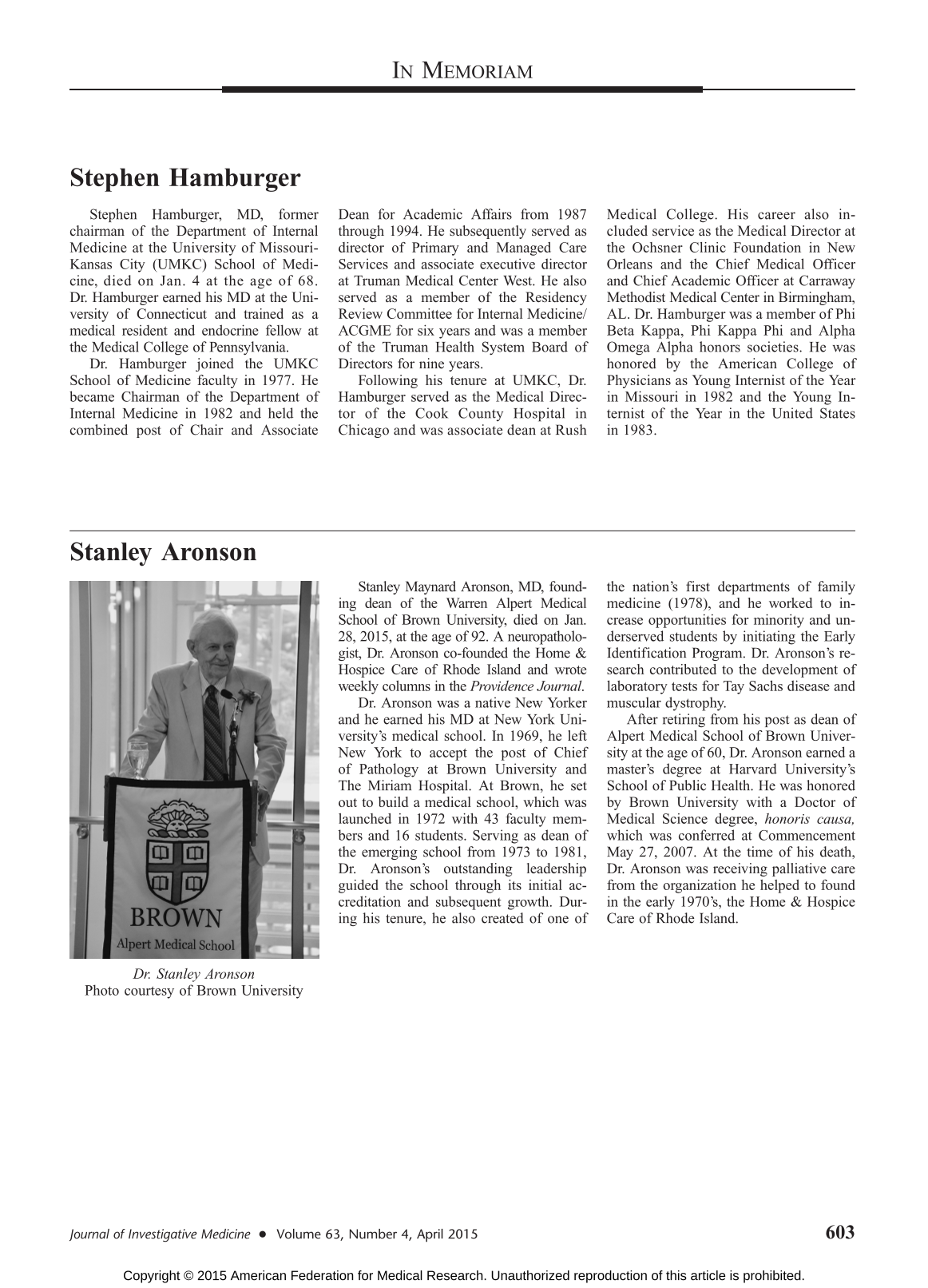
Dr. Stanley Aronson
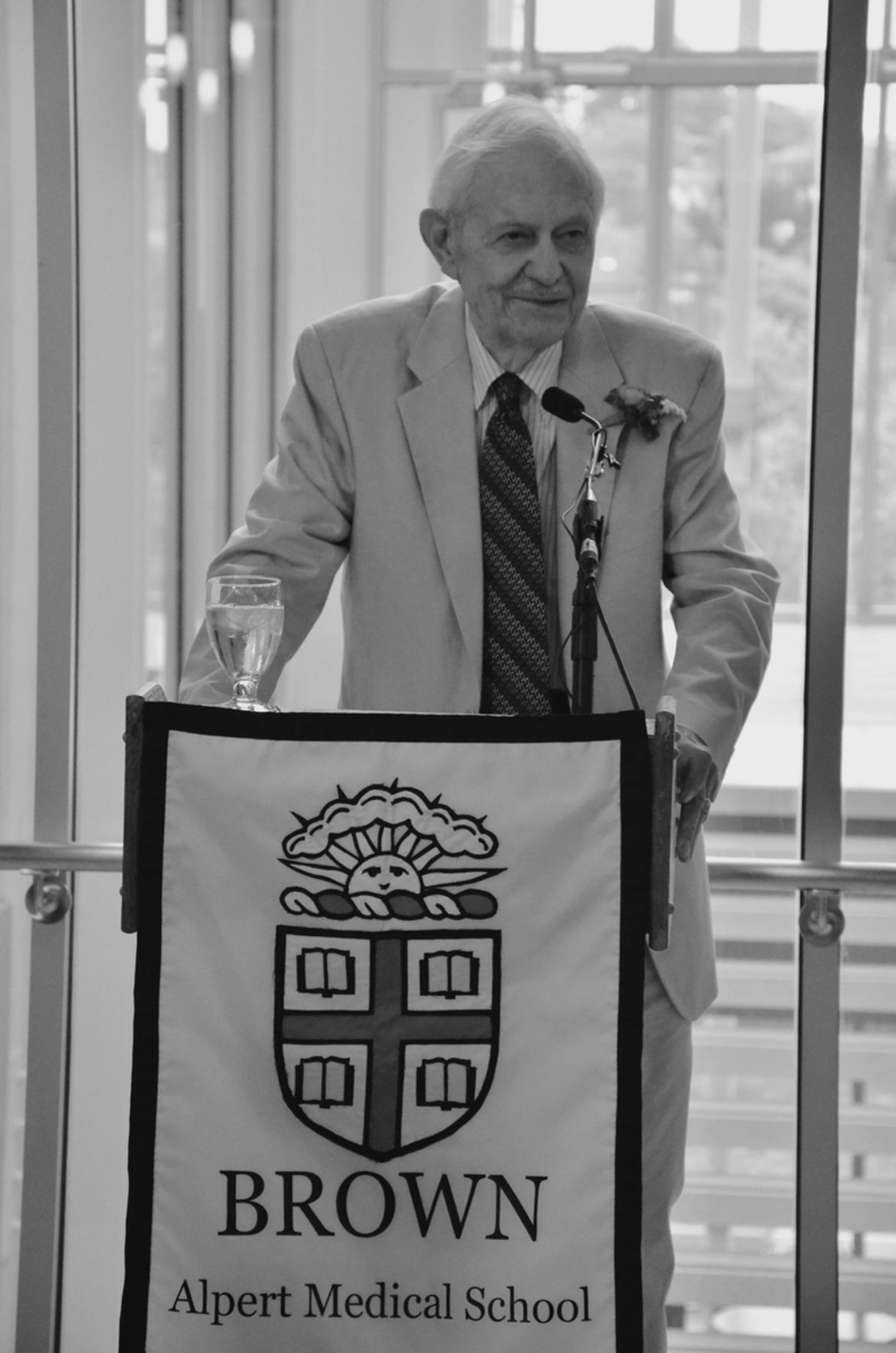
Stanley Maynard Aronson, MD, founding dean of the Warren Alpert Medical School of Brown University, died on Jan. 28, 2015, at the age of 92. A neuropathologist, Dr. Aronson co-founded the Home & Hospice Care of Rhode Island and wrote weekly columns in the Providence Journal.
Dr. Aronson was a native New Yorker and he earned his MD at New York University's medical school. In 1969, he left New York to accept the post of Chief of Pathology at Brown University and The Miriam Hospital. At Brown, he set out to build a medical school, which was launched in 1972 with 43 faculty members and 16 students. Serving as dean of the emerging school from 1973 to 1981, Dr. Aronson's outstanding leadership guided the school through its initial accreditation and subsequent growth. During his tenure, he also created of one of the nation's first departments of family medicine (1978), and he worked to increase opportunities for minority and underserved students by initiating the Early Identification Program. Dr. Aronson's research contributed to the development of laboratory tests for Tay Sachs disease and muscular dystrophy.
After retiring from his post as dean of Alpert Medical School of Brown University at the age of 60, Dr. Aronson earned a master's degree at Harvard University's School of Public Health. He was honored by Brown University with a Doctor of Medical Science degree, honoris causa, which was conferred at Commencement May 27, 2007. At the time of his death, Dr. Aronson was receiving palliative care from the organization he helped to found in the early 1970's, the Home & Hospice Care of Rhode Island.
Jean Lindenmann
Jean Lindenmann, MD, co-discoverer of interferon, died of prostate cancer in Zürich, Switzerland on January 15, 2015. As a postdoctoral student at the National Institute for Medical Research (NIMR) in London in 1957, Dr. Lindenmann and colleague, Alick Isaacs, MD, identified a substance which inhibited viral growth. Their discovery, which they named interferon, has led the development of therapeutics for the treatment of some cancer types, hepatitis C, and multiple sclerosis.
Dr. Lindenmann was born in Zagreb, Croatia. He grew up in Zurich, Switzerland, where he completed medical education and training. After completing postgraduate work in diagnostic bacteriology, he completed a one-year fellowship from the Swiss Academy for Medical Sciences to work in virology at NIMR. It was during this fellowship that he and Dr. Isaacs discovered interferon. He subsequently returned to the University of Zurich until 1962, when he moved to the USA as a visiting professor at the University of Florida. He subsequently returned to the University of Zurich, where he spent the remainder of his scientific career. He has been recognized with a number of awards, including the 1973 Robert Koch Prize, the 1976 Marcel Benoist Prize, and the 2007 European Virology Award of the European Society for Virology.