






Abstract
This article examines the relationship between economic policy networks and policy learning during the 1960s, using recently released files to flesh out the operation of both networks and learning. It finds that policy failure in the 1950s brought into being a new policy network which was able to secure a radical shift in the economic policy of the core executive in the early 1960s. However, it then proved impossible to craft, implement and sustain a coherent and enduring set of new policies within the new policy framework due to the ability of competing networks to resist central control. This leads to three conclusions. First, peripheral actors may obtain influence over policy-making in the core executive by means of a policy network. Second, policy learning does not necessarily generate policy change of a similar order because, whilst networks may facilitate learning, competing networks may block the translation of this learning into effective policies. Third, ‘governance’ is not solely a phenomenon of the years since 1979: in the 1960s the British core executive was already operating within a polity characterised by fragmentation, inter-dependency and self-organising policy networks.
Introduction
The concept of policy networks (Marsh and Rhodes 1992; Rhodes 1995 and 1997; Marsh 1998; Smith 1999) provides a more realistic portrayal of the British polity than the traditional ‘Westminster model’. Guy Peters (1998, 26) has noted, ‘there can be little doubt that policy-making systems are segmented and that the specialised relationships that exist between the actors within individual segments are important for understanding the decisions made’. However, the Marsh and Rhodes model has critics who argue that it is inadequately theorised and, most importantly, lacks explanatory power (Atkinson and Coleman 1992, 156–163; Blom-Hansen 1997; Bogason and Toonen 1998, 225; Daugbjerg and Marsh 1998; Dowding 1995 and 2001; Hay and Richards 2000, 25; Evans 2001). As Jeremy Richardson (2000) notes, policy network theory has tended to view networks as stable and (David Marsh 1998, 11–12) has acknowledged that an important feature of the model is that change, both in terms of networks and policy outcomes, is brought about exogenously.
To deal with this lack of dynamism, several authors have suggested that we need to look not just at the policy network but at the broader context within which it is embedded (Hay 1998; Marsh and Smith 2000; Pemberton 2000). In Colin Hay's (1998, 44) view, networks may be ‘conceived of as strategic alliances recursively reconstituted through the process and practice of networking’. In this process, Hay has argued that policy outcomes affect the context within which actors in policy networks make strategic calculations. Subsequent calculations and actions by these policy actors take place within this changed context. These changed actions in turn feed into policy outcomes and so have the potential to create further environmental change. Thus, argued Hay, there is a two-way relationship between strategic learning by policy actors and network change. Moreover, those taking strategic action are not necessarily passive recipients of context; they may actively seek to change the environment within which they operate (Pemberton 2000).
This two-way relationship between policy outcomes and networks has also been acknowledged by David Marsh and Martin Smith (2000, 10) in their ‘dialectical approach’ to policy networks. Marsh and Smith are perhaps unrealistic in treating context and learning as discrete. Their diagrammatic model (see Figure 1) has also been criticised, with some justification, by Keith Dowding (2001), who complained that, because virtually all the relationships in it are ‘dialectical’, the model actually tells us little about the process it seeks to analyse. 2 Charles Raab (2001) has also complained that Marsh and Smith's two-way arrows fail to recognise that some relationships are more important than others, that some arrows are obviously missing, and that their feedback arrow is too generalised with too little attention paid to the time dimension. Nevertheless, although Marsh and Smith's diagram is problematic and adds little that is substantive to Hay's analysis, the insight that outcomes and structure are related via a two-way relationship in which learning by actors operating in policy networks may play a core role remains an important one. A network can change its environment as a consequence of the actions which its learning gives rise to—but this changed environment may change the configuration of the network. It also has the potential to trigger the demise of the network, or to result in the creation of a new network. By including policy learning within the policy network model, therefore, its lack of dynamism can be addressed.
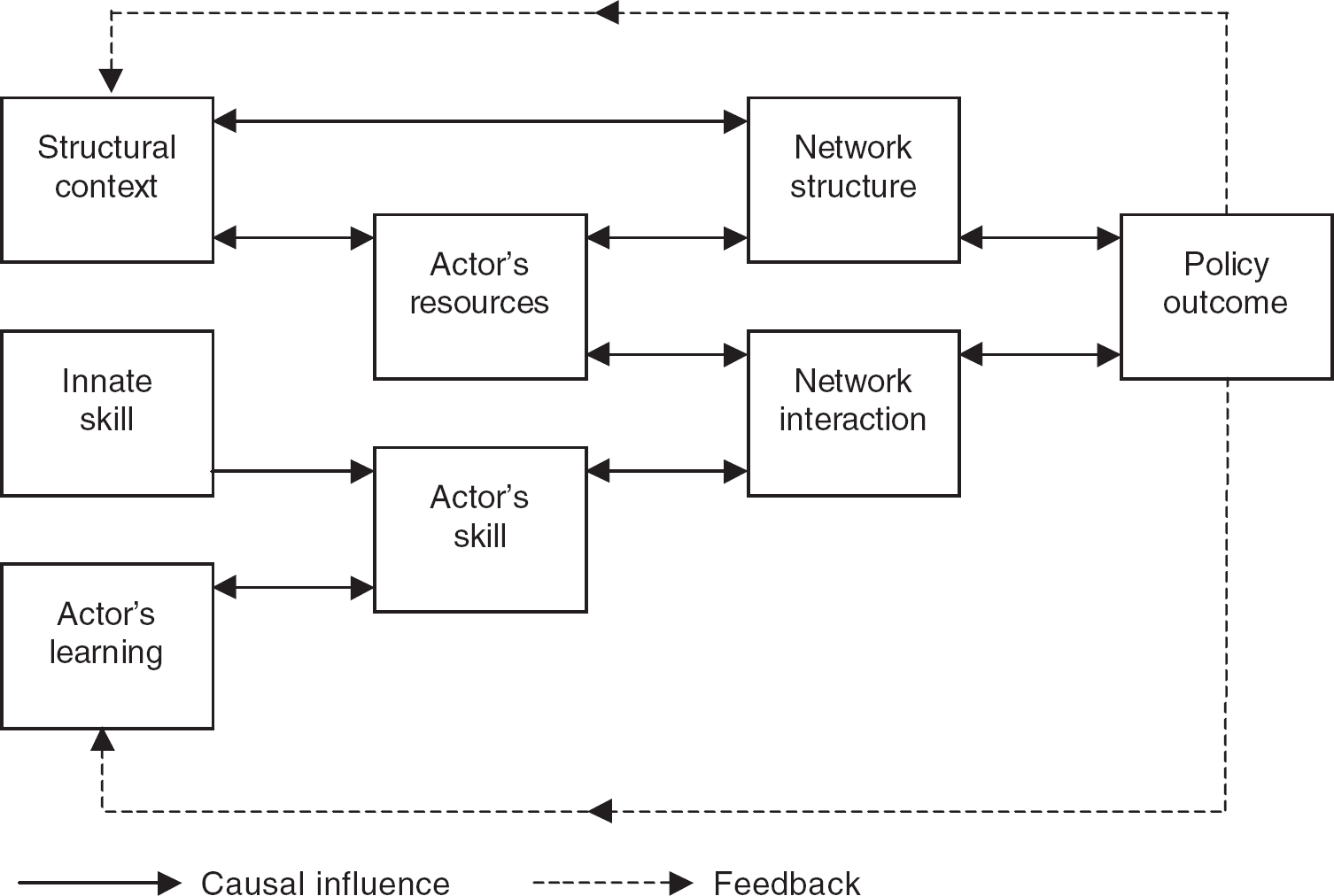
Marsh and Smith's ‘dialectical approach’ to policy networks and policy outcomes (Marsh and Smith 2001, 10)
Identifying a link between learning, environmental change and networks is, however, not as novel as either Hay or Marsh and Smith assume. It had, for example, been noted a decade ago by Peter Hall (1993, 289) in an analysis of ‘social learning’ in British economic policy. In his article, Hall outlined a typology of learning with three degrees or ‘orders’ of change (Hall made no distinction between learning and change, a potential problem to which we shall return). In ‘first order change’ the settings of a policy instrument used to attain a set of given policy goals, for example the rate of interest, are amended. ‘Second order change’ sees changes to the actual policy instruments used to attain these goals, for example Gordon Brown's decision in May 1997 to transfer responsibility for setting UK interest rates to a new Monetary Policy Committee.
Both first and second order policy change occur within an unchanged overarching set of goals. However, occasionally the goals themselves may change. Such an alteration is so fundamental that Hall argued that it amounts to a ‘paradigm shift’ on Kuhnian lines (Kuhn 1996 [1962]). Hall cited as an example of such a shift the transition from a ‘Keynesian’ to a ‘monetarist’ paradigm in UK economic policy-making during the 1970s. This ‘third order’ of change involved an ideational transformation in the very framework of policy. In this process, Hall observed that something like a ‘policy network’ or ‘issue network’ sprang up in response to a decline in the authority of government economic policy-makers—a decline resulting from the manifest failure of decisions taken within the existing Keynesian framework to solve the problem of simultaneous high unemployment and high inflation. The network which resulted, Hall (1993, 288) noted, ‘spilled well beyond the boundaries of the state to involve the media, outside interests and contending political parties’ in a debate over the remedies that the UK economy required and it ‘provided outsiders with influence over a formerly closed policy process.
Hall's suggestion of a link between networks and ‘third order learning’ is the starting point for this article, which summarises the results of a detailed archival case study of networks and learning in the field of British economic policy during the 1960s (Pemberton 2004). This focus on the politics of 40 years ago may initially seem surprising. It is a response to (Lowe and Rollings' 2000, 99–100) recent call for a greater degree of interdisciplinarity between political science and history, and it builds upon work done during the ESRC's Whitehall Project (Rhodes 2000a and 2000b), itself an exemplary case of such co-operation. As Dennis Kavanagh (1991) noted, ‘political science needs history’ (as history needs political science, though historians are often reluctant to admit it). Evan Lieberman (2001), for example, has recently suggested that political scientists might benefit from using a comparative historical analysis covering longer time spans, thus gaining access to the large number of case studies that an historical perspective provides. In studying British government, there is certainly a strong argument to be made that access to the vast quantities of declassified material available under the government's code of practice on access to government information (Lord Chancellor's Department 2000), particularly for the period before 1971, makes it easier to map the ‘multi-form maze of government which characterises the “differentiated polity”’ (Lowe and Rollings 2000, 99–100).
The article argues that emerging problems with the Keynesian policy paradigm in the 1950s led to the creation of a new network advocating radical change in the objectives of economic policy. It therefore suggests that environmental change (in this case policy failure) has the potential to bring into being a new policy network. However, this relationship between environmental change and network change was two-way. The new network, which had its roots in academia and was brought into being by environmental change, was also the means by which policy learning occurred in the core executive. The network developed new policy ideas on how to achieve higher growth, and it actively (and successfully) promoted them both to the core executive, not least by recruiting key policy-makers, and to the wider electorate. In doing so, it was able to change the environment within which policy decisions were taken.
Nevertheless, despite the fact that the core executive ‘learned’ through the actions of this advocacy network that radical change was required in economic policy objectives, translating these new ideas about how to increase growth into effective policies to achieve it proved more problematic. The article finds that, whilst extensive changes were made to the framework of policy, it proved impossible to craft, implement and sustain a coherent and enduring set of policies that would enable the changed objectives to be attained. I argue that the cause of this failure lay in the ability of powerful competing networks (some long-standing, some brought into being as a result of environmental change produced by the ‘growth’ advocacy network) to resist central control. This leads to an important conclusion: that competing networks can impede ‘third order change’ and, therefore, that learning does not necessarily generate change of a similar order as assumed by Hall.
By focusing on the 1960s, the article also brings into question a prevailing assumption (Rhodes 1994, 138–139 and 1997, 24, 45 and 199; Richards and Smith 2002; Smith 1999, 204–209) that Britain has been transformed during the post-war period, and particularly since 1979, from a powerful unitary state with a strong executive to a ‘differentiated polity’ characterised by ‘self-organising, inter-organisational networks characterised by interdependency, resource exchange, rules of the game and significant autonomy from the state’ (Rhodes 1997, 15–16). This phenomenon is termed ‘governance’ by Rhodes (1997), and he has argued that its emergence explains why government now seeks to ‘steer rather than “row”’ (Osborne and Gaebler 1992). However, the assumption that ‘governance’ is largely a phenomenon of the last two-and-a-half decades was questioned by contemporary historians working in the ESRC's recent ‘Whitehall Project’ (for example Bridgen 2000; Lowe 1997; Lowe and Rollings 2000; Ringe and Rollings 2000). This article finds considerable support for Lowe and Rollings' (2000, 115) assertion that, even in the 1950s and 1960s, the ‘fragmentation and differentiation’ of British institutions ‘sapped the ability of the core executive to co-ordinate a strong central policy’. The case study described here provides evidence of considerable policy learning in the early 1960s on the need for radical new policies to reverse Britain's relative economic decline and address emerging problems with Keynesian demand management. However, this learning was not translated into effective policies to achieve these linked objectives because the British core executive was already operating within a polity characterised by fragmentation, interdependency and self-organising policy networks.
Networks and learning
This section describes the way in which negative feedback from the policies of the 1950s dynamised policy networks in the field of economic policy. It examines the role that the new ‘growth’ advocacy network played in helping to alter the environment within which policy calculations were made, and thus the key part that policy networks can play in the creation of radical new government policies.
By the early 1960s, considerable influence was being exercised over the future of the government's economic policy by a loosely articulated network advocating radical new policies to promote higher economic growth. This ‘growth’ policy network encompassed, amongst others, economists, financial journalists and industrialists (Pemberton 2000, 784–788). It had come into being as a consequence of negative feedback from the economic policies of the 1950s and emerging evidence of Britain's relative economic decline vis-à-vis her main economic competitors. It had its origins in academia, where economists had begun after the 1955 recession to express their concern at Britain's relatively lacklustre growth rate and uneven economic performance, and to develop policy ideas to address these problems. For some years, debate about Britain's ‘growth problem’, and about how best it might be solved, remained largely restricted to the academic world. However, the perception that problems with Keynesian demand management might be holding back growth was reinforced by new data revealing Britain's relatively poor performance in comparison with the European economies. Consequently, the idea that new policies were required to correct this failure began to percolate into a wider arena towards the end of the decade. These new ideas about growth and economic policy spread like a virus (Colander and Coates 1989; Richardson 2000, 1017–1018), transmitted from person to person and institution to institution, and this process of ‘infection’ shaped the development of this ‘growth’ advocacy network.
The ‘growth’ network began rapidly to expand after 1959, stimulated by another recession in 1957–1958 and the development of its many links demonstrates that, contrary to the assertion of Bernd Marin and Renata Mayntz (1991, 17–18), policy networks can consist of many actors. Pressure groups such as Political and Economic Planning (PEP) and think tanks such as the National Institute for Economic and Social Research (NIESR) began to take an interest in growth and to develop and promote new policy ideas that might raise it. Both organisations were important carriers of the growth policy ‘virus’. By the middle of 1961, the network had grown to encompass academics, think tanks, pressure groups, financial journalists, the more forward-looking industrialists in the Federation of British Industries (a forerunner of the CBI) and elements of the TUC (particularly its general secretary and economic staff). It had also extended its tentacles into the core executive via links to the Economic Section of the Treasury and to the Board of Trade.
Thus the outcome of past policies, by changing the policy environment, had triggered the creation of a new and widespread network. This network was able to influence policy calculations in two ways. Firstly, through its links with the core executive, the network was able to inject into it radical new ideas about economic policy. A joint NIESR/PEP conference on French planning in April 1961, for example, was particularly influential on Treasury thinking. It encouraged the Treasury to undertake a wide-ranging reappraisal of policy that resulted in a recommendation to cabinet in July 1961 that growth must be raised and that, to achieve this, government intervention was required in a number of fields of economic policy (PRO 1961a). Secondly, the network was able to change the environment within which policy was made by influencing broader informed opinion and, by extension, the wider electorate. Particularly important in this process were the writings of economic commentators and pressure groups (see, for example Shonfield 1958; PEP 1960; Shanks 1961).
In a two-way relationship, therefore, learning had been central to network growth but a network had also been central to learning. Through the influence of the ‘growth’ advocacy network, the core executive had learned the lesson that a policy revolution was required if Britain's ‘growth problem’ was to be addressed and the new growth objective attained. The consequent public adoption by the government in 1962 of an explicit annual target for economic growth of 4 per cent represented a marked reordering of economic objectives. It led to an array of new policy instruments to attain faster growth: action on the supply-side of the economy to remove bottlenecks, in particular the adoption of ‘indicative planning’ and the creation of the National Economic Development Council (NEDC); an incomes policy to ensure that higher growth did not simply feed into higher inflation and force the government to deflate the economy to protect the value of sterling; and changes to fiscal policy in order to relate government spending and revenue raising better to the new growth objective.
Such a revision of economic objectives and the consequent introduction of an array of new policy instruments represented a significant degree of learning. It had all the makings of a really fundamental third order policy change on the lines of the paradigm shift that was to take place in the 1970s (Hall 1993). Yet, the early 1960s has come to be seen not as the start of a new economic era but merely as an incremental development of Keynesian demand management—‘Keynesian-plus’ (Gamble in Gamble and Walkland 1984, 69–71 and 80–85). Why did it not prove possible to translate such fundamental learning into change of an equivalent order? The next three sections will examine the development of policy in each of the three fields of major policy change. In each case, it will be argued that the objectives of change were not attained and that a key reason for this failure was the fragmented nature of Britain's economic policy institutions and, particularly, the existence of powerful self-organising networks that allowed vested interests to resist reform.
Supply-side policy
Beginning in 1961, the government tried to improve the operation of the supply-side of the British economy via the introduction of ‘indicative planning’ and government intervention to correct market failure. Indicative planning involved the setting by the new NEDC of agreed targets for indices such as the rate of growth of gross domestic product and of investment in specific industrial sectors. Astrid Ringe and Neil Rollings (2000, 348), drawing upon governance theory, have recently argued that the decision to create the NEDC and ‘indicatively’ to plan the economy via tripartite target-setting was the product of the frustration, perhaps even desperation, caused both by the Treasury's failure to get the fragmented institutions of central government to accept and act upon the conclusions of its July 1961 report to cabinet on growth, and by its recognition of the veto power of both industry and the unions. Thus problems of governance pushed the Treasury into ‘steering’ because it saw that it faced considerable difficulties in ‘rowing’. Paradoxically, however, the failure of the NEDC to fulfil its promise was also largely the product of the fragmentation and interdependence of economic policy institutions and of the consequent lack of power at the centre of British governance (Ringe and Rollings 2000; Lowe and Rollings 2000).
If indicative planning foundered on the rocks of institutional fragmentation, how effective was government intervention to correct market failure? One instance of the new interventionism was the attempt to improve the quality of industrial training via the 1964 Industrial Training Act. This instituted a compulsory training levy on firms, with rebates to companies providing training of adequate quality. It also created a new institutional structure to oversee and reform training. Enacted by the Conservatives and implemented by Labour, the Act has generally been seen as a reversal of years of government inaction on industrial training (Perry 1976, xix; King 1995, 128). Nevertheless, the Act failed to achieve its objectives. Both the quality and the quantity of industrial training remained lower than the achievement of the new growth objective required them to be. The rest of this section considers why this was the case.
One obvious problem was a high degree of fragmentation within government. Both the Ministry of Labour and the Ministry of Education were nodal points of competing producer networks, each ministry acting as the sponsor for its network in government. The Ministry of Labour formed part of an established industry-based network. This producer network had an institutionalised structure embodied in tripartite committees such as the National Joint Advisory Committee (NJAC), that brought ministry officials together with representatives of the peak organisations of employers and unions. Although Ministry of Labour officials were keen to introduce a levy/rebate scheme to correct market failure in industrial training, other members of this network were generally hostile to the wholesale reform of the existing apprenticeship system (reservations on both sides of industry are evident in minutes of the NJAC working party on the manpower situation at PRO 1961b). If there were to be changes, they were determined that control of training should remain with industry.
This industry-based network was, however, at odds with a powerful education network which included Ministry of Education officials, academics specialising in the field of education, technical colleges and members of the education committees of both the Trades Union Congress and British Employers' Confederation. Actors in this network were prepared to see change in industrial training, but change that would involve increased provision of general skills education in technical colleges and government training centres rather than reform of specialised on-the-job training in industry (the aims of this network are concisely summarised in PRO 1962a). For nearly two years, infighting between these two networks prevented the construction by the government of a policy that embraced both further education and on-the-job training. This was a significant contributor to the failure of the Act to improve the quality of training.
Radical reform of training was further hampered by the more general fragmentation of government itself. For example, the levy/rebate scheme was proposed by the Ministry of Labour as the means by which both the quantity and quality of British industrial training might be raised (PRO 1961e). This, however, faced opposition not just from a policy network based around the Ministry of Education, but from an economic policy network based on the Budget Committee. The Inland Revenue, an important player in this network, was opposed to the additional administration and the possibility of tax hypothecation (PRO 1961c) and it used this network to obstruct change. Treasury officials also initially used the network to resist the proposal for a levy/rebate scheme. At first sight, this opposition is surprising, given the Treasury's recognition that radical new policies were required on growth. It was the product of antagonistic relations between economic policy and industrial networks following the Treasury's recent botched attempt to implement a tax on company payrolls (PRO 1961d). Thus, again, network rivalry was a considerable barrier to progress.
This network rivalry and interdepartmental fragmentation made it very difficult to produce firm recommendations either on the changes required to improve industrial training or on how they should be financed. As a consequence of these divisions in government and in the labour market, the initiative on training became utterly bogged down. Industry was obviously incapable of solving the problem itself (PRO 1961b) but all the interested ministries were at loggerheads and without agreement between them a change in policy could not proceed. The problem was only solved when the prime minister took personal control of economic policy and made ‘economic growth … the [government's] most important desideratum’ (PRO 1962b). Macmillan's intervention galvanised Whitehall and was reinforced by a Treasury shift towards intervention in training as it thought through the implications of its new commitment to higher growth. This enabled proponents of the levy/rebate scheme to win their battle. In December, a white paper (HMSO 1962) outlined three objectives: to relate decisions on training more closely to the attainment of higher growth; to improve the quality of training; and to spread its cost more fairly. It proposed to achieve this by giving the minister of labour statutory powers to set up Industrial Training Boards (ITBs) to oversee training in individual industries and to pay allowances to trainees that would be financed via the imposition of a levy on firms in the industry.
The ‘growth’ network, from which these proposals had sprung, appeared to have triumphed. However, the translation of these proposals into an effective policy was another matter entirely, with individual firms and craft unions proving adept at exploiting divisions within the labour market. This enabled them to shape the policies of their respective peak associations in such a way as to create a common resistance to the implementation of the planned reform. Thus, employers and unions, rather than functioning as separate interest groups, were here operating together in a low-level industrial network, the aim of which was to subvert government policy in the field of industrial training.
Recognising the potential veto power of such industrial networks, professional industrial trainers, by now firmly incorporated within the ‘growth’ policy network, called for greater central control (BACIE 1963). This call initially divided the industrial producer network. A ‘strong central body’ was at first supported by the TUC leadership (1963a). However, it was opposed by craft unions, which saw it as an assault on their ability to restrict entry to skilled work, and their opposition ultimately led the TUC to the view that ‘training is a matter where the initiative must lie with the employer’ rather than with government (TUC 1963b). The employers were similarly divided. Despite some support for the levy/rebate scheme amongst the leaderships of employers' associations they met with violent objections from many of their members (Page 1967, 60–64). This led them also to resist central control (Finegold and Soskice 1988, 29–30; Morgan 1994). Thus, the desire of the craft unions to preserve the advantages the apprentice system conferred upon them, and the desire of individual firms to preserve their autonomy in training, brought the peak organisations of both employers and unions to a common resistance to government intervention.
This recommitment by the industrial producer network to opposing the ministry of labour's proposals led the ministry to the conclusion that enforcing change would lead to a deterioration in its relations with industry that it could not afford. It began to back-pedal. Almost immediately, it decided to cede responsibility for collecting the levy to industry—a marked retreat from intervention. It eschewed the taking of reserve powers both to direct an ITB to raise the value of its levy and to enable it to vary its own contribution, both of which would have enabled the ministry to deal with an ITB which decided to circumvent reform by setting a low levy. The ministry even decided that it would be inexpedient to seek representation on the boards. This left it with no influence at all over industrial training other than ‘propaganda and the gradual infiltration of ideas’ (PRO 1963a). In effect, as the ministry implicitly admitted to the Treasury, responsibility for implementing policy reform had been delegated to employers and trade unions in the industrial producer network, both of which could be expected to co-operate in a minimalist approach (PRO 1963b).
It was soon apparent that the hopes of the reformers had been disappointed. The new institutions failed to bridge the traditional divide between education and training, actively restricted labour mobility (Caves et al. 1968, 283), and did little to improve the volume of training or to improve its quality (Tavernier 1968). The conclusion of the Donovan Commission (HMSO 1968, para. 330) that ‘a radical change in outlook [was] particularly urgent’ implicitly acknowledged the failure. The 1964 reforms had simply entrenched the existing apprenticeship system rather than revolutionising it (Shonfield 1965, 117–118; Finegold and Soskice 1988, 25–26; King 1995, 211). They did little to raise growth because the barrier to change formed by the preference of many employers and unions to retain their autonomy, and by their ability to organise themselves in a powerful producer network and resist direction, had proved to be insurmountable.
Incomes policy
The ability of self-steering networks to thwart the intentions of a reforming centre is also evident when we examine incomes policy, the second plank of the economic reforms of the 1960s. Appeals by the government for voluntary wage restraint to offset the benefits of full employment went back to 1944 (HMSO 1944, para. 18). What was new in the early 1960s was the widespread intellectual change produced by the ‘growth’ network which persuaded both the economic section of the Treasury and the prime minister that a permanent incomes policy must be an essential element of any new policy on growth (Cairncross and Watts 1989, 342; PRO 1961f). From this flowed the imposition of a temporary pay ‘pause’ by the Conservatives in July 1961 and the subsequent, but eventually futile, attempts by both the Conservative government and its Labour successor in 1964 to build a permanent and voluntary incomes policy.
The problem for both governments was that both the unions and the employers were reluctant to enter into a bargain on wages. From the start the public sector unions, on whom the ‘pause’ fell, bitterly resented such an arbitrary interference in free collective bargaining. In the face of union opposition, progress on devising a permanent incomes policy to succeed the temporary pay ‘pause’ was painfully slow. Substantive progress had to await the election of a Labour government in October 1964. TUC resistance to wage restraint was then translated by Labour into a policy of cooperation in the ‘planned growth of incomes’. This produced a ‘joint statement of intent on prices and incomes’ between the government, TUC and employers' organisations on 16 December 1964, and the subsequent creation of a National Board for Prices and Incomes in March 1965, to oversee a ‘pay norm’ of 3–31/2 per cent. Nevertheless, it was almost immediately clear that the norm was being breached. In the summer of 1965, to avoid a compulsory wage freeze to defend sterling the TUC reluctantly agreed to institute an ‘early-warning system’. This proved inadequate. In July 1966, following a severely disruptive strike by seamen over a 17 per cent pay claim and in response to a severe run on the pound, the government imposed a six-month statutory wage freeze followed by a further six-month period of ‘severe restraint’.
Not only did the attempt to build a permanent voluntary policy ultimately fail (Blackaby 1978, 641–642) but also what progress there was did not succeed in controlling the growth of wages (Cairncross 1996, 269–271; Jones 1987, 5–7; Kirby 1992, 640). A fundamental cause of this overall failure can be found in the fragmented yet interdependent nature of both the core executive and the British labour market. An apparently powerful centre was made all too aware of its weakness when it came to incomes policy.
The Treasury's desire to relate the growth of wages to that of productivity could not simply be achieved by fiat, a fact which it acknowledged. The Treasury struggled to control the wages even of public sector workers (most of whom were covered by arbitration awards). It certainly could not dictate wage settlements in the private sector. It therefore recognised that it needed to secure the co-operation of employers and unions and build with them a consensus on both ends and means (PRO 1961a, paras. 61–70). It also needed to secure the support of those government departments that would oversee incomes policy, because it lacked the means, experience and network links to do this itself. However, divisions within and between these interdependent actors were again to prove an insuperable barrier to progress.
Within the core executive, the Treasury immediately faced strong opposition from the ministry of labour (PRO 1961g) which, as with industrial training reform, feared the impact of an incomes policy on its relations with industry. The Board of Trade also proved a doughty opponent to the extension of the policy into prices and dividends; a move which seemed to be the price of TUC co-operation. From the start, there was considerable resistance to this from industry and the City and they proved adept at mobilising against such intervention, and in co-ordinating their resistance with the Board of Trade (see for example BEC 1963 and PRO 1964a). The resistance of these two ministries, the co-operation of which was essential to the successful implementation of incomes policy, made for slow progress on a policy that inevitably involved intervention in both fields if restraint was to be equitable.
It might have been expected that, given the crucial importance of incomes policy to the wider growth project, the NEDC would have helped in the construction of an agreement. It turned out to be almost completely useless. Such were the sensitivities surrounding prices and wages that it proved impossible to break out of bilateral discussions between the government and industrial interests into a more wide-ranging debate about the crucial importance of incomes policy to growth. This severely weakened the ability of Britain's new planning structure to construct an effective voluntary incomes policy (Tomlinson 1994, 272–273; Wilensky and Turner 1987).
Labour market fragmentation, however, went deeper than disagreement between the TUC and employers' organisations. Because conciliators and arbitrators lay outside the control of the core executive it was unable to stop a succession of awards that broke and undermined agreed norms. Moreover, even when national agreements were concluded, there proved to be too little power at the centre to make these stick at company level, with individual firms and trade unions colluding with each other to settle at rates above national norms. This suited the unions because they got more pay, and it suited individual companies because it avoided industrial unrest and disrupted production. If a price were to be paid it would be paid by others: by those who observed the norm; and by consumers through higher prices. The resulting ‘wage drift’ was a major factor in the failure of incomes policy to contain inflation (its deleterious effect is charted by PRO 1964b).
Thus, despite the high hopes placed on a voluntary incomes policy as an important means to higher growth, its successful implementation was balked by the fragmented institutional structure of Britain's labour market. The centre could not achieve its aims alone and was forced into negotiations with other powerful players both within and without government—players who were well able to work within established networks to undermine the effects of incomes policy. Institutional fragmentation and interdependence therefore stymied substantive progress on this second element of the Keynesian-plus policy package, as it had with the first.
Fiscal policy
If Rod Rhodes is right in asserting that ‘governance’ is a phenomenon of the period since 1979 and that prior to this the core executive was better able to ‘row’, then, of all the new policies inaugurated in the early 1960s, one would expect the government to have had most success in the field of fiscal policy, and particularly in taxation policy, an area traditionally seen as dominated by the Treasury (see for example, Lipsey 2000, 122–123). Certainly, the decade of the 1960s was a particularly fecund period in tax policy (Robinson and Sandford 1983, 2). This fecundity flowed from the Treasury's reappraisal of economic policy in 1960–1961 (Pemberton 2001) which, as we have seen, was in turn the product of learning induced by the ‘growth’ policy network. By the end of 1960, the Treasury had concluded that new tax instruments were required in order to achieve the new objective of higher growth. As with the other two planks of the ‘Keynesian-plus’ policy package, this desire to amend instruments as part of a revision of economic policy goals added up to third order learning. But again, the learning of this lesson was only the first stage of a process of change; learning must now be turned into actual policies. In this, the Treasury was only partially successful.
Between 1961 and 1966 both Conservative and Labour governments introduced new taxes designed specifically to improve Britain's rate of economic growth. Taxation of short-term capital gains by the Conservatives in 1962 and Labour's introduction of a full-blown capital gains tax and a corporation tax in 1965 were all attempts to use taxation to encourage higher and longer-term investment. Similarly, both the 1961 payroll regulator (which allowed the government to vary employee national insurance contributions between budgets) and the imposition of selective employment tax (SET) in 1966 were intended to encourage industry to release surplus labour to be used more productively. In addition, both the simultaneous introduction in 1961 of the payroll regulator and the customs and excise regulator (which allowed the variation between budgets of purchase taxes and customs duties without recourse to parliament) and, albeit to a lesser extent, Labour's selective employment tax were attempts to raise growth through improved demand management. All these new taxes, with the exception of SET, fell less heavily on firms and, coupled with measures such as increased investment allowances, this contributed to a reduction in the proportion of taxation paid by companies. Again, this change was growth-related—aiming to raise corporate profits and encourage more industrial investment and innovation.
Tax was now being used for economic purposes and was no longer dominated by considerations of revenue raising and the preservation of horizontal equity (Robinson and Sandford 1983, 2). This radical change had been brought about by members of the ‘growth’ network within the core executive: by officials on the economic side of the Treasury under the Conservatives and by economic advisers (particularly the economist Nicholas Kaldor) under Labour. It was a technocratic response to the negative policy feedback of the 1950s: the problem of ‘stop–go’; mounting evidence of relative decline; and the changed intellectual and electoral environment produced by the ‘growth’ policy network. This shift in goals and instruments amounted to third order learning. It did not require a political battle to institute the change because agreement on the need for change transcended party boundaries. Consequently, both parties introduced measures to attain similar ends with similar means. Of course, this congruity did not imply complete agreement between the governments, or between the technocrats, on the policies that would best achieve the new objective. Nor was ideology altogether absent—the policy legacy of the 1950s made it difficult for the Conservatives completely to reinvent their tax policy, whereas Labour ideology proved more congenial to technocratic reform proposals (Pemberton 2001, 372). However, both governments acted on a common recognition that tax reforms could promote higher growth.
Nevertheless, viewed as a whole, the slew of new taxes between 1961 and 1966 did not amount to a coherent reform programme. At least four of the six taxes mentioned above were introduced at short notice in response to economic crises. Reform of taxation, instead of being strategic, was largely tactical. A key reason for this was that Britain's tradition of adversarial politics made both the Conservative and Labour parties extremely wary of specific commitments on tax. Consequently, neither party constructed a strategic programme for taxation. Nor, despite a good deal of agreement amongst officials, advisers and ministers of both parties about the need to use taxation to promote growth, was there any attempt to build a cross-party consensus on detailed proposals.
The failure to construct a consensual programme for strategic tax reform was encouraged by Britain's tradition of confining budgetary policy-making within a tightly bound policy community at the core of the core executive. Devising policy behind the veil of budget secrecy might have been expected to strengthen the hand of officials and advisers in the Treasury who were promoting change. It did not do so. Without a publicly endorsed mandate for change, they found it extremely difficult to surmount another adverse institutional inheritance: the fragmentation of British economic policy-making institutions. The fact was that the centre lacked the power to impose its solution even in a field of policy in which the Treasury is normally seen as virtually all-powerful. Because there was no electoral mandate for change, under both governments key elements of technocratic proposals for reform, especially those relating to the taxation of consumer expenditure, failed to attract the political backing that was necessary if the Treasury was to prevail over the conservatism of the administering departments.
What is noticeable is that the penetration of the Treasury by the ideas of the ‘growth’ policy network did not result in any real change to the structure of tax policy-making. The tightly bound economic policy-making network at the core of the core executive, most obviously the Budget Committee, remained untouched (Pemberton 2001). To break the power over policy that this conferred on the revenue departments, an interdepartmental working party on growth (created and dominated by Treasury modernisers) recommended a committee of inquiry along the lines of a Royal Commission (PRO 1961h). This was not set up because, on reflection, the Treasury feared that it would thereby lose its control over the direction of policy. Instead, in September 1961, an interdepartmental steering group, again dominated by Treasury representatives and with a Treasury chairman, was created to review tax policy. This was a strategic misjudgement. Although the change in the overall climate of opinion produced by the ‘growth’ policy network was putting pressure on officials in all departments to devise tax reforms that would encourage economic growth, the revenue departments retained a high degree of veto power because their co-operation was required to implement new taxes or customs duties. Ultimately, despite third order learning in the Treasury regarding growth and taxation, and despite its control over the membership of the interdepartmental review of taxation policy, the Treasury proved unable to persuade the revenue departments that a major reform of taxation should be undertaken. In the absence of such agreement, the Treasury was forced to sacrifice strategy for tactics and attempt a programme of reform by stealth (Pemberton 2001). This led to the hasty and imperfect construction of policy, to compromises which reduced technical efficiency and, whilst it was not without some successes, it served to reduce the coherence of the Treasury's tax reform project.
Similar problems were encountered with vested interests outside government (Pemberton 2001). Under the Conservatives, for example, the fact that industry had not been involved in the construction of the payroll regulator, and that there was no political mandate for such a change, made it easier for it to repudiate the new tax. Similarly, under Labour, the lack of a mandate to change corporate taxation made it more difficult to resist making concessions to City interests that were adept at co-ordinating with the Bank of England in their own network to oppose tax reforms that worked to their detriment.
To defeat their opponents, whether inside or outside government, members of the ‘growth’ network in the core executive needed heavyweight political support. This was all too often lacking. The absence of a prior and publicly endorsed programme meant that each new tax carried political risks, particularly where a proposal had an obvious political cost such as increased prices or higher unemployment. Officials and advisers were forced to trim their sails accordingly. Thus the need continually to negotiate political backing made it much more difficult to defeat the vested interests that were opposed to change and to construct a coherent set of reforms.
The result was that, whilst there was third order learning in tax policy in the 1960s, with taxation reform seen as a route to higher growth, and whilst this certainly resulted in important new taxes, these were too incoherent to amount to third order change. Despite a high level of elite consensus on the need to make the tax structure more growth-oriented, a combination of Britain's adversarial politics and its highly fragmented policy-making institutions made it extremely difficult for politicians to discuss far-reaching changes to the tax system, let alone construct a strategic programme for tax reform that transcended party boundaries. Although the technocratic tax reform project was pursued with political support, without a clear political mandate it proved extremely difficult to defeat vested interests operating in self-steering policy networks.
Conclusions
The study undertaken here confirms that policy networks can be a powerful lens through which to examine the actions of the core executive. It also confirms that archival research can provide a rich source of material for the analysis of policy networks. Clearly policy networks were not a causal variable in the case studies summarised in this article. In themselves, therefore, policy networks do not enable us to predict change (Peters 1998; Pemberton 2000). However, the detailed archival analysis reveals that they were a particularly important intermediate variable in a recursive process. Policy change was brought about by learning in policy networks, but networks were also shaped by changes in the policy environment. Negative feedback from past policies brought the new ‘growth’ network into being, and its subsequent expansion was extremely rapid. This confirms that introducing the concepts of feedback and learning into policy network theory can supply the latter's missing internal dynamic (Hay and Richards 2000; Peters 1998, 25; Richardson 2000, 1017–1018). If what was true in the 1960s is true today, and there seems little reason to doubt this, then policy outcomes affect the configuration of, and can create, policy networks (Marsh and Smith 2000, 7, 19–20).
The consequence of the process of policy feedback, network growth and idea transmission described here was a significant shift in government economic strategy during 1961–1962. Actors outside the core executive had therefore succeeded in changing both the objectives of, and instruments used by, the core executive. This again is an important finding because it indicates that peripheral actors with little obvious power can exert great influence over policy through the medium of a policy network. As (Smith 1999, 33–34) points out, tactics are important if actors with limited resources are to win. The key to the success of the proponents of new policies on growth was their success in infecting others with their ideas and thus drawing them into the ‘growth’ network. Information and knowledge were traded across this network, indicating that power resources are important even within advocacy networks (Rhodes 1981 and 1997, 10–11; Jessop 1990; Smith 1998 and 1999, 31).
Nevertheless, whilst the ‘growth’ network was the medium through which learning occurred, the lesson that fundamental changes were required to the framework of British economic policy did not lead to policy change of a similar order. Significant policy changes certainly occurred but they tended to be short-lived and relatively ineffective. The cause of this failure lay in the profound fragmentation of Britain's economic policy institutions and the existence of competing policy networks. The ‘growth’ policy network was able to change the terms of the debate and alter the framework of policy but it proved less powerful an influence on policy implementation than competing industrial and financial networks. The existence of these powerful networks sapped the power of the centre to impose the change that its learning had led it to believe was required. This left the core executive no real option but to seek the co-operation of producer networks in implementing the new policies. In effect, the government, finding itself unable to ‘row’, was forced into a ‘steering’ role.
Yet, the fragmentation of economic policy institutions (both governmental and non-governmental) made steering extremely difficult. In particular, although the peak associations of employers and unions were prepared, if somewhat reluctantly, to consent to new institutions on the supply-side and in incomes policy, powerful producer networks encompassing both sides of industry worked to undermine these institutions. The ability of these actors to combine together in self-organising low-level industrial networks had two consequences. Firstly, it shaped the response of the peak associations and led them to resist real reform on the supply-side. Secondly, it undermined agreements struck at the national level because the peak associations lacked the power to persuade, let alone compel, their respective members to comply with them. The consequence was that, despite widespread support for the radical new policies advocated by the ‘growth’ network, Britain was unable to build effective and enduring new institutions that would both implement and oversee them. One must therefore conclude that Hall's assumption that policy learning equates to policy change is erroneous. In effect, in the 1960s third order learning occurred, but third order change was not achieved.
The analysis has revealed that this failure to translate an order of learning into an equivalent order of policy change arose because British policy-making was already conducted within a polity characterised by fragmentation, interdependency and self-organising policy networks. Thus the core executive already lacked the power to impose change. As Harold Wilensky and Lowell Turner (1987, 49–51) pointed out, the British labour market was highly fragmented long before 1989. This fragmentation was a formidable block to effective action in both industrial policy and incomes policy. Even in taxation, a field of policy in which the core executive might be expected to have almost free rein, the Treasury's attempt to implement a programme of tax reforms linked to the new growth objective was stymied by a combination of political disengagement induced by Britain's adversarial (i.e. fragmented) political culture, and the resistance of self-steering policy networks operating within the core executive. This suggests that the ‘differentiated polity’ of the 1980s and 1990s may not be the new phenomenon that it is claimed to be. Peters (1998, 22) may be right in his conjecture that policy network theory has simply revealed a long-standing phenomenon—making explicit the fragmentation that already existed within the British polity. Such fragmentation may have increased since 1989, but clearly self-steering policy inter-organisational networks have existed for some time in British policy-making and policy implementation; they have simply been awaiting the development of the concepts needed to describe them.
Footnotes
1.
The research for this article was conducted during a doctorate funded by the ESRC (award R00429734705) and Institute for Historical Research. The article was written during a one-year ESRC postdoctoral fellowship (award T026271086), and it was revised in the early stages of a British Academy postdoctoral research fellowship. Thanks are due to all these institutions for their generous support. I am also indebted to Rodney Lowe and Mark Wickham-Jones for their invaluable comments on earlier drafts; to the anonymous referees of the BJPIR; Roger Middleton, Rod Rhodes, Martin Daunton and Angela Bourne for more general comments on the research; and to respondents to various papers presented by me to the Economic History Society, Institute for Contemporary British History and European Group on Public Administration. Of course, the usual disclaimers apply.
2.
It will be self-evident, however, that this author deprecates Dowding's dismissal of both policy network theory and historical institutionalism as ‘pointless’ and ‘hopelessly vague’. See  for a reply to Dowding which makes a strong case for political science models that acknowledge that social reality is often complex, involves reflexive agents, and does not provide us with data that that can be formally tested.