






Abstract
Research Highlights and Abstract
A sympathetic critique of the literature on ‘Normative Power Europe’ that incorporates economic liberalism into the repertoire of the EU's constitutive principles. The derivation of three ideal type liberal modes of justification for external action and a discussion of their potential complementarities and contradictions. An application of the three modes to the case of EU external action.
This article—a sympathetic critique of the literature on ‘Normative Power Europe’—observes that the rationales for EU external action, while understandable in terms of the concept of ‘normative power’, emerge from a variety of overlapping and potentially contradictory liberal arguments. For the purposes of the argument, these liberalisms are organised into three ideal types: market liberalism, the pursuit of peace through liberal means and the ethic of cosmopolitan duty. The article suggests that while it is possible to associate different domains of EU external action with different varieties of liberal discourse, it is often more appropriate to see these policy domains as sites of struggle, negotiation and (perhaps) reconciliation between competing liberal projects.
Introduction
Recent discussion about the nature of EU external policy has tended to cluster around the lively debate about ‘normative power Europe’ (NPE) (Manners 2002). The idea of NPE tends to be explicitly aligned to a liberal view of EU ‘foreign policy’. Its defenders—policy-makers as well as academics—suggest that because the EU is constituted as a liberal order, its external actions are pre-disposed to be liberal in character and effect. 1 This image of the EU as a liberal ‘force for good’ has been central to its self-image for at least the past fifteen years, and certainly since the signing of the Treaty of Amsterdam (1997). 2 The most typical rebuttal of the NPE thesis maintains that while the EU might premise its behaviour on normative rhetoric, the practice of its external action needs to be understood in terms of strategic/instrumental rationality. Indeed, it is sometimes maintained that a full and proper evaluation of EU external action needs to take into account both norm-motivated and interest-motivated behaviour, as if these were discrete empirical categories.
This article challenges the usefulness of the distinction between normative and strategic motivations as being helpful for understanding the liberalism or otherwise of (EU) foreign policy. For the most part, the article is supportive of the key premises of the NPE approach to EU foreign policy and external action. Indeed, the argument here shares three key premises with the NPE approach—two theoretical, one empirical. The first is a broadly constructivist view of foreign policy—to agree that ‘normative power’ is first and foremost about attempts to influence conceptions of what is ‘normal’ in world politics. This is a view (also shared with Schmidt's contribution to this collection) that treats an actor's communicative discourse as constitutive of interests and behaviour (see also Schmidt 2008)—hence the reluctance here to draw a sharp analytical distinction between interest-driven and norm (or value)-driven action (see variously Dodier 1993; Laffey and Weldes 1997; Hay and Rosamond 2002; Blyth 2003; Hay 2011). The second shared premise is the claim that an actor's external policy is internally constituted (thereby requiring inside-outside analytical strategies) as opposed to externally or structurally determined. The third point of basic agreement is empirical—that the constitutive principles of ‘normative power Europe’ are liberal. But this third point of agreement is offset by a substantial point of empirical disagreement, which is to suggest that an account of NPE consistent with the first two points of theoretical consensus must incorporate economic liberalism into its analysis. This amounts to saying (a) that the EU is significantly (though not necessarily exclusively) constituted by economic liberalism, (b) that its identity as a liberal market order is a significant determinant of the EU's external policy and (c) that a significant portion of the EU's normative influence in world politics consists of the propagation of economic liberal norms.
Three additional observations need to be made at this point. First, this line of argument is not to suggest that the designation ‘market power’ (Damro 2012) is a better understanding of the orientation and substance of EU external policy than ‘normative power’. To make such a move requires an understanding that reduces normative power to value-driven behaviour that yields value-promoting outcomes. This is not consistent with a close reading of the NPE argument and has the consequence of identifying only particular norms and ideas—those associated with liberal-cosmopolitan expressions of positive freedom—as being consistent with the exercise of ‘normative power’. This in turn might disallow the analysis of the normative power of ideas associated with liberalism as negative freedom/market cosmopolitanism in the domain of the economy (Parker and Rosamond 2013). The second observation is that an emphasis on the importance of market liberalism to NPE does not necessarily mean that other liberal logics are absent or unimportant to the operation of the EU's normative power. Indeed, one of the main components of the argument here is to sketch the logic of three ideal typical ‘liberalisms’ that are manifest in the EU's internal constitution and (thus) in its external policy. The third point concerns economic liberalism, which, of course, should not be treated as a unitary category. As is noted later in this piece, there are multiple varieties of economic liberalism and the distinctions between them are important. The history of EU economic liberalism is a delicate balancing act between these varieties (for example ordo-liberalism vs. Neo-liberalism), which carry within them quite different accounts of the market and the role of public authority therein (Harvey 2005; Peck 2008 and 2010; Crouch 2011; Harcourt 2011; Bonefeld 2012; White 2012).
The argument proceeds in the following manner. The next section seeks to dissolve the simple distinction between normative and strategic action by thinking about not only the range of possible motivations for ‘liberal’ forms of external action, but also about the ways in which action or policy might be justified ethically as liberal. This move is designed with two purposes in mind: (a) to caution against the reduction of discussion of NPE to a matter of settling empirically whether EU external action is either liberal/normative or realist/strategic in character, and (b) to affirm that ‘liberal’ external action is potentially multifaceted and, crucially, normatively contestable. The second section thinks about how an actor or its policy might be constructed as ‘normative’ or ‘liberal’ and makes a brief case for a broadly constructivist approach to the evaluation of liberal foreign policy. The third section derives and presents three ideal typical modes of liberalism. These emerge from distinct strands in liberal thought. Their application to the EU case is discussed, with particular reference to how the NPE debate can be taken forward.
Normative/Strategic: How Do We Know When an Action is Liberal?
Is EU external policy driven by values or by strategic calculus? The distinction suggests that genuine liberalism in foreign policy actions can be understood by the motivations for that action. It further implies that value-driven (normative) foreign policy is the only possible vehicle for liberal foreign policy. Values here equate to liberal values. Strategic calculus equates to something else—realpolitik—that is fundamentally rooted in interest-driven behaviour.
At first sight, the ‘normative’ vs. ‘strategic’ opposition would appear to be something of a reinvention of the dividing lines between liberal and realist thought in International Relations. Realists maintain that a state's behaviour is explained by interest-driven external security calculus. Liberals also think that states follow a rational interest-driven logic in the international system, but are more than open to the idea that a state's foreign policy is a function of preference formation within the domestic political processes. Liberals thus treat the relationship between domestic and international politics as a two-level game, while realists understand the domestic and international polities as autonomous domains with separate structural determinants of actor behaviour.
Notice immediately that ‘strategic’ need not necessarily mean that a state operates according a realist security calculus. Also interest-driven behaviour may involve the promotion of liberal values. To assume that interest-driven behaviour cannot be associated with values or ethics is to fall into the trap of what Brown (2001) calls ‘pop realism’. ‘Strategic’ action could be domestically determined and authorised—perhaps through democratic means. Normative power is most obviously liberal in that it invokes liberal universals and claims legitimacy to act upon those principles. But, of course, those liberal universals could, in some circumstances, be invoked without democratic authorisation. Crudely, this leaves us in the peculiar situation where action that is strategic would seem to be more liberal than action premised on normative claims. However, there are two arguments that might be used in defence of declaratory normative power (that is normative power without domestic authorisation). The first is that liberal universals are non-negotiable and so action in defence of these principles must by definition be liberal. This is analogous to arguments that resist restoration of capital punishment in domestic societies where a majority of the population favours capital punishment. The right to life is a fundamental and non-negotiable premise of democratic society. A state that transgresses this right, even in the context of its democratically-authorised punishment regime, ceases to be a liberal state. (The argument is impeccably Lockean.) The second argument is that declaratory normative power should be judged by its outputs not its inputs. Strategic action may carry liberal democratic authorisation and thus input legitimacy, but if its consequences are illiberal then perhaps it has less of a claim to be properly liberal than normatively-driven actions that consequentially advance the cause of liberalism, even if they lack liberal authorisation. 3
We are left, in other words with two forms of liberal ethical justification for quite different types of external action. One locates the liberalism (or otherwise) of an act in the process through which it is decided upon, while the other locates liberalism (or not) in an act's consequences. In short, there is no straightforward route to adjudicating the liberality or otherwise of an external act. In terms of ethical theory these two ideal typical representations of liberal foreign policy can be aligned with, respectively, deontological and consequentialist ethical justifications (Brown 2001; see also Manners 2008). From a deontological perspective, it is important to ask whether the decision to act was arrived at via clearly established rules and understandings of duty. If the action can be shown to have conformed to such solid ethical reasoning then it can be said to have been morally appropriate—regardless of its consequences. This ethical justification might only apply to the rather special circumstances found in our ideal typical example—where clear rules about the liberal democratic authorisation of policy yield an act that is strategic. Indeed we may end up determining that such an act is ‘strategic’ only through a negative evaluation of its consequences. Consequentialist understandings of ethical justification, in contrast, judge the moral propriety of an act only in relation to the consequences it brings about. If those consequences are liberal then the act can be deemed to have been liberal. 4 As Manners (2008) reminds us, there is a third strand of ethical theory—virtue ethics—that offers another way of adjudicating the morality of an act. The focus of virtue ethics is the moral status of the actor. If the actor is constituted as liberal, then we may infer its actions to be liberal (where liberalism and morality are equated). Manners (2008) argues that a virtue ethics reading of an actor's foreign policy would be to investigate not only whether it consistently and coherently applies its own norms when acting externally, but also whether it applies norms that emanate from a more liberal universalising project (the United Nations). But a virtue ethics reading could also refer us to an actor's constitutive principles—to the extent to which it is formed itself as a liberal actor.
We might simplify this discussion of ethical justification a little by noting that the claim about whether action is liberal can be reduced to input (deontological/virtue) and output (consequentialist) considerations. The point to make is that reducing the adjudication of the liberal credentials of an external intervention to strategic vs. normative motivations is—at one level—a false dichotomy (see, to some extent, Youngs 2004). It is, as argued above, possible to grade actions that might seem to be the obverse of normative power as liberal. In Manners' early formulation of the NPE concept (Manners 2002), he seemed to rely upon input arguments as the basis for arguing for the EU's normativity. Here Manners identifies normative power with a particular subset of actions that constitute the default mode of behaviour for a particular type of actor. In short, normative power is about the promotion ‘of norms which displace the state as the centre of concern’ (2002, 236). In the case of the EU, this mode of action is itself constituted by the context of the EU's foundation, the hybrid quality of its polity and its tendency to transform—to constitutionalise—international treaties. As such the EU has a series of norms inscribed into itself and these five ‘core norms'—peace, liberty, democracy, the rule of law, and respect for human rights and fundamental freedoms—predispose the EU to act on their behalf in world politics. 5 He elaborates thus (2008, 46): ‘the EU promotes a series of normative principles that are generally acknowledged, within the United Nations system, to be universally applicable’. Some early discussants of the NPE concept critiqued Manners for his lack of attention to the implementation or consequences of normative power. Both Diez (2005) and Pace (2007) argue that the EU tends to treat its norms as absolutes that are imposed coercively as conditions upon negotiating partners. A better form of normative power would see the EU entering into dynamic dialogue with the norms of others, where the foreign policy outcome is not pre-determined, but rather the product of negotiation between normative orders. More recently, Manners (2008) has argued that one of the criteria to be invoked in a deontological adjudication of the EU's external action would be the extent to which is behaves ‘reasonably’ in world politics; the degree to which it practices engagement and dialogue.
One clear point to make at the conclusion of this section is that the commonplace distinction between normative and strategic power is problematic. It has also been suggested that the ethical adjudication of whether the EU acts in accordance with its supposed liberal principles (presumably a key indictor of its normativity) can also be done in different ways with potentially different results. Yet all of the foregoing assumes a straightforward understanding of liberalism as being located in a set of civic cosmopolitan values and their normative expression. The argument developed here suggests that a proper understanding (and thus adjudication) of normative power and needs to take account of varieties of liberalism. In the EU context this means that the literature on normative power so far has not considered the ways in which these different liberalisms might (a) be considered as fundamentally constitutive of the EU thus (b) might account for quite distinct and potentially contradictory modes of external behaviour.
The ‘Hows and Whys’ of Liberalism
Ethical adjudication is one way to explore the liberalism or otherwise of EU external action. Needless to say such ethical adjudication always relies upon an objectivist stance in relation to how we judge an action. To say that action x is authentically liberal requires an external referent of what proper liberalism would be in this instance. Another method would be to draw upon broadly constructivist scholarship on the importance of ideas to action. In contrast to the adjudication of liberalism via the toolkit of ethical absolutes, this approach would be more interested in understanding how and why an action or an actor comes to be constituted as liberal and with what effects. It would be interested in why liberal principles, as opposed to any others, are invoked and what kind of work such principles do.
There are several ways in which the use of liberal ideas in foreign policy might be studied. The most minimal approach is to suggest that ideas explain that narrow category of phenomena that interest-driven instrumental rationality cannot (Goldstein and Keohane 1993). In this account, ideas can work in two ways: (a) as normative justifications for action (‘principled beliefs’ in Goldstein and Keohane parlance) and (b) as ‘causal’ beliefs—that is road maps which helps actors to achieve their goals that have been derived externally from their material interests (see also Parsons 2002). Thinking about foreign policy and liberal ideas, this account is relatively easily completed. Liberal ideas provide rhetorical cover for action that is strategically motivated. They also help actors confronting a crisis situation to navigate their way through the process of diagnosing the problem and prescribing solutions (e.g. ‘ideas tell us that what is going on in Syria is x, therefore—and given our interests—we should do y’). Subsequent scholarship has built on these two distinctions to think more deeply about ideas. One important strand is the question of how guiding intellectual frameworks (or ‘policy paradigms'—Hall 1993) change, or how ideas—via the mediation of uncertainty—account for change in institutional equilibria (Blyth 2002). 6
For the purposes of this article, it is also important to ask, why, how and under what conditions liberal principles are invoked in support of external/foreign policy behaviour. Campbell's work provides a helpful starting point (Campbell 1998). Campbell argues that ideas can work on both cognitive and normative levels. Moreover, ideas maybe at the foreground of public debate—and thus contested—or ‘backgrounded’ (not contested publicly). Cognitive ideas operate according to a technical logic of consequence or necessity: if x, then y is the technically correct solution. Normative ideas are about legitimation: what is good and bad about x, and if x, then we should do y. The foreground/background distinction is useful because it guides us to whether a claim about the world (and what to do in it) is sedimented and naturalised in public discourse. So, for example, in the case of liberal ideas about intervention, we might ascertain the extent to which the principle of humanitarian intervention and the broader ideas that underpin it are subject to political contest over time. If it is fully backgrounded as an idea, then we might appreciate why foreign policy-makers routinely draw upon the idea and seemingly act in accordance with its assumptions. Note that humanitarian intervention (HI) and R2P (Responsibility to Protect) are deeply value-laden (i.e. normative) concepts. If policy-makers internalise HI/R2P assumptions, then the scope of what is legitimately possible to do is both defined and circumscribed. At the same time such ideas also seem capable of migration, in this case from the status of public ‘sentiments’ to ‘frames'. This would mean that policy-makers, acting on the basis of assumptions consistent with an HI/R2P view of the world happily bring the ideas into the arena of normal politics a way of signalling the legitimacy of their action.
All of this may help us to understand the deeper anatomy of interventionist/foreign policy liberalism. But it leaves one question unanswered. One of the implications of the foreground/background distinction is that ideas can become assimilated to the extent that policy-makers come to believe them. Such circumstances would clearly differ from instances where an actor drew upon an idea is order to justify an interest-driven action. In this latter case, the actor would be using the idea without believing it. So, do actors actually believe in the liberal principles that they invoke when justifying external action, or do they knowingly deploy such rhetoric knowing that its conceptual repertoire can be persuasive and will assist them in pursuing interest-driven goals? 7
In sum, this broadly constructivist approach to ideas allows us to rethink and add nuance to the rather crude differentiation between normatively- and strategically-driven modes of action that has been integral to much recent discussion about EU external action. One of the things that can happen in debates about normative power is a two-step dismissal of the importance of ideas. First, ‘ideas’ are reduced in importance by their inclusion (opposite ‘interests') in an ‘either/or’ discussion about the proximate determinants of actor behaviour. Second, ideas are dismissed as ‘just rhetoric’, thereby becoming little more than secondary expressions of interests, which are likely to be the primary sources of EU foreign policy. Normative power, as an explanation, would only get a look-in where either (a) ideas/values are clearly articulated in the pursuit of EU external action or (b) material interests or expressed actor preferences appear to have been overridden in policy outcomes. The usefulness of the foreground/background distinction mentioned here is to point us to the fact that communicative discourse will not always express the ideational sources of policy. By definition, this is unlikely to happen in circumstances where the ideas in question have become ‘backgrounded’. The utility of the normative power approach—as presented by Manners—is that it asks us to look for the ideational determinants of external action in empirical loci other than the communicative discourse of policy actors. In particular, we are invited to consider the constitutive principles of an actor and its behaviour. It is to these constitutive principles of EU external action that the article now turns. Using the architecture of the normative power argument then allows us to question the extent to which the prevailing expression of the ‘normative power Europe’ thesis offers a complete representation of the scope and nature of the EU's normative power.
Liberalism and EU External Policy: Three Modes of Justification
So far little has been said about the substance of liberal argument. This section brings these concerns together to discuss three modes of liberal justification for external action. Here we re-engage with the idea of NPE, which—it is suggested here—does not incorporate the full repertoire of liberal forms of external action. Manners (2002), it should be remembered, works with two levels of definition about the analytics of normative power. First, normative power is defined as a form of action that seeks to shape conceptions of ‘normal’ in international politics. If the definition were left here, then it could embrace many forms of coercive action. Crudely, you might be able to convince me that something was normal through discussion, argument, persuasion and the appeal to moral principles. Nevertheless, I will probably arrive at the same conclusion if you are pointing a loaded pistol at my head. The second level of the definition, as noted above identifies a particular liberal character to normative power. It is a type of power that begets interventions informed by and on behalf of particular values. Moreover, in the EU's case these values can be understood as external expressions of the EU's constitutive principles. Manners (2008) reminds us that there are nine substantive normative principles at the heart of EU foreign policy: ‘sustainable peace’, ‘social freedom’, ‘consensual democracy’, ‘associative human rights', ‘supranational rule of law’, ‘inclusive equality’, ‘social solidarity’, ‘sustainable development’ and ‘good governance’. These are almost all unequivocally liberal principles (particularly when the qualifying adjectives are removed). 8 However, one rather obvious variety of liberalism is missing from Manners' list: economic liberalism. At an analytical level, this is a rather curious omission, particularly when we reconsider the constitutive principles of the EU as expressed in the Treaties and the consolidated acquis. This is not the place for an extended discussion, but there are strong grounds to argue (a) that the EU represents one of the most sustained projects of market making in the present period and (b) that its dominant governance modus operandi involves as a priority the provision of conditions for a functioning market order. The dominance of market liberal principles in the Treaties, the consolidated acquis and the operation of the single market have recently led Damro (2012) to develop an argument on behalf of an alternative/complementary mode of power—‘market power Europe’. Indeed it might be argued—and this is Damro's point—that ‘market power’ (the externalisation of internal market policies) is the EU's dominant method of external action and is premised on core features of the EU's identity (a large regulated market). Damro's argument is also significant because he finds evidence of externalisation being imposed coercively. It could be argued that this infringes the basic definition of what ‘normative power’ is. Perhaps, but in terms of the first part of Manners'definition of the term, the externalisation of market liberalism certainly conforms to efforts to influence conceptions of what is ‘normal’ in world politics. The second part of Manners’ definition invokes liberalism as the primary normative substance of the EU's normative power. But it invokes only one part—perhaps a lesser part—of the EU's liberalism.
The suggestion here us that a full evaluation of the EU's liberalism in external policy needs to incorporate its role as purveyor of market liberalism. Moreover, it is suggested that there are actually three overlapping modes of liberalism pertinent to the EU's rationalisation of its external action. These are labelled ‘market liberalism’, ‘liberalism as the pursuit of peace’ and ‘liberalism as cosmopolitan duty’. Each contains within it a dominant idea that carries technical and normative implications for how the world is organised. Each identifies core ‘subjects’ to whom policy/intervention is targeted and through whom liberal outcomes are expected to emerge. And each derives from its premises a clear policy logic (i.e. what type of external policies follow from the ideational premises—in particular, what are the expected outcomes of policy?). These aspects are summarised in Table 1 below.
The EU's Modes of Liberalism
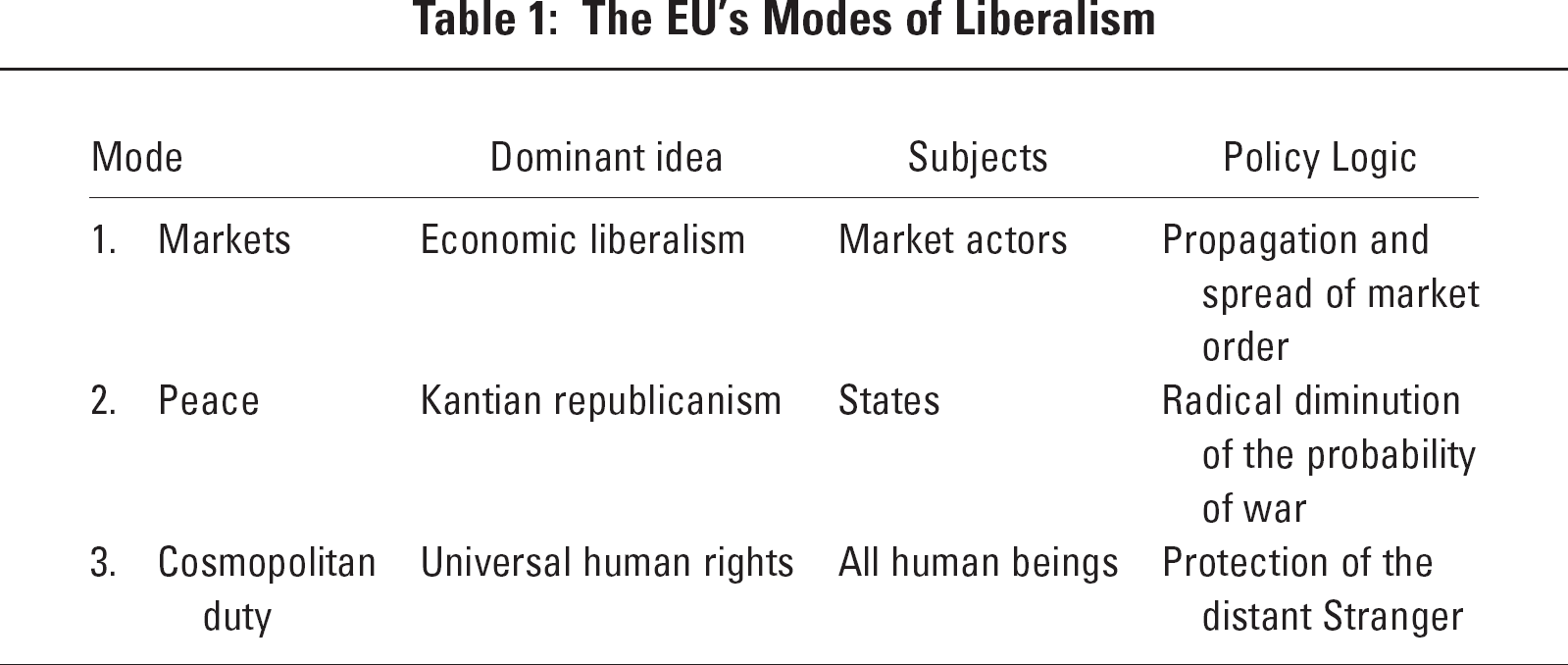
The distinction between modes 1 and 3 is perhaps the most familiar, and is perhaps the most crucial in seeking to understand the constitutive logics of the EU (Parker 2012, Parker and Rosamond 2013). The dominant idea of economic liberalism (in its broadest sense) is about the normative validity of market order. Markets, often seen as naturally consistent with human propensities, are deemed to be the most effective instruments for the efficient allocation of resources and the consequent advancement of human welfare. The proper task of public authority is thus confined to ensuring that market orders are created and maintained, with the assurance of ‘negative freedom’ for market subjects. Indeed human freedom is thought to be most realised in the domain of the market. Of course, as already suggested, economic liberals take a range of positions on the appropriate extent of state action that might be consistent with these overall goals. That said, economic liberalism operates—across the board—with a consistent understanding of the key subject through whom market freedom is realised and on behalf of whom market society is constructed. In Foucault's terms, these individual and corporate agents are construed as ‘subjects of interest’ whose freedom is realised within the market and achieved via independence from government (Foucault 2008, 42).
Mode 3 liberalism also rests upon universalist principles. But rather than imagining human subjects purely (or at least primarily) as agents whose freedom is most realised in the achievement of market order, mode 3 liberalism emerges from the claim that freedom can only be guaranteed by ensuring that all people enjoy a repertoire of basic rights regardless of spatial, temporal or any other form of difference. Hence the high premium placed on the notion of the ‘distant stranger’ (Linklater 2007), whose rights are as valid as those bestowed to member of our own community. While some philosophers, notably Locke (1988 [1689]), have worked hard to reconcile modes 1 and 3 into an integrated form of liberalism, it is clear that the two modes represent alternative types of liberal cosmopolitanism and can, therefore, pull in different directions (Appleby 1976). Freedom, in its mode 3 sense, is to be guaranteed by government, and democratic instruments have come to be regarded as the most effective means to the achievement of this end (since democratic societies are able to hold their governments to account). Mode 3 liberalism is distinct from mode 1 liberalism in that its subjects are considered—again in Foucault's (2008) terms as ‘subjects of right’. The tensions between economic liberalism (realised through the achievement of capitalist economies) and democracy are well known and much discussed (see, for example, Streeck 2011 and 2012). Indeed the distinctiveness of the two modes is perhaps at its starkest when we consider the implications for ‘liberal’ foreign policy. Whereas mode 1 liberalism encourages the propagation of market order and its associated negative freedoms on a global scale, the logic of mode 2 liberalism pushes ‘liberal’ actors to promote the spread of democratic institutions, human rights norms and positive freedoms. Liberals, by definition, seek to attenuate the power of government vis-à-vis individuals, but liberalism in its mode 3 variant also embodies a commitment to distribute power as well as to limit it (Bobbio 1990).
The other ideal typical mode of liberalism (mode 2 in Table 1) has its origins in liberal international thought. Here liberal optimism of the prospects for peace contrasts with realist pessimism about the inevitability of international conflict. For international liberals, following a line of reasoning that first fully crystallised in Kant's political philosophy (Kant 1957 [1795]) and which has been worked through by modern political scientists such as Karl Deutsch (Deutsch et al. 1957) and Michael Doyle (2011), a peaceful order need not be post-international. A peaceful world order is logically consistent with a world of states. What matters is that those states take on a particular democratic (or in Kant's terms, ‘republican’) character, which in turn yields a propensity for forms of external behaviour that significantly diminish the probability of conflict among this community of states.
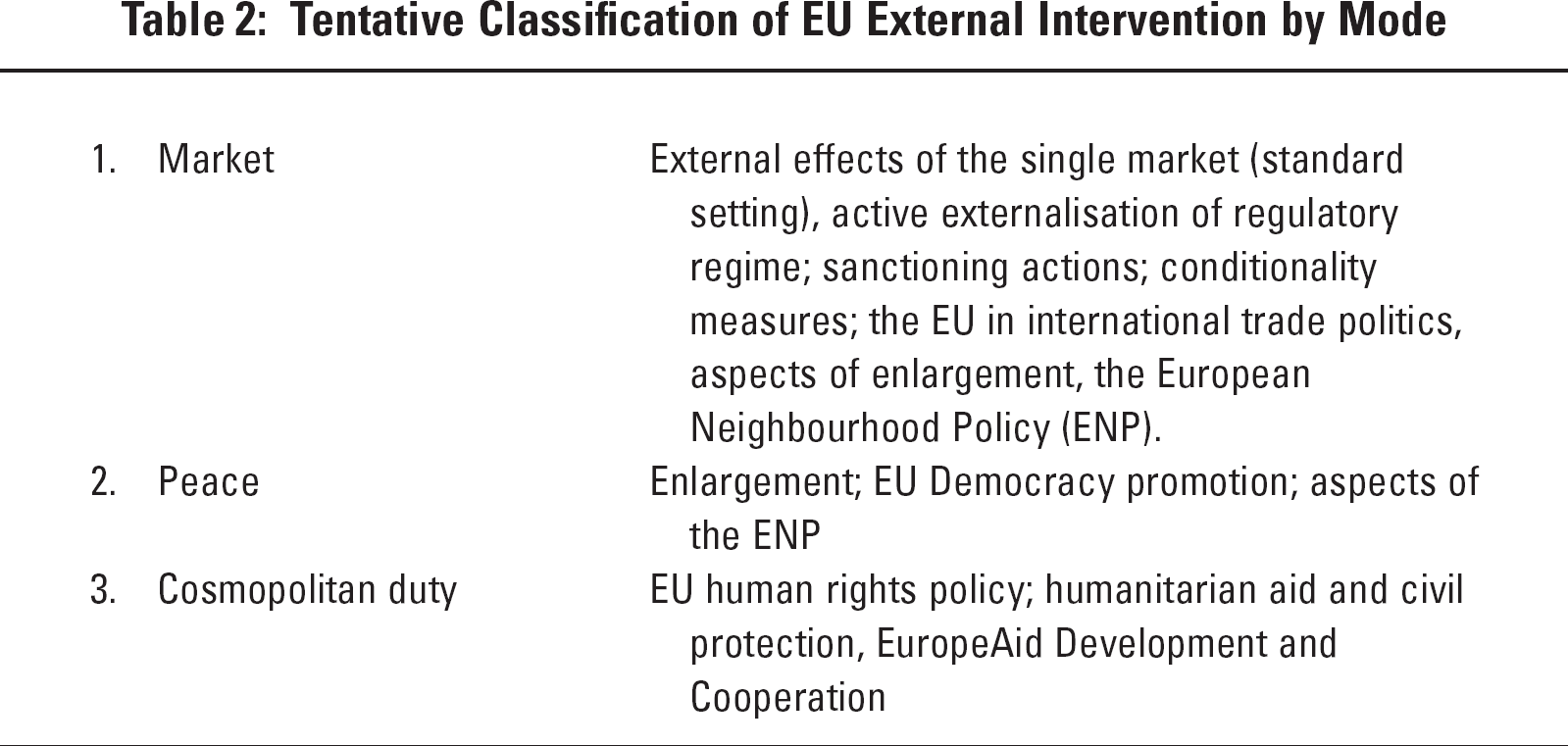
At a basic level, this simple framework allows us to classify EU external interventions according to the mode(s) of liberalism at work. This could be accomplished in two steps. The first would be an analytic classification such as the one presented tentatively in Table 2 (below). The second step would be to examine policies in terms of how they are justified in discourse (both communicative and coordinative), and the extent to which liberal concepts are invoked.
Tentative Classification of EU External Intervention by Mode
Discussion
Some clarification and further discussion of the material in Tables 1 and 2 is necessary at this point. First, these modes of liberalism are separated for analytical reasons. Of course, they do not necessarily operate as constitutive principles in isolation from one another. For example, as suggested already, one of the most controversial discussions in modern political theory departs from the commercial liberal claim that increasing levels of economic transaction between states is the surest way to ensure a lasting peace between them. In terms of this classification, mode 2 goals would be achieved through mode 1 means. Indeed, we could argue that the foundational logic of post-war European integration was built upon this exact premise: peace through markets (Delanty 1998). The expansion of the EU can be conceived in these terms: as a geographically-expansive project of market integration that has successfully transformed European international politics into a non-violent and pacific sub-region of the world system.
Second, the analytical separation is justified when we consider the different subjects at whom external interventions based upon each mode are targeted and through whom liberal outcomes are to be accomplished. Mode 2 is most distinctive here. Mode 2 interventions are designed to shape the international order in a more pacific direction. The Kantian technique—as specified in Perpetual Peace—is to build international institutions and international law that shape state behaviour, while at the same time shaping the character of states themselves. Again, enlargement can be offered as a good example of a EU ‘intervention’ that is at least partly mode 2 in character. EU enlargement is both a project of changing the character of the European international system (or at least those parts of the international system at the EU's border) and shaping the character of candidate states in ways that render them more EU-like. Of course part of this transformation of the character of candidate states might involve mode 1 techniques, the premise being that the development of market orders within states and the consequent alteration of economic subjectivities will have shaping effects on the state.
Third, mode 1 liberalism should be disaggregated. There is a literature suggesting that the EU is ineluctably neo-liberal in character and that it is a project designed explicitly to divorce political accountability from market power and economic policy-making (for example, Gill 2003). But straightforwardly equating ‘neoliberalism’ with ‘economic liberalism’ misses the complex range of intellectual currents that have fed into the economic thought of the EU (Maes 2006). The lazy equation of neoliberalism with generic economic liberalism also risks missing the distinctive and important character of the neoliberal turn in the history of economic thought (Crouch 2011). 9 The history of EU economic liberalism has been, to simplify, a struggle and delicate balancing act between German ordo-liberalism, Anglo-American neoliberalism and French Colbertism. Jabko (2006) argues that there are too many institutional correctives and countervailing policy tendencies in the EU system for it to be conceptualised as a pure experiment in neoliberalism from its point of origin (see also Caporaso and Tarrow 2009). A lot of recent work takes as open-ended the question of which economic ideas will prevail in the EU, while noting a definite drift over time towards neoliberal policy norms. This applies to internal policy regimes as well as their external projection into realms such as global trade politics (van Apeldoorn and Horn 2007; Buch-Hansen and Wigger 2010; Horn 2011; Siles-Brügge 2011, De Ville and Orbie in this collection). Examining how the balance between these varieties of economic liberalism has changed over time and how they have influenced institutional designs and policy programmes within the EU is a pre-requisite for understanding how EU economic principles have been externalised if the NPE argument is to be taken seriously. Indeed, thinking about the struggle between economic liberalisms (as systems of thought and perhaps found in distinct institutional sites 10 ) within the EU system open up a line of thought that the extant NPE literature has bracketed: the internal normative politics of the EU.
Fourth, the disaggregation of ‘liberalism’ into ‘liberalisms’ shines additional light on the complexities of ethical adjudication outlined earlier. One of the problems that follows from any attempt to evaluate the liberal’ character of EU external interventions via ethical reasoning is difficulty of establishing what external referents are used to establish good’ and right’. This is especially true of adjudication of using consequentialist or virtue arguments. How do we know what constitutes a good liberal consequence of an action? Indeed, following Zhou Enlai's famous answer to Henry Kissinger's question, 11 we might wonder when appropriate consequences have been achieved. Similarly, how do we know when an actor's constitution is appropriate for its actions to be considered prima facie ethical. The point is that each mode has its own internal ethical reasoning and that these rationalities may well clash. Take the relationship between mode 1 and mode 3 liberalism. Mode 3 is premised on the sovereign equality of all human subjects regardless of exogenous variance. Yet, as a very well-established discussion in political theory and political economy points out, mode 1 logics have little problem with the market delivering and accentuating real inequalities, which in turn may make the need for mode 3 correctives more pressing. This ties, interestingly, to debates about the internal legitimacy of the EU. In Majone's account of the EU-as-regulatory state (Majone 1994, 1996 and 2005), the EU's legitimacy is understood as residing in its capacity to deliver the conditions for a market order to prevail. The argument is not only analytical, but also normative since it rests on a thin conception of output legitimacy (Wincott 2006), and the ethical reasoning that deems this to be legitimate is consequentialist. But it is a form of ethical reasoning that is internal to a neoliberal conception of good/justice. Similar arguments could be considered in relation to the EU's economic liberal interventions beyond its borders. Indeed these ethical arguments are not only tools for evaluating the authentic liberal character of EU external policy. They are also, in line with the tenets of most constructivist scholarship, things to be studied in themselves. The revelation of these tensions should not be seen as an inconvenience, but as an analytical opportunity.
Finally, the modes of liberalism should be viewed as discourses that both complement and contradict one another. Each has strong normative content. Each has the capacity to make technical (if … then) arguments. Each has ideational components that sit at the background of public debate. Other parts are more contested (and thus contingent). Each will have evolved historically and the balance between each will have varied over time. How does each intersect with other discourses such as discourses of security (e.g. mode 1 market liberalism might be imposed more coercively when linked to ideas about security threats—the ENP might be an example)? Moreover, how, if at all, do crises such as the ongoing global financial crisis affect the balance between different economic liberalisms? For example, De Ville and Orbie (in this collection) find evidence of nothing more than the ‘subtle rearticulation’ of neoliberalism rather than its displacement in the context of the crisis.
Conclusion
Debate about EU foreign policy during the past decade has been very rich, but it has tended to be organised around two positions. The first—‘Normative Power Europe’—has been read as a claim that the EU's external action is, because of internal constitutive reasons, predominantly liberal in character. Discussants of the NPE thesis have tended to take a variety of positions that qualify or refute the EU's external liberalism. This article has offered an alternative way of thinking about EU external interventions in terms of liberalism that goes beyond this opposition. The NPE view gives a (deliberately) partial account of the EU's external liberalisms. The most important additive, it has been argued here, is economic liberalism. Liberalism was also separated into three separate modes—each with its own internal technical and normative claims and derivative policy logics. The liberal quality of an action can be addressed through ethical reasoning, but the logic of the position developed here is to suggest not only is the adjudication of liberalism through ethics a complex matter in and of itself, but that different modes of liberalism also carry within them different ethical positions. This is philosophically complex, but analytically interesting because a constructivist approach to liberal modes of external action is designed to ask about how such ideas operate and are used within political discourse.
In terms of the debate about the nature and determinants of the EU's external action, this article has argued with and against the ‘Normative Power Europe’ thesis. Indeed the point here has been to accept in very large part, for broadly epistemological-methodological reasons, the premises of the NPE literature. At the same time the use of NPE's own theoretical architecture to think about the broader range of liberal principles that are constitutive of the EU and its external policy draws attention to that literature's empirical silences.
Footnotes
The following colleagues offered valuable comments on previous drafts of this paper: Rebecca Adler-Nissen, Annika Bergman Rosamond, Caterina Carta, Chad Damro, Catherine Eschle, Thomas Diez, Nina Graeger, Ian Manners, Thomas Moore, Jean-Frederic Morin, Owen Parker, Mark Phythian and Vivien Schmidt. The usual disclaimers apply.
1.
Of course, the EU does not qualify, by conventional Weberian definitions, as a state (Jachtenfuchs 2007), but it does constitute itself as an actor in world politics and is generally understood as a ‘liberal order’ (Garton Ash 1998; Schimmelfennig 2001; Ferrera 2009;  ).
).
2.
Article J1(1) of the Treaty of Amsterdam—http://www.eurotreaties.com/amsterdamtreaty.pdf; now article 21 of the Consolidated Version of the Treaty on European Union—
3.
Insofar as this type of argument is rooted in the tradition of liberal thought, then it is best described as utilitarian.
4.
Of course, there may be some disagreement within liberalism—e.g. between universalists and utilitarians—over what constitutes ‘good’ in terms of consequences.
5.
6.
This article does not pay much attention to these issues, although historically there is a very interesting story to be told about a paradigm shift towards liberal principles of humanitarian intervention. As will become clear below, when we consider broadening the definition of liberalism to include economic liberalism, the very significant literature on ideas in political economy is important to understanding shifts towards and the reproduction of neoliberalism.
7.
Note that this is not the reappearance of the strategic/normative opposition. This is rather about the degree to which an idea (that could be technical-strategic) as much as normative is naturalized in the thinking of a policy actor.
8.
The two that might be considered as potentially departing somewhat from the classical core of liberalism are ‘social solidarity’ and ‘sustainable development’. In terms of the passages quoted by Manners to verify the existence of these norms, neither appears as a firm counterweight (either social democratic or green) to liberal practices.
9.
Two distinctive features of neoliberalism are first the crucial relaxation of the condition that a market should retain a multiplicity of producers and that tendencies toward oligopoly should be resisted, as a matter of principle. Second, neoliberalism has a tendency to seek the depoliticisation of its core tenets. The two are linked, as argues, through the recent emergence of corporations as sites of governance.
10.
See Crespy's piece in this collection.
11.
When he met Chinese Premier Zhou Enlai in 1972, Henry Kissinger (then National Security Advisor) asked what he thought has been the consequences of the French Revolution. Zhou replied ‘it's too soon to tell’.